

Business
Sunrise Energy Metals Shares Surge 14% on Critical Minerals Momentum and Strategic Project Advances


SYDNEY — Sunrise Energy Metals Ltd shares jumped 14.14% on Monday to close at $16.87, extending a remarkable rally as investor enthusiasm for critical minerals and the company’s scandium project continued to drive strong buying interest in the Australian resources sector.
The significant gain pushed the company’s market capitalization higher, reflecting sustained market optimism around its Syerston project in New South Wales, which is positioned to become a major Western producer of scandium. The metal, used in aerospace, defense and clean energy applications, has seen heightened demand amid global supply chain diversification efforts away from dominant producers.
Sunrise Energy Metals has benefited from several positive catalysts in recent months, including strategic partnerships and government interest in securing reliable supplies of critical minerals. The company’s focus on developing what could be one of the first major primary scandium operations outside China has attracted attention from investors seeking exposure to materials essential for advanced manufacturing and the energy transition.
Project Developments and Strategic Partnerships
The Syerston project remains central to Sunrise’s value proposition. Recent updates on resource estimates and development plans have reinforced its potential as a significant scandium producer. The company has made progress toward a final investment decision, targeting early production in the coming years.
A notable highlight has been the involvement of major defense and industrial players. Lockheed Martin secured a multi-year supply option for scandium oxide from the project, underscoring the material’s strategic importance for aerospace and defense applications. Such partnerships provide validation and potential revenue visibility that investors have rewarded.
The company has also pursued financing and offtake discussions to support project development. Recent capital raises have strengthened its balance sheet, enabling continued advancement of pre-construction activities while minimizing dilution concerns for existing shareholders.
Analysts have highlighted the compelling long-term thesis for Sunrise, citing tight global scandium supply, growing demand in solid oxide fuel cells, aluminum alloys and other high-performance applications. The stock’s dramatic rise over the past year reflects the market’s recognition of this potential, though volatility remains high given the project’s development stage.
Market and Sector Context
The resources sector on the ASX has seen renewed interest amid stabilizing commodity prices and positive global sentiment following recent geopolitical developments. Critical minerals, in particular, have attracted attention as governments and industries seek to secure supplies for clean technology and defense needs.
Sunrise’s performance stands out even within this context. The company’s focus on scandium differentiates it from more traditional mining plays, offering investors exposure to a niche but strategically important market with limited Western supply alternatives.
Broader interest in battery materials and critical minerals has supported related stocks, but Sunrise’s specific advancements and partnerships have driven outsized gains. The stock has shown remarkable momentum, with significant percentage increases reflecting both fundamental progress and speculative interest in the critical minerals theme.
Company Background and Strategy
Sunrise Energy Metals, formerly known as Clean TeQ, has repositioned itself around the Syerston scandium project after earlier work on other battery materials. The company benefits from experienced leadership and a location in a stable jurisdiction with established infrastructure.
Its strategy centers on developing a world-class scandium operation while exploring complementary opportunities in related materials. Management has emphasized responsible development, community engagement and environmental considerations as the project advances toward construction.
Recent announcements, including equity investments and applications for quotation of securities, have supported ongoing development activities. The company continues to engage with potential partners and offtake customers to de-risk the project and secure long-term revenue streams.
Analyst and Investor Views
Market observers have noted the stock’s strong performance while cautioning about the risks inherent in development-stage mining companies. Execution on project timelines, securing financing and navigating regulatory requirements will be critical to realizing the full potential of Syerston.
Valuation metrics have expanded significantly with the share price rise, reflecting optimism but also raising questions about near-term catalysts. Investors are closely watching for updates on construction financing, additional offtake agreements and technical studies that could further validate the project’s economics.
For long-term believers in the critical minerals story, Sunrise offers leveraged exposure to scandium market growth. However, the stock’s volatility underscores the need for careful position sizing and thorough due diligence.
Broader Industry Trends
The global push for supply chain security in critical minerals has created opportunities for Western producers like Sunrise. Governments in the United States, Europe and Australia have implemented policies to support domestic and allied production of materials essential for defense, electronics and clean energy.
Scandium’s unique properties — strength, lightness and corrosion resistance when alloyed with aluminum — make it attractive for aerospace and automotive applications. Growing interest in hydrogen technologies and fuel cells could provide additional demand drivers in the coming years.
Sunrise’s progress contributes to a more diversified global supply picture, reducing reliance on single sources and enhancing supply chain resilience. The company’s success could encourage further investment in similar projects across Australia and other stable jurisdictions.
Risks and Considerations
As with any junior to mid-tier mining company, Sunrise faces risks including project delays, cost overruns, commodity price fluctuations and regulatory challenges. The capital-intensive nature of mine development requires careful financial management and access to funding on reasonable terms.
Market sentiment toward critical minerals can shift rapidly based on macroeconomic conditions, policy changes and technological developments. Investors should monitor quarterly updates, exploration results and partnership announcements for signals on project momentum.
Diversification remains important when considering exposure to individual mining stocks. While Sunrise’s story is compelling, balancing it with other assets helps manage sector-specific risks.
Outlook for Sunrise Energy Metals
The company is transitioning from explorer to developer, with key milestones ahead including final investment decisions and construction timelines. Successful execution could position Sunrise as a significant player in the Western scandium market, with potential for substantial value creation.
Management’s focus on strategic partnerships and disciplined project advancement provides a solid foundation for growth. As global demand for critical minerals expands, Sunrise is well-placed to benefit from its advanced project and strong technical credentials.
Monday’s strong share price performance reflects continued market enthusiasm for the company’s potential. While near-term volatility is likely, the longer-term outlook remains positive for investors aligned with the critical minerals thesis.
As Sunrise Energy Metals advances its Syerston project, the company stands at the forefront of efforts to develop secure, Western sources of scandium. Its recent market performance underscores investor belief in the strategic importance of its assets and the potential for significant returns as the project moves toward production.
The mining sector’s evolution toward critical minerals for modern technologies creates exciting opportunities, and Sunrise Energy Metals is emerging as a notable participant in this shift. Investors will continue to watch closely as the company delivers on its development plans and capitalizes on growing global demand.

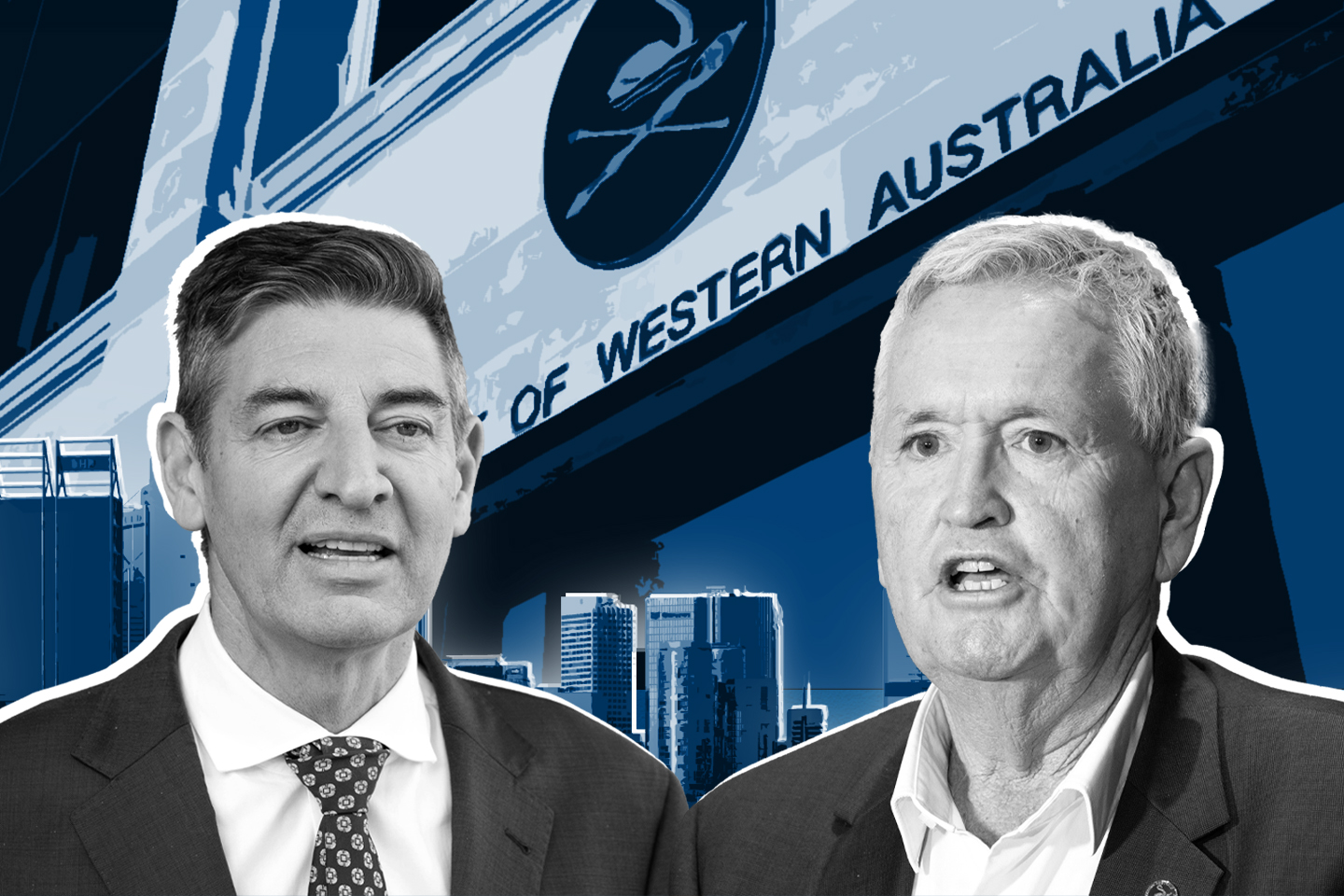
From the Hill: School’s nearly out as state parliament MPs prepare to rise for the winter recess.
Business
Iran Fight Back Twice to Earn 2-2 Draw Against New Zealand in Dramatic 2026 World Cup Opener


LOS ANGELES — Iran twice came from behind to earn a hard-fought 2-2 draw against New Zealand in their 2026 World Cup Group G opener on Monday at Los Angeles Stadium, showcasing resilience amid significant off-field challenges that had overshadowed their preparations for the tournament.
Goals from Mohammad Mohebi and Ramin Rezaeian allowed Iran to recover from deficits created by Eli Just’s brace for New Zealand. The result provided a much-needed positive moment on the pitch for a team that had faced unprecedented logistical and political hurdles leading into the match, including a last-minute change of training base and travel disruptions.
Mehdi Taremi, Iran’s captain, described the team’s World Cup experience as a “disaster” in the lead-up, while coach Amir Ghalenoei labelled his squad the “most oppressed” team at the tournament. Despite these difficulties, Iran delivered an entertaining performance that earned them a valuable point against a determined New Zealand side.
Match Summary and Key Moments
New Zealand took the lead in the seventh minute when Eli Just finished smartly after linking with Chris Wood. The Motherwell striker controlled a long kick from goalkeeper Max Crocombe and set up Just, who steered the ball past Alireza Beiranvand.
Iran responded strongly, equalizing when Ramin Rezaeian poked home after a sumptuous pass from Saman Ghoddos. The 36-year-old ghosted into the box to convert after Mohammad Moghanloo was crowded out. New Zealand regained the advantage 10 minutes into the second half when Just dinked the ball over Beiranvand following another interplay with Wood.
Iran once again found an answer. Mohebi rose highest to head in via the post after evading New Zealand’s central defenders, securing the draw in a lively contest that showcased both teams’ attacking intent.
New Zealand coach Darren Bazeley expressed mixed emotions after the match. “We were so close to making history,” he said. “We’ve maybe taken a few people by surprise in showing who we are and how good we can play. We’re disappointed to come away with that sense of ‘what if?’”
Off-Field Challenges Overshadow Build-Up
The match took place against a backdrop of significant turmoil for the Iranian team. Eleven officials were refused entry, forcing a switch of their training base from Arizona to Tijuana, Mexico. Travel arrangements were disrupted, and the team arrived in Los Angeles with a reduced support staff.
Pre-match protests outside the stadium and at the team hotel highlighted divisions within the Iranian diaspora. Some supporters carried the pre-revolutionary flag, while others expressed political messages. FIFA upheld a ban on certain flags following a legal challenge, but dozens were still seen inside the venue.
FIFA President Gianni Infantino visited the Iran dressing room to hear their concerns. Despite the chaos, the players produced a committed performance in front of a partisan crowd that provided vocal support throughout the 101 minutes of action, including stoppage time.
Stadium Atmosphere and Fan Support
Los Angeles Stadium, with its teardrop-shaped canopy and massive LED chandelier, provided a spectacular setting. Iranian fans created a lively atmosphere, singing and cheering throughout, offering a welcome distraction from the political tensions surrounding the team.
The Hollywood Hills were visible from parts of the venue, adding to the memorable backdrop. The match itself was relatively drama-free on the pitch compared to the buildup, allowing both teams to focus on football and deliver an entertaining contest for the spectators.
Group G Outlook
The draw leaves Group G wide open. Iran will face Belgium next, while New Zealand will look to build on their promising showing. Both teams demonstrated quality and determination, suggesting competitive matches ahead in the group stage.
For Iran, the point provides encouragement after a difficult preparation period. For New Zealand, the performance against a higher-ranked opponent offers valuable experience in their World Cup campaign.
The result underscores the competitive balance in the expanded 48-team tournament. New Zealand’s ability to take the lead twice against a traditionally strong side like Iran highlights the depth and unpredictability introduced by the new format.
Broader Tournament Context
The 2026 World Cup, co-hosted by the United States, Canada and Mexico, has already produced compelling storylines in its opening days. Political and logistical challenges have affected several teams, but on-field performances continue to captivate audiences worldwide.
Iran’s participation has been particularly scrutinized due to ongoing regional tensions and domestic issues. The team’s ability to secure a point despite these distractions demonstrates the players’ professionalism and commitment to representing their nation.
As the tournament progresses, Group G promises to deliver more intriguing matches. Belgium enters as one of the favorites, but both Iran and New Zealand have shown they can compete and create moments of quality.
Player Performances and Tactical Notes
For Iran, Rezaeian and Mohebi stood out with their contributions to the comeback. Taremi’s leadership was evident, while goalkeeper Beiranvand made important saves to keep his team in the game. New Zealand’s Just was clinical with his two goals, and Wood provided a strong focal point in attack.
Tactically, both teams showed willingness to play open, attacking football. New Zealand’s direct style created problems early, while Iran’s technical ability and quick transitions allowed them to respond effectively. The match featured several hydration breaks due to the warm conditions, which provided tactical resets for both coaches.
The result is likely to boost morale for Iran as they prepare for tougher challenges ahead. For New Zealand, it offers encouragement and valuable lessons as they continue their debut World Cup campaign.
Fan and Cultural Impact
The presence of passionate Iranian supporters created a vibrant atmosphere despite the political complexities. The match served as a reminder of football’s power to unite people, even amid broader tensions. New Zealand fans also showed strong support, contributing to an engaging contest.
The event at Los Angeles Stadium highlighted the scale and spectacle of the 2026 World Cup. With its modern facilities and large capacity, the venue provided an impressive stage for what was ultimately a competitive and entertaining draw.
As the tournament continues, both teams will analyze this result closely. Iran will seek to build on their fighting spirit, while New Zealand will aim to capitalize on their promising debut performance. The draw keeps Group G wide open and sets up intriguing fixtures in the coming days.
The 2026 World Cup has already delivered drama both on and off the pitch. Iran’s resilient performance against New Zealand adds another compelling chapter to the story of a tournament marked by resilience, competition and the enduring appeal of the beautiful game.

IG Design Group CEO designate receives share award

Pending Mega IPOs Could Curb Passive Positive Feedback Loop
Business
Turtlemint Fintech sets IPO price band at Rs 144-152 for Rs 883 crore offer. Know GMP, other key details

Here is everything investors need to know about the public issue:
Turtlemint IPO price band
The company has fixed the price band at Rs 144-152 per share. At the upper end of the price band, Turtlemint is valued at more than Rs 4,500 crore.
Turtlemint IPO important dates
The IPO will open for subscription on June 19 and close on June 23. The anchor investor portion will open on June 18, a day ahead of the public issue, according to the company’s public announcement made on Tuesday. The shares are scheduled to list on the NSE and BSE on June 29.
Turtlemint IPO GMP today
In the grey market, the premium has climbed to 10.53%, indicating expectations of a decent listing gain. Based on the current premium, the expected listing price is around Rs 168 per share, compared with the issue price of Rs 152.

Investors should note that the grey market premium is an unofficial and unregulated indicator. It does not necessarily reflect or guarantee the stock’s actual listing performance.
Turtlemint IPO details
The IPO consists of a fresh issue of equity shares worth up to Rs 660.72 crore and an offer-for-sale of 1.46 crore equity shares, aggregating to about Rs 221.95 crore by existing shareholders.
As part of the OFS, promoters Anand Rohidas Prabhudesai and Dhirendra Nalin Mahyavanshi, along with existing investors including Kunal Shah, Nexus Venture Partners, Peak XV Partners, Blume Ventures and GGV Capital, will partially sell their holdings.
The issue allocation has been fixed at 75% for qualified institutional buyers (QIBs), 15% for non-institutional investors (NIIs) and 10% for retail investors.
Turtlemint Financials
For FY25, the company reported revenue of Rs 662.7 crore, compared to Rs 78.6 crore in FY24. Its net loss widened marginally to Rs 194.1 crore from Rs 193.3 crore a year earlier
Use of IPO proceeds
Turtlemint plans to use the proceeds from the fresh issue to strengthen its cloud and server infrastructure, fund salary expenses for its technology and product development teams, and support marketing initiatives.
Part of the proceeds will also be used for lease payments related to existing properties of the company and its wholly-owned subsidiary, TIB.
In addition, the company plans to invest in TIB to support its working capital requirements. Funds will also be deployed towards inorganic growth through unidentified acquisitions.
About Turtlemint
Founded in 2015 by Dhirendra Mahyavanshi and Anand Prabhudesai, Turtlemint focuses on simplifying the purchase and management of insurance policies. The company has sold around 1.6 crore policies through a network of more than five lakh advisors. It claims to have processed over 90 crore claims for more than 1.2 crore customers. Its technology platform enables financial advisors to instantly match customers with suitable insurance products, helping improve efficiency and support business growth.
Book-running lead managers
ICICI Securities, Jefferies India, JM Financial and Motilal Oswal Investment Advisors are the book-running lead managers to the issue, while KFin Technologies Ltd is the registrar.
(Disclaimer: Recommendations, suggestions, views and opinions given by the experts are their own. These do not represent the views of The Economic Times)
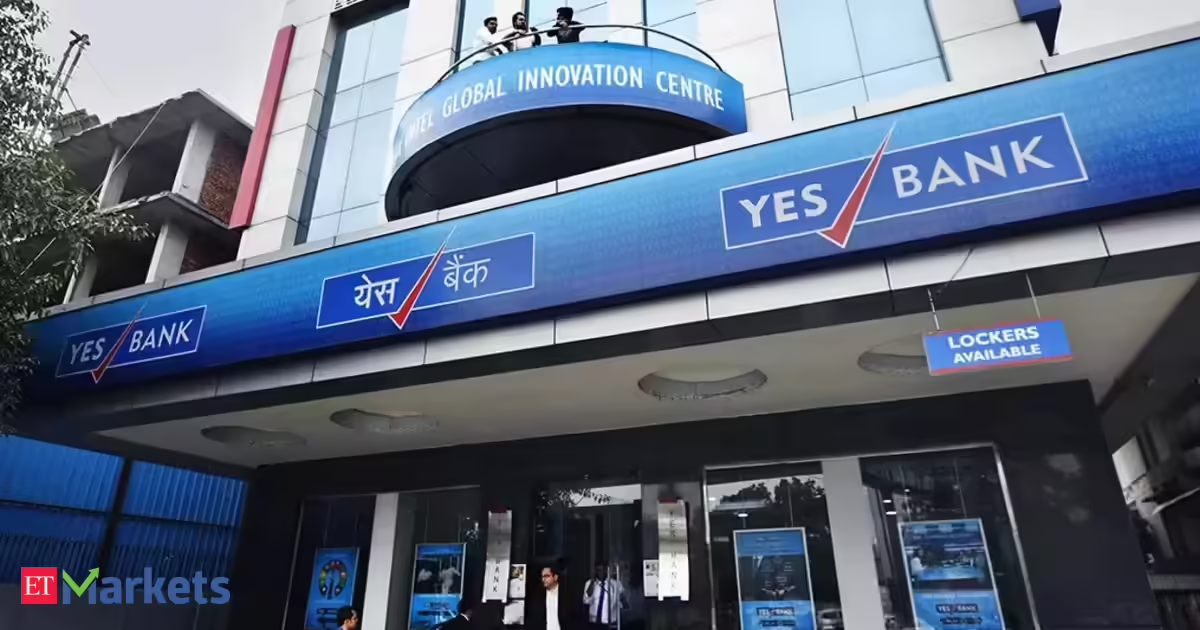
The collaboration brings together YES Bank’s balance-sheet strength, digital infrastructure, and distribution network with Northern Arc Capital’s origination, underwriting and technology capabilities.
The partnership is also a result of YES Bank’s collaboration with Sumitomo Mitsui Banking Corporation (SMBC), which is the largest strategic shareholder in YES Bank and a key shareholder in Northern Arc Capital.
According to the companies, SMBC played a role in bringing together the two platforms, with the partnership expected to leverage synergies across origination, distribution, technology and balance-sheet capacity. The companies described the agreement as the first in a series of potential collaborations between YES Bank and Northern Arc Capital.
As part of the arrangement, Northern Arc Capital will use its network of 368 originator partners, comprising financial institutions, to facilitate credit deployment for YES Bank through its placements business. The partnership will provide the lender access to a diversified pipeline of credit opportunities sourced through Northern Arc’s ecosystem of lending partners.
The companies said the alliance will also focus on expanding retail lending through Northern Arc’s nPOS co-lending platform. The initiative will be supported by data-led underwriting, risk-sharing structures and portfolio monitoring frameworks, while leveraging Northern Arc’s origination network across underserved markets.
In addition to lending, the partnership will extend to wealth and investment products. Northern Arc Investment Managers (NAIM), a wholly owned subsidiary of Northern Arc Capital, will offer Alternative Investment Funds (AIFs) and Portfolio Management Services (PMS) to YES Bank’s retail, affluent and institutional clients.Further, Altifi, Northern Arc Capital’s online bonds platform, will be integrated with YES Bank’s wealth management ecosystem, enabling customers to access fixed-income investment products through a technology-enabled interface.
A key aspect of the collaboration is the integration of technology platforms across both organisations. Northern Arc’s proprietary platforms, including nPOS, NIMBUS and NuScore, will be integrated with YES Bank’s digital lending architecture to support loan onboarding and credit delivery at scale.
Commenting on the development, Ashish Mehrotra, Managing Director and Chief Executive Officer of Northern Arc Capital, said the partnership combines technology, distribution and risk management capabilities to improve access to financial services and strengthen credit market linkages.
Rajan Pental, Executive Director at YES Bank, said the partnership aligns with the bank’s strategy of building technology-enabled credit infrastructure and will help expand formal credit access while also opening up private credit and alternative investment opportunities for a wider customer base.
(Disclaimer: Recommendations, suggestions, views and opinions given by the experts are their own. These do not represent the views of The Economic Times)
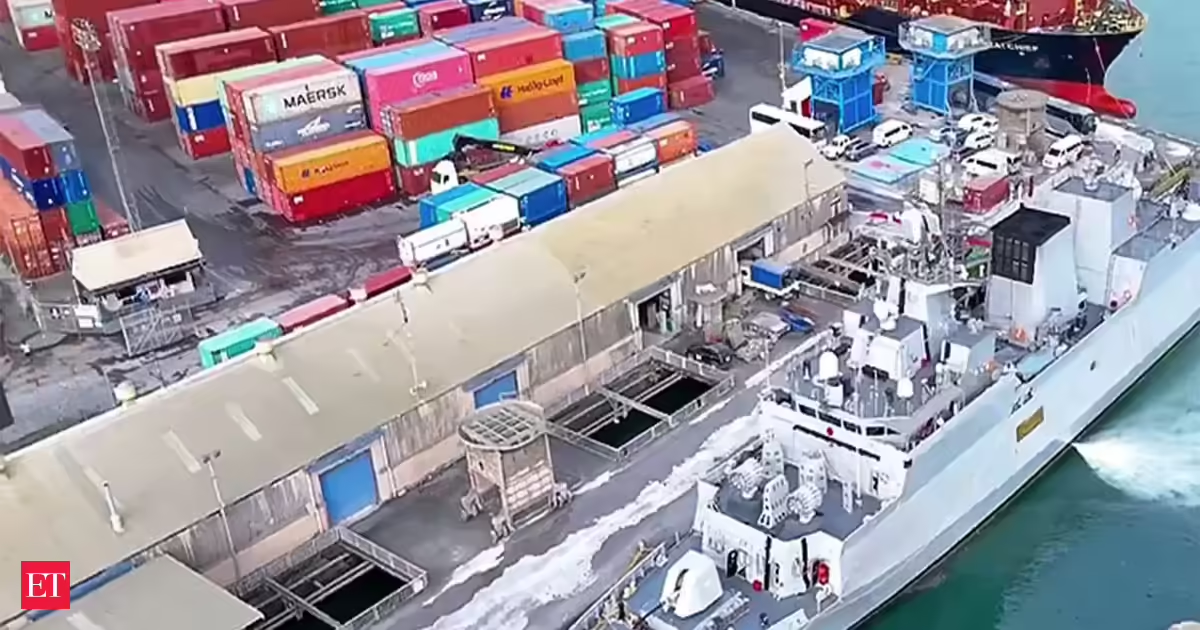
The most striking shift has been Oman’s emergence as a key trade partner. Ranked only 30th among India’s import sources in April-May 2025, the Gulf nation has jumped to 10th place in the first two months of the current financial year. Imports from Oman surged 3.8 times to $3.4 billion, largely driven by energy shipments.
The changes extend far beyond the Gulf. The UAE slipped to fourth place among India’s import partners, while Russia reclaimed the second spot, followed by the US. India’s search for alternative LPG supplies helped lift imports from the US, while purchases from Brazil rose 2.8 times to $2.7 billion. Imports from Peru climbed 3.7 times to more than $2 billion, making it India’s 20th-largest import source compared with 35th a year earlier.

Export patterns have also undergone a significant shift. Singapore overtook China and the Netherlands to become India’s third-largest export destination during April-May, trailing second-ranked UAE by just $180 million. Tanzania emerged as the eighth-largest destination for Indian exports, up from 25th place a year ago, while South Africa climbed to 10th.
According to Commerce Secretary Rajesh Agrawal, exports of oil products and gems and jewellery have driven Tanzania’s rise, with shipments increasing from $800 million in April-May last year to $2.2 billion this year. Exports to Sri Lanka nearly tripled to $1.8 billion, lifting the island nation to 12th place among India’s export markets.
Singapore’s rise has been fuelled largely by a 2.2-fold increase in imports of Indian petroleum products, with exports touching $5.1 billion. The island nation has been among the economies most affected by disruptions caused by the conflict in West Asia, helping it edge past China despite a more than 25% increase in Indian exports to the world’s second-largest economy.
The disruption of shipping routes through the Strait of Hormuz, the vital gateway to the Persian Gulf, has elevated Oman’s strategic importance. Agrawal said Oman, with which India recently operationalised a free trade agreement, has opened the ports of Sohar, Salalah and Duqm for the transit of Indian goods to destinations across the region, including the UAE.
These arrangements have helped India restore exports to West Asia to nearly last year’s levels. Imports from the region, however, remain around 18% lower due to ongoing disruptions in energy supplies.

NEW YORK — SpaceX shares surged 11% in premarket trading on Tuesday, extending gains from its blockbuster initial public offering as investors continued to embrace Elon Musk’s rocket company amid strong demand for its satellite services and ambitious plans for future growth.
The space technology and artificial intelligence firm, trading under the ticker SPCX, has seen remarkable volatility since its debut on Friday. Shares jumped as much as 20% in their first full day of trading, closing at levels that pushed the company’s market capitalization well above $2 trillion and cemented Musk’s status as the world’s wealthiest individual when combining his stakes across ventures.
Monday’s premarket activity reflected sustained enthusiasm, with traders betting on SpaceX’s dominant position in commercial launches, its rapidly expanding Starlink broadband network and potential synergies with Musk’s other enterprises. The latest move comes as the company positions itself at the intersection of space exploration and artificial intelligence infrastructure.
Musk, who serves as SpaceX CEO, fueled optimism over the weekend with a post on X stating the company “might be able to reach approximately” $1 trillion in revenue by 2030. The comment highlighted ambitious targets for Starlink subscriber growth, reusable rocket operations and new ventures in orbital data centers and deep-space missions.
Record IPO Sets Stage for Continued Interest
SpaceX’s IPO, priced at $135 per share, raised $75 billion in what became the largest public offering in history. The stock opened at $150 and climbed as high as $176.52 before closing at $160.95 on its first trading day, delivering immediate gains for early investors and employees with equity stakes.
The offering drew overwhelming demand, with institutional investors oversubscribing by a significant margin and retail orders reaching tens of billions of dollars. The strong debut reflected broad excitement about SpaceX’s technological leadership and its role in transforming access to space and global connectivity.
Founded in 2002, SpaceX has achieved what many once considered impossible: routine reuse of orbital rockets, dramatically lowering launch costs and increasing flight cadence. The company’s Falcon 9 has become the workhorse of the industry, with hundreds of successful missions and a reliability record that has captured the majority of commercial and government payloads.
Starlink and Diversification Drive Value
Starlink, SpaceX’s satellite internet constellation, has emerged as a major revenue generator. The service now connects millions of users worldwide, particularly in remote and underserved areas, and continues to expand with new satellite deployments. Recent deals, including infrastructure partnerships with major technology firms, have further validated its potential as a high-margin business.
The company’s merger with Musk’s xAI startup and integration with his social media platform X have created additional synergies. These moves position SpaceX within a broader ecosystem of artificial intelligence, connectivity and data services, appealing to investors seeking exposure to multiple high-growth technology frontiers.
Analysts have noted the company’s unique advantages, including vertical integration from rocket manufacturing to satellite operations and a track record of rapid innovation. While development of the fully reusable Starship vehicle has faced technical and regulatory hurdles, successful test flights have reinforced confidence in its long-term potential for crewed missions, cargo transport and point-to-point Earth travel.
Challenges and Risks Remain
Despite the enthusiasm, SpaceX faces significant challenges. The company remains capital-intensive, with substantial investments required for Starship development, satellite production and ground infrastructure. Regulatory scrutiny from bodies like the Federal Aviation Administration continues to influence launch schedules and expansion plans.
Competition in the launch market is intensifying, with Blue Origin’s New Glenn and other entrants seeking to challenge SpaceX’s dominance. Starlink also faces regulatory hurdles in various countries and competition from other satellite broadband providers.
Valuation concerns have emerged as shares trade at elevated multiples. Some analysts caution that the current price reflects optimistic assumptions about future growth and execution on ambitious timelines. Profitability in the core launch business has improved with reusability, but Starlink’s path to sustained high margins will depend on subscriber acquisition and retention.
Market Reaction and Broader Implications
The premarket surge on Tuesday followed a strong first week of trading, with shares maintaining momentum despite some profit-taking. Institutional interest has remained robust, while retail investors have shown particular enthusiasm for the story of innovation and exploration.
The IPO has provided SpaceX with additional capital to accelerate its plans while offering liquidity to employees and early backers. It has also increased transparency, subjecting the company to public market reporting requirements and analyst coverage.
Broader implications for the commercial space sector are significant. SpaceX’s public success could encourage further investment in the industry, validating the model of privately funded space ventures. It also highlights the growing convergence of space technology with artificial intelligence and communications infrastructure.
Investor Considerations
For those evaluating SpaceX as an investment, the company offers exposure to multiple transformative trends: reusable spaceflight, global broadband connectivity and orbital infrastructure. However, the stock’s volatility and dependence on Musk’s leadership introduce notable risks.
Analysts recommend a long-term perspective, given the capital-intensive nature of the business and the extended timelines for major projects like Starship. Diversification remains important, as single-stock exposure to any high-growth technology company carries inherent uncertainties.
The strong premarket performance on Tuesday underscores continued market appetite for SpaceX’s story. As the company executes on its ambitious roadmap, investors will watch closely for progress on Starlink subscriber growth, launch cadence and regulatory milestones.
SpaceX’s rise from a startup challenging conventional wisdom to a multi-trillion-dollar public company exemplifies the potential rewards of bold technological innovation. While challenges remain, its dominant market position and diversified growth drivers position it as a central player in humanity’s expanding presence in space and the broader technology landscape.
The coming weeks and months will test whether the initial public market enthusiasm can be sustained as SpaceX navigates the realities of public company reporting, competitive pressures and execution risks. For now, the momentum built since its record-breaking IPO shows little sign of fading.
Business
‘Don’t know why we are being sent back’: Iran coach Amir Ghalenoei upset after team asked to leave US immediately after FIFA World Cup 2026 opener

Ghalenoei said the team had expected to stay overnight in California to recover before travelling back the next day. However, the players were reportedly told after the final whistle that they needed to leave right away.
Also Read-telegram ban
Iran coach questions sudden travel decision
The Iran coach expressed disappointment over the decision, saying the change in plans affected the team’s recovery process after a physically demanding match.
“They didn’t even give us time to recover, after the game they told us that we had to leave immediately. Recovery is extremely important after a match, but we were asked to get on a plane and return to our camp in Tijuana. We are really troubled by that,” Ghalenoei said through an interpreter.
Ghalenoei added that the team was unaware of the reason behind the sudden change and suggested that decisions were being taken outside the team’s control.
“To be honest, we don’t know why we are being sent back. It feels very strange. It seems that decisions are being made for us elsewhere. We were supposed to arrive two days before the game and stay overnight afterwards before returning the next day. We have no idea why that changed,” he added.The coach also claimed Iran had faced several difficulties during their preparation for the tournament.
“I think our team is perhaps the most oppressed in the World Cup,” Ghalenoei concluded.
Captain Mehdi Taremi raises concerns over visa issues
Iran captain Mehdi Taremi also spoke about the challenges faced by the team, saying some members of the delegation could not join the squad after visa problems.
He said officials from the Iranian Football Federation, support staff and media representatives were among those affected.
“We have to leave Los Angeles right now, and it is not good for us,” Taremi said. “I think FIFA have to help us more than this. … Everything is like a disaster, actually, for us,” he concluded.
Iran and New Zealand share points in World Cup opener
The match itself produced an exciting contest, with New Zealand taking the lead twice but failing to hold on. Elijah Just scored in the seventh and 54th minutes, with both goals created by captain Chris Wood.
Iran responded on both occasions. Ramin Rezaeian scored the equaliser before half-time, while Mohammad Mohebbi headed in Iran’s second goal after the break to make it 2-2.
Both teams had chances late in the game, but neither side managed to score the winning goal, forcing them to settle for one point each in their Group G opener.
Iran faces another US travel challenge
Iran’s travel concerns may continue during the group stage. Their next Group G match against Belgium is also scheduled at SoFi Stadium on Sunday.
The team will have to travel back to the United States later this week before returning to Los Angeles for their next fixture.

The Andrew Forrest-led miner has locked in another five years of support for the Royal Flying Doctor Service of Western Australia to the tune of $7.25 million.

The House Opinion Article | Britain must join the new world bank for defence
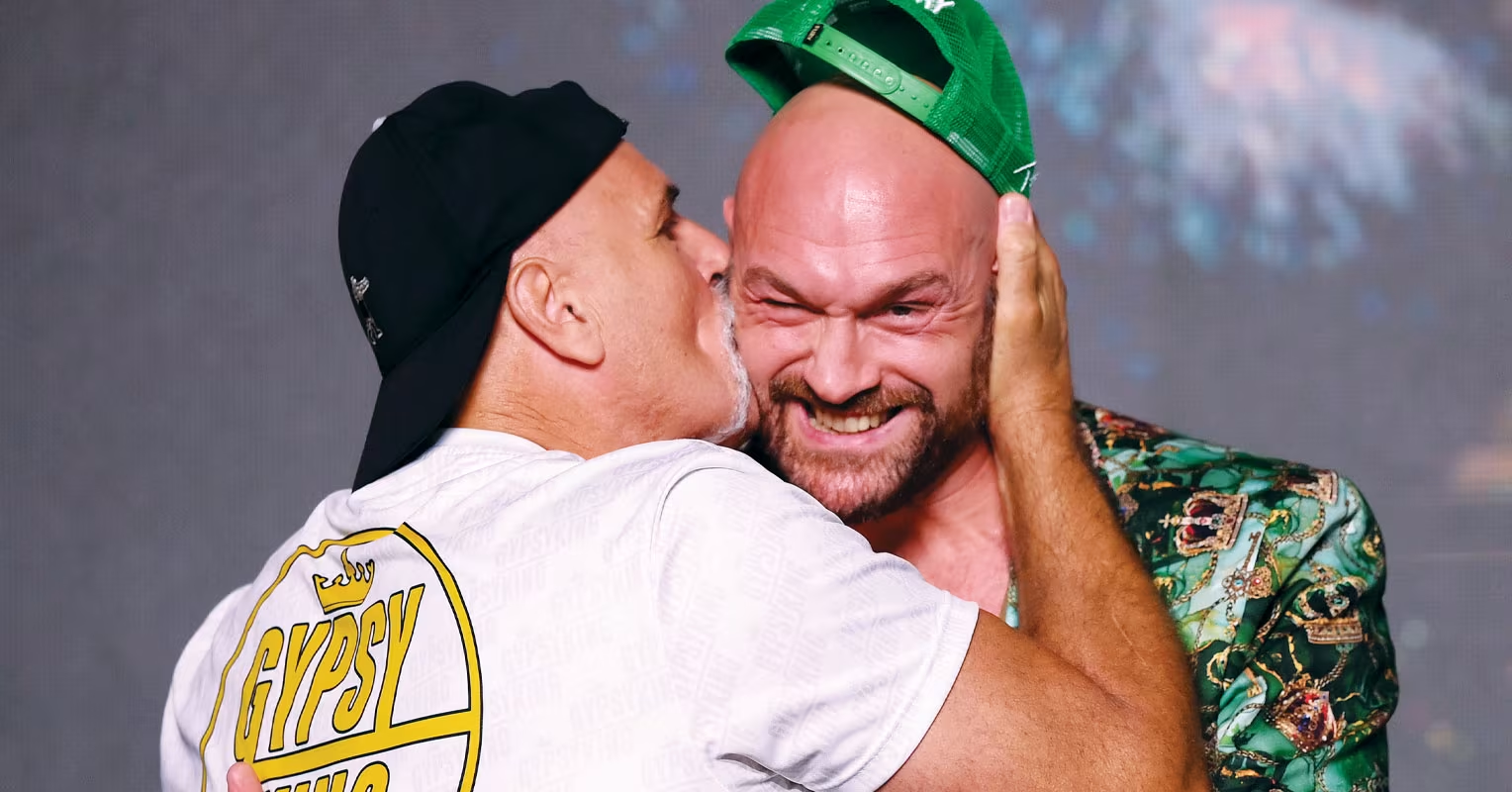
John Fury names the heavyweight who is ‘the next Tyson Fury’: “I never thought I’d see it”

Trump’s ‘Made In the USA’ Phone Is Just a Reskinned HTC U24 Pro


-

 Business2 days ago
No Jackpot Winner as $257 Million Prize Rolls Over to $269 Million Monday Draw
-

 Crypto World5 days ago
Oppenheimer backs SpaceX as $70 billion retail frenzy builds
-

 Fashion4 days ago
Weekend Open Thread: Tuckernuck – Corporette.com
-

 Crypto World5 days ago
Markets Rally as SpaceX IPO Looms Amid Iran Tensions and Inflation Surge
-
 Crypto World1 day ago
Zimbabwe Requires Crypto Businesses to Register Annually Under New FIU Regulations
-

 Entertainment7 days ago
The Ryan Gosling True Crime Thriller On Netflix That Gets Even Stranger, Stream It Now
-

 Tech3 days ago
NanoClaw integrates JFrog registries to secure AI agent downloads
-
 Sports7 days ago
Bangladesh beat Australia after 20 years in ODIs, register only their second win over six-time world champions | Cricket News
-

 Crypto World3 days ago
Bitget enters Argentina’s regulated crypto market through PSAV registration
-

 Tech4 days ago
This Week In Security: Microsoft On Microsoft, Register Your Domains, Linux On ARM, And FreeBSD Joins The File Cache Club
-
 Tech5 days ago
Dutton Ranch star claims they ‘didn’t see any disruption’ on set following Chad Feehan’s exit from Yellowstone spinoff fueled by Taylor Sheridan clash rumors
-

 NewsBeat4 days ago
El Nino has formed in the Pacific and could set records, forecasters say
-

 Business6 days ago
Thailand Ranks Second Worldwide for AI Adoption Growth, Microsoft Reports
-

 Politics5 days ago
Politics Home | Healey Resignation Is “Colossal Failure Of Government”, Says Former Labour Defence Secretary
-

 Tech6 days ago
‘This is Seattle’s position on AI’: City Council votes unanimously to pause big new data centers
-
 Entertainment5 days ago
Donnie Wahlberg & More Heat Up Las Vegas at Circa’s Barry’s Downtown Prime
-
 Tech5 days ago
Opendoor Ends India Operations, Fueling a Bigger Conversation About AI and Outsourcing
-

 Sports5 days ago
First Time Since 1971: Australia Register Historic Low In ODI Cricket
-

 Politics5 days ago
Belfast burns, while Met chief points finger at Iran and Russia
-

 NewsBeat4 days ago
FBI searches office of Ohio voter registration group
You must be logged in to post a comment Login