Connect with us
DAPA Banner
DAPA Coin
DAPA
COIN PAYMENT ASSET
PRIVACY · BLOCKDAG · HOMOMORPHIC ENCRYPTION · RUST
ElGamal Encrypted MINE DAPA
🚫 GENESIS SOLD OUT
DAPAPAY COMING

Business

Tata Motors PV Q4 Results: Profit falls 32% YoY to Rs 5,783 cr; co declares Rs 3/share dividend

Published

on

Tata Motors PV Q4 Results: Profit falls 32% YoY to Rs 5,783 cr; co declares Rs 3/share dividend
Tata Motors Passenger Vehicles (TMPV) on Thursday reported a 32% year-on-year (YoY) decline in its consolidated net profit at Rs 5,783 crore. The company’s board has recommended a final dividend of Rs 3 per share for the financial year ended March 2026. The dividend, if approved at the AGM, will be paid to the eligible shareholders on or before July 14.

Revenue from operations increased 7% YoY to Rs 1.05 lakh crore in the March quarter.

On a standalone basis, revenues for Q4 came in at Rs 18,598 crore, showing a growth of 43% YoY, while profit after tax more than halved to Rs 455 crore. EBITDA Margin for the quarter stood 9.4%.

In Q4, PV and EV volumes were 2,01,800 units, driven by favourable volumes, mix and operating leverage, despite a challenging pricing and cost environment.

Advertisement

In FY26, the business achieved revenues of Rs 58,500 crore, while EBITDA and EBIT margins remained steady at 6.9% (flat YoY) and 1.4% as adverse pricing and commodities offset the favourable impact of volumes and mix.


Looking ahead, the company said domestic demand continues to be sustained, led by growth in SUVs, CNG and EV. However, geopolitical developments remain a key monitorable to mitigate potential supply-side and commodity price risks. We will ramp up production to meet demand.
“We expect to build on the strong momentum of H2 and continue to deliver profitable and industry-beating growth in FY27, supported by a robust demand pipeline, planned pipeline of new products, and established multi-powertrain strategy,” Tata Motors said in a filing.During the year, the company achieved its highest-ever annual sales of over 6.4 lakh units, delivering industry-beating growth of 15% YoY and emerging as the second-ranked player in H2 FY26. In EVs, the company clocked robust 43% YoY growth and our highest-ever annual EV volumes of over 92,000.

JLR business

JLR reported Q4 revenues at £6.9 billion, down 11.1%, while EBITDA margin fell 130 bps to 14%. FY26 revenue stood at £22.9 billion.

JLR said volumes and profitability were impacted YoY by the continued planned wind-down of outgoing Jaguar models ahead of the new Jaguar launch, and the competitive environment the automotive industry is facing in China.

Profit before tax and exceptional items was £458 million in Q4 and £14 million for the full year, down from a profit of £875 million and £2.5 million respectively a year ago.

Advertisement

Free cash flow for the quarter was £829 million and £(2.2) billion for the full year.

“JLR faced a challenging year with revenue and profit impacted by multiple headwinds, including a pause in production following the cyber incident. We recovered well in the fourth quarter as production returned to normal levels, demonstrating the commitment of our people, suppliers and retail partners,” said PB Balaji, CEO, JLR.

(Disclaimer: Recommendations, suggestions, views and opinions given by the experts are their own. These do not represent the views of The Economic Times)

Advertisement
Continue Reading
Click to comment

You must be logged in to post a comment Login

Leave a Reply

Business

Fiona McCoss, founder of Wild Feminine Retreats

Published

on

Fiona McCoss, founder of Wild Feminine Retreats

For Fiona McCoss, business is not about hustle culture or rigid corporate structures, it’s about creating sustainable success through intuition, connection, and embodied leadership.

As founder of Wild Feminine Retreats and creator of the Wild Feminine Facilitator Training, she has built a thriving international community supporting women to reconnect with themselves, their bodies, and their creativity. From transformational retreats in Greece and Ibiza to mentoring female entrepreneurs around the world, McCoss has developed a business model rooted in what she calls “feminine business”, one that values nervous system regulation, pleasure, flexibility, and authentic human connection over burnout and one-size-fits-all formulas.

What do you currently do at your business?

My core offerings are my signature Wild Feminine Facilitator Training, one-to-one mentorship, and immersive retreats. Right now, I’m supporting 16 women through the current training cohort while preparing to host retreats in Crete and my online Wild Feminine Solstice Festival, which reaches over a thousand women globally.

No two days are ever the same. One day I may be teaching a masterclass, another focused on strategy, marketing, or client mentorship. What matters most to me is intimacy and genuine connection. I don’t see clients as names on a spreadsheet, I know their stories, their families, their dreams, and often even their pets’ names.

Together, we work on everything from nervous system healing and feminine leadership to pleasure, emotional expression, and business sustainability. My work is centred around helping women reconnect with themselves in a world that often encourages disconnection and over-performance.

Advertisement

Who do you admire?

Honestly, the women I work with who are mothers.

I’m child-free by choice, and I’ve chosen to pour my creative energy into the businesses and communities I’ve built. But I witness every day the depth of work many mothers are doing, not only raising children, but consciously breaking generational patterns and creating emotionally healthier environments for their families.

They’re teaching their children about boundaries, emotional literacy, consent, and self-worth in ways previous generations often didn’t experience. That level of self-awareness, sacrifice, and devotion deserves far more recognition and support than society currently gives it.

Looking back, is there anything you would have done differently?

I probably would have studied business or economics earlier on. When I first started, I had to teach myself everything from scratch and invested heavily in coaches and programmes to understand how to build a sustainable company.

Advertisement

Some of those investments were invaluable. Others weren’t.

What I eventually realised was that many traditional business formulas simply didn’t align with how I wanted to work or live. I had to create my own blueprint, one that balanced success with sustainability and nervous system health.

Personally, I’d also remind myself to enjoy the process more. Entrepreneurship can easily become an endless pursuit of the next milestone. I’m still learning to slow down and appreciate the beautiful moments along the way.

What defines your way of doing business?

The way I run my business is deeply rooted in feminine principles, which looks very different from traditional business culture.

Advertisement

For me, feminine business means working cyclically rather than mechanically. It means understanding energy, nervous system regulation, intuition, pleasure, creativity, and sustainability. I structure my work around what allows me to operate at my best, not around rigid nine-to-five expectations.

It’s also about rejecting performative hustle culture. You won’t find aggressive sales tactics or “bro marketing” here. I believe business can be deeply successful without burnout, urgency, or constant pressure.

My approach blends intuition with strategy. I trust what feels aligned while also applying systems and structure that genuinely support growth. Ultimately, I want to build businesses that support life, not consume it.

What advice would you give to someone starting out?

Get support early and build slowly.

Advertisement

I often describe feminine business as a “slow burn” model. It takes time to build sustainable momentum, but once it’s established, it creates something far more enduring than overnight success culture.

Too many people leave corporate seeking freedom and accidentally recreate the same stress and burnout patterns inside their own businesses. That’s why structure, systems, and support matter so much.

I’d also ask people to be honest with themselves: do you truly have the resilience and vision to build something long-term? Entrepreneurship is incredibly rewarding, but it’s also deeply challenging. Without a strong “why,” it becomes very difficult to stay committed when things get hard.

And finally, don’t let fear stop you. Most people regret the opportunities they didn’t take, not the ones they did.

Advertisement

What are your favourite things to do outside of work? How do you maintain a healthy work/life balance?

Pleasure and spaciousness are priorities in my life, not rewards I “earn” after overworking.

I’ve intentionally designed my business to support balance. I don’t check my phone before 8am or after 7pm, I avoid client calls on Mondays, and I don’t start desk work before 10am. These boundaries allow me to stay regulated, creative, and present.

Outside work, I love gardening, dancing, redecorating our home in Somerset, and spending time outdoors. Earlier this year, my partner and I bought a house in Frome, so I’ve been planting flowers and creating a space that feels nourishing and grounding.

And when I travel for retreats, I always stay a few extra days, preferably near a beach.

Advertisement

Jamie Young

Jamie Young

Jamie is Senior Reporter at Business Matters, bringing over a decade of experience in UK SME business reporting.
Jamie holds a degree in Business Administration and regularly participates in industry conferences and workshops.

When not reporting on the latest business developments, Jamie is passionate about mentoring up-and-coming journalists and entrepreneurs to inspire the next generation of business leaders.

Advertisement
Continue Reading

Business

US stocks today: US stocks end higher on tech rally; investors eye Beijing talks

Published

on

US stocks today: US stocks end higher on tech rally; investors eye Beijing talks
U.S. stocks advanced on Thursday, ​lifted by a rally in tech stocks as investors absorbed generally solid economic data and watched for developments from Beijing, where U.S. President Trump was engaged in a high-stakes meeting with his Chinese counterpart Xi Jinping.

All three major U.S. stock indexes gained ground, with the S&P 500 and the Nasdaq setting ‌their latest in ⁠a series ⁠of record closing highs.

“Everybody’s asking the same question: how much longer does this (rally) go on? There’s a lot of people that are loving this rally, but they’re ​also antsy at the same time,” said Robert Pavlik, senior portfolio manager at Dakota Wealth in Fairfield, Connecticut. “You have to be in it to ​win it, not just sitting on the sidelines watching the market go to all-time highs.”

Trump attended the summit along with an entourage that included Tesla CEO Elon Musk and Jensen Huang, chief executive of artificial intelligence chipmaker Nvidia.

Advertisement

Nvidia’s shares closed sharply higher after the ​U.S. cleared the sales of the company’s H200 chips to Chinese firms.


The summit ⁠between Trump and ‌Xi is intended to hash out a broad array of issues, including trade, U.S. arms sales ​to Taiwan and the ​re-opening of the Strait of Hormuz. The waterway, through which Asia gets much of its crude, has ⁠been effectively shut down during the U.S.-Israel war on Iran.
“Obviously, these are very ​high stakes meetings,” said Michael Monaghan, portfolio manager at Founder ETFs in Dallas. “It is certainly ​great power competition, but I think that these two economies will be better off working together.””I’m happy to see the two leaders collaborating, a tone of collaboration, and hopefully we’ll see that follow through in long-term agreements,” Monaghan added.

On the economic front, retail sales were in line with expectations, but propped up by rising gasoline prices resulting from the Iran war. Gasoline was largely responsible for the biggest jump in import prices since October 2022.

A series of inflation reports this week showed the risk of spiking energy ‌costs metastasizing to other goods and services, extinguishing hopes for near-term rate cuts from the U.S. Federal Reserve.

Kansas City Fed President Jeffrey Schmid called inflation the most “pressing risk” to the U.S. economy, which he characterizes as “resilient.” ​While Schmid is not ​a voter on monetary policy this ⁠year, his remarks reflect the view of the Fed’s hawkish wing.

Advertisement

According to preliminary data, the S&P 500 gained 57.39 points, or 0.77%, to end at 7,501.64 points, while the Nasdaq Composite gained 232.88 points, or 0.88%, to 26,635.83. The Dow Jones Industrial Average rose 374.79 ​points, or 0.75%, to 50,067.99.

Cisco surged to an all-time high after the computer networking giant announced nearly 4,000 job cuts as part of a restructuring scheme, and raised its annual revenue forecast.

U.S.-listed shares of tech infrastructure firm Nebius Group rose after Northland Capital raised its target price by 15.3% to $248 per share.

China has agreed to buy 200 jets from Boeing, President Trump told Fox News. Even so, the planemaker’s stock closed lower.

Advertisement

Cerebras jumped nearly 90% above its offer price in the chipmaker’s U.S. market debut.

Continue Reading

Business

Citizens financial chief legal officer sells $376,068 in stock

Published

on


Citizens financial chief legal officer sells $376,068 in stock

Continue Reading

Business

UK Businesses Tariff Refunds: Many Exporters Face Rejection from US CAPE System

Published

on

Trump’s new 15% tariff plan ‘will hit UK exporters and dent global growth’

A swelling queue of British exporters hoping to recoup money lost to Donald Trump’s now-discredited emergency tariffs may discover that they are entitled to precisely nothing, the audit, tax and business advisory firm Blick Rothenberg has warned.

According to John Havard, a consultant at the firm, roughly 126,000 claims have been lodged through the US Consolidated Administration and Processing of Entries (CAPE) system since it opened for business on 20 April. Yet a sizeable proportion of those applications are expected to be bounced, either because the claimant is not legally eligible or because the paperwork has fallen foul of the portal’s exacting requirements.

“Some UK businesses hoping for compensation may find they are ineligible for it and receive nothing,” Mr Havard said. “A number of small British firms may never have encountered tariffs until President Trump’s second term. They are likely unaware that, although falling sales and higher shipping costs have inflicted significant harm on their finances, legally they are owed nothing by the US Government.”

Who actually owns the tariff bill

The crux of the issue, Mr Havard argues, lies in the small print of international trade contracts. Where British firms shipped goods to American customers on an “ex-works” or “cost and freight” basis, the legal obligation to settle the tariff sat with the US importer rather than the UK seller.

“Reimbursing the US importer for its additional costs does not qualify the UK entity to apply for a tariff refund,” he explained. In other words, even where British exporters voluntarily absorbed the cost to preserve a customer relationship, they cannot now walk into the CAPE system and ask for it back.

Advertisement

It is a hard truth for the cohort of SMEs that scrambled to keep American buyers on side after Mr Trump invoked the International Emergency Economic Powers Act (IEEPA) to slap tariffs on a wide range of imports, measures that were subsequently struck down by the US Supreme Court, opening the door to refund claims in the first place.

A system creaking under the weight of claims

An official status report timed at 7am Eastern on Monday 11 May 2026 indicated that of the 126,000 claims received, roughly 87,000 had been validated. The remainder are sitting in limbo, with many of the rejections traceable to mundane formatting problems in the CSV files uploaded to the portal.

“Rejections may be because the CSV files submitted to the online portal could not be read and processed by the system due to formatting mistakes,” Mr Havard said. “But some rejections will be due to the claimants’ ineligibility for refunds.”

He added that before businesses can even attempt to file, they must hold an account with US Customs and Border Protection’s Automated Commercial Environment. “Anecdotally there has been considerable activity in new account registrations since the Supreme Court ruled the IEEPA tariffs to be unlawful, but this presents another system for businesses to navigate before they can attempt to get refunds.”

Advertisement

A further pitfall is mistaken identity. “Another reason for rejection could be that the person who filed for a tariff refund is not in Government records as the listed importer, or that person’s broker, for the particular tariffs identified in the claim. This could be people trying to game the system, but it is also potentially because individuals do not fully understand who is supposed to make the claim.”

Refunds trickling out – and bank details missing

Despite Washington signalling that no payments would land before 12 May, Mr Havard said there is reliable evidence that some refunds have already been paid out, with at least one claimant receiving interest on top.

But the process is being held up at the final hurdle for nearly 1,900 claimants who have failed to supply bank details. “As at 7am Eastern time on Monday 11 May 2026, there were 1,880 consolidated refunds which could not be passed from the Office of Trade to US Treasury for payment because the claimant had still to provide the necessary bank account details,” Mr Havard said.

Importers whose applications have been rejected can correct errors and resubmit. “However, no amount of resubmission will help if the claim is invalid in the first place – or if they are not getting clear messages from CAPE to explain why they were rejected.”

Advertisement

The next legal front: the 10% global tariff

Even as refunds for the IEEPA tariffs begin to flow, a second courtroom battle is unfolding over Mr Trump’s replacement measure, a blanket 10% “global tariff” introduced under Section 122 of the Trade Act of 1974 after the Supreme Court struck down the original duties.

A coalition of small businesses and roughly two dozen, mostly Democrat-led, states challenged the move at the US Court of International Trade, which ruled by a 2:1 majority on 7 May that the new tariffs were also invalid. The Government has appealed to the US Court of Appeals for the Federal Circuit, which has granted an administrative stay, meaning the 10% levy continues to be collected on US-bound shipments while the legal process plays out.

“Whatever decision the Appeals Court eventually hands down, it seems inevitable that the losing side, as with the IEEPA tariffs, will want to make a further appeal to the US Supreme Court,” Mr Havard said.

The sums at stake are far from trivial. Estimates suggest some $8 billion of Section 122 tariffs were collected in March alone, a substantial slice of the wider tariff burden being shouldered by British exporters, which has weighed heavily on UK trade flows and prompted British factories to cut their exposure to the US market.

Advertisement

For SME exporters watching from this side of the Atlantic, the message from Blick Rothenberg is sobering: those who think a cheque is in the post would do well to check the terms of their export contracts, and the bank details on their CBP account, before they start spending it.


Amy Ingham

Amy is a newly qualified journalist specialising in business journalism at Business Matters with responsibility for news content for what is now the UK’s largest print and online source of current business news.

Advertisement
Continue Reading

Business

Blockbusters and Breakouts Dominate Charts

Published

on

3D Apple Logo

NEW YORK — Netflix’s May 2026 viewing charts in the United States have been dominated by a powerful mix of returning flagship series, major new releases and unexpected sleeper hits, reflecting the platform’s ability to balance broad-appeal spectacles with compelling niche storytelling.

According to Netflix’s official Top 10 data for the United States through mid-May, here are the 10 most-watched shows based on minutes viewed and household reach:

1. The Lincoln Lawyer (Season 5) Manuel Garcia-Rulfo’s final season as Mickey Haller has dominated the charts since its premiere. The emotional conclusion to the popular legal drama has drawn massive audiences eager for closure on the long-running series.

2. Squid Game Season 3 The Korean survival phenomenon returned with its third and reportedly final season, maintaining enormous global and domestic viewership. Its intense storytelling and cultural resonance continue to captivate American audiences.

Advertisement

3. Wednesday Season 2 Jenna Ortega’s gothic hit expanded its universe in Season 2, blending dark humor, mystery and coming-of-age themes that have kept it a consistent Top 10 fixture.

4. Baby Reindeer The limited series based on real events has enjoyed remarkable staying power, with viewers continuing to discover and discuss its psychological depth months after initial release.

5. The Diplomat Season 3 Keri Russell’s sharp political thriller has built a loyal following with timely storylines and strong ensemble performances, proving a major draw for adult audiences.

6. Bridgerton Season 4 The lavish period romance series continued its reign, delivering the romantic escapism and high production values that have made it a perennial favorite.

Advertisement

7. The Night Agent Season 2 The fast-paced action thriller returned with more conspiracy and high-stakes drama, appealing strongly to fans of adrenaline-fueled entertainment.

8. Adolescence This surprise British coming-of-age drama has emerged as one of the month’s biggest breakouts, earning praise for its authentic characters and emotional honesty.

9. The Gentlemen Guy Ritchie’s stylish crime comedy series with Theo James has built a dedicated audience with its signature blend of humor, violence and sharp dialogue.

10. Outer Banks Season 5 The teen adventure drama wrapped up its run with high emotional stakes, maintaining strong popularity among younger viewers.

Advertisement

Netflix’s May performance demonstrates its continued strength in delivering both event-level programming and sustained catalog engagement. The strong showing of long-running series like The Lincoln Lawyer and Bridgerton highlights the value of building durable franchises, while breakout hits like Adolescence prove that fresh, character-driven stories can still cut through in a crowded market.

The platform’s algorithm and personalized recommendation system have played a key role in sustaining viewership across these titles. By surfacing both popular blockbusters and hidden gems, Netflix keeps subscribers engaged and helps smaller shows find their audience.

Industry analysts note that Netflix’s investment in diverse content — spanning international hits, prestige dramas and genre entertainment — has helped it maintain its lead in the streaming wars. The current Top 10 reflects a healthy balance that appeals to different demographics, from younger viewers drawn to Wednesday and Outer Banks to adult audiences favoring The Diplomat and The Lincoln Lawyer.

For viewers looking to catch up or discover new favorites, all of these shows are currently available to stream on Netflix. The platform’s Top 10 list updates regularly, reflecting real-time popularity trends across the country.

Advertisement

The success of these titles also underscores broader trends in television consumption. Audiences continue to favor high-production-value series with strong characters, engaging plots and emotional depth, whether they are thrillers, romances, comedies or prestige dramas.

As May continues, Netflix has several major releases lined up that are expected to shake up the rankings. The competition for attention remains fierce, but the current Top 10 shows the streamer’s ability to keep viewers coming back week after week.

Whether you prefer legal thrillers, international sensations, gothic mysteries or heartfelt coming-of-age stories, Netflix’s May 2026 lineup offers something for nearly every taste. The platform’s continued focus on quality and variety ensures it remains a dominant force in global entertainment.

The current chart leaders represent the best of what modern streaming has to offer — ambitious storytelling, strong performances and cultural relevance that keeps audiences talking long after the credits roll. As the month progresses, these shows and several new arrivals will continue shaping the conversation around television in 2026.

Advertisement
Continue Reading

Business

OpenAI’s ChatGPT Faces Regional Disruptions Amid High Demand

Published

on

OpenAI

SAN FRANCISCO — OpenAI’s ChatGPT and related services experienced scattered disruptions for hundreds of users on Thursday, May 14, 2026, according to real-time alerts and community reports, though the issues appear limited in scope rather than a full-scale outage affecting the entire platform.

The outage-monitoring account @status_is_down on X posted at approximately 12:54 GMT, stating “OpenAI / ChatGPT is reportedly down for hundreds of users right now. Are you one of them?” and linking to a community forum discussion titled “Is ChatGPT / OpenAI down May 14 2026?” The post quickly gained traction as frustrated users sought confirmation that their connectivity problems were not isolated.

Downdetector and similar platforms showed elevated but not catastrophic reports for OpenAI and ChatGPT in the past several hours. Most complaints centered on slow responses, failed generations, login issues and intermittent connectivity rather than a complete service collapse. OpenAI’s official status dashboard indicated normal operations across major components as of mid-morning Pacific time, with no broad alerts posted.

This latest flare-up follows a relatively stable period after earlier incidents in May. On May 11, users reported elevated errors with certain GPT models that were quickly mitigated. A more substantial outage occurred on April 20 when ChatGPT was unavailable for around 90 minutes, affecting thousands and sparking widespread discussion. Those events highlighted the challenges of scaling AI infrastructure to meet surging demand from hundreds of millions of weekly active users.

Advertisement

Today’s reports appear more regional or device-specific. Customers in various markets described frozen loading screens, error messages during conversations and difficulties accessing advanced features like voice mode or custom GPTs. Some noted that refreshing the page or switching networks temporarily alleviated symptoms, while others reported the problems persisting across multiple devices on the same network. The volume of complaints — hundreds rather than millions — suggests localized congestion, maintenance activity or a targeted software glitch rather than a core infrastructure failure.

OpenAI serves tens of millions of subscribers and free users worldwide with conversational AI tools used for writing, coding, research and creative tasks. Peak usage hours often strain capacity, especially during business hours in major time zones. Any minor hiccups today likely coincide with heightened demand rather than systemic failure.

Users experiencing problems should follow standard troubleshooting steps recommended by OpenAI. Refreshing the browser, clearing cache and cookies, trying incognito mode or switching networks frequently resolves temporary glitches. For mobile app users, force-closing and restarting the app or checking for updates can help. OpenAI’s support pages also suggest signing out and back in or trying a different device.

The company has invested heavily in infrastructure resilience through multiple data centers and sophisticated load balancing. Despite occasional disruptions common to all major AI platforms, ChatGPT maintains strong overall uptime and responds quickly to reported issues. No formal statement has been issued for today’s scattered complaints, consistent with OpenAI’s approach to non-catastrophic events.

Advertisement

Recent technical difficulties, such as brief model-specific errors earlier in the month, underscored the complexity of running frontier AI systems at scale. OpenAI typically offers apologies or credits for significant outages, though none appear warranted for the current limited reports.

Customer frustration is understandable. AI tools like ChatGPT have become essential for work, education and daily productivity, and even brief interruptions disrupt workflows for students, professionals and casual users. Social media platforms lit up with memes and complaints, with hashtags like #ChatGPTdown and #OpenAIDown trending briefly as users shared screenshots of error messages.

For businesses and enterprise users relying on OpenAI’s APIs for applications, any downtime carries higher stakes. Dedicated support channels often provide faster resolution, but consumer accounts depend on self-service tools. The service’s integration with productivity apps and developer tools continues to drive loyalty despite occasional hiccups.

As of late morning Pacific time on May 14, the situation remained fluid. Some users reported partial restoration while others continued experiencing problems. Monitoring accounts like @status_is_down play a valuable role in crowdsourcing real-time information when official channels lag. The linked forum thread showed users sharing experiences and potential fixes.

Advertisement

Looking ahead, OpenAI is expected to continue expanding its model offerings and enterprise features. These expansions increase pressure on infrastructure but also drive subscriber growth. In the meantime, users can stay informed through OpenAI’s status page, the ChatGPT app and third-party trackers.

The May 14 reports serve as a reminder of how dependent modern work and creativity have become on AI services. While not rising to the scale of previous major incidents, the issues affecting some users highlight ongoing challenges in maintaining flawless performance across a vast global user base. OpenAI has historically resolved such matters quickly and offered goodwill gestures to impacted subscribers.

Users are advised to document any prolonged disruptions for potential credits and to explore alternative AI tools until service stabilizes. The platform’s commitment to infrastructure investments suggests these types of events will become less frequent over time, though complete elimination remains unlikely in such a complex system.

For now, most OpenAI and ChatGPT users appear unaffected, with the reported problems limited to a subset of subscribers. The situation underscores the importance of diversified AI options and staying informed during peak usage periods. As the day progresses, further updates from OpenAI or monitoring services will clarify the full scope and resolution timeline.

Advertisement
Continue Reading

Business

Pelthos Therapeutics Inc. (PTHS) Q1 2026 Earnings Call Transcript

Published

on

OneWater Marine Inc. (ONEW) Q1 2026 Earnings Call Transcript

Q1: 2026-05-14 Earnings Summary

EPS of -$4.66 misses by $1.08

 | Revenue of $10.91M beats by $468.29K

Pelthos Therapeutics Inc. (PTHS) Q1 2026 Earnings Call May 14, 2026 8:30 AM EDT

Company Participants

Scott Plesha – CEO, President & Director
Sai Rangarao – Chief Commercial Officer
John Gay – CFO, Treasurer & Secretary

Advertisement

Conference Call Participants

Mike Moyer – Lifesci Advisors, LLC
Olivia Brayer – Cantor Fitzgerald & Co., Research Division
David Amsellem – Piper Sandler & Co., Research Division
Brandon Folkes – H.C. Wainwright & Co, LLC, Research Division
Jeffrey Jones – Oppenheimer & Co. Inc., Research Division
Thomas Flaten – Lake Street Capital Markets, LLC, Research Division
Jonathan Aschoff – ROTH Capital Partners, LLC, Research Division

Advertisement

Presentation

Operator

Ladies and gentlemen, good morning, and welcome to the Pelthos Therapeutics 2026 First Quarter Financial Results Conference Call. [Operator Instructions] As a reminder, this conference is being recorded.

It is now my pleasure to introduce your host, Mike Moyer from LifeSci Advisors. Please go ahead.

Advertisement

Mike Moyer
Lifesci Advisors, LLC

Good morning, everyone, and welcome to the Pelthos Therapeutics 2026 First Quarter Financial Results Conference Call. Pelthos issued a press release today announcing its financial results for the quarter ended March 31, 2026. A copy can be found in the Investor Relations tab on the corporate website, www.pelthos.com.

Before we begin, I’d like to remind you that during today’s call, statements about the company’s future expectations, projections, plans and prospects are forward-looking statements. These forward-looking statements are based on management’s current expectations. These statements are neither promises nor guarantees and involve known and unknown risks, uncertainties and other important factors that may cause our actual results, performance or achievements to be materially different from our current expectations expressed or implied by the forward-looking statements. Any such forward-looking statements represent management’s estimates as of the date of this conference call. While the company may elect to update such forward-looking statements at some point in the future, it disclaims any obligation to do so even if

Advertisement
Continue Reading

Business

U.S. Treasury Yields Decline, Dollar Firms

Published

on

Stocks Little Changed After Fed Decision

U.S. Treasury yields were declining as oil prices moved lower, stabilizing after Tuesday’s rise following a higher-than-expected U.S. April inflation print.

Meanwhile, the dollar rose slightly due to haven demand amid continued uncertainty in the Middle East and as the inflation data “reinforced expectations that the Federal Reserve will maintain a cautious stance over monetary policy,” said DHF Capital S.A’s Bas Kooijman.

The 10-year Treasury yield fell 0.8 basis points to 4.463%, according to Tradeweb. The DXY dollar index rose 0.3% to 98.570.

Continue Reading

Business

Business Daily – The US-China economic relationship

Published

on

Business Daily - The US-China economic relationship

Available for 29 days

As US President Donald Trump travels to Beijing to meet Chinese President Xi Jinping, we look at the tensions and the relationship between the world’s two biggest economies.

Presenter: Will Bain, Michelle Fleury and Rahul Tandon
Producer: Gideon Long

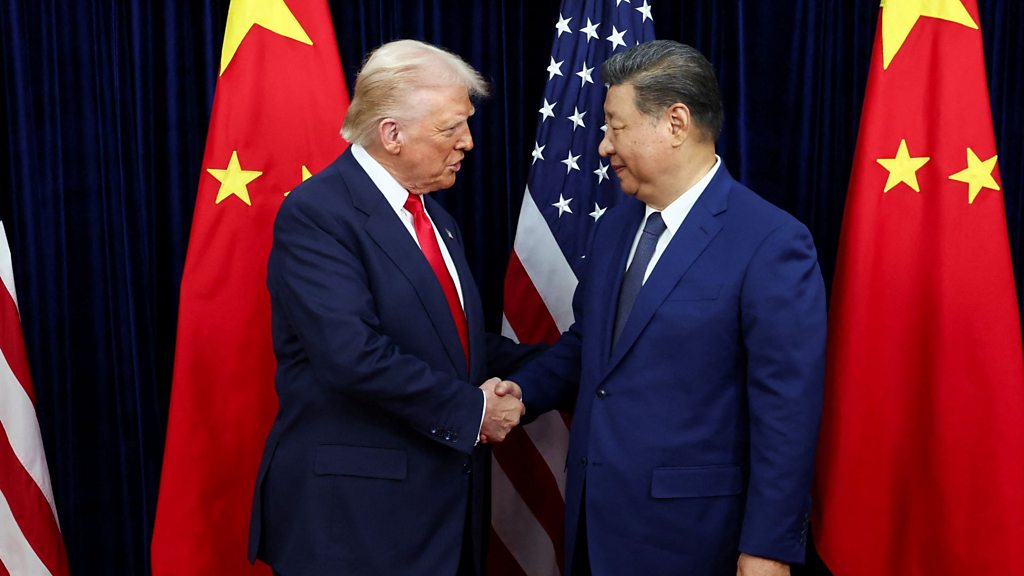
(Photo: US President Donald Trump shakes hands with Chinese President Xi Jinping in Busan, South Korea, 30 October, 2025. Credit: Evelyn Hockstein/Reuters)

Advertisement

Programme Website

Continue Reading

Business

Watches of Switzerland shares soar as US luxury watch market booms

Published

on

Business Live

The UK’s largest luxury watch retailer hailed a 13 per cent jump in revenue to £1.8bn in the year to May

The Watches of Switzerland branch in Greene Street, New York

The Watches of Switzerland branch in Greene Street, New York

Shares in Watches of Switzerland soared after the company announced record revenue growth, driven by affluent Americans snapping up luxury timepieces.

Advertisement

The UK’s leading luxury watch retailer reported a 13 per cent rise in revenue to £1.8bn for the year ending May, with its US market alone posting a 24 per cent increase to £1.2bn.

Shares in the FTSE 250 company leapt 13 per cent to 600p when markets opened on Thursday, putting the stock up 28 per cent for the year to date.

The retailer had faced headwinds from Trump’s unpredictable tariff policy over the past 18 months, yet has successfully capitalised on booming demand across the Atlantic, which it describes as the world’s largest and fastest-growing luxury watch market.

Watches of Switzerland posted 25 per cent growth in its US retail market, while revenue at Roberto Coin — the Italian luxury jeweller it owns — surged by 22 per cent, as reported by City AM.

Advertisement

The US emerged as the firm’s largest market, with revenue climbing to £927m, while UK revenue grew by five per cent to £901m.

The Leicestershire-based retailer said it had succeeded in strengthening its domestic performance despite consumer confidence falling to a two-year low.

Chief executive Brian Duffy celebrated “a major milestone in the world’s largest and fastest growing luxury watch market, achieved in just over eight years from entering the US”.

He said: “In the UK, performance has improved despite the challenging macroeconomic backdrop, with resilient demand for luxury watches and jewellery.”

Advertisement

The toll being inflicted on some luxury giants by the decline in tourism after the Iran conflict was laid bare last month, when the owners of brands such as Gucci, Louis Vuitton and Birkin saw the situation dent their revenues.

However, Watches of Switzerland insisted it will not be pulled down by the conflict, noting it has minimal exposure to tourist consumers and to the Middle East market.

The company recently snapped up Texas-based luxury jeweller Deutsch & Deutsch and reported strong performance across its four US locations.

The outlets, which predominantly deal in Rolex watches, have delivered £16m in revenue since the acquisition, while the transaction pushed Watches of Switzerland’s net debt up to £57m.

Advertisement

The business was established in 1924, when Maurice Lane opened its first office in Ludgate Hill, London.

Continue Reading

Trending

Copyright © 2025