GAINESVILLE, Fla. — Olivier Rioux, the 7-foot-9 Canadian center for the Florida Gators, continues to captivate college basketball fans in March 2026 as the tallest player ever to compete in NCAA men’s hoops. Now a redshirt freshman in his first active season after preserving eligibility in 2024-25, Rioux has appeared in limited minutes but already etched his name in record books with historic dunks and crowd-roaring entrances.
Olivier Rioux
Born February 2, 2006, in Terrebonne, Quebec, Rioux turned 20 this year and stands at 7 feet 9 inches (2.36 meters) tall, weighing 305 pounds. Guinness World Records once named him the tallest teenager on Earth in 2021 at age 15 (then 7-5), and his growth trajectory — 6-1 at age 8, 6-11 by sixth grade, crossing 7 feet before seventh grade — has fueled lifelong fascination.
Here are five key facts about the emerging big man as he navigates his debut campaign with the Gators in the 2025-26 season.
Record-Breaking Height and Historic College Debut. Rioux became the tallest player in college basketball history when he checked into Florida’s 104-64 win over North Florida on December 18, 2025, surpassing previous marks. He scored his first career field goal — a thunderous dunk — against Alabama in late February 2026, making him the tallest ever to score in an NCAA men’s game. Crowds erupt whenever he enters, with fans chanting for “Clap Shark” (his nickname) and giving standing ovations even for brief appearances. In 11 games through mid-March, he averages 0.6 points and 0.5 rebounds in 1.5 minutes per contest, shooting 50% from the field and free-throw line.
Developmental Path and Redshirt Decision. After starring at IMG Academy in Bradenton, Florida — a powerhouse prep program — Rioux committed to Florida as a preferred walk-on, meaning no athletic scholarship or guaranteed playing time. He took a developmental redshirt in 2024-25, serving on the scout team while adapting to college strength, conditioning and the SEC’s physicality. Coach Todd Golden praised his attitude during the limited role, noting Rioux’s work ethic despite minimal reward. The Gators, coming off a 2025 national championship, value his presence in practice, where his size challenges teammates daily.
Family of Tall Athletes Fuels His Journey. Rioux comes from a towering Quebec family: father Jean-François Rioux (6-8), a retired volleyball player and photographer; mother Anne Gariépy (6-2), a former volleyball standout and Royal Bank of Canada employee; and older brother Émile (6-9), who has played basketball. The athletic genes run deep — both parents competed at high levels in volleyball — and Olivier started basketball at age 5. The family relocated multiple times in Quebec (Anjou borough of Montreal, Beloeil suburb) before he pursued elite training in the U.S. His background reflects French-Canadian heritage, with the Rioux family emphasizing sports and discipline.
International Experience and Early Accolades. Before college, Rioux represented Canada internationally, helping the U18 team win bronze at the 2023 FIBA AmeriCup (averaging 4.5 points and rebounds). He competed for Canada at U16 and U19 levels, earning medals and showcasing soft hands, touch around the rim and improving mobility for his frame. His prep career at IMG included strong showings against top talent, drawing NBA scout interest despite questions about speed and perimeter defense. Draft boards occasionally project him as a late second-round pick in 2027 or beyond, though many note the challenges extreme height poses for NBA viability — coordination, injury risk and agility demands.
Limited Role in 2025-26 Amid Gators’ Success. Florida’s deep roster and defensive focus have kept Rioux on the bench for most games, with coach Golden explaining the plan prioritizes development over forcing minutes. Rioux has appeared in eight to 11 contests (reports vary slightly), grabbing rebounds off the floor, altering shots and energizing crowds. His size 20 shoes and 5,000-plus calorie daily intake highlight the logistical demands of sustaining his frame. While playing time remains sparse, his presence adds unique value — opponents must adjust schemes, and he contributes in blowouts or foul trouble situations. Analysts see growth potential as he adds strength, refines footwork and gains confidence.
Rioux’s story blends wonder and realism: unmatched height draws global attention, viral dunks and crowd chants, yet his college role reflects patient development in a loaded SEC program. As Florida pushes through March Madness 2026, Rioux’s brief but impactful appearances remind fans of basketball’s evolving extremes. Whether he evolves into a rotational force or remains a novelty, his journey captivates as one of the most unique in modern college hoops.
A version of this article first appeared in the CNBC Property Play newsletter with Diana Olick. Property Play covers new and evolving opportunities for the real estate investor, from individuals to venture capitalists, private equity funds, family offices, institutional investors and large public companies. Sign up to receive future editions, straight to your inbox. Even as more local communities rise up against the proliferation of massive, energy- and water-sucking data centers, some big players in housing are betting consumers would be willing to put mini data centers right on the walls of their homes. Span is a California-based startup that originally launched with so-called “smart” electrical panels designed to help homeowners save money on their electric bills. Now, with the help of Nvidia, it has come up with something new – small, fractional data centers, or “nodes,” called XFRA units, that can be put on the side of residential homes and small commercial businesses. The idea is to take advantage of unused electrical capacity on local grids, which the Span smart panels can pinpoint. The rapid growth of artificial intelligence has strained local power grids nationwide and, in some cases, resulted in higher electric bills for homeowners. A network of these nodes, communicating with each other across the country, is the equivalent of a small to mid-sized traditional data center, which could either augment an existing center or negate the need to build a new one, Span says. Hyperscalers and AI cloud providers just tap into the network as they would a traditional data center. “Fundamentally, it’s an infrastructure play,” said Arch Rao, founder and CEO of Span. “We’re uniquely positioned to build infrastructure that can simultaneously help us meet what is clearly an insatiable demand for more compute, much more cost effectively, while benefiting individual consumers.” The small, white XFRA boxes with the hardware inside are put on the outside of homes, alongside regular HVAC and electrical systems. Span says it can install 8,000 XFRA units about 6 times faster and at 5 times lower cost than the construction of a typical centralized 100 megawatt data center of the same size. Span collaborated with Nvidia, using its technology in the system, including one of the first-to-market uses of liquid-cooled Nvidia RTX PRO 6000 Blackwell Server Edition GPUs. These require no fans, so there is no noise. “We’re trying to get access to power, and there’s a lot of power right now on the grid. But, unfortunately, to come up with large loads for big data centers – it’s a challenge,” said Marc Spieler, senior managing director of global energy industry at Nvidia. “The ability to leverage existing locations that have access to power makes a lot of sense. … We believe that we can bring on AI solutions quicker, and it should add to the affordability story.” The Span systems include its smart electrical panel, the XFRA unit, a home backup battery and, in some cases, solar panels. The panels tap into existing, unused electrical capacity, which then powers the XFRA system. Homeowners would pay a flat fee for both electricity and Wi-Fi. “If you are one of the homes that is hosting an XFRA node, XFRA will then give you compensation for energy and internet usage,” Rao said. “We expect that the value there is a heavily discounted cost of energy and internet.” The Span systems are going on newly built homes. PulteGroup, one of the nation’s largest homebuilders, is in the early testing phase as it assesses the capabilities and economics of the XFRA nodes, according to a company spokesperson. It has already been deployed in a handful of communities. “There is certainly opportunity, as SPAN can provide homeowners with access to innovative technology and potential income generation that can help offset monthly energy costs,” the spokesperson said in a statement. “On a larger scale, if the technology proves out, it might also keep local infrastructure from being overburdened which could keep land open for other uses, such as building homes.”
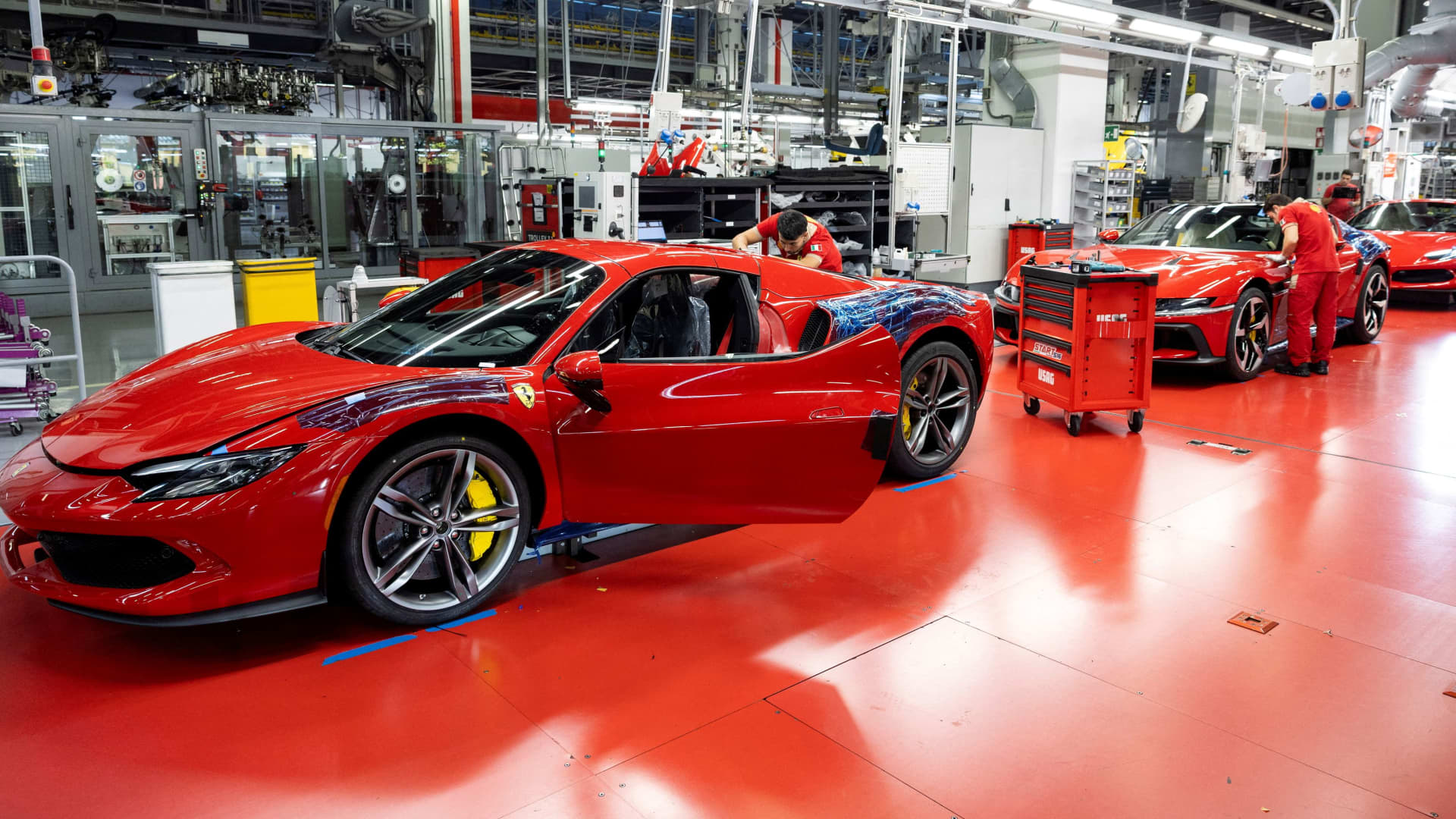
Ferrari technicians inspect supercars on the production line inside the company’s factory in Maranello, Italy, October 2, 2025. REUTERS/Remo Casilli/File Photo
Remo Casilli | Reuters
DETROIT — Ferrari on Tuesday beat Wall Street’s first-quarter earnings expectations and reconfirmed its guidance for the year, weeks ahead of the sports car maker revealing its first all-electric vehicle.
Advertisement
Here’s how the company performed in the first quarter compared with average estimates compiled by LSEG:
Earnings per share: 2.33 euros (US $2.72) adjusted vs. 2.27 euros expected
Revenue: 1.85 billion euros vs. 1.81 billion euros expected
Ferrari’s revenue was up more than 3% compared with 1.79 billion euros during the first quarter of 2025, while its operating profit and adjusted earnings increased 1.1% and 4.2% year-over-year, respectively.
The company’s 2026 guidance includes 7.5 billion euros in net revenues and an adjusted operating profit of at least 2.22 billion euros, or 9.45 euros adjusted EPS. Its industrial free cash flow is targeted at 1.5 billion euros or more for the year.
Those results were despite deliveries being down 4.4% year-over-year to 3,436 units, as the sports car maker said it slowed production to “ease the execution of the planned model change-over.”
The company said deliveries “were not impacted by the surge of hostilities in the Middle East, as Ferrari leveraged its geographical allocation flexibility, bringing forward certain deliveries to other regions.”
Advertisement
Ferrari’s results come weeks before the scheduled debut of the Luce, its first fully electric vehicle, on May 25.
“With only twenty days to the world premiere of the Ferrari Luce, the sense of anticipation has never been so high. The Ferrari Luce brings together so much extraordinary technologies and the passion of so many people. It is the evidence of how tradition and innovation can come together to create something unique,” Ferrari CEO Benedetto Vigna said in a statement Tuesday.
LOS ANGELES — Olivia Rodrigo announced “The Unraveled Tour,” a sweeping 65-date global arena run supporting her highly anticipated third studio album “you seem pretty sad for a girl so in love,” set for release June 12 via Geffen Records. The tour kicks off Sept. 25, 2026, with back-to-back nights at PeoplesBank Arena in Hartford, Connecticut, and stretches into May 2027 across North America, Europe and the UK.
Olivia Rodrigo Unraveled Tour 2026: Full Schedule, Presale Times and Ticket Guide for Massive Run
The three-time Grammy winner, whose previous Guts World Tour showcased her explosive live presence, promises an emotionally raw and visually ambitious production for this next chapter. Fans can expect a setlist heavy on new material alongside beloved hits from “Sour” and “Guts.”
Tour Schedule Highlights
The North American leg features multiple-night residencies in major markets. After launching in Hartford, the tour hits Pittsburgh, Washington D.C., Chicago, Atlanta, Nashville, Toronto, Vancouver, Oakland, Las Vegas and more before wrapping the domestic run in mid-February 2027 at Barclays Center in Brooklyn with several shows.
International dates follow in spring 2027, with stops in Stockholm, Paris, Milan, London, Munich, Amsterdam, Barcelona and additional European cities. Full itineraries are available on Ticketmaster and Rodrigo’s official site.
Advertisement
Special guests vary by region and include Wolf Alice, Devon Again, Grace Ives, Die Spitz and The Last Dinner Party on select nights, adding depth and excitement to the bill.
Presale and Ticket Information
Amex cardholders gain early access during the official presale beginning Tuesday, May 5, at 12 p.m. local time through Wednesday, May 6, at 10 p.m. local time. No presale code is required, but purchases must use an eligible American Express card. Availability varies by market.
Fans who pre-ordered the new album or registered on OliviaRodrigo.com may receive additional presale access or codes for select dates, particularly in Europe and the UK. In the UK, an O2 Priority presale also opens May 5 at 10 a.m. local time.
Advertisement
General public on-sale starts Thursday, May 7, at 12 p.m. local time via Ticketmaster and official channels. A limited number of $20 Silver Star Tickets will be released during these windows for select shows, offering more affordable options.
Where and How to Buy Tickets
Primary tickets will be available through Ticketmaster, with links also on OliviaRodrigo.com. Fans should create accounts in advance, enable two-factor authentication and have payment information ready to navigate high demand.
Resale platforms such as StubHub, Vivid Seats and SeatGeek will offer secondary market inventory after the initial sale, though prices will likely exceed face value. Official warnings advise against third-party purchases before general sale to avoid scams.
Advertisement
Ticket limits are typically four per order. Dynamic pricing may apply, with face values expected to range from $49.50 to several hundred dollars depending on seating. VIP packages and meet-and-greet experiences are anticipated but details remain limited at announcement.
Fan Tips for Success
Set multiple alarms for presale and onsale times adjusted to local venue hours. Use a reliable internet connection, preferably on a computer rather than mobile during peak traffic. Joining official fan communities or Rodrigo’s mailing list can provide last-minute updates or extra presale opportunities.
Those without Amex cards should monitor for any artist or venue presales. Pre-ordering the album, even without immediate purchase, has unlocked codes in past campaigns. Patience during the checkout process is essential as queues can be long.
Advertisement
Context and Excitement
Rodrigo’s rise from Disney actress to global pop-rock phenomenon has been meteoric. Her tours consistently sell out arenas, with fans praising the emotional authenticity and high-energy performances. This new outing arrives as she evolves her sound further, promising “unraveled” vulnerability onstage.
The announcement generated massive social media buzz, with fans celebrating the extensive routing that reaches both coasts and international markets. Hashtags like #UnraveledTour and #OliviaRodrigo2026 trended immediately after the reveal.
Industry analysts predict rapid sellouts for many dates given her dedicated “Livies” fanbase and the post-album release timing. The tour represents one of the largest arena campaigns by a young female artist in recent years.
Advertisement
What to Expect on Tour
While production details remain under wraps, expectations are high for theatrical elements, given Rodrigo’s cinematic music videos and past stage designs. The setlist will likely interweave new singles like “drop dead” with fan favorites, creating an emotional journey that matches the “unraveled” theme of raw self-expression.
As tickets become available this week, demand is expected to surge. Fans unable to secure primary tickets should monitor official resale policies and verified platforms for fair options closer to show dates.
Olivia Rodrigo’s “The Unraveled Tour” marks a major milestone in her career. With a new album on the horizon and a globe-spanning itinerary, the 2026-2027 run is poised to be one of the year’s most talked-about concert experiences. Mark your calendars, prepare your strategies and get ready for nights of cathartic anthems and unforgettable performances from one of pop’s brightest stars.
The local authority is bidding for money from the government’s Structures Fund
08:20, 05 May 2026Updated 08:26, 05 May 2026
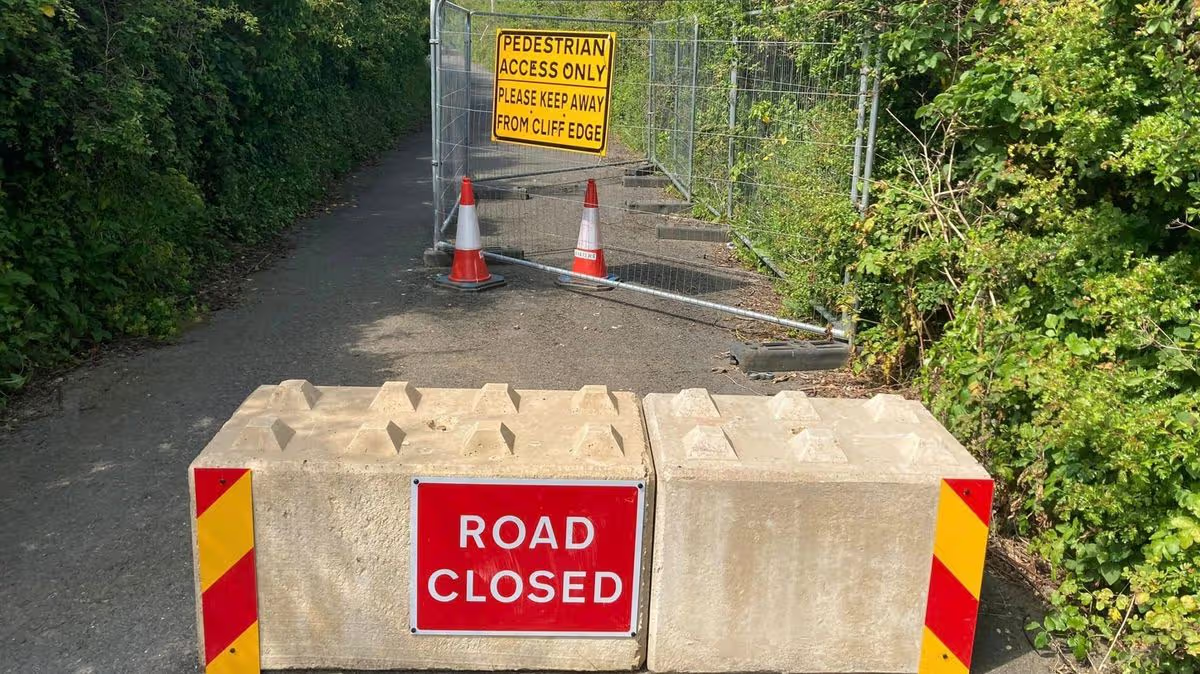
The B3191 Cleeve Hill in Watchet(Image: Local Democracy Reporting Service / BBC)
A “vital” coastal road in Somerset that closed three years ago over safety concerns could reopen to traffic. Somerset Council is bidding for Government cash to reopen the B3191 Cleeve Hill, which links Watchet to Blue Anchor in Somerset.
The road was shut by the local authority in January 2023 due to concerns around coastal erosion. The closure left just one route in and out of the town centre, using a 150-year-old bridge over the West Somerset Railway heritage line.
Advertisement
The B3191 reopened to pedestrians and cyclists in 2024 but has remained closed to motor vehicles.
Somerset Council has now submitted an initial bid to the government’s Structures Fund for a contribution towards what would be a £30 to £40m scheme to reinstate the B3191, either by making the existing route safe for vehicles or by redirecting the route further inland.
Councillor Richard Wilkins, Somerset Council’s lead member for transport and waste services, said: “There is of course no guarantee that we can get this agreed, and any scheme would need to be approved by council, but we have been directed to this fund by the Secretary of State who recognises the issues locally and this is the first real chance we have had to find a way to reinstate this vital route for the community since it closed in 2023.
“We will be pushing hard for this funding, as we have been doing so from the outset – we fully understand the impact on the community of only having one road into Watchet, and the potential impact on the West Somerset traffic that has to take long diversions if the A39 has to close due to an incident.
Advertisement
“We consulted our communities about the ongoing closure and they told us that it is having a major effect on the economy of Watchet including the cost to the local economy and the inconvenience in terms of hours lost in delays, the logistics of coping with delivering goods to and from Minehead as well as the negative effects on tourism.”
Based at M-SParc in Ecodetect has developed an advanced ecology detection toolkit that combines artificial intelligence and machine learning
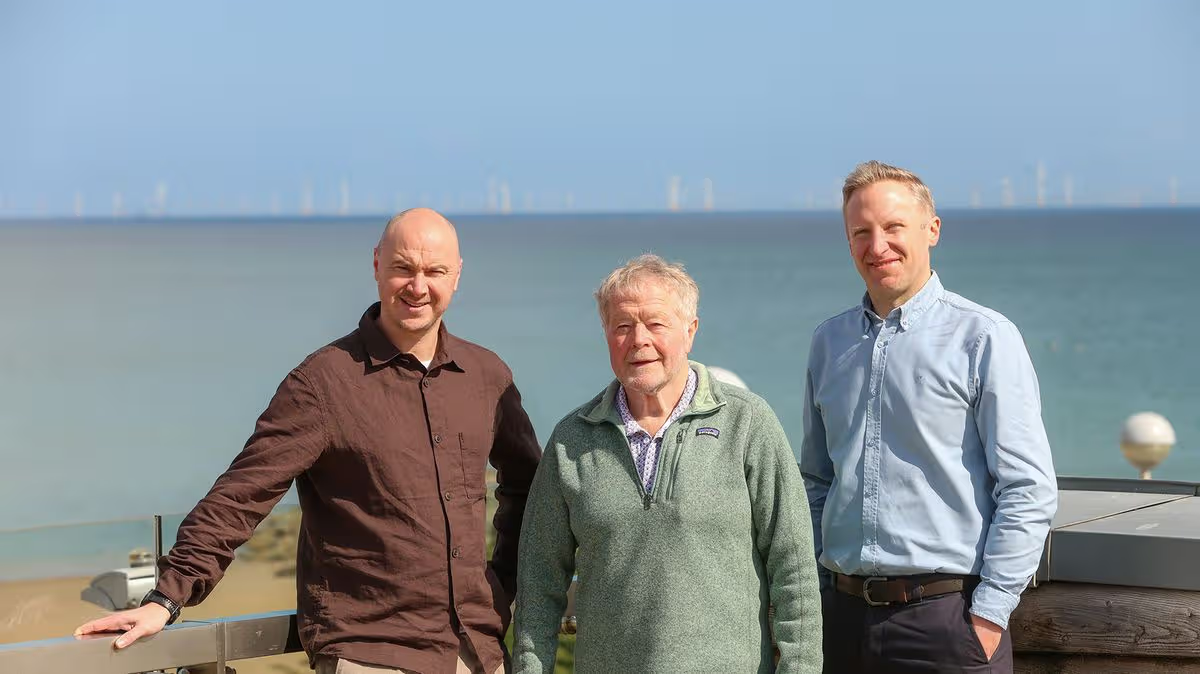
Ecodetech investment: Left to right: David Gold, founder and CEO of Ecodetect; Bobby Williams, lead Investor; Tom Preene, Fund Manager for the Wales Angel Co-Investment Fund.
Anglesey-based Ecodetech,, which specialises in AI-driven marine monitoring for offshore infrastructure, has secured a £490,000 equity investment to help scale its technology.
The funding round includes £245,000 from a six-strong angel syndicate led by Bobby Williams, a member of the M-SParc Angel Network, which also included £25,000 from climate-focused investor OnePlanet Capital. This has been matched by another £245,000 from the Wales Angel Co-Investment Fund, managed by the Development Bank of Wales.
The equity investment will help the business strengthen its team over the next six months, with four new jobs being created, and increase its ability to deliver its technology at scale as offshore and floating renewable energy projects expand.
The new roles are expected to be created over the next six months, with the business looking to recruit from the local area wherever possible as it builds its capability in marine monitoring, AI and offshore renewables.
Advertisement
Based at M-SParc in Ecodetect has developed an advanced ecology detection toolkit that combines artificial intelligence and machine learning with specialist programming to automatically identify and record wildlife interactions with marine infrastructure using data captured by underwater imaging sensors. Its core customers are renewable energy developers, who must monitor and report environmental impacts as part of project licensing and compliance requirements.
The company says the latest investment will allow it to expand in parallel with the wider renewable energy market, where developers are moving from small numbers of turbines to larger-scale installations that generate large volumes of environmental monitoring data. The funding will also support further technology development, including marine communication systems designed to improve how data is transmitted, processed and analysed.
Founded and led by managing director Dr David Gold, Ecodetect brings together three key areas of expertise: offshore and renewable energy, marine wildlife, and advanced technology including AI.
Dr Gold has a background in the energy sector and has built the business around the goal of helping renewable energy developers meet environmental obligations more efficiently while supporting marine conservation. The wider team combines technical, scientific and commercial capability, with the business already recognised for eco-tech innovation in the UK and Europe.
Advertisement
The company is targeting growth in offshore wind, floating wind and tidal energy, including opportunities emerging in Welsh waters. It also sees wider applications for its marine monitoring technology across other sectors including aquaculture, fishing and broader marine infrastructure.
Dr Gold, founder and managing director of Ecodetect, said:“This investment gives us the platform to grow the team, strengthen our technology and make sure we are ready to support the rapid expansion of offshore and floating renewables. There is huge momentum building in the sector and a clear need for robust, scalable monitoring solutions that can keep pace with that growth.
“We are proud to be building this business in North Wales. We want to create high-quality local jobs, contribute to the green economy and develop technology here in Wales that can be deployed internationally.”
Advertisement
Bobby Williams, lead investor, said:“Ecodetect is working at the intersection of AI, marine science and renewable energy at exactly the right time. The business has developed a compelling solution to a real and growing challenge for offshore developers, and David has built a company with strong technical foundations and clear market relevance.
“I’m pleased to be joining the board and supporting the next stage of the company’s growth as it scales its capability and builds its presence in a sector with significant long-term potential.”
Tom Preene, fund manager for the Wales Angel Co-Investment Fund, said:“Ecodetect is a strong example of the kind of innovative Welsh business attracting investment from angel investors that the Wales Angel Co-Investment Fund is designed to support. The company is developing specialist technology in a sector with clear global demand, while also creating skilled jobs and contributing to the growth of Wales’ green economy.
“This investment also shows the value of bringing together experienced angel investors and public capital to help ambitious businesses build the capacity they need to scale.”
Advertisement
Pryderi ap Rhisiart, M-SParc’s managing director, said: “Ecodetect’s success reflects the strength of the innovation ecosystem we are continuing to build at M-SParc. From early support through to investment, scale-up and global opportunity, this is a great example of how ambitious businesses can grow here on Anglesey. It’s particularly encouraging to see connections through our wider network, including angel investors, playing a role in this journey. Supporting companies like Ecodetect to scale from North Wales while creating high-value local jobs is exactly what we are here to do.”
Foreign institutional investors have sold Indian equities on nearly 150 of the last 240 trading sessions, a pattern that says as much about global capital flows as it does about the changing structure of Indian markets. The numbers show that foreign investors have been net sellers on roughly three out of every five market days over the past year.
That is not a one-off reaction to elections, earnings misses or a single geopolitical event. It points to a sustained reassessment of India by global money managers at a time when oil prices are rising, the rupee is under pressure, US bond yields are climbing and the global technology trade is pulling capital back toward developed markets.
The intensity of the selling has also picked up sharply in recent months. The biggest single-day outflow during the period came on April 2, 2026, when FIIs sold a net Rs 19,837 crore worth of Indian equities. That was followed by a cluster of heavy selling days in March, including Rs 11,299 crore on March 24, Rs 10,966 crore on March 20, and Rs 10,827 crore on March 16.
Another major selloff was seen on May 21 last year, when foreign investors pulled out over Rs 10,000 crore in a single session.
Advertisement
Most of the heavy selling has come since tensions in West Asia escalated earlier this year, pushing crude oil prices sharply higher and reviving concerns about India’s macroeconomic stability. Since the conflict intensified, foreign investors have pulled out more than Rs 1 lakh crore from Indian equities, while the Nifty has corrected over 9% from its recent highs.
Live Events
For a country that imports more than 80% of its crude requirement, every sustained rise in Brent crude increases India’s import bill, widens the current account deficit and creates inflationary pressure across the economy. When oil moves toward $100-115 a barrel, as it has in recent weeks, foreign investors start reassessing not just earnings forecasts but the broader macro picture. That pressure is now visible in the currency market as well. The rupee recently slipped beyond 95 against the US dollar, touching record lows. For dollar-based investors, that creates another problem. Even if Indian equities deliver returns in local currency terms, those gains can be reduced or even erased once translated back into dollars.At the same time, the global interest rate environment has become less supportive for emerging markets. The US 10-year Treasury yield moving toward 4.5% has significantly changed the risk-reward equation. When investors can earn close to 4.5% in dollar assets with virtually no credit risk, they become more selective about paying premium valuations in emerging markets.
India, despite the recent correction, still trades at a premium compared with most major Asian peers. Global investors today are not looking at India in isolation. They are comparing Indian valuations with markets such as South Korea, Taiwan and even parts of China, where earnings multiples are lower and, in some cases, currency risks are less pronounced.
That valuation gap has become harder to justify at a time when global money is chasing another powerful theme — artificial intelligence.
VK Vijayakumar, Chief Investment Strategist at Geojit Investments, says the AI-driven shift in global capital is becoming an important force behind FII behaviour.
Advertisement
“The continuing momentum in the AI trade implies that FIIs will continue to sell in India. This might keep largecaps under check with activity moving significantly to the broader market,” he said. He believes even political triggers or domestic sentiment rallies may not be enough to reverse that trend immediately.
“Any rally triggered by domestic political developments will be used by FIIs to sell more. The global AI trade will continue to weigh on markets in the near term,” Vijayakumar added.
That helps explain an unusual market trend seen this year. Even as FIIs continue to exit, several smallcap and midcap stocks have delivered strong gains, supported by domestic institutional investors and retail participation. In April alone, the Nifty Smallcap index staged one of its strongest monthly rebounds in nearly two decades.
This is where the story of Indian markets has changed. A decade ago, selling on 150 out of 240 trading days by foreign investors would likely have triggered a much deeper market correction. Today, domestic institutional investors have become an equally powerful force.
Advertisement
Mutual fund SIP inflows, insurance money and pension allocations have created a steady domestic liquidity base. That domestic money has absorbed a significant portion of foreign selling and prevented sharper drawdowns in benchmark indices.
This does not mean foreign money has stopped mattering. FIIs still dominate largecap price discovery, currency sentiment and sector leadership. But the market is no longer entirely dependent on them for direction.
Analysts say the current phase should not be interpreted as foreign investors giving up on India. It is more accurately described as a period of “risk recalibration.”
Bajaj Broking believes the next phase of institutional flows will be driven largely by global macro developments rather than domestic headlines. The brokerage said developments in US-Iran negotiations, central bank commentary from the Federal Reserve and the Bank of Japan, and movements in global energy prices will remain the key variables influencing institutional activity.
Advertisement
Oil prices need to cool. The rupee needs to stabilise. And US bond yields need to stop climbing. Until then, foreign investors may continue doing what they have done on 150 of the last 240 trading days — selling selectively, especially into strength.
(Disclaimer: Recommendations, suggestions, views and opinions given by the experts are their own. These do not represent the views of Economic Times)
























































You must be logged in to post a comment Login