Connect with us
DAPA Banner
DAPA Coin
DAPA
COIN PAYMENT ASSET
PRIVACY · BLOCKDAG · HOMOMORPHIC ENCRYPTION · RUST
ElGamal Encrypted MINE DAPA
🚫 GENESIS SOLD OUT
DAPAPAY COMING

Business

Universal Music Group declines Pershing Square proposal

Published

on

Universal Music Group declines Pershing Square proposal


Universal Music Group declines Pershing Square proposal

Continue Reading
Click to comment

You must be logged in to post a comment Login

Leave a Reply

Business

Natera, Inc. (NTRA) Presents at Goldman Sachs 47th Annual Global Healthcare Conference 2026 Transcript

Published

on

OneWater Marine Inc. (ONEW) Q1 2026 Earnings Call Transcript

Natera, Inc. (NTRA) Goldman Sachs 47th Annual Global Healthcare Conference 2026 June 8, 2026 9:20 AM EDT

Company Participants

Mike Brophy – Chief Financial Officer

Conference Call Participants

Advertisement

Elizabeth Koslosky – Goldman Sachs Group, Inc., Research Division

Presentation

Elizabeth Koslosky
Goldman Sachs Group, Inc., Research Division

Advertisement

All right. Thank you. Well, good morning, everyone. I’m Evie Koslosky, the Life Science Tools and Diagnostics Analyst here at Goldman Sachs. And I’m joined here today by Mike Brophy, CFO of Natera.

Mike Brophy
Chief Financial Officer

Good morning. Thanks for having me.

Advertisement

Question-and-Answer Session

Elizabeth Koslosky
Goldman Sachs Group, Inc., Research Division

Advertisement

Of course. So I guess just to start things off, you came off a really strong Q1. You cleared the 1 million unit milestone for the first time in a single quarter, raised full year revenue guide. Maybe walk us through a high level what you saw in the quarter and then how things have changed since then?

Mike Brophy
Chief Financial Officer

Yes. Well, we had a great quarter. I mean, we had another record Signatera volume growth quarter. We had an absolutely massive women’s health quarter as a record on a number of different levels just in terms of volumes. Realized pricing was outstanding across the board, COGS per unit was actually outstanding across the board, if you look at the specific unit economics and the COGS per test that we delivered, had a very strong set of data that we just released at ASCO, I guess, last weekend, circa last weekend, that was very encouraging. So we’re on a fantastic trajectory here.

Advertisement

Looking into the rest of the year, we significantly bumped the revenue guide. We bumped the gross margin guide. We even bumped the R&D guide this year, which I viewed as a positive because what that meant was that

Advertisement
Continue Reading

Business

Bank of Dave star Dave Fishwick says OBE is ‘just unbelievable’

Published

on

Business Live

Entrepreneur who inspired Netflix film named in King’s Birthday Honours list for services to finance, business and charity

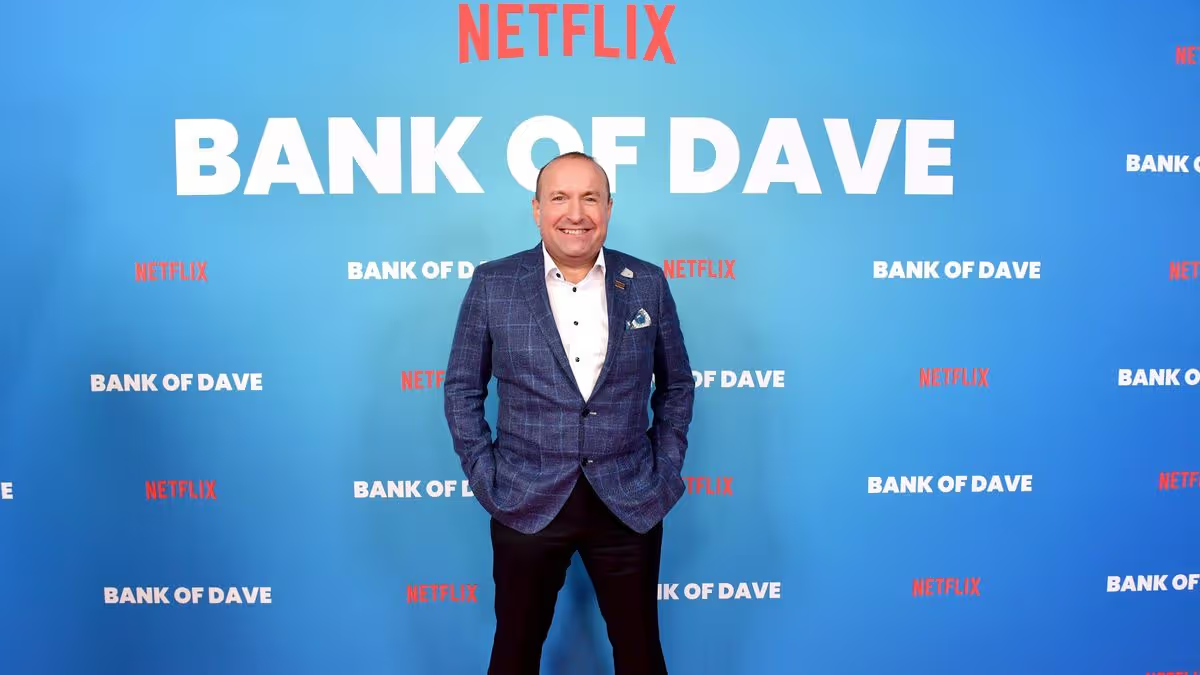
Dave Fishwick attends the world premiere of Netflix's "Bank of Dave" on January 15, 2023 in Burnley

Dave Fishwick attends the world premiere of Netflix’s “Bank of Dave” on January 15, 2023 in Burnley(Image: Getty Images for Netflix)

Entrepreneur Dave Fishwick, the inspiration behind Netflix’s Bank of Dave film, has credited self-belief and determination as the driving forces behind his success after he was made an Officer of the Order of the British Empire (OBE).

Advertisement

Fishwick was raised in a working-class family in Nelson, Lancashire, before amassing his fortune through minibus sales and subsequently establishing an independent lending firm to help people in the wake of the 2008 financial crisis.

Upon learning of his inclusion in the King’s Birthday Honours list on Friday, the 55 year old businessman-turned-philanthropist said: “It’s just wonderful that His Majesty the King has spent some time looking at what we’ve been doing and seen fit to award us an OBE.

“It’s just unbelievable. And from a lad from Burnley, who set off with absolutely no qualifications whatsoever – I left school at 16, absolutely useless.”

Upon leaving school, Mr Fishwick had little option but to head straight into labouring on building sites for just under £30 a week. He kept three jobs on the go simultaneously, selling clothes at Smithfield Market in Manchester each morning, working on building sites during the day, and spinning records at nightclubs in the evenings.

Advertisement

Mr Fishwick harboured ambitions of working with cars, but couldn’t stretch to even a gallon of petrol. Undeterred, he toured dozens of garages seeking old part-exchange vehicles he could take away, renovate and sell, retaining a share of the proceeds.

“I did it again and again, and that just shows sometimes you’ve got to think outside the box, because you can start with absolutely nothing, and it’s not where you start that matters, it’s where you finish that counts,” he told the Press Association.

“This award from the King just shows that if you put your mind to it, you can achieve anything, and you can come from the north, you really can come from the north of England and still have opportunities like lots of people do in the south.”

He was honoured with his OBE for services to finance, business and charitable causes.

Advertisement

Mr Fishwick established Burnley Saving and Loans in 2011, with the tale of its success and his investigations into loan sharks forming the basis of 2023’s Bank of Dave, featuring Rory Kinnear, alongside its 2025 follow-up Bank of Dave 2: The Loan Ranger.

“If Dave from Burnley with absolutely nothing can make it happen, then you can too,” he said.

“So it’s really important that we get the message out that if you put your mind to it, self-belief, determination.”

Bank of Dave's Dave Fishwick outside his building society in Burnley, Lancashire

Bank of Dave’s Dave Fishwick outside his building society in Burnley(Image: Channel 4)

The proceeds from Burnley Savings and Loans, which operates under the tagline “Bank on Dave”, support worthy causes, predominantly throughout Lancashire.

Advertisement

Mr Fishwick attributes his ongoing achievements to his “right-hand man” David Henshaw, his wife Nicky and the production team behind Bank of Dave, as he embarks on fresh ventures, including becoming ambassador for 6,000 community banks across America.

When questioned about his future plans, Mr Fishwick expressed his desire to maintain his advocacy work and distribute financial guidance. He also revealed he had been approached to appear on Strictly Come Dancing – though confessed he has no dancing ability whatsoever.

“I’ve been offered the jungle (I’m a Celebrity… Get Me Out Of Here! ) and lots of other things, but that’s not something I’d want to do,” he said.

“But the dancing, I’m thinking maybe next time, because that just sounds fun, doesn’t it?”.

Advertisement
Continue Reading

Business

Tom Hanks Opposes New Oscar Category for Voice Acting Performances

Published

on

Taylor Swift

LOS ANGELES — Tom Hanks has voiced opposition to creating a dedicated Oscar category for voice actors, arguing instead that exceptional vocal performances should compete directly in the best actor and best actress categories.

The two-time Academy Award winner made the comments while promoting Disney and Pixar’s “Toy Story 5,” in which he reprises his iconic role as Woody. Speaking with Gold Derby, Hanks emphasized that the existing acting categories already provide sufficient recognition for performances that move audiences, regardless of whether they appear on camera.

“I think they have enough categories,” Hanks said about the Oscars. “The truth is, truly, a voice actor can win Best Actor. The judgment is ‘any performance that moved you.’”

He cited examples of actors who have come close to recognition without traditional on-screen appearances, including Andy Serkis, whose motion-capture work as Gollum in “The Lord of the Rings” films generated significant awards discussion. Hanks noted that pure vocal performances should be eligible under the same criteria applied to all acting work.

Advertisement

“If they are moved, that means they are moved by a human being’s performance. That’s all the requirement,” Hanks added.

Historical Context and Precedents

The Academy of Motion Picture Arts and Sciences has never nominated a voice-only performance in the lead or supporting acting categories. Scarlett Johansson generated considerable Oscar buzz for her voice role in Spike Jonze’s 2013 film “Her,” which ultimately won best original screenplay, but she was not nominated for acting. Similarly, motion-capture performances have struggled for recognition despite critical acclaim.

Zoe Saldaña, who portrays Neytiri through performance-capture technology in James Cameron’s “Avatar” franchise, has spoken about the oversight. In 2024, she told The Independent that longstanding traditions within the Academy make change difficult. “Old habits die hard, and when you have old establishments, it’s really hard to bring forward change,” Saldaña said. “And I understand that, so I’m not bitter about it, but it is quite deflating when you give 120% of yourself into something.”

Advertisement

Cameron has been equally vocal in support of Saldaña’s work, telling Variety in 2024 that her contributions equal those of traditional Academy Award-winning actors. “I’ve worked with Academy Award-winning actors, and there’s nothing that Zoe’s doing that’s of a caliber less than that,” Cameron said. “But because in my film she’s playing a ‘CG character,’ it kind of doesn’t count in some way, which makes no sense to me whatsoever.”

Hanks, who won best actor for “Philadelphia” in 1993 and “Forrest Gump” in 1994, brings particular credibility to the discussion. He received an Annie Award nomination for his voice work as Woody in the original “Toy Story” in 1995 but has never been recognized by the Oscars for the role despite the character’s cultural impact.

Broader Debate on Acting Recognition

The conversation reflects ongoing discussions within the film industry about how to honor evolving performance techniques. Motion capture and voice acting have become increasingly sophisticated, blurring traditional lines between live-action and animated work. Proponents of new categories argue they would provide appropriate recognition for specialized skills, while opponents like Hanks contend that strong performances should compete on merit regardless of delivery method.

Advertisement

The Academy has expanded categories over time to reflect industry changes, including best animated feature and various technical honors. However, the core acting categories have remained largely consistent, focusing on performances that audiences experience as human characters, whether captured traditionally or through advanced technology.

Critics of the current system point to cases where groundbreaking work in voice or performance capture has been overlooked, potentially discouraging innovation in storytelling methods. Supporters of maintaining the status quo emphasize the importance of preserving the integrity of acting awards as celebrations of human emotion and craft.

Implications for “Toy Story 5” and Animation

Hanks’ comments come as “Toy Story 5” prepares for its theatrical release on June 19. The film continues the beloved franchise that helped establish Pixar’s reputation for emotional storytelling through computer animation. Hanks has voiced Woody across all installments, contributing significantly to the character’s enduring appeal.

Advertisement

The franchise’s success demonstrates the power of voice performances to connect with audiences across generations. While unlikely to compete in traditional acting categories, the films have earned multiple Oscar nominations and wins in animated feature and technical categories.

Industry observers note that voice actors in major animated releases often deliver performances comparable in depth and nuance to live-action roles. The emotional range required to convey complex characters through voice alone represents a distinct but equally demanding skill set.

Academy’s Position and Future Considerations

The Academy has not publicly responded to recent calls for new acting categories. Its awards structure undergoes periodic review, with changes typically driven by member consensus and industry evolution. Any proposal for a voice acting or motion-capture category would require broad support and careful definition of eligibility criteria.

Advertisement

Past expansions, such as the introduction of best animated feature in 2001, show the organization’s willingness to adapt. However, core acting categories have proven more resistant to subdivision, maintaining focus on overall performance impact rather than technical delivery methods.

Industry Reactions and Perspectives

Voices across Hollywood have weighed in on the debate. Some actors and directors support greater recognition for non-traditional performances, arguing it would encourage creative risk-taking and technical excellence. Others worry that additional categories could dilute the prestige of existing honors or create unnecessary fragmentation.

Hanks’ stance carries particular weight given his stature and personal experience with voice work. His belief that strong vocal performances should compete directly challenges assumptions about what constitutes eligible acting and invites further industry conversation.

Advertisement

Looking Ahead

As “Toy Story 5” approaches release, Hanks’ comments add an intriguing layer to discussions about performance recognition in modern cinema. The film’s success will likely renew attention on the contributions of voice actors in animated features, even if Oscar eligibility remains limited to existing categories.

The broader debate reflects cinema’s ongoing evolution. As technology advances and storytelling methods diversify, awards bodies face the challenge of balancing tradition with innovation. Hanks’ perspective offers one viewpoint in a conversation that is likely to continue as more performers deliver compelling work outside traditional parameters.

For now, the two-time Oscar winner maintains that existing categories suffice when performances truly move audiences. “We’ve talked about, for example, Andy Serkis,” Hanks said. “Even though he does not appear as Andy Serkis, he gives all the raw material to it. There’s been people who have been close to being nominated that do not appear on camera. That could happen to a pure-vocal actor.”

Advertisement

The Academy’s next awards cycle will provide another opportunity to observe how voters respond to innovative performances across all formats. Whether voice and motion-capture work gains greater recognition remains an open question, but Hanks’ clear position adds a prominent voice to the discussion.

As the film industry continues evolving, conversations about how best to celebrate excellence in acting will remain central. Hanks’ comments while promoting “Toy Story 5” serve as a timely reminder that emotional impact, rather than technical delivery, should ultimately define great performances.

Continue Reading

Business

What’s happening with the contested ballots in Peru’s election?

Published

on

What’s happening with the contested ballots in Peru’s election?


What’s happening with the contested ballots in Peru’s election?

Continue Reading

Business

Fidelity Investments Down? Service Faces Widespread Outages Disrupting Trading and Account Access

Published

on

A Fidelity Investments store logo is pictured on a building in Boca Raton, Florida March 19, 2016.

NEW YORK — Fidelity Investments experienced significant service disruptions on Friday, with users across the United States reporting difficulties logging into accounts, accessing the mobile app and executing trades as outage tracking sites recorded elevated complaint volumes.

The problems affected core platform functions, including website access, account dashboards and trading capabilities. Many customers encountered login errors, loading failures and temporary unavailability of portfolio information during what is typically a busy trading period.

Downdetector and other monitoring services showed spikes in reports, with login issues, app malfunctions and website problems among the most commonly cited complaints. The outages appeared widespread but not universal, impacting a substantial number of retail and institutional users relying on Fidelity for investment management and brokerage services.

Details of the Disruptions

Advertisement

Users reported being unable to log in, with some seeing error messages related to technical issues or third-party browser plugins. Fidelity acknowledged problems on its site, advising customers to try incognito mode or alternative browsers while the company worked on a resolution. Charting and trading features were among the most affected services, according to multiple reports.

The timing coincided with active market hours, potentially complicating account monitoring and trade execution for investors. Some users noted intermittent access, while others faced complete outages lasting for extended periods.

Fidelity has not yet released a detailed statement on the root cause. Past similar incidents at major brokerages have been attributed to high traffic, technical glitches or infrastructure updates. The company typically resolves such issues promptly and provides post-incident explanations.

Impact on Customers

Advertisement

The disruptions affected both individual retail investors and those managing retirement accounts or institutional portfolios. Many expressed frustration on social media, particularly those needing real-time access during market volatility. Small business owners and financial advisors using Fidelity platforms for client services also reported challenges.

The outage highlights the critical role major brokerages play in everyday investing and the potential consequences of service interruptions. Fidelity, one of the largest U.S. financial services firms, manages trillions in customer assets and serves millions of accounts.

Broader Context for Brokerage Reliability

Major brokerages including Fidelity, Charles Schwab and others have faced occasional outages in recent years, often during periods of high market activity. These events have prompted increased scrutiny of platform resilience and backup systems as more investors shift to digital trading.

Advertisement

Regulatory bodies encourage firms to maintain robust contingency plans, though complete prevention of technical issues remains challenging given the complexity of modern trading infrastructure. Fidelity has historically invested heavily in technology to support its growing customer base and expanding service offerings.

Company Response and Recovery Efforts

Fidelity advised affected users to attempt basic troubleshooting steps while its technical teams addressed the underlying problems. Customers were encouraged to contact support for assistance with urgent needs. In previous outages, the firm has communicated updates through its website, app notifications and social channels.

Full restoration of services was expected as engineers implemented fixes. Users were urged to exercise patience and avoid repeated login attempts that could add strain during recovery.

Advertisement

Investment and Market Implications

While temporary, such outages can create inconvenience and, in extreme cases, missed trading opportunities. Most brokerages maintain phone-based support and alternative access methods during platform disruptions. Long-term, these incidents reinforce the importance of diversified access points and contingency planning for investors.

Fidelity’s platforms support a wide range of services including brokerage accounts, retirement planning, wealth management and institutional offerings. The company’s scale makes reliability particularly important for maintaining customer trust.

Looking Ahead

Advertisement

As services return to normal, Fidelity is likely to conduct a full review to prevent similar issues. Customers can monitor official channels for updates and post-incident reports. The event serves as a reminder for investors to maintain awareness of alternative contact methods and backup platforms.

Friday’s outage at Fidelity Investments disrupted access for many users during active market hours. While the company works toward full restoration, the incident underscores both the convenience and vulnerability of digital financial services in today’s interconnected environment. Investors are encouraged to stay informed through official sources as normal operations resume.

The broader financial industry continues advancing platform reliability, but occasional disruptions remain part of operating large-scale digital systems. Fidelity’s response and recovery will be watched closely by customers and industry observers alike.

Advertisement
Continue Reading

Business

Nasdaq Edges Higher to 25,822 as Tech Sector Shows Modest Resilience

Published

on

The Nasdaq logo is displayed at the Nasdaq Market site in Times Square in New York

NEW YORK — The Nasdaq Composite Index posted a slight gain on Friday, rising 12.47 points or 0.05% to close at 25,822.13 as selective buying in technology and communication services stocks offset broader market caution.

The modest advance reflected a balanced session in which investors weighed ongoing corporate earnings reports against persistent macroeconomic uncertainties and geopolitical developments. While gains were limited, the index maintained stability near recent levels, underscoring underlying resilience in growth-oriented sectors amid mixed signals from the broader economy.

Sector Dynamics and Leadership

Technology names provided the primary support, with several large-cap constituents reporting steady progress in artificial intelligence initiatives and cloud computing demand. Communication services also contributed positively as investors rotated into areas perceived as having durable growth characteristics.

Advertisement

The session showed signs of selective participation rather than broad momentum. While mega-cap technology companies anchored the index gain, smaller growth names exhibited more varied performance depending on individual earnings outcomes and forward guidance. Defensive sectors offered relative stability as traders navigated a complex backdrop.

Earnings Season Influence

Corporate results continued to shape market direction. Several Nasdaq-listed companies delivered results that aligned with or exceeded expectations, particularly in software, semiconductors and digital services. Forward-looking commentary in key areas remained constructive, helping alleviate some concerns about margin pressures and demand softness.

However, certain segments faced scrutiny over execution risks and competitive dynamics. The overall tone of earnings season has been mixed but generally supportive of current valuations in growth sectors, with many executives citing stable enterprise spending and innovation pipelines.

Advertisement

Macroeconomic and Policy Backdrop

Persistent inflation concerns remained a key variable. The May Consumer Price Index report showed headline inflation at 4.2% year-over-year, largely driven by energy costs, while core measures stayed closer to the Federal Reserve’s target range. This balance has kept expectations for near-term rate cuts subdued but preserved the possibility of easing later in the year.

The Federal Reserve’s upcoming policy meeting will be closely watched, with markets pricing in a high probability of rates remaining unchanged. Any signals of data-dependent flexibility could support risk assets, particularly those sensitive to borrowing costs.

Geopolitical developments, including ongoing tensions in the Middle East, added another layer of uncertainty but did not derail the session’s modest gains. Energy prices stabilized, providing limited spillover into broader technology-focused sentiment.

Advertisement

Technical and Sentiment Indicators

The Nasdaq remained well above key support levels but continued to encounter resistance near recent highs. Technical indicators suggested the index was in a consolidation phase within a longer-term uptrend. Options activity reflected measured positioning, with implied volatility contained but not at extremes.

Investor sentiment improved modestly, supported by corporate earnings resilience. Institutional flows appeared balanced, with selective accumulation in quality growth names. However, many participants remained wary of potential surprises in upcoming economic data releases.

Global Market Influence

Advertisement

International markets posted mixed results overnight, with European indexes showing modest gains and Asian markets closing with varied performance. The U.S. dollar traded in a relatively stable range, reflecting balanced global risk perceptions.

Commodity prices, particularly in metals and energy, influenced related sectors but had limited direct impact on the Nasdaq’s technology-heavy composition. Currency movements affected multinational earnings outlooks for companies with significant international exposure.

Analyst and Strategist Views

Wall Street analysts maintain a generally constructive longer-term outlook for growth stocks, citing productivity gains from artificial intelligence adoption and resilient corporate balance sheets. Near-term volatility around data releases and policy decisions is expected to continue.

Advertisement

Technology analysts emphasize the importance of execution on AI initiatives and sustainable growth. Companies demonstrating clear paths to profitable expansion in this area are likely to maintain investor favor, while those facing increased competition or execution challenges may see pressure.

Investment Implications

For investors, the current environment rewards selectivity within the technology sector. Focus on companies with strong competitive moats, visible revenue pipelines and prudent capital allocation is recommended. Diversification across growth and defensive areas can help manage volatility.

Longer-term investors may view periodic pullbacks as opportunities to add to high-quality names, while shorter-term traders monitor technical levels and upcoming catalysts closely. Risk management remains essential given the potential for sharp moves around key events.

Advertisement

Broader Market Perspective

The Nasdaq’s modest advance reflects a market attempting to balance optimism around technological innovation with realism about macroeconomic challenges. Corporate America’s ability to deliver earnings growth despite higher costs has provided support, but sustained progress will depend on the trajectory of inflation and consumer spending.

As the second half of 2026 unfolds, focus will remain on the interplay between AI investment cycles, monetary policy decisions and global economic developments. The technology sector’s performance will continue influencing broader market sentiment given its significant index weighting.

Looking Ahead

Advertisement

Markets will continue monitoring upcoming economic releases, including retail sales and further inflation metrics. Corporate earnings season remains in focus, with additional reports expected to shape sentiment in the days ahead.

The Nasdaq’s ability to hold recent gains will be an important technical test. As the trading week concludes, participants will parse new information for signals on sustainability of current valuations and growth prospects.

Friday’s incremental progress leaves the index well-positioned after recent consolidation. Many analysts view current levels as supported by fundamentals, though execution risks and external shocks could introduce volatility in coming sessions.

The session’s activity underscores the market’s capacity to absorb news and find buying opportunities amid a complex backdrop. Investors remain attentive to both risks and opportunities as the year advances.

Advertisement

Overall, the Nasdaq’s modest gain reflects measured optimism as traders balance enthusiasm for innovation with awareness of inherent uncertainties in the current environment. The coming weeks will provide further clarity on corporate momentum and policy direction.

Continue Reading

Business

Ryerson Holding Corporation (RYZ) Presents at 16th Annual Wells Fargo Industrials & Materials Conference – Slideshow

Published

on

OneWater Marine Inc. (ONEW) Q1 2026 Earnings Call Transcript

Ryerson Holding Corporation (RYZ) Presents at 16th Annual Wells Fargo Industrials & Materials Conference – Slideshow

Continue Reading

Business

Falcon’s Beyond Global elects directors and ratifies auditor at annual meeting

Published

on


Falcon’s Beyond Global elects directors and ratifies auditor at annual meeting

Continue Reading

Business

Banking leader Sir Jon Cunliffe made Knight Grand Cross in King’s Birthday Honours

Published

on

Business Live

Sir Jon’s career spans politics, economics and diplomacy, as well as leading water sector reform as chairman of the Independent Water Commission

Sir Jon Cunliffe, deputy governor for financial stability at the Bank of England

Sir Jon Cunliffe was deputy governor for financial stability at the Bank of England

A leading financier who helped navigate the country through the 2008 financial crisis and is now championing a reform of the water industry, has been made a Knight Grand Cross of the Order of the British Empire (GBE).

Advertisement

Sir Jon Cunliffe has been honoured in the King’s Birthday Honours list in recognition of his public service throughout a distinguished career spanning politics, economics and diplomacy. The honour is the highest rank in many of the Orders of the British Empire.

He features on the list in his current capacity as chairman of the Independent Water Commission, which is working to drive much-needed reform across the struggling water sector in England and Wales.

Privately-owned water companies have faced mounting criticism in recent years over pollution levels, rising bills and executive bonuses.

Sir Jon produced a review into the industry, published last year, which set out wide-ranging recommendations for overhauling water regulation and attributed blame to the Government for failing to provide sufficient direction.

Advertisement

Before taking up that role, Sir Jon held a central position within the UK economy as deputy governor for financial stability at the Bank of England for a decade until 2023, during which time he also served on the committee responsible for setting interest rates.

The 73 year old previously occupied senior government positions as an adviser to former prime minister Gordon Brown between 2007 and 2011. This involved close collaboration with the PM during the depths of the financial crisis, providing counsel on European and international matters and conducting discussions at G8 and G20 summits.

He has also worked at the Treasury and at the Department of Transport, and studied at the University of Manchester. He was appointed a Companion of the Order of the Bath in the New Year Honours 2001, and made a Knight Bachelor in the New Year Honours 2010.

Advertisement
Continue Reading

Business

Delta Passenger Indicted for Slapping Flight Attendant’s Buttocks During In-Flight Service

Published

on

Delta Air Lines

ATLANTA — A 32-year-old man has been federally indicted for interfering with a flight crew member after a Delta Air Lines flight attendant reported that he slapped her on the buttocks during beverage service on a May 9 flight from Fort Lauderdale to Los Angeles, prompting an emergency diversion to Atlanta.

Cody James Maluck faces one count of interference with crew members or attendants, a charge that carries a maximum penalty of 20 years in prison if convicted. A federal grand jury in Atlanta returned the indictment on June 9, according to court records.

The incident occurred aboard Delta flight 800 while the aircraft was en route. According to a criminal complaint filed in the U.S. District Court for the Northern District of Georgia, the flight attendant, identified as “P.L.L.,” was performing beverage service when she felt a slap to her buttocks with enough force to cause her body to move forward.

P.L.L. immediately turned around and saw Maluck raising his hands and stating words to the effect of, “I didn’t do anything.” Another flight attendant reported hearing P.L.L. yell and seeing her body move as if she had been struck or pushed. Crew members then suspended in-flight service, and the pilot diverted the aircraft to Hartsfield-Jackson Atlanta International Airport.

Advertisement

Upon landing, Atlanta Police Department officers met the plane and detained Maluck. He was later arrested and taken to the Atlanta City Detention Center. The case was referred to the FBI for investigation.

Maluck’s Account and Legal Proceedings

According to the complaint, Maluck told investigators he was wearing headphones and did not hear anyone offering beverages. He admitted touching the flight attendant’s buttocks area but claimed he did not slap her hard enough to move her forward. Maluck stated he was trying to get her attention and did not mean to harm or disrespect her.

Federal prosecutors allege the actions constituted interference with crew members performing their duties. The charge is part of broader efforts to address unruly behavior on commercial flights, which has been a persistent concern for airlines and regulators.

Advertisement

Maluck’s arraignment and further court proceedings are pending. The U.S. Attorney’s Office for the Northern District of Georgia is prosecuting the case. The Atlanta Police Department declined to comment, referring inquiries to federal authorities. The FBI office in Atlanta did not immediately respond to requests for comment.

Delta’s Response and Zero-Tolerance Policy

Delta Air Lines issued a statement emphasizing its commitment to passenger and crew safety. “We have zero tolerance for disruptive or unruly behavior,” a company spokesperson said. “We will always cooperate with law enforcement to address such conduct and protect our people.”

The diversion of flight 800 highlights the operational impact of such incidents. Airlines must prioritize safety and crew well-being, often resulting in schedule disruptions, additional costs and passenger inconvenience when flights are rerouted.

Advertisement

Rising Trend of Unruly Passenger Incidents

The Federal Aviation Administration has recorded 687 reports of unruly passengers in 2026 so far, with 33 enforcement actions initiated. These figures reflect ongoing challenges in maintaining order aboard commercial aircraft despite enhanced training and reporting mechanisms.

A separate high-profile incident on May 31 involved a Frontier Airlines passenger who allegedly tried to open an exit door mid-flight and choke an off-duty flight attendant, leading to an emergency landing and misdemeanor battery charges. Such events have prompted airlines to strengthen policies and collaborate more closely with law enforcement.

Legal Framework for In-Flight Offenses

Advertisement

Interference with flight crew members is a serious federal offense under U.S. law, designed to protect aviation safety. Prosecutors must demonstrate that the actions impeded or interfered with crew duties. Penalties can be severe, especially when physical contact is involved.

Cases like Maluck’s often hinge on witness statements from crew members and any available video evidence from cabin cameras. The swift response by the pilot in diverting the flight to Atlanta underscores standard protocol for ensuring safety when crew members report threats or assaults.

Broader Industry Efforts to Combat Disruptions

Airlines have implemented various measures to address unruly behavior, including de-escalation training for crew, increased security presence at gates and stricter enforcement of mask and conduct policies where applicable. Trade groups such as Airlines for America have advocated for consistent prosecution of disruptive passengers to deter future incidents.

Advertisement

The FAA continues to track and publicize enforcement actions, aiming to raise awareness and encourage reporting. Despite these efforts, incidents persist, often linked to alcohol consumption, stress or disputes over seating and service.

Impact on Flight Attendants and Crew

Flight attendants operate in a confined environment where maintaining authority and passenger cooperation is essential for safety. Physical assaults, even seemingly minor ones, can have lasting effects on crew members and undermine the professional environment required for safe operations.

Industry unions have called for stronger protections and faster legal responses to incidents involving crew. The Delta case adds to ongoing conversations about workplace safety for aviation professionals who face public-facing roles in high-pressure settings.

Advertisement

Public and Industry Reaction

The incident has drawn attention to the challenges airlines face in balancing customer service with crew protection. Social media discussions have been mixed, with some condemning the alleged behavior and others questioning the severity of the charge. Legal experts note that federal intervention is appropriate given the aviation context and potential safety implications.

Delta’s zero-tolerance stance aligns with industry standards and sends a clear message to passengers. Similar policies across carriers aim to create safer environments for both crew and travelers.

Looking Ahead in the Case

Advertisement

As the federal case against Maluck proceeds, prosecutors will likely present evidence from crew statements, any cabin footage and Maluck’s own admissions. Defense arguments may focus on intent and the context of the interaction.

The outcome could influence how similar incidents are handled in the future. Successful prosecution would reinforce the seriousness with which authorities view interference with flight crews.

For the aviation industry, continued vigilance and training remain essential. As passenger numbers recover and flights resume at high volumes, maintaining order and professionalism aboard aircraft is critical for safety and operational efficiency.

The Delta incident serves as a reminder that even routine flights can escalate quickly when boundaries are crossed. Crew members perform vital safety roles, and legal protections exist to ensure they can carry out their duties without fear of assault or interference.

Advertisement

Authorities continue to investigate and prosecute such cases to deter disruptive behavior and maintain confidence in commercial air travel. As this matter moves through the courts, it will provide further insight into the application of federal statutes designed to safeguard aviation operations and those who keep them running safely.

Continue Reading

Trending

Copyright © 2025