Connect with us
DAPA Banner

Business

US drivers head to Native American lands for cheaper gas

Published

on

US drivers head to Native American lands for cheaper gas

As fuel prices rise, some of the cheapest gas in the US can be found on Native American land throughout the country.

States like California, New Mexico, New York, Oklahoma, and Washington, have dozens of tribally-owned petrol stations, including some in busy travel corridors.

These territories are exempt from state fuel taxes and can sell gas for much less than competing stations nearby.

Continue Reading
Click to comment

You must be logged in to post a comment Login

Leave a Reply

Business

Prominent Perth business figures to join RFDSWA board

Published

on

Prominent Perth business figures to join RFDSWA board

Prominent business figure and former Fortescue chief executive Fiona Hick is one of four new appointees to the board of the Royal Flying Doctor Service Western Australia.

Continue Reading

Business

Quality As A Foundation In An Uncertain World

Published

on

Hercules Capital: 3 Reasons Why The Market Is Wrong (Rating Upgrade)

Quality As A Foundation In An Uncertain World

Continue Reading

Business

Judge spells out Rinehart children’s claim

Published

on

Judge spells out Rinehart children’s claim

The Supreme Court judge deciding the Hope Downs ownership battle found that Lang Hancock spelt out his wishes in 1988 that 49 per cent of Hancock Prospecting go to his grandchildren after he died.

Continue Reading

Business

Gold ETFs deliver up to 61% returns since last Akshaya Tritiya. Should you hold or book profits after the rally?

Published

on

Gold ETFs deliver up to 61% returns since last Akshaya Tritiya. Should you hold or book profits after the rally?
In India, buying gold is not just an investment—it is deeply rooted in tradition. People often purchase gold during festivals as it is associated with prosperity, good fortune, and long-term wealth. Akshaya Tritiya is one such special occasion, widely considered highly auspicious for buying gold.

Against this traditional backdrop, gold exchange-traded funds (ETFs) have also emerged as a strong modern alternative to investment in the bullion.

Gold ETFs have delivered stellar returns of up to 61% since the last Akshaya Tritiya, an analysis by ETMutualFunds showed. Market experts, however, caution that allocation discipline remains key—investors should book profits in line with their asset allocation, trimming exposure when it exceeds targets and rebalancing when it falls short.

Also Read | Mutual funds raise tech exposure in March after 8-year low. Tactical move or trend reversal?

Akshat Garg, Head – Research & Product of Choice Wealth, shared with ETMutualFunds that align profit booking with your long-term asset allocation: trim exposure (e.g., 20-30%) if gold now exceeds your target of 5-15%, reallocating to underweight assets like equities or debt to maintain balance without fully exiting the hedge.

Vishal Dhawan, Founder & CEO, Plan Ahead Wealth Advisors, told ETMutualFunds that on profit-booking, the more sensible lens is usually portfolio discipline, not price excitement, and after a very sharp move, tactical profit-booking can make sense if gold has moved meaningfully above the intended portfolio weight.
But for long-term investors, gold is usually held as a strategic diversifier, so exiting solely because returns were strong can defeat the role it plays in cushioning portfolios during stress, Dhawan further said.

What has driven the rally?

The sharp surge in gold ETF returns has largely been driven by multiple global factors, including geopolitical tensions, central bank buying, a softer interest rate outlook, and persistent macro uncertainty. Gold’s appeal as a safe-haven asset has strengthened as investors seek protection against volatility in equities and currencies.

Advertisement

Experts believe that while the rally has been strong, gold is benefiting from inflation-hedging demand.

Dhawan said that the rally has largely been driven by a mix of safe-haven demand, strong central-bank buying, continued geopolitical uncertainty, a softer US dollar at various points, and falling or volatile real yields, and gold is benefiting from inflation-hedging demand

To this, Garg said central bank buying, massive ETF inflows (especially in India), inflation fears from US tariffs, and global debt pressures have fueled the surge, even as Middle East tensions caused temporary dips via oil-driven USD strength—though the dollar remains range-bound at DXY approximately 98.

Since the last Akshaya Tritiya was celebrated on April 30, 2025, gold ETFs gave an average return of 59.63%. There were 20 gold ETFs in the said period, of which the Tata Gold ETF gained the most, around 60.59%.

Advertisement

Aditya Birla SL Gold ETF and ICICI Pru Gold ETF posted a return of 60.27% and 60.22%, respectively. Zerodha Gold ETF rallied 60.12%, followed by Kotak Gold ETF, which went up 60.06%.

Quantum Gold Fund ETF was the last one in the list, which gained 58.55% from April 30, 2025, to April 16, 2026.

Also Read | Mutual fund SIPs not enough for Rs 3 crore goal in 12 years? Here’s how to bridge the gap

Is the surge sustainable?

While gold ETFs have delivered impressive returns, questions remain about the sustainability of this rally. Valuations in the near term may appear stretched after such a sharp move, but structural drivers for gold remain intact.

Advertisement

According to Garg, this rally is structurally sustainable due to persistent Asian and central bank demand plus macro hedging qualities, though short-term stretches exist post-rally; long-term investors should continue SIPs targeting 5-10% allocation.

Dhawan said that flows into gold ETFs have clearly remained strong, supported in part by sharp trailing returns, though the pattern has not been linear, while the broader trend has stayed firm, there have also been signs of moderation and volatility in flows, both in India and globally which suggests that the rally is no longer a simple one-way flow story and that investor behaviour is becoming more sensitive to price levels and market conditions.

Dhawan added that valuations do appear more stretched than they were a year ago, at least from a momentum perspective. For long-term investors, continuing SIPs may still be the more disciplined approach rather than trying to time the top after a sharp rally and the key, however, is to ensure that gold remains within a planned asset-allocation framework and does not become a disproportionate driver of the portfolio simply because of recent performance.

A right time to invest?

Geopolitical tensions, which traditionally bolster gold, complicated the narrative this time. According to a report by Tata Mutual Fund, war-driven energy price spikes increased pressure on importing nations, some central banks had less room to buy gold, and countries like Turkey even sold gold reserves to stabilise their currency.

Advertisement

Central banks have been the backbone of gold’s rally since 2023. However, this does not signal a full reversal. It’s just a slowdown in buying. Overall, gold swaps by central banks are largely neutral for prices, the report further mentioned.

With gold prices being volatile, many investors are debating whether to enter now or wait for a correction. In response to this, Dhawan said that for a lump-sum investor, waiting for a correction is emotionally attractive but practically difficult, because gold rallies are often driven by unpredictable risk events. For a long-term allocator, staggered entry is generally the cleaner approach than trying to call the perfect level, which is especially true after a sharp run-up when near-term volatility risk is higher.

He further said that a strategic allocation is usually more relevant than a return-chasing allocation. In practical wealth-allocation discussions, many diversified portfolios treat around 5% to 10% as a reasonable strategic range for gold exposure, while going materially above that usually needs a stronger macro view and higher tolerance for commodity volatility, and that is a framework, not a one-size-fits-all prescription.

Garg said that this is suitable for SIP entry at these levels for patient investors; consider waiting for a 5-10% pullback if tactical and aim for 7-12% portfolio allocation, fitting Indian investors’ diversification needs amid equity volatility.

Advertisement

Historical performance

In the last six months, gold ETFs have rallied upto 21.19% with Tata Gold ETF being the top performer. In the last nine months, the gain has been upto 55%. And in the current calendar year so far, gold ETFs gained up to nearly 16%, with LIC MF Gold ETF delivering the highest return of 15.50%.

Also Read | Equity mutual fund average AUM rises 17% in FY26; flexi cap funds lead investor preference: Abakkus Mutual Fund

A rough ride in 2026

Gold and silver emerged as the standout performers till January 29, offering investors superior returns. January 2026 was a very eventful month for gold and silver. Prices of both metals went up sharply during most of the month as many investors rushed towards safe options because of uncertainty in global markets. People looked at gold and silver as protection for their money, which pushed prices higher.

Gold and silver reached very high levels, close to record prices. On January 29, Gold futures scaled fresh lifetime highs on the Multi-Commodity Exchange (MCX) and gold climbed closer to Rs 1.8 lakh per 10 grams.

Advertisement

Silver emerged better than gold in the starting month of the current calendar year because it benefits both as a precious metal and from industrial demand, which added to the buying pressure.

However, towards the end of the month, things changed quickly. Once prices became very high, many investors started selling to book profits. This caused a sudden fall in prices. On January 30, gold prices tanked as much as 12%, or Rs 20,514, in a single day on January 30, marking their worst one-day rout since March 2013, when prices had plunged 9% on the MCX.

What to expect in the next 12-18 months

Garg said that one can expect $4,000-$5,000/oz consolidation through 2026-27, backed by policy easing, steady demand, and geopolitical risks maintaining a bullish tilt.

Dhawan said the base case still looks constructive, but probably with much more volatility than the recent straight-line move suggests. So, over the next 12–18 months, the key variables are likely to be geopolitics, the direction of US real yields, the dollar, central-bank buying, and whether inflation stays sticky enough to keep hedging demand alive.

Advertisement

He further said that if those remain supportive, gold can stay elevated and may still grind higher. But after such a strong run, investors should also expect corrections and weaker ETF-flow months along the way. That makes the medium-term case still positive, but the near-term path much less smooth.

(Disclaimer: Recommendations, suggestions, views and opinions given by the experts are their own. These do not represent the views of The Economic Times)

If you have any mutual fund queries, message on ET Mutual Funds on Facebook/Twitter. We will get it answered by our panel of experts. Do share your questions on ETMFqueries@timesinternet.in alongwith your age, risk profile, and twitter handle

Advertisement
Add ET Logo as a Reliable and Trusted News Source

Continue Reading

Business

Ecology Building Society to open its first UK physical branch in the Valleys

Published

on

Business Live

It has transformed a former hardware store in Porth for its first high street branch with plans for more branches

Chief executive of Ecology Building Society Gareth Griffiths.

Chief executive of Ecology Building Society Gareth Griffiths.

Building society Ecology will open its first UK high street branch in the Valleys next week. The Yorkshire headquartered mutual, which is the youngest in the UK having been established in 1981, will open it maiden physical branch in Porth on Monday having acquired a former hardware shop on Hannah Street.

In partnership with Rhondda Cynon Taf Council, Ecology Building Society – which has 15,000 customers served via online, post and telephone – secured UK Government Shared Prosperity Funding to renovate the building, which had stood empty since June 2025.

It will provide face-to-face service offering a range savings and mortgage products. It will also feature kiosks giving business and retail customers free access to cash deposit and withdrawal services, including to those without Ecology accounts. A community space, available for local groups to host activities, has also been designed into the branch.

READ MORE: Creo Medical agree sale of its manufacturing operationREAD MORE: FAW post record revenues and the cost World Cup qualification failure

Advertisement

To mark its first physical branch, Ecology has launched the first savings account of its kind to raise cash for good causes in Rhondda Cynon Taf (RCT). The easy access product pays a rate of 2%. The society will make a donation equivalent to an annual rate of 1% of average monthly balances into a fund offering grants of up to £500 to eligible good causes.

The Porth branch has created three roles; a branch manager, a community engagement manager and a branch service specialist. Ecology is currently evaluating a number of other potential sites in the UK for further physical branches.

Gareth Griffiths, chief executive of Ecology Building Society, who is learning Welsh, said: “We’re looking forward to opening our first-ever branch, bringing essential financial services back to Porth high street for residents and businesses in the area who were deserted by the big bank closures.

“To show our commitment to our new community, we’ve created the community impact saver account, through which savers can support local charities and other organisations doing good in their area.

Advertisement

“We know how much people value face-to-face support. Our branch team are ready to welcome the people of Porth and the surrounding area, providing access to ethical savings and mortgages that do good for people and our planet.”

For its 2025 financial year Ecology grew total assets from £336.7m a year earlier to £347.9m, with saving balances up from £316.4m to £325.2m. It raised a further £4.1m through a second issue of core capital deferred shares, giving the society added capital to £4.1m to support its growing mortgage book and providing funding for commercial projects.

Due to planned investment, Ecology made a modest underlying profit before tax in 2025 of £418,000 (2024: £445,000).

Mr Griffiths said: “A huge amount of hard work throughout 2025 has set us up for success in 2026. “We’re the UK’s youngest building society and were created to be a pioneer and a disruptor, to challenge the norm in our industry and do business differently.

Advertisement

“The delivery of such a pivotal year in our history is testament to the passion and dedication of our fantastic colleagues and I’m proud of their commitment to our purpose as a business and their care for our members. Underlying profits remain strong and we forecast a return to usual levels of profitability in 2027.”

Continue Reading

Business

Nuggets Star Healthy and Surging as Playoffs Begin vs Timberwolves

Published

on

Nikola Jokic of the Denver Nuggets lost 20 to 25 pounds during the 2020 lockdown in Serbia.

DENVER — Denver Nuggets center Nikola Jokic enters the 2026 NBA playoffs fully healthy after navigating the first significant injury of his career earlier this season, a left knee hyperextension that sidelined him for 16 games in late December and January. The three-time MVP has shown no lingering effects from the knee issue or a minor right wrist concern managed at the end of the regular season, positioning him as the engine for a Nuggets team seeded third in the Western Conference and set to face the Minnesota Timberwolves in the first round.

Jokic suffered the knee injury on Dec. 29, 2025, against the Miami Heat when teammate Spencer Jones inadvertently stepped on his foot, causing a hyperextension and bone bruise. Initial fears of a more serious ligament damage quickly eased after tests revealed intact structures. The Nuggets announced he would be reevaluated in four weeks, and he returned to action on Jan. 30 against the Los Angeles Clippers, posting 31 points and 12 rebounds in a victory. Since then, he has missed only one additional game, maintaining strong availability through the stretch run.

The Serbian big man finished the regular season averaging 27.8 points, 12.9 rebounds and 10.9 assists over 64 games, becoming just the second player in NBA history to average a triple-double in consecutive seasons. His efficiency remained elite at around 57 percent from the field. The brief absence tested Denver’s depth, but the team went 10-6 without him, underscoring the supporting cast’s growth while highlighting Jokic’s irreplaceable impact.

In recent weeks, Jokic dealt with a right wrist issue listed as “injury management.” He sat out the April 11 game against the Oklahoma City Thunder but was questionable for the regular-season finale against the San Antonio Spurs on April 13. Coach David Adelman indicated the team would decide based on treatment and the need for Jokic to reach the league’s 65-game threshold for MVP and All-NBA eligibility. Reports suggested Denver prioritized playoff readiness over forcing minutes in a low-stakes contest.

Advertisement

Jokic has repeatedly expressed a desire to play rather than rest excessively. Ahead of the playoffs, he told reporters he dislikes long breaks, preferring to build rhythm through games. “To be honest, I don’t like it. I just want to play,” he said regarding the several days off between the end of the regular season and Game 1. Teammates and coaches have praised his conditioning and basketball IQ, noting he looks sharp in practices leading into the postseason.

The knee scare in December marked a rare vulnerability for Jokic, who had previously enjoyed remarkable durability. He played at least 70 games in most seasons before the 2025-26 campaign. The hyperextension required careful load management upon his return, with the Nuggets monitoring minutes initially. By mid-February, he was back to logging heavy workloads, often exceeding 35 minutes per night while orchestrating Denver’s offense from the high post.

Denver’s medical staff took a conservative approach throughout, prioritizing long-term health over short-term awards contention. The 65-game rule for individual honors became a subplot, with Jokic ultimately qualifying thanks to his post-return availability. Other stars around the league faced similar eligibility challenges, sparking broader discussions about the rule’s fairness for players enduring unavoidable injuries.

As the Nuggets prepare for Minnesota, health across the roster remains a focal point. Several key contributors, including Jamal Murray (right shoulder impingement), Aaron Gordon (right hamstring) and Christian Braun (ankle/hip flexor), have dealt with their own issues and were limited or sidelined late in the season. Adelman has emphasized that the extra rest heading into the playoffs could benefit the banged-up group, though Jokic has pushed for quicker action.

Advertisement

Jokic’s presence transforms Denver’s ceiling. His ability to read defenses, deliver precise passes and score efficiently in the paint or from mid-range makes the Nuggets a dangerous matchup for any opponent. In recent practices and scrimmages, he has looked dominant, according to insiders, with no visible hesitation from the earlier knee trauma. His rebounding and defensive positioning have also returned to All-Defensive levels.

The Timberwolves present a tough first-round test, featuring elite defenders and athletic wings capable of challenging Jokic physically. Minnesota’s Rudy Gobert and Karl-Anthony Towns (if healthy) could force Denver to adjust schemes, but Jokic’s historical success against similar front lines suggests he will thrive. He averaged strong numbers against Minnesota during the regular season, often exploiting mismatches with his passing.

Beyond the immediate series, Jokic’s recovery story reflects his professional approach. Known for his quiet work ethic and love of horses back home in Serbia, he has used downtime to stay mentally fresh. Teammates describe him as engaged on the bench during his absence, offering insights that helped younger players step up. Christian Braun and others have credited Jokic’s leadership for keeping the team connected.

Nuggets fans breathed a collective sigh of relief after the December diagnosis. Social media lit up with concern when video showed Jokic collapsing and grabbing his knee, but the four-week timeline proved accurate. His return sparked a surge in Denver’s performance, helping secure the third seed despite a competitive Western Conference.

Advertisement

This postseason carries extra weight for Jokic and the franchise. After winning the title in 2023 and reaching the conference finals in subsequent years, Denver aims to make another deep run. Injuries to key pieces have tested resilience all season, but entering the playoffs relatively healthy — with Jokic at full strength — has renewed optimism in Ball Arena.

Analysts point to Jokic’s basketball genius as the ultimate mitigator for any minor physical setbacks. Even if the wrist or knee required occasional management, his court vision and decision-making remain unaffected. Advanced metrics show his on/off differential remains among the league’s highest, with Denver outscoring opponents by double digits when he plays.

Looking ahead, the organization continues investing in player health. Strength and conditioning programs tailored to big men like Jokic have helped prevent more serious issues common at the center position. His playing style — less reliant on explosive athleticism and more on positioning and skill — may also contribute to longevity.

As Game 1 against the Timberwolves approaches, the focus shifts from injury updates to execution. Jokic has downplayed personal concerns, instead discussing team preparation and matchups, including his respect for Anthony Edwards’ explosiveness. “We just need to go into Game 1 and play well,” he said in a recent press conference.

Advertisement

The broader NBA landscape has watched Jokic’s situation closely. His ability to return from the knee hyperextension without apparent decline offers hope for other stars recovering from lower-body injuries. At 31, Jokic shows no signs of slowing, continuing to dominate as one of the league’s most unique talents.

Denver’s front office and coaching staff have balanced rest and readiness effectively in the final weeks. By limiting exposure in meaningless late-season games, they aim to preserve energy for the grind of the playoffs, where every possession matters.

For Nuggets supporters, the narrative has shifted from worry to anticipation. Clips of Jokic dominating in practice have circulated widely, fueling excitement for another “Joker” playoff run. His signature step-back jumpers, no-look passes and calming presence on the floor remain intact.

While minor wrist management drew attention late in April, all indications point to full clearance as the series begins. The Nuggets are treating the playoffs as a fresh start, with health on their side for the first time in months.

Advertisement

Jokic’s journey this season — from the scary fall in Miami to triple-double dominance and now playoff readiness — embodies resilience. It reinforces why he has earned MVP consideration year after year, not just for stats but for elevating everyone around him.

As the 2026 postseason tips off, the basketball world will watch closely to see if a healthy Nikola Jokic can lead Denver back to championship contention. For now, the latest injury update is the best possible news: the Joker is back, healthy and ready to play.

Continue Reading

Business

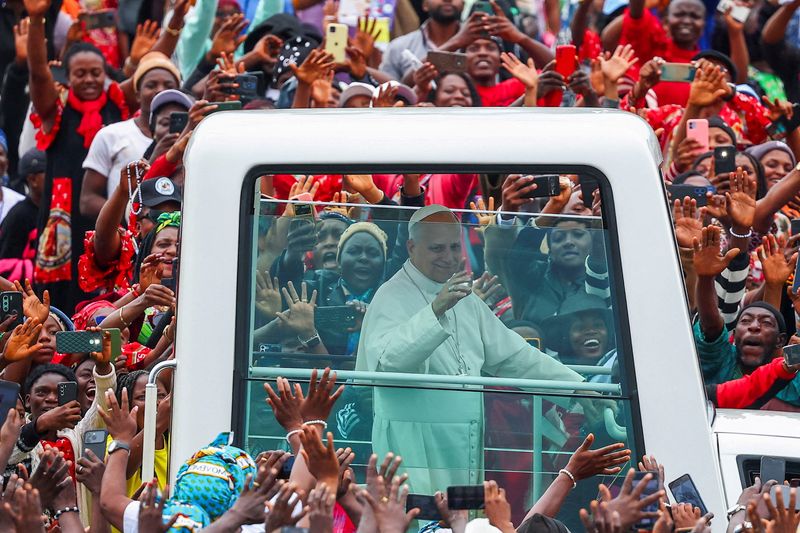
Crowds gather in Cameroon for biggest event of Pope Leo’s Africa tour

Published

on

Crowds gather in Cameroon for biggest event of Pope Leo’s Africa tour


Crowds gather in Cameroon for biggest event of Pope Leo’s Africa tour

Continue Reading

Business

Workspace shares dive 13% on profit warning and dividend reset

Published

on


Workspace shares dive 13% on profit warning and dividend reset

Continue Reading

Business

Rupee touches one-week high on report of RBI plan to ease oil refiners’ dollar bids

Published

on

Rupee touches one-week high on report of RBI plan to ease oil refiners' dollar bids
The Indian rupee rose to a one-week high on Friday after a Reuters report said the central bank took steps to curb the impact of dollar buying by state-run oil refiners, which traders said supported the currency.

The rupee rose 0.5% to 92.7250 per dollar as of 10:50 a.m. IST, its ‌strongest level since ⁠April ⁠10.

The central bank has urged state-run oil refiners to tap a special credit line for foreign exchange needs while curbing spot dollar purchases, Reuters reported post market hours on Thursday.

The measure marks a fresh deployment of crisis era tools to support the rupee which has been battered by concerns over high energy prices and weak capital flows.

Advertisement

A combination of regulatory measures ⁠by the ‌central bank – including caps on banks’ net open FX positions, curbs on banks offering corporates NDFs and the special facility ⁠for oil refiners – has helped boost the rupee about 2.5% from its record low hit in late March.


Along with earlier measures like tighter position limits and curbs on NDF, “this signals one clear message: the RBI is actively defending the rupee in a challenging environment,” said Amit Pabari, managing director at FX advisory firm CR Forex.
Separately, Reuters also reported on Friday that Indian banks have halted gold ‌and silver imports amid a delay in government clearance. Meanwhile, global markets are keeping their eyes peeled for developments related to Iran war peace talks.

A 10-day ceasefire ⁠between Lebanon and Israel went into effect on Thursday and President Donald Trump said the next meeting between the United States and Iran may take place over the weekend.

Asian currencies were mostly range-bound while Brent Crude futures fell 1% to $98 per barrel.

“If diplomacy fails and optimism fades, USD could stay supported for longer, while recent Asian FX gains look more vulnerable amid still high energy prices,” MUFG said in a note.

Advertisement
Continue Reading

Business

Nearly 160,000 uninsured cars seized on UK roads

Published

on

Nearly 160,000 uninsured cars seized on UK roads

Seizure numbers hit a 17-year high as an estimated 300,000 uninsured vehicles are driven each day.

Continue Reading

Trending

Copyright © 2025