Connect with us

Business

WEC Energy posts mixed Q2 results, shares edge lower as guidance falls short of estimates

Published

on

Continue Reading
Click to comment

You must be logged in to post a comment Login

Leave a Reply

Business

Princes forecasts 60% yield this year

Published

on

Princes forecasts 60% yield this year

Princes, the food group that owns the only pea cannery in the UK, has forecast yields from this year’s British pea harvest at about 60 per cent, only marginally higher than in 2025 and against more than 100 per cent in 2024, when rainfall and cooler temperatures produced a bumper crop.

The harvest runs for about eight weeks and will finish by mid-August. Growers produce an estimated 160,000 tonnes of peas a year, using viners costing £750,000 apiece.

Last year’s harvest was the earliest in well over a decade. Vining pea growers across Lincolnshire, Norfolk, Suffolk and East Yorkshire reported a near-third drop in the number of peas picked and processed.

Allen Giles, general manager at the Holbeach Marsh farming co-operative in Lincolnshire, said conditions this season had been comparable. “It’s been tough, really tough. We haven’t had any rain in six weeks,” he said. “Only hindsight will tell, but in five or six years’ time, if this weather continues, then we may not have peas in this area any more.”

The co-operative typically harvests about 10,000 tonnes of peas across 2,200 hectares each year, most of which are frozen. Giles said no grower would make money on the crop this season. “From our point of view as a co-operative, no farmer will make any money on peas this year, and we didn’t last year. We get paid by the tonne, we need tonnes per hectare to make this land profitable. And that’s nobody’s fault, that’s just the weather.”

Advertisement

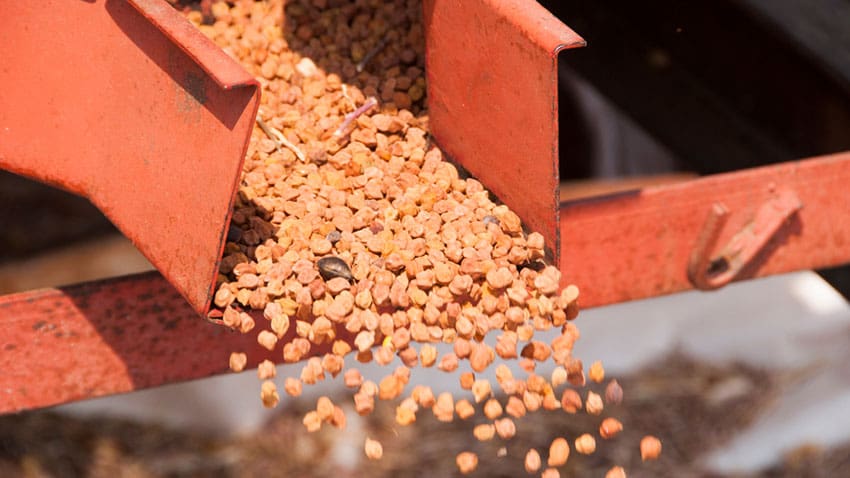
The co-operative has planted chickpeas for the first time. “We’ve grown some chickpeas this year for the very first time and they look quite good, they’ve enjoyed the hot weather,” Giles said. Lentils are also under consideration, alongside discussions about producing hummus.

Giles said successive heatwaves had accelerated the spread of disease-carrying aphids, and that a rise in ladybird numbers had allowed the co-operative to stop spraying. “So it helps us, but there’s about a year lag. There won’t be so many ladybirds going into the winter and we’ll probably end up with an aphid problem next year.”

The Met Office recorded more days above 30C by 15 July than in the whole of 1976, with the UK mean temperature running 1.8C above the seasonal average. The Environment Agency’s latest bulletin reports 1,353 abstraction licence restrictions in force and says prolonged dry conditions are producing early harvesting and poorer yields.

Peas mature rapidly, and higher temperatures shorten the window processors have to freeze or can them. Peas harvested in Lincolnshire are canned within six hours at Long Sutton, the Princes site that remains the only pea cannery in the UK and produces about 24 million cans and 40 billion peas a year. Drought and disease-resistant varieties can protect yields but often take years to reach the market.

Advertisement

Giuseppe Mastrolia, interim chief executive at Princes, said the pressure extended across the group’s product range. “Climate change is a topic that’s going on across all different areas, in pasta, in tomatoes. Things are changing,” he said. “We need to be prepared and we are already implementing changes. Climate is touching the whole industrial structure.”

Princes, one of Europe’s largest food producers, pushed through emergency price increases earlier this year after the Iran war raised energy and packaging costs and led to global shortages of fertiliser. “We took a hit in March and April. Things have slowed down but there is still an uncertainty around,” Mastrolia said. Cuts to government support and higher employment costs have also affected the food industry.

Mastrolia said he shared Giles’s view on the opportunity in chickpeas, citing rising demand for protein-rich foods, but that the harvest would limit local sourcing. “What we try to do with peas is sell what we produce and pack in the UK, but given the circumstances this year, we won’t be able to fulfill demand. Last year we bought some frozen peas, still in the UK from Scotland, so we are trying to source locally but the best is to produce fresh peas.”

Retailers have already linked hot weather and lower crop yields to rising food prices, while the question of how far the 2026 drought compares with 1976 has become a live one for the farming sector.

Advertisement

Amy Ingham

Amy Ingham

Amy Ingham is a reporter at Business Matters, covering UK business news with a focus on breaking news, business policy, late payments and insolvency. She joined the magazine in 2026 after completing the NCTJ Diploma in Journalism at Harlow College’s journalism school. Her recent reporting includes British Steel’s nationalisation and its impact on SME suppliers, the decline in late payments by large firms, and Insolvency Service director disqualifications. Reach her at aingham@cbmeg.co.uk.

Advertisement
Continue Reading

Business

Liontown shares slide on soft quarter

Published

on

Liontown shares slide on soft quarter

Shares in underground lithium miner Liontown slid on softer-than-expected results as a major investment call awaits on an expansion of its Goldfields operation.

Continue Reading

Business

Amazon chips business is next pillar, says Jeff Bezos

Published

on

Amazon chips business is next pillar, says Jeff Bezos

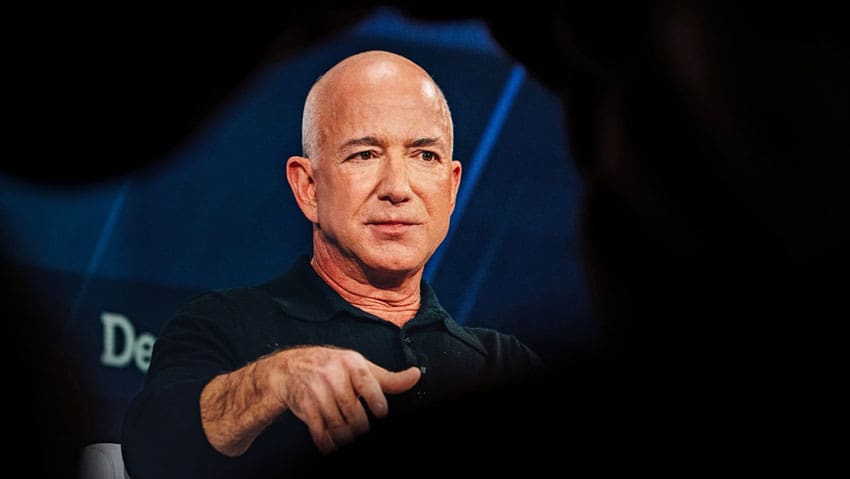
Jeff Bezos has said Amazon’s custom chip business is “lining up to be our next pillar”, alongside the retail, streaming and cloud divisions of the world’s largest company by revenue, as the group prepares to spend about $200 billion in capital in 2026, most of it on artificial intelligence infrastructure.

Bezos, Amazon’s founder and executive chairman, told Fortune that the chips division, which includes the Trainium and Graviton processors, would be the “foundation” of that investment.

“A few of our offerings have become durable pillars, things like Marketplace and Prime and Amazon Web Services. What I see right now is that our chips business, our silicon business, is lining up to be our next pillar,” Bezos said.

The $200 billion forms part of wider spending across the “hyperscaler” technology groups that is expected to exceed $700 billion this year. Those figures have fed concerns about an industry bubble.

Technology companies are developing their own processors to reduce their dependence on Nvidia’s AI chips. A new Amazon chip, Trainium4, is expected to be launched next year.

Advertisement

Bezos was speaking about Amazon’s race to catch up with AI rivals, having been described by one influential Wall Street analyst last year as “in last place in AI”.

He said the company’s success in Marketplace retail, media through Prime Video and cloud computing through Amazon Web Services, which had $129 billion of revenue in 2025, came down to being “customer-obsessed”.

“A lot of companies will tell you they’re customer-obsessed, but they’re really competitor-obsessed,” Bezos said. “You can’t be customer-obsessed unless you love inventing … You have to do new things. And Amazon is culturally very good at both of those things.”

“If we ever stop obsessing over customers, if we ever stop inventing, if we start making short-term trades,” he said, “we could probably coast for a while, but we would lose.”

Advertisement

Andy Jassy, who formerly ran AWS, took over from Bezos as chief executive in 2021. Fortune quoted Jassy as saying that AI will change “every customer experience that we know today and invent a whole host of new ones”.

“I do think we’re living in a world where … the key to the compute is often the chips,” Jassy said. “The growth in AI has been so significant, but we have a chips business that we built over the last decade here that is growing very quickly.”

Jassy said in April that AWS’s AI revenue run rate exceeded $15 billion, defending the level of investment. “We’re not investing … on a hunch. Of the AWS capex we expect to spend in 2026, much of which will be monetised in 2027-2028, we already have customer commitments for a substantial portion of it,” he said.

It was disclosed at the same time that the custom chips business has an annualised revenue run rate of more than $20 billion, double the $10 billion reported alongside fourth-quarter results.

Advertisement

Jassy has suggested Amazon could eventually sell its chips to outside customers. Google struck a deal last October to supply Anthropic, the creator of Claude, with one million of its custom AI chips, worth tens of billions of dollars.

Bezos’s comments came amid a cautious mood across global markets towards AI chip stocks, on concerns about corporate spending on the technology and lower-cost Chinese competition. South Korea’s technology-heavy Kospi index dropped more than 10 per cent on Tuesday and Japan’s Nikkei fell 4 per cent.

Amazon, along with Meta, Apple and Microsoft, is due to report earnings later this week. Nvidia shares fell 5 per cent overnight after the Wall Street Journal reported the chipmaker was in talks to provide roughly $250 billion in financing guarantees for OpenAI as part of a data centre project. Some investors say deals of that kind mean Nvidia is guaranteeing the loans that pay for its own revenue rather than driving sales through organic demand.

Bezos, 62, also described Amazon’s growth from a garage start-up selling books online in 1995. “You could not at that time have predicted the magnitude of change that would occur, and anybody who did predict that magnitude of change would probably have been quickly institutionalised and sent to the mental hospital,” he said. “It wouldn’t have been credible or believable.”

Advertisement

He also spoke about Prometheus, his AI start-up reportedly valued at more than $40 billion, which is said to be creating AI tools to help engineers manufacture products more rapidly.

“If you take a step back, all civilisational wealth is driven by invention,” Bezos said, adding: “We have an endless set of things to invent.”


Jamie Young

Jamie Young

Jamie Young is Senior Reporter at Business Matters, covering SME finance, employment law and Westminster policy since 2016. He has reported on every Budget and Autumn Statement since 2018, helped make sense of the ‘covid era’ and the bounce-back loan scheme from launch through the fraud investigations, and broke the magazine’s coverage of the 2024 late-payment reforms. He joined Business Matters straight from completing his BA in Administration from Exeter University and is NCTJ-qualified. Reach him at jyoung@cbmeg.co.uk

Advertisement

Continue Reading

Business

Keppel REIT (KREVF) Q2 2026 Earnings Call Transcript

Published

on

OneWater Marine Inc. (ONEW) Q1 2026 Earnings Call Transcript