

Business
Why Indian investors need global exposure today

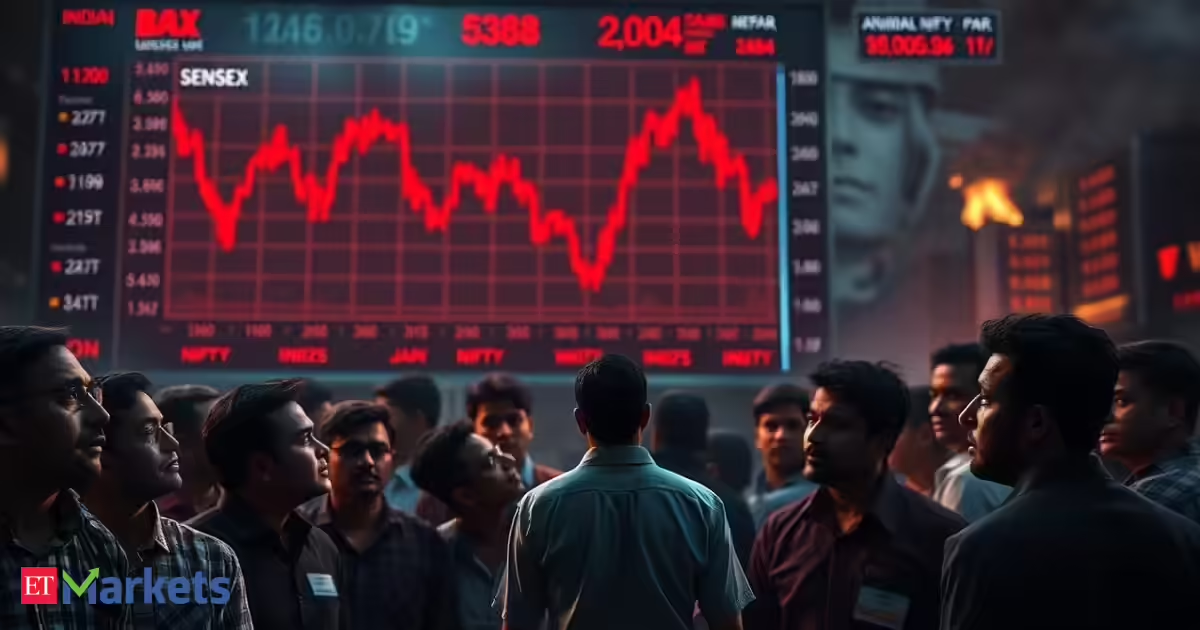
Where We Are
The rupee has depreciated against the dollar at a compound annual rate of approximately 5% since the 1991 liberalisation. The journey reads like a one-way ladder: Rs 3.30 at independence in 1947, Rs 17 before liberalisation, Rs 46 by 2000, Rs 75 in 2020, Rs 97 today. While the RBI has managed the pace of depreciation effectively, there has not been a sustained reversal along that path.
The current stress has a specific character worth noting. The rupee has weakened 12% over the last 12 months. The DXY dollar index, by contrast, fell 9.4% through all of 2025. That is rupee-specific stress, and it points directly to the forces underneath.
Three Catalysts, None Short-Lived

The first is oil. India imports 88% of its crude requirement, and Brent crude ranged between $97 and $110 per barrel in May 2026, spiking above $110 precisely when the rupee hit its record low. Every dollar increase in the oil price widens the import bill, adds to current account pressure, and increases structural demand for dollars. The RBI cannot drill its way out of this.
The second is capital flows. Foreign portfolio investors have pulled Rs 2.2 lakh crore from Indian equities in 2026 alone, the worst outflow year since FPI investing in Indian equities was first permitted in 1992. When foreign capital exits, it exits in dollars. Dollar supply in the market falls, demand rises, and the rupee weakens. The mechanism is direct and the numbers are not small.The third is the inflation differential. India’s CPI has run structurally above US CPI over any five-year or longer horizon, and purchasing power parity adjustments work quietly but persistently in the background. The approximately 5% annual depreciation since 1991 is not coincidental to this differential. It is mechanical.
None of these catalysts resolve quickly. Oil dependence is a decade-long infrastructure challenge. FPI flows depend on global risk appetite and relative valuations that will remain volatile. The inflation differential compresses only when India’s supply-side productivity gains structurally outpace the US over a sustained period. The RBI Governor has stated the bank will do “whatever is required” for orderly markets and that the rupee appears undervalued.
But rate hikes to defend the currency are not on the agenda. The tools available to the central bank are narrower than the structural forces pressing against it.
What This Means for Portfolio Construction
A dollar-denominated asset earns on two levels for an Indian investor: the USD return of the underlying, and rupee depreciation layered on top. At the 10-year average depreciation rate of 3.4%, a flat-returning US asset still delivers a 1.4x return in INR over a decade, purely from currency. At the long-run 5% rate, currency alone roughly doubles the INR value of any dollar asset over 20 years. The dollar has strengthened against the rupee on a net basis for 34 years. The currency tailwind is built into the asset class.
Sure, the Nifty 50 TRI delivered 14.6% CAGR in INR terms for the decade ending 2023, a strong number on any measure. The S&P 500 in INR delivered approximately 15-16% annualised over the same 10-year window, per reconstructed data combining S&P 500 USD returns with RBI exchange rate data. Comparable headline returns, but with uncorrelated drivers. When oil spikes and FPI outflows hit simultaneously, a domestic-only portfolio absorbs the equity market impact and the currency erosion at the same time. A portfolio with dollar exposure absorbs the equity impact but earns on the currency move. Those are meaningfully different risk profiles wearing similar return numbers.
A 20 to 30% allocation to US equities through the LRS route, built over time via low-cost index ETFs and direct stocks accessible through platforms like Appreciate, is a structural response to a structural reality: the rupee has weakened at approximately 5% annually for 34 years, three catalysts sustain that pressure today, and a portfolio concentrated entirely in one currency carries a risk the data has been pricing in for decades.
(The author, Subho Moulik is Founder & CEO at Appreciate)
(Disclaimer: Recommendations, suggestions, views and opinions given by the experts are their own. These do not represent the views of The Economic Times.)


Wizz Air CEO Yvonne Moynihan also advises passengers to carry portable chargers and water due to lengthy queues.

Exxon Mobil: Sell If The Iran War Ends

Taiwan says it will not be ‘silenced’ after China expels NYT reporter

Rebecca, 36, takes the train about six times a month in her role as head of operations for a charity, and spends her journeys sending emails and instant messages as well as using software. The connection can be mixed, and sometimes the wi-fi “doesn’t work at all”, she says.

One mutual fund and one specialised investment fund (SIF) will open for subscription this week, offering investors exposure to passive and hybrid long-short strategies. HSBC Mutual Fund and Motilal Oswal Mutual Fund are launching the schemes. Investors should align fund selection with their risk profile and financial objectives.
Bitmine Immersion: An Ethereum Treasury Trading Below Its Own Assets

Meteor fireball triggered loud boom across New England, NASA confirms

Will private credit infect public markets?
Business
5 equity mutual funds offer up to 24% annualised return on SIP investments in 10 years. Check details

Five equity mutual funds, led by small-cap schemes, have delivered strong SIP returns over the past decade, with some exceeding 20% annually. The data highlights the potential of disciplined long-term investing, while reinforcing that investors should align fund selection with risk appetite, goals and investment horizon rather than past performance alone.

Equity mutual funds witnessed a weak May, with the worst-performing schemes losing up to 7%. International and sectoral funds dominated the laggards’ list, led by HSBC Brazil Fund. Several consumption, FMCG, energy and PSU-focused schemes also posted negative returns, reflecting pockets of weakness across specific market segments.

Arrive three hours before flight home, airline boss tells UK holidaymakers

Pete Davidson Having ‘Productive Conversations’ With His Ex

La dette : monnaie magique | MONEY | ARTE


-

 Business7 days ago
NYT Strands Answers May 24 2026 Revealed for Puzzle No. 812 Theme Summer Essentials
-

 NewsBeat4 days ago
Israel says it has killed new Hamas military leader in Gaza City airstrikes
-

 Politics6 days ago
Bridgerton Season 5: Cast, Release Date And Everything We Know So Far
-

 Tech4 days ago
NASA taps Blue Origin to deliver lunar rovers for Moon Base initiative
-

 Business4 days ago
Selena Gomez Reportedly Upset Over Benny Blanco’s Comments on Her ‘Terrible’ Diet
-

 News Videos4 days ago
XRP *JUST* SUCCEEDED!!!! CLARITY ACT EXPOSED!!! (SHE EXPOSED IT)
-
 Crypto World4 days ago
Micron Crosses $1 Trillion Market Cap as AI Demand Reshapes Memory Sector
-

 Business6 days ago
BTS Sells Out Four Las Vegas Shows at Allegiant Stadium for ARIRANG World Tour
-

 Tech6 days ago
Microsoft’s quiet Claude Code retreat and the real cost of enterprise AI
-
 Tech5 days ago
China assigns ID codes to 28,000+ humanoid robots
-
Crypto World6 days ago
Brian Armstrong Outlines Crypto Vision for the Future Financial System
-
 NewsBeat6 days ago
Hottest May day ever as London hits 34.8C in 2C leap from previous records
-

 Tech2 days ago
Waymo dominates autonomous vehicle registrations as Tesla trails behind
-

 News Videos2 days ago
This is BROKEN! INSANE 5x MONEY CAR WASH WEEK! The NEW GTA Online UPDATE Today! (GTA5 New Update)
-
Tech4 days ago
The Samsung pay deal is the moment Korean unions changed register
-

 Sports5 days ago
2026 NBA Finals schedule, odds: Knicks await Thunder or Spurs after winning East
-

 Tech6 days ago
Westone Audio and Etymotic Acquired by Fidelity Collective in Major IEM Market Move
-

 Business5 days ago
Nikkei 225 Surges Past 65,000 for First Time as Iran Peace Hopes Fuel Record Rally
-
 Entertainment5 days ago
‘Breaking Bad’ Star’s Easy-to-Binge 6-Part Crime Series Spin-Off Is Finally Heading to Free Streaming
-

 Tech4 days ago
Millions of AI agents imperiled by critical vulnerability in open source package
You must be logged in to post a comment Login