
Crypto World
4 trends to watch this cycle



By Ben Caselin, CMO at VALR
When crypto prices surge, market commentary tends to fixate on green candles and central bank policy.
Yet, looking beyond the immediate rally reveals a deeper structural shift taking place on-chain. Robinhood’s CEO, Vlad Tenev, skilfully drew global attention to this shift with the launch of the Robinhood Chain, joining a broader movement of major platforms bringing mainstream retail equity investors directly onto native on-chain execution.
Macroeconomic stress provides background fuel, but technological innovation provides the spark. Beneath the price action, four key trends are defining this cycle and reshaping how global wealth is owned, accessed, and stored.
Trend 1: The Retail Ownership Supercycle
At a recent White House summit, Vlad Tenev summarised his platform’s mission in a single word: ownership. Broad asset ownership is essential to a free and prosperous society, and the Robinhood Chain is putting that principle into practice.
Consider novel mechanics like The Index. Holding this single token automatically drops fractional tokenised equities directly into a user’s wallet. In a few clicks, crypto-native traders gain organic exposure to traditional stock portfolios, opening up meaningful diversification beyond crypto alone.
Crucially, this movement is propelled by retail culture. Memes like Popcat, Pepe, and Doge previously proved mass-market retail appetite on tier-one exchanges. Today, that energy is driving on-chain execution. On the Robinhood Chain, Cashcat has emerged as the primary runner and unofficial mascot. Meanwhile, Coinbase listing Basecat on Base, alongside community-led initiatives building around Cate on Solana, points to a broader, multi-chain “cat season.”
These community movements act as the primary onboarding engine for crypto and tokenised real-world asset ownership.
Trend 2: CeDeFi and Infrastructure Convergence
While the Robinhood Chain reignited retail attention on-chain, another milestone was taking shape at the infrastructure level. In previous cycles, centralised exchanges focused on building isolated, walled-garden blockchains and proprietary wallets. This cycle marks a fundamental pivot toward Centralised-Decentralised Finance (CeDeFi): direct liquidity integration.
We see this clearly in two parallel moves: Robinhood integrating Lighter, and VALR integrating Hyperliquid.
If Robinhood’s mandate is ownership for everyday retail investors, VALR’s mandate is global access. By directly plugging into Hyperliquid’s high-performance order book, VALR instantly gave over two million users across Africa and emerging markets seamless access to more than 200 liquid markets across crypto, equities, stock indices, commodities, precious metals, and foreign exchange.
Trend 3: The Two-Phase Transformation of Money
This expanding global access lays the foundation for a much larger monetary transition. The evolution of money is unfolding in two distinct phases.
Phase 1 is happening right now through stablecoins. While the distant future of fiat currency looks bleak, stablecoins make storing, transferring, and spending value effortless. They are becoming the pragmatic rails for daily users, global enterprises, and international trade.
However, stablecoins merely digitise fiat; they do not protect against chronic currency debasement. When it becomes obvious to everyone that inflation is indeed not transitory, but long-lasting and ever-worsening, Phase 2 will surely take hold. The transition to sound money will be swift and violent, and stablecoins will provide the off-ramp.
Tokenised gold like XAUt and, fundamentally, Bitcoin are natural destinations for this transfer of capital. We are still early.
Trend 4: Agentic Finance and Human Purpose
Alongside monetary evolution sits the rise of agentic finance. Autonomous AI agents and algorithmic execution will soon handle complex market mechanics, liquidity deployment, and execution strategies.
What AI will do to our economies is still unfolding. Personally, I would rather focus on painting and tending a rose garden, letting the world figure out the question of AI and robots. Optimistically, that is the true promise of technology anyway: outsourcing the mundane to machines so humans can focus on service, kindness, creativity, and contemplation.
Beyond Rotation: The Conviction Cycle
Speculative token-hopping and short-term player-versus-player trading have defined much of recent crypto culture. Yet, set against this culture of endless rotation, a simple phrase is taking root: believe in something.
The platforms, protocols, and participants that endure in this next cycle will not be those chasing fleeting market trends. In addition to ownership and access, this cycle will belong to conviction.
About the author
Ben Caselin is Chief Marketing Officer at VALR.com, Africa’s largest crypto exchange and infrastructure provider by trade volume. Headquartered in Johannesburg, VALR serves over 1900 corporate and institutional clients and more than 1.9 million traders worldwide. Drawing on years of experience in the digital asset space, mostly in Hong Kong, the UAE and now South Africa, Ben focuses primarily on driving the adoption of bitcoin in emerging markets and advocates for an approach to innovation on the basis of spiritual principles.


Futures for the Dow Jones Industrial Average and the other major stock indexes dropped Monday, as Wall Street reacted to new U.S. strikes on Iran. Meanwhile, oil prices jumped on the stock market today. Ahead of Monday’s open, Dow futures fell 0.2% as S&P 500 futures moved down 0.3%. Nasdaq-100 futures slipped 0.2% in early morning trading. West Texas Intermediate…
Copyright ©2026 Investor’s Business Daily, LLC. All rights reserved. 87990cbe856818d5eddac44c7b1cdeb8


Australian authorities charged two Western Australian men on Aug. 26 following a joint investigation into the alleged TeamPCP cybercrime syndicate.
Summary
- Australian police charged two Western Australian men with fourteen offences following the TeamPCP cybercrime investigation.
- Authorities estimate malicious software potentially compromised over 1,000 organizations and exposed more than 500,000 credentials.
- Investigators allege the syndicate stole at least 300 gigabytes of data from downstream software customers.
- U.S. prosecutors separately indicted Thomson on federal computer crime charges carrying maximum five-year prison terms.
- Police said cryptocurrency payments remain under investigation and disclosed no seizure value or laundering total.
The Australian Federal Police filed a combined 14 charges against 21-year-old Ruben Ian Thomson and 23-year-old Louis Michael Gaebler. Both appeared before Perth Magistrates Court on Aug. 27, according to ABC.
The operation involved the AFP, the FBI and the Western Australia Police Force. Authorities executed warrants at properties in Cottesloe, Hamilton Hill and Mandurah.
Police allege the group compromised more than 1,000 organizations, obtained over 500,000 credentials and removed at least 300 gigabytes of data. The defendants have not been convicted, and the charges remain allegations.
TeamPCP allegedly targeted trusted software components
The joint investigation began in April after several cybersecurity companies supplied intelligence about malicious software distributed through an open-source repository, the AFP said in its official release.
Investigators allege TeamPCP inserted malicious code into legitimate software components used by other developers. Once incorporated into downstream systems, the modified code allegedly gave the group unauthorized access to organizations across government, academia and the private sector.
Software supply-chain attacks can spread beyond the organization hosting the original compromised code. A trusted component may be reused by hundreds of developers, allowing one modification to reach many unrelated systems.
Australian authorities estimated that responding organizations face remediation costs totaling hundreds of millions of dollars. That figure reflects an official estimate rather than a confirmed financial loss suffered by identified victims.
The AFP said infected software enabled the alleged theft of credentials, authentication materials and other sensitive information. However, authorities have not published a complete list of affected organizations or software packages.
Cryptocurrency payments remain under investigation
Police allege the two men were principal participants in the operation and received cryptocurrency for their roles. Authorities said the value of those payments remains under investigation.
The official release did not identify the cryptocurrencies involved. It also did not disclose wallet addresses, transaction hashes, mixers, exchanges or a confirmed laundering total.
Reports claiming that investigators seized large cryptocurrency balances or expensive property go beyond the details contained in the AFP announcement. Authorities said electronic devices and other items were seized, but they did not assign a digital-asset value to those items.
Thomson faces one Australian charge of dealing with money or property worth at least 100,000 Australian dollars that authorities allege represented criminal proceeds. The offence carries a maximum prison sentence of 20 years. That threshold describes the charge and does not establish the final amount involved.
Blockchain transactions can assist investigators when funds move through identifiable services or interact with regulated exchanges. As previously reported, Australian authorities forfeited nearly 25 Bitcoin and other assets tied to a 2013 exchange theft.
U.S. indictment creates a separate federal case
The U.S. Department of Justice separately unsealed a federal indictment against Thomson. Prosecutors charged him with conspiracy to violate the Computer Fraud and Abuse Act and obtaining information from a protected computer.
The American indictment concerns alleged TeamPCP attacks during spring 2026. Prosecutors claim malicious code scanned downstream systems, extracted sensitive information and maintained persistent access.
The Justice Department also alleges TeamPCP used stolen information to make ransom or extortion demands. Members allegedly offered not to publish victims’ data in exchange for payment. These claims have not been proven in court.
Each U.S. offence carries a maximum five-year prison term and a fine of up to $250,000, or twice the alleged gross gain or victim loss. Any sentence would be determined by a federal judge after a conviction.
The U.S. announcement names Thomson but does not announce a corresponding American indictment against Gaebler. Thomson remained in Australian custody when prosecutors disclosed the case.
U.S. agencies have previously targeted infrastructure allegedly used to convert cybercrime proceeds. In related coverage, the FBI seized nine cryptocurrency exchanges accused of laundering ransomware and investment-fraud proceeds.
Forensic examinations could produce further charges
The AFP said investigators are examining a large volume of seized data and electronic devices. That work may help authorities identify additional participants, victims and financial transfers.
Police have not ruled out further arrests or charges. They have also not announced whether the United States will seek Thomson’s extradition or wait for the Australian proceedings to advance.
The investigation’s next phase will involve digital forensics and the examination of cryptocurrency payment records. Prosecutors must separately prove each defendant’s identity, role, intent and connection to the alleged activity.
Potential victims should review software dependencies, rotate exposed credentials and examine authentication logs. Australian organizations can report incidents through Report Cyber, while individuals concerned about identity theft can contact IDCARE.
The case produced no verified cryptocurrency market reaction. It concerns the alleged use of digital assets for payments rather than a vulnerability in a blockchain or cryptocurrency protocol.


The two-month-old network processed a record 5.52 million transactions on Aug. 30 as users launched 22,600 tokens and memecoin trading tools drove most of the $2.66 million in revenue.
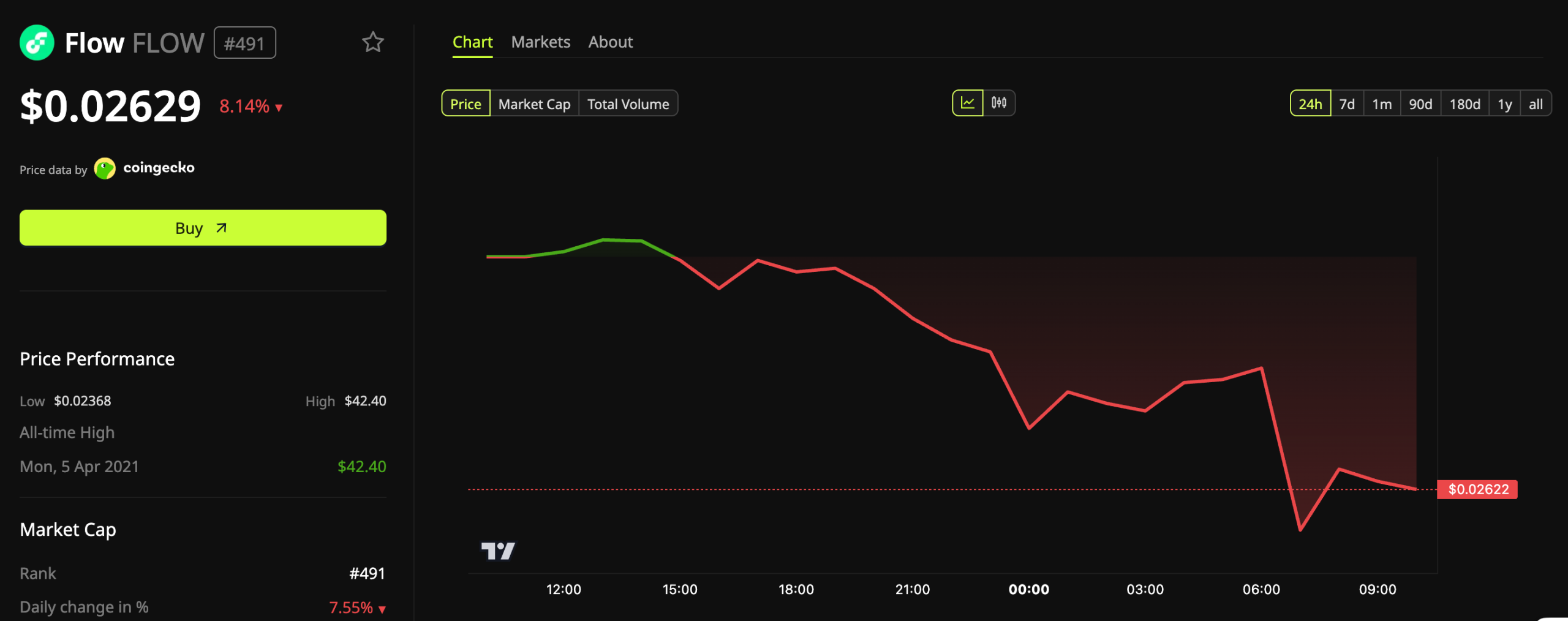
More Markets lost 15.5 million Wrapped Flow (WFLOW) to an exploit on Flow EVM on Monday. Security firm Blockaid put the initial impact at $9.3 million.
The lending protocol has not confirmed any loss. Its team said it is looking into the claim and will publish findings once the review is complete.
What Blockaid Traced Onchain
More Markets is a non-custodial lending market on Flow EVM built by More Labs. Blockaid said an attacker combined an Ankr bonded liquid staking token with the protocol’s Efficient Mode setting to drain the mFlowWFLOW reserve.
The firm published the exploit transaction, the contract deployment, and 11 follow-up transfers. It also names the attacker address, a helper wallet, and the affected pool.
Follow us on X to get the latest news as it happens

Markets reacted quickly. Flow (FLOW) fell about 8% over 24 hours to trade near $0.026. Value locked in More Markets dropped to roughly $3.6 million. Still, the drop comes amid a broader market downturn, which has pulled the total market cap down roughly 3%
The attack lands at the end of a punishing stretch for crypto protocols. Cronos halted its blockchain on August 30 after identifying an exploit at Tectonic, its largest lending market. Last week, Moonwell lost an estimated $8.7 million.
DefiLlama data records 37 hacks in August, totaling roughly $140 million. Lending protocols account for the bulk of that figure.
Subscribe to our YouTube channel to watch leaders and journalists provide expert insights
The post Blockaid Traces $9.3 Million Exploit at Flow Lender More Markets appeared first on BeInCrypto.


Float Protocol has lost about $28,000, or 10.71 ETH, after an attacker used a flash loan to manipulate a Uniswap V3 spot price and exploit how its Hypervisor contracts calculated liquidity provider share values.
Summary
- Float Protocol lost about $28,000, or 10.71 ETH, after a flash loan attack manipulated a Uniswap V3 spot price.
- SlowMist said the manipulation caused affected Hypervisor contracts to calculate inflated LP share values.
- The attacker used large swaps to distort currentTick() and getTotalAmounts(), then repeatedly deposited and withdrew against the incorrect values.
- SlowMist said critical functions lacked TWAP or oracle verification and slippage protection.
SlowMist said on Aug. 31 that the attacker distorted the Uniswap V3 slot0 spot price, causing affected Hypervisor contracts to calculate incorrect LP share values. The blockchain security firm traced the exploit to functions that lacked TWAP or oracle verification and slippage protection.
Using large swaps in the underlying V3 liquidity pool, the attacker manipulated the values returned by currentTick() and getTotalAmounts(). SlowMist said the attacker then repeatedly deposited and withdrew funds while the Hypervisor contracts were working with inflated share values.
The security firm identified the attacker address as 0xaea29218262dc6b0904ca077f6527c49dfd426d9 and the attack contract as 0xb46655eb5b77de277063a75586d1883e951b6c54.
Two vulnerable contracts were listed as 0x85cbed523459b7f6f81c11e710df969703a8a70c and 0xc86b1e7fa86834cac1468937cdd53ba3ccbc1153, while the underlying liquidity pool was identified as 0xe8c2036068fc3b0161ee1def0e8d01df4eac0ac.
Float Protocol exploit relied on Uniswap V3 spot price manipulation
The attack centered on how the affected contracts obtained pricing information from the underlying Uniswap V3 pool. SlowMist said large trades allowed the attacker to distort slot0, which contains the pool’s current price and tick information.
Once the pool price had been moved, the manipulation changed the values returned by currentTick() and getTotalAmounts(). The affected Hypervisor contracts used the altered data to calculate LP share values, which allowed the attacker to interact with the contracts while those shares were incorrectly priced.
Flash loans supplied the temporary capital needed to make the large trades. As crypto.news previously explained, a flash loan allows assets to be borrowed without upfront collateral as long as the loan and fees are repaid within the same blockchain transaction.
If repayment does not occur, the entire transaction reverts. The mechanism allows traders to access large amounts of temporary liquidity for arbitrage, collateral swaps and liquidations, but the same liquidity can be used to exploit vulnerable pricing or smart contract logic.
In its analysis of Float Protocol, SlowMist attributed the loss to the contracts relying on a manipulable spot price without checks that could verify it against a time weighted average price or another oracle. Critical functions lacked slippage protection as well, according to the security firm.
Attacker repeatedly used inflated LP share values
SlowMist said the attacker did not stop after changing the Uniswap V3 pool price. Once slot0 had been distorted, the attacker repeatedly deposited into and withdrew from the affected contracts using the inflated LP share calculations.
The sequence allowed value to be extracted while the contracts were relying on the manipulated pool state. SlowMist estimated the final loss at approximately 10.71 ETH, worth about $28,000 when it published the alert.
Similar methods have been used in other DeFi attacks where large temporary trades distort prices or pool ratios before another contract uses the manipulated values.
In July, Allbridge Core was halted after an attacker used a $1.12 million USDC flash loan from Kamino during an exploit that PeckShield estimated caused about $1.65 million in losses.
Onchain Lens said the Allbridge attacker made rapid USDC and USDT swaps to change the ratio inside a stablecoin pool. The attacker then withdrew liquidity at the distorted rate before repaying the flash loan in the same transaction.
Allbridge said some liquidity pools were left temporarily out of balance after the incident and asked users who had profited from unusual pricing to consider returning the funds. The protocol paused Core while investigators tracked assets that had been moved from Solana to Ethereum.
Price data has remained a target in DeFi attacks
Another July incident showed how manipulated pricing information can be used even when the weakness sits outside a protocol’s smart contracts.
Ostium concluded that its $23.75 million USDC exploit originated from compromised off-chain infrastructure. The decentralized trading protocol said an attacker submitted fraudulent BTC/USD price reports that allowed funds to be drained from its OLP liquidity vault.
Ostium said its smart contracts were not the source of that breach. Automated monitoring detected the attack, trading resumed on July 23, and the protocol reported that user collateral had not been affected.
Float Protocol’s incident involved a different mechanism described by SlowMist. The security firm’s analysis placed the weakness inside the affected Hypervisor contracts, where manipulated Uniswap V3 pool data could influence the calculations used to value LP shares.
Flash-loan capital has featured in other attacks this year. A July attack against Swan Treasury used a PancakeSwap flash loan after a compromised off-chain signer key allowed an attacker to purchase STY tokens at a large discount.
The Swan Treasury exploit caused an estimated $625,000 loss. Security analysis found that forged claim and transfer signatures had been created with the protocol’s compromised signer key, allowing roughly 687,000 STY to be purchased at around a 100 times discount before being sold into the STY/USDT pool.
The flash loan supplied capital for the transaction, while investigators attributed the underlying vulnerability to the leaked signer key instead of the protocol’s signature verification logic.
SlowMist points to missing price checks in Float Protocol contracts
For Float Protocol, SlowMist specifically identified the absence of TWAP or oracle validation as part of the attack path.
A TWAP uses observations collected across a period instead of relying solely on the price available at one moment. Spot prices inside liquidity pools can move when a sufficiently large trade changes the ratio of assets, which was the mechanism SlowMist said the Float Protocol attacker exploited.
Crypto.news’ flash loan guide described price manipulation as one of the common ways temporary liquidity can be used against a vulnerable DeFi application. The report noted that the flash loan provides the capital for an attack while the exploitable weakness can lie in price oracles, governance systems or contract logic.
In Float Protocol’s case, SlowMist said large trades were used to distort the Uniswap V3 pool’s slot0 value, which in turn changed currentTick() and getTotalAmounts(). The attacker repeatedly deposited and withdrew while the affected Hypervisor contracts calculated inflated LP share values, resulting in an estimated loss of 10.71 ETH.
Decentralized exchange Hyperliquid and memecoin launchpad Pump.fun reportedly accounted for nearly 90% of the record $638 million in token buybacks carried out by cryptocurrency projects so far in 2026.
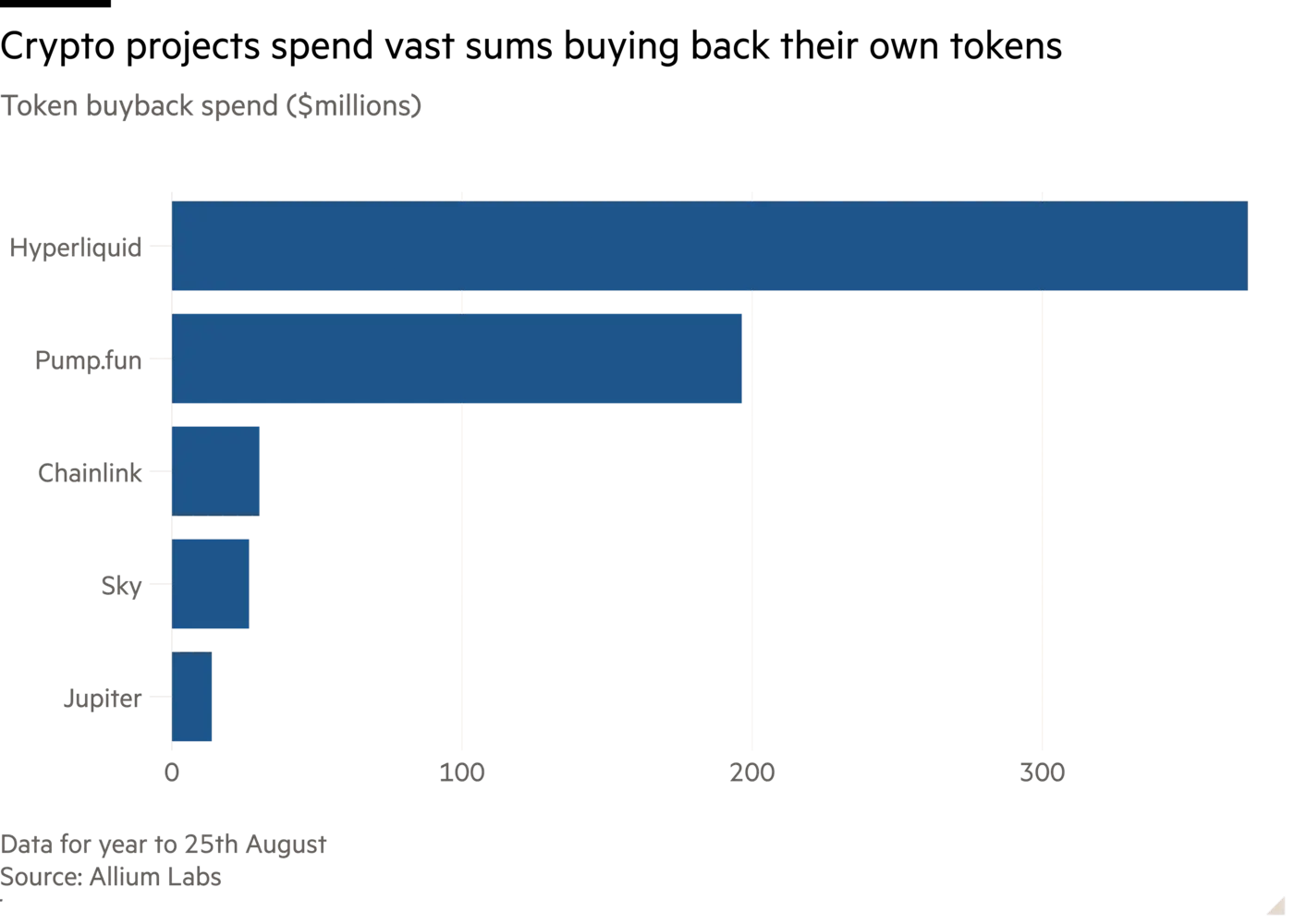
Crypto projects spent a record $638 million to repurchase their own cryptocurrencies year-to-date, up from $545 million during the same period in 2025 and $366,000 in 2024, according to Allium Labs data cited by the Financial Times in a Monday report. Of the $638 million, Hyperliquid accounted for roughly $370 million and Pump.fun for nearly $200 million.
Token buybacks are similar to share buybacks by publicly listed companies, which buy back their own stock to support their share prices and increase returns for existing shareholders.
While token buybacks are still rare in the crypto industry, more companies are taking advantage of the move. On Thursday, the Ethena Foundation opened a vote on a fee-switch proposal under which 95% of the net revenue paid to it from Ethena’s core business lines would be used to repurchase Ethena (ENA) tokens. The ENA token rose 10.7% on the day after the proposal.
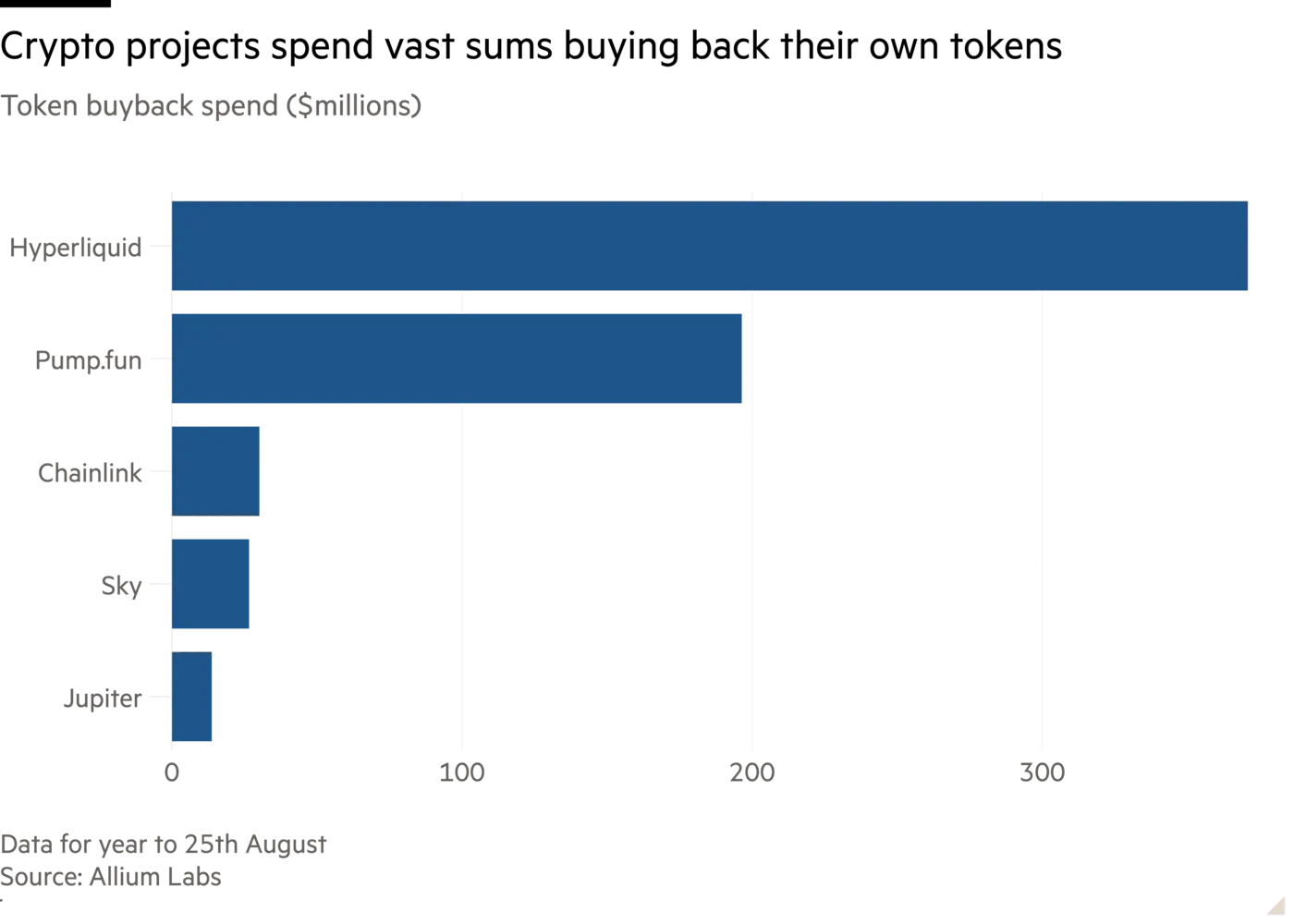
Crypto project spend on token buybacks, year-to-date leading up to Aug. 25. Source: Allium Labs, Financial Times.
HYPE, PUMP outperform crypto market as buybacks boost token valuations
The Hyperliquid (HYPE) and Pump.fun (PUMP) tokens have outperformed the broader cryptocurrency market decline so far in 2026.
HYPE rose 145% and PUMP rose 109% year-to-date, while Bitcoin’s (BTC) price fell 10% and the total crypto market capitalization declined by 11.9% during the same period, according to TradingView data.
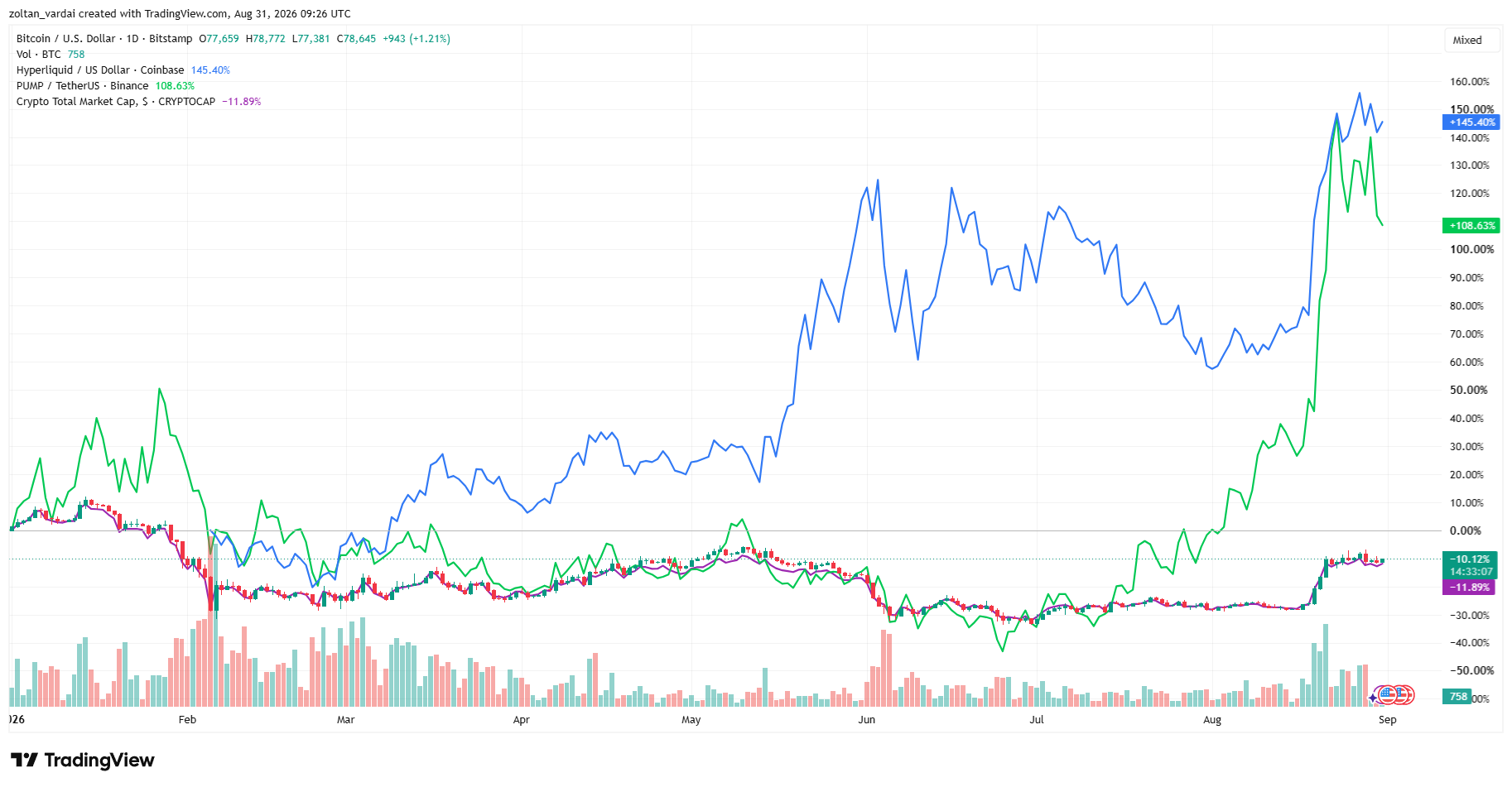
HYPE, PUMP, BTC, Total Crypto Market Cap, year-to-date chart. Source: Cointelegraph/TradingView
Hyperliquid spends about 99% of its revenue on token buybacks. Hyperliquid reported $169 million in second-quarter revenue on Aug. 6 and directed $141 million toward HYPE buybacks.
Related: Crypto generated about 1% of Webull’s record $198M Q2 revenue
Pump.Fun allocates about 50% of its net protocol revenue for token repurchases. The memecoin launchpad currently boasts $420 million in annualized revenue, based on the average daily revenue of the past 90 days.
Crypto valuations could double in the next two years as protocols increasingly use revenue to fund token buybacks and burns, hence returning more value to investors, said Bitwise chief investment officer Matt Hougan earlier in August.


Your day-ahead look for Aug. 31, 2026

XRP price is sitting in a corrective pocket after one of its stronger months of the year. That $2 target sounds ambitious given the current chart, but one metric buried in the fundamentals is giving bulls a reason to stay patient.
XRP remains up roughly 31% for August despite shedding about 5% over the past week, a pullback that follows a volatile range between $1.35 and $1.55 for most of the month. Meanwhile, RLUSD stablecoin volume on the XRP Ledger crossed $1 billion on August 30.
XRPL ACTIVITY SURGES — MjB38 | Crypto News (@MjB38) August 29, 2026

Receiving addresses briefly jumped to 926,000, while the transaction rate climbed 151%. Meanwhile, tokenized stocks, metals and Dubai real estate are expanding on the XRPL.
The RWA era is growing but we can’t yet say it caused the activity spike. $XRP
Not just the volume, active addresses have also surged more than 650%, climbing from 47,180 to 356,070 in just two weeks. The sharp rise in network participation came alongside XRP’s recent rally and suggests the move was supported by stronger blockchain activity. If this momentum continues and XRP can reclaim the $1.55 to $1.60 resistance zone, the token could open a path toward $1.70, $1.80 and eventually the psychologically important $2 level.
Bitcoin itself sat just under $78,000 Monday morning, flat on the day, while the market split hard. Risk appetite is uneven right now, and XRP’s next move likely hinges on whether it can decouple from that chop.
Discover: The Best Crypto to Diversify Your Portfolio
Can XRP Price Hit $2 This Week?
Short-term support clusters at $1.30–$1.36, with a daily pivot near $1.36 and deeper structural support around $1.28. Its immediate resistance is at $1.41–$1.45, a zone XRP needs to reclaim before any serious continuation talk. The pullback from the upper Bollinger Band near $1.40 reads more like cooling off than a breakdown as momentum eases.

- Bull case: a daily close above $1.45 opens the path toward $1.57, and from there the well-circulated $2.00 target becomes a live conversation rather than wishful thinking.
- Base case: consolidation between $1.30 and $1.45 while the market waits for a catalyst.
- Bear case: a breakdown below $1.30 tests the $1.00 structural floor, a level some analysts flag as the point where bears take real control.
Whale flows versus ETF demand remain worth watching closely here.
Trade XRP on Bybit and Get a Chance to Win Our $1,000 USDT Airdrop
Bitcoin Hyper Targets Early Mover Upside as XRP Tests Key Levels
Holding XRP through this chop takes conviction. The RLUSD volume story is real, but a move from $1.37 to $2 is “only” a 46% gain. Fine for a position, unremarkable for anyone chasing outsized returns at this stage of the cycle. That’s pushing more traders toward presale-stage infrastructure plays where the upside math looks different.
Bitcoin Hyper ($HYPER) is building the first Bitcoin Layer 2 with native SVM integration, smart contract execution faster than Solana itself, layered on Bitcoin’s base security.
The presale has raised $33 million at a current token price of just $0.0136855, with a high 35% APY staking already live for early participants.
Its Decentralized Canonical Bridge aims to solve BTC’s long-standing programmability gap without sacrificing trust assumptions.
Research Bitcoin Hyper before the presale window closes.
Discover: The Best Token Presales
The post XRP Price Targets $2 as One Key Metric Flashes Bullish Signal appeared first on Cryptonews.

A screen displays an image of Gemini co-founders Tyler Winklevoss and Cameron Winklevoss, and the Gemini logo, during the company’s IPO at the Nasdaq MarketSite, in New York City, U.S., Sept. 12, 2025.
Jeenah Moon | Reuters
Gemini Space Station scored a legal victory earlier in August after an arbitrator found the crypto exchange did not mislead users and was not at fault for the collapse of its Earn lending program.
The claim was filed in late 2024 by a user of the digital asset firm’s lending program Earn. However, there was insufficient evidence that Gemini had lied to its customers or neglected to do due diligence with Genesis Global Capital, its main lending partner, according to the ruling viewed by CNBC.
“To succeed in a claim for negligent infliction of emotional distress, a claimant must prove: (i) a breach of a duty owed to the claimant; (ii) emotional harm; (iii) a direct causal connection between the breach and the emotional harm; and (iv) circumstances providing some guarantee of genuineness of the harm,” the Aug. 12 ruling said. “In the instant case, Claimant offered no evidence of an actual or perceived threat to his physical safety.”
Launched in 2021, Earn allowed users to reap up to 7.4% annual yields on their cryptocurrencies by lending them out. Under the program, Gemini lent the assets to institutional borrowers, using Genesis as its intermediary.
However, Gemini halted withdrawals from its Earn program in November 2022, angering some of its more than 300,000 users. The move came shortly after Genesis paused new loan originations and redemptions due to a liquidity crunch it faced amid the crypto market downturn that year.
Following the Earn withdrawals freeze, several customers brought legal complaints against Gemini. The New York Attorney General also sued Gemini over its Earn program, settling with the company for $50 million in 2024.
In February 2024, Gemini announced that the company reached a “settlement in principle” with Genesis and other creditors in the Genesis Bankruptcy. Three months later, Earn users received $2.18 billion of their digital assets in kind, representing 97% of digital assets owed to Earn users and $1 billion more than when Genesis halted withdrawals in 2022.
As of earlier this month, there were still more than a dozen ongoing disputes aimed at Gemini brought by Earn customers.
— CNBC’s Talia Kaplan contributed reporting.
Bitcoin (BTC) heads into September still battling key resistance as markets flip hawkish on Federal Reserve policy.
Key points:
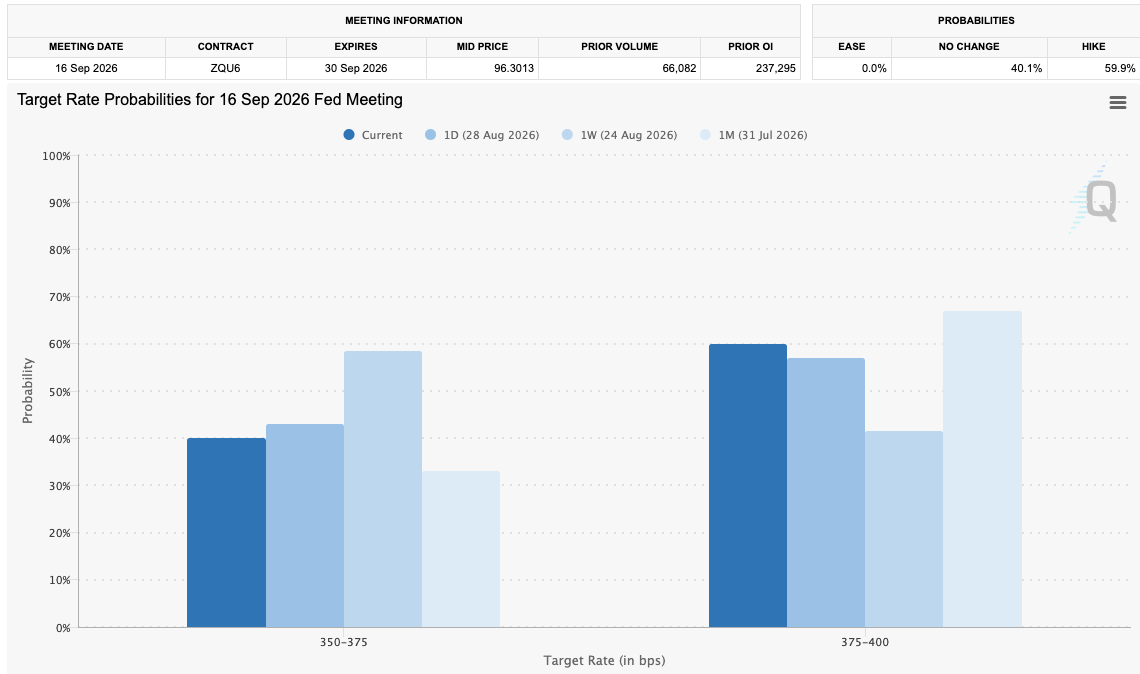
- Markets see a 60% chance of the Fed hiking interest rates in September, with jobs data due this week.
- Oil has experienced renewed volatility amid fresh US strikes on Iran and an unprecedented US-Venezuela oil-supply deal.
- Bitcoin remains under a crucial patch of resistance below $86,000 heading into the August monthly candle close.
September rate hike bets return after Jackson Hole
The coming week will bring the release of multiple US employment indexes, each likely to shape expectations for policy changes from the Federal Reserve.
The Fed is already in the spotlight after last week’s Jackson Hole economic symposium, which featured its first keynote speech from new chair Kevin Warsh. Warsh remained characteristically tight-lipped on policy cues, describing forward guidance — a fixture of Fed PR for decades — as having “overstayed its welcome.”
On inflation, Warsh described current data as too high, despite July’s lower-than-expected results for the Consumer Price Index (CPI) and Personal Consumption Expenditures (PCE) index.
“Each of these broad inflation measures have fallen significantly from their highs of a few years ago, but progress through the past couple of years has been more modest, and while this summer’s PCE and CPI readings were better than expected, they do not tell me that underlying trends have meaningfully improved,” he said.
Markets responded with increased expectations of interest-rate hikes, reverting to majority odds for a 0.25% hike at the Fed’s September meeting, per data from CME Group’s FedWatch Tool. At the time of writing, these odds stand at just below 60%, up from 41.4% last week.
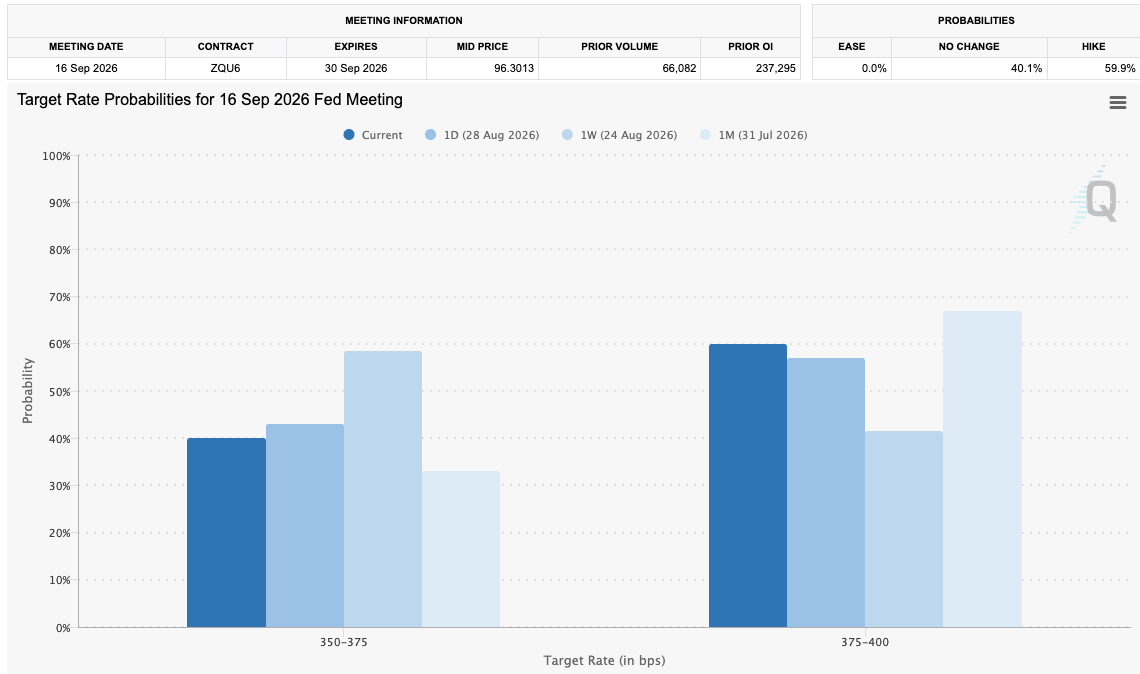
Fed target-rate probability comparison for September FOMC meeting (screenshot). Source: CME Group
Rates expectations could be tempered, however, by labor-market numbers. Friday will see August nonfarm payrolls data released. The economy is expected to have added 50,000 jobs last month, compared to a loss of 23,000 in June.
Private-sector employment numbers will precede nonfarm payrolls on Wednesday, followed by initial jobless claims on Thursday.
“All eyes are on the labor market,” trading resource The Kobeissi Letter summarized in commentary on X, noting that this would form the last slew of jobs data before the September rate decision.
Kobeissi flagged major downward revisions to employment numbers, with weak labor-market conditions forming a potential hurdle to Fed policy tightening. Citing data from the Bureau of Labor Statistics (BLS), it reported another 79,000 jobs removed in the 12 months through March this year.
“This follows last year’s record -911,000 revision and marks the 4th consecutive annual downward adjustment, matching the streak that ended in 2010 after the 2008 Financial Crisis,” it added, describing the labor market as being “weaker than initially reported for years.”
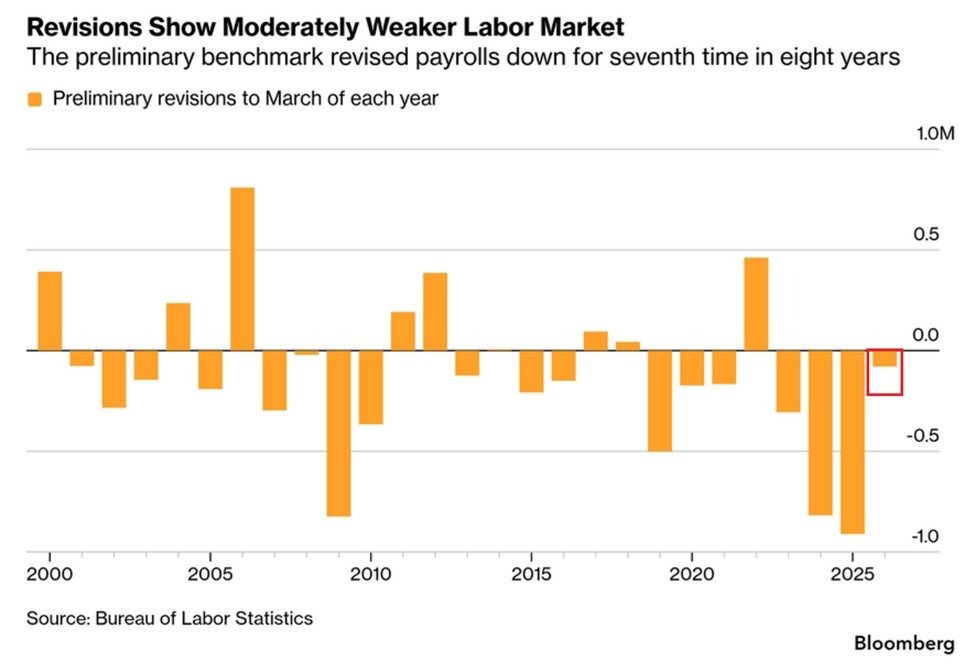
US employment data revisions. Source: The Kobeissi Letter on X.com
Oil spikes on US-Iran escalation
Oil markets are at the forefront of macro volatility as the week begins thanks to a combination of geopolitical catalysts.
Renewed US strikes on Iran sent Brent crude back above $90 per barrel on Monday, nearing its highest levels in a week. US WTI crude passed $85 per barrel, and was up 2.5% on the day at the time of writing.
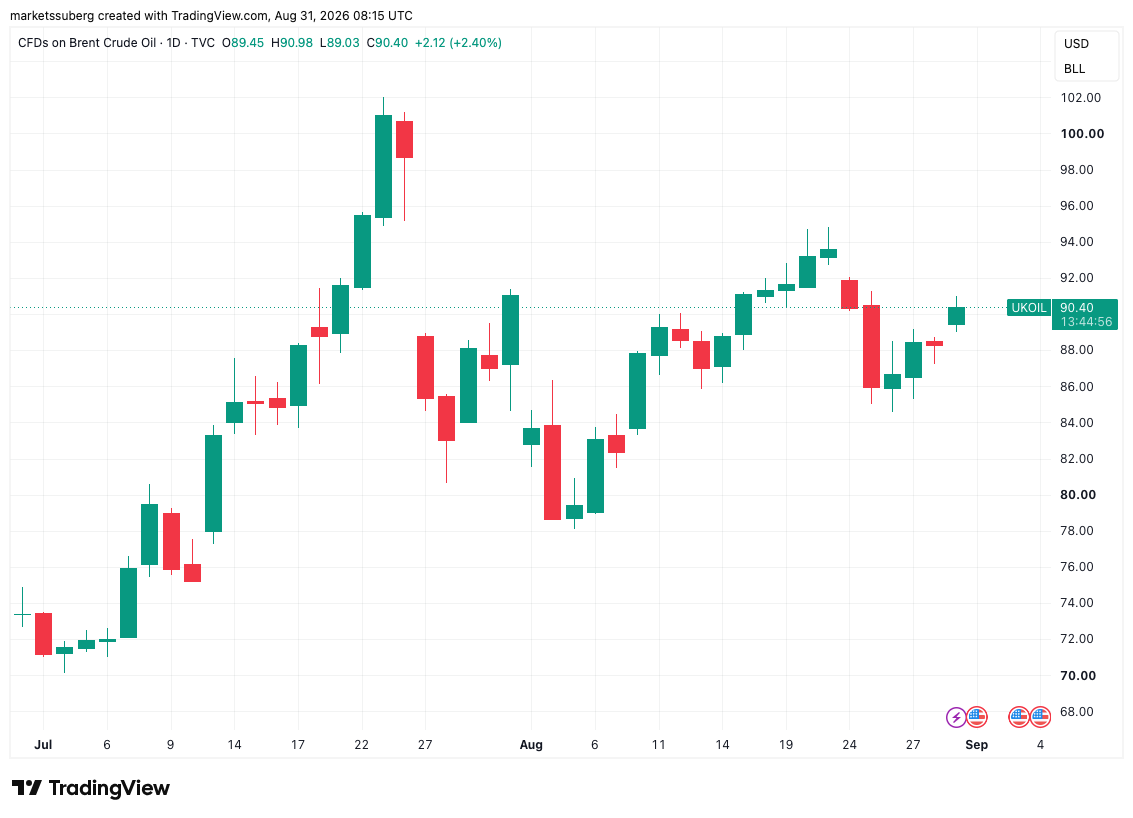
CFDs on Brent crude oil one-day chart. Source: Cointelegraph/TradingView
European stocks came under pressure as a result of the events, with Germany’s DAX down 0.7%. US president Donald Trump implied that Iran’s Kharg Island oil hub was once more a target. In a post on Truth Social, Trump uploaded an AI-generated video that appeared to show the bombing of oil infrastructure, describing the island as “being blown to smithereens.”
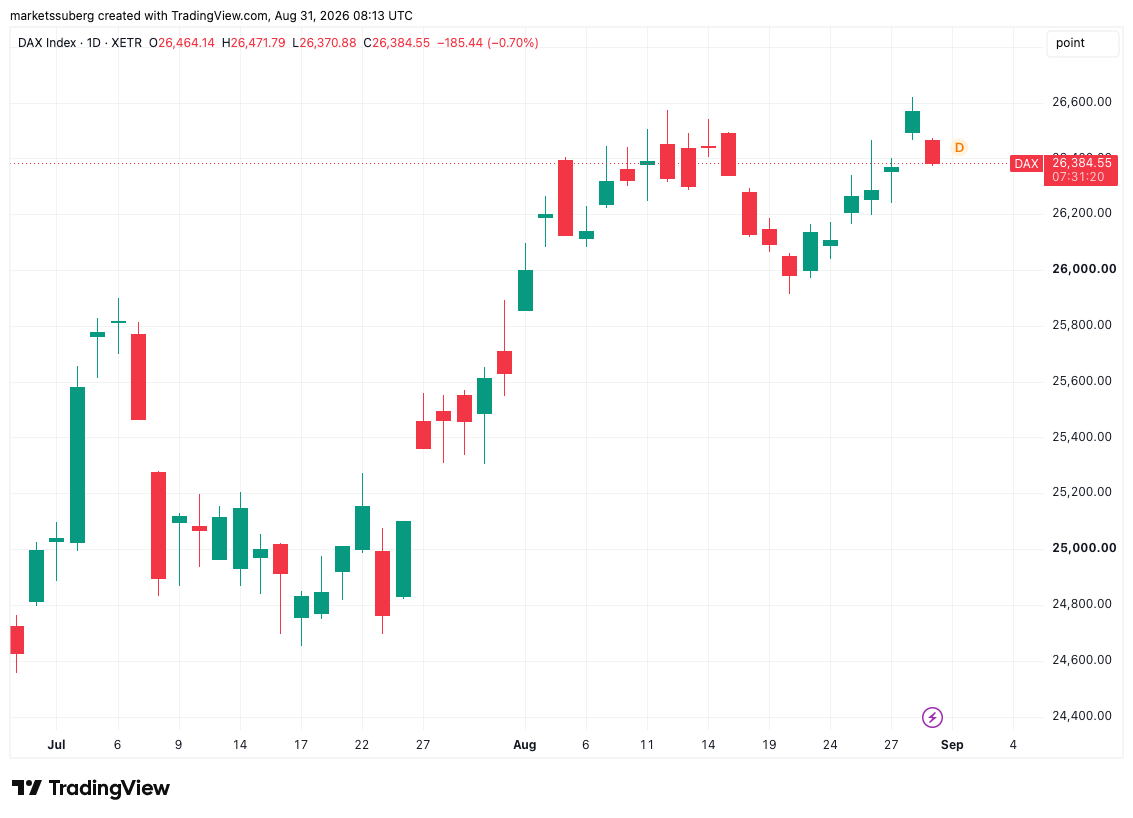
DAX one-day chart. Source: Cointelegraph/TradingView
The strikes followed news of a major energy deal granting the US significant control of Venezuela’s oil reserves. Numbers from Venezuela’s interim president Delcy Rodriguez quoted by CNBC and others referenced a daily oil-output target of 1.5 million barrels, with total reserves involved at 65 billion barrels, currently worth around $5.4 trillion.
In a Truth Social post, Trump described the takeover as the “biggest oil deal in history.”
Bitcoin battles multiple 50-week trend lines
Bitcoin saw late sell pressure into Sunday’s weekly close, with a brief trip below its 50-week exponential moving average (EMA) at $77,269, per data from TradingView.
Price defended the trend line, which we had previously flagged as important support, for a second consecutive week. In the wake of its recent rally, BTC had managed to reclaim the moving average with a weekly close for the first time since November 2025.
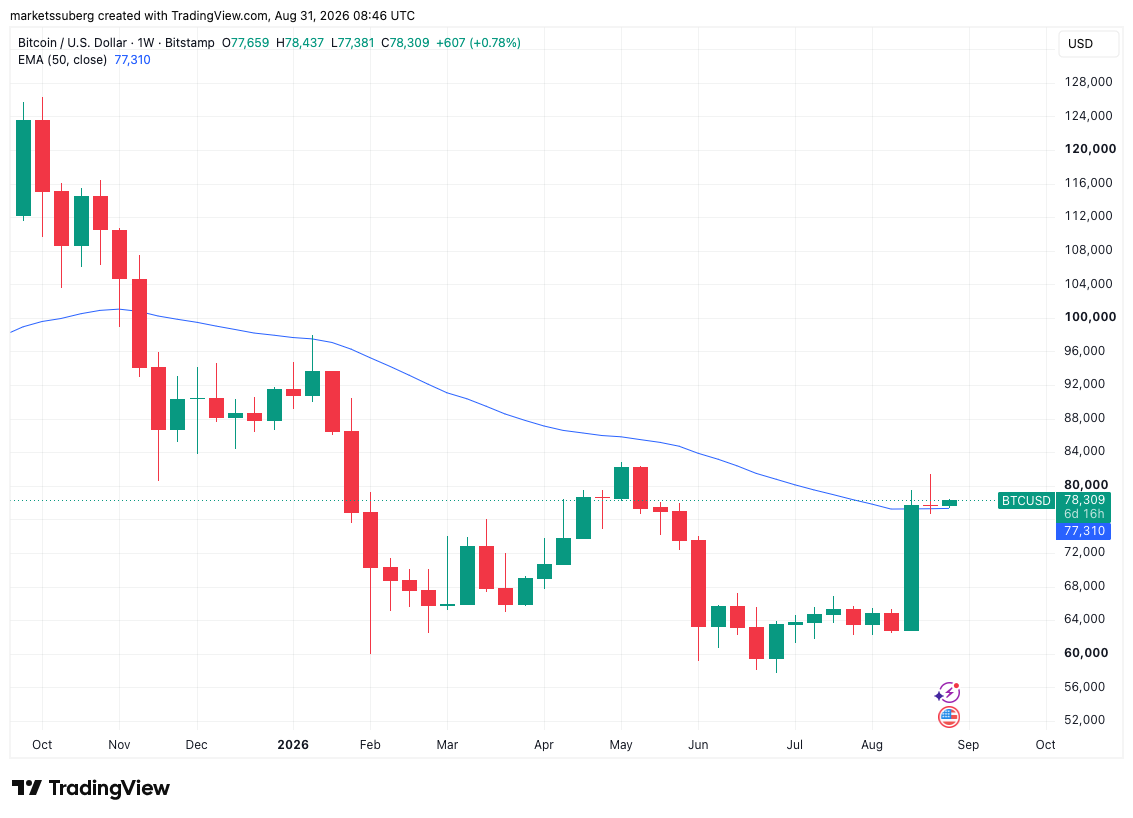
BTC/USD one-week chart with 50 EMA. Source: Cointelegraph/TradingView
In his latest market observations on X, Rafael Schultze-Kraft, cofounder of crypto analytics platform Glassnode, drew attention to the equivalent simple moving average (SMA) at $80,307. Here, BTC/USD still lacks a reclaim on the weekly time frame — something which has preceded additional price upside in the past, he showed.
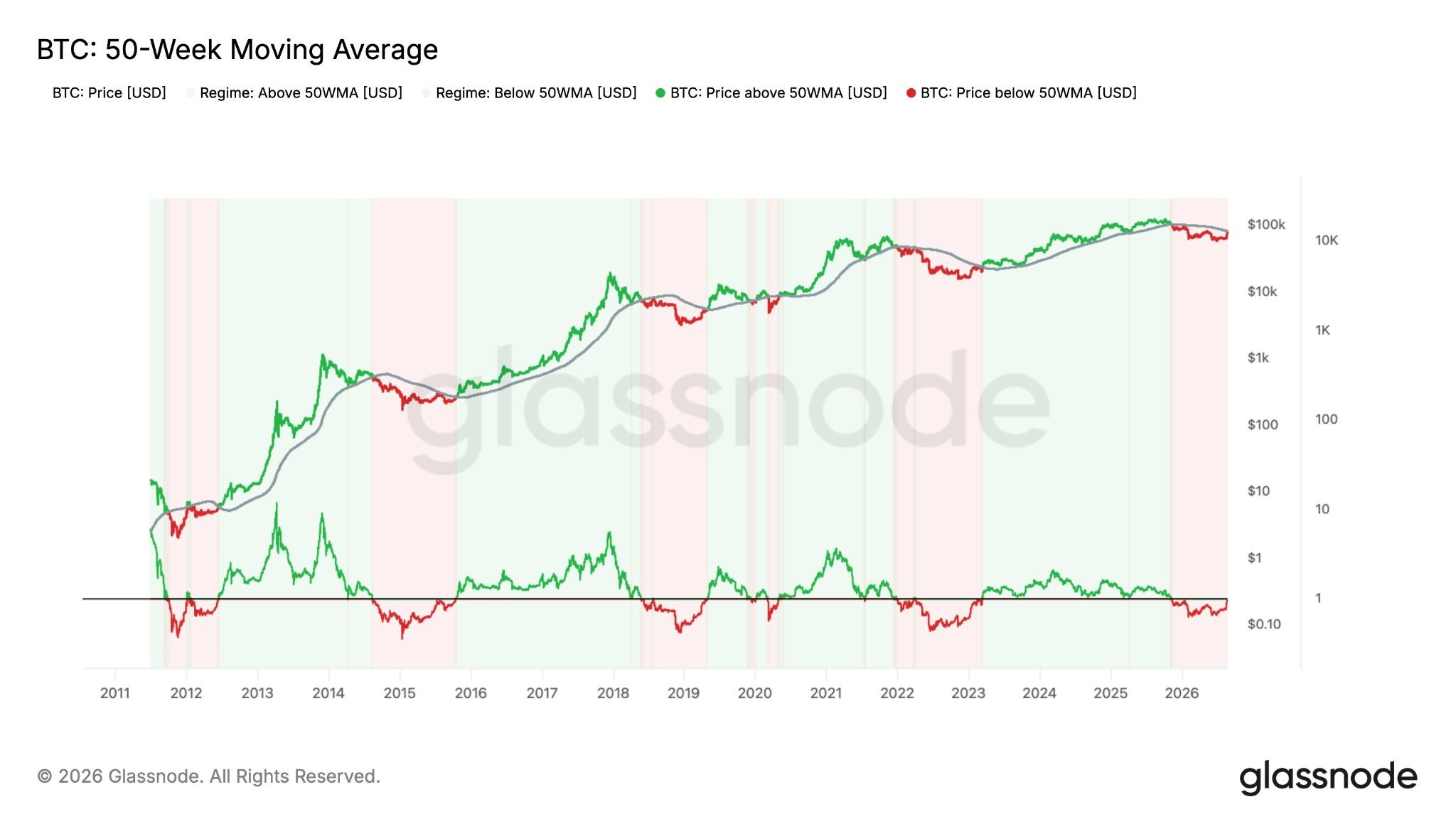
BTC/USD chart with periods above and below 50-week SMA. Source: Rafael Schultze-Kraft on X.com
Monthly close faces stiff resistance
Heading into the August monthly close, Bitcoin bulls face a key test as monthly gains for BTC/USD hover near 25%.
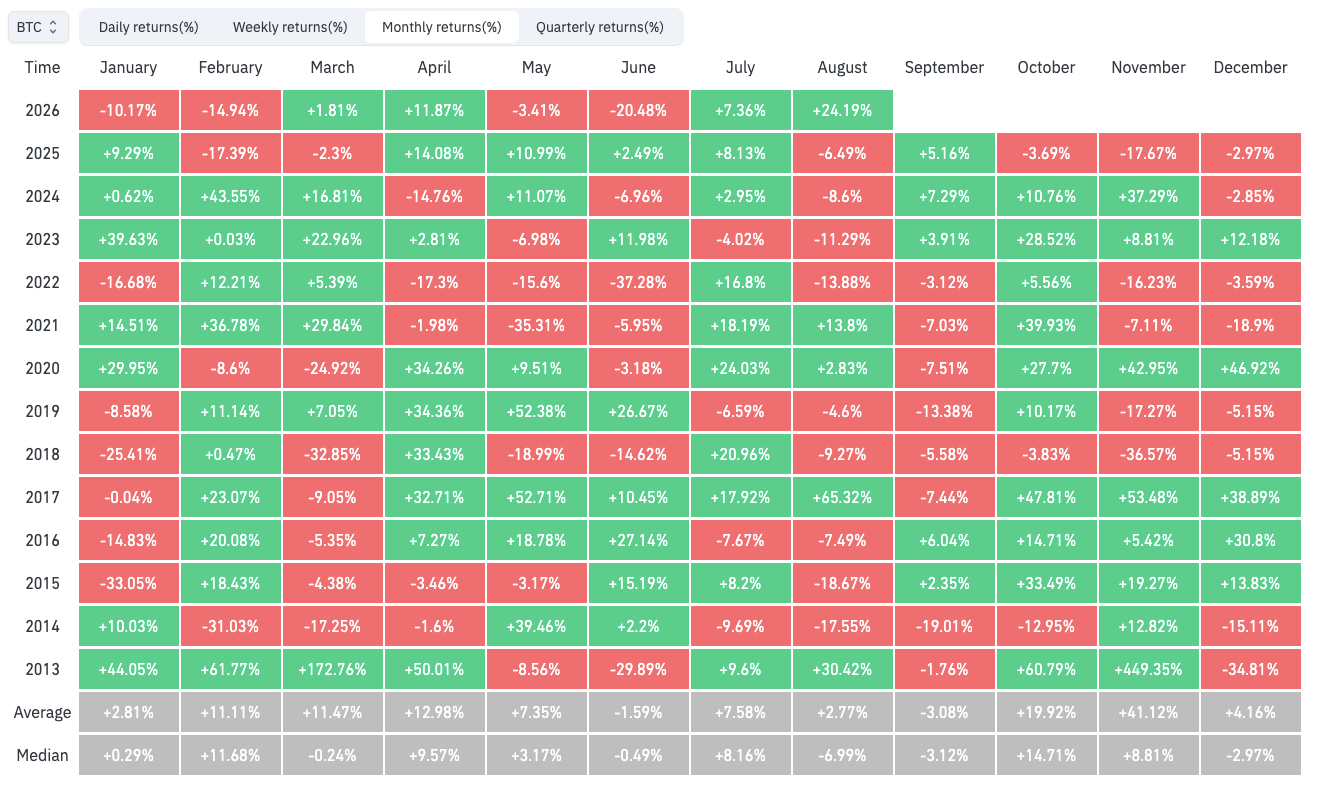
BTC/USD monthly returns (screenshot). Source: CoinGlass
Despite the biggest crypto short liquidation event ever recorded, buyers have so far failed to reclaim key resistance above $80,000, analysis warns.
“Bitcoin is still hovering beneath the Macro Downtrending resistance, having upside wicked briefly beyond it,” trader and analyst Rekt Capital summarized about the current status quo in his latest analysis on X.
“Still the pivotal resistance and by staying below it, Bitcoin continues its series of Macro Lower Highs.”
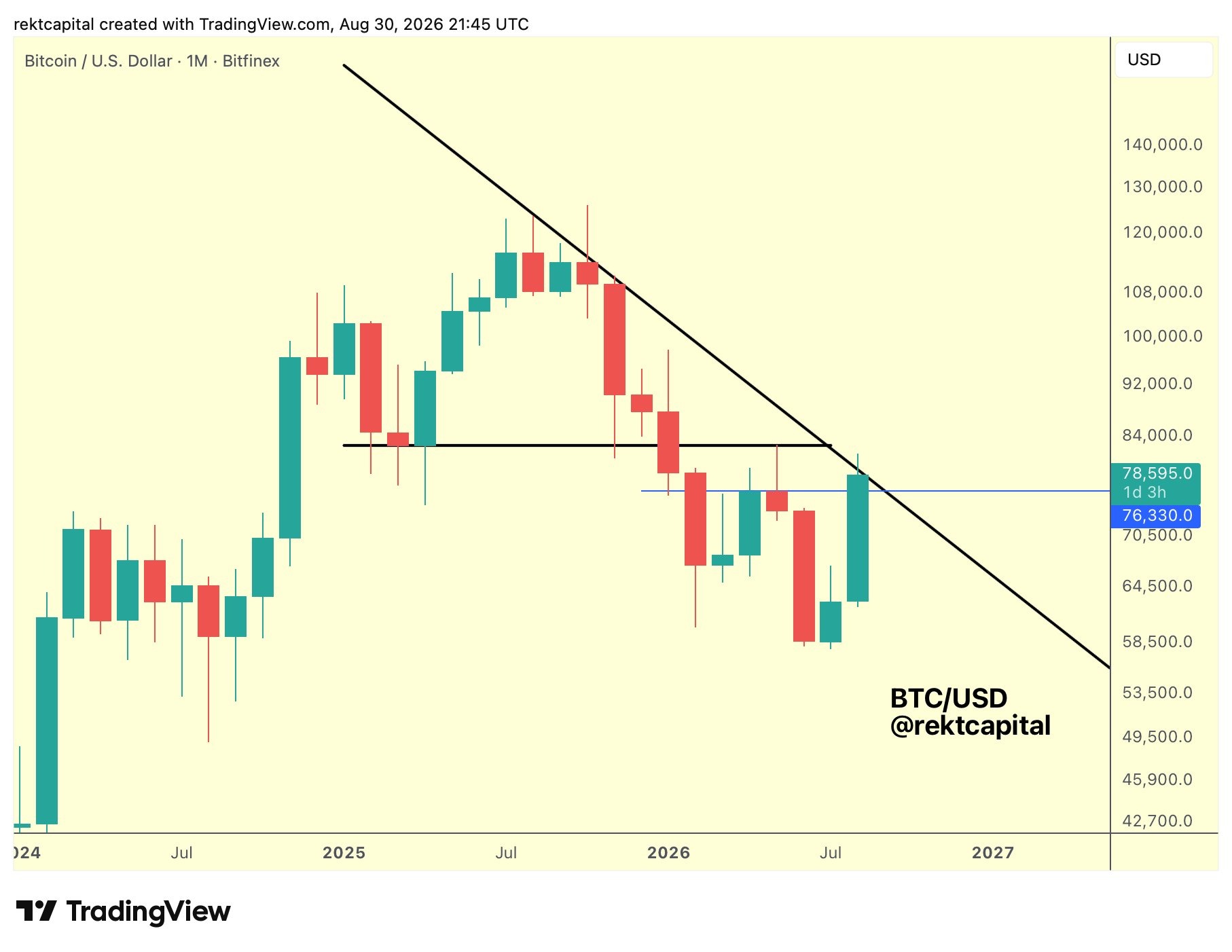
BTC/USD one-month chart. Source: Rekt Capital on X.com
Rekt Capital argued that a breakout above this resistance would have major implications for the four-year BTC price cycle, as it would mean that its latest bear market would be shorter than those before it.
Beyond the trend line, however, additional resistance has already formed thanks to thickening ask liquidity on exchange order books. As Cointelegraph reported, this extends to $86,000, thus requiring even more buy-side momentum to effect a lasting breakout.
“Every overhead structure we track now sits between $81K and $86K; that band is where the recovery’s demand meets its test,” Glassnode wrote in research last week.
Larger buyers seen as pivotal to BTC price upside
Glassnode calculated that 1.05 million BTC owned by long-term holders have a cost basis between $83,000 and $86,000. Long-term holders refer to wallets holding a given amount of BTC without selling for six months or more.
Related: Supply absorption ‘key question’ as Bitcoin fails to reclaim $80K: Analysis
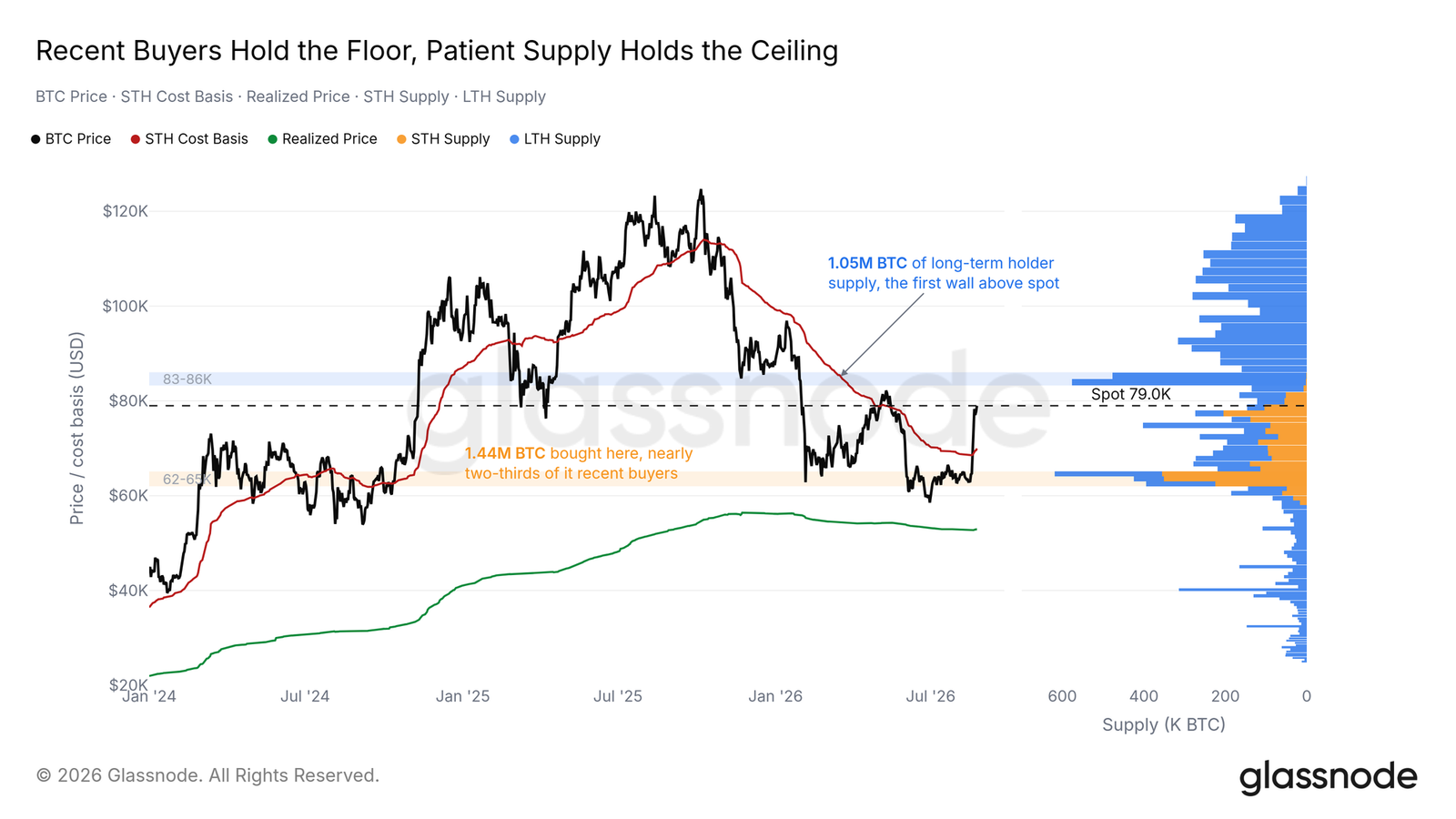
BTC supply distribution by wallet cohort. Source: Glassnode
In additional findings this week, onchain analytics platform CryptoQuant drew attention to the potential impact of large-volume investors going into September. These entities, its data showed, were behind buyer appetite this month, while smaller investors took profit or exited the market after their holdings returned to breakeven.
“From 1–30 August, wallets with 100+ BTC added about 60,000 BTC. Wallets with 1–100 BTC sold about 33,000. Wallets under 1 BTC sold about 14,000,” it wrote in a blog post on Monday.
“That split is the month. Large holders absorbed the breakout. Smaller holders used the rally as an exit.”
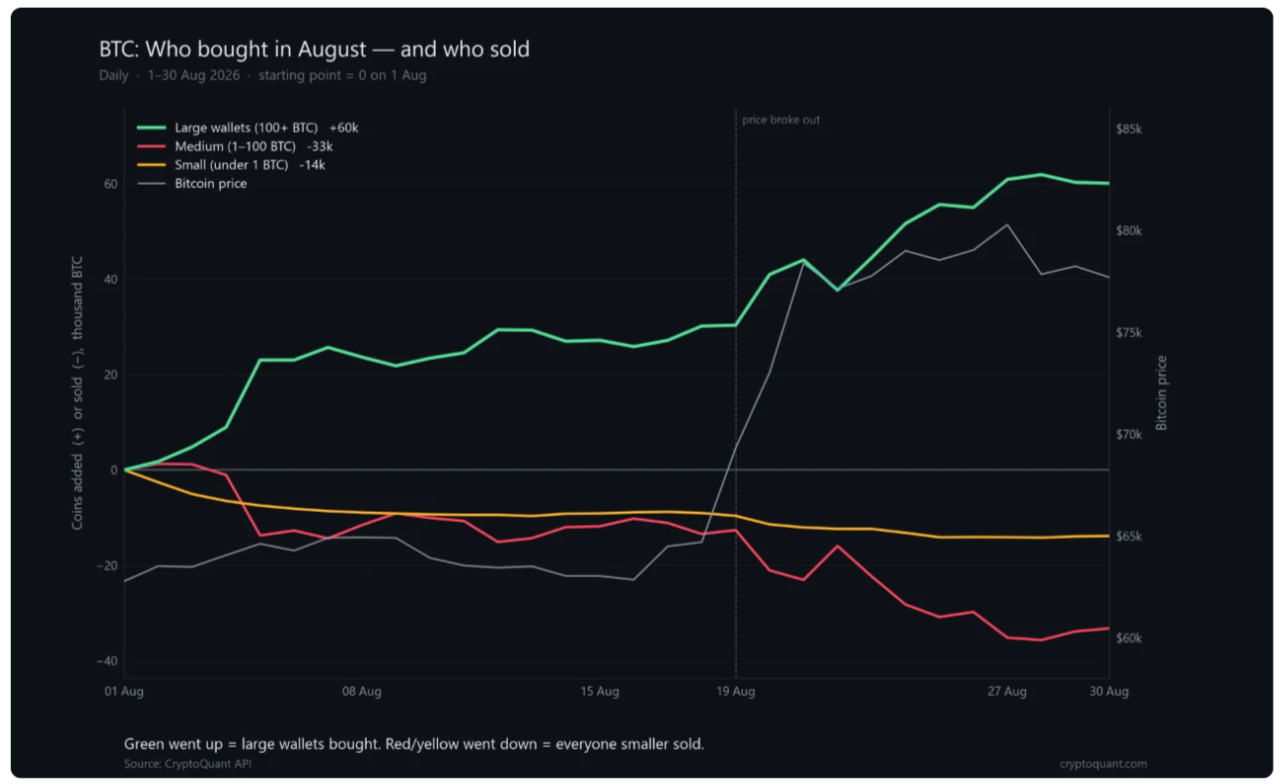
Bitcoin accumulation data by wallet cohort (screenshot). Source: CryptoQuant
CryptoQuant added that the view of large-investor accumulation would require reassessment should those entities start selling recently acquired supply below $80,000.

US stars A’ja Wilson and Kelsey Plum to miss the FIBA Women’s World Cup

Business groups urge Swinney to scrap ‘ineffective’ food price cap plan

Stock Market Today: Dow Falls, Oil Prices Jump As U.S., Iran Exchange New Strikes

Weekend Open Thread – Corporette.com

Weekend Open Thread: Brooks Brothers

London Mayor Sadiq Khan handed a peerage by Keir Starmer alongside 15 other Labour figures… just days before the PM leaves No10

Steps to download your financial documents | #ServiceAtYourFingertips #avinashbanga #shorts

Teni – Money (Lyrics) Money can’t buy you happiness and love

Bitcoin’s August Rally Just Met Warsh #bitcoin #crypto #btc #cryptocurrency #cryptologic
-

 Crypto World6 days ago
SpaceX stock could rise 75% to $240, JPMorgan says
-

 Fashion3 days ago
Weekend Open Thread: Maeve – Corporette.com
-

 Crypto World4 days ago
Bitcoin’s 22% rally now needs real demand to outlast Treasury liquidity boost
-

 Crypto World5 days ago
Warsh Jackson Hole keynote puts financial innovation first
-

 Crypto World6 days ago
A $30 Billion AI Fund Implodes, Now the SEC Is Investigating Wall Street’s Role
-

 Business3 days ago
Salesforce Stock Soars 19% as Blowout Earnings and Agentforce AI Growth Silence Software Skeptics
-

 Crypto World5 days ago
Did Trump Just Move SpaceX Stock With One Truth Social Post?
-

 Crypto World5 days ago
Elon Musk Grok Bot Promise: We Will Make You Whole if AI Loses Your Money
-

 Business4 days ago
Apple Confirms September 9 Keynote and Reveals Its Full Pre-Order Schedule
-

 Business5 days ago
Walmart takes aim at younger shoppers with new fashion brand
-
 NewsBeat5 days ago
Lindsay Clancy jury braces for closing arguments as judge tells court: ‘You’ve heard all the evidence’ – Live updates
-

 Business2 days ago
Onto Innovation Stock: AI’s Next Bottleneck Is Yield (NYSE:ONTO)
-

 Crypto World2 days ago
Bitcoin price tests $82K resistance as Brandt stays long
-

 Business6 days ago
Thailand’s Eastern Economic Corridor Capital City (EECiti): Key Developments and Investment Opportunities
-

 Crypto World4 days ago
NVIDIA revenue hits $96.2B as AI demand doubles
-

 Business7 days ago
Moderna CEO warns China is pouring state money into mRNA technology
-

 Business7 days ago
NVIDIA Stock Drops Nearly 2 Percent to $210 on Seventh Losing Day Ahead of Critical AI Earnings
-

 Business3 days ago
iPhone 18 Pro Pre-Orders Could Shift to Saturday as Apple Reportedly Avoids September 11 Anniversary
-

 NewsBeat5 days ago
Trump’s trade truce with China faces test with Iran effort
-
 Crypto World5 days ago
Nvidia Q2 Earnings Reveal $96.2 Billion Beat, So Why Is NVDA Falling?
You must be logged in to post a comment Login