

Crypto World
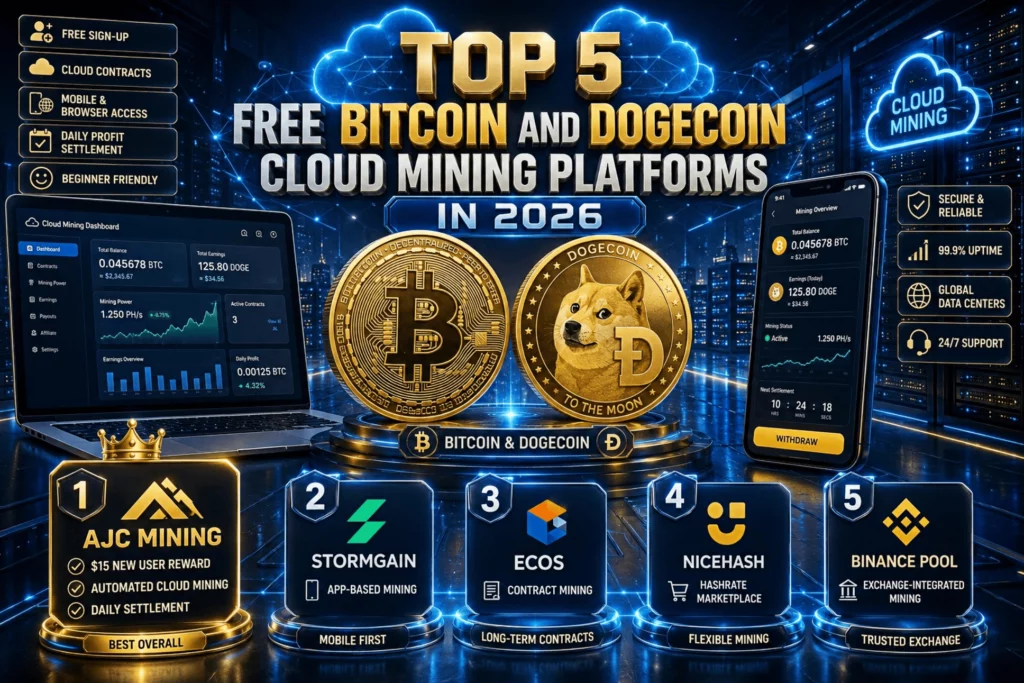
5 leading Bitcoin and Dogecoin cloud mining platforms in 2026

Disclosure: This article does not represent investment advice. The content and materials featured on this page are for educational purposes only.
AJC Mining gains attention as cloud mining platforms evolve beyond traditional crypto mining models.
Summary
- AJC Mining offers beginner-friendly cloud mining with automated contracts, daily settlements, and no hardware setup required.
- Cloud mining in 2026 now includes apps, marketplaces, and hosted systems, with AJC Mining targeting easy beginner access.
- AJC Mining simplifies Bitcoin and Dogecoin mining through cloud contracts, reducing technical and equipment barriers.
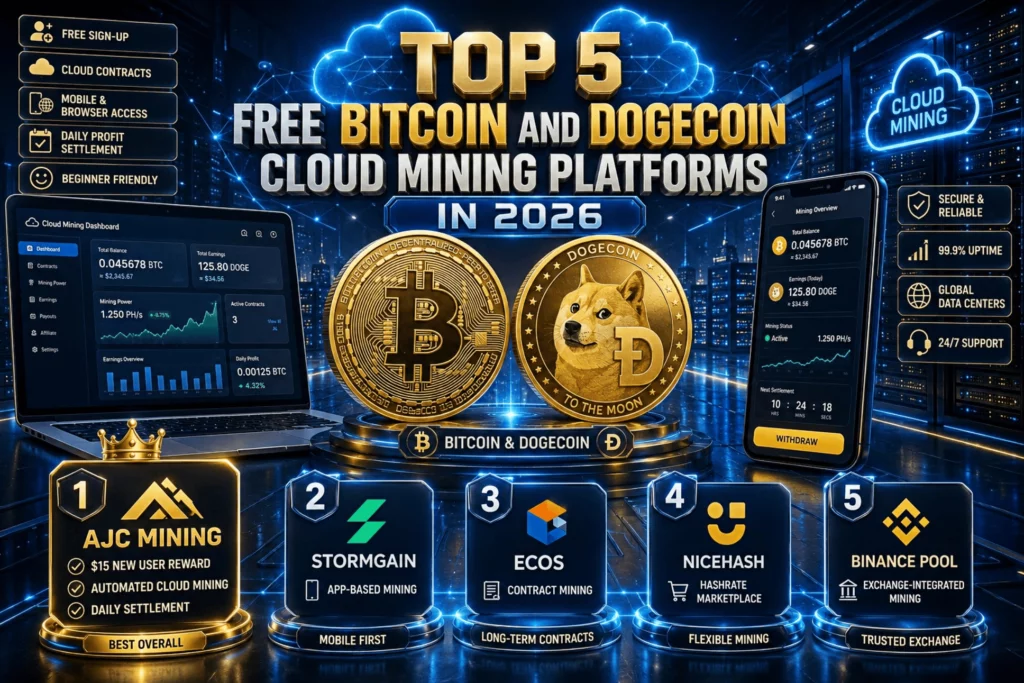
As more users search for easier ways to understand Bitcoin mining and Dogecoin cloud participation, mobile-first platforms and browser-based dashboards continue gaining visibility as alternatives to hardware-heavy mining setups.
As users continue searching for questions like what Bitcoin mining is, how cloud mining works, and whether mobile-friendly mining options still exist in 2026, platform-based mining access remains an area of interest.
Compared with buying hardware, managing electricity costs, or operating mining rigs directly, cloud mining platforms are often seen as a more accessible starting point for beginners.
In real use, “free” rarely means unlimited mining at no cost forever. More often, it refers to free registration, app access, welcome rewards, trial contracts, beginner dashboards, or activation features that help users understand how a platform works before choosing larger participation plans.
That is why comparison roundups still matter for users trying to understand how cloud mining platforms operate and which services may be easier to approach.
What “free” usually means in 2026
Free cloud mining usually refers to:
- Free account registration
- App or browser-based platform access
- Welcome rewards or onboarding bonuses
- Trial or entry-level contracts
- Dashboard access before selecting paid plans
- Automated mining participation under separate platform terms
Top free cloud mining platforms in 2026
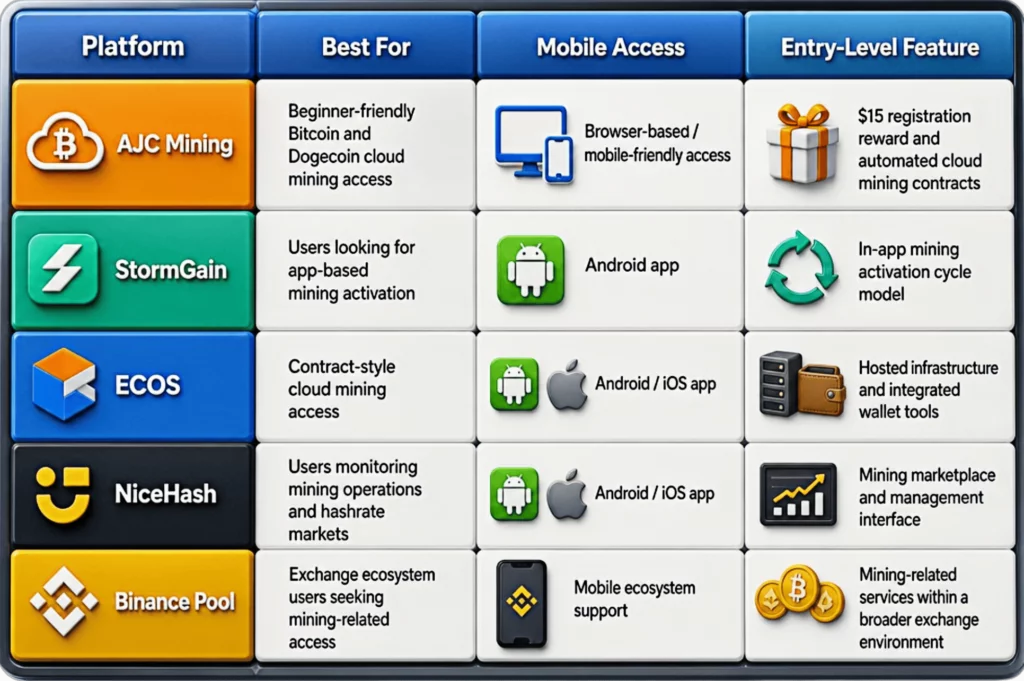
The comparison above reflects the different ways users approach mining in 2026. Some prefer simple onboarding, some want structured cloud mining contracts, while others prefer marketplace tools or exchange-integrated mining ecosystems.
1. AJC Mining — Best for beginners seeking automated cloud mining access
AJC Mining can be understood as a beginner-friendly cloud mining platform designed for users who want to explore Bitcoin and Dogecoin mining participation without buying or maintaining physical mining machines.
For users with no prior mining experience, AJC Mining offers a relatively simple onboarding process. The platform focuses on cloud computing power deployment, fixed-term contract options, and automated daily settlement according to contract terms.
This makes AJC Mining suitable for users who want a lower-barrier entry point into cloud mining while avoiding hardware setup, technical configuration, heat management, and manual operation.
How do users join AJC Mining?
The process for joining AJC Mining is designed to be simple for new users.
Step 1: Register an account
Users can register through the official AJC Mining website. After successful registration, new users receive a $15 reward.
(Click here to register now and claim a reward.)
Step 2: Select a cloud mining contract
AJC Mining offers both short-term and longer-term cloud mining contracts. Users can choose based on:
- Budget
- Contract duration
- Profit goals
- Preferred mining strategy
Step 3: Activate the contract
Once a contract is selected, the system automatically deploys cloud computing power. Earnings are settled daily according to the contract terms, and no manual mining operation is required from the user.
AJC Mining cloud mining contract reference
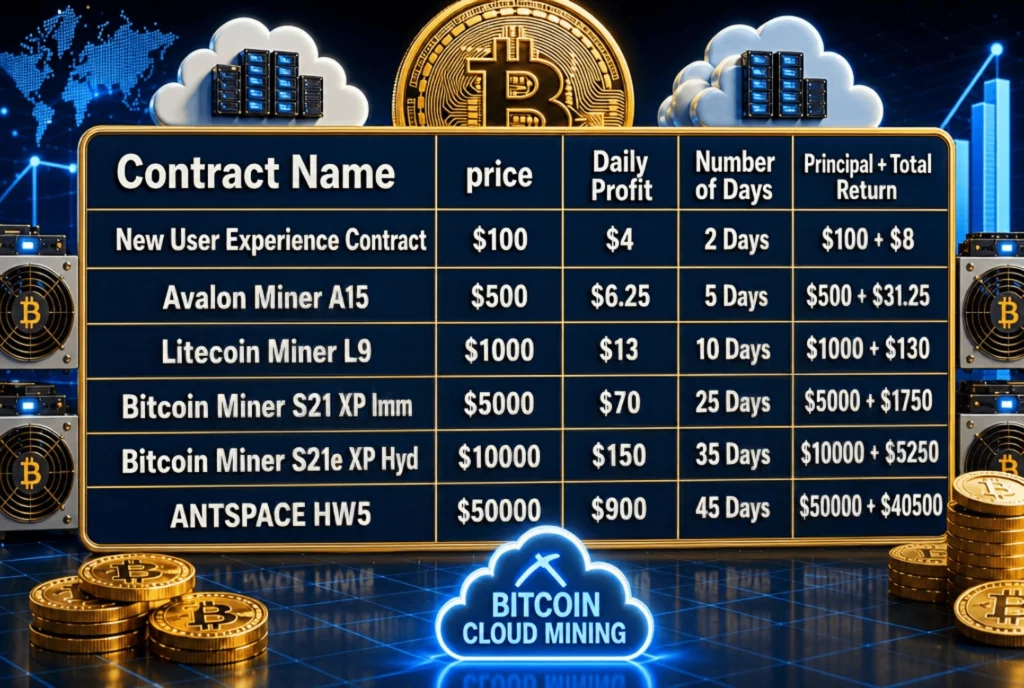
These contracts represent different levels of computing power and participation strategies. AJC Mining emphasizes:
- Fixed-term cloud mining contracts
- Daily profit settlement
- Fully automated mining operations
- Beginner-friendly access
- No hardware purchase or maintenance required
(Click to view more cloud mining contracts.)
2. StormGain — Best for users who want an app-oriented mining experience
StormGain is often discussed by users looking for a mobile-first cloud mining experience. Its app-based interface makes it easier for users to activate mining-related features without navigating a complex technical dashboard.
This convenience helps explain why StormGain continues to appear in beginner-focused mining discussions. It may appeal to users who want a lighter app experience rather than a traditional contract-style cloud mining setup.
3. ECOS — Best for structured contract-style cloud mining access
ECOS is often included in cloud mining roundups because it presents hosted mining through a more structured contract-style model. This type of setup may suit users who prefer clearly defined participation terms, contract durations, and platform-managed infrastructure.
For users who want something more organized than simple app activation, ECOS remains a commonly referenced option.
4. NiceHash — Best for users interested in mining marketplace tools
NiceHash is less of a typical “free mining app” and more of a mining marketplace and management environment. It gives users visibility into hashrate markets, mining power activity, and operational tools.
This makes NiceHash more suitable for users who want to understand mining power markets or manage mining-related activity with more control.
5. Binance Pool — Best for exchange-integrated mining access
Binance Pool stands out because it connects mining-related services with the broader Binance exchange ecosystem. For users already operating within Binance’s platform environment, this integrated structure may feel easier than using a separate standalone mining service.
Its appeal comes from ecosystem convenience, especially for users who prefer having exchange, wallet, and mining-related services in one place.
Why Bitcoin and Dogecoin cloud mining continue to attract attention
Bitcoin remains the best-known digital asset by market value, while Dogecoin continues to attract everyday interest from retail crypto participants. Together, they represent two highly visible but very different parts of the digital asset market.
Many users searching for how to mine cryptocurrency or how cloud mining works are not necessarily trying to build large mining operations. More often, they are looking for easier ways to understand the process and decide whether a mobile-friendly or browser-based platform makes more sense than running mining hardware directly.
Cloud mining platforms continue to attract attention because they reduce several traditional barriers, including:
- Hardware purchase costs
- Machine maintenance
- Electricity and heat management
- Technical configuration
- Direct mining operation
How to choose the right cloud mining platform
Every platform works differently, and “free” does not mean the same thing everywhere. Before choosing a platform, users usually compare:
- What the free registration or reward actually includes
- Whether the service is app-based, browser-based, or contract-based
- How clearly the platform explains its mining model
- Whether fees, returns, contract terms, and withdrawal rules are disclosed
- Whether the platform is built for beginners or advanced users
- Whether daily settlement and contract details are transparent
A practical starting approach is often to begin with a lower-barrier platform, review the dashboard and platform rules carefully, and only then decide whether to commit more time or capital.
Frequently asked questions
What is Bitcoin mining?
Bitcoin mining is the process of using computing power to validate transactions and help secure the Bitcoin blockchain. Cloud mining generally allows users to access mining participation through remote infrastructure instead of owning and operating mining machines themselves.
What is Dogecoin cloud mining?
Dogecoin cloud mining refers to participating in Dogecoin-related mining through hosted computing power or platform-based infrastructure. Instead of running hardware directly, users access mining services through a cloud mining provider.
What does “free cloud mining” usually mean?
Usually, it refers to free registration, platform access, welcome rewards, trial contracts, app features, or limited activation periods. It does not usually mean unlimited mining forever at zero cost.
How can beginners start exploring cloud mining?
Beginners often start with platforms that offer simple registration, beginner dashboards, automated contracts, and clear explanations of how mining participation works. AJC Mining, for example, provides a registration reward and automated cloud mining contract options for new users.
Can users mine crypto on a phone or laptop?
Serious direct mining on a phone or laptop is generally not practical anymore. In most cloud mining models, mobile devices and laptops are mainly used for account access, contract management, and dashboard monitoring while the actual mining infrastructure runs remotely.
How should beginners choose a platform?
Beginners should look for platforms that clearly explain their mining model, provide transparent contract details, disclose fees and withdrawal rules, and offer a user-friendly dashboard.
Conclusion
The cloud mining landscape in 2026 is no longer defined by a single type of product. Users can now choose between automated cloud mining contracts, mobile-first mining apps, hosted infrastructure platforms, mining marketplaces, and exchange-linked mining ecosystems.
For users exploring Bitcoin and Dogecoin mining participation, a practical starting point is usually a platform that clearly explains its access model and reduces the hardware, setup, and technical barriers involved in traditional mining.
AJC Mining stands out in this comparison because it offers a beginner-friendly registration process, a $15 new user reward, automated contract activation, and daily profit settlement based on selected contract terms. For users who want a simpler way to understand cloud mining without managing physical equipment, AJC Mining may be a suitable platform to explore.
As always, users should compare platform terms carefully, understand what “free” really means, and review contract rules, risks, fees, and withdrawal conditions before participating.
For more information, visit the official website.
Disclosure: This content is provided by a third party. Neither crypto.news nor the author of this article endorses any product mentioned on this page. Users should conduct their own research before taking any action related to the company.



The U.S. Treasury has sanctioned two networks linked to the Sinaloa Cartel over allegations that they used cryptocurrency transactions to move fentanyl trafficking proceeds.
Summary
- U.S. Treasury sanctioned two networks accused of helping the Sinaloa Cartel move fentanyl trafficking proceeds through cryptocurrency.
- Six Ethereum wallet addresses were added to the sanctions list, including one USDT-linked address that became active again in April after more than a year.
- Authorities in Brazil and the U.S. have continued targeting crypto-linked money laundering operations tied to organized crime groups across Latin America.
According to the U.S. Department of the Treasury, the sanctions announced Wednesday were carried out through a coordinated operation led by the Homeland Security Task Force with support from the Drug Enforcement Administration.
Treasury Secretary Scott Bessent said the administration would continue targeting cartel-linked financial operations tied to fentanyl trafficking. In a statement released by the Treasury, Bessent said the government would not allow “narco-terrorists” to use financial networks to move drug-related proceeds into the United States.
Among those added to the sanctions list was Armando de Jesus Ojeda Aviles, whom the Treasury accused of helping convert cash into cryptocurrency on behalf of the Sinaloa Cartel. The department also identified Jesus Alonso Aispuro Felix as an associate allegedly involved in transferring drug trafficking proceeds through blockchain-based transactions.
At the same time, the Treasury attached six Ethereum wallet addresses to the sanctions designation. Five of those addresses were linked to Ojeda Aviles, according to the department’s release.
Blockchain activity tied to the listed wallets showed limited recent movement. Data referenced in the Treasury announcement indicated that five of the six Ethereum addresses had remained inactive for years. One address ending in “e27cb,” however, reportedly sent $894 worth of Tether’s USDT stablecoin on April 27 after more than a year without recorded activity.
Treasury expands cartel-linked crypto enforcement
Treasury officials said the sanctions were issued under two executive orders focused on combating illicit drug production and organizations designated as terrorists or supporters of terrorism.
In its statement, the Treasury described the Sinaloa Cartel as a Foreign Terrorist Organization responsible for trafficking significant quantities of fentanyl into the United States. The department said the drug continues to contribute to tens of thousands of deaths annually across the country.
Federal agencies have previously linked cryptocurrency networks to cartel financing operations across Latin America. A July 2025 report from the U.S. Department of Justice said the DEA had seized more than $10 million in crypto assets connected to the Sinaloa Cartel.
Elsewhere in the region, Brazilian authorities have also investigated organized crime groups accused of using digital assets to launder illicit funds. In August 2024, civil police in São Paulo dismantled a money laundering operation allegedly tied to the Primeiro Comando da Capital, or PCC, one of Brazil’s largest criminal gangs.
According to CNN Brasil, investigators said the group operated a cryptocurrency exchange that handled nearly 500 million Brazilian reais, or about $88.6 million at the time. Authorities reportedly seized 55 million reais in checks during raids linked to the investigation, while police arrested 13 individuals connected to the scheme.
Earlier investigations in Brazil pointed to similar patterns. In June 2023, the country’s Special Department of Federal Revenue raided six cryptocurrency exchanges accused of laundering roughly $380 million in illicit funds. A separate federal police operation in 2024 dismantled another crypto-linked laundering network that authorities valued at about $2.6 billion.
A 2023 report cited by regional investigators had already identified the growing use of cryptocurrency among organized crime groups in Latin America, including the Sinaloa Cartel and MS-13. Despite those cases, crypto adoption in Brazil continued to rise, with local trading volumes climbing 30% in 2024 while regulators advanced digital asset oversight measures.

For the past two decades, the internet has increasingly shifted toward a subscription-driven economy. From software and entertainment to cloud storage and productivity tools, users are now conditioned to pay recurring monthly fees simply to access digital services. The Software-as-a-Service (SaaS) model became one of the dominant business frameworks of the modern web, creating predictable revenue streams for companies but also locking users into ecosystems they rarely control.
Decentralized Finance (DeFi) introduces a radically different possibility: a financial system where infrastructure is open, services are composable, and participation is based on ownership and usage rather than perpetual subscription payments.
As blockchain networks mature, DeFi may become the foundation of a broader subscription-free digital economy.
The Rise of Subscription Fatigue
The modern internet is increasingly expensive to maintain as a consumer.
Users pay subscriptions for:
- cloud software
- streaming platforms
- productivity tools
- payment processors
- trading platforms
- banking services
- premium APIs
While subscriptions create stable cash flow for companies, they also create friction for users. Over time, the internet has evolved into a fragmented collection of recurring payments where access is temporary and conditional.
In traditional systems, users rarely own the platforms they depend on. They rent access.
This model creates several long-term problems:
- centralized control over infrastructure
- limited user ownership
- increasing platform lock-in
- rising costs for digital participation
- monetization through advertising and data extraction
DeFi challenges these assumptions by rethinking how financial infrastructure itself can operate.
Open Financial Rails Instead of Closed Platforms
At its core, DeFi is not simply an alternative banking system. It is an open financial coordination layer built on programmable blockchains.
Traditional financial services rely on closed networks:
- banks control accounts
- payment processors control transfers
- brokerages control market access
- Software providers control the infrastructure
DeFi replaces these siloed systems with open financial rails that anyone can access.
Protocols operating on networks such as Ethereum, Solana, and Avalanche allow developers to build financial applications without needing permission from centralized intermediaries.
This changes the economics of digital finance.
Instead of companies charging recurring subscription fees for access to financial services, protocols can monetize through:
- transaction fees
- liquidity incentives
- network participation
- protocol-owned assets
- optional premium tooling
The infrastructure itself becomes publicly accessible while monetization occurs at the usage layer.
The Emergence of Pay-Per-Use Economics
One of DeFi’s most important innovations is the shift from subscription models toward pay-per-use economics.
In traditional SaaS:
- Users pay whether they actively use the service or not
- Access disappears when payments stop
- Pricing is determined centrally
In DeFi:
- users interact directly with protocols
- Fees are often proportional to actual activity
- Access remains open to anyone with a wallet
This model resembles internet-native utility infrastructure more than corporate software licensing.
For example:
- Decentralized exchanges charge trading fees only when trades occur
- Lending protocols generate yield through borrowing demand
- cross-chain protocols monetize through routing activity
- stablecoin systems earn from settlement flows
Users pay for economic activity rather than platform membership.
This distinction matters because it lowers barriers to participation while creating more efficient capital allocation across networks.
Protocol-Owned Infrastructure Changes Incentives
A major weakness of traditional digital finance is that infrastructure ownership remains concentrated among corporations.
DeFi introduces the concept of protocol-owned infrastructure:
- liquidity pools owned by protocols
- decentralized validator networks
- community-governed treasuries
- shared execution environments
- open-source financial primitives
Instead of maximizing shareholder extraction, many DeFi systems attempt to align incentives between:
- users
- liquidity providers
- developers
- token holders
- network participants
This does not eliminate profit motives, but it redistributes how value flows through the ecosystem.
In many cases, users are not simply customers. They are stakeholders.
That distinction could reshape the future relationship between individuals and digital platforms.
Ownership Versus Subscription
The philosophical divide between traditional finance and DeFi may ultimately center around a simple question:
Should users rent digital access, or should they own part of the systems they use?
In Web2 platforms:
- Users generate value
- Corporations capture most of the upside
- Participation rarely translates into ownership
DeFi experiments with a different structure:
- governance tokens
- community treasuries
- revenue-sharing mechanisms
- decentralized voting systems
- permissionless participation
While governance systems remain imperfect, the broader shift is significant.
Ownership transforms users from passive consumers into active economic participants.
This is one reason why many DeFi communities resemble digital economies rather than traditional customer bases.
Internet-Native Finance
The internet was originally designed as an open communication network. DeFi extends that philosophy into financial infrastructure.
Internet-native finance operates differently from legacy banking systems because it is:
- global by default
- interoperable
- programmable
- continuously accessible
- composable across applications
A developer in the Philippines can integrate decentralized liquidity, lending, payments, and settlement into an application without negotiating with banks or payment processors.
This dramatically reduces coordination costs.
As these systems improve in scalability and user experience, financial services may increasingly resemble open internet protocols rather than private corporate products.
The implications extend far beyond crypto trading.
Potential applications include:
- global creator economies
- machine-to-machine payments
- decentralized AI marketplaces
- tokenized real-world assets
- borderless business infrastructure
- autonomous digital organizations
DeFi may eventually function as the invisible financial layer powering internet-native economic activity.
Challenges Still Facing DeFi
Despite its potential, DeFi remains early and highly experimental.
Several major obstacles still limit adoption:
User Experience Complexity
Wallet management, gas fees, private keys, and cross-chain interactions remain difficult for mainstream users.
Security Risks
Smart contract exploits and protocol failures continue to undermine trust across the industry.
Regulatory Uncertainty
Governments are still determining how decentralized systems fit into existing legal frameworks.
Scalability Constraints
Many blockchain ecosystems still struggle with throughput, fragmentation, and interoperability.
Sustainable Monetization
Not all DeFi protocols have viable long-term economic models.
The transition toward subscription-free finance will require infrastructure that is not only decentralized but also reliable, intuitive, and economically sustainable.
The Bigger Economic Shift
The deeper significance of DeFi may not be speculative assets or token prices.
Its real importance could lie in redefining how digital economies are structured.
The current internet economy is dominated by:
- rented access
- platform dependency
- centralized monetization
- recurring subscriptions
DeFi proposes an alternative:
- open infrastructure
- composable services
- user ownership
- usage-based economics
- permissionless participation
If these systems mature successfully, they could reduce reliance on centralized financial gatekeepers and create a more open framework for global economic coordination.
Conclusion
DeFi is often described as an alternative financial system, but its broader impact may be far larger.
It challenges the idea that digital infrastructure must always operate through subscription-based access controlled by centralized companies.
By combining open financial rails, protocol-owned infrastructure, and internet-native economics, DeFi introduces a model where users interact directly with transparent systems rather than renting access from intermediaries.
The long-term outcome remains uncertain. Many protocols will fail, regulations will evolve, and infrastructure must continue improving.
Yet the underlying concept is powerful:
Finance may become less about permissioned platforms and more about open networks.
If that transition succeeds, DeFi could become one of the foundational layers of a more open digital economy — one where access, ownership, and economic participation are no longer restricted to centralized institutions.
Crypto World
Alphabet (GOOGL) Stock: Google Commits $15B to Missouri Data Center and AI Infrastructure Expansion

Key Highlights
- Alphabet’s Google is committing $15 billion to Missouri infrastructure development, featuring a major data center facility in New Florence within Montgomery County.
- The development will generate thousands of construction positions during the building phase and hundreds of long-term employment opportunities.
- Google has secured more than 1 gigawatt of fresh power generation in Missouri, with an additional 500 megawatts being developed alongside utility provider Ameren.
- According to 2025 Missouri law, Google must fund 100% of electricity and infrastructure expenses associated with the data center operations.
- A new $20 million Energy Impact Fund will be established by Google to assist in lowering residential energy expenses across nearby counties.
Google, a subsidiary of Alphabet (GOOGL), has announced a $15 billion investment in Missouri infrastructure, marking one of the most substantial technology investments the state has ever witnessed.
The investment focuses on constructing a cutting-edge data center in New Florence, located in Montgomery County. At the time of the public announcement, GOOGL stock experienced a 0.32% increase.
The development will create thousands of employment opportunities for construction workers throughout the building period. After completion, the facility is expected to maintain hundreds of full-time staff positions.
Missouri Governor Mike Kehoe praised the announcement, noting it reinforces the state’s emerging position as a major destination for technology and innovation investments. In recent years, Missouri has been steadily attracting substantial infrastructure projects.
Google President and Chief Investment Officer Ruth Porat indicated the company intends to combine the infrastructure expansion with workforce training initiatives and energy cost reduction programs.
Regarding power arrangements, Google has already secured contracts for over 1 gigawatt of additional generation capacity throughout Missouri. The company is collaborating with Ameren to develop another 500 megawatts of capacity.
Martin Lyons, Ameren’s Chairman and CEO, characterized the project as the most significant economic development undertaking in the utility’s Missouri operations — a notable declaration considering Ameren’s extensive presence throughout the region.
According to Missouri legislation enacted in 2025, Google must assume 100% of the electricity costs and infrastructure investments directly tied to the data center’s functions. This requirement protects local utility customers from shouldering these expenses.
$20 Million Fund for Community Energy Relief
In conjunction with the infrastructure investment, Google is establishing a $20 million Energy Impact Fund focused on communities within Montgomery, Clay, and Platte counties.
A portion of these funds will support residential weatherization and energy efficiency improvements administered through the North East Community Action Corporation. The remaining resources will finance construction apprenticeship programs and skilled trades education initiatives throughout Missouri.
The data center design prioritizes water conservation. Google states the Montgomery County installation will incorporate sophisticated air-cooling technologies, limiting water usage primarily to standard non-industrial applications such as kitchen facilities.
Artificial Intelligence Fueling Infrastructure Expansion
The magnitude of this investment demonstrates the escalating power and computing requirements driven by artificial intelligence technologies. Major cloud providers — Google, Microsoft, Amazon, and Meta — have been allocating billions toward data center infrastructure throughout the United States.
Utility companies across the Midwest and Southeast regions have reported increased electricity demand projections directly attributed to this infrastructure expansion.
Google’s Missouri investment represents part of the broader competition to establish computing capacity before market demand exceeds available supply.
Ameren’s Lyons reaffirmed that this project stands as the largest economic development initiative in the utility’s Missouri operational history, emphasizing the facility’s substantial scale once it reaches full operational capacity.


Key Highlights
- SpaceX submitted its S-1 registration statement to the SEC, pursuing a valuation reaching $1.8 trillion
- The Starlink division delivered $11.4 billion in sales during 2025, representing roughly 50% growth compared to the prior year
- SpaceXAI and xAI operations recorded a $6.36 billion operating deficit in 2025, offsetting gains elsewhere
- Investment in Starship development has exceeded $15 billion, surpassing initial projections
- Elon Musk controls approximately 42% of SpaceX equity; a successful offering could elevate his wealth beyond $1 trillion
SpaceX has submitted its S-1 registration document to the Securities and Exchange Commission, formally launching its journey toward becoming a publicly traded entity on the Nasdaq exchange with the ticker symbol SPCX. The investor roadshow is scheduled to commence on June 5.
The aerospace manufacturer recorded $18.67 billion in total sales during 2025, while simultaneously reporting a net deficit of $4.9 billion. The opening quarter of 2026 showed $4.69 billion in revenue alongside a $4.3 billion net loss.
SpaceX maintains $102 billion in total assets against $60.5 billion in outstanding liabilities.
The organization is pursuing a market capitalization of up to $1.8 trillion, positioning it as potentially the most significant initial public offering in American financial history.
Elon Musk maintains ownership of approximately 42% of the company. Should SpaceX achieve a $1.6 trillion market value, his holdings alone would propel his personal wealth beyond the $1 trillion threshold, establishing him as humanity’s first trillionaire.
Starlink Powers Financial Performance
The Connectivity division, predominantly composed of Starlink operations, represents the primary revenue driver. This segment delivered $11.39 billion in sales throughout 2025, marking nearly 50% annual expansion, while generating $4.42 billion in operating profit.
During the first quarter of 2026, Starlink alone produced $3.26 billion in revenue with $1.19 billion in operating earnings.
As of March 2026, SpaceX maintained more than 9,600 satellites in orbital deployment serving 10.3 million paying customers.
The launch services operation, designated as the Space segment, contributed $4.09 billion in revenue throughout 2025 but operated at a $657 million deficit.
SpaceX has committed over $15 billion toward Starship development, its advanced heavy-lift launch vehicle, beyond original cost estimates. The Starship program is preparing for its twelfth test flight this week.
Artificial Intelligence Operations Drain Resources
The artificial intelligence division, designated as SpaceXAI and incorporating xAI technology, continues burning through capital rapidly. This unit recorded a $6.36 billion operating loss during 2025 and accumulated an additional $2.47 billion deficit in Q1 2026 alone.
Musk has indicated intentions to eliminate xAI as a separate entity and integrate AI capabilities directly under SpaceX corporate structure.
The registration document revealed that Anthropic, creator of the Claude AI assistant, has committed to $15 billion in annual payments for utilizing data center infrastructure connected to xAI facilities.
SpaceX and Tesla unveiled Terafab, a collaborative initiative focused on establishing internal semiconductor manufacturing capabilities to supply SpaceX satellite systems, Tesla automotive platforms, and xAI computing requirements.
The IPO documentation highlights numerous legal exposures, including litigation claiming Grok, xAI’s conversational AI system, enabled deepfake creation, along with intellectual property disputes, European Union content regulation proceedings, and cybersecurity breach allegations.
The forthcoming roadshow will provide SpaceX and its investment banking partners opportunity to present the offering to major institutional capital allocators before final pricing determination and commencement of public trading.
Bitcoin’s price recovery that started a couple of days ago pushed the asset to just over $78,000 before it was stopped and driven south by around $500.
Minor gains are evident from BNB, SOL, and DOGE, but, as mentioned in the title, two larger-cap alts have stolen the show.
BTC Progress Stopped at $78K
Bitcoin was rejected at $82,000 on a few occasions last week, with the last such example taking place on Thursday. At the time, the cryptocurrency had gained over $3,000 in hours after the CLARITY Act passed the US Senate Banking Committee. However, it couldn’t keep climbing and quickly lost the $80,000 psychological level.
It dived further by Friday evening to under $79,000 before the bears drove it a step lower to beneath $78,000 on Saturday. After a relatively calm Sunday, the largest digital asset fell again on Monday and Tuesday. This time, it dumped to $76,000, which became its lowest price tag in over three weeks.
After it had lost over $6,000 in several days, the bulls finally intervened and prevented another setback. BTC started a gradual recovery that drove it to over $77,000 yesterday and to just north of $78,000 earlier this morning. However, it couldn’t keep climbing and now sits below that level.
Its market capitalization is down to under $1.560 trillion, while its dominance over the alts has been reduced slightly to 58.2% on CG.

ZEC, HYPE on the Rise
Ethereum continues with its underwhelming performance, being slightly in the red daily, but it still stands above $2,100. In contrast, BNB, SOL, DOGE, BCH, and XMR are with 1-2% gains. HYPE has rocketed the most from the larger-cap alts. It’s up by 19% daily to $58, which brings it inches away from a new all-time high.
ZEC has added over 13% of value and now trades well above $660. DASH, MNT, ONDO, and TAO follow suit, while SUI and NEAR are next in terms of daily gains.
The total crypto market cap has increased by over $30 billion in a day and is close to $2.680 trillion on CG.

The post HYPE and ZEC Steal the Show, BTC Price Stopped at $78K: Market Watch appeared first on CryptoPotato.

Hyperliquid’s HYPE token climbed above $57 on Thursday, just eight months after its last visit to those levels, as a wave of short liquidations and ETF-driven buying pushed the token within 2% of its all-time high near $59 reached in September 2025.
The rally has turned HYPE into one of the market’s strongest large-cap performers this year, while traders pile into leveraged bets tied to the fast-growing perpetual futures platform.
How the Short Squeeze Played Out
According to on-chain analytics firm Santiment, on May 18 and 19, funding rate data across exchanges registered a sharp spike into negative territory, a sign that large numbers of traders were opening short positions and betting on a pullback.
Instead, the price kept climbing, and as it rose, those bearish traders were forced to automatically buy back their positions to avoid liquidation, which added more upward pressure rather than removing it.
The liquidation data from CoinGlass makes the damage to shorts clear. It shows that over the past 12 hours alone, roughly $21 million in HYPE futures positions were wiped out, with shorts accounting for all but $677,000 of that figure. In 24 hours, short liquidations reached $30.6 million against $1.08 million on the long side, showing just how hard the shorts got squeezed.
What makes the situation more unusual is that open interest didn’t collapse during the liquidations, as it often does. According to Santiment, HYPE’s open interest was above $1.92 billion, but data from CoinGlass shows it is now sitting closer to $2.5 billion.
This is because new traders kept stepping in to replace those who were being flushed out, and that only happens with assets that people genuinely want exposure to.
At the time of writing, HYPE was up nearly 17% in 24 hours and more than 46% over the past seven days. Across one year, it’s up over 111%, outrunning heavyweights like Bitcoin, Ethereum, Solana, XRP, BNB, and DOGE by a significant margin.
Why Is HYPE Up?
The asset’s rally has coincided with rising institutional attention around Hyperliquid, with Santiment pointing to new HYPE-linked ETFs launched in May by Bitwise and 21Shares as one of the main catalysts behind the move.
Bitwise’s Matt Hougan also recently gushed over Hyperliquid, calling it “one of the fastest-growing financial businesses” he had seen and arguing that investors were still underpricing both the platform and its token.
Meanwhile, his colleague, Hunter Horsley, posted on May 21 that the network, as well as Solana, is forming a new category he called “revenue chains,” noting that it has generated $790 million in total blockchain revenue, ahead of Solana’s $532 million, with Tron and Ethereum following at $471 million and $425 million, respectively.
Recall that before this latest leg up, HYPE had already gained around 24% from its May 13 low near $38, partly on the back of the CLARITY Act passing on May 14 and the debut of synthetic SpaceX perpetual contracts on the Hyperliquid-linked platform Trade.xyz.
The post HYPE Surges Above $57 as Short Squeeze Pushes it 2% Away From ATH appeared first on CryptoPotato.
Fundamental Background
On 14–15 May, a high-level US–China summit took place in Beijing, where both sides discussed the potential easing of trade tensions and certain mutual concessions. Against a backdrop of positive expectations, the S&P 500 closed above 7,500 points for the first time, while the Dow Jones returned to the psychologically significant 50,000 mark.
At the same time, markets continue to feel pressure from US debt-related risks: the country’s credit rating remains below the highest tier, while the growing federal budget deficit and accumulated debt burden are increasing investors’ sensitivity to fiscal risks. The combination of trade optimism and budgetary vulnerabilities is creating a mixed and more volatile fundamental backdrop for the S&P 500.
Technical Picture
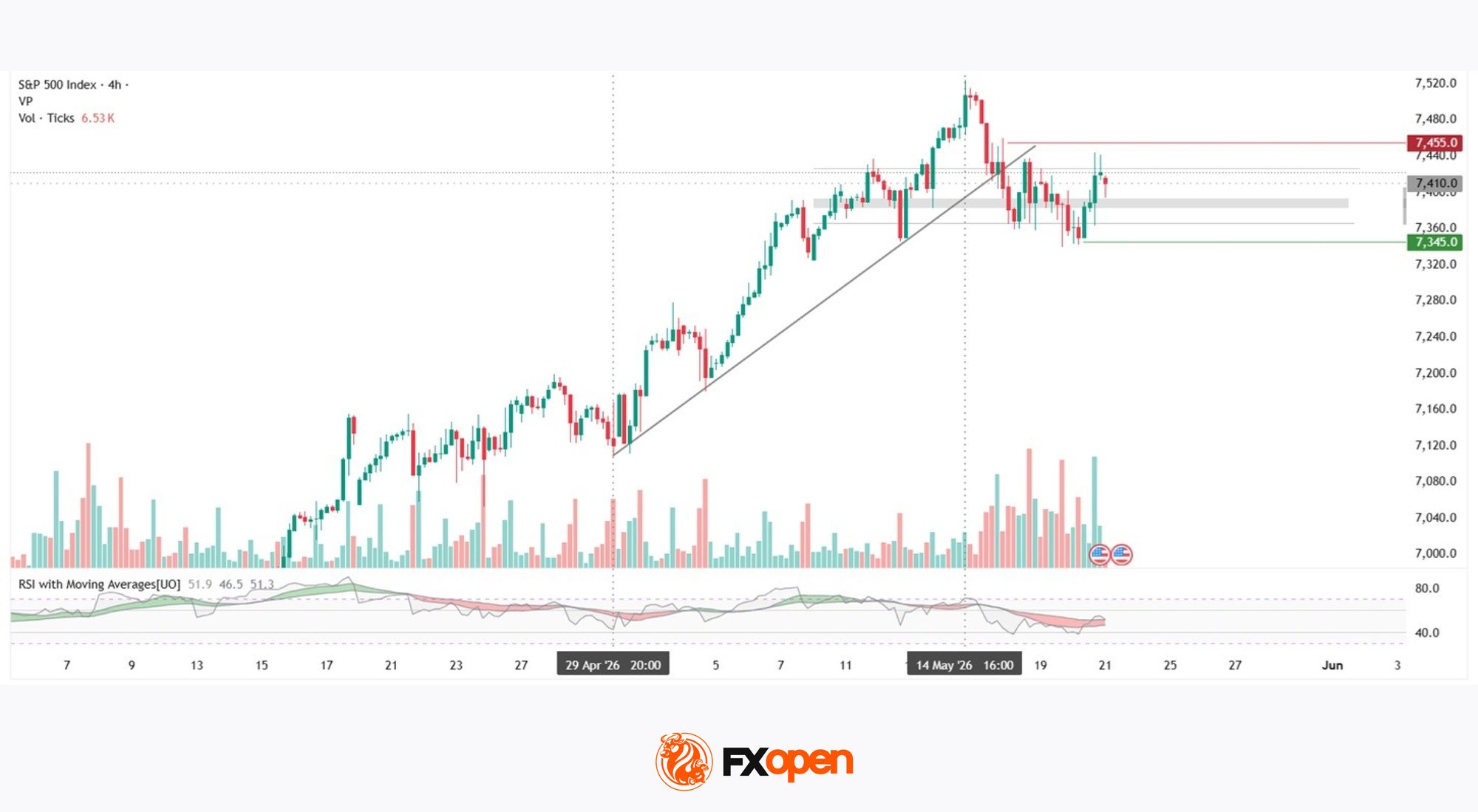
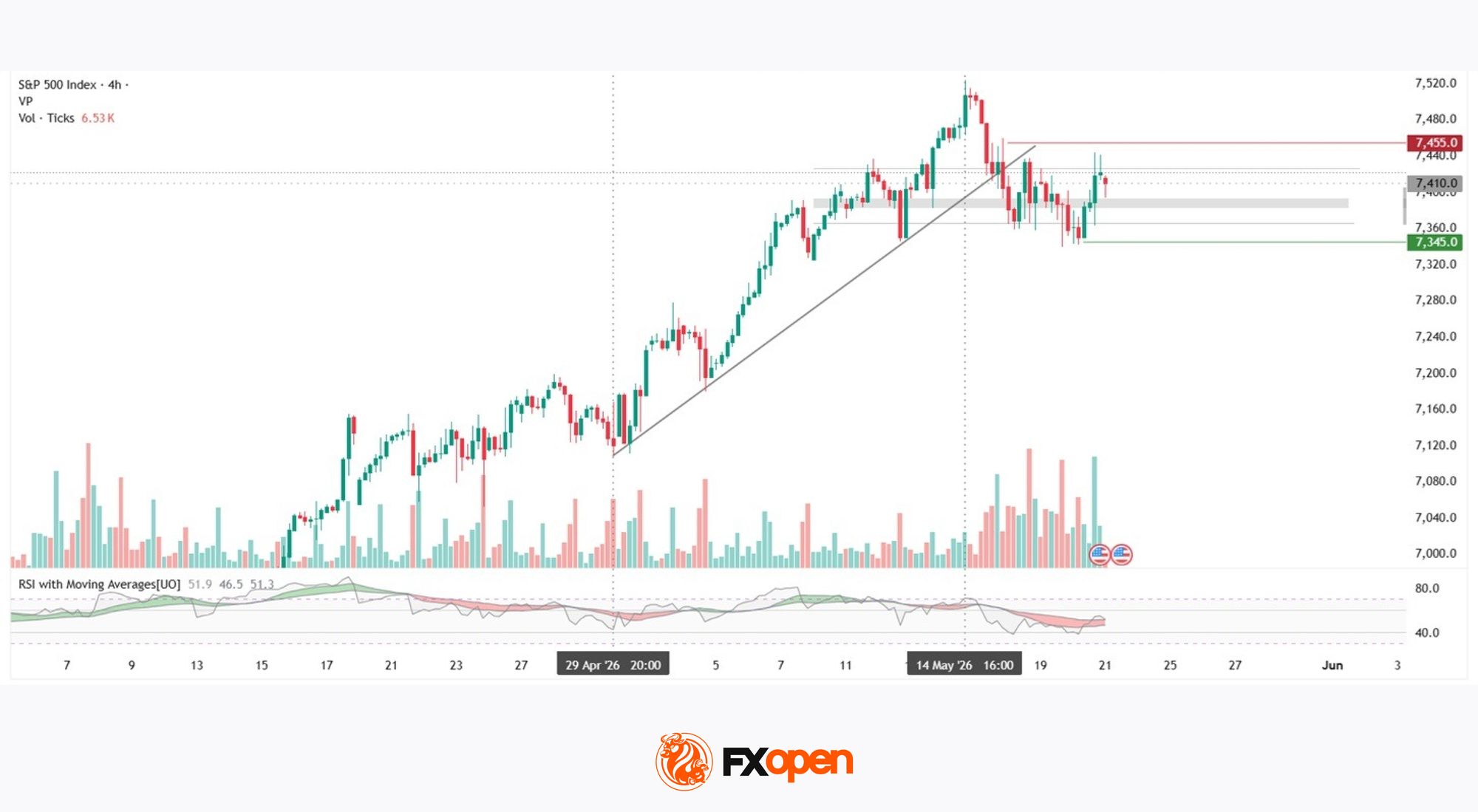
Since March 2026, the S&P 500 has remained in a medium-term uptrend, and between 29 April and 14 May it formed a new trending leg within the broader trend, reaching a peak around 7,520. The trend was subsequently broken, while trading volume increased noticeably, signalling heightened market participation. As a result of the standoff between equally matched buyers and sellers, the index has shifted into sideways movement and is currently determining its future direction.
The POC zone within the profile is concentrated around 7,385–7,390 — this is where the main area of confrontation is forming.
At present, the price remains above this zone (POC), but below the upper profile boundary at 7,425. Should the price resume its trend movement, the red resistance level at 7,455 may act as a limiting factor. The green support level at 7,345 remains a potential reference point should quotations move below the profile. RSI + MAs currently show readings of 51, 46 and 51 — the oscillator indicators remain in neutral territory, with no clearly defined directional momentum.
Key Takeaways
The index has completed its short-term bullish impulse and moved into sideways consolidation. RSI readings near neutral levels, without a pronounced directional impulse, reflect the current balance in the market — investors are weighing uncertainty surrounding trade negotiations against the backdrop of continued sensitivity to fiscal risks.
Trade global index CFDs with zero commission and tight spreads (additional fees may apply). Open your FXOpen account now or learn more about trading index CFDs with FXOpen.
This article represents the opinion of the Companies operating under the FXOpen brand only. It is not to be construed as an offer, solicitation, or recommendation with respect to products and services provided by the Companies operating under the FXOpen brand, nor is it to be considered financial advice.


MAPO, the native token of Map Protocol, has collapsed by 96% after attackers exploited the Butter Network cross-chain bridge to mint an enormous amount of unauthorized tokens.
Summary
- MAPO plunged 96% after attackers exploited the Butter Network bridge to mint a quadrillion unauthorized tokens.
- Blockaid said the attacker drained about 52 ETH from Uniswap pools and continued holding nearly a trillion MAPO tokens after the exploit.
- TON TAC has recovered about 80% of assets lost in its separate $2.68 million bridge exploit, though the protocol remains paused for an independent audit.
According to blockchain security firm Blockaid, the attacker created a quadrillion MAPO tokens through a flaw in the bridge’s Solidity contract layer before dumping roughly 1 billion tokens into Uniswap liquidity pools.
The sales drained around 52 ETH, valued at nearly $180,000, while the attacker continued holding close to a trillion MAPO tokens that could still threaten other liquidity pools and exchange markets.
CoinGecko data showed MAPO falling from about $0.003 to nearly $0.0001 within hours as the exploit overwhelmed the token’s legitimate circulating supply.
Map Protocol later confirmed that the issue originated from the Solidity contract implementation rather than compromised keys or failures in its light client infrastructure. The project said it had paused the mainnet and started a migration process while the investigation remains ongoing.
In a follow-up statement, the team said a new contract address and asset snapshot timeline would be announced separately. Tokens controlled by attacker-linked wallets would be excluded from future conversion events and invalidated during the migration process, according to the project.
Forged retry message triggered unauthorized mint
Additional analysis from Blockaid showed the attacker first submitted a legitimate oracle multisig-signed message before deploying a malicious contract at a targeted address. Afterward, the attacker resent what appeared to be an identical “retry” message, although the payload had been modified.
Because the bridge validated the manipulated retry request as authentic, the protocol executed the unauthorized mint and released the newly created MAPO tokens into circulation, according to Blockaid.
The firm said the exploit was not tied to stolen private keys or broken cryptographic verification. Instead, Blockaid described the incident as a “classic Solidity vulnerability involving multiple dynamic fields.”
Cross-chain bridge exploits tied to forged or improperly validated messages have surfaced repeatedly across the DeFi sector this year. Earlier this week, the Verus Protocol Ethereum bridge lost more than $11.5 million after attackers allegedly used forged cross-chain transfer instructions to siphon reserve assets from the protocol.
At the time, Blockaid compared the Verus incident to the 2022 Nomad Bridge and Wormhole exploits, where fake transfer payloads reportedly tricked protocols into releasing funds. ExVul later said the Verus exploit appeared to involve a forged cross-chain import payload that bypassed verification checks inside the bridge mechanism.
GoPlus Security separately stated that the Verus exploit was likely linked to a cross-chain message validation failure, withdrawal bypass issue, or access control weakness.
TON-TAC bridge recovers 80% of stolen assets
Elsewhere in the cross-chain bridge sector, TON-TAC, a bridge built as an extension for The Open Network, published a post-mortem Thursday covering its $2.68 million exploit from May 11.
According to the project, the incident originated from missing validation checks inside the sequencer software. A counterfeit TON wallet lacking proper code-hash and minter verification was reportedly accepted by the system, leading to another unauthorized token mint.
TON-TAC said recovery operations have secured nearly 80% of the affected assets. Even so, the bridge remains paused while an independent audit reviews the patched sequencer infrastructure and liquidity restoration process.
Map Protocol operates as an omnichain network that connects Bitcoin with ecosystems including Ethereum, BNB Chain, Tron, and Solana for cross-chain asset transfers involving Bitcoin, stablecoins, and tokenized assets.
Meanwhile, attacks targeting interoperability infrastructure have continued mounting across decentralized finance. Alongside the MAPO exploit, protocols such as THORChain, Transit Finance, TrustedVolumes, Echo Protocol, Ekubo, and RetoSwap have also reported security incidents in recent weeks.


Missouri has sued the operator of crypto ATM network CoinFlip, accusing the company of knowingly facilitating fraudulent transactions and profiting from them through excessive fees charged at its kiosks across the state.
Attorney General Catherine Hanaway’s office filed the action. The state is seeking civil penalties of up to $1.826 million and a court order blocking further operations in Missouri.
Follow us on X to get the latest news as it happens
Missouri Sues CoinFlip Alleging Fraud Facilitation
The lawsuit follows a probe Hanaway opened in December into several crypto kiosk operators after reports of scams targeting Missouri residents. The same investigation also examined Bitcoin Depot. The firm filed for Chapter 11 bankruptcy this month.
Meanwhile, CoinFlip currently runs 136 kiosks in Missouri and 4,229 nationwide, according to its locations page. The case is the latest in a wave of state and municipal actions against crypto kiosk operators, with several jurisdictions moving to restrict or ban the machines outright.
“Bitcoin and crypto ATMs are the new getaway cars for fraud, whisking away innocent people’s money to scammers, never to return,” said Attorney General Hanaway.
CoinFlip Pushes Back, Calls Suit Meritless
In a statement shared with BeInCrypto, a company spokesperson rejected the allegations and said CoinFlip has actively lobbied for tougher consumer protection rules in Missouri and other states.
“Attorney General Hanaway’s lawsuit is meritless. It’s a misguided attack on the company that has spent years urging the passage of cryptocurrency kiosk consumer protection laws in Missouri and across the country… CoinFlip will fight this lawsuit aggressively, and we look forward to demonstrating that these allegations are baseless,” the spokesperson told BeInCrypto.
The spokesperson also added that CoinFlip was a key force behind Missouri’s 2025 cryptocurrency kiosk consumer protection legislation.
The company worked directly with state lawmakers to secure mandatory licensure, stronger compliance standards, and meaningful consumer protection requirements to shield Missourians from scammers.
Subscribe to our YouTube channel to watch leaders and journalists provide expert insights
The post Missouri Sues CoinFlip, Crypto ATM Operator Calls Lawsuit “Meritless” appeared first on BeInCrypto.
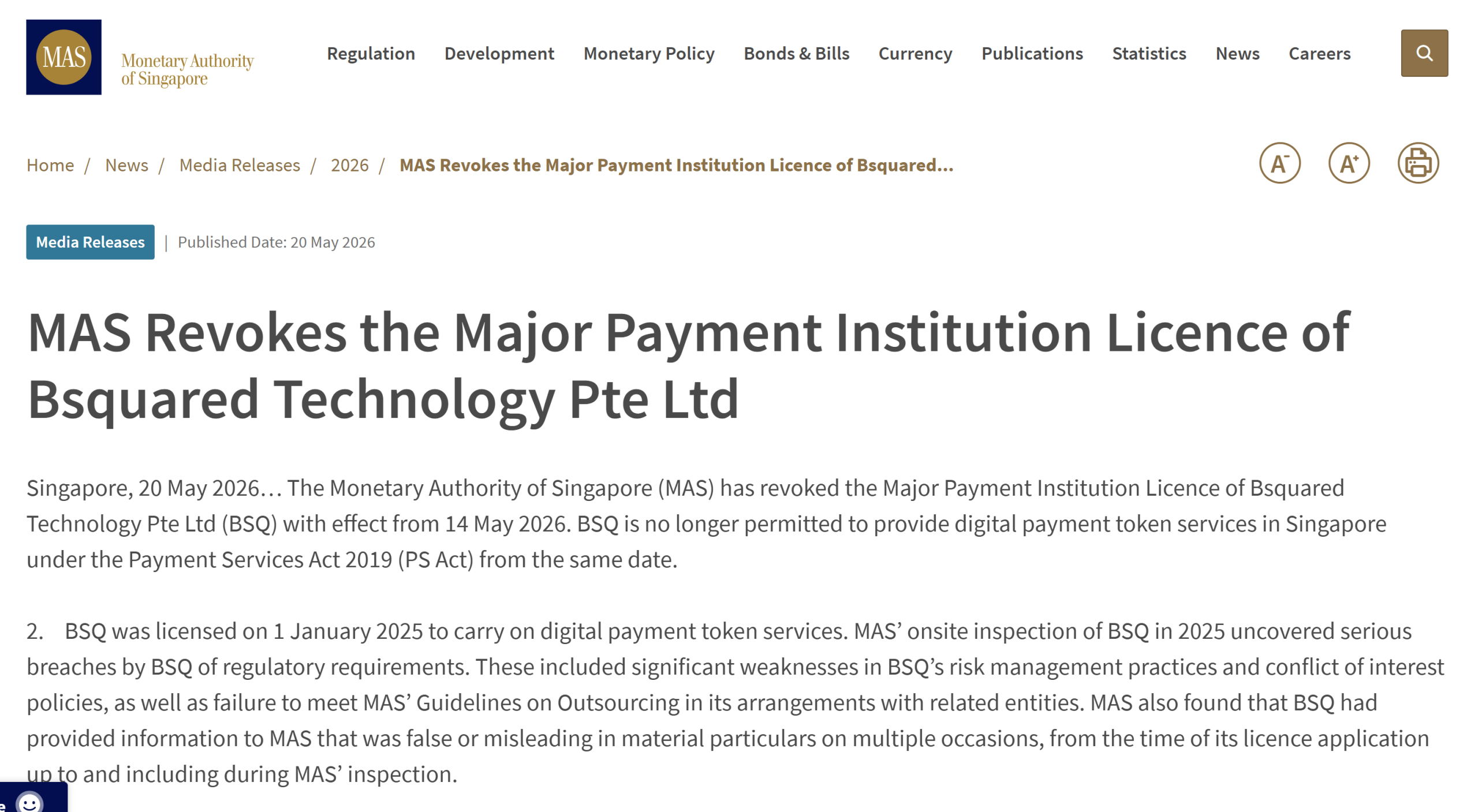
Singapore’s central bank has pulled the crypto payment license of Bsquared Technology Pte. Ltd., stripping the firm of its right to provide digital payment token services after uncovering a series of breaches.
In a Wednesday announcement, the Monetary Authority of Singapore (MAS) said it revoked Bsquared’s Major Payment Institution Licence after an on-site inspection found weaknesses in the company’s risk management practices and conflict-of-interest policies, as well as failures to comply with the regulator’s outsourcing guidelines.
MAS said Bsquared provided false or misleading information on multiple occasions, from its initial license application through the inspection itself.
Bsquared, also known as BSQ, obtained its license 16 months ago after receiving approval to offer digital payment token services under Singapore’s Payment Services Act 2019.
Related: Singapore’s OCBC launches tokenized gold fund on Ethereum and Solana
MAS orders Bsquared to submit a closure certificate
The company is required to submit a closure certificate from its auditors confirming that all customer funds have been returned to their recipients. Bsquared told MAS it held no outstanding customer assets.
“MAS takes a serious view of the breaches committed by BSQ, and is reviewing the responsibilities of key officers of BSQ,” the central bank added.
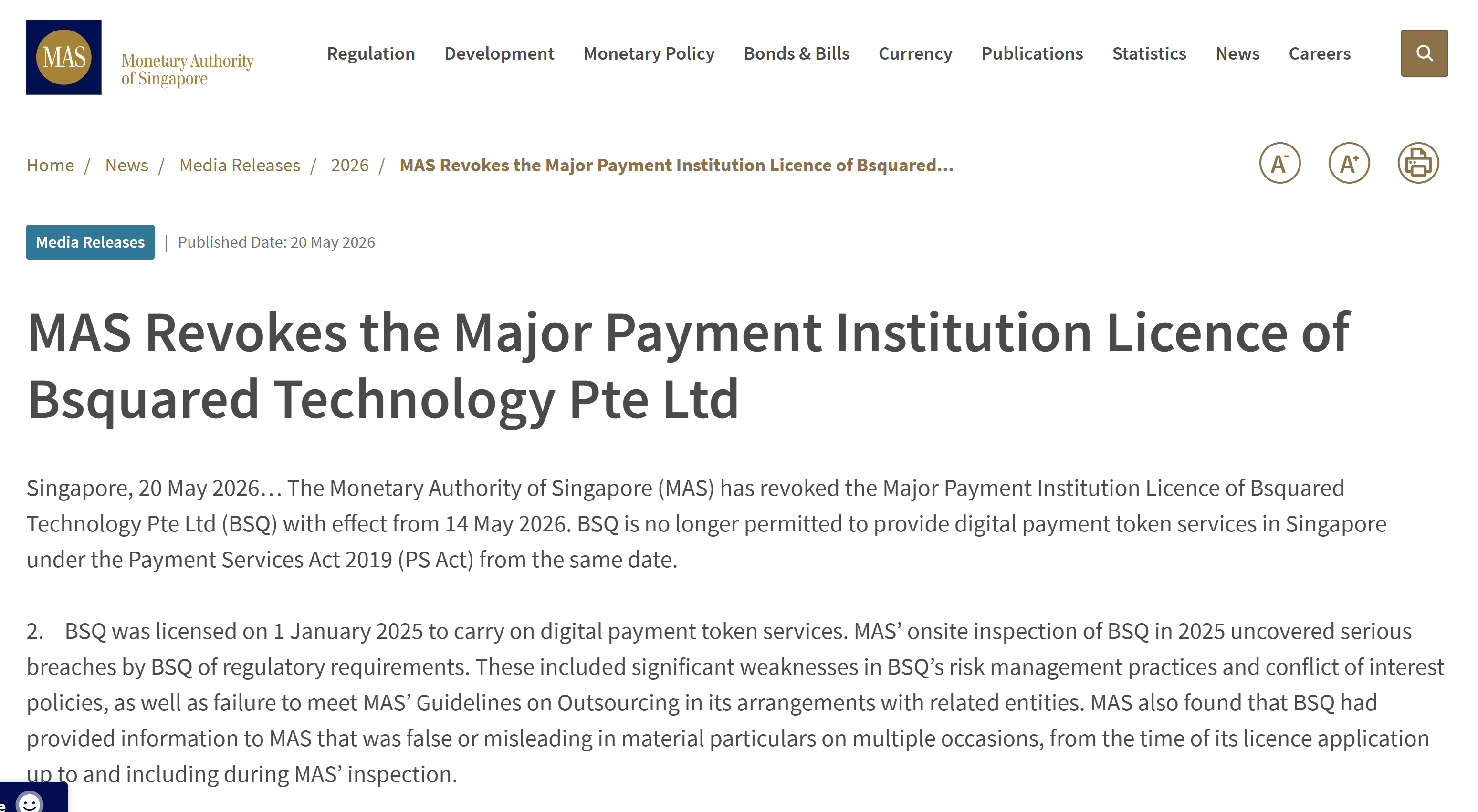
MAS revokes Bsquared’s license. Source: MAS
MAS has granted 37 digital payment token services licenses so far, and revocations remain uncommon. Last year, MAS rejected an application from AmazingTech, the operator of Tokenize Xchange, and the Commercial Affairs Department subsequently launched a probe into the company.
Related: Crypto dispute over Resupply exploit lands in Singapore harassment court
Singapore pushes deeper into digital asset infrastructure
Singapore has built a reputation as one of Asia’s leading crypto hubs, home to regional offices of Coinbase and Ripple, as well as the global headquarters of Crypto.com.
The city-state is also cementing its position as a leading hub for integrating traditional finance with digital assets.
Last month, Singapore Gulf Bank launched a service allowing institutional clients to mint and redeem stablecoins directly from their bank accounts via the Solana blockchain, enabling 24/7 settlement between fiat and digital assets.
Magazine: Guide to the top and emerging global crypto hubs — Mid-2026

The hidden role of connectivity in today’s AI race

Trump: I don’t think about Americans’ financial situation

David Beckham received brutal 7am call from son as split in family is plain to see


-

 Crypto World5 days ago
BloFin War of Whales 2026 Grand Prix opens registration for $5M trading championship
-

 Fashion6 days ago
Weekend Open Thread: Theory – Corporette.com
-

 Crypto World6 days ago
E-Estate Announces 1 Year Live: Washington DC Summit as Real Estate Tokenization Enters Its Next Phase
-

 Tech6 days ago
Tech Moves: Microsoft AI leader jumps to OpenAI; former AI2 exec joins Meta; and more
-

 Tech5 days ago
Google reimburses Register sources who were victims of API fraud
-

 Crypto World7 days ago
Google’s Gemini AI Predicts Incredible Solana Price by the End of 2026
-

 Business6 days ago
H&R Real Estate Investment Trust (HR.UN:CA) Q1 2026 Earnings Call Transcript
-
 Entertainment7 days ago
Zara Larsson Has Blunt Response To Chris Brown Diss
-

 Sports5 days ago
Napoleonic enters 2026 Doomben 10,000 field via Abounding withdrawal
-

 Crypto World5 days ago
BeInCrypto 100 Institutional Awards Nomination: KAST for Best Digital Assets Neobank and Best Digital Assets Fintech
-
 Crypto World5 days ago
Bitcoin Battles US Bond Nerves With BTC Price Dip Toward New May Lows
-

 Fashion4 days ago
On the Scene at Gucci’s Cruise Show in New York City: Mariah Carey, Kim Kardashian, Lindsay Lohan, Iman, and More!
-
 Crypto World5 days ago
Wall Street’s Boldest Gold Prediction Has Russians Rushing to Buy
-

 Crypto World5 days ago
ICE and CME urge US regulators to curb Hyperliquid energy trading
-

 Politics6 days ago
DWP PIP Timms review continues to be an absolute farce
-

 Fashion5 days ago
Trending Western Style Vests Perfect for Summer
-

 Entertainment6 days ago
David Letterman Returns to Late Show, Blasts Cancellation
-

 Crypto World5 days ago
IREN closes $3 billion convertible notes deal amid AI infrastructure expansion
-
Crypto World6 days ago
Lido Finance Selects Chainlink CCIP as the Official Cross-Chain Infrastructure for wstETH Security
-

 Fashion4 days ago
Amazon Sundays: Memorial Day Hosting
You must be logged in to post a comment Login