
Crypto World
Aave faces ‘serious trouble’ as all its core markets hit 100% utilization. What this means.



Aave, one of the largest decentralized lending platforms, effectively froze Tuesday after all its major lending protocols ran out of available funds, leaving users unable to withdraw billions of dollars in crypto, DeFi Warhold said as he explained what the 100% utilization means.
Roughly $5 billion in stablecoins USDT and USDC are effectively locked, Warhold added, saying the protocol has no liquidity to pay out those assets .
The crisis began April 18, following a $292 million exploit of the Kelp DAO rsETH bridge. The attacker used forged cross-chain messages to mint unbacked rsETH, which was then deposited into Aave as collateral to borrow nearly $200 million in WETH. As news of the “bad debt” spread, a classic bank-run dynamic took over, causing a total of $6.6 billion to exit the protocol in under 24 hours.
When asked for comment on the crisis, Aave founder Stani Kulechov told CoinDesk via WhatsApp: “I do not have anything useful to say.”
For a lending protocol to hit 100% utilization across all markets at once is the “equivalent of a full stop. It actually means no liquidity available for withdrawals. Liquidations can’t be processed” and therefore $3 billion in USDT and $2 billion in USDC “are stuck with no clean exit,’ DeFi Warhol said.
What’s worse, the analyst added, “if prices move, bad debt compounds with no mechanism to cover it.” DeFi Warhol said that this is the worst situation for a lending protocol to be in because “when liquidations cannot execute, the protocol has no way to protect itself against further bad debt.”
Aave is in serious trouble
Natalie Newson, a senior blockchain security researcher at CertiK, said that Aave is in serious trouble.
“100% utilization doesn’t just mean a lack of liquidity; it means the protocol’s self-defense systems are down.”
Liquidations require liquidity to work because without it, undercollateralized positions can’t be closed and bad debt just keeps piling up, leaving the protocol in a situation it will not be able to recover from without outside help, she said.
“Aave didn’t get hacked. It got stuck due to the fallout from someone else’s bridge failure, and that difference should worry everyone working in this area,” Newson said. “The KelpDAO exploit didn’t just affect one protocol; it put the entire DeFi system to the test at the same time.”
Newson agreed with DeFi Warhol that those who did nothing wrong are now left dealing with the risks. She also said that the interconnectivity that makes DeFi powerful is the same feature that turns a single point of failure into a large-scale disaster.
A known risk scenario
Aave’s risk framework explicitly anticipated 100% utilization, with former Aave Risk Manager Alex Bertomeu-Gilles saying in 2020 that at that level, “no liquidity is left” and the situation becomes “problematic” because depositors are unable to withdraw their funds.
Technical analyst and crypto author Duo Nine was the first to highlight that Aave had hit 100% utilization.
“When the rsETH exploit happened and AAVE incurred bad debt, whales like Justin Sun, MEXC exchange, and others immediately withdrew billions from AAVE,” the analyst said. “Initially, the ETH market hit 100% utilization, meaning you could not withdraw your ETH from AAVE.”
That soon spread to USDT and USDC pools as over $6 billion in assets left the protocol within hours. “As whales took out their money, USDT and USDC also hit 100% utilization,” Duo Nine said.“These markets are now also stuck with money locked.”


TLDR
- Core Scientific plans to raise $3.3 billion through senior secured notes due in 2031.
- The company will back the notes with its assets, giving investors priority claims in a default.
- Core Scientific intends to use the proceeds to fund AI-focused data center expansion across the United States.
- The company will also repay borrowings under its 364-day credit facility to extend debt maturities.
- Core Scientific recently secured a separate $1 billion credit agreement with Morgan Stanley to support its buildout plans.
Core Scientific disclosed plans to raise $3.3 billion through senior secured notes due in 2031 to fund data center growth across the United States. The company said it will use the proceeds to expand infrastructure and refinance short-term debt obligations. The move supports its shift toward high-performance computing and artificial intelligence workloads as mining conditions tighten.
Core Scientific Expands Financing for AI Infrastructure
Core Scientific said it will issue senior secured notes backed by company assets, which gives investors priority claims in a default. The structure allows the company to secure capital without issuing new shares, so it avoids equity dilution. The notes will mature in 2031, which extends the company’s debt timeline and supports long-term projects.
The company stated that it will use part of the proceeds to repay borrowings under its 364-day credit facility. This step will extend existing maturities and improve debt structure as infrastructure scales. Core Scientific identified expansion projects in Georgia, Texas, North Carolina, and Oklahoma to support AI-focused data center services.
Core Scientific announced the offering after securing a separate $1 billion credit agreement with Morgan Stanley in March. The earlier agreement strengthened its access to capital for ongoing development plans. Together, both financings highlight the company’s effort to lock in long-term funding for its data center buildout.
The company has shifted focus beyond traditional bitcoin mining and toward diversified computing services. It continues to build facilities designed for high-performance computing and artificial intelligence tasks. The strategy aims to align infrastructure with evolving demand across the enterprise and technology sectors.
Crypto Miners Increase Leverage for Data Center Growth
Several mining firms have adopted similar financing strategies to expand data center capacity. MARA Holdings, Riot Platforms, and Hut 8 have invested in infrastructure and partnerships to diversify revenue streams. These companies seek to reduce reliance on bitcoin mining and pursue AI-driven workloads.
IREN reported one of the sector’s largest recent expansions, spending about $800 million on data centers and related infrastructure in its latest quarter. The company accelerated capital deployment to strengthen its computing footprint. This approach reflects a broader push to secure capacity for advanced workloads.
Partnerships have also shaped the industry’s growth model as companies expand AI operations. On Tuesday, Soluna Holdings announced an expanded partnership with Blockware to increase hosting capacity. The agreement will add 3.3 megawatts at Soluna’s West Texas colocation facility, which primarily serves third-party mining clients.
Blockware confirmed that the latest deal marks its fourth expansion with Soluna. The companies continue to collaborate on renewable-powered infrastructure to support mining and computing operations. The announcement adds fresh capacity at the West Texas site as expansion efforts continue.


Bitcoin’s distribution dynamics have shown a notable shift in recent days, with mid-size wallets moving fewer coins onto major exchanges and inflows concentrated on a single venue. Data from CryptoQuant indicates Binance mid-size wallet inflows — defined as entities holding roughly 100–1,000 BTC — have cooled to about 3,000–4,000 BTC over a seven-day horizon, a level not seen since 2023. In tandem, Coinbase reported around 8,500 BTC in inflows from similar-sized wallets on April 19, while inflows to other exchanges remained comparatively muted. Analysts view the pattern as a sign of reduced near-term selling pressure, though inflows alone do not prove that coins are being dumped on the market.
Key takeaways
- Binance mid-size wallet inflows have fallen to roughly 3,000–4,000 BTC on a weekly average, marking a multi-year low for this cohort and suggesting less immediate sell-side pressure on the exchange.
- Coinbase saw mid-size wallet inflows of about 8,500 BTC on April 19, nearing levels observed after the FTX episode in November 2022, while other exchanges reported smaller flows.
- Bitcoin’s 30-day net flow to exchanges swung negative in March (around −300,000 BTC) and remained materially negative near −98,000 BTC as of April 21, with exchange reserves continuing to dwindle for weeks.
- The inflow pattern appears fragmented rather than synchronized across venues, indicating mixed sentiment rather than a broad, coordinated distribution.
- Overall supply dynamics point to a withdrawal trend from exchanges, but traders should monitor how these signals translate into price action in the coming weeks.
Mid-size inflows back toward 2023 norms on Binance, while Coinbase remains distinct
CryptoQuant’s wallet-size taxonomy identifies mid-size holders as those controlling roughly 100–1,000 BTC. These entities are often associated with active traders and smaller institutions, and their decisions to move coins onto exchanges typically reflect near-term selling intent. Amr Taha, a crypto analyst, pointed out that the seven-day average inflows from this cohort into Binance have cooled to about 3,000–4,000 BTC, a level well below the 5,500–6,000 BTC range observed during the April–May 2023 period. The decline is notable because it suggests less urgent distribution pressure, though it does not prove that coins are being withdrawn from the market entirely or that selling has ceased.
Beyond Binance, the broader picture in inflows is more nuanced. Coinbase recorded roughly 8,500 BTC flowing from mid-size wallets on April 19, approaching levels last seen in the wake of the FTX collapse. In contrast, inflows to other exchanges appeared more muted, with no broad-based surge across multiple venues. This fragmentation implies a more dispersed sentiment among market participants rather than a synchronized dump across the ecosystem.
Net-flow signals point to a supply shift, not an imminent cascade of selling
Another lens on the pattern comes from tracking Bitcoin’s net flow, a measure that aggregates all inflows and outflows from exchanges. Axel Adler Jr., a Bitcoin researcher, highlighted a pronounced shift in supply dynamics: the 30-day net flow dropped from a positive 94,000 BTC in February to a negative 300,000 BTC in March, situating near −98,000 BTC as of April 21. That trajectory signals a sustained phase of exchange outflows, or at least a weaker tendency for coins to reappear on exchange desks.
Adding to the narrative, Adler Jr. noted that exchange reserves have declined for seven consecutive weeks, with more than 105,000 BTC withdrawn since early March. Even during the April 2 pullback toward roughly $67,000, there was no corresponding surge of coins back onto exchanges. Taken together, the data point to a tightening of readily available BTC on exchange rails rather than a broad, front-loaded selling wave. This pattern aligns with a market environment where holders are less inclined to surrender their positions into selling pressure, even as price volatility remains elevated.
For context, a broader audit of inflows by other researchers and analysts underscores that a single-week surge on one venue does not automatically translate into a market-wide distribution. The Coinbase inflow spike to 8,500 BTC, while meaningful, sits amid a backdrop of more tepid activity elsewhere. As Taha observed, a truly broad distribution signal — such as synchronized inflows across multiple exchanges — has yet to emerge in the current data, suggesting a more nuanced, mixed sentiment landscape among traders and funds.
What these dynamics could mean for traders and investors
From an investing and trading perspective, the divergence between Binance’s cooled mid-size inflows and Coinbase’s relatively larger single-day inflow creates a nuanced backdrop. If mid-size holders across multiple venues were actively distributing, one would expect more uniform pressure across platforms; the absence of such a pattern hints at selective liquidity dynamics rather than an indiscriminate sell-off. This distinction matters for price discovery because it suggests that selling intentions may be concentrated among specific counterparties or strategies rather than a broad market event.
Another layer of complexity comes from the persistence of lower exchange reserves. A seven-week streak of withdrawals implies tightening available supply on centralized platforms, which can have implications for volatility and liquidity, particularly when the market confronts macro headlines or sudden shifts in risk appetite. However, lower inflows to exchanges do not guarantee higher prices; price action will depend on the balance of demand, risk sentiment, and the speed with which holders choose to realize gains or reallocate exposure.
Investors should also watch how this dynamic interacts with broader narratives around Bitcoin adoption, institutional involvement, and regulatory developments. If outflows remain resilient while price remains range-bound or modestly bid, it could indicate that market participants are prioritizing custody and off-exchange holding, at least in the near term. Conversely, any resurgence of inflows across a broader set of venues could reintroduce selling pressure and higher volatility, especially if coupled with macro catalysts or shifts in risk tolerance.
Where the data points us next
Looking ahead, the key to interpreting these signals will be the trajectory of inflows across multiple venues, the pace of exchange-reserve depletion, and how these variables interact with price movement. If Coinbase inflows persist at elevated levels or if mid-size holders begin to re-accelerate deposits on other exchanges, traders should expect heightened attention to potential distribution phases. On the other hand, a continued fragmentation of inflows and persistent reserve drawdowns without broad-based selling could indicate that demand outside exchanges is absorbing supply more effectively than during prior cycles.
Market participants will also be watching for any shifts in the behavior of large holders and institutional players, which can have outsized effects on price dynamics. While the current data point to a cautious, non-coordinated pattern of activity rather than an imminent dump, the situation remains sensitive to evolving sentiment, liquidity dynamics, and external risk factors. In this context, the coming weeks could reveal whether the current quiet period on most exchanges translates into a more resilient price floor or if renewed selling pressure emerges as market conditions evolve.
The unfolding picture underscores a broader theme in crypto markets: inflows and outflows offer valuable clues about sentiment, but they must be interpreted in the context of where participants choose to store and move their assets, as well as what else is happening in the macro and regulatory environment. For now, the data suggest a cautious market, with a mix of targeted selling by some traders and a growing preference among others to guard Bitcoin on non-exchange wallets or custody solutions.
This analysis reflects data and observations through mid-April to late April 2024 and should be considered in the light of ongoing market developments. Readers should stay tuned for fresh exchange-flow metrics, reserve movements, and price action to gauge whether the current pattern holds or evolves into a more traditional distribution phase.

DoorDash plans to offer its users, “dashers” and merchants the option to use stablecoins in their transactions with the food delivery app, according to the Tempo blockchain.
In a Tuesday notice, Tempo said that together with DoorDash, it was “building stablecoin-powered payment infrastructure” in a move for its delivery drivers, also known as “dashers,” merchants, and users to settle transactions using digital currency. The blockchain cited payout speed, lower cross-border cost and transaction flexibility in its reasons for the integration, expected to apply to users in more than 40 countries.
“If we can get merchants and Dashers their money faster, and do that in a way that’s affordable for them, that’s a no-brainer for the entire ecosystem,” said DoorDash co-founder Andy Wang.

Tempo announced the DoorDash integration as part of a larger move into stablecoins along with payments platform Stripe, investment firm Paradigm, Coastal Bank and fintech company ARQ.
While the delivery app previously announced moves into AI, the stablecoin infrastructure would represent a significantly large delivery app onboarding a digital asset payment rail for everyday settlements.
In February, DoorDash reported that it delivered 903 million orders in the fourth quarter of 2025, at a total value of $29.7 billion. The delivery platform is slated to report Q1 2026 results on May 6.
Related: UK plans payments rule changes for stablecoins, tokenized deposits
Payment companies continue to expand stablecoin infrastructure
In addition to its work with Tempo, Stripe agreed to purchase the stablecoin platform Bridge as part of a $1.1 billion deal in 2024.
Traditional credit card companies, including Visa and Mastercard, have reached similar agreements moving closer to stablecoins. Mastercard agreed in March to buy stablecoin infrastructure company BVNK for a reported $1.8 billion, while Visa expanded its stablecoin settlement platform in July to support additional stablecoins.

Kevin Warsh’s nomination to lead the U.S. Federal Reserve faced pointed scrutiny at a Senate confirmation hearing on Tuesday, as lawmakers pressed him over financial disclosures and potential conflicts of interest tied to holdings in crypto and other sectors. The exchange illuminated ongoing debates about Fed independence in a political environment shaped by questions about executive influence and the central bank’s future policy trajectory.
With Jerome Powell’s term as Fed chair about to expire, lawmakers are under pressure to consider a successor who can command broad confidence across parties while maintaining insulation from political interference. The hearing underscored the central tension: how to preserve credible monetary policy and regulatory stewardship when the appointment is perceived as falling within presidential prerogative, and how that dynamic could affect the government’s approach to a rapidly evolving digital-asset landscape.
During questioning, Massachusetts Senator Elizabeth Warren, the committee’s ranking member, criticized Warsh for what she described as potential outsized influence from the White House and suggested that confirmation could open the door to policy outcomes favorable to the president’s broader agenda. Warsh, in turn, avoided committing to specific policy positions or rate decisions, stating that no president had ever asked him to promise a particular outcome and that he would not agree to do so if asked. His responses reflected the broader challenge of balancing independence with accountability in a high-stakes policy environment.
Democrats pressed Warsh on concrete concerns about conflicts of interest that could arise if he were confirmed and how they might affect the Fed’s decisions on monetary policy, financial stability, and regulatory oversight. Critics warned that even the appearance of political influence could undermine the Fed’s credibility in times of market stress or when difficult regulatory choices must be made regarding financial institutions and asset markets. The discussion touched on the potential for conflicts to extend into novel areas of policy as digital assets gain prominence within the financial system.
The hearing also included questions on crypto policy, a topic that has moved to the center of congressional debates about broader financial regulation and consumer protection. Wyoming Senator Cynthia Lummis asked Warsh about the role of digital assets within the U.S. financial system. Warsh indicated that digital assets are “part of the fabric of our financial services industry in the United States,” signaling a recognition that the Fed’s stance on digital assets will be increasingly consequential for financial markets and regulatory frameworks. According to Cointelegraph, Warsh has indicated a willingness to engage with the evolving regime governing crypto, while also emphasizing the need for clear governance of the central bank’s authority in a rapidly digitizing market.
Warsh has pledged to divest from his financial holdings, including investments in crypto and AI companies, before taking the oath if confirmed. This commitment, noted in coverage by Cointelegraph, is intended to mitigate potential conflicts of interest and reassure lawmakers that the Fed chair’s decisions would be guided by policy considerations rather than personal financial interests. The discussion occurred against a backdrop of broader concerns about the independence of the Fed’s decision-making at a time when political dynamics have elevated scrutiny of central-bank independence as a global policy issue.
The committee’s chair, Tim Scott, speaking to CNBC, framed the independence objective within the Fed’s dual mandate. He argued that while collaboration among the administration, Congress, and the central bank is essential, the core function of the Fed remains to deliver monetary policy and financial stability in a manner that does not compromise its autonomy. This framing aligns with longstanding institutional expectations that the Fed’s policy actions should be insulated from short-term political incentives, even as lawmakers seek greater transparency and accountability through the appointment process.
Key takeaways
- The nomination process highlighted enduring questions about Federal Reserve independence amid executive-branch influence concerns, particularly in the context of a presidential transition and a looming leadership shift.
- Warsh’s disclosed holdings, including crypto-related investments, drew scrutiny regarding potential conflicts of interest; he committed to divesting prior to taking office to mitigate perceived bias in policy decisions.
- Crypto assets occupied a substantive role in the hearing, with Warsh acknowledging their place in the U.S. financial services ecosystem, a signal that the Fed’s regulatory approach to digital assets could intersect with congressional oversight and market developments.
- The timing of a final Fed chair appointment remains uncertain, with Powell’s term ending mid-May and market instruments projecting potential delays in confirmation, affecting regulatory planning and policy signaling.
- The proceedings sit within a broader regulatory context that includes ongoing debates over crypto legislation, international alignment, and U.S. agency coordination on supervision, licensing, AML/KYC, and market integrity standards.
Fed leadership, independence, and the policy horizon
From a governance perspective, Warsh’s confirmation hearing placed a spotlight on how the Fed maintains independence when its leadership is explicitly connected to an administration’s agenda. Critics argue that swift turnover or a chair perceived as tethered to political interests could introduce discomfort among markets and financial institutions that rely on a predictable, rule-based framework for monetary policy and regulatory oversight. In this context, the confirmation process is not simply about one individual but about institutional design and the resilience of the policy framework that underpins the U.S. financial system.
Supporters of the nominee emphasize the need for steady stewardship and a measured approach to risk management, especially in an era of heightened financial-market complexity and rapid innovation. The discussion reflects a broader historical cycle in which central banks operate at the intersection of macroeconomic management and financial regulation, balancing the goals of price stability, full employment, and systemic resilience. The outcome of Warsh’s confirmation will likely influence how forthcoming communications from the Fed are interpreted by markets and how the central bank coordinates with other agencies on policy matters affecting the digital-asset sector.
Crypto disclosures and the regulatory context
The disclosure issue remains central to governance expectations for high-level public office in the financial domain. The pledge to divest from crypto- and AI-related holdings is a concrete step toward reducing perceived conflicts and ensuring decision-making is driven by policy merit rather than personal investments. This aligns with compliance practices observed in institutions that prioritize robust governance, robust disclosure regimes, and risk management protocols to address potential conflicts of interest.
From a regulatory standpoint, the matter sits at the confluence of monetary policy, financial stability, and digital-asset regulation. As policymakers seek greater clarity on how the Fed will engage with digital assets, observers note that the central bank’s stance could influence liquidity considerations, banking relationships with crypto-exposed institutions, and the pace of regulatory alignment across jurisdictions. In parallel, U.S. lawmakers are advancing broader debates around crypto oversight, including licensing regimes, consumer protection, anti-money-laundering standards, and cross-border cooperation—areas where the Fed’s policy framework will interact with agencies such as the Securities and Exchange Commission, the Commodity Futures Trading Commission, and the Department of Justice.
Cointelegraph’s coverage underscores that the nomination process is intertwined with ongoing policy discussions about how the United States will address digital assets within established regulatory architectures, including potential implications for the CLARITY Act and related legislative efforts. The cross-cutting nature of these issues means that the Fed’s leadership choice could influence, or be influenced by, a broader policy stance on asset classification, financial-market structure, and regulatory reach across the crypto economy.
Timeline, markets, and the political calculus
Powell’s term as chair is set to expire on May 15, creating a narrow window for a confirmation vote. Depending on the Senate’s pace, Warsh could serve in a temporary capacity at the Fed Board while the confirmation process unfolds, continuing to study and decide on policy directions until a final appointment is secured. This transitional dynamic is particularly relevant for financial institutions seeking policy clarity and for market participants evaluating the regulatory path for digital assets and related financial products.
Market observers have started to reflect the uncertainty in the timing of any confirmation. Prediction markets have captured this ambivalence; for example, one active event contract tracked by Polymarket indicates a substantial portion of participants expect confirmation to occur after mid-May, with a smaller fraction betting on a May confirmation. The same market activity shows a consensus leaning toward a June or later timeline. While not predictive of policy outcomes, these instruments illustrate the degree to which stakeholders are calibrating expectations around leadership, policy signaling, and regulatory evolution at a sensitive juncture.
Beyond the confirmation timeline, the intersection of regulatory oversight and digital-asset policy continues to shape the institutional environment. The debate touches on licensing, cross-border enforcement, AML/KYC standards, and the harmonization—or at least the acknowledgement—of international approaches to crypto regulation. As U.S. policymakers weigh internal governance with external policy requirements, the Fed’s approach to digital assets will likely interact with broader regulatory shifts, including potential updates to domestic and international financial infrastructure, central-bank digital currency considerations, and the evolving stance of major financial institutions toward crypto exposure.
Closing perspective
As the confirmation process advances, observers will watch not only for the outcome of Warsh’s candidacy but also for the signal it sends about the Fed’s posture toward independence, regulatory collaboration, and digital-asset policy. The coming weeks will be pivotal for institutions planning compliance, risk management, and engagement with a regulatory landscape that is increasingly focused on crypto markets, anti-money-laundering controls, and cross-border coordination across financial regulators.
Looking ahead, the central question remains: how will a new Fed leadership balance the imperatives of monetary stability with the fast-evolving realities of digital finance, while maintaining clarity and credibility for markets and for the broader ecosystem of crypto firms, banks, and investors? The answer will shape regulatory dialogue, enforcement priorities, and the architecture of U.S. financial regulation for years to come.


study producing major crypto privacy news found that zero-knowledge proof systems including Railgun, PrivacyPools, Aleo, and Aztec are mathematically immune to quantum attacks, because they rely on information-theoretic security rather than encryption, meaning they remain safe even against infinitely powerful attackers including future quantum computers.
Summary
- The Coinbase-led study, co-authored with Stanford and Ethereum Foundation researchers, found that ZK proof systems derive their security from how information is structured and shared.
- Bitcoin wallets with exposed public keys remain the most immediately vulnerable category in any quantum attack scenario, while ZK-based privacy tools are unaffected by the same class of attack.
- The finding provides a concrete security advantage for privacy-preserving DeFi infrastructure at a moment when the broader crypto industry is still debating how and when to implement post quantum cryptography across base-layer networks.
Crypto privacy news arrived Tuesday with a significant finding: the same quantum computing threat that has triggered emergency roadmaps at Ripple, Bitcoin, and Ethereum appears not to apply to privacy-preserving zero-knowledge proof systems. A study co-authored by Coinbase researchers alongside teams at Stanford and the Ethereum Foundation concluded that networks like Railgun and PrivacyPools rely on a fundamentally different security model than the one quantum computers are designed to attack.
The study was shared with DL News and concludes that zero-knowledge proof systems “rely on information-theoretic systems which are secure even against infinitely powerful attackers because of how information is structured and shared, not because of encryption.” That distinction is not a matter of degree. It is a categorical difference between computational security and information-theoretic security.
Why Zero-Knowledge Proofs Are Structurally Immune
Standard blockchain security, including the protection on Bitcoin wallets and Ethereum accounts, relies on computational hardness: the assumption that breaking the underlying math problem requires more computation than any attacker possesses. Quantum computers using Shor’s algorithm can in theory solve certain categories of these math problems exponentially faster than classical computers, which is why Bitcoin’s elliptic curve signatures are considered potentially vulnerable.
Zero-knowledge proofs work differently. They allow one party to prove knowledge of a secret without revealing the secret itself, and the security guarantee comes from information-theoretic principles rather than computational difficulty. Even a computer with infinite processing power cannot extract more information than the proof was designed to reveal. That structural property makes ZK-based privacy tools immune to Shor’s algorithm and to any quantum attack that targets computational hardness.
What This Means for Railgun, Aztec, Aleo, and PrivacyPools
Railgun is a privacy protocol that shields transaction amounts and addresses using ZK proofs on Ethereum. PrivacyPools is a protocol designed to allow compliant privacy by letting users prove their funds do not come from sanctioned sources without revealing their full transaction history. Aleo is a Layer 1 blockchain built natively around ZK proofs. Aztec is an Ethereum Layer 2 with private smart contract execution via ZK proofs.
All four rely on information-theoretic security for their core privacy guarantees. The Coinbase study’s conclusion means that when quantum computers eventually mature to the point of threatening Bitcoin’s key security, the privacy properties of these networks will remain intact. Their vulnerability, if any, would come from other components of their architecture, such as the underlying elliptic curve signatures used for account authentication, which is a separate security layer from the ZK proof system itself.
The Broader Implication for DeFi Privacy Infrastructure
The finding arrives as the broader Bitcoin quantum risk debate is producing governance friction across the ecosystem. The quantum threat debate in Bitcoin has centered on whether to force coin migration or rely on optional upgrades. ZK-based privacy infrastructure sidesteps that debate entirely, because its core security model was already quantum-immune by design.
For DeFi developers and institutional users evaluating infrastructure choices over long time horizons, the study provides a concrete basis for treating ZK-based privacy tools as categorically more future-proof than traditional transparency-based blockchain accounts with respect to the quantum threat. Ethereum co-founder Vitalik Buterin has publicly endorsed protocols like Railgun on broader grounds, arguing that privacy should be a default option for blockchain users. The quantum immunity finding adds a security dimension to that argument.
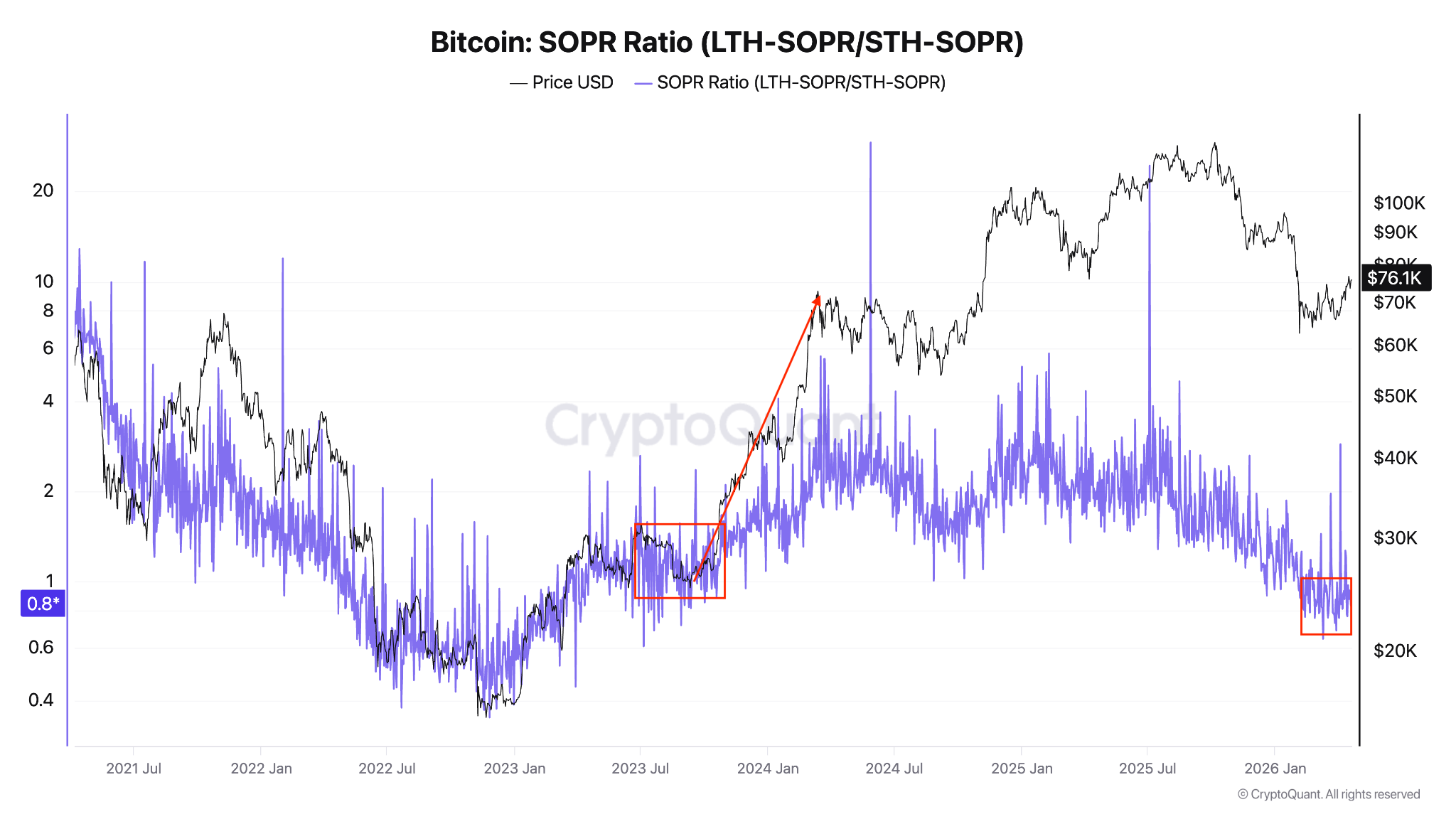
Market analysts said Bitcoin’s (BTC) latest rally to $78,000 means that the “uptrend has began,” but the upside could be capped at $84,000, based on several key metrics.
Key takeaways:
Bitcoin profitability suggests BTC rally “has begun”
Bitcoin’s recent price recovery toward $76,000 has pushed it more than 26% above its sub-$60,000 multi-year low reached on Feb. 6.
This was accompanied by an increase in the Spent Output Profit Ratio (SOPR), which hit an eight-month high of 2.87, after dropping as low as 0.62 in early February.
Related: Bitcoin risks losing $70K as Strategy’s STRC slips below $100
SOPR is a metric used to show whether Bitcoin investors have made a profit or loss compared to when they first held Bitcoin. This ratio has historically marked the short-term bottom for BTC when it hits its lowest point.
“The $BTC SOPR Ratio shows that $BTC has already broken out of the bottom and is rising,” CryptoQuant analyst CW8900 said in a Tuesday post on X, adding:
“The bottom for $BTC was formed last February. The rally is already in progress.”

Similarly, Bitcoin’s Net Unrealized Profit/Loss (NUPL), the difference between total profits and losses currently held by investors, has flipped positive for the first time since early January.
This suggests that the downtrend for Bitcoin has ended, and the “real rally of this cycle has begun,” CW8900 said in another X post.

This structurally resembles conditions seen in early stages of previous bull markets, where the NUPL recovered from extended periods below zero as Bitcoin embarked on a sustained rally.
1.1 million BTC at $84,000 could trigger sell-off
According to Bitcoin’s cost basis distribution data, investors hold approximately 1.1 million BTC at an average cost of $84,000, creating a potential resistance zone. This concentration suggests many investors may sell at break-even, potentially stalling Bitcoin’s upward momentum.

As Cointelegraph reported, Bitcoin’s immediate resistance is at $78,000, where the true market mean currently sits.
The US spot Bitcoin ETF cost basis at $83,100 is seen as the next key hurdle.

Analyst AlphaBTC said the BTC/USD pair might rise higher to fill the CME gap at $84,000, which was created at the start of February.

As Cointelegraph reported, a close above the $76,000-$78,000 resistance zone would confirm that the buyers are in control, clearing the path for a potential rally to $84,000.
This article is produced in accordance with Cointelegraph’s Editorial Policy and is intended for informational purposes only. It does not constitute investment advice or recommendations. All investments and trades carry risk; readers are encouraged to conduct independent research before making any decisions. Cointelegraph makes no guarantees regarding the accuracy or completeness of the information presented, including forward-looking statements, and will not be liable for any loss or damage arising from reliance on this content.


The White House has discussed offering a financial lifeline to the United Arab Emirates as the U.S. war with Iran wreaks havoc on the Gulf state’s economy, a White House official told CNBC.
The UAE has not formally requested a currency swap line, and plans are not currently being drawn up, the official said, speaking on condition of anonymity to talk about nonpublic plans. Still, it is being discussed within the administration, the person said. Such a move would provide liquidity in dollars to the oil-rich UAE, but could be politically tenuous for the administration as U.S. consumers grapple with higher prices at home.
The UAE and other Persian Gulf nations have been hit hard by the U.S. war with Iran. Tehran has fired troves of missiles at the U.S.’ regional allies, damaging economic infrastructure. Iran’s closure of the Strait of Hormuz has also largely choked off oil exports that the UAE depends on for cash flow.
The UAE is a particularly close ally of the Trump administration, and has labored to extend overtures to Washington since Trump returned to the White House. The country committed to invest more than $1 trillion in the U.S. last year. The leaders of the Gulf nation are also reportedly intertwined with President Donald Trump‘s family business.
Trump, on CNBC’s “Squawk Box” Tuesday, appeared to say that he was willing to assist the UAE when asked directly about whether a currency swap was under consideration.
“If I could help them, I would,” the president said. “It’s been a good country. It’s been a good ally of ours.”
A potential currency swap line comes with political risk for Trump, however, as U.S. voters could view it as a bailout of a foreign country — and a wealthy one — while American consumers are swallowing higher prices.
The White House official said Trump sees the UAE as a major ally of the U.S. and is open to helping them, but cautioned that a swap is still “something we’re thinking about considering.”
Even if the administration is open to providing support, the ultimate decision on providing swap lines rests with the Federal Reserve.
Swap lines historically have been limited to major central banks and systemically important markets, so offering one to the UAE would represent an unusual broadening of scope.
The prospect of a swap line between the U.S. and the UAE first cropped up on the sidelines of last week’s World Bank and IMF meetings in Washington, when U.S. Treasury officials pulled some Gulf allies aside to ask what they might need to rebuild their economies after the Iran war concludes, the official said. The UAE later raised a potential currency swap, but did not make a formal request for one, The Wall Street Journal first reported.
The Journal also reported the UAE warned it may have to use the Chinese yuan for oil sales and other transactions if it runs short on dollars, a threat to the supremacy of the dollar on oil markets.
The UAE, in a statement from its embassy in the U.S. posted to X, refuted that it needs a bailout.
“Any suggestion that the UAE requires external financial backing misreads the facts,” the statement read. “The UAE and the United States will continue to prosper together for decades to come, not because one depends on the other for support, but because both benefit from one of the world’s most important economic partnerships.”
— CNBC’s Jeff Cox contributed to this report.
Crypto World
Prediction markets are the new secret weapon for Coinbase (COIN) and Robinhood (HOOD) growth


Prediction markets are gaining traction as a new growth area for Coinbase (COIN) and Robinhood (HOOD), as investors look beyond a weak first quarter for crypto trading and focus on future products, according to Cantor Fitzgerald analyst Ramsey El-Assal.
El-Assal said “investors are increasingly treating the quarterly print as backward-looking,” with attention shifting to “forward-looking demand trends and the product roadmap,” including newer offerings such as prediction markets.
Both companies are expected to report softer results for the first quarter of 2026 after a pullback in crypto prices and trading activity. Bitcoin and ether (ETH) fell about 23% and 29% in the quarter, weighing on volumes across exchanges. Trading activity also slowed as the quarter progressed, with Coinbase volumes declining from roughly $66 billion in January to $54 billion in March, based on third-party data.
Cantor estimates Coinbase’s consumer and institutional trading volumes at $35 billion and $167 billion, both below Wall Street expectations. The firm also projects exchange revenue below consensus. Still, El-Assal maintained an “overweight” rating on the stock and raised his price target to $250, citing improving sentiment and longer-term growth drivers.
Robinhood faces similar near-term pressure. The analyst expects a sequential decline in trading volumes due to softer market conditions, along with a hit to net interest revenue from lower rates. But the company’s business model offers some cushion. Higher volatility can lift trading margins, and Cantor expects stronger yields in equities and options to partly offset weaker activity.
At the same time, crypto revenue quality may come under pressure. El-Assal noted the platform’s “tiered pricing structure … earns lower yields on large active traders … and higher yields on marginal traders,” with the latter group pulling back during volatility.
Despite these headwinds, both stocks have rallied in recent weeks. Coinbase shares are up about 18% quarter-to-date, while Robinhood has climbed roughly 40% in April from late-March lows, helped by improving risk sentiment and easing geopolitical tensions.
The focus now is on what comes next. For Coinbase, investors are watching regulatory developments and new business lines. The company’s prediction markets offering, launched this year, “continues to attract meaningful interest,” El-Assal said.
Robinhood is also leaning into prediction markets alongside other initiatives such as tokenization and private market access. The analyst said these efforts, along with regulatory changes like updates to pattern day trading rules, could help drive future growth.
Cantor maintained an “overweight” rating on Robinhood and raised its price target to $110.
The broader view, according to El-Assal, is that while current trading trends remain tied to crypto price cycles, the next phase of growth will depend more on product expansion and new use cases.
Later on Tuesday, the New York Attorney General’s office filed a lawsuit against Coinbase and fellow crypto exchange Gemini over their prediction market offerings, alleging that the products were actually gambling products and therefore in violation of state regulations.
Whether prediction markets — specifically, sports-related prediction markets — are gambling products are not is currently a topic of debate in both state and federal courts. The Commodity Futures Trading Commission has argued that prediction markets are swaps, and therefore properly regulated by that agency at the federal level. States have argued that at least the sports-related contracts are not swaps, and should be licensed and overseen by state regulators. This question is likely to end up before the U.S. Supreme Court.


Wilson Fisk proposed diversifying his criminal empire into Bitcoin (BTC) during a flashback scene in Daredevil: Born Again, Season 2, Episode 5, marking one of the MCU’s most direct crypto references to date.
The moment aired on Disney+ on April 14 as part of “The Grand Design,” an episode built around Kingpin’s origin story.
Kingpin’s Bitcoin Pitch Got Overruled
The flashback takes place around 2014 to 2015, before the events of the original Netflix Daredevil series. Fisk, played by Vincent D’Onofrio, rides in a car with his right-hand man James Wesley, played by Toby Leonard Moore.
After discussing complications with an associate known as “The Lion,” Fisk floats the idea of Bitcoin as a way to modernize and diversify their money laundering operations.
Wesley pushes back, viewing crypto as too volatile. He steers Fisk toward the art world instead, mentioning a contact at the Scene Contempo Gallery.
Fisk initially dismisses art as pretentious but agrees to visit. That decision leads directly to his first encounter with Vanessa Marianna, setting up one of the MCU’s defining romances.
The timeline fits. BTC traded around $200 to $300 during that period, still far from mainstream recognition.
For a forward-thinking crime boss exploring discreet financial channels, the suggestion landed as both plausible and amusing.
Crypto Fans Reacted Quickly
The line went mildly viral on social media. A post on Reddit’s r/Bitcoin community titled “Daredevil: Born Again S2 E5” drew upvotes and comments ranging from “that’s wild” to debates over whether Fisk would have been an early whale.
No later episodes have followed up on the idea. The art pivot is what stuck for Kingpin’s empire.
The post Marvel Drops Bitcoin Mention in Daredevil Season 2 appeared first on BeInCrypto.

New York’s attorney general has filed lawsuits against crypto exchange operators Coinbase Financial Markets and Gemini Titan for allegedly violating state gambling laws, according to court records cited by Reuters.
Copies of the complaints show the state alleges both exchanges failed to obtain licenses from the New York State Gaming Commission to operate their markets, Reuters reported.
“Gambling by another name is still gambling, and it is not exempt from regulation under our state laws and Constitution,” Attorney General Letitia James said in a statement.
James said the lawsuit seeks to recover alleged illegal profits from operating prediction markets in the state, as well as restitution, and would bar Coinbase and Gemini from offering such products to individuals under 21 years of age.

Related: Polymarket in talks to raise $400M at a $15B valuation: Report
State regulators crack down on prediction markets
The move fits into a broader push by state regulators, including New York, to assert control over prediction markets, which occupy a fast-growing corner of crypto commerce that allows users to bet on real-world events.
Much of the recent scrutiny has centered on platforms like Polymarket and Kalshi, which have drawn questions over whether their products fall under financial regulation or gambling laws.
The tension has also reached the federal level. The Commodity Futures Trading Commission (CFTC) has taken legal action against several states attempting to regulate prediction markets, arguing it has sole authority over the sector.
New York’s lawsuit underscores a key risk for crypto companies. Even as the federal stance has softened, state-level enforcement remains active. By targeting prediction-style markets, regulators may be opening a new front — one that could force platforms to rethink how these products are offered in major jurisdictions.
Nevertheless, not every company is taking it lightly. As Cointelegraph reported, Polymarket has filed a lawsuit against Massachusetts, arguing the state lacks authority to regulate prediction markets approved by the CFTC.

Related: NYSE parent ICE completes new $600M investment in Polymarket

Tony’s Chocolonely debuts sensory-focused bars
Core Scientific Targets $3.3B Debt for AI Data Centers
“Jeopardy” is getting another sports spinoff and will bring back a familiar face to host

Manchester United reach agreement with Casemiro over contract clause amid transfer speculation

Steven Gerrard disagrees with Gary Neville over ‘shock’ Chelsea and Arsenal claim | Football

US brings back mandatory military draft registration


-

 News Videos7 days ago
Secure crypto trading starts with an FIU-registered
-

 Fashion4 days ago
Weekend Open Thread: Theodora Dress
-

 Sports4 days ago
NWFL Suspends Two Players Over Post-Match Clash in Ado-Ekiti
-

 Politics4 days ago
Palestine barred from entering Canada for FIFA Congress
-
Entertainment2 days ago
NBA Analyst Charles Barkley Chimes in on Ice Spice McDonald’s Fiasco
-

 Business2 days ago
Powerball Result April 18, 2026: No Jackpot Winner in Powerball Draw: $75 Million Rolls Over
-

 Crypto World4 days ago
Russia Pushes Bill to Criminalize Unregistered Crypto Services
-

 Politics1 day ago
Gary Stevenson delivers timely reminder to register to vote as deadline TODAY
-

 Tech3 days ago
Auto Enthusiast Scores Running Tesla Model 3 for Two Grand and Turns It Into Bare-Bones Go-Kart
-
 Business5 days ago
Creo Medical agree sale of its manufacturing operation
-

 Politics2 days ago
Zack Polanski demands ‘council homes not luxury flats for foreign investors’
-

 Tech6 days ago
‘Avatar: Aang, The Last Airbender’ Leaked Online. Some Fans Say Paramount Deserves the Fallout
-

 Crypto World4 days ago
Russia Introduces Bill To Criminalize Unregistered Crypto Services
-

 Tech7 days ago
Microsoft adds Windows protections for malicious Remote Desktop files
-

 Crypto World7 days ago
X Launches New Cashtag Feature for Stocks and Crypto: X
-
 Entertainment7 days ago
Dave Portnoy Slams Dianna Russini: ‘Makes Zero Sense’
-

 Entertainment7 days ago
Prince Carter Brings Fans Front Row and Backstage at Boys 4 Life Tour
-

 Sports6 days ago
British climbers complete new route in Swiss Alps
-
 Crypto World7 days ago
Paxos Labs Raises $12M to Launch Crypto Yield and Lending Platform
-
 Crypto World7 days ago
Bitcoin surpasses halfway mark in current halving cycle
You must be logged in to post a comment Login