

Crypto World
AI Coding Agents Have Made All DeFi Unsafe, Security Expert Says

Manuel Aráoz, co-founder of smart contract security firm OpenZeppelin, went public on May 26 with a blunt recommendation that people should get out of DeFi, all of it, including the blue chips.
According to him, AI-powered coding agents have tilted the security game so far toward attackers that no protocol can currently be trusted to hold user funds.
Aráoz’s Warning
The software engineer wrote in a post on X;
“PSA: I now consider all of DeFi unsafe.”
He also said he has been privately advising friends and family to exit all DeFi positions, naming Aave, MakerDAO, and Compound as protocols he no longer considers safe.
His reasoning is based on asymmetry: defenders must find and fix every vulnerability, while attackers need only one to cause damage. Now, with AI coding agents capable of scanning smart contracts faster and more thoroughly than any human security team can, Aráoz feels the asymmetry has become unworkable.
OpenZeppelin itself recently noted that crypto companies lost more than $3.4 billion to hacks in 2025; however, it blamed most of that theft on compromised credentials, operational failures, and code shipped between audits, rather than on smart contract bugs.
This year has also seen a rollercoaster of attacks, with more than $650 million stolen in April alone. Of that amount, $292 million came from an exploit on KelpDAO, with another $285 million siphoned from Drift Protocol following what experts say were months of social engineering.
Pushback From X Users
Against that backdrop, Aráoz’s warning landed hard, but people immediately pushed back. One of those criticizing the post was Aave Chan Initiative founder Mark Zeller, who held nothing back.
His counter was data-driven: he pointed out that fewer than 10% of DeFi issues in the past year stemmed from code-level vulnerabilities, with most failures, according to him, tracing back to poor risk parameters, collateral mismanagement, and weak operational security, not AI-assisted exploits.
Several others echoed Zeller’s view, though with slightly less heat. Phoenix Lab co-founder Sam McPherson indicated that smart contracts of blue-chip DeFi platforms were “quite safe these days” and pointed to opsec failures as the real culprit behind most of the major hacks that have happened recently.
Another X user, Polaris Finance developer Robert, made a similar distinction, saying that actual smart contract exploits are “almost non-existent these days.” He added that recent breaches have largely involved centralized components that allow human control rather than the immutable code beneath them.
Ethereum co-founder Vitalik Buterin also has a different view on AI and its effect on crypto security, writing earlier this month that AI-assisted formal verification could actually make crypto systems more secure over time. According to him, developers can use AI to write both the code and the mathematical proofs of its correctness.
The post AI Coding Agents Have Made All DeFi Unsafe, Security Expert Says appeared first on CryptoPotato.


The United Kingdom has expanded its Russia-related sanctions, designating Huobi Global S.A. as a sanctioned entity and signaling intensified scrutiny of crypto networks that authorities say support Moscow’s war economy. The measures, part of a broader package announced on May 26, target crypto and illicit-finance channels linked to Russia, including the A7 “shadow” system alleged to channel funds into the Kremlin’s war effort. In parallel, HTX—the operator of the sanctioned platform—pushed back, arguing the designation applies only to Huobi Global as a separate legal entity and that its own exchange operations and user funds remain unaffected.
Regulatory filings and blockchain-analysis work cited by authorities point to ongoing concerns that Russian-linked actors continue to move funds through major centralized exchanges despite sweeping restrictions since Moscow’s invasion of Ukraine. The sanctions package designates 18 entities and pieces of infrastructure tied to the A7 network, including a Kyrgyz bank, and references a major global crypto exchange suspected of funneling more than $1.5 billion to Russia. The response underscores Western regulators’ focus on on-chain channels, cross-border compliance gaps, and the potential for asset freezes and service prohibitions to disrupt illicit financial flows.
The UK’s action comes as authorities increasingly rely on blockchain analytics to map flows across networks and counterparties. HTX, which has faced separate enforcement actions in the UK, says the designation targets Huobi Global and emphasizes that its own operations remain normal and its customers’ funds are secure. Nonetheless, a new report prepared for Cointelegraph by Global Ledger contends that HTX-linked activity and a broader set of Russian-linked flows continue to channel liquidity through centralized platforms, a claim that regulatory and compliance teams will want to scrutinize as part of ongoing monitoring and licensing considerations.
Key takeaways
- UK designates Huobi Global S.A. as a sanctioned entity, subjecting it to asset freezes and restrictions on providing financial services, as part of a broader package targeting Russia-related crypto and illicit-finance networks.
- The sanctions describe A7-linked infrastructure, including a Kyrgyz bank and what the government characterizes as a “major global cryptocurrency exchange” implicated in moving more than $1.5 billion back into Russia’s war economy.
- HTX contends the designation affects only Huobi Global as a separate legal entity, asserting its own exchange operations and user funds are unaffected and that it remains committed to compliance with law enforcement.
- Independent blockchain-analytics work presents a broader view of flows, citing billions of dollars in high-risk activity connected to Russia and other sanctioned networks, including entities linked to darknet markets and other high-risk counterparties.
- The UK Financial Conduct Authority has pursued its own enforcement against Huobi Global and individuals connected to its promotion of crypto trading in the UK, reinforcing the cross-agency, cross-border regulatory posture toward crypto platforms.
Regulatory action and the scope of the package
The UK government’s sanctions package designates Huobi Global S.A., a Panamanian-registered entity, and targets a network described as central to evading Moscow-era restrictions. The Foreign, Commonwealth & Development Office said the measures focus on “crypto and illicit finance networks” used to sustain Russia’s war economy. In particular, the A7 designation framework points to a cluster of related infrastructure, including a Kyrgyz financial-institution and a large exchange suspected of transmitting substantial sums to Russia.
Asset freezes and bans on providing financial services apply to entities linked to these pathways, with authorities stressing that the sanctions aim to disrupt the flow of funds to sanctioned actors and networks. The action reflects a broader intent to close loopholes that sanctions-dodging actors purportedly exploit through crypto rails and high-risk exchange activity.
HTX response and the legal nuance of designation
HTX addressed the designation in a Tuesday post, stating that the sanctions designate Huobi Global as a separate legal entity and that its own exchange operations and user funds remain unaffected. The response frames the move as a targeted action against a distinct corporate entity, rather than HTX as a whole. The company reiterated its commitment to compliance and cooperation with law-enforcement authorities, and it asserted that day-to-day operations continue normally for its global user base.
Meanwhile, a blockchain-analysis briefing circulated to Cointelegraph argues that the sanctioned platform processed substantial volumes of funds tied to Russian counterparties and darknet markets. The report asserts that the HTX-flagged platform has seen billions of dollars transit through high-risk channels over a multi-year horizon. The interpretation of these findings will be central to ongoing regulatory scrutiny and any potential licensing or oversight implications for HTX and similar exchanges.
On-chain flows and the broader enforcement context
Independent analysis cited by authorities depicts a substantial footprint of high-risk activity, with reported totals suggesting several billions of dollars linked to Russian entities and darknet markets traversing centralized exchanges. The report identifies notable names—some previously associated with illicit activity—and flags the potential exposure of HTX-linked flows to sanctioned networks. The UK government, citing on-chain tracing, indicated that around $1.5 billion of flows were moved back into Russia’s coffers, a figure presented as a portion of a much larger pool believed to involve Russian-linked actors in the wider $7.6 billion range across multiple entities and marketplaces.
In addition to the Russia-focused action, the UK government’s designation carries broader implications for exchange risk management, AML/KYC programs, and cross-border compliance obligations. Observers note that the emphasis on A7 and related infrastructure underscores the importance of robust screening, suspicious-activity reporting, and co-operation with international regulators to prevent sanctioned funds from re-entering legitimate financial systems through crypto rails.
The FCA’s involvement adds another layer of enforcement pressure. In October 2025, the regulator commenced High Court proceedings against Huobi Global and individuals described as controlling the entity, alleging violations of the UK’s strict financial-promotion rules. The case highlights the growing convergence of consumer-protection mandates and crypto-market regulation in the UK landscape, with potential implications for licensing, advertising standards, and the risk controls expected of activity directed at UK residents.
Regulatory implications for exchanges, banks, and policy
The combination of UK sanctions and FCA enforcement actions reinforces a tightening regime for crypto platforms operating in or with access to the UK market. For exchanges, the measures reinforce the expectation of rigorous AML/KYC controls, comprehensive monitoring of counterparties, and clear attribution of which legal entity is serving as the operating arm for a given jurisdiction. The designation against Huobi Global S.A. also raises questions about corporate layering, ownership structures, and the ability of sanctions regimes to pinpoint liability across multi-entity platforms with regional affiliates.
Regulators emphasize licensing and oversight as ongoing priorities. While MiCA governs the EU’s crypto-market framework, the UK continues to pursue its own post-Brexit regulatory approach, with sanctions-implementation and enforcement reflecting broader international cooperation in AML/CFT standards. For banks and financial institutions, the sanctions extend a clear expectation that correspondent relationships, payment rails, and custody arrangements consider the heightened risk associated with sanctioned platforms and their on-ramps and off-ramps. In this light, cross-border enforcement and information-sharing between jurisdictions will be critical to maintaining effective oversight.
Broader policy context and risk considerations
The sanctions action sits at the intersection of national security policy and financial-market regulation. The A7 network’s alleged role as a backchannel for funds tied to Russia’s war economy illustrates ongoing concerns about sanctions evasion through crypto channels. The reported exposure of HTX-linked flows—and the discussion around a “major global exchange” being used to move funds—highlights the practical implications for compliance teams: robust detection of sanctioned-counterparty ties, forensics-led tracing of on-chain movements, and timely risk-scoring of high-risk counterparties are now central to day-to-day operations and strategic licensing decisions.
Observers note that the outcomes of these cases will feed into a broader policy debate about how best to harmonize cross-border oversight, ensure transparent corporate governance for multi-jurisdiction platforms, and prevent the leakage of sanctioned liquidity into legitimate markets. The relationship between on-chain analytics, traditional financial-crime controls, and enforcement action will continue to shape how exchanges structure compliance programs, onboarding procedures, and liquidity partnerships in markets globally.
Closing perspective
As regulators intensify scrutiny of crypto platforms in relation to sanctioned networks, institutions should monitor ongoing designations, enforcement developments, and cross-border collaborations. The HTX-Huobi case illustrates how legal distinctions between affiliated entities can influence compliance obligations, while the broader analytics-driven narrative underscores the enduring importance of robust AML/KYC practices and transparent governance in safeguarding market integrity.


After losing 90% of its stock price over the past year, the first US-listed Solana (SOL) treasury company, DeFi Development Corp, filed a clever maneuver yesterday. Relocating from Delaware to Nevada, it is now much harder to fire members of its Board of Directors.
In a new SEC filing yesterday, the once-$600 million, now-$118 million company bolted from Delaware to Nevada without a full shareholder vote. It simply informed minority stockholders of the decision by its ‘Special Committee’ and majority stockholders.
“YOUR VOTE OR CONSENT IS NOT REQUESTED OR REQUIRED,” the company informed common shareholders in all caps.
Read more: Largest Solana treasury company falls below 1X mNAV
Importantly, its new Nevada charter raises the bar for shareholders to remove directors who have presided over the company’s 90% decline over the past 52 weeks.
Insiders controlling 81.79% of voting power authorized the move. Most shareholders found out by reading the SEC filing.
As one explanation for the move, the Board of Directors literally cited litigation risk. “Our Board also considered the increasingly active litigation environment in Delaware, where well-funded plaintiffs’ firms have brought a greater frequency of opportunistic claims against corporations and their directors and officers, creating unnecessary distraction and costs,” it admitted plainly.
It also claimed Nevada taxes would be lower than in Delaware and celebrated the end of any “unwarranted scrutiny” against its officers.
Nevada “will provide greater protection from such claims [and] better allow our directors and officers to focus,” it explained.
Supervoting in the Solana treasury
The mechanics of the vote were striking. There are 30,118,205 common DFDV shares, each carrying one vote. However, DeFi Development also has 10,000 Series A Preferred shares, all held by management and management-affiliated entities. Each preferred share enjoys 10,000 votes.
That supervoting structure gave Chairman and CEO Joseph Onorati 36.46% of total voting power. As a group, 10 officers and directors controlled 81.94% voting power.
The new Nevada charter raises the threshold to remove a director without cause to two-thirds of the voting power. Delaware, in contrast, allowed removal by simple majority.
Read more: CHART: Solana survived six years of near-death experiences
Any opposing coalition, even including every other remaining shareholder, would thus fall short of the two-thirds power required to remove a board member.
Despite framing the Nevada relocation as a defense against “opportunistic claims” in Delaware courts, the filing insists that it is not “in response to any present attempt known to our Board to acquire control of the Company.”
Moving to Nevada after losing 90%
In spring 2025, a group of former Kraken executives led by Onorati acquired control of an old real estate fintech. They pivoted it into a Solana accumulation company. For one day, the stock traded over $53 per share. Its 52-week high of $38.21 was exactly one year ago: May 27, 2025.
Yesterday, after losing 9/10ths of its value, this stock closed its Nasdaq trading session at $3.94 per share.
Delaware’s corporate code lets a majority of voting power approve corporate actions in writing, with no shareholder meeting. DeFi Development’s Board approved the Nevada conversion on May 21.
DeFi Development is not the only company to have left Delaware for Nevada. TripAdvisor, Dropbox, and Tesla have led a broader “Dexit” movement.
What is notable is the package DeFi Development bundled into its move. Insiders who already outvote everyone else used a written consent to install a new state charter that raised their removal hurdle even higher.
The board’s own filing says the change “is not being effected to prevent a sale of the Company.”
Common holders are left with a 90% decline in 52 weeks and insiders who just made themselves harder to fire.
Got a tip? Send us an email securely via Protos Leaks. For more informed news and investigations, follow us on X, Bluesky, and Google News, or subscribe to our YouTube channel.


Longtime DeFi platform Stake DAO has become the latest victim in an increasingly worrying run of DeFi hacks.
In what appears to be a private key compromise, an attacker was able to mint 5.4 trillion of the project’s vsdCRV tokens on the Arbitrum network.
Blockchain monitoring firm Blockaid explains that an attacker used the compromised deployer to reconfigure the token’s LayerZero OFT contract to grant minting authority to an “attacker-deployed malicious contract.”
Read more: Bridge hacks back in vogue as Verus exploit brings 2026 total to $329M
The hacker swapped a portion of the tokens, a yield-bearing, wrapped version of Curve Finance’s CRV, for a total of 44 ETH. After presumably depleting on-chain liquidity, the approximately $91,000 of total profit was then bridged back to Ethereum.
The project posted to X that it is “aware of the ongoing situation,” urging users not to interact with csdCRV. Additionally, Curve Finance advised its users to exit LlamaLend positions involving asdCRV to avoid the risk of liquidation.
Launched in 2021, Stake DAO has weathered DeFi’s stormy seas for over five years. But this isn’t the first time it has faced trouble.
On March 12 this year, the platform’s Votemarket rewards program was attacked via a “peripheral oracle update mechanism.” Most of the $175,000 stolen on Arbitrum and Base was later returned.
Read more: Polymarket exploited for $700K in private key hack
Crisis of confidence in DeFi security
Today’s Stake DAO hack comes amidst a heated, ongoing debate over DeFi security in the age of AI.
Hours before the hack, Manuel Aráoz, co-founder of OpenZeppelin, posted to X that he considers all of DeFi “unsafe.”
Read more: DeFi sector in $14B meltdown as $290M rsETH hack fallout burns Aave
OpenZeppelin, founded in 2015, provides secure standards for smart contracts for use in DeFi applications and audit services for projects. But Aráoz believes that “superhuman” coding agents put even “low-risk ‘blue chips’ like Aave, MakerDAO & Compound” at risk.
However, former Aave delegate Marc Zeller calls Aráoz’ post “moronic.” He argues that the majority of DeFi losses are down to “bad parameter configuration, collateral blow up and poor opsec,” rather than smart contract exploits.
Pseudonymous Yearn developer banteg agrees that DeFi’s asymmetric security landscape means “one small mistake is enough to kill you.” However, they agree that recent hacks are dominated by “privileged role or key compromises or configuration errors.”
Got a tip? Send us an email securely via Protos Leaks. For more informed news and investigations, follow us on X, Bluesky, and Google News, or subscribe to our YouTube channel.


A major experiment led by the Bank for International Settlements (BIS) found that tokenization could help fix some of the biggest pain points in cross-border payments, from slow settlement times to costly reconciliation between banks.
Project Agorá, a joint effort between the BIS, seven central banks and more than 40 private financial institutions, concluded that tokenized central bank reserves and commercial bank deposits could support atomic settlement across currencies and jurisdictions.
Atomic settlement refers to transactions completing on an “all-or-nothing” basis, reducing the risk that one side of a cross-border payment fails while the other succeeds.
The initiative involved the Federal Reserve Bank of New York, Bank of England, Bank of Japan, Swiss National Bank and other central banks alongside large commercial banks and financial firms.
Project Agorá participants now plan to move beyond simulations toward testing real-value transactions involving some currencies and institutions. The Bank of Canada also joined the initiative this week.
The findings landed as global banks and asset managers ramp up their own tokenization efforts. DTCC, Wall Street’s clearing house, plans to roll out its tokenized settlement infrastructure for stocks, ETFs and U.S. Treasuries, while Nasdaq and NYSE-owner Intercontinental Exchange are both developing blockchain-based systems for tokenized stocks.
A cross-border transfers can bounce between several intermediary banks before reaching its destination at present, often taking days to settle and creating operational risks along the way. Using tokenization and blockchain rails could mean fewer delays and failed payments in the global financial system, the report showed.
The BIS, often described as the “central bank for central banks,” has become increasingly active in blockchain and tokenization research as governments and financial firms rethink how money and securities move globally.
The agency, however, warned that stablecoins — digital currencies tied to fiat money issued on blockchain by private companies — could pose risks to the financial system, urging to speed up efforts to regulate the sector.

TLDR:
- Hyperliquid generated nearly $800M revenue in 2025 without raising venture capital funds.
- The HYPE token reached a $13B market cap despite the platform remaining blocked in the U.S.
- Hyperliquid processed $2.9T in perpetual futures volume during 2025 across global markets.
- Grayscale believes HYPE remains undervalued compared with traditional exchange businesses.
Grayscale Research has identified Hyperliquid as the standout success story in modern digital assets. The decentralized exchange generated approximately $800 million in revenue during 2025.
It reached the 8th largest crypto asset by market capitalization. All of this was achieved without a single dollar of venture capital funding.
Notably, the platform remains geoblocked in the United States, yet its growth trajectory has drawn serious institutional attention.
How Hyperliquid Built a $800M Revenue Machine Without VC Backing
Grayscale’s report frames Hyperliquid’s rise as something the digital assets industry rarely produces. The platform launched publicly in August 2023, before Bitcoin ETPs arrived in U.S. markets.
It built its foundation during a relatively quiet period for decentralized finance. That timing proved deliberate rather than coincidental.
Rather than raising venture capital, Hyperliquid distributed approximately 30% of its HYPE token supply directly to early users. That decision shaped who owned and cared about the platform from day one.
The initial holder base consisted of traders, builders, and community participants. They had already used the product before they ever held the token.
This funding model created a different kind of alignment than most crypto projects carry. There were no VC lockup schedules or insider allocations waiting to pressure the market.
Trust, which Grayscale notes is scarce in this category, became a genuine competitive advantage. Users perceived Hyperliquid as a platform building for them rather than extracting value from them.
Grayscale’s report also points to product focus as central to the revenue story. Hyperliquid was engineered specifically around perpetual futures trading. It was not a general-purpose chain that happened to support a trading application.
That narrow focus allowed the team to prioritize exactly what active traders demand: fast order entry, deep liquidity, and reliable execution.
The Platform That Geoblocks America Yet Ranks 8th by Market Cap
Perhaps the most striking detail in Grayscale’s report is what Hyperliquid achieved while locked out of the United States.
U.S. users remain unable to access the platform due to regulatory ambiguity around perpetual futures and decentralized exchanges.
Despite that, HYPE carries a circulating market capitalization of roughly $13 billion. That places it among the eight largest crypto assets globally by market value.
Grayscale processed $2.9 trillion in perpetual futures volume across the platform during 2025. Open interest currently sits at around $7 billion.
That positions Hyperliquid as the third or fourth largest crypto perpetual futures exchange by open interest. All of this activity came exclusively from non-U.S. participants.
The report further notes that Hyperliquid has moved well beyond crypto-native markets. Through its HIP-3 framework, third-party developers can deploy perpetual contracts on traditional assets.
Oil perp volume on the platform surpassed $4 billion in a single 24-hour session on April 9, 2026. During that window, it briefly exceeded Bitcoin perpetual volumes on the same platform.
Bloomberg described Hyperliquid as a round-the-clock venue for leveraged commodity bets. An officially licensed S&P 500 perpetual contract now trades on the platform every day of the week.
Silver perp volume reached over $4 billion daily during the February 2026 price spike. Grayscale frames these data points as evidence that Hyperliquid is evolving into a 24/7 market structure layer for real-world assets.
What Comes Next for Hyperliquid and the HYPE Token
Grayscale’s report identifies U.S. regulatory clarity as the most consequential near-term catalyst for Hyperliquid. The Commodity Futures Trading Commission has recently signaled movement toward frameworks that could accommodate perpetual-like products.
Coinbase, Kraken, Robinhood, and Kalshi are already positioning for compliant perp offerings. That momentum points toward a market structure shift that could directly benefit Hyperliquid.
The HYPE token currently trades at roughly 14 times earnings over the four quarters ending Q1 2026. Grayscale compares this to high-growth public exchange businesses like Robinhood and Interactive Brokers.
Those companies trade at multiples between 35 and 50 times earnings. That gap forms the basis of Grayscale’s view that HYPE offers meaningful upside over time.
Fee mechanics reinforce the token’s value case. Around 99% of platform trading fees flow into an assistance fund that converts fees into HYPE and burns them.
Because burns consistently exceed new token issuance, circulating supply has trended lower. Grayscale draws a direct parallel to share buyback programs in traditional equity markets.
Risks remain part of the picture Grayscale presents. HYPE carries annualized price volatility near 80%, roughly 40 percentage points above Bitcoin.
The platform runs on closed-source software with a more centralized validator set than comparable blockchain networks. U.S. market access remains contingent on regulatory decisions that have not yet reached a final form.

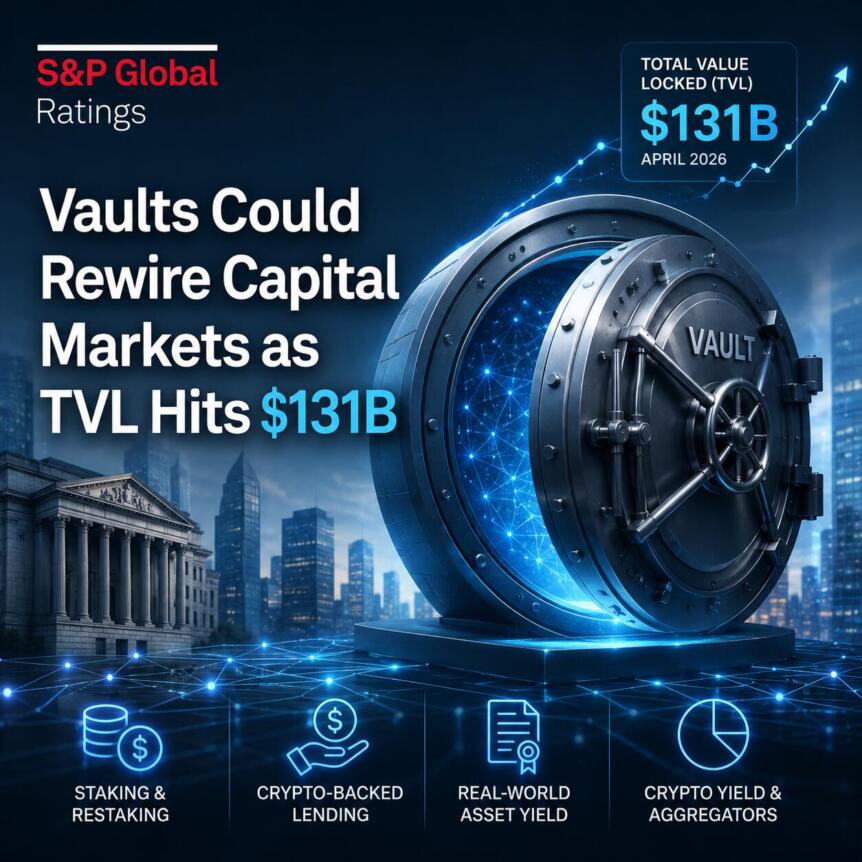
Growing fast, but still nascent: S&P lays out the promise and pitfalls of on‑chain vaults
S&P Global Ratings released a primer this week examining the role of digital asset “vaults”—on‑chain pooled investment vehicles that issue share tokens and deploy capital according to a defined strategy. The report highlights rapid expansion in deposits and says vaults could migrate beyond crypto-native uses to handle tokenized real‑world assets (RWAs) and functions traditionally performed by funds and intermediaries. At the same time, S&P warns that leverage mechanics, uneven disclosure practices, technical failure modes and regulatory ambiguity could constrain their path to wider institutional adoption.
What vaults are and how they have grown
Vaults aggregate deposits and allocate them across strategies via smart contracts, or a hybrid of automated code and discretionary manager decisions. Investors receive tokenised shares that represent a proportional claim on the pooled assets and any returns. That structure makes vaults a different primitive from direct asset ownership: they can implement dynamic, multi‑asset strategies, reallocate automatically and integrate with other protocols.
Market metrics cited by S&P show the space has expanded sharply: total deposits in vaults rose to about US$131 billion as of April 2026, from roughly US$24 billion in April 2023. But the firm notes that approximately 94% of current activity is concentrated in crypto‑native strategies such as staking, crypto‑backed lending and yield aggregation.
Why vaults might matter to capital markets
S&P argues vaults could eventually support a wide range of financial functions traditionally carried out by private credit funds, money market vehicles, hedge funds and more. The combination of automation, composability and secondary‑market liquidity turns pooled on‑chain assets into reusable building blocks: vault shares can be traded, posted as collateral, or blended into composite strategies.
The report also points to a potential bridge to much larger markets. For example, tokens representing treasury or repo‑like instruments could be used as collateral on‑chain; because global repo turnover is many times the market capitalization of crypto assets, even modest uptake could materially increase vault activity.
Key risks S&P flags
Leverage and looping. Vault architectures and composability enable recursive reuse of collateral. Borrowed funds can be redeployed as collateral to generate additional exposure, a practice S&P calls “looping.” Looping can occur at the depositor level—similar to margin—or at the vault level, where curators’ actions raise leverage for all depositors. That amplifies returns in good times and can accelerate deleveraging and cascading liquidations during stress.
Technical failure modes. Reliance on smart contracts, external oracles and protocol integrations introduces risks not seen in traditional funds. Code bugs, oracle failures or integration errors can produce direct losses or disrupt settlement and rebalancing processes.
Disclosure and transparency gaps. While on‑chain transactions are visible, S&P notes that raw blockchain data is often hard to interpret and does not substitute for structured disclosures. Many vaults focus on headline yield figures and provide limited, non‑standardised information on mandate, allocation limits, leverage practices and governance. Where disclosures exist, mechanisms such as “time locks”—typically several days for concentration changes—are used to give depositors exit windows, but monitoring these changes can be resource intensive.
Regulatory ambiguity. Uncertainty over whether vault tokens constitute securities or other regulated instruments is a major constraint on institutional participation. Vault shares can represent tokenised ownership of RWAs or resemble investment contracts under legal tests used by regulators. Without clearer cross‑jurisdictional frameworks, many institutions remain cautious.
Market structure and consolidation
S&P observes early consolidation among vault curators and infrastructure providers. On one relatively mature platform, Morpho, two curators accounted for roughly 77% of deposits as of April 2026. The ratings firm expects further concentration as operators scale, risk and disclosure standards rise, and traditional finance entrants and established market makers expand their presence. Names mentioned as active or interested participants in the market include Apollo, Wintermute and Bitwise—signalling growing crossover between legacy asset managers, trading firms and crypto infrastructure players.
Implications for institutional adoption and next steps
The primer’s central contention is that vaults have technical and economic features that could make them useful building blocks for tokenised capital markets, but that a series of market‑level changes is likely required before large institutional flows arrive. Those include clearer regulatory guidance, more standardised disclosures and independent operational controls—custody, audited smart contracts, resilient oracles and third‑party risk engines. Without those, S&P warns, vaults risk remaining a predominantly crypto‑native toolkit rather than forming the plumbing for broader financial markets.
For market participants and policymakers, S&P’s analysis provides a roadmap of trade‑offs: vaults can improve capital efficiency and liquidity, but the same composability that delivers benefits also increases interconnectedness and systemic risk. How participants, platforms and regulators respond will determine whether vaults evolve into core market infrastructure or remain an increasingly sophisticated corner of the crypto ecosystem.
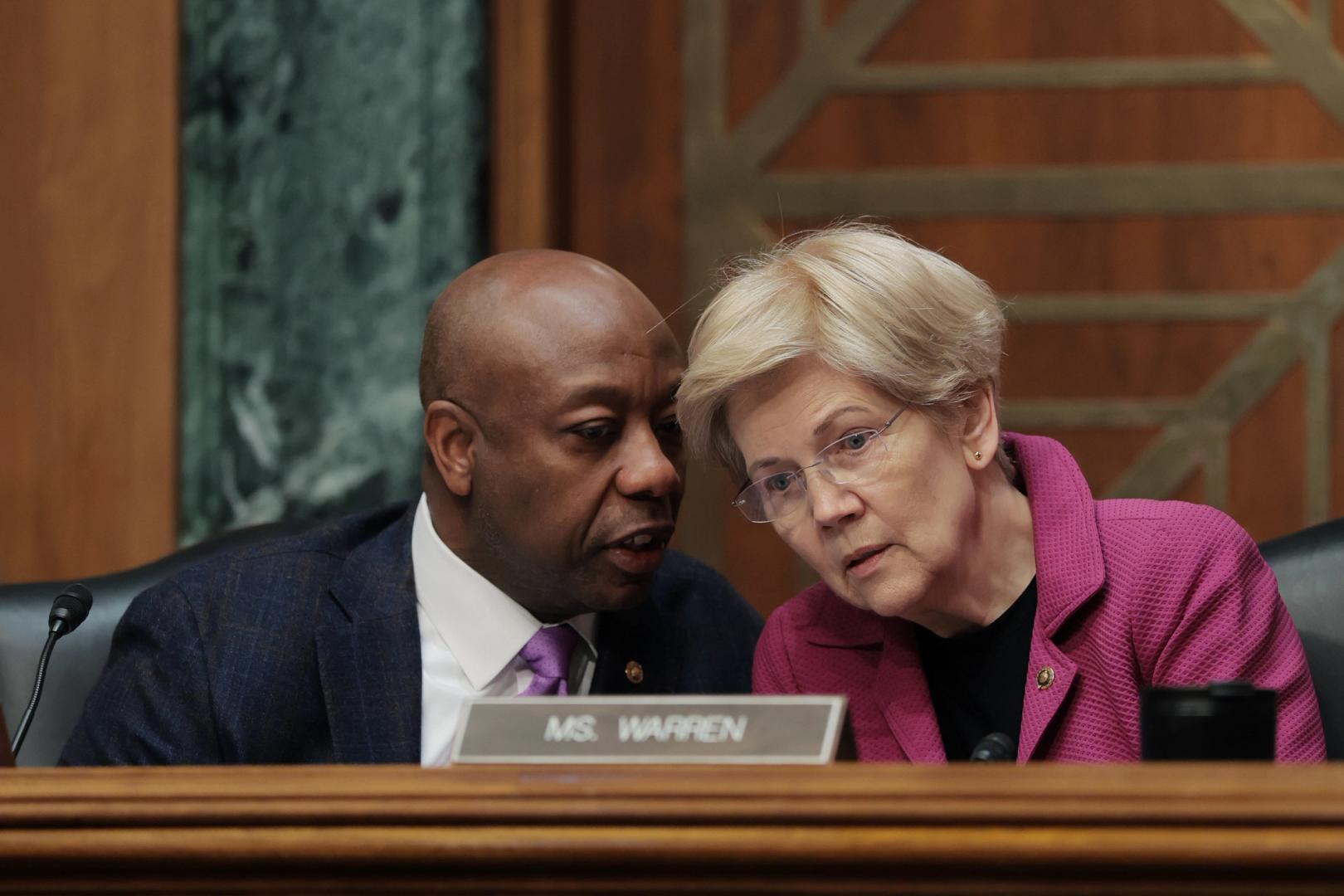
At the recent Senate Banking markup of the Digital Asset Market Clarity Act (CLARITY), Senator Angela Alsobrooks (D-MD) shared a story that should resonate with every parent in America. She spoke about her twenty-year-old daughter and her daughter’s generation – their intuitive interest in digital assets and their desire for a modern financial system that offers both opportunity and protection.
It underscored the growing urgency and gravity surrounding digital asset policy in Washington. “The digital revolution is upon us,” Senator Alsobrooks said. “It’s happening with us or without us. We have a responsibility to regulate it to create rules of the road.”
Her remarks reflected the growing recognition that the U.S. can no longer afford to approach digital asset policy reactively. This legislation is not just about the America of today; it is about tomorrow. We owe it to our children and the younger generation to get this policy right.
Chairman Tim Scott framed the debate through the lens of opportunity, faith and the American dream for working families. Senator Cynthia Lummis, one of Congress’s earliest bitcoin champions, emphasized the bipartisan work behind the legislation. Even senators who withheld support at this time, including Senator Lisa Blunt Rochester, spoke thoughtfully about how engaged her constituents are with this technology and emphasized the importance of legislation that ensures their protection.
The question now facing us is whether the U.S. will lead in shaping that future or will neglect that responsibility.
The 15-9 vote to advance Clarity to the Senate floor underscores three critical realities for the future of the American economy.
First, serious bipartisan policymaking regarding digital assets is not only possible but is already happening. The markup was a testament to the fact that credible policy and thoughtful engagement can still move Washington forward. Even senators who ultimately did not vote in favor of the bill, including Senator Mark Warner (D-VA), expressed their intention to continue working toward a constructive path forward.
The desire of leaders like Senators Scott, Lummis, Tillis, Alsobrooks, Gallego, Hagerty, Moreno and others to bridge the gap – including on the complex issue of stablecoin yield – shows that a bipartisan path is the only durable way forward.
Second, digital assets and the blockchain are here to stay. As articulated throughout the hearing by Senators on both sides of the aisle, the debate over the viability of digital assets is over. The only question is whether the U.S. will lead in shaping the future of digital finance or cede that leadership to others.
Nearly 68 million Americans, about one in five, already own digital assets. New Harris polling shows the number has increased by 12 million in the past year alone, putting American holders closer to one in four. They are teachers, construction workers, veterans, entrepreneurs and small business owners, with a third Gen Z and another third millennials. They use digital assets to send money to family members, make purchases and plan for their financial futures. Eighty-three percent of all American holders agree that stronger regulation is needed to protect consumers. Yet 88% of global crypto exchange activity occurs on foreign exchanges beyond U.S. supervision. Americans deserve the protections, clarity and oversight that only a federal framework can provide.
Finally, Congress must finish the job. The time is now. It is imperative that the full Senate act promptly.
The GENIUS Act established the payment layer through stablecoin legislation, but without Clarity to provide the market structure, trading platforms oversight and asset classification needed to support it, the U.S. risks leaving the job unfinished. As Treasury Secretary Scott Bessent has rightly noted, stablecoins without a broader market structure are a “foundation without walls.” If we fail to act, we risk sending the next generation of American innovation and the talent, investment and tech that comes with it, to foreign jurisdictions.
This important work is the industry’s responsibility as well. Comprehensive market structure will not arrive because we asked for it; it will arrive because we match the seriousness Congress has shown. The time is now to continue engaging substantively and constructively with concerns raised by members of Congress. Doing so is not the obstacle to the work; it is the work.
The markup proved that the momentum is with us. The resolve in that room showed that Washington recognizes the high stakes for American competitiveness and the future of digital finance. We have the mandate, bipartisan support, and the duty to ensure that the future of digital finance is unambiguously American.
America has long led the world because it has embraced innovation, markets and the rule of law. The window is open. The only question is whether we will close it on our terms.
A vote for Clarity is a vote for regulation – the rules this generation needs and the rules the next generation will inherit. Congress now has the chance to shape this technology rather than chase it. Let’s finish the job on the Senate floor.
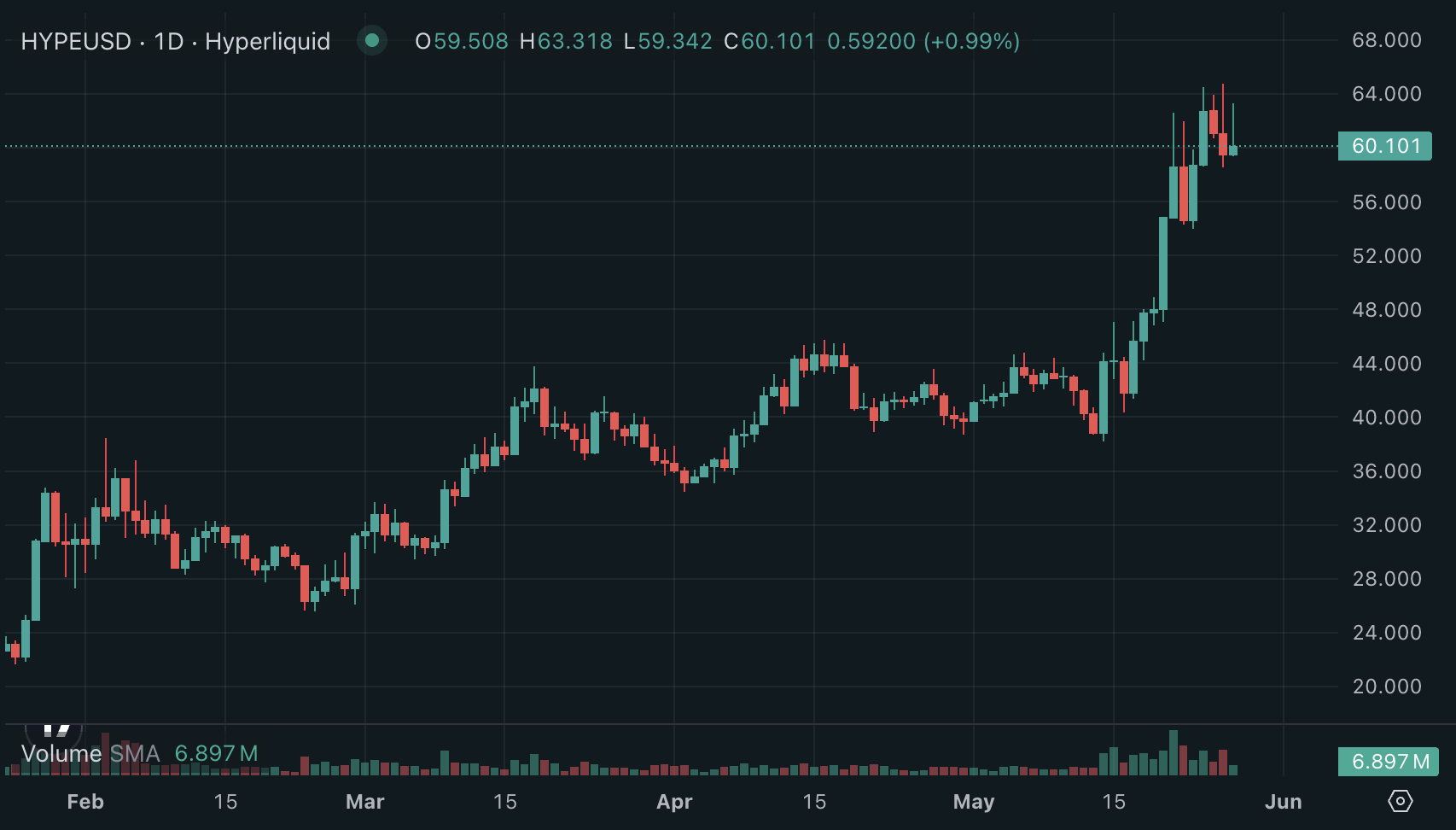
Bitwise Asset Management’s physically backed spot HYPE ETF early volume data show that the product launch is not a soft one. Does this reframe HYPE as a genuine cycle winner, or is the Bitwise ETF premium already priced in?
Bitwise’s BHYP debuted on NYSE with a 0.34% sponsor fee, temporarily waived to 0% on the first $500M in AUM for the opening month. The firm manages approximately $11 billion in client assets. Within 48 hours of launch, the two US-listed HYPE ETFs recorded a 50% single-day volume surge on May 20 and $25.5M in net inflows, with $8.8M attributed to BHYP alone, already making it one of the largest altcoin ETF launches by early metrics.
Meanwhile, Hyperliquid’s derivatives volume hit $2.9 trillion in 2025, with over 400% year-on-year growth. Not only derivatives volume, the protocol has also captured 44% of weekly blockchain fee revenue last week alone, generating $11M versus Ethereum’s $3M.
Discover: The Best Crypto to Diversify Your Portfolio
Can HYPE Break $100 as Bitwise ETF Flows Accelerate?
HYPE is having its own rally in this market bloodbath. It’s just so bullish at the moment that every major resistance is being breached. Right now, HYPE is at its price discovery after a more than 50% jump in the past 2 weeks. It’s the hottest token now as it’s outperforming the market by a huge margin.
If BHYP and the 21Shares product sustain eight-figure monthly net inflows, HYPE could easily clear $70 decisively, targeting $80. Moderate flows after the fee-waiver window closes would likely bring HYPE to the sidelines around its $60 range.

For those shorting, the best case is to see ETF inflows reverse or stall below $5M weekly, which then breaks the price to under $55 support and reverts toward the $48 range, where structural buybacks provide a floor.
The Assistance Fund mechanic is the variable not to be missed. By March 2026, the Fund had accumulated 28.5 million HYPE through automated open-market purchases, spending over $1.3 billion cumulatively, bringing an annualized buyback rate of 7% of market cap, four to five times BNB’s equivalent rates.
Discover: The Best Token Presales
Bitcoin Hyper Targets HYPE’s Style Run
HYPE’s potential is real. The ETF wrapper expands access, but it also compresses the asymmetry available to early participants. Traders rotating capital toward high-performance infrastructure narratives are increasingly looking earlier in the stack for that kind of leverage.
Bitcoin Hyper ($HYPER), currently in active presale at $0.0136, positions itself at a different point on the risk curve. It is the first Bitcoin Layer 2 integrating the Solana Virtual Machine, delivering sub-second finality and low-cost smart contract execution while settling on Bitcoin’s security layer.
The project has raised more than $32.7 million to date, with a decentralized canonical bridge enabling native BTC transfers. Staking is live with a high 36% APY for early participants. The core thesis: Bitcoin holds $1.8 trillion in idle capital; programmability unlocks it.
Research Bitcoin Hyper here before the next price adjustment.
The post Bitwise HYPE ETF is The world Largest: Is Hyperliquid The Winner This Cycle? appeared first on Cryptonews.
A new report from Grayscale Research evaluates Hyperliquid, a decentralized finance platform that aims to bring high-throughput derivatives trading on-chain while preserving blockchain custody and transparency. The note focuses on the economics of the platform’s native HYPE token, the expanding product set that now includes spot and traditional-asset futures, and what the project could mean for the broader migration of trading activity from centralized exchanges to on-chain venues.
What Hyperliquid is building
Hyperliquid began by targeting perpetual futures, a lucrative and liquidity-intensive market dominated by centralized exchanges. The project has prioritized matching the performance expectations of professional traders – low latency, tight spreads and predictable execution – while operating onchain. To achieve that mix, Hyperliquid employs design choices intended to reduce friction between on-chain settlement and off-chain-like performance.
Beyond perpetuals, the platform has opened to permissionless third-party development and expanded into spot trading, futures on traditional assets, and outcome-style markets that resemble prediction markets. That modular approach is consistent with several DeFi projects that seek to attract external builders to increase product depth and diversify fee sources.
Grayscale’s focus: HYPE token economics
The Grayscale report centers on the HYPE token and how its economic design aligns with platform growth. Rather than presenting price forecasts, the research examines mechanisms commonly used to tie token value to platform activity, such as fee-sharing, protocol-owned liquidity, staking incentives and governance rights. Grayscale frames these mechanisms in the context of Hyperliquid’s product roadmap and potential revenue pools.
Token economics matter for platforms like Hyperliquid because they affect incentives for liquidity providers, market makers, and governance participants. Well‑calibrated token mechanics can improve fee capture and reduce reliance on external liquidity; poorly designed incentives can fragment liquidity or introduce speculative volatility that undermines trading utility.
Industry context: why on-chain derivatives matter
The examination of Hyperliquid comes amid growing interest in on-chain derivatives. Traders and institutions are increasingly evaluating whether blockchain-native venues can deliver the speed, capital efficiency and risk controls they expect from centralized counterparts. On-chain derivatives promise advantages including transparent order books, verifiable settlement and the elimination of custodial counterparty risk.
However, moving derivatives on-chain also raises operational challenges. Matching throughput with blockchain finality, limiting extractable value such as front-running, and ensuring deep, concentrated liquidity across products are nontrivial engineering and market-structure problems. Hyperliquid’s approach seeks to bridge those gaps, but the broader market will judge on repeatable execution quality and capital efficiency.
Market opportunity and competition
Grayscale’s report notes that the market opportunity for on-chain trading expands beyond crypto-native derivatives, especially if platforms can list futures on traditional assets or host outcome-based markets. Entrants that can combine institutional-grade execution with regulatory clarity could attract order flow migrating away from centralized counterparties.
Competition is a factor. Established centralized exchanges retain deep liquidity and product breadth, and other DeFi projects and hybrid venues are pursuing similar technical and commercial propositions. Success will depend on user experience, cost structures, regulatory positioning and the ability to aggregate liquidity across venues and chains.
Risks and regulatory considerations
The report and the market environment underscore several risks. Token investments remain speculative and subject to high volatility. For platforms offering derivatives tied to traditional assets or outcomes, regulatory scrutiny is a significant consideration as authorities assess how existing securities and commodities rules apply to on-chain products.
Operational risks also persist: smart contract vulnerabilities, liquidity fragmentation that raises slippage, and potential centralization vectors if execution infrastructure is controlled by a small set of actors. Protocol teams must balance performance optimizations with decentralization and robust governance to avoid concentrated risk.
Implications for institutional adoption
If platforms such as Hyperliquid can consistently deliver low-latency execution with verifiable on-chain settlement and clear token-aligned incentives, they may broaden the universe of institutional counterparties willing to route more activity on-chain. That could reshape liquidity dynamics and the economics of trading venues, but the transition will be gradual and contingent on regulatory clarity and operational track records.
Bottom line: Grayscale’s analysis highlights why token design and execution performance are core to any on-chain trading platform’s prospects. Hyperliquid’s combination of high-throughput derivatives and a permissionless developer model presents an intriguing use case for on-chain markets, but adoption will hinge on addressing liquidity, governance and compliance hurdles as trading evolves away from centralized incumbents.
Disclosure: Grayscale’s publication includes standard disclaimers noting that digital asset investments are speculative and may result in partial or total loss. This article summarizes the themes reported by Grayscale and does not constitute investment advice.


A hacker compromised StakeDAO's deployer private key on Wednesday, minting 5.4 trillion vsdCRV tokens on Arbitrum and swapping a portion for roughly $91,000 worth of ETH, an attack that rippled into Curve Finance's lending market and forced yield optimizer Beefy Finance to pause an affected vault…. Read the full story at The Defiant

Victor Wembanyama skips media after worst game of series in Game 5 loss

Can you enforce strong Active Directory password rules without frustrating users?

The UK Financial Crisis Could Force An Early Election | Could This Trigger A Snap Election?


-

 Crypto World6 days ago
Blockchain.com files with SEC for U.S. IPO
-

 Fashion5 days ago
Holiday Weekend Open Thread – Corporette.com
-

 Crypto World5 days ago
Bitcoin Accumulation Weakens as BTC Realized Losses Hit $600M
-

 Business5 days ago
Dell Technologies DELL Stock Surges 15% on AI Server Momentum and Analyst Upgrades in 2026
-

 Crypto World4 days ago
Robinhood crypto COO Tanya Denisova exits
-

 Tech2 days ago
Microsoft’s quiet Claude Code retreat and the real cost of enterprise AI
-

 Politics5 days ago
Makerfield: a tale of two social-media histories
-

 Business3 days ago
NYT Strands Answers May 24 2026 Revealed for Puzzle No. 812 Theme Summer Essentials
-

 Crypto World5 days ago
Space X IPO Is ‘Bad News’ for Tech Stocks: But What About Bitcoin?
-

 Business5 days ago
Trump Invests $1M-$5M in Kura Sushi USA Chain With 27 California Locations
-

 Crypto World6 days ago
MicroStrategy’s Saylor Says Miners No Longer Set Bitcoin Price, Another Force Has Taken Over
-

 Tech6 days ago
WhatsApp ads could make Irish debut after discussions with DPC
-
 NewsBeat6 days ago
Charity run by Reform leader Malcolm Offord accused of ‘law breaking’ over Scottish registration
-
 Tech5 days ago
A 0.12% parameter add-on gives AI agents the working memory RAG can’t
-

 Crypto World5 days ago
AI infrastructure race heats up as IREN pitches full-stack strategy, WhiteFiber lands $160M deal
-
Tech4 hours ago
The Samsung pay deal is the moment Korean unions changed register
-
 Crypto World2 days ago
Nvidia (NVDA) CEO Calls on Super Micro to Strengthen Export Controls Amid Smuggling Probe
-

 Tech6 days ago
You Can Now Add ChatGPT To PowerPoint
-

 Tech2 days ago
Westone Audio and Etymotic Acquired by Fidelity Collective in Major IEM Market Move
-

 Sports6 days ago
2026 CJ Cup Byron Nelson leaderboard: Brooks Koepka finds putting stroke in Round 1
You must be logged in to post a comment Login