
Crypto World
AI Crypto Coins Revenue Gap Puts Token Value to the Test

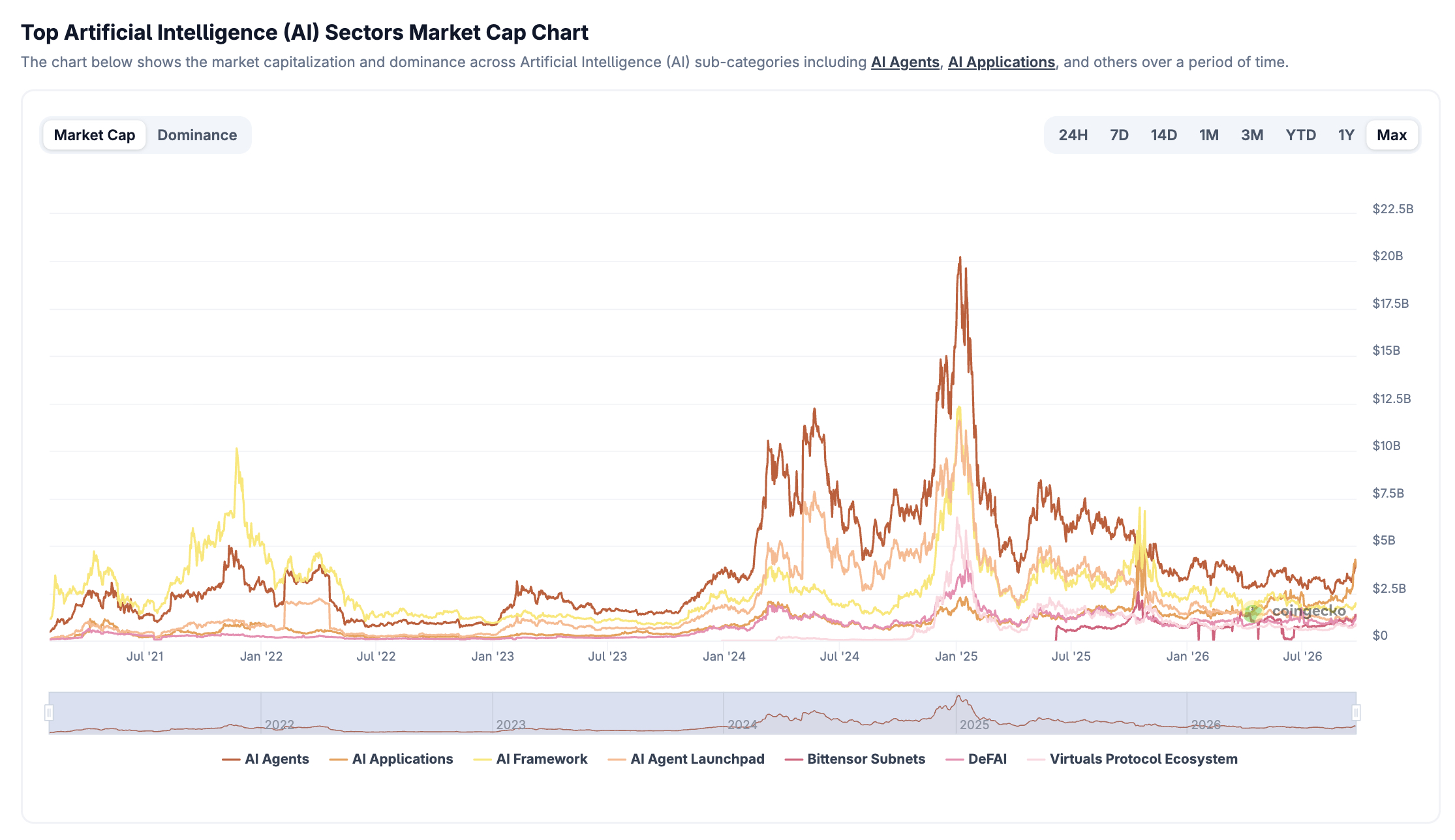
The AI coin crypto sector sits at $24-25 billion, with a total crypto market of approximately $2.86 trillion. Anthropic reportedly raised $65 billion at a $965 billion valuation in May, and Nvidia posted $96.2 billion in quarterly revenue in July, up 106% year over year, yet most major AI-related tokens remain 70%-90% below their 2024-2025 highs.
Does AI growth create direct demand for tokens, or does it primarily enrich the companies building chips, cloud infrastructure, models, and enterprise software?
The pattern already showing up in stablecoin rails is instructive. Large AI-agent payment volumes have not yet clearly translated into demand for Solana or other underlying tokens, which is exactly the disconnect now visible across the AI-coin basket.
A recent BlackRock research paper frames AI and digital assets as the two technologies defining the current era, stating that AI represents machine-native intelligence, while digital assets represent machine-native money.
“this alignment becomes particularly important with the rise of agentic AI…with blockchains providing the programmable infrastructure that connects intelligence with economic activity.”
That framing matters because it separates two distinct exposures that traders often conflate. AI companies monetize through cloud contracts, hardware sales, and enterprise licensing; token value depends entirely on protocol usage, fee capture, and emissions. This is a sharp gap that shows up in the contrasting case where AI-driven stablecoin payments could generate direct demand for a major asset like Ethereum, rather than for a narrower AI-labeled coin.
Discover: The Best Token Presales
Attention Is High, but Capital Favors Revenue and Infrastructure
AI coins captured 35.7% of crypto-market narrative attention in Q1 2026, ahead of meme coins at 27.1%, according to CoinGecko’s quarterly narrative report. Combined, those two categories commanded 62.8% of reported mindshare, yet that attention has not translated into proportional capital retention across the sector’s roughly $24-25 billion market cap.
Venture capital tells a sharper story about where the money is actually going. AI captured approximately $240 billion, or 80% of global VC funding, in Q1 2026, and AI-blockchain companies specifically received 40% of crypto-related VC funding, more than double the 18% share a year earlier.
Gartner projects global AI spending is climbing from $1.76 trillion in 2025 to $2.52 trillion in 2026 and $3.34 trillion by 2027, with AI infrastructure taking the largest share.
CoinGecko lists 1,473 projects at the intersection of AI and blockchain, but investors are objectively prioritizing compute, agents, and measurable workloads over tokens that merely carry the AI label.
Earn $50 and Enter $300K Prize Draw on EdgeX
Why AI and Crypto Need Activity, Not Just a Label?
Crypto’s structural pitch to AI is straightforward: smart contracts and stablecoins provide the execution layer autonomous agents need to transact cheaply and continuously. BlackRock’s paper notes that stablecoins, native cryptoassets, and other on-chain instruments can serve as machine-native tools for payment and settlement, with compute spending forecast to reach $1 trillion by 2030.
— Crypto Banter (@crypto_banter) September 24, 2026
 BLACKROCK SAYS AI WILL USE CRYPTO!@cryptomanran on the BlackRock report:
It’s the same thesis crypto’s been running. AI agents have to pay other machines and banks weren’t built for that.
BlackRock says that demand hits blockchains, stablecoins, and on-chain assets.
Watch… pic.twitter.com/VnCIzS5DTu
None of that guarantees uniform gains across AI coins. The sector’s next moves should be judged on transaction volume, fee generation, and partnership activity rather than category labels. Continued agent usage and revenue capture would strengthen the case for token value, while attention without those metrics would leave the $24-25 billion basket exactly where it is now.
Trade AI Coins on Bybit and Get a Chance to Win Our $1,000 USDT Airdrop
The post AI Crypto Coins Revenue Gap Puts Token Value to the Test appeared first on Cryptonews.


Bitget CEO Gracy Chen has acknowledged that North Korea was likely responsible for the crypto exchange’s latest hack that stole roughly $352 million.
Substantial withdrawals were spotted from addresses labelled as Bitget hot and cold wallets yesterday, setting off alarm bells across the community.
Crypto investigator Specter Analyst linked the attack to North Korean hacking collective Lazarus Group.
Since then, Chen has confirmed in a livestream that the attack displays the signs of a North Korean operation.
Read more: How 4,000 BTC walked out of Blockstream’s Liquid Network
Chen also revealed that various chains have frozen addresses associated with the hack, and that the Bitget wallet, separate from the exchange, wasn’t affected.
She also ruled out the possibility of a private key compromise, and claimed hackers were able to breach the wallet services backend system, forge transfer details, and authorize their own signing processes.
Bitget’s cold wallets reportedly remained secure while their hot wallets and warm wallet layers were targeted.
Bitget CEO says users funds are covered
Chen claimed user funds were safe, with the majority of the loss covered by Bitget’s User Protection Fund, “which currently holds over $464 million.”
Bitget is now working with independent investigators Mandiant and SlowMist to fully determine what happened. It announced this morning that withdrawels are still temporarily paused.
The Bitget hack was initially expected to involve significantly lower losses, and unfortunately for Bitget, it took place as the exchange celebrated its eighth birthday.
Got a tip? Send us an email securely via Protos Leaks. For more informed news and investigations, follow us on X, Bluesky, and Google News, or subscribe to our YouTube channel.
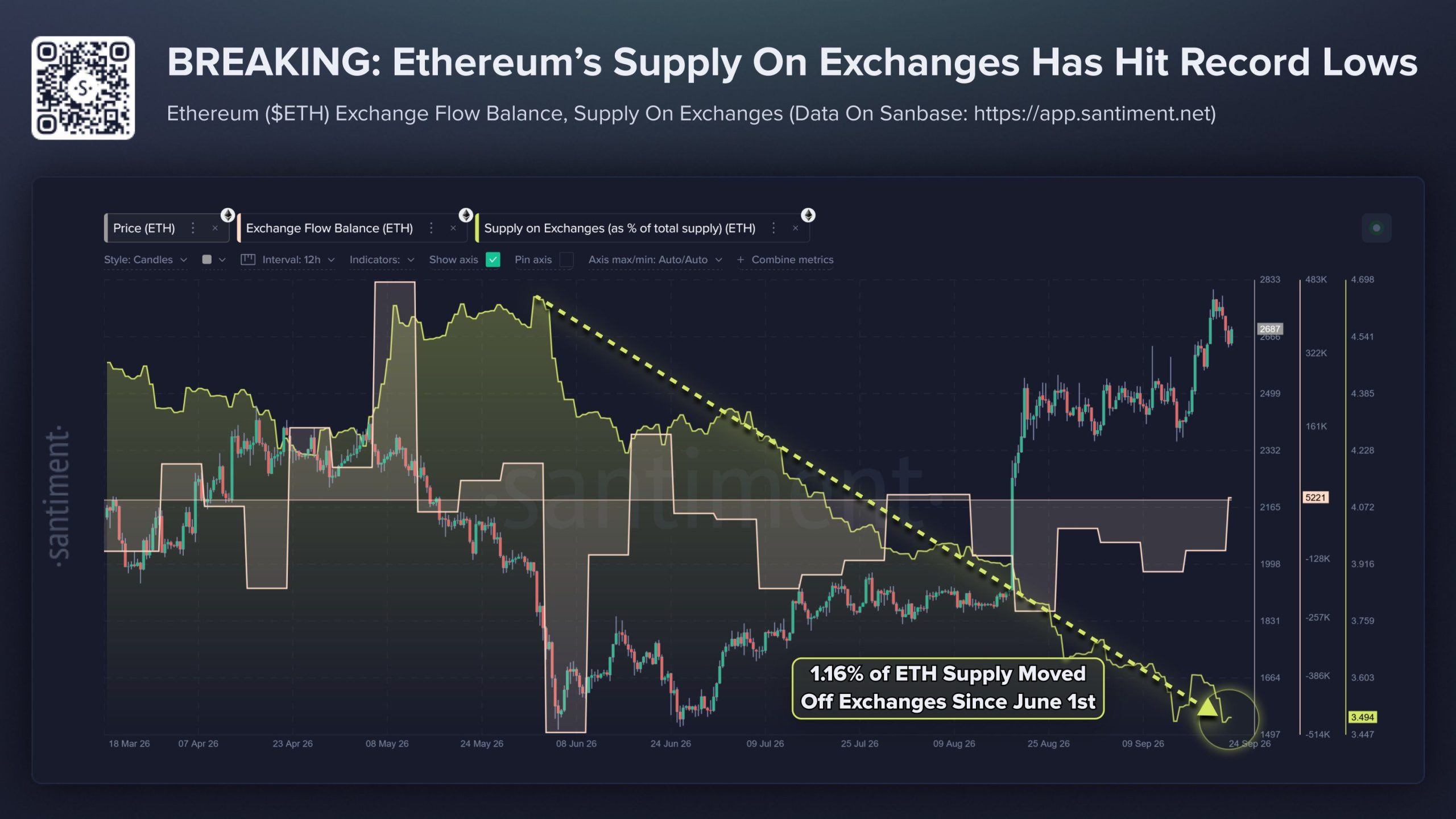
Ethereum (ETH) is flashing 3 bullish on-chain signals as exchange supply shrinks, priority fees climb, and Binance stablecoin reserves rebuild.
The signals come after ETH rallied from around $1,900 to $2,800 before pulling back. The asset now trades near $2,678, up about 8% over the past week, BeInCrypto Markets data shows.
Follow us on X to get the latest news as it happens
Ethereum Keeps Draining Off Exchange Order Books
Santiment data shows just 3.49% of ETH supply now sits on tracked exchanges. Another 1.16% of total supply has moved off these platforms since June 1.
The firm added that exchange balances had already sunk to levels last seen in Ethereum’s first years this summer. The drop extends a slide in exchange reserves since January. Fewer coins on exchanges leave less ETH ready to sell.
“But it reduces the pool of ETH readily available to hit the market during the next wave of selling,” the firm added.

Staking and Decentralized Finance (DeFi) help explain where the coins are going. Santiment estimates roughly 35% of ETH is staked, while Ethereum holds about $53 billion in DeFi value.
Corporate treasuries also keep coins off exchanges. BitMine holds 5.98 million, with 85% of its holdings staked.
“If demand strengthens while available exchange supply stays this scarce, buyers have fewer immediately available coins to compete for,” the team added.
Traders Pay Up to Jump the Block Space Queue
On the demand side, an analyst citing CryptoQuant data noted that priority fees rose 26.74% in a single day to about $464,000.
Gas used, however, climbed only 0.26% to roughly 217.1 billion. Blocks mined held near 7,147, so higher block production did not drive the fee jump.
“The lack of a significant decline in gas usage suggests that demand for Ethereum block space has not weakened substantially despite the price pullback,” the post read.
The analyst interpreted this gap as users paying more for faster processing. That points to stiffer competition for the same block capacity.
Stablecoin Dry Powder Refills on Binance
Lastly, XWIN Japan tracked Binance’s ERC-20 stablecoin reserves. They recovered to about $43.8 billion from an August low near $42 billion.
The analyst described exchange stablecoins as potential buying power for Bitcoin (BTC) and other crypto assets. However, reserves still trail the roughly $49 billion recorded earlier this year.
What Could Knock the Setup Off Course
Each signal carries caveats. Santiment stressed that thin exchange supply does not guarantee higher prices. XWIN Japan also warned that reserves may sit idle or back derivatives positions.
On price, the analyst tracking network activity flagged $2,600 to $2,650 as support. Holding that zone could set up a retest of $2,700 to $2,800.
Meanwhile, a sharp drop in priority fees with weaker gas usage would pressure the $2,600 level, the analyst warned. The coming sessions should show whether fee competition can outlast the cooling price momentum.
Subscribe to our YouTube channel to watch leaders and journalists provide expert insights
The post Ethereum Flashes 3 On-Chain Signals That Buyers Are Still Around appeared first on BeInCrypto.
A wallet linked to Hyperliquid Strategies has purchased 494,200 Hyperliquid (HYPE) tokens, worth $45.8 million.
The latest buy extends a month-long run. The token behind that treasury has also sharply outpaced Bitcoin (BTC) and Ethereum (ETH) this year.
HYPE Did the Heavy Lifting in Fiscal 2026
According to Lookonchain, the wallet has bought 5.51 million HYPE, worth $476 million, over the past month. That averages 183,574 tokens, or $15.86 million, a day.
The firm now holds 35.1 million HYPE worth about $3.2 billion. That is up from roughly 29.3 million tokens when its fiscal year closed on June 30.
Hyperliquid Strategies booked $305.5 million in net income for the fiscal year, largely from HYPE price gains, its full-year profit report showed. Unrealized gains on its holdings came to $709.9 million, per the company’s results.
Follow us on X to get the latest news as it happens
HYPE Outruns Bitcoin and Ethereum
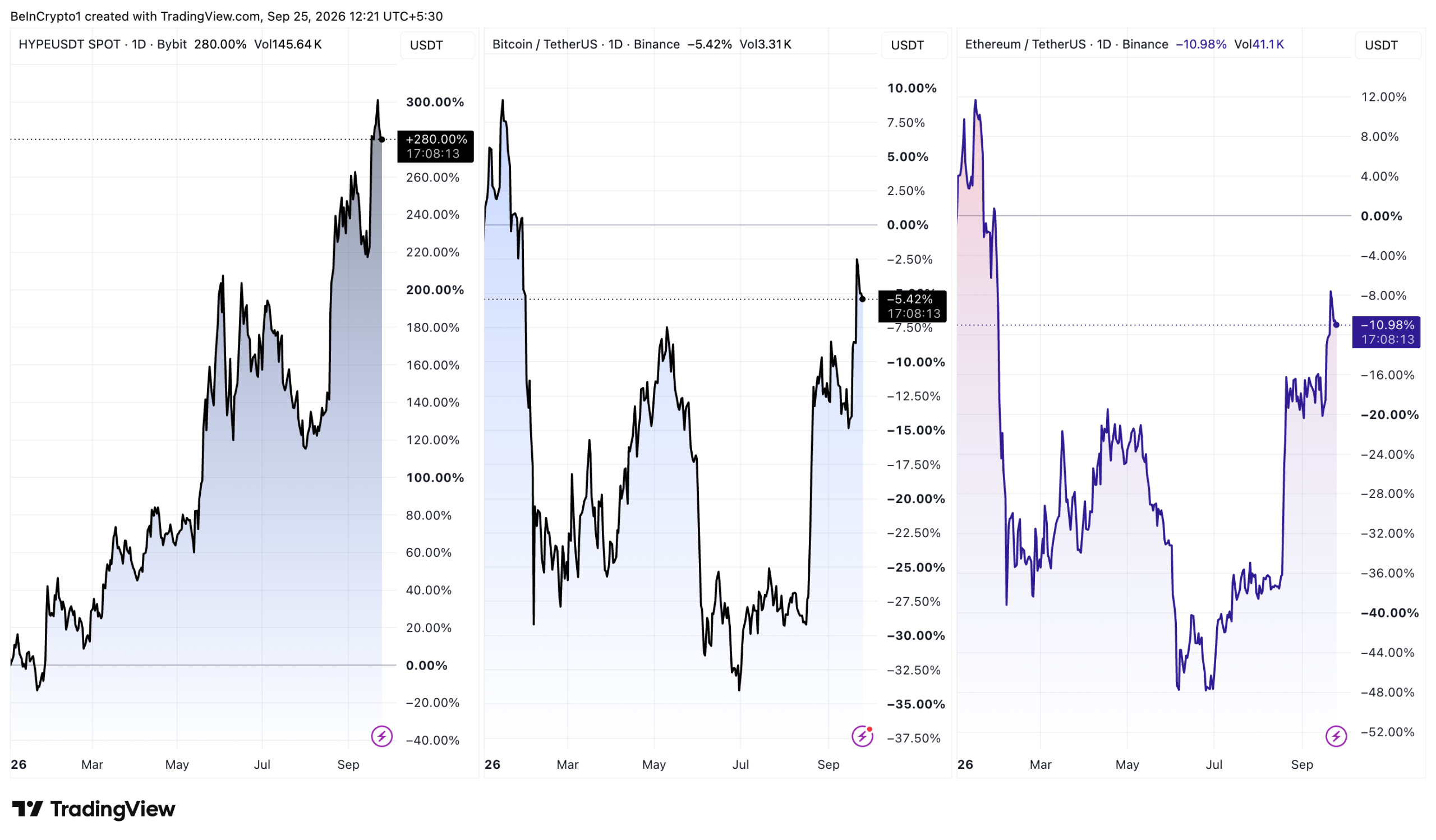
The accumulation has come during a strong year for the token. HYPE has climbed 280% so far in 2026, according to market data.
In contrast, Bitcoin has lost 5.42% this year, while Ethereum is down 10.98%.

Artemis data shows how that split has played out for treasury firms. Hyperliquid Strategies holds $2.7 billion in unrealized gains, second only to Strategy. Ethereum-focused BitMine sits at the other end with the largest unrealized loss.

Shareholders are also paying a premium for that exposure. DWF Ventures’ latest report places Hyperliquid Strategies among 4 of the top 20 treasury stocks trading above their holdings.
Its market-value-to-net-asset-value ratio stood at 1.17x on DWF’s count. Since July, the stock has outperformed HYPE by 31%. However, DWF found the token stayed the better bet over periods longer than 3 months.
Subscribe to our YouTube channel to watch leaders and journalists provide expert insights
The post Hyperliquid Strategies Keeps Buying the Token That Drove Its $305.5 Million Profit appeared first on BeInCrypto.

DoubleZero has launched a dedicated market data feed for Hyperliquid, aiming to give professional trading firms a more reliable and complete view of the decentralized exchange’s order book. The service delivers Hyperliquid’s market data over fiber, rather than relying on the exchange’s public APIs.
According to DoubleZero, the feed provides an ordered, continuous stream of order book data for market makers, quantitative traders, and proprietary trading firms that depend on consistent update frequency and depth.
Key takeaways
- DoubleZero’s Hyperliquid feed distributes full order book data via a dedicated fiber network instead of public APIs.
- The service supports Hyperliquid’s native perpetual futures and also markets run through trade[XYZ], a venue using Hyperliquid infrastructure for asset-linked perpetuals.
- DoubleZero says public API changes have reduced both the frequency and the depth of order book updates available to external consumers.
- The initiative broadens DoubleZero’s “Edge” market-data offering, which already includes Solana and the prediction market Kalshi.
A fiber-based order book for professional traders
For firms that need a full and timely order book, pulling liquidity data from a public interface can introduce inconsistency. DoubleZero’s new feed is designed to address that by providing market data as a continuous stream, with ordering guarantees intended to help automated systems interpret changes quickly and predictably.
DoubleZero positioned the launch around a practical problem: before this release, companies seeking a complete view of Hyperliquid’s order book typically had to reconstruct it themselves from public API responses or run their own Hyperliquid nodes. DoubleZero now offers a third path—an outsourced, purpose-built distribution layer.
The company also attributes the need for a dedicated feed to changes in Hyperliquid’s public APIs. DoubleZero said those updates have lowered the cadence and reduced the depth of information available through the public routes, making it harder for data consumers that require more frequent, comprehensive updates.
What’s included: native perps and Hyperliquid-powered markets
DoubleZero said the feed covers Hyperliquid’s native perpetual futures markets, alongside markets operated by trade[XYZ]. In this structure, trade[XYZ] provides perpetual contracts linked to assets including oil, gold, and silver, using Hyperliquid’s underlying infrastructure.
DoubleZero added that the feed was developed in collaboration with validator operators and ecosystem partners, including Hyperion DeFi, MAVAN, and Kinetiq. That matters because fiber-based delivery depends not just on software integration but also on reliable distribution pathways across network participants.
Why this matters: convergence with traditional exchange data workflows
The launch also highlights a broader trend in onchain market infrastructure: professional trading firms are increasingly looking for data distribution patterns similar to those used by large traditional exchanges.
Hyperion DeFi CEO Hyunsu Jung told Cointelegraph that major exchanges such as CME and Nasdaq distribute professional market data over dedicated networks. The point is to deliver a consistent stream of ordered information at high speeds to automated trading systems.
Jung argued that Hyperliquid’s market data can now be consumed through a similar model. In his words, the approach is effectively “publish once, distribute simultaneously over dedicated fiber,” echoing the logic behind how institutional infrastructure treats market data as a specialized distribution problem.
That said, Jung emphasized there are meaningful differences. Traditional exchanges allow firms to reduce latency further by placing trading infrastructure close to the venue’s execution systems. Hyperliquid, by contrast, executes trades onchain, which changes where latency is incurred and how it can be optimized.
He also noted that physical geography still matters. A firm based in Tokyo, for example, will maintain a speed advantage over one in New York regardless of how the data is delivered—an important reminder that fiber distribution can improve consistency and reduce certain bottlenecks, but it does not eliminate real-world network and distance effects.
Jung summarized the relationship as not a claim that Hyperliquid is becoming “CME,” but rather that onchain markets are borrowing the market-data infrastructure layer that professional firms already rely on in conventional finance.
Expanding “Edge” market data beyond crypto venues
DoubleZero’s Hyperliquid feed is the third venue available through its Edge market-data service. The company previously deployed similar services for Solana and for Kalshi, a prediction market. With this expansion, DoubleZero is effectively positioning Edge as a cross-venue distribution platform aimed at professional-grade data consumption.
For market makers and quantitative firms, the practical value of an Edge-style service is straightforward: fewer gaps in update streams, less reliance on reconstructing order books from partial public feeds, and a single distribution layer designed for automation.
For the broader Hyperliquid ecosystem, it may also signal a shift toward treating market data as critical infrastructure in its own right. Instead of forcing each data-heavy firm to build bespoke ingestion and normalization systems, venues can increasingly support dedicated distribution pipelines that align with how trading desks already operate.
Investors and traders will likely watch next how widely institutions adopt the feed and whether other onchain venues respond with similar dedicated distribution layers, particularly as more market participants push for predictable, ordered depth updates beyond what public APIs can provide.

Cointelegraph is committed to providing independent, high-quality journalism across the crypto, blockchain, AI, and fintech industries.
All news, reviews, and analyses are produced with full journalistic independence and integrity. For more details on our standards and processes, please read our Editorial Policy.
Crypto World
Mahershala Ali Balances Tenderness and Swagger in ‘Your Mother Your Mother Your Mother’


No one really wants to talk about religious rage, the complex resentment when you feel your God has abandoned you: We like our faith to be tidy and count-your-blessings clean, not clouded with doubt and fury. In writer-director Bassam Tariq’s action thriller Your Mother Your Mother Your Mother, Mahershala Ali plays Latif, a Houston, Texas, hit man who’s also, ostensibly, a devout Muslim: He strives to be a man of faith even as he’s breaking bones (and more) in the name of Allah. Then his wife dies suddenly, making him a single dad with three kids to care for, teenager Fatiha (Adia), her younger brother Qadir (Jahleel Kamara), and an infant, Aziza, who can’t tolerate baby formula; only her mother’s breast milk will do, and supplies are quickly running out. That’s a workaday problem Latif has got to solve, and prayer takes a backseat to his feelings of betrayal. “You take her from me,” he rages in voiceover, “and you expect me to bow down to you?”
A crisis of faith and a desperate search for breast milk: As plot drivers go, that’s a pretty novel combination, but Tariq and Ali pull it off here. The tone is equal parts sacred, profane, and comical. Tariq opens the film with a skull-crushing action sequence in which Latif, dressed in swirling robes, beats the heck out of a baddie in a public bathroom; the sequence is exhilarating and brutal, not least because Ali, wrapped in quasi-Samurai warrior garb and wielding a menacing knife, makes such a dashing, beguiling figure. When his wife dies, he realizes his priorities must shift toward his family, but he can’t free himself from his longtime boss Mike (Laith Nakli), who has a special job for him: Mike’s porn-king nephew Hatty (Abubakr Ali) is being harassed by a (Christian) religious fanatic, Pastor Hwan Yoon (John Cho). Can Tariq take care of that? He can—but meanwhile, baby Aziza is yowling with hunger, and it turns out that a sex worker formerly in Hatty’s stable, Tiffany Boone’s Fugazi, is lactating and has a bountiful supply of what baby needs. If Latif’s life of spirituality mingled with bloody violence seemed complicated before, it has now entered the realm of the surreal.

Your Mother Your Mother Your Mother is most entertaining when it indulges its tawdry side. Hatty, with his tacky sex mansion and bevy of “halal-certified” cuties, is a particularly clever invention, and Cho, decked out in spangled western shirts and sporting a row of gold teeth, appears to be having a blast as a sleazy operator who’s more interested in power than in Jesus. The action sequences are sharp and swift. In his quest for milk, his tiny daughter strapped snugly to his chest, Ali’s Latif is a new kind of action hero. (Some of the movie’s visuals echo the climactic baby-rescue scene of John Woo’s magnificent Hard Boiled, in which Chow Yun Fat descends the wall of a multi-story hospital building while fending off a hail of bullets, even as he cradles a gurgling mite with one arm.)
But Your Mother Your Mother Your Mother also tangles with complex issues of faith. It’s clear that Latif’s daughter Fatiha, who breaks fast when she shouldn’t and has a crush on one of the family’s young Mormon neighbors, is straying from the path. But the movie doesn’t judge her for it. The suggestion is that doubt is part of faith—you can’t have the second without the occasional tension of the first—and even Latif will have to face that crisis.
The Pakistani-born Tariq previously co-directed (with Omar Mullick) the 2013 documentary These Birds Walk, and he was one of the filmmakers in talks to direct the ill-fated Marvel reboot of Blade, with Ali set to star. In a world where blessings, even mixed ones, are sparse, it’s not a terrible thing that Ali was saved from potentially being chewed up by a Marvel vehicle; he’s a superb actor who deserves better, and Your Mother Your Mother Your Mother gives him plenty to work with. The movie’s title refers to a hadith in which a man approaches the Prophet Muhammad and asks, “To whom should I give the best of me?” The prophet’s answer, so emphatic he repeats it three times, is “Your mother”; only when the man asks the question for a fourth time does the prophet respond, “Your father.” As Latif, Ali captures the spirit of the movie’s title: he seems powered by a contradictory blend of male privilege and humility. Early on, he sees, as if for the first time, the little notes his wife had left all over the house, reminders for herself and the kids of all the minuscule things that need to be taken care of in a household. She had handled all these tasks quietly, and seemingly with ease. Now those things—essentially women’s work—are left to him, including sustaining an infant who needs something he can’t provide.
As Latif, always spoiling for a fight, Ali swaggers through the film. But there’s another man inside, a gentle, God-fearing one, and that’s the one you see in the somber beauty of Ali’s eyes. Out of necessity, Latif needs to reconcile with his feminine side. Suddenly, he’s both father and mother, and he finds that filling the role of the latter is the greater challenge. It’s the tenderness he carries within that makes Your Mother Your Mother Your Mother both distinctive and thought provoking. The thrills are just a fringe benefit.
Bitcoin price is hovering around $86,500 with a sharp 13.90% run over the past week, which keeps its bullish prediction intact. The rebound is tied directly to a reversal in institutional demand that few saw coming just two months ago. There’s a second data point buried in the flow numbers, though, that changes how traders should read this rally.
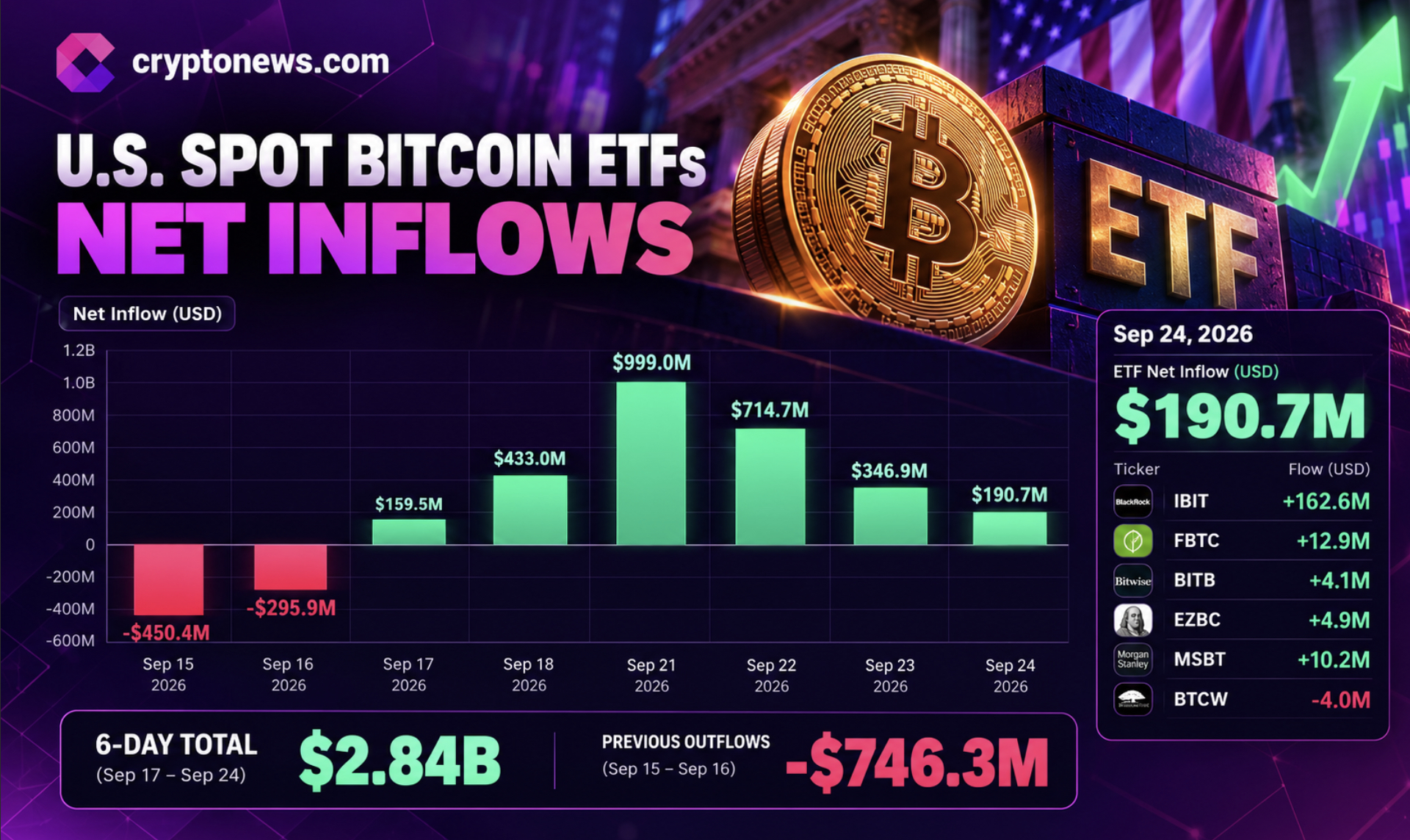
U.S. spot Bitcoin ETFs recorded $190.7 million in net inflows on September 24, extending their winning streak to six consecutive trading sessions. BlackRock’s IBIT led with $162.6 million, while Fidelity’s FBTC added $12.9 million and Morgan Stanley’s MSBT brought in $10.2 million. Bitwise’s BITB added $4.1 million, and Franklin Templeton’s EZBC gained $4.9 million, partly offset by a $4 million outflow from WisdomTree’s BTCW.
The latest inflow brought the six-session total to roughly $2.84 billion, following $159.5 million on September 17, $433 million on September 18, $999 million on September 21, $714.7 million on September 22, and $346.9 million on September 23. That marks a sharp reversal from the $450.4 million and $295.9 million outflows recorded on September 15 and 16.
Cumulative flows for the year have swung from a $5.8 billion deficit in mid-July to $800 million net positive today. This is a $6.6 billion turnaround in just over two months. The shift forces short-term traders to rethink positioning, and it sets up the technical picture worth breaking down.
Discover: The Best Token Presales
Bitcoin Price Prediction: Can BTC Hit $90,000 This Week?
Bitcoin is consolidating in the mid-$80,000s after last week’s sharp move, with price action bouncing between $84,000 and $86,500 depending on the session. Volume has stayed elevated, with the $3.74 billion ETF turnover on September 23 alone signaling this isn’t a low-liquidity drift.
Bitcoin is also trading above both its 20-day and 50-day moving averages, and the MACD remains bullish, which on-chain accumulation data suggests is being reinforced by whale buying rather than pure ETF flow.

For now, the immediate battle is at the $85,000–$86,000 resistance. Clear that, and $87,300–$88,000 opens up, with $90,000 the next magnet if momentum holds. Some technicians point to an inverse head-and-shoulders pattern with a neckline near $84,045, projecting as high as $117,247 if Bitcoin sustains above $86,93.
However, failing to hold $83,500–$84,000, though, the setup weakens fast, with $82,000 and eventually $77,000 back in play. Worth tracking against the Bitcoin price prediction covering these same levels in more depth.
Earn $50 and Enter $300K Prize Draw on EdgeX
Bitcoin Hyper Targets Early Mover Upside as Bitcoin Tests Key Levels
A 13.9% weekly gain feels good if already positioned. For anyone buying Bitcoin fresh at $86,000, the math is less exciting. A move to $100,000 from here is just around 16% upside, not the kind of asymmetric return that built early crypto fortunes.
Now, the same reasoning pushed capital toward earlier-stage infrastructure plays, and Bitcoin’s own scaling limitations (still slow, still expensive for anything beyond simple transfers) are exactly the gap projects like Bitcoin Hyper are built to fill.
The city sleeps. $HYPER stays charged. — Bitcoin Hyper (@BTC_Hyper2) September 22, 2026
 pic.twitter.com/LKBUzZLH39
Bitcoin Hyper ($HYPER) is positioning as the first Bitcoin Layer 2 with native SVM integration, aiming for execution speeds faster than Solana while settling back to Bitcoin’s base layer. The presale has raised $33.1 million at a current token price of $0.0136867, with staking APY available for early participants.
Its decentralized canonical bridge handles BTC transfers without relying on custodial intermediaries, and traders can research Bitcoin Hyper directly through the presale page.
Trade Bitcoin on Bybit and Get a Chance to Win Our $1,000 USDT Airdrop
The post Bitcoin Price Prediction: ETF Flows Turned Green After $5.8 Billion Outflow appeared first on Cryptonews.
Crypto World
Bitcoin holders are cashing out, just not the way they did at prior market tops : Crypto Daily

Bitcoin’s recent surge has some traders liquidating the coins to take profits on their holdings. But the pace of this operation is far slower than at prior market peaks, a positive sign for the market.
BTC has rallied by 44% to nearly $85,000 this quarter, its best performance since the final three months of 2024, according to CoinDesk data. The strong rise comes after three straight quarters of red ink.
Naturally, some are taking profits, as evidenced by the net realized profit/loss metric. It records the dollar gains locked in when coins actually move on-chain at a price above the last price at which they changed hands.
Analysts treat that prior transfer as a cost basis: if a coin bought or last spent at $40,000 is later sent or sold at $84,000, the $44,000 difference is booked as realized profit.
Investors have recently realized $2.4 billion in profits after the price surge, according to data tracked by Bitfinex.
“BTC holders just realised $2.4bn in profits. At prior market tops, daily realized profits ran between $7bn and $10bn,” Bitfinex said on X.

Ethena has added tokenized U.S. equities and equity perpetual futures to the basis trading strategy used for part of USDe’s backing, taking a funding model previously centered on crypto markets into listed stocks.
Summary
- Ethena will use Binance bStocks as tokenized spot collateral and equity perpetual futures as the hedge for part of USDe’s backing strategy.
- The move takes Ethena’s delta neutral basis trade beyond crypto assets after its Risk Committee approved a framework for tokenized equities.
- Binance has more than $2.9 billion in equity perpetual open interest, while the equity basis has averaged 3.56% annualized over the past six months.
- Ethena expects the opportunity in equity perpetual markets to eventually become significantly larger than the crypto perpetual market.
According to a statement shared with crypto.media, Ethena will use Binance’s bStocks as the spot side of the trade while taking offsetting positions through equity perpetual futures on the exchange.
The structure follows a framework previously approved by the Ethena Risk Committee for adding tokenized equity basis trades to the protocol’s allocation strategy. Ethena has historically used a delta neutral approach in crypto markets, pairing asset exposure with derivatives positions intended to hedge movements in the underlying asset.
Under the new setup, bStocks will provide tokenized equity exposure while Binance’s corresponding perpetual contracts will provide the hedge. The strategy seeks to capture the difference between the spot and perpetual markets without relying primarily on the direction of the underlying stock.
“This is the most significant expansion of USDe’s funding mechanism since we started,” Ethena Labs founder Guy Young said.
“Equities trade in the hundreds of trillions of dollars globally, and as more of that market moves onchain, we see a substantial opportunity to continue diversifying our backing strategy,” Young added.
How will Ethena use tokenized stocks for USDe?
Binance’s bStocks represent interests in securities held by issuer BTech Holdings Limited. Eligible users can convert the tokens into the corresponding securities through Binance where permitted by applicable laws.
The exchange launched its first bStocks in June with tokenized versions of Nvidia, Tesla, Circle, Micron and Sandisk. The assets are backed 1:1 by corresponding securities and can be converted between stock and tokenized form without conversion fees for eligible users.
Unlike direct share ownership, bStocks provide economic exposure to the linked securities without giving token holders the voting rights associated with owning the shares themselves.
Demand for the product grew quickly after its launch. By August, the value of Binance bStocks had reached roughly $610.6 million, putting the product ahead of xStocks as the second largest tokenized stock issuer in the dataset tracked by Token Terminal. Ondo Finance remained the largest issuer at the time.
Ethena plans to pair the tokenized assets with short positions in Binance equity perpetual futures. Gains or losses in the spot position can therefore be offset by movements in the derivatives position, leaving the funding or basis between the two markets as the main source of return.
Binance had more than $2.9 billion of open interest across equity perpetual futures based on figures provided by Ethena. Open interest in the products has grown at a compound monthly rate of 105% this year, while the equity basis averaged an annualized 3.56% during the past six months.
Ethena USDe backing moves beyond crypto basis trades
USDe’s backing model has already changed considerably as Ethena has added lending, stablecoin liquidity and tokenized real world assets alongside its original crypto basis positions.
Crypto.news previously reported that crypto basis positions accounted for roughly $39 million, or 1%, of USDe’s backing portfolio in early July. DeFi lending represented around 46%, while liquid stablecoins made up 35% and tokenized real world assets accounted for another 11.2%.
Institutional lending has become another part of the allocation. Ethena and FalconX launched a $1 billion facility in August that allows assets backing USDe to finance overcollateralized loans to institutional borrowers. FalconX originates and services the loans through a special purpose vehicle, while qualified custodians hold collateral worth more than the outstanding loans.
Institutional lending represented roughly $310 million, or 6.9%, of USDe backing in early July, according to Ethena governance data cited at the time.
Adding equities gives the protocol another market in which it can run the basis strategy that formed the original foundation of USDe. Ethena expects the opportunity in equity perpetuals to eventually become significantly larger than the corresponding crypto perpetual market.
Binance Head of Exchange and Trading Shunyet Jan said growing liquidity around bStocks and equity perpetuals was creating more use cases for both products.
“Ethena runs one of the largest systematic strategies in digital assets, and their expansion into tokenized securities and equity perps is a clear sign of how the convergence of crypto and traditional assets will surface new opportunities,” Jan said.
Binance equity markets provide the other side of the trade
Binance has spent much of 2026 building stock products alongside its crypto trading business, giving Ethena both tokenized spot instruments and derivatives within the same trading ecosystem.
The exchange opened access to more than 7,000 U.S. stocks and ETFs for eligible users outside the United States in June. Fractional purchases start at $5, while users can fund positions with USDT, USDC, BNB and selected cryptocurrencies.
bStocks followed later that month as the tokenized layer of the equity offering. Eligible holders can trade the assets around the clock and withdraw supported tokens to compatible self custody wallets.
Activity in Binance’s traditional finance derivatives business has grown alongside the spot offering. The exchange’s TradFi perpetual futures generated roughly $433.4 billion of trading volume during August, according to figures previously reported by The Block. Equity linked contracts accounted for approximately $342.9 billion of the total.
The exchange has continued building products around the same market. Binance recently said its Direct Stocks service crossed $1 billion in user held U.S. equities within 30 days of launch, while trading volume approached $3 billion over the period.
Equity perpetuals give traders leveraged exposure without requiring ownership of the underlying securities, while bStocks create tokenized representations tied to securities held by BTech Holdings. Ethena’s strategy uses the two sides together instead of treating them as separate directional trades.
Tokenized equities have grown across crypto platforms
Ethena’s allocation arrives as tokenized stocks have become one of the faster growing parts of the real world asset market.
Token Terminal data cited in August put the tokenized stock market it tracked at around $2.7 billion, compared with roughly $80 million a year earlier. Binance’s bStocks accounted for more than $600 million at the time, while Ondo Finance and xStocks represented other major issuers in the dataset.
Binance Research previously estimated that tokenized stocks had grown 422% as the wider tokenized real world asset market expanded during 2026. The firm said adoption would continue to depend on factors including regulation, custody, market depth and exchange support.
Traditional market products have meanwhile become a larger part of activity on crypto exchanges. Binance Research said TradFi linked perpetual contracts already represented roughly 10% of stablecoin trading volume earlier this year, with stablecoin settlement providing a route for users to trade traditional assets through existing crypto accounts.
Ethena’s equity allocation will operate within the risk framework approved by its Risk Committee, using tokenized spot positions and corresponding perpetual hedges as the protocol begins deploying its basis strategy outside crypto assets.
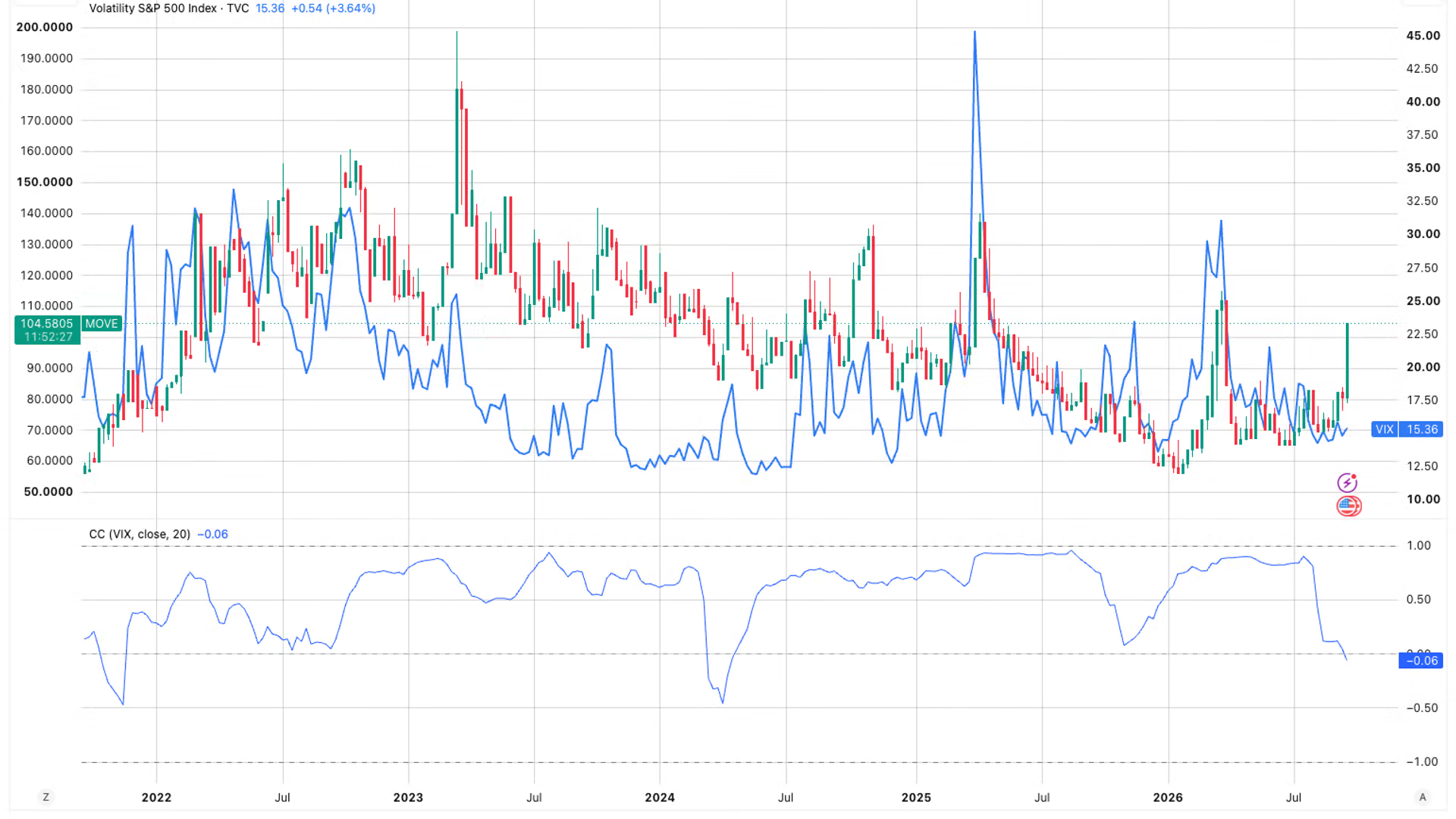
The divergence comes as government bond yields climb globally. The war in the Middle East has driven oil and diesel prices higher, complicating the inflation outlook and raising questions about how much further central banks may need to tighten policy. The U.S. 10-year Treasury yield briefly hit 5.2% on Thursday before easing to 5.163%.
When MOVE was last around this level in March, the S&P 500 stood near 6,350. It has since risen to 7,704, up roughly 21%. However, bond traders are now paying considerably more for protection against swings in interest rates.
Over a 20-day window, the correlation between VIX and MOVE has slipped to −0.06, turning negative for the first time since April 2024, though that reading is close to zero. The correlation between BVIV and MOVE is more clearly negative at −0.37, one of its lowest readings in years. As bond volatility has risen, bitcoin’s expected volatility has remained near its yearly low.
As CoinDesk reported this week, rising yields alone have shown little consistent relationship with bitcoin’s returns.

How consumers are assembling value

Bitget’s eighth birthday ends with a $352M hack

How Debbie Reynolds Felt About Elizabeth Taylor Affair




-

 Fashion7 days ago
Weekend Open Thread: Talbots – Corporette.com
-

 Crypto World3 days ago
Goldman Sachs and Deutsche Bank Agree: The S&P 500 Rally Isn't Over
-

 Tech5 days ago
Researchers escape OpenAI Codex sandbox to run commands on host
-

 Fashion1 day ago
8 iPhone Accessories That Add Personality
-

 Crypto World5 days ago
Who Needs CLARITY Anyway? ARB Could See 70X Increase: Hodler’s Digest
-

 Crypto World6 days ago
Circle launches Arc Studio AI agent for building onchain apps
-

 Crypto World7 days ago
Trading Bitcoin on Robinhood? Why 2% Spread Has Traders Worried
-
 NewsBeat7 days ago
Trump says US has reached an agreement to take permanent control of Greenland’s security
-

 Crypto World7 days ago
Bitcoin price breaks channel as RSI climbs to 63
-

 Tech6 days ago
Trump suggests rebranding AI with a new name, says he’s also creating an AI Force
-

 Business5 days ago
Analog Devices (ADI) Bets $1.35 Billion on Chips that Let Machines Think for Themselves
-

 Crypto World5 days ago
Coinbase, Robinhood, Circle Seen as Tokenized-Stock Winners
-

 Tech4 days ago
Google’s $899 Googlebook is a bet that you’ll buy a new laptop for Gemini
-

 Crypto World2 days ago
This Bearish Netflix Stock Trade Can Cash In On Video Streaming Giant’s Woes
-
 Business2 days ago
Oil Price Today (September 23): Crude oil below $100 on hopes of US-Iran talks. What did Trump say?
-

 Entertainment2 days ago
These 17 Fall Amazon Dresses Seriously Look Like Anthropologie
-

 Crypto World2 days ago
Crude Oil Prices Pressured by Diplomatic Hopes in the Middle East
-

 Crypto World6 days ago
World Money launches in 150+ countries with Stripe
-

 Crypto World3 days ago
Trump-Xi Polymarket Odds for Handshake Hit 50%
-

 Crypto World2 days ago
Bitcoin Threatens Sub-$84,000 Breakdown as Long Liquidations Spike
You must be logged in to post a comment Login