
Crypto World
Allbirds stock rockets as shoe brand pivots to AI ‘neocloud’



Allbirds stock explodes after the struggling shoe brand announces a $50M GPU‑fueled pivot into “NewBird AI,” sells its name for $39M, and rides the AI mania wave.
Summary
- Allbirds shares spike more than 400% after announcing a $50 million AI pivot and “NewBird AI” rebrand.
- The company plans to sell its shoe brand and assets for $39 million and redeploy into GPU‑powered cloud infrastructure.
- The move underscores how investors are rewarding legacy consumer brands that bolt on AI narratives, despite weak fundamentals.
Allbirds shares went vertical on Tuesday after the San Francisco‑based shoe maker said it would pivot into AI compute, rebrand as “NewBird AI” and raise $50 million in convertible financing to buy GPUs, sending the stock from $2.49 to an intraday high of $24.31 before closing at $13.59, up roughly 446% on the day. The move comes just weeks after Allbirds agreed to sell its brand and footwear assets to American Exchange Group for about $39 million, a dramatic turn for a company that once commanded a $4 billion valuation at its 2021 IPO.
According to a press release summarized by outlets like Investing.com, Allbirds has signed a definitive agreement with an unnamed institutional investor for a $50 million convertible financing facility, with proceeds earmarked for “high‑performance GPU assets” and a transition to GPU‑as‑a‑Service and AI‑native cloud solutions under the NewBird AI banner. The facility is expected to close in the second quarter of 2026, subject to shareholder approval at a special meeting scheduled for May 18, 2026, for stockholders of record as of April 13.
Allbirds said it plans to use the initial capital to acquire and deploy dedicated AI compute capacity and to lease that infrastructure to customers who need long‑term access to GPUs, citing “increasing GPU procurement lead times” and “historic low North American data center vacancy rates” as tailwinds for demand. The company also flagged a special dividend for shareholders of record on May 20, 2026, funded from net proceeds of the $39 million asset sale once it closes and after costs, likely in the third quarter.investing+4
On X, the pivot drew a mix of disbelief and fascination as the stock’s parabolic move was screenshotted across FinTwit. “Allbirds, the shoe brand, now says it’s an AI compute company,” Bloomberg reporter Tracy Alloway wrote, posting a chart of the intraday surge. Watcher.Guru told followers that Allbirds’ BIRD ticker had risen “over 420% after announcing shift from shoes to AI,” while The Kobeissi Letter described the move as a “pivoting from shoes to AI” that sent the stock more than 200% higher early in the session.
The asset sale to American Exchange Group, which owns brands such as Aerosoles, was negotiated by a special committee of independent directors and must still be approved by Allbirds’ shareholders, with closing expected in the second quarter of 2026. Filing details show Allbirds had a market capitalization of around $20 million to $26 million before the AI announcement, negative free cash flow of roughly $58 million over the last 12 months and revenue declines of about 22%, underscoring the financial strain behind the dramatic strategy shift.
Market data providers including MarketWatch and Yahoo Finance reported that BIRD shares were up between 300% and 600% at various points during the day as trading volume exploded above 100 million shares, a staggering multiple of the recent daily average. At the same time, analysts and commentators noted that the new AI plan still hinges on shareholder approval for both the $39 million asset sale and the $50 million financing, leaving open questions about execution risk, governance and whether a struggling consumer brand can credibly reinvent itself as a cloud‑infrastructure play in one of the most capital‑intensive corners of the AI boom.

CLARITY Act gridlock is mounting on Capitol Hill as House Republicans remain split over FISA surveillance reauthorization and budget reconciliation, burning the limited legislative bandwidth that crypto’s most important bill in a generation needs before midterm politics consume the calendar entirely.
Summary
- House Republicans are divided over FISA Section 702 reauthorization, which expires April 19, with some members demanding the SAVE America Act be attached as a condition of their vote.
- Senate Republicans are deadlocked on budget reconciliation for ICE and CBP funding, adding legislative pressure at the exact moment the CLARITY Act needs Senate Banking Committee attention.
- The CLARITY Act must clear the Senate Banking Committee by late April to avoid being buried by the midterm calendar, with Senator Lummis warning this is “our last chance” until at least 2030.
CLARITY Act gridlock is not a crypto story in isolation. The backlog of Republican infighting across FISA, budget reconciliation, and Iran war powers resolutions is consuming the precise legislative oxygen that the most consequential digital asset bill in US history requires in the next two weeks. None of those fights are about crypto. All of them determine whether crypto legislation moves or dies.
The Senate returned from Easter recess this week with roughly 14 days of working time before midterm politics absorb the calendar. Senate Banking Committee Chair Tim Scott has not yet announced a markup date for the CLARITY Act as of April 15.
FISA Section 702, which authorizes surveillance of foreign nationals abroad, expires April 19. Speaker Mike Johnson is pushing a clean reauthorization, but a faction of House Republicans is withholding votes unless unrelated voting reform measures including the SAVE America Act are attached. That standoff may require Democratic votes, stretching floor time and management attention that Senate leadership cannot spare.
Budget reconciliation is equally knotted. The Senate Budget Committee is drafting a second reconciliation bill to fund ICE and Border Patrol, after Senate Democrats blocked standard appropriations. Some House Republicans insist they will not consider the Senate’s partial DHS funding bill until the reconciliation piece is finalized. That back-and-forth has already consumed weeks.
The CLARITY Act Math and Why It Matters Now
Even if Tim Scott schedules a Banking Committee markup this week, the bill still faces five sequential steps: a committee vote, a full Senate floor vote requiring 60 votes, reconciliation between the Banking and Agriculture Committee versions, reconciliation with the House-passed version, and a presidential signature. Paradigm’s Justin Slaughter has stated Senate floor procedures alone require two to three weeks.
If the bill clears Banking by late April, the arithmetic gets tight. If it misses that window, the Senate schedule goes dark from August 10, then again from October 5 through the November 3 midterms. A House flip in November could kill the CLARITY Act’s prospects until the end of the decade, as TD Cowen analysts and Senator Lummis have both warned.
What Is at Stake for Digital Assets
The CLARITY Act would resolve the SEC-CFTC jurisdictional ambiguity that has kept institutional crypto infrastructure in regulatory limbo. JPMorgan analysts have called midyear passage a positive catalyst for digital assets. Polymarket currently prices passage odds at 55%. That number gets less favorable with every legislative day that FISA and reconciliation absorb before Tim Scott announces a date.
“This is our last chance to pass the Clarity Act until at least 2030,” Senator Cynthia Lummis wrote on X this month. Republican gridlock may be the thing that proves her right.
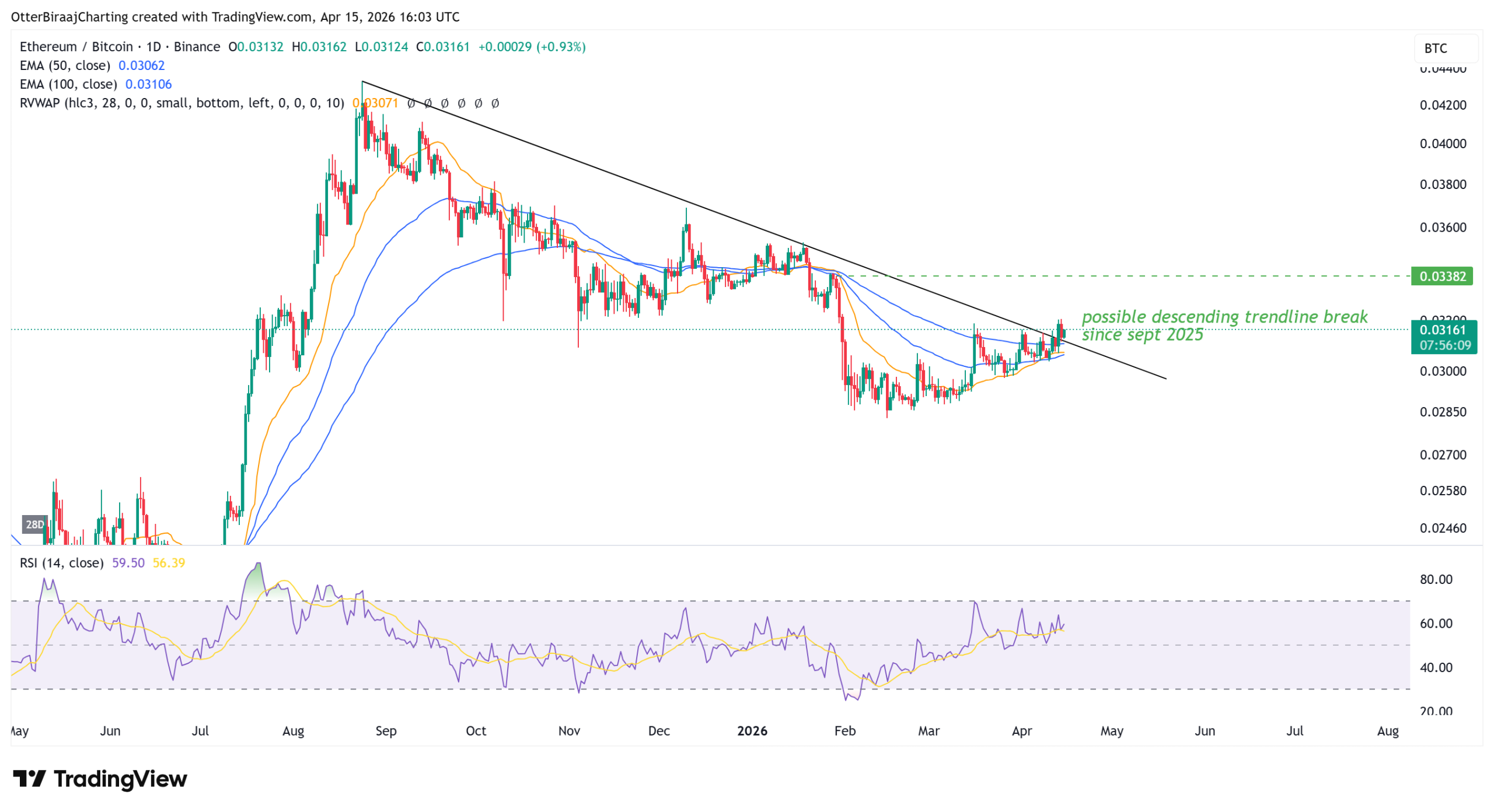
Ether looks poised to gain a price advantage over BTC as the ETH/BTC ratio soars to a 10-week high.
The ETH/BTC ratio has climbed to a 10-week high, suggesting that Ether (ETH) is gaining momentum against Bitcoin (BTC) in the charts.
Ether’s footing has improved as clearer DeFi regulations from the US Securities and Exchange Commission (SEC) were applauded by the crypto community. At the same time, Bitmine has added 71,524 ETH to its Ether treasury on April 13.
The ETH/BTC ratio broke through a descending trendline resistance that had been in place since August 2025. A daily close above this trend line marks the first breakout in months.
The pair trades above the 50-day and 100-day exponential moving averages at 0.0310, both of which are now acting as dynamic support. The compression between these averages points to a possible bullish crossover if the trend continues.

XWIN Research noted that a stronger underlying shift in Ether is driven by an April 13 SEC staff statement that explained how DeFi front-ends and wallet interfaces can operate without broker-dealer registration under defined conditions, such as no custody and neutral fee structures. XWIN Research added,
“On-chain data supports this shift. Active addresses are trending upward, indicating renewed network usage. Meanwhile, the Coinbase Premium Gap is improving, suggesting a recovery in U.S.-driven demand, often linked to institutional flows.”
As the ETH/BTC pair shows strength, corporate-level accumulation continues to accelerate. Bitmine now holds 4.87 million ETH, accounting for over 4% of the circulating supply, after adding 279,296 ETH over the past 30-days.
Related: Tom Lee says ‘mini crypto winter’ is over, sees Ether above $60K
Will an Ether bull market resume?
Crypto analyst GugaOnChain noted a sharp divide in ETH futures positioning. The global open interest reached $16.37 billion on April 14, sitting well above its 14-day average. Funding rates across exchanges remain negative at -0.0013%, indicating a short positioning against the rally.
However, open interest climbed to $6.04 billion, a 10.47% daily increase on Binance. Funding rates on the exchange turned positive at 0.015%, signaling rising long positioning.
This creates a split between global shorts and Binance-based longs. The analyst added,
“We face an extreme imbalance. With 40% of global ETH Open Interest on Binance, the fuel for a violent move is ready.”

Related: Ether holders back in profit as ETH price aims for rally to $3K
This article is produced in accordance with Cointelegraph’s Editorial Policy and is intended for informational purposes only. It does not constitute investment advice or recommendations. All investments and trades carry risk; readers are encouraged to conduct independent research before making any decisions. Cointelegraph makes no guarantees regarding the accuracy or completeness of the information presented, including forward-looking statements, and will not be liable for any loss or damage arising from reliance on this content.
MicroStrategy Executive Chairman Michael Saylor said the firm generated 17,585 BTC Gain during the first two weeks of April, a figure he valued at roughly $1.3 billion.
The announcement places quarter-to-date BTC Yield at 2.3% and year-to-date yield at 5.6%, or 37,339 BTC worth approximately $2.8 billion.
What BTC Gain Actually Measures
BTC Gain is a proprietary, non-GAAP metric that tracks the net increase in Bitcoin per diluted share. It factors in new purchases minus the dilutive effect of issuing equity to fund those buys.
Saylor called it “the closest analog to Net Income on the Bitcoin Standard.”
Follow us on X to get the latest news as it happens
That framing omits significant context. Under GAAP fair-value accounting, MicroStrategy reported a $14.46 billion unrealized loss on its Bitcoin holdings for Q1 2026 and missed analyst estimates by a wide margin.
How the Gain Was Generated
Strategy acquired roughly 18,798 BTC in the first two weeks of April through at-the-market common stock sales and its STRC preferred share program.
The lower BTC Gain figure of 17,585 reflects the dilution adjustment after new shares entered circulation.
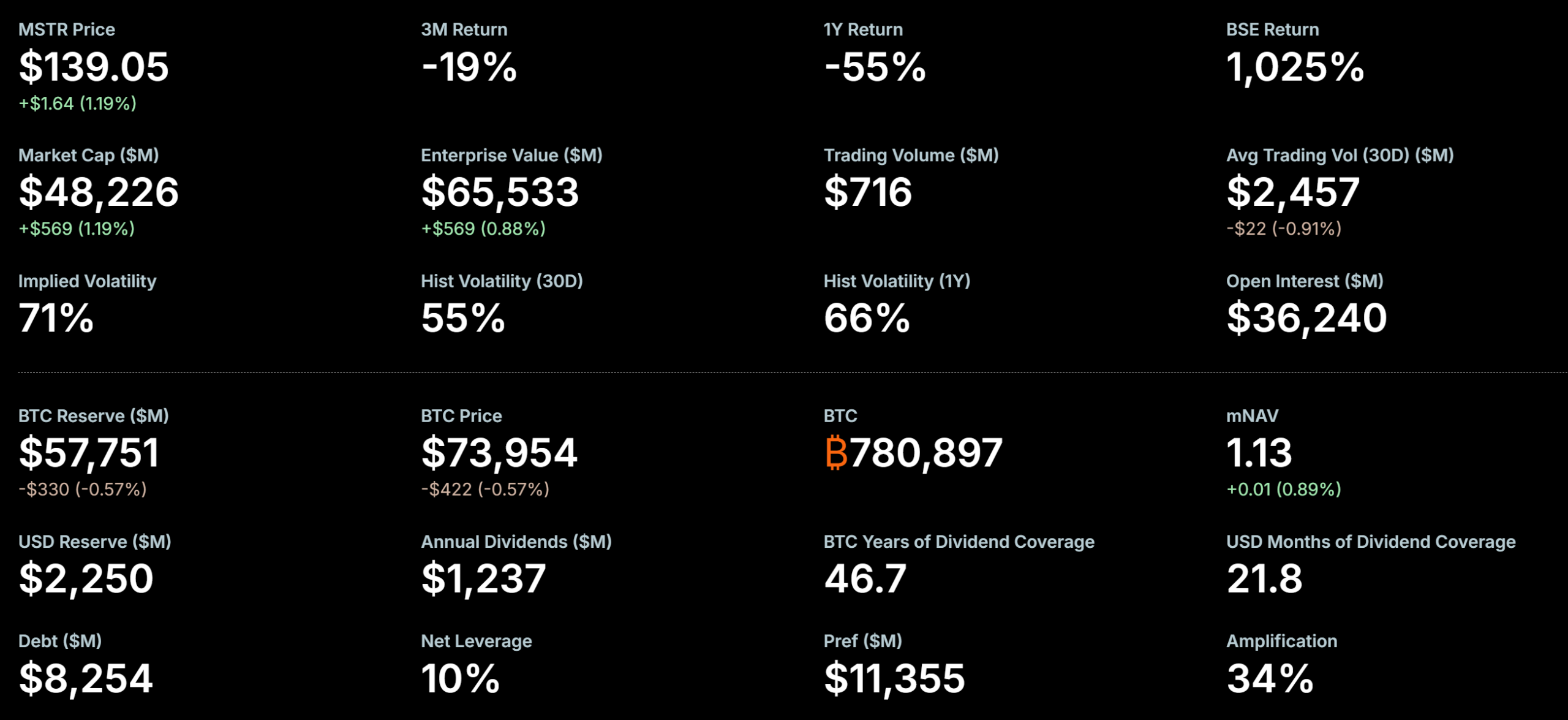
Total holdings now sit at approximately 780,897 BTC, purchased for $59 billion at an average cost of roughly $75,580 per coin.
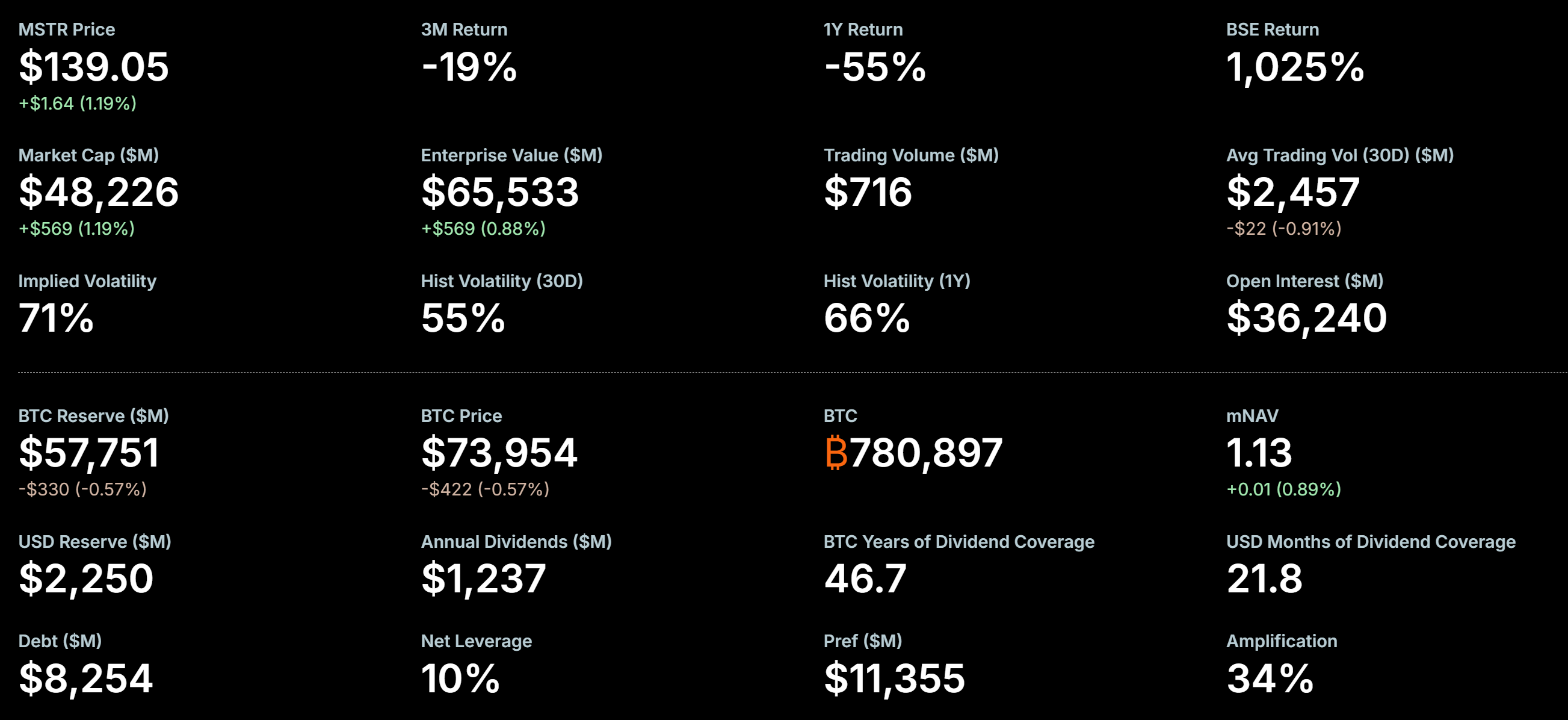
With BTC trading near $73,954, the portfolio remains slightly underwater on a cost-basis measure. Positive BTC Yield does not guarantee positive returns for shareholders.
It measures Bitcoin accumulation efficiency, not cash flow, earnings quality, or the rising dividend obligations on preferred stock.
Whether the market continues to reward that trade depends on sustained capital market access and BTC price appreciation.
Meanwhile, MicroStrategy co-CEO Phong Le, says that STRC, the firm’s perpetual preferred stock, has seen its liquidity double every month.
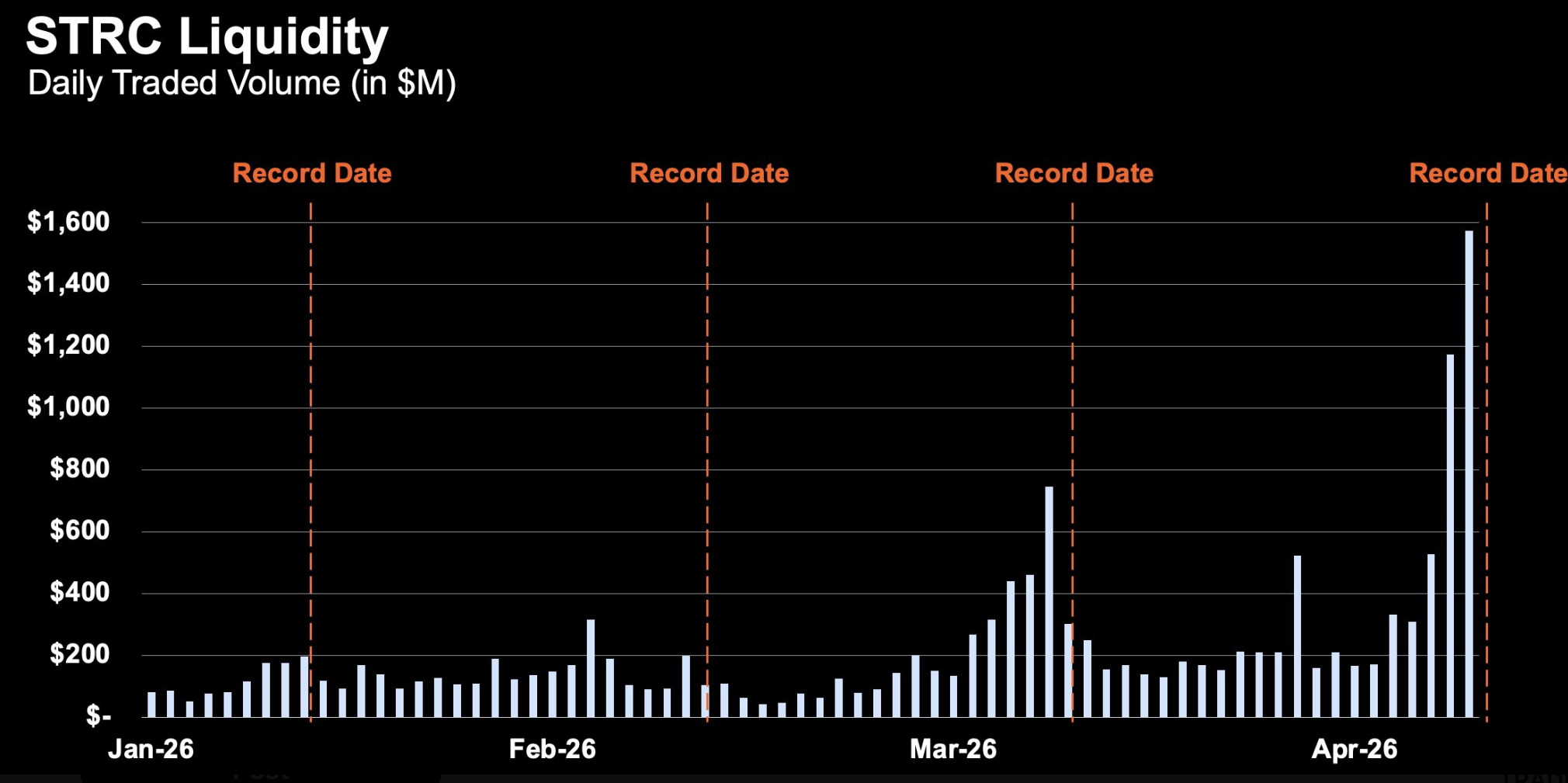
“Record date dynamics are interesting,” he stated.
The surging liquidity and retail interest in this yield-focused Bitcoin exposure vehicle. However, it is worth noting that STRC holders will never capture a Bitcoin moonshot as the price is engineered to stay near $100.
The post MicroStrategy Reports $1.3 Billion ‘Bitcoin Gain’ in April, But is It Actual Profit? appeared first on BeInCrypto.
Key points:
-
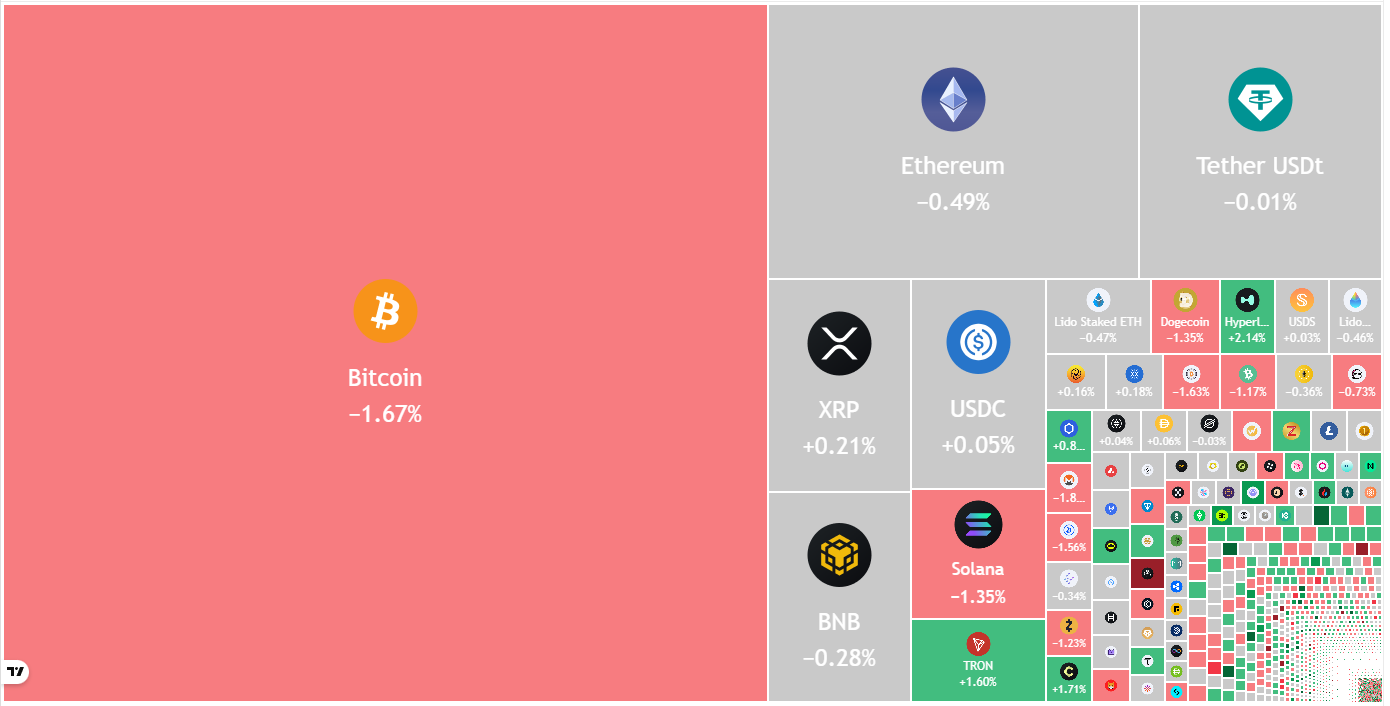
Bitcoin’s shallow pullback from the $76,000 resistance suggests that buyers are holding onto their positions, expecting the recovery to continue.
-
Select major altcoins are showing strength and are expected to break above their overhead resistance levels.
Bitcoin (BTC) pulled back after crossing the $76,000 level on Tuesday, but a positive sign is that bulls have not let the price dip below $73,500. That suggests the bulls are holding their positions as they expect the overhead resistance to be broken.
Another encouraging indication for the bulls is that BTC’s move toward $76,000 has been supported by $411.5 million in inflows into US spot BTC exchange-traded funds on Tuesday, according to SoSoValue data. That pushes the total net flows for 2026 into the positive territory at roughly $245 million.

While some analysts believe the bottom has been reached at $60,000, others remain skeptical. They anticipate BTC to collapse below $60,000 to as low as $50,000 before finally bottoming out.
Trend reversals could be tricky, but traders should be nimble when they spot one. Maintaining a negative view when the charts are screaming bullish is a recipe for disaster.
Could BTC and select major altcoins break above their overhead resistance levels? Let’s analyze the charts of the top 10 cryptocurrencies to find out.
Bitcoin price prediction
BTC turned up from the 20-day exponential moving average ($71,116) on Monday and reached the $76,000 resistance on Tuesday.

Sellers are expected to protect the $76,000 level with all their might, as a close above it will complete a bullish ascending triangle pattern. That clears the path for a rally to the $84,000 level.
Conversely, any pullback is expected to find support at the 20-day EMA. If the BTC price rebounds off the 20-day EMA with force, it suggests a positive sentiment. That enhances the prospects of a break above the $76,000 resistance. Sellers will be back in control on a close below the support line of the triangle.
Ether price prediction
Ether (ETH) is facing resistance at $2,415, but a positive sign is that the bulls have not ceded much ground to the bears.

The prospects of a break above the $2,415 level increase if the ETH price turns up from the current level or the 20-day EMA ($2,198). The ETH/USDT pair may then surge to $2,800 and then to $3,050.
Sellers have an uphill task ahead of them. They will have to quickly pull the price below the moving averages to weaken the bullish momentum. The pair may then decline to the $1,916 support.
XRP price prediction
Buyers are struggling to drive XRP (XRP) above the 50-day simple moving average ($1.37), indicating that the bears are active at higher levels.

If the price turns down and dips below the 20-day EMA ($1.35), it may signal that the XRP/USDT pair consolidates between the 50-day SMA and $1.27 support for a few days. A break and close below the $1.27 level tilts the advantage in favor of the bears.
Contrarily, a close above the 50-day SMA signals the start of a sustained recovery toward the downtrend line of the descending channel pattern. Buyers will be back in the driver’s seat on a close above the downtrend line.
BNB price prediction
BNB (BNB) reached the 50-day SMA ($626) on Tuesday, where the bears are posing a strong challenge.

If bulls do not give up much ground from the current level, the possibility of a break above the 50-day SMA increases. The BNB/USDT pair may then rally to the $687 overhead resistance. Buyers will have to overcome the $687 barrier to clear the path for a rally to $730, then to $790.
On the downside, a close below the $570 support signals that the bears have seized control. The pair may then start the next leg of the downtrend toward $500.
Solana price prediction
Solana’s (SOL) failure to rise above the 50-day SMA ($85) suggests that the bears are fiercely guarding the level.

The flattish moving averages and the relative strength index (RSI) near the midpoint do not provide a clear advantage to either the bulls or the bears. That suggests the SOL/USDT pair may continue consolidating within the $76 to $98 range for a while.
The next trending move is expected to begin on a close above $98 or below $76. If the SOL price turns down and breaks below $76, it indicates an advantage to bears. The pair may then drop to $67. On the upside, a close above $98 opens the doors for a rally to $117.
Dogecoin price prediction
Dogecoin (DOGE) broke above the moving averages on Tuesday, but the long wick on the candlestick shows selling on rallies.

If the price dips below the moving averages, the bears will attempt to sink the DOGE/USDT pair below the $0.09 support. If they succeed, the DOGE price may resume its downtrend toward $0.08 and then $0.06.
Instead, if the price moves above the 20-day EMA ($0.09) and breaks above $0.10, it suggests the bears are losing their grip. The pair may then rally to $0.11 and eventually to $0.12.
Hyperliquid price prediction
Hyperliquid (HYPE) is witnessing a tough battle between the bulls and the bears at the breakout level of $43.76.

If the HYPE price rallies from the current level and breaks above $45.30, it suggests that the bulls have turned the $43.76 level into support. That increases the likelihood of a move to the $50 level.
Contrary to this assumption, if the price turns down and breaks below the 20-day EMA ($40), it suggests that the break above the $43.76 level may have been a bull trap. The HYPE/USDT pair may then plunge to the 50-day SMA ($36.77).
Related: Tom Lee says ‘mini crypto winter’ is over, sees Ether above $60K
Cardano price prediction
Cardano (ADA) has been swinging between the 50-day SMA ($0.26) and the $0.23 support for the past few days.

The 20-day EMA ($0.25) has started to turn down gradually, and the RSI is in the negative zone, signaling a slight edge to the bears. If the price turns down and breaks below $0.23, the ADA/USDT pair may plummet toward the support line of the descending channel pattern. There is support at $0.22, but it is likely to be broken.
Buyers will have to propel the ADA price above the downtrend line to signal a potential trend change. The pair may then climb toward $0.36.
Bitcoin Cash price prediction
Buyers attempted to push Bitcoin Cash (BCH) above the 20-day EMA ($444), but the bears held their ground.

Sellers will strive to strengthen their position by driving the BCH price below $419. If they manage to do that, the BCH/USDT pair may start a downward move toward the $375 level.
This bearish view will be negated in the short term if buyers drive the price above the moving averages. The pair may then rise to the $486 level, where the bears are again likely to pose a strong challenge.
Chainlink price prediction
Chainlink (LINK) has been trading near the moving averages for the past few days, signaling a balance between supply and demand.

The flattish moving averages and the RSI just above the midpoint suggest that the LINK/USDT pair may remain inside the $8 to $10 range for some more time.
The first sign of strength will be a break and close above the $10 resistance. That opens the doors for a rally to $10.94 and later to $11.61. Sellers are expected to defend the $11.61 level, as a close above it indicates that the bulls are back in the game. The bears will have to yank the LINK price below the $8 level to gain the upper hand.
This article does not contain investment advice or recommendations. Every investment and trading move involves risk, and readers should conduct their own research when making a decision. While we strive to provide accurate and timely information, Cointelegraph does not guarantee the accuracy, completeness, or reliability of any information in this article. This article may contain forward-looking statements that are subject to risks and uncertainties. Cointelegraph will not be liable for any loss or damage arising from your reliance on this information.

Ripple and Kyobo Life have teamed up to modernize Korean government bond settlement. The partners will test tokenized transactions through Ripple Custody in a regulated institutional setting. Kyobo is the first Tier 1 Korean insurer to take this step with Ripple. Ripple said the model could reduce settlement from two days to near real time.
Ripple and Kyobo Life Begin On-Chain Bond Settlement Work
Ripple announced the partnership in Seoul on April 15, 2026. It is Ripple’s first collaboration with a leading Korean insurance institution. The project centers on tokenized government bond settlement inside a regulated environment. Both companies released the announcement on Wednesday.
Kyobo Life is one of Korea’s largest and oldest life insurers. The company will use Ripple Custody to hold, transfer, and settle tokenized assets. That setup replaces fragmented and manual bond workflows with transparent on-chain execution. The work will start with custody-led settlement flows.
Ripple said custody is the starting point for broader digital asset services. Those services may later include payments, liquidity, and treasury management. The company said the project offers a model for other regulated institutions. Ripple described that path as gradual and regulated.
Ripple Custody Targets Faster Trade Settlement
Government bond trades often settle two business days after execution. Ripple said on-chain settlement can move that timeline closer to real time. Faster settlement can lower counterparty risk and free up capital sooner. That could improve balance sheet use for institutions.
Ripple Custody is built for banks and other regulated financial firms. The platform supports secure movement, record keeping, and settlement activity. It also gives institutions one system for custody and transaction processing. The platform combines custody with settlement support.
Fiona Murray, Ripple’s managing director for Asia Pacific, described Korea as a key market. She said, “It is available, proven, and ready to deploy in Korea today.” She added that Ripple sees a long-term role in Korea. Ripple said the company views this work as part of a broader market effort.
Kyobo Reviews Wider Payment and Market Use
The partners will also review stablecoin-based payment rails for institutional use. Those rails could support round-the-clock transactions within a compliant framework. The firms will also assess technical and regulatory feasibility in Korea. That review covers technology needs and compliance checks.
Jin Ho Park, a senior executive vice president at Kyobo Life, explained the aim. He said, “This is about validating how traditional financial instruments can operate securely on blockchain.” Kyobo linked the work to its wider digital transformation plans. Kyobo said the effort goes beyond digital asset storage.
Ripple said the deal adds to its growth in Korea. The company noted that Korea began licensing remittance payment providers in 2017. The partnership shows how insurers can test digital asset infrastructure inside regulated markets. Ripple also said its Korean business activity has been growing.
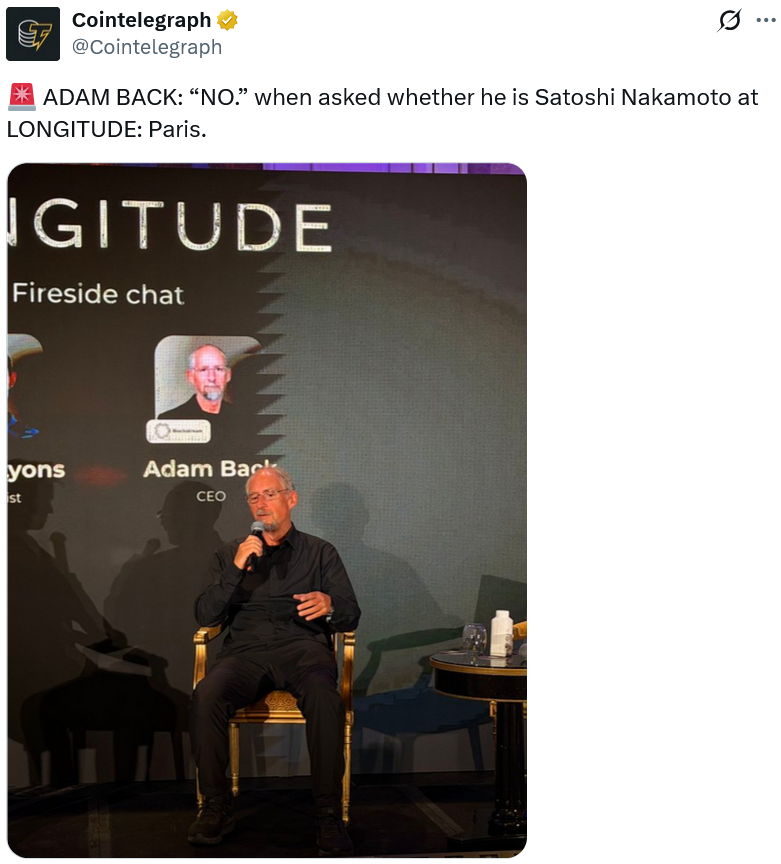
Blockstream CEO Adam Back, an early pioneer of the crypto movement, said Bitcoiners should be looking at building quantum-resistant solutions now, even if the threat is still decades away.
“Quantum computing still has a lot to prove. Current systems are essentially lab experiments. I’ve followed the field for over 25 years, and progress has been incremental,” Back said at Paris Blockchain Week on Tuesday.
“That said, Bitcoin should prepare,” Back said, adding that the “safest approach” is to build optional upgrades that allow migration to quantum-resistant cryptography if needed.
Concerns that quantum computers could eventually break blockchain cryptography have fueled industry-wide fear that bad actors could use it to break into crypto wallets, plunging the market into chaos.

Back said in November that the quantum threat is still 20 to 40 years away, while explaining to Bloomberg earlier this month that today’s quantum computers are slower than calculators.
Despite this, his Bitcoin development company, Blockstream, has a dedicated quantum team researching potential threat vectors to the Bitcoin network.
Part of that work has involved implementing hash-based signatures on Blockstream’s Bitcoin layer-2 Liquid Network, Back said at Paris Blockchain Week.
“Preparation is key. Making changes in a controlled way is far safer than reacting in a crisis.”
He added that the Taproot protocol could also support alternative signature schemes on the Bitcoin network without affecting current users.
Quantum computing threat may be closer than it appears
Last month, Google and California Institute of Technology researchers said functional quantum computers could come sooner than expected and that far less computing power is needed to break cryptography than previously thought.
Google went as far as to say that quantum computers could potentially break Bitcoin’s cryptography as quickly as nine minutes, allowing hackers to perform an “on-spend” attack.
Asked what would happen if the quantum threat arrives sooner than anticipated, Back said Bitcoin developers would “act quickly.”
“We’ve seen that before — bugs have been identified and fixed within hours. When something becomes urgent, it focuses attention and drives consensus.”
Quantum proposal to freeze old Bitcoin met with backlash
On Tuesday, Bitcoin developer Jameson Lopp and five other crypto security researchers introduced a proposal to freeze quantum-vulnerable Bitcoin — including Satoshi Nakamoto’s $81.9 billion stash — to prevent them from being stolen once quantum computers become functional.
Related: Bitcoiners propose freezing quantum-vulnerable coins in BIP-361
The proposal drew sharp criticism from several members of the Bitcoin community, including developer and researcher Mark Erhardt, who described it as “authoritarian and confiscatory.”
Phil Geiger, head of business development at Metaplanet, said: “We have to steal people’s money to prevent their money from being stolen.”
Magazine: Bitcoin will not hit $1M by 2030, says veteran trader Peter Brandt
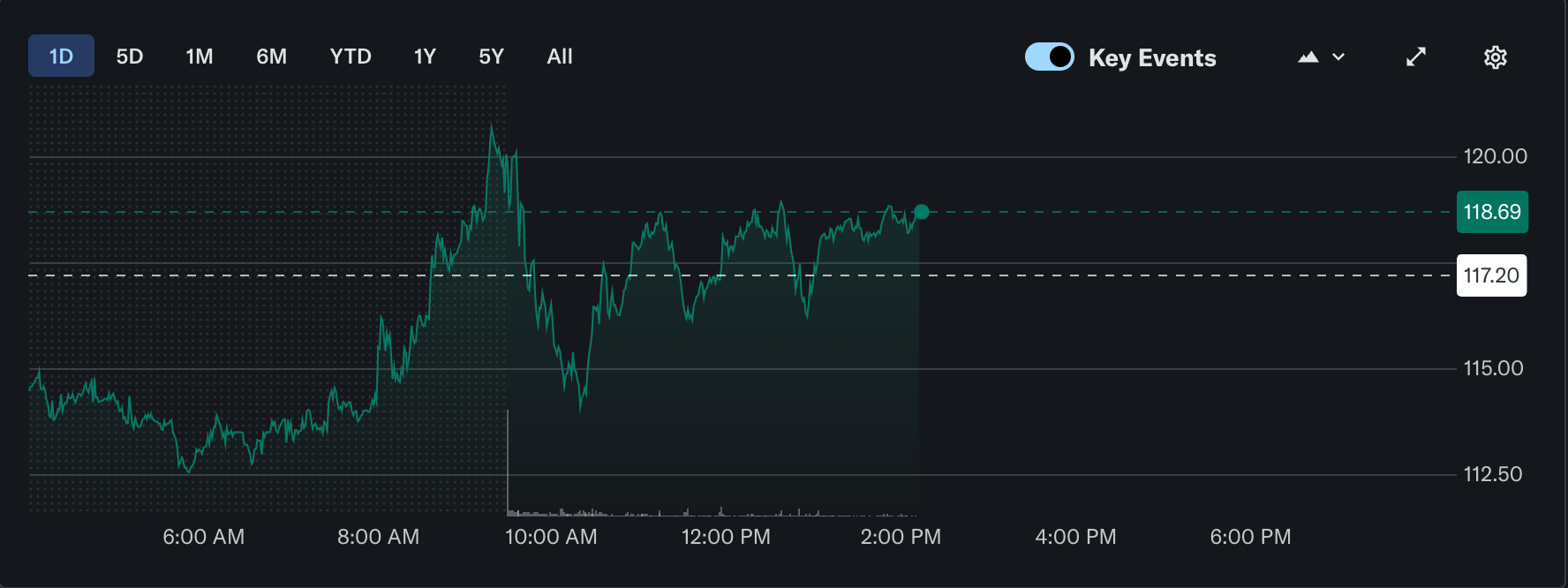
CoreWeave, a publicly traded AI cloud infrastructure company, announced on Wednesday a $6 billion deal with quantitative trading firm Jane Street, in which the firm will use CoreWeave’s AI cloud computing infrastructure to power its trading and research operations.
Under the agreement, CoreWeave will provide Jane Street with compute from multiple data center facilities, the company’s announcement said.
Jane Street also purchased $1 billion in CoreWeave Class A Common stock at $109 per share, according to CoreWeave.
Shares of CoreWeave (CRWV) rose by 1.5% on Wednesday, climbing to about $119.04 at the time of publication, according to data from Yahoo Finance.

The deal comes about one week after CoreWeave announced an agreement with Anthropic, in which the AI developer would use CoreWeave’s compute infrastructure to power its Claude AI large language models.
CoreWeave’s pivot to AI predates the crypto mining industry’s shift by years, and highlights how miners can repurpose their infrastructure to power high-performance computing and shore up declining revenues amid a challenging economic environment.
Related: CoreWeave’s $8.5B loan shows how AI is replacing crypto mining finance
CoreWeave dominates “neocloud” computing sector
CoreWeave was founded as a crypto mining company called Atlantic Crypto, in 2017, before beginning a pivot to AI cloud computing infrastructure in 2019.
The company’s shift to AI infrastructure years ahead of the crypto mining industry’s rush into the sector helped establish CoreWeave as a leading “neocloud” company, according to analysts from asset management and investment research company Bernstein.

“Neocloud” service providers are cloud computing companies built around graphics processing units (GPUs), which power artificial intelligence workloads.
Traditional cloud service providers power their operations with basic computer processing units (CPUs) suitable for running websites, Web2 platforms, video games, media streaming and applications.
The analysts compared CoreWeave with IREN and Nebius, and concluded that “relative to its neocloud peers, CRWV has by far the strongest commercial machine.”
CoreWeave benefits from a mix of contractual agreements and on-demand revenue-generating activities, while also commanding a diverse customer base, Bernstein said.
“Nine of the leading 10 AI model providers now leverage CoreWeave’s platform,” spokespeople for CoreWeave said following the Anthropic deal in April.
Magazine: Would Bitcoin really be at $200K if not for Jane Street? Trade Secrets


CEO Tarek Mansour said in an interview that Kalshi would prevent kids from using a parent’s ID to skirt its age restrictions by launching a parent portal and AI verification.
Kalshi co-founder and CEO Tarek Mansour reportedly announced a new strategy for the prediction markets platform to crack down on minors illegally using its services.
According to a Wednesday Semafor report, Mansour said that Kalshi was launching a “portal for parents” to submit their identification to check whether their children were using the platforms under their names. There have been incidents in which minors have been able to bypass Kalshi’s age requirements — a US-based user must be 18 years old — by using one of their parent’s IDs for verification.
“We are also adding selfies to accounts, where you can basically look at the face of a person, and it can tell you obviously if this person is not the actual parent that’s 50 years old,” said Mansour, according to Semafor.
The CEO’s comments came as prediction market platforms come under scrutiny in the US, both by state-level gaming authorities for the companies’ event contracts related to sports and at the federal level for controversial bets on military actions.
Crypto exchanges have also been challenging Kalshi’s dominance in the market, with Binance integrating prediction market features in its wallet app last week, followed by Crypto.com partnering with High Roller Technologies in a similar move.
Related: Polymarket bets removed from Google News after brief appearance: Report
Central to Kalshi’s arguments in court is the claim that the company is under the exclusive jurisdiction of the federal commodities regulator, the US Commodity Futures Trading Commission (CFTC). Michael Selig, who chairs the CFTC, has backed this position in an amicus brief in support of Crypto.com in its dispute with the Nevada Gaming Control Board.
Court battles continue over sports and election event contracts
As of Wednesday, many of the cases against Kalshi were ongoing at the state level.
A federal judge in Arizona blocked state officials from enforcing the state’s gambling laws as applied to Kalshi’s event contracts last week. The decision followed a similar outcome in New Jersey, where a federal appellate court sided with the company’s argument claiming that the Commodity Exchange Act — under the CFTC — preempted the state’s law on sports gambling.
Magazine: Should users be allowed to bet on war and death in prediction markets?


Day one at Paris Blockchain Week turns into an institutional scouting mission for privacy, composability and gold‑backed tokenization plays in the heart of Paris.
Summary
- Early conversations at Paris Blockchain Week 2026 are converging on institutional needs for privacy and composability, according to builders on the ground.
- Canton Network and iExec are drawing attention as examples of how to square confidential data with interoperable on‑chain workflows for banks and asset managers.
- A gold tokenization project reportedly backed by JPMorgan is adding real‑world asset “weight” to a program already framed as “where institutions and digital assets finally meet.”
Day one of Paris Blockchain Week 2026 is underscoring a simple message from the buy‑side: if blockchains want serious institutional flows, they must solve privacy and composability at the same time. In a recap post after the first day, investor and commentator Tokenoya wrote that “institutions are converging on one thing: privacy + composability is the real bottleneck,” name‑checking custody platform dfnsHQ and permissioned ledger project Canton Network as emblematic of that shift.
Institutional Paris turns to privacy and composability
Held at the Carrousel du Louvre on April 15‑16 under the banner “Where Institutions and Digital Assets Finally Meet,” Paris Blockchain Week’s 7th edition has drawn more than 10,000 decision‑makers from banks, asset managers, regulators and Web3 infrastructure teams. Organizers and partners describe the focus as squarely post‑speculation, with sessions on tokenized treasuries, regulated stablecoins and cross‑border settlement rails framed as extensions of existing market structure rather than parallel casinos.
Social media threads highlight how that institutional tone is filtering into side events. At a dfnsHQ gathering, they reported that large institutions now view privacy‑preserving composability as “the real bottleneck,” a view echoed by Canton Network’s own framing of public‑chain design as a trade‑off between radical transparency and usable confidentiality. Canton describes itself as a “network of networks” that lets financial institutions run applications with “institutional‑grade privacy” while still enabling atomic swaps between, for example, a tokenized private equity fund and a digital currency, without exposing either party’s full books.
The recap also nods to a coffee meeting with iExec’s Fotshudi in Paris, with Tokenoya telling followers that “if you’re into privacy, give him a follow,” underscoring how off‑program conversations are gravitating toward confidential computing and data markets. iExec has long pitched itself as a way for enterprises to tap trusted execution environments and privacy‑preserving compute, a theme that fits neatly with European regulators’ insistence on data protection even as banks experiment with on‑chain settlement and DeFi‑style liquidity pools.
Perhaps the most eye‑catching detail in the post is a “meeting with a gold tokenization project backed by JP Morgan,” a reminder that real‑world asset pilots are no longer confined to crypto‑native players. Paris Blockchain Week’s own marketing leans heavily on tokenization “at scale,” pointing to experiments in digitizing U.S. Treasuries, sovereign bonds and private credit, and several speakers have suggested that tokenized commodities and collateral will be the next wave once legal and custody issues are ironed out.
Coverage from French outlets such as Journal du Coin has framed the 2026 edition as the moment “la finance traditionnelle bascule,” with tokenization and digital euros forcing incumbents to rethink plumbing, capital efficiency and risk controls rather than just issuing press releases. Global Digital Finance, a policy group whose members include major banks and crypto firms, similarly describes this year’s conference as one where “the focus is no longer speculative,” but on how blockchain “is beginning to play inside large financial institutions” under MiCA and other regulatory regimes.


President Trump disclosed Wednesday that he and Chinese President Xi Jinping exchanged letters over China’s alleged weapons transfers to Iran, with Xi denying the claim in writing and Trump calling it a positive step ahead of their May summit.
Summary
- Trump revealed on Fox Business that he wrote Xi asking him not to supply Iran with weapons, and Xi responded saying China was not doing that.
- Trump posted on Truth Social that China had “agreed not to send weapons to Iran” and predicted Xi would give him a “big, fat, hug” at their planned meeting in Beijing next month.
- Any genuine easing of US-China tensions alongside Iran diplomacy could reduce the oil-driven pressure that has weighed on Bitcoin since February.
President Trump told Fox Business Wednesday morning that Chinese President Xi Jinping sent him a letter denying that China is supplying weapons to Iran. Trump said he initiated the exchange after US intelligence reports surfaced suggesting Beijing may have sent a shipment of missiles to Tehran. “I wrote him a letter asking him not to do that, and he wrote me a letter saying, essentially, he’s not doing that,” Trump said.
In a follow-up Truth Social post, Trump wrote that China had “agreed not to send weapons to Iran” and said he and Xi were “working together smartly, and very well.” The post also stated that China was “very happy” the US was moving to reopen the Strait of Hormuz, through which China sources a significant portion of its energy imports.
The exchange carries diplomatic weight even without formal verification. Trump last week threatened a 50% tariff on any country supplying Iran with weapons, a warning aimed squarely at China. Xi’s written denial, whether or not it reflects Beijing’s actual behavior, gives Trump a face-saving path to de-escalate one front of the conflict without confrontation.
US intelligence has not confirmed definitive evidence that Chinese missiles have been used against American or Israeli forces. Chinese companies have, however, provided dual-use components tied to Iran’s missile and drone programs, a distinction analysts say matters significantly for what Xi’s letter does and does not commit to.
Trump and Xi are scheduled to meet in Beijing on May 14 and 15, and Trump said the Iran situation would not affect that meeting.
How China Fits Into the Iran Standoff
China is the primary buyer of Iranian crude oil and has the most to lose economically from a prolonged Strait of Hormuz closure. As the largest non-Western power with influence over Tehran, Beijing’s posture toward the conflict has been closely watched by both markets and diplomatic circles. Xi’s first public comments on the war came Tuesday, when he told Spain’s prime minister that “the international order is crumbling into disarray.”
The letter exchange suggests a backchannel is open between Washington and Beijing at a moment when the two countries are also navigating trade tensions, with tariff negotiations expected to feature prominently at next month’s summit.
What It Means for Bitcoin and Crypto Markets
Bitcoin has been acutely sensitive to every diplomatic signal in the Iran conflict. BTC rallied 5% to $74,400 on Trump comments suggesting Iran wanted to return to talks, and dropped to a session low of $70,617 when the naval blockade was announced and oil spiked to $105. Each diplomatic signal has produced an immediate repricing, amplified by the heavy short positioning that has built up over 46 consecutive days of extreme fear.
A credible path toward US-China cooperation on Iran, even without a formal ceasefire, would ease the oil-driven inflation pressure that has kept the Federal Reserve hawkish and risk assets on the back foot since February. Market analyst Sam Daodu has outlined a $75,000 to $80,000 range for BTC if new talks produce even a temporary agreement, and a path toward $100,000 by year-end if a full deal materialises.

AeroVironment: Far From A High Flier In A Dynamic Environment (NASDAQ:AVAV)

CLARITY Act Gridlock: GOP Fights Stall Crypto

Ridley Scott’s Best Sci-Fi Franchise Hit With Uncertain Update [Exclusive]


-

 Politics5 days ago
US brings back mandatory military draft registration
-
 Sports5 days ago
Man United discover Nico Schlotterbeck transfer fee as defender reaches Dortmund agreement
-

 Fashion5 days ago
Weekend Open Thread: Veronica Beard
-

 Politics6 days ago
Malcolm In The Middle OG Turned Down ‘Buckets Of Money’ To Appear In Reboot
-

 Politics3 days ago
World Cup exit makes Italy enter crisis mode
-

 Crypto World7 days ago
Canary Capital Files SEC Registration for PEPE ETF
-

 Business5 days ago
Tesla Model Y Tops China Auto Sales in March 2026 With 39,827 Registrations, Beating Cheaper EVs and Gas Cars
-

 Crypto World2 days ago
The SEC Conditionalises DeFi Platforms to Be Avoided for Broker Registration
-

 Crypto World2 days ago
SEC Signals Exemption for Crypto Interfaces From Broker Registration
-

 News Videos18 hours ago
Secure crypto trading starts with an FIU-registered
-
 NewsBeat3 days ago
Pep Guardiola and Gary Neville agree over Arsenal title problem that benefits Man City
-

 Business6 days ago
OpenAI Halts Stargate UK Data Centre Project Over Energy Costs and Copyright Row
-

 Business4 days ago
Ireland Fuel Protests Enter Day 5 as Blockades Spark Shortages and Government Prepares Support Package
-

 Politics6 days ago
LBC Presenter Mocks Trump Over Iran War Failures
-

 Crypto World5 days ago
Federal judge blocks Arizona from bringing criminal charges against Kalshi
-
 NewsBeat4 days ago
JD Vance announces ‘no agreement’ with Iran over nuclear weapons fear
-

 Crypto World2 days ago
SEC Proposes Certain Crypto Interfaces Don’t Need to Register as Brokers
-

 NewsBeat2 days ago
Trump and Pope Leo: Behind their disagreement over Iran war
-

 Tech6 days ago
A version of Windows 10 released a decade ago is now eligible for additional security patches
-

 Business5 days ago
IMF retains floor for precautionary balances at SDR 20 billion
You must be logged in to post a comment Login