

Crypto World
Analyst: Altcoins Down 80-90% Could Outperform Bitcoin


Crypto analyst Credible Crypto believes many of the beaten-down altcoins could offer better risk-reward than Bitcoin (BTC) at current prices.
According to him, projects trading 80% to 90% below their all-time highs may deliver outsized returns if the market turns.
Market Is Building a Base as Attention Moves to Altcoins
Speaking in the July 5 episode of the NinjaTrader podcast, Credible Crypto said that BTC has been in a higher time frame downtrend since hitting its $126,000 peak in October last year. However, he believes the correction is unfolding inside an important support zone rather than breaking the broader bull market.
The analyst pointed to the flagship cryptocurrency’s 2024 consolidation between $50,000 and $75,000, stating that the market has returned to an area where, in the past, buyers have accumulated. And as long as Bitcoin holds above $50,000, he expects the current range to become a base before another higher move.
He also cited on-chain data showing that nearly 80% of the BTC supply is now in the hands of long-term holders, which is the highest level on record. According to him, those investors have historically continued buying through market weakness instead of selling when prices dipped, meaning they tend to gradually absorb supply until prices recover.
That outlook has shaped the trader’s portfolio, with his capital now almost entirely allocated to altcoins after he accumulated Bitcoin from as low as $3,000 and exited his position as the asset approached the $100,000 mark. He said his reason for doing this is that, while there’s every possibility that BTC can climb from its local low near $60,000 to as high as $250,000 over time in his assessment, many altcoins have already dropped 80% to 90% from their peaks, which gives them greater potential if sentiment improves.
“At this point, I think the better bet is on altcoins that are now basically where Bitcoin was when Bitcoin was trading at $3K or $6K or even $15K,” he explained. “Many alts are now down 80 to 90% from their highs. Just as that was the best time to buy Bitcoin, I think that’s now the best time to buy alts.”
Selectivity Is Still Critical Even With the Bullish Outlook
Despite his hope for an eventual uptick in alternative crypto assets, Credible was also quick to point out that not every token deserves a recovery. In his estimation, most cryptocurrencies on the market right now don’t have any meaningful value. As such, he warned against assuming that every chart will revisit previous highs simply because their prices are down.
Instead, he advised investors to focus on projects with working products, active users, and sustainable business models.
“I’m not saying that every single altcoin in the entire market is going to have a massive run because that’s just not realistic,” he clarified. “We have now hundreds of thousands of coins in the market, and I would say 85-90% of them do absolutely nothing and should not really be existing at this point in time.”
In his opinion, the remaining 5 or 10%, even if they don’t make it back to their all-time highs, could still see returns of up to 3 or 4x their present values in a matter of weeks “when the time is right.” In contrast, for Bitcoin to multiply by the same number, which would take it to at least $250,000 from its current level, may require months, if not years.
The post Analyst: Altcoins Down 80-90% Could Outperform Bitcoin appeared first on CryptoPotato.


Disclosure: This article does not represent investment advice. The content and materials featured on this page are for educational purposes only.
EX DeFi is gaining attention as an AI-powered cloud mining platform, offering users access to BTC, DOGE, and LTC mining without owning hardware.
Summary
- EX DeFi launched a cloud mining platform with AI-powered infrastructure and free computing power for new users.
- It has expanded its cloud mining services, highlighting AI optimization, security features, and multi-asset support.
- The platform has introduced AI-driven cloud mining services for BTC, DOGE, LTC, and other major digital assets.
As we enter 2026, mainstream digital assets such as Bitcoin (BTC), Dogecoin (DOGE), and Litecoin (LTC) continue to attract widespread attention from global investors. For many newcomers to cryptocurrencies, how to participate in the digital asset market with a lower barrier to entry and explore long-term profit opportunities has become a key focus. Therefore, free cloud mining platforms are gaining popularity.

Compared to traditional mining models that rely on ASIC miners, cloud mining eliminates the need to purchase expensive equipment and incur electricity costs or complex maintenance. Users simply need to register to participate in the digital asset ecosystem through cloud computing power, starting their digital asset experience in a more convenient way.
Among numerous cloud mining platforms, EX DeFi has gradually become one of the most watched platforms in the market due to its AI-driven computing power optimization technology, automated management system, and transparent operating model. The platform offers a variety of cloud computing power products, helping users participate in the digital asset ecosystem more easily and efficiently, attracting the attention of many novice users and long-term investors.
EX DeFi – A Cloud Mining Platform to Watch in 2026
Register now and receive a $17 reward of computing power for new users!
For those new to cloud mining, EX DeFi offers a low-barrier-to-entry experience. The platform provides new users with $17 worth of free computing power, combined with AI-powered intelligent hosting and computing power optimization technology, making it easier for users to participate in cloud computing services. Whether someone is a cryptocurrency novice or someone looking to learn about long-term cloud computing models, EX DeFi makes it easy to start their digital asset journey.
EX DeFi Platform Advantages
Compliance and Transparency
Headquartered in the UK, EX DeFi is committed to providing digital asset services within a transparent and compliant operating framework, continuously improving its platform operation system to create a more reliable user experience.
Security Protection
The platform employs an offline cold wallet storage solution, combined with the McAfee® cloud security system and Cloudflare® enterprise-grade network protection, providing multi-layered protection for user accounts, assets, and data security.
Supports Multiple Mainstream Digital Assets
The platform supports multiple mainstream digital assets, including BTC, ETH, XRP, USDC, DOGE, SOL, LTC, and USDT, meeting the asset management needs of different users.
Daily Earnings Settlement
Cloud computing power earnings are settled daily according to platform rules. Users can flexibly manage their assets according to platform regulations, providing a more convenient experience for long-term participation in the digital asset ecosystem.
Green Energy Data Center
EX DeFi’s data center uses clean and renewable energy to provide stable support for cloud computing power services, while actively practicing green and sustainable development concepts.
Affiliate Program
The platform launches an affiliate program, where eligible users have the opportunity to receive rewards of up to $50,000, providing more incentives for long-term participation in the platform ecosystem.
How to Start Earning Passive Income?
1. Register
Visit the EX DeFi official website and create an account on the platform using an email address. Upon successful registration, users will receive a $17 newcomer bonus.
2. Choose a Smart Contract Plan
Choose a popular mining contract that matches a particular budget and contract term, and start automatic mining with one click.
3. After purchasing the contract,
The system will automatically contribute computing power to the mining pool, and the rewards will be automatically credited to the account within 24 hours. No action is required; the principal will be automatically returned upon contract expiration.
Popular DeFi Yield Plans
BTC (Beginner Trial Contract): Investment: $100 | Term: 2 days | Daily Yield: $4 | Total Yield: $100 + $8
DOGE (Goldshell-Mini-Doge-Pro): Investment: $500 | Term: 6 days | Daily Yield: $6.5 | Total Yield: $500 + $39
BTC (Canaan-Avalon-A1466): Investment: $1,000 | Term: 10 days | Daily Yield: $13.4 | Total Yield: $1,000 + $134
BTC (Bitmain-S19): Investment: $7,000 | Term: 25 days | Daily Yield: $107.8 | Total Yield: $7,000 + $2,695
BTC (Whats-M56) Investment Amount: $30,000 | Term: 33 days | Daily Yield: $501 | Total Earnings: $30,000 + $16,533
Click here to learn more about EX DeFi mining contract options.
Conclusion: Why EX DeFi is one of the mining platforms to watch in 2026
As the digital asset industry continues to develop, cloud computing power is gradually becoming a convenient way for more and more users to participate in the cryptocurrency ecosystem. Among many platforms, EX DeFi has attracted the attention of more and more new users with its transparent operating model, intelligent computing power management, and simplified usage process, providing users with a more relaxed digital asset participation experience.
For office workers, freelancers, and digital asset novices who want to understand the cloud mining model with a lower barrier to entry, EX DeFi provides a more convenient way to get started. Users do not need to purchase complicated hardware equipment to participate in the digital asset ecosystem through cloud computing power, and further understand and experience how to create more income using computing power.
Ready to start the cryptocurrency journey? Register for EX DeFi now and start the intelligent passive income journey.
Disclosure: This content is provided by a third party. Neither crypto.news nor the author of this article endorses any product mentioned on this page. Users should conduct their own research before taking any action related to the company.
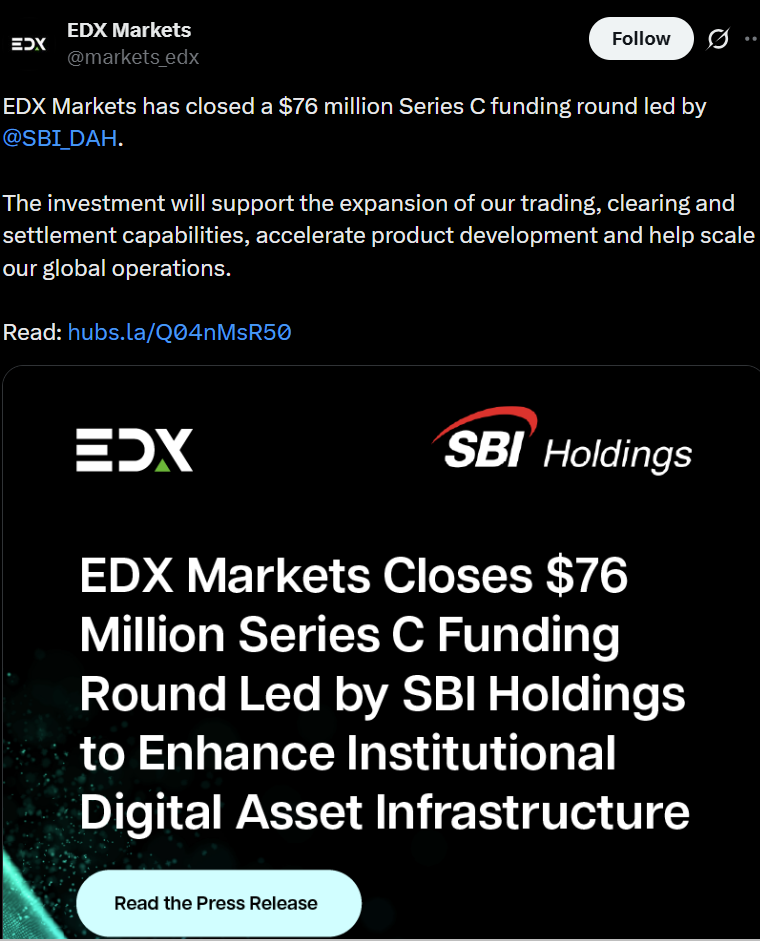
EDX Markets, a cryptocurrency exchange focused on institutional investors, has raised $76 million in a Series C funding round led by Japan’s SBI Holdings, marking one of the larger funding rounds this year for crypto market infrastructure as institutional adoption continues to expand.
The company said Monday it will use the proceeds to expand its spot trading, clearing and settlement services, develop new products and grow internationally. EDX operates a US-focused institutional spot exchange and a Singapore-based perpetual futures venue for eligible non-US institutional clients.
The latest round builds on previous backing from traditional financial companies, including Citadel Securities, Fidelity Digital Assets, Virtu Financial and Charles Schwab, highlighting continued investor appetite for institutional crypto infrastructure despite a slower venture funding market.
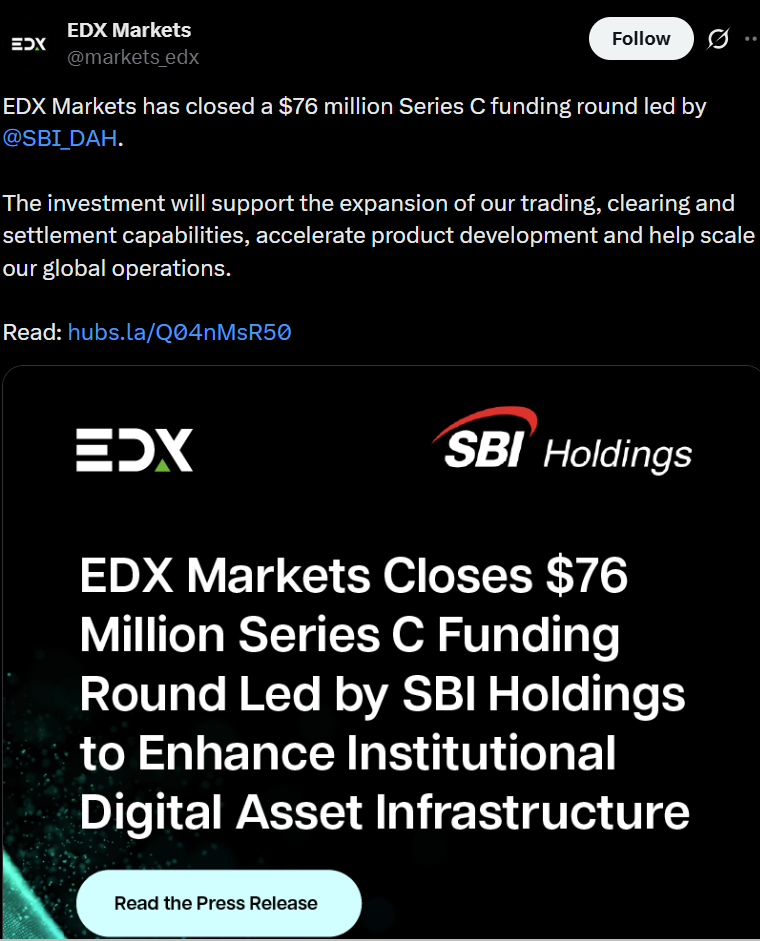
Source: EDX Markets
EDX has quietly expanded its institutional footprint over the past year. In May, Ripple Prime integrated with the exchange, allowing institutional clients to access EDX’s spot and perpetual futures liquidity through Ripple’s prime brokerage platform, with the companies also planning to support RLUSD as a settlement and collateral asset.
The exchange has processed as much as $685 million in daily trading volume, underscoring growing demand for institutional crypto trading venues.
Related: Ripple co-founder backs venture launched by US senator’s son: Report
Crypto infrastructure continues to attract capital despite bear market conditions
The latest funding round reflects continued investor interest in institutional crypto infrastructure, even as digital asset trading volumes have softened and venture funding remains below the industry’s 2021 peak.
Investors have increasingly backed companies building trading, payments and settlement infrastructure, betting that institutional adoption will continue to expand as the US regulatory environment becomes more accommodating.
San Francisco-based Framework Ventures, an early investor in several crypto startups, recently raised $400 million for a new fund targeting frontier technologies, including blockchain networks and decentralized finance, according to Fortune.
Other crypto infrastructure startups have also secured fresh capital. Fomo, a crypto trading startup focused on cross-chain trading, recently raised $75 million at a $550 million valuation. Meanwhile, Trace Finance, a startup building stablecoin-based cross-border payment and settlement infrastructure for businesses, raised $32 million to expand its platform.
Magazine: Bitcoin decouples from tech stocks, Ether eyes ‘selling wave’: Market Moves
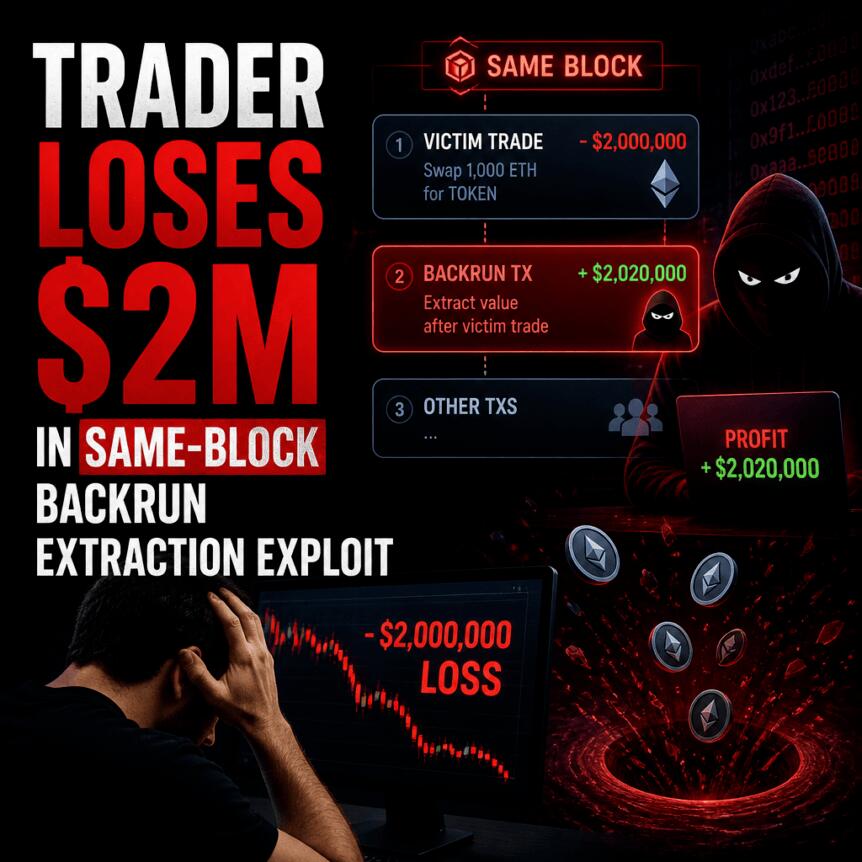
A decentralized exchange swap worth $2.01 million ended in a steep loss for one trader after a liquidity router routed the trade through a thin market, enabling an Ethereum block builder to capture profits from a same-block arbitrage. According to GoPlus Security, the order effectively turned into a “backrun extraction” rather than a fair swap outcome—one that left the victim with only about $14,500 in the resulting tokens.
The episode highlights how maximal extractable value (MEV) activity and routing mechanics can combine to produce outsized losses when trades are executed through low-liquidity pools. It also underscores a practical lesson being shared in the community: users should review the transaction route before signing DEX actions, not just confirm the trade.
Key takeaways
- A $2.01 million ETH swap on a DEX resulted in a near-total value drop, landing at roughly $14,500 after execution via a low-liquidity pool.
- GoPlus Security described the event as same-block backrun extraction, not a conventional “sandwich” attack.
- Titan Builder was identified as the largest beneficiary, receiving about $1.8 million as a builder reward from the transaction.
- The victim’s route involved routing into an AVAIL/WETH pool that executed at around 120x the later sell price, enabling an imbalance to be monetized.
- Traders are being urged to verify swap routes before confirming, since clicking through without inspecting routing can lead to irreversible execution outcomes.
A swap that was rerouted into a low-liquidity trap
GoPlus Security said the trader swapped 1,126.44 ETH on Monday at 1:59 am UTC but received only 5,776 Lighter (LIT) tokens. The security firm framed the result as a “textbook case of same-block backrun extraction,” where the trade’s execution path created an exploitable price discrepancy within the same block.
In the assessment, this was not portrayed as a classic sandwich attack. Instead, the core mechanic was that a router directed the swap through a pool with insufficient depth, allowing another actor—working with block-building capabilities—to profit from the temporary mispricing and the order’s same-block lifecycle.
The incident was publicly discussed via on-chain analysis referenced in earlier community posts, including Lookonchain, and GoPlus’s commentary identifying the nature of the extraction.
How the route imbalance drove a ~99% loss
GoPlus Security’s breakdown points to the swap’s intermediate routing. The firm said the victim’s transaction routed roughly 1,117 ETH into a low-liquidity AVAIL/WETH pool on Uniswap v3. Once executed, the swap price was reportedly around 120 times higher than what the received AVAIL tokens could later be sold for.
That pricing mismatch becomes a leverage point when a trade is executed in a way that creates a temporary window for extraction. After the trader received nearly 6.67 million AVAIL tokens at an inflated price, the router involved—identified by GoPlus as “0x router”—reportedly sold a small amount of externally sourced AVAIL back into the same pool. The purpose, according to GoPlus, was to extract approximately 1,072 WETH before paying out 1,018 ETH, worth about $1.8 million, to Titan as a builder reward.
After these internal steps, the AVAIL was swapped for LIT tokens valued at roughly $14,200. That translated to a reported 99.3% loss for the trader, based on the amounts described in GoPlus Security’s analysis.
For users, the key takeaway is that the harm didn’t come from a smart contract “hack” in the typical sense. It came from execution conditions—specifically, routing into a pool where trade size relative to liquidity could severely distort outcomes, while MEV-aware infrastructure could monetize that distortion before the victim can unwind.
Why this is more than “just a bad swap”: MEV and routing mechanics
The episode fits a broader pattern in decentralized trading: as long as block builders can influence transaction ordering and routing can route through multiple liquidity venues, the same block can contain both the victim’s swap and the counter-trade needed to extract advantage from temporary imbalances.
The article’s framing also connects the event to ongoing concerns about MEV bots and liquidity routers atop a landscape that already faces risks from scams and exploits. While the details here are specific, the implication is general—traders may believe they are placing a straightforward order, but routing behavior and transaction ordering can turn the execution into a target.
From an investor or trader perspective, this means diligence has to extend beyond token and protocol selection. Execution parameters—including route, intermediary hops, and whether a swap is likely to interact with thin liquidity—can determine whether the trade results in the expected price or in an unfavorable extraction scenario.
Community warning: read the route before you click confirm
In response to incidents like this, crypto trader Ruslan Khairullin advised that traders should read the transaction route before signing the transaction. He described the event as what happens when someone “clicked confirm faster than you read the route,” calling it a “painful lesson” after the fact.
This kind of guidance is practical because it targets the behavioral failure mode: users often focus on the expected output shown by interfaces while ignoring what the route actually does under the hood. In low-liquidity conditions, the route’s intermediate steps can matter as much as—if not more than—the end pair.
Where the mechanics are especially risky is when routing can pull a large trade into a pool with limited depth, because the price impact can be severe enough to create an exploitable imbalance. If the resulting swap path lets MEV-capable actors profit within the same block, victims may not have a straightforward opportunity to recover at a reasonable price.
Titan Builder’s role and what to watch next
GoPlus Security identified Titan Builder as the biggest beneficiary, stating it received about $1.8 million from the transaction as a builder reward. Cointelegraph reported that it reached out to Titan but did not receive an immediate response. Separately, DefiLlama data shows Titan has made $112.6 million in revenue from block building services this year.
The firm’s profitability is not limited to this case. Cointelegraph noted that Titan’s biggest day this year came in March, when it extracted around $34 million in arbitrage profit from a MEV bot incident involving the CoW Protocol.
For market participants, the immediate question is not whether these mechanics exist—they do—but how often they are triggered by routing into low-liquidity pools and whether future tooling will make route inspection easier for ordinary users. The next developments to watch are whether DEX interfaces or aggregators tighten route transparency by default and whether users get better warnings when a trade path passes through thin liquidity that could be targeted by same-block extraction.
Solana has extended its July rally after record on-chain activity, tokenized stock issuance, and steady ETF inflows revived bullish sentiment.
Summary
- Solana climbed above $81 after tokenized stock issuance and record network activity boosted buying interest.
- Technical charts show bulls defending $80 support while traders watch $83 and $90 as the next resistance levels.
- Analysts remain optimistic on long-term upside, though macro risks and liquidity could limit near-term gains.
According to data from crypto.news, Solana (SOL) extended its recovery this week, gaining roughly 11% over several sessions to trade around $81 after briefly reclaiming the $82 level. The rally accelerated as institutional adoption on the network continued to expand, led by Securitize tokenizing $295 million worth of New York Stock Exchange-listed common stock on Solana following its SPAC debut.
The development arrived alongside the launch of the Solana Foundation’s Governance Proposals framework, introducing formal on-chain validator voting and adding another utility milestone for the ecosystem.
Network activity has expanded at the same time. Solana processed more than one billion weekly non-vote transactions for the first time, while tokenized asset spot volume reached an all-time quarterly high of $5.77 billion, reinforcing the network’s growing role in real-world asset issuance.
Institutional demand also remained positive, with spot Solana ETFs recording approximately $5.75 million in net inflows even as several other crypto investment products experienced persistent capital outflows.
Technical structure has shifted back in favor of buyers
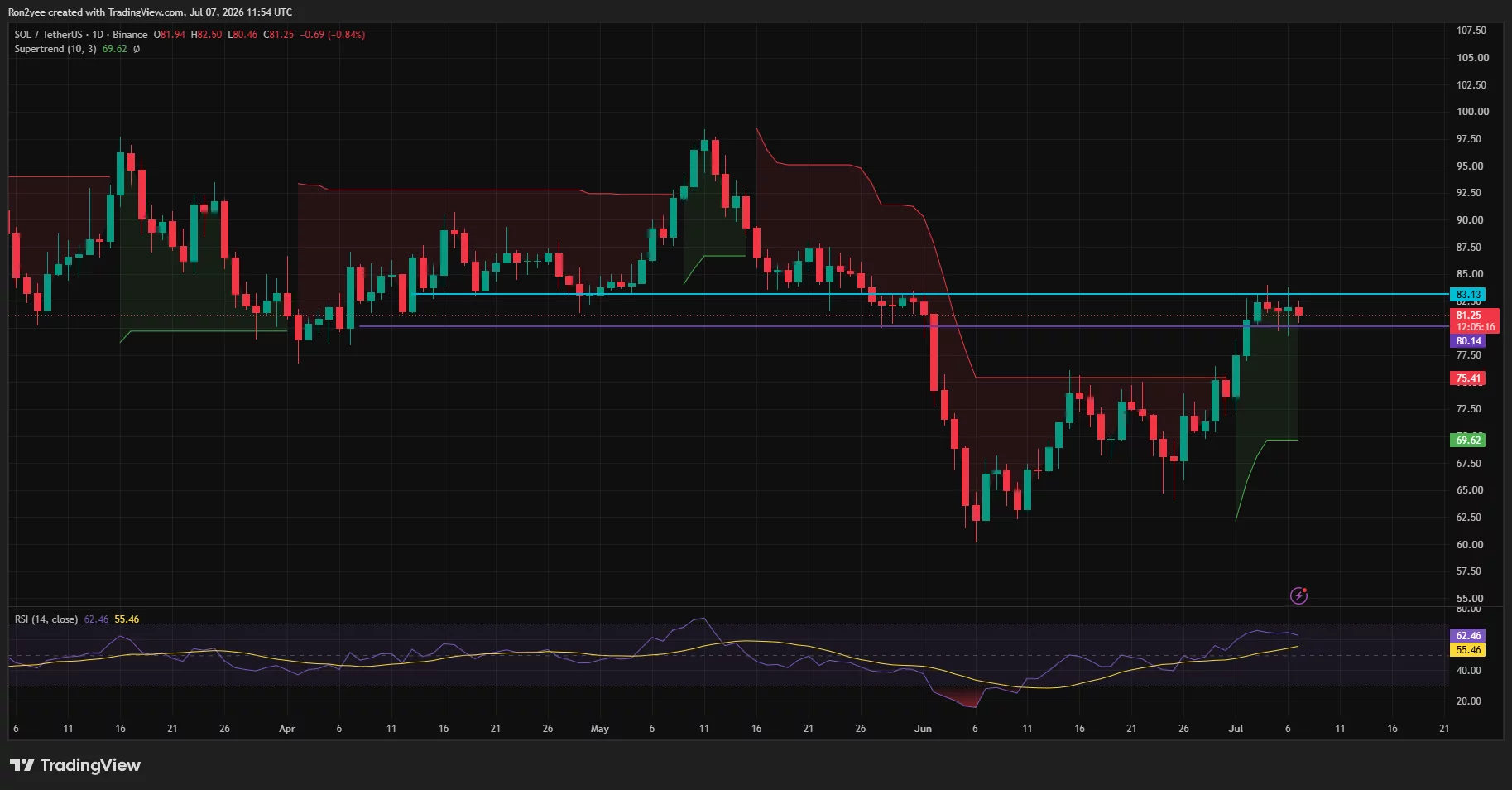
The daily chart shows Solana recovering from its June selloff after buyers defended the long-term support zone near $73, close to the 0.786 Fibonacci retracement level referenced by many traders during last month’s decline. Price has now reclaimed the previous breakdown area around $80.14 and is attempting to convert it into support while approaching horizontal resistance near $83.13.
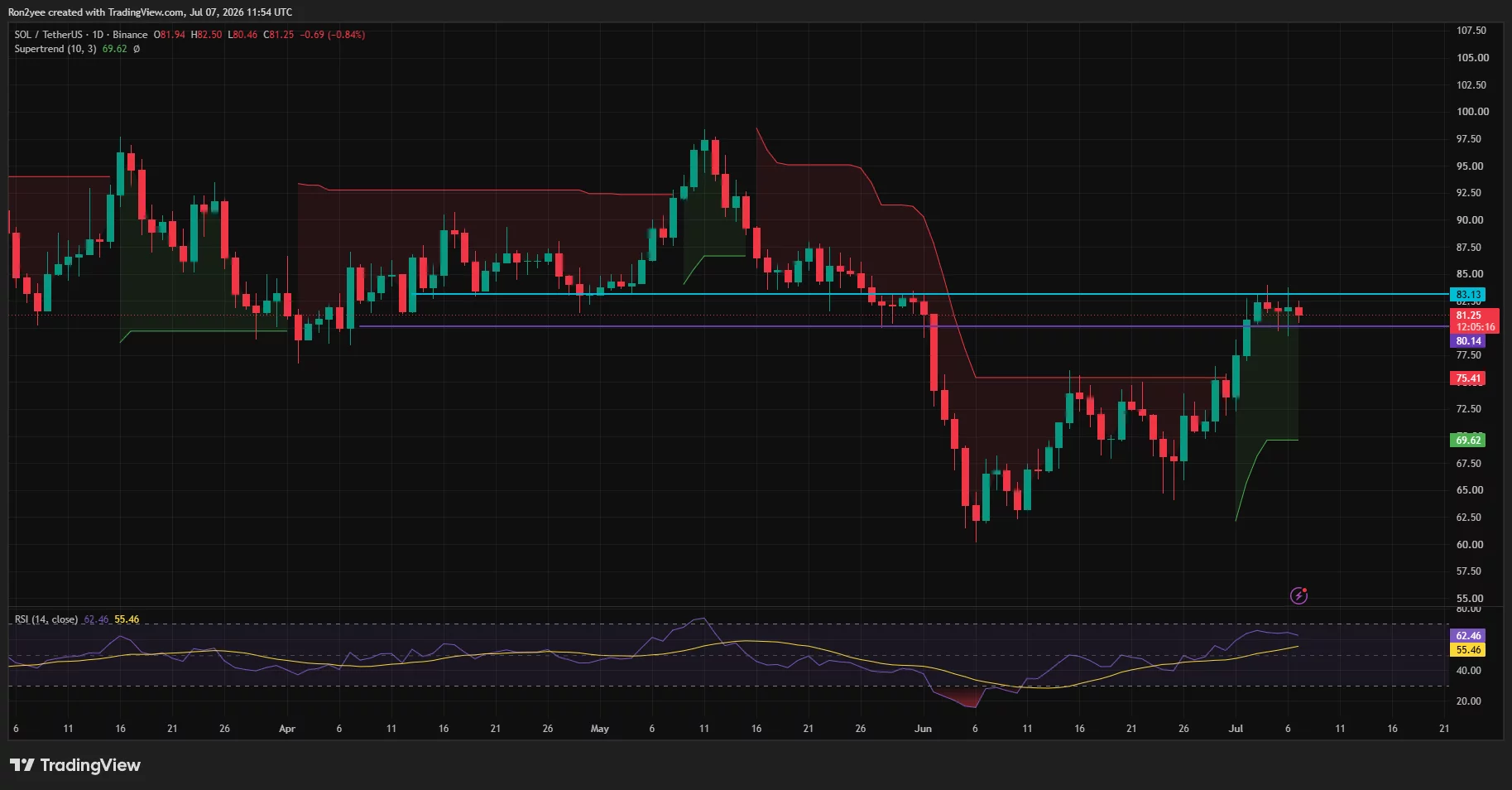
Momentum indicators have improved alongside the rebound. The daily RSI has climbed above 62 after recovering from oversold conditions in June, while the Supertrend indicator has remained bullish with dynamic support near $69.6. A successful close above $83 could expose the next resistance around $90, whereas failure to hold above $80 may invite another test of the $75.4 support region.
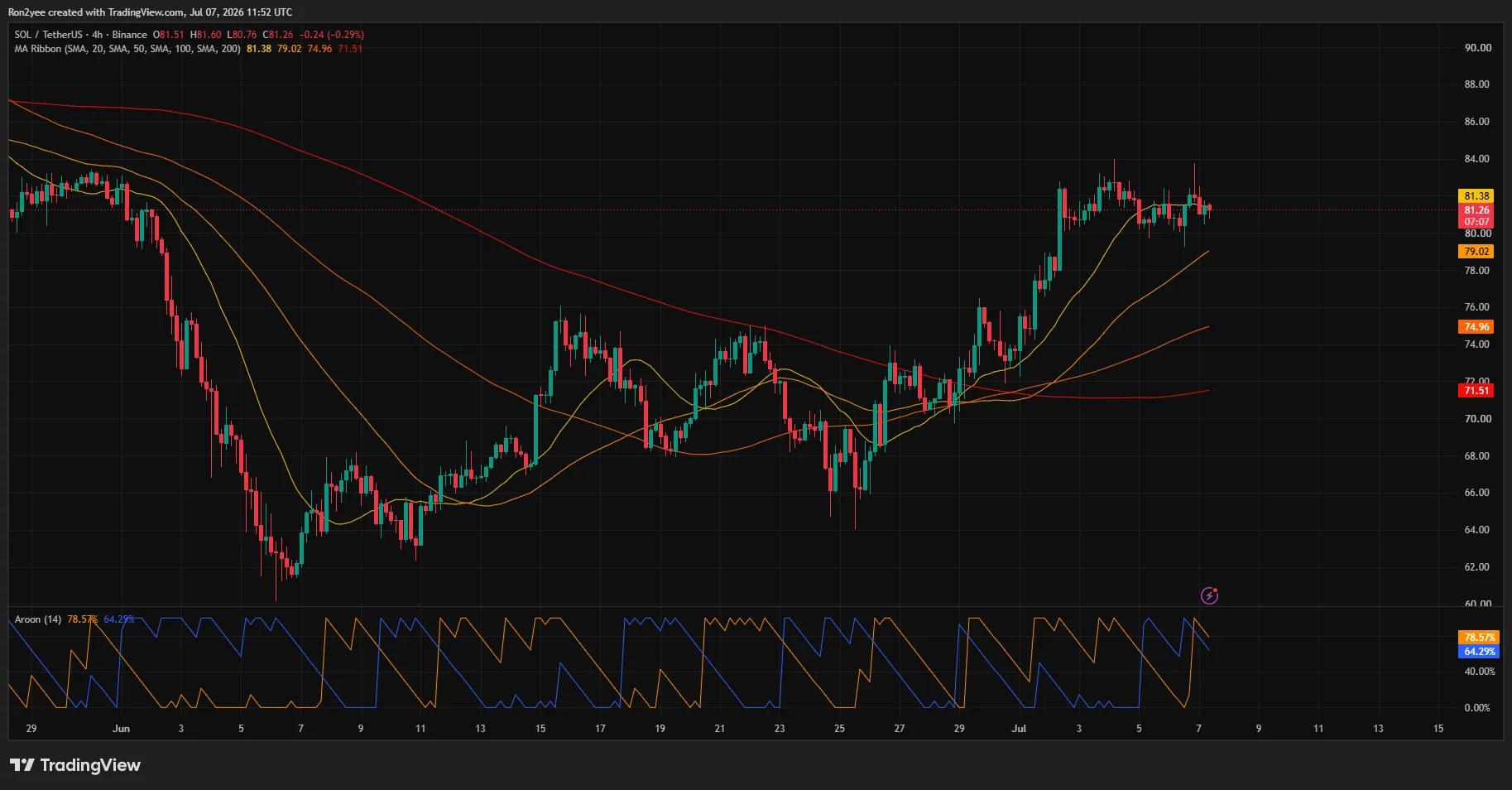
Shorter-term charts also favor bulls. On the 4-hour timeframe, SOL continues trading above its 20-, 50-, 100- and 200-period moving averages, with the 20 SMA near $81.4 providing immediate dynamic support. The moving average alignment remains constructive even as price has entered a brief consolidation after last week’s sharp advance. The Aroon indicator still favors buyers, although the slight decline in Aroon Up suggests momentum has slowed while the market waits for another catalyst.
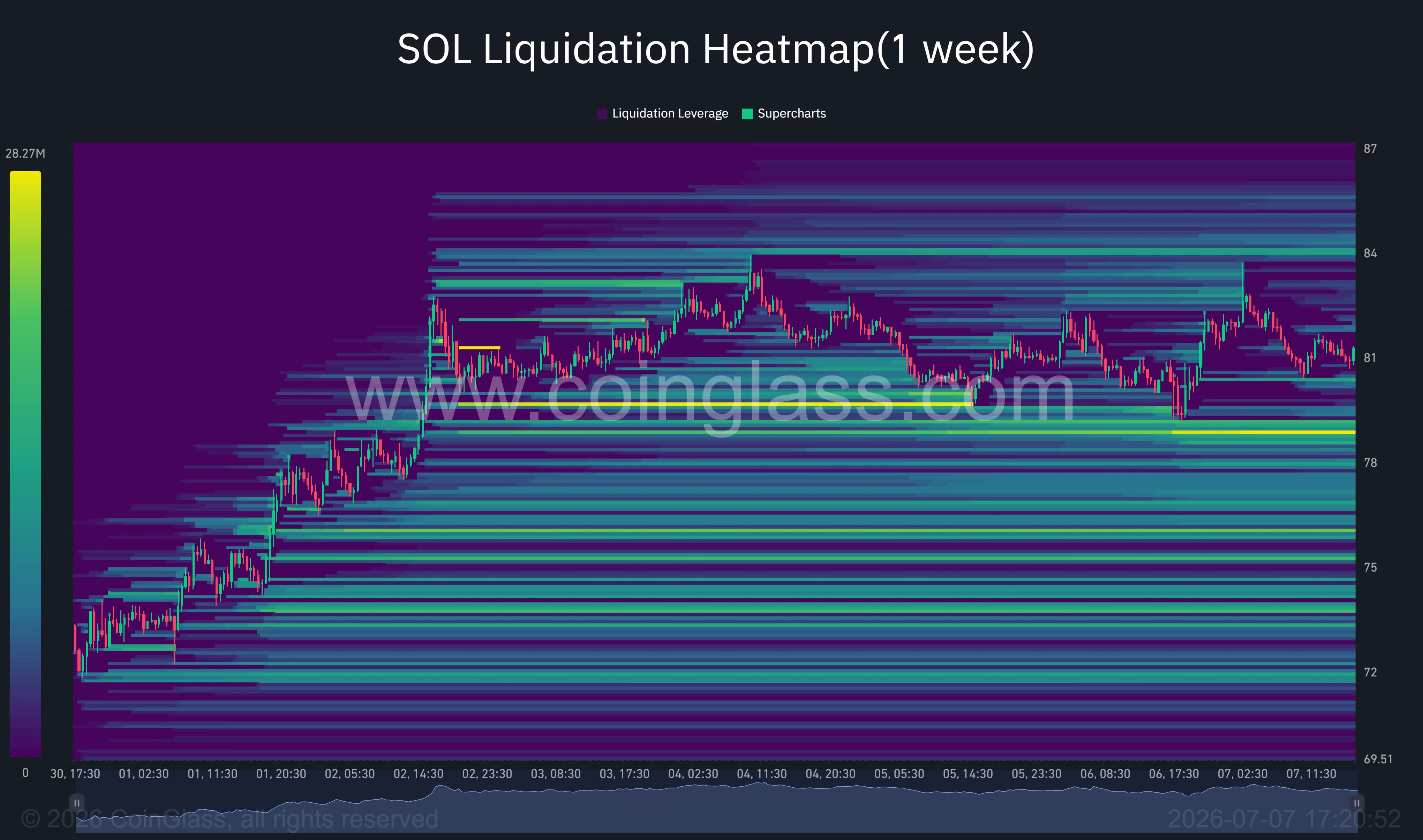
Derivatives positioning presents a similar picture. CoinGlass liquidation heatmaps show one of the largest nearby short liquidation clusters sitting around the $84 level. A decisive move through that zone could trigger forced short covering and accelerate upside toward the upper liquidity pocket near $87. On the downside, dense long liquidation levels have accumulated between $78 and $79, making that area an important support if profit-taking intensifies.
Analysts target triple-digit prices while key resistance remains intact
Market participants have also become more optimistic after Solana strengthened against Bitcoin. Commenting on the latest structure, analyst Michaël van de Poppe wrote that SOL “is still in an uptrend here,” adding that it has broken its year-long downtrend versus Bitcoin.
“I don’t think that we’ll stall, I do think that we’ll continue to see strength happening here,” he wrote, adding that he would buy lower levels if a deeper correction develops before concluding that “it’s a matter of time until $SOL regains the $100+ levels.”
Despite the improving technical backdrop, Solana remains roughly 74% below its all-time high near $293 and more than 40% lower year to date. Macro uncertainty surrounding future Federal Reserve policy, geopolitical risks, and relatively thin crypto spot liquidity continues to limit aggressive positioning. Until bulls establish sustained closes above the $90 and $100 resistance zones, the current recovery is likely to remain vulnerable to renewed selling pressure despite the network’s strengthening institutional fundamentals.
Disclosure: This article does not represent investment advice. The content and materials featured on this page are for educational purposes only.
The total cryptocurrency market fell 1.24% on Wednesday after the United States launched military strikes against Iran, lifting oil prices and pushing investors out of risk assets.
Bitcoin (BTC), Ethereum (ETH), and most large tokens traded lower over the past 24 hours, though the majors held onto strong gains built over the past week.
Oil Price Jumps as US Strikes Hit Iran
CENTCOM said its forces struck Iran, revealing they hit more than 80 targets with precision munitions on July 7. The actions followed reports of Iranian attacks on three vessels in the Strait of Hormuz.
The latest attacks tested a fragile ceasefire reached between Washington and Tehran last month. The military described the operation in a statement posted to social media.
“The unwarranted aggression by Iranian forces is a clear and dangerous violation of the ceasefire and undermines freedom of navigation,” CENTCOM wrote.
Follow us on X to get the latest news as it happens
At the same time, Washington re-imposed sanctions on Iranian oil. The Ministry of Foreign Affairs of the Islamic Republic called it a “clear and material breach of Article 10 of the Memorandum of Understanding on the Cessation of War.”
Following the escalation, oil prices jumped. Brent crude rose 2.05% to $75.68 a barrel, according to Trading Economics data. US West Texas Intermediate (WTI) gained 2.07% to $71.90.
Crypto Retreats in Risk-Off Move
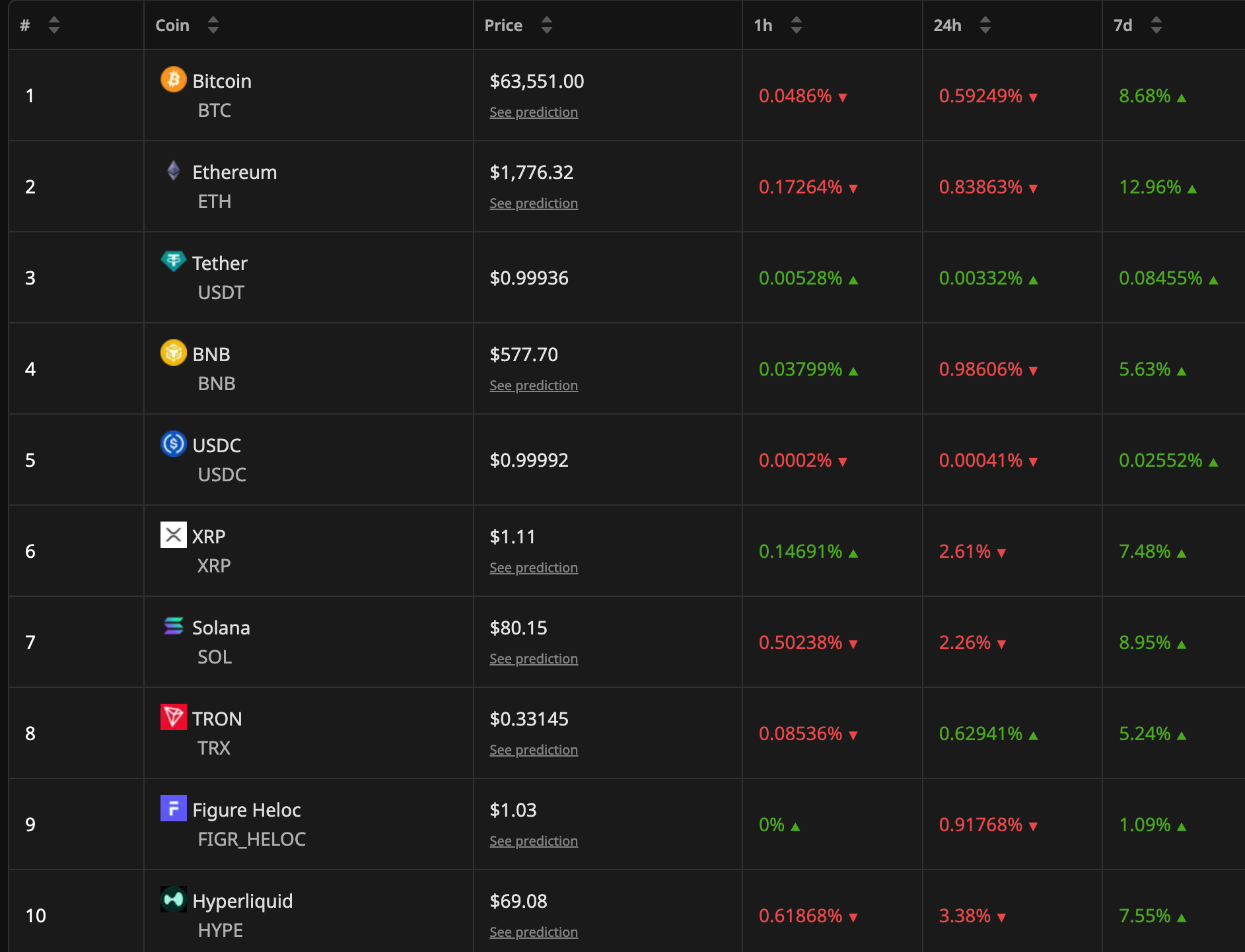
Meanwhile, crypto markets moved in the opposite direction, with the total market cap down 1.24%. Bitcoin traded near $63,551, down 0.59% over 24 hours. Ethereum slipped 0.84% to about $1,776.

Hyperliquid (HYPE) led losses among the top 10 assets, falling 3.38% to $69.08. XRP (XRP) dropped 2.61%, and Solana (SOL) fell 2.26%.
The pullback came after a strong week for digital assets. Higher oil prices tend to fuel inflation worries. Those concerns can push expectations of interest rate cuts further out, weighing on risk assets.
Subscribe to our YouTube channel to watch leaders and journalists provide expert insights
The post Crypto Market Slips 1.24% as US Strikes on Iran Lift Oil appeared first on BeInCrypto.
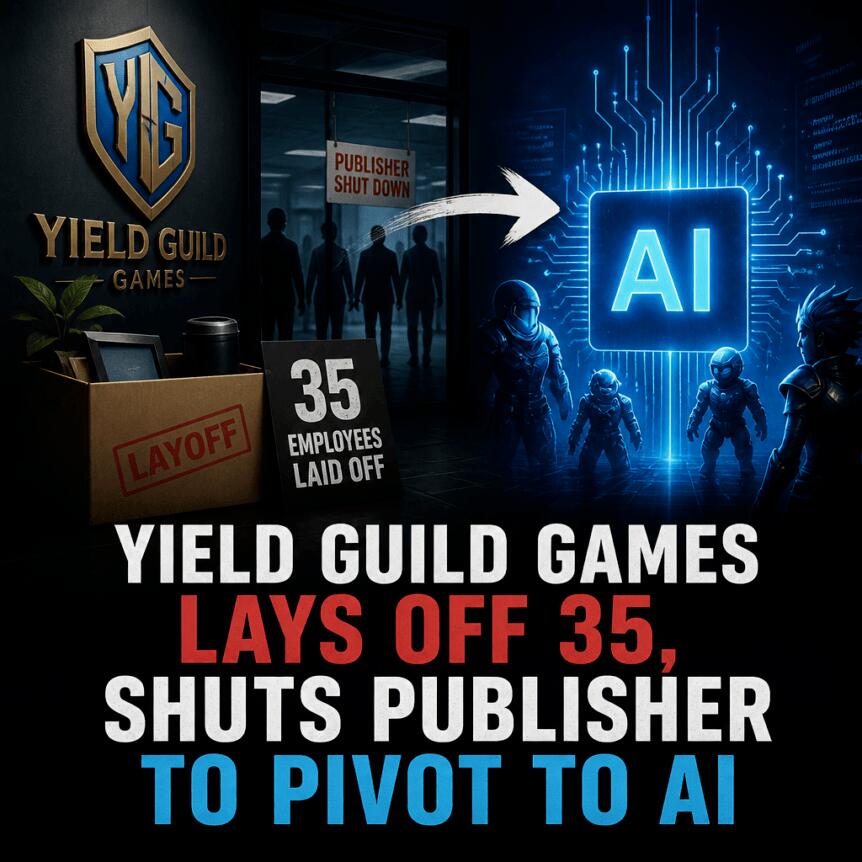
Yield Guild Games (YGG) has moved to shut down its crypto game publishing arm, YGG Play, while cutting 35 employees and redirecting resources toward AI-focused datasets. The restructuring comes as the company cites a prolonged downturn in crypto markets alongside a difficult environment for video game publishing.
In an update posted Monday, YGG said it is sunsetting the web-based publishing activities under YGG Play because it no longer expects consumer demand in crypto gaming or the broader Web3 publishing market to recover “sufficiently” in the near term. The company also attributed the shift to how a major market crash on Oct. 10 “fundamentally altered retail market psychology.”
Key takeaways
- Yield Guild Games is sunsetting YGG Play, ending its publishing website, web app experience, and community rewards support.
- The company will lay off 35 employees, pointing to weak crypto consumer conditions and an unsustainable publishing market.
- YGG says the restructure extends its operating runway to four years, citing $20.6 million in treasury funds as of the end of the first quarter.
- Instead of publishing games, YGG plans to build “AI data economy” pipelines using behavioral datasets generated by its global community through gameplay.
Sunsetting YGG Play amid market stress
According to YGG’s announcement, the decision is driven less by product performance and more by the economics of Web3 game publishing under current conditions. The company said YGG Play “cannot be commercially sustainable,” blaming both a continued crypto market slump and what it called a “similarly brutal” video game publishing landscape.
In a brief statement included with the update, YGG co-founder Gabby Dizon framed the move as a response to market realities. She said sunsetting YGG Play is a “market decision, not a product decision,” adding that she was “proud of what this team achieved under such tough conditions.”
As part of the shutdown, YGG said it will close the YGG Play website, discontinue its web app used to launch games, and end marketing support for third-party titles. That includes taking down specific games listed as browser-based offerings, while other Web3 versions are set to remain accessible.
What ends—and what stays live
YGG said it will remove LOL Land, a browser game described as a “game in the style of a board game,” and also take down the puzzle game Waifu Sweeper.
However, YGG indicated that Web3 versions of two other titles would continue as normal. Those are the baseball game GIGACHADBAT and the battle game Ragnarok Breaker. The company’s update suggests that it will focus on maintaining certain blockchain-based game experiences while stopping the publishing and support layer that sits behind YGG Play’s broader web infrastructure.
The company also said it would end marketing support for third-party games distributed through YGG Play, signaling that the restructure is not limited to internal game development but also affects the broader publishing and promotion function.
From publishing to AI training data pipelines
While sunsetting YGG Play, Yield Guild Games says it is pivoting toward “the AI data economy.” The company’s plan is to use its community to create datasets designed to help train AI systems.
YGG stated it will initially build a pipeline for gaming datasets and that its global community “can generate these behavioral datasets just by playing.” In other words, rather than monetizing publishing as a standalone activity, YGG is positioning gameplay behavior as a raw input for AI model training.
The company also argued that games create complex, real-time decision-making environments. In YGG’s framing, video game players continually make split-second choices, often involving “human irrationality and emergent behavior,” which it says AI networks could benefit from learning.
This shift reframes YGG’s role in the Web3 ecosystem: from distributing and promoting games to contributing structured behavioral information that can support AI development.
Runway extended, layoffs align with broader crypto job cuts
YGG said the sunsetting of YGG Play and the associated restructuring will extend its operating runway to four years. The company added that it held $20.6 million in treasury as of the end of the first quarter.
The layoffs at YGG are part of a wider wave of workforce reductions across the crypto sector. Data cited in the reporting shows that crypto companies have cut more than 5,000 jobs this year, with many employers citing difficult market conditions and a redirection of budgets toward artificial intelligence initiatives.
Examples highlighted include Block Inc.’s large February layoff round in which it cut 4,000 staff, roughly half its workforce at the time, according to earlier coverage from Cointelegraph. BitGo later laid off about 15% of staff (estimated at 90 people), while Robinhood reportedly reduced its workforce by 10%. Earlier in the year, Kraken said it cut 150 roles and Coinbase reduced 700 employees, with Gemini also cutting 200 employees in February and Crypto.com reducing about 180 staff the following month—again citing the role of AI in shaping staffing priorities.
For investors and builders, the pattern suggests companies are not only tightening costs, but also changing what they view as the most durable growth lever. In YGG’s case, that lever is shifting from Web3 entertainment publishing toward data production tied to AI training—an approach that may be less dependent on immediate consumer spending on new crypto game launches.
What remains to be seen is how YGG will translate community gameplay into usable datasets in practice, and whether its AI data direction can generate sustainable revenue or partnerships at scale. Readers should watch for details on the pipeline, how YGG measures dataset quality and value, and which of its current game experiences remain central to that data strategy as the YGG Play transition continues.
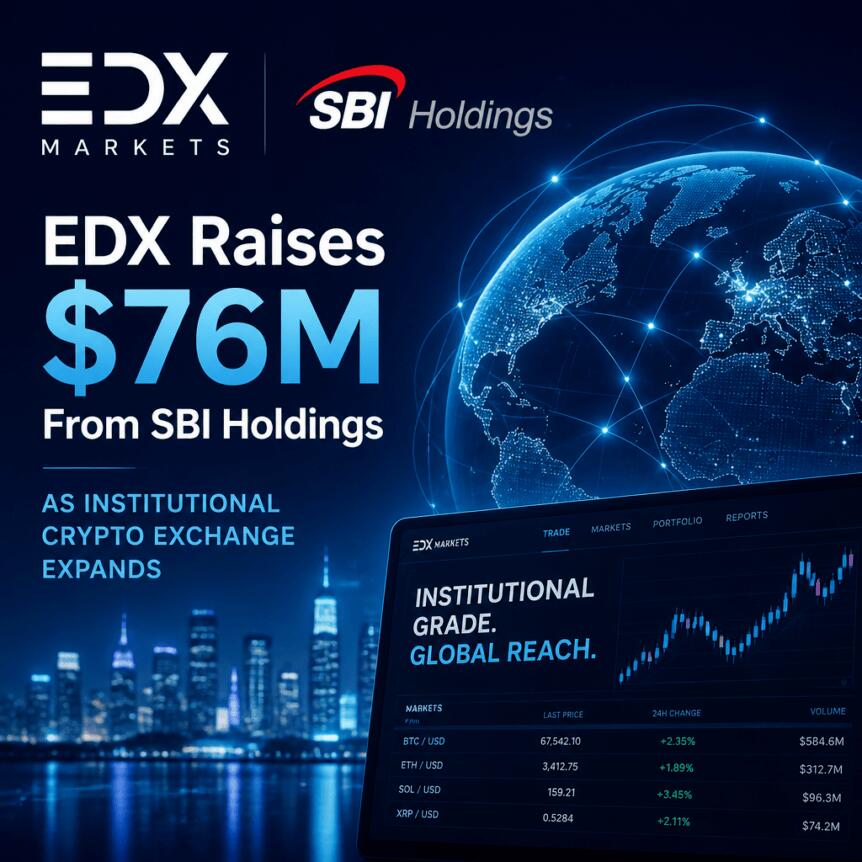
Institutional-focused crypto exchange operator EDX Markets has raised $76 million in a Series C funding round led by Japan’s SBI Holdings, the company announced Monday. The raise underlines sustained institutional demand for regulated market infrastructure even as broader venture activity in digital assets remains more subdued than it was during the 2021 boom.
EDX said it plans to use the proceeds to expand its spot trading, clearing, and settlement offerings, introduce new products, and increase its international presence. The exchange runs a US-based institutional spot venue and a Singapore-based perpetual futures platform designed for eligible non-US institutional clients.
Key takeaways
- EDX Markets secured $76 million in a Series C round led by SBI Holdings, supporting growth of its institutional spot, clearing, and settlement services.
- The company operates both a US institutional spot exchange and a Singapore perpetual futures venue, targeting different segments of global institutions.
- EDX’s funding momentum comes despite softer digital asset trading volumes and a still-cautious venture market versus 2021 levels.
- Backers already include major traditional finance names such as Citadel Securities, Fidelity Digital Assets, Virtu Financial, and Charles Schwab.
- Recent partnerships, including Ripple Prime integration, point to expanding access to EDX liquidity through institutional prime brokerage channels.
Why EDX’s Series C matters for institutions
Large funding rounds in crypto are often tightly linked to market participation and infrastructure needs. In EDX’s case, the focus is on the plumbing that institutional desks typically require—order execution, custody-adjacent operational workflows, and settlement and clearing processes—rather than consumer-facing products.
EDX’s latest round arrives during a period when crypto trading activity has cooled from its earlier highs and venture funding remains below the industry’s 2021 peak. Even so, the investment signal remains clear: capital continues to flow toward entities that can support institutional participation as regulation, market structure, and compliance practices evolve in the US.
EDX also emphasizes that it is expanding beyond a single offering. By pairing spot trading growth with clearing and settlement capability, the company is positioning itself as a more complete venue for institutions that need end-to-end execution and post-trade processing.
Building on existing investor support
EDX said the Series C follows previous investment from traditional financial firms, including Citadel Securities, Fidelity Digital Assets, Virtu Financial, and Charles Schwab. That roster is notable because it reflects ongoing interest from established market participants in crypto infrastructure, even when venture capital overall is less aggressive.
The company’s backers also highlight a broader shift in how institutions approach crypto. Instead of directly integrating into fragmented trading ecosystems, larger players often prefer venues designed around institutional workflows—liquidity access, operational readiness, and risk controls that can be more straightforward to integrate into existing systems.
Partnership-driven expansion and liquidity access
EDX has also expanded its institutional footprint over the past year through strategic integrations. In May, Ripple Prime integrated with EDX, enabling institutional clients to access EDX’s spot and perpetual futures liquidity via Ripple’s prime brokerage platform.
According to EDX’s announcement, the partnership also includes plans to support RLUSD as a settlement and collateral asset. The development matters because settlement and collateral treatment can be a decisive operational variable for institutions: it affects capital efficiency, transaction processing, and the overall complexity of moving value through market infrastructure.
EDX said it can process as much as $685 million in daily trading volume, suggesting that demand for institutional-grade execution venues remains intact even if overall market activity is less frenzied than in prior cycles.
For readers tracking institutional adoption, the key question is whether these integrations lead to sustained growth in client onboarding and deeper liquidity rather than only incremental access through partners. EDX’s strategy appears aimed at embedding itself into prime brokerage distribution pathways—an approach that can reduce friction for institutions that already rely on established counterparties for connectivity and compliance.
Institutional infrastructure still attracts capital
EDX’s Series C is part of a wider pattern: investors continue to fund companies building trading, payments, and settlement infrastructure despite a less bullish risk appetite than in 2021.
As one comparison point, Fortune reported that San Francisco-based Framework Ventures recently raised $400 million for a new fund targeting frontier technologies including blockchain networks and decentralized finance. Other infrastructure-adjacent funding also continued during the same general period referenced in the article, including:
- Fomo, a cross-chain trading-focused startup, raised $75 million at a $550 million valuation, according to Cointelegraph’s coverage.
- Trace Finance, which builds stablecoin-based cross-border payment and settlement infrastructure for businesses, raised $32 million to expand its platform, according to Cointelegraph’s coverage.
Taken together, these moves suggest that while crypto venture funding may be slower than the peak era, investors are still willing to place significant bets on infrastructure that can serve institutional requirements—especially where regulation and operational design reduce uncertainty for larger counterparties.
Looking ahead, investors should watch whether EDX’s expansion plans translate into measurable increases in new institutional clients, sustained trading volumes, and broader settlement/collateral support through partnerships like Ripple Prime. The funding itself is only one milestone; the next test is whether institutional demand continues to deepen enough to justify the scale-up of clearing, settlement, and product development.
Crypto World
AEREDIUM collaborates with Alba Bay’s $5.4 billion development to explore the future of RWA payment infrastructure

Disclosure: This article does not represent investment advice. The content and materials featured on this page are for educational purposes only.
AEREDIUM has joined the Lava Tokenization Sandbox with Lava Foundation and BHL to explore future infrastructure models for tokenized assets.
Summary
- AEREDIUM joins Lava Tokenization Sandbox to explore RWA tokenization, payments, and settlement infrastructure using Alba Bay as a real-world test case.
- AEREDIUM partners with Lava Foundation and BHL in a tokenization sandbox exploring future blockchain infrastructure for real-world assets.
- It has entered Lava Tokenization Sandbox to test how tokenized assets can connect traditional finance with digital settlement systems.

AEREDIUM, the blockchain infrastructure company building the security and settlement layer for tokenized assets, today announced that it has joined the Lava Tokenization Sandbox alongside Lava Foundation and Bretagne Holding Limited (BHL). Together, the companies will explore how future tokenized asset infrastructure may interact with both traditional and digital financial systems, using Alba Bay, a large-scale master-planned development in the Dominican Republic, as a real-world innovation framework through which future infrastructure models can be evaluated.
As real-world asset (RWA) tokenization accelerates, one challenge continues to slow institutional adoption: payments and settlement. Creating a token is relatively straightforward. Enabling investors to purchase tokenized assets using the currency and payment method they already hold, while allowing developers to receive secure, compliant settlement without managing fragmented digital asset treasuries, remains one of the industry’s biggest infrastructure gaps.
The collaborative sandbox initiative was designed to explore how these challenges may eventually be addressed through emerging infrastructure.
As part of the initiative, participants are exploring potential real-world applications using Alba Bay as one of several reference environments for evaluating future infrastructure models. Unlike conventional tokenization pilots, the sandbox is built around a real, capital-backed development, allowing participants to test tokenization, payments, and settlement under real-world conditions rather than in isolated blockchain environments.
Within the sandbox, AEREDIUM is testing payment-agnostic settlement infrastructure designed to simplify how tokenized real estate is purchased while removing operational complexity for developers.
Each partner contributes a distinct layer to the initiative.
Bretagne Holding Limited contributes development expertise and provides a real-world project framework through which future innovation models can be evaluated.
Lava Network provides the decentralized RPC and API infrastructure that powers blockchain connectivity without a single point of failure.
AEREDIUM provides payment and settlement infrastructure that allows future market participants to interact with tokenized asset infrastructure using a wide range of payment methods, including bank transfers, payment cards, stablecoins, or digital assets across multiple blockchain networks. Through atomic settlement, the platform converts the buyer’s payment into the asset the developer chooses to receive, delivering a single, secure, and auditable transaction across blockchain networks, banking systems, and enterprise platforms.
For developers, this removes one of the biggest operational barriers to adopting tokenized assets. Rather than managing fragmented treasuries across multiple chains and digital assets, developers receive clean settlement while maintaining a verifiable payment trail and reducing the operational and compliance complexity associated with accepting digital asset payments.
Beyond settlement, AEREDIUM’s infrastructure combines institutional-grade cryptographic security, proof-of-reserve verification, verifiable payment trails, and atomic settlement into a unified platform for tokenized assets. The company has filed three U.S. patent applications covering core components of its security architecture, including its patent-pending AERKey technology, and is developing TRUSTCORE, a post-quantum security framework designed to strengthen future digital asset infrastructure.
“We joined the sandbox to solve one of the biggest obstacles preventing tokenized assets from reaching institutional adoption: payments,” said Albert Dadon, Founder and CEO of AEREDIUM. “A buyer should be able to pay with any currency, on any rail, while the developer receives secure, auditable settlement in the asset they choose. Developers shouldn’t have to manage fragmented treasuries or carry the compliance burden that comes with accepting multiple digital assets. That’s exactly what we’re testing through this initiative.”
“At BHL, we believe emerging technologies will continue transforming how large-scale development projects are financed and accessed globally. Through this exploratory initiative, we are interested in understanding how future innovation may improve efficiency, transparency, and accessibility within the broader real estate ecosystem,” said Yossi Abadi, Partner and CEO at Bretagne Holding Limited.
“Tokenized assets are only as reliable as the infrastructure beneath them,” said Nimrod Knoller, Head of Foundation at Lava Foundation. “By combining decentralized infrastructure, settlement innovation, and real-world development perspectives, we are exploring what future institutional-grade digital asset infrastructure may look like.”
The partners believe the initiative represents the next phase of RWA adoption. While the first generation of tokenization focused on bringing assets onchain, the next will depend on infrastructure that makes tokenized assets as easy to buy, pay for, and settle as traditional financial products.
Through the Lava Tokenization Sandbox, led by Lava Foundation and BHL, AEREDIUM aims to demonstrate how payment-agnostic settlement can remove one of the final infrastructure barriers to institutional-scale adoption of real-world assets.
The partners believe the initiative shifts the RWA conversation from token issuance toward the infrastructure that real ownership actually needs: secure settlement, verifiable payments, and a buying experience that works with the money people already hold.
This initiative is exploratory in nature and is intended solely for evaluating potential future infrastructure models and technological interoperability. No public offering, sale of securities, token issuance, or formal tokenization structure is currently being launched through this collaboration.
Disclosure: This content is provided by a third party. Neither crypto.news nor the author of this article endorses any product mentioned on this page. Users should conduct their own research before taking any action related to the company.

Key Highlights
- Amazon is pursuing a $25 billion bond offering structured across eight tranches, featuring one floating-rate option and seven fixed-rate securities.
- Funds raised will support general corporate objectives, with emphasis on AI infrastructure development, capital investments, and refinancing existing obligations.
- Corporate debt markets are experiencing historically favorable conditions, with average spreads approaching record lows not seen in nearly three decades.
- Amazon’s total 2026 bond issuance now exceeds $72 billion, incorporating a $37 billion U.S. offering from March and approximately C$14 billion in Canadian bonds from June.
- Wall Street analysts maintain a “Moderate Buy” consensus on AMZN shares, with an average target of $312.79 representing significant upside from the current $247.03 level.
Amazon (AMZN) is returning to debt markets with another substantial capital raise. The e-commerce and cloud computing giant submitted a 424B5 filing Tuesday, detailing plans for a minimum $25 billion bond sale structured across eight separate tranches—comprising one floating-rate note and seven fixed-rate securities.
Shares of AMZN closed at $247.03 on Tuesday, gaining $2.87 during the session, though remaining considerably below the 52-week peak of $278.56.
This offering represents the latest chapter in an aggressive debt-raising campaign. Amazon secured $37 billion via a U.S. bond sale during March, subsequently adding approximately C$14 billion through Canadian dollar-denominated bonds last month. With Tuesday’s announcement, the company’s 2026 debt issuance surpasses $72 billion.
The strategic timing appears calculated. Corporate bond spreads—representing the additional yield investors demand above U.S. Treasury rates—reached 73 basis points on June 15, marking the tightest levels since June 1998. In an environment where capital costs hit generational lows, aggressive borrowing makes financial sense.
Amazon indicates the capital will address “general corporate purposes,” encompassing business investments, capital expenditure programs, and refinancing maturing obligations. The underlying message is clear: substantial AI infrastructure investments are planned.
Technology Sector Borrowing Surge
Amazon’s debt activity mirrors broader industry trends. Nvidia completed a $25 billion bond offering in June. Alphabet executed a ¥576.5 billion yen-denominated bond sale in May—establishing a record as the largest yen bond issuance by any foreign entity. Morgan Stanley research indicates approximately $236 billion in global debt was issued through May specifically for AI-related initiatives, representing more than quadruple the comparable 2025 period.
Morgan Stanley projects hyperscaler capital expenditure will exceed $1 trillion by 2027. Amazon clearly intends to secure substantial positioning within that forecast.
Institutional investment activity reflects continued confidence in AMZN. Matrix Asset Advisors expanded its position by 8.1% during Q1, acquiring 10,150 additional shares to reach 135,469 total units valued near $28.2 million. Several additional investment firms increased holdings in Q4, notably Arrowstreet Capital, which raised its stake by 21%. Institutional ownership collectively represents 72.2% of outstanding shares.
Analyst Perspectives and Price Targets
Wall Street sentiment toward Amazon remains decidedly bullish. Among 60 tracked analysts, 57 maintain Buy ratings while three hold neutral positions. The consensus price target stands at $312.79—approximately 27% above current trading levels.
Recent analyst actions include New Street Research elevating its target to $350, while Truist increased its objective to $320. Both firms maintained Buy recommendations.
Amazon’s latest quarterly results, released April 29, significantly exceeded market expectations. Earnings per share reached $2.78 versus consensus estimates of $1.63. Revenue totaled $181.52 billion, representing 16.6% year-over-year growth and surpassing projected $177.28 billion.
Technical indicators show the 50-day moving average at $254.57, positioned above the current $247.03 trading price. The 200-day moving average registers at $234.65.


Payward, the parent company of crypto exchange Kraken, has won a $22 million arbitration award against former auditor Mazars USA and asked the Delaware Court of Chancery to enter judgment on the award, according to a letter published Tuesday by co-CEO Arjun Sethi.
Payward said Mazars withdrew from the exchange’s nearly completed 2022 audit despite finding no fraud, raising no concerns about management’s integrity and reporting no disagreements with the company.
“An audit is not a favor. It is oxygen,” Sethi wrote, arguing that independent audits are essential for obtaining banking services, licenses and other business relationships.
Sethi said Mazars’ resignation was part of what he described as Operation Chokepoint 2.0, a broader campaign that pressured banks, auditors and other institutions to cut ties with lawful crypto companies.
The letter cited a series of regulatory developments from 2023 as evidence supporting that claim. These included joint guidance from US banking regulators, the Securities and Exchange Commission’s since-rescinded Staff Accounting Bulletin No. 121 and the collapse of crypto-focused banking networks Silvergate SEN and Signature’s Signet.
Sethi also called on Congress to pass the CLARITY Act, arguing that a comprehensive market structure framework would provide clearer rules for digital asset companies and reduce reliance on regulatory enforcement.
Related: Kraken lets traders use tokenized stocks as collateral for leveraged trades
Kraken executives reflect on auditor dispute
Kraken co-CEO Dave Ripley said on X Tuesday that “this story is worth surfacing despite its PTSD-inducing nature,” adding that “only a fraction of the stories from that era have ever been told.”
Ripley described the $22 million arbitration award as compensation for financial harm caused by what he called a coordinated campaign against the crypto industry.
Meanwhile, US regulators continue to address concerns around crypto-related debanking. In February, the Federal Reserve sought public feedback on a proposal to formally remove “reputation risk” from bank supervision, following its 2025 directive to stop pressuring banks to close customer accounts over reputational concerns. Critics said the move could help bring an end to Operation Chokepoint 2.0.

Source: Dave Ripley
Kraken was founded in 2011 and has been widely expected to pursue an initial public offering. In November 2025, the company said it had confidentially submitted a draft Form S-1 registration statement to the US Securities and Exchange Commission.
However, it was reported in May that its public debut may not come until 2027, citing weaker crypto market conditions and the exchange’s ongoing cost-cutting efforts.
Magazine: China’s 107 Bitcoin memory thief, Bithumb CEO booked: Asia Express

New poll finds majority of people in NI support immigration checks at border

How To Increase Your Loan Approval In The Philippines

EX DeFi makes earning BTC and XRP easy for everyone


-

 Fashion4 days ago
Weekend Open Thread: High Hopes
-
 NewsBeat3 days ago
Taylor Swift and Travis Kelce wedding staffer hilariously struggles to keep her cool while checking in megastars
-

 Fashion1 day ago
Open Thread: What Great Books Have You Read Recently?
-
 Crypto World7 days ago
Airdrop Registration Becomes Key Focus For Remittix As RTX Launch Updates Approach
-

 Politics5 days ago
The House | “Reframing the debate from a binary discussion of winners and losers”: Yuan Yang reviews ‘We Are Not Machines’
-

 Crypto World4 days ago
Standard Chartered Secures MiCA License as ESMA Adds 37 New Crypto Firms
-

 Business1 day ago
AXT Shares Jump Nearly 14% as Semiconductor Materials Maker Rebounds on AI-Linked Indium Phosphide Demand
-

 Sports7 days ago
Broncos roster: OL Ben Powers (No. 74) entering final year of contract
-

 Crypto World6 days ago
Binance stock trading tops $1B in first month after launch
-
Crypto World1 day ago
SK hynix (000660.KS) Stock Dips as $28B Nasdaq ADR Offering Drives AI Memory Expansion
-

 Crypto World6 days ago
Alibaba-affiliate Ant Group enters the humanoid robot market with 12 deals
-

 Crypto World3 days ago
South Africa proposes crypto tax guidance under existing rules
-

 News Videos1 day ago
Best Time to Enter Small Caps Right Now? Another Bull Run? | Financially Free
-

 Tech3 days ago
Lenovo laptops are now shipping with YMTC SSDs, a sign of Chinese NAND entering the mainstream
-

 News Videos23 hours ago
Whats Hidden Inside This Cash Register? #treasure #reselling #money
-

 Business6 days ago
Meta Platforms Stock Jumps 7% Today as Bloomberg Reports Company Plans to Enter the Cloud Business
-
 NewsBeat6 days ago
New exhibition reflects five decades of movement between island of Ireland and GB
-

 Business5 days ago
What a 10 Percent Drop Means for Buyers, Sellers and Renters
-

 Crypto World5 days ago
Binance Re-Enters Philippines As EU MiCA Rules Restrict Access
-

 News Videos2 days ago
Avoid entering in FOMO #bitcoin #cryptocurrency #trading #scalping
You must be logged in to post a comment Login