
Crypto World
Arch Lending Eyes Tokenized Stocks as Loan Collateral


Crypto lender Arch Lending plans to expand into loans backed by tokenized equities as the market for onchain stocks expands and lenders begin exploring new uses for the assets as collateral.
Arch co-founder and chief revenue officer Himanshu Sahay told Cointelegraph’s Chain Reaction podcast that the lender plans to enter the market “pretty soon,” pointing to a need for credit against tokenized stocks.
Sahay said tokenized equities have grown rapidly over the past year, but lending against the assets remains limited, and predicted that more lenders will enter the market.
He pointed to tokenized equities issued by firms including Superstate, Robinhood and Securitize, predicting that multiple lenders will eventually participate in the market to provide credit against the assets.

Source: Cointelegraph
Arch has already expanded beyond cryptocurrencies into tokenized real-world assets, launching loans backed by Paxos Gold and Tether Gold in recent weeks, according to Sahay.
But crypto still dominates Arch’s existing loan book, with Bitcoin (BTC) accounting for more than 80%, Sahay said. He added that the lender has recently seen growing interest in XRP as collateral, particularly among US borrowers.
Related: Kraken brings DeFi yield to tokenized stocks and ETFs
Tokenized stocks enter lending markets
Arch would not be the first lender to enter the tokenized equity credit market, with tokenized stocks and exchange-traded funds (ETFs) already entering lending and collateral products.
In February, Ondo Finance launched DeFi lending markets for two of its tokenized ETFs through an integration with lending protocol Morpho. Ondo’s tokenized versions of the SPDR S&P 500 ETF and Invesco QQQ can be used as collateral for borrowing on Ethereum.
Tokenized stocks are also beginning to find uses beyond dedicated lending markets. Kraken made 10 xStocks eligible to back futures and margin positions in July, while Coinbase’s B20 stocks launched on Base in August with price-feed infrastructure designed to support uses including DeFi borrowing and lending.
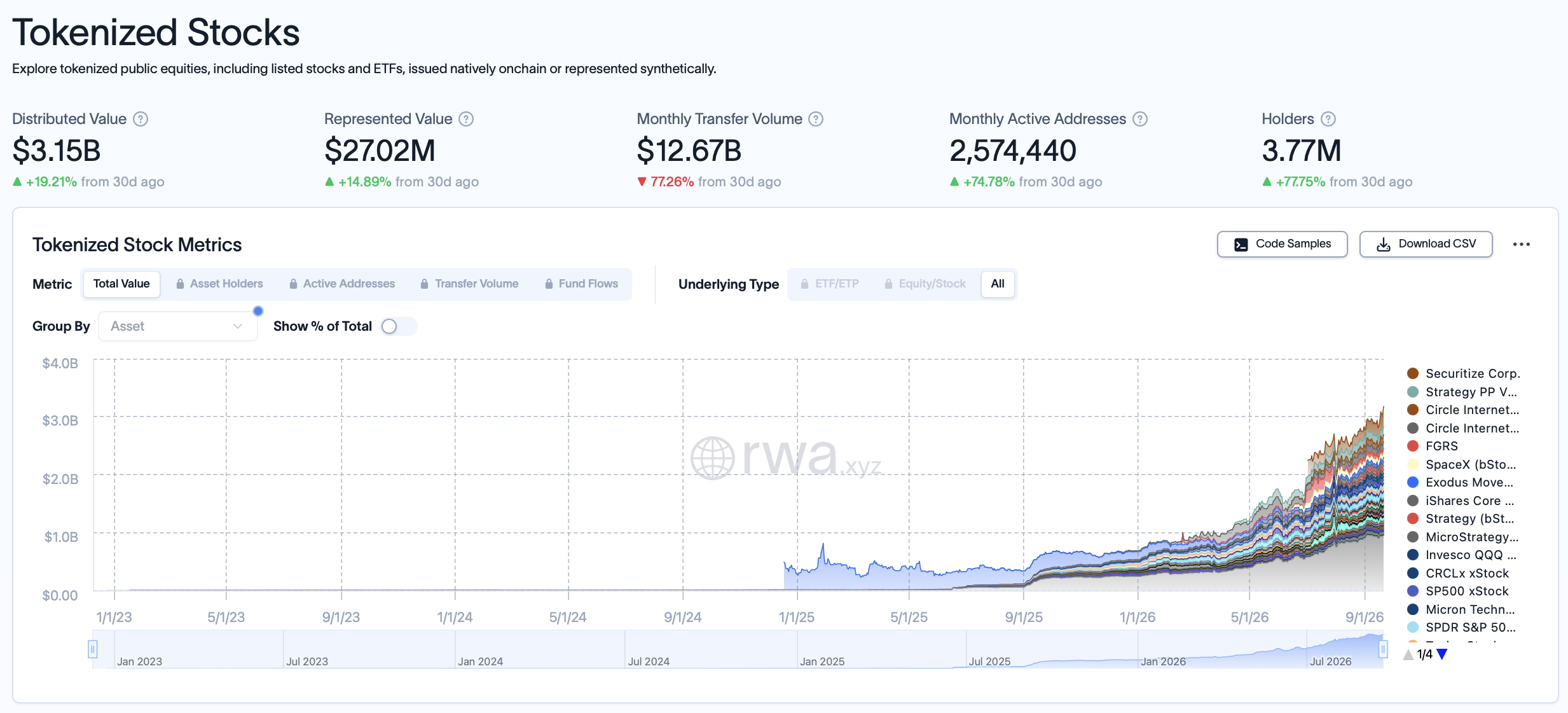
Tokenized equities. Source: RWA.xyz
The growth in lending use cases comes as the tokenized equities market itself has expanded sharply. Distributed tokenized stock value has climbed to about $3.15 billion from roughly $630 million a year ago, according to RWA.xyz data.
Magazine: Kyle Samani predicts SOL flippening, claims ‘no one’ uses ETH

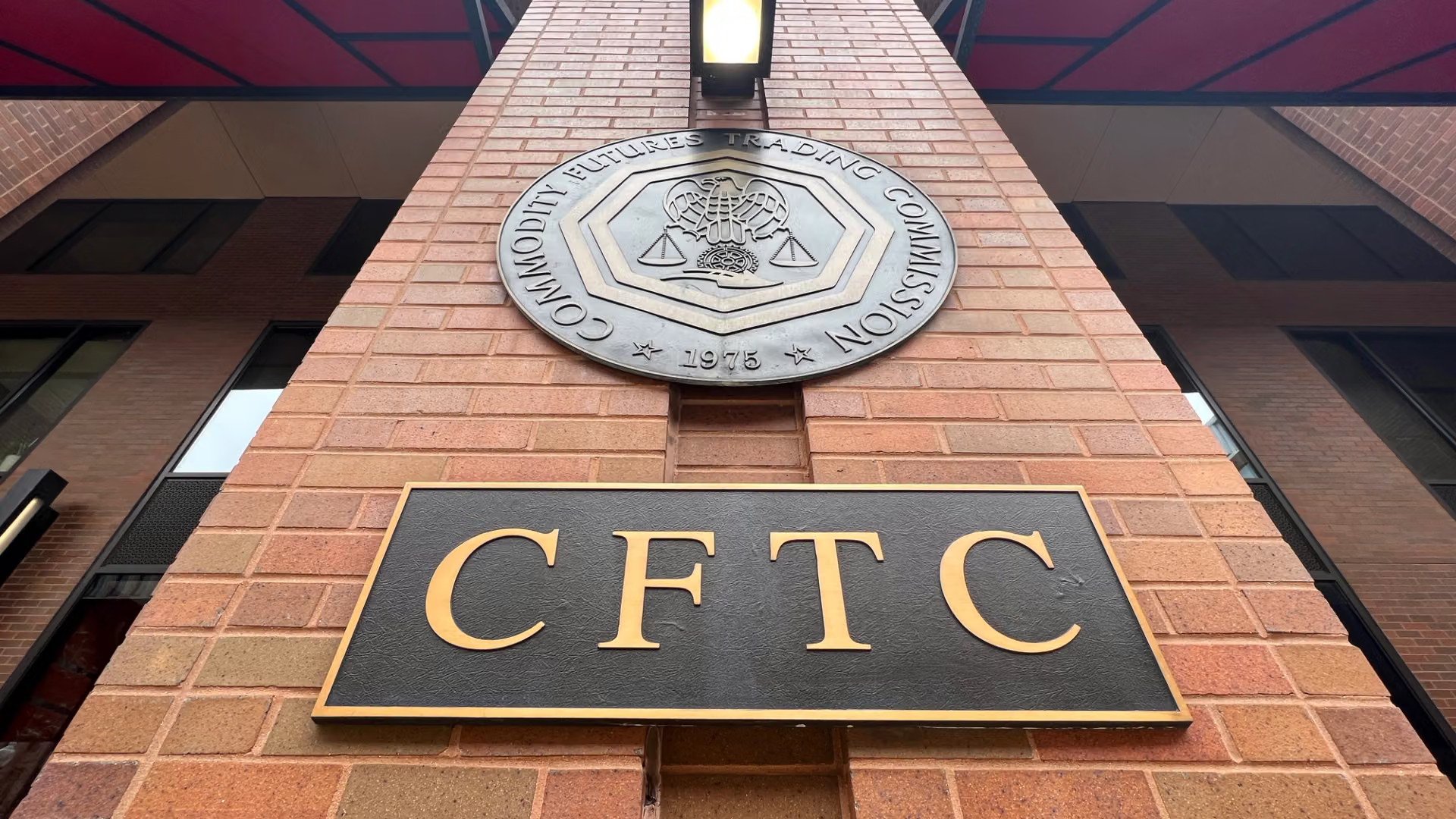
Popular betting on what an individual might say or do, known as “mention markets,” pose some special dangers in the eyes of the U.S. regulator overseeing prediction market firms such as Kalshi and Polymarket, according to an advisory issued on Tuesday that may narrow the window on event contracts that would easily clear the agency’s supervisory hurdles.
This category of wagering isn’t like other markets featuring “independently generated, externally verifiable outcomes that are outside the control of any single person,” said the Commodity Futures Trading Commission’s staff advisory. Instead, the agency noted, the outcome pivots on “the discrete conduct of a named person, and that conduct may be neither independently generated nor externally verifiable.”
Basically, the individual or people around the person could shift the outcome based on their own knowledge of the betting. The CFTC’s Division of Market Oversight that watches this sector may see these markets as “presumptively readily susceptible to manipulation,” according to the advisory. To that end, the CFTC reminds prediction platform operators that they’re only allowed to trade “derivative contracts that are not readily susceptible to manipulation.”



Kazakhstan’s regulated cryptocurrency market has surpassed $10 billion in annual trading turnover as the country expands licensed digital asset services and builds its domestic Web3 developer ecosystem.
Summary
- Kazakhstan’s regulated crypto market recorded $10.58 billion in trading turnover in 2025, up from $320 million in 2023, while users increased to 215,000.
- More than 8,000 people received Solana ecosystem training over the past year, with over 2,000 earning certificates and Kazakhstan entering the global top 10 for Solana hackathon applications.
- Kazakh Web3 startups received 121 million tenge in grants, while the country hosted a Solana Summit attended by more than 900 participants from over 30 countries.
- Kazakhstan is extending blockchain use into regulated finance through a Solana based exchange traded fund and plans to tokenize up to $60 million in real estate and logistics projects by the end of 2026.
According to Deputy Minister of Artificial Intelligence and Digital Development Gizzat Baitursynov, trading turnover across the regulated market reached $10.58 billion in 2025, compared with $320 million in 2023, while the number of users rose from 53,000 to 215,000 over the same period.
Baitursynov disclosed the figures during a government meeting on Sept. 15, detailing the expansion that followed Kazakhstan’s initial crypto market pilot with the Astana International Financial Centre and financial regulators.
Launched in 2022, the pilot was designed to test a regulatory framework for cryptocurrency exchanges before becoming the basis for a licensing and operating system within the AIFC.
Kazakhstan has continued building regulatory infrastructure around the growing market. crypto.news previously reported that the country plans to establish a national crypto analytics center to monitor fiat payments, cryptocurrency transfers, wallets and customer information.
National Bank Chairman Timur Suleimenov said the center would operate on the central bank’s SupTech supervisory platform and connect with its existing Anti Fraud Center. Banks, law enforcement agencies and licensed digital asset providers are expected to receive access to its verification tools.
Kazakhstan crypto market grows alongside Solana developer base
Development of the regulated market has been accompanied by programs designed to train blockchain developers and support local Web3 projects.
Talgat Dossanov, head of the Solana Superteam KZ corporate foundation, said more than 8,000 people received training through cooperation with the Solana ecosystem over the past year. More than 2,000 participants completed the programs and received certificates.
Roughly one in five certified graduates represented a government body, according to Dossanov. Training programs covered blockchain fundamentals, development on Solana, practical assignments and preparation for international hackathons.
Kazakhstan has since entered the global top 10 by the number of applications submitted to international Solana hackathons, Dossanov said.
Local startups have received financial support alongside the training programs. A total of 57 Kazakh startups secured grants worth 121 million tenge, equivalent to approximately $262,000.
The country hosted an international Solana Summit attended by more than 900 participants from over 30 countries. Livestreams distributed through Solana’s social media channels reached an audience of roughly 4 million people, according to the government.
Kazakhstan remains the only country in Central Asia with an official Solana representation, government officials said.
Solana enters Kazakhstan’s financial infrastructure
Work with the Solana ecosystem has moved beyond developer training and startup programs into regulated financial products.
Together with the Kazakhstan Stock Exchange, the country launched an exchange traded fund based on the public Solana blockchain. The product gives the domestic financial market another connection to Solana as regulated investment products tied to the network expand internationally.
Institutional demand for Solana investment products has grown in other markets during 2026. In the United States, the Bitwise Solana Staking ETF surpassed $1 billion in assets in August, less than 10 months after its launch.
Bitwise reported that the fund held 9.33 million SOL worth approximately $1.018 billion as of Aug. 26, with 96% of its assets staked. Bloomberg senior ETF analyst Eric Balchunas said Solana funds had retained most of the roughly $1.7 billion in accumulated inflows recorded at the time.
Kazakhstan has pursued direct cooperation with organizations in the Solana ecosystem as well. On June 11, Alatau City and the Solana Foundation signed a memorandum in Hong Kong covering further cooperation.
The agreement came as Alatau City develops its role in Kazakhstan’s technology and digital asset plans, while the government continues bringing blockchain based services into regulated financial infrastructure.
Kazakhstan expands state backed crypto programs
Digital asset policy in Kazakhstan now covers trading, mining, payments, market surveillance and state investment programs.
In July, the government approved a strategic crypto mining framework that allows qualifying large scale miners to obtain electricity quotas at regulated tariffs after agreeing to transfer part of their mined cryptocurrency to a reserve mechanism administered through Astana Hub.
Operators seeking strategic status must own a digital mining data center with at least 150 megawatts of installed capacity. Mining equipment at qualifying facilities must provide at least 150 terahashes per second of computing power per unit, while operators face requirements covering staffing, repair facilities, internet connections and tax compliance.
The program sits alongside Kazakhstan’s plans for state exposure to digital assets. Earlier in 2026, the National Investment Corporation earmarked $350 million from foreign currency and gold reserves for crypto related investments.
The country has maintained enforcement against activity outside its licensed market while expanding regulated services. Authorities blocked more than 1,100 online platforms offering cryptocurrency exchange services without authorization during 2025.
Financial authorities had taken action against 36 illegal crypto platforms a year earlier. The operators recorded combined turnover of 60 billion tenge, while authorities seized 4.8 million USDT from unauthorized services.
Tokenization plans target real estate and logistics
Kazakhstan’s next set of blockchain projects includes bringing physical assets into digital markets.
National Bank Governor Timur Suleimenov said the country plans to tokenize up to $60 million worth of real estate and logistics projects by the end of 2026.
The initiative is intended to test digital assets as a source of financing for economic projects, extending Kazakhstan’s blockchain activity from cryptocurrency trading and mining into tokenized assets.
Tokenization converts ownership or economic rights connected to assets into blockchain based tokens that can be issued, transferred and settled digitally. The sector has been attracting growing institutional interest, with the global market for tokenized real world assets reaching roughly $30 billion to $34 billion by mid 2026.
Kazakhstan’s planned projects will follow several regulated crypto initiatives already operating in the country. Bybit Kazakhstan launched the country’s first regulated peer to peer trading platform in November 2025 under an Astana Financial Services Authority license, requiring identity verification and routing fiat payments through corporate accounts held by licensed financial institutions.
The Astana Financial Services Authority began a separate pilot in September 2025 that permits eligible firms to pay regulatory fees using US dollar pegged stablecoins through approved agents.
Regulated crypto payments have since entered the banking system. Alatau City Bank partnered with Binance Kazakhstan in July to introduce Crypto Pay, allowing customers to pay with cryptocurrency through QR codes and point of sale terminals connected to the bank’s acquiring network.
Kazakhstan’s mining industry remains part of the same regulated infrastructure. The Cambridge Digital Mining Industry Report ranked the country fifth globally by Bitcoin mining activity in April 2025, while the government’s strategic mining framework now ties additional regulated electricity access to participation in its state backed digital asset reserve.

Kalshi has asked the Commodity Futures Trading Commission to approve a margin framework for eligible event contracts, limiting access to qualified participants and excluding markets tied to sports.
Summary
- Eligible contracts may cover economic, financial, political, commercial, and other verifiable events.
- Sports contracts will remain ineligible, while Kalshi reportedly excluded culture and mention markets.
- Access will require trading through an FCM or qualifying as an approved self-clearing member.
- Kalshi’s model uses a one-day risk period and targets confidence above the required 99% level.
Kalshi margin framework targets eligible event contracts
Kalshi Klear’s Sept. 22 filing asks the CFTC to approve amendments to its rules and margin risk framework under Regulation 40.5(a). The clearinghouse said the changes would introduce a new initial-margin method for selected event contracts.
Contracts tied to economic data, financial developments, politics, commercial activity and other “objectively verifiable events” could qualify. Eligibility would depend on the product and the side of the contract being traded.
Sports-event contracts would not receive margined treatment under the proposal. Kalshi also told CNBC that culture and mention markets, which can cover whether a person says a particular word or phrase, would remain outside the program.
Under Kalshi’s current structure, event contracts are binary products that settle at $1 when a specified outcome occurs and $0 when it does not. Before settlement, prices trade between those two values, leaving each side with a defined maximum possible loss.
A trader holding a YES position can lose no more than the price paid. For the opposing NO position, the maximum loss equals $1 minus the YES price. Kalshi said the bounded payoff allows its clearinghouse to calculate margin separately for each side.
Rather than requiring traders to post enough funds to cover the full possible loss at the outset, the framework would set initial margin according to modeled adverse price moves. A qualifying participant could therefore control more contracts than would be possible under the platform’s fully collateralized structure.
Access would remain limited to qualified participants
Margin would not become available to every Kalshi customer under the filing. Eligible contracts could be cleared only through a registered futures commission merchant, or FCM, or by an eligible contract participant approved by Kalshi Klear as a self-clearing member.
Eligible contract participants generally include institutions and other entities that meet financial thresholds defined under U.S. commodities law. The restriction positions the product for hedge funds, trading firms, and other professional market participants rather than ordinary retail accounts.
Each newly listed product would initially remain fully collateralized until Kalshi reviewed and approved it for margin. Its clearinghouse could designate both sides of a binary contract for margin, approve only the YES or NO side, or keep both sides fully funded.
According to the filing, early or sudden resolution may create different risks for the two sides of a contract. Kalshi therefore plans to calculate eligibility and margin requirements separately instead of treating opposing positions as identical.
The framework would also raise collateral requirements as a contract approaches expiration or when market conditions increase the risk of abrupt repricing. Contracts would eventually reach full collateralization near resolution, even if they retained their formal classification as margined contracts.
Scheduled events capable of causing sharp price changes would trigger additional requirements. Kalshi also proposed volatility floors, concentration charges, and liquidity adjustments designed to account for the cost of closing positions after a clearing-member default.
Kalshi proposes a one-day margin risk period
Kalshi has requested permission to use a one-day, or 24-hour, margin period of risk for qualifying products. The period represents the estimated time needed to manage or close a position after a default.
Its model seeks to maintain a confidence level above the 99% minimum required by CFTC regulations. The clearinghouse said it tested the framework using historical data and measured performance separately for the YES and NO sides.
Among the safeguards, Kalshi described a dual-speed volatility measure that would raise margin quickly after a price shock but reduce it more slowly when conditions settle. Such controls are intended to prevent required collateral from falling too far during less volatile trading periods.
Portfolio offsets would be permitted only for related contracts with reliable payoff links or correlations. Before receiving the benefit, a portfolio would need to pass loss backtesting designed to determine whether the proposed offset remains effective under adverse conditions.
Kalshi said its guaranty fund would support margined event contracts and perpetual futures through separate contract segments. Fully collateralized customers would not lose their posted collateral because of defaults involving margined positions, although a severe event could expose part of their profits to contract tear-ups when the other side contains a margined position.
The proposed amendments would take effect no earlier than the first business day after the 45th calendar day following the submission, unless Kalshi or the CFTC selects a later date. Several technical sections covering the model’s design, calibration and validation were withheld from the public document after the company requested confidential treatment.
Institutional push follows Kalshi’s perpetual expansion
Kalshi has already introduced leverage through its U.S. perpetual futures business. As crypto.news reported in May, the CFTC cleared the company to list a Bitcoin perpetual futures contract, providing a federally regulated route to a product historically concentrated on offshore crypto exchanges.
The exchange has since added contracts tied to several digital assets. In early September, Kalshi launched five crypto perps covering BNB, Cardano, Worldcoin, Aave and Venice Token. The dollar-margined products allow long and short positions without an expiry date, with maximum leverage varying by asset.
Perpetual futures and binary event contracts carry different payout structures. Perpetuals track an underlying asset’s price without an expiration date, while Kalshi’s event contracts pay a fixed amount based on whether a defined outcome occurs. Both products can expose traders to larger losses when margin reduces the amount of capital required to open a position.
The event-contract filing arrives as Kalshi seeks more business from professional trading firms. An August securities filing showed that the company had sold $1.12 billion of a nearly $1.5 billion equity offering since April, leaving about $380 million available.
Kalshi’s $1 billion Series F valued the company at $22 billion in May, with Coatue leading the round and participation from Sequoia Capital, Andreessen Horowitz, IVP, Paradigm, Morgan Stanley and ARK Invest. Company figures released at the time put annualized trading volume at $178 billion, up from $52 billion six months earlier, while institutional volume had risen 800%.
Reports later said Kalshi was considering another $750 million raise at a valuation of about $40 billion. The August filing did not confirm whether its remaining $380 million represented a separate financing or identify the investors that could purchase the unsold portion.

The Senate’s failure to advance the CLARITY Act has left existing customer identification, anti-money laundering, sanctions, and suspicious activity reporting requirements unchanged for covered U.S. crypto businesses.
Summary
- The failed Senate vote has not altered existing Bank Secrecy Act obligations for covered crypto companies.
- Sponsor banks expect identity, wallet, and transaction controls to remain connected throughout the customer relationship.
- Self-custodial wallet users can be verified at access points without placing personal information on-chain.
- AI agents require limited, revocable authority tied to an identifiable person or company.
CLARITY Act vote leaves existing AML duties intact
Prove Global Head of Digital Assets and Sponsor Banks Fernando Castellanos told crypto.news that the bill dealt mainly with market structure and would not have replaced the Bank Secrecy Act requirements already imposed on covered crypto businesses.
Customer identification, beneficial ownership checks, sanctions screening, AML controls and suspicious activity monitoring remain in force, according to Castellanos. Crypto companies must also continue filing required reports when their systems detect activity that meets applicable reporting standards.
“The failed vote does not change the compliance obligations that already apply to covered crypto businesses,” Castellanos said.
“Market structure legislation was never going to displace the Bank Secrecy Act; it would have clarified which regulator sits on top of it.”
On Sep. 15, the Senate rejected cloture on the motion to proceed with H.R. 3633, the House version of the Digital Asset Market Clarity Act. The failed procedural vote received 49 votes in favor and 50 against, leaving the measure 11 votes below the 60 required to open debate.
The result did not amount to a final vote on the bill itself. Seven Democratic senators who opposed cloture later described the outcome as “not the end” and said they remained committed to bipartisan negotiations. No second vote has been scheduled, although the seven Democrats reopened talks as lawmakers continued to dispute ethics provisions covering elected officials and their digital asset interests.
While the bill remains unresolved, Castellanos said moving funds through blockchain networks does not remove the need to determine who controls an account or stands behind a transaction. Faster settlement and transactions that are difficult to reverse leave firms with less time to identify suspected fraud or illicit activity.
“If anything, it raises the bar,” he said. “As stablecoins and other digital assets make payments faster and harder to reverse, the window to catch a problem gets smaller.”
According to Castellanos, firms must therefore maintain identity and risk checks after onboarding instead of treating verification as a one-time step. Changes in account behavior, wallet activity, or transaction patterns can alter the risk attached to an existing customer.
Sponsor banks expect connected crypto risk controls
When sponsor banks assess a crypto company, Castellanos said they examine controls across the entire customer and transaction lifecycle. Reviews commonly cover customer and business verification, beneficial ownership, sanctions screening, fraud prevention, wallet screening and transaction monitoring.
Banks also seek evidence that each control works under actual operating conditions, rather than relying solely on written compliance policies or tests conducted before launch. Castellanos said separate tools can create blind spots when identity, wallet and transaction data do not flow into the same risk process.
“A bank needs confidence that you know who is behind an account or a wallet, and that you will see it when that risk profile changes.”
Under the proposed CLARITY framework, federal oversight would be divided between the Securities and Exchange Commission and the Commodity Futures Trading Commission. The bill’s split federal oversight would place qualifying digital commodities and registered spot-market intermediaries under CFTC supervision while preserving SEC authority over securities and related transactions.
Such a division would answer which federal regulator supervises certain assets and activities, but it would not erase separate compliance layers. State money-transmitter licensing, federal sanctions rules and existing obligations for covered financial institutions could still apply depending on a company’s services and customers.
For sponsor banks, connected controls help determine whether an account or wallet still belongs to the verified party and whether later activity matches the customer’s expected use. Castellanos said firms can reduce friction for legitimate users by combining several risk signals instead of repeatedly asking customers to complete isolated checks.
DeFi identity checks can remain off-chain
Verification for self-custodial wallets and decentralized finance does not require personal information to be written to a public blockchain, according to Castellanos. Firms can perform checks at points where regulated companies already interact with users, including fiat on-ramps, off-ramps, application interfaces and other access points.
Keeping names, identification documents and other sensitive records outside public ledgers avoids exposing information that cannot later be removed. Regulated companies can still retain the records needed to meet their obligations within controlled systems.
Castellanos said counterparties also do not need every piece of information collected during verification. A firm may only need confirmation that a user has passed an identity check, controls a stated wallet or does not appear on a sanctions list.
“Confirming a claim, rather than handing over the underlying data, is what lets firms meet their obligations without putting personal information on-chain or forcing open software to behave like a conventional intermediary.”
Such an approach separates a protocol’s open-source code from the compliance duties of regulated companies using interfaces or payment rails around it. Castellanos said the objective is not to treat every self-custodial wallet like a bank account, but to establish enough verified information around a regulated interaction to manage its identified risks.
The CLARITY proposal addressed related questions through registration exemptions for some DeFi software developers, wallet providers and validator operators. Its failure to advance means firms must continue applying existing law while Congress, the SEC and the CFTC consider how decentralized services fit within U.S. financial rules.
AI agents require limited and revocable authority
Identity controls become more complex when an AI agent opens an account, trades assets or initiates a payment for a person or company. Castellanos said institutions must establish who controls the agent, who approved a specific action, and what the software is permitted to do.
Each question requires a separate check. Verifying the human or business behind an agent establishes accountability, while an authorization process determines whether the agent has permission to initiate the transaction under review.
According to Castellanos, such authority should be limited in scope, bound to a set period, and capable of being withdrawn. Institutions should verify permission when a transaction occurs instead of relying on an approval granted earlier, especially when software can move funds without fresh human input.
The issue has become more immediate as U.S. crypto platforms add tools for machine-directed finance. In June, the Coinbase for Agents launch allowed authorized software agents to trade crypto, manage portfolios, make payments and perform financial tasks through user accounts.
Coinbase said users can set rules for portfolio rebalancing, trade execution and position management. Its x402 protocol also allows agents to pay for data, research, application programming interfaces and computing services without direct human involvement in each payment.
For financial institutions supporting similar services, Castellanos said authorization must connect the transaction to the responsible human or company. The record should identify the principal, the agent, the approved action and the limits applied when the transaction was initiated.
“As agents begin interacting with financial systems and moving money autonomously, there needs to be a clear, verifiable chain connecting the person, the business, the agent and the transaction,” he said.
Castellanos said institutions will need to move from verifying a customer once to continuously checking who has authority to act and whose funds or account an AI agent is using.

The European Central Bank and national central banks across the European Union have called for MiCA’s stablecoin remuneration ban to cover lending, borrowing, staking and other arrangements that can generate indirect returns for token holders.
Summary
- ECB backed central banks want MiCA’s stablecoin yield ban extended to lending, borrowing and staking products.
- The ESCB said indirect returns could allow platforms to turn stablecoins into yield bearing arrangements despite existing restrictions.
- Central banks proposed replacing MiCA’s minimum bank deposit requirements with reserve rules based on one to five day liquidity.
According to the European System of Central Banks, the restriction should extend beyond services already regulated under the Markets in Crypto Assets framework because crypto platforms could structure products outside MiCA that effectively turn stablecoin holdings into yield bearing arrangements.
“Electronic money is intended to be used for making payments and not as a means of saving,” the ESCB said in its 57 page response to the European Commission’s consultation on reviewing MiCA.
The central banks said they “continue to support the prohibition on CASPs paying remuneration on stablecoins,” referring to crypto asset service providers. Existing restrictions should cover both direct payments and returns generated through other products, according to the response.
Stablecoin yield ban could extend to lending and staking
MiCA prevents issuers of electronic money tokens and crypto asset service providers from granting interest in relation to those tokens. The ESCB wants EU lawmakers to make clear that the restriction cannot be bypassed by placing stablecoins inside lending, borrowing, staking or similar products.
Stablecoins can be “transformed into yield-bearing arrangements through lending, staking or other layered structures,” the central banks said. Such products could provide holders with an economic return even when the stablecoin itself does not directly pay interest.
The ESCB said allowing such arrangements could weaken the regulatory distinction between electronic money and bank deposits while creating unequal conditions between crypto companies and regulated financial institutions.
“Maintaining and, where necessary, strengthening the prohibition, covering both direct and indirect forms of remuneration, should be a clear legislative priority,” the group said.
The position closely resembles a dispute that has shaped debate over stablecoin rewards in the United States.
As crypto.news previously reported, eight banking associations asked U.S. lawmakers in September to tighten the CLARITY Act’s restrictions on stablecoin incentives. The groups argued that rewards linked partly to balances or holding periods could operate like interest on bank deposits even when another condition was attached to the payment.
Banking groups have focused on the potential effect on deposits because those funds are used to support mortgages, business financing and other lending. In July, the American Bankers Association, Independent Community Bankers of America and 76 state banking associations sought tighter restrictions on incentives that could encourage customers to hold stablecoins instead of keeping money in bank accounts.
Citigroup CEO Jane Fraser raised a similar concern in August, warning that stablecoin reward programs could reduce deposits available to lenders. Fraser supported passage of the CLARITY Act but said changes were still needed to its stablecoin reward provisions.
The U.S. legislation later failed to advance in a 50 to 49 procedural vote on Sept. 15, with the debate covering stablecoin rewards as well as ethics and other provisions.
ECB backed banks want MiCA reserve rules changed
Alongside the remuneration restrictions, the ESCB proposed changing how MiCA regulates reserves backing stablecoins.
Current EU rules require issuers of tokens referencing official currencies to keep at least 30% of the amount referenced in each currency as deposits with credit institutions. The requirement rises to 60% for significant tokens.
The central banks want those minimum deposit requirements removed because large stablecoin issuers could become an unstable source of funding for banks. If an issuer faced heavy redemptions, it could need to withdraw a large deposit over a short period, according to the ESCB.
Such withdrawals could expose the receiving bank to sudden funding pressure at the same time the stablecoin issuer is trying to obtain cash to satisfy redemption requests.
Instead of requiring a fixed share of reserves to remain in bank deposits, the ESCB proposed rules based on how quickly reserve assets can mature or be converted into cash.
The approach would require issuers to maintain specified portions of their reserves in assets with maturities ranging from one to five working days, giving them liquid assets that can be used to handle redemptions without relying as heavily on withdrawals from banks.
Existing MiCA rules already require reserve assets to be managed in a way that addresses liquidity risks arising from holders’ permanent redemption rights. EU law requires the European Banking Authority, working with the European Securities and Markets Authority and the ECB, to specify liquidity requirements covering daily and weekly maturities.
Liquidity rules would focus on one and five day maturities
The ESCB pointed to European Banking Authority standards as a basis for the proposed structure.
Under the liquidity framework, significant stablecoins referencing official currencies would need at least 40% of reserve assets available within one working day and 60% within five working days. For non significant tokens, the corresponding thresholds would be 20% and 30%.
EBA standards were calibrated partly using observed deposit outflows connected with crypto related events. The framework covers cash and other reserve assets according to how quickly they can mature, be withdrawn or otherwise become available to meet redemption demands.
The proposal would therefore separate the amount of liquidity an issuer needs from the amount it must place directly with commercial banks. Stablecoin issuers would still need sufficient liquid reserves, but compliance would depend more heavily on the maturity profile of those assets.
The ESCB’s position comes as European authorities continue refining MiCA after its stablecoin provisions began applying in June 2024. The framework introduced EU wide requirements for asset referenced tokens and electronic money tokens, including reserve management, redemption rights and additional requirements for tokens classified as significant.
MiCA requires reserve assets to be legally and operationally segregated from an issuer’s own estate, while significant tokens face additional prudential requirements and heightened supervision.
European regulators have previously focused on redemption risk when setting the liquidity framework. The EBA’s technical work kept separate one day and five day liquidity buckets, while significant tokens face higher thresholds because of the potential scale of redemptions.
The ESCB’s latest proposal would retain that liquidity based approach while removing the rule forcing issuers to keep a minimum 30% or 60% of relevant reserves as bank deposits.
In the United States, banks have pursued a related argument from the opposite side of stablecoin balance sheets. Their focus has been on preventing reward paying stablecoins from drawing deposits away from lenders, while the ESCB’s reserve proposal addresses the risk created when stablecoin issuers themselves place large deposits inside banks.
The dispute over rewards remained active ahead of the September CLARITY Act vote. Banking groups argued that incentives tied to stablecoin balances could resemble deposit interest, while crypto companies sought to preserve rewards linked to transactions and other platform activity. A Senate compromise had sought to restrict passive yield while retaining some activity based incentives.
The ESCB wants the EU prohibition to cover indirect remuneration regardless of whether the return comes directly from the stablecoin issuer or through lending, staking or another layered product offered around the token.
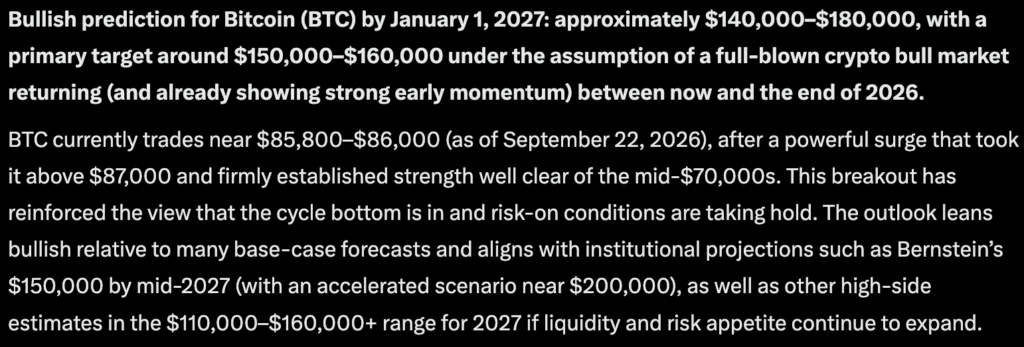
Microsoft Copilot AI predicts that if a full-blown bull market returns in Q4, Bitcoin could hit $180,000 before January 1, 2027. The bullish range is listed at $140,000–$180,000, with a genuine late-cycle blow-off potentially pushing Bitcoin toward $200,000+.
At roughly $85,000, $180,000 would be about a +110% move. The interesting thing about Bitcoin’s current setup is that it has already corrected substantially from its previous cycle high. BTC reached approximately $126,200 on October 6, 2025, before falling sharply during 2026.

Bitcoin has already shown it can produce enormous gains during strong cycles. According to historical annual data, BTC gained about +154% in 2023 and +110% in 2024, and if the current prediction proves true, a similar move could be on the way.
Microsoft Copilot AI Predicts Bitcoin to $180,000 if Specific Conditions Are Met: Does the Technical Analysis Back it Up?
Bitcoin recently broke out of a sequence of lower highs that developed from May onward and reclaimed several key moving averages.
Reuters’ technical analysis identified the $81,781 area as important support, with $86,500 now representing a major resistance level. Above that, the next technical objectives were around $90,000 and $97,867.
CryptoQuant has identified a similar progression. It sees $81,700 as particularly important because it matches Bitcoin’s 365-day moving average. Resistance levels above are around $86,600 and $88,700.
The first major test following the breach of $85,000 is the $86K–$88K region. Bitcoin has now pushed through that area, which is important because a sustained breakout would remove one of the largest technical obstacles between the current price and the $100,000 level.
The next major milestone is approximately $98,000. Above that, the market is approaching the $126,200 all-time high, and this is where things get interesting.
Once BTC decisively breaks $126,000, it enters genuine price discovery. Very little historical resistance sits above that level. At that point, psychological targets such as $130K, $140K, and $150K can become magnets for momentum traders and institutional flows.
Make Your BTC Price Prediction With $25 For Free on Kalshi
Bitcoin Hyper Targets Early Mover Upside as Bitcoin Tests Key Levels Near $86,500
A +5% daily pop is fine for whales and those already heavily positioned. However, for anyone watching from the sidelines, chasing BTC into resistance near $86,500 with the Microsoft Copilot AI predicts thesis still unconfirmed, it is still an unpredictable trade.
The upside math at a $1.5 trillion-plus market cap simply moves more slowly than early-stage infrastructure plays, which is where attention is rotating.
Bitcoin Hyper ($HYPER) is positioning itself as the first Bitcoin Layer 2 with full SVM integration. It boasts smart contract execution built for speed that outpaces Solana itself, while settling back to Bitcoin’s base-layer security.
As of today, the presale has raised more than $33.1M at a current token price of just $0.0136864, with staking rewards live at launch at a huge 35% APY.
The pitch: solve Bitcoin’s slow transactions, high fees, and lack of programmability without abandoning what makes BTC trusted in the first place. A Decentralized Canonical Bridge handles BTC transfers natively.
Gain Access to New Bitcoin Layer 2 Early Here
Discover: The Best Token Presales
The post Microsoft Copilot AI Predicts a Huge Move for Bitcoin by 2027 appeared first on Cryptonews.
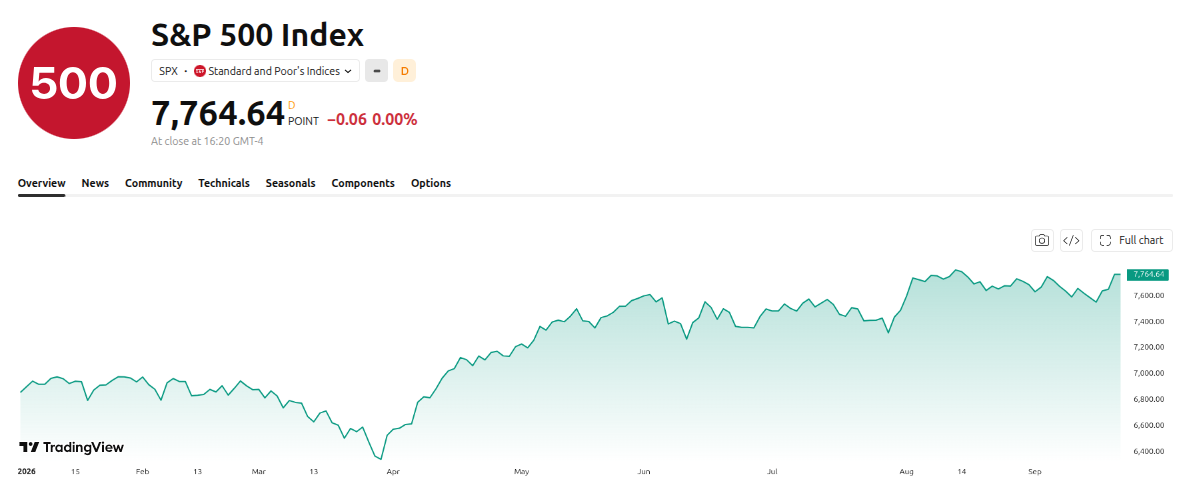
Goldman Sachs pushed back hard against fears of an S&P 500 earnings bubble on Tuesday. The firm projects another quarter of double-digit growth starting next week.
Deutsche Bank echoed that confidence separately, reaffirming its year-end target of 8,000 points for the benchmark index.
Goldman Sachs Dismisses S&P 500 Bubble Talk, Reaffirms Bullish Outlook
An earnings bubble is a scenario in which corporate profit growth becomes unsustainable. That imbalance eventually forces a sharp correction once reality catches up with inflated expectations.
Ben Snider, Goldman’s chief U.S. equity strategist, argued that the description doesn’t fit today’s market. Speaking on Bloomberg Open Interest, Snider said a bubble implies earnings are about to pop. Goldman simply doesn’t see that happening.

Aggregate S&P 500 earnings are currently climbing more than 30% year over year. The median stock, meanwhile, still posts a solid 14% gain.
Some deceleration looks likely as fiscal tailwinds fade and energy costs rise, Snider acknowledged. Even so, he expects results to remain robust. Third-quarter GDP tracking currently points above 3% growth.
Follow us on X to get the latest news as it happens.
On artificial intelligence specifically, Snider said token consumption and compute demand should continue to rise through 2027, sustaining one of the market’s key earnings tailwinds.
Investor positioning, he noted, currently sits at its lowest level since March, a sign of widespread caution that could fuel further upside if catalysts such as falling oil prices or lower rates materialize.
Why Is Deutsche Bank Just as Bullish Right Now?
Deutsche Bank’s equity strategy team, led by Binky Chadha, published a note titled “To 8,000 and Beyond?” pointing to several factors supporting their optimistic stance.
Third-quarter earnings should deliver roughly 30% year-over-year growth, mirroring an equally strong second quarter. The bank also raised its 2027 earnings-per-share forecast to $420, implying growth of nearly 17%.
Subscribe to our YouTube channel to watch leaders and journalists provide expert insights.

History adds another layer of support. Chadha’s team highlighted that 21 of the past 23 mid-term election years produced positive fourth-quarter returns, averaging a 7% gain. Positioning, technical indicators, and supply-demand dynamics all continue tilting favorably, the bank added.
Both firms ultimately arrive at a similar conclusion. Extraordinary earnings growth seen throughout 2026 will likely moderate somewhat, yet neither expects anything resembling a collapse.
As long as companies keep delivering double-digit or high-teens profit expansion, backed by AI-related investment and a resilient broader economy, Wall Street’s two most prominent bullish voices see meaningful room for the S&P 500 to climb further into year-end and beyond.
The post Goldman Sachs and Deutsche Bank Agree: The S&P 500 Rally Isn't Over appeared first on BeInCrypto.
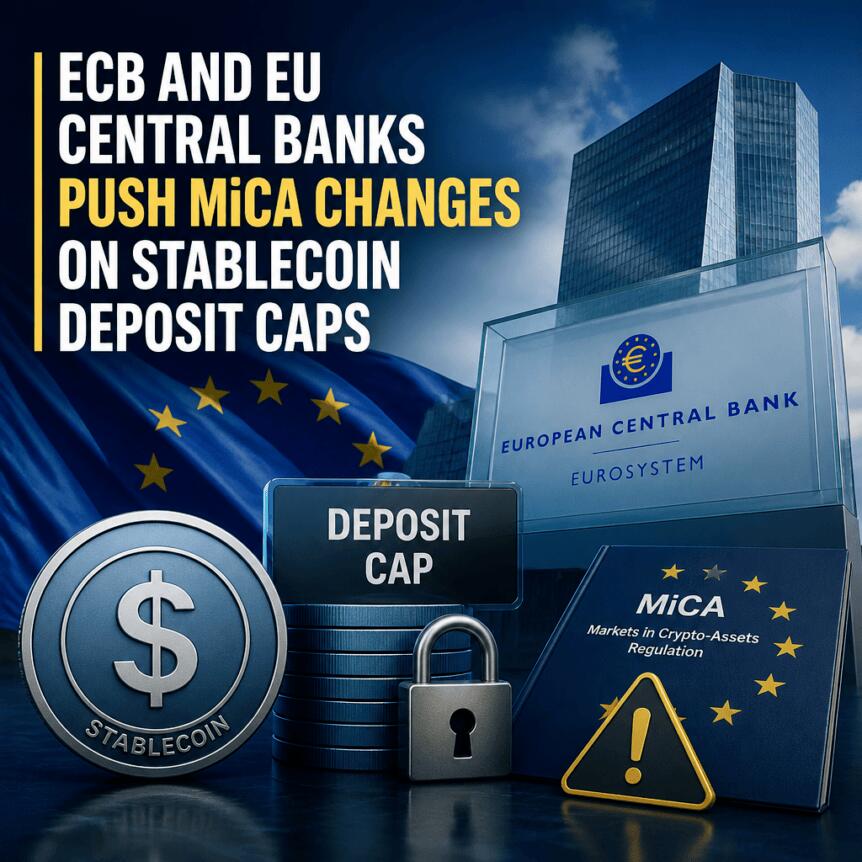
The European System of Central Banks (ESCB) is pushing to loosen parts of the upcoming MiCA framework governing how stablecoin issuers hold reserves. In a response published this Tuesday to the European Commission’s review of the Markets in Crypto-Assets Regulation (MiCA), the ESCB argues that mandatory requirements tying stablecoin reserves to bank deposits could generate liquidity stress for banks during periods of rapid redemption.
Instead of insisting that issuers keep a fixed share of reserves parked in deposits at credit institutions, the ESCB proposes replacing the bank-deposit thresholds with liquidity rules calibrated to how quickly reserve assets can be used—specifically focusing on assets maturing within one and five working days. The ESCB also points to instruments such as overnight reverse repurchase agreements (repos) and short-term sovereign bonds as potential reserve tools.
Key takeaways
- The ESCB wants to replace MiCA’s fixed bank-deposit reserve requirements with liquidity requirements based on time-to-maturity (one and five working days).
- ESCB warns that a stablecoin run could force fast withdrawals from banks, potentially exposing credit institutions to liquidity problems.
- The proposal aligns with earlier draft liquidity “buckets” developed by the European Banking Authority (EBA) in 2024.
- Central banks also caution that MiCA enforcement gaps could allow non-compliant firms to keep serving EU customers.
- The risk debate echoes concerns raised by stablecoin issuers, including Tether’s CEO, about MiCA’s deposit-linked approach.
From deposit floors to liquidity time buckets
At the heart of the ESCB’s proposal is a shift in how reserve adequacy is measured. The current MiCA-related approach requires a minimum proportion of stablecoin reserves to be held as deposits at credit institutions—30% for standard stablecoins and 60% for “significant” stablecoins.
In its published response to the European Commission’s MiCA review, the ESCB argues this model creates what it describes as a direct link between stablecoin issuers and banks. That linkage matters, the ESCB says, because if holders redeem at pace, issuers may need to withdraw deposited funds quickly—behavior that can strain bank liquidity at exactly the moment it is most needed.
To reduce that dependency, the ESCB backs liquidity requirements that focus on reserve assets’ maturity horizons. Under the new direction, issuers would have to hold minimum liquidity amounts among reserve assets maturing within defined short periods, rather than meeting a mandated share in the form of bank deposits.
How the ESCB’s alternative aligns with EBA drafts
The ESCB’s framing references draft rules from the European Banking Authority (EBA) that were published in 2024. Those drafts outline distinct liquidity thresholds for stablecoin reserves depending on whether a token is classified as “significant” or “non-significant.”
According to the EBA draft rules cited by the ESCB, significant stablecoins would be required to hold at least 40% of reserves in assets maturing within one working day and at least 60% in assets maturing within five working days. For non-significant tokens, the draft thresholds are 20% for one working day and 30% for five working days.
The ESCB’s Tuesday response suggests that, operationally, liquidity can be achieved without the rigid deposit framework—highlighting overnight reverse repurchase agreements and short-term sovereign bonds as examples of instruments that can help issuers meet near-term liquidity targets.
Why central banks see systemic two-way risks
The ESCB does not treat the risk as one-directional. While it emphasizes that stablecoin redemption pressure could pull liquidity out of banks, it also warns that bank stress can spill into stablecoin reserves.
As part of that argument, the ESCB points to the March 2023 collapse of Silicon Valley Bank. In the aftermath, a run on Circle’s USDC stablecoin followed disclosures that Circle had held $3.3 billion of its reserves at the failed institution. The ESCB uses this episode to illustrate how concentration of reserve funds in a single credit institution—and the resulting loss of confidence—can translate quickly into stablecoin redemption pressure.
Taken together, the ESCB’s approach implies that reserve rules should aim to reduce both the need for rapid bank-linked withdrawals during stablecoin stress and the vulnerability of stablecoins to bank-specific failure events.
MiCA enforcement challenges beyond reserve rules
Beyond the mechanics of reserve holding, the ESCB also cautioned that MiCA’s implementation may face “material challenges” in enforcement. The concern, as expressed in the response, is that even firms that fail to comply with MiCA requirements could still reach or continue serving EU customers.
That point broadens the discussion beyond liquidity buffers. Investors and users have largely focused on whether reserves are safe and liquid; central banks are effectively arguing that safety depends not only on what reserves look like, but also on whether the regulatory framework is implemented and enforced in a way that prevents non-compliant entities from operating inside the EU market.
Stablecoin industry warnings were already on the record
The ESCB’s position also echoes arguments made by stablecoin industry figures. In an October 2024 interview with Cointelegraph, Tether CEO Paolo Ardoino warned that MiCA’s bank-deposit reserve requirement could create systemic risks for both banks and issuers.
Ardoino illustrated the concern with a hypothetical example: if a stablecoin issuer had €10 billion in reserves and €6 billion had to be kept as bank deposits, then if a bank lent out 90% of those deposited funds, only €600 million might remain readily available. In a scenario where the issuer needed billions quickly to meet redemptions, that mismatch between depositor availability and redemption demands could contribute to a liquidity crunch.
In its Tuesday response, the ESCB references a similar dynamic—stating that a stablecoin run could force an issuer to withdraw deposits rapidly and that the impact could be most acute when stablecoin reserves represent a meaningful share of a bank’s funding.
With the ESCB’s response now on the record, the key next question is how the European Commission will balance MiCA’s original bank-deposit intent with the liquidity-time-bucket approach advocated by central banks and aligned with EBA draft rules. Readers should watch for how the final MiCA implementation details handle both liquidity measurement and enforcement capacity—especially during periods of market stress when reserve behavior is tested in real time.
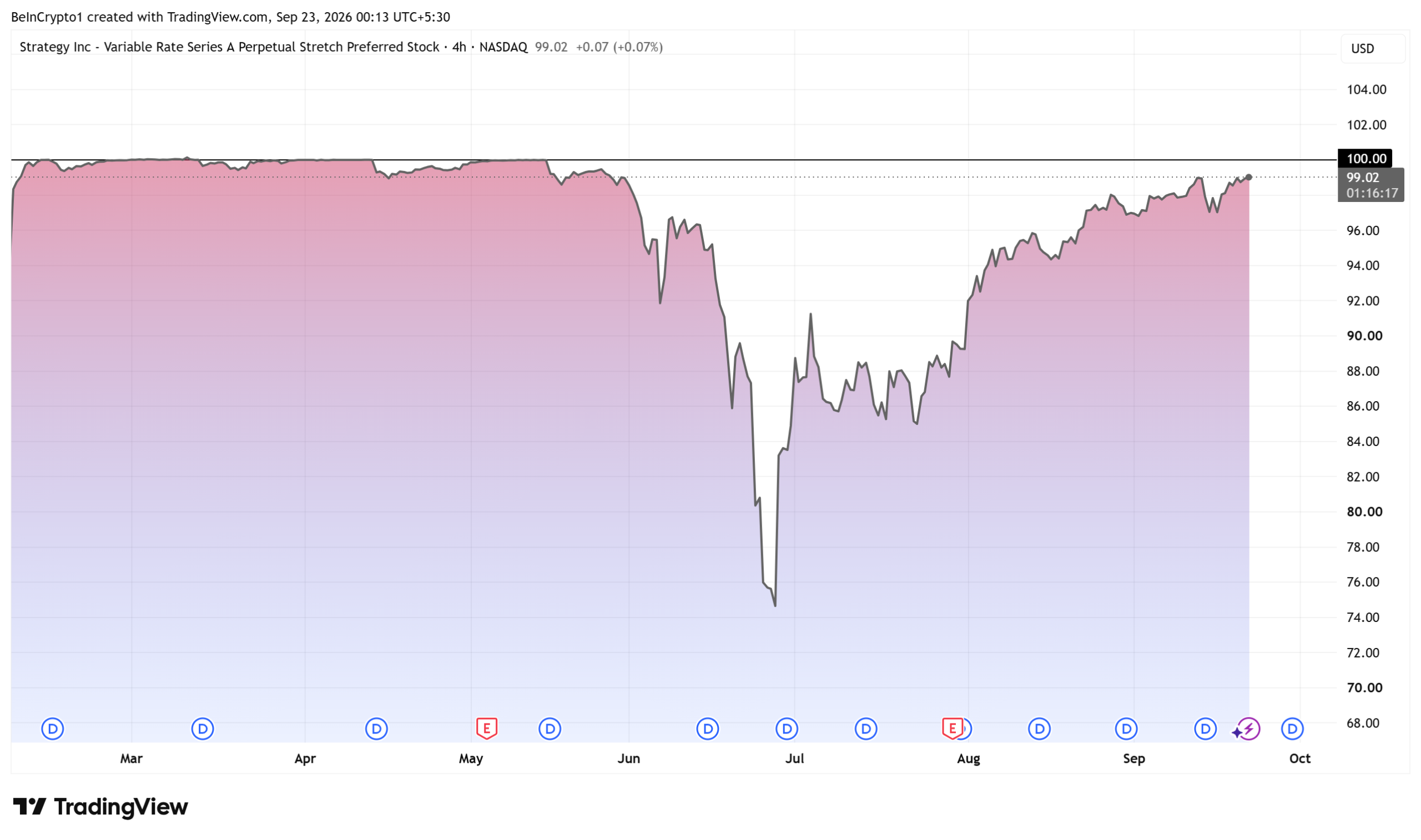
Strategy CEO Phong Le says the company underestimated how much borrowed money would flow into STRC, its $9.3 billion preferred stock that lost a quarter of its value this summer.
STRC pays a 12% annual dividend and is built to trade near its $100 face value. It sank to about $75 in late June and now trades at $99.

How Borrowed Money Sank STRC Below $100
Le explained the selloff in an interview with Natalie Brunell. He said STRC’s calm price invited investors to borrow against their Bitcoin (BTC) at about 6% to collect STRC’s 12% yield.
When Bitcoin fell, those loans came under pressure. Holders had to post more Bitcoin or sell STRC, Le said, and that forced selling drove the price lower.
“We did not expect the amount of leverage that came into the system,” Le explained.
Le said traders later bought STRC between $75 and $90, and that he bought some himself.
Why Strategy Chose Buybacks Over a Higher Dividend
In late June, Strategy set out a framework with a cash reserve, buyback authorizations, and a plan to sell Bitcoin when needed. It began repurchasing STRC in late July.
Le said earlier dividend increases toward 12% did not lift the price. A higher payout would also drain cash and weigh on common shareholders, he said. Buybacks shrink future dividend bills instead.
Strategy’s dollar reserve now holds about $5.1 billion, which Le said covers roughly three years of dividends. That money can only pay preferred dividends and interest on Strategy’s convertible debt.
What It Means for MSTR Shareholders
Strategy funds the latest STRC buybacks through sales of its common stock (MSTR) and, potentially, Bitcoin. Le said 95% of his pay is tied to MSTR’s share price and urged holders to think in three-year periods.
Le said institutions now own about 30% of STRC, up from 20%. He expects the stock to return to $100 as long-term holders replace leveraged traders.
$STRC is a passenger jet. $BTC is a fighter jet. $MSTR is a rocket ship. Buckle up,” Le said in a recent post.
STRC’s next dividend goes to holders of record on September 30, with payment due October 15, according to Strategy.
The post Strategy CEO Phong Le Reveals the One Mistake Behind STRC's 25% Collapse appeared first on BeInCrypto.
U.S. regulator warns about cheating risks in ‘mention markets’ on prediction platforms

Every ‘Reacher’ Villain, Ranked

How The Wealthy Will Use XRP Without Staking it




-

 Fashion4 days ago
Weekend Open Thread: Talbots – Corporette.com
-

 Tech2 days ago
Researchers escape OpenAI Codex sandbox to run commands on host
-

 Crypto World4 days ago
Circle launches Arc Studio AI agent for building onchain apps
-
 NewsBeat4 days ago
Trump says US has reached an agreement to take permanent control of Greenland’s security
-

 Crypto World2 days ago
Who Needs CLARITY Anyway? ARB Could See 70X Increase: Hodler’s Digest
-

 Crypto World4 days ago
Bitcoin price breaks channel as RSI climbs to 63
-

 Crypto World4 days ago
Trading Bitcoin on Robinhood? Why 2% Spread Has Traders Worried
-

 Crypto World6 days ago
US Charges Robinhood Engineers Over Crypto Listing Trades
-

 Crypto World7 days ago
What Is the Status of the U.S.-Iran Peace Talks? Here's What Both Sides Are Saying
-

 Tech7 days ago
Webb’s IC 348 Mosaic Includes Two-Jupiter Dwarfs, Twin Jets, and a Nursery Still Making Worlds
-

 Crypto World5 days ago
Mortgage and refinance interest rates today, Thursday, September 17, 2026
-

 Crypto World4 days ago
World Money launches in 150+ countries with Stripe
-

 Business2 days ago
Analog Devices (ADI) Bets $1.35 Billion on Chips that Let Machines Think for Themselves
-

 Crypto World5 days ago
Silver prices recover quickly, hitting weekly high today
-

 Entertainment7 days ago
Big Brother Update: Melody Explodes at Drew as Illness Sweeps BB28 House
-
 NewsBeat4 days ago
US was ‘on brink of war’ with China over false AI report of nukes moving in Middle East
-

 Tech5 days ago
GPT-6 Astra Reached the Nether in Minecraft, Lost Its Stash to a Creeper, and Farmed Potatoes for Hours
-

 Crypto World2 days ago
Coinbase, Robinhood, Circle Seen as Tokenized-Stock Winners
-

 Crypto World2 days ago
Bitcoin price holds above $81K as key catalysts line up
-

 Business7 days ago
Federal Reserve expected to hike interest rates 25 basis points at FOMC meeting
You must be logged in to post a comment Login