
Crypto World
Australia’s 40-year outlook names AI, omits crypto


Australia’s Treasury has placed artificial intelligence among five transitions expected to reshape the economy through 2065–66, while digital assets are absent from the report’s five headline themes.
Summary
- Australia’s 2026 Intergenerational Report identifies artificial intelligence as one of five major long-term economic transitions.
- Treasury says agentic AI systems are becoming more autonomous, capable and widely used across society.
- Crypto receives no focus in the 40-year outlook despite separate government digital finance initiatives underway.
- Australia’s Financial Innovation Strategy links AI agents with real-time, interoperable and programmable payment infrastructure needs.
- DFCRC estimates full digital finance adoption could generate A$24 billion in annual Australian economic gains.
Treasury published the seventh Intergenerational Report on Sept. 21, covering Australia’s economic and federal budget outlook for the next 40 years. The report identifies the AI revolution, geopolitical fragmentation, the energy transition, population aging and the country’s continuing move toward a services economy as its major transitions.
The government expects Australia’s economy to more than double in size by 2065–66, while real income per person is projected to rise 55%. Average annual economic growth is expected to slow as population growth and workforce expansion lose pace, leaving productivity as a larger part of the long-run growth equation.
Australia places AI among five long-term transitions
Artificial intelligence receives a dedicated place in the latest outlook, a change from the previous 2023 Intergenerational Report. Treasurer Jim Chalmers said AI represented the most dramatic technological change since that earlier report and would become a defining influence on the economy over the coming four decades.
Treasury’s analysis covers automation, changing skill requirements and the potential for AI to alter how existing jobs are performed. The report does not assume that every productivity gain will arrive automatically, with investment, technology adoption, skills and regulatory settings remaining part of its long-term economic assumptions.
Agentic AI receives particular attention. Treasury describes newer systems as increasingly capable of acting with less direct human involvement, while AI performance has surpassed human benchmarks in several tasks. The government’s separate financial innovation work defines agentic systems as software capable of taking actions, making recommendations or performing tasks for people and businesses.
Chalmers described the “AI revolution” as the biggest economic transformation of the current era during the report’s release. Treasury retained a long-run productivity assumption of 1.2% a year, while acknowledging that AI could change productivity, investment and labor-market outcomes in ways that remain difficult to quantify decades in advance.
Crypto sits outside the report’s five headline themes
Digital assets do not appear among the five transitions Treasury selected to organize its 40-year outlook. Coinbase Australia country director John O’Loghlen criticized the omission in comments supplied to Cointelegraph, arguing that future AI agents will require financial systems capable of supporting automated economic activity.
“The Intergenerational Report makes it clear that Australia’s prosperity over the next 40 years will depend heavily on our ability to adopt new technology and lift productivity,” O’Loghlen said. He argued that the report’s AI focus leaves out the financial infrastructure autonomous agents could use when making payments or conducting transactions.
The absence of crypto from the five-transition framework does not mean the Australian government has excluded digital assets from current economic policy. Treasury released a separate Financial Innovation Strategy on Sept. 3 that explicitly addresses digital assets, stablecoins, tokenization, digital money and AI-enabled financial services. Treasury described the strategy as a framework for coordinating government, regulators and industry as financial technology develops.
The strategy states that Australia has legislated a licensing framework for digital asset platforms and tokenized custody platforms, scheduled to begin on April 9, 2027. Payment reforms are expected to regulate payment stablecoins as tokenized stored-value facilities. Regulators will continue assessing legal and operational questions involving tokenized markets as those systems move toward commercial use.
As previously reported, Australia’s new digital asset licensing framework begins in April 2027, while businesses covered by existing financial-services requirements face separate licensing obligations under current law.
Treasury links AI agents with programmable payments
The Financial Innovation Strategy makes a direct connection between AI and payment infrastructure that is not central to the Intergenerational Report. Treasury states that advances in agentic systems could increase automated and machine-to-machine transactions.
Such activity could create demand for payment and settlement systems capable of real-time execution, interoperability and programmable services, according to the strategy. Treasury cautions that fully autonomous financial agents remain largely experimental and have not reached the reliability required for most real-world financial applications.
O’Loghlen said stablecoins and tokenized markets could become part of the rails used by agentic finance, while calling for clearer rules covering tokenized stored-value facilities. His comments represent Coinbase’s policy position, not a Treasury forecast that AI agents will necessarily use crypto assets.
Work elsewhere in the payments industry provides current examples of that model. Crypto.news has covered AI agents using stablecoins for automated payments through Visa-linked testing, while separate projects have explored programmatic machine payments through blockchain infrastructure.
Australia’s own payments planning has moved in a similar technical direction. As previously reported, Australia’s payment rails are being assessed for stablecoin interoperability, including possible connections between bank money and tokenized forms of value.
RBA keeps tokenized finance on its policy agenda
The Reserve Bank of Australia has continued developing its tokenized-finance work separately from the Intergenerational Report. In May, the RBA and Digital Finance Cooperative Research Centre released the final findings from Project Acacia, which tested 20 wholesale tokenized asset use cases across issuance, trading and settlement.
Tests covered different settlement assets, including existing central-bank balances, a pilot wholesale CBDC, commercial-bank deposit tokens and stablecoins. The project found possible efficiency, functionality and resilience benefits but identified questions involving legal certainty, settlement design, infrastructure and regulation that require more work.
DFCRC research estimates that full adoption of digital finance could generate as much as A$24 billion in annual economic gains for Australia. The estimate covers tokenized real-world assets, payments and other digital-finance applications and remains a modeled economic estimate, not realized economic output.
Crypto.news previously covered Australia’s estimated A$24 billion tokenization opportunity when the RBA moved from experimental work toward discussions about market implementation.
In September, the RBA opened another consultation examining how its Reserve Bank Information and Transfer System and Fast Settlement Service could support tokenized markets. The central bank is considering settlement between traditional accounts and tokenized private money, potential stablecoin access to central-bank reserves and future designs for tokenized reserves.
The RBA set Oct. 30, 2026 as the deadline for submissions to that consultation. Regulators plan to use the responses when assessing future RITS capabilities, while the government’s Financial Innovation Strategy schedules a digital financial market infrastructure sandbox for the second half of 2027.

We have been witnessing a strange paradox lately. Major news, including the CLARITY Act failure and the US interest rate hike, should be considered bearish for the cryptocurrency market, yet the latter has entered green territory with remarkable strength.
Ripple’s cross-border token has been a major beneficiary, with its price up 8% over the past week. Naturally, this resurgence has drawn comments from industry participants, many of whom believe the asset has much more room to grow in the near future.
What Now?
As of this writing, XRP trades around $1.53 (per CoinGecko), representing a 53% rebound from the local bottom of sub-$1 registered in mid-August. Other catalysts for its pump, besides the broader revival of the crypto market, include solid institutional interest. As CryptoPotato reported, spot XRP ETFs posted 10 consecutive green weeks as cumulative net inflows into such products exceeded $1.72 billion.
Another positive factor is the whales’ activity. Last week, renowned analyst Ali Martinez revealed that large holders have accumulated approximately 1.54 billion tokens (worth over $2.2 billion) in about 96 hours.
Several hours ago, he claimed that this demand has positively impacted XRP’s valuation, arguing that on-chain data suggests there may still be room to run. In his view, the URPD shows relatively little resistance ahead until $1.60, where around 2.5 billion coins previously changed hands.
“That’s the next major level I’m watching for potential profit-taking before looking for the next setup,” he concluded.
X user Diana also chipped in, outlining $1.61 as the next big resistance zone. She maintained that if XRP breaks and holds above, then $1.70 comes into play.
“If bulls clear $1.70 too, the chart opens toward the much bigger $2.20-$2.40 resistance zone,” the analyst predicted.
Veteran trader Peter Brandt and JAVON MARKS made even more optimistic bets. The former issued a long-term forecast of $5.40, while the latter believes that XRP can explode to $15 and above.
Time to Lose Some Steam?
As mentioned above, the past several days have been highly positive for the cryptocurrency market, which entered an up-only mode. However, prices cannot climb forever, making an eventual correction inevitable.
XRP’s Relative Strength Index (RSI) suggests such a move might be just around the corner. The ratio has jumped above 70, signaling that the asset has entered overbought territory. Conversely, readings below 30 are typically interpreted as buying opportunities.

The post Top Ripple Price Predictions as XRP Reclaims $1.50 appeared first on CryptoPotato.
Cointelegraph is committed to providing independent, high-quality journalism across the crypto, blockchain, AI, and fintech industries.
All news, reviews, and analyses are produced with full journalistic independence and integrity. For more details on our standards and processes, please read our Editorial Policy.
Crypto World
BioNTech Stock Recently Got Downgraded. But Is Wall Street Underestimating Its Cancer Pipeline?

BMO (NYSE: BMO) Capital Markets has been quite bullish about BioNTech SE (NASDAQ: BNTX) this year. However, that’s no longer the case.
On Sept. 8, 2026, BioNTech’s shares dipped after BMO downgraded the biotech stock from an “outperform” rating to a “market perform” rating. BMO also lowered its 12-month price target for BioNTech from $128 to $105.
Missed AI’s “Act 1”? Act 2 Could Be 15x Bigger. Most investors think they missed the AI boat because they didn’t buy Nvidia in 2005. But according to our analysts, we’re only at the end of “Act 1″—the R&D phase. “Act 2” is the global rollout. Continue »
There’s a simple explanation for BMO’s new take on BioNTech. But is Wall Street underestimating the company’s cancer pipeline?

What the downgrade got right — and wrong
It isn’t all that surprising that BMO Capital Markets is now significantly less optimistic about BioNTech’s near-term prospects than it once was. The global demand for BioNTech’s COVID-19 vaccines continues to wane.
BMO’s downgrade also followed a key setback in BioNTech’s pipeline. On Aug. 28, 2026, the company announced that it was canceling a Phase 2 clinical trial evaluating the personalized mRNA cancer vaccine BNT122-01 for the treatment of colorectal cancer. There weren’t any safety concerns, but the experimental therapy didn’t demonstrate statistically significant efficacy. As a result of the bad news, the company lowered its full-year revenue guidance to €1.6 billion to €1.9 billion from its previous forecast of €2 billion to €2.3 billion.
Investors were excited about BioNTech after Moderna (NASDAQ: MRNA) and Merck (NYSE: MRK) reported positive results from a late-stage study of Moderna’s personalized mRNA cancer vaccine intismeran autogene, in combination with Merck’s blockbuster immunotherapy Keytruda. However, the momentum has now nearly evaporated.
But the rest of BioNTech’s oncology pipeline shouldn’t be ignored. The company has over 25 Phase 2 and Phase 3 clinical studies evaluating experimental cancer therapies underway. It recently announced encouraging results from one of them, with gotistobart nearly doubling median overall survival compared with standard-of-care chemotherapy in previously treated patients with squamous non-small cell lung cancer (NSCLC).
BioNTech expects to report data from 11 other late-stage clinical studies by the end of 2029. These trials focus on multiple types of tumors, including breast cancer, gastrointestinal cancer, and lung cancer. Data from three studies will be announced before the end of this year.
Sept 22 (Reuters) – As China and the US race to build separate AI supply chains, investors are playing both sides, with US banks fundraising for AI upstarts in China and Chinese money flowing to US tech.
The stakes are sizable, with Wall Street banks acting as bookrunners on 19 Chinese high-tech equity capital market deals worth $17.2 billion so far this year, according to LSEG data, accounting for nearly 30% of the sector’s total issuance.
US stocks, particularly semiconductors, are also the favourite destination for China’s outbound mutual funds. The value of US equity held by Hong Kong residents and mainland Chinese has jumped 23% in the past year to top $750 billion, US data shows.
The financial connections, shown in public disclosures, enmesh the competitors in a rivalry analysts say is akin to the Cold War Space race. AI is likely to be in focus when leaders Donald Trump and Xi Jinping meet this week in Washington.
For investors, the mutual exposure is a safety net giving both sides an interest in keeping relations steady, and holding expectations low for the Trump-Xi meeting to break new ground.
It is also at risk of unwinding painfully if US-China relations deteriorate and further cleave AI development in two.
“US and Chinese businesses and investors continue to maintain connectivity and invest in each other despite highly volatile geopolitical conditions,” said Fred Hu, founder and chairman of private equity firm Primavera Capital Group.
“The forthcoming Trump-Xi Summit can hopefully inject more certainty and energy to the essential financial connectivity and broader economic relationship.”
US Treasury Secretary Scott Bessent said he and Chinese Vice Premier He Lifeng discussed setting up a US-China AI dialogue this week, with a notification system for common goals and threats.
FINANCIAL CONNECTIONS
The financial connectivity has held and deepened despite China’s pursuit of AI self-sufficiency and the US Pax Silica initiative, aimed at securing its AI supply lines.
Washington restricts the supply of top-line chips and chip-making technology to China and has restricted U.S. investment into sensitive AI-related sectors in China for several years.
But the investing rules contain a carve-out for publicly-traded securities and have not stopped Wall Street’s involvement in China’s AI listing boom, where investor interest is fuelled in part by China’ self-sufficiency drive.
Wall Street banks this year advised on more than a dozen AI and chip listings and follow-on share sales, LSEG data showed.

Upbit has placed Sophon (SOPH) under a trading warning and suspended deposits, while Binance has scheduled seven USDC spot pairs for removal on Sept. 25.
Summary
- Upbit placed SOPH under trading caution and halted deposits across KRW, BTC and USDT markets.
- The SOPH review runs until mid-October, with delisting possible if Upbit’s concerns remain unresolved afterward.
- Binance will remove seven USDC spot pairs on September 25 after reviewing liquidity and volume.
- Underlying tokens will remain tradable on Binance through other supported pairs after USDC markets close.
- Binance previously removed margin support for four of the seven affected USDC pairs this month.
Upbit designated SOPH as a trading-caution asset at 3:00 p.m. Korea Standard Time on Sept. 22, covering SOPH/KRW, SOPH/BTC and SOPH/USDT. The South Korean exchange cited shortcomings involving disclosure, changes to the token’s circulation plan and the procedures used to make those changes.
The exchange said its review found “numerous deficiencies” and a “potential for user harm.” SOPH deposits were blocked when the notice was published, while existing spot markets remain available during the assessment.
On Binance, a separate review produced a narrower action. Binance announced that AIXBT/USDC, DOLO/USDC, ENJ/USDC, HUMA/USDC, SXT/USDC, TNSR/USDC and TURTLE/USDC will stop trading at 03:00 UTC on Sept. 25. The exchange cited factors including “poor liquidity and trading volume.”
Upbit gives SOPH until mid-October for review
Upbit’s warning period runs from Sept. 22 through the second week of October, which the exchange defined as Oct. 12–16. During that window, the exchange will assess whether the concerns behind the designation have been addressed.
Three outcomes remain possible under Upbit’s process. The exchange can lift the warning, extend its review period or terminate trading support. Upbit said a final delisting decision could follow if the reasons for the warning are not fully resolved. Any extension or termination would be announced separately.
Deposits sent after the 3:00 p.m. KST cutoff will not be credited normally and are subject to return, according to the notice. Deposit-return processing is suspended while deposit support remains closed and would resume sequentially once the service becomes available.
The warning focuses heavily on information supplied to investors. Upbit said its assessment considered whether material information had been disclosed on time through appropriate electronic channels, the scale of changes to SOPH’s circulation plan and whether procedures governing such changes were sufficiently transparent and reasonable.
Upbit’s published post-listing framework explains that warning cases can involve project circumstances, technology, technical support and trading conditions. A project can have the warning lifted if the underlying problem is resolved, while unresolved concerns can lead to termination after a review period.
A recent example showed the other possible outcome. Crypto.news reported that Upbit removed a warning after reviewing the TAIKO security incident and project remediation measures in July. The exchange resumed deposits once it determined the issues behind the designation had been addressed.
Bithumb places SOPH under similar scrutiny
Upbit is not the only South Korean exchange reviewing SOPH. CoinNess reported on Sept. 22 that Bithumb had placed the token on a warning list over similar concerns involving disclosures, circulation-plan changes and the procedures surrounding them.
Bithumb’s action gives the case a second South Korean exchange review, though each platform controls its own trading-support decisions. Bithumb’s general policy states that assets placed under investment caution remain monitored and can ultimately lose trading support if identified problems are not corrected.
SOPH has already undergone infrastructure changes during 2026. Bithumb resumed SOPH transfers on July 28 after moving its supported deposits and withdrawals from the Sophon network to Ethereum. The exchange said the original Sophon network would no longer be supported for transfers after the switch.
Upbit temporarily halted SOPH deposits and withdrawals for another network transition beginning Sept. 8 and resumed them Sept. 11, according to the exchange’s announcement archive. The Sept. 22 warning does not state that either network migration caused its concerns about token circulation, so the two matters should not be treated as the same issue.
Separate scrutiny had emerged outside South Korea before Tuesday’s notices. As crypto.news reported, Binance placed SOPH under closer review in its August Monitoring Tag assessment of five tokens. Binance did not provide an asset-specific reason for SOPH at the time, and a Monitoring Tag does not itself remove the token from spot trading.
Upbit’s market data showed SOPH/KRW near 6.01 won during Sept. 22 trading, down 1.64% over 24 hours at the captured reading. The token had traded between 5.87 won and 6.11 won over that period. The data do not establish that Upbit’s warning caused the price movement.
Binance removal affects seven USDC pairs, not tokens
Binance’s Sept. 25 action operates differently from the SOPH warning. The exchange is removing individual quote pairs after a regular market review, not announcing a full delisting of AIXBT, DOLO, ENJ, HUMA, SXT, TNSR or TURTLE.
When trading ends at 03:00 UTC, users can continue buying or selling the underlying assets through other Binance spot markets where available. USDC remains supported as a Binance asset; the action concerns only the seven named order books.
Spot Trading Bot services attached to the seven markets will stop at the same time. Binance advised customers to disable or cancel affected bots before the cutoff to reduce the risk of unwanted outcomes when those markets close.
The exchange has used the same procedure repeatedly during September. In related coverage, crypto.news reported on Binance’s previous removal of four USDC spot pairs involving BREV, COOKIE, LA and QNT on Sept. 18. Each underlying token remained available through other supported Binance markets.
That process differs from a complete asset delisting. Binance’s phased removal of Pax Dollar from multiple exchange services, for example, includes separate deadlines for spot trading, deposits, withdrawals, margin, lending and other products. No comparable token-wide withdrawal schedule appears in Tuesday’s seven-pair notice.
Four affected pairs already lost Binance margin access
Several of the spot markets scheduled for removal have already been taken out of Binance Margin. The exchange removed AIXBT/USDC, SXT/USDC, TNSR/USDC and TURTLE/USDC from both cross and isolated margin trading on Sept. 3.
BREV/USDC was part of that earlier margin action but is not included in the Sept. 25 spot-pair announcement. DOLO/USDC, ENJ/USDC and HUMA/USDC appear in Tuesday’s spot notice but were not among the USDC pairs listed in Binance’s Sept. 3 margin removal.
Binance says its spot-pair reviews consider market quality and may remove individual order books when liquidity or trading volume falls below the exchange’s requirements. Tuesday’s announcement did not provide separate volume thresholds or pair-specific data explaining why each of the seven markets was selected.
For SOPH holders, the next scheduled checkpoint is Upbit’s review period during Oct. 12–16, unless the exchange extends it or announces another decision earlier. Deposits remain suspended while SOPH/KRW, SOPH/BTC and SOPH/USDT continue under the trading-warning designation.
For the seven Binance markets, spot trading and applicable bot services are scheduled to end at 03:00 UTC on Sept. 25. Binance has not announced deposit or withdrawal suspensions for the seven underlying tokens as part of this pair-removal notice.
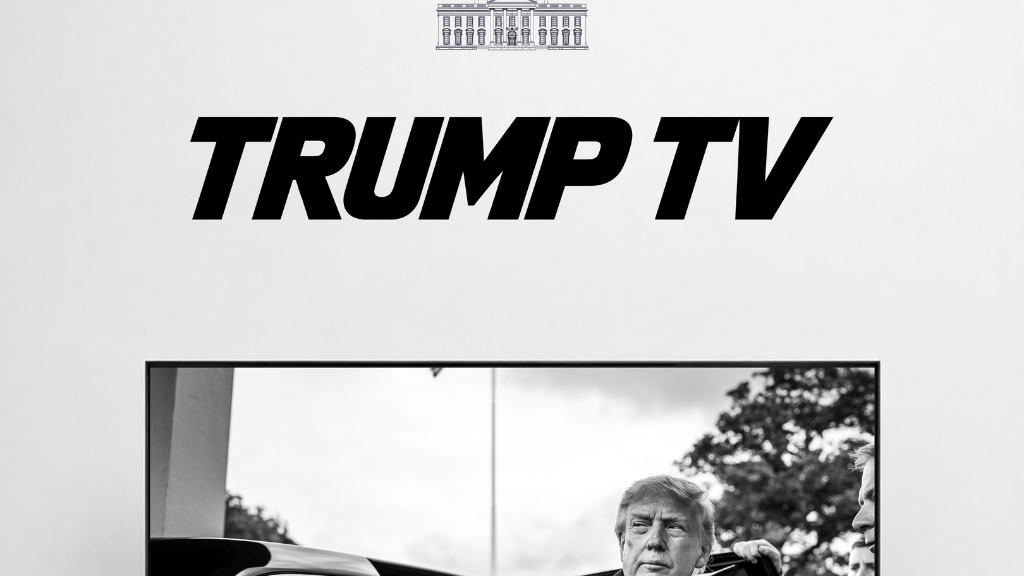
It’s unclear if the YouTube-hosted stream, called “Trump TV,” is meant to potentially fill the void of television pool coverage of the President’s events. But it went live at 7 p.m. ET, according to the White House, with a rerun of Trump’s speech at Mount Rushmore on July 3.
The White House described the stream as putting “top past moments, announcements, and the latest and greatest from the Administration all in one place.” In its social media post, the White House added: “Not every big moment has made it on your tv, now it can.”
Kaelan Dorr, a deputy assistant to the President and head of digital strategy at the White House, posted on social media about how Trump TV would show “the Administration’s greatest hits, unfiltered.” Dorr added: “The press, in some cases, reported inaccurately or not at all on the Administration’s many record breaking accomplishments on behalf of all Americans.”
CNN was supposed to shoot for the pool on Monday, with footage distributed to other networks, but it was one of the three organizations, alongside MS NOW and Politico, which were banned from the White House on Friday over their negative coverage of the President. The outlets have sued the Administration on free speech grounds, and, in seeming solidarity against the ban, ABC, CBS, CNN, Fox News, and NBC subsequently suspended television pool coverage of presidential events. “No Administration should restrict a news organization because it objects to its reporting,” their joint statement said.
Despite all the negative macro and industry developments that took place in the past week, bitcoin’s price went on an impressive run on Monday morning, surging to a new eight-month high of just over $87,000.
Here are some of the possible reasons behind this, but let’s start with why it was unexpected.
The Bad News
It was just a week ago that the US Senate was set to vote on advancing the key crypto market structure bill, the CLARITY Act. Without much fight, the Republicans lost the vote, and the legislation faced another major setback, although many experts believe this is not the end of it.
A day later, the situation for risk-on assets like BTC worsened when the US Federal Reserve hiked interest rates for the first time in over three years. Bitcoin’s price reacted with immediate declines, slipping to a three-week low of $75,000 on a couple of occasions.
However, the bulls showed resilience the following days and initiated a more impressive leg up on Friday. Although the Bank of Japan followed the Fed’s example, BTC rallied to just over $80,000. It climbed to $82,000 on Saturday, but another set of negative macro developments — escalating tension in the Middle East as well as more violent attacks exchanged by Ukraine and Russia — led to a brief correction to $80,300.
Monday, though, was a big day for the crypto markets. Despite all of the above, BTC skyrocketed by over seven grand from bottom to top and peaked at $87,400 (on Bitstamp), which became its highest price tag since late January.

How Come, BTC?
The most obvious reason behind the cryptocurrency’s spectacular ascent came from the ETF inflows. Data from SoSoValue shows that $998.95 million entered the funds on Monday alone, making it the single-best performance in nearly a year.
CryptoQuant’s analysis sheds further light on the situation. The analysts claimed that there’s more to the story, especially on the technical side. Spot demand worked in tandem with the ETF inflows, resulting in well over $340 million in shorts getting wrecked in a classic short squeeze.
They added that there wasn’t much resistance on the way up, as the URPD showed little historical activity between $80,000 and $85,000, which allowed BTC to “move through quickly.” Now, though, the asset has reached major resistance at $85,000 and $95,000.
“BTC needs ETF flows to follow through to push through this area. But the Coinbase Premium Gap has turned negative, suggesting U.S. spot demand has cooled. All eyes are on the U.S. session to see whether ETFs can deliver another strong day,” CQ predicted.
The post The Real Reasons Why Bitcoin Skyrocketed by $7K Daily: But Can the Rally Last? appeared first on CryptoPotato.

Ondo Finance has launched an in-kind conversion route that lets approved institutions mint and redeem Ondo Stocks with underlying shares through Alpaca’s Instant Tokenization Network.
Summary
- Approved institutions can now convert existing shares directly into Ondo Stocks through Alpaca’s tokenization network.
- Conversions are live on Ethereum and BNB Chain, with access granted case by case only.
- Institutions need active Ondo and Alpaca accounts before using the new in-kind conversion route directly.
- RWA.xyz tracks $3.63 billion in Ondo distributed assets across 441 products as of September 22.
- Ondo says using existing shares can reduce financing needs and improve secondary-market liquidity for institutions.
Ondo Finance said on Sept. 21 that the service is live on Ethereum and BNB Chain, adding a primary-market route alongside its existing cash-funded minting process. Access is limited to institutions approved by Alpaca case by case, and participants need active accounts with both companies before activation.
Ondo Finance lets institutions swap shares for tokens
For a mint, an approved institution transfers the underlying stock or ETF from its Alpaca account to Ondo’s Alpaca account through an internal book transfer. Ondo then issues the corresponding tokenized position on a supported blockchain. Redemption reverses the process, sending the underlying shares back to the institution’s Alpaca account after the tokens are redeemed.
Ondo said the integration removes the need for manual approval on each individual conversion. The company described the feature as a way for market makers to move existing inventory between traditional brokerage accounts and onchain venues without funding every token mint with separate cash.
The institutional route does not change the general terms for ordinary Ondo Stocks holders. Ondo’s current product documentation says the tokens are offered only to eligible non-U.S. persons through its platform and are unavailable there to U.S.-based clients. Ondo says its tokenized stocks provide economic exposure to referenced securities but are not themselves stocks, ETFs or ADRs and do not automatically give holders the right to receive the underlying securities.
Alpaca makes a similar distinction in its own tokenization disclosures. Its Instant Tokenization Network can create and burn tokens against brokerage-held shares, while third parties perform the tokenization. Alpaca states that tokenized assets generally provide economic exposure to equities and do not represent direct ownership of the underlying company unless a particular structure says otherwise.
The new Ondo arrangement creates a specific exception for institutions admitted to the conversion program. Approved firms can redeem their Ondo Stocks tokens through the ITN process and receive the corresponding shares back into their Alpaca accounts. Access therefore depends on institutional approval and the required accounts, not simply possession of the token.
In-kind conversion removes a separate cash step
Before this launch, an institution using Ondo’s cash-funded route could already own the underlying shares yet still need separate cash to mint matching Ondo Stocks tokens. Ondo said the new setup lets an approved participant contribute shares it already holds, removing the extra funding step.
The company said the model could reduce financing costs and timing mismatches when market makers need more tokenized inventory. Ondo described the expected outcome as “tighter spreads and deeper liquidity” in secondary markets, but it did not publish an independent spread study or post-launch liquidity figures alongside the announcement.
Alpaca describes ITN as infrastructure for instant in-kind minting and redemption against stocks held through brokerage accounts. Its platform says the network is designed to create and burn tokens against those shares without waiting for conventional settlement processes. Alpaca Clearing provides securities brokerage and custody and is a FINRA-regulated broker-dealer.
Conversions under the Ondo integration currently cover Ethereum and BNB Chain. Ondo Stocks themselves have a larger network footprint: Ondo’s product page lists Ethereum, BNB Chain and Solana, while its current website advertises more than 450 tokenized stocks and ETFs. The Sept. 21 in-kind announcement did not include Solana among supported conversion networks.
Ondo’s distributed asset value reaches $3.63 billion
Onchain data shows Ondo operating at a larger scale than the new conversion feature alone. RWA.xyz recorded $3.63 billion in distributed asset value for the Ondo platform as of Sept. 22, alongside 441 tracked products and 485,296 holder addresses. Monthly transfer volume stood at $1.58 billion.
The $3.63 billion figure covers RWA.xyz’s tracked Ondo platform assets and should not be treated as the value of Ondo Stocks alone. Network data on the same dashboard showed roughly $2 billion of Ondo assets on Ethereum, $407.1 million on BNB Chain and $300.6 million on Solana, with other Ondo assets distributed across several networks.
Ondo said in May that its tokenized stock platform had passed $1 billion in total value locked after launching in September 2025. At that point, the company reported more than 260 tokenized U.S. stocks and ETFs and $18 billion in cumulative trading volume. By June, Ondo said cumulative trading volume had moved beyond $20 billion.
Distribution has expanded through exchanges, wallets and DeFi protocols. As crypto.news reported, Ondo extended a group of tokenized U.S. stocks and ETFs to Hyperliquid’s HyperEVM, with 35 assets initially supported through that integration.
In related coverage, crypto.news reported that MetaMask had integrated more than 200 Ondo tokenized U.S. stocks and ETFs earlier in 2026, giving eligible mobile users access from inside the wallet.
U.S. tokenization rules continue to develop
The launch follows a Sept. 17 U.S. Securities and Exchange Commission order creating temporary, conditional exemptions for certain Tokenized Securities Venues. The framework permits qualifying venues to facilitate trading in tokenized National Market System stocks through permissioned automated market maker liquidity pools, subject to specified conditions.
Among the SEC’s conditions, a venue must verify that a tokenized NMS stock provides the same rights and privileges as the equivalent traditional stock. The framework requires notice to an underlying issuer for tokens created by an unaffiliated party, auditable public smart contracts and trading suspensions when the underlying stock is halted.
Ondo did not state that the Alpaca in-kind service operates under the SEC’s Innovation Exemption. Its current Ondo Stocks platform remains unavailable to U.S. persons through the main product unless registration or another applicable exemption permits an offering.
The company has pursued a separate U.S. regulatory path. In April, Ondo submitted a no-action request asking the SEC for assurance concerning a model where Ethereum would record tokenized security entitlements while Alpaca’s offchain books remained the official ledger. The proposal said underlying securities would remain within the existing brokerage and DTC custody structure.
Ondo described the Ethereum tokens as an operational layer over existing securities entitlements instead of a replacement for the regulated brokerage record.
Another infrastructure step came on Sept. 16, when DTCC confirmed that Ondo subsidiary Oasis Pro Markets had joined Fund/SERV as its first tokenization-platform member. DTCC said Fund/SERV processes transactions covering more than 85% of U.S. mutual fund activity, while Oasis Pro Markets is a U.S.-registered broker-dealer and FINRA member.
For the new Alpaca conversion route, Ondo has not announced a separate fee schedule, minimum conversion size, Solana activation date or timetable for opening ITN access more generally. Institutions seeking the service must maintain accounts with Ondo and Alpaca, complete the applicable onboarding process and request activation from both firms.

Ben Nadareski, CEO of Solana-based decentralized finance platform Solstice, said crypto markets are unlikely to return to the extreme boom-and-bust cycles as deeper liquidity brings stability to digital assets.
Speaking on Cointelegraph’s Chain Reaction show, Nadareski said liquidity across major crypto trading pairs has increased significantly, even during bear markets, reducing the conditions that produced sharp price swings seen in previous cycles.
He added that crypto is increasingly a market for institutional capital and household wealth rather than speculative trading.
“We don’t want to go through 2017. We don’t want to go through 2021. We don’t want to go through these massive fluctuations,” he said.
The comments come as institutional participation and deeper trading markets reshape crypto market structure, potentially tempering the volatility that defined earlier cycles.
Deeper markets could temper crypto volatility
Bitcoin market data supports Nadareski’s view that deeper markets have coincided with lower volatility.
A December 2025 report from blockchain analytics firm Glassnode and asset manager Fasanara Digital found that Bitcoin’s one-year realized volatility had fallen from 84.4% to 43%, which the firms attributed partly to growing market depth and institutional participation.
Daily Bitcoin spot volumes also increased to between $8 billion and $22 billion a day from $4 billion to $13 billion during the previous market cycle, according to the report.
Related: Bitcoin cycle bottom may already be in at $58K, says analyst James Check
Other industry participants have also argued that institutional capital is changing crypto cycles.
In March, SkyBridge Capital managing partner Anthony Scaramucci said Bitcoin’s four-year cycle had been “muted” by institutional investors and spot Bitcoin ETF inflows, though he argued the traditional cycle had not disappeared entirely.
Nadareski says Solana stablecoins could push toward $100 billion
Nadareski, whose company operates within the Solana ecosystem, also predicted growth in the network’s stablecoin market.
He said that the value of stablecoins on Solana could rise above $50 billion and approach $100 billion over the next five years, citing growing adoption among fintech companies and Solana’s transaction speed and low fees.
Solana currently has about $16 billion in stablecoin market capitalization, according to DefiLlama.
Stablecoins have also become an increasingly significant source of liquidity across crypto markets. According to CEX.IO data, stablecoins accounted for 75% of total crypto trading volume in the first quarter of 2026, the highest share on record, while transaction volume surpassed $28 trillion.
Magazine: Kyle Samani predicts SOL flippening, claims ‘no one’ uses ETH
Securitize stock could nearly double over the next year, according to Cantor Fitzgerald. The firm set a $21.20 price target, marking a 95% upside from Friday’s close of $10.86.
Cantor opened coverage on Monday at an overweight rating, putting a Wall Street number on a company that turns stocks and funds into blockchain tokens.
A $39 Billion Start in a $319 Trillion Market
Analyst Gareth Gacetta placed Securitize near the start of a long runway. Cantor estimates roughly $39 billion in assets are sitting onchain today, equal to 0.01% of the $319 trillion held in traditional financial assets.
“Tokenization is the largest overhaul financial infrastructure has seen over the past century, and Securitize is the public company covering most of that lifecycle, issuing, registering, custodying, distributing, and enabling trading of the asset under a single roof,” Gacetta said.
Gacetta added that if the world goes onchain, a large share of it goes onchain through Securitize. Independent data supports the position, if not yet the scale.
RWA.xyz ranks Securitize as the largest tokenization platform by distributed asset value at $4.64 billion, ahead of Ondo’s $3.63 billion.
The tracker counts 1,877 holders across 26 tokenized assets, while monthly transfer volume reached $1.12 billion, up 178% from a month earlier.
Follow us on X to get the latest news as it happens
The Rally Started With a Rule Change
Cantor’s note landed on a stock already moving. The Securities and Exchange Commission (SEC) announced a temporary order on Thursday. The regulator has drawn a path for select venues to issue tokenized representations of publicly traded US equities.
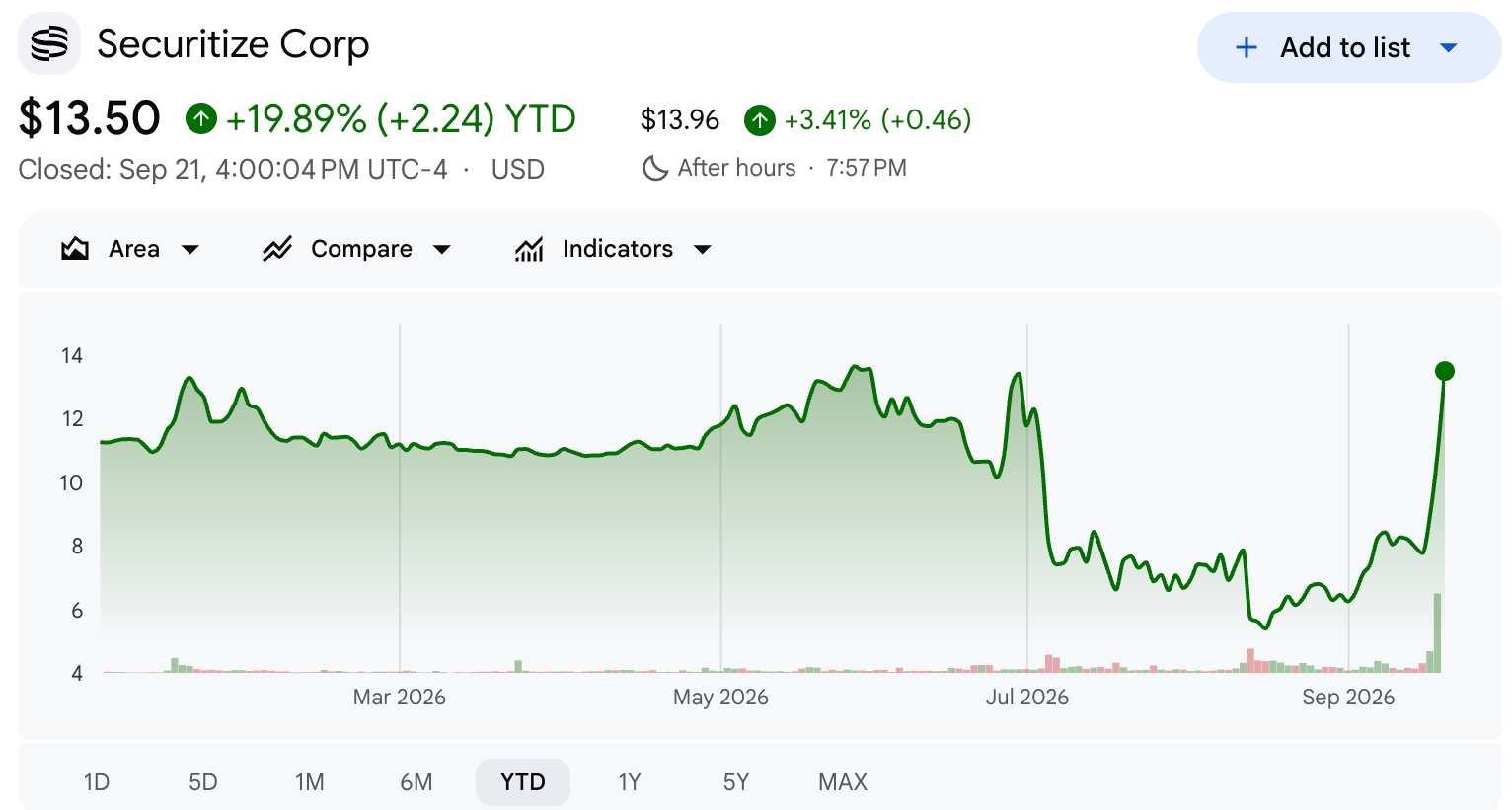
The ruling had already lifted the shares 14%. Monday’s initiation added to that momentum. The stock closed at $13.50, a gain of about 24% on the day, and traded near $13.96 after hours.

The rally also ate into the call itself. Measured from Monday’s close rather than Friday’s, $21.20 implies roughly 57% upside. Securitize is up 19.89% so far this year, with substantial ground covered in the past four sessions.
Subscribe to our YouTube channel to watch leaders and journalists provide expert insights
The post Cantor Fitzgerald Flags 95% Upside in the Firm Putting Stocks Onchain appeared first on BeInCrypto.
UK politics latest: Burnham says he will find ‘common ground’ with Trump in first meeting

Agree Realty: Perfect Balance, Limited Appeal Of Fixed Income (NYSE:ADC)
Top Ripple Price Predictions as XRP Reclaims $1.50

Weekend Open Thread – Corporette.com

Weekend Open Thread: Talbots – Corporette.com

Memory prices are slowing because buyers ran out of money

Salary badh rahi hai…. #finance #1croregoal #investment #financialeducation #mindset #financial

Bull vs Bear Personal Finance 101 #personalfinance

HUGE CLARITY ACT NEWS! DEMOCRATS MEET TO DISCUSS CRYPTO BILL & TRUMP MEETS WITH ETHICS ADVISORS!
-
 Fashion4 days ago
Weekend Open Thread: Talbots – Corporette.com
-

 Tech1 day ago
Researchers escape OpenAI Codex sandbox to run commands on host
-

 Crypto World7 days ago
Robinhood engineers charged over $50K crypto scheme
-

 Crypto World3 days ago
Circle launches Arc Studio AI agent for building onchain apps
-
 NewsBeat3 days ago
Trump says US has reached an agreement to take permanent control of Greenland’s security
-

 Crypto World3 days ago
Bitcoin price breaks channel as RSI climbs to 63
-

 Crypto World1 day ago
Who Needs CLARITY Anyway? ARB Could See 70X Increase: Hodler’s Digest
-

 Crypto World5 days ago
US Charges Robinhood Engineers Over Crypto Listing Trades
-

 Crypto World6 days ago
What Is the Status of the U.S.-Iran Peace Talks? Here's What Both Sides Are Saying
-

 Crypto World3 days ago
Trading Bitcoin on Robinhood? Why 2% Spread Has Traders Worried
-

 Tech6 days ago
Webb’s IC 348 Mosaic Includes Two-Jupiter Dwarfs, Twin Jets, and a Nursery Still Making Worlds
-

 Crypto World3 days ago
World Money launches in 150+ countries with Stripe
-

 Crypto World4 days ago
Silver prices recover quickly, hitting weekly high today
-

 Entertainment6 days ago
Big Brother Update: Melody Explodes at Drew as Illness Sweeps BB28 House
-

 Crypto World4 days ago
Mortgage and refinance interest rates today, Thursday, September 17, 2026
-
 NewsBeat4 days ago
US was ‘on brink of war’ with China over false AI report of nukes moving in Middle East
-

 Crypto World1 day ago
Bitcoin price holds above $81K as key catalysts line up
-

 Tech4 days ago
GPT-6 Astra Reached the Nether in Minecraft, Lost Its Stash to a Creeper, and Farmed Potatoes for Hours
-

 Business6 days ago
Federal Reserve expected to hike interest rates 25 basis points at FOMC meeting
-

 Crypto World3 days ago
CFTC sends crypto market structure rulemaking to White House
You must be logged in to post a comment Login