

Crypto World
Automated platforms for smarter profits



Disclosure: This article does not represent investment advice. The content and materials featured on this page are for educational purposes only.
AI trading bots gain traction in 2026 as traders rely on automation to manage fast-moving stock and forex markets.
Summary
- AI trading bots gain traction in 2026 as traders use automation to manage volatility across stocks, forex, and crypto.
- Platforms like BulkQuant, MetaTrader 5, and QuantConnect offer no-code tools, signals, and algorithmic trading systems.
- Focus shifts from profit promises to disciplined, data-driven execution, reducing emotional decision-making in fast markets.
As global financial market volatility rises in 2026, the intraday rhythm of stock and forex trading has become harder for human traders to manage alone. Price shocks can appear within seconds, macroeconomic data can change currency direction quickly, and stock indexes may react sharply to earnings, rate expectations, sector rotation, or geopolitical headlines.
For day traders, swing traders, and more systematic market participants, the problem is no longer just finding information. The harder task is processing that information fast enough, applying a consistent strategy, and avoiding emotional mistakes when markets move against expectations.
That is why AI trading bots are gaining attention across stocks and forex.
Their core value is not the illusion of “guaranteed profits.” A serious AI trading bot should not be judged by bold promises. Its real value is process discipline: using rules, signals, data analysis, automation, and risk controls to reduce emotional decision-making and help traders identify probability-based opportunities in large volumes of market data.
This guide reviews nine AI trading bots and automated trading platforms for stocks and forex in 2026. Each platform serves a different type of user, from beginners who want a guided dashboard to active traders, forex users, no-code strategy builders, and advanced quant researchers.
9 AI trading bots for stocks and forex to watch in 2026
- BulkQuant — 9.3/10
A guided AI trading automation platform for users who want managed workflows across crypto, forex, and stock market scenarios without building a technical system from scratch. - Capitalise.ai — 9.0/10
A code-free automation platform for traders who want to turn plain-language stock or forex scenarios into testable automated workflows. - TrendSpider — 8.8/10
A technical analysis and strategy automation platform for traders who want AI-assisted charting, no-code strategy testing, alerts, and bots. - Trade Ideas — 8.7/10
A real-time AI stock market radar for active traders who need fast scanners, AI signals, paper trading, and backtesting. - MetaTrader 5 — 8.6/10
A widely used multi-asset trading platform for forex and stock market users who want Expert Advisors, signals, VPS hosting, and strategy testing. - cTrader Automate — 8.4/10
A forex-focused automation environment for traders who want cBots, cloud-based algos, and broker-connected execution. - SignalStack — 8.2/10
An alert-to-order automation bridge for traders who want to turn signals from charting platforms into live broker orders. - QuantConnect — 8.1/10
A research-grade algorithmic trading platform for users who want to backtest, refine, and deploy systematic stock and forex strategies. - Tickeron — 8.0/10
An AI stock robot and idea engine for users who want machine-learning-based signals, pattern recognition, and stock or ETF trade ideas.
What makes an AI trading bot useful for stocks and forex?
A useful AI trading bot is not simply a piece of software that places orders.
In stock and forex trading, automation can serve several different roles. Some platforms scan markets and generate signals. Some allow users to build rules without code. Some execute alerts through brokers. Some offer research, backtesting, and paper trading. Others provide a more managed dashboard for users who do not want to build their own system.
The right choice depends on the trader’s workflow.
A stock trader may need real-time scanners, earnings alerts, AI stock signals, or technical pattern recognition. A forex trader may need currency-pair monitoring, macro-sensitive alerts, low-latency execution, and risk controls around leverage. A systematic trader may need historical testing, broker integration, and strategy development tools.
Before choosing any AI trading bot for stocks or forex, users should ask:
- Does the platform support stocks, forex, or both?
- Does it generate signals, execute orders, or only test strategies?
- Does it connect to a regulated broker?
- Are risk settings visible?
- Does it support paper trading or backtesting?
- Can users understand the strategy logic?
- Are fees and account rules clear?
- Does the platform avoid guaranteed-profit claims?
The strongest platforms are not always the most aggressive ones. They are the tools that make trading decisions easier to inspect.
1. BulkQuant — 9.3/10
BulkQuant earns the highest score in this list because it is built around a broader idea than a single-market trading bot. Instead of asking users to assemble every part of an automated trading system by themselves, BulkQuant presents a more guided AI trading environment that can support crypto, forex, and stock market workflows.
For users comparing AI trading bots for stocks and forex in 2026, this matters. Many platforms offer signals, scanners, APIs, or chart automation, but the user still has to connect the pieces. BulkQuant focuses on a managed workflow, giving beginners and less technical traders a clearer way to review automation before using it more seriously.
Its stronger appeal is accessibility. A user does not need to start by coding an algorithm, renting a server, building API connections, or manually testing every execution rule. The platform is more suitable for users who want dashboard-based access, expert-supported workflow guidance, and multi-market automation exposure.
BulkQuant may be especially relevant for users who want AI trading bots for stocks and forex but also want to understand how crypto market movement connects with broader risk sentiment. Since forex, stocks, and digital assets often react to the same macro forces, a multi-market platform can feel more practical than a tool locked into one narrow asset class.
Eligible new users may receive a $10 instant reward plus $50 in free trial credit. Users can compare plan information here:
review BulkQuant trading plans and trial access
The score reflects BulkQuant’s guided workflow, no-code accessibility, multi-asset positioning, and beginner-friendly structure. The main point users should understand is that BulkQuant is not a guaranteed-income product. It is better viewed as a structured AI trading workflow for users who want a more accessible way to explore automation.
2. Capitalise.ai — 9.0/10
Capitalise.ai scores highly because it solves one of the most common problems in trading automation: most traders can describe a strategy, but they cannot always code it.
Its platform is built around plain-language automation. Instead of forcing users to write scripts, Capitalise.ai lets traders create strategy conditions in natural language, test them, simulate them, and monitor them. For stock and forex traders who think in scenarios, this is a useful bridge between discretionary trading and rule-based execution.
For example, a forex trader may want to define a rule around EUR/USD after a central bank announcement. A stock trader may want to trigger an alert or action when a stock breaks a technical level after earnings. Capitalise.ai is designed for this type of conditional thinking.
The platform’s value is not just that it removes code. Its value is that it forces traders to express their ideas clearly. That can be useful because vague trading ideas often become inconsistent decisions in live markets.
Capitalise.ai fits users who want to keep control over their strategy logic but do not want to become developers. Its 9.0 score reflects its no-code structure, practical automation model, and usefulness for both stock and forex scenarios.
3. TrendSpider — 8.8/10
TrendSpider is one of the more useful platforms for traders who still rely heavily on charts but want fewer manual steps. It is less about replacing the trader and more about making technical analysis faster, more consistent, and easier to test.
The platform combines automated technical analysis, market scanners, alerts, strategy testing, chart pattern tools, and no-code trading bots. For stock traders, this can help identify setups faster. For forex traders, it can make technical condition monitoring more systematic across currency pairs.
TrendSpider’s advantage is that it helps convert chart habits into repeatable workflows. A trader who normally draws support and resistance manually, watches breakouts, or monitors moving-average conditions can use TrendSpider to reduce repetitive work and test whether those rules have historical value.
Its score reflects strong chart automation, no-code strategy testing, and broad usefulness for technically driven traders. It may be less ideal for users who do not use charts at all, but for active traders who rely on price action, it brings real workflow value.
4. Trade Ideas — 8.7/10
Trade Ideas is best understood as an AI-powered radar for active stock traders. It is not trying to be a full forex automation suite. Its strength is stock market discovery, especially when traders need to find movement quickly.
Active stock traders often need to monitor unusual volume, momentum shifts, intraday breakouts, earnings reactions, and sector rotation. Trade Ideas helps narrow that universe through real-time scanning, AI signals, paper trading, backtesting, and market alerts.
The platform’s value is speed plus filtering. It does not replace a trading plan, but it can reduce the time traders spend looking for candidates. This is why it remains relevant for users searching for AI stock trading bots in 2026.
Its 8.7 score reflects strong stock-market specialization, real-time scanning capability, and active-trader utility. The lower score compared with broader platforms comes from its narrower forex relevance.
5. MetaTrader 5 — 8.6/10
MetaTrader 5 remains important because it is one of the most familiar automation environments in forex trading. While newer AI platforms may look more modern, MT5 still has a large ecosystem of Expert Advisors, indicators, signals, VPS hosting, and broker-connected execution.
For forex traders, MT5’s appeal is its infrastructure. Users can test strategies, run trading robots, subscribe to signals, access market tools, and work with developers through the broader MQL5 ecosystem. It is also used across forex and some stock market environments, depending on broker support.
The platform is flexible, but that flexibility creates responsibility. Not every Expert Advisor is reliable. Not every signal provider is worth following. Users must evaluate robots, broker execution, spreads, leverage, slippage, and historical performance claims carefully.
MT5 receives an 8.6 because it remains a serious automation environment for forex and multi-asset traders. It is powerful, but less beginner-friendly than newer dashboard-first platforms.
6. cTrader Automate — 8.4/10
cTrader Automate is relevant for forex and CFD traders who want a broker-connected algorithmic trading environment. It is not as beginner-oriented as a simple AI trading app, but it offers a strong framework for users who understand automated execution.
The platform’s automation ecosystem is centered around cBots, indicators, and broker-connected execution. For forex users, this can be valuable because the platform is designed with trading infrastructure in mind rather than only signal discovery.
cTrader’s strength is that it gives more technical traders a clean route into automated forex strategies. Users can explore cBots, run algorithmic tools, and use broker-supported execution paths depending on availability.
Its 8.4 score reflects solid forex automation relevance, broker connectivity, and algorithmic flexibility. It scores slightly lower because it requires more technical understanding than beginner-focused AI trading bot platforms.
7. SignalStack — 8.2/10
SignalStack has a different role from most platforms on this list. It is not mainly a stock scanner, forex robot, or AI idea engine. It is an execution bridge.
Many traders already generate alerts from tools such as TradingView, TrendSpider, or other charting platforms. The problem is that an alert still needs to become an order. SignalStack helps automate that step by turning supported alerts into broker orders.
This makes it useful for traders who already have a tested signal system but want faster execution. A stock trader can use it to reduce manual order placement. A forex or CFD trader may use it to connect alerts to live execution depending on broker and instrument support.
SignalStack receives an 8.2 because it solves a specific automation problem well. Its limitation is that it depends heavily on the quality of the signal source. If the underlying alert logic is weak, faster execution will not fix the strategy.
8. QuantConnect — 8.1/10
QuantConnect is best described as a research lab for algorithmic traders. It is not a plug-and-play AI trading bot, and it is not designed for users who want a simple dashboard. Its value is in serious strategy development.
QuantConnect allows users to research, backtest, refine, and deploy systematic strategies across multiple asset classes, including equities and forex. For developers and quant researchers, this makes it one of the strongest environments for building deeper trading systems.
The platform is useful for users who want to ask more serious questions: How did this strategy behave across different regimes? What happens under different volatility conditions? Does the strategy survive costs, drawdowns, and parameter changes?
Its 8.1 score reflects strong research depth, free backtesting value, and multi-asset flexibility. It scores lower for general users because it requires coding ability, testing discipline, and patience.
9. Tickeron — 8.0/10
Tickeron is an AI stock idea engine built around AI Robots, AI signals, stock screeners, trend tools, and pattern recognition. It is more stock-focused than forex-focused, but it still deserves a place on this list because it directly targets the AI stock trading bot audience.
Tickeron is useful for traders who want machine-learning-generated stock and ETF ideas without manually scanning every chart. It can help users discover pattern-based setups, trend signals, and robot-generated trading ideas.
The platform’s strength is idea discovery. It can give traders a more structured way to review potential opportunities, especially in stocks and ETFs. Its limitation is that users still need to decide whether those ideas fit their time horizon, risk tolerance, and broader market view.
Tickeron receives an 8.0 because it is relevant for AI stock signals and robot-generated ideas, but it is less balanced for users who need serious forex automation.
What traders should check before using AI trading bots
Before using any AI trading bot for stocks or forex, users should review:
- supported markets;
- broker connections;
- account rules;
- fees and spreads;
- subscription costs;
- paper trading availability;
- backtesting quality;
- live execution rules;
- risk settings;
- leverage exposure;
- platform transparency;
- local regulatory requirements.
Users should also ask whether the platform actually fits their experience level. A beginner-friendly dashboard and a research-grade coding environment are very different tools.
Final thoughts
The best AI trading bots for stocks and forex in 2026 are not all solving the same problem.
BulkQuant focuses on guided, managed multi-market workflows. Capitalise.ai turns plain-language trading ideas into automated scenarios. TrendSpider helps chart-focused traders build technical automation. Trade Ideas gives active stock traders AI-powered market scanning. MetaTrader 5 and cTrader remain important for forex robots and broker-connected execution. SignalStack connects alerts to live orders. QuantConnect gives advanced users a research lab for systematic strategies. Tickeron helps stock traders explore AI-generated ideas and patterns.
For traders looking for smarter profits, the key is not to chase the loudest AI promise. It is to choose the platform that matches the trading workflow, test carefully, review risk, and understand what the tool can and cannot do.
Automation can improve structure. It can reduce manual workload. It can help traders follow rules more consistently.
But it cannot guarantee results.
FAQ
What are the best AI trading bots for stocks and forex in 2026?
Some of the most relevant platforms include BulkQuant, Capitalise.ai, TrendSpider, Trade Ideas, MetaTrader 5, cTrader, SignalStack, QuantConnect, and Tickeron. Each platform serves a different workflow, from guided automation and no-code trading to forex robots, alert execution, and quant research.
Which AI trading bot is best for beginners?
BulkQuant may fit beginners who want a guided AI trading workflow. Capitalise.ai may fit users who want plain-language automation. TrendSpider may fit chart-focused traders who prefer no-code strategy tools.
Which platform is best for forex automation?
MetaTrader 5 and cTrader are two major forex automation environments. MetaTrader 5 is widely used for Expert Advisors and forex signals, while cTrader supports cBots and broker-connected algorithmic trading.
Which platform is best for stock trading signals?
Trade Ideas and Tickeron are more stock-focused. Trade Ideas is useful for active traders who want scanners and AI signals, while Tickeron is useful for AI stock robots, pattern tools, and stock or ETF ideas.
Can AI trading bots guarantee profits?
No. AI trading bots cannot guarantee profits. They can help scan markets, automate workflows, test strategies, or execute signals, but stocks and forex remain risky and unpredictable.
What should users check before using automated trading platforms?
Users should check fees, broker connections, account rules, risk settings, leverage exposure, backtesting quality, paper trading access, market support, and whether the platform avoids unrealistic profit claims.
Risk disclosure
AI trading bots, automated trading platforms, forex robots, stock scanners, signal tools, and algorithmic trading systems involve substantial risk. Stocks, forex, CFDs, crypto assets, futures, options, and other financial instruments can move quickly and may result in significant losses.
Past performance, backtesting, paper trading, AI signals, strategy examples, marketplace rankings, copy trading results, or platform demonstrations do not guarantee future performance. Automated tools can execute losing strategies quickly, and market conditions may change without warning.
Users should review all platform terms, broker rules, account settings, fees, spreads, leverage exposure, risk controls, and local legal requirements before using any trading automation tool. Users should only trade with funds they can afford to lose and should consider independent financial advice where appropriate.
Disclosure: This content is provided by a third party. Neither crypto.news nor the author of this article endorses any product mentioned on this page. Users should conduct their own research before taking any action related to the company.

Crypto World
Leveraged Launches the Leveraged Cup to Trade Your Way to the World Football Final in New York

[PRESS RELEASE – Limassol, Cyprus, June 16th, 2026]
Leveraged, a prop trading firm empowering anyone to become a trader, announced the launch of the 2026 Leveraged Cup, a trading competition running from June 17-30. The overall winner will receive an all-expenses-paid Champions Package valued at $20,000 for the World Football Final in New York in July.
The Leveraged Cup invites traders worldwide to compete using Leveraged’s Sprint accounts, trading accounts designed for those who can capitalize on quick movements in the market. The competition challenges users to compete by achieving the highest percentage return over the two week span of the competition. The final four top traders will go head to head in a live-streamed Final Four Sprint 2 Cash competition, and the winner will receive the Grand Prize Champion’s Package with two tickets to the world football final, flight, and accommodations. In addition $200 prizes will be distributed to the daily winner to host friends for the match of a lifetime and become a Legendary host.
The competition is open to eligible traders who buy a Sprint account with a trading range from $10,000 to $100,000. Over the 15-day competition, participants will battle for leaderboard positions based strictly on payout percentages in their Sprint accounts. Traders can buy multiple Sprint accounts, and their highest payout percentage is their score. Throughout the tournament, traders will be ranked by percentage growth rather than nominal profit, aligning with Get Leveraged’s core value that trading talent should not be limited by capital size.
The competition will feature:
- The Grand Prize Champions Package, two tickets to the world football final, flight, and accommodations
- Become a Legend, and host friends for the match of a lifetime with daily $200 prizes
- A leaderboard tracking percentage gains in real time
- A live Sprint 2 Cash grand finale, where the top four traders battle it out
The four highest-ranked traders on the overall leaderboard will advance to the head to head Sprint 2 Cash competition, a 90-minute trading grand finale. To ensure complete fairness, all finalists will trade with identical account sizes during the live event. The trader who generates the highest percentage return during the session will be crowned the 2026 Leveraged Cup Champion.
“Trading and sport have more in common than meets the eye,” said Tal Fromchenko, Founder of Leveraged. “The best traders, like the best athletes, succeed because of their ambition, discipline, decision-making, and execution under pressure. The Leveraged Cup celebrates those qualities and gives traders around the world the opportunity to showcase their skills on a global stage and get rewarded for that.”
The competition also allows traders to receive a free Sprint account for every two users they refer who open Sprint accounts, giving an additional opportunity to compete on the leaderboard. To qualify for daily cash prizes and Final Four eligibility, participants must follow @Get_Leveraged on X or Instagram, share a screenshot of their current Sprint account dashboard or leaderboard position with the hashtag #LeveragedCUP, and tag @get_leveraged.
The company serves traders in more than 150 countries, has funded over 50,000 portfolio managers, and has processed more than $100 billion in trading volume, disbursed over $1 million in commissions to its traders, supported by funded trading programs, educational resources, and proprietary tools.
For full competition rules and registration details, visit www.getleveraged.com/leveragedcup.
About Leveraged
Leveraged is a global proprietary trading firm founded on the belief that “Everyone’s a Trader.” Serving traders in more than 150 countries, the company provides access to funded trading accounts, AI-powered trading tools, and comprehensive educational resources designed to help traders develop professional-level skills. Get Leveraged has funded more than 50,000 portfolio managers and processed over $100 billion in trading volume.
The post Leveraged Launches the Leveraged Cup to Trade Your Way to the World Football Final in New York appeared first on CryptoPotato.


The recent SpaceX IPO has made Elon Musk into the richest man alive, with a Forbes estimated net worth of $1.4 trillion.
It’s hard to comprehend.
For context, a billionaire who’s earning a conservative 4% on their portfolio can spend over $3 million every single month, more than $100,000 every single day, and never see their wealth decrease.
A trillionaire is the equivalent of a thousand billionaires.
If they’re earning 4% on their portfolio, they can spend $111 million every single day without ever decreasing their wealth.
Read more: ANALYSIS: Mapping Donald Trump’s growing crypto empire
Musk’s wealth is so massive that it makes the reality-warping fortunes of other crypto billionaires seem like a pittance.
Binance founder Changpeng Zhao is probably the richest person in crypto, with a mind-boggling net-worth of over $110 billion.
That’s less than 8% of Musk’s wealth.
Giancarlo Devasini leads what’s arguably the most important company in the industry, Tether, and it’s led to him having an estimated net worth of over $89 billion.
That’s less than 7% of Musk’s wealth.
Donald Trump, the president of the United States, who according to Forbes has seen his net worth increase by a stunning 282% since 2024, is worth a total of $6.5 billion.
This means that despite Trump’s unprecedented ability to increase his wealth during the presidency, his former “adviser” is worth 229 times more than he is.
Even among the ultra-wealthy who have found ways to personally increase their wealth thanks to proximity to state power, they’re worth a tiny fraction of what Musk is.
Indeed, Musk’s wealth is greater than Zhao’s, Devasini’s, Paolo Ardoino’s, Jean-Louis van der Velde’s, Peter Thiel’s, Stuart Hoegner’s, Chris Larsen’s, Justin Sun’s, Brian Armstrong’s, Howard Lutnick’s, and Donald Trump’s combined.
Got a tip? Send us an email securely via Protos Leaks. For more informed news and investigations, follow us on X, Bluesky, and Google News, or subscribe to our YouTube channel.
Wall Street’s largest asset managers are increasingly competing to manage the assets backing stablecoins, a market that could swell into the trillions of dollars as digital dollars become a larger part of the financial system.
State Street Investment Management introduced the State Street Stablecoin Reserves Money Market Fund on Tuesday, a government money market fund designed specifically for stablecoin issuers operating under the framework established by the GENIUS Act.
The fund’s introduction comes as traditional financial (TradFi) firms race to position themselves as key providers of reserve management services for stablecoin issuers. Stablecoins, which are typically pegged to the U.S. dollar, are backed by reserves that often include Treasury bills, cash and money market funds. As issuance grows, so does the pool of assets generating management fees for fund providers.
The fund’s initial investors include State Street Bank and Trust Company and Anchorage Digital, the crypto-focused bank that holds a federal charter in the United States.
Stablecoins have become one of the most sought-after opportunities in digital assets for traditional finance firms. Major asset managers, custodians and banks have spent the past year rolling out products aimed at tokenized cash markets and reserve management infrastructure.

Bitcoin’s (BTC) Exchange Flux Balance has dropped to 2.56 million BTC. This is one of the lowest levels seen since 2020, according to the latest analysis by Alphractal.
This is fueling fresh accumulation speculation, but there could be another major force at play.
Exchange Supply Shrinks Fast
The metric measures the cumulative net flow of Bitcoin across exchanges over time. It rises when more BTC is sent to exchanges than withdrawn, which can indicate growing sell pressure, and falls when more coins move off trading platforms into self-custody or off-exchange storage, often linked to accumulation behavior.
This indicator reflects the long-term balance of Bitcoin held on exchanges rather than short-term market activity. In previous instances, the metric reached around 3.15 million BTC during the early 2020 peak before falling to nearly 2.6 million BTC in mid-2022 amid the market turmoil following the Luna collapse and FTX crisis, when investors rapidly withdrew funds from exchanges.
The balance later climbed above 3 million BTC during the late 2024 and early 2025 bull market cycle as inflows increased again.
Over the last 12 months, however, the balance has steadily declined from about 3 million BTC to the current 2.56 million BTC level. This represents an estimated drop of roughly 440,000 BTC. Alphractal described the decline recorded through 2025 and 2026 as one of the sharpest drawdowns in the dataset.
There are two possible interpretations of the trend. One view suggests that continued exchange outflows point to longer-term holding behavior, as previous periods of compression in the metric were later followed by price recoveries. Another interpretation is that Bitcoin may simply be moving into alternative custody structures such as ETFs, institutional vaults, or OTC desks that are not reflected in the same on-chain data.
Strategy Buys Again
The trend also comes as institutional Bitcoin accumulation continues to expand. Strategy, for one, has continued adding BTC to corporate reserves. The Michael Saylor-led business intelligence firm acquired 1,587 BTC for approximately $100 million. Its total Bitcoin holdings have now climbed to 846,842 BTC, worth nearly $56 billion at current prices.
This followed Strategy’s first Bitcoin sale in nearly four years, a move that rattled the broader crypto market.
The post Bitcoin Exchange Supply Crashes to 2.56M BTC in Sharpest Drawdown Since 2020 appeared first on CryptoPotato.
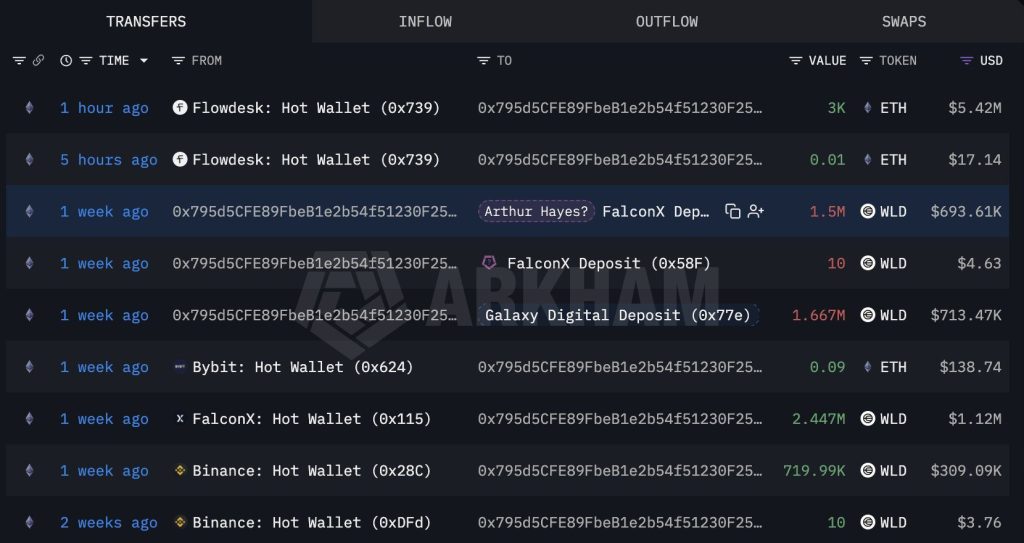
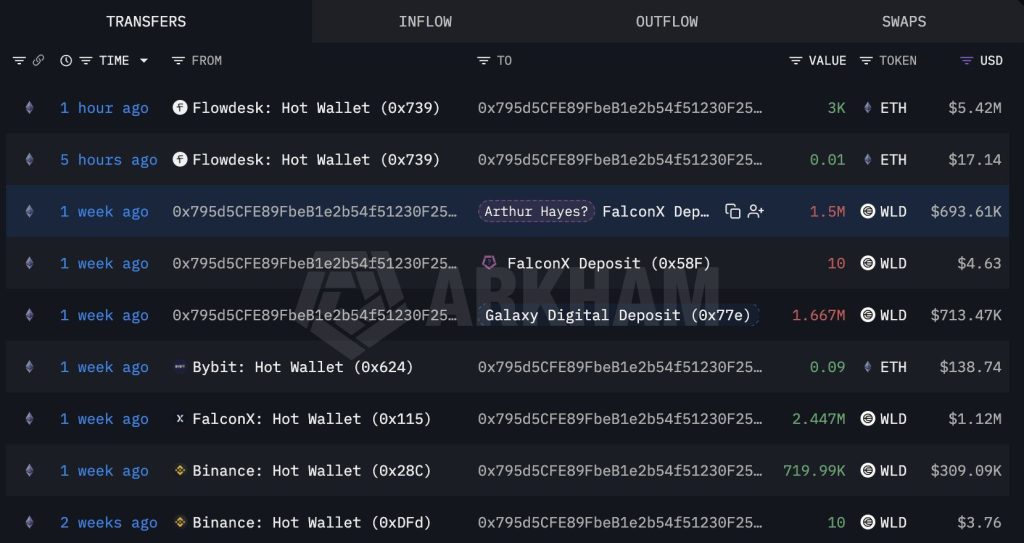
Ethereum News: A wallet linked to Arthur Hayes received 3,000 ETH worth $5.42 million from market maker Flowdesk on June 15, according to on-chain tracker Lookonchain, as Ethereum surged nearly 6% following the announcement of a U.S.–Iran peace agreement.
The ETH purchase signals Hayes is shifting back into direct ETH exposure after weeks of reducing altcoin risk, and doing so at the moment a significant macro headwind has just cleared.
The geopolitical risk removal was decisive. U.S. President Donald Trump announced the completion of the Iran deal and confirmed that shipping traffic through the Strait of Hormuz had resumed, driving crude oil prices up more than 5% to around $80.53 per barrel.
Lower energy prices directly reduce inflation pressure, which improves the macro calculus for high-beta assets. Ethereum’s response was immediate: ETH price climbed to $1,828, its highest level in over a week, outperforming most major cryptocurrencies during the session.
Discover: The Best Crypto to Diversify Your Portfolio
Ethereum News: Whale Buying Extends Beyond Hayes
The whale buying was not isolated to the Hayes wallet. Lookonchain on-chain data showed that the address geministar.eth pulled 21,136 ETH worth approximately $37.05 million from Binance through a series of transactions on the same day.

Combined, the two buyers accumulated more than $42 million in ETH within hours, a scale of accumulation that reflects institutional-grade conviction, not retail momentum chasing.
Hayes’ move follows a deliberate portfolio reset. In his June 8 essay Reality Test, the Maelstrom CIO disclosed selling positions in Hyperliquid, Near Protocol, Worldcoin, and Zcash, framing those exits as defensive responses to macro uncertainty rather than thesis changes.
Bitcoin and Ethereum remained explicit core holdings throughout that rotation, making the Flowdesk-sourced ETH purchase a re-loading of a position he never fully abandoned.
ETH Price Rally Tests Key Technical Resistance
The ETH rally has structural support beyond the macro catalyst. On the daily chart, Ethereum broke above a descending trendline that capped every bounce since late April, clearing the upper boundary of a bearish flag that formed during the decline from roughly $2,400.
The daily MACD has produced a bullish crossover and the Chaikin Money Flow indicator is rising, both consistent with fading sell pressure rather than a sentiment spike that stalls quickly.
The next meaningful level is the 0.618 Fibonacci retracement near $1,858, a zone that has to hold as support on any retest to confirm the bearish flag is invalidated.
Analyst Ali Martinez flagged an ascending triangle on the 4-hour chart projecting a move toward $1,850, placing his target almost exactly at that resistance.
A clean break above $1,858 on volume would significantly shift the near-term structure in ETH’s favor.
Hayes has projected ETH could reach $10,000 to $20,000 before the current cycle ends, citing expected liquidity expansion and Ethereum’s position within decentralized finance.
The June 15 buy, executed through a professional liquidity desk and timed to a macro pivot, is consistent with that thesis playing out in practice rather than just in print.
Discover: The Best Token Presales
The post Ethereum News: Arthur Hayes Buys $5.4M in ETH After Iran Peace Deal appeared first on Cryptonews.


The upgrade is shaping up to be one of Ethereum’s most ambitious since the network’s transition to proof-of-stake in 2022. Jayanthi described Glamsterdam as “probably the largest fork we’ve had since the Merge,” adding that it will “change a lot of assumptions about Ethereum and set us up for much more scaling in the future.”
Among the headline features are enshrined Proposer-Builder Separation (ePBS), formally tracked as EIP-7732, and Block-level Access Lists (EIP-7928).
ePBS would bring into Ethereum’s core protocol a separation between the entities that build transaction blocks and those that propose them. Today, that process largely relies offchain, where there are additional trust assumptions and centralization concerns. By moving the mechanism onchain, developers hope to reduce opportunities for manipulation related to maximal extractable value, or MEV.
Another major proposal, Block-level Access Lists, would allow blocks to declare in advance which accounts and smart-contract data they intend to access. The change would enable Ethereum clients to preload information more efficiently, helping make block execution faster, more predictable and easier to optimize.
Beyond those headline proposals, Glamsterdam also includes a sweeping set of gas repricings that could significantly alter the economics of using Ethereum.
“This will majorly change the cost of actions on Ethereum. High-level compute gets cheaper and state gets more expensive.”
Crypto World
Binance says its European regulatory application is compliant despite report of Greek rejection


Binance, the world’s largest cryptocurrency exchange, may be unable to serve customers in Europe if its regulatory license application in Greece is turned down, as Reuters reported on Tuesday.
Binance’s Markets in Crypto Assets (MiCA) license application, which has to be approved by a deadline at the end of this month, is going to be rejected by the Greek financial watchdog Hellenic Capital Market Commission (HCMC), according to the report, which cited two people familiar with the situation.
Binance said it has been pursuing a MiCA license over the past 18 months, including through a comprehensive application process with the HCMC in Greece.
“Our understanding is that the HCMC completed its review of the application and considered it compliant with MiCA requirements, and that the application was also reviewed at ESMA level,” a Binance spokesman told CoinDesk via email.
The spokesman also said that “HCMC informed ESMA that it was their view that the application was compliant and that they intended to progress the licence and move to authorise at an upcoming Board meeting.”
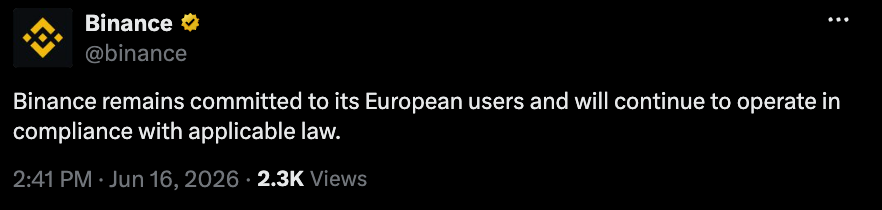
Cryptocurrency exchange Binance, whose application under the European Union’s Markets in Crypto Assets (MiCA) framework is under consideration, has generally deferred responding to a report that the company’s licensed activities in the region could be at risk.
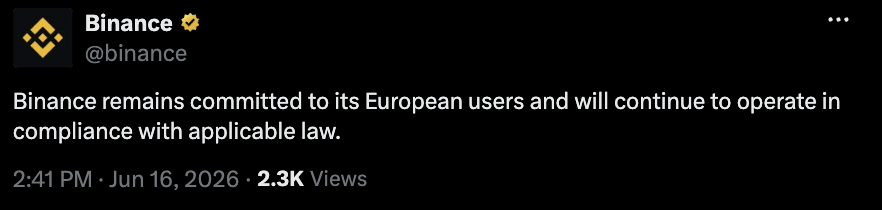
In a Tuesday blog post, Binance said that Greece’s Hellenic Capital Market Commission (HCMC), one of the regulators responsible for overseeing MiCA, had completed its review of the crypto exchange’s application and “considered it compliant with MiCA requirements,” subject to review at the European Securities and Markets Authority (ESMA). The post came just a few hours after Reuters reported that EU regulators were preparing to reject Binance’s licensing bid, potentially cutting off the exchange’s ability to offer services to residents.
“Binance serves more users in Europe than any other crypto exchange, and any delay or distortion in our MiCA path has consequences beyond Binance,” said the company. “It risks weakening liquidity, reducing competition and user choice, and pushing activity, jobs, investment, and tax revenue outside the EU.”
Source: Binance
Under the MiCA framework, companies operating in the EU only have until the end of June to gain approval to offer services to residents. Should Binance’s application with HCMC be rejected, the exchange would likely be unable to legally operate in the EU starting on July 1.
Related: Robinhood cuts 10% of workforce as Tenev touts business strength
A Binance spokesperson told Cointelegraph that the company expected that ESMA “intended to progress the licence and move to authorise at an upcoming board meeting.” The company did not immediately respond to an additional request for clarification on the Reuters report, but added in the blog post it would update users by June 30, the deadline for the MiCA application.
The crypto exchange applied for its MiCA licensing in Greece under HCMC in January. Several regulators, including those in Germany and the Netherlands, have already approved licenses for crypto companies seeking to be compliant under MiCA with the deadline approaching in a matter of weeks.
Binance still under scrutiny by US authorities
In 2023, Binance reached an agreement with US authorities in which then-CEO Changpeng Zhao stepped down and pleaded guilty to one felony charge, and the company agreed to a $4.3 billion settlement with the US Treasury Department and Department of Justice and to follow a monitoring program. Amid the US-Israel war with Iran and reports that the exchange facilitated $1 billion to sanctioned entities, US lawmakers have been pressing for answers regarding Binance’s compliance.
Magazine: Bitcoin, the ‘canary in the coal mine,’ XRP transaction demand falls 91.5%: Market Moves

-
How Bitcoin perps are entering regulated US markets
For years, Bitcoin perpetual futures have ranked among the most important products in crypto trading. They account for a large share of global crypto derivatives activity and are widely used by traders seeking leverage, hedging tools and short-term exposure to market moves.
Despite their popularity, perpetual futures have mostly operated outside regulated US markets. Most trading has taken place on offshore platforms. This left many American traders and institutions with limited choices: Avoid true perps, use offshore venues where permitted or turn to imperfect regulated alternatives.
That could now change.
In late May 2026, the US Commodity Futures Trading Commission (CFTC) approved KalshiEX to list the BTCPERP contract, a perpetual futures contract that references the spot price of Bitcoin. The decision marks an important step for crypto derivatives. It could also change how retail and institutional traders gain leveraged exposure to Bitcoin.
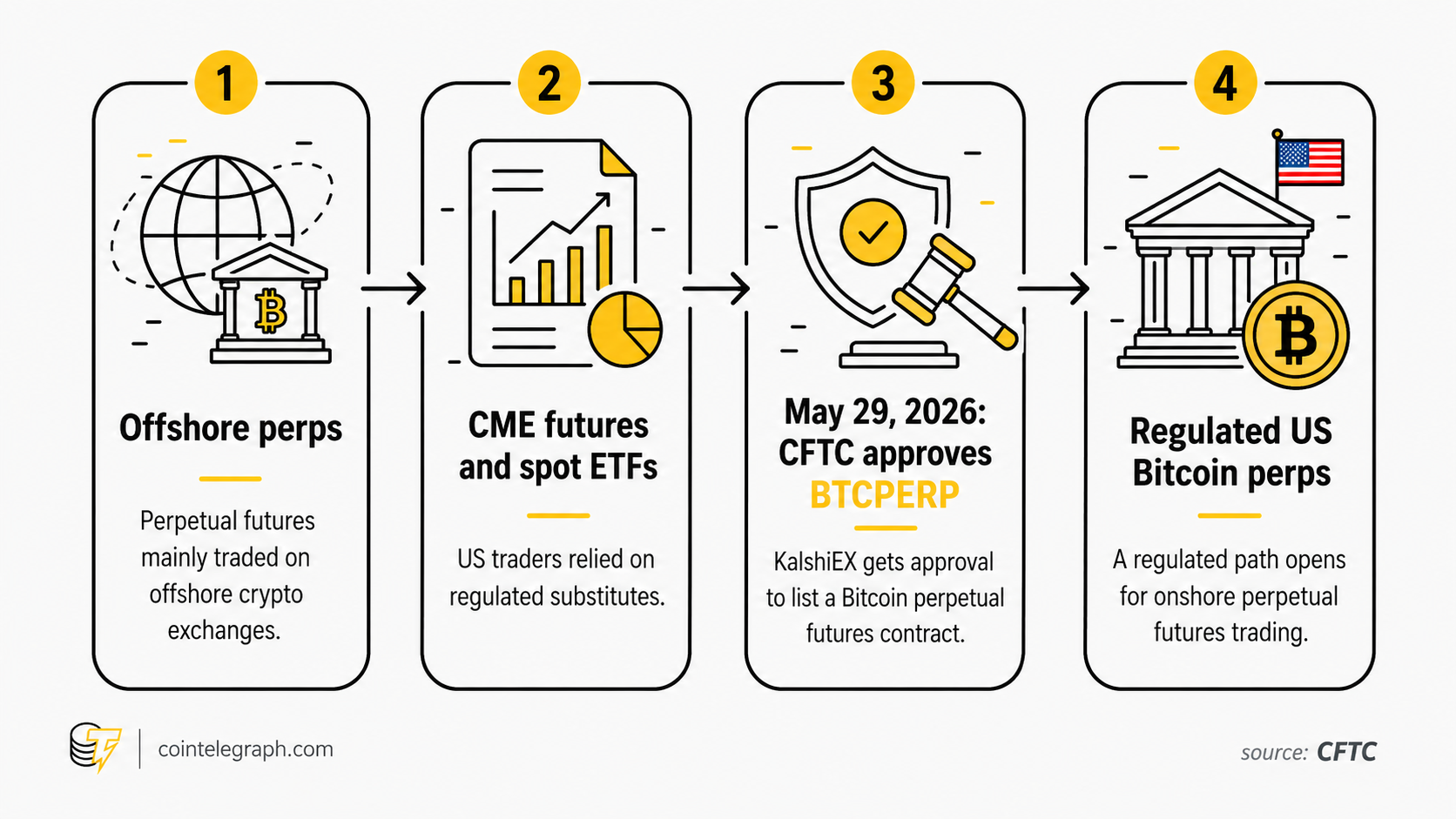
While the contract is important on its own, its larger meaning lies in the signal it sends: One of crypto’s most widely used financial tools is moving into regulated US financial markets.
-
What are Bitcoin perpetual futures?
A perpetual futures contract, often called a “perp,” is a type of derivative that lets traders take positions on Bitcoin’s price moves without holding the underlying asset.
Unlike traditional futures, perpetual futures have no set expiration date. Positions can stay open as long as traders maintain enough margin.
Standard futures contracts require traders to move into a new contract when the old one expires. Perpetual futures remove this step, making them more convenient and often more cost-effective for ongoing trading.
To keep perpetual contracts from moving too far away from Bitcoin’s spot price, platforms use a funding rate mechanism. Based on market conditions, traders in long or short positions make periodic payments to each other. This helps keep perp prices closer to the price of the underlying asset.
This simple design has helped perpetual futures become the preferred product for many crypto market participants.
-
How perpetual futures became crypto’s top trading product
Perpetual futures first became popular on offshore crypto exchanges. What started as a niche product grew into one of the most actively traded products in crypto.
The appeal is clear. These contracts provide leverage, letting traders manage larger positions with relatively modest capital. They allow traders to position for both rising and falling markets. They also avoid many of the practical challenges tied to traditional futures.
As the crypto sector grew, perpetuals became the go-to tool for speculators, hedge funds, market makers and arbitrage traders.
In many cases, perpetual futures trading volumes surpass spot market volumes for major cryptocurrencies. They also serve as a key venue for price discovery.
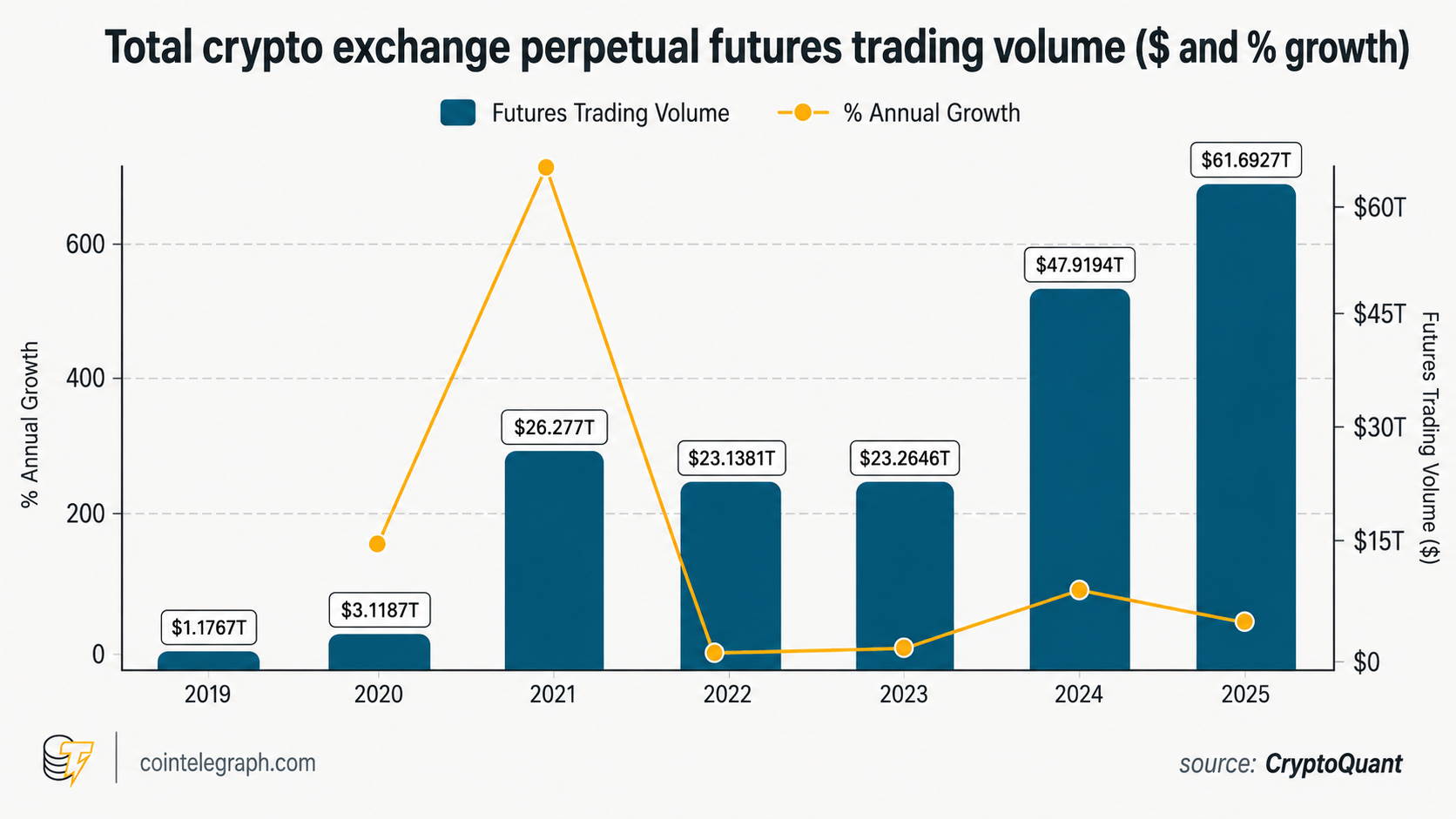
This growth has made perpetual futures one of the most important parts of crypto finance, even though their presence in regulated US markets has remained limited until recently.
Did you know? Unlike many financial products that began in traditional markets, perpetual futures first gained traction in crypto. The design solved a practical problem: Traders wanted futures-like exposure without constantly rolling contracts into new expiration dates.
-
Why the US stayed on the sidelines
For a long time, US regulators were cautious about crypto perpetual futures. That caution had a clear reason.
The hesitation was not about futures trading itself. Regulated futures markets have operated for many years. Instead, the concerns were tied to the features of several offshore crypto platforms.
Very high leverage, weak customer protections, limited transparency and risks of market manipulation made regulators reluctant to approve similar products in the US.
As a result, many US traders either used offshore platforms or relied on alternatives such as CME Bitcoin futures and, more recently, spot Bitcoin exchange traded funds (ETFs).
This created an unusual imbalance. One of crypto’s most popular products largely remained outside the reach of the world’s largest financial market. The recent approval of regulated Bitcoin perpetual futures may now help close that gap.
-
What exactly has the CFTC approved?
The CFTC recently approved KalshiEX’s Bitcoin perpetual futures contract, known as BTCPERP. The move gives the product a regulated path in the US.
Unlike many offshore alternatives, this contract operates under a US-regulated framework overseen by federal authorities.
The decision also gave the market more clarity on how perpetual futures can fit into existing futures rules. Rather than treating them as entirely new products, regulators found that they can work within current futures market rules if proper safeguards are in place.
The approval opens the door for regulated perpetual futures to trade alongside other established US derivatives products. This may be just as important as the contract approval itself.
Did you know? Many crypto enthusiasts assume Bitcoin’s spot market sets the price. In reality, large volumes of leveraged trading on futures and perpetual contracts often influence short-term price moves across the wider crypto market.
-
How regulated perpetuals differ from offshore versions
On the surface, regulated perpetual contracts and their offshore versions may look similar. Both offer leveraged exposure to Bitcoin without requiring traders to hold the actual asset.
But their market structures differ in important ways.
US-regulated products must follow strict compliance standards. Exchanges must use know-your-customer (KYC) and anti-money laundering (AML) checks. Trading is also monitored for signs of abuse, while risk management practices face regulatory review.
Margin rules are usually more conservative than those on offshore platforms.
Traders used to very high leverage may find regulated perpetuals more restrictive. Still, supporters argue that stronger protections can reduce systemic risks and improve market reliability.
Participants may accept lower leverage in exchange for better transparency and stronger regulatory oversight.
-
What regulated perpetuals mean for retail traders
For individual investors, regulated Bitcoin perpetuals could offer easier access to leveraged crypto trading within the traditional financial system.
In the past, traders seeking perpetual futures had few options beyond offshore platforms. This often meant dealing with unclear regulations and higher counterparty risks.
A regulated option may offer several advantages:
- Clearer market rules
- Stronger customer protections
- Official oversight of trading platforms
- Better safeguards for client assets
Still, retail traders should not confuse regulation with guaranteed safety.
Perpetual futures remain high-leverage products that can lead to large losses quickly. Even under regulation, weak risk controls can result in fast liquidations.
While market infrastructure may become safer, the risks of trading do not disappear.
Did you know? Perpetual futures have no expiry date, so exchanges use funding payments between traders. These payments help keep perpetual prices close to spot prices without direct intervention from the exchange.
-
Why institutions may gain the most
Although retail interest often gets more attention, institutions could benefit the most.
Hedge funds, asset managers and proprietary trading firms have been cautious about offshore perpetual futures because of compliance concerns. Even when the trading opportunities looked attractive, internal policies often limited their involvement.
A regulated US market changes that. Institutions could now access:
- Leveraged exposure to Bitcoin
- Advanced hedging tools
- Market-neutral strategies
- Arbitrage opportunities across spot, ETF and futures markets
The launch of regulated perpetuals may bring more institutional capital into crypto derivatives. That, in turn, could improve liquidity and make markets more efficient.
-
How ETFs and perpetual futures are becoming more connected
The approval of spot Bitcoin ETFs marked an important step in wider crypto adoption. Regulated perpetual futures could be the next step.
Spot ETFs offer simple exposure to Bitcoin price moves. Perpetual futures, on the other hand, offer leveraged access and more advanced risk management tools.
Together, these products help create a fuller market structure that looks more like those seen in traditional asset classes.
Institutional traders often use a mix of spot and derivatives products. With regulated perpetuals now available, new strategies linking ETFs, spot Bitcoin and futures contracts are likely to develop.
This could improve overall liquidity and strengthen the connection between traditional finance and digital assets.
-
Crypto exchanges face a new competitive test
The approval has also created a new competitive test for trading platforms. KalshiEX secured the first approval for a regulated Bitcoin perpetual contract, but it is unlikely to be the last.
Coinbase has shown strong interest in crypto derivatives. It has expanded its capabilities through acquisitions, including Deribit, and through regulatory efforts involving its CFTC-regulated futures commission merchant.
Other exchanges could seek similar approvals if the CFTC continues to review perpetual products under this framework.
Crypto derivatives can be commercially attractive because they generate large trading volumes and create new fee opportunities. This gives platforms strong reasons to compete for the market.
As a result, regulated perpetual futures could become a key area of competition among crypto exchanges.
-
Could regulated perpetuals weaken offshore exchanges?
A central question is whether regulated perpetuals will draw liquidity away from offshore venues. The answer is not simple.
The outcome will likely depend on several factors:
- Available leverage levels
- Trading costs
- Market depth
- Institutional involvement
- Regulatory predictability
Offshore platforms still have deep liquidity and loyal user bases. Many traders remain comfortable with their current setups.
Still, if US-regulated venues can offer competitive fees and enough liquidity, some trading activity may slowly move onshore. Any such shift would likely happen over years rather than months, though the trend could become more important over time.
-
The risks regulators still worry about
Even after the approval, regulators remain cautious about perpetual futures. Their main concern is leverage.
Leverage increases both profits and losses. During sharp market swings, heavily leveraged positions can trigger chains of liquidations that make price moves worse.
Crypto markets have seen such episodes across several market cycles. While regulated perpetuals may include stronger protections, they cannot remove the core risks of leveraged trading.
Participants need to understand that regulation mainly addresses market structure risks, not the risks of the investment itself.

Binance says a key step in its EU Markets in Crypto Assets (MiCA) licensing process has moved forward, even as Reuters reported that regulators are preparing to reject the exchange’s bid—an outcome that could limit Binance’s ability to serve customers in the bloc.
In a Tuesday blog update, Binance stated that Greece’s Hellenic Capital Market Commission (HCMC)—a MiCA regulator involved in reviewing the company’s application—has completed its assessment and “considered it compliant with MiCA requirements,” while noting that the matter still requires review by the European Securities and Markets Authority (ESMA).
Key takeaways
- Binance claims HCMC has completed its MiCA application review and found its submission compliant, subject to ESMA oversight.
- Reuters reported EU regulators may reject Binance’s licensing request, potentially preventing the exchange from offering services to EU residents.
- MiCA authorization timing remains critical: EU firms must obtain approval by the end of June to continue serving residents lawfully.
- Binance says delays could affect liquidity, competition, and user choice, and may shift activity outside the EU.
Binance points to progress with HCMC review
Binance’s response comes shortly after Reuters reported that EU regulators were preparing to reject the exchange’s licensing bid. Binance’s blog post did not directly address the Reuters claim in detail, but it framed the latest stage of the process as constructive.
According to the company, HCMC has finished reviewing its application and concluded that it meets MiCA requirements, with remaining steps moving to ESMA. Binance characterized any disruption in the timeline as having consequences beyond its own operations, arguing that it could reduce liquidity and competition while narrowing user choice.
Binance also said it plans to update users by June 30, aligning with the MiCA application deadline referenced in its communication.
What MiCA timing means for Binance in the EU
Under the MiCA framework, crypto businesses that want to operate legally for EU residents need to secure authorization by the end of June. The reporting in the source indicates that if Binance’s application—submitted to and reviewed through HCMC—were ultimately rejected, it would likely be unable to legally continue offering services in the European Union starting July 1.
The practical significance for users and market participants is straightforward: authorization or lack of it can determine whether an exchange can provide services to EU-based customers without regulatory risk. That makes the ESMA review stage pivotal, particularly given the approaching end-of-June cut-off.
Binance previously applied for MiCA licensing in Greece under HCMC in January, and the source notes that other regulators—such as those in Germany and the Netherlands—have already approved some MiCA-compliant licenses, underscoring how time-sensitive the current stage is for remaining applicants.
Why the HCMC-to-ESMA handoff is a flashpoint
MiCA oversight is split across national authorities and EU-level review. In this case, Binance highlights that the Greek regulator has completed its portion and assessed compliance, while Reuters suggests EU-level decisions could still go the other way.
That gap—between a national regulator’s compliance assessment and the eventual outcome after ESMA review—matters to investors, traders, and counterparties because it affects expectations around service continuity, custody arrangements, and liquidity flows. Market participants often plan around regulatory certainty, and a process that appears to be “moving” on one layer but is rumored to be heading toward rejection at another can raise uncertainty about near-term access to a major venue.
Binance’s blog message reflects that concern, arguing that any delays or distortion in its MiCA path could have broader consequences for the EU crypto market, including liquidity and competitive dynamics.
Binance faces additional compliance scrutiny in the US
While the immediate focus is MiCA authorization in Europe, the exchange’s regulatory posture is also shaped by its ongoing history with US authorities. In 2023, Binance reached an agreement with US regulators in which then-CEO Changpeng Zhao stepped down and pleaded guilty to a felony charge. The company also agreed to a $4.3 billion settlement with the US Treasury Department and Department of Justice and to operate under a monitoring program.
More recently, US lawmakers have pressed for answers regarding Binance’s compliance amid war-related geopolitical developments and reporting that the exchange facilitated $1 billion to sanctioned entities. The source indicates that this issue has continued to draw attention from US lawmakers.
For market participants, this parallel regulatory track is relevant because it can influence reputational risk assessments and compliance expectations globally, even when the immediate decision is specific to EU authorization.
With ESMA review and the end-of-June MiCA deadline approaching, the key question for users and the broader market is whether Binance’s authorization path ultimately aligns with Binance’s claim of HCMC compliance—or whether Reuters’ report of a possible rejection proves accurate; the June 30 update and the timing of ESMA’s next steps will be the most important signals to watch.

Chicago signs Spain star Leila Ouahabi to 3-year deal

Android 17 is about to make gaming on foldables way better

The five North East Lloyds and Halifax branches set to close


-

 Business2 days ago
No Jackpot Winner as $257 Million Prize Rolls Over to $269 Million Monday Draw
-

 Crypto World5 days ago
Oppenheimer backs SpaceX as $70 billion retail frenzy builds
-

 Fashion4 days ago
Weekend Open Thread: Tuckernuck – Corporette.com
-

 Crypto World5 days ago
Markets Rally as SpaceX IPO Looms Amid Iran Tensions and Inflation Surge
-
 Crypto World2 days ago
Zimbabwe Requires Crypto Businesses to Register Annually Under New FIU Regulations
-

 Tech4 days ago
NanoClaw integrates JFrog registries to secure AI agent downloads
-

 Tech4 days ago
This Week In Security: Microsoft On Microsoft, Register Your Domains, Linux On ARM, And FreeBSD Joins The File Cache Club
-

 Crypto World3 days ago
Bitget enters Argentina’s regulated crypto market through PSAV registration
-

 Business7 days ago
Thailand Ranks Second Worldwide for AI Adoption Growth, Microsoft Reports
-
 Tech5 days ago
Dutton Ranch star claims they ‘didn’t see any disruption’ on set following Chad Feehan’s exit from Yellowstone spinoff fueled by Taylor Sheridan clash rumors
-

 NewsBeat5 days ago
El Nino has formed in the Pacific and could set records, forecasters say
-

 Politics5 days ago
Politics Home | Healey Resignation Is “Colossal Failure Of Government”, Says Former Labour Defence Secretary
-

 Tech6 days ago
‘This is Seattle’s position on AI’: City Council votes unanimously to pause big new data centers
-
 Entertainment5 days ago
Donnie Wahlberg & More Heat Up Las Vegas at Circa’s Barry’s Downtown Prime
-
 Tech5 days ago
Opendoor Ends India Operations, Fueling a Bigger Conversation About AI and Outsourcing
-

 Sports5 days ago
First Time Since 1971: Australia Register Historic Low In ODI Cricket
-

 Politics5 days ago
Belfast burns, while Met chief points finger at Iran and Russia
-

 NewsBeat4 days ago
FBI searches office of Ohio voter registration group
-

 Business5 days ago
AT&T: Verizon's 27% Outperformance Sets Up A Solid Entry Point
-
 Tech5 days ago
Anthropic is spending $150M to embed 1,000 AI fellows inside nonprofits. No degree required.
You must be logged in to post a comment Login