
Crypto World
Belgian Police Arrest Phishing Suspect Linked to $572K Theft


Belgian authorities have arrested a 19-year-old man they say was a central figure in a European phishing and money-laundering operation that netted more than €500,000 by targeting victims with fake government emails and phone calls. The suspected scheme relied on remote-access software to carry out fraud, and investigators say cryptocurrencies were used to move and launder the proceeds.
According to a Federal Judicial Police report cited by Belgian law enforcement, the arrest took place in Antwerp at an Airbnb, where a second suspect was also found. The investigation began in March 2026, when regional authorities escalated phishing as a priority.
Key takeaways
- Belgian police say the suspected phishing crew used fake government communications to trick victims into installing remote-access software.
- The operation allegedly involved money mules and cash carriers before converting proceeds into cryptocurrencies.
- Investigators characterize crypto as serving multiple roles in phishing—both as part of laundering workflows and as an enabling tool.
- Broader industry data cited in the report reinforces that phishing and social engineering remain leading drivers of crypto theft.
- Recent warnings about malicious ads on Google highlight how attackers are continuing to target users through mainstream search advertising.
Arrest in Antwerp and a laundering pipeline using crypto
In the Belgian case, the Federal Judicial Police reported that the suspected mastermind was detained in an Airbnb in Antwerp. A second suspect was discovered at the location as well, and the primary suspect was subsequently brought before an investigating judge, who issued an arrest warrant.
While authorities did not detail the full operational workflow in the cited report, they described the alleged criminal method: victims were contacted via fake government emails and phone calls designed to induce them to install remote-access software. That is a classic social-engineering pattern in phishing campaigns, because it converts a digital entry point into remote control capabilities.
Police also said the network used intermediaries—money mules and cash carriers—to process and move funds before laundering. The critical addition for the crypto angle is that investigators allege the gang ultimately laundered proceeds through cryptocurrencies, demonstrating how digital assets can be integrated into stages of criminal finance rather than remaining isolated as a payment layer.
Why this matters for crypto users and compliance
The Belgian arrest underscores a recurring reality for the crypto ecosystem: many of the highest-impact losses do not begin with vulnerabilities in smart contracts or protocol code. Instead, fraudsters frequently use human-targeted tactics to obtain access to accounts, wallets, or other assets—and then use crypto to obscure trails.
From an investor and operator standpoint, this has practical implications. It suggests that even if a platform’s underlying technology is secure, users may still face outsized risk through phishing campaigns that impersonate trusted entities. It also points to why transaction monitoring and compliance controls remain relevant even when the entry attack is “off-chain.”
For builders and exchanges, the lessons tend to be operational rather than technical: account security, verification processes for high-risk requests, user education, and fraud response playbooks can all influence outcomes when scams target individuals rather than software.
Phishing and social engineering still dominate crypto losses
The broader threat landscape aligns closely with the Belgian case. Phishing and social engineering scams are described as major contributors to crypto theft, including in reported loss figures for early 2026.
According to Hacken, phishing and social engineering accounted for $306 million of the $482 million lost in the first quarter of 2026. That data, as presented in the source reporting, frames phishing as the most prevalent mechanism behind real-world losses—even as decentralized finance security debates often focus on exploits and protocol failures.
Attackers have long exploited predictable human behavior: creating urgency, impersonating authority figures, and using convincing messaging to bypass caution. The persistence of those tactics is why the crypto community continues to treat user manipulation as a top-tier security concern, not a fringe risk.
Malicious Google ads and evolving tactics
Recent warnings show that phishing campaigns are not limited to email and direct calls. On May 25, onchain analyst “b-block” warned that scammers used Google to run malicious phishing ads impersonating decentralized exchange Uniswap, reportedly stealing more than $400,000 from victims. The warning adds another layer to the problem: threat actors may be leveraging established advertising ecosystems to reach users at scale.
In parallel, DeFiLlama said fake ads on Google are a common source of phishing attacks. Separately, Crypto cybersecurity group Security Alliance reported in April that there was a significant uptick in phishing activity on Google Search in March. Together, these points indicate that mainstream discovery channels—search ads and ad placements—can become a distribution method for crypto scams.
Blockchain security company CertiK’s Skynet report also highlighted phishing and social engineering among leading tactics used by malicious actors associated with North Korea-linked operations. The source further notes that CertiK attributed the 2022 Ronin Bridge exploit to a spearphishing campaign that involved a fake LinkedIn recruiter and a malware-laden PDF—an example of how phishing can lead into broader compromise chains.
What to watch next
With Belgian authorities tying phishing directly to crypto laundering techniques, and with multiple reports indicating phishing remains the largest share of reported losses, the next signal to track is whether law enforcement actions and platform security measures reduce scam distribution channels—especially ads and impersonation attempts—or whether attackers continue to shift to new mainstream touchpoints faster than users can adapt.



Bitget said it will stop providing crypto trading services to residents of Japan, citing efforts to comply with local regulations.
The crypto exchange, ranked fifth by Coingecko with trading volume of roughly $714.7 million over the past 24 hours, stopped accepting new registrations from Japanese residents on Sunday, according to a Monday announcement.
Japan reclassified cryptocurrencies as financial instruments following legislation approved by its parliament in mid-July. The new rules are expected to take effect next year and include fines of about $62,800 and prison sentences of up to 10 years for operation without registration.
Existing users who believe Bitget has incorrectly identified them as Japanese residents must complete a Level-2 identity verification, including proof of address by Nov. 1, the company said. Accounts that do not complete the process will be considered Japanese, it added.
Bitget will place those accounts into close-only mode starting Nov. 1, according to its FAQ. Users will not be able to open or add to positions or use services, including spot and futures trading, copy trading, trading bots and their earn products. Deposits, subject to limits, and withdrawals will remain available.

People likely have different protein needs
Despite some promising research on protein restriction, people shouldn’t start eating diets that are very low in protein, Lamming and other scientists of aging say.
“While we know that protein restriction extends lifespan in yeast, fruit flies, mice, and rats, that doesn’t necessarily mean it will do so in humans,” says Christopher D. Morrison, a professor at Louisiana State University’s Pennington Biomedical Research Center whose lab pioneered the discovery of a life-extending hormone known as FGF21 that is required by mice to respond to protein restriction. The hormone also increases in people eating a protein-limited diet.
Protein restriction studies in people have also been small in scale and short-term, Lamming says. He adds that more research is needed into how protein restriction might impact exercise and people of different ages and needs.
Matt Kaeberlein, a molecular biologist and longevity scientist, says there could also be some negative consequences of a diet that is very low in protein, such as poor immune function and lower bone density. He also points out that while the diets of lab animals in protein restriction studies can be extreme, the studies in people have involved more moderate diets. “We’re not talking about extreme protein restriction down into malnutrition territory,” he says.


A former FBI special agent has been indicted after being accused of stealing somewhere in the region of $1 million in cryptocurrency from the agency.
Specifically, Patrick Steven Yaroch, who worked at the FBI from February 2025 through July 2026, has been charged with receipt of stolen goods and interstate transportation of stolen goods.
This is according to an affidavit filed by another FBI special agent.
Read more: FBI details how USDT is laundered through Binance
After stealing the crypto, Yaroch apparently told a Department of Justice employee about what he had done, claiming that it was “eating him up inside.”
On July 29, Yaroch contacted FBIHQ to set up a meeting to discuss what he’d done, and during the interview it was revealed that the value of Yaroch’s wallet was “approximately one million dollars.”
That same day, when the FBI went to his residence to collect property, he surrendered key phrases for crypto wallets, though about half an hour later he withdrew that consent according to the affidavit.
Read more: FBI Director Kash Patel’s undisclosed Strategy trade is down 45%
Once the FBI obtained Yaroch’s cell phone, they were able to get access to his Kraken account, which contained “approximately $188,570.58” worth of value, principally in USDC and US dollars.
Additionally, the FBI review revealed that Yaroch had previously transferred approximately $1 million to Suilend.
Yaroch apparently told the FBI agents that “he chose this service simply because he liked that the logo was a water droplet.”
ChatGPT helps plan an escape
While the FBI was reviewing ChatGPT conversations on Yaroch’s phone they found fascinating conversations.
These included him asking ChatGPT:
- “If I had a million dollars, how would you suggest investing it/spending it to maximize profit and return”
- “If you had a bucket of money (around $1 million) and you wanted to leave the USA and become a resident or citizen of an EU country, what would you do?”
ChatGPT helpfully suggested to him that Portugal would be his best choice.
The FBI affidavit notes, “FBI Agents located an upcoming trip from the United States to Portugal” for Yaroch.
Yaroch also tried to claim to the FBI agents that “he was not planning to funnel money into Portugal,” and while recognizing he would no longer be allowed to visit Portugal, “he hoped his wife and child would still go on the trip.”
Got a tip? Send us an email securely via Protos Leaks. For more informed news and investigations, follow us on X, Bluesky, and Google News, or subscribe to our YouTube channel.
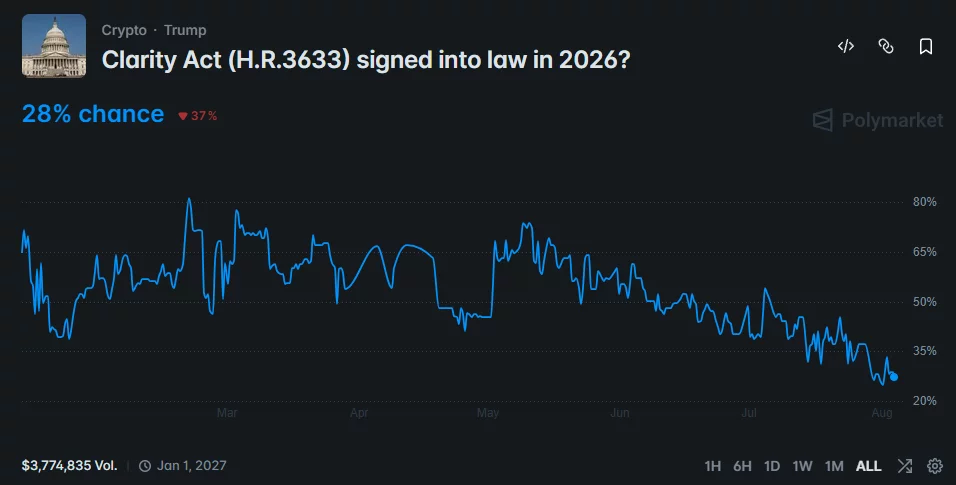
The CLARITY Act’s narrowing path through the U.S. Senate could trigger another crypto sell-off before the market recovers later this year, according to Bernstein analysts.
Summary
- CLARITY Act passage odds have fallen to 28% as the Senate’s summer recess approaches.
- Bernstein expects a failed vote or delay to produce an immediate negative crypto market reaction.
- The bill remains absent from the Senate’s Aug. 3 schedule, leaving lawmakers only days to act.
- An Aug. 5 cloture filing could allow an initial procedural vote on Aug. 7.
CLARITY Act misses the Aug. 3 Senate schedule
The Digital Asset Market Clarity Act, or CLARITY Act, was not included in the U.S. Senate’s published schedule for Monday, Aug. 3, reducing the time available for lawmakers to begin floor proceedings before the summer break.
The official Senate schedule lists a 5:30 p.m. cloture vote on the motion to proceed to H.R. 6500, a legislative vehicle for a continuing resolution. It does not include scheduled action on H.R. 3633, the CLARITY Act.
The Senate’s cloture ledger also records the July 30 filing for H.R. 6500 but no corresponding petition for the crypto market-structure bill.
The omission does not prevent Senate Majority Leader John Thune from bringing up the legislation later in the week. However, it leaves the bill without a publicly confirmed floor timetable before the Senate’s tentative state work period begins on Aug. 10. The break is scheduled to continue through Sept. 11.
Bernstein warns of another crypto market decline
Bernstein analysts said a Senate failure to advance the bill could generate an immediate negative response across Bitcoin and the broader crypto market.
The analysts described the possible reaction as an industry “knee-jerk” sell-off that could produce another leg down for digital asset valuations. The warning comes as Bitcoin trades under pressure, and investors monitor whether Congress can complete its crypto policy agenda before the midterm elections.
“From a tactical standpoint, we expect the crypto market to bottom and start showing momentum towards late Q3 and early Q4 prior to the mid-terms,” Bernstein analysts wrote in a Monday report shared with clients.
Prediction market traders have also become less confident. Polymarket places the probability of the CLARITY Act passing before the end of 2026 at 28%, down 10 percentage points over the past week and 12 points over the past month. Traders have wagered about $3.77 million on the market.
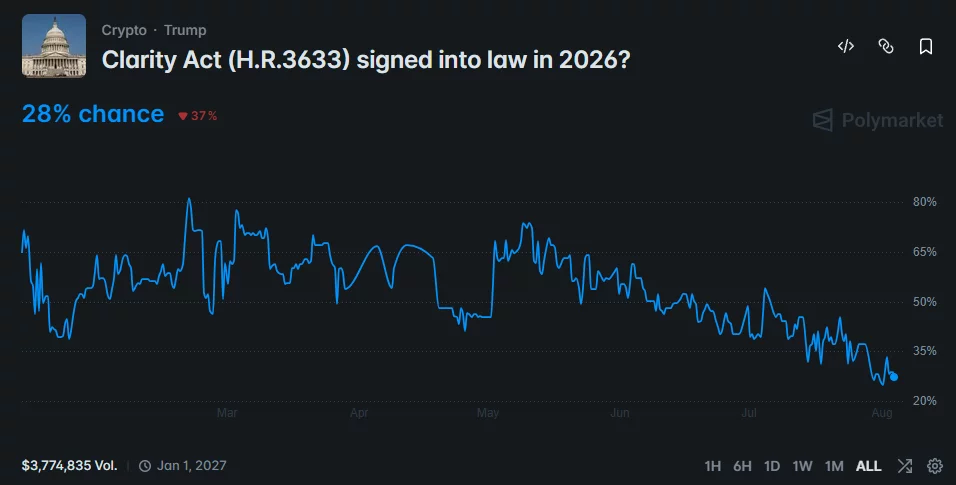
Galaxy Digital previously cut its estimated probability of the legislation becoming law this year to 50%, citing the Senate’s limited remaining calendar.
Regulators could move faster if Congress fails to act
Bernstein said a legislative delay could pressure the Securities and Exchange Commission and Commodity Futures Trading Commission to provide more regulatory guidance through Project Crypto.
The joint initiative seeks to use the agencies’ existing authority while Congress works on a permanent market-structure framework. Bernstein expects regulators could issue interpretations covering token classifications and decentralized finance while accelerating a proposed exemption for some token issuances.
Such an exemption could temporarily shield qualifying token offerings from securities requirements under defined conditions. Agency guidance, however, would not provide the same statutory certainty as legislation passed by Congress.
The CLARITY Act would establish rules for digital asset issuers and trading platforms while dividing oversight responsibilities between the SEC and CFTC. Senator Cynthia Lummis released updated legislative text on July 22, combining work from the Senate Banking and Agriculture committees.
Banking groups have opposed parts of the proposal, arguing that its stablecoin provisions could allow crypto platforms to offer rewards without facing requirements comparable to those imposed on banks.
Aug. 5 may be the final practical filing window
Under the Senate’s standard Rule XXII process, a cloture petition requires signatures from 16 senators. A petition filed Wednesday, Aug. 5, could allow a cloture vote on Friday, Aug. 7, if the chamber remains in session.
That vote would only determine whether the Senate limits debate on the motion to proceed. It would not pass the CLARITY Act. Invoking cloture on legislation generally requires 60 votes and can permit up to 30 additional hours of consideration.
Senators would still need to vote on the motion to proceed, debate amendments, and hold a final passage vote. A second cloture process could also be required.
White House officials are meanwhile considering a bipartisan ethics proposal negotiated by Republican Senator Thom Tillis and Democratic Senator Ruben Gallego. The proposal would reportedly allow state attorneys general to challenge the Justice Department when it fails to enforce federal ethics rules.
With no floor action yet scheduled, the Senate’s remaining days before recess will determine whether the CLARITY Act advances now or returns to an increasingly crowded agenda in September.

South Korean crypto exchange Bithumb says it is moving toward a public listing, with plans to apply for a preliminary listing review in 2027 and complete an initial public offering (IPO) in 2028. The timetable is described as flexible and could shift based on market conditions and the scheduling of relevant regulators.
In a statement released Monday, Bithumb linked its IPO roadmap to internal restructuring efforts designed to clarify responsibilities across business units and reduce potential conflicts of interest. The exchange also outlined operational changes it says are part of its preparation for the scrutiny that comes with becoming a listed company.
Key takeaways
- Bithumb plans to pursue a preliminary listing review in 2027 and target an IPO for 2028, subject to regulatory and market timing.
- The exchange says it reorganized its structure, including spinning off Bithumb Asset, to better separate responsibilities and limit conflicts of interest.
- Bithumb is preparing to strengthen internal controls and transition from domestic accounting standards to K-IFRS.
- The company’s listing push follows a separate incident in February involving an over-crediting error tied to a promotional reward mechanism.
Restructuring and accounting changes ahead of an IPO
Bithumb’s IPO plan is anchored in a set of organizational and compliance steps. According to the exchange, it has reorganized its business structure, including spinning off Bithumb Asset, with the stated goal of clarifying what each unit is responsible for. Bithumb said this approach is intended to reduce the risk of conflicts of interest before it enters the listing review process.
Beyond governance and structure, the exchange also said its preparations include upgrading internal controls. It further stated that it plans to move away from domestic accounting standards and adopt K-IFRS, the international accounting framework used by listed companies in South Korea.
While the company set out a broad timeline—application for preliminary review in 2027 and an IPO in 2028—Bithumb emphasized that the schedule is not guaranteed. It said changes could be required depending on market conditions and how quickly authorities complete their review processes.
A crypto market shifting toward traditional finance ties
Bithumb’s move toward going public is unfolding as several South Korean crypto exchanges tighten their relationships with traditional finance and technology groups. The exchange is among five South Korean platforms that offer fiat currency trading via real-name bank accounts, and it operates that service through a partnership with KB Kookmin Bank.
In the broader sector, the competitive landscape has increasingly reflected corporate and financial integration. Rival exchange Korbit saw a major change when Mirae Asset Consulting took control on July 23, while Upbit operator Dunamu is pursuing a share-swap arrangement that would make it a wholly owned subsidiary of Naver Financial, though the transaction is described as subject to regulatory and shareholder approvals.
For investors and market participants, these developments matter because they suggest that the “crypto exchange” category in South Korea is increasingly being treated like a mainstream financial business—one that attracts scrutiny around corporate governance, accounting practices, and the boundaries between crypto operations and affiliated entities.
The February “620,000 BTC” promotional error and governance implications
Bithumb’s listing ambitions arrive after a notable operational failure earlier this year. In a February promotional mistake, the exchange mistakenly credited customer accounts with balances totaling 620,000 Bitcoin instead of distributing 620,000 Korean won in cash rewards, according to earlier coverage. Bithumb later recovered 99.7% of the erroneous credits, but some customers sold about 1,788 BTC before account freezes were applied.
At a February 11 National Assembly parliamentary hearing, Bithumb CEO Lee Jae-won said the exchange’s process for checking the planned distribution against actual holdings had failed. He also stated that the promotional amount had not been set aside in a separate account, a factor that complicated the detection and containment of the error.
While the episode appears to have been addressed through clawback of the majority of the mistaken credits, it is the kind of incident that regulators and auditors often consider when assessing internal controls—precisely the area Bithumb says it is upgrading as part of its IPO preparations.
Listing cleanup for Bithumb-linked public firms continues
Bithumb’s timetable for an IPO also intersects with governance and listing challenges involving entities connected to the exchange. Two Bithumb-linked listed companies have faced ongoing audit and listing issues, with their shares trading suspended since March 2023.
Yonhap reported that Bucket Studio, which indirectly controls Vidente (a major Bithumb shareholder), appointed a former police official as its standing auditor in June. Separately, Vidente has said it plans to appoint a former National Tax Service official to the same auditor role. According to Yonhap, South Korea’s Government Public Service Ethics Committee cleared both hires after concluding there was no close relationship between the officials’ previous duties and their new positions.
These developments are relevant to Bithumb’s listing ambitions because they show how tightly regulated the ecosystem can be in South Korea, not only at the exchange level but also across corporate relationships and audit oversight.
For readers tracking Bithumb’s path to the public markets, the next key indicators will be whether the exchange’s stated internal control upgrades and K-IFRS transition proceed on schedule, and how regulators respond to both the IPO review process and lingering questions raised by prior compliance and governance issues. The 2027/2028 targets are not fixed—so market conditions and authority review timing will likely determine what actually happens next.

Galaxy Research head Alex Thorn has hinted that Coldcard was hit by a fourth wave of attacks on August 3, estimating that the attackers moved 448.7 BTC from 709 wallets belonging to victims.
Thorn based his findings on blockchain analysis rather than device records, describing the addresses as “likely Coldcard victims.”
A Fourth Wave?
Thorn described the addresses hit by the suspected attack as “likely Coldcard victims,” adding that the unspent outputs and transactions matched the vulnerable wallet pattern. Galaxy’s initial snapshot covered blocks 960,778 through 960,792, identifying 218 transactions involving 388.9 BTC and 462 potential victim addresses. The updated estimate expanded the figures to hundreds of transactions involving 448.7 BTC and 709 potential victim addresses.
Thorn posted the findings on X:
“LIKELY 4TH ORGANIZED WAVE COLDCARD ATTACK OCCURING RIGHT NOW THERE ARE STILL SIMILAR TXS IN THE MEMPOOL WAITING TO BE CONFIRMED AND THE PREVIOUSLY-CONFIRMED TXS SIGNAL RBF OPT-IN, CHECK YOUR FUNDS, AND YOU MAY BE ABLE TO RBF YOUR WAY OUT OF THIS.”
According to Thorn, Galaxy measured 13.8 sweeps per block, a 45x increase compared to 0.3 sweeps per block measured during a pre-incident control period. The siphoned funds were sent to a new address instead of a shared wallet. Some of the stolen funds were subsequently moved to new addresses, making them difficult to track.
Previous Waves
Galaxy has already mapped three prior waves that siphoned 1,367.05 BTC from 4,585 addresses, with the first wave targeting 1,082.05 BTC across 1,196 addresses. The latest wave brings the total figures to 1,815.75 BTC across 5,294 addresses. However, the figures are yet to be confirmed by authorities, Coinkite, or the wallet owners. Additionally, it isn’t clear whether one entity was responsible for all four waves.
Thorn also added that there were transactions awaiting approval in Bitcoin’s mempool, giving holders an escape route. According to Thorn, Bitcoin Core documentation states that unconfirmed opt-in Replace-by-fee transactions can be replaced. This means a user still in control of an affected key could broadcast a conflicting transaction with a higher fee and send the funds to a secure wallet. However, it cannot be replaced once it enters the block, and a replacement is not guaranteed to succeed.
Coldcard Users Must Generate New Seeds
The ongoing issue arises from an RNG integration error that occurred during a March 2021 firmware change. Coinkite estimates that the affected Mk2 and Mk3 seeds have around 40 bits of effective entropy, while seeds generated on affected Mk4, Mk5, and Q releases have 72 bits instead of 128.
Additionally, an engineering team from Block discovered that the firmware called a deterministic MicroPython fallback instead of the hardware random-number generator. However, the Block team clarified they could not confirm exploitability without full empirical testing.
Meanwhile, Coinkite has released version 4.2.0 for Mk2 and Mk3, 5.6.0 for Mk4 and Mk5, 1.5.0Q for Q, and 6.6.0X or 6.6.0QX for Edge releases. However, simply updating the existing firmware does not fully address the vulnerability. Once updated, users must generate a new seed and verify the receiving address. Once verified, they must send a test transaction before migrating the complete balance.
Coinkite also clarified that seeds created using a minimum of 50 fair, private dice rolls are not considered at risk, and that a unique BIP-39 passphrase could serve as a second line of defense. However, it recommended that users complete the migration. The advisory does not cover TAPSIGNER, OPENDIME, and SATSCARD because they use separate codebases.
Disclaimer: This article is provided for informational purposes only. It is not offered or intended to be used as legal, tax, investment, financial, or other advice.
Crypto World
Greece Battles Raging Wildfires After Collision Between Firefighting Helicopters Kills Two

Ursula von der Leyen, president of the European Commission, also remembered the contributions of the fallen.
“It takes a special courage to fly towards the flames so that others can be safe. As we continue to battle these fires side by side, Europe grieves with Greece and Denmark,” she said.
Widespread wildfires devastate Europe
Wildfires have swept across regions in France, with President Emmanuel Macron describing the situation as “the toughest since the Second World War.”
Elsewhere in western Europe, an emergency incident was declared in Suffolk, England, last week as firefighters tackled a blaze the size of at least 210 soccer pitches.
Much of Europe is in the midst of yet another heat wave, further compounding the issue and raising concerns that even contained fires may gather pace once more.

Crypto investor Arthur Hayes warned on August 3 that markets should watch this week’s Federal Reserve H.4.1 release for signs that Japan used US Treasury holdings as collateral to obtain dollars during recent yen intervention efforts.
The move has raised questions about how central banks may manage currency pressure without disrupting bond markets, with potential effects on global liquidity and risk assets like Bitcoin (BTC).
Watching the Fed’s Balance Sheet
The H.4.1 report publishes weekly details on the Fed’s balance sheet, including any repo activity with foreign central banks, which is why Hayes pointed traders there for confirmation.
His post followed last Friday’s coordinated currency action, which Treasury Secretary Scott Bessent said had been taken to counter “disorderly yen movements,” and that his department is still in close contact with the BOJ and Japan’s Ministry of Finance and “will not hesitate to participate in further joint intervention.” He also called for the FIMA repo facility, which lets foreign central banks borrow against Treasury holdings, to be expanded in the coming months.
“If Bessent can get the counterparty limit increased then the Fed can create money using MOF TSY as collateral,” Hayes wrote in response.
The H.4.1 publication adds to a list of macro events already on the radar of traders, including Friday’s Nonfarm Payrolls report and this week’s ISM Manufacturing PMI.
Bitcoin advocate Adam Livingston called the US-Japan action “one of the funniest pieces of elite macroeconomic theater,” pointing out how the Asian economic giant had spent years pinning rates low, monetizing debt, and turning its fiat currency into a funding source for global carry trades. Now it has weakened, with Washington describing it as “substantially undervalued.”
The crypto author noted that Japan needs dollars to defend the yen, and it holds a large stock of US Treasuries, which, if sold, could push American yields higher and raise US financing costs as well as tighten liquidity. However, a bigger FIMA facility allows Japan to borrow dollars against those Treasuries instead of dumping them onto the market.
The crypto community has been watching the yen issue because Japan’s low-rate environment supported the yen carry trade for years. Investors borrowed the currency cheaply and placed money into higher-yielding assets, like stocks and cryptocurrencies. Last week, analyst EGRAG CRYPTO warned that a fast unwind of such carry trade-funded positions could force selling across risk assets, including BTC, if the yen strengthens too quickly.
Where Crypto Stands This Week
At the time of writing, the global cryptocurrency market cap was holding near $2.2 trillion after a slight 0.8% dip in 24 hours. BTC was trading closer to $63,000 than $62,000, down about 1% on the day and over 4% across one week. Meanwhile, Ethereum (ETH) sat near $1,800, about 6% from where it was a week ago.
Analyst Daan Crypto Trades observed that Bitcoin and the broader crypto market have underperformed the recent bounce in tech stocks. He attributed the pattern to a liquidity rotation where speculation returns more readily to equities once they recover, leaving crypto lagging unless stocks move sideways for a stretch.
The post Here’s Why Crypto Traders Need to Watch the Fed’s H.4.1 Report This Week appeared first on CryptoPotato.
Cardano’s native token is among the best-performing cryptocurrencies (from the top 10 club) over the past week.
Its renewed momentum has naturally drawn more attention, with some market observers now projecting further gains.
The Rally Goes on?
ADA experienced a sudden and rather unexpected revival this weekend, rising to a monthly peak of around $0.19. As of this writing, it trades just south of that mark, representing a 13% increase on a seven-day scale.
The most probable catalyst for the upswing seems to be the accumulation from whales, with Ali Martinez revealing that these big investors have purchased more than 240 million tokens in just five days.
Meanwhile, X user JAVON MARKS believes that ADA’s recent performance resembles that of 2020-2021, which was followed by a massive bull run towards an ATH. That said, the analyst set a target of $2.90, which is currently 1,300% away.
Leon Voss Official also chipped in, claiming that ADA has broken above a long-term descending trendline that had acted as persistent resistance.
“Daily candle comes on stronger side and now obvious touch the support for further confirmation to hold above $0.17. That’s connected to Cardano TVL surge by some +9% over the past week, reclaiming a level of nearly $68 million,” the X user added.
For their part, Crypto Tony said they will look for a short position upon a potential rejection of the recent rally or go long if the price flips the $0.22 zone.
Entering a Dangerous Territory
ADA’s pump is more than evident, yet one should keep in mind the unfavorable condition of the broader crypto market, meaning the bears can regain control at any time and quickly erase the gains.
The Relative Strength Index (RSI) should serve as another warning. Its ratio briefly spiked above 80, easing back to 65, which still keeps it hovering near overbought territory and signals a potential short-term correction.

The post Cardano (ADA) Could Explode to Almost $3 if History Repeats: Analyst appeared first on CryptoPotato.

A Contemporary Services Corporation (CSC) now hiring flyer is displayed for job opportunities as an event security guard at an Inspire Together job and resource fair in Los Angeles, California on July 29, 2026.
Patrick T. Fallon | Afp | Getty Images
The Bureau of Labor Statistics is set to release the employment picture for July on Friday, and economists are expecting a gain of 85,000 jobs in the month, according to Dow Jones consensus estimates.
However, traders on prediction market platform Kalshi think those figures may come in lower.
Speculators place just a 47% chance that employers added more than 80,000 jobs in July, but they also give a 60% chance that they added more than 70,000 jobs in the month.
The contracts on the platform ask traders what the jobs number will be for July, asking if the official figure will be above a series of numbers. Contracts are resolved using the official data from the Bureau of Labor Statistics.
A beat compared with consensus estimates isn’t out of the question, even if not likely: traders place a 41% chance employers added 90,000 jobs in July, and just over a one-in-three chance that the number will come in at six figures.
However, traders also think there’s a one-in-three chance the number will come in below 60,000.
Last month, Kalshi traders placed a 63% chance that employers added more than 125,000 jobs in June, above consensus estimates for 115,000. However, the official figure came in much lower, at just 57,000 jobs added.
Disclosure: CNBC and Kalshi have a commercial relationship that includes customer acquisition and a minority investment.

Farage claims Reform would stop small-boats crisis ‘in a fortnight’ as he unveils ‘Operation Fortress’ plan to use the Royal Navy to return Channel migrants to France

Amazon joins $3 trillion club as AI, cloud growth fuel stock rally

Bitget notifies users of end to crypto trading services in Japan


-

 Business5 days ago
Why Trees Belong on the Risk Register
-

 Fashion3 days ago
Weekend Open Thread: Wit & Wisdom
-

 Politics3 days ago
Meta enters AI-training agreement with far-right ‘propaganda rag’ Newsmax
-
 Entertainment6 days ago
‘Stargate’ Creator’s New Sci-Fi Series Returns for Season 3 Tomorrow
-

 Crypto World2 days ago
MicroStrategy Post-Earnings CLARITY Act Push Could Add New Catalyst for Its Stock
-

 Politics6 days ago
The Part of the Electric Transition Nobody Wants to Discuss
-

 Business6 days ago
Major shareholder moves on Canyon
-

 Crypto World2 days ago
XRP Ledger v3.3.0 brings five institutional features
-

 News Videos4 days ago
Bitcoin Enters the 3rd Stage of the Bear Market
-

 Crypto World6 days ago
Kraken Enables Retail Access to Jersey Mike’s IPO via Tokenized Shares
-

 Tech7 days ago
New macOS Sequoia & Sonoma security updates for older Macs
-

 Politics4 days ago
Luke Littler’s dominance sparks GOAT debate
-

 News Videos6 days ago
Claude: Build Financial Dashboards in Minutes (2026)
-

 Business6 days ago
Johnson & Johnson agrees to $5.5B settlement over talc cancer claims
-

 Sports4 days ago
Seema Kaliramna Wins Discus Throw Bronze, Takes India’s CWG Medals Tally To 17
-

 Crypto World1 day ago
Crypto PAC spending tops $2M in Michigan House race
-

 Business3 days ago
Trump Announces Hamas Disarmament Agreement as Iran Strikes Kuwait Air Base and US Attacks Pause Overnight
-

 Crypto World3 days ago
New York sues Kalshi over prediction market gambling
-

 Tech5 days ago
Gemini can now summarize the messiest comment threads in Google Docs
-

 Tech1 day ago
ESET tracks rise in malicious AI skills and adaptable malware
You must be logged in to post a comment Login