

Crypto World
Bernstein backs Coinbase’s bold expansion with $330 price target

Bernstein has reaffirmed its buy rating on Coinbase and maintained a $330 price target after the company unveiled a series of new products designed to extend its business beyond crypto trading.
Summary
- Bernstein maintained a buy rating on Coinbase and kept its $330 price target after the System Update event.
- Coinbase unveiled AI-powered trading tools, prediction markets, tokenized stocks, and pre-IPO trading products.
- Barclays stayed bearish with a $107 target, while Benchmark and Cantor Fitzgerald remained bullish.
According to Bernstein, the latest announcements from Coinbase’s System Update event support its long-term bullish view on the company despite a sharp reduction from its earlier $440 target following the broader crypto market downturn.
Bernstein continues to see substantial upside in Coinbase shares, citing growth opportunities across stock trading, stablecoin infrastructure, blockchain services, custody, and institutional products.
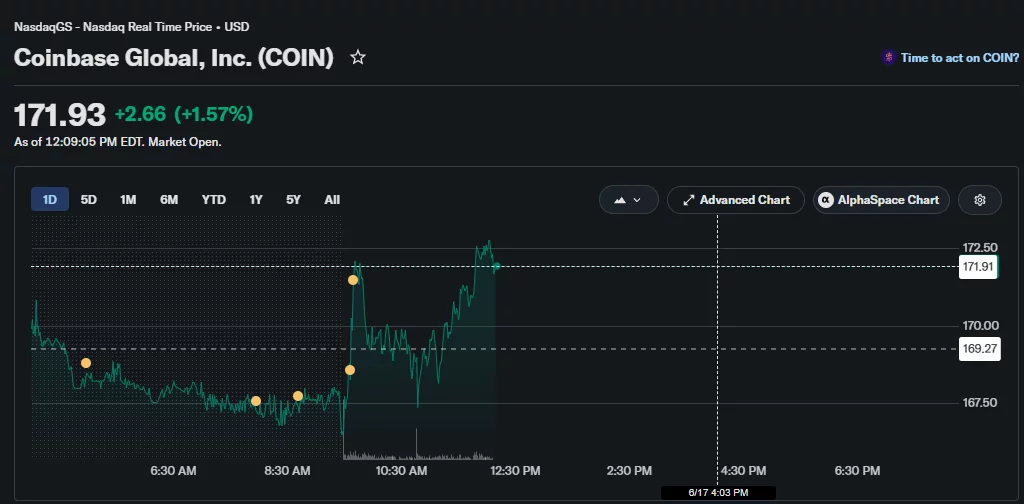
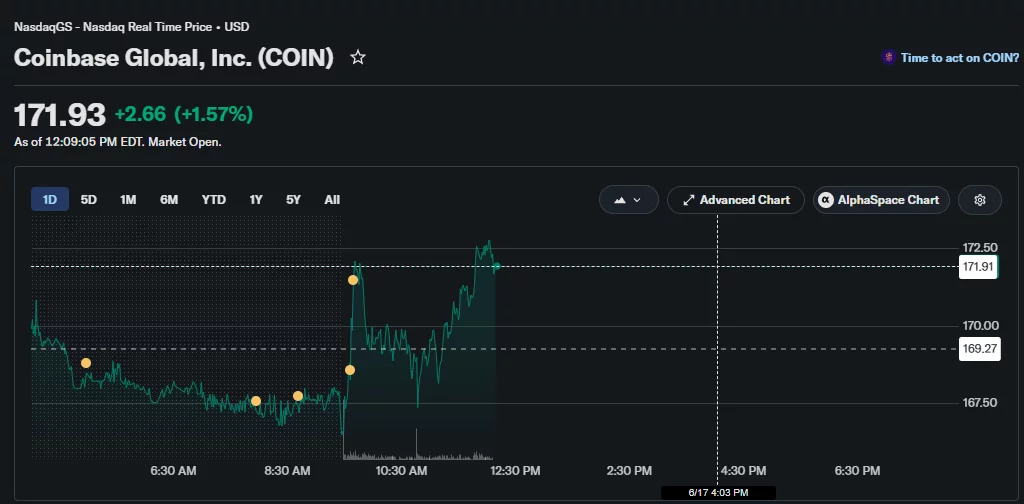
Coinbase shares traded higher on Wednesday, rising about 1.6% to around $171.93 after closing 0.2% lower at $169.27 in the previous session. While investors continued monitoring the Federal Reserve’s policy decision and the outlook for interest rates, several Wall Street firms reassessed Coinbase’s latest product expansion and long-term growth strategy.
Coinbase adds AI tools and traditional market products
During its System Update event, Coinbase introduced an SEC-registered AI investment advisor that can access customer portfolio data and account history. According to Coinbase Chief Executive Officer Brian Armstrong, users will be able to interact with the advisor through natural language prompts and receive portfolio suggestions directly through the platform.
The company also announced that artificial intelligence agents can now connect directly to Coinbase. Using systems such as ChatGPT and Claude, customers can establish trading parameters and authorize AI-powered agents to execute trades on their behalf.
Alongside the AI products, Coinbase revealed plans to expand access to derivatives, prediction markets, and pre-IPO trading products tied to large private technology companies. The rollout follows the exchange’s recent announcement that it intends to launch tokenized stocks backed one-for-one by underlying shares.
According to Coinbase, the initiatives form part of its effort to develop what it describes as an “Everything Exchange,” combining crypto services with products traditionally associated with mainstream financial markets.
Analysts remain divided on Coinbase valuation
Not all Wall Street firms share Bernstein’s optimism. Following the same product event, Barclays reiterated its underweight rating and maintained a $107 price target on Coinbase shares.
According to Barclays, new offerings including tokenized equities, AI-powered advisory services, equity options, and agentic payments are unlikely to fully compensate for weaker crypto trading activity if market volumes remain subdued.
Elsewhere, Benchmark reiterated its buy rating and set a $270 price target. Benchmark analyst Mark Palmer argued that Coinbase is evolving beyond its role as a cyclical crypto brokerage and is building a platform capable of attracting demand from traditional financial markets.
Cantor Fitzgerald also maintained its overweight rating and kept its $250 price target unchanged. According to the firm, Coinbase’s continued product development during a challenging market environment strengthens its competitive position, although analysts cautioned that fluctuations in crypto asset prices could still create cyclical headwinds.
At the same time, broader market conditions remain a factor for Coinbase and other crypto-related stocks. Bitcoin briefly fell below $65,000 ahead of the Federal Reserve’s policy decision, while stronger-than-expected retail sales data reinforced expectations that policymakers could keep interest rates elevated for longer.

Zcash founder Zooko Wilcox has explained how the network’s July 28 Ironwood hard fork will address uncertainty around a critical flaw in the Orchard shielded pool.
Summary
- Zcash will seal the old Orchard pool, limiting how much ZEC can leave after Ironwood.
- Ironwood cannot identify fake coins individually but can stop excess hidden supply from escaping Orchard.
- Temporary exchange and wallet disruptions may occur as providers prepare for Zcash’s July 28 upgrade.
The upgrade will not identify or freeze individual counterfeit coins. Instead, it will seal the old pool and limit how much ZEC can leave.
In a July 19 post on X, Wilcox explained how the planned upgrade would deal with any hidden excess supply if the flaw was exploited before developers patched it. Because Orchard hides transaction details, the network cannot prove that counterfeit ZEC was never created.
Ironwood will seal the vulnerable Orchard pool
Ironwood, also known as NU6.3, is scheduled to activate at block 3,428,143 on July 28. The upgrade will retire the current Orchard pool and introduce a new shielded pool based on the corrected circuit.
According to Zcash’s official Ironwood user update, users will no longer be able to send or receive ZEC inside the old Orchard pool after activation. Funds can leave only through the turnstile, which prevents more ZEC from exiting than legitimately entered.
The Zcash team said it believes the flaw was “unlikely to have been exploited,” but users cannot independently prove no counterfeit ZEC was created. Ironwood aims to trap any excess value inside the old pool rather than allow it to enter wider circulation.
Orchard bug left a supply question Zcash could not prove away
Security researcher Taylor Hornby discovered the Orchard flaw on May 29 while auditing the shielded system. The bug could have allowed an attacker to create counterfeit ZEC inside Orchard without leaving an obvious public record.
As reported by crypto.news, developers first disabled Orchard activity and then restored it through the NU6.2 hard fork with corrected cryptography. No evidence of unauthorized value creation was found, but Orchard’s privacy means past exploitation cannot be ruled out with complete certainty.
Crypto.news later reported that Ironwood would create a fresh shielded pool and use the turnstile to control value leaving the old one. Node operators can then verify that circulating ZEC does not exceed the amount permitted by the network’s monetary rules.
Wallets and exchanges may temporarily pause services
Zcash users do not need to take immediate action before the hard fork. However, wallets, exchanges and other providers may temporarily suspend deposits, withdrawals or related services while completing software upgrades.
The official network guidance says Orchard users will eventually need wallet support to move funds into the new pool. Funds may remain temporarily unavailable in wallets that have not added the required migration tools.
The July 28 activation also follows Zcash’s move away from the legacy zcashd client. Providers still completing that migration may need more time before fully supporting Ironwood.
Zcash adds more security checks after the flaw
The Orchard incident led to wider security work across the Zcash ecosystem. As reported by crypto.news, an AI-assisted review using Anthropic’s Mythos system found no additional serious vulnerabilities after the original flaw was disclosed.
Developers are also pursuing independent audits and formal verification for the updated cryptographic system. The work aims to reduce the risk of another hidden counterfeiting flaw and give users stronger ways to verify Zcash’s supply rules.
Ironwood addresses the unresolved supply question rather than the already-fixed bug itself. By sealing Orchard and controlling withdrawals through the turnstile, the hard fork aims to prevent any hypothetical counterfeit ZEC from entering circulation.

XRP just secured a record no other altcoin can claim, staying inside crypto’s top 10 by market cap every single year since 2014.
The streak spans more than a decade, from bull runs to brutal bear markets to a landmark legal battle against regulators.

The Only Altcoin Besides Bitcoin in the Top 10
A top 10 ranking measures the ten largest cryptocurrencies by market cap, the total value of all coins in circulation. XRP is the only asset besides Bitcoin to hold that position continuously since 2014.
The CoinGecko study, which excluded 2013 due to sparse data, frames the achievement in stark terms. Back in 2014, XRP ranked eighth, with a market cap of nearly $32 million, just 0.3% of the top 10’s combined market cap.
The token reached second place in 2015, right behind Bitcoin. It later held third across 2017, 2018, and 2019 before stablecoins and Layer-1 tokens reshaped the ranking.
The list of casualties makes the run even more impressive. Early giants like Litecoin, Dash, NEM, Namecoin, and Peercoin once filled the top 10 but eventually faded from view.
Follow us on X to get the latest news as it happens.

XRP, by contrast, refused to disappear entirely. It weathered every rotation of capital, narrative, and technology that pushed rivals out of the elite tier and into obscurity.
Ethereum offers a useful perspective on the feat. It has spent years in the top 10, yet its token only launched in 2015, leaving XRP alone alongside Bitcoin as a genuine 2014 survivor.
Why Does XRP’s Longevity Actually Matter
The resilience faced its harshest test between 2020 and 2023. The US Securities and Exchange Commission sued Ripple, the payments firm tied to XRP, triggering delistings across several major exchanges.
Even then, the token retained enough value to stay among the industry’s largest names. CoinGecko attributed that endurance to sustained institutional and cross-border payment demand across every market cycle.
The numbers show how far it has traveled since those early days. By 2025, XRP had reached fourth place with a market cap of nearly $127.9 billion, roughly 4.3% of the top tier.
Its trajectory mirrors both the explosive growth of crypto and its own ability to stay relevant as the industry matured around it year after year.

Legal commentator, Bill Morgan, called the record both a fact and an inconvenient truth for skeptics who still question XRP’s long-term relevance.
The achievement carries weight beyond bragging rights. Longevity signals durable demand, a quality that increasingly matters as institutions weigh which assets belong inside regulated financial products and long-term portfolios.
XRP currently trades near $1.10, holding its top-10 spot despite recent market volatility that briefly dragged the price to $1.05 before recovering.
Subscribe to our YouTube channel to watch leaders and journalists provide expert insights.
The post XRP Achieves a Milestone No Other Altcoin Has Ever Reached in Crypto History appeared first on BeInCrypto.
Circle President Heath Tarbert has defended the company’s long-term strategy after Circle shares fell sharply from their post-IPO peak.
Summary
- Circle says USDC’s scale and network effects remain difficult for new stablecoin competitors to replicate.
- Open USD adds pressure as Circle shares trade far below their post-IPO peak near $260.
- Circle keeps expanding regulated infrastructure while investors question competition, margins, and future stablecoin revenue sharing.
Speaking in a July 14 interview with FOX Business, Tarbert said management remains focused on building financial infrastructure rather than reacting to short-term moves in the stock.
The interview came as Circle faced growing investor concern over competition in the stablecoin market. CRCL had traded near $260 after its public debut before falling toward the low $60 range. Tarbert said Circle is “playing the long game” and argued that successful execution would eventually support shareholder value.
Tarbert points to USDC network effects
Tarbert said Circle’s main focus remains building a full-stack internet financial platform around USDC and related infrastructure. He argued that the company’s position cannot be measured only through daily stock movements and said the stock should “take care of itself” if Circle delivers on its wider mission.
He also defended USDC against new competitors. Tarbert pointed to roughly $73 billion in circulation and native support across 34 blockchains, saying those network effects would be “incredibly hard to replicate.” Circle describes USDC as a regulated digital dollar used across trading, payments and settlement.
Open USD adds new pressure to Circle
The comments came after Open Standard launched Open USD, a planned stablecoin backed by more than 140 participating businesses. The group includes Visa, Mastercard, Stripe, BlackRock, BNY and Coinbase. Open Standard says partners can mint and redeem Open USD without fees and receive reserve earnings after a management charge.
As reported by crypto.news, Circle shares fell 17.5% to $62.63 after Open USD entered the market and CRCL left several Russell Growth indexes. The decline added to concerns about whether new stablecoin models could pressure Circle’s economics.
Wall Street has also raised questions about that competition. Crypto.news reported that Mizuho cut its Circle price target to $50, arguing that Open USD’s revenue-sharing structure could pressure margins and raise distribution costs.
Circle faces pressure over USDC economics
Circle’s challenge extends beyond new stablecoin issuers.JPMorgan lowered earnings forecasts for Circle and Coinbase after a new revenue-sharing agreement tied to USDC balances on Hyperliquid. The bank said stronger adoption could come with lower reserve income retained by the companies.
Tarbert pushed back on the idea that competitors can quickly reproduce USDC’s reach. He also described USDC as the largest regulated stablecoin and said it leads in actual transaction volume, presenting scale and existing distribution as key parts of Circle’s competitive position.
Circle keeps expanding regulated infrastructure
Circle has continued adding regulated infrastructure despite the stock decline. On July 10, the company received final OCC approval to establish Circle National Trust. The trust bank will initially provide digital asset custody, with USDC reserve management planned as a possible future service.
As reported by crypto.news, the approval places the new entity under direct federal supervision. Circle says the structure could support wider institutional use of its digital asset infrastructure.
Tarbert’s comments frame the stock decline against a wider contest for stablecoin distribution and reserve income. Open USD brings a large group of payment and financial companies into the market, while Circle continues betting that USDC’s existing network and regulated infrastructure will support its long-term position.
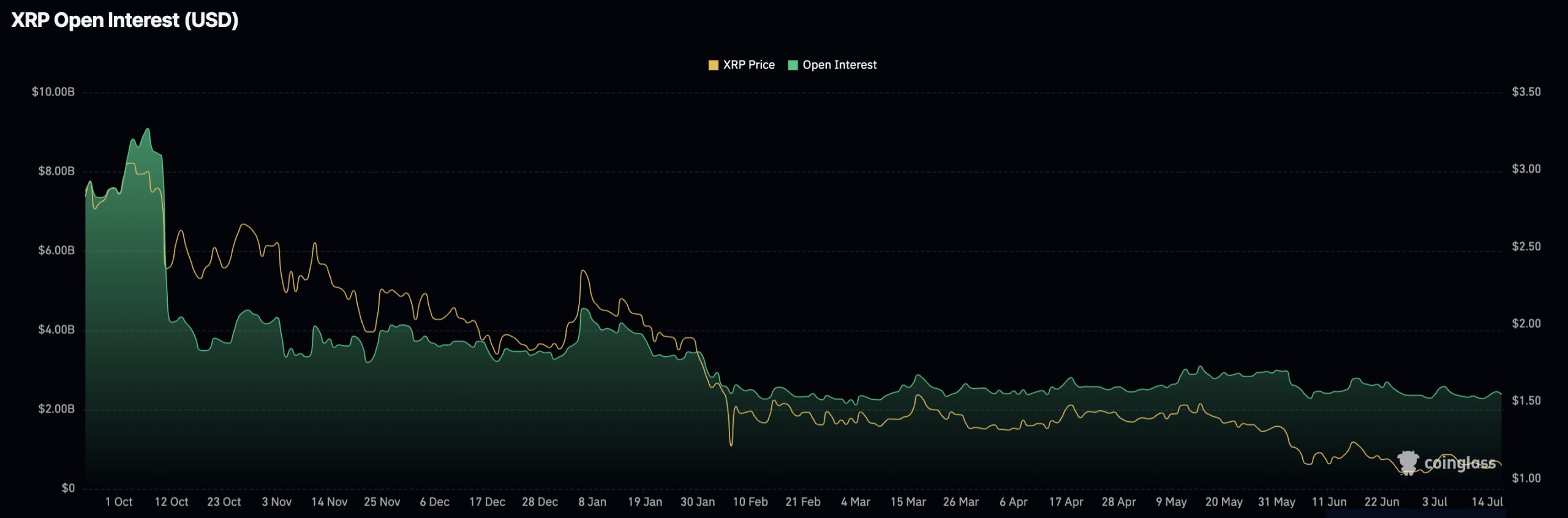
XRP price prediction remains in focus as it trades between $1.08 and $1.10. The chart still gives bulls little to celebrate. Price remains below the 50, 100, and 200-day EMAs between $1.15 and $1.16, $1.24 and $1.25, and $1.45 and $1.46. That leaves the $1.00 to $1.02 zone as the key support that traders keep watching.
The latest inflation data briefly lifted risk appetite across financial markets. However, XRP barely flinched. While stocks welcomed the softer backdrop, XRP continued to drift as traders stayed on the sidelines. Sometimes the market hears good news and simply shrugs.
Open interest in perpetual futures has continued to fade, reflecting weaker speculative demand. ETF inflows have also slowed, while assets under management remain below $900 million to $1 billion. Retail participation has yet to return in meaningful numbers, leaving momentum without much fuel.
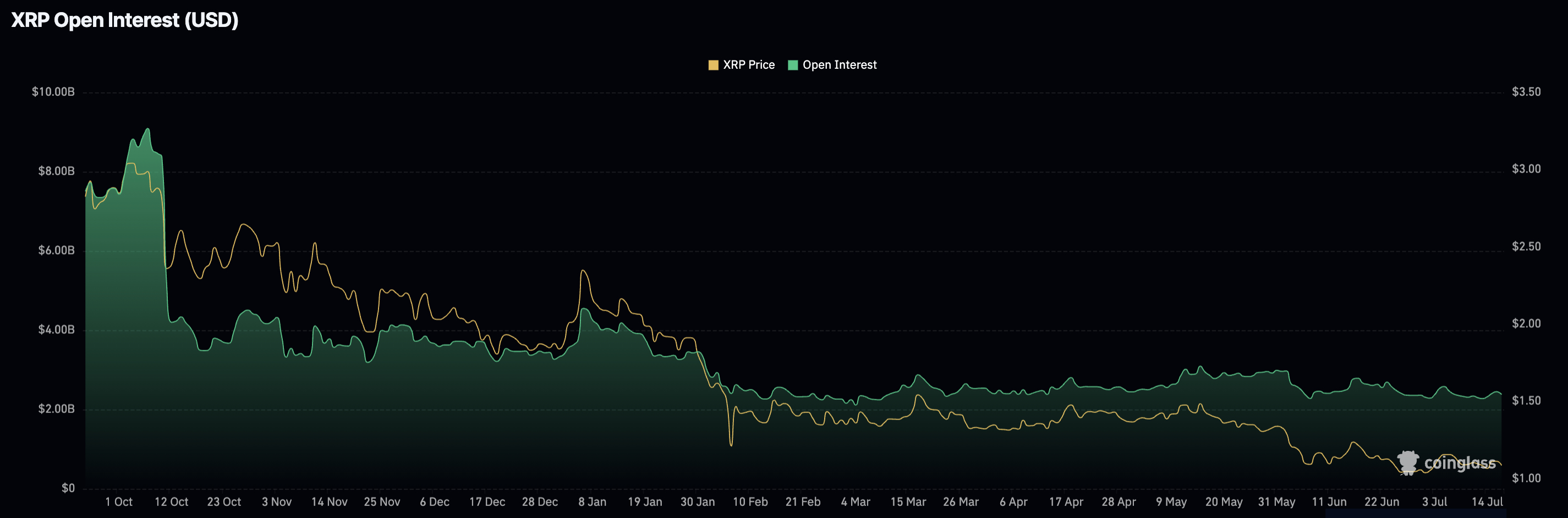
Even so, momentum remains neutral rather than outright bearish. The daily RSI sits between 44 and 46, suggesting neither buyers nor sellers have full control. That shifts the focus away from breakout dreams. Instead, traders are asking whether XRP can defend the psychologically important $1.00 to $1.02 area before sellers push for another leg lower.
Now, can XRP push higher next week?
Trade ADA on Bybit and Get a Chance to Win Our $1,000 USDT Airdrop
XRP Price Prediction: Hold $1.00 Support This Week?
XRP is trading between $1.08 and $1.10, while 24-hour volume sits between $1.0 billion and $1.1 billion. Activity remains healthy, but volume still lacks the punch that usually confirms a trend. Meanwhile, the failed defense of the $1.10 to $1.11 zone remains the technical headline. That area briefly acted as support, but losing it puts buyers back on the spot.
The EMA stack still leans against a quick recovery. The 20, 50, and 200-day EMAs continue capping upside attempts. As a result, every bounce runs into overhead supply almost immediately. Sellers are not running away with the market, but they are still calling the tune.

The bullish path remains straightforward. Buyers need to defend the $1.08 to $1.10 range and reclaim $1.15 to $1.17 with convincing volume. Fresh optimism around regulation could also help, although the price still needs to prove it. Hope is cheap, but breakouts usually demand cash.
The base case is still a sideways grind between $1.08 and $1.16. However, if $1.10 to $1.11 turns into firm resistance again, attention shifts toward $1.02 to $1.04. A break there would put the $0.99 to $1.00 area back in focus, where traders often become far more emotional than technical.
The RSI around 51 to 53 reflects neutral momentum rather than a decisive edge for either side. In that environment, patience often beats prediction. Longer-term models still lean constructive, yet short-term traders are likely watching whether the $1.00 mark survives before dreaming about the next rally.
Discover: The Best Token Presales
Bitcoin Hyper Targets Early Mover Upside as XRP Tests Key Levels
When a large-cap asset like XRP is grinding below every meaningful moving average with weakening institutional flows, the risk-adjusted case for holding it starts to compete with the opportunity cost of sitting in something earlier in its curve. That’s the rotation trade some active traders are running right now. They are not abandoning crypto, but moving capital where asymmetry is higher.
Bitcoin Hyper ($HYPER) is currently in presale at $0.0136832, having raised $32.9 million to date. The project’s core pitch is infrastructure, not hype: it’s positioning as the first Bitcoin Layer 2 with Solana Virtual Machine (SVM) integration, with sub-Solana latency on a chain secured by Bitcoin’s trust model.
The presale includes staking with a high APY, and the feature set covers a decentralized canonical bridge for BTC transfers alongside low-cost smart contract execution.
Research Bitcoin Hyper at the presale page before the current pricing stage closes.
Discover: The Best Crypto to Diversify Your Portfolio
The post XRP Price Prediction: Can XRP Hold $1 Next Week? appeared first on Cryptonews.

The Electronic Transactions Association (ETA) is signaling that Bitcoin may become a more visible part of mainstream payments conversations—at least within the group’s broader push to engage with emerging transaction technologies. ETA CEO Jason Oxman told CoinDesk that the organization is not lobbying for or against Bitcoin, but he suggested that ETA members are beginning to recognize its potential disruption in the payments stack.
The message comes as the ETA expands its membership base to include BitPay. On August 6, the trade group announced that BitPay—the Bitcoin payments provider—had become the first virtual currency company to join the ETA, framing the move as part of the industry’s ongoing innovation agenda.
Key takeaways
- The ETA’s Jason Oxman said the group does not take an official pro- or anti-Bitcoin stance and supports electronic transactions broadly, including non-Bitcoin technologies.
- BitPay’s entry as the ETA’s first virtual currency member is being presented by Oxman as evidence the trade group “won’t turn a blind eye to innovation.”
- Oxman pointed to education efforts around Bitcoin—specifically referencing the role of the Bitcoin Foundation—in shaping ETA members’ attitudes.
- On New York’s BitLicense proposal, Oxman argued regulators should avoid applying “reflexive” rules to new technology and instead conduct a deeper technical review of how Bitcoin systems and consumer protections work.
- New York’s financial regulator extended the public comment period for the BitLicense proposal by 45 days, pushing the deadline to October 21.
Why BitPay’s ETA membership matters
ETA represents major players in electronic payments, including companies such as Visa, MasterCard, Amazon, and PayPal. When Oxman discussed the ETA’s posture toward Bitcoin, he did not describe the trade group as endorsing a single technology. Instead, he framed the ETA’s mission around enabling electronic transactions in whatever form merchants and customers choose.
In that context, Oxman cited the ETA’s partnership with Atlanta-based Bitcoin payment solutions provider BitPay as a practical sign of openness. He suggested the organization is trying to position itself as a partner for emerging technology startups, with engagement driven largely by whether market participants show demand for those tools.
Oxman’s core argument was that transaction rails evolve according to user and merchant preferences. As he put it in his remarks, electronic transactions will take “whatever the customer or merchant of choice agrees is going to be the form of their electronic transaction.”
From education to partnerships
Oxman also linked the ETA’s shifting view to earlier learning efforts about Bitcoin. He said the Bitcoin Foundation played a significant role in educating ETA members about Bitcoin’s benefits and emphasized the value of business-oriented introductions between Bitcoin startups and established payment companies.
Specifically, Oxman referenced an ETA event in 2013 where Bitcoin Foundation general counsel Patrick Murck spoke. In Oxman’s recollection, Murck helped frame Bitcoin in business terms, after which Oxman said at least one ETA member decided to pursue a deal with a Bitcoin processor.
This detail matters because it suggests the ETA’s openness is not only policy-driven, but also influenced by how Bitcoin is presented—less as a speculative innovation and more as a payments system that can be integrated into existing commercial workflows.
What Oxman says about BitLicense and consumer protection
The ETA CEO’s comments also touched New York’s BitLicense framework, which has been at the center of ongoing debate about how cryptocurrency businesses should be regulated. Oxman said the ETA’s historical experience with regulatory change has involved adjusting to new payment options such as PayPal, noting that it previously spent significant effort encouraging regulators not to constrict innovation.
However, he acknowledged why regulators may be cautious with new payment technologies. His reasoning was that regulators tend to focus on consumer protection. According to Oxman, the less established the alternative system is—meaning the fewer protections are clearly available—the more regulators feel compelled to intervene.
Still, Oxman said the NY Department of Financial Services (NYDFS) should do more than react quickly to novelty. He argued regulators should not rely on “reflexive rules” simply because a technology is new, and instead conduct a real in-depth look at Bitcoin’s underlying systems.
In his view, the key is understanding how Bitcoin’s system operates, including how the blockchain works, and how Bitcoin providers—such as payment processors—can implement additional safeguards for consumers and merchants. The implication is that compliance standards should reflect the actual operating model and control points of Bitcoin-related businesses, rather than generic assumptions that could overreach.
Regulatory timeline shifts in New York
While ETA’s stance is aimed at engagement rather than advocacy, New York’s regulatory process is still unfolding. Earlier this week, NYDFS superintendent Benjamin Lawsky extended the public comment period on the BitLicense proposal by 45 days, pushing the deadline to October 21. This extension followed a joint letter addressed to Lawsky from BTC China, Huobi, and OkCoin, where the “Big three” exchanges outlined concerns about the proposal.
For industry participants, the practical takeaway is that the BitLicense debate remains active and that the regulatory outcome may depend on the arguments that emerge during the revised comment window. For Bitcoin-focused payments firms, that matters directly: the availability of licensing pathways and the scope of compliance requirements can influence whether and how businesses expand within New York.
As the ETA continues to bring Bitcoin payments into its orbit through members like BitPay and as New York works through its BitLicense process, readers should watch two things: whether regulators adopt a more technical, systems-level approach to consumer safeguards, and whether established payments networks deepen partnerships with Bitcoin-related processors as demand from merchants and customers becomes more visible.


South Korea’s Financial Supervisory Service has begun a formal sanctions process against Dunamu, the operator of crypto exchange Upbit, over the major wallet breach reported in November 2025.
Summary
- South Korea’s FSS opened sanctions proceedings against Dunamu over Upbit’s November 2025 wallet breach case.
- Current law lacks direct hacking penalties, leaving regulators uncertain about how severe sanctions can be.
- Upbit reimbursed affected users and rebuilt wallet systems while regulators continued examining the incident closely.
The action follows a months-long inspection into whether the exchange met its duties under the country’s Virtual Asset User Protection Act.
According to an SBS report citing financial authorities, the FSS recently sent Dunamu an inspection opinion letter. The document gives the company a chance to respond before regulators decide what penalties, if any, should follow. The process then moves through several formal regulatory review stages.
FSS reviews Upbit’s response to the 2025 breach
The November 27 attack affected Solana-based assets held by Upbit. Early estimates varied, with crypto.news reporting losses of about $36 million based on figures available at the time. South Korean reports now place the affected amount at 44.5 billion won, worth about $32 million at current exchange rates.
Upbit said it moved assets to cold wallets, halted deposits and withdrawals, and began tracing the stolen funds after detecting abnormal transfers. In its official customer notice, the exchange said customer losses would be covered with company funds. Authorities later examined both the security failure and the timing of Upbit’s public disclosure.
Legal gap makes the possible sanctions unclear
The current Virtual Asset User Protection Act gives regulators powers over custody, unfair trading and customer protection, but it does not set direct penalties specifically for hacking or computer system failures. That leaves uncertainty around how far the FSS can go in this case.
The regulator will consider Dunamu’s response before issuing advance notice of any proposed action. Final measures would require further review by the sanctions review committee, the Securities and Futures Commission and the Financial Services Commission. South Korean authorities are also considering stronger rules for hacking and technology failures in the next phase of digital asset legislation.
Upbit has faced wider regulatory pressure
The hack arrived during a period of close regulatory attention on Dunamu. As reported by crypto.news, South Korea’s Financial Intelligence Unit previously imposed a 35.2 billion won fine on the company over anti-money laundering and customer verification failures.
That earlier enforcement action later faced court scrutiny. Crypto.news reported that a court canceled a three-month partial suspension against Dunamu after finding gaps in the legal basis used for the sanction. The latest hacking case could create another test of how existing laws apply to crypto exchange operations.
Dunamu’s Naver deal remains under review
The sanctions process also comes while Dunamu works through a planned share swap with Naver Financial. the companies recently delayed completion of the transaction to December 31 because several regulatory approvals remain outstanding.
The current inspection does not automatically block that deal. However, Dunamu remains under several layers of regulatory review while South Korea prepares broader digital asset rules. The FSS has not yet announced a proposed sanction level in the hacking case, and Dunamu still has an opportunity to challenge the inspection findings before any final decision.


South Korea’s Financial Supervisory Service (FSS) has reportedly sent an inspection opinion letter to Dunamu, the operator of crypto exchange Upbit, regarding the $36 million hack from November 2025.
Local news outlet Yonhap News reported Sunday that the FSS had recently sent Dunamu an inspection opinion letter.
The letter marks the formal start of a sanctions procedure by the financial authorities. It provides Dunamu with an opportunity to respond to the inspection’s findings before the regulator notifies the company of its proposed sanctions.
Cointelegraph has approached Dunamu for comment on the matter.
Related: Kaspersky identifies malware framework targeting crypto investors
Upbit faced criticism for delaying its announcement of the $36 million exploit, according to Yonhap.
The breach lasted about 54 minutes, starting at 4:42 a.m. KST on November 27, but Upbit only announced the hack at the end of the day, after a merger-related event involving internet giant Naver Financial concluded.
The financial regulator said it is reviewing whether the exchange violated the Virtual Asset User Protection Act, which provides no direct sanctions provisions related to cyberattacks or computer hacks.
The report said South Korean authorities plan to address the regulatory gap by adding sanctions and compensation provisions for hacking and computer system failures to the second phase of the Digital Asset Basic Act.
Upbit reimburses users, launches onchain tracing system for fund recovery
In a statement following the November exploit, Upbit said it froze approximately 2.3 billion won ($1.5 million) worth of funds. The exchange said it would fully reimburse affected customers using its own balance sheet assets.
Upbit said it initiated an overhaul of its crypto wallet architecture to address potential vulnerabilities after the exploit and migrated all assets from affected wallets.
In December 2025, Upbit said it developed an automatic onchain tracking service, Onchain AI Tracer System, to track the path of the stolen funds and aid potential recovery efforts.
Upbit ranks third in CoinMarketCap’s crypto spot exchange rankings, based on scores that include traffic, liquidity and trading volumes.
Magazine: Does Botanix’s failure prove Bitcoiners don’t care about DeFi?
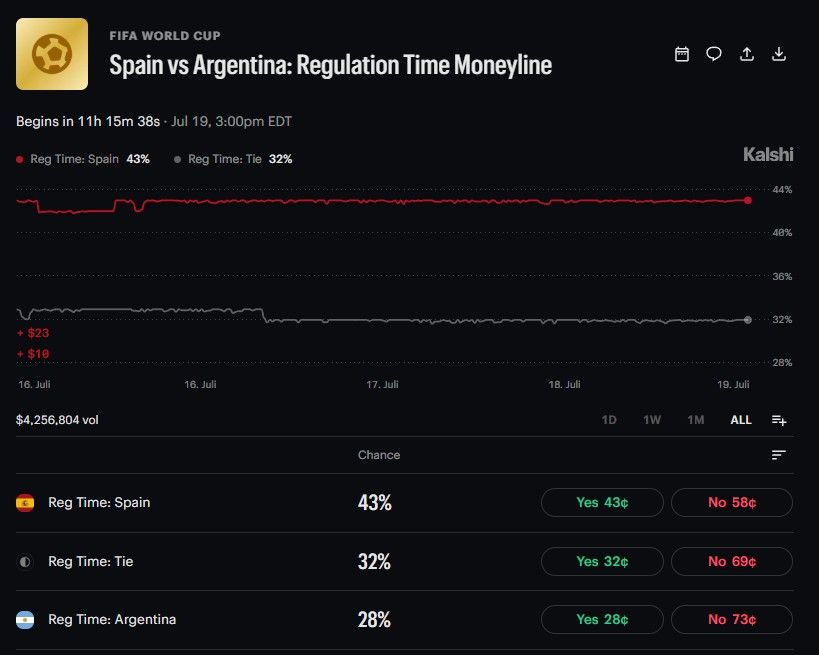
Canadian singer Drake has wagered $1.5 million USDT on Argentina to beat Spain in regulation time at Sunday’s World Cup final. A win would pay the rapper $5,175,000.
He placed the bet through the crypto gambling platform Stake and announced it on Instagram. In contrast, Spain enters the World Cup final at MetLife Stadium as the favorite.
A World Cup Curse Looms Over the Bet
Soccer fans have already invoked the Drake Curse, the belief that teams he backs publicly falter at the worst moment. A similar regulation-time bet cost Drake his last World Cup payout, even though Argentina won it in extra time. The wager only pays out if Argentina wins within 90 minutes, excluding extra time and penalties.
The rapper’s crypto ties run deeper than betting slips. He referenced Bitcoin (BTC) on his new Iceman album this year, calling himself a “crypto big-timer.” This bet, however, relies entirely on a stablecoin rather than a volatile token.
Kalshi Odds Favor Spain in Regulation
Kalshi’s regulation-time market prices Spain’s win probability at 43%, compared with 28% for Argentina and 32% for a tie. Meanwhile, that gap mirrors how World Cup betting markets have leaned toward Europe throughout the knockout rounds. The Kalshi contract for Sunday’s World Cup game had already logged more than $2.8 million in trading volume.
Prediction markets have grown into a major venue for World Cup wagering this year. Kalshi recently expanded its World Cup prediction hub through a partnership with ADI Predictstreet. Still, Drake’s wager sits well outside that data-driven crowd.

A Historic World Cup Night Beyond the Bet
Tether chief executive Paolo Ardoino shared news of the wager on X, adding an Argentine flag and a heart emoji. Celebrity wagers have become a running theme this World Cup, following a similar betting wave around Taylor Swift’s rumored wedding.
The final also marks a first off the pitch. FIFA will award custom championship rings to World Cup winners for the first time, a tradition borrowed from American sports. Interest has spiked around other World Cup markets, including bets on the halftime show lineup.
Kickoff is set for 3 p.m. ET at MetLife Stadium in New Jersey. If Messi and Argentina deliver in regulation, Drake finally breaks even on a wager that has haunted him for years.
The post Drake Eyes $5 Million Crypto Payout in Spain Vs Argentina World Cup Final appeared first on BeInCrypto.


A prediction made more than a decade ago about closer ties between Bitcoin startups and traditional payment companies increasingly resembles the payments market of 2026.
Summary
- A 2014 prediction about traditional payment firms partnering with Bitcoin startups increasingly resembles today’s market.
- Visa and Mastercard now work directly with crypto firms on cards, settlement, stablecoins, and payments.
- BitPay continues expanding regulated crypto payment services more than a decade after joining the payments industry.
Former Electronic Transactions Association CEO Jason Oxman discussed that possibility in an August 2014 interview with CoinDesk. His comments followed BitPay becoming the first digital currency company to join the payments trade group. Oxman said the association would remain open to new payment technologies without formally backing Bitcoin over other systems.
Early Bitcoin partnerships pointed to a wider shift
Oxman argued that payment companies ultimately respond to how consumers and merchants choose to transact. He said the industry was “in the business of facilitating electronic transactions,” regardless of which technology carried those payments.
The comments came during an early period for commercial Bitcoin adoption, when regulators were still debating New York’s BitLicense proposal. Oxman also warned regulators against applying rules simply because a technology was new, while accepting that consumer protection remained a valid concern.
The leadership of ETA has since changed. Jodie Kelley became the organization’s CEO in 2019, and ETA now operates a dedicated Digital Assets committee alongside its other payments industry groups.
Visa and Mastercard build direct crypto partnerships
The type of partnership Oxman discussed is now common across the payments industry. Visa and Stripe-owned Bridge announced plans in March to expand stablecoin-linked Visa cards to more than 100 countries by the end of 2026. As reported by crypto.news, the cards allow users to spend stablecoin balances across Visa’s merchant network.
Visa has also expanded its stablecoin settlement pilot to nine blockchains. The company said in April that the program had reached a $7 billion annualized settlement rate. Visa said the expansion gives payment partners more choice when selecting blockchain networks.
Mastercard has followed a similar path. Its Crypto Partner Program brings together more than 100 crypto companies, financial institutions and payment providers. As reported by crypto.news, Alchemy Pay joined the initiative in May to explore closer links between fiat payments and onchain commerce.
Stablecoins now lead much of the payments expansion
The industry’s focus has also shifted from Bitcoin alone toward stablecoins. Visa, Mastercard and Coinbase recently joined more than 140 companies backing Open Standard, a group developing the Open USD stablecoin.
As reported by crypto.news, the project plans to create payment infrastructure for businesses using a dollar-linked digital asset. The move puts major card networks directly alongside crypto-native companies in developing blockchain payment systems.
BitPay has also continued expanding. Crypto.news recently reported that the payment company secured MiCA authorization in the Netherlands, allowing it to provide regulated crypto and stablecoin services across eligible European Union markets.
More than a decade after Oxman predicted growing cooperation, partnerships between traditional payment networks and crypto companies have moved from isolated experiments into cards, settlement systems, stablecoins and cross-border payments.


Disclosure: This article does not represent investment advice. The content and materials featured on this page are for educational purposes only.
Spreadefi faces scrutiny as users assess trust, transparency, and DeFi platform credibility.
As the decentralized finance (DeFi) space has evolved, users have gotten a lot more careful about which platforms they trust with their digital assets. After a long line of fraudulent projects, one question comes up naturally: can Spreadefi be trusted, or is it just another scam?
Let’s take a closer look at the project, check the available information, and see whether there’s any real reason to call it unreliable.
What is Spreadefi?
Spreadefi is a DeFi platform that lets users earn income by staking in liquidity pools. Crypto assets are placed into a pool, and from there, they’re used to provide liquidity on decentralized exchanges. In return, participants earn rewards generated from fees and other protocol mechanisms.
The platform puts the emphasis on automated operations, cross-chain infrastructure, and risk management, aiming to make DeFi more accessible to both experienced users and newcomers alike.
Why do questions about a scam come up at all?
These days, just about any new crypto project faces questions like this. The market has lived through a string of high-profile frauds in recent years, and investors have grown far more cautious as a result.
Search queries like “Spreadefi scam” or “Is Spreadefi legit?” are completely normal. People want to be sure a project is actually building something, and wasn’t created just to pull in funds.
What was verified
In looking at the project, the focus is on the criteria that typically help separate a real company from a questionable crypto operation.
The company is officially registered
One of the first positives was the project’s legal transparency. Spreadefi operates through an officially registered company in the United States, information you can verify through public registries. Being able to confirm a legal entity is a strong sign of openness, especially in the crypto space.
Registration alone doesn’t guarantee success, of course. But fraudulent schemes almost never make that kind of information public.
Another important factor is that Spreadefi is building an ecosystem rather than relying on a single service.
Alongside its liquidity pool infrastructure, the platform has developed its own crypto swap service, allowing users to exchange supported digital assets directly within the ecosystem. This helps create additional utility for the platform while supporting internal liquidity.
The company is also developing API solutions for developers and business partners. These APIs are designed to allow third-party platforms, applications, and digital asset services to integrate Spreadefi’s infrastructure into their own products, expanding the ecosystem beyond the platform itself.
In addition to its staking and liquidity services, Spreadefi continues to invest in its technology stack, user interface, security systems, and infrastructure tools. Recent updates have included improvements to liquidity allocation algorithms, mobile experience, platform performance, and internal security architecture.
Projects that consistently expand their product offering and continue investing in infrastructure typically demonstrate a longer-term development strategy rather than focusing solely on attracting deposits.
Active project development
During the analysis, the team’s public activity was also taken note of.
Spreadefi regularly publishes content on its official blog, sharing updates on product development, new features, and technical upgrades. On top of that, project representatives take part in industry events and conferences, which suggests long-term development plans rather than a short-lived platform.
That kind of public visibility is rare for fraudulent projects. After launch, they usually cut off nearly all interaction with their audience.
Are there any negative reviews?
A deliberate effort was made to dig up confirmed negative material about Spreadefi.
After going through publications, reviews, and discussions across open sources, no convincing evidence was found that the project is engaged in fraud. There are the usual user questions, discussions of DeFi risks, and skeptical comments, all of which are completely natural for any crypto project.
What wasn’t found, however, were mass complaints, confirmed accusations of fraud, or signs of a classic rug pull.
It’s important to understand that the absence of that kind of material doesn’t mean there’s zero risk. Any DeFi protocol comes with market and technical risks. That said, the information landscape around Spreadefi looks significantly calmer than what you see with a lot of young crypto projects.
What risks remain?
Even if a project is legitimate, working with DeFi always carries certain risks:
- market volatility
- smart contract risk
- blockchain infrastructure vulnerabilities
- shifts in liquidity
- changes in crypto regulation
These factors apply to the entire decentralized finance industry, and they don’t point to any specific platform being fraudulent by nature.
Conclusion
Based on the information available right now, there are no objective grounds to call Spreadefi a scam.
Several things speak in the project’s favor:
- official company registration
- an actively expanding ecosystem including liquidity pools, a native swap service, and developer APIs
- regular product updates and infrastructure improvements
- regular posts on the official blog
- project representatives participating in conferences and industry events
- no confirmed accusations of fraud or widespread reports of misconduct
As with any crypto project, investors should study the documentation themselves, weigh the risks, and only make decisions after doing their own research. But as of today, Spreadefi gives the impression of a project that’s developing out in the open, with transparency, and with its sights set on being around for the long haul.
Disclosure: This content is provided by a third party. Neither crypto.news nor the author of this article endorses any product mentioned on this page. Users should conduct their own research before taking any action related to the company.
IBM CEO Arvind Krishna Has Nowhere to Hide From AI

Zcash sets July 28 hard fork to seal Orchard after critical bug

World Cup 2026: France’s Mbappé becomes all-time tournament goalscorer


-
 NewsBeat3 days ago
London Mayor Sadiq Khan handed a peerage by Keir Starmer alongside 15 other Labour figures… just days before the PM leaves No10
-

 Fashion2 days ago
Weekend Open Thread – Corporette.com
-

 Politics1 day ago
The House | The City of London can help the new chancellor deliver growth in every postcode
-

 Politics4 days ago
Young campaigners urge incoming PM to act on outdoor junk food ads
-

 Crypto World3 days ago
CFTC blocks Kalshi from unwinding Michigan trades after court order
-

 Business3 days ago
Nvidia Stock Slips After Big Tuesday Rally as Huang Confirms Vera Rubin Chip Is Now in Production Today
-

 Crypto World1 day ago
Ripple Payments Joins MiCA With 14 Firms, Does It Mean Anything For XRP?
-
 Entertainment4 days ago
Disney’s Most Ambitious Failed Star Wars Attraction Is Coming to SDCC
-

 Crypto World2 days ago
Ripple wins EU-wide access as ESMA adds it to MiCA register
-

 Business3 days ago
Palantir Shares Rise After Expanded Nvidia Partnership and Fresh Analyst Upgrades Ahead of Earnings Day
-

 Crypto World3 days ago
Injective Submits SEC Transfer-Agent Registration to Onchain Ownership Records
-

 Tech5 days ago
Get Your ESP32 Sunny Side Up With This Solar Dev Board
-

 News Videos5 days ago
XRP BOMBSHELL… XRP OMBOARDED FOR TRANSACTIONS!!!
-

 NewsBeat2 days ago
Registration is now open for March for Men with Kev 2026
-

 Tech5 days ago
Dark Secrets Emerge When Jailbreaking LLMs
-
 Sports4 days ago
New Cornerback Enters Vikings Trade Rumor Mill
-

 News Videos2 days ago
Money | Class 12 Economics | CBSE Board Exam 2026-27
-
 Crypto World2 days ago
Two July Windows Left: The CLARITY Act’s Senate Fight and What Failure Means
-

 Business2 days ago
Banco Bilbao Vizcaya Argentaria, S.A. (BBVA) Discusses Global Macro Environment and Economic Outlook for Core Markets Transcript
-

 Crypto World3 days ago
Claude Fable 5 Slips to Second in AI Coding Leaderboard
You must be logged in to post a comment Login