The howling winds are like nothing I’ve heard before as they beat against the windowpanes. The sky is an eerie gray — not from clouds, but smoke. A massive wildfire rages nearby. Disaster is imminent.
In our second-story apartment, my partner and I pack up our most essential belongings and a few treasured possessions. We tape our window seams to prevent smoke and ash from blowing inside and keep our eyes glued to a map of the fire’s spread.
The rising stress and deteriorating air quality are too much. We head 20 miles south to a hotel, where we stay until the fire is more contained. Even there, we see ash rain down from the sky.
I live in Pasadena, and my apartment was just outside the evacuation zone for the Eaton Fire, which took 19 lives and destroyed over 9,400 structures in January 2025. That month, the Eaton and Palisades fires raged simultaneously across Southern California, becoming the second- and third-most destructive wildfires in state history.
Advertisement
We were lucky, as the fire’s spread stopped five miles from our apartment. While many lost their homes, we were able to return to ours. Still, our taped-up windows did little to keep ash and smoke from seeping through cracks and coating everything in our apartment.
With unhealthy outdoor air quality, we couldn’t open windows for fresh air, so we relied on our air purifier. At the time, we had just one in our living room. We’ve since added another to our bedroom, along with two air quality monitors in each area.
The atmospheric dangers haven’t gone away: As I write this piece, smoke from a Boyle Heights warehouse fire is blowing toward us, making it once again ill-advised to open windows.
Fires are a significant contributor to poor air quality, but they aren’t the only one. Power plants burning fossil fuels spew pollutants, as does car exhaust from highways and city streets. There’s a reason why our phones’ weather apps report each day’s air quality index, or AQI. And although overall outdoor air quality in the US has improved over the decades, it hasn’t gotten better everywhere, especially in communities of color.
Advertisement
We face breathing dangers indoors as well, from gas-burning appliances and furnaces to myriad household chemicals and the off-gassing from furnishings and other goods. Outdoor air pollution slithers inside.
As a health and wellness writer for 12 years, I’ve often seen concerns about the health risks in the air we breathe 12 to 20 times per minute take a backseat to more tangible human needs, such as crystal-clear water and food free of contaminants. But there are simple steps we can take to improve the air quality in our homes.
Air purifiers can protect our airways from certain contaminants, as CNET Labs has found, but they aren’t the best or sole line of defense against poor air quality.
Are air purifiers the breath of fresh air we need?
Air purifiers look a lot like speakers — rectangular or cylindrical electronic appliances under 3 feet tall, with perforated metal or plastic casings. You’ll typically find them on the floor or a tabletop in high-traffic areas like the bedroom, living room or kitchen. Prices for air purifiers can range from $50 to $1,000.
Advertisement
I didn’t grow up in a home with air purifiers, but my mom now has two in her New York suburban home. She’d been relying on her HVAC system’s filter, but when COVID-19 cases spiked during the pandemic, she invested in air purifiers.
Experts from air care tech companies like Dyson, Blueair, Airthings, Coway and Oransi all tell me they’ve seen air purifier sales grow during events that spur concern about the impact of what’s in our air on our health. Think the COVID-19 pandemic, wildfires, smoggy days of urban pollution and allergy season.
My colleague Tara Brown, CNET social media manager, recently got her first air purifier. It wasn’t technology she grew up with, and at first it seemed like a luxury item.
“The way my mom dealt with a dusty house was to open up the windows when cleaning, and during pollen season we’d try to keep windows closed and take daily allergy pills,” Brown, who lives in the suburbs on the East Coast, says. “As I get older and now have my own money, I am interested in trying one out because I’m allergic to dust and pollen.”
Advertisement
Turns out, Brown’s mom was right to open her home’s windows. As I’ve learned, that’s the second step you should take when addressing poor air quality, even before turning on an air purifier.
The first two steps toward clearing the air
Your first line of defense is to focus on controlling the source of pollution.
“In cities, the largest source of volatile organic compounds used to be vehicles, but vehicles have gotten cleaner, and over time, now it seems that the largest source is actually the stuff we use in our residences,” Linsey Marr, a university distinguished professor in Virginia Tech’s Department of Civil and Environmental Engineering, tells me.
This includes common goods like shampoo, lotion, hairspray, deodorant, cleaning products and paints.
Advertisement
If you’re looking for low- or no-cost methods to control VOCs, Brigit Hirsch, press secretary for the US Environmental Protection Agency, recommends carefully following product instructions to ensure that you don’t use more than is recommended and to determine the type of ventilation required. If you’re painting walls, for instance, you should keep your windows open.
As for gas and particle pollution released when you’re cooking on the stovetop or in the oven, turn on your range hood to exhaust it. If your range exhausts outdoors, avoid using it on days when outdoor air pollution is high. Instead, an air purifier near the stove can help trap those cooking particles and, if it has an activated carbon filter, some gases.
To remove particles on surfaces before they’re disturbed and end up in the air, regularly vacuum with a filtered vacuum cleaner and dust with a damp cloth. To dampen that cloth, use low-toxicity cleaners, like soap and water, that don’t contain ammonia or chlorine, which can worsen air quality.
“The most important thing to do about air pollution is source control, so let’s actually reduce the sources that are causing the pollution first and foremost,” Glory Dolphin Hammes, CEO of IQAir North America, tells me. IQAir is the world’s largest free, real-time air-quality monitoring platform and also sells air purifiers.
Advertisement
Once you’ve exhausted your options for source control, it’s time to ventilate. To prevent pollutants from building up inside, open your windows, turn on kitchen or bathroom fans that exhaust outdoors and use window or attic fans.
When ventilation isn’t an option because of high outdoor air pollution, such as during a wildfire or during rush hour if you live near a high-traffic road, you’ll want to focus on air purification.
HVAC vs. air purifier: Which is your air ally?
You may be surprised to learn, as I was, that your HVAC’s filters were originally designed to protect the system’s heating and cooling coils, not human health.
On top of that, Theresa Pistochini, co-director of engineering at the UC Davis Energy Efficiency Institute and Western Cooling Efficiency Center, tells me that to save energy, household HVAC systems usually only turn on when heating or cooling the air, so the fan doesn’t run constantly. That means it’s not filtering your air all the time, and even when it does, you might not have the highest-grade filter.
Advertisement
You’ll want to pay attention to MERV, which stands for minimum efficiency reporting value and is based on a test method developed by the American Society of Heating, Refrigerating and Air Conditioning Engineers. While most people buy cheaper MERV 8 filters for their HVAC systems, they should be getting MERV 13 to improve their air quality.
An HVAC filter’s MERV rating indicates how effectively it removes airborne particles of different sizes.
EPA/Zooey Liao/CNET/Getty Images
“In order to get a certain MERV value, you have to be able to remove a certain percentage of particles,” Pistochini says. “The higher the MERV rating, the higher the fraction of the particles that are removed.”
Advertisement
Even so, a HEPA (high-efficiency particulate air) filter, which is the highest-grade filter and what you should look for in an air purifier, is best because it removes at least 99.97% of particles that measure 0.30 microns and larger. However, a HEPA filter isn’t recommended for HVAC systems because its dense nature creates too much airflow resistance. That’s why a MERV 13 filter is used instead, and it removes at least 50% of particles sized from 0.30 to 1.0 microns, with the percentage increasing as particle size increases.
Note that neither removes gases – for that, many air purifiers have an activated carbon filter, which is just one step in the filtration process.
Since it’s more efficient to run a portable air purifier than it is to run an entire HVAC system through ductwork that’s prone to leakage and can contribute to energy losses, Pistochini says it’s better to use air purifiers right in the room — especially in the kitchen, where you cook, and in your bedroom, where you tend to spend extended periods of time.
But if you’re wondering whether you should upgrade your HVAC filter to MERV 13 or purchase an air purifier with a HEPA filter, Joseph G. Allen, director of Harvard’s Healthy Buildings Program and a professor at the Harvard T.H. Chan School of Public Health, tells me that you should do both, as they’re not significant expenses. Plus, they come with important health benefits.
Advertisement
“Air purifiers solve a key problem, and that is the general low to nonexistent filtration in homes,” Allen says. “Most of the filters that are in a home are low-grade and are designed to protect the equipment. Air purifiers have filters that are designed to protect people. That’s a key distinction.”
The past, present and future of our air, inside and out
At the national level, a key element in achieving better air quality is the sweeping government regulation known as the Clean Air Act of 1970. A landmark achievement of the environmental movement, this law requires state, local, tribal and federal agencies to work together to clean our air.
As a result, “air quality in the US has improved tremendously over time, particularly in the last 20 years,” Hirsch says.
According to the EPA’s 2025 Our Nation’s Air report, since 1970, the combined emissions of benchmark or “criteria” pollutants have decreased by 79%. Using monitors across the US, the EPA measures six criteria pollutants: carbon monoxide, lead, nitrogen dioxide, ozone, particulate matter and sulfur dioxide.
Advertisement
But while the Clean Air Act has improved our overall outdoor air quality, poor air quality remains an invisible guest in our own homes.
“Hundreds of thousands of lives have been saved [because of the Clean Air Act],” says Allen. “But that is solely about outdoor air pollution. Our indoor air pollution has continued to worsen. We do not have a Clean Indoor Air Act.”
Inside our homes, we’re exposed to volatile organic compounds emitted as gases from everyday items such as cleaning products, upholstered furniture and cosmetics. We’re enveloped by particulate matter from cooking and burning candles, along with biological contaminants such as pollen, mold spores, pet dander, viruses and bacteria. At the flick of a switch, gas stoves and unvented kerosene and gas space heaters release carbon monoxide and nitrogen dioxide. Through windows and doors and hidden cracks in our homes, outdoor air pollution seeps inside.
At the same time, our buildings have become more airtight. On the positive side, this prevents energy losses; on the negative side, pollutants get trapped indoors once you shut your windows.
Advertisement
While data on indoor air quality is elusive, our outdoor air quality is something we can measure, track and easily view in our weather apps. And despite the Clean Air Act, we still can’t escape pollutants in the air we breathe once we step outside our homes, especially in specific neighborhoods.
“Just because air quality got better for a while overall doesn’t mean that the air in your community is better, especially if you have a highway, warehouse or power plant nearby,” Laura Kate Bender, the American Lung Association vice president of nationwide advocacy and public policy, tells me.
Since 2000, the ALA has released an annual State of the Air report. In its 2026 report, the ALA found that more than one in four Americans, 152.3 million people, live in locations with unhealthy air pollution levels. Perhaps even more alarming is that almost half of American children, 33.5 million people under the age of 18, live in counties with a failing grade for at least one air pollution measure.
A person of color is also more than twice as likely as a white person to live in a place with a failing grade for all three pollution measures. Hispanic people are more than three times as likely.
Advertisement
Climate change has started showing up in the ALA’s reports, “and it’s undoing some of the progress that the country made in cleaning up those polluting sources,” Bender says.
A majority of the experts I spoke with mentioned wildfires, which are escalating because of climate change. NASA reports that wildfire activity has more than doubled worldwide over the last 21 years. Its satellites detect active wildfires twice per day.
Because of wildfires, there’s been an increase in particulate matter, says Priyanka deSouza, assistant professor in the University of Colorado Denver’s Department of Urban and Regional Planning. Research also suggests that levels of ozone, a highly reactive gas that’s both natural and manmade, will increase due to higher temperatures and wildfires.
“It isn’t looking great,” deSouza says.
Advertisement
In February 2022, the United Nations Environment Programme reported that extreme fires across the globe will increase by up to 14% by 2030, 30% by the end of 2050 and 50% by the end of the century.
A series of proposed and finalized rollbacks of air pollution limits on gas and coal power plants and cars by the Trump administration has undercut progress toward clean air. The EPA’s Hirsch says the agency is committed to clean air protections.
Breathless: The toll of air pollution on our health
Poor air quality has unmistakable immediate effects: difficulty breathing, coughing, irritation of the eyes, nose and throat. Some people may also experience headaches, dizziness, fatigue and chest pain.
Children are more susceptible to the health effects of poor air quality because their lungs haven’t fully developed, Srikanth (Sri) Nadadur, branch chief for the Exposure, Response and Technology Branch at the National Institute of Environmental Health Sciences, tells me. The same goes for older adults, due to compromised lung function and the higher probability of them having a lung disease like asthma or COPD.
Those with hay fever, heart conditions and pulmonary fibrosis (scarring in the lungs) are also more likely to be affected as air quality in the home decreases, according to Dr. Brian W. Christman, an American Lung Association national spokesperson.
Airborne pollutants can cause health problems affecting different parts of the body, including the lungs and heart.
Zooey Liao/CNET/Getty Images
Because of their size, ultrafine particles can get deeper into the lungs and then release anything they’ve absorbed along the way, like VOCs. If these compounds get into the lungs’ fluid, they can enter the circulatory system, potentially affecting cardiovascular function.
“Of late, the literature is indicating this having effects on the brain and also on the reproductive system,” Nadadur says. “There is good evidence from multiple epidemiological cohorts for an increase in the incidence of lung cancer from long-term exposure to outdoor PM2.5 particles, but the association for other cancers is still not clearly well known.”
If you’re living in a place with poor air quality or have been affected by a wildfire, you should reach out to your doctor if you notice symptoms such as shortness of breath. If you have a lung disease like asthma or other health conditions that a wildfire could worsen, it’s important to plan for these events, especially as they become more common. Ensure you have your medication ready and know what to do if an evacuation is mandated.
Advertisement
As for poor indoor air quality, remember the three steps to address it: Source control, ventilation and air purification.
What your air purifier can (and can’t) do for you
An air purifier uses its fan to draw air inside it, where it passes through various filters to trap airborne pollutants. The freshly filtered air is then pushed out to circulate throughout the room.
Each filter is designed to capture different sizes and types of pollutants. Chloe Waller, Airthings chief commercial officer, explains that a well-designed air purifier filter system works in three stages.
Stage 1: The prefilter
Usually made of fabric and designed to extend the life of the other filters in the system, this outer filter is coarse to capture larger particles, such as pet hair, lint and visible dust. Certain units make this filter washable or vacuumable.
Advertisement
Stage 2: The HEPA filter
HEPA filters can capture microplastics and certain nanoplastics, dust, pollen, mold spores, some bacteria and viruses and PM2.5 particles, which can come from wildfire smoke, cooking, using a fireplace, vehicle exhaust and industrial pollution.
CNET’s 2025 lab tests conducted in a smoke chamber confirmed that air purifiers with a true HEPA filter can capture viruses that might cause illness, including influenza and the COVID-19-causing SARS-CoV-2.
Out of 12 models tested, CNET Labs found that on a low fan setting, the Shark HP232 air purifier performed the best at removing fine particles 2.5 microns and under, averaging 1 minute and 15 seconds. At high fan speed, the Coway Airmega 400S was the best at removing fine particles in an average of 34 seconds.
Stage 3: The activated carbon or charcoal filter
While HEPA captures particles, an activated carbon filter targets gases such as VOCs and odors from smoke, pets and cooking. Peter Mann, CEO of Oransi, creator of CNET’s “best for pet hair and dust” air purifier, added that activated carbon filters can also absorb gases such as ammonia, formaldehyde and hydrogen sulfide.
Advertisement
While activated carbon filters can remove ozone, the efficiency of this process depends on the amount of activated carbon in the filter. However, there is no performance rating system for filters designed to remove gases.
But there is a rating system for particles: clean air delivery rate. The higher the CADR, the larger the area an air purifier can filter.
“My rule of thumb is you want to have 300 CADR for every 500 square feet,” says Allen. “Depending on the exact size of your room, we’re trying to target four, five or six air changes per hour.”
Advertisement
Air purifiers can have multiple filtration layers that capture particles and gases.
Zooey Liao/CNET/Coway
While many air purifier manufacturers will put the room size on their packaging, they may not display the CADR. That means the air purifier might not be effective unless you’re using it in a room smaller than what’s noted on the product package.
After all, your air purifier can’t filter what it can’t catch, which is why you’ll want to make sure it’s correctly sized for your space. Harvard’s Healthy Buildings Program has a sizing tool for that.
“Most consumer purifiers are designed for rooms up to 500 to 600 square feet,” says Waller. “In larger open spaces, or when doors and windows are regularly opened during a smoke event, a single unit running on auto mode may not maintain clean air throughout the space.”
Advertisement
You’ll also want to ensure that your air purifier has a true HEPA filter, not one labeled HEPA-type or HEPA-like.
Changing both the HEPA and activated carbon filters is crucial. Collected pollutants build up and clog the filters, and dirty filters can actually release them back into your home, making air quality even worse than it was before you set up your air purifier.
What an air purifier can’t capture
Air purifiers capture airborne particles and some gases as air passes through the machine, which means anything they remove must first be suspended in the air and drawn into the purifier.
There are a few things they can’t fully address: “Dangerous gases like carbon monoxide and radon require dedicated detectors and professional remediation,” says Nedra Ogden, senior product manager at Blueair, maker of CNET’s top-recommended air purifier.
Advertisement
Radon is an invisible, naturally occurring radioactive gas that enters homes through cracks and gaps from the ground as radioactive metals break down in soil, rocks and groundwater. Carbon monoxide is also an invisible gas, and sources include gas stoves, leaking chimneys and unvented kerosene and gas space heaters.
Air purifiers can’t capture the carbon dioxide we exhale, either.
“When you don’t have appropriate ventilation, with lots of people breathing, carbon dioxide levels can increase, and it can lead to people getting migraines and headaches,” says deSouza.
Although activated carbon filters can absorb VOCs, there is a limit, especially if they become saturated and aren’t regularly replaced.
Advertisement
Air purifiers also can’t address temperature and humidity. While they can capture moisture-loving mold spores floating around in the air, Petra Oman, vice president of marketing at home and air care tech company SharkNinja, tells me that these products can’t remove mold growing on surfaces or fix a widespread mold problem in your home. For the latter, the EPA recommends a professional mold remediation service.
To determine whether your air purifier is effective, experts recommend investing in an air quality monitor. The one I have in my living room measures radon, PM2.5 particles, CO2, VOCs, air pressure, humidity and temperature.
Zooey Liao/CNET/Airthings
Some air purifiers have a built-in air quality monitor, so the purifier automatically adjusts its speed to match the level of certain pollutants. Yet, air purifiers may not display the pollutant numbers like a dedicated monitor, and will only show pollutants around the machine – not in the entire room.
“It’s a classic business maxim: What gets measured gets managed,” says Allen. “If we don’t know what the levels are out there, we don’t really know what we’re trying to manage.”
Advertisement
Are special features just hot air?
Beyond a true HEPA filter, you don’t need any fancy air purifier features.
Air purifiers that tout UV light filters or ozone- and ionic-producing technologies can do more harm than good because they produce ozone, a pollutant that can worsen airway inflammation and exacerbate asthma and hay fever.
Because of this, in 2008, the California Air Resources Board enacted an air cleaner regulation to limit ozone emissions from indoor air cleaners, requiring the board to certify all indoor air cleaners sold in the state.
“There is a lot of marketing spin with air purifiers,” Mann says. “I believe this is partly because consumers cannot see what an air purifier removes from the air.”
Advertisement
The pure potential of future air purifiers
Eventually, air purifiers may have more built-in sensors that adjust speed in real time to capture more pollutants, so a separate air quality monitor wouldn’t be necessary.
We could at some point see air purifiers connected to HVAC systems and other smart home and health devices, so that all technologies — cooling, heating, humidification, air quality, health — can work holistically to create a healthy environment. This would help connect indoor air quality to sleep, productivity, illness and other health vitals.
Air purifiers might even get built into walls, furniture and lighting rather than being standalone appliances, according to Gil Jung, director of Coway USA, maker of CNET’s favorite air purifier for the whole home.
“AI-driven predictive purification is also a possibility, so rather than reacting to pollution, systems will anticipate it,” says Waller. “Imagine a purifier that precharges to boost mode when it detects from external data sources (air quality forecasts, local wildfire tracking) that conditions are about to deteriorate.”
Advertisement
Your air purifier would turn on before you even smell smoke.
Stuart Thompson, senior design manager of environmental care at Dyson, tells me that we’ll see innovation in filtration systems, going beyond HEPA and activated carbon, with “multiple specialized layers to target an even broader range of pollutants.” They’ll be able to capture ultrafine particles, absorb more complex gases and break down certain pollutants at a molecular level.
Though true HEPA filters currently aren’t reusable, according to Hirsch, research points to reusable filtration systems being a future product development.
Once the air makes its way through these filters, motion sensors could direct purified air toward people based on where they are in a room. Thompson expects future air purifiers to project air farther and circulate it more effectively in larger spaces, so that every corner of the room gets clean air.
Advertisement
It would be great to see air purifiers that produce less noise, which might encourage more people to use them.
According to CNET Labs’ 2025 testing, on a low fan speed, the quietest air purifier was the BlueAir 311i at 34.84 dBA. At high fan speed, the quietest model that still effectively filtered particles measuring 0.30 microns was the 51.56-dBA Shark HP102. That compares with about 60 dBA for people speaking 3 feet away.
But while we await the air purifiers of the future, there’s still significant work that can be done to prevent future generations from having to worry about air pollution in the first place.
Air awareness and action
While air purifiers can improve indoor air quality, there’s only so much we can expect from a device when it comes to addressing air pollution as a whole.
Advertisement
“Until we stop burning fossil and other harmful fuels for our energy, transportation and production, we’re essentially trying to make the health impacts as least bad as possible, but we’re not actually stopping them,” says Bender.
Education and awareness are key. Just like you monitor the weather, you should monitor your air quality, both inside and out. Not simply to know when you should remain indoors, avoid outdoor ventilation or turn on your air purifier, but also to see the problem firsthand, as I did during the Eaton Fire.
The air pollution problem goes beyond what any one household can address, meaning collective action is needed. This will require contacting policymakers, whether you’re reaching out to your school board, city council, state representatives, federal agencies or the White House to share your stories and thoughts about air pollution and climate change in an effort to push for change.
Just like you wouldn’t drink a glass of dirty water or eat food visibly covered in microplastics, you shouldn’t have to breathe polluted air. After all, breathing isn’t optional. Breathing clean air shouldn’t be, either.
In this week’s Sunday Reboot, Apple’s AI model-shrinking talk could have massive benefits, with a chance of also being a billion-dollar deal if it plays its cards right.
Sunday Reboot is a weekly column covering some of the lighter stories within the Apple reality distortion field from the past seven days. All to get the next week underway with a good first step.
Small AI models, big pricing
Back on July 9, a startup in the AI world gained a lot of attention. PrismML used the mythical power of mathematics and science to somehow cut down the size of large language models (LLMs) by a considerable amount.
The process resulted in models like the 54GB Qwen 3.6 being compressed down to an astoundingly tiny 4GB. That’s a 27 billion-parameter model being smushed down to a size that would fit on some promotional USB thumb drives from back in the day.
Advertisement
While there was some suspicion that Apple was looking at the startup, it was confirmed by PrismML itself on July 14. In an interview, PrismML CEO Babak Hassibi said that Apple and other companies were evaluating the work of its technology.
Hassibi’s public confirmation was an interesting one, especially since Apple has a tendency to NDA everything it does with other companies. While it is unknown if Apple did the same with PrismML, Hassibi seems confident enough in the tech to ignore the possible ire from a potentially massive client.
I say “client” because this sort of important thing in the current AI-centric market warrants acquisition talks. It’s something that, if one company buys PrismML and makes the tech exclusive to it, the buyer then has a serious advantage over the rest of the industry.
An acquisition is entirely a possibility for Apple, based on the July 15 report about the reign of John Ternus is believed that Apple is showing signs of changing its acquisition tactics, from spending hundreds of millions on a single company to spending billions.
Advertisement
It’s an extremely small change. What’s an extra decimal place between friends?
This sort of advantage could well be valued at the billion-dollar level to Apple, if it does acquire the startup. That said, it would also require the startup to be willing to be purchased, too.
Hassibi’s interview doesn’t really seem like someone willing to sell up. It feels more like he’s trying to get more attention from other AI firms to create a bidding war, if the company does want to be sold.
The alternative is that he’s trying to secure as many lucrative licensing agreements as possible from AI companies in general. All while remaining independent.
Advertisement
Either route seems like a win for PrismML.
On-device advantage
For Apple, if the technology is sound, it has big benefits, specifically for its aim of increasing the amount of on-device processing.
Apple’s current problem is that iPhones don’t have massive amounts of memory, nor do most entry-level consumer devices. While some AI-related tasks can be performed with on-device processing, it can get offloaded to a cloud server.
The remote processing can perform much bigger tasks and workloads than a smartphone. Partly because of the higher amount of processing capability, but mostly because the server can have massive amounts of memory to handle the sizable models in the first place.
Advertisement
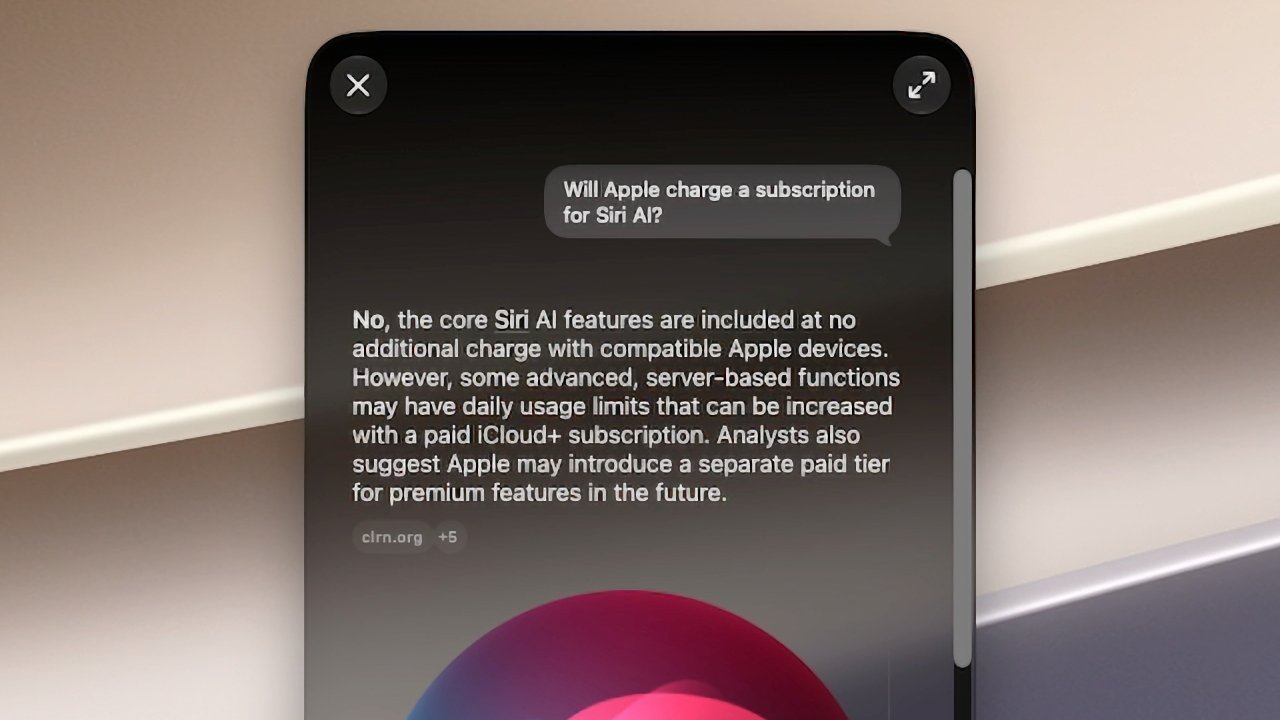
Siri on the iPhone is better under iOS 27 and macOS 27 Golden Gate.
Apple has managed to use a process of distillation and training to recreate some of Google Gemini’s functionality in a smaller iPhone-friendly model. But something like PrismML could be a force multiplier.
Not only could the big models potentially work entirely on an iPhone in the first place, but these distilled models could get even smaller. That frees up more memory for processing the tasks that use these distilled models.
Add in the continuing improvements in AI processing that are coming down the line, and a future iPhone could be an absolute beast.
Advertisement
Better AI on more hardware
There’s also the possibility of Apple doing something completely unexpected: expanding Apple Intelligence’s reach.
During WWDC, Apple said that the most powerful on-device models would be available only on specific iPhone and Mac models. That includes the iPhone Air and iPhone 17 Pro with 12GB of memory, the M4iPad also with 12GB of memory, and an M3 Mac with the same memory or better.
Apple says the most powerful on-device AI models will not be on all devices – image credit: Apple
While processing is a factor, memory is certainly going to be another. It’s not hard to imagine Apple using the PrismML tech to cut the size of that “most powerful on-device model” to fit into the smaller memory allowances of earlier models.
Advertisement
Extrapolating that further, maybe Apple could expand the availability of Apple Intelligence to older, lower-specification devices.
Sure, there are some tradeoffs, such as much slower processing of tasks. Owners of older hardware would probably be fine with that.
PrismML is a prime opportunity for Apple to take a massive leap when it comes to AI.
If it wants to dominate the field when it comes to on-device processing, it has a chance to take a very major step toward that goal.
Advertisement
Last week’s Sunday Reboot talked about the iPhone 17 Pro Max going into a time capsule for 250 years, and pondered if it will emerge in one piece.
One of the most crucial aspects of FDM 3D printing is ensuring sufficient material is extruded. Determining the right flow rate can be done manually, but some printers these days automatically perform this adjustment, which is very convenient. [Stefan] of CNC Kitchen investigates how to add similar functionality using existing bed-leveling sensors.
A major complication with extrusion in FDM printers is that the flow rate has to fit the printing speed. However, you can’t just immediately speed up or reduce the flow rate, as the melting filament is flexible and thus acts like a spring, especially as the extruder is exerting significant force on the filament, which adds compression.
The moment you reduce or increase the speed of the nozzle, you can get over- or under-extrusion, but the delayed response by the extruded filament means that you have to adjust for this change in advance. Ergo, the name ‘pressure advance’, also known as the K-value. Obviously, this is a parameter that differs with each material, printer, and other factors, so a direct measurement is always the best.
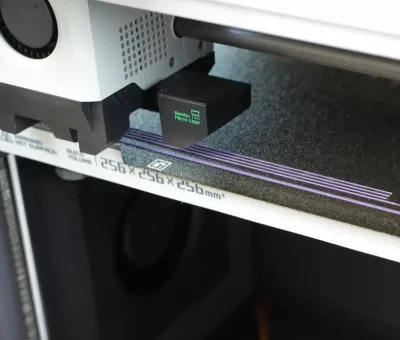
In the Bambu Lab X1 FDM printer, a Lidar scanner was used to scan various test patterns to automatically determine the optimal setting. This was later moved to the purge section of the extruder in newer Bambu Lab printers. On other FDM printers, the only available sensor in that area is typically the pressure sensor for bed leveling. Could this sensor make a similar measurement?
This wasn’t just an idle thought, but was inspired by the Snapmaker U1, which runs open-source Klipper, with tantalizing glimpses of how it does pressure-advance sensing in its extruder. This extruder also only contains a load cell, as do some Prusa printers. These much more open printers thus provided a test bed for some experimentation.
Advertisement
With load cell data available, [Stefan] measured how various extrusion rates affect the load cell, which can then theoretically be correlated with the appropriate K-values for specific transitions. He created a calibration tool for a range of Prusa printers that works with stock firmware, though this is definitely still a work in progress. There are also a couple of similar open-source projects, such as this Auto PA Calibration project by [Mark].
Overall, K-value presets tend to work pretty well, but adding a pressure-advance calibration feature to existing FDM printers is definitely an interesting idea. There’s also the prospect of lateral sensing using this same bed-leveling sensor, which could allow the printer to sense much more than just the bed.
An anonymous reader shared this report from the Los Angeles Times:
A federal judge has halted California’s groundbreaking “Truth in Recycling” law, which aims to reduce consumer confusion about which packaging can be recycled. [Originally planned to take effect October 4th], California’s recyclable packaging law prohibits manufacturers from using a “chasing arrows” recycling symbol on products or materials unless they are actually being recycled in a meaningful way, which the law quantifies…
A coalition of farming, forestry, restaurant and packaging organizations sued the state in March, arguing the law violates their right to free speech. They argued that Senate Bill 343 operates as “government-imposed censorship.” Judge William Hayes agreed that their challenge has merit, and on Tuesday ordered California Atty. Gen. Rob Bonta, the defendant in the case, to pause enforcement of the law “until further order of the Court….” Advocates of reducing plastic use disagreed. “The court got it wrong, and I’m confident that the state will ultimately prevail,” said Nick Lapis, director of advocacy for Californians Against Waste. “S.B. 343 does not violate the 1st Amendment; it requires companies to tell the truth when they make recyclability claims. Suggesting that the 1st Amendment protects misleading environmental marketing is inconsistent with the basic principles of consumer protection that states like California have implemented for decades.”
In January, CalRecycle, the state’s waste agency, reported that less than 10% of most single-use plastic materials in the state were being recycled. Even yogurt containers and margarine tubs — made of ubiquitous polypropylene, or No. 5 plastic — are being recycled at a rate of only 2% in the state, the report said. Only 5% of colored shampoo and detergent bottles, made from polyethylene, or No. 1 plastic, are getting recycled…
Plastic materials that can’t be recycled are typically sent to landfills or sometimes illegally shipped overseas, where they are burned or end up in landfills, rivers and waterways.
Advertisement
The bill’s author told the Los Angeles Times “All you have to do is look at the numbers. These products are not getting recycled, despite what the industry is claiming. They are just confusing consumers, clogging the waste stream, polluting the environment, leading to higher and higher prices for local governments and ratepayers.” He argues the symbols shouldn’t be used to “confuse people who see the symbols [on products] and assume they can be recycled.”
The article also quotes Judith Enck, former Environmental Protection Agency regional administrator and president of the nonprofit Beyond Plastics. “Given the long history of the plastics industry deceiving the public about plastics recycling, this is an especially bad outcome. It is a reminder that the plastics industry has enough money to fight even the most modest policy designed to protect people and the planet.”
Spotify, it’s fair to say, has made some weird user-experience choices.
There are a number of panels in the app, and the layout is confusing. The service constantly tracks your activity. The app also seems to have an odd hostility to playing actual albums. This all works to create a general feeling that Spotify’s designers are trying to push you into using the service in a particular way.
It’s understandable, then, that some people are annoyed with the way music videos have been added to the platform. For the most part, they would start to play by default, in the background, whenever an artist had uploaded a video for the song. Some music videos have very different audio from the original tracks, particularly if they include sketches or sound effects, which can prove distracting if you prefer the album version of the song. And even if you enjoy music videos (which I do), the decision to have videos play by default—using up bandwidth and battery power—upset a lot of people.
There are a few other quirks. On Spotify’s desktop app, the videos are barely visible; they stay contained in the tiny album art panel until you manage to find the hidden, extremely small Now playing button that enlarges them. Also, the selection of videos that are on the platform, and the ones that are mysteriously absent, seems totally random. Because of this, I check YouTube first when I really want to watch a music video.
Advertisement
The most annoying thing, though, had been a lack of any obvious way to disable all videos. That changed recently—there’s now a toggle in the settings to disable music videos in Spotify entirely, alongside controls that disable the Canvas feature (animated album art) and video podcasts.
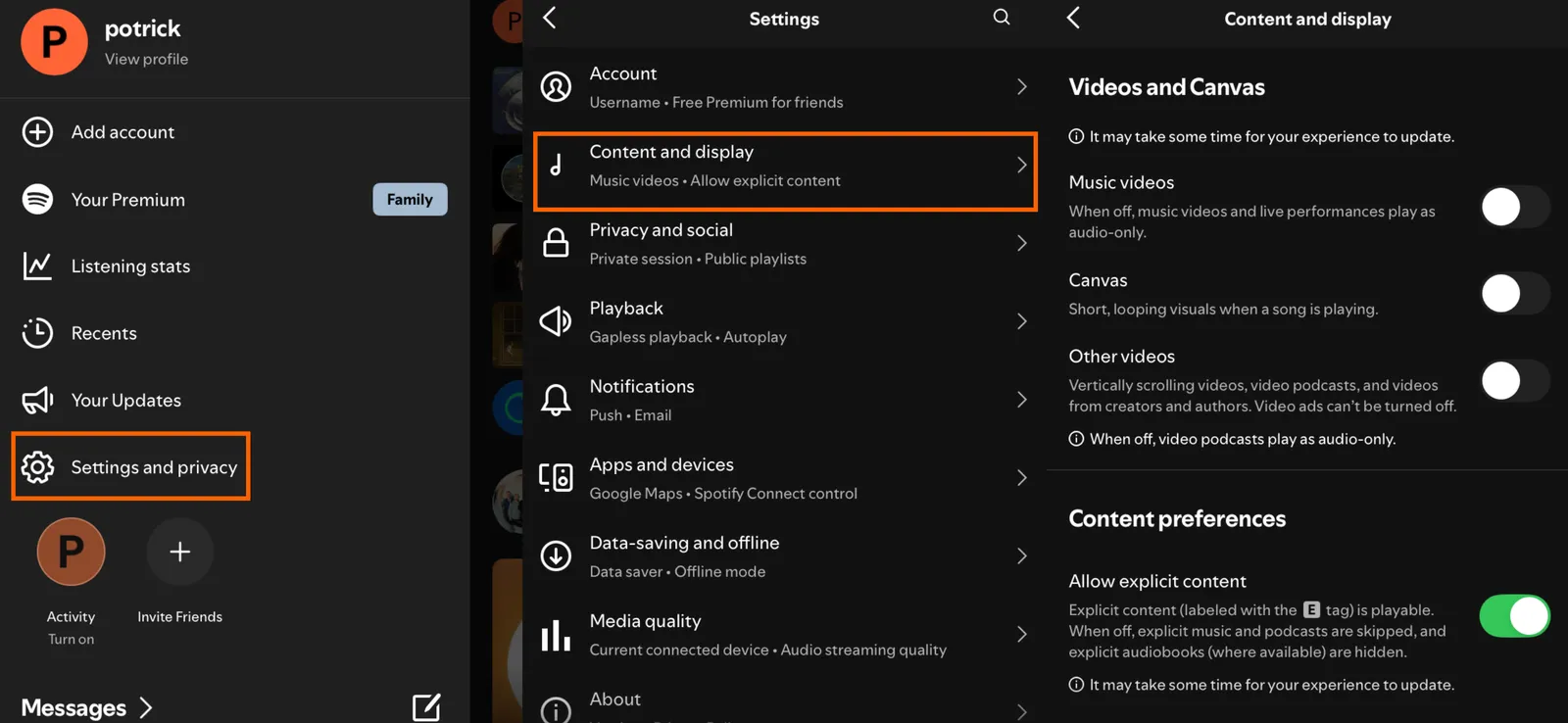
On mobile you can do this by tapping your user profile icon in the top-left to bring up the side panel. Then tap Settings and privacy, followed by Content and display.
Photograph: Justin Pot
In the Videos and Canvas section you will see three toggles: one for music videos, one for Canvas, and one for all other videos. This last toggle disables video podcasts, meaning you’ll get the audio-only version of podcasts instead. Turn all these off, and Spotify will use a lot less bandwidth.
On the desktop app, it’s a little different. Click your user profile icon in the top-right corner, then click Settings. Scroll down to the Videos and Canvas section to find the options to disable music videos and Canvas.
Advertisement
I tested this and it worked. The music video icon in playlists and albums disappeared, as did the collection of music videos on Artist pages. The only remnant of the disabled feature is a Switch to video button in the Now Playing sidebar, which appears below the album art. Click it and you’ll be told the video can’t play unless you turn videos back on in the settings. Odd, for sure, but for the most part turning this off means you don’t have to think about music videos in Spotify anymore.
I sincerely wish that Spotify would roll out music videos with more care. Sometimes I really do want to see a video—just not every time I play a track. Playlists of music videos might be welcome if they ran separately from the audio-only playlists. I just don’t want to get a music video when I’m looking for the album version of a song, and I don’t think I’m alone in that. I can only hope that Spotify’s future interface design choices will keep things more clearly separated.
Square Enix just rolled out a fresh pixel trailer for Final Fantasy Resonance, and it leans hard into the question of what the series might have looked like if it never left those old Super Nintendo sprites behind. The nearly three-minute clip puts the HD-2D style front and center, showing off battles, summons, and story moments that feel pulled straight from the glory days of Final Fantasy IV and VI while running on modern hardware.
Final Fantasy Resonance is the Final Fantasy series’ first foray into HD – 2D format, and it does so in a big way. Instead of simply copying over the action from the mobile game Final Fantasy Brave Exvius, the developers rebuilt and expanded on the opening story arc, transforming it into a full-fledged console RPG. Rain and Lasswell, a squadron commander and his boyhood friend, will head out after receiving a royal order to deal with a weakened barrier at the Earth Shrine.
Kick off the fun with a Nintendo Switch 2 system, your choice of a select digital game, and a savings* of up to $29.99!
Includes choice of either the Mario Kart World, Donkey Kong Bananza, or Pokémon Pokopia digital game download
One system, three play modes: TV, Tabletop, and Handheld
Inside, they face up against Veritas of the Dark, a man in black armor who simply wipes the floor with them, shattering the Earth Crystal and leaving their entire force in disarray. They then have to run back home to discover that Grandshelt is being attacked. Following the king’s desperate rescue, they partner up with a mystery girl named Fina to go out and protect the remaining crystals strewn over the earth.
Combat remains true to its turn-based roots, but with a few nifty improvements. When you hit an enemy’s weak area, you will stun them and shatter their defenses, giving you the opportunity for a couple of extra turns and those massive Resonance assaults, which are basically a showstopper in cinematic fashion. You can use traditional Espers such as Ifrit, Shiva, and Titan to gain a few extra rounds before they finish with a sweeping strike like Hellfire or Diamond Dust. Then there are Visions, crystallized reflections of heroes from throughout the Final Fantasy history with whom you can team up. Equip one, and he (or she) will fight alongside the team. The stronger the link, the more of Vision’s special abilities you will be able to access. Expect to see familiar names like Cloud, Tidus, the Warrior of Light, Cecil, Bartz, Squall, and Zidane appear in this way.
Between story beats, exploration reigns supreme. The cities may not have much to offer beyond a jump-rope contest or Mog Tag, but when you come across a Sanctum of Light, you’ll find a new Vision crystal to add to your collection. Then there are side paths to the Colosseum for some challenging monster confrontations, or the Chamber of Arms, where you can get your hands on some legendary weapons, or at least try to get them from the sealed creatures that are now protecting it. Places like Dilmagia, the steel metropolis that began it all with airship technology, and Olderion, the water-rich capital guarded by the Wardens of the Waters, give the game world a genuine lived-in atmosphere. Expect to see Chocobos, airships, and other Final Fantasy staples.
Square Enix and co-developer Lancarse are preparing to release the game on October 22, 2026, for Nintendo Switch 2, Nintendo Switch, PlayStation 5, Xbox Series X|S, and PC via Steam and the Microsoft Store. The standard game costs $49.99, the Digital Deluxe version adds in-game goodies for an additional $59.99, and the Collector’s Edition costs $209.99.
Strategy meets vibes, skill meets will and control meets chaos in the World Cup final between Spain and Argentina tonight. The first ever meeting between a pair of reigning continental champions on this grand stage sets up a clash of styles between two sides that could hardly be more different.
La Roja blitzed the competition en route to the Euros title two years ago, but they’ve had to completely reinvent themselves on the fly at FIFA World Cup 2026, owing to injuries sustained by Lamine Yamal and Nico Williams in the lead-up to the tournament. Although Yamal has dazzled in fits and starts, Williams has barely featured.
It was a masterstroke from Luis de la Fuente, therefore, to shift the team’s identity from wing wizardry to defensive solidity, with Rodri and Fabian Ruiz effectively being deployed as midfield sweepers. They’ve conceded just once across their seven games, but it was the way the 2010 champions blunted France’s vaunted attack and carved through the erstwhile favourites at will that truly underlined their qualities.
Advertisement
It’s a minor miracle that Argentina are in the World Cup final at all. They were dead and buried in all four of their knockout ties, only for deus ex machina to dramatically rescue them either deep into stoppage time, in extra time or in stoppage time of extra time on all four occasions. If only there was a Spanish word for remontada.
We’ll almost certainly never see a run like it again, a cross between Real Madrid in the Champions League and Terminator 2‘s T-1000, and the detail that makes it all the more remarkable is that Lionel Scaloni has had no obvious gameplan beyond feeding the ball to Lionel Messi at every opportunity.
What’s perhaps most extraordinary of all, however, is that it’s worked. Love or hate La Albiceleste’s bully-boy antics, the back-to-back South American champions are now on the verge of becoming the first team since Brazil in 1962 to win back-to-back World Cups.
Read on as we show you how to watch World Cup final 2026 for free from anywhere.
Advertisement
How to watch World Cup final 2026 for free
World Cup final 2026 is available to watch for free in multiple countries, including the UK, Australia, Brazil, Belgium, Ireland, Netherlands, Switzerland and Turkey.
Abroad? Can’t access your free stream? Unblock your free World Cup final stream with Norton VPN – more on that below.
Advertisement
Use a VPN to watch World Cup final 2026 live streams
If you’re traveling, you might discover your usual World Cup final 2026 stream is unavailable due to geo-restrictions.
Don’t worry, that’s exactly where a VPN can help. A virtual private network lets you connect to servers around the world so you can securely access your preferred Spain vs Argentina coverage as if you were back home.
Those looking for a streaming service instead can watch World Cup final on Fox One (3-day free trial). Telemundo is also available via Peacock ($10.99/month).
Visiting the US from the UK? You can still watch your free World Cup final stream thanks to Norton VPN (try for 60 days).
Advertisement
How to watch World Cup final 2026 in the UK
(Image credit: Other)
Viewers in the UK are in luck, as they can watch World Cup final 2026 for free on both BBC One and ITV1, with live streaming available via BBC iPlayer and ITVX.
You need a TV license and a valid UK postcode (e.g. SE1 7PB) in order to tune in.
Norton VPN can unlock your stream if you’re abroad this weekend.
Advertisement
How to watch World Cup final 2026 in Australia
(Image credit: free)
World Cup final 2026 is free-to-air in Australia on SBS, with live streaming available courtesy of the SBS On Demand platform.
Traveling for work or on holiday? A VPN like Norton VPN can help unlock your free stream.
Advertisement
How to watch World Cup final 2026 in Canada
(Image credit: Other)
In Canada, TSN is broadcasting World Cup final 2026.
You can live stream Spain vs Argentina via the TSN+ streaming platform, which starts at CA$29.99/month.
Outside of Canada? Use Norton VPN whilst you’re traveling away from home to unlock your World Cup final stream.
Advertisement
How to watch World Cup final 2026 in New Zealand
In New Zealand, World Cup final 2026 is free-to-air on TVNZ 1, with live streaming available via TVNZ+.
Not in New Zealand right now? You can use a VPN like Norton VPN to watch all the action as if you were back home.
How to watch World Cup final 2026 in Spain
(Image credit: Creative Commons)
In Spain, you can stream the World Cup final 2026 thanks to RTVE Play.
Advertisement
You will need an account for this with a valid Spanish postcode (e.g. 28036)
UK resident visiting Spain? Unlock your stream with Norton VPN.
How to watch World Cup final 2026 in Argentina
(Image credit: Other)
In Argentina, Telefe and TV Publica will broadcast the World Cup final.
Advertisement
Abroad? Use Norton VPN to stream your local service wherever you are in the world.
World Cup final 2026: Match Information
What is the World Cup final 2026 start time?
The World Cup final kicks off at 8pm BST / 3pm ET on Sunday, July 19. That’s 5am AEST on Monday, July 20 in Australia.
The 2026 World Cup final is taking place at 80,663-capacity MetLife Stadium in East Rutherford, New Jersey, which has been branded the “New York/New Jersey Stadium” for the duration of the tournament.
Advertisement
Neither Spain nor Argentina have played there yet.
Who is the World Cup final 2026 referee?
Slovenian referee Slavko Vincic is officiating the World Cup final, with on-field assistance coming from his compatriots Tomaz Klancnik and Andraz Kovacic, and Jordanian duo Adham Makhadmeh and Mohammad Alkalaf.
Vincic previous oversaw the 1-1 draw between Brazil and Morocco, Algeria’s 2-1 victory over Jordan, and Mexico’s 2-0 win over Ecuador, which each passed without controversy.
Swipe to scroll horizontally
Spain vs Argentina: Road to World Cup final 2026
Stage
Advertisement
Spain
Argentina
Group stage
Group H: 1st, 7 points
Advertisement
Group J: 1st, 9 points
Last 32
Beat Austria (3-0)
Beat Cape Verde (3-2 AET)
Advertisement
Last 16
Beat Portugal (1-0)
Beat Egypt (3-2)
Quarter-finals
Advertisement
Beat Belgium (2-1)
Beat Switzerland (3-1 AET)
Semi-finals
Beat France (2-0)
Advertisement
Beat England (2-1)
What is the weather for World Cup final 2026?
The temperature in East Rutherford is around 81F (27C) at kick-off.
A far more pressing concern is the air quality, with parts of New Jersey having been cloaked in haze of wildfire smoke in midweek, which prompted an official health alert.
Can I watch World Cup final 2026 on my mobile?
Of course, most broadcasters have streaming services that you can access through mobile apps or via your phone’s browser.
Advertisement
You can also stay up-to-date with all of the key World Cup final moments on the official social media channels on X/Twitter (@FIFAWorldCup), Instagram (@FIFAWorldCup), TikTok (@FIFAWorldCup) and YouTube (@FIFA).
We test and review VPN services in the context of legal recreational uses. For example: 1. Accessing a service from another country (subject to the terms and conditions of that service). 2. Protecting your online security and strengthening your online privacy when abroad. We do not support or condone the illegal or malicious use of VPN services. Consuming pirated content that is paid-for is neither endorsed nor approved by Future Publishing.
Looking for the most recent Connections answers? Click here for today’s Connections hints, as well as our daily answers and hints for The New York Times Mini Crossword, Wordle, Connections: Sports Edition and Strands puzzles.
Today’s NYT Connections puzzle features one of those purple categories where you need to hunt down a hidden word inside four of the clues. Read on for hints and today’s Connections answers.
The Times has a Connections Bot, like the one for Wordle. Go there after you play to receive a numeric score and to have the program analyze your answers. Players who are registered with the Times Games section can now nerd out by following their progress, including the number of puzzles completed, win rate, number of times they nabbed a perfect score and their win streak.
Here are four hints for the groupings in today’s Connections puzzle, ranked from the easiest yellow group to the tough (and sometimes bizarre) purple group.
Yellow group hint: Announce.
Advertisement
Green group hint: One might be turned up.
Blue group hint: Fresh start.
Purple group hint: Something you drink is hidden in each word.
If you don’t love the look of a big TV in the living room, have limited space in your home to accommodate a TV, or just want a fun and easy way to elevate movie nights, you might want to look into buying a home projector. It used to be considered a luxury to have a projector set up in your home, but modern projectors are surprisingly cheap, thanks to technological improvements, material swaps, and lower production costs. Plus, home projectors are worth buying used, allowing consumers to save even more money on a gadget that used to feel too premium for the average household.
There are so many different types of home projectors to choose from, but no matter which projector model you go with, they all come with similar placement recommendations. That said, some projectors are built to perform better in certain conditions, like niche outdoor projectors bright enough to clearly project an image in direct sunlight. However, for the most part, all home projectors share these worst places to avoid. We’ve gathered five spots you should absolutely avoid putting a projector, along with a detailed explanation and a recommendation for where you should set it up instead.
Advertisement
Any messy or overcrowded surface
Studio Romantic/Shutterstock
A projector, like any electronic media device, tends to get hot while it’s working. And because projectors have a lamp or a light bulb inside, they typically get hotter than a standard DVD player or even a gaming console. To prevent overheating, a projector is designed to pull air through intake vents, over the hot components, and out through exhaust vents.
This ventilation process is so important for user safety and the life of the projector that most (if not all) brands will highlight how important it is to set up the projector in an uncrowded area where it can breathe while in use. According to Lisowod, maker of the best cheap projector on Amazon, users are supposed to make sure there’s “adequate ventilation around the device” and that it’s on a “stable, flat surface.”
If your coffee table is frequently a dumping ground for takeout containers, dirty clothes, and other miscellaneous items, you shouldn’t set up a projector there. And if you do, you run the risk of potentially starting a fire or damaging the projector past the point of fixing, either due to overheating or falling from an uneven surface. Instead, choose a surface you know tends to stay clean and dusted or, if you know that’s not an option, you can tidy the surface each time you plan to use the projector.
Advertisement
The kitchen or the bathroom
Pixel-Shot/Shutterstock
Most people set up projectors in their living room, bedroom, a dedicated media room, or backyard, which are typically the best places to use a projector. However, some might consider using a projector in their kitchen or bathroom, both of which are terrible places for this media device. Putting a projector in your bathroom so you can watch a movie while you’re relaxing in the tub or in the kitchen to keep you entertained while cooking dinner sounds great on paper, but in reality, a projector in either of these rooms will have a shorter lifespan.
In the kitchen, projectors can be exposed to oil, oil mist, steam, smoke, or airborne cleaning chemicals. Depending on how small your kitchen is, there’s a chance the projector could be dangerously close to a hot stove or the sink. In the bathroom, humidity is the greatest danger to a projector. While kitchens can also get pretty humid while cooking, the risk of humidity damaging the projector is much greater in the bathroom, especially if there’s not a good ventilation system. According to Epson, a projector being exposed to high humidity could result in a fire, electric shock, or damage to the case or the projector itself.
Advertisement
An enclosed cabinet in a TV stand
Gordine N/Shutterstock
Just like balancing a projector on a messy surface can prevent a projector from ventilating properly, so can placing it inside a cabinet, even if the cabinet is completely empty. Most cabinets in entertainment centers or dressers don’t have any active ventilation solutions set up inside. Some may have a hole built into the back panel or a larger cutout for cables to pass through, but with nothing actively pushing hot air out and bringing cool air in, this is too hot a space for a projector.
Most cabinets are also too compact for a projector to operate safely. Sony recommends leaving nearly 12 inches of clearance around some of its projector models, and other projectors from Sony and other brands likely need a similar amount of room to breathe. In a cabinet that’s too small and doesn’t offer nearly enough ventilation for a hot projector, you run the risk of the device overheating and possibly starting a fire or damaging the device beyond repair. Instead of sticking it inside a cabinet, a projector should be placed on a clean, roomy surface or mounted to the ceiling.
Advertisement
In direct sunlight or in rooms with bright lights
Mixetto/Getty Images
One of the worst places you can set up a projector is in a room that’s too bright or anywhere that gets direct sunlight. This isn’t because the projector might get too hot, though if it’s in the path of a sunbeam for too long while it’s actively in use, it’s possible it could overheat. Rather, a projector shouldn’t be set up in a spot that’s too bright because it makes it nearly impossible to see the projected image.
Some rooms, like the aptly named sunroom, are designed to let the sun in, and it would be strange to put blackout curtains in there just so you could have a projector in that room. For living rooms and bedrooms, two common rooms for a projector to call home, blackout curtains are a great way to block sunlight from streaming in. If the lights you have installed inside are too bright, you can invest in dimmer switches or smart bulbs that allow you to adjust brightness within a mobile app.
Advertisement
Near an air conditioner
Sandsun/Getty Images
LG warns users of its ProBeam DLP projectors not to install them anywhere that’s “under the air conditioner or is directly exposed to the wind from the air conditioner.” The brand also notes that users should avoid installation anywhere that’s “dusty or exposed to wind and rain,” so it’s likely that the constant (and possibly dusty) airflow and potential condensation are two of the biggest reasons LG recommends against installing a projector there.
A projector manual from Sony echoes this recommendation to steer clear of AC units during installation and use. The manual explains how air from air conditioners can cause oscillation in the projected screen. In more simple words, this influx of air can cause the projected image to look shaky or jittery. A jumping image could also be the result of setting up the projector on an air conditioner simply because of the vibrations produced by the AC unit, according to projector brand Miroir.
Advertisement
Methodology
M_a_y_a/Getty Images
Most of us on the SlashGear team have home projectors as well as other similar media devices, like gaming consoles, DVD players, TVs, and so on. Because of that, it’s easy to rely on common sense to come up with this list of the worst places you can set up your projector. However, we didn’t stop there. We took the time to verify each reason we thought of with documentation from reputable projector brands, including LG, Sony, Lisowod, and Epson, for suggestions and warnings on where to set up or avoid setting up a projector.
Mopar’s mid-1960s to early 1970s run of muscle cars easily goes down as one of the greatest eras ever for an American performance car maker. The Dodge and Plymouth brands of this period sold some of the most iconic muscle cars ever made, with model names every bit as recognized as the cars they adorned. Filling showrooms at this time were the Charger, the Challenger, the Cuda, the Super Bee, and the Demon, just to name a few.
While certainly not obscure or forgotten, the Plymouth GTX is a model from this period that sometimes gets overlooked when compared to its siblings. In the mid-’60s, as the muscle car movement was taking off, the mid-sized GTX would help lay the groundwork for the Mopar muscle cars that would follow it. The GTX also developed an image as a “gentleman’s muscle car” or “gentleman’s hot rod” through Mopar’s marketing and its higher price — and more well-appointed nature — compared to other mid-sized muscle cars of the time.
While there are other late ’60s and early ’70s American performance cars that could also lay claim to the “gentleman’s muscle car” label, the Plymouth GTX’s blend of upscale luxury and drag-strip-ready performance certainly made it stand out among its Mopar muscle car contemporaries. Today, this also makes the GTX a very desirable piece of muscle car history for collectors.
Advertisement
Mopar muscle with a dash of luxury
Raimo Bergroth/Shutterstock
While the definition of what exactly is or isn’t a muscle car is loose, the Chrysler Corporation had been building high-performance, V8-powered automobiles since the mid 1950s, and it really began ramping up those efforts in the early and mid 1960s. By 1967, muscle car fever had begun to sweep the industry, with automakers rolling out a stream of specially-marketed and packaged, mid-size models powered by large cubic-inch engines.
The GTX debuted for the 1967 model year as Plymouth’s mid-sized muscle offering. Based on the Belvedere, the GTX came with big block power as standard, offering buyers a choice between the base 440 cubic-inch Super Commando V8 and the legendary 426 Street Hemi. Beyond its power plant, the GTX came well-equipped inside and was adorned with hood scoops to help it stand out in the growing segment of mid-sized muscle offerings.
Advertisement
It was in 1968, though, when the GTX really began to separate itself as Plymouth’s more upscale muscle car offering. That’s because this is the same year the legendary Plymouth Road Runner debuted. Based on the same mid-sized Belvedere body style, the Road Runner was all about stripped-down, budget-friendly big-block performance. This meant that GTX was now Plymouth’s better-equipped, more upscale take on the mid-sized muscle car, available with engines like the aforementioned 426 Hemi or the potent 440 Six Pack.
Advertisement
The GTX wasn’t the only upscale muscle car
Different_brian/Getty Images
While there wasn’t any specific or official branding of the GTX as the “gentleman’s muscle car,” it was marketed as part of the “executive branch” of Plymouth’s so-called Rapid Transit System muscle car lineup alongside the full-size Sport Fury GT. However, just because it was positioned upmarket didn’t mean the GTX lacked the fun of other Mopar muscle cars. It still had the same bright color options and wild optional features like the Air Grabber hood scoop. The GTX existed as a standalone model until 1971, by which point the muscle car era itself was already beginning to fade out.
Because there’s no official “gentleman’s muscle car” title, there are several other muscle-era models that could also be deserving of the label. These included the well-equipped Oldsmobile 442, the early 1970s Pontiac Grand Prix, and the related Chevrolet Monte Carlo, all of which were General Motors offerings. The latter two, in particular, matched big cubic-inch muscle car engines with elements of the emerging personal luxury car segment.
Luxury muscle wasn’t solely the domain of mid-sized offerings, though, and there were also full-size offerings that blended muscle car and luxury features. These include the aforementioned Plymouth Sport Fury GT and the rare Chrysler 300 Hurst Edition, both of which added some muscle car spice to spacious and upscale full-size coupes.
While Spain vs Argentina battle it out in the 2026 FIFA World Cup final for football’s biggest prize, global stars will light up the stage in what will be the first-ever World Cup halftime show.
The show will be headlined by some of the biggest global stars, including Madonna, Shakira, Justin Bieber, and the popular South Korean band BTS. It’ll be curated by Coldplay’s Chris Martin and will also feature the famous Muppets from Sesame Street – characters that have been a cherished part of many Americans’ childhoods.
But this isn’t just about entertainment. The halftime show at the New York New Jersey Stadium will support the FIFA Global Citizen Education Fund, aiming to raise $100 million to provide access to quality education and football opportunities for children worldwide.
Advertisement
FIFA has already raised around $30 million, with $1 being added to the total for every FIFA ticket sold. “It will be a celebration of football, unity and shared humanity that will resonate far beyond the final whistle,” said FIFA President Gianni Infantino.
So, read on as we show you exactly how to watch the 2026 World Cup final halftime show for free from anywhere.
How to watch World Cup 2026 final halftime show for free
The first-of-its-kind World Cup final halftime show is available to watch for free in multiple countries, including the UK, Australia, Brazil, Belgium, Ireland, Netherlands, Switzerland and Turkey.
Advertisement
Abroad? Can’t access your free stream? Unblock your free World Cup stream with Norton VPN – more on that below.
Use a VPN to watch World Cup 2026 final halftime show live
If you’re traveling, you might discover your usual World Cup final stream is suddenly unavailable due to geo-restrictions.
Don’t worry, that’s exactly where a VPN can help. A virtual private network lets you connect to servers around the world so you can securely access your usual World Cup coverage as if you were back home.
Visiting the US from the UK? You can still watch your World Cup stream for free thanks to Norton VPN (try for 60 days).
How to watch World Cup 2026 final halftime show in the UK
UK customers are in luck as they can stream the World Cup final halftime show for free on ITVX and BBC iPlayer.
Advertisement
You require a TV license and a valid UK postcode for an account (e.g. SE1 7PB).
Norton VPN can unlock your stream if you’re abroad today.
How to watch World Cup 2026 final halftime show in Australia
(Image credit: free)
The World Cup final halftime show will be shown for free in Australia on SBS On Demand.
Advertisement
The streaming platform is showing every game of the tournament for free, making it the perfect place for your World Cup viewing.
Traveling for work or on holiday? A VPN like Norton VPN can help unlock your free stream.
How to watch World Cup 2026 final halftime show in Canada
(Image credit: Other)
In Canada, TSN and free-to-air channel CTV will be broadcasting the final’s halftime show.
Advertisement
You can live stream via the TSN+ streaming platform, which costs CA$8 per month or CA$80 per year.
CTV will require your TV provider login details, but is also available via pay-TV streaming platform Crave if you want an alternative.
Outside of Canada? Use Norton VPN whilst you’re traveling away from home to unlock your stream.
What time does World Cup 2026 final halftime show start?
The World Cup final between Spain and Argentina kicks off at 8pm BST / 3pm ET / 7am AEST (Mon), so the halftime show should start around 8:50pm BST / 3:50pm ET / 7:50am AEST (Mon).
Advertisement
How long will be the World Cup 2026 final halftime show?
Although sources within FIFA say the halftime show will last around 20 minutes, it’s more likely to stretch closer to 25-30 minutes. That’s because the 11-minute Super Bowl-style performance, co-headlined by Madonna, Shakira and BTS, will take place after the scheduled 15-minute halftime interval.
There’s precedent for this, too. Last year’s FIFA Club World Cup final also featured a halftime show, with performances from Coldplay, J Balvin, Doja Cat, Tems and Emmanuel Kelly, and the break ultimately lasted 24 minutes.
Not everyone is happy about a potential half-hour halftime show. Many football fans have criticized the move on social media. As one user on X put it: “We’re not here for a pop festival. It will completely ruin the atmosphere and momentum of the match.”
Just heard the World Cup final half time show will mean a 30 minute half time? Are they effing joking? We’re not here for a pop festival. It will completely ruin the atmosphere and momentum of the match.July 14, 2026
Can I watch World Cup 2026 final halftime show on my mobile?
Of course, most broadcasters have streaming services that you can access through mobile apps or via your phone’s browser.
Advertisement
You can also stay up-to-date with all of the key World Cup moments on the official social media channels on X/Twitter (@FIFAWorldCup), Instagram (@FIFAWorldCup), TikTok (@FIFAWorldCup) and YouTube (@FIFA).
We test and review VPN services in the context of legal recreational uses. For example: 1. Accessing a service from another country (subject to the terms and conditions of that service). 2. Protecting your online security and strengthening your online privacy when abroad. We do not support or condone the illegal or malicious use of VPN services. Consuming pirated content that is paid-for is neither endorsed nor approved by Future Publishing.







 In the Bambu Lab X1 FDM printer, a Lidar scanner was used to scan various test patterns to automatically determine the optimal setting. This was later moved to the purge section of the extruder in newer Bambu Lab printers. On other FDM printers, the only available sensor in that area is typically the pressure sensor for bed leveling. Could this sensor make a similar measurement?



























































You must be logged in to post a comment Login