

Crypto World
BetMGM Alternative Searches Are Climbing Steadily and ZunaBet Is Leading the Conversation

The online gambling industry is watching its audience evolve in real time. Players who once gravitated toward the biggest brand in the room and stayed without questioning the choice are behaving differently now. They compare. They research. They ask whether the platform they are using is genuinely the best available option or simply the most visible one. BetMGM, carrying one of the most storied names in casino history, has become a frequent reference point in that comparison process. The platform remains a major force in the market. But the steady growth in searches for BetMGM alternatives reveals that a meaningful and expanding portion of players believes the market now offers something that the traditional giants were not built to provide. The platform appearing most consistently in those searches is ZunaBet — a crypto-native casino and sportsbook that launched in 2026 and immediately demonstrated what online gambling looks like when it is designed for the audience that is arriving rather than the audience that came before.
BetMGM: Legacy Power in a Digital World
BetMGM operates with advantages that most competitors cannot replicate. The MGM brand has been a pillar of casino culture for generations. BetMGM translates that legacy into the digital space through a joint venture backed by MGM Resorts International and Entain, combining physical casino expertise with online gambling technology. The platform holds licenses across a substantial number of US states and ranks among the most prominent online gambling operators in the American market.
The product reflects the investment behind it. The casino section features a curated collection of slots, table games, and live dealer rooms from reputable providers. The sportsbook delivers broad coverage of NFL, NBA, MLB, NHL, college athletics, international football, tennis, golf, motorsports, and combat sports. The mobile app is well engineered and benefits from regular updates. BetMGM also connects its online loyalty program to the wider MGM Rewards ecosystem, allowing players to accumulate points redeemable for hotel stays, dining experiences, entertainment, and other perks at physical MGM properties across the country.
Payment infrastructure follows the established model. Bank accounts, debit and credit cards, PayPal, and similar traditional services manage the flow of funds. These methods provide the kind of universal accessibility that a mainstream-oriented platform requires to minimize barriers for the widest possible audience.
BetMGM delivers a polished and professional experience within the boundaries it was designed to operate in. The issue driving alternative searches is not product failure but product scope. The game library is focused but modest compared to what newer global platforms now deliver at launch. The payment system processes transactions through intermediary networks that impose delays and fees inherent to traditional banking. And while the connection to physical MGM properties is a genuine differentiator for a specific audience, it holds limited relevance for the growing population of players whose gambling activity is entirely digital and whose financial lives increasingly run on cryptocurrency. BetMGM was built to bring the MGM experience online. The market is now asking for something that goes beyond translating a legacy experience into digital form.
ZunaBet: Built From Scratch for a Digital-First Audience
ZunaBet was not designed to digitize an existing brand. It was designed to build something new for an audience that traditional operators were never equipped to serve. Launched in 2026 by Strathvale Group Ltd, the platform is guided by a management team with more than 20 years of combined gambling industry experience. It operates under an Anjouan gaming license and is registered in Belize. Cryptocurrency serves as the foundational infrastructure — the core architectural principle from which every feature and system extends.
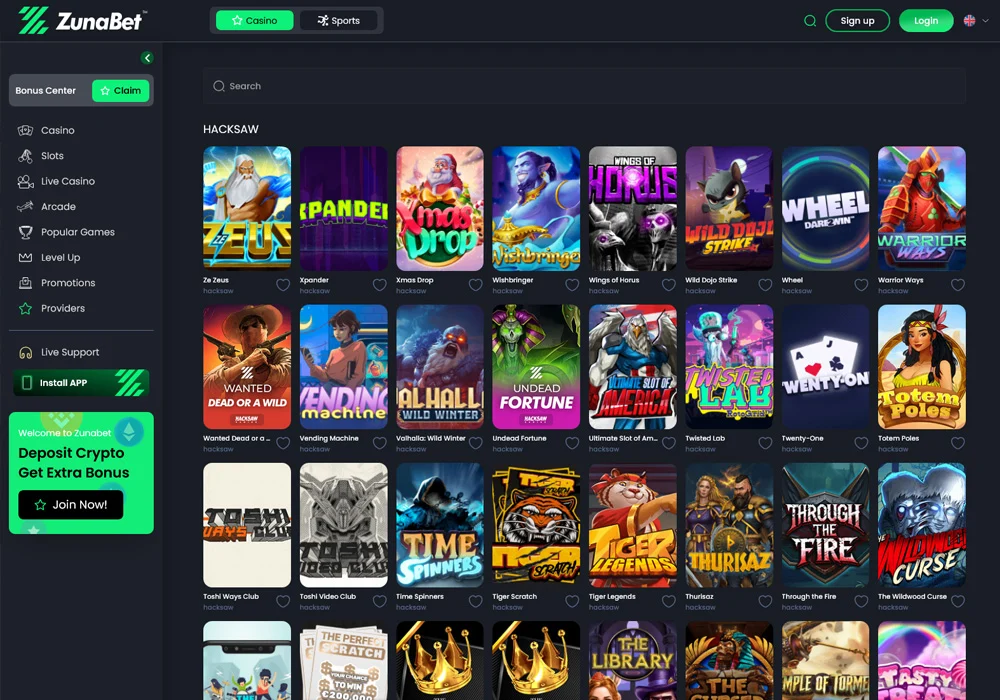
The game library delivers the first and most powerful statement of intent. ZunaBet launched with 11,294 games from 63 separate providers. That volume exceeds what many established operators have built across years or even decades of continuous operation. The provider roster is headlined by studios that set the quality standard across the industry — Pragmatic Play, Evolution, Hacksaw Gaming, Yggdrasil, and BGaming — supported by dozens of additional developers whose collective output ensures comprehensive coverage across every game category and style.
Slots constitute the largest portion of the catalog, as they do at every online casino worldwide. ZunaBet’s strength lies in the depth beyond slots. RNG table games span blackjack, roulette, baccarat, poker across multiple variants, and specialty titles that add unexpected range to the non-slot categories. The live dealer section features high-definition real-time streaming from premium production studios, creating immersive interactive experiences that capture the atmosphere of a physical casino within a digital interface. With 63 providers contributing distinct design philosophies and mechanics, the catalog offers the kind of genuine diversity that sustains a sense of discovery across months of regular play rather than weeks.
That sustained discovery changes how players relate to the platform. On sites with smaller libraries, content fatigue arrives quickly and drives players to look elsewhere. On ZunaBet, the sheer volume and variety of available content means that months of regular activity leave the majority of the catalog still unexplored. The experience of finding something genuinely new does not fade after the first few sessions. It remains a constant feature of the platform, creating organic retention that no promotional campaign can substitute for.
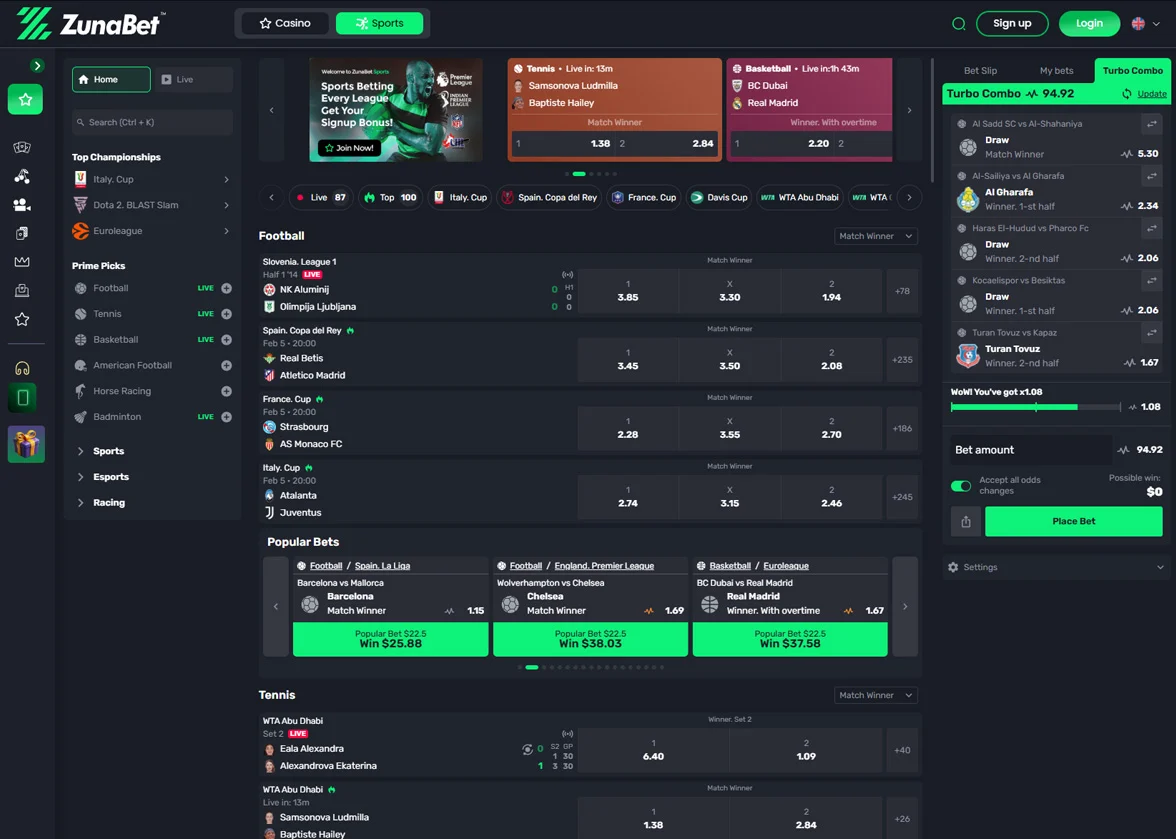
The sportsbook functions as a fully developed product alongside the casino, sharing the same player account and wallet. Traditional sports coverage extends across football, basketball, tennis, NHL, combat sports, and virtual sports. Esports receives dedicated comprehensive treatment with complete betting markets on CS2, Dota 2, League of Legends, and Valorant. This commitment reflects a strategic understanding of the modern gambling audience. Competitive gaming draws hundreds of millions of viewers globally, and the overlap between esports fans and crypto-native users is substantial. ZunaBet built for that intersection from day one, giving it immediate credibility with a demographic that traditional operators have repeatedly underestimated.
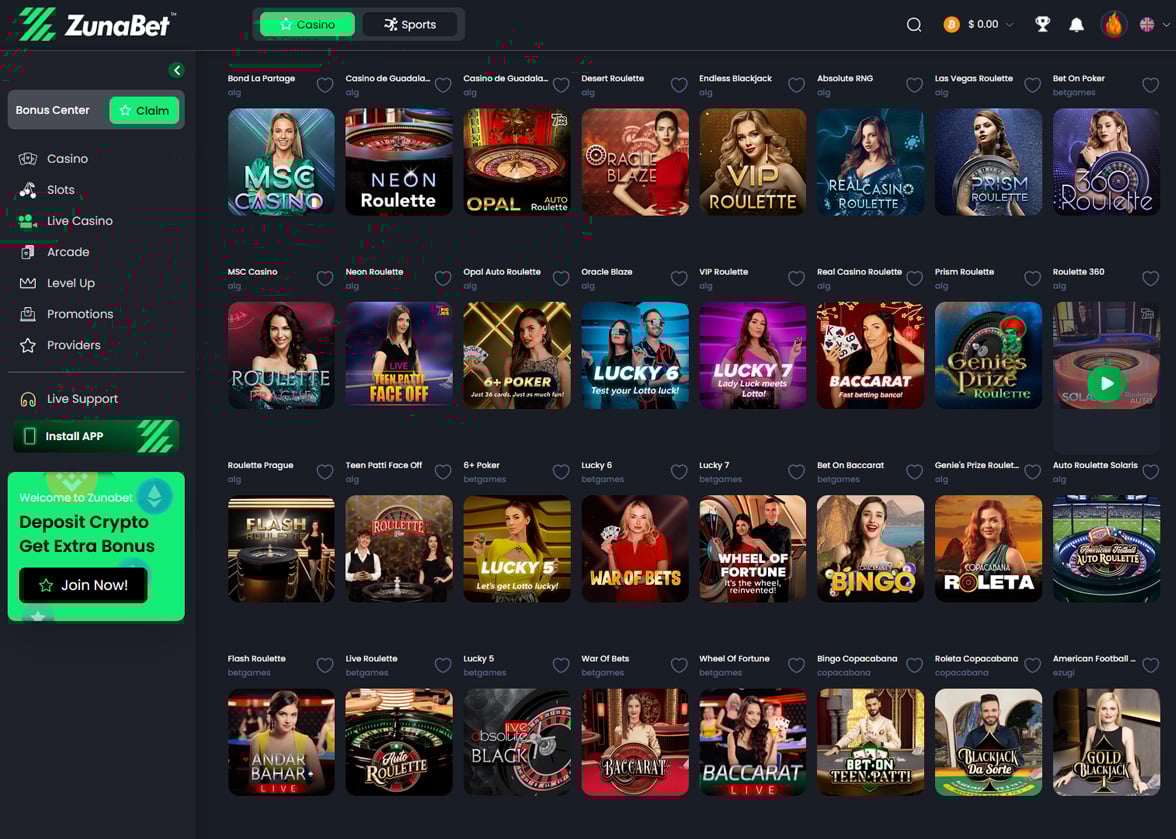
Over 20 cryptocurrencies power the payment infrastructure — Bitcoin, Ethereum, USDT across multiple blockchain networks, Solana, Dogecoin, Cardano, XRP, and additional options. Platform processing fees do not exist. Withdrawals settle on blockchain networks that operate without interruption, returning funds to player wallets in minutes regardless of when the request is submitted. The crypto-only architecture means no traditional fiat system operates beneath the surface to introduce delays or inconsistency. Every transaction follows the same seamless path.
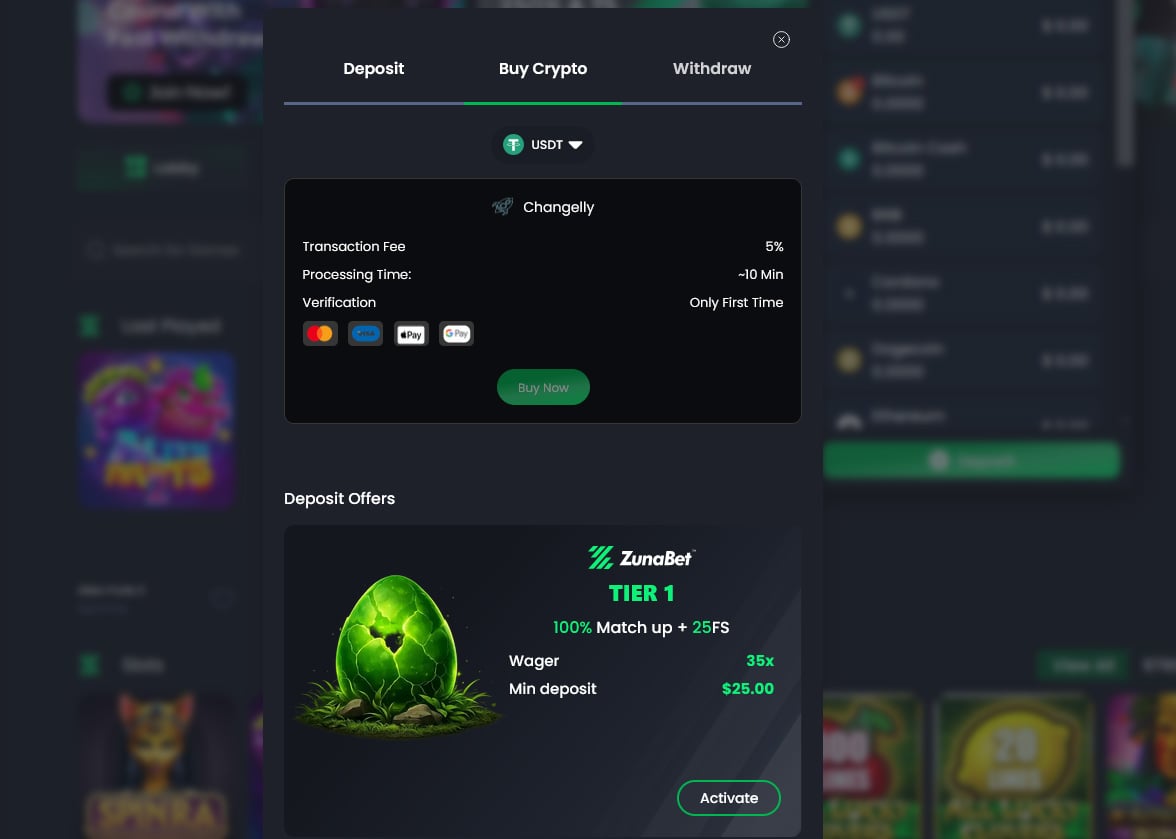
New players access a welcome package worth up to $5,000 plus 75 free spins over three deposits. First deposit receives a 100% match up to $2,000 with 25 free spins. Second deposit earns a 50% match up to $1,500 with 25 spins. Third deposit completes the offer with a 100% match up to $1,500 and 25 final spins. The three-deposit structure sustains engagement across multiple sessions rather than concentrating all value at the point of entry.
The platform runs on HTML5 with a dark-themed responsive interface and fast performance across every device type. Native apps cover iOS, Android, Windows, and MacOS. Live chat support is available at every hour of every day.
Why Crypto Infrastructure Outperforms Traditional Payment Systems
The payment gap between crypto-native and traditional platforms is not a matter of minor convenience. It is a structural difference that produces measurably different outcomes across every transaction a player makes.
Traditional platforms route financial transactions through layered networks of banks, card companies, and payment processors. Each layer adds processing time. Many add cost. Withdrawals are particularly affected — platform review stages, banking processing queues, business-day limitations, and weekend and holiday pauses stack on top of each other to create timelines stretching from one to five business days. Fees charged at various points along the chain erode the total reaching the player.
On ZunaBet, every transaction is a single blockchain event. Player initiates. Network confirms. Funds arrive. Minutes from start to finish. No platform fees. No institutional queues. No calendar dependencies. The experience works identically at any hour because blockchain networks never stop operating.
Over a year of regular use, the accumulated savings in time and money are significant. These savings are not promotional. They are the permanent product of a more efficient infrastructure applied uniformly to every transaction. A player on ZunaBet does not need to strategize around withdrawal timing or payment method selection. The system delivers speed and cost efficiency by default because it was built to do nothing else.
ZunaBet maintains this consistency through pure crypto architecture. No traditional payment layer runs alongside it. No hybrid system creates variability. One foundation produces one consistently excellent outcome for every player on every transaction.
Physical Rewards vs Digital Progression
BetMGM’s loyalty program holds a distinctive advantage through its integration with MGM Rewards. Players earn points that translate to tangible benefits at physical MGM properties — hotel rooms, restaurant reservations, show tickets, and resort experiences. For players who visit MGM destinations, this bridge between digital gambling and physical luxury creates genuine added value.
For the expanding segment of players whose gambling lives exist entirely in the digital realm, however, those physical perks carry limited weight. This is the space where ZunaBet’s loyalty approach resonates most powerfully.
The dragon evolution system structures progression across six tiers — Squire at 1% rakeback, Warden at 2%, Champion at 4%, Divine at 5%, Knight at 10%, and Ultimate at 20%. Each tier delivers escalating digital rewards — free spins building to 1,000 at the highest level, VIP club access, and double wheel spins. A dragon mascot called Zuno evolves visually as the player advances through each stage, creating a personal progression narrative.
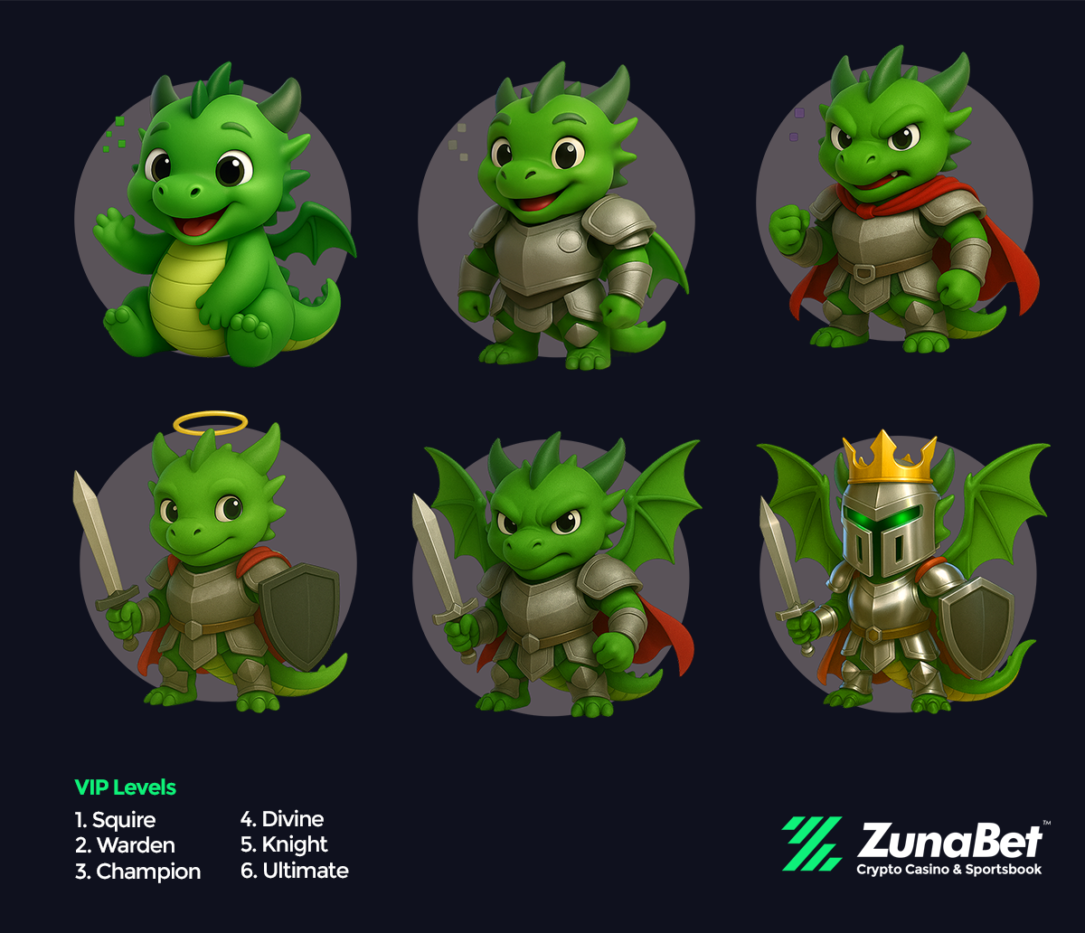
The design draws directly from video game mechanics. Defined levels with clear requirements. Meaningfully escalating rewards at each stage. Visual evolution that makes progress observable and personal. Achievement dynamics that give milestones emotional weight. These principles have sustained engagement in gaming for decades, and they connect powerfully with the demographic most likely to use a crypto-native gambling platform — players raised on progression systems, achievement unlocks, and visual feedback loops.
ZunaBet players interact with their loyalty tier actively rather than passively. They track progress. They strategize around milestones. They feel authentic accomplishment when they advance. That behavioral pattern represents a fundamentally different relationship with loyalty than what points-based systems produce, even those connected to physical resort experiences. For the digital-first audience, progression that lives within the platform they use daily carries more personal resonance than perks they may never redeem at a property they may never visit.
What the Search Data Means
The consistent growth in BetMGM alternative searches tells a straightforward story about a market in transition. BetMGM will continue to hold significant ground. The MGM brand, regulatory licenses, Entain partnership, physical property integration, and financial resources provide a foundation that ensures long-term relevance. The platform serves its audience well and will keep doing so.
But the audience itself is diversifying beyond what BetMGM was constructed to address. The fastest-growing player segment wants crypto-native payments that are instant and free. It wants game catalogs so vast that boredom becomes structurally impossible. It wants esports treated as a serious betting vertical. It wants loyalty programs designed for digital engagement rather than physical redemption. It wants platforms built for the world it currently inhabits.
ZunaBet was engineered from a blank page to satisfy every one of those demands. Its game library ranks among the deepest anywhere. Its payment infrastructure delivers speed and cost efficiency beyond what traditional systems can approach. Its esports offering serves a massive audience with genuine commitment. And its loyalty system turned the industry’s most neglected convention into something players actively enjoy. That is why ZunaBet keeps appearing when players search for something beyond BetMGM. They are looking for what online gambling should be for a new generation, and ZunaBet already built it.
Disclaimer: This is a Press Release provided by a third party who is responsible for the content. Please conduct your own research before taking any action based on the content.



Etoro reported a robust first quarter, with net income of $82 million, up 37% from the same period last year, as gains in commodities trading helped offset softer activity in crypto. The earnings beat was driven by a higher trading contribution and an improved profitability profile, even as the crypto segment faced headwinds that echoed broader industry softness.
The company announced adjusted EBITDA of $109 million, up 35% year over year, while net contribution rose 19% to $258 million. On the revenue side, funded accounts climbed 12% to 4.02 million, and assets under administration rose 15% to $17 billion. Etoro also held $1.3 billion in cash, cash equivalents and short-term investments as of March 31. In a related trend, Etoro said that assets under administration reached $18.7 billion in April, up 19% year over year, with total money transfers for the month totaling $1.4 billion, up 53% from a year earlier.
Commodities trading was the standout driver in the quarter, accounting for roughly 60% of trading commissions, with volumes up nearly fourfold versus a year earlier. The shift helped the firm diversify revenue streams even as crypto volumes and on-chain activity faced a softer backdrop. In addition to expansion in traditional markets, Etoro expanded its equities footprint, adding Japanese stocks to bring its exchange coverage to 26. The broker also activated its BitLicense to enable crypto trading in New York, a milestone that aligns with its strategy to bridge traditional finance with on-chain infrastructure. Separately, Etoro completed the acquisition of Zengo, a self-custodial wallet provider, on April 30, a move CEO Yoni Assia described as advancing the firm’s bridging objectives between fiat and crypto rails.
Crypto trading volumes retreat even as product innovation advances
Despite the resilience of its commodities business, Etoro’s crypto trading volumes deteriorated in April. The company disclosed that crypto trade volumes fell 32% year over year to two million trades, with the average invested amount per trade dropping 22% to $207. The softness in crypto activity comes amid a broader crypto market backdrop that has challenged exchanges and brokers to translate on-chain interest into sustainable revenue growth.
On the product side, Etoro has been moving to diversify its crypto offerings and improve user onboarding. The firm rolled out an AI-powered Agent Portfolios feature and deepened its collaboration with xAI, embedding Grok 4.2-powered market sentiment into Tori, its AI investing assistant. These enhancements aim to give users sharper market signals and a more interactive experience, even as overall trading volumes remain volatile.
Market observers noted that Etoro’s results sit within a broader pattern seen in listed crypto platforms. For instance, Coinbase reported a net loss of $394.1 million in the first quarter, its second consecutive quarterly loss, with revenue of $1.41 billion, reflecting a 40% drop in transaction revenue and a 13.5% decline in subscription and services revenue. The quarter also saw overall crypto market cap and trading volume retreat by more than 20% quarter over quarter. The juxtaposition highlights how firms with diversified revenue mixes—combining conventional asset classes with crypto—are navigating contrasting dynamics in traditional markets and digital assets.
Growth in users and on-ramp activity amid regulatory and strategic moves
Etoro’s top-line resilience rests not only on trading activity but also on user growth and capital deployment. The jump in funded accounts and the expansion of assets under administration suggest a broadening audience, supported by stronger cash reserves and liquidity. The company’s strategic push into New York crypto trading, backed by BitLicense authorization, signals a continued commitment to regulatory compliance as a pathway to broader market access. The Zengo acquisition further reinforces this trend by enabling on-chain self-custody options for users, potentially expanding wallet and custody capabilities across Etoro’s platform.
From a strategic standpoint, these moves indicate Etoro’s intention to blend the familiarity of traditional trading with evolving on-chain infrastructure. The addition of Japanese equities broadens its international reach, offering clients additional diversification options while leveraging the company’s growing global footprint. The April 30 closing of Zengo closes a loop in Etoro’s product strategy: a self-custody pathway that complements its hosted custody and trading experiences, providing a more complete platform for users who want direct control of their crypto assets.
Industry context and what to watch next
Etoro’s quarterly results arrive as the crypto sector grapples with a delicate balance: growing adoption of on-chain products and cross-asset wallets against persistent volatility in crypto volumes and macro headwinds in several geographies. The company’s mixed performance underscores the value of diversified revenue streams while spotlighting the fragility of relying heavily on active trading in a cyclic market.
Investors and users should monitor several developments in the coming quarters. First, whether commodity-driven revenue can sustain earnings momentum as crypto volatility persists. Second, the impact of product enhancements—such as AI-powered advisory features and improved sentiment analysis—on user engagement and average revenue per user. Third, regulatory movements, particularly in major markets, and how they shape the pace at which Etoro and peers can expand crypto trading and custody services. Finally, the effectiveness of the Zengo integration and the broader strategy to blend traditional finance with on-chain infrastructure will be key to assessing Etoro’s long-term growth trajectory.
As the sector evolves, Etoro’s Q1 performance offers a nuanced view: while crypto volumes may swing, a well-rounded platform that folds commodities, equities, and on-chain capabilities into a cohesive service can still deliver meaningful profitability and user growth. The question for readers and investors is how these dynamics unfold in the next few quarters, and whether the company’s regulatory-first approach and product diversification translate into durable, multi-asset momentum.
What’s next to watch: any sustained uptick in total money transfers and assets under administration, the cadence of new crypto product features, and the continued integration of Zengo’s wallet framework into Etoro’s platform. Those factors will help determine whether the current quarterly strength in non-crypto trading can offset ongoing pressures in crypto activity and what that means for Etoro’s overall margin profile in a shifting market.

A former Celsius executive is set to forfeit more than $1 million ahead of a sentencing hearing in the U.S. district court system, according to court filings. The U.S. Attorney for the Southern District of New York indicated that Roni Cohen-Pavon consented to a judgment of $1,070,000 representing proceeds traceable to his alleged crimes, with credit for funds—whether cash or cryptocurrency—held in Celsius that may be available through the platform’s bankruptcy process.
Cohen-Pavon pleaded guilty in September 2023 to fraud and conspiracy to commit price manipulation tied to Celsius’s CEL token. In advancing the case, U.S. authorities did not prescribe a specific sentence but requested the judge consider a potential sentencing reduction for substantial assistance rendered by the defendant. He is scheduled to appear for sentencing in the U.S. District Court for the Southern District of New York on Thursday.
The Celsius collapse stands among the crypto industry’s most consequential bankruptcies of 2022. It unfolded in a period that also saw the Terra ecosystem’s downfall and contributed to a broader wave of distress that culminated in FTX’s Chapter 11 filing. In a related development, former Celsius CEO Alex Mashinsky was sentenced to 12 years in prison in May 2025 after pleading guilty to commodities and securities fraud and agreeing to a forfeiture exceeding $48 million.
In April, Cohen-Pavon’s counsel sought leniency, asking for a sentence of time served, underscoring the cooperation agreement and Cohen-Pavon’s potential role in Mashinsky’s guilty plea. They argued that the Celsius executive had taken “full responsibility for his conduct.” In a letter to Judge John Koeltl, Cohen-Pavon stated, “I pleaded guilty because I am guilty … I participated in the manipulation of the CEL token. I did not stop it when I should have, and I did not leave when I could have. I take full responsibility for that.”
Key takeaways
- The court-approved forfeiture amounts to $1,070,000 linked to proceeds traced to Cohen-Pavon’s wrongdoing, with potential offsets for Celsius assets under bankruptcy.
- Cohen-Pavon pleaded guilty to fraud and conspiracy to manipulate the CEL token price in September 2023; sentencing factors will consider substantial cooperation with prosecutors.
- The Celsius case is part of a broader post-2022 enforcement narrative targeting crypto firms, market manipulation, and misrepresentation in crypto lending ecosystems.
- Separately, Judge Lewis Kaplan ordered that $10 million of assets tied to Sam Bankman-Fried be applied to his forfeiture obligations as part of the FTX proceedings, with Bankman-Fried sentenced to 25 years and a liability exceeding $11 billion; appeals remained pending as of the latest filings.
- In related filings, prosecutors and defense teams have highlighted cooperation and ongoing policy implications for crypto governance, market integrity, and bankruptcy treatment of digital assets.
Forfeiture, sentencing, and the enforcement context for crypto executives
The Cohen-Pavon matter illustrates how U.S. prosecutors pursue financial penalties that trace to illicit conduct in crypto markets and how those penalties interact with bankruptcy procedures. The $1.07 million judgment signals the government’s effort to recover proceeds believed to originate from manipulation schemes associated with a high-profile token tied to a bankrupt platform. The court filings also reflect a structural tension in crypto enforcement: penalties are pursued in parallel with complex asset recovery processes that cross into bankruptcy estates and digital asset holdings.
From a regulatory and compliance perspective, the case underscores several practical implications for crypto firms, exchanges, and platform operators. First, it highlights the risk that executives and employees can face aggressive enforcement actions for market manipulation and related fraud in crypto markets. Second, it reinforces the role of cooperation credits in sentencing, a factor that may influence corporate governance considerations, internal investigations, and the design of compliance programs. Third, it emphasizes the importance of transparent asset tracing and the treatment of digital assets in bankruptcy contexts, an area that has grown increasingly intricate as crypto assets are exchanged, stored, and audited in real-world estate-like processes.
Broader context: Celsius, Terra, and the evolving enforcement landscape
The Celsius collapse was a watershed event in 2022, signaling vulnerabilities in crypto lender models and the liquidity risks tied to yield strategies that relied on volatile token economics. Analysts note that the episode occurred in a tumultuous period that also involved the Terra collapse and major platform distress that culminated in the FTX bankruptcy. In the wake of these events, U.S. authorities intensified scrutiny over market manipulation, disclosures, and the legality of complex tokenized instruments used by crypto firms to attract and retain customers.
The broader enforcement environment continues to evolve, with agencies such as the Department of Justice (DOJ) and the Securities and Exchange Commission (SEC) pursuing cases that touch on securities, commodities, and payment token questions. In parallel, the criminal-justice approach to enforcement intersects with regulatory regimes abroad, including the European Union’s Markets in Crypto-Assets Regulation (MiCA), which aims to harmonize licensing, investor protection, and market integrity standards. For institutions, this convergence reinforces the necessity of robust AML/KYC frameworks, rigorous internal controls, and clear governance structures to manage legal risk across cross-border operations.
Enforcement actions tied to the SBF case and implications for policy
In a separate but contemporaneous action, SDNY Judge Lewis Kaplan ordered that $10 million in assets associated with Sam Bankman-Fried be applied toward his forfeiture agreement. Bankman-Fried, who was sentenced to 25 years in prison, faces a total liability exceeding $11 billion for the fraud and misappropriation of customer funds. As of the latest proceedings, his attempts to seek a new trial had been denied, and his appeal to overturn the conviction remained under review by the Second Circuit. The Kaplan decision highlights how asset recovery and forfeiture play a central role in high-profile crypto prosecutions, alongside traditional sentencing considerations.
For policymakers and compliance professionals, the Bankman-Fried case and related Celsius developments illustrate ongoing tensions between rapid innovation in crypto markets and the need for robust oversight. The enforcement trajectory reinforces the expectation that regulators will scrutinize token economics, disclosures around custody and custody arrangements, and the handling of customer funds in the context of corporate restructuring. It also underscores the importance of coordinated actions across jurisdictions as regulators pursue cross-border asset tracing and restitution in complex digital-asset ecosystems.
Looking ahead, market participants and observers should monitor how potential sentencing outcomes, asset-recovery decisions, and regulatory developments interact with ongoing bankruptcy proceedings, licensing considerations, and international regulatory alignment. The convergence of criminal enforcement, bankruptcy law, and regulatory oversight is likely to shape governance standards for crypto firms, influence licensing decisions, and inform AML/KYC policy design in the period ahead.
Closing perspective: The sequence of cases surrounding Celsius and FTX-era executives reinforces a clear priority for enforcement authorities—establishing accountability for market manipulation, fraud, and misuse of customer assets within digital-asset platforms. As regulatory frameworks mature and cross-border cooperation intensifies, institutions engaging in crypto activities should expect continued scrutiny, greater emphasis on compliance infrastructure, and a measured but persistent risk of execution actions tied to misconduct in crypto markets.
Key takeaways:
- A successful Hyperliquid whale opened a $70 million short position, but data suggests this is a technical move.
- Rising oil prices and Fed liquidity injections could devalue US Treasuries, boosting Bitcoin as a scarce macro asset.
Bitcoin below $80,000 as Hyperliquid whale flips bearish on crypto
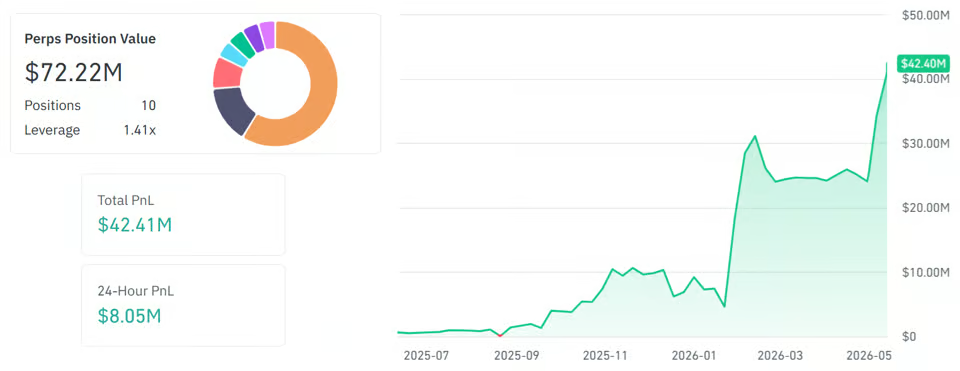
Bitcoin (BTC) failed to sustain bullish momentum on Wednesday, retreating below the psychological $80,000 level. Traders grew anxious as persistently high oil prices applied pressure to inflation and consumer spending. A Hyperliquid whale with $42 million in historical profits flipped bearish, leaving investors to question whether the recent rally is losing its foundation.

Hyperliquid whale 0x8def…992dae profit/loss, USD. Source: CoinGlass
The Hyperliquid whale at address 0x8def…992dae recently opened a $70 million bearish position on various cryptocurrencies and synthetic tokens tied to major technology stocks. According to the Hyperdash trading and data platform, the address belongs to Loracle, an early developer within the Hyperliquid ecosystem. This account began betting more aggressively in September 2025.
Related: Bitcoin price targets $79K as US PPI inflation hits highest since 2022
Interestingly, the majority of this whale’s past profits were generated through bullish bets, including several successful trades over the last month. A long position in Bitcoin, Zcash (ZEC), and Toncoin (TON) closed on Monday, netting a $9.2 million profit in just two weeks. On Thursday, the same entity secured a $3 million profit on bullish synthetic tokens linked to oil prices after a nine-day hold.

Hyperliquid whale 0x94d373…c933814 position on May 13. Source: app.trade.xyz
Over the past week, this whale flipped bearishly by accumulating a massive $49 million short position on HYPE. These bets on downside price movements expanded to include a $12.5 million short in Bitcoin, alongside $8 million in synthetic tokens tracking chipmaker Sandisk (SNDK US) and the Nasdaq-100 Index.
Why is the whale shorting BTC, HYPE, and tech stocks?
This bearish assessment is further supported by a $1.7 million long position in a gold-backed stablecoin. However, trade data analysis from app.trade.xyz reveals an algorithmic trading style, with positions typically lasting less than a week. These findings suggest the whale is reacting to short-term technical moves rather than a fundamental breakdown in risk-on assets.

Brent crude oil (left) vs. US 5-year Treasury yield (right). Source: TradingView
The ongoing war in Iran has pushed Brent crude oil prices above $100. This spike likely pushes the US Federal Reserve to expand its balance sheet as US Treasury yields spiral out of control. As US fiscal budget issues mount, investors are increasingly incentivized to seek shelter in scarce assets, especially since higher inflation expectations reduce the appeal of fixed-income investments.

US Federal Reserve total assets, USD millions. Source: St Louis Fed
The US Fed has begun accumulating bonds and mortgage-backed assets to relieve pressure on financial institutions. While providing liquidity eases immediate concerns, this intervention causes inflation to accelerate. This remedy, though efficient, curbs the potential for expansionist monetary policies, as the Fed has less room to trim interest rates effectively.
Even if Bitcoin and tech stocks initially react negatively to signs of an overheating economy, traders will likely eventually exit fixed-income investments as the expansion of the monetary base becomes evident. Lower demand for US Treasuries indicates eroding trust in monetary policy, which serves as a positive driver for Bitcoin over the medium term.
Ultimately, little reason exists to fear this Hyperliquid whale’s bearish bets, even when accounting for the entity’s successful track record.
Despite its extreme volatility, Bitcoin emerges as a disruptive option for retirement planning while inflation erodes the purchasing power of traditional pensions throughout the developed world. Over the last 4-year period, the asset is still up 166.7%.
So, is it still possible to retire with BTC? It always depends on the price trajectory. We review the projections from major banks, how many BTC you need to retire, and the risks of the five-year plan.
How Much Bitcoin Do You Need to Retire in the Coming Years?
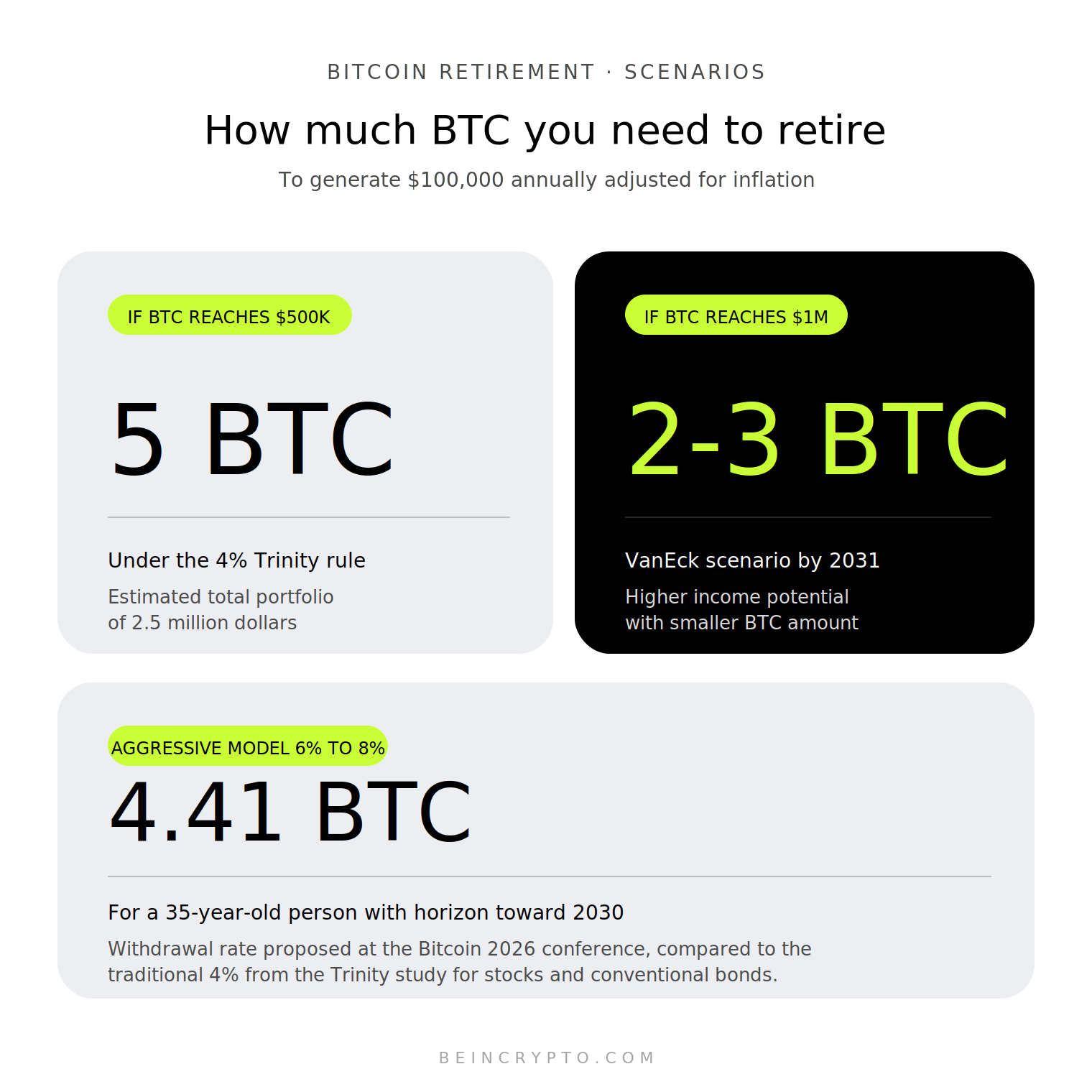
To retire with Bitcoin in the next five years, an investor would need between 2 and 5 BTC, depending on the asset’s price and the withdrawal rule applied. These projections are based on the standard portfolio calculation to generate $100,000 annually, adjusted for inflation.
The most discussed projection comes from VanEck. Matthew Sigel, head of digital assets research at the firm, recently declared that Bitcoin could reach $1 million by 2031. He described it as the firm’s base case, driven by demographic trends and sustained institutional buying.
Other banks handle more conservative but still bullish estimates. Standard Chartered, Bernstein, and Fundstrat place the asset between $120,000 and $ 250,000 by the end of 2026. For the long term, Michael Saylor projects $1 million while Cathie Wood at ARK Invest aims for $1,2 million dollars in 2030.
The 4% rule from the Trinity study serves as the initial reference for calculations. Applied to a traditional portfolio, an investor seeking $100,000 annually would need approximately $ 2.5 million accumulated.
If Bitcoin reaches $500,000 by 2030, 5 BTC would be enough to generate that income.

More aggressive models discussed at the Bitcoin 2026 Conference suggest withdrawal rates of 6% to 8% for Bitcoin, given its appreciation potential.
Under this scenario, a 35-year-old person could need only 4.41 BTC to generate $100,000 dollars annually, adjusted for inflation by 2030.
Specialized tools facilitate personalized calculations. Calculators like the Bitcoin Retirement Calculator from Unchained or Bitcoin Well allow users to simulate scenarios that incorporate monthly contributions, expected inflation, and different asset growth rates over the defined timeframe.

Pension Funds are Accelerating their Bet on Bitcoin
Institutional adoption accelerates the optimistic scenario for Bitcoin-based retirement plans. Vehicles such as the New York State Common Retirement Fund and the Texas Teachers Pension Fund recently increased their positions in Strategy (formerly MicroStrategy) as a proxy for indirect exposure to the digital asset.
Other public funds followed the same strategic path. The pension plans of Ohio, California (through CalPERS), and Louisiana revealed similar exposures in their recent reports.
Some faced temporary losses due to MicroStrategy’s recent volatility, but maintain the positions as a medium-term bet.
This trend marks a clear inflection point. Bitcoin stops being a purely speculative asset for retail investors and formally integrates into institutional retirement plans under strict regulation.
In the United States, regulations facilitating Bitcoin in 401(k) and IRA accounts expand access to trillions of dollars in retirement savings.

The integration has important long-term implications. When public pension funds allocate capital, they do so with horizons of 20 to 30 years and rigorous approval processes. The institutional decision alone provides qualitative validation that no individual technical analysis can replicate.
What Risks Does Retiring with Bitcoin by 2030
Despite institutional optimism, retiring exclusively with Bitcoin by 2030 carries substantial risks. The asset recorded drops of more than 70% in previous cycles, a volatility incompatible with the stability that a traditional retirement plan requires, given fixed monthly commitments.
Some analysts anticipate additional turbulence in the short term. Peter Brandt foresees a possible low investable point between September and October 2026, before a new sustained bullish cycle.
This reading aligns with the warnings from Geoffrey Kendrick, then at Standard Chartered, during the first quarter of the year.
Diversification is the universal recommendation among traditional financial experts.
Publications like The Motley Fool suggest that investors close to retirement should allocate no more than 1% to 5% of their total portfolio to Bitcoin. The proportion changes depending on individual risk profile and the available timeframe.
Specific strategies exist to mitigate exposure.
- The HODL method involves holding the asset long-term without selling.
- Bitcoin-collateralized loans allow generating liquidity without liquidating the position and avoiding taxes.
- Flexible percentage withdrawals adjust the amount withdrawn based on the asset’s annual behavior.
The final critical factor is the actual time horizon. Those who invest today with five to ten years ahead have greater room to absorb volatility than those needing immediate liquidity.
The universal crypto rule remains valid: never invest more than you can afford to lose.
The post Retiring With Bitcoin by 2030: Hoax or Real Financial Strategy? appeared first on BeInCrypto.
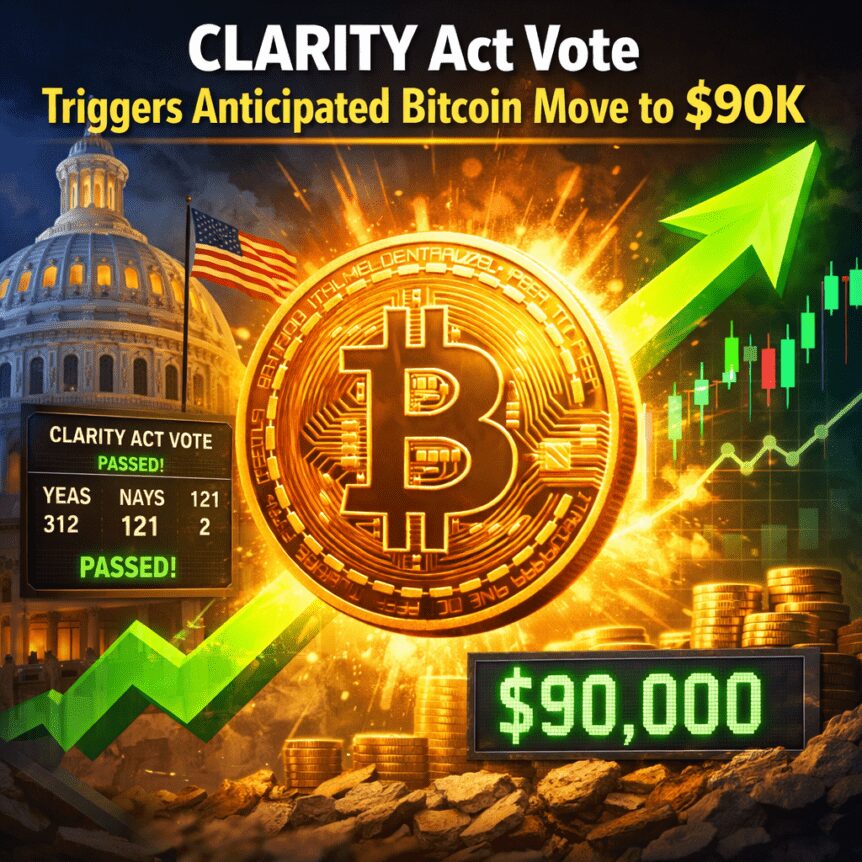
Bitcoin (BTC) traders are eyeing the path to higher ground as the U.S. Congress prepares to debate the CLARITY Act this week. With BTC hovering near the $80,000 level and the 200-day exponential moving average serving as a major overhead hurdle, market participants see a setup that could spark a rapid move higher if momentum holds and short-term selling eases.
Key takeaways
- Bitcoin remains near $80,000, with the 200-day EMA acting as a critical resistance line that could determine the trajectory in the near term.
- More than $3 billion in leveraged long positions cluster between $79,000 and $78,000, suggesting a potential test of price support before any sustained breakout.
- On-chain signals point to improving market conditions: short-term holder loss pressure has been zero for five consecutive days, and the share of supply held by short-term traders sits at 22.2%, the lowest in roughly 90 days.
- The CLARITY Act, which seeks clearer regulatory guidelines for crypto markets and stablecoins, has drawn significant attention as lawmakers filed more than 100 amendments ahead of a markup session.
- A looming resistance zone around $83,400–$84,600—the next Fibonacci-related hurdle—could temper gains and prompt profit-taking if BTC reclaims the 50% retracement level near $78,983.
Bitcoin market signals a potential breakout
Over the past week, Bitcoin traded around the $80,000 level as traders weighed the possible implications of the CLARITY Act vote. The 200-day EMA continues to loom as a robust resistance point, and a cluster of leveraged long positions—estimated at more than $3 billion—has formed between $79,000 and $78,000. This setup implies that a brief retest of that range could occur before BTC attempts another push above the long-term moving average.
“If this continues to grind upwards, with the upcoming CLARITY Act tomorrow, I would assume we might see a fast move to $90K in a matter of days for Bitcoin.”
That sentiment from Michaël van de Poppe, founder of MN Capital, reflects a broader expectation that improving market conditions could translate into a sharper upside once the regulatory event passes and funding flows resume their upward tilt.
On-chain analysis adds nuance to the price narrative. Bitcoin researcher Axel Adler Jr. highlighted that short-term holder loss pressure has remained at zero percent for five consecutive days, a signal that new buyers are not yet capitulating into pain. In addition, Adler noted that the share of Bitcoin supply held by short-term traders has fallen to 22.2%, a 90-day low. Taken together, these metrics suggest a cooling of near-term selling pressure and potential buoyancy for a sustained rebound if price starts to move higher.
However, a counterpoint remains in the charts. Crypto trader Zord warned of a potential resistance band ahead, pointing to a zone between roughly $83,400 and $84,600 after BTC reclaims the 50% Fibonacci retracement level near $78,983. In the perspective of technical analysts, this zone represents a 0.618–0.65 Fibonacci resistance, where short-term profit-taking could slow BTC’s ascent and prompt a pause before any continued breakout.
Policy backdrop: CLARITY Act in focus
The CLARITY Act is aimed at providing clearer rules for regulators overseeing crypto markets and stablecoins. In a development that underscores the bill’s high-stakes nature, Senate Banking Committee members filed more than 100 amendments in the run-up to Thursday’s markup, reflecting diverse viewpoints on how to regulate crypto exchanges, stablecoins, and crypto developers. A leaked version of the draft suggested limits on stablecoin rewards that resemble traditional interest-bearing accounts, signaling a potential rethink of incentive structures across platforms.
Industry observers have framed the debate as a push to separate stablecoins used for everyday payments from products that behave more like bank deposits. XWIN Japan described the drafting as signaling a deliberate shift toward distinguishing payment-focused stablecoins from yield-bearing crypto products, a distinction with wide market implications if it solidifies into policy.
Meanwhile, stablecoins continue to grow their footprint across networks. CryptoQuant and other researchers have highlighted parabolic growth in ERC-20 stablecoin active addresses in recent years, illustrating the ongoing liquidity and usage of stablecoins as the backbone of crypto market activity. The broader narrative is that stablecoins remain a central conduit for capital in crypto markets, potentially supporting longer-term investment in Bitcoin as adoption widens and financial products linked to digital assets mature.
What could come next for BTC
Looking ahead, the critical question is whether BTC can clear the looming resistance zone around $83,400–$84,600 and sustain a move beyond the 200-day EMA. If the price can pierce this band with aided demand from on-chain support and stablecoin-driven liquidity, a swift advance toward higher targets, including the $90,000 region, would be plausible in the short to medium term. Conversely, if sellers saturate this zone, a retest of the lower boundary around the $80,000s or a deeper pullback could reassert itself as market participants reassess risk ahead of regulatory milestones.
Beyond price action, the evolving regulatory backdrop will continue to shape market dynamics. Investors should monitor the CLARITY Act developments—particularly amendments related to stablecoins and crypto incentives—as they may affect exchange offerings, product design, and the calculus of risk and return for Bitcoin and associated assets.
In the near term, the ongoing growth of stablecoins and their use in funding flows into crypto markets remains a crucial backdrop. If stablecoin adoption continues its current trajectory, it could bolster liquidity and demand for Bitcoin over time, even as short-term price volatility persists. As always, readers should stay attuned to both price catalysts and regulatory signals to gauge how the balance of supply, demand, and policy could steer Bitcoin in the days and weeks ahead.
Readers should watch the CLARITY Act developments closely and track on-chain dynamics for cues about Bitcoin’s next move in the near term.
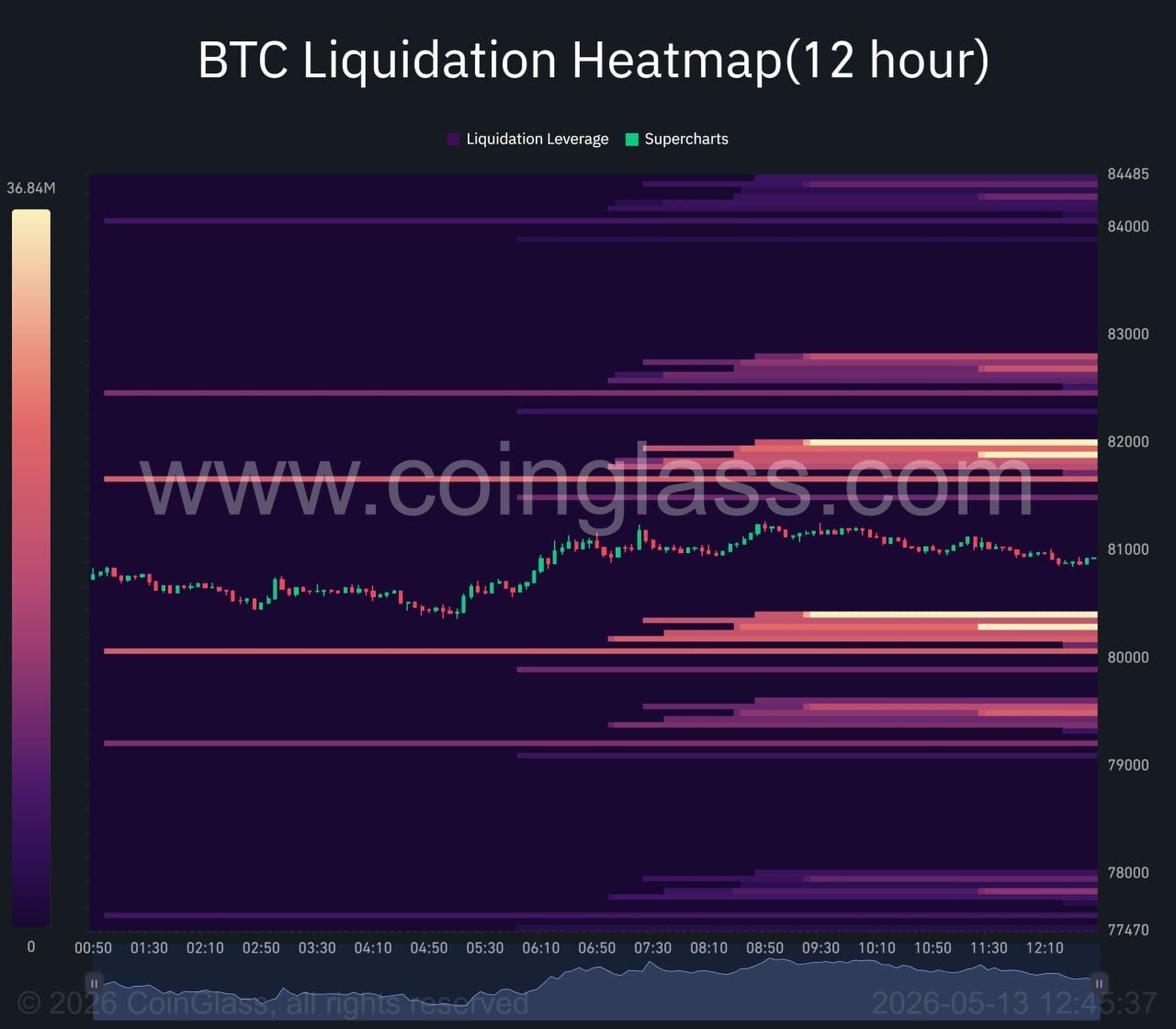
Bitcoin (BTC) is trapped between two deep liquidation pockets, with stacked longs below $80,000 and dense short positions above $82,000. A decisive break could trigger a cascade and ignite the next major move.
BTC trades near $80,107 after slipping 0.48% over the past 24 hours. Market structure has weakened with three consecutive lower highs, while volatility across multiple timeframes has compressed to historic lows.
Liquidation Heatmap Shows BTC Caught Between Two Walls
The 12-hour Bitcoin liquidation heatmap from CoinGlass shows BTC consolidating around $80,800 with two unusually dense leverage clusters bracketing the current price.
Bright yellow bands sit just above $82,000, where stacked short positions face liquidation, while a second cluster between $79,800 and $80,500 marks where leveraged longs would be wiped out.

Liquidation cascades typically amplify short-term moves by adding directional pressure. A push through $82,000 would squeeze shorts and fuel a fast run higher, while a flush below $80,000 would wipe leveraged longs and accelerate the slide.
Lower Highs Suggest Momentum Is Fading
While the heatmap frames the binary outcome, market structure is leaning bearish.
Throughout the prior leg up, Bitcoin typically formed only one lower high before resuming the trend. The current three-bar sequence suggests buyers are losing conviction near the upper resistance band.
No lower low has formed yet, which prevents the structure from confirming a full bearish shift.

The key trigger to watch is a clean break below the recent swing low near $79,200, marked as Key Support on the chart. A daily close beneath that floor would validate the bear thesis and align with the lower liquidation cluster.
Bitcoin Price Outlook: $85,000 Bounce or $76,000 Breakdown
On the daily timeframe, Bitcoin broke out from its ascending parallel channel on May 4 and has spent more than a week trending above the upper band. Two clean tests of that line on May 8 and again on May 13 confirm the former resistance is now acting as support.

If buyers defend the trendline once more, BTC could push toward the 0.382 Fibonacci retracement at $85,286, placing the next upside target between $85,000 and $87,000. A decisive bounce above $82,000 would also trigger the upper liquidation pocket and feed the move.
A breakdown back into the channel exposes the midline at the 0.236 Fibonacci retracement near $75,622, with broader support stretching from $74,000 to $76,000.
The four-hour chart confirms the tight range, with horizontal resistance at $82,000-$82,500 capping every recent attempt and a soft support shelf between $79,500 and $80,000.

Volatility readings on the BBWP indicator have compressed to extreme lows on both daily and four-hour charts, often a precursor to expansion.
With RSI declining on every timeframe but still above the neutral zone, the next directional break carries more weight than any analysis of the past three weeks.
The post Bitcoin Price on Knife’s Edge: Liquidation Explosion Awaits at $82,000 appeared first on BeInCrypto.
Welcome to our institutional newsletter, Crypto Long & Short. This week:
- Dovile Silenskyte provides an alternative to the “bitcoin as a risk asset” narrative.
- Joshua de Vos shares insights and analysis on global exchanges.
- Top headlines institutions should pay attention to by Francisco Rodrigues.
- CoinDesk 80 Leads as Crypto Outperforms Across Asset Classes in Chart of the Week.
Thanks for joining us!
Expert Insights
Bitcoin vs. gold: 26% relative undervaluation
By Dovile Silenskyte, director of digital assets research, WisdomTree
For years, markets have struggled to classify bitcoin. Currently, the dominant media narrative tends to treat bitcoin as a high-beta expression of investor risk appetite: rising when liquidity is abundant and falling when markets turn defensive.
That framing increasingly misses the bigger structural shift underway.
Bitcoin is evolving into a monetary asset competing for the same macro allocation bucket as gold. Both bitcoin and gold:
- Sit outside the traditional fiat system.
- Respond to inflation expectations, real yields and confidence in sovereign currencies.
- Attract investors looking for scarce and politically neutral stores of value.
The difference is that gold represents monetary defensiveness while bitcoin represents monetary expansion. This distinction changes how bitcoin should be analyzed.
Rather than evaluating bitcoin through an equity or risk-asset framework, we believe the cleaner analytical lens is bitcoin versus gold. The key question is not whether bitcoin will rise in absolute terms, but whether its monetary premium relative to gold is too low or too high given the prevailing macro backdrop.
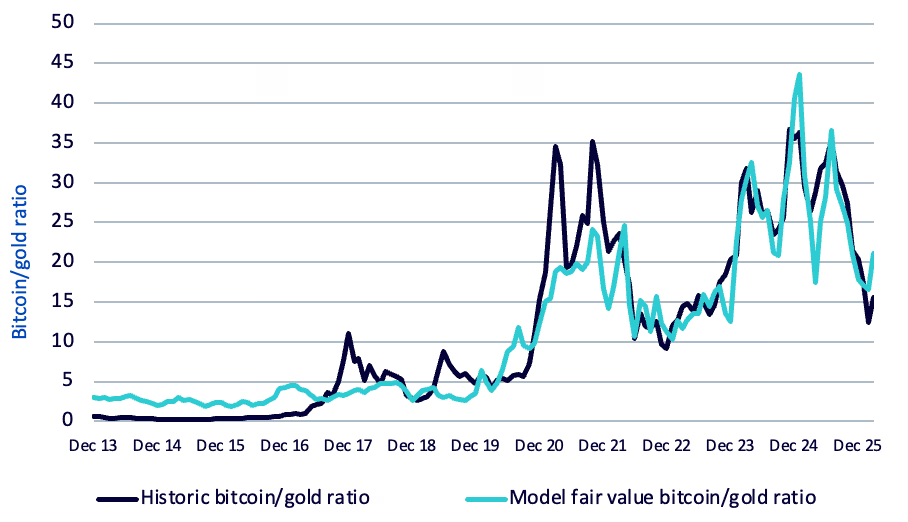
Our Bitcoin in Gold (BiG) model attempts to answer precisely that question. As of March 31, 2026:
- Actual bitcoin/gold ratio: 15.6
- Model fair value: 21.1
That gap implies bitcoin is 26% undervalued relative to gold.
Figure 1: The actual bitcoin/gold ratio is sitting clearly below model estimate

Source: WisdomTree, Stooq. From December 31, 2013 to March 31, 2026. Historical performance is not an indication of future performance, and any investment may go down in value.
This gap is not abstract. It reflects current macro inputs embedded in the model. Specifically, bitcoin reacts more aggressively than gold to macro shifts:
- Falling real yields / easier liquidity: bitcoin outperforms.
- Stronger USD / risk-off: gold outperforms.
- Rising inflation expectations: typically supports gold first.
Today’s mix implies a higher bitcoin/gold ratio than observed.
As of March 31, 2026, the model assigns the highest probability for the following three macro scenarios over the coming 12 months, and each of them leads to different outcomes:
- Current: no shock; gradual convergence to fair value.
- Inflation shock: gold leads initially; bitcoin catches up later.
- Risk-off: stronger USD; gold outperforms.
Figure 2: Scenario paths for the bitcoin/gold ratio

Source: WisdomTree. April 7, 2026. Model assumes that macro scenario starts on April 1, 2026 and continues for the next 12-month. Forecasts are not an indication of future performance and any investments are subject to risks and uncertainties.
For investors, there are three practical applications of the BiG model:
- Relative value trade: long bitcoin and short gold is one potential implementation approach.
- Allocation tilt: if holding both, increase bitcoin weight when the gap is wide.
- Macro overlay: combine with real yields, dollar trend and liquidity indicators.
The BiG model is a positioning tool. The edge comes from systematically leaning into dislocations when they are wide and scaling back as they compress. The discipline is straightforward: track the gap, anchor decisions in the macro context and avoid overfitting short-term price moves.
See further detail in Bitcoin vs gold: bitcoin looks 26% undervalued relative to gold blog.
Principled Perspectives
The centralized exchange market is pulling apart
By Joshua de Vos, research lead, CoinDesk Data
Centralized exchanges have long maintained that the industry has reached maturity. CoinDesk’s May 2026 Exchange Benchmark, which evaluates 75 spot exchanges against more than 100 metrics, provides a rigorous test of that assertion. The resulting data is encouraging in some areas and complex in others; most notably, it reveals a systemic vulnerability to market failures that persists even among top-tier venues.
The bar rises
The primary shift this cycle is methodological: the AA grading threshold was raised from 80 to 85, reflecting the higher institutional standards required as the benchmark evolves. Six exchanges met this new criteria: Bitstamp by Robinhood (90.26), Coinbase (88.58), Kraken (87.77), Binance (87.25), Bullish (86.99) and Crypto.com (86.22). For the first time in three years, Bitstamp leads the rankings, overtaking Binance. Meanwhile, Gemini and OKX moved from AA to A status. This reclassification was a direct consequence of the higher threshold rather than a decline in quality, as both exchanges actually improved their individual scores.

The Exchange Grade Distribution highlights a significant evolution over the last three cycles. The most notable change occurred at the bottom of the scale; the number of E-grade exchanges dropped from 11 in November 2025 to just four, with seven venues ascending to the D-tier. This represents the largest single-cycle grade shift in the benchmark’s history. The universe average score rose to 58.42, marking a third consecutive period of improvement, and the number of ‘Top-Tier’ exchanges (rated BB or higher) grew to 21 from 20 last cycle.
Volume concentrates at the top
Top-tier exchanges now command 59% of Q1 spot volume despite making up only 27% of rated venues; a sharp increase from 40% in October 2025. This trend aligns with a long-term pattern of institutional capital gravitating toward venues with verifiable infrastructure. Binance remains the dominant force with 24% of total spot volume, nearly four times that of its nearest competitor. Conversely, MEXC commands 6.25% of global volume but remains C-graded, illustrating a small yet visible disconnect between trading activity and institutional risk standards amongst trading long-tail assets.

October’s lesson
A critical finding this cycle involves the market-wide exchange failures on October 10th, which caused price dislocations across 62 of the 75 benchmarked exchanges and affected at least 571 trading pairs. The incidence of flash crashes was near-universal, impacting 81% of all rated exchanges, including 100% of AA-grade and 100% of B-grade venues. These results suggest that such market failures are systemic, rather than isolated to lower-tier platforms. To better track this, the benchmark has introduced a broader flash crash assessment to monitor venue resilience.

What the data still shows
Transparency continues to trend upward. Proof of Reserves coverage reached 63%, and due diligence questionnaire (DDQ) submissions hit an all-time high with 21 verified responses. However, the regulatory landscape remains fragmented. Despite MiCA being in effect since late 2024, only 16 of the 75 benchmarked exchanges hold a full license, and 66% have no regulatory presence in the EU at all. Notably, HitBTC, Thalex and Woo have yet to establish a regulatory footprint in any jurisdiction.

Looking ahead, the November 2026 cycle opens for exchange submissions in October. As institutional allocation into digital assets deepens and scrutiny from counterparties increases, the cost of operating outside institutional risk frameworks is only rising. The benchmark plays a central role in making that cost visible.
Headlines of the Week
– By Francisco Rodrigues
This week’s headlines show a fresh wave of capital flowing into crypto infrastructure as banks, asset managers and tokenization platforms race to build the rails for institutional adoption. That’s even as one of the sector’s largest bitcoin holders flags potential selling pressure.
- Circle raises $222 million for Arc, beats Q1 earnings estimates but misses on revenue: The USDC issuer closed the round at a $3 billion valuation for its Arc blockchain token, with backing from BlackRock, Apollo and Bullish, alongside Q1 results that topped earnings expectations but came in light on the top line.
- Ripple raises $200 million from Neuberger Berman to expand its Ripple Prime platform: The new facility will fund the buildout of an institutional prime-brokerage offering, addressing rising demand for margin financing and trading services that span both traditional and digital asset markets.
- Morgan Stanley brings crypto trading with lower fees than rivals: The bank is rolling out spot crypto on E*Trade at a 50-basis-point transaction fee, undercutting Coinbase, Robinhood and Charles Schwab while giving its wealth clients a bank-run route into the asset class.
- Crypto platform Bullish to buy Equiniti for $4.2 billion, building tokenized securities infrastructure: The deal adds regulated transfer-agent, shareholder-record and issuer-services capabilities to the exchange’s stack as it positions for tokenized securities, 24/7 trading and stablecoin-based settlement.
- Michael Saylor’s Strategy signals potential bitcoin sale to fund dividend obligations: After reporting a $12.54 billion Q1 loss, the company said it may sell BTC to meet dividend payments, refocusing attention on the leverage, financing costs and potential supply overhang tied to listed bitcoin-treasury firms.
Chart of the Week
CoinDesk 80 Leads as Crypto Outperforms Across Asset Classes
Bitcoin has gained 5.7% month-to-date, outpacing major asset classes including the S&P 500, gold and oil since the start of May 2026. This strength has filtered down the market-caps, with the CoinDesk 80 (CD80) up 15.32% MTD — significantly ahead of large caps — led by ZEC’s 57% rally. The divergence between CD80 and BTC, CD5 and CD20 (all clustered around 3 -5%) suggests momentum is rotating into smaller-cap altcoins as the broader crypto rally extends.

Listen. Read. Watch. Engage.
Looking for more? Receive the latest crypto news from coindesk.com and market updates from coindesk.com/institutions.
Note: The views expressed in this column are those of the author and do not necessarily reflect those of CoinDesk, Inc., CoinDesk Indices or its owners and affiliates.
The world’s largest publicly-traded Solana treasury company has lost roughly $1 billion holding SOL despite earning 6.7% staking yields.
Forward Industries launched its Solana treasury strategy on September 8, 2025 — months after the crypto treasury bubble had already popped — with a $1.65 billion private placement led by Galaxy Digital, Jump Crypto, and Multicoin Capital.
Multicoin co-founder Kyle Samani personally added $25 million and became chairman.
“Our strategy to build an active Solana treasury program underscores our conviction in the long-term potential of SOL,” the company proclaimed at the onset. That day, SOL was trading at $206.
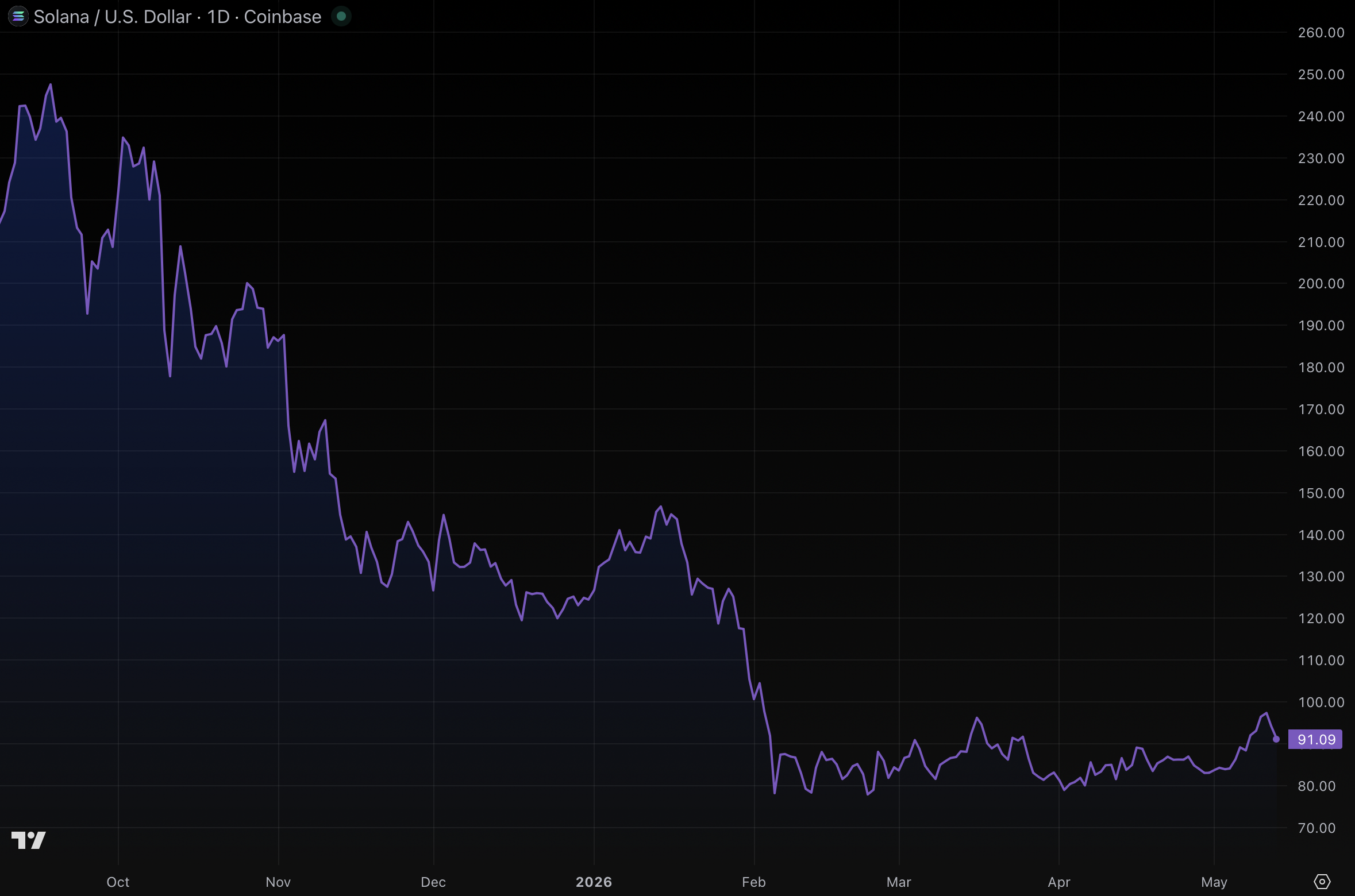
SOL trades at $91 today. Forward Industries currently holds 6,979,967 SOL.
Consider Forward Industries’ 10-Q for the quarter ended December 31, 2025, when the company reported a $585.65 million net loss. The same quarter a year earlier also produced a loss, albeit a less embarrassing $708,000.
Of that loss, $560.2 million was attributable to an unrealized loss on digital assets, i.e. the disastrous performance of SOL. The company also had a $33 million impairment on fwdSOL, its own liquid-staking token, which tracks the price of SOL.
All of those losses were offset by just $17.4 million in staking revenue.
That $17.4 million is the value of the 5-7% variable staking rewards that often dominate the company’s marketing materials about the value of its so-called treasury strategy.
That strategy is bleeding investor confidence. The company’s stock, as high as $46 per share on September 12, 2025 after its PIPE fundraise, is now trading at $4.71.
Forward Industries’ $955 million loss on SOL, plus expenses
The company’s 7 million SOL have an average cost basis near $232 and are now worth approximately $635 million, delivering roughly $955 million in unrealized losses beneath the initial $1.59 billion cost basis.
Because the company’s holdings haven’t increased substantially since the initial buy in September 2025, a chart of its holdings roughly traces the price chart of SOL itself.
That is, unfortunately, a chart that’s trended in one direction: down.
By February, CoinGecko reminded investors of their mark-to-market 64% loss. Despite 6% staking APY on its holdings, investors’ losses haven’t improved much since.
Year to date, SOL has lost 27%, including a 48% decline over the past 12 months. Over that same time period, the company’s stock price has lost 28% and 42%.
With Forward Industries’ losses mirroring that chart, investors seem to have no more confidence in its management than in SOL itself.
Forward Industries’ market cap-to-Net Asset Value (mNAV) multiple has collapsed to 0.62x, meaning that investors are willing to pay even less for company than the SOL it holds.
In fact, depending on whether someone uses fully diluted or market cap as a valuation metric, the market values the entire company at 17% or 38% less than its SOL, respectively.
Read more: Crypto treasury companies are trading for less than their holdings
Operating losses are relatively small yet compound shareholder losses. Over just one quarter, the company spent $1.398 million operating its Solana validator, plus $3.25 million in general and administrative expenses plus another $3.4 million for G&A to a “related party,” Galaxy.
It also spent $535,000 on sales and marketing.
Paying millions of dollars for the privilege of losing $1 billion
Forward Industries paid Galaxy $3.44 million in a single quarter: roughly $1.7 million in asset management fees at 0.6% per annum.
Through December 31 alone, Forward Industries had paid Galaxy approximately $4.37 million in fees. A good portion of the company’s staking yields routed straight back to the third party that designed the vehicle.
To preside over the losses, Forward Industries CEO Michael Pruitt earned earned $873,817 in executive compensation across fiscal 2025, including a $713,817 options award. CFO Kathleen Weisberg earned $725,992.
On April 13, 2026, an 8-K disclosed the hire of Mark Brazier as a new CFO at $500,000 base pay plus a targeted $250,000 bonus.
Forward Industries has accumulated more than 112,171 SOL in staking rewards since inception, an advertised 6.73% APY before fees. At today’s SOL price, those rewards are worth roughly $10.7 million and don’t even cover the cost of validator operation, SG&A, and Galaxy payments, let alone the company’s near-$1 billion loss on its SOL holdings.
Investors have noticed. “Is this the dumbest corporate crypto move ever?” asked one commenter in February. CoinGecko pointed out FWDI’s percentage loss was “4x larger than Strategy,” referencing the once-massive unrealized losses at Michael Saylor’s bitcoin treasury company.
Got a tip? Send us an email securely via Protos Leaks. For more informed news and investigations, follow us on X, Bluesky, and Google News, or subscribe to our YouTube channel.

Vietnam is moving toward a formal, supervised crypto asset market, with the possibility of the first official activity as early as the third quarter of 2026. Deputy Minister of Finance Nguyen Duc Chi announced the timeline at the Digital Trust in Finance 2026 forum, signaling a milestone in Hanoi’s plan to regulate the sector within a safety-first framework.
Chi’s remarks, reported by VnEconomy, indicate that the initial onshore activities would operate under a framework designed to ensure safety and transparency, aligning with Vietnam’s broader strategy to channel crypto activity domestically and under formal oversight.
We believe that, as early as the third quarter, Vietnam could witness the first official activities of its crypto asset market, operating under a framework designed to ensure safety and transparency.
According to VnEconomy, the remarks were delivered during the Digital Trust in Finance 2026 forum.
Vietnam’s regulatory push includes opening a licensing pathway for domestic crypto asset trading platforms earlier this year. As Cointelegraph reported, five Vietnamese companies passed the initial qualification round in March, comprising affiliates of Techcombank, VPBank and LPBank, alongside stockbroker VIX Securities and conglomerate Sun Group. This development marks a substantive step toward a formal onshore market.
In February, Vietnam drafted a tax framework that would treat crypto transactions similarly to traditional securities trading, proposing a 0.1% individual tax on each crypto transaction processed through a licensed provider.
Cointelegraph contacted Vietnam’s Ministry of Finance for comment but did not receive a response by publication.
Related: Vietnam’s five-year crypto pilot with strict controls
Key takeaways
- Vietnam expects the first official onshore activity in its regulated crypto asset market by Q3 2026, operating under a safety-and-transparency framework, per Deputy Minister Nguyen Duc Chi.
- A licensing pathway for domestic crypto asset trading platforms was opened earlier this year; five Vietnamese firms reportedly advanced through the initial qualification round in March, including affiliates of Techcombank, VPBank, LPBank, plus VIX Securities and Sun Group.
- A proposed 0.1% tax on individual crypto trades conducted via licensed providers would align crypto taxation with securities-like treatment, pending formal adoption.
- Vietnam ranks among the world’s most active crypto markets, with Chainalysis placing it fourth in the 2025 Global Crypto Adoption Index; onchain value received reached about $200 billion over the 12 months to June 2025, though offshore exchanges remain prominent.
- To domesticate activity, a five-year pilot began in September 2025 requiring all transactions to be settled in Vietnamese dong through locally registered entities.
Regulatory trajectory toward a formal onshore market
The statements from Hanoi’s finance leadership reflect a deliberate shift from exploratory measures to formal supervision of crypto assets. By signaling a near-term window for official market activities, authorities aim to establish clear licensing criteria, ongoing supervision, and enforceable standards designed to safeguard investors and maintain financial stability. The licensing pathway previously opened for domestic platforms signals the government’s preference for onshore activity and greater visibility into trading volumes, enforcement actions, and tax receipts.
Industry observers note that the onshore framework will hinge on robust compliance requirements, including AML/KYC controls, consumer protections, cybersecurity standards, and transparent reporting. The progression from pilot licensing to full-fledged regulated exchanges also suggests potential cross-border policy considerations, as regional regulators assess harmonization opportunities and risk-sharing mechanisms for the swiftly evolving crypto landscape.
As reported by Cointelegraph, the March qualification wave underscored a tangible pipeline of local operators seeking licensed status, reinforcing expectations that regulatory licensing could become the gatekeeper for regulated market participation rather than a purely permissive environment.
Taxation, licensing, and market structure implications
The February tax framework proposal would levy a 0.1% tax on each crypto transaction processed through a licensed provider, aligning crypto trading with securities-style taxation and expanding the state’s visibility into market activity. If enacted, the tax regime would intersect with licensing requirements, AML/KYC standards, and consumer protections that regulators intend to apply to onshore platforms. The tax design also signals a broader shift toward integrating crypto trading activity into formal fiscal reporting and compliance channels.
The five-year pilot, announced in tandem with the broader licensing push, requires all domestic crypto trades to be executed in Vietnamese dong through locally registered companies. This regime aims to improve traceability, curtail capital flight, and align trading activity with domestic supervisory frameworks. For financial institutions and service providers seeking licenses, the new requirements will place emphasis on risk management, vendor oversight, and data-driven compliance programs that support supervisory objectives and consumer safeguards.
These developments arrive within a broader context of regulatory oversight for digital assets, where institutions—banks, exchanges, and intermediaries—will need to navigate licensing timelines, capital and liquidity expectations, and mandatory AML/KYC standards. The onshore shift could also influence cross-border liquidity, correspondent banking considerations, and the banking sector’s readiness to accommodate crypto-related activity under enhanced risk controls.
Adoption landscape and policy context
Vietnam’s crypto market footprint remains substantial, reflecting its status as a regional hub for digital asset activity. Chainalysis’ 2025 Global Crypto Adoption Index places Vietnam fourth globally, underscoring robust user engagement and transactional activity. The country also ranked third in onchain value received, with an estimated $200 billion in transactions over the 12 months through June 2025, behind only India and South Korea. These metrics illustrate a mature level of activity that regulatory reforms aim to channel more effectively onshore.
Despite strong onchain activity, a sizeable portion of Vietnamese trading has historically occurred on offshore exchanges, including major platforms like Binance, OKX, and Bybit. The five-year dong-denominated pilot and the licensing pathway are designed to pivot a significant share of this activity onto domestically supervised venues, thereby increasing regulatory visibility, enabling tax collection, and strengthening consumer protections. The broader policy context includes Vietnam’s ambition to expand its digital economy—encompassing a target for digital transactions to account for a substantial portion of GDP by 2030 and a reduction in cash reliance—creating a coherent framework for market development and financial innovation within a regulated structure.
Looking ahead, the realization of a regulated onshore crypto market will depend on timely licensing outcomes, coherent regulatory guidelines, and the evolution of tax and AML/KYC regimes. Institutions should monitor the pace of regulatory implementation, enforcement actions, and cross-border policy alignment as Vietnam’s crypto market matures.
Roni Cohen-Pavon, the former chief revenue officer of defunct cryptocurrency lending platform Celsius, will likely turn over more than $1 million as part of a forfeiture order by US authorities ahead of his sentencing hearing.
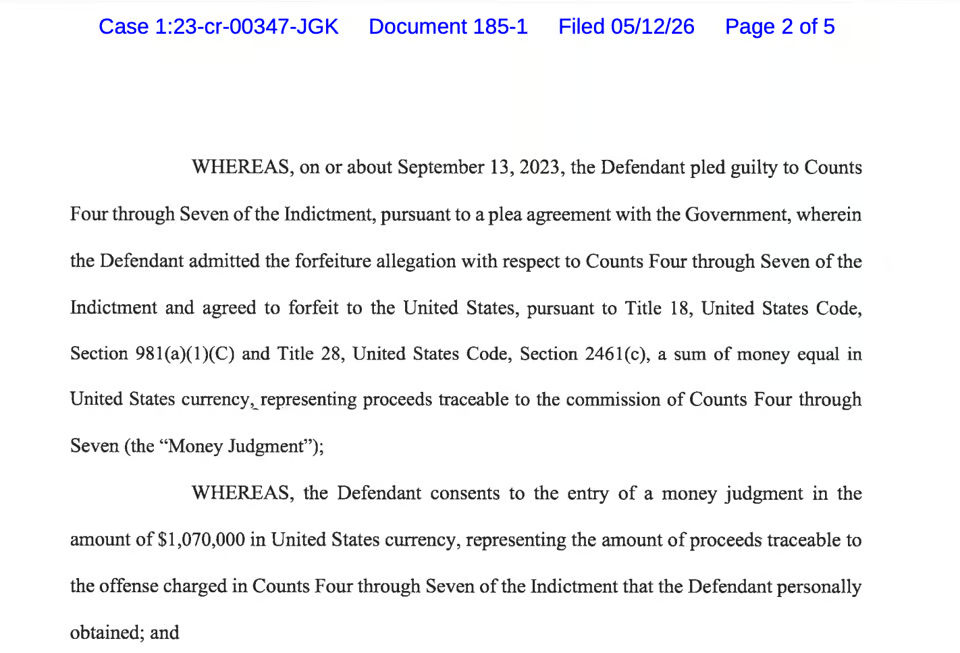
In a Tuesday court filing, US Attorney for the Southern District of New York Jay Clayton said that Cohen-Pavon had consented to a $1,070,000 judgment “representing the amount of proceeds traceable” to the former Celsius executive’s crimes. Clayton said that Cohen-Pavon would receive credit for any funds, in cash or crypto that he had on Celsius, paid as part of the platform’s bankruptcy case.

Source: PACER
Cohen-Pavon pleaded guilty to fraud and conspiracy to commit price manipulation related to Celsius’s CEL token in September 2023. Clayton did not recommend a specific sentence for the Celsius executive, instead asking the judge to consider the guidelines for an “appropriate sentencing reduction for a defendant who has rendered substantial assistance.” He is scheduled to appear for sentencing in the US District Court for the Southern District of New York on Thursday.
The collapse of Celsius was one of the most significant bankruptcies in the crypto industry in 2022, possibly precipitated by the downfall of the Terra ecosystem and leading to large exchanges including FTX filing for Chapter 11 in the US. Former Celsius CEO Alex Mashinsky was sentenced to 12 years in prison in May 2025 after pleading guilty to commodities and securities fraud and agreed to a forfeiture of more than $48 million.
Related: Celsius founder Alex Mashinsky settles FTC case with $10M payment
In April, Cohen-Pavon’s lawyers asked that he be sentenced to time served, citing his cooperation agreement with the government and potential role in Mashinsky’s guilty plea. They said that the Celsius executive took “full responsibility for his conduct.”
“I pleaded guilty because I am guilty,” said Cohen-Pavon in a letter to Judge John Koeltl. “I participated in the manipulation of the CEL token. I did not stop it when I should have, and I did not leave when I could have. I take full responsibility for that.”
Judge orders $10 million added to judgment of former FTX CEO
On Thursday, SDNY Judge Lewis Kaplan ordered that $10 million in assets connected to Sam “SBF” Bankman-Fried be used toward the former FTX CEO’s forfeiture agreement. Bankman-Fried was sentenced to 25 years in prison and ordered to pay more than $11 billion as part of his role in defrauding FTX users and investors.
In April, Kaplan denied Bankman-Fried’s motion for a new trial, with the former CEO claiming that the judge showed “manifest prejudice” during his time in court in 2023. His appeal to overturn his conviction and sentence with the Second Circuit was still pending as of Wednesday.
Magazine: eToro founder timed Bitcoin top perfectly due to belief in 4 year cycles

Trump’s counter-terror czar thinks arch-conservative Tucker Carlson is an extremist Sharia law fanboy

Man City see off Palace to keep pressure on Arsenal

Software Developers Say AI Is Rotting Their Brains

Manchester United reach agreement with Casemiro over contract clause amid transfer speculation

US brings back mandatory military draft registration

Steven Gerrard disagrees with Gary Neville over ‘shock’ Chelsea and Arsenal claim | Football


-
 Crypto World5 days ago
HarrisX Poll Found 52% of Registered Voters Support the CLARITY Act
-

 Fashion5 days ago
Weekend Open Thread: Marianne Dress
-

 Crypto World7 days ago
Upbit adds B3 Korean won pair as Base token gains Korea access
-
 NewsBeat7 days ago
NCP car park operator enters administration putting 340 UK sites at risk of closure
-

 Fashion2 days ago
Coffee Break: Travel Steam Iron
-

 Tech4 days ago
Auto Enthusiast Carves Functional Two-Stroke Engine from Solid Metal
-

 Fashion3 days ago
What to Know Before Buying a Curling Wand or Curling Iron
-

 Politics2 days ago
What to expect when you’re expecting a budget
-
 Business4 days ago
Ignore market noise, India’s long-term story intact, say D-Street bulls Ramesh Damani and Sunil Singhania
-

 Politics5 days ago
Politics Home Article | Starmer Enters The Danger Zone
-

 Tech3 days ago
GM Agrees To Pay $12.75 Million To Settle California Lawsuit Over Misuse Of Customers’ Driving Data
-

 Politics6 days ago
Simon Cowell Says He Was ‘Horrible’ To Susan Boyle During BGT Audition
-

 Entertainment7 days ago
Sarah Paulson Called Out For Met Gala ‘Hypocrisy’
-

 Entertainment6 days ago
General Hospital: Ric & Ava Bombshell – Ric’s Massive Secret Exposed!
-

 Crypto World7 days ago
Robinhood says Wall Street is building onchain
-

 Sports7 days ago
UEFA Champions League final schedule, teams, venue, live time and streaming | Football News
-

 Entertainment6 days ago
Why David Letterman Called CBS ‘Lying Weasels’
-

 Fashion7 days ago
The Best Work Pants for Women in 2026
-
 Sports7 days ago
Mike Tyson speaks out on status of Floyd Mayweather fight
-
Entertainment7 days ago
Hayden Panettiere reveals she's estranged from mom, addresses brother Jansen's sudden death: 'I was floored'
You must be logged in to post a comment Login