
Crypto World
Bitcoin approaches $82,000 as oil crashes 6% on fresh Iran peace deal hopes

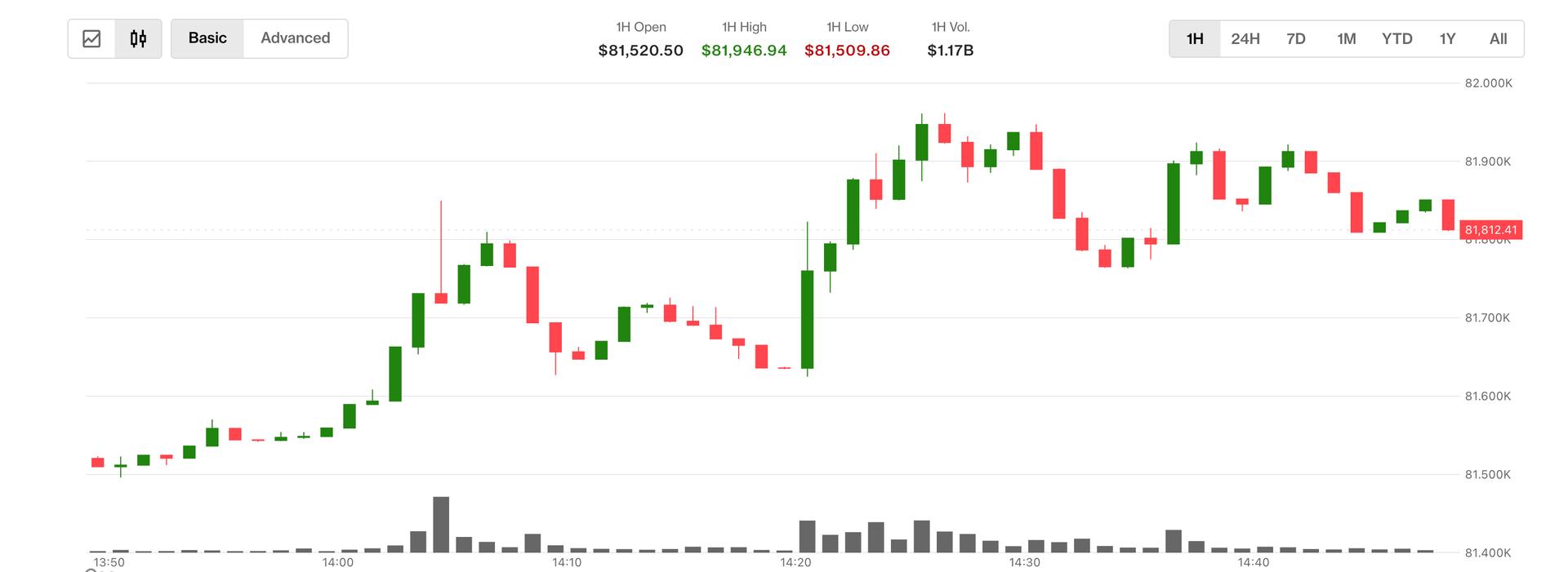
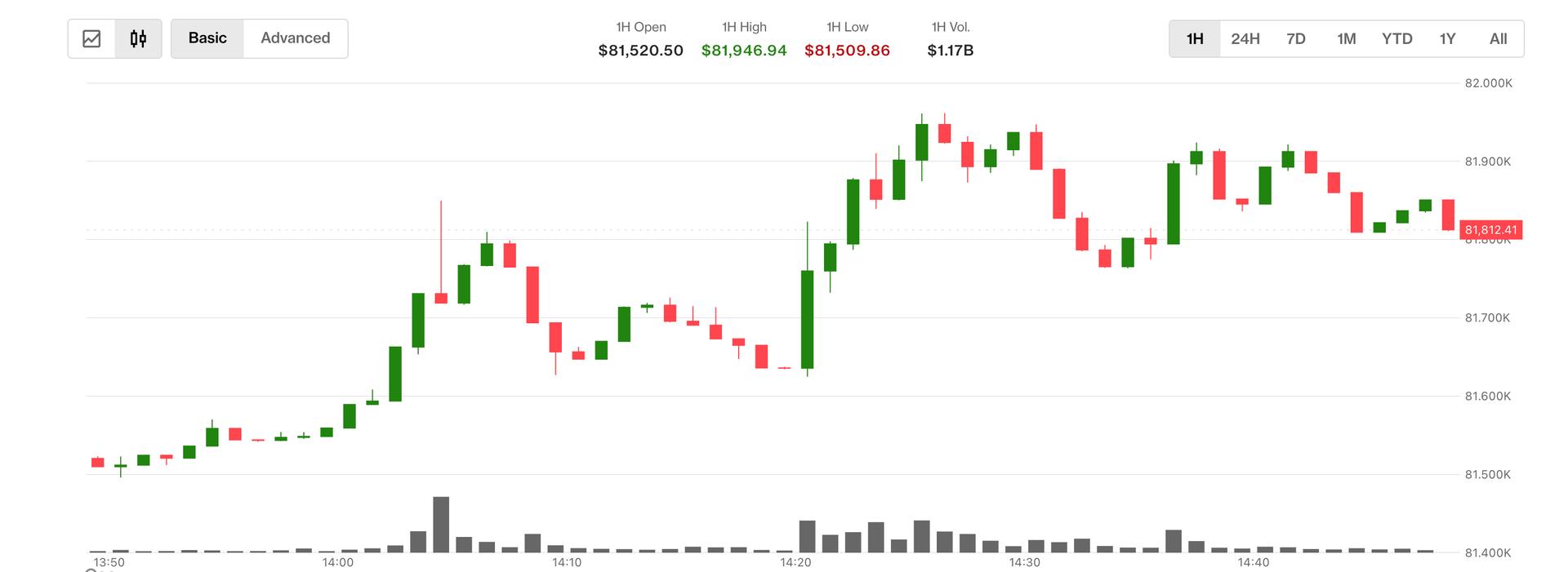
Risk assets rallied across the globe and oil crashed during Monday’s European hours as reports of progress in U.S.–Iran peace talks boosted risk sentiment.
Bitcoin extended Asian gains to trade close to $82,000 during the European hours, as futures tied to Wall Street’s tech heavy index Nasdaq rose over 1%. Futures tied to WTI crude oil fell 6% to $95.28 per barrel.
The move followed an Axios report that Washington and Tehran are close to a one-page memorandum of understanding aimed at ending the war. The draft agreement is said to include negotiations between U.S. envoys Steve Witkoff and Jared Kushner and Iranian officials, conducted both directly and through intermediaries.
The report raised hopes for the normalization of oil flows through the Strait of Hormuz, which has reportedly been mined by Iranian forces. The disrupted flows since late February have wreaked havoc in energy markets across the world, especially in Asia.
According to the report, Iran would agree to remove highly enriched uranium from the country, a long-standing U.S. demand that Tehran has previously resisted. However, some market participants questioned the likelihood of a durable breakthrough, particularly around nuclear concessions.
“I’m a bit skeptical on the final point about Iran ceding ground on the nuclear front. But we’ll have to wait and see I guess,” ForexLive’s currency analyst Justin Low said.
Still, the prospect of de-escalation was enough to trigger a broad shift in positioning, with traders moving into risk assets and out of energy exposure on expectations of reduced geopolitical friction.

The cryptocurrency market continued its upward move, and Zcash (ZEC) is the best-performing top-100 digital asset today (May 6).
The massive resurgence has reignited bullish sentiment among analysts, with some eyeing an explosion to a potential all-time high in the short term.
The Start of a New Bull Run?
Earlier today, ZEC climbed to almost $600 after posting a 40% daily increase. This represents the token’s highest level since November last year, while its market capitalization exceeded the $10 billion milestone. In other words, ZEC has reclaimed a spot among the 15 biggest cryptocurrencies after flipping Cardano (ADA), Monero (XMR), Bitcoin Cash (BCH), and other popular altcoins.

The sudden move north was likely triggered by Tushar Jain’s (Co-founder and Managing Partner of Multicoin Capital) recent announcement. He revealed that his entity has built a significant position in ZEC since February and highlighted the project’s privacy focus.
“We believe that truly private, censorship and seizure-resistant assets have a clear product-market fit and demand is accelerating. We believe ZEC is the cleanest way to express this thesis in public markets,” his post reads.
Of course, another possible catalyst could be the green wave passing through the broader cryptocurrency market. Bitcoin (BTC) has surged past $82,500, while numerous altcoins such as Dash (DASH), Toncoin (TON), Filecoin (FIL), and Internet Computer (ICP) have jumped by double digits over the past 24 hours.
Many analysts expect ZEC’s rally to continue in the coming weeks and months. X user WIZZ, for instance, predicted that the asset’s price could reach a four-digit range later this year, marking a new all-time high.
For his part, Ardi paid attention to the $550 level, describing it as “the macro lower-high resistance area” that stopped the prior breakout attempt in December 2025. As mentioned above, the valuation climbed above that zone, and it will be interesting to see whether it now heads into uncharted territory.
Meanwhile, on-chain activity also points to growing confidence among traders. According to Lookonchain, a newly created wallet opened a 10x long position on 5,000 ZEC (worth $2.64 million). Such aggressive leveraged positions signal that some market participants expect further upside, adding another layer of bullish momentum to the breakout.
The Risks Remain
The crypto sector might have been on an evident uptrend lately, but that doesn’t guarantee that the bear market is over. This means that ZEC, alongside many other digital assets, could head south just as sharply should the bulls lose momentum.
The asset’s Relative Strength Index (RSI) should serve as another warning. The ratio has skyrocketed to 96 (out of 100), indicating the price has increased too much in a short period and could be on the verge of a pullback. Conversely, readings below 30 are typically interpreted as buying opportunities.

The post Zcash (ZEC) Explodes 40% Daily: What Drives the Pump and What’s Next? appeared first on CryptoPotato.
Bitcoin (BTC) buyers resumed their activity during the early Asian trading hours on Wednesday, pushing the price to a new multi-month high of $82,240.
Onchain indicators, including the short-term holder (STH) cost basis, suggest that the BTC price can go higher, with the next big target at $92,000.
Key takeaways:
- Bitcoin holders are back in profit, increasing the chances of reaching $92,000.
- BTC bulls must overcome resistance at $84,000 to continue the uptrend.
Bitcoin price eyes $92,000 next
Data from TradingView shows that BTC/USD had risen 37% to trade above $82,000 from its multi-month low of $60,000 reached on Feb. 6.
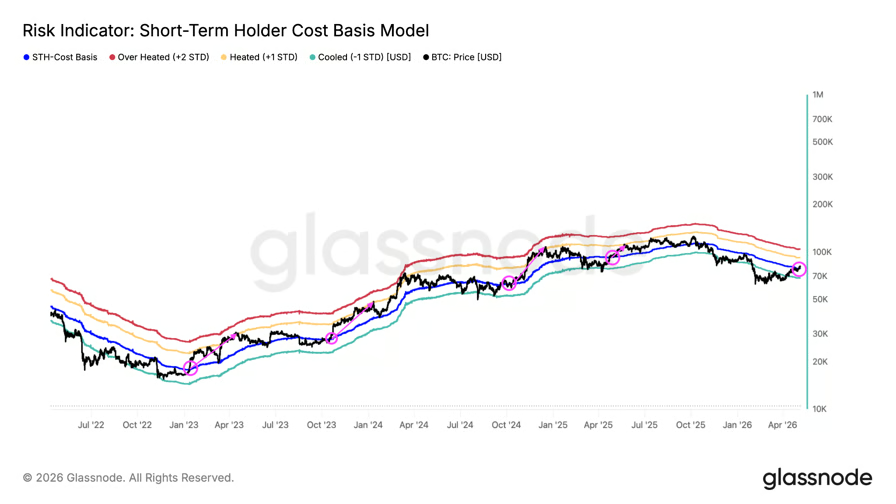
This rally has seen Bitcoin rise above the cost basis of its short-term holders, currently at $79,000, according to data from Glassnode.
STH cost basis refers to the average purchase price of investors who have held Bitcoin for less than 155 days.
Historically, reclaiming this level has coincided with extended recovery phases, as investors returning to profit are often less inclined to sell and more willing to add exposure. The shift can also attract fresh buyers and trigger short squeezes as bearish positioning unwinds.
Related: Bitcoin in ‘disbelief rally’ as traders spot $84K BTC price target
The chart below shows that when the price reclaimed its realized price in April 2025, it rallied 30% toward the upper band of this metric at $112,000 four weeks later.
Similar occurrences in October 2024, October 2023 and January 2023 also saw the BTC price rally toward the same onchain level, as shown in the chart below.
If BTC breaks above the line, there is a good chance of seeing $92,423 in the short term, about 13% above the current price.
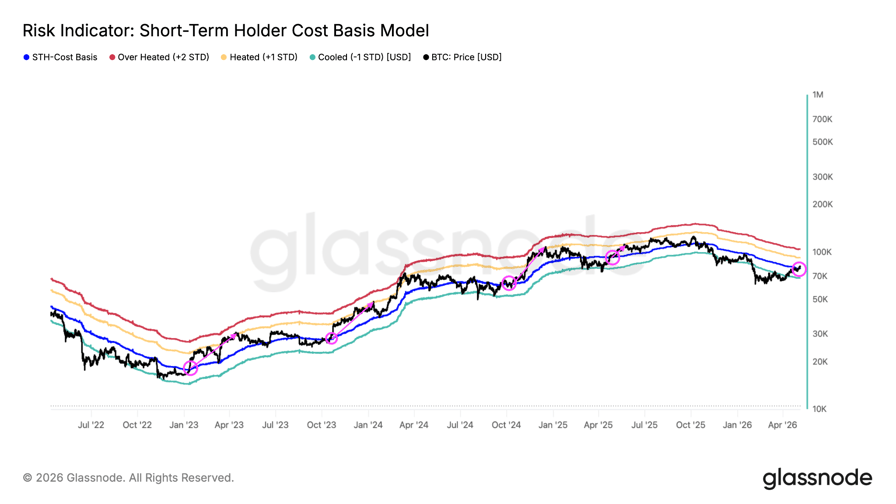
Bitcoin STH cost basis. Source: Glassnode
“Bitcoin has crossed the coveted ‘short-term holder breakout,’” analyst Mitchell Askew said in a Wednesday post on X, adding:
“This typically signals the end of bear markets and consolidation periods.”
Bitcoin analyst Plan C said if the price “can find sustained support above this level,” it would confirm that the 50% drawdown from the $126,000 all-time high was just a “mid-cycle correction.”
Meanwhile, Bitcoin’s STH spent output profit ratio (SOPR) has flipped positive, showing early signs of a shift in market behavior.
The metric is “back above 1, which usually means recent buyers are back in profit and selling pressure is easing,” analyst BitBull said in a Wednesday post on X, adding:
“This is where markets often move from accumulation into early bullish phases.”
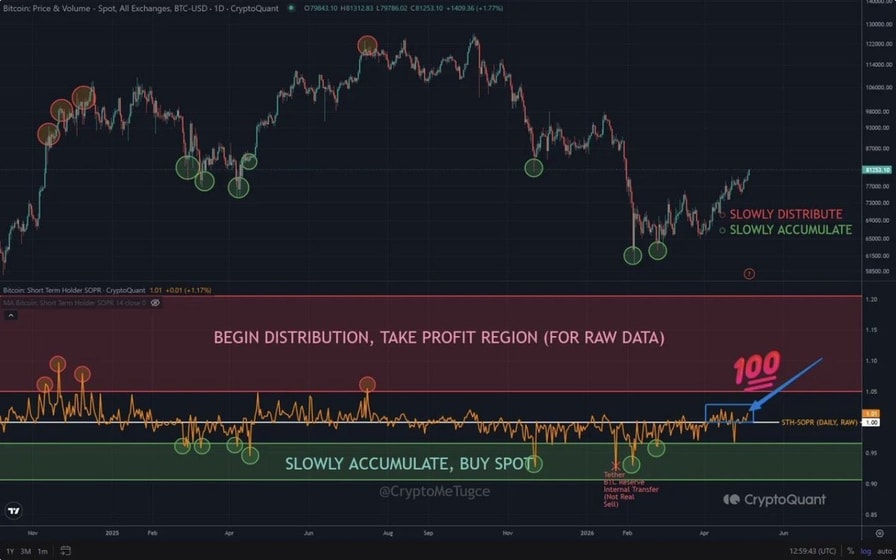
Bitcoin STH SOPR. Source: BitBull
As Cointelegraph reported, several technical indicators suggest that Bitcoin’s bottom is in, with analysts setting targets as high as $250,000 within a year.
Bitcoin’s price needs to flip $84,000 into support
Bitcoin’s bullish weekly close above the 20-week exponential moving average and true market mean at $78,300 has convinced traders it can move higher from current levels.
Analysts say the continuation of Bitcoin’s rally now hinges on breaking above the $82,000-$84,000 supply zone.
Bitcoin is retesting the low $80,000s region, which “corresponds with the November lows and the Daily 200MA/EMA coming in a bit higher,” trader and analyst Daan Crypto Trades said in his latest Bitcoin analysis on X.
Note that the 200-day EMA and the 200-day simple moving average are at $82,600 and $83,402, respectively.
This is a “big level” for Bitcoin bulls, the analyst said, adding:
“Acceptance higher can lead to a further bounce back into the $90Ks, but a rejection will likely keep this rangebound with $80K as the ceiling for a while.”
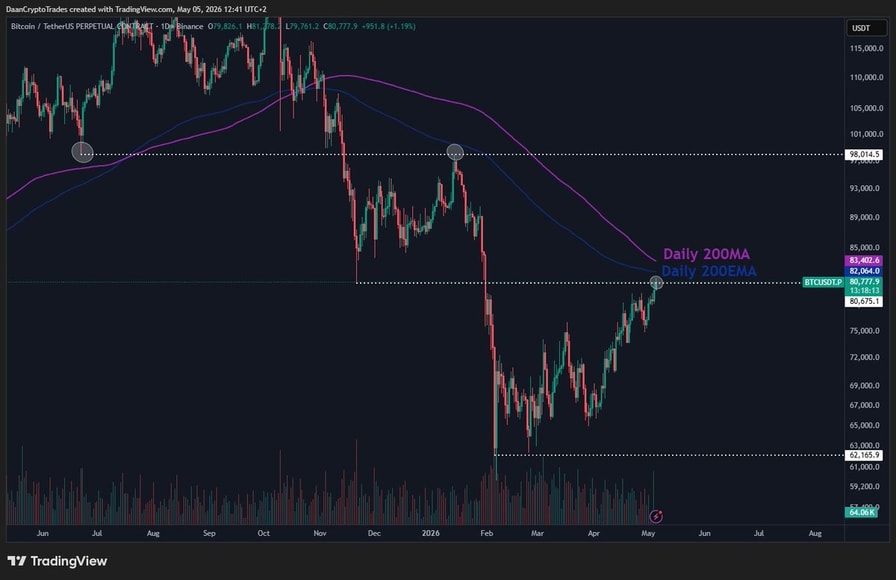
BTC/USD daily chart. Source: X/Daan Crypto Trades
MN Capital founder Michael van de Poppe shared a chart showing $84,000-$86,000 as the “next resistance zone,” which, if broken, could potentially see Bitcoin “continue to the 50-Week MA around $90K.”
Meanwhile, Bitcoin’s whale order book showed “big ask orders concentrated” between $82,000-$84,000, making it a crucial level for the bulls to overcome.
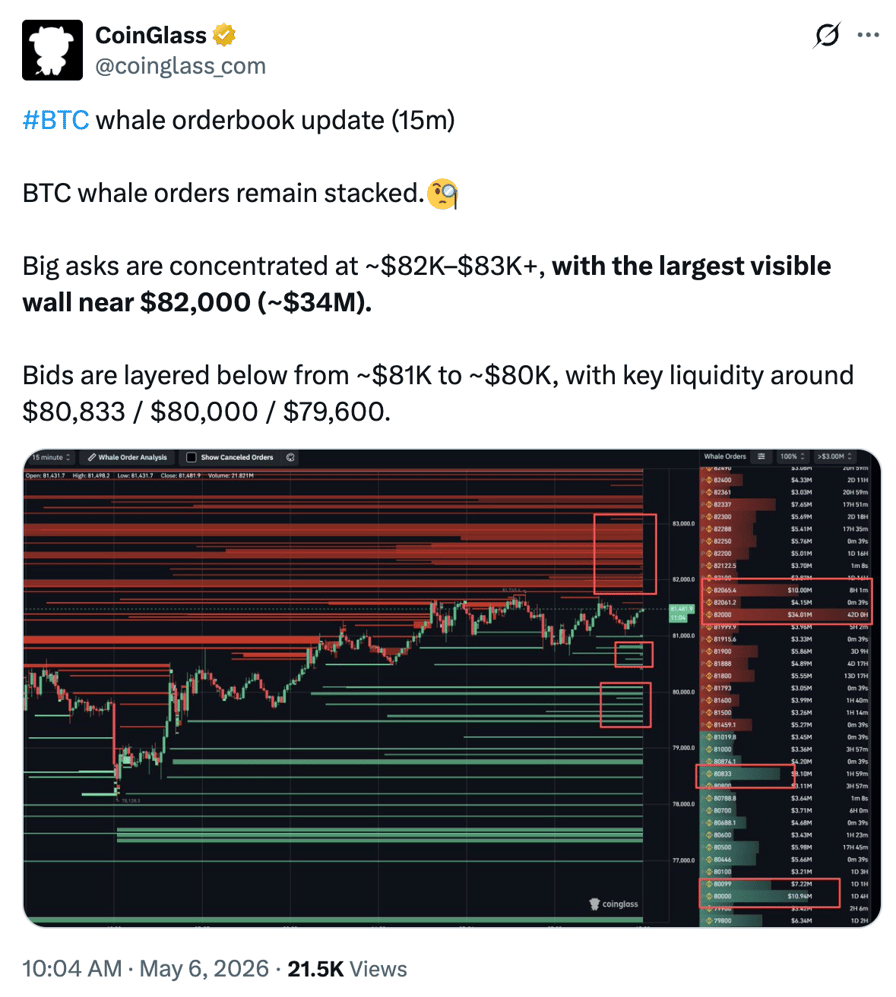
Bitcoin whale order book. Source: CoinGlass
As Cointelegraph reported, the BTC/USD pair may rise as high as $92,000 if resistance at $84,000 is broken.
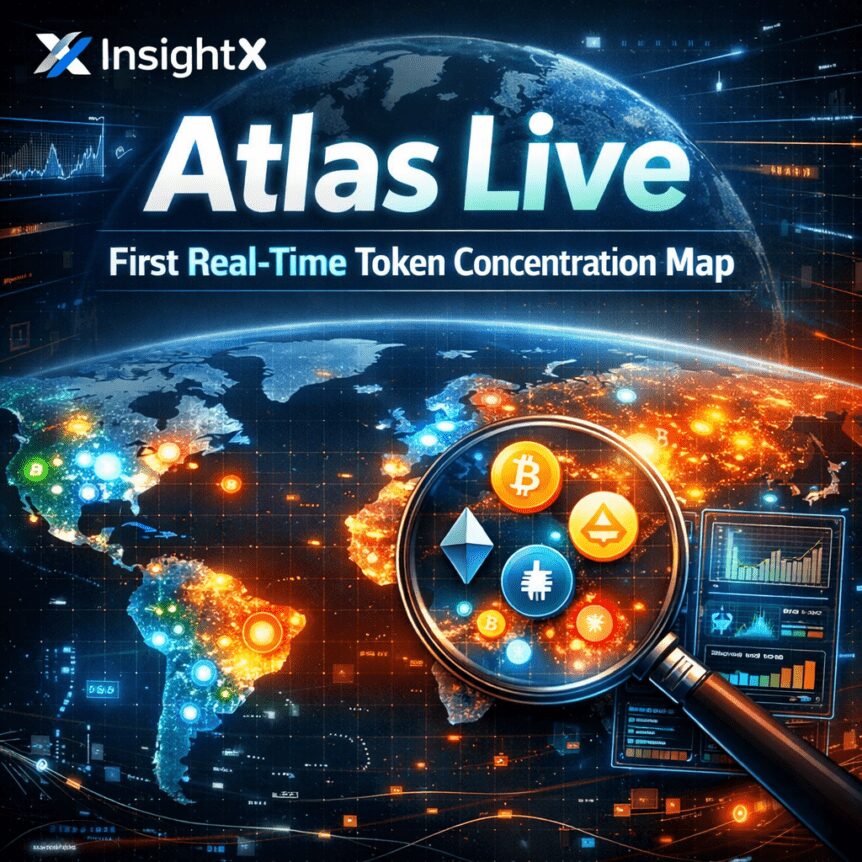
InsightX is expanding its on-chain safety toolkit with Atlas Live, a real-time token holder map designed to give traders immediate visibility into who holds and moves tokens. Announced from Odense, Denmark on May 6, 2026, Atlas Live builds on the widely used Atlas holder visualization and turns it into a live, decision-ready research engine. The platform is positioned as a first-of-its-kind real-time map, enabling continuous observation of holder activity without the need to refresh or wait for periodic updates.
Atlas Live integrates Atlas, a tool trusted by millions of traders for quick grasp of token ownership and clustering patterns that can reveal coordinated wallet activity. The live service expands Atlas’ reach by embedding itself into major DeFi gateways and dashboards, including Pump.fun, Axiom, Terminal, and GMGN. Its real-time data stream is designed to shorten the lag between discovery and action in a market where rapid moves can define outcomes for early investors and risk-averse participants alike.
Key takeaways
- Atlas Live delivers the world’s first live token holder map, letting traders watch wallets buy, sell and transfer tokens in real time.
- The platform removes the need for manual refreshing, providing instant visibility into distributions and movements as they happen.
- Historical mode enables researchers to rewind a token’s distribution, analyzing behavior at any moment to identify patterns beyond static snapshots.
- AI-powered detection uncovers hidden links and ownership structures, helping distinguish ordinary flows from potentially coordinated or malicious activity.
- Atlas Live is available across 15 ecosystems, including Solana, Ethereum, BNB Chain, and Polygon, enabling cross-chain analyses at scale.
Real-time data reshapes token research
The introduction of Atlas Live marks a shift from static holder maps to a continuously updated view of token ownership. In practice, traders can observe how large holders react to price moves, liquidity shifts, and newly minted supply, potentially signaling sell pressure or unusual accumulation long before a traditional dashboard would reflect it. Lasse Møller, CEO of InsightX, underscored the distinction between “real-time” in crypto and the everyday use of the term, noting that Atlas Live offers data without manual refreshes—the feed is live and instantaneous.
“The word ‘real-time’ gets used a lot in crypto, but it rarely means truly instant. With Atlas Live, there’s no refresh button, no delay. The data is just there – live, as it happens,”
Historical mode and deeper context
Beyond live observation, Atlas Live provides a historical lens. Researchers can rewind token distributions to study how early holders behaved and how a token’s ownership evolved over time. This capability helps answer questions such as when insider accumulation started, how it correlated with price action, and whether large transfers preceded liquidity events. The historical mode supports targeted investigations of specific moments rather than broad, one-off snapshots.
This capability is designed to support several practical objectives:
- Identify insider accumulation before a significant price move.
- Detect clusters of wallets that may indicate coordinated activity.
- Develop a chronological understanding of a token’s distribution trajectory.
AI-driven ownership insights
As on-chain networks grow more complex, the question of true decentralization becomes harder to answer simply by looking at holder counts. Tokens can appear widely distributed on paper, yet be controlled through a small set of entities or intermediary wallets connected by common funding streams. Atlas Live incorporates AI-powered detection to surface these hidden links, offering traders the context needed to distinguish normal market flows from suspicious patterns.
“Not everything is black and white. Large clusters of wallets can reflect legitimate exchange activity, but they can also signal coordinated behavior. Atlas Live helps traders understand that difference in seconds. Context matters,”
Speed, scope, and cross-chain reach
The platform blends speed with interpretive context, highlighting outsized movements by major holders and shifts in early liquidity that could precede a sell-off or rug pull. Atlas Live is built for immediacy and accuracy, with a cross-chain footprint spanning 15 ecosystems, including Solana, Ethereum, BNB Chain, Base, Abstract, XLayer, Monad, HyperEVM, Sonic, Avalanche, Sui, Tron, Polygon, Arbitrum, and Unichain.
About InsightX and Atlas Live
InsightX describes itself as a Web3 transparency and security platform that combines on-chain scanning with live holder maps to illuminate DeFi markets. Its Atlas visualization tool is a cornerstone product, already embedded in popular platforms such as Pump.fun and Axiom and used by a broad trading community. The Atlas Live rollout broadens the product’s reach by offering real-time, context-rich insights to traders, researchers, and ecosystem participants across multiple chains.
For readers seeking more information, InsightX maintains a public-facing presence with resources and documentation at its website and through Atlas Live’s dedicated app. Additional channels include the company’s social and community hubs where users can stay updated on new features and data capabilities.
Website: InsightX
Atlas Live App: Atlas Live App
X (formerly Twitter): @InsightXnetwork
Docs: Docs
Whitepaper: Whitepaper


South Korea’s KOSPI broke through 7,000 for the first time in history on Wednesday. The index closed 6.45% higher at a record 7,384.56 in a rally driven by surging demand for artificial intelligence (AI) chips.
The benchmark is up roughly 75% year-to-date after gaining 76% in 2025, its strongest year since 1999.
Follow us on X to get the latest news as it happens
Notably, Samsung Electronics jumped 14.4%, lifting its market value above $1 trillion. It has become the second Asian company, after Taiwan Semiconductor Manufacturing Company (TSMC), to reach that mark.
SK Hynix climbed 10.6% to a fresh all-time high. Together, the two companies account for roughly 44% of the KOSPI’s total market capitalization.
Global demand for artificial intelligence hardware has emerged as a key driver shaping equity market performance. Meanwhile, easing tensions between the United States and Iran have further supported risk sentiment across Asian markets.
Bullish Bets on iShares South Korea ETF Surge 600% in Weeks
Meanwhile, South Korea’s manufacturing purchasing managers index (PMI) rose to 53.6 in April, the highest reading since February 2022. At the same time, exports climbed for an 11th straight month in April. The data has anchored the rally in fundamentals.
Bullish positioning on the iShares MSCI South Korea ETF (EWY) has also reached extreme levels. Call option notional open interest hit a record $5.5 billion last week. The Kobeissi Letter described the shift in a recent X post.
“The total dollar value of outstanding bullish bets has risen +600% over the last several weeks. To put this into perspective, weekly call open interest did not exceed $700 million before 2025,” the post read.
Net inflows into EWY have reached approximately $6.3 billion year to date. The fund has gained 68% in 2026 and surged 181% over the past 15 months, making it the top-performing major equity market globally.
The Kobeissi Letter said investors are positioning for further upside in South Korean equities.
Subscribe to our YouTube channel to watch leaders and journalists provide expert insights
The post South Korea’s KOSPI Breaks 7,000 Ceiling To Hit a New Record High appeared first on BeInCrypto.
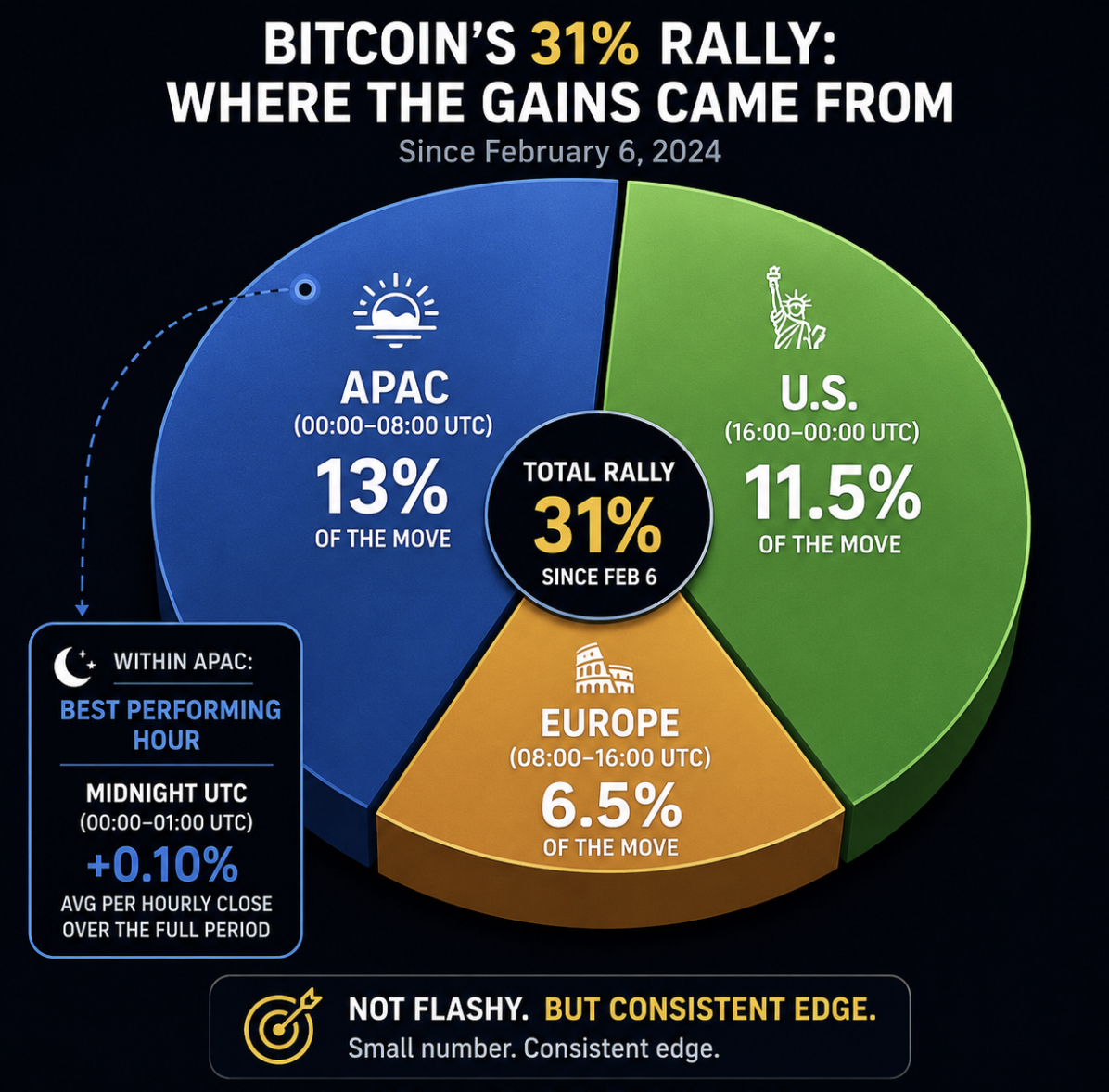
Bitcoin just broke $82,000, but the real edge isn’t the prediction of where the price is going. It’s in knowing when it moves. Three months of session data reveal a surprisingly consistent internal rhythm to BTC’s recovery that most traders are simply sleeping through.
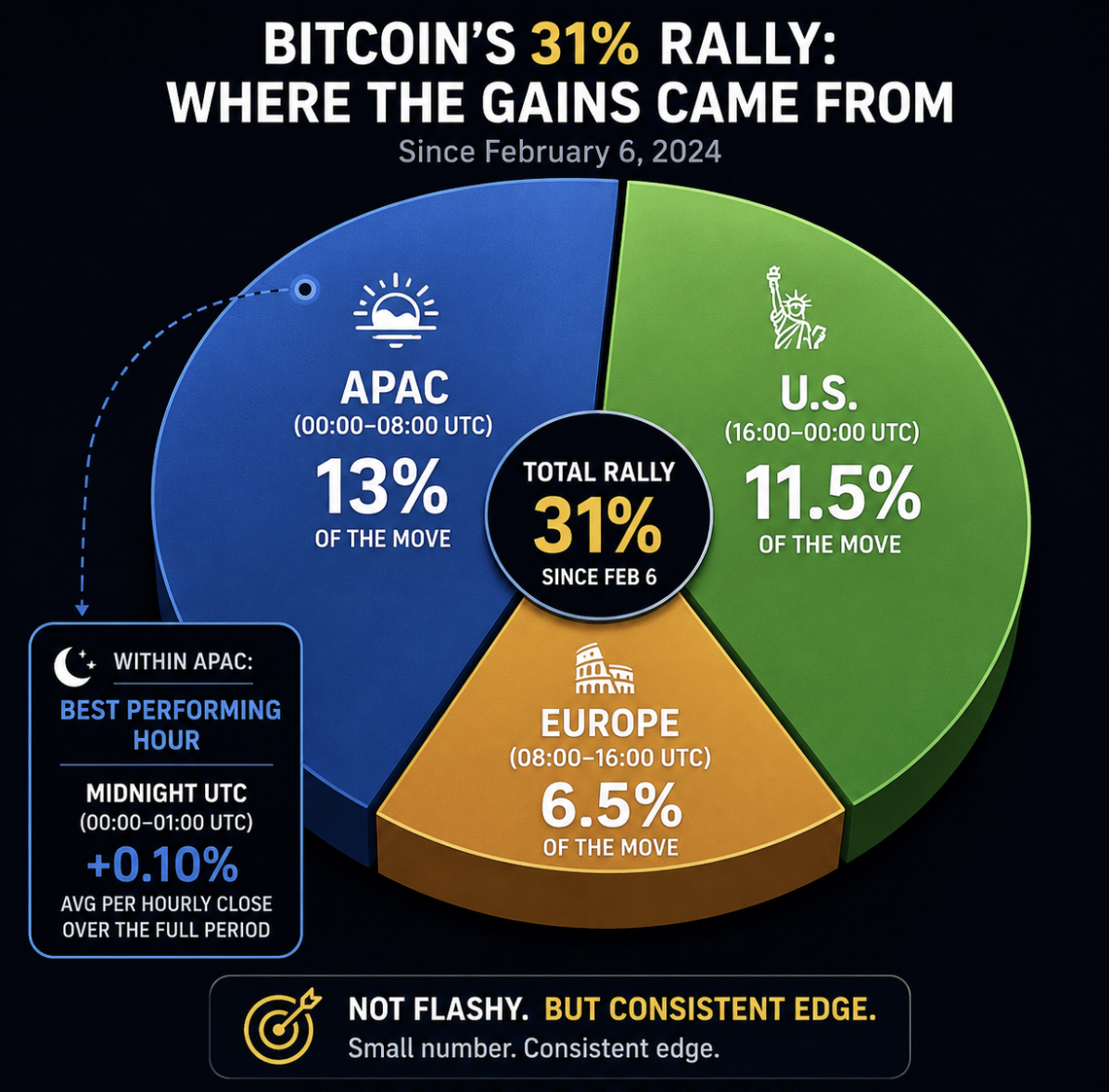
The data from Velo shows Bitcoin’s 31% rally since February 6 has been anything but evenly distributed across the clock. APAC hours (00:00–08:00 UTC) have contributed 13% of that move. The U.S. session (16:00–00:00 UTC) added 11.5%. Europe? A comparatively muted 6.5%. And within APAC, the single best-performing hour is the midnight UTC candle, averaging 0.10% per hourly close over the full period. Small number. Consistent edge.
Discover: The best crypto to diversify your portfolio with
Bitcoin Price Prediction: Break $89,000 This Week??
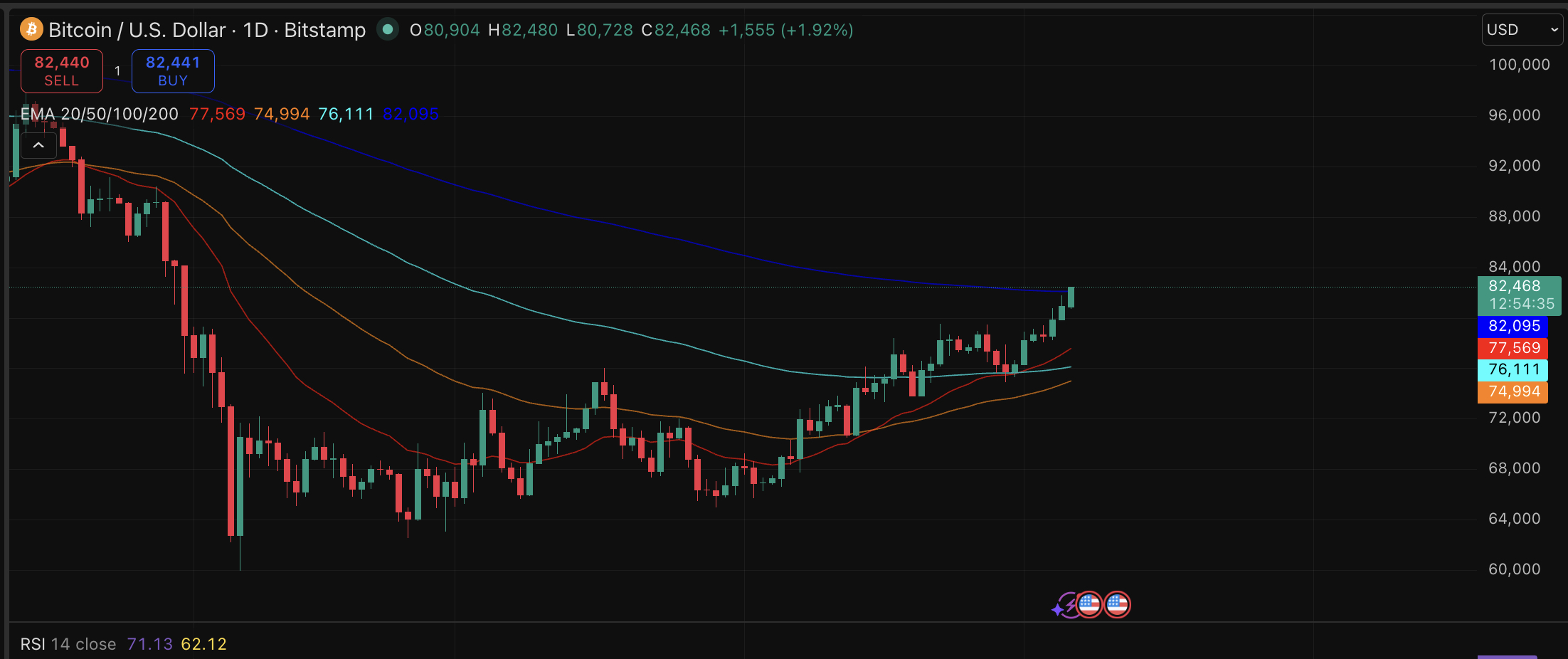
Bitcoin’s current technical setup is constructive. Price held above $80,000 support before it rallied toward $82,000 hours ago. The 24-hour range shows compression with 12 buy signals versus 7 sell signals across 23 oscillators and moving averages according to aggregated technical models.
The high of $89,000 is the resistance ceiling; a confirmed close above it would validate a renewed uptrend. If ETF inflows accelerate and the APAC session can maintain its momentum, BTC could test $89,500 in the mid-term. However, a daily close below $75,000 reopens the February lows near $63,000.
U.S. hours were flat-to-negative through most of February and March, then flipped decisively positive in early April. That pivot likely shows that institutional positioning is rotating into the New York session, which could compress the APAC edge over the coming weeks.
Discover: The best pre-launch token sales
Bitcoin Hyper Targets Early-Mover Upside as BTC Rallies
Bitcoin at $82,000 with $89,000 still uncaptured raises a fair question: how much asymmetric upside remains for spot BTC at this price? Institutional desks are already positioned. Retail is watching.
The magnitude of the next leg may disappoint latecomers relative to the risk being taken at current prices. That dynamic is exactly why some capital is rotating toward earlier-stage Bitcoin infrastructure plays.
Bitcoin Hyper ($HYPER) is positioning itself at that intersection, billing itself as the first-ever Bitcoin Layer 2 with Solana Virtual Machine (SVM) integration, targeting faster-than-Solana transaction finality while preserving Bitcoin’s security layer.
The presale has raised $32.5 million at a current price of $0.0136, with staking available for early participants. Bitcoin’s programmability problems, like slow transactions, high fees, and no smart contracts, are solved at the infrastructure level rather than patched at the application layer.
Research Bitcoin Hyper’s full presale terms before allocating capital.
The post Bitcoin Price Prediction: The Hidden Timing of Daily Pump-and-Dump Cycles appeared first on Cryptonews.
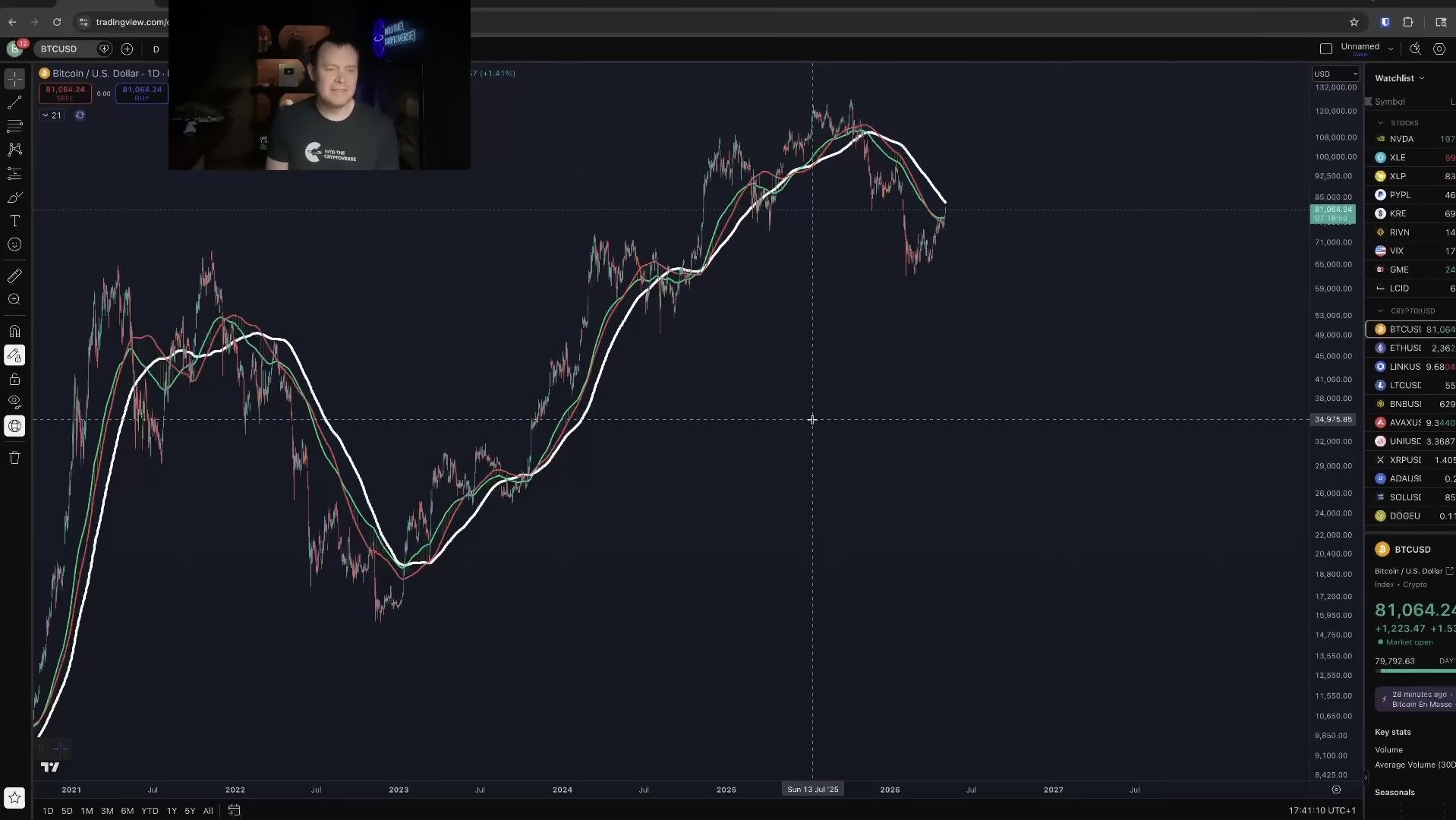
Bitcoin’s recent rally has not convinced Benjamin Cowen that the bear market is over. The Into the Cryptoverse founder warns the current move is likely to top within weeks before another decline, with a possible low arriving in October.
His thesis hinges on a pattern that repeated in 2014, 2018, and 2019, when Bitcoin climbed above key moving averages mid-bear market before resuming the downtrend. Time between cycle lows historically runs 140 to 174 days.
Bitcoin Bear Market Still Intact
In a recent video, Cowen said he is keeping his “bear goggles on” despite Bitcoin’s continued strength. He argues the current playbook still tracks past cycles.
“I think this will likely yield a rally that finds a top within the next few weeks and then we come back down to those levels.”

The Bullish Counterargument
Cowen acknowledged several reasons the bear case could be wrong. Bitcoin’s year-to-date return is currently outperforming the average midterm year by a wide margin. The token sits roughly 10% below its yearly open, compared with a typical decline of 30 to 35% at this stage.
It has also reclaimed the bull market support band. Cowen flagged another structural shift.
“Bitcoin topped on apathy rather than euphoria.”
Retail interest never returned, and altcoins continued bleeding against Bitcoin throughout the rally. That apathetic peak could mean a different kind of bear market this time.
Why the Pattern Still Points Lower
Past cycles offer the strongest case for staying defensive. In 2014, 2018, and 2019, Bitcoin rallied above the bull market support band before pulling back, with the 200-day moving average serving as resistance.
“If I’m right, it will seem so obvious… If I’m wrong, then by the time you do something that’s different enough, you’re already well off the lows.”
Time between cycle lows is the other signal Cowen tracks. Recent cycles waited roughly 140 to 174 days before printing a new low.
“We’re currently on day 88. So, who’s to know what’ll happen in 3 months.”
Cowen expects the current rally to peak within weeks before retracing toward the bull market support band, with a possible October low. For investors who exited near last year’s peak, his takeaway is direct.
“Anyone who took profits on Bitcoin in Q4 when everyone else was screaming 300K is still doing fine.”
The post Bitcoin Bear Market Not Over, Benjamin Cowen Says Despite Recent Rally appeared first on BeInCrypto.
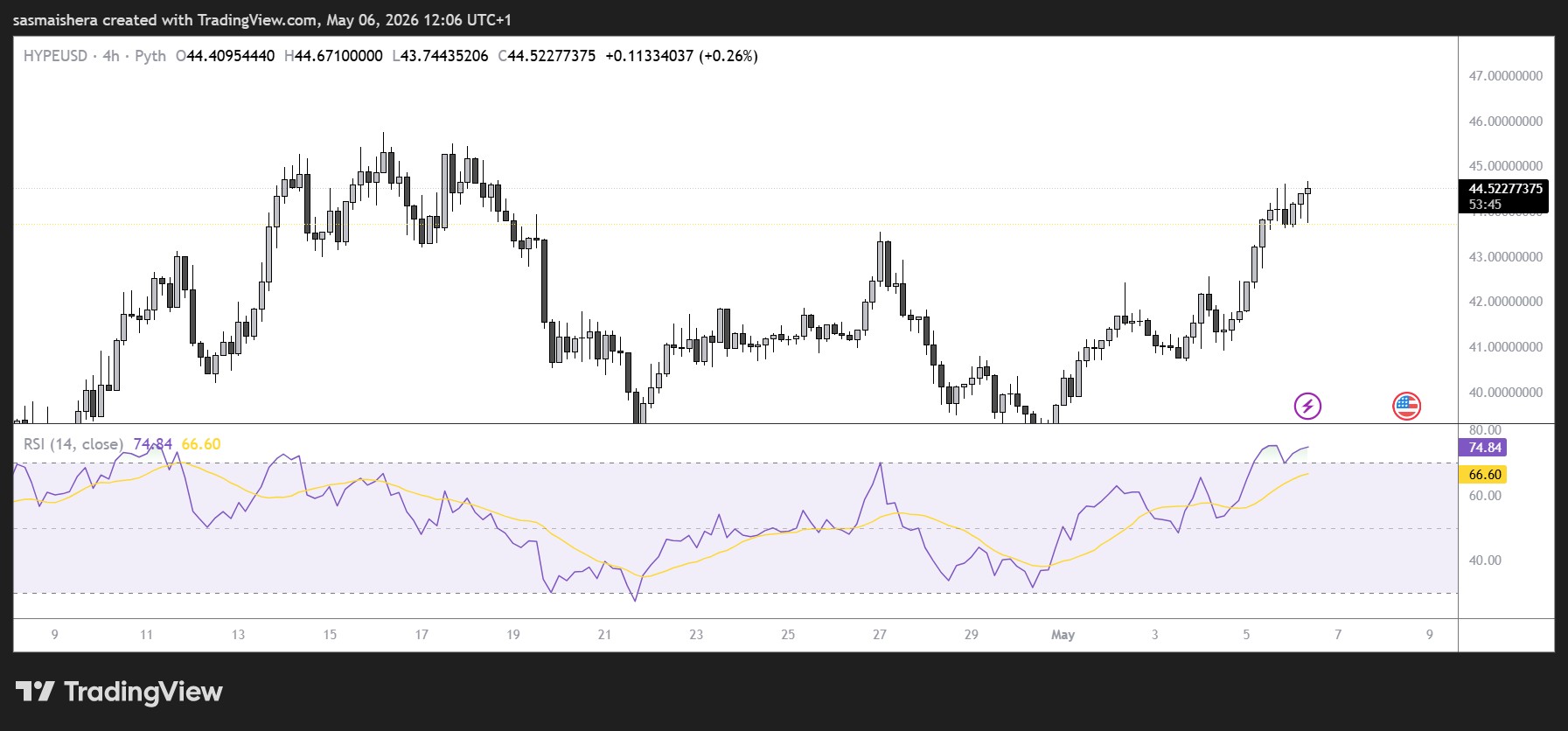
Hyperliquid (HYPE) traded above $44.00 on Wednesday, extending its rally for a sixth consecutive session as rising derivatives activity and growing platform usage strengthened bullish sentiment around the exchange token.
The latest rally comes as investor confidence gradually returns to the broader crypto market, boosting both leverage exposure and user participation across the Hyperliquid ecosystem.
Hyperliquid sees rising retail demand and platform activity
CoinGlass data show HYPE futures Open Interest (OI) climbed to $1.75 billion on Wednesday from $1.62 billion the previous day, signaling an increase in leveraged positions and fresh capital entering the market.
The sharp rise in Open Interest suggests traders are increasingly positioning for additional upside as bullish momentum accelerates.
At the same time, DeFiLlama data indicate Total Value Locked (TVL) on Hyperliquid increased more than 2% over the last 24 hours to reach $1.556 billion, reflecting stronger inflows into the protocol.
Growing TVL is typically associated with rising user engagement and improving platform fundamentals, as more capital flows into decentralized finance applications built on the ecosystem.
Hyperliquid also continues to rank among the strongest-performing DeFi protocols by revenue generation.
Excluding stablecoin protocols, Hyperliquid currently leads the sector in seven-day revenue with $11.58 million, underscoring sustained trading activity and demand for the platform.
Technical outlook: HYPE targets a breakout above $50
Technically, Hyperliquid maintains a strong bullish structure as price action continues to trade comfortably above the 50-day, 100-day, and 200-day Exponential Moving Averages (EMAs), all of which continue to slope upward and reinforce the broader uptrend.
Momentum indicators also support the bullish outlook. The Moving Average Convergence Divergence (MACD) remains firmly in positive territory on the 4-hour chart, signaling sustained upward momentum, while the Relative Strength Index (RSI) hovers near 74, reflecting an overbought condition.
On the upside, the next key resistance level is the R1 Pivot Point near $45.52. A decisive breakout above this barrier would bring the broader descending trendline resistance near the psychological $50.00 level into focus.

A sustained close above the $50 region could trigger a stronger bullish continuation phase and potentially open the door for a broader medium-term rally.
On the downside, immediate support sits near the rising trendline around $40.00, followed by the 50-day EMA near $39.76.
Additional downside protection is seen at the 100-day EMA around $37.45 and the 200-day EMA near $36.45 if broader market conditions weaken and trigger a deeper correction.
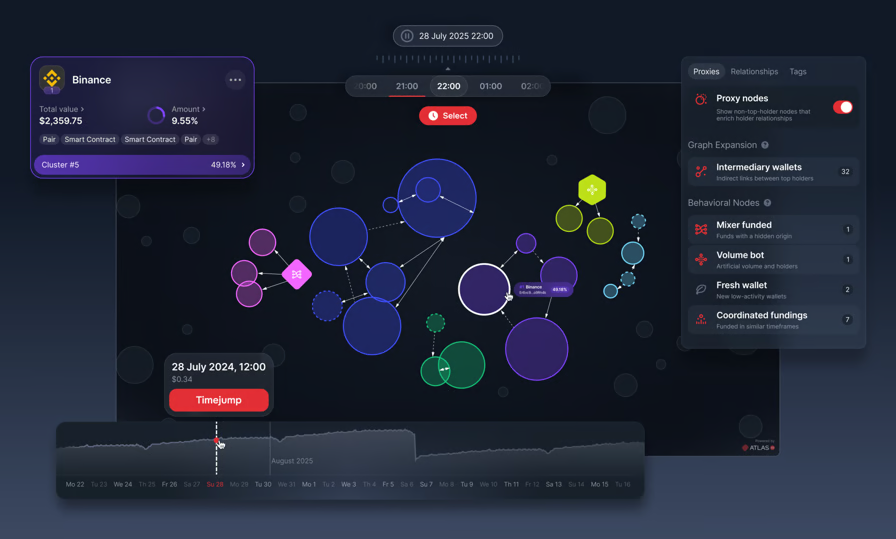
A new era of on-chain trading transparency. Atlas Live enables traders to analyze token concentration and spot potential rug pulls. Now in real time.
Odense, Denmark, May 6, 2026 – InsightX, the on-chain safety and analytics platform, launches Atlas Live, the world’s first real time token holder map.
InsightX is best known for Atlas, a holder visualization tool used by millions of traders each month. It simplifies token ownership at a glance, with clustering patterns revealing potential coordinated wallet activity. Atlas is integrated across major platforms including Pump.fun, Axiom, Terminal and GMGN.
The launch of Atlas Live transforms the research tool into a decision-making engine for live trading. Until now all holder maps required manual refreshing, leaving traders a step behind the true token distribution. In a market where scams unfold in seconds this delay was critical. Atlas Live changes this, turning static analysis into real-time insights.
What’s new
Live holder map
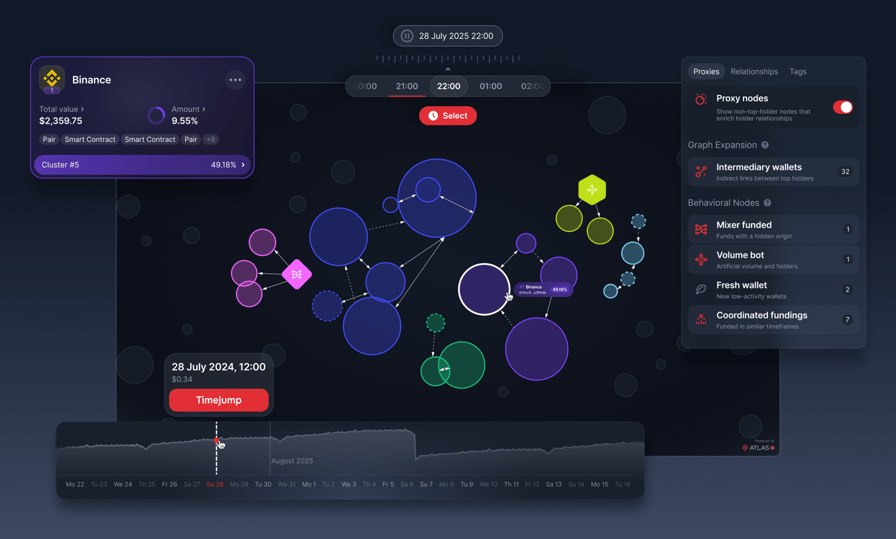
Atlas Live introduces the world’s first live token holder map. Traders can now watch wallets buy, sell and transfer tokens in real time, revealing patterns that were previously invisible. This can make the difference between getting out early or being left with an empty bag.
“The word ‘real-time’ gets used a lot in crypto, but it rarely means truly instant.” said Lasse Møller, CEO of InsightX. “With Atlas Live, there’s no refresh button, no delay. The data is just there – live, as it happens.”
Historical mode
With Historical mode traders can rewind any token’s distribution and analyze how early holders behaved. Most importantly, it enables the investigation of any given moment, not just snapshots.
This makes it possible to:
- Identify insider accumulation before a pump
- Detect coordinated wallet clusters
- Understand how a token evolved over time
AI powered detection
Identifying true ownership has become increasingly difficult. Tokens may appear decentralized on paper, yet remain controlled by a small group of holders. Funds can be routed through intermediary wallets that may never interact directly but are linked via shared funding sources. AI powered detection uncovers these hidden links, helping traders separate normal activity from suspicious behavior.
“Not everything is black and white.” Møller added. “Large clusters of wallets can represent normal exchange flows, but they can also indicate coordinated behavior. Atlas Live helps traders understand that difference in seconds. That’s why context is so important.”
Built for speed and real-time insights
Atlas Live combines real-time data with contextual insights to help traders read token distribution and react faster. It highlights large holder movements and early liquidity shifts that may signal sell-offs or potential rug pulls.
Atlas Live is available cross-chain on 15 ecosystems: Solana, Ethereum, BNB Chain, Base, Abstract, XLayer, Monad, HyperEVM, Sonic, Avalanche, Sui, Tron, Polygon, Arbitrum and Unichain.
About InsightX
InsightX is an innovative Web3 transparency and security platform, transforming how traders and ecosystems navigate on-chain markets. The InsightX product suite combines smart contract security scanning with live holder maps to deliver clarity, trust and alpha across the DeFi space. Best known for its holder map, Atlas, InsightX powers major platforms like Pumpfun and Axiom, serving more than 2M traders each month.
Website | Atlas Live App | X | Telegram | Docs | Whitepaper
Media contact:

A suspected $150 million crypto Ponzi scheme centered on BG Wealth Sharing has seen its domain seized by U.S. law enforcement, following reports of a large-scale rug pull and mounting investor losses. The operation’s online presence was brought down as part of a joint initiative involving federal authorities and specialized task forces, underscoring ongoing efforts to disrupt scam networks that rely on social media to lure retail investors into high-yield promises.
On-chain sleuthing by ZachXBT indicated that illicit actors tied to BG Wealth Sharing attempted to launder more than $92 million in cryptocurrency between April 27 and this week. In a coordinated response, investigators managed to freeze more than $41 million of those assets, with cooperation from industry players including Tether, Binance and OKX, as well as U.S. law enforcement. The influencer’s update also framed the scheme as potentially responsible for losses well above the $150 million mark, based on activity since 2025 and the thousands of victim withdrawals identified to date.
“While these Chinese investment frauds are obvious to most, they purposely target unsophisticated retail investors via social media,” ZachXBT commented, noting the difficulty of convincing victims that they were scammed even after the fact.
Key takeaways
- Domain seized: BG Wealth Sharing’s website was taken down by U.S. authorities as part of a joint operation involving Level Up and the Scam Center Strike Force, signaling a broader crackdown on unlicensed crypto investment platforms.
- Asset recovery and laundering: investigators reported laundering attempts exceeding $92 million, with more than $41 million frozen in cooperation with major exchanges and law enforcement partners.
- Scale of impact: the scheme reportedly operated since 2025 and is linked to thousands of withdrawals, suggesting total losses could exceed $150 million.
- Regulatory warnings and cautions: regulators had long warned investors away from BG Wealth Sharing, including the FCA and the Central Bank of Samoa, highlighting the risks of unregistered crypto investment offers.
- Investor-facing red flags: descriptions of daily profits, referral schemes, and a claimed IPO for a related exchange were later tied to deceptions, culminating in a public rug pull narrative and warnings from state regulators.
Crackdown context: enforcement, warnings, and the scale of risk
The seizure of BG Wealth Sharing’s domain comes amid heightened vigilance from regulators and law enforcement against crypto investment platforms that promise high returns with minimal friction. In multiple jurisdictions, authorities have warned that BG Wealth Sharing presented itself as a crypto-trading advisor while peddling guaranteed yields and referral commissions—a combination commonly associated with sophisticated advance-fee scams and Ponzi-like structures.
Regulators’ warnings were not limited to one territory. The UK Financial Conduct Authority issued formal warnings about BG Wealth Sharing, while the Central Bank of Samoa cautioned investors that the group represented an investment scam. In the United States, the action aligns with broader joint efforts—Operation Level Up and the Scam Center Strike Force—designed to disrupt cross-border scams that rely on social media amplification to reach unsophisticated retail investors.
Investors have faced a difficult truth as authorities step up enforcement: schemes that promise regular, outsized returns often collapse once new inflows stall. The Washington State Department of Financial Institutions reiterated concerns by noting a pattern consistent with advance-fee fraud, a warning echoed in official statements that highlight how new funding is often required to access any withdrawn funds.
A company that requires an investor to deposit additional external funds in order to withdraw their investment is highly likely to be operating an advance fee scam.
Context for this crackdown is supported by broader crime data. The U.S. Federal Bureau of Investigation reported in April that Americans lost $21 billion to cyber-enabled crime last year, with crypto investment scams accounting for a substantial portion of those losses. The scale of the problem underscores why authorities continue to pursue operators like BG Wealth Sharing and why investors must scrutinize platform claims, licensing, and regulatory status before committing capital.
What BG Wealth Sharing advertised—and what regulators say happened
BG Wealth Sharing presented itself as a crypto-trading guidance service, heavily promoted on social media with promises of “daily profit opportunities” and a structured compensation plan featuring referral commissions and rank-based bonuses. It also advertised a daily yield range of about 1.3% to 2.6%, a promise that rarely survives the realities of a market where liquidity and withdrawal policies can hinge on the platform’s ability to attract new funds.
As the scheme unfolded, purported leadership and marketing claims around a related DSJ Exchange surfaced in a late-stage address to users. A video message from a figure identified as the company’s CEO suggested the exchange would be pursuing an initial public offering, with a requirement of a 12% tax on account balances as part of the regulatory process. When users began warning each other that a rug pull was in progress, regulators stepped in with formal alerts—reiterating that the platform’s claims did not align with licensed, compliant financial activity.
The grim arc of BG Wealth Sharing is consistent with other scams that leverage social-media reach to lure retail investors who may be drawn by the prospect of fast gains. ZachXBT’s reporting emphasizes the tension between the perceived legitimacy of online promotions and the reality that many participants may not realize they are dealing with an unregistered or fraudulent operation until well after losses mount.
Why this matters for the market and for participants
Criminal actions against BG Wealth Sharing illustrate the persistent threat of Ponzi-like crypto investment schemes that mix aggressive marketing with questionable licensing. For traders and investors, the case highlights several practical considerations: the importance of verifying licensing and regulatory status, the risks of platforms that offer unusually high yields with little transparent risk management, and the need to consider on-chain evidence and official cautions before committing funds.
For builders and infrastructure players, the episode underscores the ongoing need for clearer provenance and due diligence tools in the crypto ecosystem. Projects that emphasize transparent treasury management, auditable yield models, and verifiable investor protections are more likely to gain trust in a crowded market where scams can leave lasting reputational damage.
From a policy perspective, the BG Wealth Sharing case reinforces the imperative for coordinated enforcement across jurisdictions. The joint seizure and the public warnings from regulators in multiple regions may deter would-be scam operators and provide a blueprint for future takedowns, even as new schemes continue to adapt their narratives to evade detection.
Looking ahead, readers should monitor updates from U.S. law enforcement and regulatory agencies for any further recoveries, charges, or civil actions related to BG Wealth Sharing and similar entities. Investors should also remain vigilant for warning signs—unlicensed status, guaranteed returns, and sudden changes in withdrawal policies—especially when paired with aggressive social-media marketing and referral incentives.
As enforcement actions unfold, the broader market will likely see continued emphasis on vetting practices, more explicit disclosures around risk and compensation structures, and a push for faster cross-border information sharing among regulators and exchanges. The ongoing investigation and any subsequent asset recovery efforts will be crucial to understanding how effectively these networks can be disrupted and deterred in the future.
Readers should stay tuned for updates on the DSJ Exchange-related aspects of the saga, additional regulator statements, and any new data on the total scope of losses tied to BG Wealth Sharing. The case remains a salient reminder that high-yield promises on crypto platforms often conceal a higher likelihood of losses, and that vigilance—both by users and by the systems designed to protect them—remains essential.
Cointelegraph is committed to independent, transparent journalism. This news coverage adheres to established editorial standards, and readers are encouraged to verify details through official sources and ongoing reporting.

TLDR:
- KelpDAO lost 116,500 rsETH in an April 18 exploit tied to North Korea’s Lazarus Group via LayerZero.
- LayerZero’s 1-of-1 DVN setup was used by 47% of OApp contracts, contradicting claims it was unique to Kelp.
- KelpDAO intervened to block $100M in additional forged transactions before pausing its bridge contracts.
- KelpDAO is now migrating to Chainlink CCIP, which has processed over $30 trillion in value over 7 years.
KelpDAO is migrating to Chainlink’s Cross-Chain Interoperability Protocol following a major exploit on April 18, 2026.
The attack, linked to North Korea’s Lazarus Group, targeted LayerZero’s infrastructure and drained 116,500 rsETH from KelpDAO’s bridge.
The total losses across DeFi protocols exceeded $300 million. KelpDAO has since disputed LayerZero’s framing of the incident, calling the infrastructure failure a systemic issue within LayerZero’s own operations.
The Attack and Its Impact on DeFi
The April 18 exploit originated within LayerZero Labs’ off-chain infrastructure. Attackers compromised two RPC nodes used by LayerZero’s DVN and launched a DDoS attack on the remaining nodes.
This forced DVN signers to validate a non-existent transaction, producing fake token burns and flooding markets with unbacked rsETH.
Aave and other DeFi platforms were among the protocols affected by the unbacked rsETH. Two additional forged transactions worth over $100 million were also signed by the LayerZero Labs DVN.
KelpDAO’s team intervened in time to pause contracts and block those transactions before further damage occurred.
KelpDAO also flagged the exploit to LayerZero directly, as the latter’s monitoring systems had not detected it. According to KelpDAO, LayerZero’s team appeared unaware of any issue when first contacted. This raised concerns about the reliability of LayerZero’s internal alerting processes.
The Dispute Over the 1-of-1 DVN Configuration
LayerZero attributed the exploit to KelpDAO’s use of a 1-of-1 DVN configuration, calling it a risky manual setup. KelpDAO pushed back firmly on this claim.
According to Dune Analytics data, 47% of roughly 2,665 LayerZero OApp contracts used the same 1-1 DVN setup at the time.
KelpDAO also shared Telegram exchanges showing LayerZero team members explicitly approving the 1-1 configuration during pre-deployment reviews. Over 2.5 years of integration discussions, LayerZero reportedly raised no objections to the setup.
KelpDAO followed LayerZero’s own documentation and quickstart guides, which defaulted to the 1-1 LayerZero Labs DVN configuration.
A post from @CatfishFishy on April 24 drew attention to a December 2024 statement from LayerZero’s Bryan, who claimed no applications were using the LayerZero DVN as a 1-1 setup.
At that point, rsETH already held roughly $200 million in TVL across L2 deployments under that exact configuration. Independent security researchers, including @banteg, also confirmed through public reports that the exploit originated from LayerZero’s own infrastructure, not from KelpDAO’s settings.
KelpDAO’s Migration to Chainlink CCIP
Following the exploit, KelpDAO announced a full transition away from LayerZero. The protocol is now moving to Chainlink’s Cross-Chain Interoperability Protocol and adopting Chainlink’s Cross-Chain Token standard for rsETH. The migration is currently being finalized by KelpDAO’s engineering team.
Chainlink’s decentralized oracle network has processed over $30 trillion in value across more than seven years of operation.
The network also remained functional during several major global outages, making it a more established option for cross-chain security.
KelpDAO stated that all rsETH cross-chain transfers will soon run through Chainlink CCIP across all supported chains.
After the exploit, LayerZero announced it would stop attesting messages for any app using a 1-1 DVN setup. KelpDAO noted that this policy change came only after the configuration had already caused hundreds of millions in losses.
The 1-1 configuration, however, reportedly still appears in LayerZero’s own documentation and default OFT deployment templates.


reMarkable’s Paper Pure Makes Sacrifices To Be Its Cheapest Tablet, But They’re Worth It

Which Country Spent More Money Every Year?

Death of girl, 12 killed by falling tree branch was accidental, coroner rules

Manchester United reach agreement with Casemiro over contract clause amid transfer speculation

US brings back mandatory military draft registration

Steven Gerrard disagrees with Gary Neville over ‘shock’ Chelsea and Arsenal claim | Football


-
 Business7 days ago
Tesla Officially Registers Elon Musk’s Stock: What Investors Need to Know
-

 NewsBeat3 days ago
Channel 5 – All Creatures Great and Small series 7 new post
-

 Entertainment6 days ago
Insider Claims Reason Behind Key & Peele Split
-
 Tech5 days ago
Trump’s 25% EU auto tariff breaches Turnberry Agreement that also covers semiconductors and digital trade
-
 Sports5 days ago
Paul Scholes issues Marcus Rashford reality check as agreement emerges over Man United star
-

 Entertainment5 days ago
Met Gala 2026 Rumored Guest List Is Turning Heads
-

 Entertainment6 days ago
Celebrities Who Are Attending the 2026 Met Gala Event
-

 Business5 days ago
Strait of Hormuz Blockade Persists Amid US-Iran Standoff, Sending Oil Prices Soaring
-
Business7 days ago
Strait of Hormuz Remains Heavily Restricted on April 29 Amid Iran Conflict
-
Entertainment5 days ago
New on Prime Video in May 2026 — Full List of Movies and Shows
-
 Sports4 days ago
David Benavidez responds to team Canelo saying the fight will never happen
-

 Crypto World7 days ago
Meta (META) starts stablecoin payout to creators in Circle’s USDC on Polygon, Solana via Stripe
-

 Sports5 days ago
Cavaliers vs. Raptors Game 6 live score, updates, highlights from 2026 NBA playoffs first-round series
-

 Tech7 days ago
Texas Instruments made a new flagship graphing calculator: the TI-84 Evo
-

 Entertainment5 days ago
Kylie Jenner Hit With Second Lawsuit From Ex-Housekeeper
-

 Sports6 days ago
Saudi Arabia set to withdraw LIV Golf funding after 2026 season, per reports
-

 Tech6 days ago
Mark Zuckerberg Says Meta Is Working On AI Agents For Personal And Business Use
-
 Sports4 days ago
IPL 2026: ‘Love you darling’- Hardik Pandya’s reaction to MS Dhoni steals the show |Watch | Cricket News
-

 Sports7 days ago
Arsenal, Atletico Madrid share draw after penalty drama in Champions League semi-final
-

 Sports5 days ago
Plane crash in Wimberley, Texas kills 5 pickleball players at tournament
You must be logged in to post a comment Login