

Crypto World
KelpDAO Switches to Chainlink CCIP After $292M LayerZero Exploit


TLDR:
- KelpDAO lost 116,500 rsETH in an April 18 exploit tied to North Korea’s Lazarus Group via LayerZero.
- LayerZero’s 1-of-1 DVN setup was used by 47% of OApp contracts, contradicting claims it was unique to Kelp.
- KelpDAO intervened to block $100M in additional forged transactions before pausing its bridge contracts.
- KelpDAO is now migrating to Chainlink CCIP, which has processed over $30 trillion in value over 7 years.
KelpDAO is migrating to Chainlink’s Cross-Chain Interoperability Protocol following a major exploit on April 18, 2026.
The attack, linked to North Korea’s Lazarus Group, targeted LayerZero’s infrastructure and drained 116,500 rsETH from KelpDAO’s bridge.
The total losses across DeFi protocols exceeded $300 million. KelpDAO has since disputed LayerZero’s framing of the incident, calling the infrastructure failure a systemic issue within LayerZero’s own operations.
The Attack and Its Impact on DeFi
The April 18 exploit originated within LayerZero Labs’ off-chain infrastructure. Attackers compromised two RPC nodes used by LayerZero’s DVN and launched a DDoS attack on the remaining nodes.
This forced DVN signers to validate a non-existent transaction, producing fake token burns and flooding markets with unbacked rsETH.
Aave and other DeFi platforms were among the protocols affected by the unbacked rsETH. Two additional forged transactions worth over $100 million were also signed by the LayerZero Labs DVN.
KelpDAO’s team intervened in time to pause contracts and block those transactions before further damage occurred.
KelpDAO also flagged the exploit to LayerZero directly, as the latter’s monitoring systems had not detected it. According to KelpDAO, LayerZero’s team appeared unaware of any issue when first contacted. This raised concerns about the reliability of LayerZero’s internal alerting processes.
The Dispute Over the 1-of-1 DVN Configuration
LayerZero attributed the exploit to KelpDAO’s use of a 1-of-1 DVN configuration, calling it a risky manual setup. KelpDAO pushed back firmly on this claim.
According to Dune Analytics data, 47% of roughly 2,665 LayerZero OApp contracts used the same 1-1 DVN setup at the time.
KelpDAO also shared Telegram exchanges showing LayerZero team members explicitly approving the 1-1 configuration during pre-deployment reviews. Over 2.5 years of integration discussions, LayerZero reportedly raised no objections to the setup.
KelpDAO followed LayerZero’s own documentation and quickstart guides, which defaulted to the 1-1 LayerZero Labs DVN configuration.
A post from @CatfishFishy on April 24 drew attention to a December 2024 statement from LayerZero’s Bryan, who claimed no applications were using the LayerZero DVN as a 1-1 setup.
At that point, rsETH already held roughly $200 million in TVL across L2 deployments under that exact configuration. Independent security researchers, including @banteg, also confirmed through public reports that the exploit originated from LayerZero’s own infrastructure, not from KelpDAO’s settings.
KelpDAO’s Migration to Chainlink CCIP
Following the exploit, KelpDAO announced a full transition away from LayerZero. The protocol is now moving to Chainlink’s Cross-Chain Interoperability Protocol and adopting Chainlink’s Cross-Chain Token standard for rsETH. The migration is currently being finalized by KelpDAO’s engineering team.
Chainlink’s decentralized oracle network has processed over $30 trillion in value across more than seven years of operation.
The network also remained functional during several major global outages, making it a more established option for cross-chain security.
KelpDAO stated that all rsETH cross-chain transfers will soon run through Chainlink CCIP across all supported chains.
After the exploit, LayerZero announced it would stop attesting messages for any app using a 1-1 DVN setup. KelpDAO noted that this policy change came only after the configuration had already caused hundreds of millions in losses.
The 1-1 configuration, however, reportedly still appears in LayerZero’s own documentation and default OFT deployment templates.



Bitcoin’s price action has spent a fourth straight week in a defined range, with buyers defending the $74,000 level while sellers stack around the $78,000 to $80,000 band. Hyblock analysts observe that the intraday jump to $78,164 may have flushed underwater longs and pushed short-sellers toward breakeven, suggesting a delicate balance between demand and supply as the market tests a psychological threshold.
According to Hyblock, the rally into the $78,000 area appeared to trigger a wave of exits from positions that had previously been underwater, while optimistic shorts opted to cut losses at breakeven to avoid further downside risk. The firm’s insights come as traders monitor whether fresh liquidity can sustain a push through resistance, or if the price will retreat back into the established corridor.
BTC/USDT net positions heatmap. Source: Hyblock
Hyblock also highlighted the role of liquidations in the intra-day move and noted how liquidity tends to act like a magnet for BTC. The firm identified two notable clusters where liquidity is concentrated and building most rapidly—the area around $75,675 to $75,700 stands out as a particularly active pocket that could exert ongoing influence on near-term price behavior.
BTC/USDT liquidation heatmap. Source: Hyblock
In the broader context, Hyblock’s discussion of liquidity dynamics aligns with recent market chatter about how futures activity can drive price action even as spot demand absorbs a portion of selling pressure. The evolving balance between futures-driven liquidity and spot market participation remains a key factor for traders watching for a sustained breakout or a renewed pullback.
Meanwhile, observers note a separate development on the demand side. Adam Back, the CEO of Blockstream, drew attention to a large Bitcoin whale employing a time-weighted average price (TWAP) strategy to accumulate BTC at a brisk pace. Back tweeted that the whale has been gobbling up around 450 BTC per day for eight-and-a-half days, underscoring the persistent interest from sizable buyers even as price hovers near the lower end of the recent range.
Bitfinex Bitcoin whale TWAP data. Source: Adam Back / X
Price action and market structure: what the indicators are signaling
The day’s price action fits a familiar pattern: a futures-driven selloff that applies pressure through derivatives markets, while spot buyers step in to absorb a portion of the supply. This dynamic can soften the impact of downward moves and help keep the market anchored near key support levels. In the current setup, the orderbook shows persistent selling pressure beginning around $77,700, with asks thickening between $78,000 and $80,000. Such a configuration implies that buyers may need to sustain higher bids or for new liquidity to emerge to push through the upper band of the range.
From a structural standpoint, the $74,000 support zone remains a critical anchor, with the market’s ability to defend that level likely shaping near-term trajectory. If buyers can absorb selling pressure and push above the $78,000 to $80,000 zone, the next test would be whether new demand surfaces to sustain a breakout or if the market reverts to the established range highs and rebalances liquidity at those levels. Hyblock’s reference to concentrated liquidity pockets suggests that the market could hinge on how quickly liquidity rehomogenizes around those clusters, potentially influencing the speed and sustainability of any breakout attempt.
For traders, the combination of a defined range, visible liquidity clusters, and notable TWAP activity from a major whale creates a nuanced backdrop. The concentration of liquidity near $75,675–$75,700 could act as a magnet, drawing price toward that pocket if the market weakens. Conversely, persistent demand beyond the $78,000–$80,000 area would require fresh liquidity and a shift in orderbook depth to sustain a sustained move higher.
What this means for traders and investors
Investors should watch three intertwined signals: the persistence of the $74,000 support, the ability to thread through the $78,000–$80,000 resistance band, and the evolving liquidity landscape around the identified clusters. If the market continues to absorb futures-driven selling while spot demand remains relatively steady, there could be a setup for a cautious rally. However, a failure to clear the $78,000–$80,000 zone may re-emphasize the range-bound regime and direct attention to the liquidity magnets around $75,675–$75,700.
The presence of a notable TWAP-driven accumulation by a large holder adds another layer of consideration for sentiment and risk management. While a single pattern in BTC behavior is not predictive on its own, sustained buying pressure at regular intervals could provide a floor for prices even when derivatives markets tilt bearish in the near term.
As market participants digest these dynamics, the next important waypoint is how orderbook depth evolves around key levels. The depth signals—sellers appearing near $77,700 and thicker asks between $78,000 and $80,000—suggest a test of supply at the upper end of the current range. A clear move through that resistance zone would likely require a combination of renewed spot demand and a shift in liquidity distribution that benefits buyers stepping in with size.
For reference, readers can review related market coverage that discusses liquidation activity surrounding BTC price moves and how such episodes shape liquidity expectations in the near term. Earlier reporting noted that liquidations have been a feature of recent moves and underscores why understanding liquidity topology is essential for navigating volatility in this market.
In a broader sense, today’s observations reinforce a common theme: Bitcoin’s short- to medium-term direction remains tied to the tug-of-war between futures-driven supply and spot-side demand, with liquidity clusters acting as a critical barometer for whether the market can muster a sustained move beyond the current range.
What to watch next: if BTC can sustain bids above the key ceiling and tip through the $80,000 mark, a fresh wave of liquidity-driven momentum could emerge. If not, the probability of another test of the $74,000 support and renewed liquidity negotiations remains high, keeping traders cautious in the weeks ahead.
Crypto World
China industrial profits jump 24.7% in April, fastest gain in over two years despite headwinds

BEIJING — China’s industrial profits in April surged by 24.7% from a year earlier, according to official data released Wednesday, marking the fastest growth since November 2023.
The increase accelerated from a 15.8% rise in March, according to China’s biggest financial data provider Wind Information.
For the first four months of the year, enterprise profits rose 18.2%, up from 15.5% growth in the first quarter.
China reported slower economic growth in April, with a 4.1% increase in industrial output and a 0.2% rise in retail sales from a year ago. Fixed asset investment fell for the first four months of the year as the real estate drag steepened.
Exports remained strong, climbing 14.1% in April from a year ago in U.S. dollar terms. Imports surged by 25.3%, data released earlier in May showed.
The producer price index in April jumped 2.8% from a year ago, the most since July 2022.


Disclosure: This article does not represent investment advice. The content and materials featured on this page are for educational purposes only.
MiCA enforcement reshapes EU crypto as ESMA register reveals 204 authorized CASPs and leading jurisdictions emerge.
Summary
- MiCA regulation now standardizes EU crypto licensing, with ESMA’s register tracking 204 authorized CASPs and their services.
- Crypto firms are assessed on real authorization data, revealing which EU jurisdictions successfully issue MiCA licenses.
- MiCA CASP licensing typically costs €200K–€475K in the first year and takes 6–9 months, with application quality as the main approval driver.
The transitional period is closing and the guessing is over. With MiCA — the EU’s single rulebook for crypto-asset services — now in force, the ESMA Interim MiCA Register works as a live scoreboard of where crypto businesses are actually incorporating.
Instead of trusting marketing claims about which jurisdiction is “crypto-friendly,” founders can read the register directly: who got authorized, for which services, and how far their EU passport reaches. Drawing on the current snapshot of 204 authorized CASPs, here is the map as it stands — four EU jurisdictions worth attention, and the two credible non-EU alternatives.
The state of play: One license, twenty-seven markets
MiCA’s core promise is the entire reason the EU dominates this conversation: a single CASP authorization, granted by one national competent authority (NCA), passports across all 27 Member States. Authorize once, notify the rest, operate everywhere. No non-EU regime offers a comparable single-application route into a market this large — and founders are responding. Of the 204 CASPs on the register, 51 were authorized in 2026 alone (about a quarter, in under five months), and 91 firms now passport into 27 or more markets. Home-state choice is heavily concentrated:
| Home Member State | Authorised CASPs | Profile |
| Germany (BaFin) | 55 | Largest market |
| Netherlands (AFM) | 25 | Exchange-heavy |
| France (AMF) | 17 | Institutional |
| Malta (MFSA) | 13 | Exchange magnet |
| Cyprus (CySEC) | 12 | Consumer apps |
| Ireland (CBI) | 12 | Payments / scale |
| Czech Republic (CNB) | 7 | Fast riser |
| Luxembourg (CSSF) | 7 | Institutional |
| Lithuania (LB) | 6 | Startup default |
| Estonia (EFSA) | 1 | Sharp reversal |
Source: ESMA Interim MiCA Register, live snapshot as of 22 May 2026 (204 CASPs total).
Germany leads on count, but volume isn’t fit. BaFin is thorough, German-language, and slow — sensible for an institution, rarely the right first move for a lean startup. The instructive story is in the smaller jurisdictions, where the trade-offs between speed, substance, and credibility are sharpest.
The four EU jurisdictions worth a founder’s attention
Malta — The exchange magnet
Malta is where the recognizable crypto-native exchanges went. The MFSA has authorized OKX, Crypto.com, Gemini, Gate, Blockchain.com and BVNK among 13 CASPs, plus a disproportionate share of full trading-platform (Class 3) authorizations. Its edge is institutional memory: it regulated crypto years before MiCA, so the MFSA understands exchange models and banking is acclimatized to crypto clients. The trade-off is real substance expectations.
Best for: funded exchanges that want to sit alongside the majors.
Lithuania — The startup default
Lithuania remains the pragmatic first choice for startups. The Bank of Lithuania accepts English, runs one of the faster EU processes (3–5 months), and offers a cost-effective base with a deep fintech ecosystem; authorized CASPs include Robinhood, CoinGate and Nuvei (the license holder behind Simplex). Its modest MiCA count understates its appetite — most of its large VASP-era base is mid-conversion to full CASP status.
Best for: first-time founders who want speed, English, and a regulator that has seen the model.
Estonia — The cautionary reversal
Estonia is the register’s biggest surprise. Once the undisputed capital of EU crypto licensing, it now shows just one MiCA-authorized CASP. An old VASP license doesn’t convert automatically into CASP authorization — firms must requalify in full — and the EFSA pairs that with strict substance enforcement. The lesson generalizes: a historically light-touch jurisdiction is not an easy MiCA jurisdiction, and substance — real local management — is now the binding constraint everywhere.
Best for: firms prepared to build genuine substance, not a mailbox.
Czech Republic — The fast riser
The Czech Republic shows how fast the map still moves: zero MiCA CASPs in February, seven today — ahead of Lithuania on count. The CNB is pragmatic, the process quick and affordable, English accepted, and Prague helps with hiring. The register is dominated by local rather than global brands, making it a low-friction base rather than a prestige address.
Best for: cost-conscious founders who value a central EU location and an early-mover window.
At a glance
| Jurisdiction | Typical SLA | Language | Substance | Best fit |
| Malta | 6–10 mo | English | High | Funded exchanges |
| Lithuania | 3–5 mo | English | Moderate | Startups, fast launch |
| Estonia | 4–8 mo | English | High | Substance-ready firms |
| Czech Rep. | 4–6 mo | English | Moderate | Cost-conscious, CE base |
Estimates reflect typical conditions and vary by service scope and applicant readiness.
When the EU isn’t the answer: Dubai and Singapore
MiCA’s passport is decisive when customers are European. When they’re not, paying for 27-market access that won’t be used — and meeting EU substance and capital rules — can be the wrong trade. Two non-EU hubs sit at opposite ends of the openness spectrum.
Dubai (VARA) — The open door
VARA was the world’s first regulator dedicated solely to virtual assets and runs the most explicitly welcoming major regime. It licenses on an activity basis (exchange, broker-dealer, custody, lending, advisory, transfer/settlement), with its Rulebook updated to v2.0 in mid-2025; the full process runs about 4–7 months. Pull factors: 100% foreign ownership, no personal income tax (with free-zone corporate-tax advantages), and a government treating digital assets as a national strategy. The catch — Dubai gives you the UAE and a global address, not an EU passport, and VARA covers the mainland and free zones but not the DIFC (regulated by the DFSA).
Best for: global or MENA-focused firms wanting speed and tax efficiency.
Singapore (MAS) — The prestige filter
Singapore is the opposite: top-tier reputation, deliberately rationed. Crypto is regulated on an activity basis under the Payment Services Act (Standard vs Major Payment Institution licenses). MAS has issued only a few dozen DPT licenses. Crucially, the DTSP regime under the FSMA (from 30 June 2025) now captures Singapore entities serving only overseas customers — and MAS has said plainly the bar is high and it will generally not license them; operating without a license risks penalties up to SGD 250,000 and/or three years’ imprisonment. A poor fit for a quick offshore setup; excellent for a substantive Asia-Pacific operation.
Best for: well-capitalized firms with a genuine APAC presence.
A simple way to choose
- Where customers are? EU-facing → MiCA, almost always. Global/MENA → Dubai. APAC with substance → Singapore.
- What services? Custody/exchange (Class 2, €125k) and trading platforms (Class 3, €150k) carry the heaviest load; advisory and order-routing (Class 1, €50k) are lighter.
- How much substance can be built? Every credible regime now demands real local management. If you can’t staff it, Estonia-style rejections await.
- Speed vs prestige? Lithuania and Czechia optimize for speed and cost; Malta, Luxembourg, and Singapore for standing.
Cost, timeline, and getting it right
Budget honestly: a MiCA CASP typically costs €200,000–€475,000 in year one (capital, incorporation, legal, MLRO, office, IT/security, NCA fees), on a realistic 6–9 month timeline for exchange-plus-custody scope. The biggest lever on both is application quality — incomplete dossiers, generic AML policies and template IT-security frameworks are the top causes of stalled or rejected applications, and a rejection costs three to six months.
The register’s clearest signal is that winning jurisdictions reward preparation, not optimism. Matching the right home state to your model, building substance from day one, and filing a regulator-ready package is what separates a four-month approval from a year of back-and-forth. This is where a specialized crypto licensing consultancy earns its fee — turning the live register into a jurisdiction and application strategy that fits, across EU and non-EU routes.
To explore the options, visit the official website.
Disclosure: This content is provided by a third party. Neither crypto.news nor the author of this article endorses any product mentioned on this page. Users should conduct their own research before taking any action related to the company.
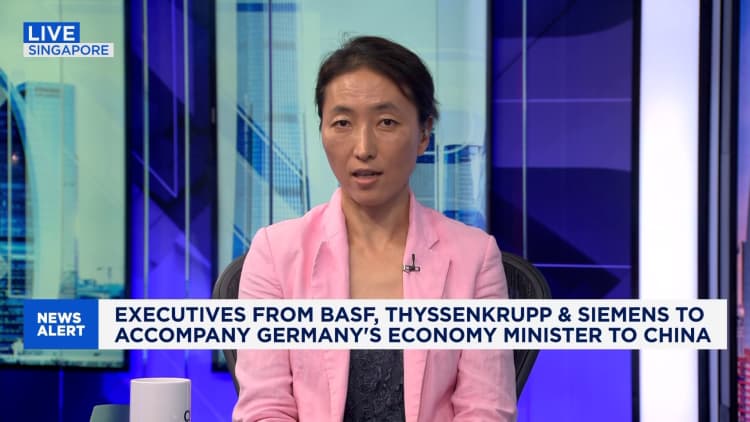
Steam cracker units at the BASF Zhanjiang Verbund site in Zhanjiang, Guangdong province, China, on Thursday, March 26, 2026.
Bloomberg | Bloomberg | Getty Images
BEIJING — More European companies are maintaining or expanding their supply chains in mainland China to remain competitive globally, according to a survey released Wednesday by the European Union Chamber of Commerce in China.
Nearly one-third of respondents said they were onshoring further in China, while 37% said they had not changed their supply chain strategy over the last two years, the report said.
The survey was based on responses from nearly 300 members collected from January to February who were familiar with their companies’ mainland China supply chain strategies.
In total, 68% of respondents said they were either staying or expanding operations in China. By comparison, only 7% said they were moving factory sourcing outside the country or setting up alternative manufacturing bases elsewhere, the report said.
“We don’t see sort of de-risking becoming a theme,” said Jens Eskelund, President of the EU Chamber of Commerce in China.
“If anything it would indicate that European companies continue to be more dependent on China as a sourcing and manufacturing location for their products,” he said.

Automation lowers costs
Cost is one of the main reasons European companies are increasing production in China, the EU Chamber survey found.
Relatively low labor costs in China have helped power its role as a global manufacturing hub. But as factories face labor shortages, many have embraced automation — quickly.
“The cost of labor, which might be lower anyway, is becoming irrelevant itself, because [of] automation,” said Denis Depoux, senior partner, global managing director at Roland Berger, a consulting firm that helped the EU Chamber assemble the survey.
“The difference in the level of automation [versus] two years ago is mind-boggling. You don’t see anybody anymore,” he said, referring to his visit this week to a privately-owned Chinese copper manufacturing company.
Depoux added that while automation can initially cost more than human labor, factories can ultimately produce products more quickly.
For example, Chinese electric vehicle maker Nio, which has expanded into Europe, said one of its factories in China operates with 941 robots that can work fully autonomously across multiple vehicle models simultaneously — without workers on the production floor. That setup allows the factory to operate around the clock.
It’s all part of a local manufacturing ecosystem with access to lower industrial energy prices and raw material costs, Roland Berger pointed out in a March report titled “China’s cost and speed advantage: A wake-up call for Western companies.”
The report added that quarterly negotiations with suppliers on price and selective state subsidies often help Chinese products reach global markets earlier and at far lower costs.
About three-fourths of EU companies in China said their production facilities in the country were more efficient than operations elsewhere, the chamber’s survey found.
“In most industries today, you have at least one Chinese competitor, or an international competitor, that are leveraging Chinese supply chains,” Eskelund said.
“So I think in many industries, if you are able to compete on price and quality, you simply need to become a part of Chinese supply chains,” he said. “It’s not necessarily because you want to onshore on [to] China.”
Crypto World
The Hashgraph Group Launches BrandBoost to Transform Enterprise Loyalty Through Real-Time Gamification
TLDR:
- BrandBoost uses Hedera’s DLT and no-code gamification to deliver real-time, personalized consumer loyalty experiences.
- Deloitte’s 2025 research shows 72% of consumers spend more with brands that offer active loyalty programs.
- Truesense’s UWB integration gives BrandBoost centimetre-level location accuracy to verify consumer presence at live events.
- THG’s HashCare helpdesk provides 24/7 human-agentic support, backed by an enterprise-grade service level agreement.
The Hashgraph Group (THG), a Swiss-based Web3 and AI technology company, has launched BrandBoost — a SaaS gamification platform.
Built on Hedera’s distributed ledger technology, BrandBoost enables brands to engage consumers through real-time incentives, tokenized rewards, and no-code gamification.
The platform targets enterprise clients across sports, media, entertainment, and telecom sectors aiming to modernize loyalty programs.
BrandBoost Redefines Consumer Loyalty Through Real-Time Engagement
Traditional loyalty programs built on static points and member cards are losing their effectiveness. Consumers today expect immediate, personalized, and interactive digital experiences from the brands they support.
BrandBoost directly addresses that gap by enabling live interactions across multiple touchpoints.
According to Deloitte’s 2025 customer loyalty research, 72% of consumers said loyalty programs make them more likely to spend with a brand.
Additionally, 56% reported spending more because of loyalty programs, and 80% said they get greater value through them. These figures show how loyalty programs still carry meaningful weight among consumers.
However, the same research revealed a critical gap: only 51% of consumers actively engage with even one loyalty program. That finding places pressure on brands to deliver relevance, personalization, and sustained value. BrandBoost responds to this by turning passive brand interaction into a live, two-way engagement experience.
Stefan Deiss, Co-Founder and CEO of THG, stated: “Loyalty programs are no longer just about points and rewards, but about creating live engagement ecosystems where consumers interact with brands in ways that feel immediate, relevant, and personalised.”
The platform also includes integrated token studios, allowing brands to create their own loyalty tokens consumers can earn, trade, and redeem.
UWB Technology and Blockchain Infrastructure Power the Platform
BrandBoost is built on Hedera’s distributed ledger and integrates THG’s digital wallet AssetGuard and identity platform IDTrust.
Together, these components create a secure and verifiable consumer engagement layer. The combination supports trusted micro-transactions within self-custody wallets.
In collaboration with Truesense, BrandBoost also incorporates ultra-wideband (UWB) technology for centimetre-level location accuracy.
This feature establishes a physical trust layer by confirming a consumer’s exact presence during events or gamified experiences. It also reduces fraud and verifies real-time participation at live venues.
Armando Caltabiano, Co-Founder and CEO of Truesense, noted: “We are excited to integrate our UWB technology within THG’s enterprise-grade BrandBoost platform, helping to trigger new disruptive monetisation streams related to consumer engagement.”
THG and Truesense recently completed a joint proof-of-concept for a satellite TV provider in Latin America, connecting DLT and UWB technology via a USB-TV Dongle.
BrandBoost also includes THG’s HashCare helpdesk, offering 24/7 human-agentic support with enterprise-grade service agreements.
The platform is part of THG’s broader Hashgraph for Enterprise product suite, supporting audience segmentation, leaderboards, and personalized consumer challenges.
Crypto exchange Binance is partnering with fintech company BlockShoals Technologies in what the platform described as its first formal market-entry approach in the Philippines, through local partnerships and regulatory engagement.
On Tuesday, Binance announced the partnership, highlighting that BlockShoals is an approved participant under the Philippine Securities and Exchange Commission’s (SEC) Strategic Sandbox, or StratBox, framework. Binance said BlockShoals will serve as the approved local intermediary, while the exchange will provide technology, security, operational and compliance support.
A Binance spokesperson told Cointelegraph that the company is pursuing a compliance-oriented market approach in collaboration with local stakeholders. “This represents Binance’s first formal market entry approach in the Philippines through local partnerships and regulatory engagement,” the spokesperson said.
The arrangement marks Binance’s latest attempt to establish a regulated presence in the Philippines after access to the exchange was previously restricted in the country. Binance said the sandbox phase is expected to begin in the second half of 2026 and continue for at least two years under the SEC framework.
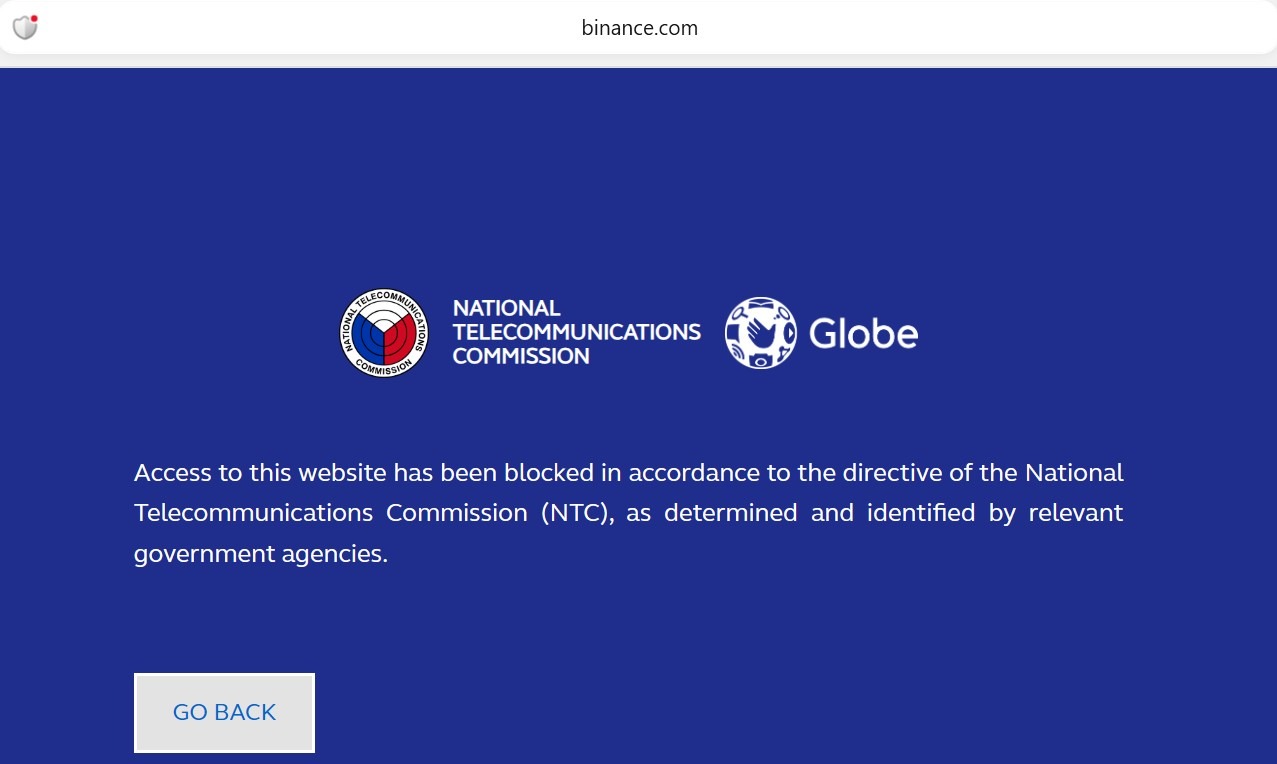
At the time of writing, Binance remains blocked, following a directive from the National Telecommunications Commission (NTC), the country’s telecommunications regulator.
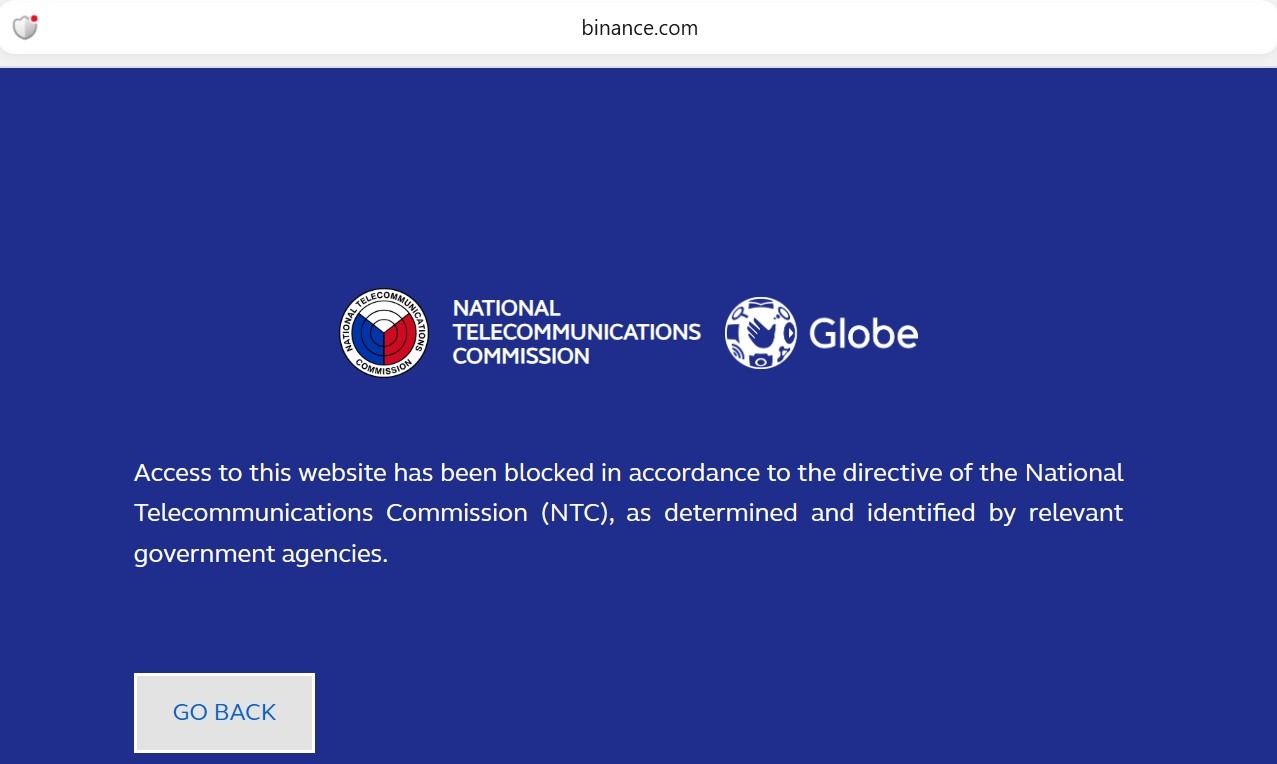
Binance remains blocked in the Philippines. Source: Cointelegraph
Binance was blocked in the Philippines over licensing concerns
The Philippine SEC first warned the public against Binance in November 2023, saying that the platform was not authorized to sell or offer securities in the country because it had not secured the necessary registration and license from the regulator.
In March 2024, the SEC said that it had asked the NTC to block access to the platform and its related webpages, citing the lack of a license to operate in the Philippines. Local internet service providers later started restricting access to Binance following the NTC order.
Related: Binance launches SpaceX-linked perpetual futures ahead of IPO
The crackdown on unlicensed operators later expanded to other major platforms. In August 2025, the SEC issued an advisory against 10 exchanges, including OKX, Bybit, KuCoin and Kraken, warning that their activities expose Filipino investors to risks.
On April 21, the regulator named crypto platforms dYdX, Aevo, gTrade, Pacifica, Orderly, Deriv, and Ostium in an investor alert, saying that the entities are not registered with the SEC but appear to be offering investments to the public.
Magazine: 50K investors fight Korean crypto tax, Singapore cancels Bsquared: Asia Express

TeraWulf is broadening its footprint beyond Bitcoin mining with the acquisition of a large Kentucky data center development site that could support more than 1 gigawatt of AI and high-performance computing (HPC) capacity. The company said the initial phase would bring online 500 megawatts by 2028, followed by another 500 megawatts by 2030, signaling a deliberate pivot toward AI hosting alongside its traditional mining operations.
The Kentucky project includes planned grid infrastructure and long-term power agreements, underscoring a broader push to secure reliable energy for AI workloads while continuing to mine Bitcoin. The development arrives as TeraWulf expands its HPC portfolio and positions itself within a growing ecosystem of crypto miners diversifying into AI and data-center capacity.
Key takeaways
- TeraWulf acquires a Kentucky data-center site with potential capacity exceeding 1 GW for AI and HPC, targeting 500 MW online by 2028 and another 500 MW by 2030.
- The project is backed by long-term power agreements and grid infrastructure plans, reflecting a strategic shift toward AI hosting alongside Bitcoin mining.
- HPC-related revenue jumped 117% in the most recent quarter, led by the Western New York Lake Mariner facility, according to Cointelegraph reporting.
- The AI strategy is underpinned by a $3 billion financing package arranged through Morgan Stanley, with Google helping backstop the debt financing.
- TeraWulf is among a cohort of Bitcoin miners expanding into AI/HPC, including Hut 8, HIVE Digital, MARA, and IREN; market reaction has been favorable, with the stock and related ETF showing gains.
A Kentucky pivot: from mining to AI data-center hosting
The Kentucky site represents a potentially transformative addition to TeraWulf’s portfolio, designed to scale AI and HPC hosting capacity in phases that align with grid readiness and power supply commitments. By tying the project to planned grid infrastructure and long-term power arrangements, the company aims to create a reliable backbone for AI workloads that require significant energy throughput and cooling capacity—conditions that can differ markedly from those of high-volume Bitcoin mining.
Executive commentary around the timing and sequencing of capacity additions suggests a deliberate strategy to balance the economics of AI infrastructure with the company’s existing mining operations. The capacity targets, if realized, would place TeraWulf among the more ambitious miners pivoting to data center and AI workloads, potentially unlocking new revenue streams beyond the cyclicality of cryptocurrency mining margins.
Financing backbone and strategic partnerships
At the heart of the expansion is a substantial financing framework. TeraWulf’s AI/HPC push is backed by a $3 billion financing package arranged through Morgan Stanley, announced last September to support data-center expansion. Google is reported to be helping backstop the debt financing, underscoring the involvement of major institutional and tech-partner support in the project.
The arrangement signals a broader industry pattern: several Bitcoin-mining operators are pursuing AI and HPC data-center opportunities to diversify revenue and leverage existing energy and colocation capabilities. The financing backdrop also indicates investor confidence in the viability of large-scale AI infrastructure within crypto mining companies, even as the sector contends with fluctuating mining margins.
Industry context: a shift in the mining narrative
TeraWulf’s move mirrors a larger trend among crypto miners expanding into AI and HPC hosting. Other players cited as pursuing similar strategies include Hut 8, HIVE Digital, MARA Holdings, and IREN. The strategy rests on the premise that AI workloads require substantial power, cooling, and data-center capacity—areas where mining firms with existing energy partnerships and scalable facilities can compete for collocation and managed services contracts.
Financial performance surrounding this pivot has been mixed. In the most recent quarter, HPC-related revenue rose significantly, driven by Lake Mariner in Western New York, yet the company also reported a wider quarterly loss as it continued investing heavily in AI infrastructure. The contrast between rising HPC revenue and ongoing investment activity highlights the ongoing trade-off between top-line growth in new verticals and the near-term profitability of core mining operations. The company’s broader earnings trajectory has been a point of focus for investors evaluating the AI/HPC expansion’s long-term viability.
Market implications of the Kentucky project were evident in early trading. TeraWulf shares rose as much as 13.6% to near $26, marking a strong intraday move and signaling investor optimism about the company’s ability to execute on its AI/HPC ambitions. The sector-wide Bitcoin mining tracker ETF, CoinShares Bitcoin Mining ETF (WGMI), also ticked higher in tandem, up roughly 4.5% at the time. Within the WGMI fund, TeraWulf represents a sizable weight, contributing about 10.86% of the portfolio, underscoring the market’s differentiated view of TeraWulf’s diversification prospects.
Through the year, the stock has outpaced much of the broader crypto mining sector and the tech-heavy market benchmarks, reflecting investor enthusiasm for AI-enabled data-center capacity and the potential for diversified revenue streams beyond volatile mining rewards. The Kentucky expansion adds a new dimension to that narrative, positioning TeraWulf as a case study in how traditional miners might adapt to the AI era.
Related coverage from Cointelegraph notes the broader context of TeraWulf’s AI expansion and its quarterly earnings trajectory, including the Q4 2025 results that highlighted a mining-revenue decline amid ongoing investments in AI infrastructure.
Source reference: Rittenhouse Research and public statements cited by Cointelegraph in coverage of TeraWulf’s AI strategy, with details on capacity targets and financing structures.
What to watch next: if Kentucky’s 500 MW phases come online as scheduled, the project will begin to contribute meaningfully to TeraWulf’s revenue mix while testing the economics of AI/HPC hosting alongside Bitcoin mining. Key uncertainties include grid-connection timelines, actual drawdown of power agreements, and the pace at which AI workloads translate into steady, sizable revenue against continuing capex and operating costs.
Ethereum treasury companies are under pressure to generate revenue from staking and other yield strategies as spot crypto exchange-traded funds (ETFs) weaken the appeal of public companies that simply hold Ether (ETH), according to a new Everstake report.
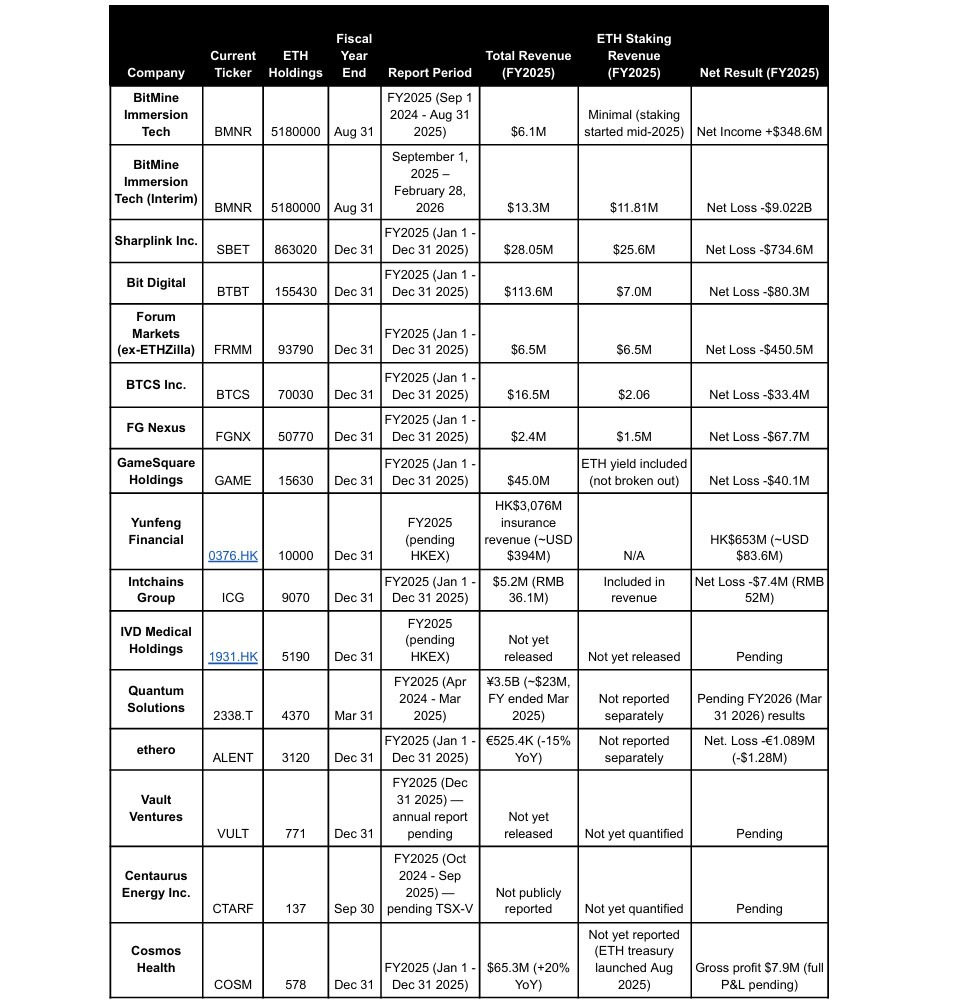
Staking accounted for an average of 60% of reported revenue among six ETH treasury firms that separately disclosed staking-related income, the staking infrastructure provider said.
Everstake reviewed 15 publicly listed companies with ETH treasury strategies and found that the firms in its sample that reported 2025 losses posted about $1.41 billion in combined net losses. Separately, BitMine Immersion Technologies reported a $9.02 billion net loss for the six months ended Feb. 28, though the figure was driven largely by unrealized losses on digital assets rather than operating losses, according to the report.
The 60% staking-revenue figure was based on six companies that separately disclosed staking-related income: BitMine Immersion Technologies, SharpLink, Bit Digital, Forum Markets, BTCS and FG Nexus. Companies that did not break out stakeholder-related rewards or had pending annual results were excluded from the calculation.
The report frames the shift as part of a broader repricing of digital asset treasury companies (DATs), which previously offered one of the few regulated ways for public-market investors to gain crypto exposure. Everstake argued that spot ETFs have weakened DATs’ passive-exposure premium, pushing treasury firms to justify valuations through staking, DeFi lending, MEV capture and other yield strategies.
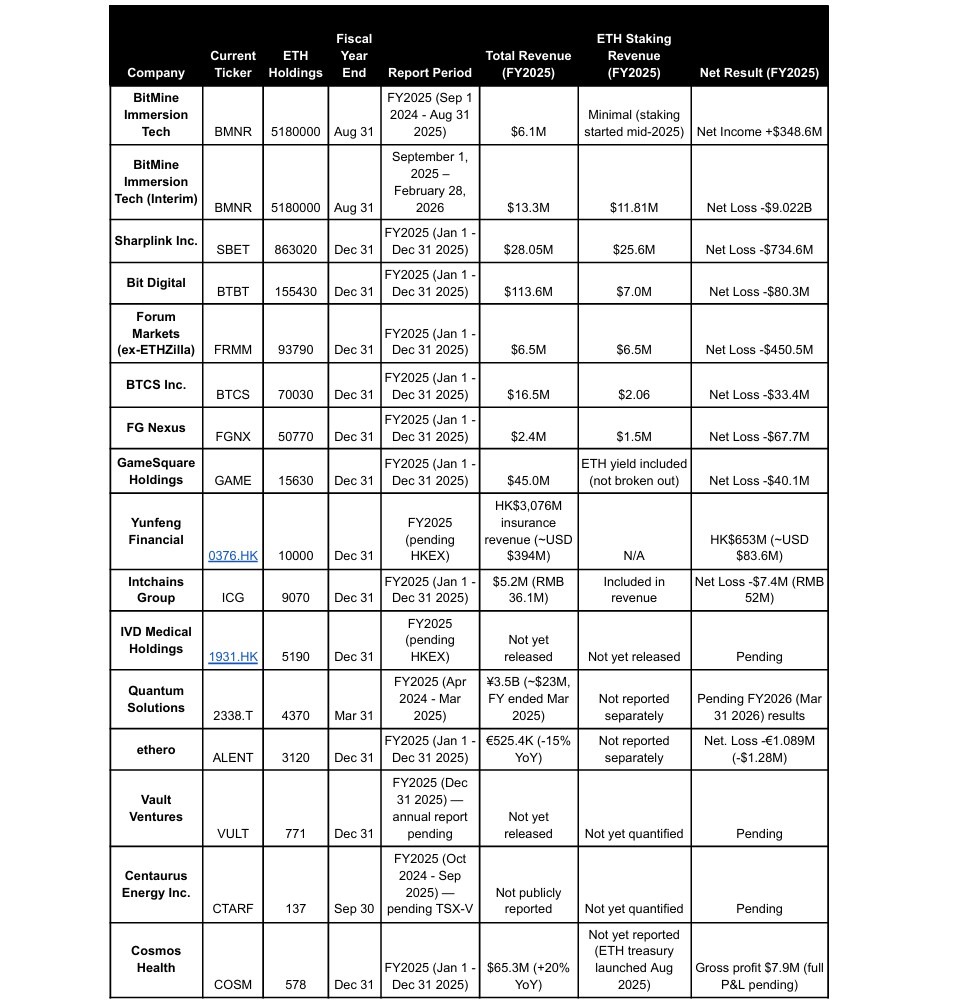
ETH treasury company data compiled by Everstake. Source: Everstake
“DATs that rely on passive exposure are being structurally repriced,” Everstake co-founder Bohdan Opryshko said in the report. He added that deployment is “no longer limited to standard protocol staking” and now includes liquid staking, DeFi lending and validator-level strategies.
Opryshko told Cointelegraph the study does not argue that staking revenue alone can support every ETH treasury model or offset all risks. ETH price volatility, dilution, net asset value discounts, financing costs and operating expenses can still outweigh staking yield, particularly for companies with weak capital structures or inefficient treasury management, he said.
He said the report’s point is narrower: “Passive ETH accumulation is becoming harder to justify as a standalone public-market strategy, particularly after spot crypto ETFs gave investors cleaner access to passive exposure.”
In that environment, staking and other forms of active asset deployment may become “necessary, though not sufficient,” for ETH treasury companies to sustain their models, he added.
ETFs matter, but may not be the only pressure point
Ignacio Aguirre, the chief marketing officer at crypto exchange Bitget, said spot ETFs have made it harder for ETH treasury companies to justify a premium based on ETH exposure alone. However, he cautioned against attributing the repricing entirely to ETFs.
“I would not over-attribute it to spot ETFs alone,” Aguirre told Cointelegraph. He said ETH treasury companies are still equity vehicles, meaning investors also weigh ETH price performance, balance sheet quality, dilution risk, treasury strategy, execution and broader market sentiment.
Related: Bitmine’s Tom Lee hints at stock tailwinds after firm considered for Russell 3000
Aguirre said staking can improve the ETH treasury model by creating a recurring revenue stream, though its impact depends on whether the yield is large enough to offset operating costs, dilution and volatility.
He added that staking-enabled ETH ETFs could become a future pressure point for treasury companies, but described them as “more complementary than existential threats.”
Magazine: ETH bears growling, Tom Lee’s buying, XRP to ‘explode’: Market Moves
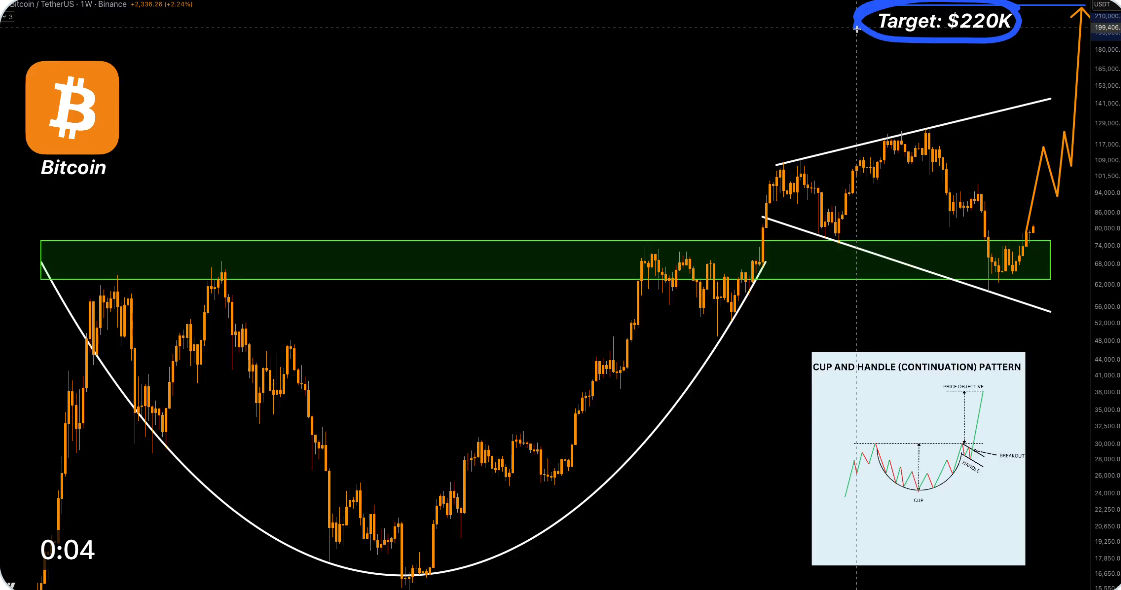
Bitcoin (BTC) is up roughly 30% from its Feb. 6 low below $60,000 as a multi-year bullish chart pattern suggests BTC price could rise to as high as $220,000 in the coming months.
Key takeaways:
- Bitcoin’s cup-and-handle pattern puts BTC’s minimum target at $220,000, but $74,000 must hold.
- Bitcoin spot volume has collapsed 81% since October 2025, a precursor to the end of every bear market.
Bitcoin’s cup-and-handle pattern targets $220,000 and above
Bitcoin price has formed a cup-and-handle (C&H) pattern on the weekly chart, suggesting that a massive upward move is still in the cards for BTC.
A cup-and-handle is a bullish continuation pattern where a rounded price recovery forms the “cup,” followed by a short consolidation inside a “handle” before a breakout.
It is resolved after a breakout above the handle’s resistance line, typically signalling a strong upward move, with the price target equal to the cup’s depth added to the breakout level.
“Bitcoin has just completed a multi-year cup-and-handle pattern,” technical analyst Crypto Tice said in a Monday post on X.
The analyst explained that C&H breakouts don’t result in small price movements, adding that “they move hundreds of percent.”
Bitcoin price has retested the cup’s $65,000-$74,000 neckline, which must be held to complete the breakout.
“The retest just finished. The launch is next,” the analyst said, adding:
“$220K is the minimum target.”
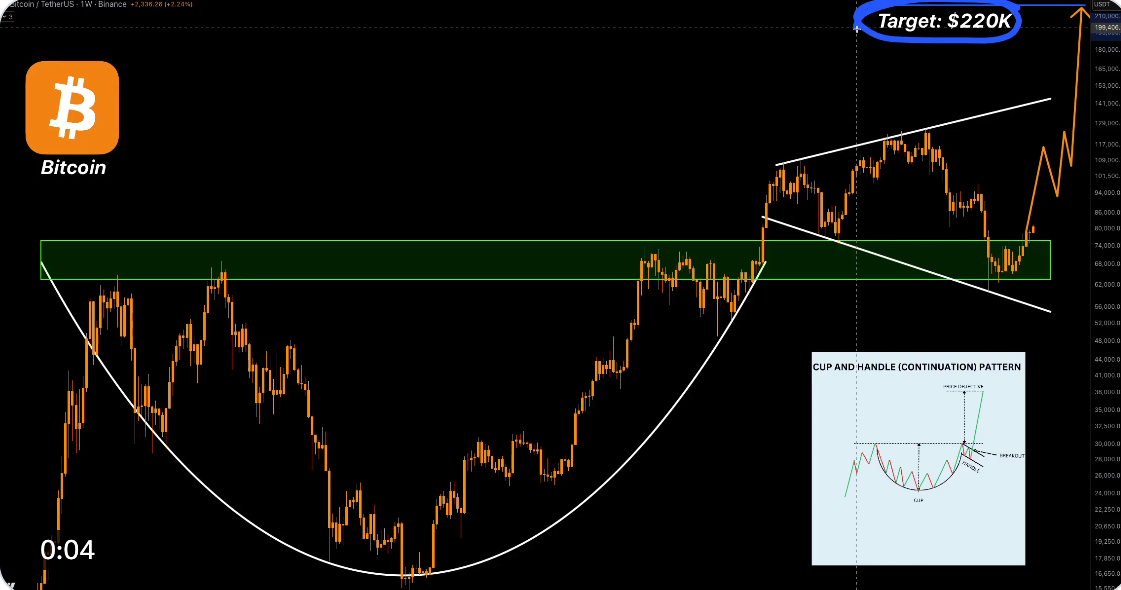
BTC/USD weekly chart. Source: X/Crypto Tice
Data from TradingView shows the measured target of the C&H pattern is $295,000, roughly 280% above the current price.
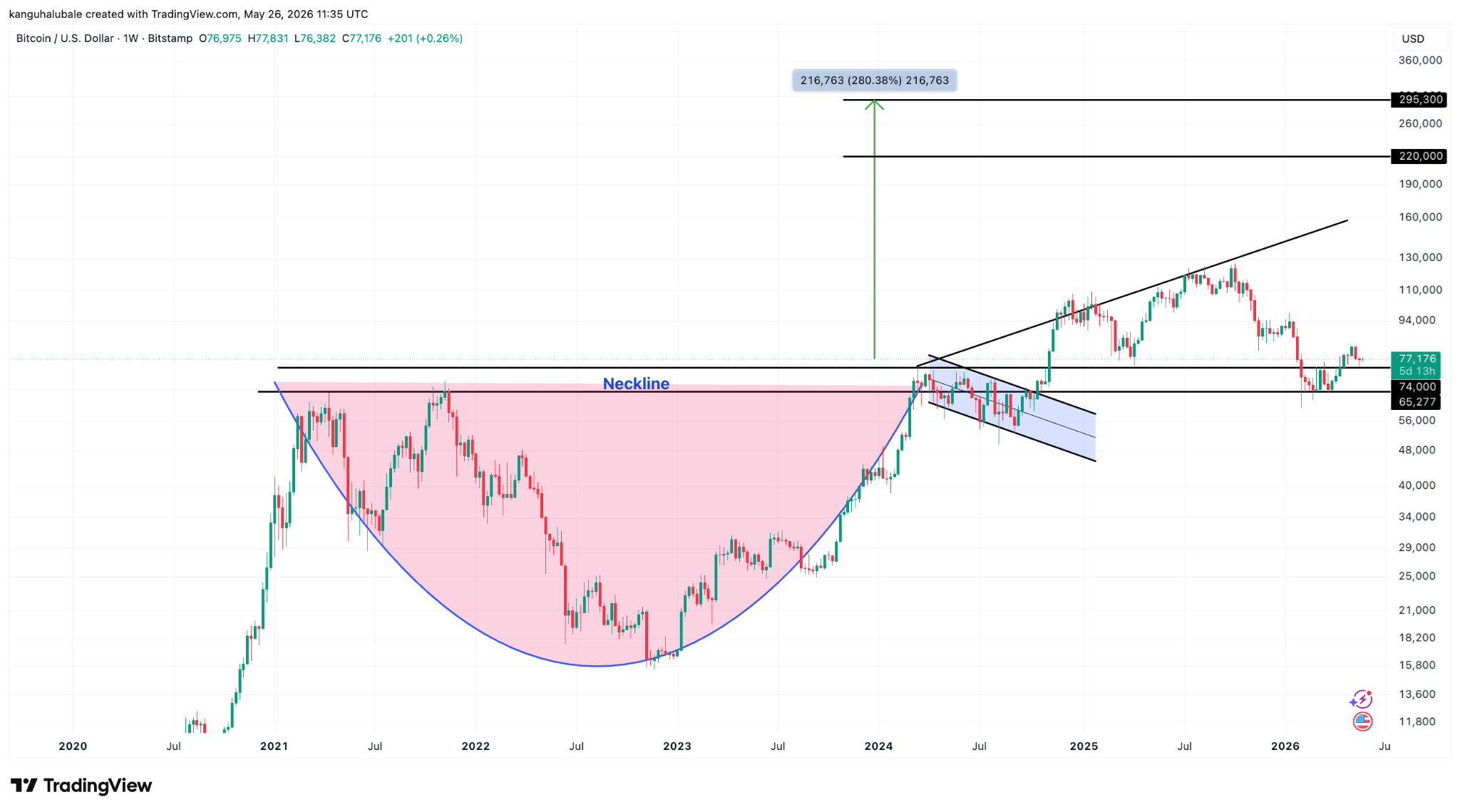
BTC/USD weekly chart. Source: Cointelegraph/TradingView
Earlier, Cointelegraph reported that Bitcoin’s Decay Channel—a logarithmic price model—suggested that BTC could rally as high as $255,000 by year-end, with its 2027 target extending to $308,000.
Trader VeLLa Crypto says the BTC/USD pair “must hold” the $74,000 support area first, to boost its bullish outlook.
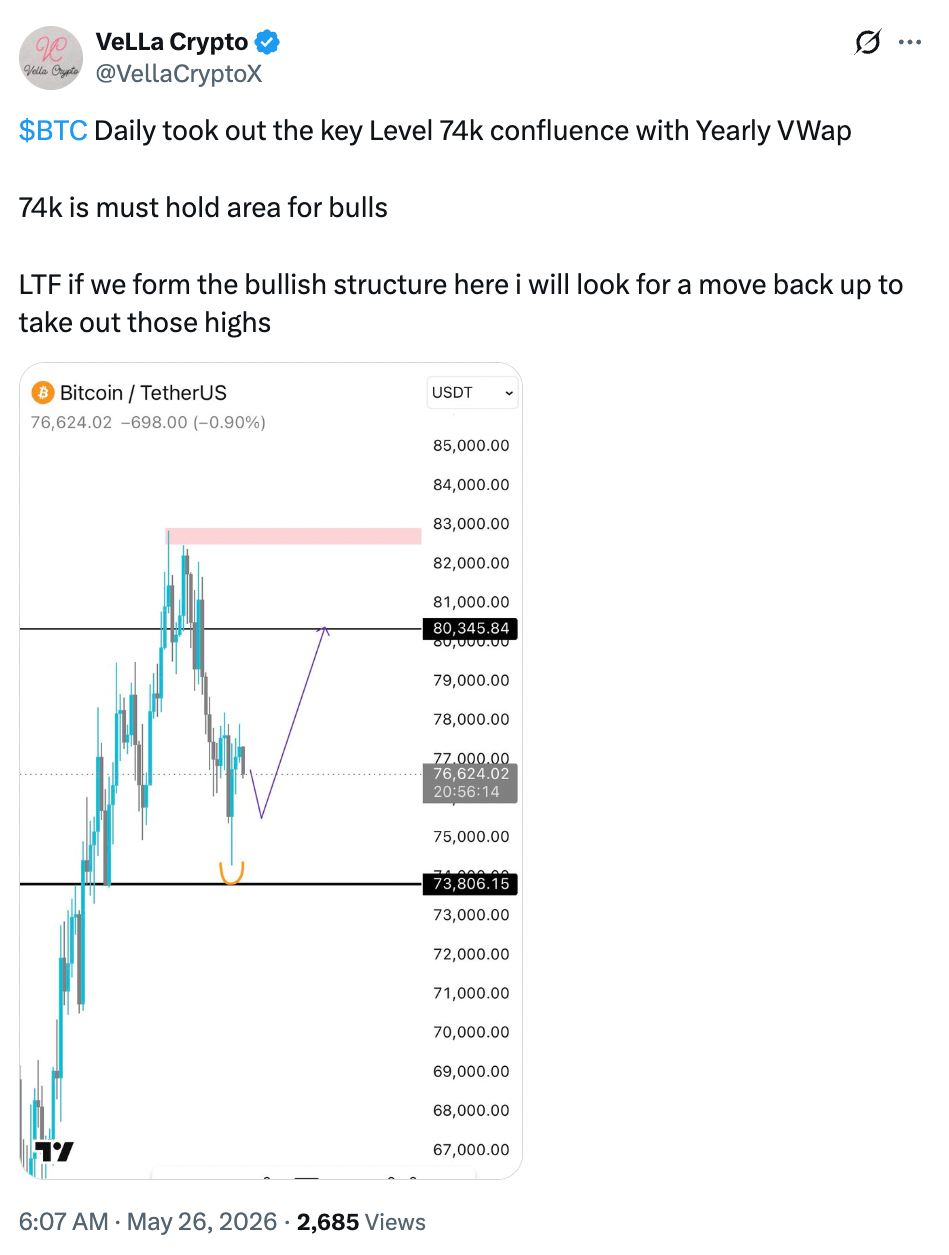
BTC/USD daily chart. Source: X/VeLLa Crypto
As Cointelegraph reported, a break below $74,000 would suggest the bears are back in control, invalidating the medium-term bullish outlook for Bitcoin.
Bitcoin spot volume collapses 81% on Binance
Bitcoin’s spot volume has now fallen to levels typically seen during bear markets, data from CryptoQuant shows.
The chart below shows that the trading volume on Binance has dropped to $36.4 billion, 81% below the $198.6 billion recorded in October 2025. Gate.io has also seen a massive 79.6% drop in volumes, while Bybit is down 66%.
“This development primarily reflects a macro environment that has been unfavorable for risk assets, CryptoQuant analyst Darkfost said in a Tuesday QuickTake post.
The decline in trading activity can also be “interpreted constructively” as it suggests that the” selling pressure behind the current retracement is gradually losing momentum.”
Darkfost added:
“It was precisely after spot volumes collapsed that the 2023 bear market came to an end, followed by the return of volatility and the recovery of the bullish trend.”
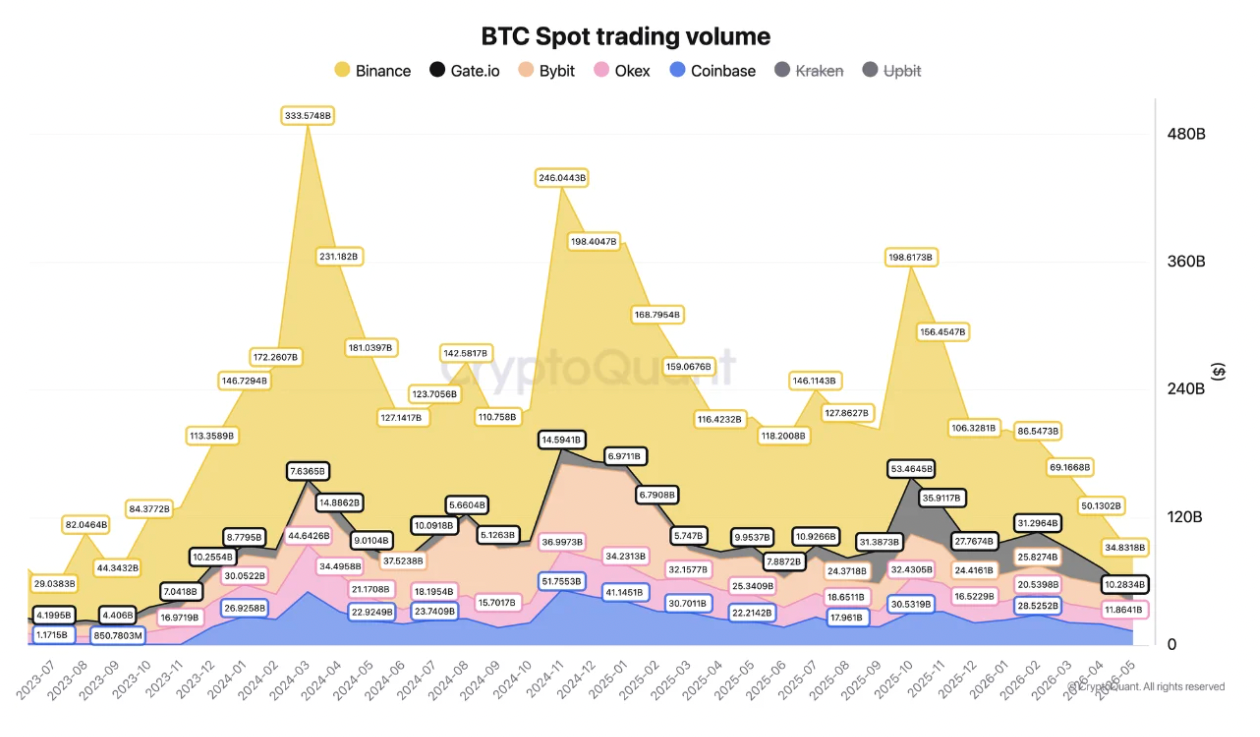
Bitcoin spot trading volume. Source: CryptoQuant
As Cointelegraph also reported, heavy outflows from spot Bitcoin ETFs have been correlated with great buying opportunities for BTC.
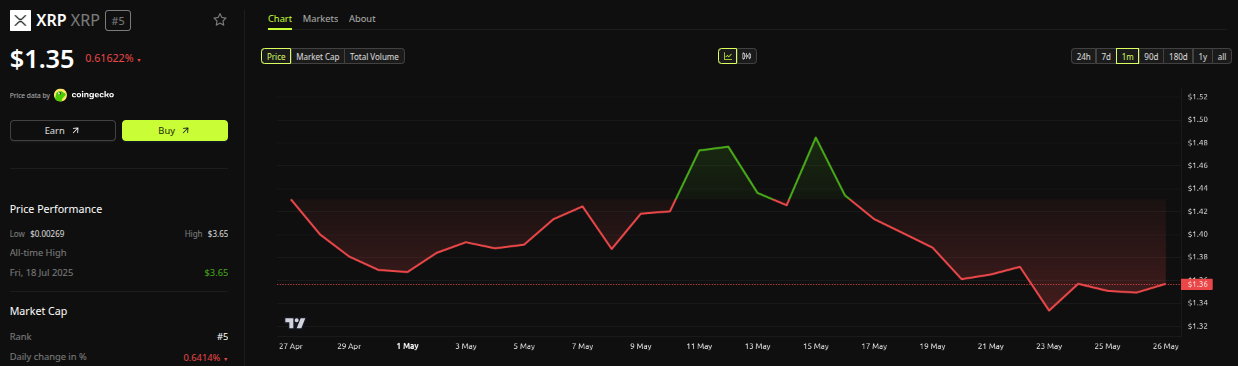
XRP Ledger activates the fixCleanup3_1_3 amendment this Wednesday, May 27, 2026. The technical upgrade, included in version 3.1.3 of the rippled software, improves the network’s infrastructure.
Despite its significance, the XRP price has barely reacted in the last few hours.
What the fixCleanup3_1_3 Amendment Changes
The upgrade focuses on essential technical fixes to ensure long-term stability. It does not introduce flashy new features, but cleans up accumulated junk data and corrects critical issues across several modules of the protocol that have grown over time.
The changes target four main areas. NFTs receive a fix in the handling of expired offers. Permissioned Domains gain new security invariants. Vaults improve withdrawals and Single Asset Vaults. The Lending Protocol corrects trust line limits and other key aspects.
Follow us on X to get the latest news as it happens
Nodes and validators that fail to update before the deadline will become amendment-blocked. This means full disconnection from the network, with no ability to participate in consensus, process transactions or communicate with the rest of the ledger.
Concern remains around adoption. Only 40-46% of nodes had completed the update by mid-May. The XRP Ledger Foundation and developers have repeatedly urged operators to migrate quickly to avoid network-wide availability issues.
Does XRP Price Care About This Upgrade?
XRP Ledger remains highly active on-chain. The last 24 hours processed close to 1,76 million transactions, nearly one million payments, and over 18,000 active accounts, according to CoinGecko data. Block close times stay below four seconds across the network.
The DEX shows strong liquidity. Tens of thousands of AMM pools are active, with the XRP/RLUSD pair among the main trading pairs. The ecosystem continues expanding into DeFi, real-world assets, and NFTs at a steady pace.
XRP trades near $1.35 at the time of writing. Its market cap stays above $83 billion, with a slight 0.4% decline in the last 24 hours. Daily trading volume holds firm above $1,2 billion across exchanges.

Analysts attribute the muted reaction to the nature of the upgrade itself. The amendment focuses on maintenance rather than disruptive innovation. Investors appear to be waiting for stronger catalysts, such as deeper institutional adoption or major regulatory advances.
For ordinary holders, no action is required. Wallets do not need to be connected, transactions do not need to be signed, and tokens do not require migration. The network continues to operate normally during the activation process.
The upgrade reinforces a broader narrative. The real value of the XRP Ledger lies in long-term utility rather than short-term speculation. Silent technical solidity often becomes the strongest predictor of resilience in blockchain networks.
Subscribe to our YouTube channel to watch leaders and journalists provide expert insights
The post XRP Ledger Update Sparks Hype, but Price Remains Unchanged appeared first on BeInCrypto.

Perfect, Disturbing Comedy Turns A Routine House Call Into An Extreme Downfall

Military to Civilian Life: Financial Adjustments Veterans Face

DWP PIP travel abroad warning for claimants planning summer holidays


-

 Crypto World5 days ago
Blockchain.com files with SEC for U.S. IPO
-

 Fashion4 days ago
Holiday Weekend Open Thread – Corporette.com
-

 Business4 days ago
Dell Technologies DELL Stock Surges 15% on AI Server Momentum and Analyst Upgrades in 2026
-

 Crypto World5 days ago
Bitcoin Accumulation Weakens as BTC Realized Losses Hit $600M
-

 Crypto World4 days ago
Robinhood crypto COO Tanya Denisova exits
-

 Crypto World4 days ago
Space X IPO Is ‘Bad News’ for Tech Stocks: But What About Bitcoin?
-

 Politics4 days ago
Makerfield: a tale of two social-media histories
-

 Business2 days ago
NYT Strands Answers May 24 2026 Revealed for Puzzle No. 812 Theme Summer Essentials
-

 Tech2 days ago
Microsoft’s quiet Claude Code retreat and the real cost of enterprise AI
-

 Crypto World5 days ago
MicroStrategy’s Saylor Says Miners No Longer Set Bitcoin Price, Another Force Has Taken Over
-

 Tech5 days ago
WhatsApp ads could make Irish debut after discussions with DPC
-

 Crypto World5 days ago
AI infrastructure race heats up as IREN pitches full-stack strategy, WhiteFiber lands $160M deal
-
 Tech5 days ago
A 0.12% parameter add-on gives AI agents the working memory RAG can’t
-

 Tech5 days ago
You Can Now Add ChatGPT To PowerPoint
-
 NewsBeat6 days ago
Charity run by Reform leader Malcolm Offord accused of ‘law breaking’ over Scottish registration
-
 Crypto World2 days ago
Nvidia (NVDA) CEO Calls on Super Micro to Strengthen Export Controls Amid Smuggling Probe
-

 Business5 days ago
Trump Invests $1M-$5M in Kura Sushi USA Chain With 27 California Locations
-

 Tech2 days ago
Westone Audio and Etymotic Acquired by Fidelity Collective in Major IEM Market Move
-

 Sports5 days ago
2026 CJ Cup Byron Nelson leaderboard: Brooks Koepka finds putting stroke in Round 1
-

 Crypto World6 days ago
Exa Labs raises $250 million in funding led by a16z
You must be logged in to post a comment Login