

Crypto World
Bitcoin Breaks Below $75,000 as Three Major Risks Hit at Once

Bitcoin dropped below $74,500 for the first time in four weeks, extending losses across nine straight trading days as regulatory, monetary, and geopolitical risks all hit the market at once.
We break down the three forces pushing the price lower and the levels that could decide the next major move.
Bitcoin Price Hits a Monthly Low
The Bitcoin drop below $73,500 for the first time since April 20 marks a clear technical breakdown, confirming the loss of recent momentum across global exchanges.
CoinGecko data shows BTC trading in a weakening range, with the latest decline aligning with broader risk-off sentiment. Even traditional safe-haven assets reflected caution as investors trimmed exposure across the board.
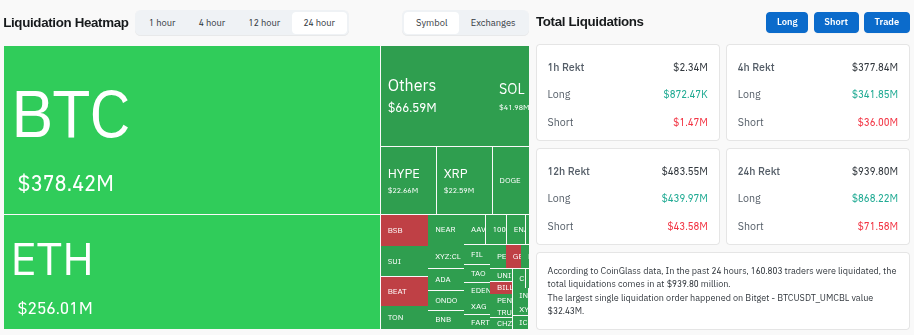
Amid this correction, the crypto market experienced a massive wave of liquidations totaling nearly $1 billion.
According to Glassnode, Bitcoin accounted for the largest share of these liquidations, totaling $378 million. Of this total, $353 million corresponded to long positions.

The biggest driver behind the move is regulatory. The Digital Asset Market Structure ‘CLARITY Act‘ faces growing delay risk in the United States Senate, undermining one of the most anticipated tailwinds of 2026.
Journalist Eleanor Terrett highlighted on X that the Senate adjourned until June. The bill now competes for limited floor time against reconciliation efforts, FISA reauthorization, and other urgent legislative priorities currently on the agenda.
Follow us on X to get the latest news as it happens
With only four working weeks in June and three in July before the August recess, the probability of further slippage has climbed sharply. Industry observers note prolonged delays could dampen the bullish regulatory expectations many investors built into prices.
“Crypto inner circle says banking lobbies are winning the Senate battle, delaying the CLARITY Act into midterms. Huge risk here, if the House flips blue, this framework is toast. Markets are reflecting the fear of prolonged uncertainty,” DarkHorse noted.
The CLARITY Act aims to deliver regulatory clarity by splitting jurisdiction between the SEC and the CFTC. It cleared a committee markup earlier in May, but ongoing amendment debates have created visible uncertainty.
Negotiations now cover DeFi protections and ethics provisions for government officials. Combined with a packed legislative calendar, these debates make it harder for the bill to advance quickly through both chambers of Congress.
Fed and Iran Tensions Add More Pressure
A hawkish shift at the Federal Reserve added a second layer of pressure on Bitcoin this week. Governor Christopher Waller signaled in Frankfurt that he can no longer rule out interest rate hikes during 2026.
Waller pointed to stubborn inflation and energy price shocks as the main concerns. Rate futures now price a non-negligible chance of a quarter-point hike as soon as October, a meaningful shift from earlier dovish expectations.
Bitcoin often reacts strongly to higher borrowing costs. As real yields climbed and the United States dollar strengthened, the asset extended its retreat alongside other risk assets across global markets.
On the other hand, several enthusiasts noted that the appointment of new Fed Chairman Kevin Warsh could negatively affect Bitcoin’s price due to hawkish rate actions.
“Every time a new Fed chairman is announced, BTC tends to fall; this is just a temporary fix that will lead to bigger problems later, so you have to keep accumulating,” Alberto Jesus said.
The third headwind comes from geopolitics. President Donald Trump has indicated he is seriously considering fresh military strikes against Iran if diplomatic agreements cannot be reached, according to reports cited by major outlets.
This follows earlier escalations during the 2026 conflict. Concerns over potential disruptions to energy supplies and broader Middle East stability have added another layer of volatility across both crypto and traditional financial markets.
What’s Next for the BTC Price?
Analysts warn that the combination of these three forces could trigger further downside. Some market watchers do not rule out a possible drop toward the 60,000 dollar psychological level if current supports fail to hold.
“$BTC has lost its key level – the gray zone. This automatically makes it more likely that it has peaked on the weekly chart; any gains we might see now are just rebounds before it continues to fall further. I’ve been warning for months on a weekly chart about this drop that will reach 60k again, it just happened earlier than expected,” The crypto analyst Gran Mago said.
That would mark a significant correction from recent highs. It would also test buyer conviction in an environment where regulatory hope, monetary policy, and global stability have all turned less favorable at the same time.
Despite the short-term gloom, some long-term observers remain optimistic about eventual regulatory progress and structural demand drivers, such as institutional adoption. Near-term trading, however, looks clearly dominated by caution and tight risk management.
As the weekend approaches, traders are watching whether Bitcoin can stabilize above critical support. Updates from Washington, the Federal Reserve, or the White House regarding Iran could quickly reshape sentiment in either direction.
Subscribe to our YouTube channel to watch leaders and journalists provide expert insights
The post Bitcoin Breaks Below $75,000 as Three Major Risks Hit at Once appeared first on BeInCrypto.


Cardano’s development began just over a decade ago, but it took a couple of years for the actual launch. Arguably, the even more important release of smart contracts, though, came in 2021 after the highly debated Alonzo upgrade.
Its native token has become a fan favorite among many crypto investors, but there are also a substantial number of doubters and critics.
Most Overvalued Network?
Satoshi Flipper, one of the most recognizable names on Crypto X with over 240,000 followers, shared another analyst’s viewpoint on the Charles Hoskinson-founded network with the caption, “Is Cardano the most overvalued blockchain on the planet?”
The underlying analysis questions the performance of the blockchain. It cited a DeFi total value locked (TVL) number of just $128 million, which is exactly what DeFiLlama shows as of press time, as well as 24-hour DEX trading volume of just $1.3 million, $26 million worth of stablecoins on top of it, and approximately 17k active addresses.
Eye Zen Hour described this as an “incredibly small on-chain economy relative to valuation.” The valuation itself is a $9 billion market cap for Cardano’s native token, which, despite its massive decline since its peak (to be discussed later), is still a top 15 altcoin by that metric.
Consequently, Zen Hour concluded that the market will eventually have to make an important decision on Cardano and ADA, whether it’s valuing an ecosystem or “just a memory from prior cycles.”
Cardano has a $9B market cap
I’m not joking when I say I don’t know a single real person active on Cardano. I don’t know many holding $ADA
The chain’s numbers are a bit scary:
> TVL: $128M
> 24H DEX vol: $1.3M
> Stablecoins: $26M
> ~17K active addressesThat’s an incredibly… pic.twitter.com/BWhn3fzQzZ
— eye zen hour
(@eyezenhour) May 23, 2026
ADA’s Memory From Past Cycles
The aforementioned Alonzo update coincided with ADA’s most impressive price surge in Q3, 2021. At the time, the token was riding high alongside the rest of the market and charted a new all-time high of just over $3. However, it turned out to be a classic sell-the-news event, and ADA has been unable to recapture its former glory.
In fact, it hasn’t even come close. During the 2025 market-wide rally, bitcoin, as well as many altcoins, managed to post new peaks. However, ADA’s high was far from its 2021 record as it couldn’t break past $1.3. It currently struggles below $0.25, which represents a mind-blowing decline of over 92% since its 2021 ATH.
Although almost all crypto assets have slumped since last October, ADA’s crash has been more than just a correction, and being 92% away from its record doesn’t sound too promising for its vast community.
The post Is Cardano the Most Overvalued Crypto Project? Analysts Debate as ADA Dumps appeared first on CryptoPotato.

Binance chief executive Zhao Richard Teng pushed back against a Wall Street Journal investigation that alleged the crypto exchange processed roughly $850 million in transactions tied to a sanctioned Iranian financier, with funds purportedly ending up with Iran’s Islamic Revolutionary Guard Corps. In a Friday post on X, Teng described the reporting as “fundamentally inaccurate,” insisting Binance never allowed transactions with sanctioned individuals and that flagged activity occurred before those individuals were placed under U.S. sanctions. He also asserted Binance had already investigated the issues prior to the Journal’s inquiry and that additional facts provided by the company were omitted from the story.
The Wall Street Journal’s report, published this week, centers on Babak Zanjani, who was re-sanctioned by the U.S. in January, and his network. It identifies Zedcex, along with accounts linked to a sister, a romantic partner, and a company director, as operating from the same devices. The Journal contends that up to $850 million moved through Binance accounts over a two-year period, with alleged activity tied to Tehran detected in late 2024. The piece also notes more than a dozen internal alerts triggered by the Zanjani-associated accounts and claims internal investigators recommended removing the accounts and informing authorities, but the accounts remained active.
The Journal’s reporting also touches on broader questions of how Binance has handled potential sanctions evasion. It states that the company’s internal compliance reviews flagged the Zanjani-linked account after Tehran-based access was detected in late 2024 and that those accounts persisted for more than a year. Binance, the Journal says, faced internal pressure to shut the accounts and report the activity, but according to the outlet, the accounts continued to operate.
The investigative piece also situates the allegations within a wider regulatory context. The Journal notes that Binance pleaded guilty in 2023 to anti-money-laundering and sanctions-violations charges and paid a record $4.3 billion fine, while promising to overhaul its compliance framework. It reports that the U.S. Justice Department is examining Iran’s use of Binance to evade sanctions in the wake of that settlement. In response to the Journal’s coverage, Binance filed a defamation lawsuit against the publication, seeking damages and a jury trial, and the exchange reiterated that it does not claim knowledge of any Department of Justice investigation and remains cooperative with regulators and law enforcement.
Beyond the Zanjani case, the Journal’s narrative points to additional alleged ties between Binance and Iranian financial networks. It cites claims that Iran’s central bank moved $107 million in cryptocurrency onto Binance accounts in 2025, and that a foreign law-enforcement agency tracked roughly $260 million in direct Binance-to-Iranian-financier transactions during 2024 and 2025.
In a separate line of defense, Teng asserted Binance’s commitment to compliance. He emphasized Binance’s “zero-tolerance for illicit activity” and described the platform as having built a “best-in-class industry-leading compliance program that continues to grow.” The exchange has also pointed readers to a Binance blog post addressing what it calls false claims, and it has publicly denied facilitating transactions for Iranian entities in response to a Senate inquiry.
Key takeaways
- Binance disputes The Wall Street Journal’s assertion of an $850 million flow linked to an Iranian financier, arguing that sanctioned individuals were never allowed to transact and that flagged activity occurred before sanctions.
- The Journal’s report centers on Babak Zanjani and his network, including Zedcex, alleging internal warnings and ongoing access to Binance accounts despite investigators’ cautions.
- Binance’s response includes a defamation lawsuit against the Journal, with the company stressing its cooperation with regulators and its ongoing compliance improvements.
- Historical regulatory context remains relevant: Binance pleaded guilty in 2023 to AML and sanctions violations and paid $4.3 billion, underscoring continued scrutiny of the exchange’s controls.
- The article’s broader claims cite Iranian central-bank crypto movements and cross-border activity that regulators allegedly tracked through Binance in 2024–2025, highlighting ongoing concerns about sanctions enforcement in crypto networks.
The Journal’s assertions and Binance’s rebuttal
The core of The Wall Street Journal’s investigation rests on a two-year stream of activity described as $850 million moving through Binance accounts associated with Babak Zanjani and his business network. The report ties these funds to networks connected with Iran, including the Islamic Revolutionary Guard Corps. It also highlights the alleged overlap of devices used by multiple figures—Zanjani’s sister, romantic partner, and a company director—within the same operational footprint and devices.
Binance countered with a straightforward defense: it says it never permitted transactions with sanctioned individuals and that any flagged activity occurred before those individuals were subject to U.S. sanctions. The CEO’s post on X argued that Binance had already investigated the issues prior to the Journal’s inquiry and that the publication did not incorporate the company’s supplied facts into its coverage.
The exchange has not stood still on the compliance front. In addition to the defamation lawsuit, Binance has publicly maintained that it is cooperating with regulators and law enforcement. Teng’s remarks echo a broader corporate narrative that Binance emphasizes: a commitment to robust compliance infrastructure and ongoing enhancements designed to deter illicit finance on its platform.
Regulatory backdrop and corporate response
The Wall Street Journal’s piece sits against a larger backdrop of regulatory scrutiny surrounding Binance. The 2023 settlement, which ended with Binance pleading guilty to anti-money-laundering and sanctions violations and the payment of a $4.3 billion fine, marked a watershed moment for the exchange’s compliance reforms. While Binance asserted that its 2023 settlement catalyzed significant reforms, the Journal’s report suggests that sanction-related flows persisted in some form in the years since.
The Journal notes that the U.S. Department of Justice is examining Iran’s use of Binance to evade sanctions in the aftermath of the 2023 settlement. Binance responded to the Journal’s coverage not only with legal action but also with public statements emphasizing its commitment to regulatory cooperation. The exchange’s official blog and public statements have framed these allegations as part of a broader tension between evolving global sanctions regimes and a high-growth, cross-border crypto platform landscape.
Amid these developments, the Journal highlighted additional purported links between Binance and Iranian financial networks—claims that extend beyond the Zanjani case. It cites a 2025 move of $107 million by Iran’s central bank into Binance accounts and notes that approximately $260 million in direct Binance–Iranian-financier transactions were tracked by a foreign law-enforcement agency over 2024 and 2025. These figures, if corroborated, would illustrate the persistent difficulty of fully segregating sanctioned activity from the rapidly moving value in crypto markets.
In response to the broader narrative, Binance publicly reiterated its stance on sanctions compliance. The company underscored its compliance program as “industry-leading” and described its approach as dynamic, ongoing, and designed to scale with emerging threats. Binance’s response also referenced its public blog addressing the Journal’s claims and reiterated its denial of facilitating transactions for Iranian entities in a Senate inquiry context.
What readers should watch next
For investors, traders, and users, the evolving story underscores the enduring importance of robust on-chain analytics, continuous compliance enhancements, and the regulatory risk embedded in cross-border crypto activity. The juxtaposition of high-profile sanctions cases with the operational realities of a large exchange highlights both the capabilities and the limitations of current oversight tools in a fast-moving market.
Observers should monitor further disclosures from Binance about its compliance program upgrades, any subsequent regulatory or DOJ updates, and additional reporting from outlets detailing the intersection of sanction policy and crypto trading. The coming months may reveal how Binance’s legal strategy interacts with ongoing investigations and how regulators assess the firm’s ability to prevent illicit flows while supporting legitimate users and institutional clients.
As this story unfolds, the key question remains whether independent findings will align with Binance’s assurances of a zero-tolerance stance on illicit activity or whether new evidence will suggest gaps in the guardrails that policymakers, investors, and users rely on to navigate the evolving crypto landscape.


Blockstream CEO Adam Back has disputed Mark Cuban’s claim that Bitcoin (BTC) has “lost the plot,” saying the billionaire’s critique does not align with recent market data.
Cuban recently disclosed he had sold most of his BTC holdings, citing Bitcoin’s failure to act as an inflation and geopolitical hedge when gold surged while the token declined.
Bitcoin’s Performance Since the Conflict Onset
Back said the numbers contradict Cuban’s reading. Since Middle East tensions escalated, BTC climbed 25-30% from a low of roughly $60,000. The S&P 500 gained 11% over the same window, the Dow Jones Industrial Average rose 5%, and gold dropped 14%.
“Bitcoin is up 25-30% from the ~$60k bottom … vs S&P500 up 11%, DJIA up 5%. and gold fell -14%. so i don’t know what @mcuban is trying to say .. doesn’t line up with data unless he sold the bottom,” says Adam Back.
Cuban’s frustration centers on an earlier period when Bitcoin fell more than 40% as gold surged to $5,000. He argued that every time the dollar weakened, Bitcoin should have risen, but it did not.
This is not Cuban’s first criticism of Bitcoin’s investment case. He also said he remains more optimistic about Ethereum going forward.
Some long-term model followers argue that Cuban’s disappointment reflects a fundamental misunderstanding of the asset.
They say Bitcoin’s price trajectory has remained consistent since its earliest days, cycling through predictable phases at different scales. The asset’s structural behavior, they contend, has not changed.
Volatility as the Cost of Outperformance
Back attributed the earlier drop to what he called the “10/10 event” and halving-period cyclicality. He described both factors as unrelated to gold’s geopolitical gains.
The Bitcoin safe-haven debate has persisted for years, and Back’s reply centers on the time horizon rather than any single data point.
“You don’t get the outlier Sharpe ratio over longer durations, without volatility. So it comes with the territory,” says Adam Back.
Bitcoin’s risk-adjusted returns over multiple years have consistently outpaced those of equities, gold, and real estate. Whether Cuban timed his exit poorly or identified a genuine shift in Bitcoin’s role may only be resolved over the next market cycle.
The post Adam Back Challenges Mark Cuban’s Bitcoin Data After Billionaire Sells His Holdings appeared first on BeInCrypto.
Bitcoin’s price calamity is not isolated, as, aside from all other macro and on-chain reasons, the exchange-traded funds tracking the asset’s performance experienced their worst weekly outflows since late January.
In fact, data from SoSoValue shows that May has turned red following two consecutive weeks of massive outflows.
Over $1.25B Pulled Out
The spot Bitcoin ETFs were on a highly impressive streak that began during the week that ended on April 2. The following six weeks were deep in the green. Moreover, 10 out of the 11 weeks at the time saw more net inflows than outflows.
However, this impressive trend broke during the week that ended on May 15, when investors pulled out $1 billion from the funds. The landscape worsened in the past five trading days, as the net outflows skyrocketed to $1.26 billion: the most since the end of January. Consequently, the cumulative net inflows dropped to just over $57 billion, out of the local peak at $59.34 billion marked just a couple of weeks ago.
Monday was the most painful day in terms of net outflows, with nearly $650 million in withdrawals. Tuesday followed suit with $331 million, another $70 million on Wednesday, $101 million on Thursday, and $105 million on Friday. Somewhat surprisingly, BlackRock’s IBIT bled out the most: $445 million on Monday, $325 million on Tuesday, $61.5 million on Wednesday, $104 million on Thursday, and $69 million on Friday.
As such, the total inflows for May have turned red, currently showing a $1 billion reduction.

Not Just the ETFs
Bitcoin’s price has also turned red for the month. After closing April with a notable 11.87% surge, May began on a positive note, and the cryptocurrency quickly spiked to a multi-month high of almost $83,000. Although it was rejected there, it managed to maintain the $80,000 level for several weeks before it broke down last weekend.
It has been unable to reclaim that level since then. Moreover, it plunged on Friday and earlier today to a monthly low of $74,200. Aside from the ETFs bleeding out, other reasons for BTC’s calamity could include war-related uncertainty and the possibility of new attacks, as well as other investors disposing of their assets.
As such, current data from CoinGlass shows that bitcoin is now over 1% in the red for May as it struggles below $75,500.

The post Bitcoin ETFs Suffer Biggest Outflows Since January as May Turns Red appeared first on CryptoPotato.
Ethereum has come under renewed selling pressure after failing to reclaim a key dynamic resistance cluster around the 100-day moving average and the lower boundary of the previous consolidation range.
While the broader market remains under pressure, ETH is now approaching a critical support region where short-term reactions may emerge. However, unless buyers quickly reclaim lost levels, the path of least resistance appears tilted toward further downside continuation.
Ethereum Price Analysis: The Daily Chart
On the daily timeframe, ETH faced a strong rejection from the confluence of the 100-day moving average near the $2.1K-$2.15K region and the broken wedge support structure, which had previously acted as dynamic support for several months.
Following this rejection, the asset decisively broke below the wedge formation, confirming a notable bearish structural shift in the market. This breakdown signals weakening bullish momentum and increasing dominance from sellers.
Currently, ETH is trading around the $2K psychological support zone after losing the important $2.1K level. The overall structure suggests that the recent move could evolve into a classic breakdown-and-pullback scenario, where price may temporarily retest the broken wedge boundary and the $2.1K-$2.15K resistance area before continuing lower.
If bearish momentum persists, the next major downside target lies near the substantial $1.8K support region, which previously acted as a strong demand zone during the February capitulation event. A break below that area could expose Ethereum to deeper corrections toward the lower macro support levels around $1.55K-$1.6K.
On the bullish side, reclaiming the 100-day MA around $2.15K would be the first sign that buyers are attempting to invalidate the recent bearish breakdown.

ETH/USDT 4-Hour Chart
On the 4-hour timeframe, Ethereum’s market structure remains clearly bearish, reflecting growing fear and uncertainty among market participants after the sharp impulsive decline from the $2.4K region.
The price has consistently formed lower highs and lower lows, while recent selling pressure accelerated after ETH lost the important ascending support trendline near $2.2K-$2.25K. This breakdown triggered another wave of liquidation-driven selling, pushing the asset directly into a key 4-hour order block located around the $1.95K-$2K support zone.
This region is highly important because it has served as a major reaction area for an extended period of time and likely contains significant resting liquidity. As a result, Ethereum could experience a short-term corrective bullish retracement from this zone before any continuation toward lower prices.
In the event of a rebound, the primary pullback target sits around the $2.1K-$2.15K area, which now acts as the nearest supply zone and potential pullback resistance. This region also coincides with the previously broken market structure, increasing the probability of renewed selling pressure if the price revisits it.
However, unless ETH manages to reclaim and stabilize above the $2.2K region, the broader short-term trend remains bearish, and any recovery rally may simply be considered a corrective move within a larger downtrend.

Sentiment Analysis
The latest Ethereum liquidation heatmap reveals a substantial liquidity concentration below the current market price, with the most significant cluster positioned around the $1.8K region. This zone has emerged as a major liquidity magnet, containing a dense accumulation of leveraged positions that could attract price action in the coming phase.
Historically, Ethereum tends to gravitate toward high-liquidity regions before establishing a meaningful reversal. The recent decline and weak recovery structure suggest that the market may still require a final liquidity sweep to fully reset positioning and flush out remaining leveraged participants. As a result, the $1.8K area becomes a critical level to monitor, as it holds the potential to absorb incoming selling pressure while clearing a large portion of resting liquidity.
From a market mechanics perspective, such liquidity grabs often occur before the beginning of a stronger impulsive trend. If Ethereum eventually taps into this zone, it could trigger panic-driven selling and forced liquidations, creating favorable conditions for large players to accumulate at discounted prices. Consequently, while short-term rebounds remain possible, the broader liquidity structure indicates that Ethereum may still be vulnerable to a deeper corrective move toward the $1.8K cluster before a sustainable bullish expansion can begin.

The post Ethereum Price Prediction: Will ETH Crash Below $2K This Week After Key Breakdown? appeared first on CryptoPotato.

Binance chief executive Richard Teng pushed back Friday on a Wall Street Journal investigation that alleged the exchange processed about $850 million in transactions linked to a sanctioned Iranian financier, with funds eventually flowing to Iran’s Islamic Revolutionary Guard Corps. In a post on X, Teng described the reporting as “fundamentally inaccurate,” arguing that Binance never facilitated transactions with sanctioned individuals and that any flagged activity occurred before those individuals were placed under U.S. sanctions. He added that Binance had already investigated the issues prior to the Journal’s inquiry and that the publication omitted facts Binance had provided.
The Journal’s report, published Thursday, centers on Babak Zanjani, who was re-sanctioned by the United States in January, and portrays a covert crypto payment network that allegedly moved $850 million through Binance accounts over two years. The article identifies Zanjani’s firm Zedcex and accounts tied to his sister, a romantic partner, and a company director as operating from the same devices, according to the Journal’s account.
The Journal said internal Binance compliance reports flagged a Zedcex account after activity from Tehran in late 2024. The account remained open for more than a year, triggering more than a dozen internal alerts. Binance’s own investigators reportedly recommended shutting down the accounts and reporting to authorities, but the Journal asserts the accounts stayed active.
Key takeaways
- The Wall Street Journal links roughly $850 million in flows through Binance accounts to a sanctioned Iranian financier, Babak Zanjani, and a clandestine network tied to Zedcex and related associates.
- Binance’s CEO disputes the findings, saying the exchange never processed transactions for sanctioned individuals and that flagged activity occurred before sanctions were in place.
- Binance previously settled with U.S. authorities in 2023, admitting AML and sanctions violations and paying a record $4.3 billion, while promising a major overhaul of its compliance framework.
- The Journal additionally reports that Iran’s central bank moved funds into Binance accounts in 2025, and that a foreign law-enforcement agency tracked substantial direct trades between Binance and Iranian financing networks during 2024–25; the accuracy and scope of these claims remain contested.
- Regulators have not concluded their inquiries, and Binance has taken legal steps, including a defamation suit against the Journal, while continuing to assert cooperation with authorities.
Allegations and Binance’s rebuttal
The Wall Street Journal’s investigation paints a portrait of a persistent, unapproved flow of funds through Binance that allegedly originated with an Iran-based financier who faces U.S. sanctions. The piece highlights Babak Zanjani, who was re-sanctioned in January, and describes a covert crypto network that moved tens of millions through Binance accounts over a two-year period. The Journal points to Zanjani’s firm Zedcex, along with accounts belonging to a sister, a romantic partner, and a company director, as operating from the same devices.
According to the Journal, Binance’s internal compliance dashboards flagged a Zedcex account after Tehran-origin access in late 2024. The account reportedly remained open for more than a year, triggering more than a dozen internal alerts. The Journal quotes unnamed investigators who reportedly recommended shutting down the accounts and reporting the activity to authorities, but the accounts purportedly remained active.
In a reply posted on X, Binance CEO Richard Teng described the allegations as inaccurate and asserted that the exchange has never enabled transactions with sanctioned individuals. He argued that the flagged activity occurred before sanctions were in place and that Binance had already investigated the issues prior to the Journal’s inquiry. Teng also claimed that the Journal did not incorporate facts Binance had provided to reporters.
Compliance history and ongoing scrutiny
The Wall Street Journal’s reporting sits against a backdrop of intense regulatory and legal scrutiny for Binance. The exchange pled guilty in 2023 to anti-money-laundering and sanctions violations and agreed to a record $4.3 billion fine, accompanied by pledges to strengthen its compliance infrastructure. The Journal now asserts that the Iranian funds issue persisted after that settlement, a claim Binance says it does not recognize.
The Journal reported in March that the U.S. Department of Justice was examining whether Iran had used Binance to evade sanctions in the wake of the guilty plea. In response to coverage, Binance filed a defamation lawsuit against the publication, seeking damages and a jury trial; Binance said it had no knowledge of any active DOJ investigation into its operations and characterized its regulatory cooperation as ongoing.
Beyond Zanjani’s network, the Journal also notes that Iran’s central bank moved about $107 million in cryptocurrency into Binance accounts in 2025, and that a foreign law-enforcement agency tracked roughly $260 million in direct transactions between Binance accounts and Iranian financiers tied to extremist networks during 2024–25. Binance has repeatedly stressed its commitment to a “zero-tolerance” stance toward illicit activity and has pointed to its growing, industry-leading compliance program as proof of ongoing reform.
The Journal’s coverage also touches on a February report that Binance “shut down” an internal probe into roughly $1 billion routed through the platform toward Iranian proxy networks. Binance denied the claim, stating that its internal probe remained active and that it identified a broader, multi-jurisdictional pattern of suspicious financial activity across Asia and the Middle East. In response to ongoing questions, Binance has published a compliance-focused blog post and has engaged with lawmakers in multiple forums, including a Senate inquiry, to outline its stance on sanctions and anti-money-laundering controls.
Source: The Wall Street Journal reporting cited in multiple articles; Binance statements and social posts referenced in company communications and coverage.
What this means for the crypto ecosystem
These developments underscore the persistent tension between rapid crypto-enabled finance and the stringent compliance expectations that regulators and banks impose on the sector. For investors and users, the principal takeaway is that even a market-leading exchange faces ongoing, high-stakes scrutiny over sanctions compliance and the flows of funds with sanctioned jurisdictions. Binance’s ongoing regulatory engagements, lawsuits, and public rebuttals will likely shape how counterparties assess risk, audit readiness, and the reliability of cross-border crypto rails in the near term.
Looking ahead, observers will be watching how authorities weigh the Journal’s allegations against Binance’s stated reforms and continued cooperation with regulators. The outcome could influence not only Binance’s operations and governance but broader market perceptions of compliance in global crypto infrastructure.
Readers should monitor any formal regulator statements, court filings, and Binance’s forthcoming disclosures as the saga unfolds, particularly around how the platform manages sanctioned-party risk and how it documents its anti-money-laundering controls in the wake of a landmark settlement and ongoing investigations.

Bitcoin dropped 3.4 percent over the last 24 hours, pulling the flagship asset down to $74,598 and dragging the broader cryptocurrency sector into a severe sell-off. The total market capitalisation shed 3.3 percent, erasing over $80 billion in value overnight as retail buyers scrambled for liquidity across major exchanges. The charts have burned, and institutional support levels are failing to hold the line against the selling pressure. For those scanning the wreckage, Coinbase’s Bitcoin price data confirms a sharp rejection at the $77,000 resistance zone, leaving traders to brace for further downside. The market has collapsed, and the noise is deafening as portfolios take heavy hits across the board.
Ethereum and Solana Extend Losses in Broader Sell-Off
The damage extends deep into the altcoin sector, proving that few assets are immune to the sudden shift in macroeconomic sentiment. Ethereum fell 4.5 percent to $2,025, pushing its 14-day relative strength index down to an oversold 28.9 level, signaling extreme bearish momentum. Solana suffered a heavier 6 percent drop, hitting $81.96 as CoinGecko’s Solana tracking shows trading volumes spiking past $4.4 billion amid panic selling. The global meme coin category retreated 2.5 percent, leaving chart survivors exhausted by the relentless volatility and unpredictable price swings. Most speculative tokens are bleeding heavily, offering little refuge for investors caught in the downtrend as the broader market searches for a definitive floor.
$GRUNTLE Presale Provides a Deadpan Alternative to Market Chaos
While the rest of the market promises impossible recoveries to mask structural decay, Gruntle ($GRUNTLE) offers a deadpan alternative. The project is a survival instrument that allocates 20 percent of its 5 billion token supply to the Deep Mud Reserve for tactical buybacks, providing a deflationary counterweight to the market chaos. There is no fake urgency or influencer hype here. The brand positioning is strictly low hype and high signal, treating the market crash as a simple fact of existence rather than a temporary setback. It is a digital refuge built for those who have accepted the current state of the charts, offering a quiet space away from the frantic trading of liquid spot assets.
Check Out the Gruntle Website to Join the Presale
Round 5 Nears $111.6k Target With 10,766% Variable APY
The intake terminal remains fully operational regardless of spot market conditions, providing a fixed entry point while liquid assets swing wildly. Round 5 is currently 93.35 percent filled, having processed $104,175 of its $111,600 current round target. Terminal-grade citizens entering Gruntle’s intake terminal secure an entry price of $0.000625 before the next price tier opens at $0.000627. Furthermore, the system includes a Hibernation Staking protocol that currently pays a 10,766 percent APY. This yield is strictly variable and computed from a 250 million token pool, meaning the APY decays as more survivors stake their tokens. The early window captures the highest yield, providing a mathematical advantage to those who enter the mud early and wait for the Phase 3 decentralised exchange listing.
Market Volatility Continues as the Presale Intake Remains Open
Analysts suggest the current bearish momentum could push major assets lower before finding a bottom, leaving many traders on the sidelines. The world stays loud, and the charts remain red. The $GRUNTLE presale stays open at $0.000625 with Hibernation Staking currently paying 10,766 percent APY (variable, decays as more enter) and the Phase 3 DEX listing roadmapped.
Secure your allocation before the cap closes the current pricing window.
FAQs
What is the Gruntle presale?
Gruntle is a deadpan meme coin built for exhausted crypto market survivors. The presale offers a structured entry point into the $GRUNTLE ecosystem before public trading begins on decentralised exchanges.
How can I participate in the intake?
Buyers can enter the presale using ETH, USDT, USDC, BNB, or card payments via Web3Payments. The intake terminal is accessible directly at the gruntle.io website.
What comes after the presale concludes?
Phase 3 of the roadmap triggers the decentralised exchange (DEX) listing and initiates applications for CoinMarketCap and CoinGecko tracking. Phase 4 will then pursue centralised exchange listings.
Is the Gruntle smart contract audited?
Yes, the Gruntle smart contract was fully audited by CredShields on May 13, 2026.
This article is for informational purposes only and does not constitute financial advice. $GRUNTLE is a meme coin with no intrinsic value. Cryptocurrency investments carry significant risk. Always conduct your own research before investing.
Disclaimer: This is a Press Release provided by a third party who is responsible for the content. Please conduct your own research before taking any action based on the content.

Peter Schiff is renewing his attack on MicroStrategy (MSTR), arguing the company’s five-year Bitcoin accumulation strategy has produced a negative total return and that its STRC preferred stock structure depends on price appreciation that has not materialized.
Schiff posted on X that MSTR has deployed approximately $64 billion into Bitcoin (BTC) since adopting its treasury strategy. The position’s total return remains negative as of May 23, he argued. He added that the entire STRC framework depends on bitcoin appreciating roughly 30% per year to fund its 11.5% annual dividend.
STRC’s Yield Math Under the Microscope
Strategy set its STRC dividend rate at 11.50% for March 2026, the seventh consecutive monthly increase since the preferred shares launched in July 2025. The rate is adjusted monthly to keep STRC shares trading near their $100 par value.
Schiff’s critique centers on the sustainability of that obligation. He contends that covering an 11.5% annual payout requires Bitcoin to compound at a rate far above historical averages.
He also notes that ongoing STRC issuance raises that threshold each month as more shares enter the float.
Schiff has previously labeled MSTR a Ponzi scheme, arguing the structure is self-reinforcing on the downside. Under that reading, weak bitcoin performance reduces MSTR’s ability to issue new shares at a premium, limiting the capital available to fund dividends.
“Well it hasn’t even managed to earn 2.5% yet, even over five years, let alone every year for five years. Plus MSTR keeps issuing more STRC. So that 2.5% hurdle rate gets higher every week,” Schiff said.
Pushback From the Thread
Not all observers accept the framing. One commenter argued that MSTR’s bitcoin holdings far exceed its dividend obligations and that a 2.5% compound annual growth rate would be sufficient to cover payments.
Schiff rejected that figure, noting that bitcoin has not even reached that modest threshold since MSTR began accumulating.
A separate participant raised a different issue, arguing the real problem is retail investors failing to grasp the volatility of a leveraged bitcoin proxy rather than any lack of disclosure.
Saylor has publicly challenged Schiff to defend his position, citing MSTR’s long-run price performance relative to traditional assets.
Strategy holds 818,869 BTC at an average cost of roughly $75,540 per coin. With bitcoin trading near $76,800 on May 23, the position sits only marginally above its cost basis.
Whether that margin justifies Schiff’s death-spiral warning or signals a temporary trough will depend on bitcoin’s trajectory. Strategy’s MSTR Bitcoin acquisitions continue, with Saylor yet to acknowledge any structural limit to the approach.
The post Schiff Slams MicroStrategy Again Amid Rising Leverage Concerns appeared first on BeInCrypto.

Bitcoin Pizza Day has long served as a symbolic checkpoint for the industry — a reminder of how far digital assets have come from their earliest use case as a medium of exchange.
In 2026, cloud mining platform BeMine is turning that narrative into user growth.
Through its Bitcoin Pizza Fest campaign, the company is structuring a set of incentives around the original premise of the first real-world Bitcoin transaction: exchanging BTC for pizza. The idea is straightforward — recreate a familiar action, attach a crypto-native reward, and use that as an entry point into a broader product ecosystem.
Are Consumer Brands Catching the Crypto Wave?
One of the more visible shifts in crypto today is how it intersects with everyday consumer behavior.
For most of its history, the industry has operated in a relatively closed loop — exchanges, wallets, protocols. Mass adoption has always been the stated goal, but the connection to everyday consumer experiences remained limited.
That is starting to change.
“If you look at how Bitcoin entered the real world, it didn’t happen through infrastructure — it happened through a simple purchase,” said BeMine’s CEO Kiryu Artemev. “In that sense, collaborations between crypto platforms and consumer brands aren’t just marketing. They’re a continuation of that original idea — bringing digital assets into everyday transactions.”
Campaigns built around recognizable brands — in this case, global pizza chains — signal a shift from abstract adoption narratives to something more tangible.
For BeMine, this is not just an experiment in user acquisition, but a step toward embedding crypto into familiar user flows.
“We see this as a natural next stage,” Kiryu Artemev added. “And we’re deliberately early here. The sooner crypto connects to real-world habits, the faster adoption stops being a concept and becomes behavior.”
Infrastructure as the Enabler
BeMine’s core product — fractional access to ASIC mining capacity — is built t reduce operational complexity. Users don’t need to manage hardware or configure infrastructure; instead, they interact with mining as a service.
That abstraction matters most in a campaign context.
The company reports over 400,000 registered users, with steady annual growth. At that scale, marketing initiatives are less about testing demand and more about managing it — making sure spikes in traffic, onboarding, and reward distribution can be absorbed without friction.
According to BeMine, previous campaign cycles have already drawn strong participation», particularly where user-generated content and simple incentives are involved. For Bitcoin Pizza Fest, the expectation is a comparable lift in both new user registrations and re-engagement from the existing base.
There is also a more practical consideration: verification.
Campaigns built around social posts and purchase receipts introduce a manual layer that doesn’t fully disappear with automation. BeMine says it is expanding its moderation and support capacity accordingly.
Internally, the expectation is clear — if participation follows prior trends, the volume will be significant.
Or, put more simply: the system may scale automatically, but someone still has to review the pizza.
Campaign Structure
Running from May 18 to May 31, Bitcoin Pizza Fest is organized around two primary participation paths:
- Share Your Slice
Users post a photo of pizza on X or Instagram, tag @bemineclub, and include #ProofOfPizza, then submit the link via the platform.In return, they receive temporary access to mining capacity — a fractional share of an Antminer S23 for seven days. Participation is capped at 2205 ASIC slots. - Proof of Pizza
Users who purchase pizza from participating chains — Domino’s Pizza, Pizza Hut, Papa John’s, or New York Pizza — can upload their receipt and receive $10 in BTC, credited directly to their account.
From Cultural Reference to Acquisition Channel
Bitcoin Pizza Day is often treated as a retrospective moment — a way to reflect on early adoption.
What campaigns like Bitcoin Pizza Fest suggest is a different use case: turning that narrative into a repeatable acquisition model.
By pairing a widely recognized story with a low-friction action and an immediate incentive, BeMine is effectively testing how offline consumer behavior can feed into crypto onboarding at scale.
Whether this approach extends beyond campaign cycles remains an open question. But if prior participation patterns are any indication, demand is unlikely to be the constraint.
Disclaimer: This is a Press Release provided by a third party who is responsible for the content. Please conduct your own research before taking any action based on the content.


Latest developments: Hyperliquid is outperforming much of the crypto market as traders rotate back into higher-risk assets.
- Hyperliquid’s HYPE token hit a new all-time high after two HYPE ETFs launched in the U.S.
- Van de Poppe said European traders have increasingly moved to Hyperliquid because perpetual futures trading remains difficult to access on many regulated venues in Europe.
- He argued Hyperliquid’s push into tokenized stocks, commodities and pre-IPO assets is accelerating broader tokenization trends across crypto markets.
- Van de Poppe said HYPE could rise to $100 or more if crypto market appetite continues to strengthen.
- Van de Poppe joined Jennifer Sanasie on CoinDesk’s Markets Outlook.
What this means: Van de Poppe sees Hyperliquid as a short-term winner but Solana as the stronger long-term conviction bet.
- He said liquidity in crypto markets is concentrating around a small group of protocols generating strong user growth and revenue.
- Van de Poppe said Hyperliquid currently benefits from that concentration but warned competitors will eventually enter the market and pressure its dominance.
- He described Solana as successfully transitioning from a “degen” ecosystem into a more institutional blockchain ecosystem.
- Van de Poppe said Solana’s long-term positioning as infrastructure makes it more attractive than Hyperliquid over a multi-year horizon.
The AI trade: AI-linked crypto projects remain deeply undervalued relative to traditional AI companies, van de Poppe said.
- He pointed to NEAR and Bittensor as two of the strongest infrastructure plays tied to AI adoption in crypto.
- Van de Poppe argued valuations for private and public AI companies have become overheated, while crypto AI tokens have fallen sharply despite continued ecosystem growth.
- He said NEAR’s projected revenue growth from roughly $10 million in 2025 to as much as $100 million this year supports a significantly higher valuation.
- Van de Poppe said Bittensor’s ecosystem expansion and subnet structure could justify prices between $1,000 and $2,000 if adoption continues.
The privacy debate: Privacy remains one of crypto’s biggest long-term themes, but fully anonymous systems face major regulatory risks.
- Van de Poppe said institutional and retail users both want more transactional privacy on blockchains.
- He argued governments are unlikely to support fully anonymous privacy coins over the long term because regulators want visibility into transactions.
- Van de Poppe said funds in Europe already face restrictions interacting with certain privacy-focused assets.
- He pointed to zero-knowledge proof systems and permissioned privacy models as more sustainable paths forward for institutional adoption.
Macro outlook: Van de Poppe said bond yields and central bank policy remain the biggest near-term macro drivers for crypto.
- He said Japanese bond yields are a key market signal and could heavily influence broader risk appetite.
- Falling yields could support equities and crypto markets, while persistent inflation could create headwinds.
- Van de Poppe said he does not expect aggressive rate cuts or renewed monetary easing from the Federal Reserve in the near term.
- He warned additional rate hikes would likely pressure crypto and broader risk assets.

Did Thunder Already Figure Out How To Stop Wembanyama in Game 3?
Is Cardano the Most Overvalued Crypto Project? Analysts Debate as ADA Dumps

Public inquiries into key Troubles events may be the gold standard. But are they any more likely to produce results unless the authorities come clean?

US brings back mandatory military draft registration

Steven Gerrard disagrees with Gary Neville over ‘shock’ Chelsea and Arsenal claim | Football

Register Renaming | Hackaday

The Money Moves Your 30s Demand : Savings, House, Kids & Retirement | Suresh Sadagopan | FWS 103

BITCOIN und ALTCOINS: Die ersten Coins brechen nach oben aus

Stock Valuation in Nepali || BBS 2nd Year Finance Chapter 5 || Financial Assets Valuation || Gurubaa
-

 Crypto World2 days ago
Blockchain.com files with SEC for U.S. IPO
-

 Fashion23 hours ago
Holiday Weekend Open Thread – Corporette.com
-

 Crypto World6 days ago
Intesa Sanpaolo’s crypto holdings jump to $235M as XRP enters
-

 Business1 day ago
Dell Technologies DELL Stock Surges 15% on AI Server Momentum and Analyst Upgrades in 2026
-

 Crypto World1 day ago
Space X IPO Is ‘Bad News’ for Tech Stocks: But What About Bitcoin?
-

 Crypto World8 hours ago
Robinhood crypto COO Tanya Denisova exits
-

 Fashion7 days ago
On the Scene at Gucci’s Cruise Show in New York City: Mariah Carey, Kim Kardashian, Lindsay Lohan, Iman, and More!
-

 Politics23 hours ago
Makerfield: a tale of two social-media histories
-
 Tech1 day ago
A 0.12% parameter add-on gives AI agents the working memory RAG can’t
-

 Crypto World1 day ago
AI infrastructure race heats up as IREN pitches full-stack strategy, WhiteFiber lands $160M deal
-

 Tech2 days ago
WhatsApp ads could make Irish debut after discussions with DPC
-

 Fashion7 days ago
Amazon Sundays: Memorial Day Hosting
-

 Entertainment6 days ago
Off Campus Easter Eggs Explained: Characters, Stories, More
-
 Crypto World5 days ago
Revolut Launches Dogecoin Debit Card Across UK and EU
-

 Crypto World1 day ago
Bitcoin Accumulation Weakens as BTC Realized Losses Hit $600M
-
 NewsBeat2 days ago
Charity run by Reform leader Malcolm Offord accused of ‘law breaking’ over Scottish registration
-

 Sports2 days ago
2026 CJ Cup Byron Nelson leaderboard: Brooks Koepka finds putting stroke in Round 1
-

 Crypto World1 day ago
Trump Media’s Bitcoin Stash Shrinks Again as 2,650 BTC Lands on Crypto.com
-
Business6 days ago
Australia defends property tax changes designed to fix ‘broken’ housing
-

 Business1 day ago
Trump Invests $1M-$5M in Kura Sushi USA Chain With 27 California Locations
You must be logged in to post a comment Login