

Crypto World
Bitcoin (BTC) isn’t broken, says Strategy’s (MSTR) Saylor



Bitcoin has tanked over 14% in one week and 22.7% in four weeks. Strategy Chairman Michael Saylor has a simple explanation for the decline: It’s capital rotation, not impairment.
In a post on X, Saylor pointed to the historic pace of AI infrastructure funding to the tune of approximately $400 billion deployed over the past six months while noting the $4 billion in outflows from the U.S.-listed spot ETFs since mid-May.
In essence, he argued that institutions are pulling money out of bitcoin and deploying into AI, leading to weakness in the top cryptocurrency. This matters because rotation implies temporary weakness, driven by capital chasing a hot theme before it eventually finds its way back.
“Volatility creates opportunity,” Saylor said, a characteristically bullish framing from the most prominent corporate bitcoin holder on the planet.
Saylor’s Strategy recently sold 32 BTC, a move, analysts say, added to the bearish sentiment in the market, deepening the price selloff. The publicly listed firm still holds 843,706 BTC.
While some analysts have flagged the AI boom as a headwind for bitcoin, most bears have drawn a darker conclusion from the recent selloff: that crypto is simply broken.
“Bitcoin just looks broken at this point Even Saylor is selling now,” pseudonymous trader QE Infinity said on X.
Their case probably rests on a confluence of concerning signals: Saylor’s surprise sale of 32 BTC, weeks of heavy ETF outflows, and the striking fact that almost every major asset class, from equities to commodities, is trading at or near record highs while bitcoin languishes.


Strategy’s bitcoin treasury is back in focus as Bitcoin trades below the company’s average acquisition price, renewing questions about the long-running treasury thesis led by Michael Saylor. Strategy, the parent of MicroStrategy, holds 843,706 BTC acquired at an average price of $75,699 per coin, delivering a total cost basis of about $63.8 billion. With the latest downturn, the reserve’s value is estimated at roughly $52.6 billion, producing an unrealized loss of about $11.2 billion on paper, according to Strategy’s dashboard.
The dip comes as Strategy also faces headwinds in its secondary equity instrument and broader market dynamics. The company’s variable-rate perpetual preferred stock, STRC, has traded below its stated $100 par value and hovered around $94.6 at the time of writing. Meanwhile, Strategy’s stock (formerly under the MSTR ticker) was down about 1.5% in pre-market trading, trading near $124.70, according to Yahoo Finance data.
The paper loss compounds scrutiny of Strategy’s bitcoin-treasury model at a time when Bitcoin itself has faced renewed selling pressure. In the same period, Strategy disclosed selling 32 BTC, its first sale since 2022. That move followed a prior tax-related sale cycle, and it comes alongside broader market indications that BTC’s price swings are testing the resilience of large-scale corporate treasury strategies.
Bitcoin’s price trajectory remains central to the debate around corporate BTC reserves. At the time of reporting, BTC traded around $63,157, down about 4.7% on the day and 13.8% over the past week, with a roughly 20% slide over the past month, according to data aggregated by TradingView. The drawdown has coincided with a broader wave of outflows from spot Bitcoin ETFs, which Cointelegraph noted recently reached about $4.4 billion over the last 13 trading days.
In a bid to calibrate the market narrative, Strategy founder and executive chairman Michael Saylor pushed back against a purely bearish read on the holdings. In a post on X, he argued that exchange-traded fund outflows were “pressuring BTC,” while capital markets have redirected around $400 billion into AI infrastructure over the past six months. “This is a capital rotation, not a Bitcoin impairment. Volatility creates opportunity,” Saylor wrote.
Some market observers framed the STRC price move as a function of typical preferred-stock dynamics rather than an indication of underlying problems. “STRC’s $100 par value is not a price floor. It’s the stated value used for liquidation preference and certain redemption provisions,” noted investor Scott Melker, adding that a mild discount to par—about 5%—reflects investors demanding a higher yield or pricing risk, which is a conventional feature of preferred stocks.
“A 5% discount to par is not evidence that something is broken. It’s evidence that investors are demanding a higher yield, pricing risk, or reacting to market conditions – exactly what preferred stocks do.”
On the other side of the spectrum, veteran commentator Peter Schiff argued that declines in STRC could force Material adjustments in Strategy’s cash flow to maintain its dividend commitments, potentially accelerating bitcoin sales to fund payments if needed. Schiff’s take frames the situation as a potential cash-flow squeeze rather than a fundamental attack on BTC value.
The broader market backdrop helps illuminate why Strategy’s next moves matter beyond a single balance sheet line item. Standard Chartered analysts have suggested that a local Bitcoin bottom might be forming, contingent on Strategy’s next purchases. Geoffrey Kendrick, Global Head of Digital Asset Research at Standard Chartered, noted that a recovery could hinge on a tangible bid from Strategy. “I would see it as a tentative sign the low has been printed, and given that logic, suspect selling over the weekend will be muted,” Kendrick said. He even floated the possibility that a sizable purchase—320 BTC (roughly 10x the recent sale) or 3,200 BTC (100x the sale)—could substantively signal a market bottom.
Key takeaways
- Strategy’s Bitcoin reserve stands at 843,706 BTC with an average cost basis of $75,699 per coin, totaling about $63.8 billion; current value sits near $52.6 billion, implying an unrealized loss of roughly $11.2 billion per the company’s dashboard.
- STRC, Strategy’s perpetual preferred stock, trades around $94.6, well below its $100 par value, illustrating how market conditions affect the willingness to issue new preferred stock to fund further BTC acquisitions.
- Strategy recently sold 32 BTC, marking its first sale since 2022; the firm previously executed a tax-related sale in 2022 and followed with a sizable repurchase two days later.
- Bitcoin’s price hovered around $63,157 at the time of reporting, down roughly 4.7% on the day and 13.8% over the past week, with spot BTC ETF outflows contributing to the broader sell-off.
- Analysts at Standard Chartered suggest the market may be approaching a local bottom contingent on Strategy’s next moves; a fresh BTC-buy signal could bolster confidence in a floor being formed.
Strategy’s treasury in context: what’s changed and what to watch
Source lines and data points cited above come from Strategy’s official dashboard, Strategy.com, and related public disclosures; price movements and ETF flow figures are drawn from market trackers and Cointelegraph reporting. The latest price data for BTC and ETF outflows are as reported by TradingView and Cointelegraph’s coverage on ETF activity.
As the year unfolds, the market will be watching for a concrete signal from Strategy—whether a renewed wave of BTC purchases or a shift toward reinforcing liquidity without significant additional bitcoin accumulation. Such moves will not only influence Strategy’s financials but could also reverberate through investor sentiment around corporate BTC programs and the broader crypto market.
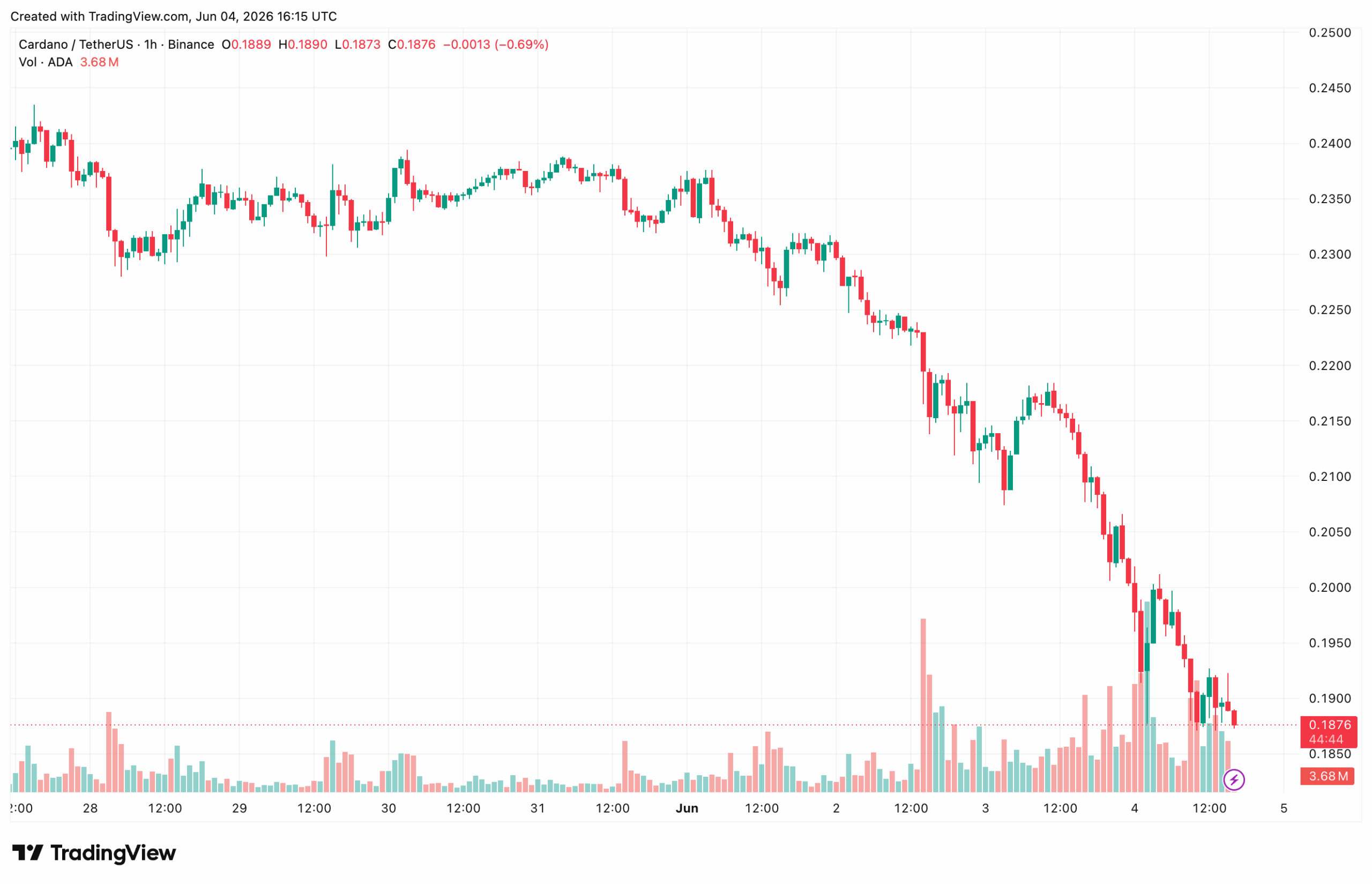
Cardano’s native cryptocurrency wasn’t spared today as the broader cryptocurrency market sees a wave of red. The altcoin crashed by about 11% in the past 24 hours, tumbling before the pivotal level of $0.20.
This follows a wave of declines throughout the past 24 hours, where the total market saw close to $2 billion worth of liquidated positions and billions removed from the market capitalization.
This also takes place as Charles Hoskinson, the person behind Cardano, suddenly announced that he’s “taking a break.”
I’m taking a break. TTYL
— Charles Hoskinson (@IOHK_Charles) June 3, 2026
There is no further context – we don’t know if this is just a vacation or if Hoskinson is stepping away from Cardano and the industry as a whole. That said, it doesn’t seem like ADA’s price action is that much influenced by the tweet – more so by the broader market decline.
The post Cardano (ADA) Plummets 11% Daily Below $0.2, Charles Hoskinson is Taking a Break appeared first on CryptoPotato.
Crypto World
Standard Chartered’s three ‘Ifs’ that stand between bitcoin and a market low: Crypto Daily
To say bitcoin bears are having a great time would be an understatement. The cryptocurrency has shed 14% in seven days, falling to levels not seen since the crash in February. Broader crypto markets have taken an equally brutal beating, and most analysts say the situation could deteriorate further if BTC breaks below the critical $60,000 threshold.
Amid the gloom, Standard Chartered’s global head of digital assets research, Geoff Kendrick, sees a different picture.
This week’s crypto pain was real, Kendrick said, but he thinks “the low is almost in.” His case rests on three pillars:
Strategy (MSTR) repeats its 2022 operation: When Strategy last sold BTC, in December 2022, it bought back more than it sold just two days later. Kendrick expects the firm to do the same after having sold 32 BTC last week. It could potentially buy as much as 100 times that amount, he said in an email, adding that, if confirmed next Monday, he’d treat it as a tentative signal that the low is in.
ETF holdings are sturdier than feared: The 11 spot ETFs listed in the U.S. have seen a net outflow of $5 billion over the past three weeks. Yet, if we zoom out, the holdings have barely moved. The cumulative net inflow since inception in early 2024 is back to $54.2 billion, right where it was earlier this year. “They went up from 682k and then back down to now 674k (broadly unchanged). This tells me that ETF holdings are more structurally strong than I had feared in February,” he said.
Liquidations are mostly done: bitcoin futures bets worth $1.5 billion have been liquidated by exchanges. That figure is similar to January’s, and with BTC already badly underperforming equities this year, the pool of leveraged longs left to liquidate is smaller than before, he argued.
The takeaway? There are too many “Ifs” involved to predict an exact bottom, but according to Kendrick, accumulating here makes more sense than waiting for certainty.
“I think when we look back at the end of 2026 with BTC at $100k and ETH at $4k we will say this was the buying zone we all wanted,” he said. Stay alert!
Read more: For analysis of today’s activity in altcoins and derivatives, see Crypto Markets Today . For a comprehensive list of events this week, see CoinDesk’s “Crypto Week Ahead.”
What’s trending
Today’s signal

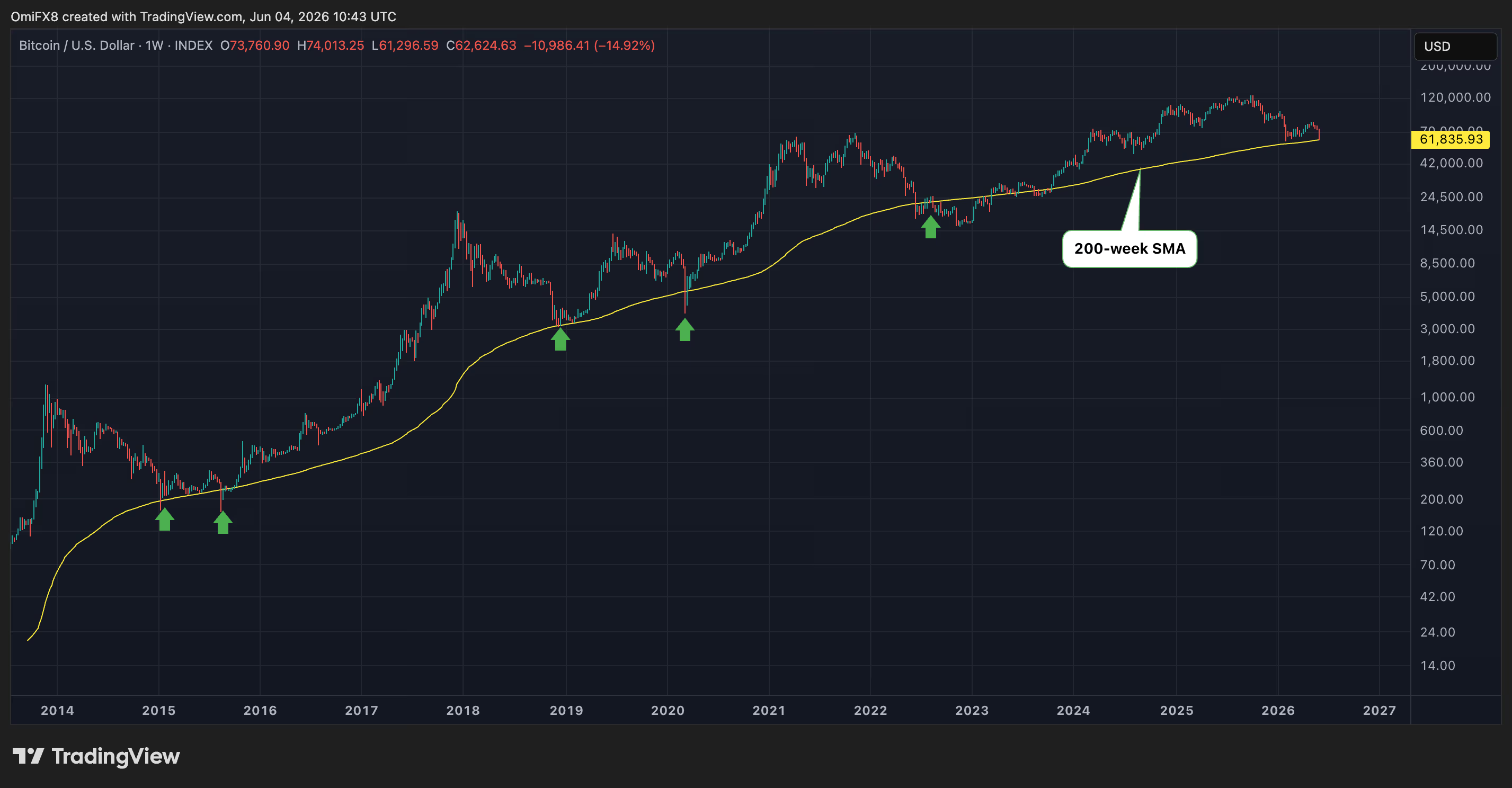
The weekly bitcoin price chart is suggesting the same as Standard Chartered’s Kendrick: The bear market is probably in its final stages and the bottom may be near.
The cryptocurrency is trading close to its 200-week simple moving average. That’s noteworthy because previous bear markets ended around the same average, as the green arrows on the chart show.
So, if past is a guide, then a bottom may happen soon. Note, however, that past patterns are no guarantee of future performance.


Kenya’s government says it will not retreat on a $13 million US-backed Ebola facility, with Health Cabinet Secretary Aden Duale declaring the country has “no apology to make” for the deal.
Speaking on national television, Duale defended the Laikipia Air Base site as one of 23 isolation centers and a product of more than two decades of US health cooperation. Neither a court order nor deadly protests have moved him.
“No Apology” on Live Television
Duale’s defense came in a combative interview, where he clashed with the host over who controls the facility and why the plan stayed quiet for so long. He insisted the project is Kenyan-run.
The base commander and Kenya Defense Forces medical leadership will reportedly oversee the site, he said, working with US colleagues. The unit would reportedly treat Kenyan security personnel and Americans alike.
He dismissed claims that the facility is reserved for US citizens. The 23 centers will serve any patient nationwide, he argued, including Kenyans returning from the outbreak zone.
“…we have no apology to make because we have partnered with the US in the health sector for over 23 years,” Duale said in the interview.
His 23-year figure tracks the US health footprint in Kenya. Through PEPFAR, launched in 2003, Washington has invested at least $8 billion in the country’s HIV response.
The $13 million at the center of the row is preparedness funding, not a price tag for one site. It followed a call between President Ruto and US Secretary of State Marco Rubio.
Duale put the US contribution at roughly 1.7 billion Kenyan shillings ($13 million) for the wider response.
He also rejected suggestions that someone was paid to secure the agreement, calling the question “pedestrian.”
On communication, he gave ground, conceding the government could have explained the plan earlier.
Sovereignty and the “Import” Question
Critics asked why Kenya would host a disease in a country with no recorded cases. Duale’s answer leaned on geography and obligation.
Thousands of Kenyans live and work in the Democratic Republic of Congo, he noted, alongside more than 450 soldiers in the UN peace mission. Sealing the country off would abandon them.
He pointed to World Health Organization guidance against closing borders during the outbreak. The virus, he said, does not recognize frontiers.
“We will not compromise the sovereignty and the nationality of our country”
Duale cited Sections 35 and 36 of the Public Health Act as the legal basis for his powers during an epidemic. He framed the centers as preparedness rather than a reaction to any local case.
The WHO declared the Bundibugyo strain outbreak a public health emergency on May 17. The strain has no licensed vaccine, which has heightened public fear.
He also questioned why this outbreak, the 17th by his count, has triggered such alarm. The missing vaccine, he suggested, is the real difference.
A Court Block, Protests, and Defiance
A High Court judge suspended the plan on May 29, after activists petitioned against the roughly 50-bed unit. On June 2, Justice Patricia Nyaundi extended the halt.
She gave the state seven days to disclose every agreement, approval, and protocol. The next hearing is set for June 23.
Despite the order, US equipment and specialists continued arriving at the base. Duale insisted the government respects the courts while pressing ahead with national preparedness.
The standoff turned violent. Two people were killed by gunshots during protests in Nanyuki, near the base, according to a protest organizer.
Duale blamed “paid up protesters” and urged local leaders to act responsibly. Opposition doctors and civil society groups counter that the deal trades biosecurity for foreign aid without proper consultation.
He sought to reassure the public with numbers. Kenya has screened more than 72,000 travelers across 26 ports of entry, he said, and detected no Ebola case at home.
Washington frames the project as mutually beneficial. The United States says it is the largest contributor to the response, having pledged more than $162 million.
However, Marco Rubio recently said the US will not allow any cases of Ebola to enter the country.
That marks a reversal. During the 2014 outbreak, the US flew infected citizens home to biocontainment units such as Emory University Hospital in Atlanta. This plan keeps exposed Americans outside the country instead.
The court’s disclosure deadline will test how much of the agreement was negotiated in public view. The result may shape how Kenya, a self-styled regional health hub, strikes future deals with powerful partners.
The post Kenya Defends $13 Million US Ebola Quarantine Plan Amid Court and Civil Unrest appeared first on BeInCrypto.


Russia sanctioned a British teenager for his role in exposing the alleged use of ruble-pegged stablecoin A7A5 in funding the war effort against Ukraine.
Alexander Browder, 17, penned a report for foreign policy and national security think tank The Henry Jackson Society, which the Russian Foreign Ministry described as spreading “defamatory speculations and false information.”
Browder, who is the son of Vladimir Putin critic Bill Browder, was sanctioned along with three other U.K. nationals and Washington Post reporter Catherine Belton.
He described it as “a badge of honour” in a post on X on Wednesday.
The A7A5 stablecoin was designed to bypass sanctions imposed on Russia following its invasion of Ukraine in 2022.
Ripple’s native token has plunged alongside the rest of the crypto market, recording a steep drop in recent days.
This comes even as the company continues to expand globally and institutional interest in the asset remains solid.
Partnerships and More
Ripple has been inking strategic deals lately, and many have focused on its USD-pegged stablecoin, RLUSD. Earlier this week, the firm shook hands with the Turkish crypto platforms BiLira, Bitexen, and Bitlo, aiming to boost adoption and usage of the product.
Moreover, it partnered with Istanbul Technical University (ITU) through RLUSD funding to support research initiatives and graduate fellowships, and establish an on-campus XRPL validator.
Most recently, the global payments giant Mastercard enhanced its infrastructure to enable merchants and partners to settle transactions using various digital assets, including RLUSD.
Besides the collaborations related to the stablecoin, Ripple strengthened its presence in its homeland by opening an expanded office in Washington, D.C., thus reinforcing its “long-term commitment to constructive engagement with policymakers, regulators, and industry partners in the nation’s capital.” Speaking on the matter was Stuart Alderoty:
“Expanding our Washington, D.C. presence reflects our long-term commitment to constructive engagement, regulatory clarity, and U.S. leadership in financial innovation. As blockchain and digital assets become more integrated into the financial system, Ripple is committed to helping shape policy that protects consumers, supports responsible innovation, and keeps America competitive.”
The ETF Front
Unlike spot BTC and ETH exchange-traded funds, those with XRP as the underlying asset have attracted substantial capital lately. Data show that inflows have outpaced outflows over the past several weeks, indicating that institutional investors have increased their exposure to the token, thereby requiring the products’ issuers, including Bitwise, Canary Capital, Franklin Templeton, 21Shares, and Grayscale, to purchase real XRP.
However, June 3 finally ended the positive streak, as spot ETFs posted a daily net flow of -$5.34 million. Since their launch, these financial vehicles have generated a cumulative total net inflow of more than $1.42 billion.

XRP Price Outlook
Ripple’s cross-border token is down 10% for the week, and that shouldn’t come as a surprise. After all, the entire crypto market has been bleeding heavily, with Bitcoin (BTC) dropping to nearly $61,000 and Ethereum (ETH) tumbling to roughly $1,700.
Recent whale activity suggests the XRP bulls may suffer further pain in the near future. As CryptoPotato reported, these big investors have sold or redistributed 60 million tokens over the last seven days. Such an exodus could spark panic across the community and cause smaller players to cash out, too. Meanwhile, some analysts believe the price could slip under $1 in the short term.
The post Ripple News and XRP Price Update Today: June 4 appeared first on CryptoPotato.
Hyperliquid’s HYPE token, one of crypto’s best-performing assets this year, tumbled following its record run as longtime bull Arthur Hayes revealed he had sold his entire position just days after predicting much higher prices.
“I just dumped my entire HYPE and NEAR position,” Hayes, co-founder of BitMEX and chief investment officer at family office Maelstrom, wrote on X.
The selloff pulled HYPE back to $67 from record highs near $75, though the token remains up more than 70% since mid-May.
Hayes said the decision reflected growing caution about broader markets rather than a change in his view of Hyperliquid. He pointed to rising energy prices tied to the Iran conflict, several high-profile AI IPOs expected in the coming months and his belief that financial markets could peak between now and September.
“Time to take profit,” he wrote.”
The abrupt exit caused backlash in crypto circles because Hayes had been among Hyperliquid’s most vocal supporters. Just days earlier, he reiterated a $150 price target for HYPE and, in a March essay, laid out a roadmap for how the token could reach that level.
Arthur Cheong, founder of crypto investment firm DeFiance Capital, described the move as “the epitome of a guy that over-trades his position” in an X post.
Others questioned why investors continue to treat Hayes’ market calls as actionable signals.
Crypto trader TraderSZ, who has more than 683,000 followers on X, noted that Hayes had recently argued HYPE could be among the year’s best-performing assets before announcing the sale.
One of crypto’s biggest winners
Hyperliquid and its token, HYPE, have been standout performers over the past few weeks as the broader crypto market remained under pressure.
As bitcoin fell back to near its 2026 lows at $60,000, HYPE notched fresh all-time highs and remains up 166% year-to-date even with Thursday’s decline.
The project operates a blockchain-based onchain perpetual futures exchange, allowing users to trade cryptocurrencies and other assets through a transparent order book rather than relying on a centralized venue.
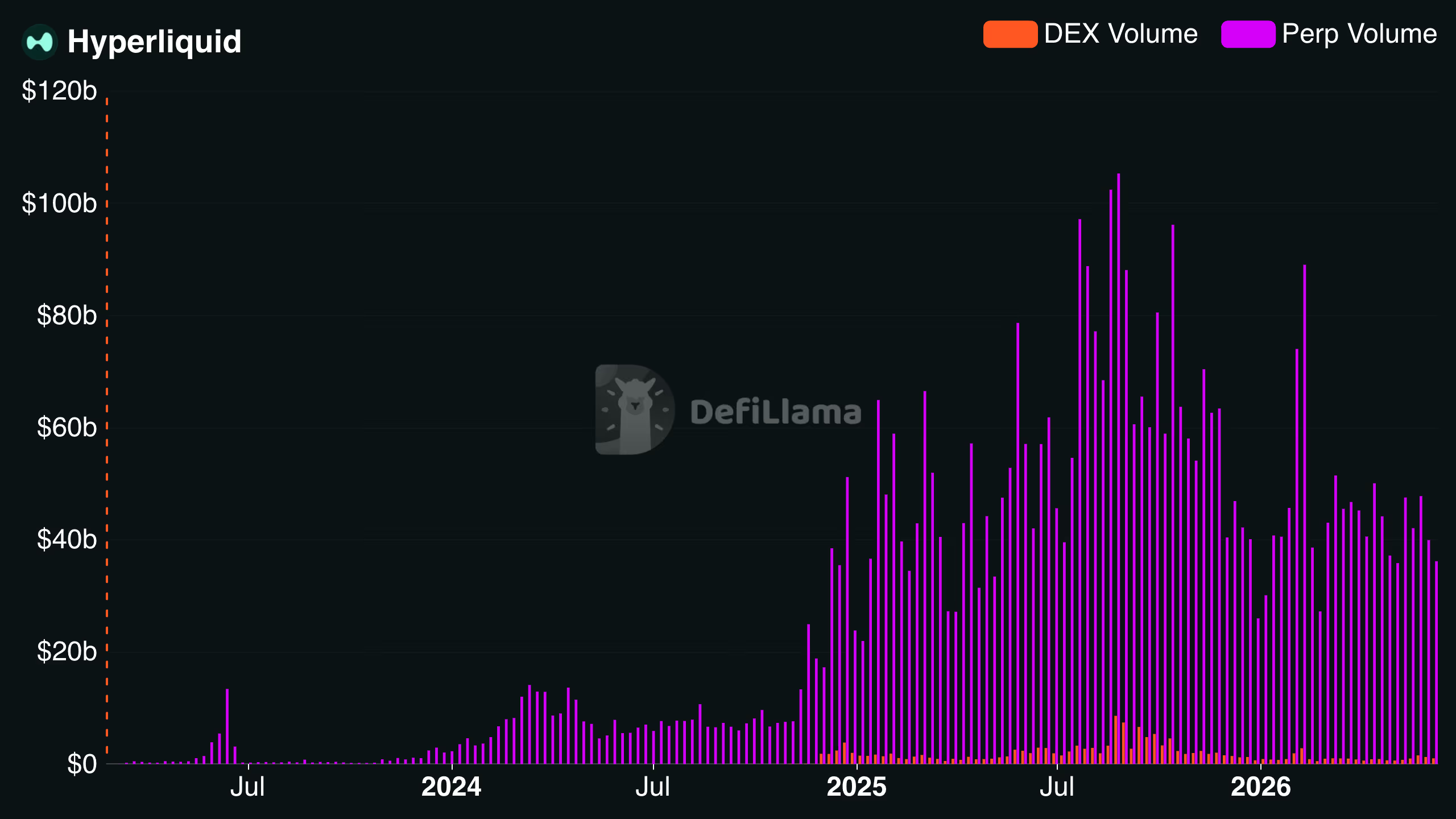
The platform has rapidly gained market share, clearing around $40 billion in weekly perp volume and $1 billion in spot assets, and has emerged as one of the closely monitored venues for weekend commodity prices and pre-IPO stocks.

HYPE rally got overheated
But the 100% gain in a month put the move overextended from the project’s fundamentals, noted Markus Thielen, founder of 10x Research.
In a report earlier this week, Thieled said Hyperliquid remained “one of the most impressive businesses in crypto,” citing its roughly 77% gross margins, fully onchain trading infrastructure and token buyback program funded by protocol revenue.
At recent highs near $75, HYPE traded at roughly 25 times projected fee revenue, near the richest levels seen over the past year, according to Thielen. Meanwhile, protocol revenue remains well below its peak, and a large token unlock scheduled for June could introduce additional selling pressure.
“We have been vocal HYPE bulls,” Thielen wrote. “But at current prices, the risk-reward has shifted.”
The long-term bull case is still compelling, he said. If trading activity recovers toward previous highs and new products attract more users, HYPE could eventually justify significantly higher prices.


Digital trading platform Moomoo said Thursday it had partnered with prediction market operator Kalshi to bring CFTC-regulated event contracts to eligible users, allowing them to trade on the outcomes of major economic, political and cultural events directly through the brokerage’s platform.
The offering gives users access to contracts linked to events such as Federal Reserve interest-rate decisions, inflation data releases, elections and the 2026 FIFA World Cup, the New York-based company said in a press release.
Event contracts are exchange-listed derivatives that allow traders to take positions on whether a specific outcome will occur. Prices range from $0.01 to $1 and represent the market’s implied probability of an event happening. The contracts are fully collateralized and integrated alongside Moomoo’s existing equities, options and exchange-traded fund (ETF) offerings.
Prediction markets have exploded in popularity since the 2024 U.S. election, evolving from a niche forecasting tool into a fast-growing corner of the retail trading market.
Platforms such as Kalshi and Polymarket have expanded beyond politics into sports, macroeconomic data and cultural events, attracting billions of dollars in trading volume. Combined monthly volume on the two largest platforms climbed from under $5 billion in September 2025 to about $24 billion by April 2026, underscoring growing investor appetite for event-driven markets.
“Our focus is on providing investors with both access and understanding,” Nate Palmer, president of Moomoo U.S., said in emailed comments. “Through event contracts and supporting educational resources, we’re giving users additional tools to analyze and engage with significant real-world events.
Kalshi, which has emerged as the dominant U.S. prediction market platform, said the partnership will broaden access to event-based trading.
The launch comes as interest in prediction markets continues to grow. By integrating Kalshi’s contracts, Moomoo joins a growing list of brokerages offering retail investors exposure to event-driven markets.
The partnership also expands Moomoo’s product ecosystem. The company recently introduced direct crypto deposits and withdrawals and launched moomoo API Skills, a feature designed to support AI-powered investing tools.
Read more: Gemini taps SpaceXAI to build a personalized prediction markets feed
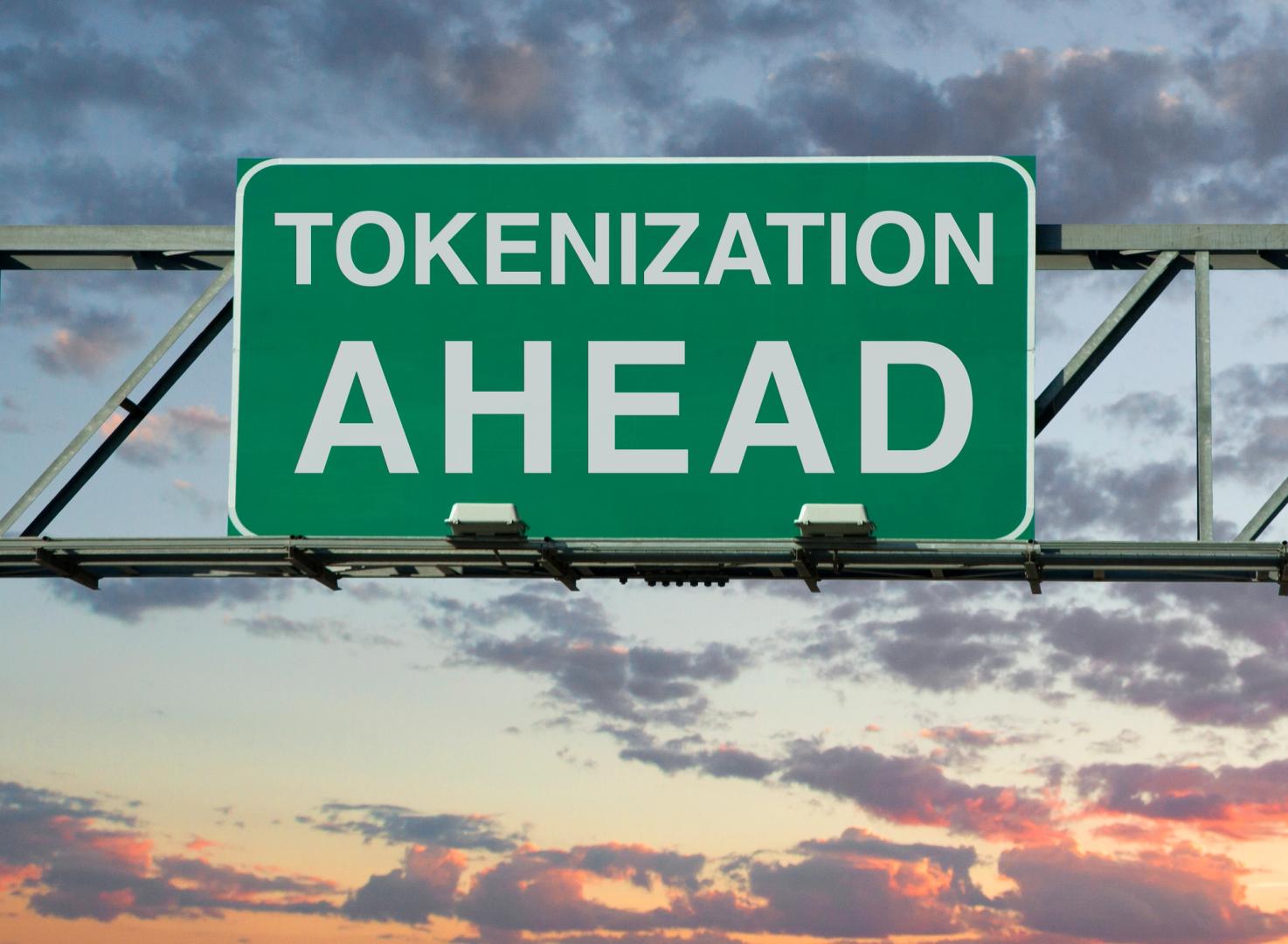
In the 1990s, exchange-traded funds (ETFs) were a novel idea. Many saw them simply as a new wrapper for traditional assets – a convenient repackaging of mutual funds. In reality, ETFs triggered a market structure revolution. By introducing creation/redemption mechanisms and arbitrage-driven liquidity, ETFs fundamentally changed how markets functioned and how investors accessed assets. ETFs blurred the line between primary and secondary markets and turned arbitrage into the mechanism for holding the system together.
How does tokenization mirror the ETFs market structure revolution? In almost every key aspect.
A robust tokenized asset isn’t simply “issued” once like a stock or bond – it typically can be minted or burned on demand against some pool of underlying assets or rights. For example, when a token represents shares of a fund or stock, authorized participants (or smart contracts acting as such) should be able to deposit the underlying and mint new tokens or redeem tokens for the underlying assets.
If the token trades above the value of its underlying holdings, arbitrageurs will mint new tokens (injecting supply) until prices realign; if it trades below, they will redeem tokens (reducing supply) until the discount closes. The economic principle is identical to ETFs. The token is a wrapper on the same assets, and arbitrage keeps its price honest.
With respect to both ETFs and tokenization, the wrapper is simply a liquid representation of a basket of economic exposures. An ETF share is not the underlying securities themselves, but a standardized claim on a basket that trades efficiently because creation and redemption keep it aligned with the underlying assets. Tokenization follows the same logic. The token becomes the liquid instrument, while the underlying assets remain the economic anchor. What matters is not the form of the wrapper, but the strength of the arbitrage link between wrapper and basket.
ETFs already represented a major leap in transparency by making baskets of assets trade continuously on-exchange, with visible prices, intraday liquidity, and alignment with underlying value through arbitrage. Tokenization builds on this foundation. Where blockchains can go further is in making issuance, transfers and outstanding supply observable in near real time, potentially widening visibility into how the wrapper evolves relative to the underlying basket.
One of the most important features of tokenized markets is their ability to trade continuously, even when underlying markets are closed. For anyone who has traded ETFs globally, this is not new but a familiar and highly valuable market‑structure capability. Continuous trading outside local market hours allows prices to incorporate new information as it emerges, rather than waiting for the next open, and enables investors across time zones to transfer risk when they actually need to. These prices reflect informed expectations — built using correlated instruments, futures, FX, and broader market signals — in the same way international and cross‑timezone ETFs have operated for decades.
U.S.-listed ETFs that hold European or Asian equities already demonstrate how credible pricing can exist when the underlying cash market is closed. Those ETFs continue to trade during the U.S. session even after Europe or Asia has shut, and their market price naturally reflects updated expectations — based on futures, FX, ADRs, macro news and other correlated signals — rather than stale closing prints. In practice, authorized participants and market makers continuously estimate an “intrinsic fair value” for the ETF, including an expected next-open price for holdings in closed markets, and quote around that to keep the ETF’s market price anchored to that fair value.
The same concept can be applied to tokenized Apple stock, for example, which can trade on Saturday based on the evaluation of Apple’s likely next trading price come Monday. If big news broke on Saturday, you’d see the token react immediately. Liquidity providers would quote a price that factors in that news, likely hedging with any related instruments, such as Nasdaq futures, if available. By Monday’s open, Apple’s real stock price would likely catch up to wherever the token traded over the weekend. In effect, the token becomes a leading indicator for the underlying stock.
Market participants (especially across different time zones) don’t all operate on U.S. Eastern Time. A European investor holding a tokenized U.S. bond fund might love the ability to adjust positions at 8 p.m. CET on a Friday, rather than waiting until Monday. While providing liquidity 24/7 raises the “cost of carry” or the risk of holding a position when underlying markets are closed. In practice, this just means spreads might be a bit wider during purely off-hour trading, as they are, say, in currency markets on a holiday – but the key difference is that the digital asset market stays open. And as more participants join and risk management tools improve, these costs diminish. In the long run, a 24/7 market should become as natural as the 24/5 FX market is today.
The current tokenization dialogue closely resembles the early days of ETFs: initial skepticism, early traction in niche segments and increasing institutional involvement. That same pattern ultimately transformed ETFs into a $10+ trillion market.
I firmly believe tokenization is on the same path, because the structural forces pushing it forward are the same ones that made ETFs successful. The relevant test is not technological novelty, but whether it improves efficiency, access and system-level robustness. Where those conditions are met, tokenization is not merely comparable to the ETF evolution — it represents its logical continuation.

TLDR
- Travala launched an AI travel protocol enabling automated booking and payment execution across hotel listings.
- The system operates on Base Layer 2 and supports gasless USDC transactions with near-instant settlement.
- The protocol uses x402 standard to enable direct internet payments without manual checkout steps.
- AI concierge manages travel planning, bookings, and cancellations within a single chat interface.
- ERC-7715 session keys ensure secure transactions while users retain final wallet authorization.
Travala introduced an agentic AI travel protocol that enables automated booking, payments, and settlement across hotel properties. The system operates on Base Layer 2 and supports gasless USDC transactions for near-instant settlement. The company said the protocol allows software agents to complete travel workflows before final user authorization.
Travala Integrates Agentic AI with Base for Automated Bookings
Travala said the new Travel MCP protocol allows autonomous agents to search and reserve hotel listings without manual input. The system uses conversational AI to manage travel planning inside a single chat thread.
The company stated that the AI concierge can maintain context across bookings, cancellations, and itinerary updates. It operates through Claude while handling travel actions in sequence.
Travala confirmed that the protocol supports over 2.2 million properties across 230 countries on its platform. The system connects search, booking, and payment layers through one integrated interface.
The company explained that agentic workflows reduce friction across traditional booking processes. It added that automation removes multiple manual checkout steps for users.
Travala noted that the protocol uses ERC-7715 session keys to secure transaction requests. It said the system ensures that users retain final signing authority within their wallets.
Gasless USDC Payments and x402 Standard Power Settlement Layer
Travala said the protocol integrates the x402 open payments standard for direct internet-based transactions. The company explained that agents can complete payments without redirecting users to external checkout systems.
It stated that USDC transactions on Base execute without gas fees for end users. The firm added that settlement occurs almost instantly with costs near $0.01 per booking.
Travala said the infrastructure supports programmable payments for APIs, applications, and AI systems. It noted that this design enables continuous execution without interruption.
The company also introduced ERC-8004 as part of the protocol’s trust framework. It said the standard enables machine-verifiable tracking of performance and execution.
Travala confirmed that developers can build AI agents on the protocol and receive incentives. It stated that participants will receive a 10% rebate in cbBTC for integrations.
The firm said future updates will expand support to flights and other travel services. It added that the AVA token will continue to support its loyalty and rewards system.


Breaking down the better-for-you snacking opportunity

Saylor downplays BTC slide as MicroStrategy faces $11B paper loss

Young adaptive clothing line hosts first Disability Pride Catwalk in Manchester



-

 Tech7 days ago
Waymo dominates autonomous vehicle registrations as Tesla trails behind
-

 News Videos6 days ago
This is BROKEN! INSANE 5x MONEY CAR WASH WEEK! The NEW GTA Online UPDATE Today! (GTA5 New Update)
-
 Tech5 days ago
SpaceX just won a second Golden Dome contract. This one is $4.16 billion.
-

 Business3 days ago
Jade Biosciences, Inc. (JBIO) Discusses Positive Interim Results From JADE101 Phase I Healthy Volunteer Study and Development Plans Transcript
-
 News Videos6 days ago
SHE IS KILLING XRP!!! WATCH URGENT AND ACT FAST
-
 NewsBeat6 days ago
FIRST NIGHT REVIEW: Take That bring the Circus back to life in spectacular sun-soaked style
-

 Business5 days ago
Is the Spurs Phenom Already Better Than Prime Diesel?
-
Crypto World6 days ago
CFTC Has Approved the First Regulated Bitcoin Perpetual Contract in the U.S.
-

 Politics5 days ago
The House | Inside Andy Burnham’s Makerfield Campaign: “Nobody Thinks This Is In The Bag”
-

 Sports2 days ago
French Open 2026 results: Alexander Zverev beats Rafael Jodar and will play Jakub Mensik in semi-finals
-
 NewsBeat6 days ago
Novak Djokovic v Joao Fonseca LIVE: French Open latest scores and results after Jannik Sinner’s shocking collapse
-
 Entertainment6 days ago
Weak ‘Supergirl’ Box Office Tracking Amid Milly Alcock Backlash
-

 Tech2 days ago
CryZENx Releases Fresh Playable Content Deep Inside Jabu-Jabu for His Ocarina of Time Remake
-
 Crypto World6 days ago
Snowflake (SNOW) Stock Rallies on Strong Q1 Results and AI Product Growth
-

 Entertainment6 days ago
Maddox Jolie-Pitt Legally Requests to Drop Brad’s Surname
-

 Business5 days ago
Demand Conditions Improve In Chemicals Sector In April 2026
-
 Entertainment5 days ago
One of the Greatest Sitcoms of All Time Shoots Up Apple TV’s Charts 11 Years Later
-
 Crypto World6 days ago
MicroStrategy Moves $30 Million in BTC to Coinbase Prime: Is the Bitcoin Sell-Off Already Here?
-

 Tech6 days ago
This Week In Security: Ubiquiti Fixes, And FreeBSD Joins The Club You Don’t Want To Join
-
 Crypto World2 days ago
Seagate (STX) Stock Surges to Record High on AI Boom and Legal Settlement
You must be logged in to post a comment Login