

Crypto World
Bitcoin (BTC) Price: Senate Backs CLARITY Act as Macro Pressures Mount

Key Highlights
- Senate Banking Committee passed the CLARITY Act with bipartisan support (15-9), triggering widespread optimism across crypto social channels.
- Sentiment analysis from Santiment reveals bullish-to-bearish ratio of 1.55:1, though the platform cautions against following crowd psychology.
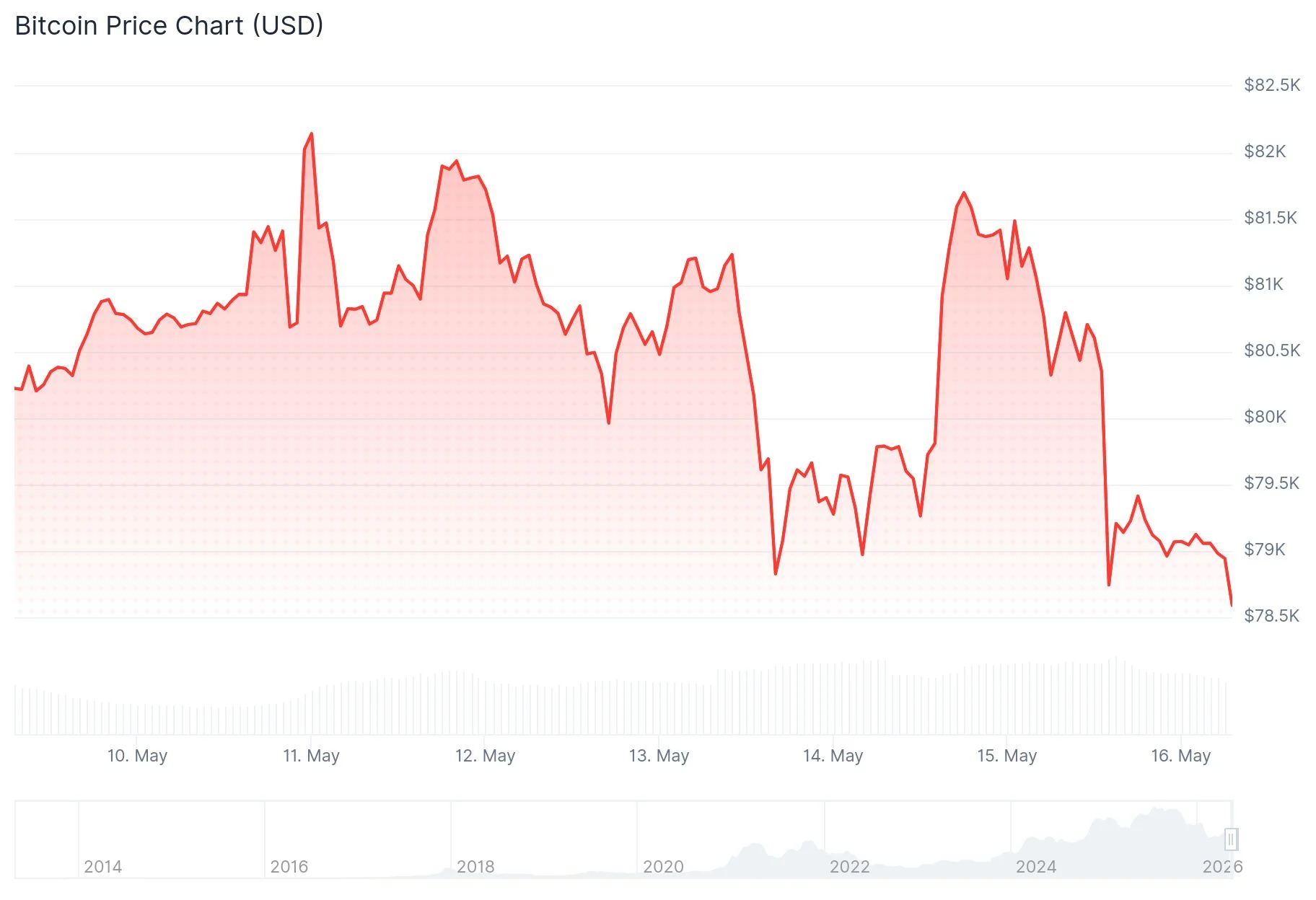
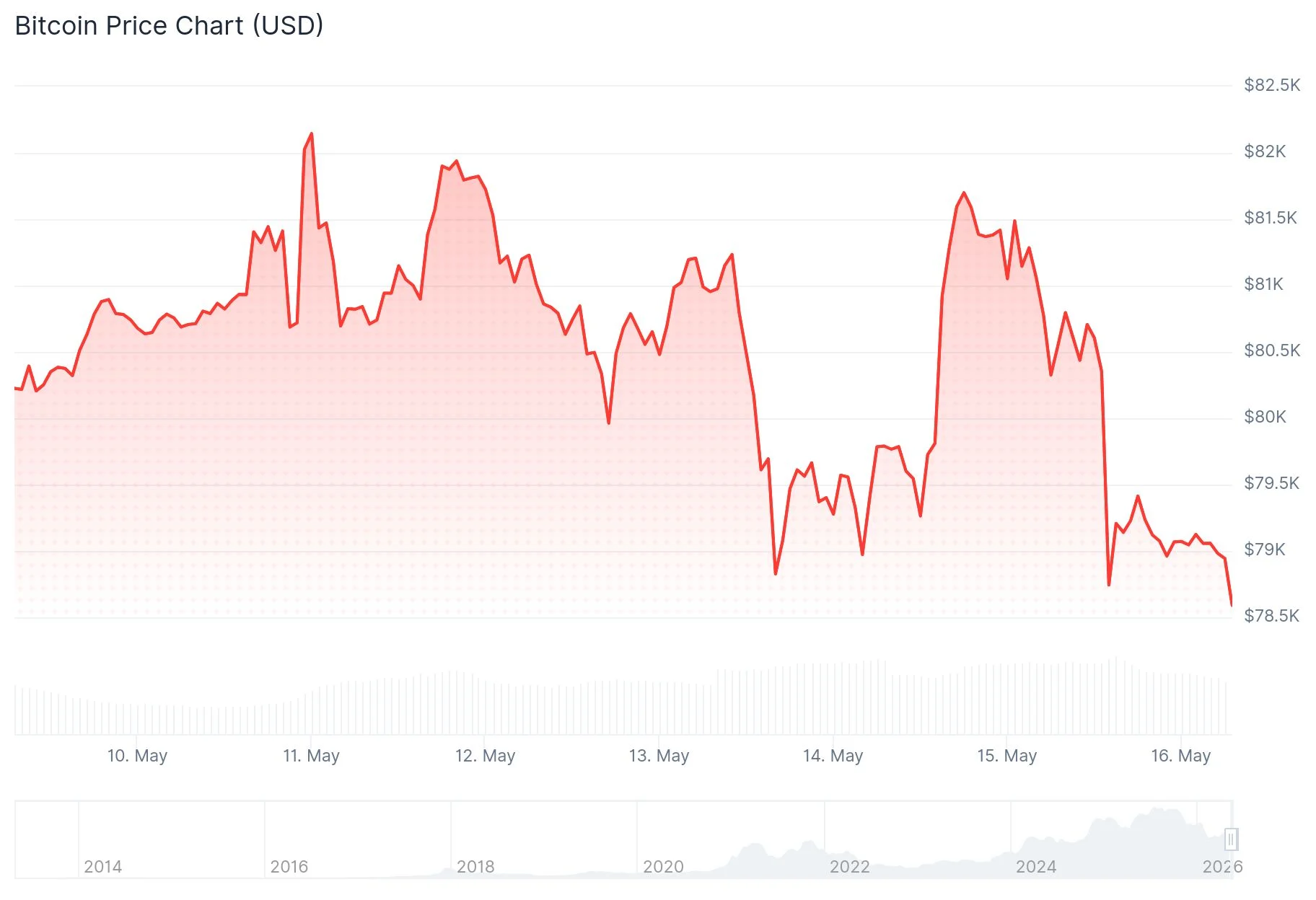
- BTC trades in the $79K-$80K range, showing a modest 3% gain since the start of May, yet remains down approximately 23% year-over-year.
- The 10-year US Treasury yield climbed above 4.55%, creating downward pressure on Bitcoin and broader risk assets.
- Spot Bitcoin ETFs experienced $290.4 million in net withdrawals on May 15, per CoinCentral data.
Bitcoin continues to consolidate around the $80,000 threshold as competing forces — positive regulatory developments and challenging macroeconomic conditions — create a tug-of-war in the marketplace.
The week’s headline development centers on the Senate Banking Committee’s advancement of the Digital Asset Market Clarity Act, commonly referred to as the CLARITY Act, which passed by a 15-9 margin. The measure received unanimous support from all 13 Republican committee members along with two Democrats, while nine Democrats opposed the bill.
Crypto analytics firm Santiment characterized the social media response as showing “a major spike of euphoria.” According to their metrics, positive commentary about Bitcoin currently outpaces negative sentiment by a ratio of 1.55 to 1.
Yet Santiment accompanied this observation with a cautionary note. “We advise caution. Markets typically move opposite to the crowd’s expectations at all times,” the company stated via their X platform.
White House digital asset advisor Patrick Witt offered measured commentary as well. Describing the committee’s decision as “a major step forward,” Witt emphasized via X that “there’s more work to be done before this legislation is ready for prime time.”
Conversely, Michael van de Poppe from MN Trading Capital struck an optimistic tone. In a Friday X post, he characterized the CLARITY Act as “the biggest, and historical, bill for the entire industry,” suggesting it “can be a strong trigger for the upcoming bull market.”
Santiment offered additional perspective, suggesting the bill’s passage could attract institutional capital that has remained dormant amid regulatory ambiguity. However, the firm also cautioned that significant cryptocurrency price movements may already be “baked in” ahead of any official legislation signing.
Macro Headwinds: Rising Yields and ETF Withdrawals
The broader financial landscape presents a more nuanced picture. Friday saw the 10-year US Treasury yield push beyond 4.55% — marking its peak since May 2025. Meanwhile, the 30-year bond yield reached 5.12%, a level not witnessed since June 2007.
As bond yields climbed, Bitcoin retreated below the $80,000 threshold during New York trading hours, tracking movements in US equity markets. The S&P 500 similarly surrendered its weekly gains. Bitcoin registered 24-hour losses ranging from 2.43% to 2.68% depending on the data provider.
Investment vehicle flows painted an additional bearish picture for May 15. Bitcoin ETFs collectively experienced $290.4 million in net redemptions. Ethereum ETFs saw $65.7 million in outflows, while Solana ETFs registered neutral activity with zero net movement.
The Crypto Fear & Greed Index registered 31 on Saturday, placing market sentiment firmly in “Fear” territory.
Technical Perspective Remains Constructive for Some
Not all market observers are adopting a defensive stance. Analyst Kaleo highlighted on X that Bitcoin’s support levels have been progressively rising throughout the year. “Have you noticed throughout the year the figure they’re using for the lower end keeps climbing higher and higher?” he observed. “New all time highs are still on the table this year. Zoom out and keep stacking.”
Bitcoin’s 200-day exponential moving average currently stands at $82,941, a technical level that has repeatedly rejected upward price attempts during the recent rally phase.
BTC trades approximately 30% beneath its October 2025 record high. As of this writing, Bitcoin is valued at roughly $79,084, representing a 3.15% increase since the beginning of May.



Disclosure: This article does not represent investment advice. The content and materials featured on this page are for educational purposes only.
Poly Truth and Meme Punch join major crypto assets in 2026 “best crypto to buy now” discussions.
Summary
- Poly Truth (PTRUE) and Meme Punch (MEPU) are presales combining AI prediction tools and play-to-earn gaming models.
- PTRUE analyzes prediction markets using data scrapers, AI scoring, and reports, while MEPU powers a meme-based PvP game economy.
- Both tokens feature public tokenomics and audits, aiming to attract early-stage investors seeking utility-driven crypto projects.
The question of which is the best crypto to buy now does not have one clean answer. As June 2026 approaches, the market is divided between two groups: large-cap coins maintaining their position and a new round of presale projects attracting investors interested in earlier entries.
Six selections from both groups are included in the list below. Poly Truth and Meme Punch are two active presales with public tokenomics and audit information. The other four are well-known names that regularly appear on lists such as these for valid reasons.
Best crypto to buy now: The 6 picks
1. Poly Truth (PTRUE)
Poly Truth is a research tool built for people active on prediction markets. The idea is simple: most participants on platforms like Polymarket read the same headlines and follow the same accounts, which leaves the information edge thin. Poly Truth pulls research together before the betting window closes.
There are 3 stages to the system’s operation. “The Runners” are a group of data scrapers that collect data from social media, news websites, market data, and historical records. After evaluating that data, an analysis layer known as “The Starlet” generates probability scores for every potential result. “The Presenter” is the last layer, which organizes everything into a readable brief that explains which outcomes have the best case and why.
$PTRUE is an ERC-20 token with a supply of 11.5 billion. 10% is allocated to staking rewards, 17% to liquidity, 40% to presale, and 10% to a team allocation with a 12-month vest and a 3-month cliff. SolidProof and Coinsult audited the smart contract, and both reports were released.
2. Meme Punch (MEPU)
Meme Punch approaches using a token in a different way. In a battle arena with a medieval theme, players choose a knight and engage in combat with other players to earn rewards using MEPU, the in-game currency. Each of the five playable characters — Pepe, Doge, Floki, Brett, and Pudgy Penguin — is dressed in full armor and is taken from memecoin culture.
PvP combat is the main flow. Players who win move up the leaderboard and are rewarded with MEPU. Because the token can be used to purchase weapons, character skins, and special abilities within the game, demand for MEPU is linked to player activity rather than just market sentiment.
The total supply of the Ethereum-based token MEPU is 10 billion. Presale takes up 40% of the allocation, followed by marketing (16.5%), staking (14.5%), DEX and CEX liquidity (12%), in-game rewards (9.5%), and project funds (7.5%).

3. Bitcoin (BTC)
As of mid-May 2026, the price of Bitcoin was $79,235, with a $1.58 trillion market capitalization and a daily volume of about $41 billion. Of the fixed 21 million supply, about 20 million are currently in circulation, and 1.31 million BTC are currently held in corporate and institutional treasuries.
Bitcoin continues to be the standard for a list of top-rated selections through June 2026. No matter the short-term price action, it consistently appears at the top of allocation talks due to a hard supply cap, rising treasury allocations, and ongoing ETF flows.
4. Ethereum (ETH)
Midway through May 2026, Ethereum traded at $2,227, with a $268 billion market capitalization and daily volume exceeding $19 billion. There is no hard cap on issuance, and the current circulating supply is 120.68 million ETH.
Because Ethereum is the default layer for the majority of the activity that defines this period, it should be on a high-credibility list going into June 2026. Along with the majority of stablecoin volume, DeFi, and the biggest NFT markets, it is the foundation for both Poly Truth and Meme Punch.
5. Solana (SOL)
With a market capitalization of $51.87 billion and a daily volume of about $4.16 billion, Solana is trading at $89.73 in mid-May 2026. Out of 626 million SOL, the circulating supply is at 578 million. With low fees that maintain retail flow throughout the chain, it has managed most of the meme coin trading volume and consumer app activity over the past year. Current entries are significantly below recent highs due to the price’s 48% decline over the previous 12 months.
6. Chainlink (LINK)
With a $7.35 billion market capitalization and a $678 million daily volume, Chainlink is trading at $10.11 in mid-May 2026. Out of a total cap of $1 billion, the circulating supply is currently at 727 million LINK. Chainlink’s place in the data layer of cryptocurrency is the reason it is on a high-credibility list for June 2026. The majority of DeFi protocols rely on this oracle network for price feeds, and tools like Poly Truth require this type of off-chain data infrastructure to operate. Over the last 12 months, LINK has decreased by 39%, which has lowered entry levels.
Final thoughts
The six picks listed above can be put into three categories. The Ethereum-based presale entries are Poly Truth and Meme Punch, one of which focuses on a play-to-earn game and the other on prediction market research.
The two biggest and most popular cryptocurrency assets are Ethereum and Bitcoin. Chainlink provides the data feeds that other cryptocurrency projects use to link to real-world information, and Solana is known for its quick and affordable transactions.
Presale tokens cannot be traded until the projects are listed on an exchange, so anyone who buys during the presale period must wait for the claim to open before selling. Both Poly Truth and Meme Punch have tokenomics and audit details available on their official websites.
Disclosure: This content is provided by a third party. Neither crypto.news nor the author of this article endorses any product mentioned on this page. Users should conduct their own research before taking any action related to the company.
Crypto World
ONDO’s Three-Product Protocol Hits $3.778B TVL as Institutional Giants Join Settlement Pilots

TLDR:
- Ondo Global Markets crossed $1B TVL in under eight months, the fastest for any tokenized equity platform.
- USDY delivers 3.5% APY backed by U.S. Treasuries, with TVL between $2.15B and $2.7B across DeFi chains.
- OUSG completed a cross-border treasury pilot with JPMorgan, Ripple, and Mastercard in under five seconds.
- ONDO reached $3.778B in total TVL across 165+ partners, including BlackRock and Franklin Templeton.
ONDO, trading at $0.34 as of this writing, is the native token of a protocol running three separate financial products. Most token holders are only aware of one. Each product targets a different audience and solves a distinct problem in finance.
Together, they represent a full-stack infrastructure play for real-world asset tokenization. The protocol’s total value locked reached $3.778 billion across all three products as of May 14, 2026.
Ondo Global Markets Leads in Tokenized Equity Access
Ondo Global Markets offers non-U.S. investors direct on-chain access to U.S. stocks and ETFs. The platform lists over 260 tokenized securities, including Tesla, NVIDIA, Apple, Amazon, QQQ, and SPY. Entry starts at $100, with 24/7 trading and instant settlement. No brokerage account or T+1 delays apply.
The product crossed $1 billion in TVL in under eight months. That marks the fastest growth of any tokenized equity platform on record.
TVL doubled from $500 million to $1 billion between January and May 2026. Cumulative trading volume has reached $18 billion across Ethereum, Solana, and BNB Chain.
Ondo Global Markets currently holds over 70% global market share in tokenized stocks and ETFs. Underlying U.S. securities are held by a regulated custodial broker-dealer, backed 1:1 with a capital buffer.
The growth curve has remained nearly vertical with no visible slowdown. This product drives the current tokenized equity narrative across crypto markets.
As analyst @2xnmore observed, “The growth curve is nearly vertical and it has not slowed.” The product is designed specifically for non-U.S. retail and institutional investors.
Users gain U.S. capital market exposure directly through a crypto wallet. No intermediary or traditional brokerage is required.
USDY and OUSG Capture Yield Demand and Institutional Infrastructure
USDY is a yield-bearing token backed by short-term U.S. Treasuries and money market instruments. It currently offers approximately 3.5% APY, accruing daily directly into the token value. No lock-up period is required. Holders of USDC or USDT earn nothing, while USDY compounds daily.
USDY TVL sits between $2.15 billion and $2.7 billion, with minimal retail attention to date. The token is transferable across chains and composable with DeFi protocols.
It ranks among six major contributors driving the tokenized U.S. Treasury market past $12.88 billion. Yield-bearing stablecoins like USDY are positioned to replace passive alternatives in the next market cycle.
OUSG is the institutional layer of the ONDO protocol, built for accredited and qualified purchasers. It is a tokenized short-term U.S. Treasury fund with 24/7 mint and redeem functionality.
In May 2026, OUSG featured in a cross-border treasury redemption pilot with JPMorgan, Ripple, and Mastercard. That transaction settled in under five seconds across international banking rails.
The pilot also involved BlackRock’s BUIDL fund as a core partner. Over 165 ecosystem partners now include Franklin Templeton, MetaMask, Broadridge, and XRPL.
Ondo additionally launched Ondo Chain, a Layer 1 blockchain purpose-built for real-world asset infrastructure. The protocol now operates across equities, yield, institutional settlement, and its own native chain.
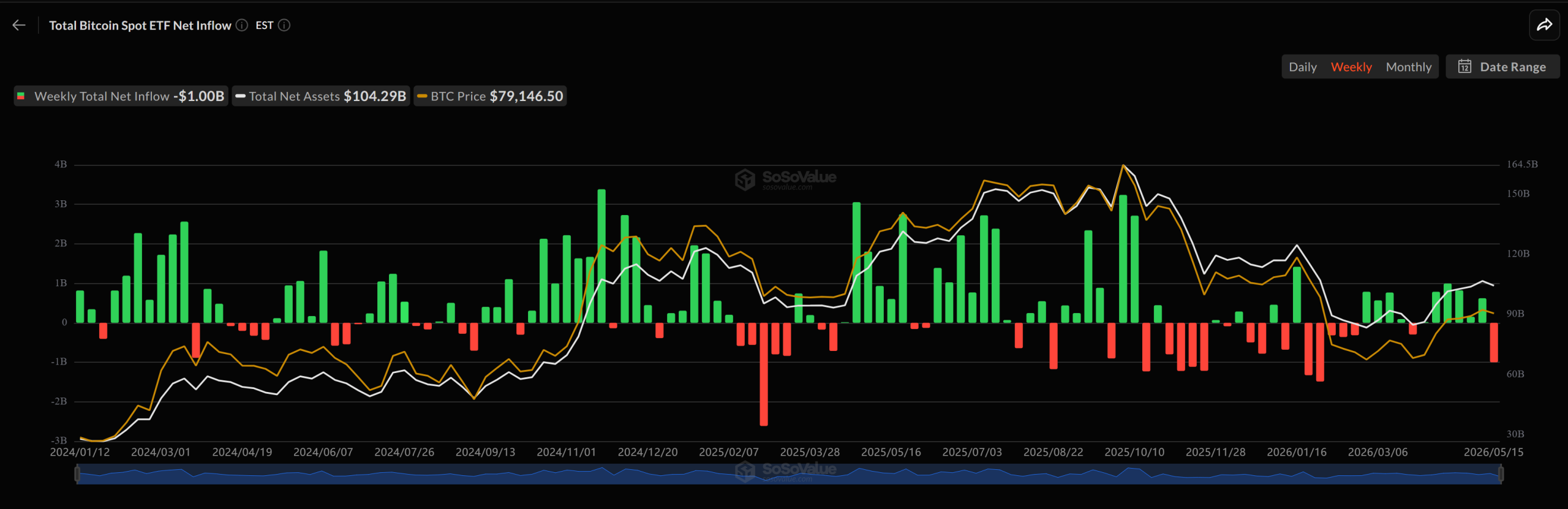
Spot Bitcoin exchange-traded funds (ETFs) recorded $1 billion in weekly net outflows, ending a six-week inflow streak that had drawn a combined $3.4 billion.
The week started on a cautiously optimistic note, with Monday posting modest inflows of $27.29 million, according to data from SoSoValue. The tide turned sharply on Tuesday, when investors pulled $233.25 million from the funds. Selling pressure intensified on Wednesday, the worst single day of the week, with outflows reaching $635.23 million.
A brief reprieve came on Thursday, as inflows of $131.31 million offered a momentary reversal. However, Friday erased that recovery as well, when a further $290.42 million exited the products, sealing the week in the red at exactly $1 billion in net outflows.
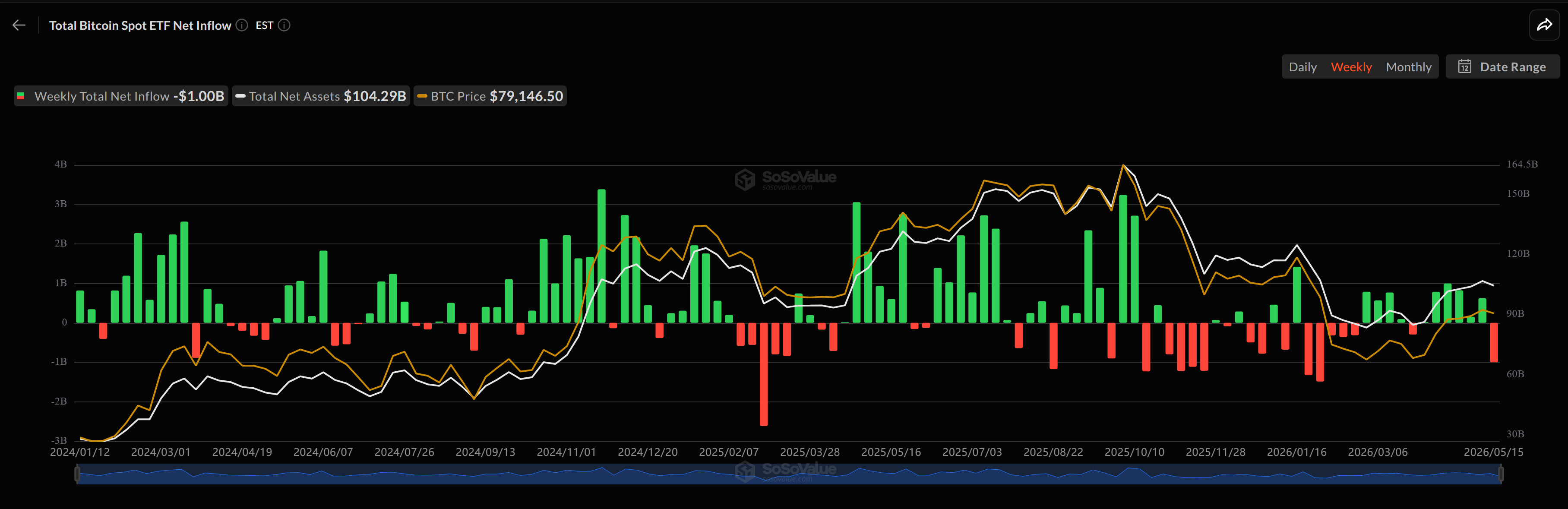
Spot Bitcoin ETFs see weekly outflows. Source: SoSoValue
The weekly loss marks a reversal from the previous six weeks, during which spot Bitcoin ETFs attracted consistent net inflows, with the week of April 17 standing out as the strongest, pulling in $996.38 million. This week’s selling leaves total net assets sitting at $104.29 billion, with cumulative net inflows across all products at $58.34 billion.
Related: Bitcoin ETFs Post Largest Outflows Since January as BTC Slips
Capital rotates toward AI, crypto
In a recent note, analysts at Bitunix said capital is “aggressively” rotating toward both the “AI growth narrative” and the institutionalization of crypto assets. NVIDIA, Google and Apple pushed toward fresh all-time highs last week, while AI chipmaker Cerebras surged more than 70% intraday on its IPO debut.
On the crypto front, the CLARITY Act, widely seen as one of the most consequential crypto market structure bills in the US, cleared the Senate Banking Committee. Coinbase shares rallied sharply subsequently as markets priced in the development, and Bitcoin climbed back toward the $82,000 mark.
However, Bitcoin’s price structure points to a market on edge, Bitunix said. They noted that heavy short liquidity sits clustered between $82,400 and $82,600, with $80,000 serving as the key support level to watch. “Current price action suggests the market has clearly entered a high-leverage volatility structure, as capital waits for further direction from the three dominant macro themes: AI expansion, U.S.-China relations, and crypto regulation,” they wrote.
Related: JPMorgan Boosts Bitcoin ETF Holdings in Q1 2026 Filing
Spot Ether ETFs see consistent outflows
Meanwhile, spot Ether ETFs recorded outflows across all five trading days last week. Tuesday was the worst session, with $130.62 million exiting the products, followed by $65.65 million on Friday, $36.30 million on Wednesday, $16.89 million on Monday, and a relatively muted $5.65 million on Thursday.
Combined, the five-day streak wiped $254.46 million from the funds, pulling total net assets down to $12.93 billion by week’s end.
Magazine: Guide to the top and emerging global crypto hubs — Mid-2026
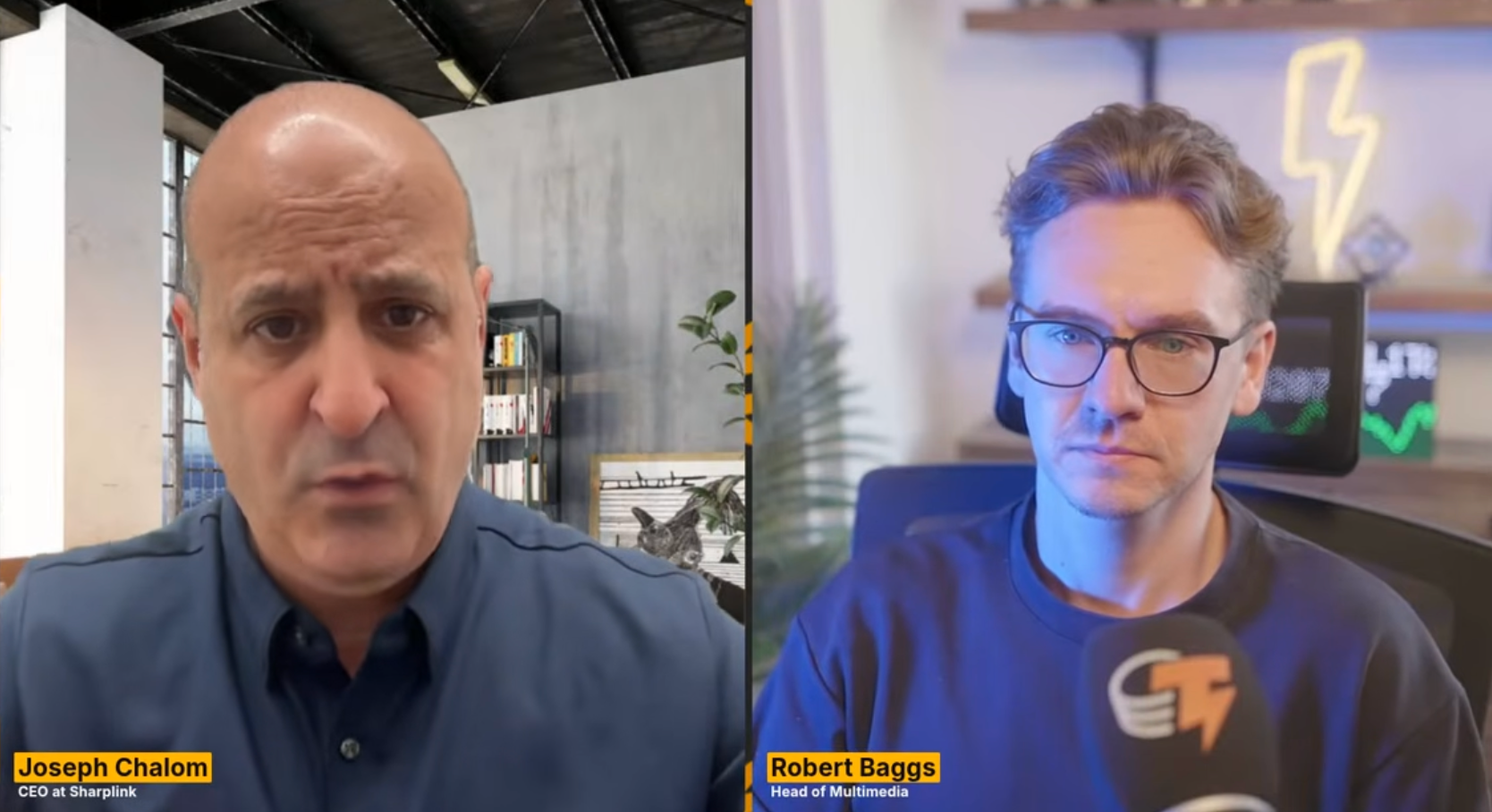
Ethereum needs three catalysts to fall into place for its price to regain momentum and surge higher, according to SharpLink Gaming CEO Joseph Chalom.
“One is the CLARITY Act to pass in the US,” Chalom pointed out in an interview with Robert Baggs on Cointelegraph’s Chain Reaction show published to YouTube on Thursday. It came on the same day that all 13 Republican members and two Democrats voted to advance the Digital Asset Market Clarity Act (CLARITY) at the US Senate Banking Committee meeting.
Chalom said that while many view the legislation, which aims to give the US crypto industry greater clarity, as “a US phenomenon,” it is also being seen as a major signal for other jurisdictions around the world.
Other countries are noticing the US shift away from a hostile stance toward crypto
“I’ve been traveling a lot in Asia, and if you go to Korea, Hong Kong, Tokyo and Singapore, they are watching really closely because they realize the US went from having a hostile stance towards crypto and digital assets to um it could become the leader again in finance and you’ll see a red dollarization of a lot of financial activity and these other capitals are very worried,” Chalom said.
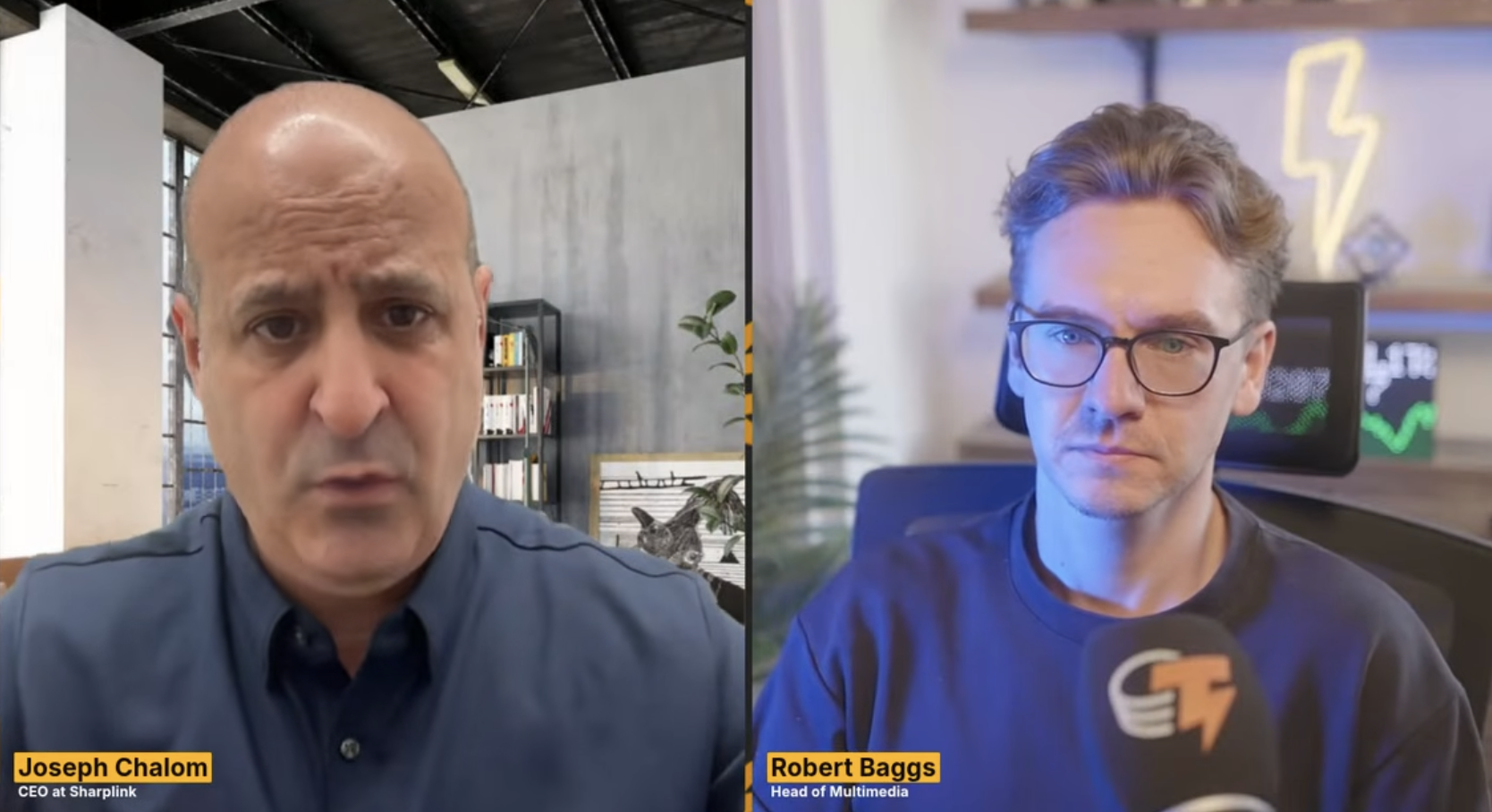
Joe Chalom spoke to Cointelegraph’s Robert Baggs on Chain Reaction. Source: Cointelegraph
Chalom said the second catalyst is a return in market risk appetite, which he said will largely depend on geopolitical tensions easing and the cooling of the “AI thesis.” “I think we’ll need some of that to go away in order to see crypto rise again,” Chalom said.
Sharplink Gaming is the second-largest publicly listed Ethereum treasury company, holding approximately 861,251 ETH, valued at $1.89 billion at the time of publication, according to Ethereum Treasuries data.
Ether (ETH) reached an all-time high of $4,823 in August 2025 as part of a broader market uptrend, but has since fallen 55% to $2,190 at the time of publication, according to CoinMarketCap.
Tokenization is where Ethereum will “dominate”
Chalom said the final Ethereum catalyst he’s watching is the continued expansion of real-world asset tokenization.
“Tokenization of financial assets is where Ethereum is going to dominate,” Chalom said.
“I think there’s about 32 billion of tokenized RWA. And tokenization started in 2017. So it’s been remarkably slow. Now you’re seeing announcements of whole fund complexes being tokenized,” he said.
Several major asset managers have recently made announcements related to tokenization.
Related: How the stablecoin market tripled from $100B to $300B in one year
On Wednesday, JPMorgan filed to launch a tokenized money market fund on Ethereum, allowing stablecoin issuers to hold reserves backing their stablecoins in a regulated, cash-like vehicle while earning interest.
In March, Franklin Templeton announced it is teaming with Ondo Finance to bring tokenized versions of its exchange-traded funds onchain, allowing investors to access them through crypto wallets.
Chalom said, “You could see a world where there’s not $30 billion in tokenized assets in a year from now. It could be $500 billion or a trillion.”
Magazine: eToro founder timed Bitcoin top perfectly due to belief in 4 year cycles
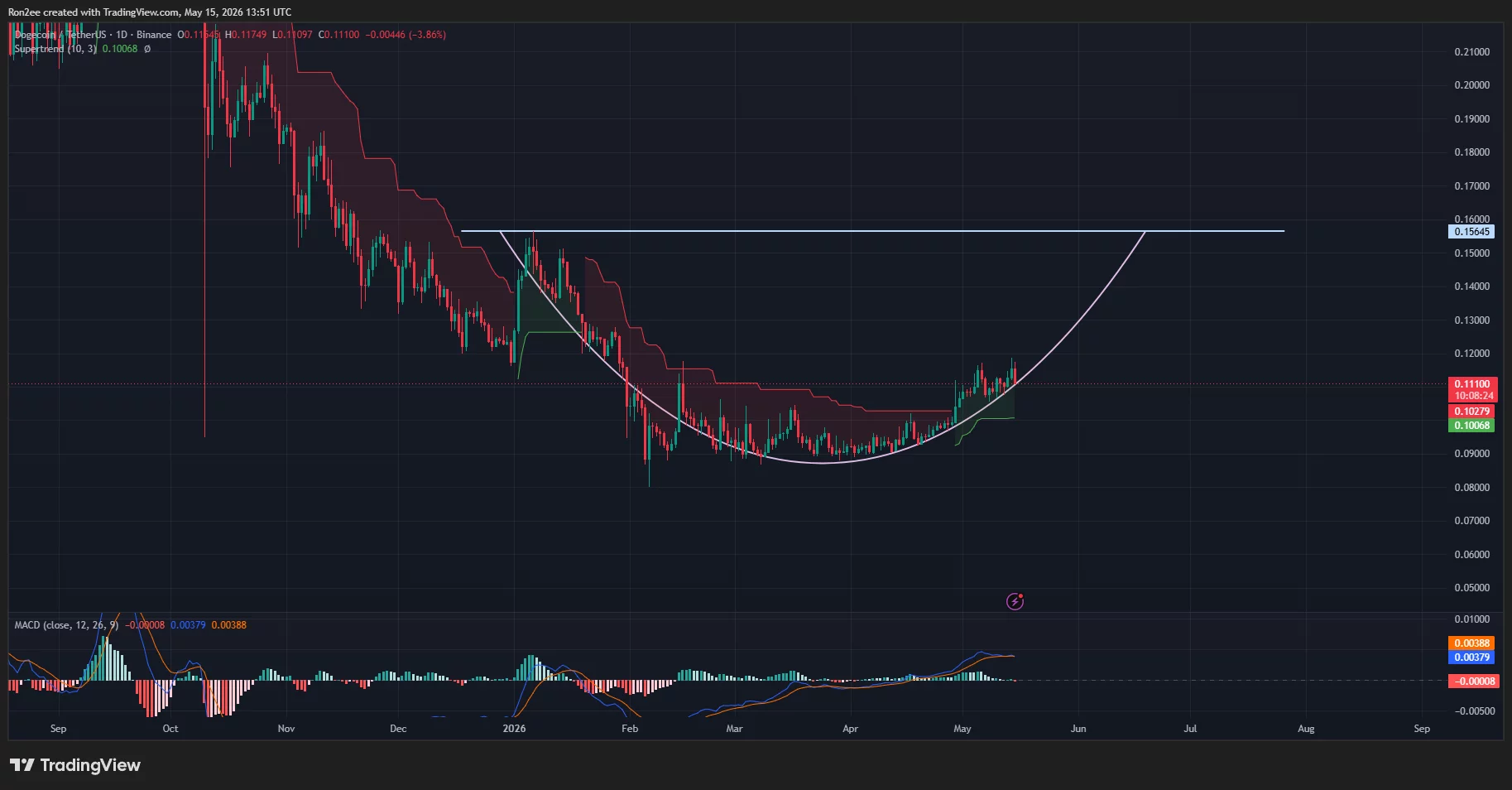
Dogecoin price continued stabilizing above a key support zone this week after forming a bullish rounded bottom pattern on the daily chart, while rising derivatives activity and growing institutional optimism strengthened the case for a larger recovery rally.
Summary
- Dogecoin price has formed a bullish rounded bottom pattern on the daily chart, with neckline resistance positioned near the $0.156 level.
- DOGE open interest climbed above $1.8 billion while daily futures volume surged 44% to nearly $4 billion, signaling rising leveraged activity.
- Whale wallets accumulated more than 160 million DOGE this month as optimism grew around ETF developments and proposed supply-reduction upgrades.
According to data from crypto.news, Dogecoin (DOGE) price traded around $0.111 at press time on May 15 after briefly climbing toward the $0.117 region earlier in the session. The token has gradually recovered from its April lows near $0.085 as speculative demand returned across the meme coin sector alongside improving sentiment in the broader crypto market.
One of the biggest catalysts supporting Dogecoin remains growing regulatory clarity in the United States. Recent joint classification guidance from the SEC and CFTC recognizing Dogecoin as a digital commodity has significantly reduced concerns surrounding potential “unregistered security” enforcement risks.
The development has helped improve institutional confidence toward the asset while supporting optimism surrounding future regulated investment products tied to Dogecoin.
Investor sentiment has also strengthened following continued progress surrounding Dogecoin-related exchange-traded fund initiatives. Recent Bitwise regulatory filings and the launch of a 21Shares Dogecoin product have fueled expectations that institutional access to the token could continue expanding over time.
At the same time, derivatives data suggest traders are increasingly positioning for a larger breakout move. Dogecoin open interest surged more than 5% over the past 24 hours to roughly $1.8 billion, while daily futures trading volume jumped 44% to nearly $4 billion, signaling aggressive leveraged positioning from both retail and institutional participants.
On-chain metrics additionally show continued accumulation among large holders. Whale wallets reportedly accumulated more than 160 million DOGE this month, helping create a stronger demand floor during recent market consolidation.
Dogecoin price analysis
On the daily chart, Dogecoin has now formed a rounded bottom pattern after spending several months gradually stabilizing following its sharp correction earlier this year. The formation typically signals weakening bearish momentum and the early stages of a bullish trend reversal.
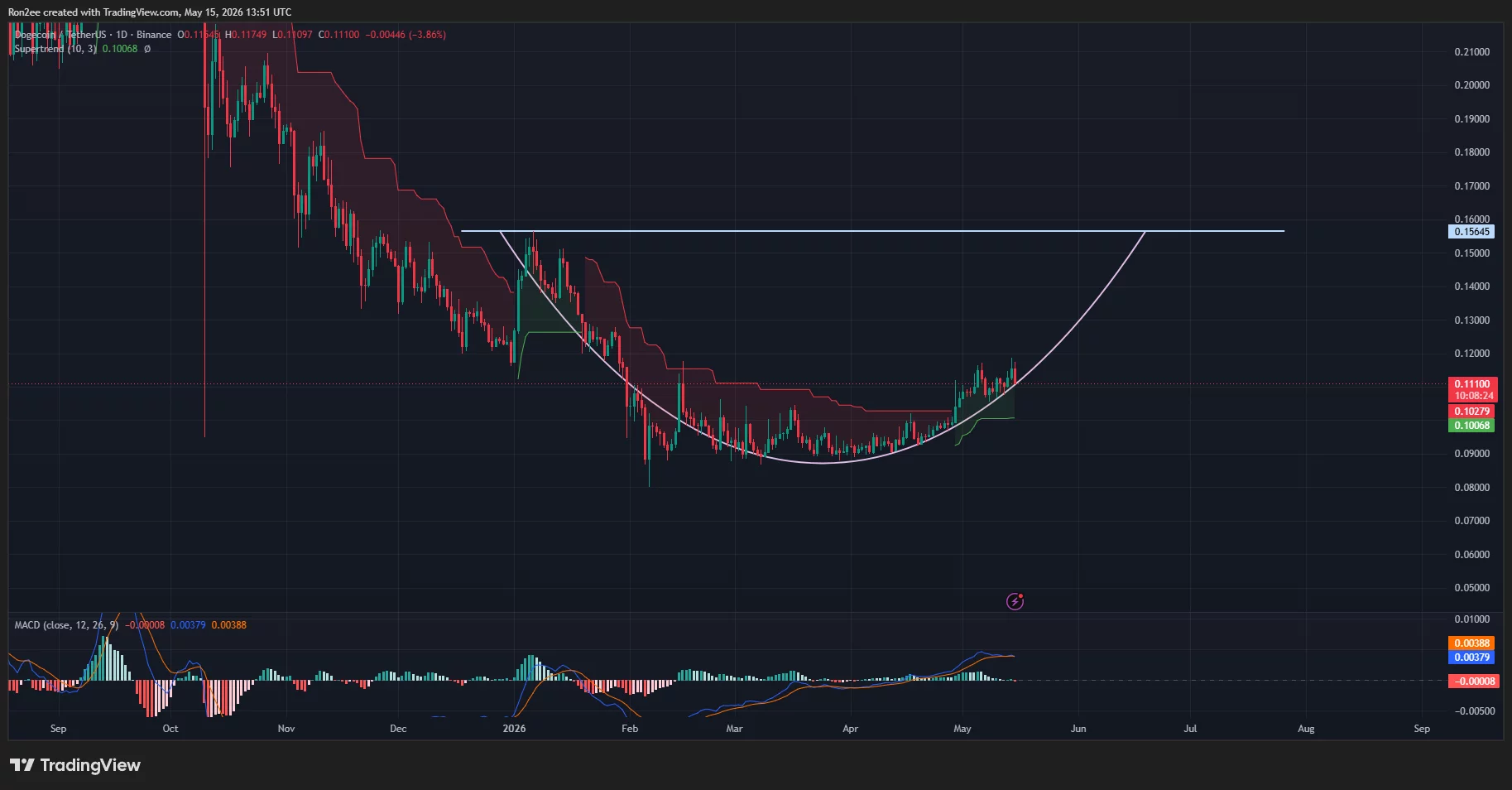
The neckline resistance of the rounded bottom sits near the $0.156 region, which also aligns closely with the overhead Supertrend resistance visible on the chart.
If bulls successfully reclaim the neckline resistance, the breakout could confirm the pattern and potentially trigger a stronger continuation rally toward the $0.15–$0.16 region in the near term.
Momentum indicators are also beginning to support the bullish structure. The MACD remains in positive territory on the daily timeframe, while the histogram recently printed multiple green bars, signaling that bullish momentum may still be building despite the recent consolidation.
Beyond the short-term setup, traders are also closely monitoring Dogecoin’s longer-term ecosystem developments. Core developers have floated a proposed hard fork that would reduce DOGE block rewards by roughly 90%, potentially cutting annual supply inflation from nearly 5 billion coins to around 500 million.
Meanwhile, DogeOS development plans involving zero-knowledge proof verification and Ethereum-compatible smart contract functionality have strengthened speculation that Dogecoin could gradually evolve beyond its meme coin narrative into a broader utility-focused network.
However, Dogecoin still faces strong resistance near the $0.12 region before bulls can challenge the larger neckline resistance near $0.156. Failure to sustain momentum above the current breakout structure could push DOGE back toward support levels near $0.10 and $0.09, where buyers previously defended the trend reversal attempt earlier this quarter.
Disclosure: This article does not represent investment advice. The content and materials featured on this page are for educational purposes only.
Key Takeaways
- Large XRP wallet addresses have accumulated 45.8 billion tokens—reaching levels unseen since May 2018
- This concentration accounts for 68.5% of total circulating supply, valued at approximately $68.5 billion
- Spot XRP ETF products in the United States hold only $1.25 billion in total assets, with stagnant inflow activity since early 2026
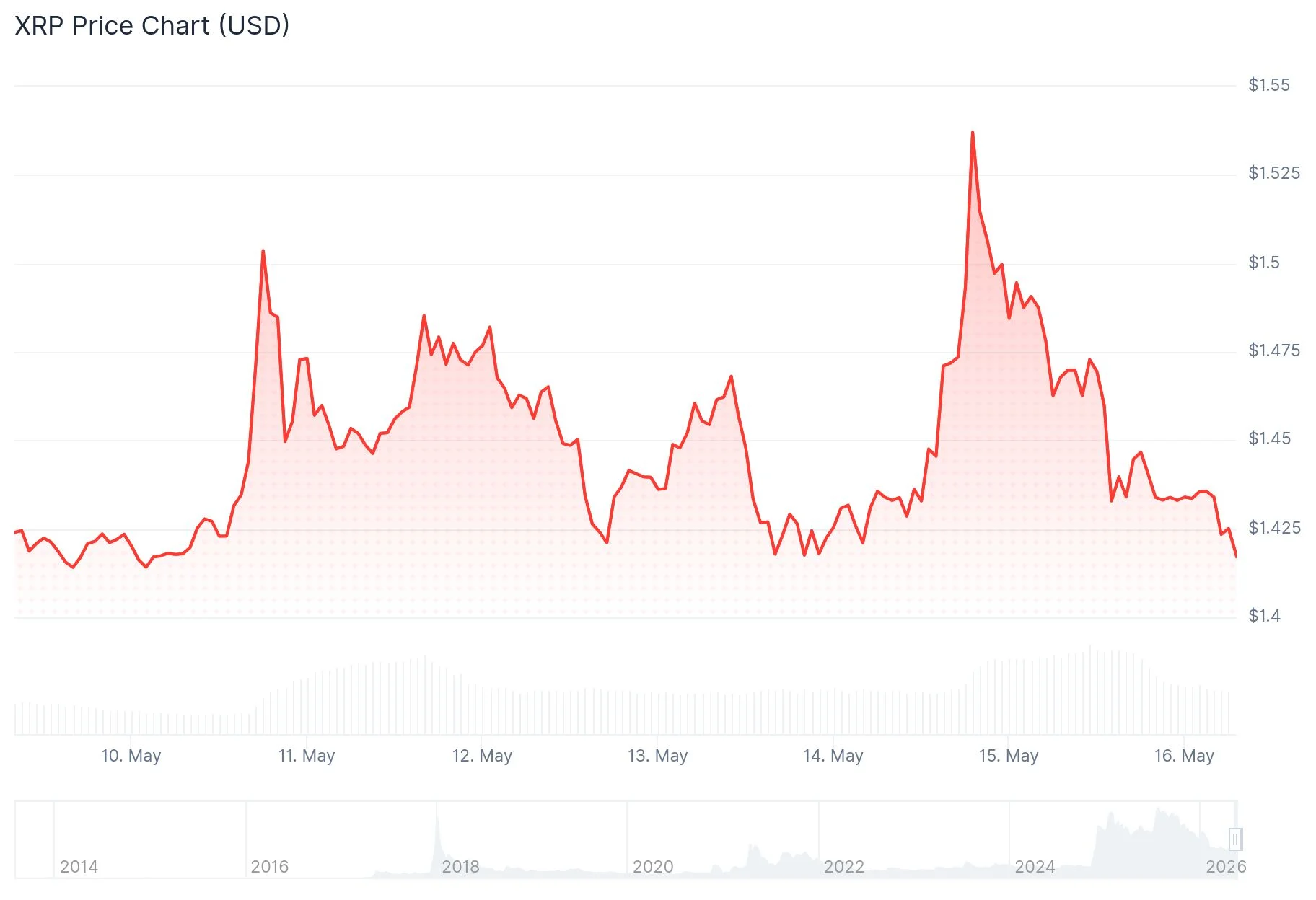
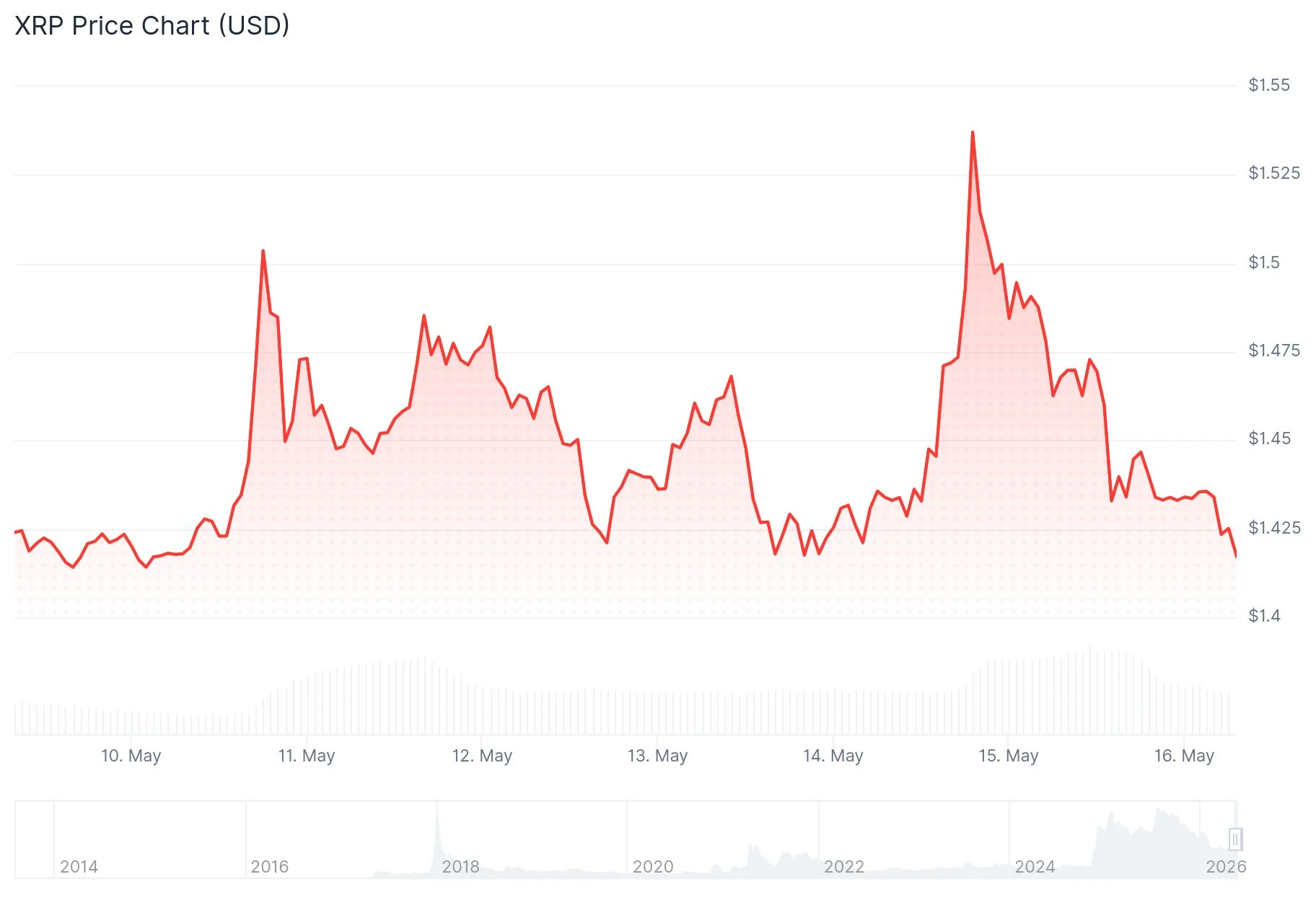
- The token has remained confined within a $1.30 to $1.60 trading corridor during the first half of 2026
- Derivatives traders on Deribit assign merely a 2% probability to XRP surpassing $2 before May concludes
Large XRP wallet holders have amassed tokens at unprecedented levels over the past eight years, yet the cryptocurrency’s price continues to trade sideways. Blockchain analytics platform Santiment reveals that addresses controlling a minimum of 10 million XRP tokens now possess a combined total of 45.83 billion tokens—approximately 68.5% of all circulating supply. Market analyst Chad Steingraber highlighted this development on X, describing it as “an 8-year high last seen in May 2018.”
Based on current market valuations, this whale-controlled supply represents more than $68.5 billion in value. By comparison, spot XRP exchange-traded funds operating in the United States collectively managed only $1.25 billion in net assets at the time of analysis.
Santiment’s monitoring also detected a notable increase in blockchain activity. During XRP’s brief rally above $1.54—marking its strongest performance in two months—active wallet addresses climbed to 48,453, representing the highest count since March 30. Additionally, newly created network addresses reached 3,317, the peak figure since March 19. While Santiment acknowledged that portions of this activity stem from speculative enthusiasm driven by price movements, increasing on-chain engagement typically signals healthier long-term price foundations.
Exchange-Traded Fund Activity Reveals Contrasting Trends
The surge in whale accumulation gained momentum during late 2025, aligning with substantial ETF capital inflows following the November 2025 launch of spot XRP investment products. However, this institutional appetite diminished as the Christmas holiday season approached and has remained largely dormant throughout 2026.
ETF tracking data from SoSo Value indicated that whale-level on-chain accumulation has similarly plateaued—maintaining approximately 68% of supply ownership for multiple consecutive months. Whale Insider documented on X that ETF participants contributed $10.87 million in additional XRP exposure, elevating total ETF-managed net assets to $1.18 billion according to their reporting timeframe.
XRP has maintained a restricted price band oscillating between $1.30 and $1.60 throughout the current quarter. At publication time, the digital asset was exchanging hands near $1.445, reflecting a 1.96% decline over the preceding 24-hour period.
Critical Technical Zones Under Market Surveillance
Technical analyst ChartNerdTA has mapped out an extended cup-and-handle formation on XRP’s price chart extending nearly eight years. Fibonacci projection modeling suggests a potential extended-term objective exceeding $8 should a validated breakout materialize, although confirmation remains pending.
In the near-term perspective, XRP maintains positioning above its 50-period exponential moving average on daily charts while encountering resistance barriers near the $1.50 threshold. Technical evaluations indicate the price structure has transitioned from a descending channel formation into a rising broadening wedge configuration.
Critical price thresholds currently monitored by traders encompass foundational support positioned around $0.89, intermediate accumulation zones spanning $1.40 to $1.50, overhead resistance barriers between $1.60 and $1.70, and an ambitious long-range extension projection above $8 contingent upon verified breakout confirmation.
Options market participants trading on Deribit currently estimate just a 2% likelihood that XRP will exceed the $2 threshold prior to May’s conclusion.
XRP was valued at approximately $1.445 during publication, registering a 1.96% decrease across the previous 24-hour trading session.


South Korea’s Financial Services Commission plans to release detailed tokenized securities rules in July.
Summary
- South Korea plans to release detailed tokenized securities rules in July before the 2027 legal rollout.
- The FSC is studying tokenized stocks, bonds and MMFs while building investor-protection rules for issuance.
- Samsung SDS is building KSD’s token securities platform as Korea prepares blockchain-based market infrastructure.
The rules will support the amended Capital Markets Act and Electronic Securities Act, which are scheduled to take effect on February 4, 2027.
The FSC discussed the plan at the second public-private tokenized securities council meeting on May 15. Local reports said the council reviewed issuance, trading, settlement and infrastructure rules before the legal framework starts.
Fractional products may get wider scope
The FSC is preparing to allow some fractional investment products to pool similar underlying assets. Current rules limit many fractional products to a single asset, such as one property. The new approach could allow a portfolio-style product made from the same type of asset.
FSC Vice Chairman Kwon Dae-young said the authority will pursue a plan to allow pooled issuance within a set range while keeping market order and investor protection as basic conditions. He also said the final model for fractional investment issuance is targeted for July after industry feedback.
Moreover, the July package is also expected to include a roadmap for tokenizing standard securities, including stocks, bonds and money market funds. The council noted that global markets are already testing tokenized public securities, green bonds and tokenized MMFs.
South Korea does not plan to move all electronic securities onto blockchain at once. Instead, authorities are preparing step-by-step tests for rights, trading, settlement and on-chain payment systems to avoid conflict with existing market infrastructure.
Samsung SDS builds market infrastructure
The rule work comes as South Korea builds the systems needed for tokenized securities. Crypto.news reported last week that Samsung SDS won a contract to build and operate a token securities platform for the Korea Securities Depository.
The platform is expected to connect KSD’s existing electronic securities account system with blockchain-based records. It will support issuance, circulation checks, rights management and real-time monitoring before the 2027 rollout.
Korea’s digital asset rules keep expanding
South Korea’s broader digital asset policy is also moving. Earlier reports said the ruling party finalized a draft Digital Asset Basic Act covering stablecoins, tokenized products and digital asset service providers.
Crypto.news also reported that the FSC planned to lift a long corporate crypto investment ban and allow eligible listed firms and professional investors to allocate up to 5% of equity capital to top crypto assets. These separate policies show Korea is building both crypto-market and tokenized-securities rules at the same time.
Key Takeaways
- Senate Banking Committee approved the Digital Asset Market Clarity Act (CLARITY) in a 15-9 vote with minimal cross-party backing
- Just two Democratic senators supported the measure; significantly more backing needed to defeat a filibuster
- President Trump’s personal cryptocurrency investments create the primary obstacle to broader support
- TD Cowen analysts increased passage probability to 40% from approximately 33%
- White House aims for a July 4 signing ceremony if legislation succeeds
On Thursday, the US Senate Banking Committee approved the Digital Asset Market Clarity Act in a 15-9 decision, pushing forward legislation designed to establish comprehensive federal oversight of cryptocurrency markets.
Democratic Senators Ruben Gallego and Angela Alsobrooks crossed party lines to support the measure alongside 13 Republican colleagues. The legislation now progresses toward consideration by the entire Senate, though scheduling for a floor vote remains undetermined.
The Senate Agriculture Committee previously greenlit its section of the legislation back in January. These separate components must be combined into unified legislation before senators can vote on final passage.
The House of Representatives already approved its companion version 294-134, including 78 Democratic votes in support.
The 60-Vote Challenge
Final Senate passage requires 60 affirmative votes to bypass a procedural filibuster. Republicans must therefore secure considerably more Democratic backing than the pair of votes received during committee proceedings.
Benchmark analyst Mark Palmer noted the legislation will “demand substantially more Democratic support than that of the two senators who voted for it yesterday.”
TD Cowen analyst Jaret Seiberg upgraded his probability forecast for passage to 40% from one-third, while acknowledging significant challenges remain.
Joshua Riezman, Chief Legal and Strategy Officer at GSR, stated prior to the committee vote that chances of presidential signature during this congressional session stood under 50%.
Coinbase’s Chief Legal Officer Paul Grewal projected greater optimism, predicting summer passage for the framework.
Trump’s Crypto Holdings Block Democratic Support
Numerous Senate Democrats indicate they won’t back the legislation without language addressing potential conflicts of interest. Their apprehension focuses on President Trump’s cryptocurrency holdings, including his memecoin project and his family’s World Liberty Financial venture.
Senator Raphael Warnock declared he couldn’t support legislation failing to address what he characterized as “pure corruption” regarding the administration’s digital asset involvement.
Senator Thom Tillis, who backed the committee version, acknowledged “more work remains in the weeks ahead.”
Senator Gallego stated plainly that without resolution of the ethics questions, he’ll oppose the bill during floor proceedings.
Banking Committee chair Tim Scott joined 12 Republican colleagues in rejecting an amendment addressing Trump’s possible conflicts of interest.
TD Cowen suggested Republicans want to avoid such votes with the 2026 midterm elections approaching.
Timeline and Next Steps
The Senate remains in session through May 22, reconvening June 1 and continuing through June 26. No floor vote on CLARITY has been calendared.
White House crypto adviser Patrick Witt indicated the administration hopes for a July 4 bill signing.
In separate action, the House Ways and Means Committee conducted a private Thursday session examining digital asset taxation policy, following December 2025 introduction of the Digital Asset PARITY Act.


The CLARITY Act cleared the Senate Banking Committee 15 to 9 on May 14, but analysts say significant obstacles remain before it can become law.
Summary
- The CLARITY Act cleared the Senate Banking Committee in a 15 to 9 bipartisan vote, with all 13 Republicans and two Democrats voting in favour.
- The bill still needs 60 Senate floor votes, a resolved ethics provision and reconciliation with the House version before reaching Trump’s desk.
- TD Cowen analysts said they remain pessimistic, as Democrats will demand a vote on a conflict of interest amendment Republicans do not want.
The CLARITY Act cleared the Senate Banking Committee in a 15 to 9 bipartisan vote on May 14, its most consequential legislative step since the House passed a similar version by 294 to 134 in July 2025. The vote was secured at the last moment after Chairman Tim Scott used a procedural maneuver to admit further amendments, bringing two Democrats across the aisle alongside all 13 Republicans.
All 13 Republicans voted yes. Democratic Senators Ruben Gallego of Arizona and Angela Alsobrooks of Maryland joined them, though both qualified their support. “My vote today is a vote to keep working in good faith,” Alsobrooks said. “We still have so much work to do.” Gallego warned he was “not afraid to vote no” on the Senate floor if an ethics deal is not reached.
Analysts warn the real fight starts now
GSR Chief Legal and Strategy Officer Joshua Riezman said before the vote that the odds of the CLARITY Act reaching the president’s desk this session were below 50%. TD Cowen was sharper in its assessment.
“We are not more optimistic because we continue to believe Democrats will demand a vote on an amendment that would apply conflict of interest standards to President Trump,” the firm said. “We believe Republicans do not want to take that vote as they do not want to be portrayed in upcoming elections as endorsing the involvement of the Trump family in crypto endeavors.”
The ethics provision is the central obstacle. The CLARITY Act’s current text contains no conflict of interest language restricting government officials from profiting from crypto, as that falls outside the Senate Banking Committee’s jurisdiction. Senator Kirsten Gillibrand has said the bill will not pass the full Senate without it. The White House has rejected any language that singles out a specific officeholder.
The full Senate requires 60 votes to overcome a filibuster, meaning Republicans need at least seven Democrats. The Senate Banking Committee revised its 309-page draft text on May 12, resolving the stablecoin yield dispute by banning passive interest while permitting activity-based rewards. That cleared one major obstacle but left the ethics fight and law enforcement provisions unresolved.
Senator Cynthia Lummis has warned that missing the window before the August recess could push comprehensive crypto legislation off the calendar until 2030. The bill must also be reconciled with the House version before going to Trump, adding further steps to an already tight timeline. As crypto.news tracked, the CLARITY Act has been stalled multiple times since January over the same fault lines now heading to the Senate floor.
Quick Summary
- OpenAI introduced banking integration features within ChatGPT for U.S. Pro plan members this past Friday
- Through Plaid integration, members can sync banking and brokerage accounts from more than 12,000 financial providers
- The AI assistant accesses account balances, transaction history, investment portfolios, and outstanding debts — without the ability to transfer funds or access complete account digits
- Future integration with Intuit will enable tax consequence calculations for equity transactions
- This premium capability requires a $200 monthly subscription and will gradually become available to broader user groups
OpenAI Enables ChatGPT to Access Financial Data and Deliver Custom Money Guidance
This past Friday, OpenAI unveiled banking connectivity features for ChatGPT. Subscribers to the Pro tier in the United States can now integrate their banking and brokerage platforms directly with the AI assistant.
The functionality relies on Plaid, a financial aggregation service that interfaces with over 12,000 banking institutions. Compatible services encompass Chase, Fidelity, Schwab, Robinhood, American Express, and Capital One.
After establishing connections, ChatGPT generates a comprehensive overview displaying investment returns, expenditure trends, recurring charges, and scheduled bill payments.
According to OpenAI, over 200 million individuals already consult ChatGPT monthly regarding financial matters. This banking integration transforms generic inquiries into customized responses derived from actual financial information.
Setup Process Explained
Users begin by selecting “Get started” within the Finances module located in ChatGPT’s navigation panel. Alternatively, they can enter “@Finances, connect my accounts” directly into the conversation interface.
Plaid then guides users through its security verification steps. The linking process between ChatGPT and financial institutions occurs exclusively through Plaid’s infrastructure.
Once activated, users can pose queries such as their previous month’s grocery expenditures, identify overlooked subscription services, or calculate timeframes for eliminating credit card balances.
The AI can additionally assist in determining monthly savings requirements to accomplish specific financial objectives.
Capabilities and Limitations
ChatGPT lacks authorization to execute transactions on connected accounts. Complete account numbers remain hidden from view. The system exclusively reads current balances, transaction records, portfolio assets, and obligations including mortgages or credit card balances.
Users maintain complete control to sever account connections whenever desired. Following disconnection, OpenAI commits to purging synchronized information within a 30-day window.
Individual “financial memories” — saved objectives or monetary commitments the AI has recorded — can be reviewed and removed by users.
A privacy setting allows users to determine whether their financial dialogues contribute to OpenAI’s model development. The organization hasn’t elaborated on potential uses of aggregated financial information or security measures following potential data compromises.
OpenAI indicated its GPT-5.5 architecture processes financial inquiries with enhanced analytical capabilities. The development involved collaboration with financial experts to establish quality standards for personal finance responses.
Future Intuit integration will enable ChatGPT to project tax consequences from equity sales.
The banking features currently function on ChatGPT’s browser platform and iOS application. Access remains restricted to Pro tier subscribers paying $200 monthly.
OpenAI intends to gather user feedback from Pro members before extending availability to Plus subscribers, ultimately targeting universal access across all user tiers.

Japan’s Monster Wolf robot is a $4,000 scarecrow with red LED eyes, and it actually works

JUST IN: Banking Engineer CONFIRMS The $300 XRP Theory

Supreme Court rejects Virginia congressional map drawn by Democrats

Manchester United reach agreement with Casemiro over contract clause amid transfer speculation

US brings back mandatory military draft registration

Steven Gerrard disagrees with Gary Neville over ‘shock’ Chelsea and Arsenal claim | Football


-

 Fashion5 days ago
Coffee Break: Travel Steam Iron
-

 Fashion16 hours ago
Weekend Open Thread: Theory – Corporette.com
-

 Politics4 days ago
What to expect when you’re expecting a budget
-

 Fashion5 days ago
What to Know Before Buying a Curling Wand or Curling Iron
-

 Tech6 days ago
Auto Enthusiast Carves Functional Two-Stroke Engine from Solid Metal
-

 Crypto World9 hours ago
BloFin War of Whales 2026 Grand Prix opens registration for $5M trading championship
-
 Business7 days ago
Ignore market noise, India’s long-term story intact, say D-Street bulls Ramesh Damani and Sunil Singhania
-

 Crypto World7 days ago
PROS explodes 48% as Upbit and Bithumb listings ignite demand
-

 Tech5 days ago
GM Agrees To Pay $12.75 Million To Settle California Lawsuit Over Misuse Of Customers’ Driving Data
-

 Tech1 day ago
Tech Moves: Microsoft AI leader jumps to OpenAI; former AI2 exec joins Meta; and more
-

 Crypto World6 days ago
CZ says US crypto rivals tried to block Trump pardon
-

 Tech4 days ago
GM agrees to $12.75M California settlement over sale of drivers’ data
-
Crypto World3 days ago
Bitcoin Suisse expands with Digital Asset License and Investment Business Act Registration Approval in Bermuda
-

 Crypto World15 hours ago
E-Estate Announces 1 Year Live: Washington DC Summit as Real Estate Tokenization Enters Its Next Phase
-

 Politics3 days ago
Pakistan to enter Chinese capital market as war inflation bites
-
 Crypto World2 days ago
Google’s Gemini AI Predicts Incredible Solana Price by the End of 2026
-

 Crypto World3 days ago
Bitcoin Suisse expands with Digital Asset License and Investment Business Act Registration Approval in Bermuda
-

 Politics6 days ago
Sky News Presenter Says Keir Starmer Is Not Waving But Drowning
-
Crypto World7 days ago
Hacker Drains $5.9M From Ethereum Liquidity Provider TrustedVolumes
-

 Fashion6 days ago
Amazon Sundays: Spring Glassware & Vases
You must be logged in to post a comment Login