
Crypto World
Bitcoin Dips to 2026 Low as Altcoins Crumble: Is BTC at $56K Next?

Key points:
-
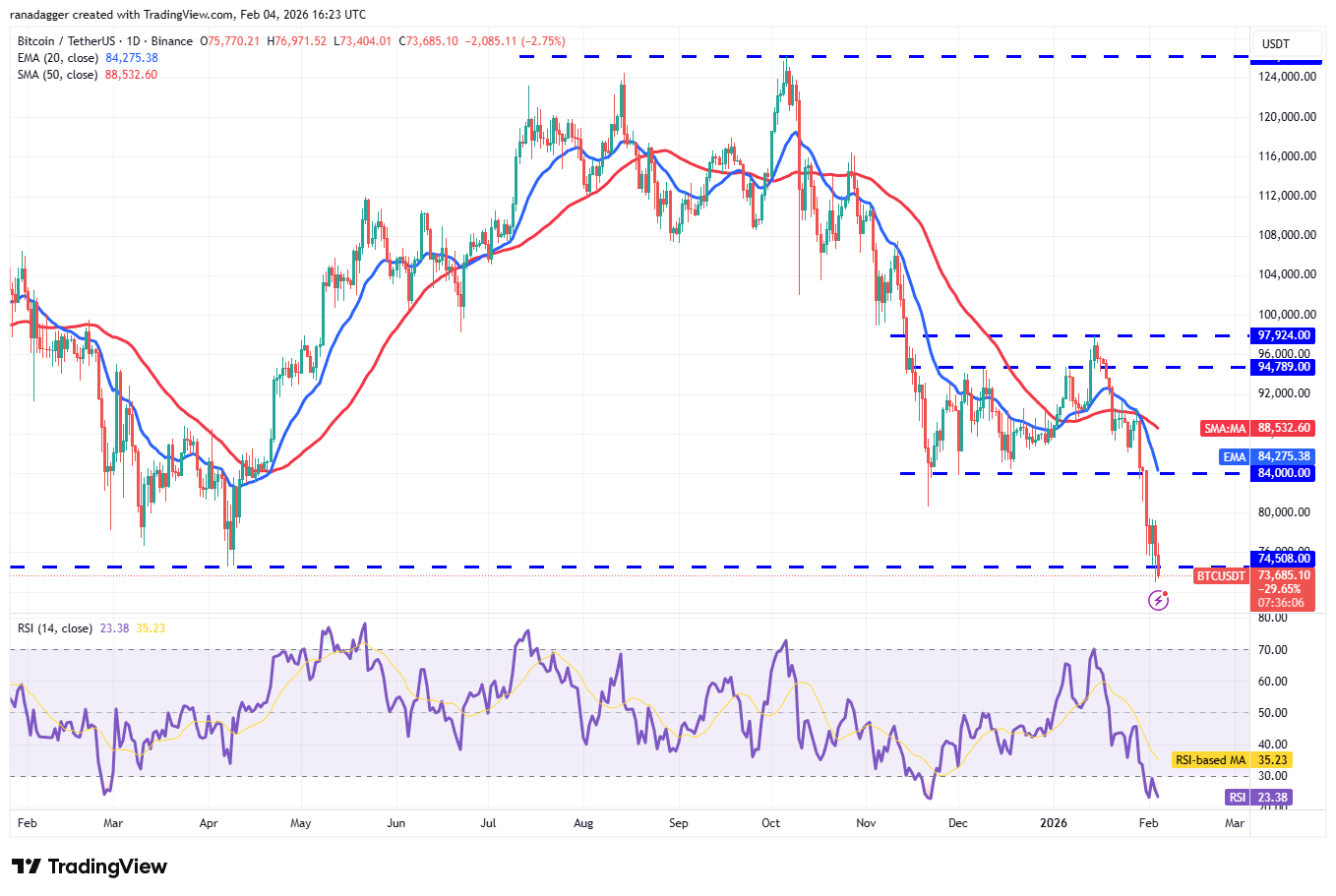
Bitcoin remains under pressure as the bears attempt to hold the price below the crucial $74,508 level.
-
Several major altcoins are struggling to bounce off their support levels, increasing the likelihood of the resumption of the downtrend.
Bitcoin (BTC) (CRYPTO: BTC) is facing renewed selling pressure after bulls pressed for a recovery but failed to sustain gains, with the price slipping beneath the key mark of $72,169. In a Monday note, Galaxy Digital research lead Alex Thorn warned that BTC could slip toward its realized price near $56,000 in the coming weeks, citing a lack of catalysts capable of reversing the trend. The absence of strong on-chain or macro catalysts has kept buyers on the defensive, and the market has yet to demonstrate a convincing bid at higher levels.
Not everyone is certain the bottom is in. On X, Bitwise chief investment officer Matt Hougan argued that the crypto markets are likely to rebound sooner rather than later, signaling that the longer-term setup could still tilt toward a renewed rally even as near-term momentum remains fragile. The disagreement among market voices highlights a broader question: are macro conditions enough to spark a durable relief rally, or will the market continue to test major support zones?
In the near term, a classical pattern is reemerging: BTC’s recovery could take time, with some observers noting a historical tendency for extended periods below the 100-week simple moving average. A noted commentator recently recalled that when BTC breaks below the 100-week SMA, it has stayed under that threshold for many months in prior cycles, with the COVID-19 shock offering a rare exception where BTC rose above the level within weeks. The question for traders remains whether this time will echo the longer baselines or deliver a quicker bounce spurred by renewed risk appetite. The gravity of the current setup is underscored by the fact that several top altcoins are testing notable supports, increasing the risk of a broader downturn if those levels give way.
Looking at the price architecture: BTC’s next crucial defense is at the $74,508 support, but buyers have struggled to hold above that level, and the price has hovered around the $72,000s region. If selling accelerates and BTC breaks decisively below $72,945, the path toward the next meaningful support near $60,000 could open, potentially inviting a broader re-pricing across the leading cryptos. The relative strength index (RSI) sits deep in oversold territory, suggesting that a relief rally could materialize if near-term selling pressure eases and buyers reclaim the vicinity of $79,500. A sustained move above the $79,500 resistance could re-energize momentum toward $84,000, though bulls still face a challenging environment amid ongoing risk-off sentiment in broader markets.
Bitcoin price prediction
Bitcoin’s trajectory hinges on how price behaves around the critical $74,508 support and the subsequent $72,945 region. A breach below those levels would likely intensify selling pressure and could revive a test of the $60,000 zone. Conversely, a rally through $79,500 and then $84,000 would lend credence to a relief rebound, potentially drawing momentum into the broader market. The current configuration remains tricky for bulls, with the macro backdrop and ongoing competition among risk assets keeping upside attempts cautious.
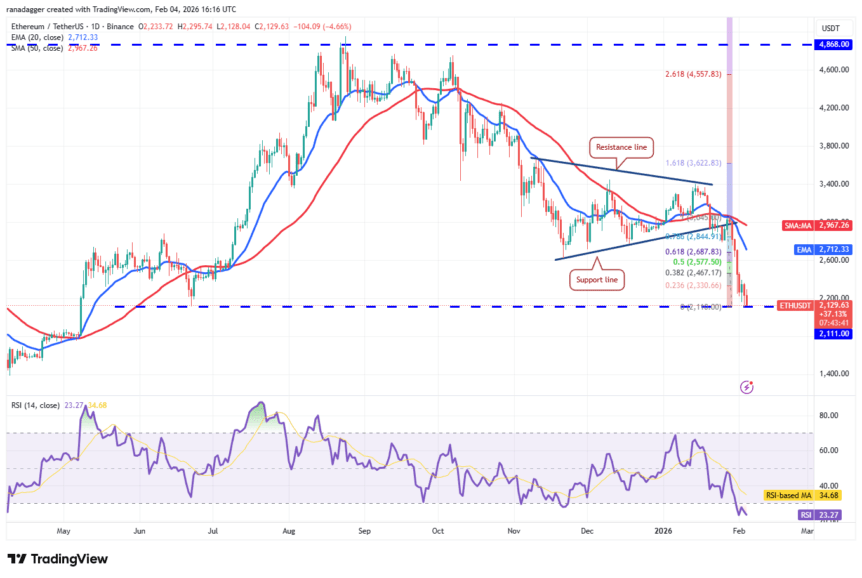
Ether (ETH) entered Tuesday defending a critical level near $2,111, but the bounce remained shallow, signaling a lack of aggressive buying support from bulls. If selling pressure resumes and the price breaks below the $2,111 mark, the ETH/USDT pair could slide toward $1,750. The RSI’s oversold condition hints at a potential short-term relief rally, yet confirmation is needed through a move above the 38.2% Fibonacci retracement at around $2,467 and the 20-day exponential moving average near $2,712. A daily close above the 20-day EMA would be a constructive sign for bulls, indicating a shift in near-term momentum.
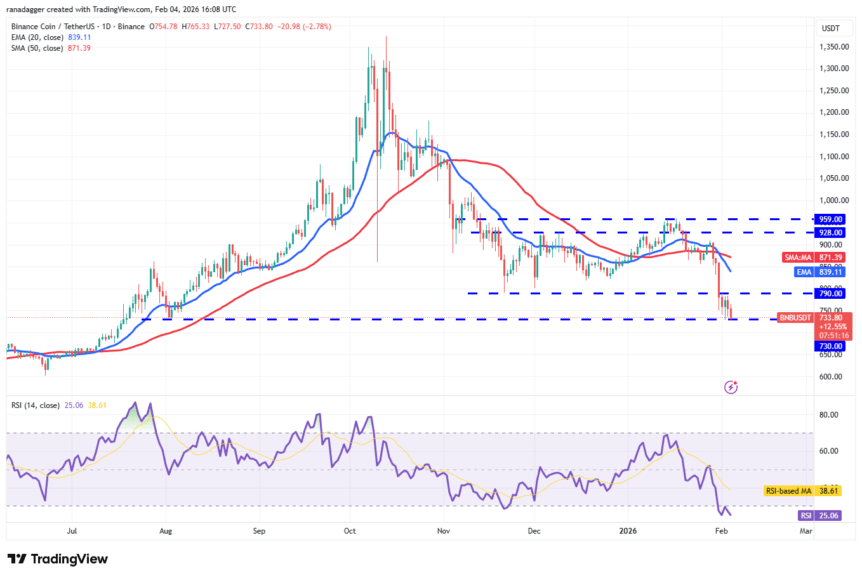
BNB (BNB) continues to trade below the $790 level, keeping the risk of a sharper dip intact should bears reclaim momentum. A close below $730 would mark a shift in control, potentially driving the pair toward $700 and then to the $645 area. Bulls, meanwhile, will need to sustain a move above the $790 resistance and push toward the 20-day EMA around $839 to reassert control over the immediate path. The clock is ticking for the buyers, with the market closely watching for a sustained rebound that could anchor a broader recovery in the altcoin complex.
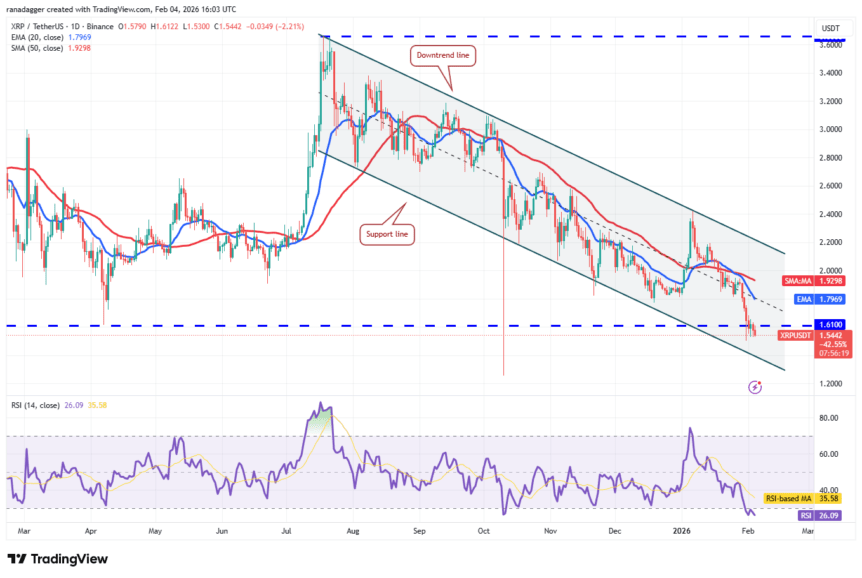
XRP (XRP) has struggled to sustain a break above the $1.61 threshold, a sign that bears are actively selling on relief rallies. A downside break from the descending channel could bring the token back toward the $1.25 region. To preserve a more constructive count, bulls would need to push above the moving averages and, ideally, above the downtrend line to keep the channel intact and hint at a longer-lasting shift in trend.
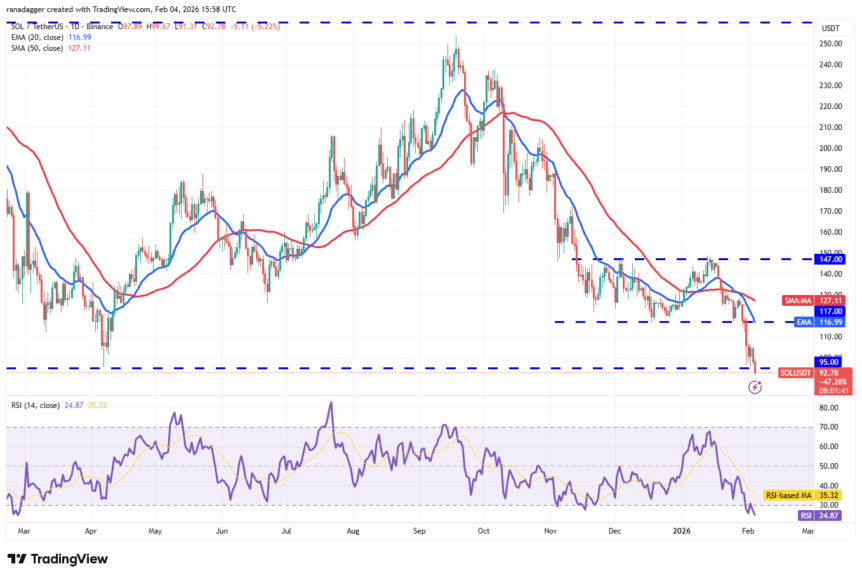
Solana (SOL) has faced renewed selling pressure after failing to clear the $107 resistance. A close below $95 would likely mark the continuation of the downtrend toward the next major support around $79, with the potential for further weakness if bears dominate the short-term action. A breakout above $107 could reframe the near-term outlook, steering the pair toward the 20-day EMA near $117, where selling pressure may re-emerge as bears attempt to reassert control.
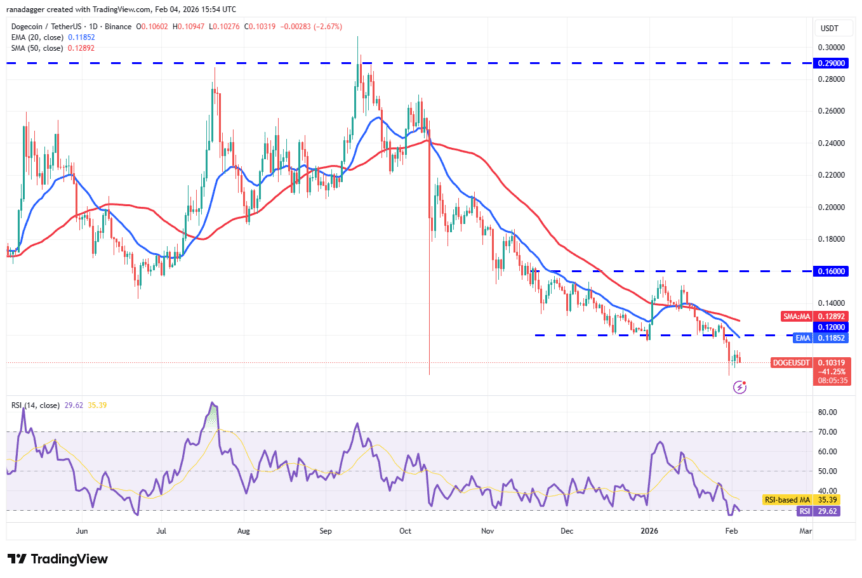
Dogecoin (DOGE) is attempting a relief move, but the bounce has been shallow, implying ongoing pressure from sellers. A relapse below the $0.10 level could drag DOGE down toward $0.08, while a move above the 20-day EMA around $0.12 could open a path toward $0.16 if buyers gain traction. The market’s reaction to the current level will help determine whether DOGE is merely testing a bear wall or laying the groundwork for a more sustained reversal.
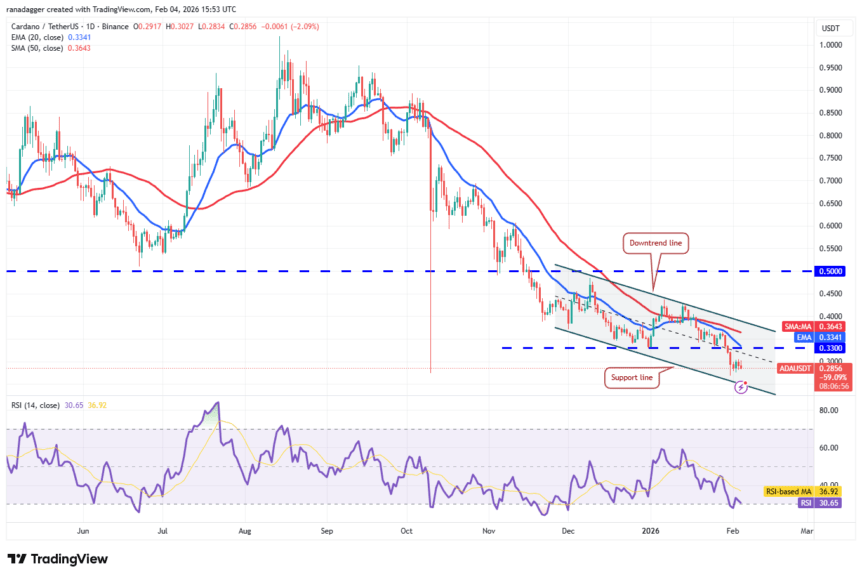
Cardano (ADA) is trying to bounce off the descending channel’s support, but the relief rally lacks strength. A turn down from the current level or the 20-day EMA near $0.33 would signal that the bears retain the upper hand and could push ADA toward the next major support around $0.20. Conversely, a decisive move above the 20-day EMA would keep ADA within the channel and could set up a test of the downtrend line, with a potential rally toward the $0.50 area if buyers reclaim control.
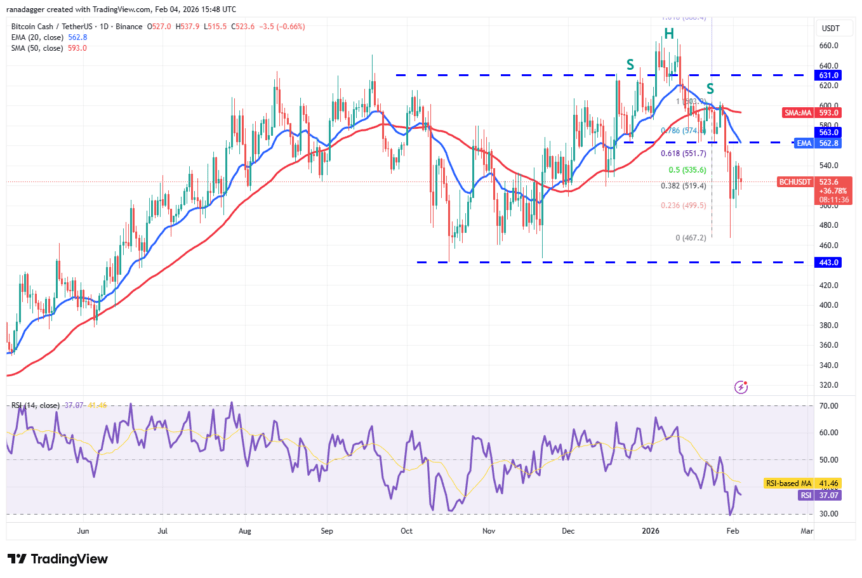
Bitcoin Cash (BCH) has mounted a stubborn resistance near the 50% retracement around $535, keeping the path to higher levels contested. If bears push BCH below $497, the downside could accelerate toward $467 and then $443. Conversely, a sustained move above $544 could draw buyers toward the 20-day EMA around $562, with a test of the $604 level possible if momentum shifts decisively in favor of bulls.
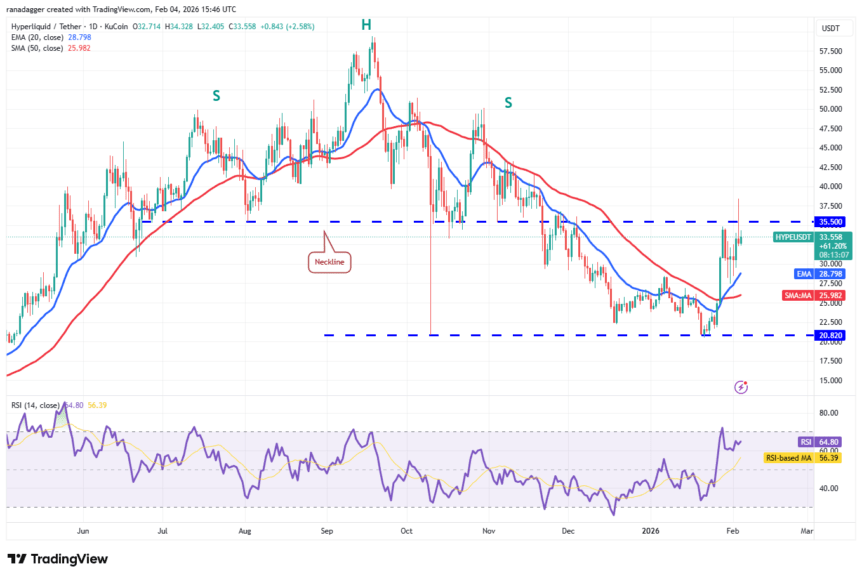
Hyperliquid (HYPE) breached the $35.50 resistance on Tuesday, but a long wick on the candlestick suggests selling at higher levels remains a headwind. If buyers partner with the current setup, a break above $35.50 could push HYPE toward $44, hinting that the corrective phase may be ending. However, a swift move below the 20-day EMA near $28.79 could keep the pair oscillating between $35.50 and $20.82 for an extended period.
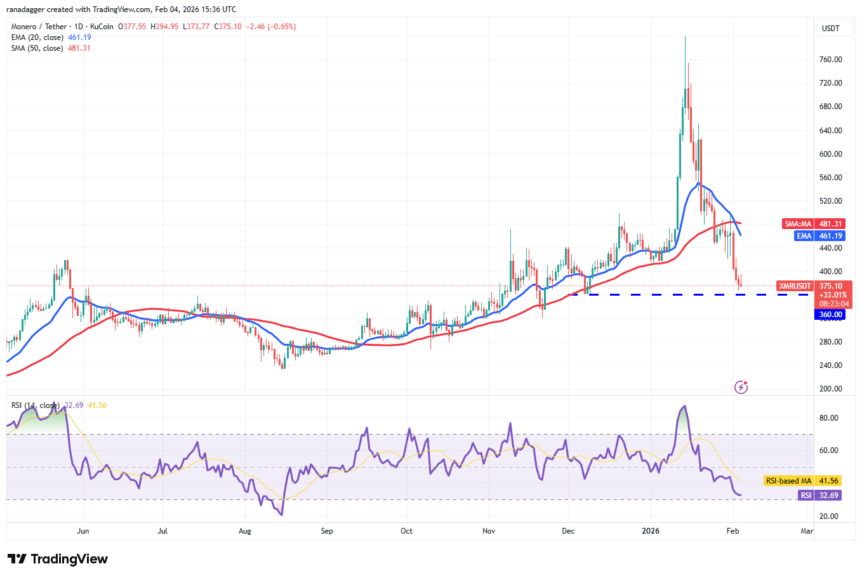
Monero (XMR) is attempting to establish a footing around the $360 level, but relief rallies remain vulnerable to selling at $412 and the 20-day EMA near $461. A move lower would place the next support near $360, while a sustained push above the 20-day EMA could invite a test toward $500, where selling pressure historically intensifies. After sharp declines, price action tends to consolidate before the next directional move, making near-term forecasts highly contingent on how the price behaves around the moving averages.
Overall, the market landscape remains delicate as traders reassess risk in a period of liquidity constraints and cautious positioning. The key near-term takeaway is that major assets are defending critical levels, but without a clear impulse from buyers, any break below established supports could accelerate the downside and redraw the scope of continued consolidation across the top ranks of the market.
Why it matters
For traders, the confluence of key supports and oversold conditions creates a fragile balance between retracements and renewed downside pressure. The tests of $74,508 and $72,169 for BTC, alongside Ethereum’s $2,111 floor, provide a battleground where micro-entries and risk controls will determine whether a relief rally gains momentum or if selling pressure resumes with renewed force. In this environment, altcoins trading near critical support zones are particularly vulnerable to quick shifts in sentiment, underscoring the importance of disciplined risk management and defined exit strategies.
From a broader market perspective, the situation underscores how macro dynamics and on-chain signals interact with technical thresholds. While some observers expect a rebound as oversold conditions unwind, others warn that the absence of catalysts could keep assets tethered to negative drift until fresh bullish narratives emerge. The tug-of-war between these viewpoints highlights the evolving complexity of crypto markets where liquidity, volatility, and sentiment can swing rapidly in response to both technical patterns and macro cues.
For developers and infrastructure teams building on-chain services, these conditions stress-test risk controls, liquidity provisioning, and the resilience of cross-chain flows. Elevated volatility can impact funding rates, borrow costs, and the timing of protocol upgrades, making robust risk assessment essential for participants across the ecosystem.
What to watch next
- BTC price action around $72,945 and $74,508: a decisive move below or above these levels will set the near-term trajectory.
- ETH at $2,111: a break below could target $1,750; a close above $2,467 and the 20-day EMA near $2,712 would signal bullish re-engagement.
- Relief rally triggers: a sustained move above $79,500 and toward $84,000 would be a meaningful bullish cue for BTC and correlated assets.
- Altcoin next supports: any breach of critical supports for SOL, XRP, ADA, BCH, and XMR could accelerate downside swings or alter the near-term trend.
- Market liquidity and risk tone: keep an eye on macro developments and any shifts in risk sentiment that could influence funding rates and asset correlations.
Sources & verification
- Galaxy Digital note stating BTC could fall to its realized price near $56,000 in coming weeks.
- Bitwise CIO Matt Hougan’s post on X discussing a potential sooner-than-expected market rebound.
- Price levels: BTC below $72,169 and near $74,508 as critical support/resistance points; RSI in oversold territory.
- ETH support at $2,111 and possible targets at $1,750, $2,467, and $2,712 based on chart analysis.
- Channel and moving-average references used to discuss XRP, SOL, DOGE, ADA, BCH, XMR scenarios.
What the story means for readers
The current setup reinforces the importance of monitoring key support zones and momentum indicators in a market that remains sensitive to macro cues and risk appetite. While a relief rally is plausible if price action turns constructive, investors should remain cautious and rely on robust risk controls as the market tests multiple moving averages and defensive levels. For builders and participants in the ecosystem, this environment emphasizes the value of resilient liquidity management and the need to prepare for a range of outcomes, from shallow bounces to deeper corrections, as assets navigate the interplay between chart-based signals and fundamental drivers.
Market context
In a climate where risk assets exhibit episodic volatility, the crypto market continues to move in step with broader liquidity conditions and investor sentiment. Downside pressure at critical levels often precedes cautious bounces, while oversold readings can precede short-lived relief rallies. The balance between technical levels and macro cues will continue to shape price action in the near term, with traders watching for confirmatory moves that could change the current narrative from consolidation to a renewed phase of directional movement.
Why this matters to traders, builders, and investors
For traders, the next few days will test the strength of risk-off sentiment against the potential for a short-covering rally. For builders and users of crypto services, stability around key prices matters for funding rates, liquidity provisioning, and the reliability of on-chain operations during periods of volatility. Investors should differentiate between short-term swings and long-term fundamentals, avoiding over-interpretation of any single move while prioritizing risk controls and diversification in a market that has shown resilience but remains prone to abrupt shifts in direction.
This article was originally published as Bitcoin Dips to 2026 Low as Altcoins Crumble: Is BTC at $56K Next? on Crypto Breaking News – your trusted source for crypto news, Bitcoin news, and blockchain updates.

Crypto World
World Liberty Financial (WLFI): Could This Token Follow LUNA’s Collapse? Red Flags Emerge

Key Takeaways
- Technical analysis reveals a bear flag formation on WLFI’s chart, suggesting a potential decline of 20% toward $0.066 during April.
- The project utilized its own illiquid WLFI tokens to secure a $75 million stablecoin loan through Dolomite, a platform operated by World Liberty Financial’s CTO.
- Pool utilization surged to 93% following the borrowing activity, preventing certain depositors from accessing their stablecoin funds.
- Tron’s Justin Sun, who committed a minimum of $75 million to WLFI, claims the project employed a concealed “backdoor blacklisting function” to freeze his 544 million token holdings.
- The threat of releasing more than 16 billion WLFI tokens hangs over the market, intensifying concerns about severe dilution.
The WLFI token from World Liberty Financial faces mounting challenges throughout April 2026. A combination of technical warning signs, controversial internal transactions, and a high-profile confrontation with a major investor are creating downward pressure on the asset’s valuation.
From a technical perspective, WLFI is currently confined within a bear flag formation — a chart pattern typically associated with continued downward momentum. The measured projection from this configuration suggests a price target near $0.066, representing approximately 20% below present trading levels. Should the token manage an upward breakout, traders would watch the 20-day and 50-day exponential moving averages positioned at $0.081 and $0.085 as immediate overhead resistance zones.
The WLFI/USDT trading pair displays this pattern prominently on four-hour timeframes, following several weeks of sharp price deterioration.
Controversial Collateral Strategy Raises Questions
Beyond technical indicators, recent on-chain activity has become the primary focus for concerned investors. According to blockchain intelligence from Arkham Intelligence, addresses associated with World Liberty Financial deposited approximately 3 to 5 billion WLFI tokens on Dolomite — notably, a DeFi lending protocol created by the project’s own chief technology officer — securing roughly $75 million worth of stablecoins including USD1 and USDC.
The WLFI Team is borrowing $150M USDC against $400M WLFI on Dolomite.
The WLFI Team is lending $406.23M of WLFI across 2 wallets. That is 4.99% of the supply, and 97.8% of the WLFI cap on Dolomite.
They are borrowing a total of $150M USDC against their holdings on Dolomite. pic.twitter.com/7dPsDKF73R
— Arkham (@arkham) April 10, 2026
More than $40 million of these borrowed stablecoins subsequently transferred to Coinbase Prime. This transaction sequence elevated Dolomite’s pool utilization rate to approximately 93%, effectively limiting withdrawal capabilities for other platform participants.
Observers have characterized this arrangement as “circular” liquidity extraction — leveraging the project’s own low-liquidity tokens to withdraw tangible value. Should WLFI experience significant price depreciation, the underlying collateral risks liquidation, potentially dumping massive token quantities into the market while leaving depositors exposed to unrecoverable losses.
THEY PRINTED 5 BILLION OF THEIR OWN TOKENS THEN WITHDREW IT AS USDC$WLFI FEELS LIKE LUNA 2.0 pic.twitter.com/5OWK25YdK7
— Darky (@Darky1k) April 11, 2026
Morten Christensen, who founded airdropalert.com and holds WLFI tokens, stated: “The whole taking a loan on your own token as collateral is tremendously shady.”
Sun’s Public Accusations Escalate Tensions
Justin Sun, the Tron blockchain founder who committed no less than $75 million to WLFI and accepted an advisory role, has publicly challenged the project’s practices. Sun alleges the team deployed an undisclosed backdoor mechanism to freeze his 544 million token allocation. He further contends that governance procedures were manipulated and has called for complete transparency regarding token release schedules.
On April 12, World Liberty Financial countered via X (formerly Twitter): “Justin’s favorite move is playing the victim while making baseless allegations to cover up his own misconduct.” The statement concluded: “See you in court pal.”
According to blockchain analytics provider Bubblemaps, Sun’s token holdings were initially frozen in September 2025, coinciding with the project’s 20% token unlock event. The freeze has persisted continuously since that date.
World Liberty maintains it has repurchased more than $65 million worth of WLFI tokens and denies liquidating any significant positions.
The organization indicated plans to conduct a governance vote addressing remaining token unlocks, while emphasizing that any release would occur incrementally rather than simultaneously. A proposed unlock involving over 16 billion tokens allocated for public distribution remains unresolved.

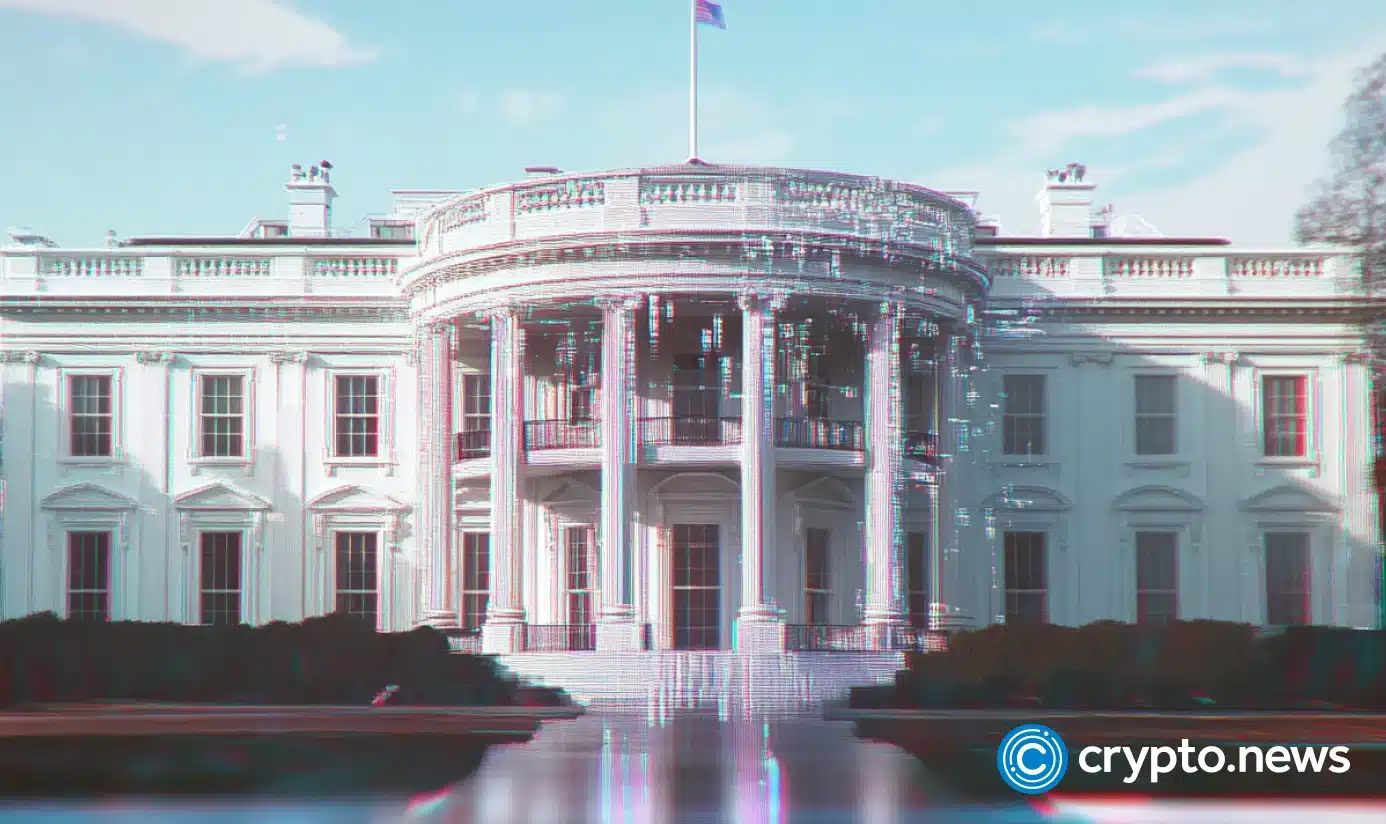
The crypto regulation standoff over the CLARITY Act shifted Monday when White House crypto adviser Patrick Witt told an interviewer that negotiations have cleared most remaining obstacles and that he is confident the final issues can be resolved, saying “we’re very close to closing them out.”
Summary
- Witt said the stablecoin yield dispute that dominated headlines for three months is largely settled under the Tillis-Alsobrooks framework, and that several other issues including DeFi rules and ethics provisions have made “considerable progress in the background.”
- The White House adviser would not specify which remaining issues have been closed, but said the fact that previously intractable problems were resolved gives him confidence that the outstanding ones will be too.
- Senator Thom Tillis is expected to release an updated stablecoin yield compromise draft this week, which could unlock a Senate Banking Committee markup before the end of April and a floor vote by late May.
The Witt interview aired Monday on CoinDesk TV as the Senate returned from Easter recess and Ripple CEO Brad Garlinghouse publicly projected the bill would pass by end of May. Witt acknowledged that the common ground secured by Senators Tillis and Alsobrooks on stablecoin yield “seems to be intact,” a notable signal given that Coinbase reversed its opposition to the bill earlier this month. The CLARITY Act cleared the House in July 2025 by a 294 to 134 vote and the Senate Agriculture Committee in January 2026, leaving only the Senate Banking Committee markup as the final major procedural step before the Senate floor.
The White House adviser’s language was deliberate. He said the negotiations made “considerable progress in the background” while the public focus was on the stablecoin yield fight, suggesting that DeFi rules and Democratic ethics demands are closer to resolution than the public record indicates. He also said that “all of these issues felt intractable and unsolvable at one point in time,” using past tense, which implies most of those previously intractable issues are now resolved.
What Still Needs to Happen Before a Vote
The Banking Committee needs a markup date from Chairman Tim Scott, who has not announced one. After the committee vote, the Banking and Agriculture Committee versions must be reconciled, then the combined Senate text must be reconciled with the House version, and then the bill requires a presidential signature. That is four sequential steps after the markup, each of which is a potential delay point.
Why the White House Is Pushing Now
The Iran war, the midterm calendar, and the TRUMP memecoin investigation are all converging in the same April window. The White House needs a crypto legislative win before the midterms arrive and Democratic incentives to cooperate disappear. As the markup window opens this week, the White House position is that the deal is done enough to vote. Whether Banking Committee members agree is the question that will define the next two weeks.

Uber and WeRide are partnering to offer robotaxi service in Abu Dhabi.
Courtesy Uber Technologies, Inc.
BEIJING — At least three Chinese robotaxi companies are pressing ahead with expansion plans in the Middle East despite the ongoing Iran war.
Ride-hailing company Didi plans to begin its first overseas robotaxi test in the United Arab Emirates later this year, according to a statement Wednesday.
Zhang Bo, co-founder of Didi and head of its autonomous driving business, disclosed the plans at a UAE-China business cooperation forum in Beijing earlier this week, according to the statement. Abu Dhabi Crown Prince Sheikh Khaled bin Mohamed bin Zayed Al Nahyan met Chinese President Xi Jinping in Beijing on Tuesday as part of a three-day state visit.
Didi’s UAE testing plan follows a broader push by Chinese autonomous driving companies in the region.
Guangzhou-based WeRide said earlier this month it had launched fully driverless, fare-charging robotaxi service in Dubai’s Jumeirah and Umm Suqeim districts. Riders can book a robotaxi through Uber‘s app.
Pony.ai is also pursuing commercial operations in the emirate. In late March, Pony.ai CEO James Peng said in response to a CNBC question that the war had not affected its application for a commercial license in Dubai and that he viewed the conflict as short term.
The Chinese robotaxi company said in September that it received permission from Dubai’s Roads and Transport Authority to test autonomous driving locally.

Baidu‘s robotaxi unit Apollo Go also announced on April 1 that residents and visitors in Dubai could start hailing fully driverless rides through its app. It was not immediately clear whether there were restricted areas of operation.
Dubai’s media office said in a social media post that the rollout would start with 50 vehicles, with plans for over 1,000 robotaxis over the next few years.
Chinese robotaxi companies have ramped up their global expansion plans in the last two years, with the Middle East emerging as an early launch market, followed by tests in Europe. Meanwhile, Alphabet-backed Waymo has rolled out fleets across more of the U.S. and has begun tests in London and Japan.

Subscribe now


Kraken co-CEO Arjun Sethi confirmed on Tuesday that the cryptocurrency exchange has moved forward with a confidential filing for an initial public offering in the United States.
Summary
- Kraken co-CEO Arjun Sethi confirmed the exchange has filed confidentially for a US initial public offering during a recent industry conference.
- Deutsche Börse Group secured a 1.5% stake in Kraken’s parent company through a $200 million investment that values the platform at $13.3 billion.
- The exchange leadership clarified that long-term growth and regulatory trust remain the primary drivers for going public rather than immediate capital needs.
Semafor reported from the World Economy 2026 conference that Sethi verified the filing during a discussion with reporter Rohan Goswami.
When asked if the news was significant, Sethi remarked, “I believe that’s news,” marking the first official confirmation of the move following unconfirmed reports in March that suggested the listing had been paused due to market volatility.
The disclosure coincided with a strategic $200 million investment from Deutsche Börse Group into Kraken’s parent company, Payward.
This deal gives the German market operator a 1.5% fully diluted stake and establishes a valuation of $13.3 billion for the exchange. This figure represents a decline from the $20 billion valuation the company held in November.
Kraken told crypto media that the partnership with Deutsche Börse is intended to merge digital assets with traditional finance. The goal is to create a single, cohesive infrastructure for institutional clients rather than maintaining parallel systems for different asset classes.
Addressing the timing of the IPO, Sethi noted that the decision is not a reaction to the current political climate in Washington. He suggested that while policy shifts might seem significant on a quarterly basis, they carry less weight for a firm looking at a multi-decade horizon.
“If you’re thinking about your company three, five, 10 or 20 years out, none of this is meaningful,” Sethi said. “It just doesn’t matter.”
The executive further clarified that the drive to go public is not solely about raising capital. Instead, the move hinges on specific market conditions and the level of established trust with regulatory bodies.
Federal Reserve nominee Kevin Warsh disclosed a diverse portfolio of private technology investments, including stakes in artificial intelligence and digital assets, as he prepares for a high-stakes Senate confirmation hearing.
Summary
- Federal Reserve nominee Kevin Warsh disclosed over $100 million in assets, including stakes in various cryptocurrency and artificial intelligence startups, ahead of his Senate hearing.
- The Senate Banking Committee scheduled a confirmation hearing for April 21 to vet Warsh as the successor to Jerome Powell, whose second term as chair concludes in mid-May.
According to a filing with the U.S. Office of Government Ethics, the former Fed governor holds interests in crypto-focused firms Compound and Dapper Labs, alongside AI startups such as Factory and Glue.
While the disclosure values his total assets at more than $100 million, specific valuation ranges for these individual technology holdings were notably absent.
Reuters reports that federal ethics guidelines exempt officials from reporting the value of assets worth less than $1,000, though the filing did detail substantial positions elsewhere, including over $50 million in the Juggernaut Fund and $10 million in consulting income from Stanley Druckenmiller’s Duquesne Family Office.
President Trump formally submitted Warsh’s name to the Senate in March, following a January announcement that signaled an end to Jerome Powell’s leadership.
The move comes as the administration faces a ticking clock; Powell’s second term as chair concludes on May 15.
The Senate Banking Committee has now scheduled Warsh’s appearance for April 21, positioning him to take over the central bank’s influence over interest rates and broader financial policy just weeks before the vacancy opens.
Despite the movement on the Fed’s leadership, the administration has yet to fill critical vacancies at the Securities and Exchange Commission (SEC) and the Commodity Futures Trading Commission (CFTC).
The SEC is currently operating with only three of its five commissioner seats filled, while the CFTC is down to a single commissioner, Michael Selig.
These gaps persist as a stalled crypto market structure bill remains in the Senate, leaving both agencies shorthanded at a time when they are expected to define the future of digital asset regulation.

Bitcoin researchers led by cypherpunk Jameson Lopp, along with five co-authors focused on quantum security, have put forward a controversial plan to shield the network from a future quantum-enabled theft. The proposal, labeled BIP-361 and titled “Post Quantum Migration and Legacy Signature Sunset,” would be implemented in three stages to migrate coins away from quantum-vulnerable output types — including Satoshi’s widely discussed stash — and to harden the network before quantum computers become practical threats. The draft was posted to GitHub this week as the second installment in the broader plan.
The impetus for the proposal is clear: researchers warn that roughly 1.7 million BTC stored in early P2PK addresses could be at risk if a quantum adversary gains access to powerful quantum hardware. Among these coins is the so‑called Satoshi stash, which some estimate could be valued in today’s dollars at around $74 billion. The aim, the authors argue, is to prevent a scenario in which quantum-enabled theft undermines trust in the Bitcoin network. The plan is framed as a defensive mechanism—a private incentive to upgrade—rather than an offensive maneuver to seize control of others’ funds.
Key takeaways
- BIP-361 is a three-phase plan that follows BIP-360’s soft-fork approach and aims to migrate vulnerable coins to quantum-resistant paths, addressing about 34% of Bitcoin’s supply that remains at risk unless moved.
- The phases are timed: Phase A begins three years after activation and would stop new BTC from being sent to old-style addresses, requiring users to migrate to quantum-resistant types.
- Phase B arrives five years after activation, invalidating old-style signatures and effectively freezing any funds remaining in vulnerable addresses.
- Phase C provides a zero-knowledge proof-based recovery mechanism for those who missed the deadline but can still demonstrate ownership via seed recovery, offering a potential rescue path.
- The proposal has drawn swift pushback from parts of the Bitcoin community, with critics calling it heavy-handed or confiscatory, arguing it undermines Bitcoin’s ethos of opt-in upgrades.
Context and the technical what-ifs
In February, developers released BIP-360, which proposed a soft fork introducing a new output type known as pay-to-Merkle-root (P2MR). The idea mirrors Bitcoin’s existing Taproot (P2TR) structure but removes the quantum-vulnerable key path from legacy addresses. While BIP-360 would protect funds moving forward, it does not automatically safeguard the substantial portion of the supply that remains vulnerable in old addresses unless owners proactively move funds to quantum-resistant forms.
BIP-361 extends this concept into a staged migration. Three years after activation, Phase A would bar transfers to old-style addresses, forcing users to adopt quantum-secure address formats. Then, five years after activation, Phase B would invalidate old-style signatures altogether, rendering coins in vulnerable addresses effectively unspendable unless they have already migrated. Phase C offers a potential rescue mechanism using zero-knowledge proofs to allow recovery for users who still possess their seed phrases but failed to upgrade in time.
Related: Bitcoin Magazine has noted the debate’s potential hard-fork implications, underscoring that the policy could center the fate of historical coins and alter the network’s long-term security model.
“This is not an offensive attack, rather, it is defensive: our thesis is that the Bitcoin ecosystem wishes to defend itself and its interests against those who would prefer to do nothing and allow a malicious actor to destroy both value and trust.”
Community reaction and the philosophical divide
The plan has ignited a robust discussion about Bitcoin’s core principles and the trade-offs of upgrading a global, permissionless system. Critics argue that forcing upgrades or rendering unupgraded UTXOs unspendable would mark a significant departure from Bitcoin’s ethos of non-coercive change and could set a dangerous precedent for future interventions.
Bitcoin protocol developer and researcher Mark Erhardt, who circulated BIP-361 on social media, faced immediate critique. Responders described the proposal as “authoritarian and confiscatory,” questioning the rationale for mandating upgrades and the legitimacy of rendering old spends invalid.
Other voices weighed in with skepticism as well. Bitcoin Magazine’s editors and contributors have been vocal in challenging the premise, while TFTC founder Marty Bent characterized aspects of the approach as inconsistent with the community’s expectations. Phil Geiger, head of business development at Metaplanet, offered a provocative take on the tension between protection and coercion. The broader sentiment remains unsettled: the consensus on whether a crypto-legalistic safeguard should override voluntary evolution is far from settled.
Cointelegraph reached out to Lopp for comment on the proposal; there was no immediate response at the time of publication. The GitHub draft, however, provides a concrete framework for discussion and potential future forks, even as many stakeholders call for a cautious, community-driven examination of the implications.
For readers tracking the evolution of quantum resilience in Bitcoin, the conversation now shifts from theoretical risk to concrete, staged mitigation. The three-phase design is designed to minimize disruption by letting the ecosystem migrate over time, but it also raises fundamental questions about asset-holding rights, upgrade incentives, and the governance of a decentralized network.
Implications for holders, users, and builders
From a practical standpoint, BIP-361 highlights two enduring tensions in Bitcoin’s path to quantum readiness. First, there is the temptation to act decisively to protect value, especially when the stakes include a multi-trillion-dollar network and the world’s most valuable cryptocurrency by market capitalization. Second, there is the risk that coercive upgrades or automatic penalties could fragment the ecosystem or erode trust among users who prefer to manage their own keys and seeds at their own pace.
For investors and developers, the proposal underscores the importance of forward-looking security models. If the plan progresses, the market could see increased demand for quantum-resistant wallets and services, as well as migrations that push older holders toward newer output types. The timeline—three years to Phase A and five to Phase B—provides a window for infrastructure teams to test compatibility, wallets to implement support for P2MR-like paths, and communities to debate the ethics and practicality of forced upgrades.
As the discussion unfolds, observers will be watching how this approach interacts with existing upgrade narratives, such as soft forks and user-initiated migrations. The zero-knowledge recovery proposed in Phase C is a particularly notable element: it aims to offer a path back to funds for those who missed the deadline, but the feasibility and privacy implications of such a mechanism will require rigorous scrutiny before any real-world deployment.
What to watch next
The BIP-361 draft opens a testing ground for how the Bitcoin community might address quantum threats without waiting for a single, sweeping upgrade. The next steps will likely involve broader discussions on GitHub, more technical vetting of the P2MR architecture, and public comment on the ethical and philosophical implications of effectively freezing or confiscating old UTXOs. Investors and builders should monitor how proponents respond to pushback from core developers and community voices, and whether practical consensus emerges around the timing and scope of any future activation.
As the conversation evolves, the central question remains: can a planned, staged migration deliver robust quantum protection without compromising Bitcoin’s foundational principles? The answer will shape not just security strategies, but the culture of upgrade, trust, and governance in the years ahead.
Key Highlights
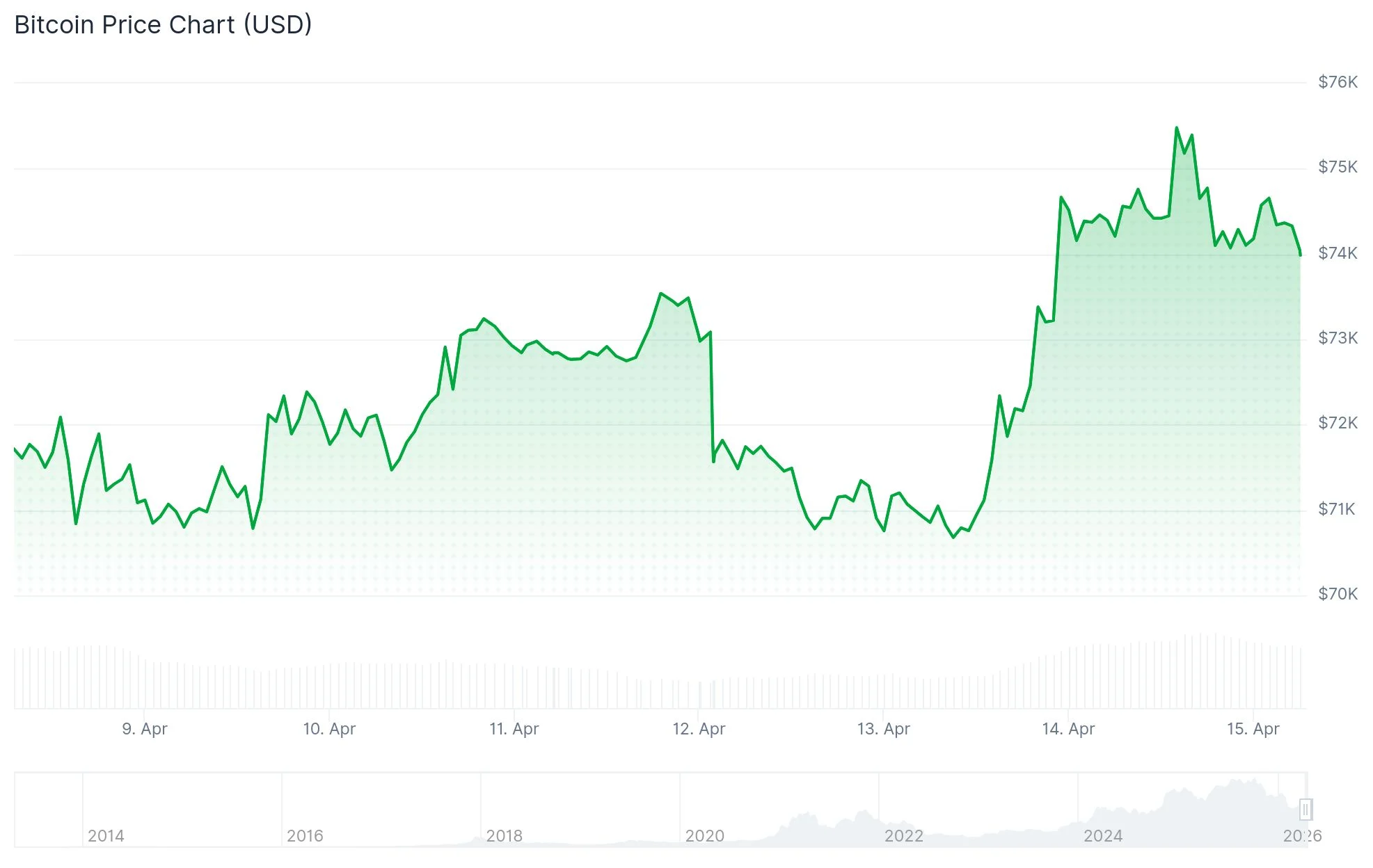
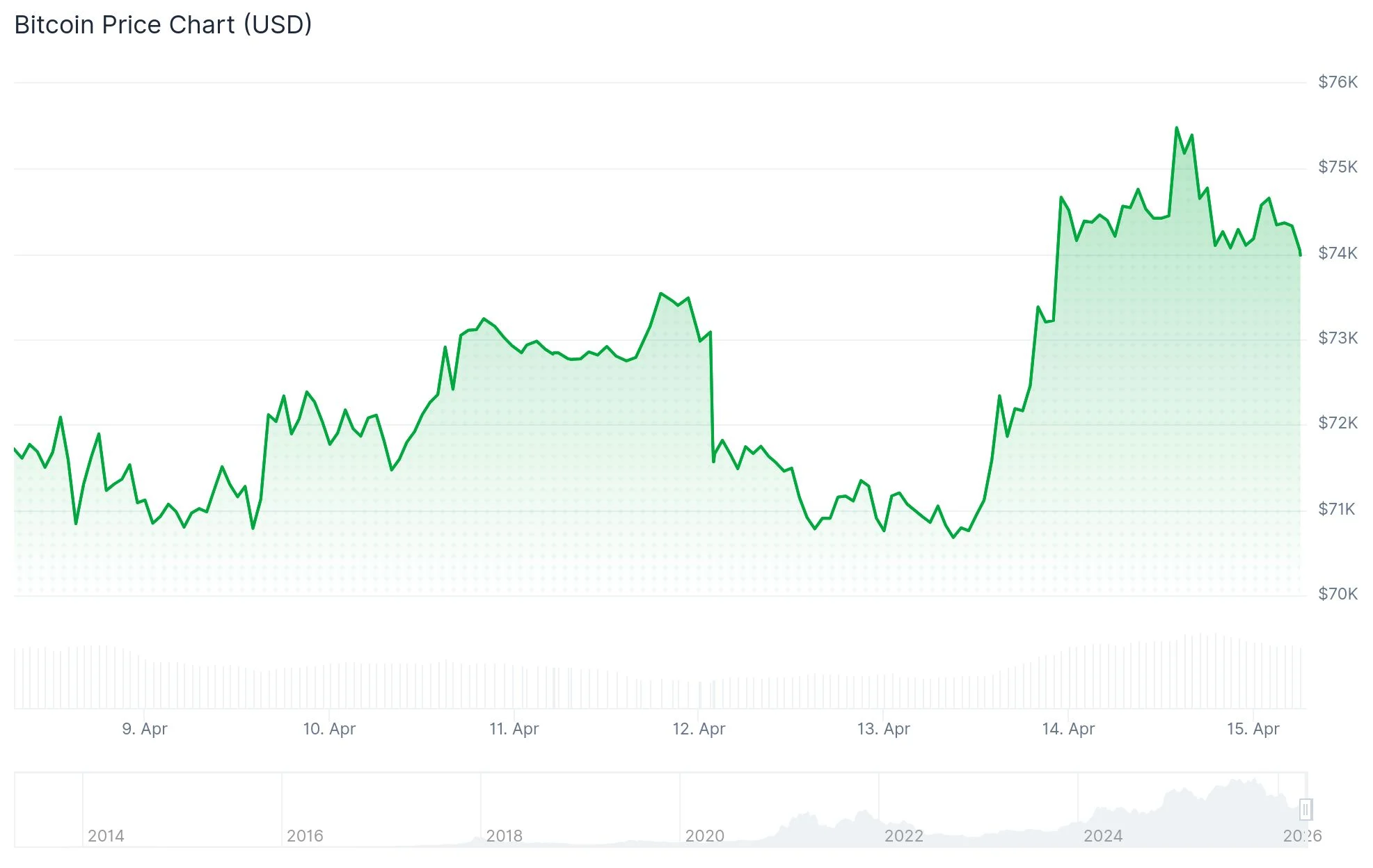
- Bitcoin maintained its position above the $74,000 threshold as investor confidence returned to global markets
- Major Asian stock indices, notably China’s CSI 300, completely recovered from earlier geopolitical setbacks
- Spot Bitcoin ETFs in the United States recorded $471 million in net inflows during a single trading session, bringing total cumulative flows above $56 billion
- The S&P 500 advanced 1.2% while the Nasdaq jumped 2%, marking the Nasdaq’s tenth consecutive daily gain
- Crude oil prices held beneath the $100 per barrel mark amid speculation of potential diplomatic engagement between Washington and Tehran, reducing inflation concerns
Bitcoin successfully maintained its position above the $74,000 mark on Wednesday as market participants demonstrated renewed appetite for riskier asset classes. Financial markets worldwide extended their rally, recovering ground lost during the U.S.-Iran tensions that emerged in late February.
Equity markets across Asia spearheaded the recovery movement. China’s CSI 300 index emerged as the most recent benchmark to completely reverse its conflict-driven losses, following similar recoveries in Taiwanese and Singaporean markets that had already returned to levels seen before the crisis began.
U.S. equity markets demonstrated strong momentum. The S&P 500 climbed 1.2% while the Nasdaq Composite soared 2%. The Dow Jones Industrial Average contributed with a 317-point increase. The S&P 500 has now delivered positive returns in nine out of the last ten trading sessions and remains just shy of the record peak it established in late January.

The Nasdaq pushed its consecutive winning session streak to an impressive ten days. Year-to-date losses attributed to the Iran conflict have been virtually eliminated.
Diplomatic developments contributed significantly to market sentiment. President Trump revealed earlier in the week that communication channels between Washington and Tehran have been established. Oil prices retreated following this announcement and continue trading below the $100 per barrel threshold, alleviating the inflationary pressures that had challenged markets throughout March.
Institutional Bitcoin ETF Activity Reflects Strong Conviction
Within cryptocurrency markets, U.S. spot Bitcoin ETFs registered $471 million in net positive flows on April 6, representing their most robust single-session performance since February. Total cumulative inflows have now surpassed the $56 billion milestone since these investment vehicles debuted in January 2024.
Bitcoin’s current trading price hovers near the calculated average cost basis for ETF investors. Market analysts suggest this level may serve as support, given that investors who maintained positions during the decline below $60,000 have limited incentive to exit at or near their entry point.
“Institutions pouring in $471 million in a single day and pushing past $56 billion cumulative means Bitcoin is getting a whole new class of long-term holders,” said Vikrant Sharma, founder of CakeWallet.
Alternative Cryptocurrencies Show Divergent Performance
Ether posted a 4% weekly advance, reaching approximately $2,325, surpassing Bitcoin’s 3.9% weekly increase. However, performance across alternative cryptocurrencies remained inconsistent. Solana declined 1.5% to $83, Cardano retreated 1%, and Dogecoin decreased 1.3% to settle at $0.093.
Tron distinguished itself with a 3% weekly appreciation.
Market observers are also incorporating expectations for potential Federal Reserve interest rate reductions later in the year. Such monetary policy adjustments typically inject liquidity into risk-oriented assets, a dynamic that has historically benefited both equities and digital currencies.
Corporate earnings announcements are commanding attention as well. Bank of America and Morgan Stanley are both scheduled to release quarterly results before Wednesday’s market opening.
U.S. stock index futures maintained relatively stable positioning Tuesday evening following the robust trading session, with contracts linked to the S&P 500, Nasdaq 100, and Dow Jones all trading near unchanged levels.
Crypto World
Tim Draper Doubles Down on $250K Bitcoin (BTC) Forecast After Nailing Previous Predictions
Key Takeaways
- Venture capitalist Tim Draper has renewed his $250,000 Bitcoin price forecast, setting an 18-month timeline for the target
- In 2014, Draper purchased 30,000 BTC for $632 per coin at a U.S. Marshals auction following the Mt. Gox incident
- Bitcoin reached a peak of $126,080 in October 2025 and currently trades near $74,271
- Draper points to increased adoption and deteriorating fiat currencies as primary drivers for his optimistic projection
- His 2014 forecast of $10,000 BTC proved correct, while more recent predictions have not met their timelines
Tim Draper’s journey with Bitcoin stretches back to its earliest days. The prominent venture capitalist first acquired Bitcoin when it traded at just $4, attempting to mine cryptocurrency with a business partner using specialized chips from Butterfly Labs. According to Draper, those chips never materialized as promised — he alleges the company used them for their own mining operations instead.
When the equipment eventually showed up, Bitcoin’s price had already surged past $30. Draper proceeded to build a substantial position, which he ultimately lost completely in the infamous Mt. Gox exchange failure.
Undeterred, Draper made a bold move in 2014, investing $19 million at a U.S. Marshals Service auction to acquire 30,000 BTC confiscated from the Silk Road operation, at a price of $632 each.
Immediately following that acquisition, he made a public forecast that Bitcoin would climb to $10,000 within three years. The prediction drew widespread skepticism. History proved him correct.
An Evolving Timeline for a Bold Forecast
On April 14, Draper shared an extensive post on X detailing his Bitcoin experience and future price expectations. He acknowledged that his latest targets “have not been so prescient” — his previous forecast called for BTC to touch $250,000 by the close of 2025.
That timeframe has been adjusted. Draper now projects Bitcoin will achieve $250,000 within the next 18 months.
He identifies two primary catalysts behind this projection: expanding acceptance of Bitcoin for everyday transactions and the ongoing devaluation of conventional fiat currencies through inflationary pressures.
Draper has consistently advocated for Bitcoin’s potential to displace traditional money. He’s stated in the past that failing to hold Bitcoin is “irresponsible” and predicted that merchants will eventually accept only BTC for transactions.
Current Bitcoin Market Position
Bitcoin touched its record high of $126,080 on October 6, 2025. Since that peak, the cryptocurrency has declined approximately 40%, trading around $74,271 as of this writing.
Beyond Bitcoin itself, Draper maintains investments in prominent cryptocurrency platforms such as Coinbase and Robinhood Markets. He was also an early Tesla backer before that company considered accepting Bitcoin payments.
Additionally, Draper has introduced DraperTV on Pump.fun, a platform built on Solana, where he showcases content with fellow entrepreneurs.


Blockaid flags CoW Swap’s cow.fi frontend as malicious, urging users to revoke token approvals and avoid the dApp amid a broader wave of DeFi interface attacks.
Summary
- Blockaid flags CoW Swap’s main cow.fi frontend as malicious.
- Users are urged to revoke token approvals and avoid the dApp immediately.
- Incident highlights growing wave of DeFi frontend attacks across major protocols.
Blockchain security firm Blockaid has warned that CoW Swap’s primary website COW.FI has been compromised in a suspected frontend attack, marking the latest high‑profile exploit attempt against a major DeFi trading interface.
In an alert shared on X, Blockaid said its system “has detected a front-end attack targeting Cowswap” and confirmed that the cow.fi domain has been flagged as malicious inside Blockaid‑integrated wallets, advising users “to refrain from signing transactions and avoid interactions with the dApp until the issue is resolved.”
Following the warning, CoW Swap community channels and independent security commentators urged traders who had connected wallets to CoW Swap to immediately revoke any outstanding token approvals and to stop interacting with the platform’s frontend until further notice, even though underlying smart contracts have not been reported as compromised.
Blockaid’s latest alert comes amid a surge in so‑called frontend hijacks, where attackers compromise a project’s website or DNS rather than its on‑chain contracts, silently swapping legitimate transaction prompts for malicious ones that drain user wallets.linkedin+1
In February, Blockaid reported a similar frontend attack on tokenization platform OpenEden, warning users to “refrain from signing transactions and avoid interactions with the dApp until the issue is resolved,” while separate incidents have recently hit lending protocol Curvance and asset manager Maple Finance.
As highlighted in CoW Swap’s own DeFi security guides, these attacks target “people, devices, and transaction behavior instead of only attacking code,” making basic hygiene like checking URLs, using browser bookmarks and monitoring token approvals critical for retail and professional users alike.
Security platforms such as Kerberus and Revoke‑style tools recommend users regularly audit and revoke token approvals after any suspected incident, noting that revocation “only removes future permission for that contract to move your tokens” and cannot recover funds already drained.
For DeFi traders, the CoW Swap incident underscores a lesson that keeps recurring in crypto.news coverage of exchange exploits, bridge hacks and protocol drains: even when audited smart contracts remain intact, a single compromised frontend can still turn a routine swap into a total wallet loss if users sign blind.
Self-custodial wallet tether.wallet supports Bitcoin, USDT, USAT and XAUT across multiple blockchains at launch.
Tether today unveiled its self-custodial crypto wallet using the open-source Wallet Development Kit (WDK) developed by the firm. According to an announcement from the firm, tether.wallet supports USDT, USAT, Bitcoin and XAUT, what the firm says represent “the only assets that truly matter for most of the people.”
Tether says the initiative, which it’s dubbing “the People’s Wallet” aligns with its mission to promote financial inclusion globally, particularly in developing countries and regions with high inflation.
Tether CEO Paolo Ardoino was quoted in the announcement on the firm’s aim of preserving self-custody, without compromising on user experience:
“The objective is to remove the complexity that has prevented broader adoption while preserving the properties that make the digital assets technology valuable. Users should be able to send value as easily as sending a message, without relying on intermediaries and without giving up control of their assets.”
As an example, the firm’s announcement notes that the wallet lets users pay fees in the asset being transferred, instead of needing to acquire or hold separate tokens for gas. The wallet also supports easily readable addresses for sending and receiving that look more like an email address, instead of the typical alphanumeric string.
Tether says at launch, the wallet supports USDT and XAUT on Ethereum, Polygon, Plasma, and Arbitrum, and USAT on Ethereum. It also supports Bitcoin both natively and via the Lightning Network. The firm plans to add support for “several other blockchains” in the future.
Last month, Tether announced that it had engaged a Big Four firm to conduct its first ever “full independent financial statement audit.”
This article was written with the assistance of AI workflows. All our stories are curated, edited and fact-checked by a human.

Which airlines have cancelled flights to the Middle East? The latest as Iran ceasefire at risk

7-Eleven to close 645 North America stores
World Liberty Financial (WLFI): Could This Token Follow LUNA’s Collapse? Red Flags Emerge


-

 Politics5 days ago
US brings back mandatory military draft registration
-
 Sports5 days ago
Man United discover Nico Schlotterbeck transfer fee as defender reaches Dortmund agreement
-

 Fashion5 days ago
Weekend Open Thread: Veronica Beard
-

 Politics5 days ago
Malcolm In The Middle OG Turned Down ‘Buckets Of Money’ To Appear In Reboot
-

 Politics3 days ago
World Cup exit makes Italy enter crisis mode
-

 Crypto World6 days ago
Canary Capital Files SEC Registration for PEPE ETF
-

 Business4 days ago
Tesla Model Y Tops China Auto Sales in March 2026 With 39,827 Registrations, Beating Cheaper EVs and Gas Cars
-

 Crypto World2 days ago
The SEC Conditionalises DeFi Platforms to Be Avoided for Broker Registration
-

 Crypto World1 day ago
SEC Signals Exemption for Crypto Interfaces From Broker Registration
-

 Crypto World7 days ago
Bitcoin recovers as US and Iran Agree a Ceasefire Deal
-
 NewsBeat2 days ago
Pep Guardiola and Gary Neville agree over Arsenal title problem that benefits Man City
-

 Business5 days ago
OpenAI Halts Stargate UK Data Centre Project Over Energy Costs and Copyright Row
-

 Business4 days ago
Ireland Fuel Protests Enter Day 5 as Blockades Spark Shortages and Government Prepares Support Package
-

 Politics5 days ago
LBC Presenter Mocks Trump Over Iran War Failures
-

 Crypto World4 days ago
Federal judge blocks Arizona from bringing criminal charges against Kalshi
-
 NewsBeat3 days ago
JD Vance announces ‘no agreement’ with Iran over nuclear weapons fear
-

 Tech5 days ago
A version of Windows 10 released a decade ago is now eligible for additional security patches
-

 Crypto World1 day ago
SEC Proposes Certain Crypto Interfaces Don’t Need to Register as Brokers
-

 Business4 days ago
IMF retains floor for precautionary balances at SDR 20 billion
-

 NewsBeat22 hours ago
Trump and Pope Leo: Behind their disagreement over Iran war
You must be logged in to post a comment Login