

Crypto World
Bitcoin ETFs’ Six-Day Loss Foreshadows 2026 Net Outflows

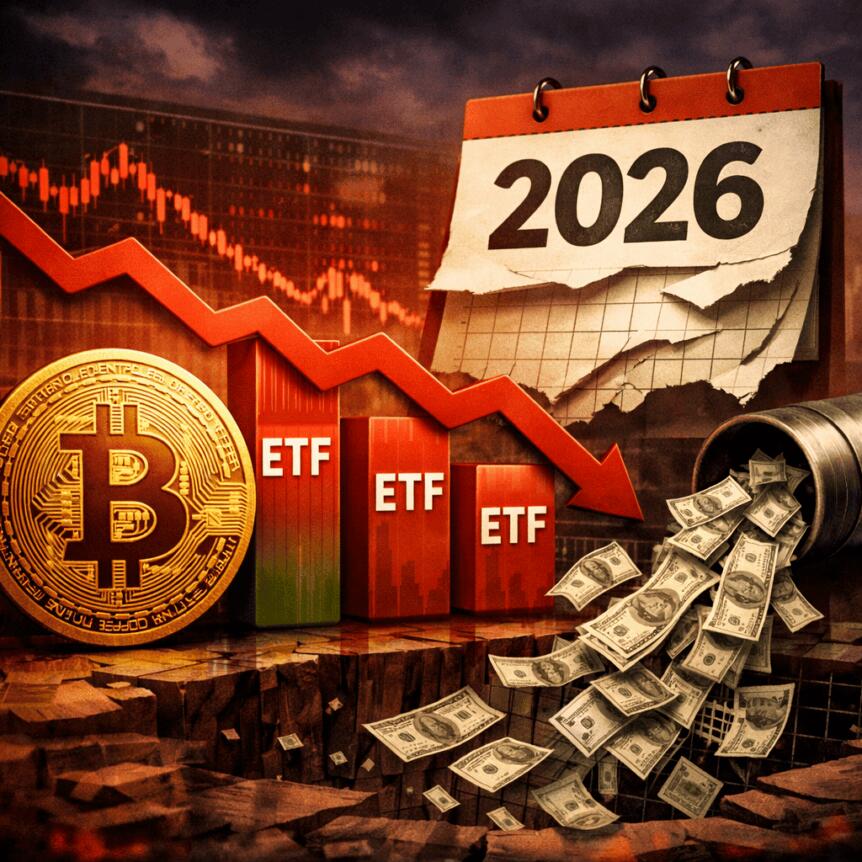
The US market for spot Bitcoin ETFs continues to wobble as Friday produced six straight days of outflows across the sector, even as year-to-date inflows remain in positive territory. Net inflows into US spot Bitcoin ETFs have cooled to roughly $536 million in 2026, with a Friday session that shaved another $105.2 million from fund totals. The bulk of 2026 demand remains focused on the iShares Bitcoin Trust (IBIT), which posted prominent net inflows of about $2.7 billion so far this year, while other funds saw red ink amid a crowded, fee-sensitive landscape.
On Friday, IBIT led the retreat, losing about $68.9 million, while the Fidelity Wise Origin Bitcoin Fund (FBTC) posted outflows of roughly $36.3 million. In aggregate, the broader group recorded $105.2 million in net withdrawals, contributing to a running total of about $1.55 billion in net outflows since May 14—the last date when any US spot Bitcoin ETF registered a net inflow. Data provider Farside Investors tracks flows across the U.S. spot Bitcoin ETF lineup, illustrating how investor demand has coalesced around a single large product while other funds struggle to keep pace.
Despite the churn, IBIT’s dominance remains intact for the moment. The fund’s cumulative inflows for 2026 are a major driver of the mainstream ETF appetite for Bitcoin exposure, underscoring how institutional demand has persisted even as competition intensifies and fee structures come into sharper focus. The latest numbers place IBIT in a different league from its peers, reinforcing a pattern from recent years where one vehicle captures the lion’s share of inflows even as others wander in and out of net flow territory.
Key takeaways
- IBIT continues to be the primary beneficiary of 2026 inflows, with about $2.7 billion in net inflows year to date, dwarfing other ETF activity.
- Morgan Stanley’s MSBT has emerged as a notable new entrant, attracting $264 million in net inflows since its April 8 launch and surpassing the early products from Invesco and WisdomTree.
- The broader US spot Bitcoin ETF landscape remains in net inflow territory for 2026, but the pace of inflows is uneven, with a heavy tilt toward IBIT and mixed results elsewhere.
- In a sign of shifting risk and pricing dynamics, several institutions trimmed exposure: Jane Street reduced its Bitcoin ETF holdings by roughly 70% in Q1, and Goldman Sachs cut its position by about 10%.
- Interest in altcoin or Ether-focused ETFs has lagged relative to Bitcoin products, as Ether ETFs show net outflows and newer offerings have not attracted the same demand.
Growing competition shapes the Bitcoin ETF landscape
The launch of the Morgan Stanley Bitcoin Trust ETF (MSBT) on April 8 marks a significant milestone in the US Bitcoin ETF race. MSBT has drawn $264 million in net inflows to date, positioning it ahead of rival launches from Invesco and WisdomTree, which entered the market in January 2024. The early momentum for MSBT is widely interpreted as a sign that investors are price-conscious and looking for an ultra-low-fee option in a crowded field; the fund is notable for a market-low fee of 0.14% per year.
Industry observers also took note of the broader competitive dynamics. Bloomberg ETF analyst James Seyffart suggested that the decision by Yorkville America—the sponsor behind the Truth Social-linked Bitcoin ETF plan—to pull multiple crypto ETFs could reflect the intense competition in this space. The 0.14% MSBT fee is a particularly compelling draw in a market where expense ratios have long been a swing factor for investors weighing Bitcoin exposure versus other risk assets. Earlier reporting from Cointelegraph highlighted MSBT’s low-fee approach as a potential differentiator against established incumbents.
Albeit the MSBT development has been positive for Morgan Stanley, the rest of the sector remains mixed. Data show that while the US spot Bitcoin ETF market as a whole remains in positive inflows for 2026, most of that positive momentum has rested with IBIT. In contrast, several other funds have retraced in 2026, and the pace of new capital into the space is not yet on track to replicate the massive inflows seen in 2025, when a single product drew about $25 billion in net new money for that year. That comparison underscores the persistent, yet uneven, demand for regulated Bitcoin access among institutional players.
Performance snapshot for related products
Alongside Bitcoin-focused products, the ether ETF ecosystem has faced headwinds this year, with US-listed spot Ether ETFs registering net outflows so far in 2026. In contrast, new altcoin ETFs have not demonstrated the same appetite from investors, underscoring a preference for established Bitcoin exposure amid ongoing regulatory and market uncertainty. The shift also highlights how issuers and fund sponsors must navigate an evolving regulatory environment and competition when structuring futures or physically-backed vehicles.
Beyond the flows and fund performance, the sector’s sentiment has been shaped by notable strategic moves from Wall Street banks. In Q1, Jane Street reduced its Bitcoin ETF holdings by approximately 70%, a telling sign that even major market makers are rebalancing exposure in a climate of thin liquidity and shifting risk appetite. Goldman Sachs—another heavyweight in the ETF space—trimmed its Bitcoin ETF position by roughly 10% in the same period, signaling a broader recalibration of Bitcoin allocation among traditional banks’ investment desks. Earlier coverage from Cointelegraph noted Goldman’s reduced exposure to crypto-focused ETFs in the first quarter of 2026, reflecting a cautious stance amid regulatory and macro headwinds.
On the regulatory and market-facing side, there was chatter about the potential launch of a Truth Social-backed Bitcoin product before Yorkville America withdrew multiple crypto ETF bids for the social platform. The episode has been read by analysts as evidence of the highly competitive and rapidly evolving environment for crypto asset investment products, where timing, pricing, and sponsor strength all play a role in whether a fund can attract sustainable capital.
Flows compiled by Farside Investors show a clear concentration of investment interest in a single, well-known conduit for Bitcoin exposure. The data also illustrate how institutional demand often follows the path of least resistance—where size, liquidity, and a favorable fee structure align—rather than dispersing evenly across the entire ETF family.
What this means for investors is nuanced. The ongoing inflow strength of IBIT signals that large institutions remain willing to allocate capital to regulated, cash-settled Bitcoin exposure, especially when the structure includes a trusted sponsor and transparent fee economics. At the same time, the emergence of MSBT and the strong early momentum it has shown indicate that new entrants can capture meaningful shares if they can offer a compelling price point and a clean regulatory narrative. As the market moves forward, observers will watch whether MSBT and other entrants can sustain inflows in a year that is already notable for macro volatility and regulatory scrutiny.
For readers looking ahead, the central questions are where net flows will land in the coming quarters, how much demand will accrue to the largest fund IBIT versus newer entrants, and whether altcoin-focused ETF offerings will begin to close the gap with Bitcoin products. The next few monthly data cycles will be telling as investors digest evolving fee structures, sponsor credibility, and the broader macro backdrop that has driven crypto allocations in recent years.
In the meantime, the landscape remains a study in how institutional appetite for regulated crypto exposure coexists with competitive pressure and shifting sponsor strategies. The market is watching not just the totals, but the composition of inflows across products, as well as the actions of major market makers and banks that help determine liquidity and price discovery in this still-nascent segment of traditional finance.
Looking ahead, investors should monitor whether MSBT and other competitive launches can sustain momentum, whether IBIT maintains its leadership in inflows, and how regulatory developments may influence fund flows and product approvals. The story of 2026’s US spot Bitcoin ETF market is still being written, with the balance of power likely to shift as new entrants refine their offerings and institutions reassess their exposure to regulated crypto investments.



The Sui blockchain has moved nearly $65 billion in stablecoins in five days, the payoff from a protocol change that made those transfers cost nothing. The figure measures transfer throughput over the window, and it lands as Mysten Labs pitches the network as a replacement for traditional payment… Read the full story at The Defiant

Charles Hoskinson said that a disputed stash of 1,096 BTC from Cardano’s early crowdfunding days was used to pay for an audit in 2016/2017.
The Cardano founder made the revelation during a recent livestream AMA, in which he talked about governance, Discord, and community management.
Hoskinson Clarifies Questions in AMA
Cardano’s crowdsale, which ran from October 2015 to January 2017, raised around 108,844 BTC, with 1,096 of this allocated to an Isle of Man Foundation entity that did some early legal and operational work for the project.
The organization has since been dissolved, but Thomas Braziel, founder of 117 Partners, recently questioned the value of the transaction and demanded a full account of where the BTC went and why they received it.
Hoskinson said during the weekend AMA that the funds date back to a March 2026 email from Michael Parsons, the project’s Chairman at the time, in which he asked to be compensated for auditing the crowdsale. He also clarified the value of the BTC, claiming that the bill was much smaller than what critics imply.
“The closing price of Bitcoin March, 13 2016, was $414. That’s about $400,000 for three auditors,” said Hoskinson.
According to him, the money was used to pay three independent reviewers, namely Michael Parsons, John McGuire, and Bruce Milligan.
Meanwhile, Hoskinson argued that the repeated calls for transparency are being made to start controversy as opposed to actually resolving anything, saying that any response leads to another round of accusations and ends up draining resources that could be used to grow the ecosystem.
Braziel Still Has Doubts
However, Braziel wasn’t satisfied with his response, arguing that the session created more questions than it resolved. He asked on social media how IOHK came to control roughly 95% of the BTC raised and got billions of ADA, while the Foundation received only a fraction of the total.
“If that’s the explanation, then the next step is simple: publish the invoices, agreements, and approvals, and payment records.”
The investor also believes the figure is inaccurate, saying that if an audit did happen, it likely took place later, when the OG cryptocurrency was already worth much more than it was during the early fundraising years. In his view, “the numbers just don’t seem to add up.”
The development comes as Cardano is in the midst of a raging debate about its treasury, governance, and engagement, with the co-founder revealing that the project is working on a plan to move its ADA community to Discord.
At the same time, the Cardano Foundation’s budget has come under public scrutiny, with only a third of the proposals approved under the new process. Organizers have also canceled their planned 2026 Singapore Summit after a $7.8 million ADA treasury request linked to the event was rejected.
The post Charles Hoskinson Reveals What Happened to 1,096 BTC From Cardano’s Early Days appeared first on CryptoPotato.
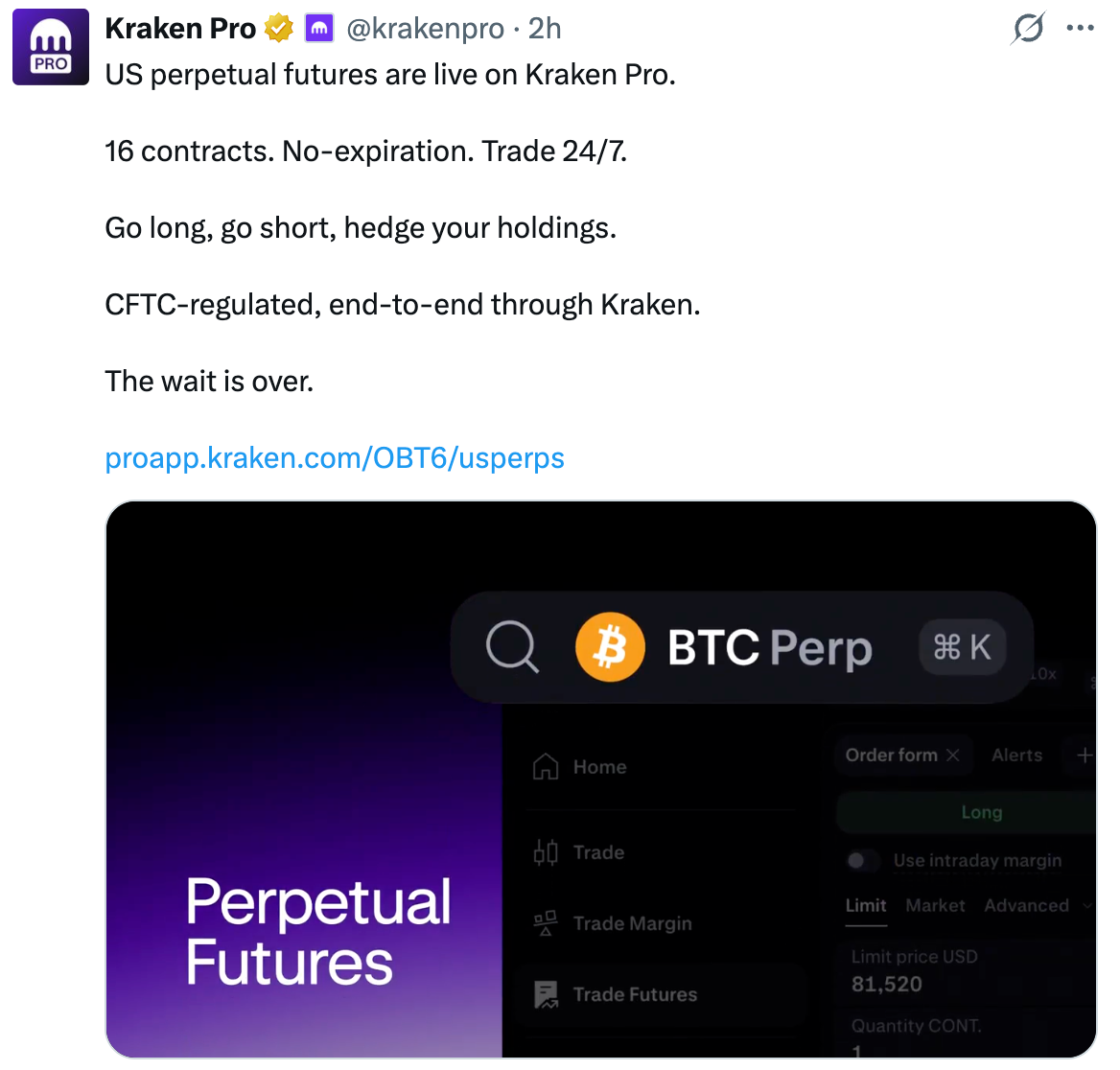
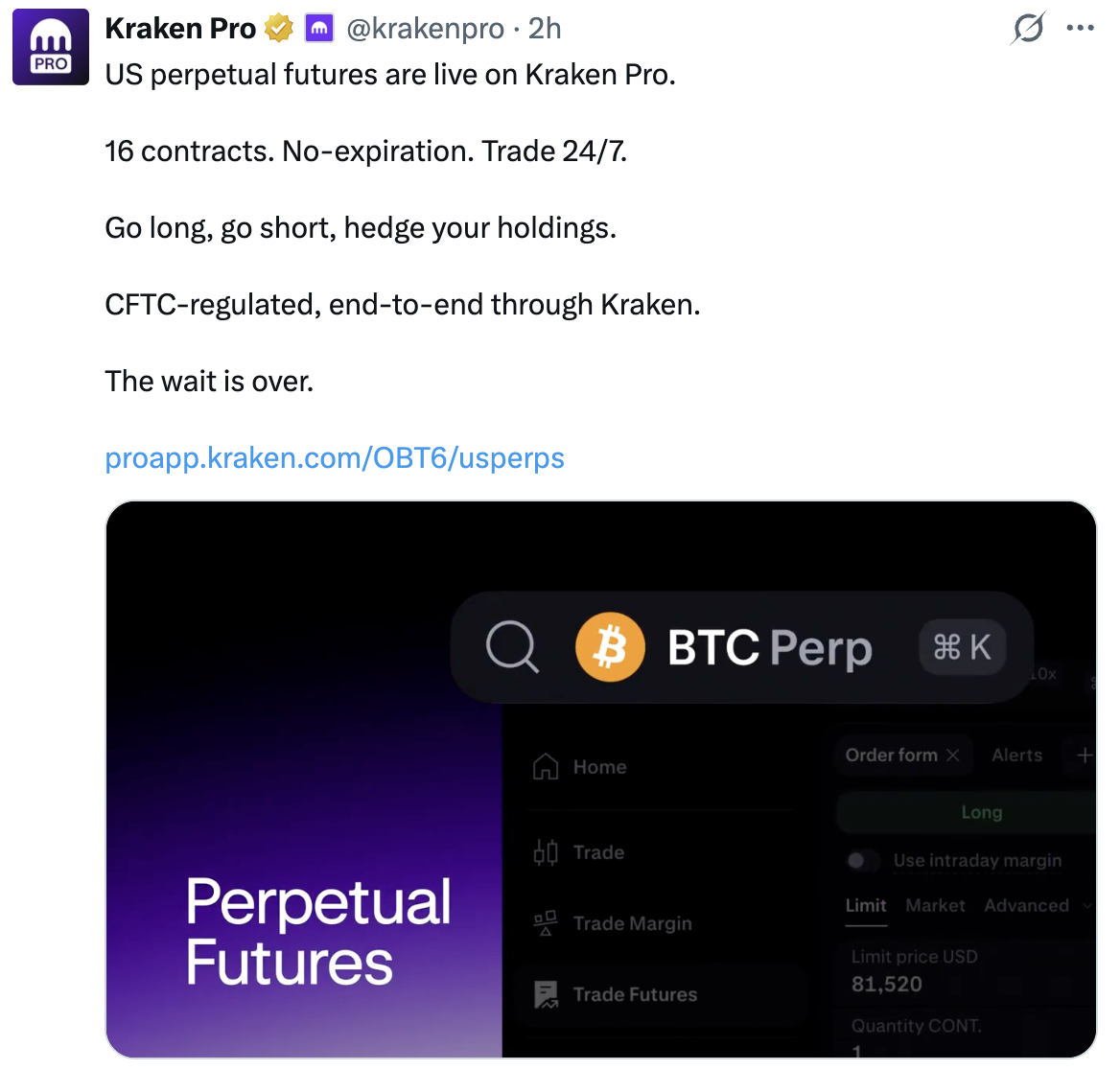
Kraken on Monday launched perpetual futures trading for eligible US users through Bitnomial, expanding its domestic derivatives offerings months after acquiring the federally regulated exchange.
The products are available through Kraken Pro and include contracts tied to major cryptocurrencies including Bitcoin (BTC), Ether (ETH), Solana (SOL), XRP (XRP), Cardano (ADA), Chainlink (LINK), Dogecoin (DOGE), Litecoin (LTC) and Avalanche (AVAX).
According to Monday’s announcement, the contracts share the same futures wallet as Kraken’s existing CME-listed crypto futures products, allowing traders to manage both positions from a single account.
Source: Kraken Pro
Kraken said perpetual futures, a type of derivative contract with no expiration date, generated more than $60 trillion in global trading volume in 2025 and have largely been traded on offshore platforms rather than regulated US venues.
Kraken has expanded its US trading offerings over the past year, adding support for CME-listed crypto futures in July 2025 and launching margin trading for eligible US customers earlier this month.
Monday’s launch follows Kraken’s late-May announcement that it planned to introduce Commodity Futures Trading Commission (CFTC) regulated perpetual futures through Bitnomial, the crypto derivatives platform acquired by parent company Payward in April.
Related: OKX expands X-Perps in Europe with Magnificent 7, gold and oil futures
US exchanges compete for crypto derivatives market
Kraken’s launch comes amid a broader push by USexchanges to bring crypto derivatives trading onshore.
On May 29, the CFTC approved Kalshi’s Bitcoin perpetual futures contract and issued a no-action position for Coinbase, paving the way for regulated perpetual futures products in the domestic market.
That same day, the company announced that its Coinbase Financial Markets unit would provide US institutional clients access to global crypto perpetual futures and options markets, which the exchange said account for roughly 80% of global crypto trading volume.
Kalshi also launched perpetual futures contracts on May 29, describing the products as its most significant expansion beyond prediction markets and a step toward becoming a broader derivatives exchange.
The regulatory approvals followed months of discussion around bringing crypto perpetual futures to the United States.
“The CFTC’s approval of the KalshiEX BTCPERP is not the end of the regulatory story; it is the beginning,” said Gontran de Quillacq, CEO and founder of Navesink International.
In a January speech, CFTC Chair Michael Selig said the agency would use its existing authority to support perpetual futures and other novel derivatives products in the US, arguing that years of regulatory uncertainty had pushed trading activity offshore.
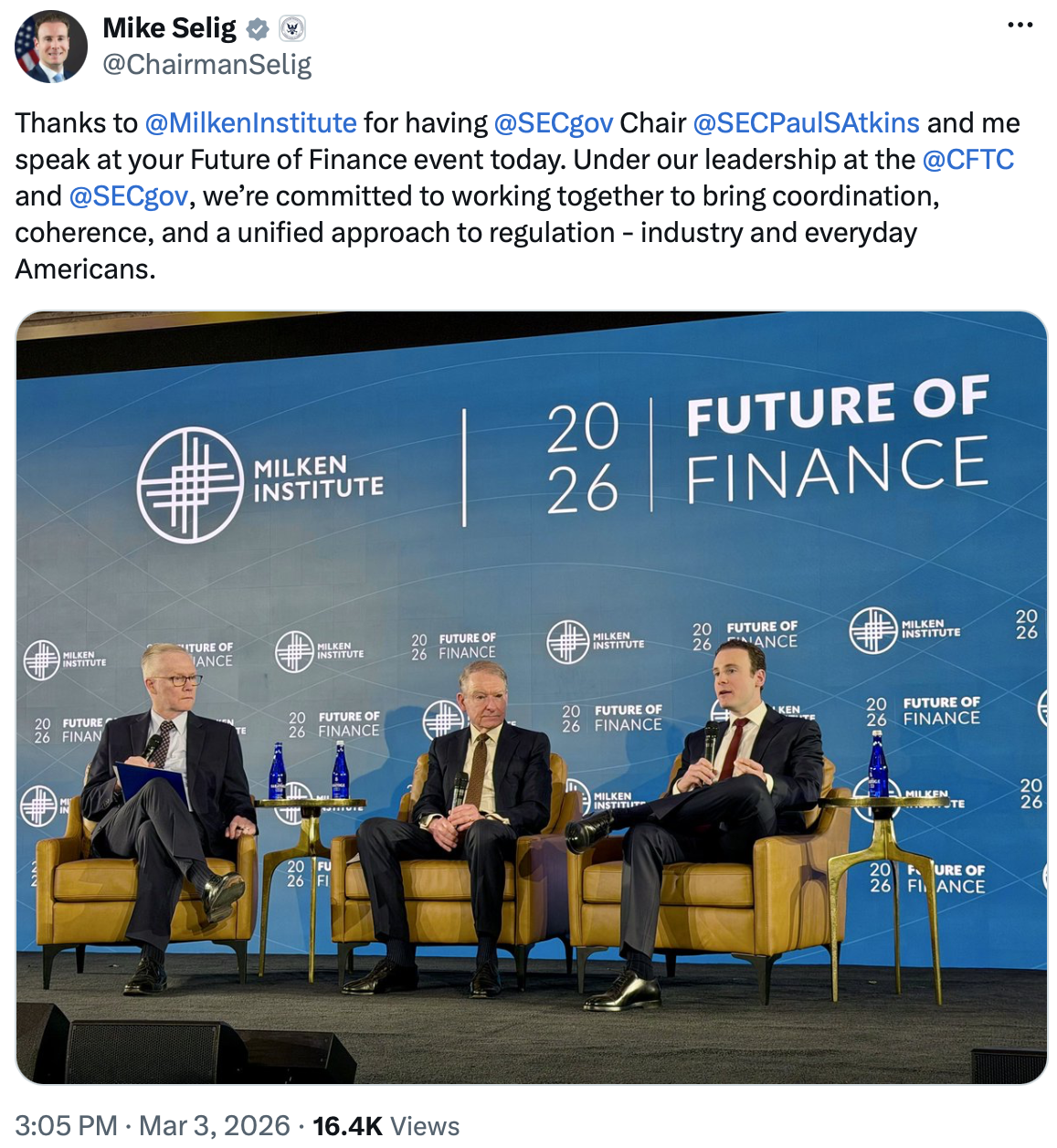
Speaking at the Milken Institute’s Future of Finance conference a few months later, Selig said the CFTC was working to establish a framework for “true perpetual futures” in the US.
Source: Mike Selig
Magazine: Bitcoin, the ‘canary in the coal mine,’ XRP transaction demand falls 91.5%: Market Moves
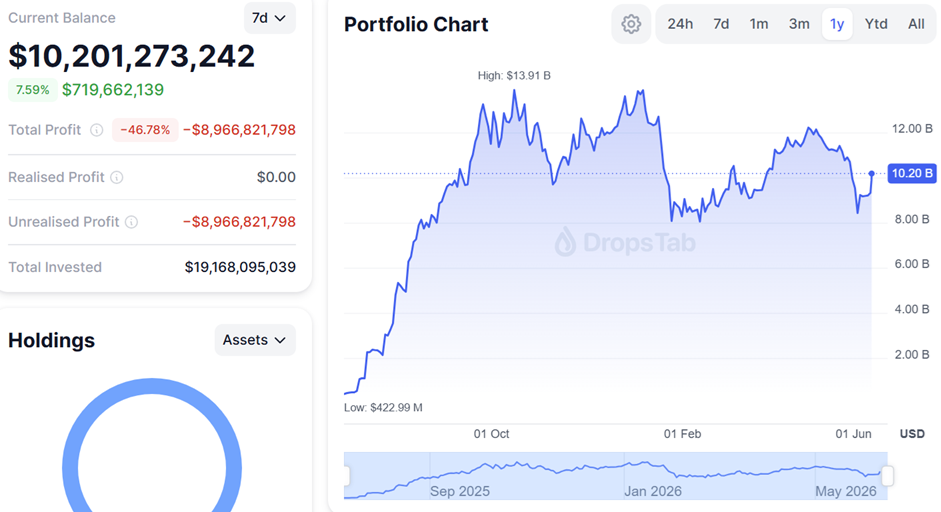
BitMine Immersion Technologies continued to expand its Ether holdings last week, acquiring more of the second-biggest digital asset despite a prolonged market downturn as its large staking operation continues to generate yield.
On Monday, the crypto treasury company reported that it acquired 76,881 Ether (ETH) over the past week, potentially reducing its average cost basis as ETH briefly plunged below $1,600 during the period. The company has been steadily acquiring Ether during the bear market, regardless of price action.
BitMine now holds 5,620,754 ETH acquired at an average price of $1,718.
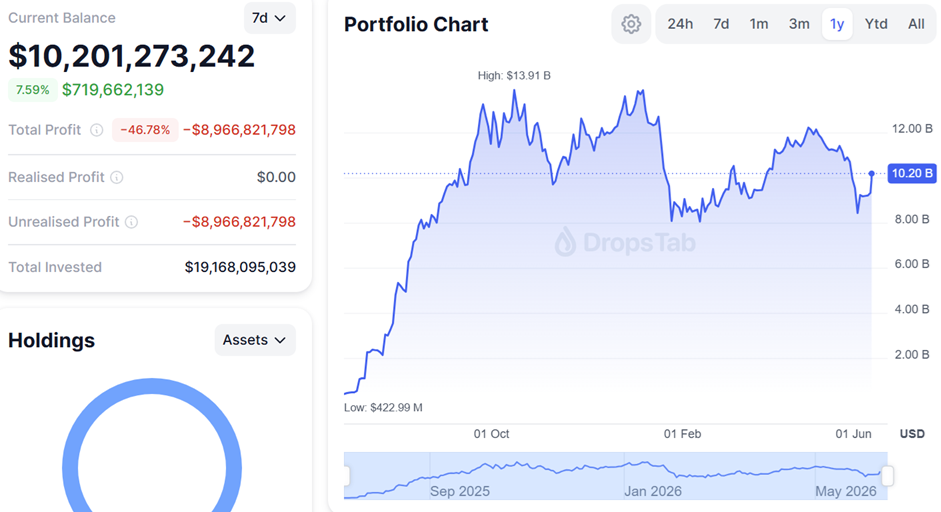
BitMine is sitting on large unrealized losses on its ETH holdings. Source: DropsTab
At current prices, the company’s ETH portfolio is worth roughly $10.2 billion, though it is sitting on an unrealized loss of nearly $9 billion, according to DropsTab data. At last look on Monday, Ether was trading at $1,843.69, according to CoinMarketCap data.
Bitmine’s latest purchases brings the company closer to its stated goal of owning 5% of Ether’s total circulating supply of 120.68 million tokens. The company currently controls approximately 4.66% of all ETH.
At the same time, BitMine has staked more than 4.1 million ETH, worth roughly $8.1 billion at current prices. Staking allows the company to earn protocol rewards by helping secure the Ethereum network, providing a recurring source of yield even during periods of price weakness.
Related: Ethereum can quantum-proof accounts for just 7 cents, says Ethereum’s Kohaku lead
Ethereum faces structural headwinds
The crypto treasury model has come under pressure this year as digital asset prices retreated sharply. The downturn has also weighed on spot Ether exchange-traded funds (ETFs), which recorded four consecutive days of net outflows last week.
Selling pressure has persisted since early May, with daily net outflows exceeding $60 million on several occasions.
BlackRock’s iShares Ethereum Trust ETF (ETHA) remains the biggest US-traded ETH ETF, with net assets of $4.75 billion. It holds 2.36% of the crypto’s circulating supply.
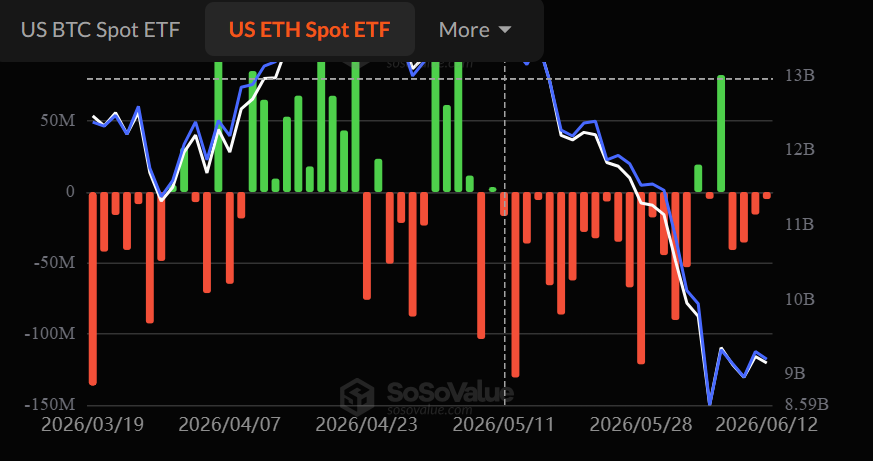
ETH’s decline has coincided with large outflows from spot ETFs. Source: SoSoValue
For Ethereum, however, the challenges extend beyond price action.
The network’s layer-2 scaling strategy, designed to deliver faster and cheaper transactions, has come under scrutiny. As more activity migrates to layer-2 networks, the Ethereum mainnet captures less transaction-fee revenue and burns less ETH, potentially weakening its deflationary dynamics.
Internal changes at the Ethereum Foundation have added to the uncertainty. At least nine senior leaders, researchers and core contributors have departed the nonprofit so far this year, marking one of the largest waves of talent attrition in its history. The departures have coincided with the foundation’s organizational overhaul and renewed community debate over its governance, strategic direction and role in Ethereum’s long-term development.


The SIREN token has lost about 95% of its value in a week after a single whale sold roughly 670 million tokens, near 92% of the total supply, for $64.8 million. The sell-off traced to one dominant wallet draining its position into a thin market. On-chain intelligence platform Lookonchain first… Read the full story at The Defiant
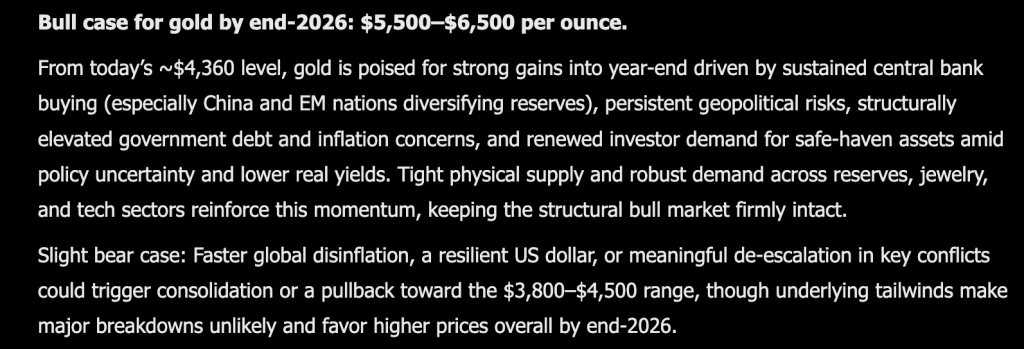
Gold price at $4,360 and Elon Musk’s Grok AI is looking at it and predicts for $5,500 to $6,500 by year end. That is a 26% to 49% move on the oldest store of value in human history, and the argument is not built on hype or cycle narratives. It is built on the kind of structural forces that do not reverse in a quarter.
The demand side of this prediction runs deeper than most people track. Central banks, particularly China and emerging market nations, are actively diversifying away from dollar reserves and buying physical gold at a pace that has no modern precedent.
That bid does not disappear when sentiment shifts, it is policy-driven and sticky. Layer on top of that the persistent geopolitical risks that keep showing no sign of resolution, structurally elevated government debt levels across every major economy, and renewed safe-haven demand from investors who have watched real yields compress.
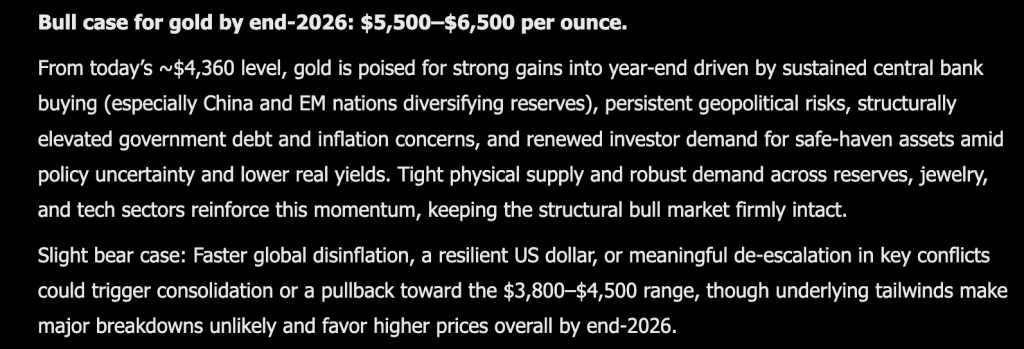
Then add tight physical supply against robust demand from reserves, jewelry, and a tech sector that actually needs the metal. Grok is not predicting a spike, it is describing a structural bull market that has momentum behind it from multiple independent directions.
The bear case is the narrowest on this entire prediction series. Faster global disinflation, a resilient dollar, or meaningful de-escalation in key geopolitical conflicts could pull gold back toward the $3,800 to $4,500 range.
The word meaningful is doing a lot of work in that sentence. The kind of peace and dollar strength required to derail this bull case is not impossible but sits well outside the base case of most macro analysts right now.

Discover: The best crypto to diversify your portfolio with
Gold Price Prediction: When The Pullback Lands Right On The Launch Pad
Gold price is at $4,367 today, up 3.65% on what looks like a decisive reclaim candle after the recent correction.
The daily chart frames the current moment perfectly. From the $3,400 base last August, gold ran to $5,500 in February, one of the cleanest trending moves on any major asset over the past year.
What followed was a textbook bull market consolidation, a series of lower highs from the peak but with the bigger uptrend structure very much intact.
The June low near $4,050 is now the most important level on the chart, because it held the line right at the same $4,000 to $4,200 zone that served as prior resistance before the big run.
Former resistance becoming support is one of the cleaner signals in technical analysis, and today’s 3.65% bounce off that floor suggests the market agrees.
For Grok’s $5,500 to $6,500 target to materialize, the obvious immediate test is the $4,600 to $4,800 zone where multiple failed recovery attempts since March have stalled.
That is the overhead supply that needs to be absorbed before the chart can make a run at the February highs and then beyond.
The bear case floor at $3,800 to $4,500 sits well below current price, which means the risk-reward from here tilts heavily in the direction Grok is pointing.
Here is What Grok AI Predicts For LiquidChain Near Future, Could be Very Bullish
Waiting at resistance for a breakout is standing in line. Someone else’s balance sheet makes that decision.
Bitcoin, Ethereum, and XRP have pressed against the same ceilings for weeks. The catalyst is always one data print away. Institutional inflows are always next quarter. Large-cap traders wait on moves they cannot control.
Early-stage infrastructure plays by different rules. Capital that registers as statistical noise at Bitcoin’s scale moves a small undiscovered project by multiples. The asymmetric return sits in one place: the gap between what a project is worth and what the market prices it at. That gap exists because nobody has found it yet. Once they do, the gap closes.
Cross-chain fragmentation has been pulling value out of DeFi since the first bridge went live. Bitcoin, Ethereum, and Solana were built as independent systems with no shared architecture and no intention to interoperate. Every transaction crossing those boundaries pays for that design decision in fees, slippage, and failed executions. Bridges were the proposed fix. They became the mechanism through which the problem charges its toll.
LiquidChain removes that toll. Three networks inside one execution layer. A single deployment reaches all of them with no cross-chain tax on any interaction.
Grok AI flagged the project as worth watching. The presale sits at $0.01454 with $835,000 raised. Execution is unproven. Adoption is unknown.
Established assets offer a predictable path toward a ceiling the market already sees. LiquidChain is an entry point that closes once the market finds it.
Explore the LiquidChain Presale
The post Elon Musk Grok AI Predicts Staggering Gold Price by End of 2026 appeared first on Cryptonews.

The United States of America and Iran shook hands on a peace deal, which is about to be officially signed on June 19. The financial and crypto markets reacted positively to the news, with Bitcoin (BTC) spiking to a multi-week high of just over $66,000.
The big question now is whether the leading digital asset can sustain its upward momentum or is gearing up for another pullback.
The Bears Remain in Charge?
BTC’s rebound has drawn significant attention, with multiple analysts speculating on the asset’s next potential move. X user Jelle described the pump as a “big victory” for the bulls, predicting that holding above the $63,000-$64,000 range is “looking rather good for relief.”
Ali Martinez noted that the price has finally broken through the $64,360 resistance level and expects a possible ascent to $67,630 “if momentum holds.”
Nonetheless, many others believe the peace news has triggered only a temporary revival, arguing that the cycle’s floor has yet to be formed. X user symbiote sees the creation of a final bottom at around $50,000, labeling that zone as a buying opportunity.
Niels believes the asset’s valuation could rise to $70,000-$72,000 in the short term, but the 4-year cycle suggests the real pain for the bulls could occur by Q3 this year. “Once BTC makes another lower high, it’ll reverse towards $55K for the cycle bottom,” they added.
Some key factors, including the recent whale behavior, reinforce the bearish outlook. As CryptoPotato reported, large investors have reduced their total holdings by over 70,000 BTC in the past month, signaling weakening confidence in the asset and perhaps preparing for a renewed correction. Moreover, their actions could influence sentiment and lead some smaller players to exit the ecosystem.
Waiting for These Events
Another popular analyst who touched upon BTC’s latest price movement and gave an interesting prediction for the near future is Ted. The X user outlined the general optimism in the space following the US-Iran peace deal and forecast that staying above $65,000 could lead to a move toward $70,000. As of the moment, though, he doesn’t see “enough real strength to confirm that scenario.”
Ted claimed that BTC’s price will depend heavily on major economic events this week, including the Federal Reserve’s interest rate decision and the possibility of further rate hikes by the Bank of Japan.
The FOMC meeting on June 17 will be the debut of Chair Kevin Warsh, and the expectations are that the benchmark will remain unchanged in the 3.5%-3.75% range. However, investors will closely monitor his speech for any hawkish or dovish signals that might hint at how the central bank plans to guide policy in the months ahead, potentially leading to heightened volatility across the entire crypto market.
The post Top Bitcoin (BTC) Price Predictions After the US-Iran Peace Rally appeared first on CryptoPotato.

NFT brand Pudgy Penguins is winding down its mobile game Pudgy Party and pausing any further development, according to an announcement from the project’s team on X. The studio says it will redirect its gaming efforts toward Pudgy World, a browser-based experience it frames as the “flagship” game within the Pudgy Penguins ecosystem.
The shift comes after Pudgy Party launched in August 2025. The team said the game exceeded 500,000 downloads on Google Play, with total downloads topping 1 million across platforms. By consolidating its roadmap behind Pudgy World, Pudgy Penguins is signaling that it wants a single gaming product designed for broader reach and longer-term scalability.
Key takeaways
- Pudgy Party is being sunset: the team says it will wind down operations and halt further development.
- Pudgy Penguins is consolidating gaming around Pudgy World, described as the ecosystem’s flagship browser experience.
- Pudgy Party hit 500,000+ downloads on Google Play and more than 1 million total downloads, despite the pivot.
- The move reflects ongoing difficulty in Web3 gaming: another project, Fishing Frenzy, is also shutting down.
Pudgy Penguins exits one mobile game to focus on a “flagship”
In its X post, the Pudgy Party team described the decision as difficult, but argued that Pudgy World holds “greater potential for scalability” and is more likely to bring new users into the Pudgy Penguins brand.
That reasoning matters for investors and players because it points to a core challenge in crypto-gaming: building a product that can sustain a player base while integrating with Web3 monetization and brand ecosystems. A mobile launch can generate early traction—as Pudgy Party did—but the team’s decision suggests that user acquisition and retention may not have translated into a durable long-term plan.
Pudgy Penguins has positioned itself beyond NFTs, pursuing initiatives across toys, gaming, licensing, and broader entertainment. The gaming consolidation therefore appears less like an abandonment of the category and more like a strategic attempt to concentrate development resources behind one experience that can serve as a stable on-ramp for the brand.
What Pudgy Party’s download numbers imply—and what they don’t
Pudgy Party’s stated reach—500,000+ downloads on Google Play and over 1 million total—signals that there was consumer interest. But a pivot after those milestones suggests that download counts alone may not be sufficient to justify ongoing development.
For readers watching Web3 gaming, the important distinction is between “top-of-funnel” adoption and “business model” sustainability. Mobile downloads can be driven by marketing, brand recognition, or viral momentum. Turning that into long-term engagement and a viable revenue structure is typically harder—especially for projects that must balance Web2-style game economics with token incentives, on-chain components, or crypto-native distribution.
Pudgy Penguins’ rationale explicitly mentions scalability and onboarding, which hints that the team believes the browser-based format or ecosystem design of Pudgy World may better support ongoing growth.
Web3 gaming’s recurring problem: product-market-business fit
Pudgy Party’s wind-down arrives during a broader wave of uncertainty in Web3 gaming. Earlier, Fishing Frenzy and its developer, Uncharted, announced they would cease operations after concluding they couldn’t establish a sustainable crypto-gaming thesis.
In an X post shared on Monday, Fishing Frenzy said it was “unable to prove our thesis on crypto gaming” and “could not find product-market-business fit.” The team said it spent the previous year testing multiple approaches and targeting different audiences without finding a path that gave them confidence to continue.
This parallel is significant: it suggests that even projects that experiment actively and iterate for extended periods may struggle to find a stable formula that combines gameplay appeal, user retention, and a monetization model that can withstand market and platform realities.
How Fishing Frenzy is shutting down—and what it’s doing with USDC and tokens
Fishing Frenzy said it will shut down its servers on June 25 at 2:00 a.m. UTC. The project also made notable changes to its token and sales mechanics: it stopped selling USDC packages and adjusted the FISH token so it is spend-only and untradable.
The team said remaining USDC in the FISH/USDC liquidity pool would be redistributed to community members and stakers. By outlining a specific redistribution plan rather than a vague “we’ll figure it out,” the project is trying to manage expectations as it exits.
These details matter because they show the practical constraints that Web3 gaming projects face when they can’t scale their business: token utility can be constrained, markets can lose liquidity, and teams may ultimately need to wind down infrastructure while addressing on-chain balances and user expectations.
NFT market backdrop: capitalization rises, but the sector is still far from prior highs
Alongside the gaming-specific developments, NFT market conditions have been fluctuating. CoinGecko data cited in the original reporting shows total NFT market capitalization climbed to nearly $1.5 billion on Monday, up from more than $1.3 billion on Friday. Still, that level remains dramatically below the sector’s 2022 peak of over $17 billion.
For builders and brand-led NFT ecosystems like Pudgy Penguins, this environment can increase pressure to demonstrate real utility. When the broader market is well below prior highs, it often becomes harder to finance development through speculative demand alone—making it more likely that teams will prune or restructure product lines to focus on what can be scaled efficiently.
At the same time, modest rebounds in market capitalization can give projects breathing room, but the trajectory of Web3 gaming may depend less on NFT prices day-to-day and more on whether games can stand alone as compelling user experiences while delivering coherent incentives.
Going forward, the key question is whether Pudgy World can deliver the scalability and new-user onboarding that Pudgy Penguins is targeting, especially in a market where other crypto games have struggled to prove long-term business fit. Readers should watch for updates on Pudgy World’s rollout and for any further clarification from Pudgy Penguins on how gaming will tie back into the broader brand beyond NFTs.
Crypto World
NyesteCasino.com Reports: iGaming Industry Navigates Dual Pressures of Regulation and Growth

[PRESS RELEASE – Norwich, United Kingdom, June 15th, 2026]
NyesteCasino.com, a leading iGaming analysis resource, released its latest industry overview, highlighting a week defined by intensifying regulatory scrutiny alongside continued global market expansion.
From U.S. Senate hearings and a widening circuit split to the localisation of crypto casinos and a surge in World Cup betting activity, iGaming operators have been balancing risk management with aggressive growth strategies.
Over the past week, the global iGaming sector has faced two powerful and often conflicting forces. Regulators across the United States, Europe, Southeast Asia, and South America have tightened rules around prediction markets, sweepstakes casinos, and credit card usage for deposits. At the same time, online gambling platforms, content providers, and policy advisors have accelerated product innovation and executed timely, region-specific sports marketing campaigns.
According to NyesteCasino.com’s team, these developments signal a broader structural transition across the industry—one in which compliance agility is rapidly becoming as critical to success as product quality. Despite increasing regulatory headwinds, the pace of innovation and market demand continues to point toward sustained sector growth.
Prediction Markets: Courtrooms, Congress, and Cross-Border Bans
The week started with a long-awaited US Senate Commerce Subcommittee gathering. The hearing named “No Sure Bets” took place on May 20 under Chair Marsha Blackburn, and Blackburn indicated more sessions were to come. The debate between American Gaming Association CEO Bill Miller and former Congressman Patrick McHenry quickly turned into a clash over the future of prediction markets. While Miller named the sports event contracts as backdoor betting operations bypassing the state licences, tax regulations, and integrity safeguards, McHenry talked on behalf of the Coalition for Prediction Markets and opposed him, stating that the current CFTC supervision is working perfectly.
On 22 May, a panel from the Ninth Circuit rejected the stay requests filed by both Kalshi and Polymarket, refusing to halt state enforcement proceedings in Nevada and Washington, which complicated the legal situation even more. The court ruled that a federal preemption defence under the Commodity Exchange Act cannot, on its own, establish federal jurisdiction. The ongoing disagreement in the appeals court of New Jersey, which had previously upheld a Kalshi injunction, has gained strength with this decision. Moreover, the process leading to a Supreme Court review of state jurisdiction over event contracts has accelerated even more.
Indonesia’s Ministry of Communication and Digital Affairs categorised Polymarket as an online gambling site, disregarding its crypto-based structure, and has requested a national ban on the market platform on May 25. The reason for this request was a viral contract regarding whether President Prabowo Subianto would resign before the end of his term in October 2029. The contract generated a trading volume of approximately $46,000. The number of jurisdictions where Polymarket is inaccessible is growing, exceeding 33 around the world now, including India, Brazil, and Singapore, among other new blockers.
State-Level Regulations: An Anti-Sweepstakes Bill from Tennessee
There have also been state-level restrictions in Tennessee on online gambling law. During the same week, Governor Bill Lee signed two vital bills. Senate Bill 2136 made Tennessee the ninth US state banning sweepstake casinos and dual-currency systems completely, which grants the attorney general the power to enforce it. And according to the SB 1992, the second bill signed by the governor, anyone who deliberately influences the outcome of an event whilst holding a prediction market contract will be charged with a Class E felony. It is expected that these bills will guide other state legislatures who are planning similar regulations at the moment.
Europe and Brazil: Tax Proposals, Ad Restrictions, and Credit Bans
The European Parliament held a plenary debate on May 20 on a proposed EU-level gambling levy. Budget Commissioner Piotr Serafin confirmed the Commission is actively assessing the option alongside digital services and crypto-asset levies as part of the next Multiannual Financial Framework. Proponent MEP Victor Negrescu estimated the levy could raise between €2 and €4 billion annually for education, youth, and addiction prevention programmes. Opponents from EPP and ECR blocs raised concerns over subsidiarity, competitiveness, and national tax sovereignty, with any operational package targeted for January 2028.
Belgium’s Kansspelcommissie and the Netherlands Gambling Authority separately issued formal World Cup advertising warnings to licensed operators ahead of the June 11 to July 19 FIFA tournament. France’s ANJ flagged a year-on-year rise of more than 25% in operator marketing budgets as the tournament approaches. Meanwhile, Brazil formalised rules on May 25 to close off Pix Crédito as a deposit method on regulated betting platforms, a move prompted in part by a Folha de São Paulo audit revealing that major banks including Bradesco and Banco do Brasil, were still processing credit transfers into betting accounts as recently as mid-May.
Editorial Perspective
“What this week makes clear is that the iGaming sector is entering a phase where regulatory IQ is as strategically important as product development,” said the editorial team at NyesteCasino.com. “The prediction markets debate alone spans courtrooms, congressional hearings, and international bans and it is far from resolved. Operators who can track and adapt to this multi-jurisdictional complexity while still executing on World Cup campaigns and localisation strategies will be best positioned for the second half of 2026.”
About NyesteCasino.com
NyesteCasino.com is a leading independent iGaming review and analysis platform. The editorial team tracks regulatory developments, operator news, and product releases across global markets to help players and industry professionals navigate the evolving online casino landscape. Users can learn more at nyestecasino.com.
The post NyesteCasino.com Reports: iGaming Industry Navigates Dual Pressures of Regulation and Growth appeared first on CryptoPotato.


BitMine Immersion Technologies (BMNR), the largest Ethereum-focused treasury company, continued its purchase streak after raising fresh capital through a preferred stock sale.
The firm acquired 76,881 ether (ETH) over the past week, worth roughly $136 million based on ETH’s current price, lifting Bitmine’s treasury to 5.62 million ETH.
The company also held 204 bitcoin, $502 million in cash and marketable securities and stakes in Beast Industries and Eightco Holdings, bringing total crypto, cash and investment holdings to $10.4 billion.
The latest purchase was smaller than the previous week’s 126,971 ETH acquisition, its largest weekly haul of 2026. Still, it suggests the company remains committed to accumulating ETH despite Lee’s comments last month about slowing purchases as the firm neared its goal of owning 5% of Ethereum’s supply.
“We are maintaining a somewhat elevated pace of buying as we believe this pullback in ETH prices does not reflect the strengthening of Ethereum fundamentals,” Bitmine Chairman Thomas Lee said.
Bitmine’s preferred equity debut
The purchase comes on the heels of raising $274 million by issuing preferred equity that offers 9.5% annualized dividend. The move resembles financing tools pioneered by bitcoin treasury firm Strategy (MSTR), which have increasingly turned to preferred equity and other yield-bearing securities to fund crypto purchases.
Stocks of oil in US Strategic Petroleum Reserve falls to lowest since 1983

Sui Processes $65 Billion in Stablecoin Transfers in Five Days After Zeroing Out Fees

Summer ICE


-

 Business1 day ago
No Jackpot Winner as $257 Million Prize Rolls Over to $269 Million Monday Draw
-

 Crypto World4 days ago
Oppenheimer backs SpaceX as $70 billion retail frenzy builds
-

 Crypto World4 days ago
Markets Rally as SpaceX IPO Looms Amid Iran Tensions and Inflation Surge
-

 Fashion3 days ago
Weekend Open Thread: Tuckernuck – Corporette.com
-
 Crypto World20 hours ago
Zimbabwe Requires Crypto Businesses to Register Annually Under New FIU Regulations
-

 Entertainment6 days ago
The Ryan Gosling True Crime Thriller On Netflix That Gets Even Stranger, Stream It Now
-
 Sports6 days ago
Bangladesh beat Australia after 20 years in ODIs, register only their second win over six-time world champions | Cricket News
-

 Tech3 days ago
NanoClaw integrates JFrog registries to secure AI agent downloads
-

 Tech3 days ago
This Week In Security: Microsoft On Microsoft, Register Your Domains, Linux On ARM, And FreeBSD Joins The File Cache Club
-

 Crypto World3 days ago
Bitget enters Argentina’s regulated crypto market through PSAV registration
-

 Politics4 days ago
Politics Home | Healey Resignation Is “Colossal Failure Of Government”, Says Former Labour Defence Secretary
-
 Tech4 days ago
Dutton Ranch star claims they ‘didn’t see any disruption’ on set following Chad Feehan’s exit from Yellowstone spinoff fueled by Taylor Sheridan clash rumors
-

 NewsBeat4 days ago
El Nino has formed in the Pacific and could set records, forecasters say
-

 Tech5 days ago
‘This is Seattle’s position on AI’: City Council votes unanimously to pause big new data centers
-
 Entertainment4 days ago
Donnie Wahlberg & More Heat Up Las Vegas at Circa’s Barry’s Downtown Prime
-

 Sports4 days ago
First Time Since 1971: Australia Register Historic Low In ODI Cricket
-
 Tech4 days ago
Opendoor Ends India Operations, Fueling a Bigger Conversation About AI and Outsourcing
-

 Politics4 days ago
Belfast burns, while Met chief points finger at Iran and Russia
-

 Business6 days ago
Thailand Ranks Second Worldwide for AI Adoption Growth, Microsoft Reports
-

 NewsBeat3 days ago
FBI searches office of Ohio voter registration group
You must be logged in to post a comment Login