
Crypto World
Bitcoin eyes $80k after weekly rally pushes BTC above key moving averages



Key takeaways
- Bitcoin, Ethereum, and XRP have gained nearly 20%, over 25%, and almost 30%, respectively, this week.
- Expanded U.S. Treasury debt buybacks have improved liquidity expectations and boosted demand for risk assets.
- Bitcoin trades around $76,800 after breaking above its 50-day, 100-day, and 200-day exponential moving averages.
Bitcoin, Ethereum, and XRP extended their rallies Friday as improving liquidity expectations continued to lift the broader cryptocurrency market.
Bitcoin has gained nearly 20% this week, while Ethereum has risen more than 25% and XRP has advanced almost 30%.
The rally gained momentum after the U.S. Treasury announced plans to double the size of certain debt buyback operations.
The decision eased liquidity concerns and strengthened demand for risk-sensitive assets.
With the three cryptocurrencies trading firmly higher, investors are now watching whether Bitcoin can reach $80,000, Ethereum can reclaim $2,500, and XRP can advance toward $1.50.
Treasury buyback expansion strengthens crypto rally
The U.S. Treasury’s decision to expand its debt buyback program has helped improve sentiment across financial markets.
Larger buybacks can support liquidity in the market for longer-dated Treasury securities, easing financial pressures and encouraging investors to increase their exposure to riskier assets.
Cryptocurrencies responded strongly to the announcement, with Bitcoin, Ethereum, and XRP recording double-digit weekly gains.
Short liquidations also accelerated the rally as bearish traders were forced to close their positions, adding further buying pressure.
Bitcoin was trading around $76,800 on Friday after decisively breaking above its major exponential moving averages.
The 200-day EMA stands at $71,545, while the 100-day and 50-day EMAs are located at $66,727 and $65,286, respectively.
BTC’s position above all three indicators supports a bullish near-term outlook and suggests the market’s broader technical structure has improved considerably.
The breakout was accompanied by strong trading volume, adding credibility to the latest upward move.
Sustained trading above the 200-day EMA would reinforce the case for further gains and could establish the level as new support.
BTC bulls target the $80,000 resistance
Bitcoin’s next major resistance lies near the psychological and horizontal barrier at $80,000.
A move from $74,700 to $80,000 would represent an additional gain of approximately 7.1%.
However, the $80,000 level could attract profit-taking and fresh selling pressure following Bitcoin’s rapid weekly advance.
A decisive break and daily close above the barrier would strengthen the bullish outlook and potentially open the way to higher levels.
Failure to clear $80,000 could lead to a period of consolidation as traders digest the recent gains.
Bitcoin’s momentum indicators remain bullish but increasingly stretched. The relative strength index is hovering near 83, placing BTC firmly in overbought territory. Such an elevated reading does not guarantee an immediate reversal, but it indicates that the rally may be vulnerable to a corrective pause.
The moving average convergence divergence remains strongly positive, showing that upward momentum is still intact.
Together, the indicators suggest bulls remain in control, although the risk of short-term profit-taking has increased.
If Bitcoin retreats, initial support sits at the 200-day EMA near $71,545. Holding above this indicator would preserve the immediate bullish structure and could provide a foundation for another attempt at $80,000.

A deeper correction could bring the 100-day EMA at $66,727 and the nearby horizontal level at $66,500 into focus.
Below that region, the 50-day EMA at $65,286 offers another layer of support, followed by the structural floor at $62,300.
A sustained decline below $62,300 would weaken the broader bullish outlook, while continued trading above the 200-day EMA would keep the $80,000 target within reach.

Bitcoin jumped roughly 25% to a two-month high above $77,000 within hours of the U.S. Treasury doubling its long-dated bonds buyback operations on August 19.
Falling Treasury yields triggered a short squeeze estimated $3.5 billion across crypto derivatives.
The move raises a pointed question: did Bitcoin catch a genuine liquidity tailwind, or trade a one-day signal that the bond market itself partially reversed within 24 hours?
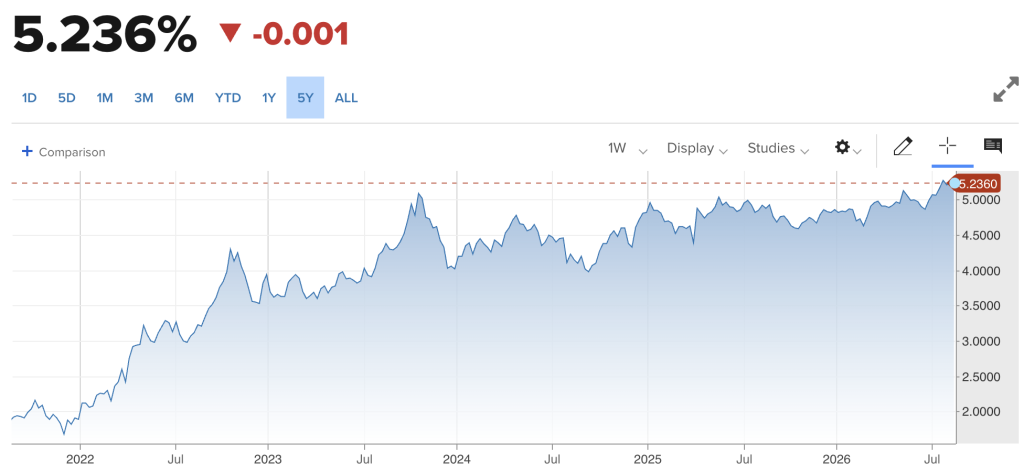
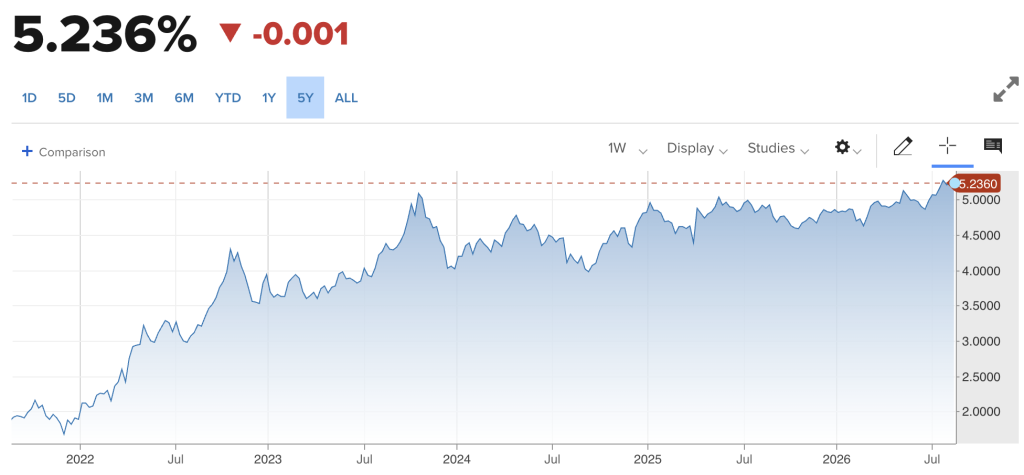
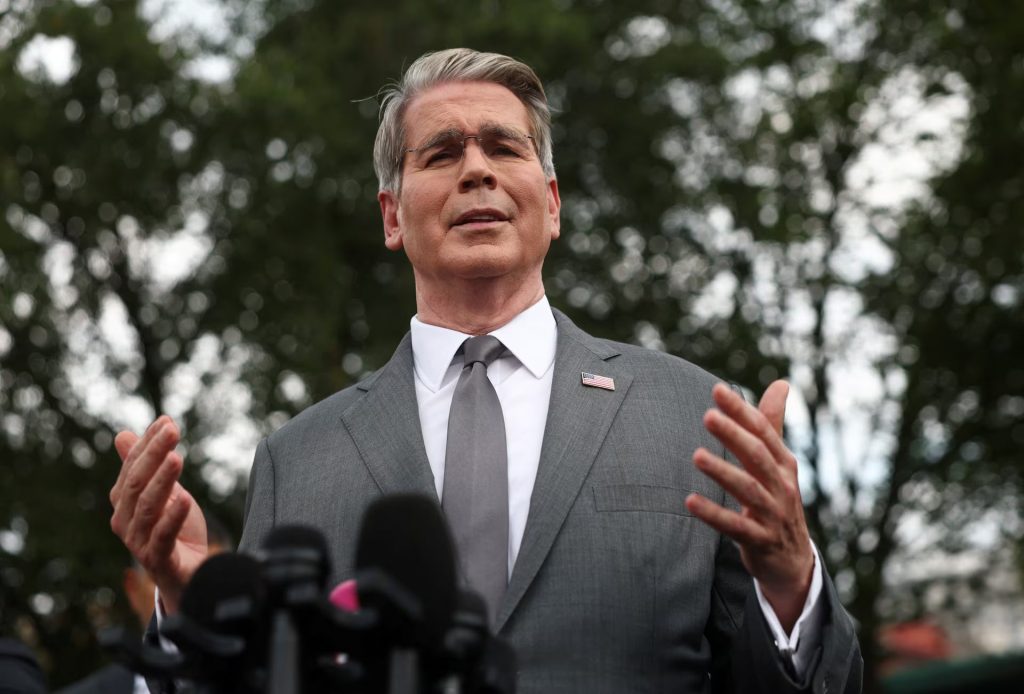
Treasury Secretary Scott Bessent’s move came a day after the 30-year Treasury yield hit 5.34%, its highest level since 2007, amid a global bond selloff tied to inflation worries, an escalating U.S.-Israeli conflict with Iran, and mounting concern over the U.S. fiscal trajectory. Total U.S. debt outstanding crossed $40 trillion the same day the buyback announcement landed.
Discover: The Best Token Presales
What the Buyback Actually Buys
Treasury will double the size of its 10- to 30-year buyback operations to at least $4 billion per operation, up from $2 billion previously, effective September 9 through November 4.
That adds at least $14 billion of additional liquidity support this quarter, bringing maximum repurchases in the current window to $83 billion, measured against a $32.2 trillion Treasury market and $5.5 trillion in outstanding 20- and 30-year bonds.
The announcement worked in the way it was designed to, at least initially: the 30-year yield fell to 5.184% from Tuesday’s high, and the 10-year yield dropped roughly six basis points to 4.66%.
Dan Gottlander, global head of USD and CAD swaps trading at Citi, told Reuters the move would have a huge impact on the long end, though he cautioned that Treasury would still need to issue elsewhere to cover the shortfall.
“It does not change deficits, obviously, and if you are going to buy back the long end, you still will need to issue. They may issue more bills, or also in the five-year to 10-year sector.”
That distinction matters for anyone reading the move as quantitative easing. A Treasury buyback is financed by issuing new short-term bills to retire older, harder-to-trade long bonds, a refinancing operation that swaps one liability for another without expanding the money supply, unlike the Federal Reserve’s own bond purchases under QE, which credit new bank reserves into existence.
Conflating the two overstates how loose the operation actually makes financial conditions.
Discover: The Best Crypto to Diversify Your Portfolio
Why the Relief Didn’t Last
By August 20, Bessent said he might increase buyback sizes even further. “We’re going to increase the size of the buyback,” he said. “I would note that it could be more than the $4 billion per issue.” He argued that yields didn’t reflect the underlying strength of the economy, tying the spike partly to the Iran conflict.
The bond market wasn’t fully convinced. The 30-year yield climbed back to 5.24% by August 20, retracing roughly half of the prior day’s drop, while the dollar clawed back most of its post-announcement losses. According to Bit.com’s market analysis, Bitcoin gave back the $70,000 level within hours, settling into the high-$60,000s after Fed minutes reintroduced rate-hike risk.
Thomas Simons, chief U.S. economist at Jefferies, told Reuters the surprise buyback announcement broke with Treasury’s tradition of predictable debt issuance, calling the move “shot from the hip.”
Evercore ISI analysts framed it more charitably, crediting Bessent’s tactical skill in catching bond shorts off guard during thin August liquidity, but questioned whether the impact would hold given the “tidal wave” of maturing debt and deficits still to be financed.
Trade Crypto Market on Kalshi and Get a $25 Signing-up Bonus
Bitcoin Just Traded a Policy Surprise: Kalshi Lets Traders Position Before the Next One Hits.
The Treasury buyback showed how fast crypto can reprice when a macro decision catches the market off guard. Bitcoin surged, shorts were squeezed, yields fell, and then part of the move unwound as the bond market reassessed what had actually changed.
Kalshi gives traders another way to approach that kind of setup.
The platform offers markets around economic data, Fed policy, politics, crypto, and other real-world events that can move risk assets. Instead of waiting for Bitcoin to react to the next Treasury announcement, rate decision, or inflation print, traders can take a position on the underlying outcome itself.
That distinction matters when the asset reaction is messy. Bitcoin can move on leverage, positioning, dollar strength, and liquidity all at once. An event market lets traders isolate the question they actually have conviction on.
Eligible new users who join Kalshi through CryptoNews can receive $25 through our referral link.
The post Treasury’s $14 Billion Buyback Triggered a $3.5 Billion Crypto Short Squeeze appeared first on Cryptonews.


Market watchers say sudden sharp price spikes and forced short liquidations are the classic signs of a bottom, though macro risks still remain.
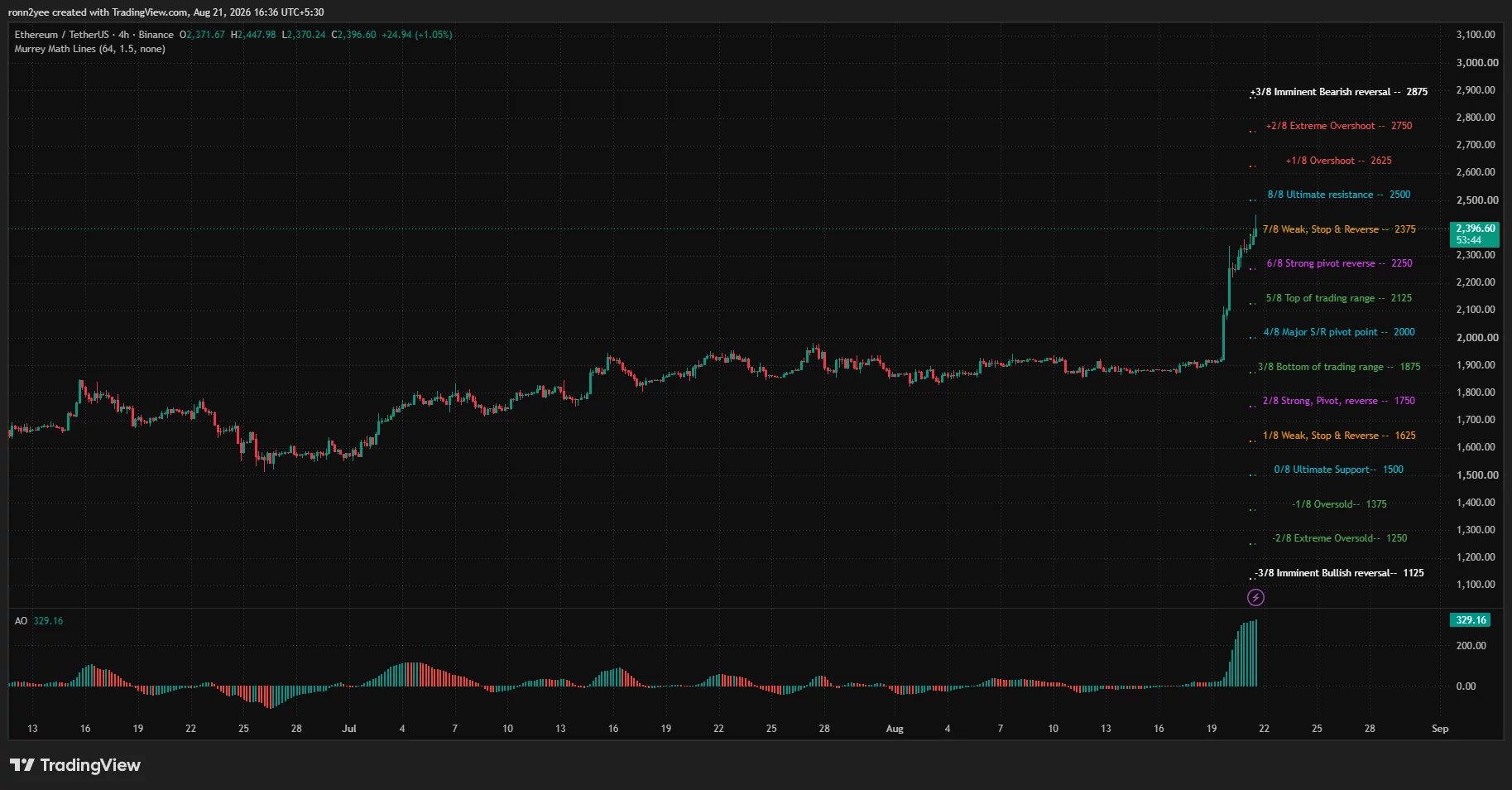
Ethereum price climbed 3% to about $2,397 on Aug. 21 after reaching an intraday high near $2,448, extending a breakout driven by ETF inflows, short liquidations and stronger risk appetite.
Summary
- Ethereum price reached $2,448 after gaining more than 20% over the past week.
- US spot Ether ETFs attracted $189 million on Aug. 19, their largest inflow since October.
- The daily RSI reached 86, placing ETH deep inside overbought territory.
- A weekly close above $2,450 could expose the $2,500 and $3,000 levels.
Ethereum price action today
According to data from crypto.news, Ethereum (ETH) price opened at $2,327 on Aug. 21 before climbing to $2,448 and settling near $2,397 at the time of writing. The 3% daily increase followed a much larger move that carried ETH from below $2,000 to more than $2,300 within two sessions.
The rally pushed Ethereum through several levels that had limited gains since April, including the $2,000 psychological barrier and the $2,250 resistance area. ETH also cleared the $2,375 Murrey Math level on the 4-hour chart, although the price was struggling to hold above it after its rejection near $2,450.
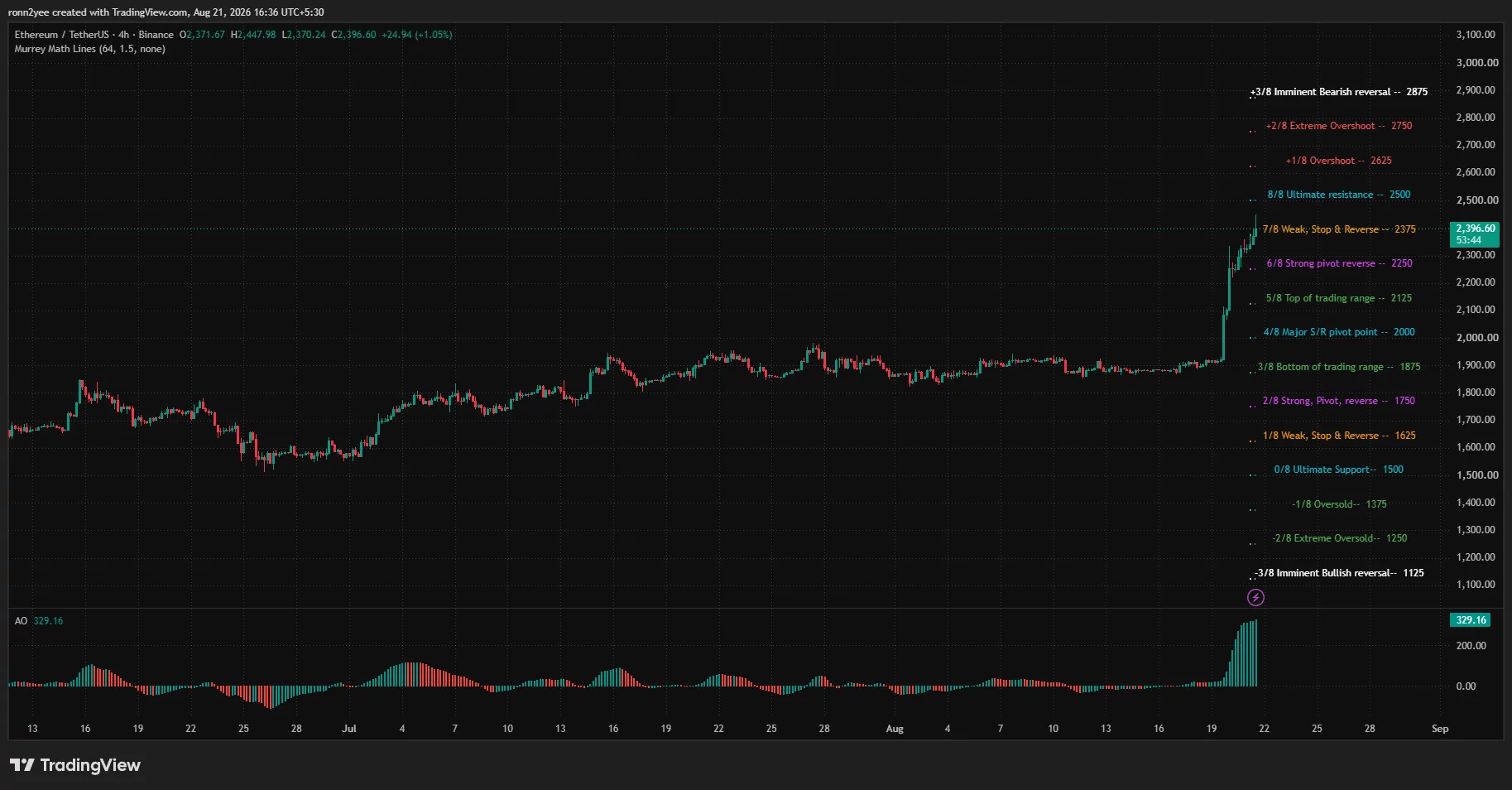
Momentum remained strong on the shorter timeframe. The 4-hour Awesome Oscillator rose to 329.16 and printed an expanding series of green bars, indicating that upward momentum had not yet weakened meaningfully.
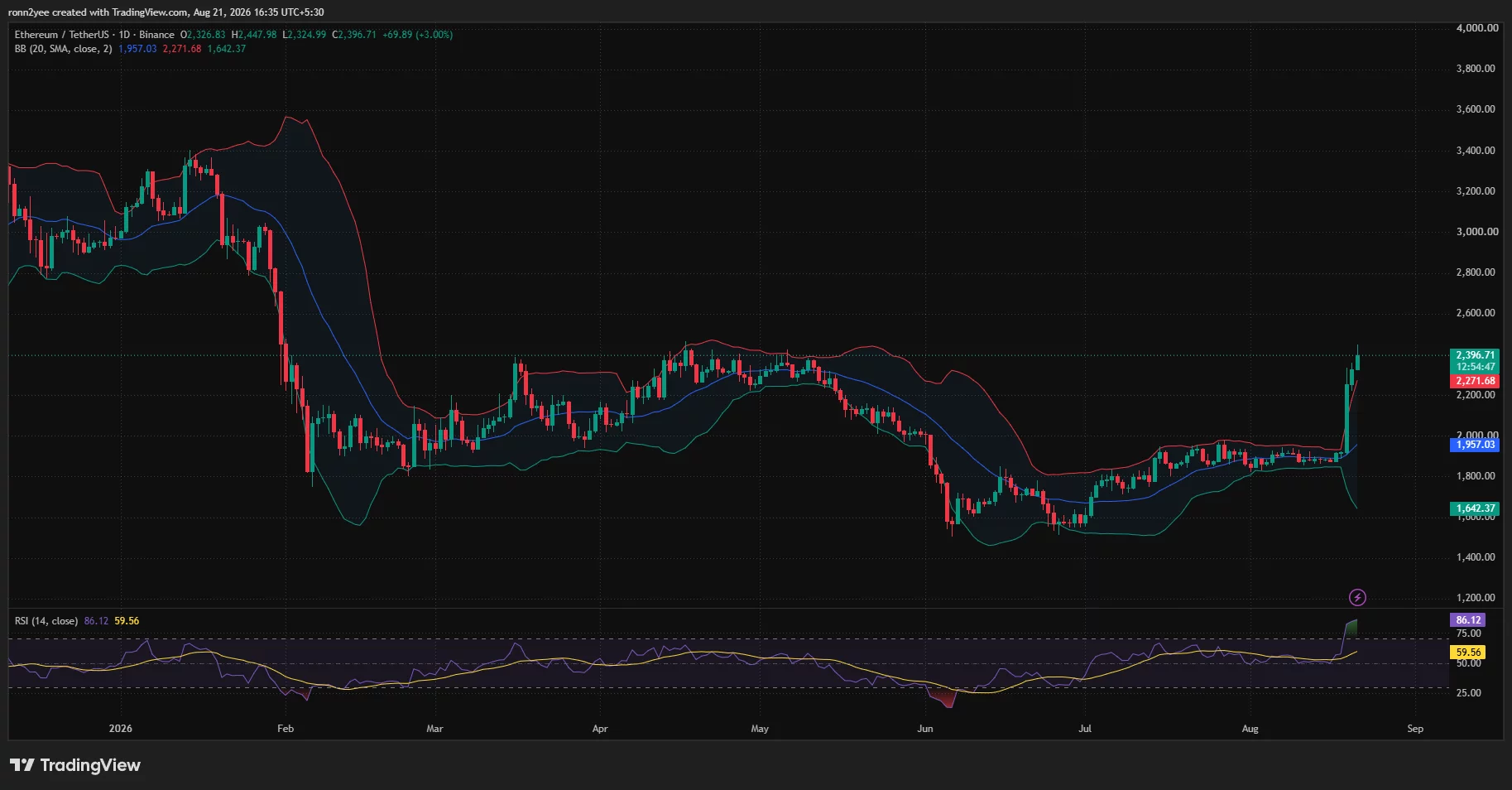
However, the daily chart showed that ETH had moved far outside its previous trading range. The price was trading about 5.5% above the upper Bollinger Band at $2,272, while the indicator’s middle band remained near $1,957.
What is driving the Ethereum rally?
US spot Ether ETFs recorded $189 million in net inflows on Aug. 19, their strongest daily intake since October 2025, according to SoSoValue data. BlackRock’s ETHA accounted for about $122 million of that total.
The ETF purchases arrived as Ethereum broke above $2,000, forcing traders with leveraged short positions to close their bets. CoinGlass data cited by Invezz showed that more than $1 billion in Ether shorts were liquidated during the initial breakout, contributing to a wider crypto liquidation event that exceeded $3 billion.
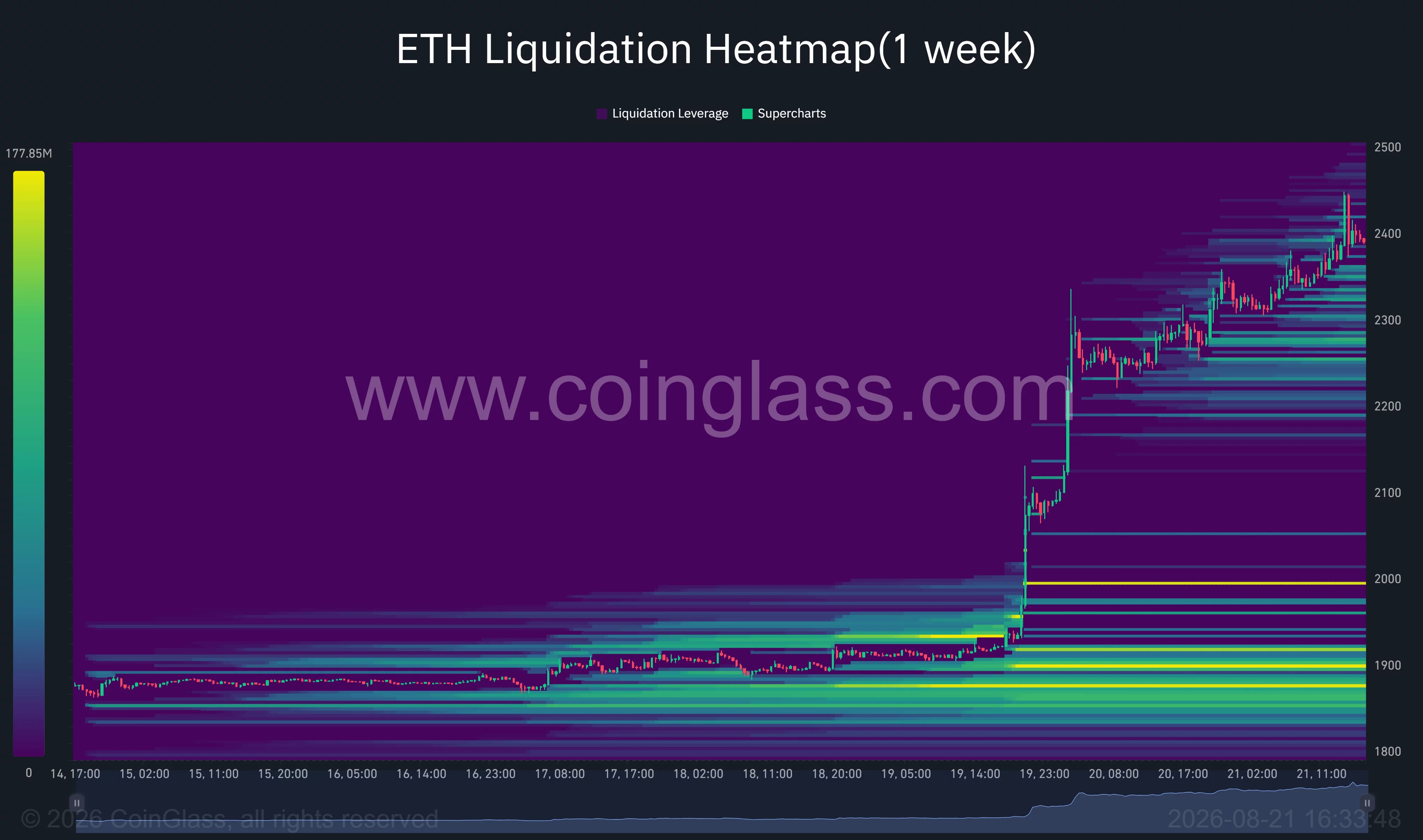
The supplied one-week CoinGlass heatmap shows how ETH moved rapidly through liquidation clusters between $1,900 and $2,300. Forced purchases associated with short liquidations likely added to the speed of the advance, although the breakout also coincided with new spot demand from US-listed funds.
Macro conditions provided another catalyst after the US Treasury announced that it would at least double the maximum size of buybacks for longer-dated nominal securities from $2 billion to $4 billion per operation. The change will begin on Sept. 9 and remain in place through Nov. 4.
Investors interpreted the announcement as support for bond-market liquidity. Treasury yields and the US dollar subsequently weakened, helping Bitcoin, Ethereum, and other risk assets extend their gains.
Ethereum faces overbought signals below $2,500
Ethereum’s immediate resistance sits between $2,448 and $2,500. The lower boundary marked the Aug. 21 intraday high, while the Murrey Math chart identifies $2,500 as the next major resistance level.
A sustained break above $2,500 could expose $2,625, followed by $2,750. The chart places stronger reversal risk near $2,875, although ETH would need additional demand to reach those levels after such a steep move.
Daily momentum presents the main short-term risk. Ethereum’s 14-day relative strength index jumped to 86.12, well above the 70 level commonly associated with overbought conditions. The reading does not guarantee a reversal, but it shows that prices have advanced much faster than their recent trend.
The CoinGlass heatmap identifies nearby liquidation concentrations between approximately $2,270 and $2,350. A failure to clear $2,450 could therefore send ETH back toward $2,375, followed by the $2,300–$2,250 area.
The $2,000 level remains the larger breakout support. The daily Bollinger Band midpoint near $1,957 and a dense heatmap cluster around $1,990 strengthen that zone, although a decline that deep would erase much of the latest advance.
Analysts watch the $2,450 weekly close
Crypto analyst Ted Pillows identified $2,450 as Ethereum’s next resistance zone. He said a weekly close above that area could open a move toward $3,000, making the upcoming close important for confirming whether the breakout can continue.
Market analyst Rain said ETH gained 17.1% during the initial daily surge and pushed its weekly advance beyond 20% after clearing resistance between $1,980 and $2,000. Rain also reported that 30-day realized volatility rose from 39.6 to 62.6 in one day, showing how quickly the earlier compression ended.
Rain said Ethereum must now prove that $2,000 can function as support. Holding well above that level would preserve the new market structure, while a deeper reversal would suggest that liquidations contributed more to the move than sustained spot demand.
US regulation adds to Ethereum’s market catalyst
The rally also followed the SEC’s Regulation Crypto Assets proposal, published on Aug. 18. The proposed framework would introduce tailored registration exemptions for certain investment contracts involving crypto assets, including fundraising exemptions of up to $75 million annually.
The proposal has not become law and does not change Ethereum’s regulatory status immediately. However, the SEC said it aims to give crypto issuers clearer pathways under federal securities laws, adding to the improved regulatory backdrop for US investors.
Ethereum’s next move now depends on whether ETF demand and spot buying can absorb profit-taking near $2,450. A confirmed breakout would bring $2,500 into focus, while rejection could produce a cooling period toward $2,375 or $2,300 as the overbought daily RSI resets.
Disclosure: This article does not represent investment advice. The content and materials featured on this page are for educational purposes only.
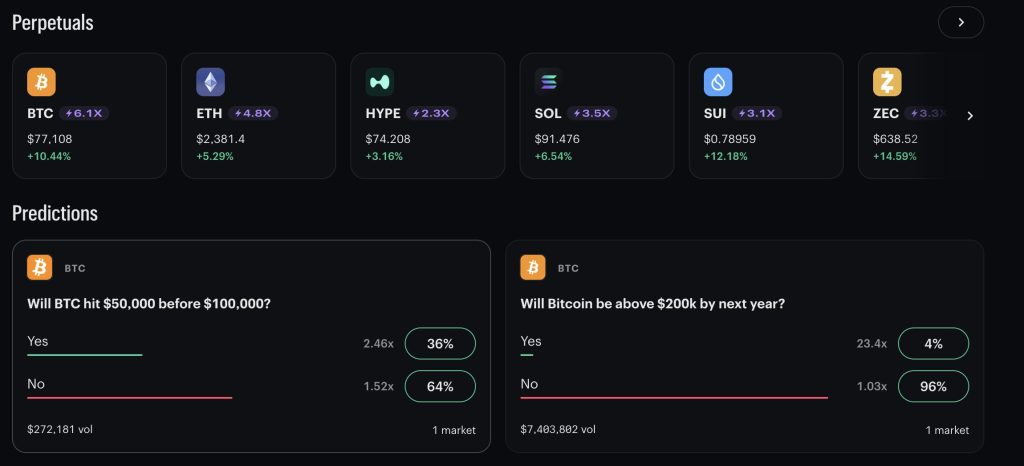
Kalshi daily crypto perpetual-futures open interest reached a record $17.98 million. The reading puts attention on Kalshi’s CFTC-regulated perpetual futures, which allow traders to take leveraged positions on crypto prices without buying the underlying assets.
Perpetual futures, or perps, are derivative contracts that let traders take a position on an asset’s price without owning the asset itself. A trader can take a long position when expecting a price rise or a short position when expecting a decline. Unlike traditional futures, perpetual futures do not have an expiration date, although positions require sufficient collateral to remain open.
Kalshi’s perpetual-futures guide says the company became the first in U.S. history to offer CFTC-regulated perpetual futures on May 29, 2026. The guide describes crypto perpetual futures as a way to trade price movements in assets, including Bitcoin, Ethereum, Solana, and XRP, without crypto changing hands.
Leverage allows collateral to control a larger position, amplifying both potential gains and potential losses. A price move against a leveraged position can lead to liquidation if losses consume the required collateral. Kalshi’s guide also says its contracts use a funding rate charged every eight hours, a mechanism intended to keep perpetual-futures prices aligned with the underlying spot market.
Discover: The Best Token Presales
Perpetual Futures and Prediction Markets Are Different Products
Kalshi offers both perpetual futures and prediction markets, but the products serve different purposes. A perpetual future is a directional position on the price of an asset with no fixed end date. A prediction-market contract concerns the probability of a specified event and resolves YES or NO on a specified date.
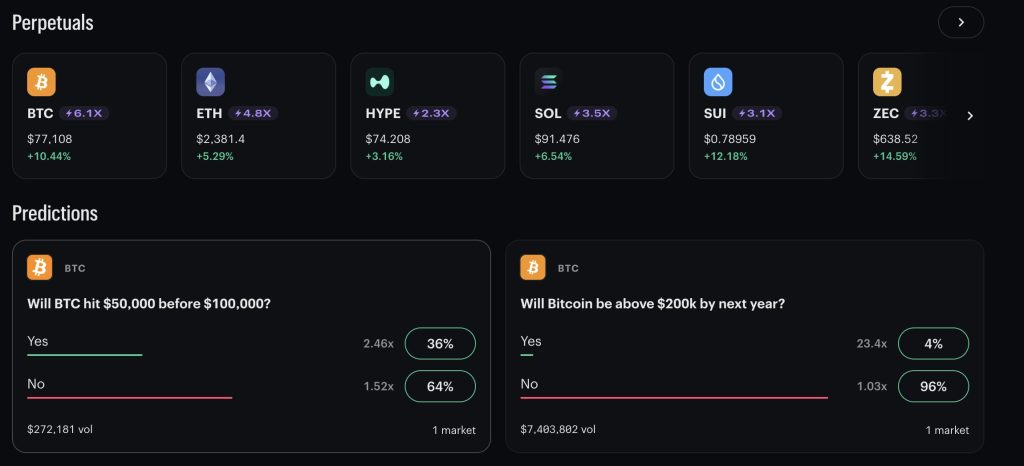
The distinction is important when assessing activity on the platform. The reported $17.98 million figure concerns crypto perpetual-futures open interest, rather than prediction-market activity. It should not be treated as a measure of event-contract trading.
Perpetual futures can be used for either rising or falling price views. They also carry risks that differ from spot crypto purchases: traders do not own the underlying token, face funding costs and may have positions liquidated if market moves exhaust their collateral.
Trade Crypto Market on Kalshi and Get a $25 Signing-up Bonus
Kalshi Crypto Perpetual-Futures Offering
As of June 3, 2026, Kalshi’s guide listed 13 CFTC-approved crypto perpetual-futures contracts. The guide listed maximum leverage of 5.9x for Bitcoin, 4.5x for Ethereum, and 2.0x for Shiba Inu, alongside contracts tied to other crypto assets.
Kalshi describes an isolated margin as an arrangement in which the collateral assigned to a specific trade is at risk if that trade is liquidated. Its guide contrasts this with cross margin, where an account balance can back open positions. The same guide says funding payments occur every eight hours.

These features make the record open-interest report a measure of activity in a product designed for leveraged crypto price exposure under CFTC oversight.
Kalshi’s reported record remains small beside major crypto perpetual-futures venues. Comparing Kalshi with Hyperliquid, which had $11.7 billion in daily open interest across 377 pairs. The comparison underscores the difference in scale between Kalshi’s crypto perpetual-futures activity and a large established market for perpetual contracts.
Kalshi’s guide frames its offering around regulated access to perpetual futures in the United States. Its contracts combine leverage, periodic funding payments, and liquidation risk with CFTC oversight. For traders, that means the product remains distinct from both spot crypto ownership and the platform’s event-based prediction markets.
Discover: The Best Crypto to Diversify Your Portfolio
Record Open Interest Suggests Traders Are Already Testing Kalshi’s New Crypto Market
Kalshi no longer needs to explain whether U.S. traders want regulated access to crypto perpetuals. The $17.98 million open-interest record is beginning to answer that question for it.
For traders, the appeal is straightforward: take long or short positions on major crypto assets, use leverage where appropriate, and do it through a CFTC-regulated platform without buying the underlying tokens.
That puts Kalshi in an unusual position. The same platform already lets users trade event outcomes, while its perpetual-futures market now adds direct exposure to crypto price moves. One account can express a view on what happens and, separately, where the market goes next.
The market is still far smaller than offshore giants such as Hyperliquid, but record activity suggests traders are starting to explore the regulated alternative.
Eligible new users who join Kalshi through CryptoNews can receive $25 through our referral link.
Trade on Kalshi and Claim Your $25
The post Kalshi’s Crypto Perpetual Futures Reach $17.98 Million Open Interest appeared first on Cryptonews.


Tether’s planned Bitcoin mining expansion in Uruguay has collapsed after an electricity supply dispute with state utility UTE left two facilities without enough power, ending a project estimated to have cost around $120 million.
Summary
- Tether invested an estimated $120 million across two Bitcoin mining sites in Uruguay’s Florida department.
- A dispute with state utility UTE over electricity allocations left the facilities without enough power to operate consistently.
- UTE disconnected the mining sites in July 2025 after contract negotiations failed and electricity bills went unpaid.
- Tether has continued investing in Bitcoin mining elsewhere, including renewable energy projects in Brazil and mining infrastructure.
Reuters has reported that Tether abandoned two mining sites in Uruguay’s Florida department after disagreements over electricity allocations disrupted operations and eventually led its local entity, Microfin, to terminate contracts with UTE.
The project had been presented in 2023 as Tether’s first major Bitcoin mining venture in South America, with Uruguay serving as a testing ground before potential expansion into Brazil, Paraguay and Argentina. A former contractor told Reuters that Tether spent roughly $60 million on each of the two sites.
Tether did not disclose an investment figure when it announced the Uruguay operation in May 2023, describing the country as the “perfect platform” because of its renewable energy supply and reliable electricity grid.
By late 2025, however, crypto.news reported that the company had informed Uruguay’s labor authorities that it would cease local operations and had laid off 30 of its 38 employees. More than $100 million had already been spent at the time, while another $50 million had been earmarked for infrastructure that was expected to pass to UTE and Uruguay’s National Interconnected System.
Tether Bitcoin mining plans ran into an electricity supply dispute
At the core of the failed project was a disagreement over how much power Microfin could draw from UTE, according to two former Tether contractors and a source at the state utility cited by Reuters.
Tether understood a provision in its electricity contract as setting a minimum power allocation that could later be increased, one former contractor said. UTE interpreted the same amount as the maximum level available under the agreement.
As demand at the mining facilities increased, the difference became critical. One former contractor told Reuters that the sites sometimes lacked enough electricity to operate for days at a time.
UTE sources also said the dispute concerned the electricity allocation available to Microfin, which operated locally on Tether’s behalf.
An internal UTE briefing reviewed by Reuters showed that the disagreement was already underway by November 2024. Tether and Microfin did not respond to the news agency’s requests for comment about the contract.
Political changes later complicated negotiations, according to people familiar with the discussions. Uruguay’s new left-leaning government took office in March 2025 and appointed new directors at UTE, after which the utility adopted a firmer position on renegotiating the electricity agreement, one former contractor told Reuters.
Two months later, Microfin stopped paying electricity bills. The company informed UTE in June 2025 that it intended to terminate its contracts, according to the utility’s internal briefing.
The two sides still attempted to preserve the project. UTE’s board approved a memorandum of understanding and revised contract documents, but Tether representatives did not attend the scheduled signing, minutes included in the briefing showed.
With the agreement unsigned and bills outstanding, UTE disconnected electricity to the facilities on July 25. Earlier reporting put the unpaid balance connected to the two sites at roughly $5 million.
Microfin eventually settled the outstanding debt in December, UTE told Reuters.
Uruguay was intended as the first step into South America
Tether had initially viewed Uruguay as an entry point for a much larger regional mining operation, according to a former contractor who worked with the company.
The country offered political stability, established infrastructure and an electricity system powered heavily by renewable sources, while the Florida facilities allowed the company to test its mining model before committing more capital elsewhere.
Tether CEO Paolo Ardoino and chairman Giancarlo Devasini have also been frequent visitors to the coastal resort of Punta del Este, industry sources told Reuters. The city has attracted wealthy foreign residents and technology investors, including billionaire Peter Thiel, who is building a reported $10 million residential compound nearby.
Early operations at Tether’s facilities generated revenue and were initially well managed, according to two former contractors. A February 2024 company video showed rows of mining buildings surrounded by farmland and wind turbines, with internal roads carrying crypto-themed names including “Memepool Avenue” and “Halving Street.”
The Uruguay exit has not ended Tether’s mining activity elsewhere in the region. In July 2025, the company signed a mining agreement with Latin American agricultural producer Adecoagro to use renewable electricity for Bitcoin mining in Brazil.
Adecoagro had more than 230 megawatts of renewable generation capacity at the time and planned to use mining to monetize surplus electricity. Its CEO Mariano Bosch said the arrangement could help secure pricing for energy normally sold on the spot market while giving the company exposure to Bitcoin.
Ardoino said at the time that the Brazil project formed part of Tether’s commitment to renewable-powered mining.
Tether keeps investing in Bitcoin mining infrastructure
Mining remains part of Tether’s investment strategy despite the Uruguay withdrawal.
Ardoino said at an industry conference last year that the company had invested more than $2 billion in energy production and Bitcoin mining, according to Reuters.
Tether has also put capital into mining-related companies. In June, it sold 627,000 shares in Bitdeer for about $12.7 million but retained a 19.7% stake in the Bitcoin mining and AI infrastructure firm. The shares were sold at roughly $20 each.
Its involvement now extends to the software used to run mining operations. Tether released MiningOS as open-source software in February 2026, giving operators a system designed to manage installations ranging from small home setups to large industrial sites.
The company followed that release with an open-source Mining Development Kit in April, providing developers with tools for controlling and automating mining hardware through a common software framework.
Those investments are funded partly through profits generated by Tether’s stablecoin business. The company controls about $183 billion worth of stablecoins, Reuters reported, while assets backing its tokens have made it one of the world’s largest holders of U.S. government debt.
Tether reported $1.04 billion in net profit for the first quarter of 2026, with total assets of $191.77 billion and liabilities of $183.54 billion, according to its quarterly attestation. Its exposure to U.S. Treasuries stood at about $141 billion.
Profits from the stablecoin operation have also been deployed into data centers, video platform Rumble, brain-computer interface businesses and Italy’s Juventus football club, Reuters reported.
Bitcoin mining economics have pushed operators toward AI
The Uruguay shutdown has occurred during a difficult period for Bitcoin miners, whose revenue was hit by the April 2024 halving and later pressure on Bitcoin prices.
The halving cut the block subsidy paid to miners in half, forcing operators to rely on more efficient machines, cheaper electricity, or alternative uses for their power and data center infrastructure.
By mid-2026, hashprice, a measure of miner revenue generated per unit of computing power, had fallen into the high-$20 range per petahash per day, while older machines faced estimated breakeven levels of about $35, according to research on miner finances published in July. Public mining companies sold more than 32,000 BTC during the first quarter of 2026 as financial pressure increased.
Some operators have increasingly allocated power and facilities to artificial intelligence and high-performance computing. A June analysis found that public Bitcoin miners had secured more than $70 billion in AI and HPC contracts, while a tracked basket of mining shares had risen more than 50% in 2026 despite Bitcoin falling about 17% over the measured period.
Tanay Ved, senior research analyst at Talos, told Reuters that miners have responded to tighter economics by buying more efficient hardware, finding cheaper sources of electricity or redirecting computing infrastructure toward AI and high-performance workloads.
Mining specialist Nicolas Ribeiro said Uruguay’s reliable grid and internet connectivity could make the country better suited to AI data centers, while relatively expensive electricity weakens the economics of Bitcoin mining.
“Uruguay isn’t viable for mining — that’s the reality,” Ribeiro said.

Bitcoin is on a roll, as we might have mentioned a few times in the past couple of days. But let’s recap quickly: BTC traded below $65,000 for weeks when all hell broke loose on Wednesday afternoon. Since then, the asset has skyrocketed by 25% and neared $80,000 earlier today for the first time in three months.
The obvious question on everyone’s mind is: Who is responsible for this spectacular rally? What’s the reason behind it? Well, after reviewing tons of online material, we have finally reached a definitive conclusion.
Did He Do It Again?
Analysts, experts, market commentators, media websites, and our mothers: we have all speculated in the past 60 hours on what could be the driving force behind this mind-blowing surge to $80,000.
And our conclusion shows clearly: It’s not the US Treasury Department’s announcement, it’s not the major White House crypto meeting, it’s not Trump’s words that the US has to lead in crypto and might accumulate BTC, it’s not the renewed ETF inflows, it’s not the de-escalating war developments. None of those have the impact that the actual reason has. And that reason has a name: Jim Cramer.
Let’s rewind the clocks a few weeks. The man himself interviewed IBM CEO Arvind Krishna about the potential quantum threat and, after hearing Krishna’s argument, announced on national TV that he would sell his bitcoin.
“Arvind Krishna knows Bitcoin and quantum. And I am going to sell mine [Bitcoin].”
On the question of whether that was a sufficient reason to dispose of his crypto assets, Cramer justified his decision by explaining that IBM’s CEO is “the man” when it comes to quantum.
Examples
I mean, how much clearer than that could it have been? The signs were all there. We were just too blind to listen and follow through. Cramer has all the right history, showing that whatever he says is the absolute truth, whether we know it or not yet. Oh, wait, it was the other way around.
Just a few examples: he created a PARC basket in July 2025 as a solid portfolio and added Coinbase (COIN) to it. A year later, COIN was down by over 60%. In late 2022, just after BTC had tumbled below $17,000, he advised investors to sell all of their crypto holdings. He said XRP, DOGE, ADA, and MATIC were going to zero. Needless to say, that was the end of the bear market at the time. Oh, and none of those went to $0.
He has been so on-point with his major predictions that it has led to the creation of an “Inverse Cramer” X account that bets against all of his calls. That account has more than 1.4 million followers on X due to its success.
Disclaimer: Obviously, this was a humorous article. The actual (possible) reasons are listed above. But the reality is that something has changed in the market. Trading volumes are 3x higher than this time last week, prices have rocketed, and legacy traditional media is back to covering crypto. Hopefully, more good times are ahead. Unless Cramer buys more BTC and announces it on national TV, of course.
The post The Real Reason Behind Bitcoin’s Mind-Blowing Surge to $80K? One Word: Cramer appeared first on CryptoPotato.


Coinkite released a new security upgrade to strengthen seed phrase generation by requiring user-supplied entropy mixed with improved device randomness.
Coinkite announced firmware 5.6.1 for Coldcard Mk4 and Mk5 devices and 1.5.1Q for the Coldcard Q in a Thursday blog post.
The release requires newly generated seeds to include user-supplied entropy through at least 65 keypresses with unpredictable timing, 50 rolls of a six-sided die or 128 coin flips. That input is combined with randomness from multiple device sources, including its secure elements and hardware random-number generator (RNG).
The combined randomness is used to create the wallet’s seed phrase and is intended to keep its private keys unpredictable even if one of the device’s entropy sources fails.
Coinkite told users to upgrade immediately, emphasizing that existing seed phrases remain vulnerable even after upgrading and must be replaced with new seeds before migrating funds.
Confirmed losses from the Coldcard exploit reached 1,778 Bitcoin (BTC), worth about $112 million, according to an Aug. 14 report by Galaxy Research. This makes the Coldcard hack the third-largest cryptocurrency exploit of 2026, according to data aggregated by DefiLlama.
Coldcard adds transaction and USB safeguards
The company’s July 31 firmware update had already fixed the seed-generation failure for newly created wallets. Thursday’s release follows three weeks of broader security review and also adds safeguards around USB data handling, transaction signing and hardware randomness.
Coinkite said the update addresses a theoretical attack involving a compromised computer USB port by re-verifying transactions immediately before signing. The firmware also introduces additional hardware RNG checks and a boot-time test designed to verify that the wallet is using its intended hardware path.
Related: Cybersecurity firm unveils crypto phishing campaign targeting 885,000 phone numbers
Other changes restrict USB downloads to the device’s most recent output and require an encrypted session, while certain Bitcoin signature hash modes that allow transaction outputs to remain modifiable are now blocked by default.
Coinspect launches weak-seed detection tool
Other companies are also launching software to identify wallets potentially exposed by weak seed generation.
Blockchain security company Coinspect revealed Unlukey, a free public tool for identifying wallet addresses generated from weak seed phrases. The first iteration of the tool aims to reproduce known weak seed generation and check whether public addresses belong to the affected dataset, Coinspect said in a Friday X post.
Weak seed phrase generation was one of the main vulnerabilities that led to the Coldcard exploit. TRM Labs said that a firmware bug from March 2021 weakened seed randomness on some Coldcard wallets, reducing key strength from 128 bits to 40 bits and making them “brute-forceable without physical access.”
Magazine: Inside the ‘fake police raid’ that forced a $1M Bitcoin transfer
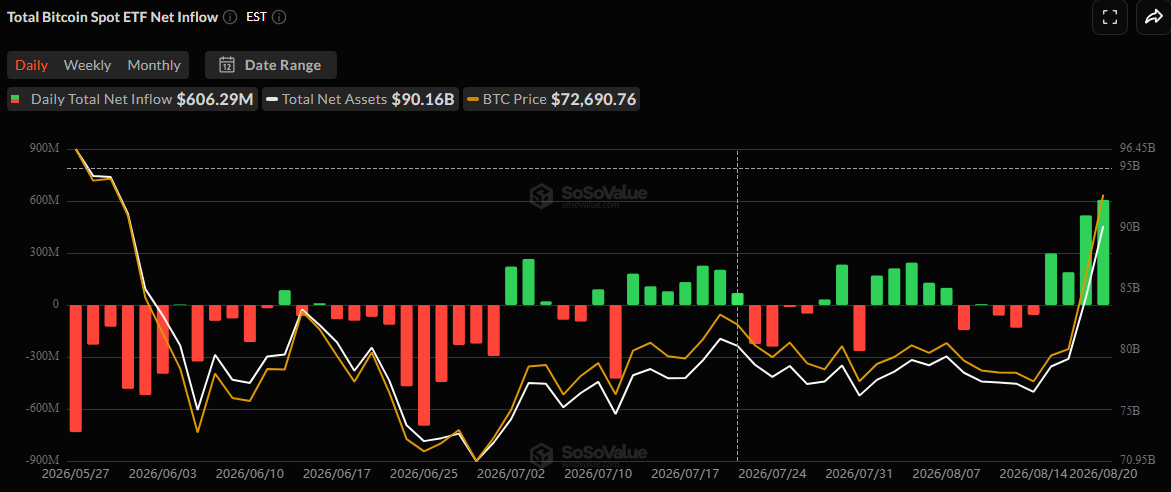
Spot Bitcoin (BTC) exchange-traded funds (ETFs) recorded $606.29 million in net inflows on August 20, marking a fourth consecutive day of inflows. The total is the largest single-day haul the funds have seen since May 1.
Spot Ethereum (ETH) ETFs added $221 million the same day, also extending a four-day inflow streak. The dual demand landed as bitcoin traded at $75,524, continuing a market-wide rally that has run through the week.
Bitcoin ETFs Extend a Four-Day Run
Thursday’s inflow followed $517.19 million on August 19, $189.30 million on August 18, and $297.56 million on August 17. Combined, the four-day run has pushed cumulative net inflows for the category to $53.40 billion.

The last time Bitcoin ETFs booked a bigger single day was May 1. That day, the funds pulled in $629.73 million, and total net assets crossed $100 billion for the first time.
BlackRock’s IBIT led the day’s inflows with $502.99 million, more than 80% of the day’s total. The broader crypto market rally that has lifted Bitcoin this week has coincided with a wave of short liquidations squeezing bearish positions across the market.
Ethereum Demand Builds Alongside Bitcoin
Ethereum ETFs have moved in step with their Bitcoin counterparts. The category booked $189.15 million on August 19, its largest single-day inflow in 10 months, before adding a further $221 million on August 20.
The simultaneous four-day streaks in both categories suggest institutions are building positions across both assets rather than rotating between them. Total value traded across Bitcoin ETFs reached $5.41 billion on August 20, and total net assets stood at $90.16 billion.
Whether the pace holds into next week may depend on the rally itself. Four straight days of buying could give way to profit-taking if momentum stalls.
The post Bitcoin ETFs Post $606 Million Inflow, Biggest Since May 1 appeared first on BeInCrypto.
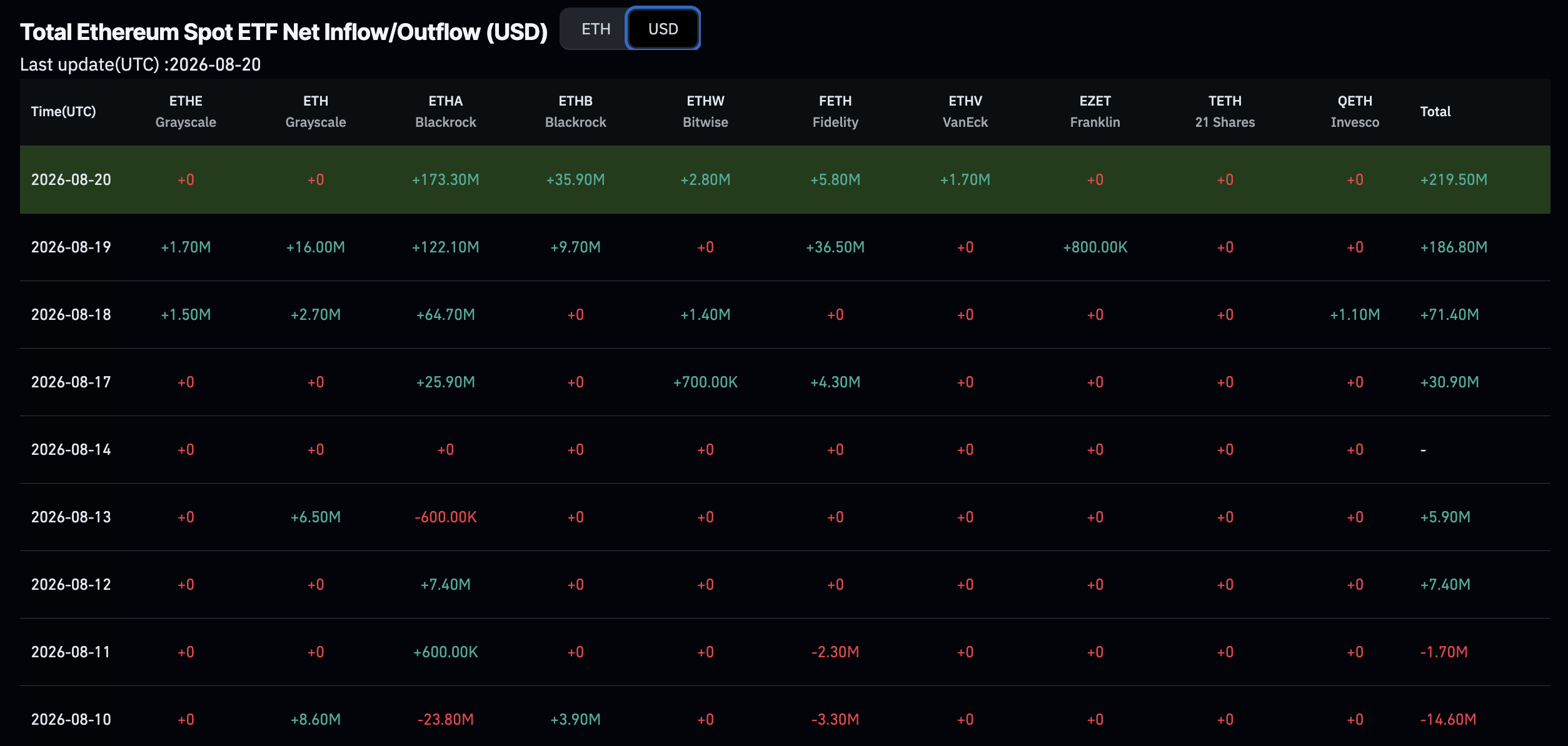
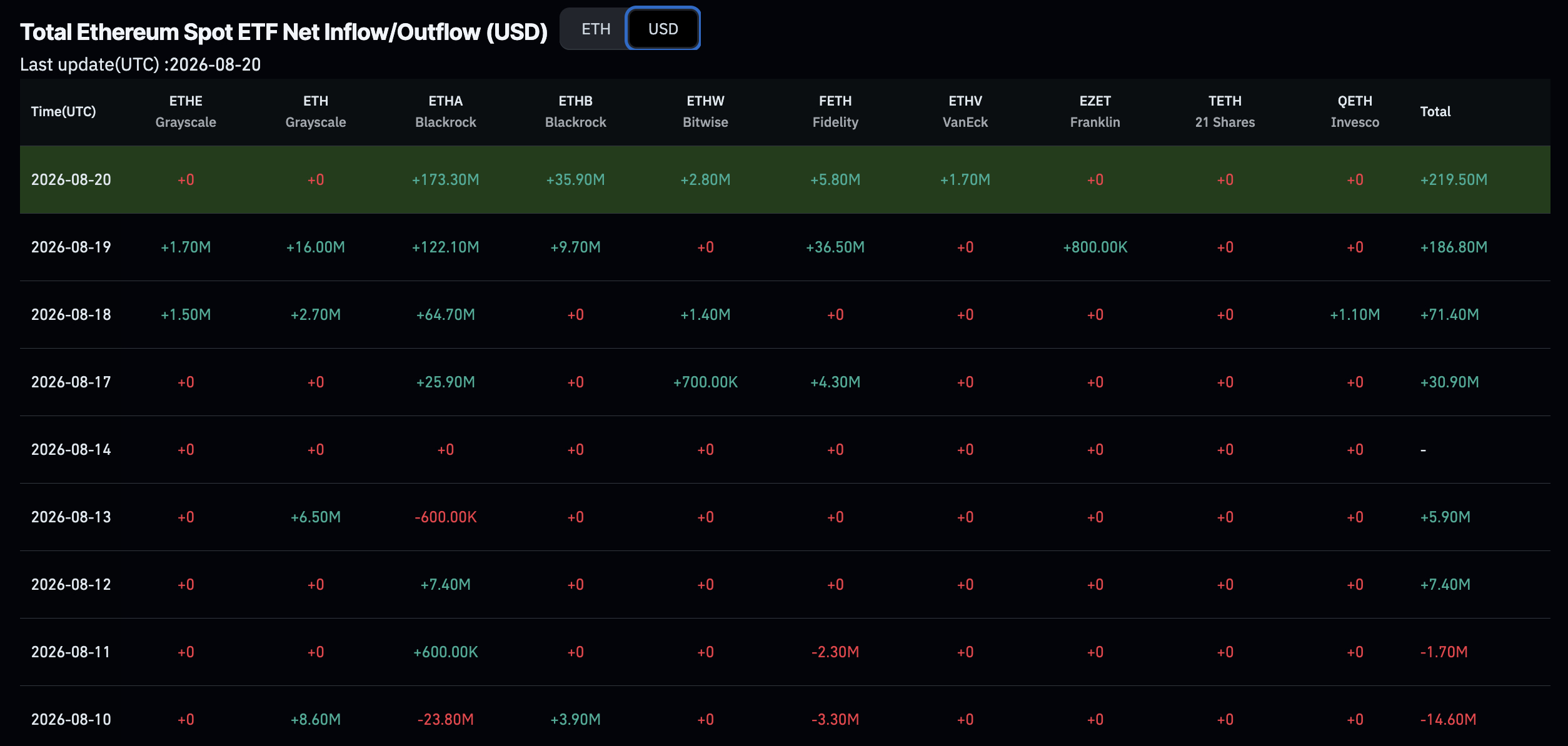
Ethereum is back in the spotlight after U.S. spot Ethereum ETF pulled more than $220 million in fresh capital on August 20. The funds recorded more $219 million in net inflows, extending their winning streak to four consecutive trading days. BlackRock’s ETHA once again dominated the session with about $173 million in inflows.
That puts the August 20 flow above the $189.15 million recorded one day earlier. The back to back inflows suggest institutional demand has not slowed after Ethereum’s sharp recovery.
ETH is also surging above the $2,300 level. CoinGecko data shows Ethereum trading around the $2,360 area in recent market data, with its market cap remaining above $270 billion.
Trade ETH Market on Kalshi and Get a $25 Signing-up Bonus
BlackRock Ethereum ETF Is Doing the Heavy Lifting
BlackRock’s ETHA accounted for roughly $173 million of the August 20 inflows. That was followed by BlackRock’s ETHB with about $35.9 million, while Fidelity’s FETH added $5.8 million.
Bitwise’s ETHW brought in around $2.8 million. VanEck’s ETHV added another $1.7 million. The remaining products recorded either smaller flows or no meaningful change during the session.
Biggest ETF Day Since May, BTC Back Above $70K — CoinMarketCap (@CoinMarketCap) August 20, 2026
Aug 19 BTC & ETH ETF Net Flows: +$684.4M
Three straight inflow days, +$1.08B combined. BTC now trades
at $71,653, up 9.7% in 24 hours and back above $70K for the
first time since early June. BTC: +$507.3M
IBIT (BlackRock):… pic.twitter.com/UOBwN2349T
The result is important because it came immediately after the $189 million inflow recorded on August 19. That earlier session had already been described as Ethereum’s strongest single day since October 2025.
As of now, August is shaping up as a major turnaround for Ethereum ETF. The funds had struggled through May and June, when combined net outflows exceeded $1 billion.
The money is moving in the opposite direction. Ethereum ETFs have posted several consecutive positive sessions while ETH has reclaimed levels that looked out of reach during the recent weakness.
Discover: The Best Token Presales
ETH Price Has Another Catalyst
Ethereum price action is giving the ETF numbers even more weight as it jumped sharply during the recent move, reaching above $2,300 and briefly trading near $2,400.
The token’s recovery also came with a sharp improvement in sentiment. Ethereum is now testing whether the $2,300 area can turn into support rather than another temporary stop. That matters because ETF demand is becoming increasingly difficult to ignore. Four straight days of inflows means institutions are adding exposure while ETH is already trading significantly above its recent lows.

There is another supply signal worth watching. Santiment data previously showed exchange held ETH falling from roughly 7.70 million coins on June 2 to 6.54 million on August 18. That represents a decline of around 15% over 11 weeks.
Fewer ETH sitting on exchanges can reduce immediately available selling supply. Combined with stronger ETF demand, that creates an interesting setup if buying pressure continues.
The big question now is whether Ethereum can turn this ETF momentum into a sustained breakout as the $2,400 area is the next obvious test. If ETH clears it decisively while ETF inflows remain strong, the market could start looking toward the next major resistance levels.
For now, the message from Wall Street is getting louder: institutions are buying the dip, and Ethereum is listening.
Discover: The Best Crypto to Diversify Your Portfolio
The post Ethereum ETF Pulls $221M as ETH Eyes Another Breakout appeared first on Cryptonews.


Laser Digital Japan will offer liquidity to domestic crypto providers, with institutional trading services planned to follow as the appetite for crypto in Japan grows.

Tottington High School celebrated superb GCSE Results Day
H.C. Wainwright cuts Envoy Medical stock price target on share count

Treasury’s $14 Billion Buyback Triggered a $3.5 Billion Crypto Short Squeeze

Weekend Open Thread – Corporette.com

Weekend Open Thread: Brooks Brothers

London Mayor Sadiq Khan handed a peerage by Keir Starmer alongside 15 other Labour figures… just days before the PM leaves No10

GFR 2017 Class | UPSC Principal & Vice Principal General Financial Rules | Delhi Principal Vacancy

Financial Literacy for Beginners: A Comprehensive Guide – Step 3

Crypto Scam In Blue Archive #bluearchive #serika #crypto #scam #ayane #abydos #shiroko
-

 Fashion7 days ago
Weekend Open Thread: Ann Taylor
-

 Sports6 days ago
Birmingham 2026: Day 6 Timetable for Irish Athletes
-
 NewsBeat6 days ago
Myanmar says over 300,000 Rohingya refugees verified for repatriation as exodus enters ninth year
-

 Business3 days ago
SMA Solar Technology AG (SMTGY) Q2 2026 Earnings Call Transcript
-

 Politics6 days ago
SEQ Code: The Three Letter Boarding Pass Code That Could Give You The Worst Seat
-

 Tech3 days ago
Qwen3.8-27B runs frontier-class coding agents and reasoning locally, no cloud API required
-

 Crypto World6 days ago
Pi Network Protocol 27 endgame: last upgrade before what?
-

 Crypto World4 days ago
OCC Greenlights Trump Family Crypto Firm for Trust Charter
-
 Tech6 days ago
Every fusion startup that has raised over $100M
-
 Entertainment6 days ago
Marvel Studios Reveals New X-Men Cast Including Adam Driver and Sadie Sink
-
 Business6 days ago
Monarch Mutual Fund set to enter MF space with maiden overnight fund; files draft with Sebi
-

 Fashion7 days ago
Weekly News Update, 8.14.26 – Corporette.com
-

 Fashion7 days ago
Silver bangles for women – Newbridge Silverware
-

 Business6 days ago
Facebook Down Now? Users Report Login And Loading Problems As Outage Trackers Monitor Ongoing Issues
-

 Business6 days ago
Cristiano Ronaldo’s Secret Wedding Deepens As Presenter Claims Family Learned ’30 Seconds’ Before
-

 News Videos1 day ago
Don’t Leave Your Financial Future To Chance | August 19, 2026
-

 Crypto World4 days ago
NAVI Prime launches institutional lending framework on Sui
-

 Fashion7 days ago
Cart Confidential Vol. 44 – Julia Berolzheimer
-

 Crypto World4 days ago
Data of 54K Wallet Users Leaked, Clarity Odds Just 10%: Hodler’s Digest, Aug. 16
-
 Fashion7 days ago
knitwear for women sale – up to 50% off
You must be logged in to post a comment Login