
Crypto World
Bitcoin rally could hold as spot buying outpaces leverage: Bitfinex analysts



Bitcoin has climbed about 23% over the past week to $77,535 as Bitfinex analysts say spot buying, ETF inflows and limited leverage could give the rally more staying power than a typical short squeeze.
Summary
- Bitcoin rose 10%–11% during the breakout while open interest increased only about 4%.
- Bitfinex identified $68,000–$69,000 as the main support zone for the recovery.
- U.S. spot Bitcoin ETFs attracted more than $1.1 billion across Aug. 19 and Aug. 20.
- Rising Treasury yields and profitable coins moving to exchanges could threaten the advance.
Why Bitfinex sees more runway for Bitcoin
Bitfinex analysts told crypto.news that forced liquidations helped Bitcoin break out of its previous range, but spot purchases and returning institutional demand have continued supporting the price after much of the short pressure cleared.
Bitcoin (BTC) traded at about $77,535 at the latest check after reaching an intraday high near $79,200. The cryptocurrency was up almost 7% over 24 hours and about 23% over seven days, extending a rally that began below $65,000 on Aug. 19.
Although squeeze-led advances often weaken once traders finish closing bearish positions, Bitfinex said the combination of ETF demand, improving macro conditions and limited selling could give the latest move a “longer runway,” with smaller retracements still possible.
Derivatives activity provides part of the evidence behind that assessment. Bitcoin gained between 10% and 11% during the initial breakout, while aggregate open interest rose by only about 4%, according to figures cited by the analysts.
“The shape of the move is the tell,” the Bitfinex team said. “Rallies built on fresh leverage show open interest jumping in step with price.”
Because open interest increased at a much slower pace than Bitcoin’s price, the analysts said spot buying and short covering performed most of the work. New leveraged positions played a smaller role, reducing the immediate risk of another large liquidation event caused by an overcrowded long market.
A weaker version of the setup would show open interest building quickly while Bitcoin stops rising. Bitfinex said the latest data had not displayed that pattern, although derivatives positioning will remain important if traders add leverage after the price increase.
Spot demand has outpaced fresh leverage
Bitcoin’s move began with a large short squeeze after the price cleared resistance around $65,000 and then crossed liquidation clusters near $67,000. Traders who had borrowed funds to bet on a decline were forced to buy Bitcoin as exchanges closed positions that no longer held enough collateral.
More than $1 billion in crypto short positions were liquidated within about one hour. Total short liquidations later approached $1.79 billion, while a longer market-wide count placed bearish liquidations near $2.7 billion over 24 hours.
The forced purchases helped Bitcoin jump from below $65,000 to approximately $69,500 on Aug. 19. As earlier liquidation data showed, the move carried BTC through several liquidity bands between $65,000 and $67,500 before it tested the upper cluster around $69,000.
Short covering explains the speed of the advance but does not fully account for Bitcoin holding above $70,000 after many bearish positions had closed. Bitfinex pointed to spot purchases and ETF inflows as evidence that other buyers entered during the breakout.
The distinction matters because liquidation demand is temporary. Each forced purchase closes an existing position, while continued spot accumulation can remove coins from the available market without creating the same exposure to futures liquidations.
Open interest will therefore remain one of the main indicators for judging the rally. A sharp increase in leveraged positions without matching price gains would weaken Bitfinex’s current reading, while steady prices accompanied by restrained open interest would remain consistent with a spot-led move.
The $68K–$69K zone could determine whether Bitcoin holds
Bitfinex identified the $68,000 to $69,000 area as the most important support zone because Bitcoin’s short-term holder cost basis currently sits within that range.
The metric represents the average acquisition price of coins held by investors who entered the market during the previous several months. Bitcoin trading above the level means that recent buyers are collectively holding unrealized profits, according to the analysts.
A sustained price above the range could limit pressure from holders seeking to exit at break-even. Falling below it would place part of the recent buyer group back into loss and could increase selling if confidence weakens.
The same area contains Bitcoin’s 200-day moving averages. BTC crossed its 200-day simple and exponential moving averages near $69,000 during the rally, reclaiming the long-term indicators for the first time in about nine months.
Barchart noted that Bitcoin had remained below its 200-day average since November 2025, about one month after it reached a record above $126,000. A sustained hold above the indicator would support the view that the decline from the October peak is losing strength, though the technical signal cannot guarantee further gains.
For a clearer measure of U.S. participation, Bitfinex said traders should monitor the Coinbase Premium. The indicator compares Bitcoin’s price on Coinbase with prices on other major exchanges, with a positive reading suggesting relatively strong demand through the U.S.-focused platform.
According to the analysts, a Coinbase Premium that catches up with the rally would provide a cleaner signal that American buyers are returning. Weakness in the indicator would suggest that demand remains concentrated outside the United States or in offshore derivatives markets.
ETF inflows and Treasury yields remain key tests
U.S. spot Bitcoin ETFs received approximately $517 million in net inflows on Aug. 19, their strongest daily result since May, according to SoSoValue data cited by market analysts. The funds added about $606 million on Aug. 20, bringing their two-session intake above $1.1 billion.
Across Monday through Thursday, the products attracted approximately $1.6 billion, putting them on course for their strongest week of 2026. Bitfinex said a complete week of inflows at a similar pace would strengthen support and provide firmer evidence of a lasting change in demand.
American investors access Bitcoin through the funds on regulated securities exchanges, making ETF flows a direct measure of demand from U.S. brokerage and institutional accounts. Continued inflows would also separate the rally from an advance driven mainly by traders closing short positions.
As reported earlier Friday, Standard Chartered global head of digital asset research Geoff Kendrick said recovering ETF flows and low open interest could allow more investors to return as Bitcoin rises.
“For the first time this year there is now a risk my end year forecast (of USD100k) is too low,” Kendrick wrote in a client note.
Kendrick said Bitcoin could move toward its $126,000 record before year-end, potentially gaining speed after Oct. 6. Standard Chartered has not formally replaced its $100,000 forecast with a $126,000 target; Kendrick described the record as a possible overshoot if the recovery continues.
Macro conditions have also supported the rally. On Aug. 19, the U.S. Treasury Department announced that it would at least double the maximum size of liquidity-support buybacks for government securities in the 10-to-20-year and 20-to-30-year maturity sectors.
The maximum will increase from $2 billion to at least $4 billion per operation beginning Sept. 9 and remain in place through Nov. 4. Long-term Treasury yields initially declined after the announcement, improving conditions for risk assets as Bitcoin moved through $70,000.
Bitfinex identified renewed increases in Treasury yields and the exhaustion of short covering as possible obstacles. The analysts also warned that a large volume of profitable Bitcoin has moved onto exchanges during the rally, creating the risk of the year’s largest profit-taking wave if holders begin selling those coins.
Disclosure: This article does not represent investment advice. The content and materials featured on this page are for educational purposes only.



Hungary has repealed its mandatory crypto conversion validation system and removed two related criminal offenses that exposed users and service providers to prison terms of up to eight years.
Summary
- Hungary has removed mandatory validation checks for crypto conversions.
- Two crypto offenses carrying prison terms of up to eight years have been repealed.
- The rules took effect on Aug. 7 after Parliament approved the repeal on July 31.
- The changes remove a separate national compliance layer alongside the EU’s MiCA framework.
The Hungarian Parliament passed Act XXXVIII of 2026 on the Repeal of Certain Statutory Provisions Concerning Crypto-Asset Conversion Services, removing a national validation requirement that had applied to crypto-to-fiat and crypto-to-crypto conversions.
Approved by Parliament on July 31 and effective from Aug. 7, the legislation removes the validation process and associated criminal penalties after the rules created a separate compliance requirement for crypto businesses operating in Hungary.
Under the previous system, covered crypto conversions had to pass through an authorized validation provider. Transactions completed without the required validation could qualify as unauthorized crypto transactions under Hungary’s criminal law.
András Gaál, an associate at law firm Schoenherr, said converting crypto assets without prior validation had constituted an unauthorized crypto transaction under Act C of 2012 on the Criminal Code.
Hungary removes crypto offenses tied to validation
Alongside the validation requirement, Parliament has removed two criminal offenses introduced under the previous framework.
The first offense, called “Abuse of crypto assets,” applied when a person exchanged crypto assets of significant value for money or other crypto assets through an unauthorized crypto-asset exchange service.
A violation could carry a prison sentence of up to two years, while the maximum penalty increased for transactions involving larger amounts. Under particularly serious circumstances, the offense could carry as much as five years in prison.
The second offense, “Unauthorized crypto-asset exchange service provision,” applied to providers conducting exchange activities of significant value while violating the country’s validation requirement.
Basic violations carried prison sentences of up to three years, while more serious cases could result in imprisonment of as much as eight years.
Hungary had introduced the criminal provisions as part of a crypto framework that came into force in 2025, creating uncertainty for exchanges and other service providers because firms serving Hungarian customers had to comply with a separate national validation process.
As previously reported by crypto.news, the rules that took effect in July 2025 required crypto exchanges to pass through a state-controlled validation process involving checks on the origin of funds, wallet ownership, customer identity and user profiles.
At the time, individuals using unauthorized crypto services could face prison terms depending on the value involved, while service providers processing particularly large transaction volumes faced sentences of up to eight years.
Local estimates cited at the time put the number of Hungarians involved in cryptocurrency activities at roughly 500,000.
The regulatory uncertainty also affected crypto companies operating in the country. Revolut suspended its crypto services in Hungary after the rules took effect, while some other firms considered moving operations to EU jurisdictions including Estonia and Lithuania.
Hungary reverses its 2025 crypto crackdown
The repeal completes a reversal that the Hungarian government had signaled earlier this year as it reconsidered the criminal provisions and the country’s separate validation regime.
On June 11, the government confirmed plans to remove the penalties after the 2025 restrictions disrupted domestic crypto trading and prompted platforms to reduce services.
The planned crypto rollback followed Hungary’s April parliamentary election, which brought the Tisza Party to power after 16 years of government under former Prime Minister Viktor Orbán.
Government spokeswoman Anita Kobol said at the time that Hungary intended to reverse measures introduced under the previous administration. Newly appointed Minister of Innovation and Technology Zoltán Tanács described the former framework as “excessive and politically driven.”
Hungarian authorities were also facing questions from the European Union over whether the country’s validation requirements were compatible with the bloc’s Markets in Crypto-Assets Regulation.
The European Commission had opened an investigation into the Hungarian rules, according to Kobol, adding another regulatory issue for a system that required exchanges operating in Hungary to satisfy national requirements on top of the EU framework.
Transactions converting crypto into fiat currency or another crypto asset required a compliance certificate from a licensed local validator. Without the certificate, the transaction could be considered legally invalid.
Hungary also created a separate category of crypto conversion validation service providers overseen by the country’s Supervisory Authority of Regulated Activities.
Before issuing certificates, validators could be required to check the origin of crypto assets, identify wallet or device ownership, examine customer profiles and compare transaction information against external databases.
MiCA rules replace Hungary’s separate crypto checks
Katalin Horváth, a partner at CMS Budapest, said the Hungarian system was incompatible with the EU internal market and duplicated protections already established through MiCA.
MiCA provides a common licensing framework for crypto-asset service providers across the European Union and allows authorized companies to serve customers in other member states through passporting arrangements.
The repeal means companies operating under the European framework no longer need to route covered Hungarian conversions through the separate national validation system.
The timing also follows the end of the EU’s MiCA transition period on July 1, when crypto firms that had been operating through legacy national registrations faced new restrictions unless they secured authorization under the bloc’s regulatory framework.
Shortly after the deadline, the European Securities and Markets Authority added another 57 authorized firms to its register, bringing the total to 300 at the time.
The July 3 MiCA register expansion included Standard Chartered and FalconX, with approved providers gaining passporting rights across all 27 EU member states. Firms without the required authorization had to stop onboarding new customers and begin winding down covered regulated services.
Other companies have since secured authorization through individual EU regulators and used MiCA passporting to expand their regulated operations.
BitPay, for example, received authorization from the Dutch Authority for the Financial Markets in July through its Netherlands-based entity.
The company’s Dutch MiCA approval allows it to provide regulated crypto services across eligible EU markets, including cryptocurrency payments and stablecoin transactions.
The European licensing system has also moved beyond the initial authorization stage. ESMA began reviewing the operational resilience of MiCA-authorized crypto custodians in July, examining areas including custody controls, key management, incident response and third-party risks.
For companies serving Hungarian customers, Act XXXVIII of 2026 removes the additional domestic validation layer that had operated alongside the EU system.
Horváth said payment institutions, crypto-asset service providers and intermediaries that had routed covered conversions through authorized validators should now unwind those processes.


Trading activity on South Korea’s two largest crypto exchanges has jumped sharply, with Upbit volume rising 273% to about $1.84 billion as Bitcoin’s latest rally pulls local traders back toward digital assets.
Summary
- Upbit’s 24 hour trading volume surged 273% to about $1.84 billion, its highest level since mid March.
- XRP led trading on both Upbit and Bithumb as activity increased across South Korea’s two largest crypto exchanges.
- Bithumb’s daily volume climbed 132.9% to about $934.9 million during the crypto market rebound.
- Presto Research said Korean investors could send more capital into crypto if the current rally holds.
According to CoinGecko data on Aug. 21, Upbit recorded its highest daily trading volume since mid-March, while XRP accounted for $418.9 million of transactions and ranked ahead of Bitcoin, USDT and Ether on the exchange.
Bithumb recorded a similar increase, with 24-hour volume climbing 132.9% to about $934.9 million. XRP also ranked as the most-traded cryptocurrency on South Korea’s second-largest exchange.
The pickup follows months of weaker activity across South Korea’s crypto market, where investors spent much of 2026 favoring domestic equities as the KOSPI reached record levels. Bitcoin’s latest rebound, however, has begun pulling some of that attention back toward crypto.
Upbit volume rebounds after months of weak Korean crypto trading
South Korean crypto activity had fallen sharply earlier this year as Bitcoin and other major cryptocurrencies remained under pressure while local stocks delivered stronger returns.
In May, crypto.news reported that local trading across Upbit, Bithumb, Coinone, Korbit and Gopax had dropped to only about 8% of KOSPI trading volume. The comparison covered data through May 26 and placed cryptocurrency turnover at less than one-tenth of activity in South Korea’s benchmark equity market.
That was a sharp reversal from late 2024, when domestic crypto exchanges at times generated trading volumes above the local stock market. Negative Bitcoin Korea Premium readings reported during May also showed weaker local demand compared with overseas markets.
The slowdown showed up in exchange earnings. Upbit and Bithumb both reported operating revenue declines of roughly 50% during the first half of 2026. Upbit’s net profit fell 74%, while Bithumb moved from a profit in the comparable period to a net loss.
Much of the competing demand came from South Korean equities. The KOSPI climbed to record highs as investors bought shares linked to the artificial intelligence memory boom, including Samsung Electronics and SK Hynix.
Even after local stocks became more volatile from late June, Korean traders continued to focus heavily on the semiconductor trade, according to the report.
XRP has again taken the lead on Korean exchanges
XRP’s position at the top of both Upbit and Bithumb’s latest volume rankings continues a trading pattern seen several times this year.
During another surge in May, XRP led Upbit trading with more than $330 million in 24-hour volume. Bitcoin recorded about $217 million at the time, while Ether generated roughly $109 million.
The May increase came after Hana Financial Group announced that Hana Bank would acquire a 1 trillion won, or about $670 million, stake in Dunamu, Upbit’s operator.
Another May trading session saw XRP/KRW become Upbit’s busiest market with about $110.9 million in volume, again placing it ahead of Bitcoin and Ether. The repeated ranking has kept XRP closely tied to periods of heavier retail activity in South Korea.
Recent institutional interest in the country’s exchanges has continued despite weaker trading conditions. Three Samsung affiliates agreed to acquire a combined 4% stake in Dunamu for about $408 million in May.
Samsung Securities, Samsung SDS and Samsung Card agreed to purchase around 1.39 million Dunamu shares from Kakao-linked entities. Samsung Securities was set to take a 2% stake, while Samsung SDS and Samsung Card would each acquire 1%.
On the Bithumb side, Kiwoom Securities entered talks in June over a possible investment through newly issued shares. The size of the proposed transaction and the resulting ownership interest had not been finalized at the time.
Bitcoin rally is drawing attention back to crypto
The latest rise in Korean exchange volumes has coincided with a sharp Bitcoin rebound after the U.S. Treasury Department expanded its debt buyback program.
The Treasury said on Aug. 19 that it would increase the size of liquidity-support buybacks for longer-dated nominal coupon securities by at least twofold. Markets initially treated the decision as supportive for liquidity, helping Bitcoin climb back above $69,000 for the first time since June before the rally extended further.
Bitcoin was up about 8.3% over the previous 24 hours and traded above $78,000 at the time of publication. The total cryptocurrency market had gained around 7.2% over the same period.
Min Jung, associate researcher at Presto Research, told crypto media that two days of stronger activity was not enough to establish that Korean investors had started a sustained move from stocks into crypto.
“While it’s too early to call this a rotation given it’s only been two days, we’d expect a much larger influx of capital into crypto if the rally holds,” Jung said.
With the KOSPI already recording a strong advance this year while cryptocurrencies lagged for months, Jung said investors were starting to consider where another catch-up trade might develop.
Korean retail capital tends to follow returns
Jung described South Korean retail investors earlier this week as “return-chasing” instead of “asset-loyal,” meaning capital can move quickly toward whichever market is delivering stronger performance.
A sustained crypto rally could therefore bring a more substantial amount of Korean capital back into digital assets, according to the researcher.
Jung also said such inflows could influence cryptocurrency prices outside South Korea because Korean trading flows have historically affected markets by more than their percentage share of global volume might imply.
The sequence, however, usually begins outside the country.
“Korean capital tends to follow a rally rather than start one,” Jung said, adding that global market momentum is more likely to attract Korean money first, after which the additional buying can amplify the move.


Fidelity Digital Assets identified six risks that could weaken the investment case connecting artificial intelligence agents with public blockchains.
Summary
- Fidelity identified six risks that could prevent AI agents from creating value for public blockchains.
- Closed technology and fintech platforms may offer agents better performance, costs, distribution and compliance certainty.
- Payments could increase blockchain activity while directing more economic value toward stablecoin issuers and services.
- AI can accelerate software development while making vulnerabilities cheaper for attackers to discover and exploit.
- Trading generated forty nine times more Ethereum revenue per dollar than payments across 180 days.
Senior research analyst Max Wadington published the report on Aug. 19. Fidelity said AI could accelerate blockchain development and create demand for programmable financial infrastructure. However, increased agent activity may not produce lasting value for blockchain networks or their native tokens.
The six risks cover limited value from increased software production, weaker technical differentiation, competition from closed systems, low value capture from payments, growing security threats and regulatory constraints.
Fidelity presented them as possible outcomes rather than forecasts. The report’s central question is not simply whether AI agents will use blockchains. It is whether networks and applications can capture meaningful economic value from that activity.
AI agents may favor closed platforms over public blockchains
Fidelity described competition from closed systems as one of the largest risks to the crypto AI thesis. Technology companies, banks, payment networks and fintech platforms are building infrastructure that allows agents to transact through controlled environments.
These platforms may offer advantages in performance, costs, user experience and regulatory clarity. They already have broad merchant distribution, established identity systems and the ability to extend credit. Public blockchains cannot assume that their accessibility and programmable settlement will overcome those advantages.
“Even if AI drives a substantial increase in overall digital economic activity, there is no guarantee that public blockchains will capture a meaningful share of it,” Wadington wrote.
Fidelity expects agents could use several types of infrastructure. An agent might use a blockchain for a machine payment but rely on a bank or fintech platform for credit, identity checks and other services. The report calls this possible outcome “multi-fi.”
Such competition is already becoming visible. Google, Mastercard, Visa, Stripe, Coinbase and other companies are developing agent payment systems across card, bank and blockchain rails.
Payment growth may not raise native token value
Fidelity also questioned whether higher transaction counts would produce proportionate returns for native blockchain tokens. Agent payments could generate substantial volume while producing limited fee revenue for the underlying network.
Stablecoin issuers and payment service providers may capture more value than base blockchains. Fidelity said low fees and strong competition could make agent payments economically useful without making them a major source of tokenholder income.
Recent activity illustrates the distinction between adoption and revenue. As previously reported, AI agents completed 1.4 million payments for approximately $280 in network fees on the XRP Ledger. The activity demonstrated technical use but generated little fee income relative to its transaction count.
Fidelity found that trading produced 49 times more Ethereum base layer revenue per dollar of volume than payments during the previous 180 days. Trading can also generate maximal extractable value for validators.
The report therefore sees stronger economic potential in agents that manage capital. Automated trading, lending, borrowing and liquidity provision could create more fees than large numbers of small payments.
AI makes development faster but weakens differentiation
AI tools can help developers write, test and deploy blockchain applications faster. Fidelity cited research involving more than 100,000 GitHub developers that found coding agents increased commits by as much as 180% and production releases by 30%.
More software does not automatically create useful products, according to Fidelity. Applications still require distribution, liquidity, regulatory compliance and sustained user demand. Human oversight also remains necessary for security critical financial software.
Cheaper development could make blockchain features easier to reproduce. Networks may find it harder to distinguish themselves through technology when competitors can quickly copy or modify similar tools.
Fidelity said durable advantages could shift toward liquidity, distribution, security and trust. Established networks and applications may benefit because those qualities cannot be reproduced as easily as software features.
Security and regulation could reshape agent adoption
Fidelity said AI lowers the cost of building software while also making it cheaper to identify vulnerabilities and conduct attacks. The resulting pressure could turn security from a basic requirement into a central competitive advantage.
Evidence supports both sides of that assessment. In related coverage, researchers found that AI agents identified genuine vulnerabilities in Ethereum related software, including a flaw later disclosed as CVE-2026-34219. Human researchers still had to separate valid findings from convincing false positives.
Regulatory requirements create another barrier. Institutions may favor systems offering clear identity controls, permissioning and legal accountability. Fully permissionless networks could face difficulty connecting autonomous agents with regulated financial services.
The market is still testing these tradeoffs. Coinbase has enabled businesses to accept USDC payments from autonomous agents, while Stripe, Visa and other established payment companies are developing competing or complementary systems.
Fidelity said investors should watch where agents deploy capital, not just how many transactions they complete. Networks that combine liquidity, strong distribution, security and regulatory integration may be better positioned to convert AI activity into durable economic demand.


Binance has continued opening and verifying new European customer accounts more than seven weeks after the European Union’s July 1 MiCA licensing deadline, despite remaining absent from the bloc’s register of authorized crypto providers.
Summary
- Binance is still opening and verifying some new EU accounts more than seven weeks after the July 1 MiCA deadline.
- Tests across several European countries found no warning that Binance lacked MiCA authorization, while crypto deposits remained available on active accounts.
- Binance is absent from ESMA’s register of authorized providers and says it is pursuing approval through another EU member state.
- ESMA had instructed unauthorized providers to stop onboarding new EU customers and implement their wind down plans by July 1.
According to a Sandmark report shared with crypto.news, tests across several EU countries found that new users could still complete Binance’s registration and identity verification process after the deadline, with two accounts fully verified and able to receive crypto deposits.
The tests covered connections in Austria, France, Germany, Spain and Belgium, using both standard internet connections and virtual private networks. None displayed a warning telling applicants that Binance lacked authorization under the Markets in Crypto-Assets regulation.
One account, created on Aug. 19 using a European identity document and residential address, was verified and subsequently funded with cryptocurrency. The account had not existed before July 1.
Binance, the world’s largest cryptocurrency exchange by trading volume, withdrew its Greek MiCA application in June after its licensing effort stalled. The company has maintained that it intends to stay in Europe and is pursuing authorization through another EU member state.
Binance accounts remain accessible after the MiCA deadline
The results come after Binance had told customers in several European countries that new registrations and deposits would stop from July 1 after it failed to secure MiCA authorization.
As previously reported by crypto.news, Binance informed users in Italy, Spain, France, Poland, Belgium and Sweden that several services would be restricted once the transition period expired. Earn products, which provide yields on deposited crypto, were also set to be suspended.
Customers were not required to withdraw their assets by July 1, however. Binance said funds would remain safe while it sought authorization elsewhere in the EU.
The latest tests found that some controls remain in place even though new account creation has not been completely blocked.
Using an Austrian IP address and a Spanish identity document, one applicant completed verification within minutes. No disclaimer appeared stating that Binance lacked MiCA approval, and crypto deposits remained available.
A separate registration from Spain used a Spanish internet connection without a VPN, along with local address and employment information. The applicant completed the sign-up process before Binance rejected the registration because the individual already had an account. The rejection did not cite EU residency or MiCA restrictions.
Access from the United States produced a different result. A U.S. connection immediately redirected the user to Binance.US. After a login to the international platform, deposits and trading were suspended, leaving only withdrawals available.
Binance said it does not comment on specific customers, accounts or individual onboarding cases. The company added that European service availability can vary based on the jurisdiction, transitional rules, the product involved and individual circumstances.
“Following the implementation of MiCA, we have taken steps to ensure that the availability of our products and services in Europe aligns with relevant legal and regulatory frameworks,” Binance said.
The exchange did not provide a specific explanation for why new European accounts could still complete verification after July 1. Binance said it remains committed to securing authorization and is “actively progressing” its application.
Belgian account was linked to Binance Poland
Another registration conducted through a Belgian connection without a VPN resulted in an active account in about ten minutes.
The onboarding process required a photograph of an identity card and a live facial check through a camera. The applicant was also asked to provide information about income, savings and professional status.
Under Binance’s terms, customers based in Belgium contract with Binance Poland Sp. z o.o., a Polish-registered virtual asset service provider.
Poland had no authorized providers on the ESMA register cited in the report, while neither Binance Poland nor another Binance entity appeared among approved providers.
Payment transfers for the Belgian account were handled by BPay Global B.S.C., Binance’s Bahrain-based payments affiliate. The funds were set to settle through an account at JSC Pave Bank in Tbilisi, Georgia.
An attempted transfer through SEPA, the EU’s euro bank-transfer system, prompted another series of checks from BPay. The transfer was not completed, leaving the additional checks that may have applied to a completed transaction unclear.
MiCA regulates the provision of crypto services to European customers, not simply whether an exchange’s website can be accessed from an EU country. The tests therefore examined whether new European customers could register, pass identity checks and fund accounts after July 1.
ESMA told unauthorized firms to stop new onboarding
The European Securities and Markets Authority had given firms explicit instructions before the transition period expired.
In a June 23 statement, ESMA said unauthorized providers should immediately stop onboarding new EU customers and restrict their remaining services to actions needed for clients to exit.
By July 1, unauthorized providers “must have implemented its wind-down plan,” the regulator said. National authorities were also instructed to check those plans and “take action against the unauthorized provision of crypto-asset services.”
Earlier in April, ESMA had said a company providing covered crypto services to EU customers without authorization would be in breach of EU law once the applicable transition ended.
The licensing gap remained large after the deadline. An Aug. 11 review of MiCA authorization found that 281 of 1,343 providers operating across the European Economic Area before the transition had obtained authorization, leaving 1,062 without approval.
Around the July deadline, ESMA added 57 firms to its register. Standard Chartered and FalconX were among the companies approved, while licensed providers gained the ability to use MiCA passporting rights to serve customers across EU member states.
A July 3 register update showed that the additions had taken the number of authorized providers to 300 at the time.
By Aug. 20, the register cited in the latest report contained 330 authorized providers. Binance was not among them.
ESMA separately maintains a register of companies identified as providing crypto services without authorization. That list contained 167 entries as of Aug. 20, including 164 supplied by Italy’s Consob and one each from regulators in the Netherlands and Slovakia. Binance was also absent from that list.
Binance had already restricted some European services
Binance’s current position follows several weeks of country-specific restrictions after the MiCA deadline.
French customers lost trading access in early July after Binance failed to obtain authorization. Spot and margin trading were among the affected services, while withdrawals remained available.
Binance also told affected EU customers at the start of July that their assets remained backed on a one-to-one basis and that previously communicated account options, including withdrawals where applicable, would continue.
The licensing problem had developed before the deadline. Binance formally applied for MiCA authorization only in Greece, while discussions had also taken place with regulators in other jurisdictions.
On June 24, Binance said it would seek another EU route if its Greek application failed to progress. The company withdrew that application the same day, shortly before the Hellenic Capital Market Commission was reportedly expected to reject it.
Restrictions were also visible during the latest account tests. The account created through Austria with a Spanish identity document could not deposit euros through a bank transfer after a third-party provider flagged an address mismatch, although Binance’s dashboard showed the address as verified. Cryptocurrency deposits were still permitted.
Regulators have meanwhile begun taking enforcement action under MiCA. On Aug. 14, Austria’s Financial Market Authority announced its first case under the framework, imposing a €70,000 fine on Vienna-based Bitpanda.
The FMA said Bitpanda failed to submit a crypto asset whitepaper at least 20 days before publication and distributed marketing materials without the required disclaimer stating that the regulator had not reviewed them.
ESMA was asked on Aug. 19 whether an unauthorized exchange allowing new EU customers to verify accounts and accept deposits after July 1 complied with its guidance, and whether it knew of other exchanges operating in the same manner. The regulator’s press office confirmed receipt of the questions and requested more time to respond, while Austria’s FMA declined to comment.


Nomura-backed Laser Digital has become Japan’s first newly registered crypto asset exchange service provider in about four years, securing approval as the country prepares to move digital assets under a financial-instruments framework.
Summary
- Laser Digital has become Japan’s first newly registered crypto asset exchange service provider in about four years.
- The Nomura-backed firm will initially provide liquidity services to domestic virtual asset service providers.
- Laser Digital plans to expand into institutional digital asset trading, though no launch date has been announced.
- Japan is preparing to bring crypto under its financial instruments framework, with new rules expected to take effect in 2027.
According to Laser Digital, its Japanese subsidiary has completed registration as a crypto asset exchange service provider and will initially supply liquidity to domestic virtual-asset service providers before considering trading services for institutional investors.
The company has not disclosed when the institutional offering will launch or the full range of services it intends to provide. The registration, however, gives Laser Digital a regulated route into a market where institutional demand has been rising, according to research conducted by Nomura and the digital-asset firm.
A 2026 survey by Nomura and Laser Digital found that 79% of respondents planned to invest in crypto assets within the next three years. Laser Digital said the findings support its decision to build services designed for professional investors in Japan.
Laser Digital gains Japan entry after a four-year registration gap
The approval follows months of regulatory work by the Nomura subsidiary, which had been preparing to establish a regulated trading operation for institutional clients.
In October 2025, crypto.news reported Laser Digital plans to seek a Japanese crypto trading license after the firm entered preliminary discussions with the Financial Services Agency. At the time, Laser Digital was considering broker-dealer services for traditional financial institutions, crypto companies and digital-asset exchanges operating in the country.
Those plans have now moved into the registration stage, although the company’s first services will focus on liquidity for locally registered crypto businesses. Institutional trading opportunities are expected to follow, subject to the company’s final service structure and launch schedule.
Laser Digital was established by Nomura in 2022 as the investment bank expanded into digital assets. The business has since developed operations across asset management, trading and venture investment, while its Japanese subsidiary has been working toward establishing a regulated local presence.
Outside Japan, the company received a full crypto business license in Dubai in 2023. Laser Digital has also launched investment products including Bitcoin and Ethereum-focused funds designed for institutional investors.
Its Japan strategy has included other parts of the digital-asset market. During its earlier licensing discussions, Laser Digital was also exploring yen- and dollar-pegged stablecoins with GMO Internet Group, including services covering regulatory support, blockchain infrastructure and backend operations.
Jez Mohideen, co-founder and CEO of Laser Digital, said the Japanese market was reaching “a new phase of maturity” as professional investors increase their exposure to the sector.
“As institutional investors increase their interest in this asset class, there remains a need for trusted counterparties and infrastructure designed specifically for their requirements,” Mohideen said.
Japan crypto rules are moving digital assets closer to securities
Laser Digital’s registration comes shortly after Japan completed legislation that changes how cryptocurrencies are treated under the country’s financial laws.
Japan passed its crypto law in July, classifying digital assets as financial products under the Financial Instruments and Exchange Act and creating a separate legal category alongside products such as stocks and bonds. The legislation followed years in which crypto assets were primarily regulated under the Payment Services Act.
Under the amended framework, Japan will introduce insider-trading restrictions for crypto transactions and annual disclosure requirements for issuers of certain digital assets. Penalties for businesses operating without registration will also increase once the rules are implemented.
The legislation also establishes a legal basis for changing how crypto gains are taxed. Japan currently treats individual crypto profits as miscellaneous income, with rates that can reach about 55%, while the planned system could place qualifying gains under separate taxation at an effective rate of about 20%.
Tax provisions are expected to take effect in January 2028 because enforcement is scheduled during Japan’s 2027 fiscal year, according to CoinPost reporting cited in the July coverage. The amended financial law itself is expected to take effect within one year of promulgation, with cabinet ordinances and supervisory guidelines setting out the detailed requirements.
Japan’s revised framework also provides the legal groundwork for domestic spot crypto exchange-traded funds. The Japan Exchange Group has been considering local crypto ETF listings as early as 2027, although approval of spot Bitcoin ETFs has not yet been confirmed.
Nomura is preparing for more institutional crypto products
Traditional financial groups were already positioning for new crypto investment products before the latest law was completed.
By May, major Japanese brokerage groups including SBI, Rakuten and Nomura were preparing or studying crypto investment trust products as regulators worked on rules allowing funds to hold digital assets. SBI Securities and Rakuten Securities were developing products internally, while Nomura, Daiwa and firms linked to SMBC and Mizuho were examining similar offerings.
The planned investment trusts could allow Japanese investors to gain crypto exposure through conventional securities accounts once regulatory requirements are completed. Japan’s roadmap has also included plans that could eventually allow investment trusts and ETFs to hold assets such as Bitcoin and Ethereum.
Laser Digital has already built products around that institutional demand outside its Japanese exchange operation. Nomura launched the unit’s Bitcoin Adoption Fund in 2023, giving institutional investors long-only Bitcoin exposure, followed by other digital-asset investment products.
The company has also expanded into tokenized finance through projects linked to institutional funds and blockchain infrastructure, placing regulated trading, asset management and tokenized products within the same digital-asset business.
For its Japanese operation, however, the immediate focus remains liquidity provision to registered domestic crypto firms. Laser Digital has said details covering the launch timetable and the scope of future institutional trading services will be announced later.
Steve Ashley, co-founder and executive chairman of Laser Digital, said professional investors globally were increasingly seeking digital-asset access alongside infrastructure capable of supporting institutional trading.
“Sophisticated investors are increasingly looking for access and the necessary quality of infrastructure behind it,” Ashley said.


Solana has reduced its target slot time from 400 milliseconds to 350ms for the first time since the network launched, starting a four-stage plan that could eventually bring slots down to 200ms.
Summary
- Solana has reduced its target slot time from 400ms to 350ms for the first time since the network launched.
- The change is the first stage of SIMD-0525, which plans further reductions to 300ms, 250ms and 200ms.
- Shorter slots are designed to reduce confirmation latency while network resource limits are adjusted proportionally.
- The remaining stages are targeted for Agave v4.2, although the activation schedule remains tentative.
Solana Foundation vice president of technology Jacob Creech announced the change on Aug. 21, saying the network had entered “a new era of 350ms” before adding, “Next stop, 300ms.”
Average slot times were running at around 360ms at the time of writing, according to Solana’s slot time explorer, compared with the network’s original 400ms target.
The change is the first step under SIMD-0525, a Solana improvement proposal that introduces four progressively shorter slot configurations at 350ms, 300ms, 250ms and 200ms. The proposal was approved and merged on May 14.
Rather than moving immediately to the final target, Solana plans to activate each reduction separately, giving validator operators and client developers a chance to test network behavior as block production becomes faster.
Solana slot time starts its move toward 200ms
The Solana Foundation said in June that reducing slots from 400ms to 200ms would lower latency and allow confirmations to reach users faster.
Under SIMD-0525, the first feature gate changes the slot target to 350ms. Later activations would bring it to 300ms, then 250ms and finally 200ms.
All four stages are currently targeted for Agave v4.2, the validator client developed by Anza, although the rollout schedule remains tentative and can change depending on testing.
Shorter slots mean block-production opportunities pass between validators more frequently. SIMD-0525 keeps the network’s 64 ticks per slot and its four-slot leader window, but the amount of real time represented by each leader window falls with every reduction.
At the previous 400ms target, four slots gave a leader a nominal 1.6-second window. A 350ms slot cuts that figure to 1.4 seconds, while 300ms would lower it to 1.2 seconds. At the final 200ms target, a four-slot window would last around 800ms.
The proposal says reducing the amount of time controlled by one leader can also reduce the period during which transactions could be delayed or reordered before another validator receives the opportunity to produce blocks.
SIMD-0525 does not simply allow the network to perform twice as much work after moving from 400ms to 200ms. Resource limits are adjusted proportionally as slot duration falls so that processing demands over a given period do not rise solely because more slots are being produced.
At the original 60 million compute-unit baseline used in the proposal, the per-slot limit would fall to 52.5 million CUs at 350ms, 45 million at 300ms, 37.5 million at 250ms and 30 million at 200ms.
Faster slots change confirmations and epoch timing
Confirmation latency is one of the main areas targeted by the change because Solana measures several parts of network operation in slots.
With validators moving through slots more quickly, slot-based confirmation thresholds can be reached in less real-world time. Applications that use slot numbers to determine how recent blockchain information is can also receive finer timing intervals.
SIMD-0525 identifies oracle users and automated market makers among applications that could benefit from the shorter intervals, particularly when decisions depend on the age of on-chain data.
Epoch duration will also fall because Solana plans to retain 432,000 slots per epoch.
An epoch with 400ms slots has a nominal duration of about 48 hours. The move to 350ms cuts that to roughly 42 hours, while 300ms would bring an epoch to about 36 hours. At 250ms, the figure falls to around 30 hours, before reaching roughly 24 hours if 200ms slots are activated.
Solana’s annual slot calculations are adjusted alongside the change so that protocol issuance remains based on real-world time instead of rising simply because more slots occur each year.
The Validator Admission Ticket proposed under Solana’s Alpenglow consensus system is also designed to scale as epochs get shorter. SIMD-0525 specifies that a 1.6 SOL cost per epoch at 400ms would decline to 1.4 SOL at 350ms, followed by 1.2 SOL, 1 SOL and 0.8 SOL at the subsequent stages.
The proposal says the adjustments are intended to keep the validator cost at roughly 0.8 SOL per day despite the shorter epochs.
Solana performance upgrades extend beyond slot times
The slot-time rollout comes while Solana developers are working on several changes to the network’s validator and consensus infrastructure.
As previously reported by crypto.news, Alpenglow entered community validator testing in May after Anza deployed the consensus design on a test cluster.
Alpenglow is designed to bring confirmation times to roughly 150ms while removing Proof of History and on-chain vote transactions from Solana’s core consensus process. Anza has called the planned upgrade the largest consensus change in Solana’s history.
The system introduces a voting design called Votor, which uses off-chain validator communication and signature aggregation to reach consensus. Its development is separate from SIMD-0525, although both projects focus on reducing the amount of time required for network operations.
Validator software has also become more diverse during 2026. Jump Crypto’s Firedancer mainnet rollout began producing blocks in May after years of development, providing an independently built alternative to Solana’s existing validator implementations.
Jump Crypto advised validators at the time not to migrate to Firedancer at scale until security audits had been completed. The client has been developed both to improve performance and to reduce the risk created when a blockchain depends heavily on one validator software implementation.
Later that month, Coinbase disclosed a multi-client setup using Jito and Firedancer across its Solana validator infrastructure. Its validator architecture supported approximately 40.48 million staked SOL at the time, or about 9.52% of the network’s staked supply, according to the exchange’s Q1 validator performance report.
Solana introduced another network-level change in July when it launched an on-chain governance framework that allows validators to take stake-weighted votes on Solana Governance Proposals. Under the new governance process, proposals that receive 15% initial support proceed through an 11-epoch process containing discussion, a stake snapshot and formal voting.
A proposal passes when votes in favor account for at least 66.67% of participating “For” and “Against” stake, while technical changes can still move through the existing SIMD process without first receiving a governance proposal vote.
The next slot reduction would bring Solana to 300ms
With the 350ms setting now active, SIMD-0525 identifies 300ms as the next stage in the sequence.
The change would reduce the nominal four-slot leader window from 1.4 seconds to 1.2 seconds and bring an epoch down from roughly 42 hours to 36 hours.
Further feature activations would then move Solana to 250ms and 200ms. Each configuration is calculated from the network’s baseline values instead of using the rounded limits from the previous stage, a design intended to prevent rounding differences from accumulating across successive reductions.
Testing of Solana’s infrastructure has continued while those stages are being prepared. During July, network activity also reached record levels as tokenized assets expanded on Solana, with tokenized stock activity contributing to increased usage across the chain.
For SIMD-0525, however, each remaining slot reduction still requires its corresponding feature activation. Following the newly activated 350ms setting, Creech identified 300ms as the network’s next target.

Deere earnings grew for the first time in more than 10 quarters, the farm and construction equipment giant’s latest report on Thursday showed. Deere stock soared above a key technical level, offering aggressive investors an entry. Early Thursday, Deere (DE) also raised the low end of its income guidance for the full year. The industrial giant cited robust demand for…
Copyright ©2026 Investor’s Business Daily, LLC. All rights reserved. 87990cbe856818d5eddac44c7b1cdeb8


Bitcoin has climbed about 24% over the past week to around $76,844, prompting Standard Chartered to say its $100,000 year-end forecast may now be too low as the cryptocurrency moves closer to its $126,000 all-time high.
Summary
- Bitcoin has risen about 24% over the past week to around $76,844.
- Standard Chartered says its $100,000 year-end Bitcoin forecast may now be too low.
- Geoff Kendrick sees a potential move toward the $126,000 record after Oct. 6.
- Short liquidations and recovering spot Bitcoin ETF inflows have supported the rally.
According to Geoff Kendrick, Standard Chartered’s global head of digital asset research, the latest Bitcoin rally has been driven mainly by short liquidations, while recovering inflows into U.S. spot Bitcoin exchange-traded funds could provide another source of demand if the advance continues.
Kendrick said in a Friday note shared with crypto media that low open interest across the market also leaves room for investors to rebuild positions as Bitcoin rises. A combination of forced buying from short sellers and returning ETF demand has helped BTC recover rapidly after spending much of the past two months around the $60,000 to $65,000 range.
“For the first time this year there is now a risk my end year forecast (of USD100k) is too low,” Kendrick wrote.
Bitcoin was trading at $76,844 at the time of the report, up roughly 24% over seven days, according to CoinGecko data. At that level, BTC remained about 39% below Standard Chartered’s $100,000 forecast and roughly 64% below the $126,000 record high.
Bitcoin could challenge $126,000 after Oct. 6
Kendrick said Bitcoin could move toward its previous record before the end of the year, with the recovery potentially accelerating after Oct. 6.
The date corresponds closely with Bitcoin’s 2025 market peak, after which the cryptocurrency entered an extended decline that continued into 2026. Kendrick’s latest view places particular focus on whether BTC can maintain its recovery once the market moves beyond the anniversary of that high.
Standard Chartered has not formally replaced its $100,000 year-end forecast with a $126,000 target. Kendrick instead described the all-time high as a level Bitcoin may revisit if the current recovery gathers momentum, while acknowledging that the bank’s existing forecast could prove conservative.
The position is stronger than the bank’s assessment during the June selloff. On June 4, crypto.news reported that Standard Chartered had retained its $100,000 Bitcoin target even after BTC fell more than 15% in a week and briefly moved toward $61,000.
At the time, Kendrick said some of the forces behind the decline were beginning to ease. He also expected Strategy to resume Bitcoin purchases and noted that liquidations during the selloff had remained below levels recorded during some previous market crashes.
Only nine days later, the bank kept the same forecast after Bitcoin fell toward $59,000 and recovered to roughly $63,500. Kendrick described the move toward $59,000 as the “likely low” of the cycle and tied the decline to forced selling, weak ETF flows and liquidity stress.
Bitcoin has since risen more than $17,000 above that June low.
Spot Bitcoin ETF flows have started to recover
ETF demand has become one of the components Kendrick is watching as Bitcoin moves higher.
The analyst said inflows into spot Bitcoin ETFs have started recovering after weak institutional demand contributed to pressure earlier in the year. Stronger ETF flows would provide buying demand that does not depend solely on traders being forced out of short positions.
ETF activity had already started improving during Bitcoin’s July recovery. On July 3, spot Bitcoin ETF inflows ended a 10-day negative streak after U.S.-listed funds recorded $221.7 million in net inflows on July 2, according to SoSoValue data cited by crypto.news at the time.
Bitcoin was trading near $61,700 during that recovery and had only recently moved back above the sub-$60,000 area.
By July 21, BTC had returned above $65,000 as spot ETF inflows extended to five consecutive sessions. Bitcoin was trading around $65,245 at the time, up about 5% over seven days, while $70,000 remained an important resistance level.
The latest rally has since carried Bitcoin well beyond both $65,000 and $70,000.
Open interest remains another part of Kendrick’s assessment. Lower open interest means fewer leveraged positions are currently active compared with periods when speculative exposure is heavily concentrated, leaving capacity for traders to rebuild positions if confidence returns.
Kendrick said the current combination of low positioning and higher prices could therefore pull investors back into the market rather than immediately creating the type of crowded leverage that can make a rally more vulnerable to liquidation cascades.
Standard Chartered cut its Bitcoin target in February
The bank’s current $100,000 forecast followed a major downgrade earlier this year.
In a Feb. 12 report, Kendrick cut Standard Chartered’s year-end Bitcoin target from $150,000 to $100,000 and lowered its Ether forecast from $7,500 to $4,000.
At the time, he expected Bitcoin could decline toward $50,000 before recovering during the remainder of the year, while Ether could fall as low as $1,400.
A February report on the downgrade said Standard Chartered cited ETF outflows, weaker macroeconomic conditions, reduced expectations for Federal Reserve rate cuts and changes in investor positioning among the factors behind its lower forecasts.
Bitcoin did not ultimately reach Kendrick’s $50,000 downside estimate. Its sharpest decline instead took the cryptocurrency toward the upper-$50,000 range before buyers returned.
Even as volatility continued during July, Standard Chartered declined to reduce the forecast again. On July 10, the bank reaffirmed its $100,000 call while Bitcoin traded above $64,000.
Kendrick said investor concerns surrounding Strategy’s changing Bitcoin treasury approach had been responsible for part of the market pressure, while Standard Chartered did not view those developments as enough to alter its longer-term price expectation.
Bitcoin has cleared July’s main resistance zones
Bitcoin had repeatedly struggled around $65,000 during the early stages of the recovery.
On July 16, BTC failed to hold above $65,000 after briefly reaching about $65,470 following softer U.S. inflation data. Whale selling and profit-taking from longer-term holders capped the move, while liquidations accelerated after the cryptocurrency slipped below the $64,400 area.
Bitcoin subsequently returned toward the same resistance zone several times before eventually breaking above it.
A July 21 rally carried BTC as high as $66,965 before sellers stepped in near $67,000. ETF inflows, progress around U.S. crypto legislation and short liquidations contributed to the advance, while higher oil prices linked to the U.S.-Iran conflict limited the move.
Those July price levels now sit more than $10,000 below Bitcoin’s latest market price.
Other industry observers have also started looking for evidence that the 2026 bear market has run its course. Swan Bitcoin CEO Cory Klippsten said Bitcoin could form a bottom in October, according to the report, while 10x Research founder Markus Thielen said an August close above $63,000 could confirm a bear-market bottom.
Bitcoin has already moved well above that threshold before the end of August, though Thielen’s condition specifically depends on where the cryptocurrency finishes the month.
During the July downturn, BTC repeatedly traded around the same $62,000 to $65,000 region. On July 17, Bitcoin fell below $63,000 as renewed U.S.-Iran military action weighed on risk assets, while U.S. spot Bitcoin ETFs still recorded $79.15 million in net inflows during the previous session.
Kendrick’s latest assessment now places the bank’s focus above those former resistance levels, with Standard Chartered retaining its official $100,000 year-end forecast while its digital asset research head sees a possibility that Bitcoin could return to $126,000 before 2026 ends.


Disclosure: This content is provided by a third party. Neither crypto.news nor the author of this article endorses any product mentioned on this page. Users should conduct their own research before taking any action related to the company.
Besu discloses five CertiK-found flaws after patching them in version 26.7.1, released July 27.
Summary
- Besu fixed five CertiK-reported vulnerabilities in version 26.7.1 before publishing full technical advisories publicly afterward.
- CertiK found resource-exhaustion risks across networking, RPC, WebSocket, and consensus interfaces during independent security research.
- Coordinated disclosure gave Besu operators time to upgrade before detailed vulnerability information became publicly available.
Besu published detailed advisories on August 14 covering five Besu security vulnerabilities found by CertiK and fixed in version 26.7.1, released on July 27.
The issues affected the Java-based Ethereum client across peer-to-peer, RPC, WebSocket, and consensus-facing interfaces. Under affected configurations, they could exhaust memory or thread capacity and disrupt node availability or consensus processing. CertiK found the flaws through self-directed testing on a private, multi-node Besu network and reported them privately to the project team.
Besu 26.7.1 released before technical details
Besu first released version 26.7.1 on July 27 as a security update and urged users to upgrade. The release addressed all five CertiK findings along with separate security issues. Besu’s GitHub release page identifies 26.7.1 as a security-focused update and credits CertiK and EF Security for responsible disclosure. The release notes also introduced limits affecting JSON-RPC filters and WebSocket subscriptions.
Technical details became public on August 14, when Besu published four advisories covering the five CertiK findings. Each advisory identified version 26.7.1 as the patched release. The timing meant operators had access to the fix before detailed information about the weaknesses became public. This coordinated sequence gave users time to upgrade while reducing unnecessary exposure to details before remediation was available.
Coordinated disclosure and independent testing
CertiK reported all five findings directly to the Besu team. Researchers also supplied reproducible proof-of-concept test harnesses that Besu could use to examine the behavior. The two teams coordinated confidentially while Besu evaluated and remediated the issues. They made technical information public only after the patched release was available, following a responsible disclosure process described in the source material.
CertiK identified the Besu security vulnerabilities during self-directed research using its Chain Scan adversarial-testing methodology. The work used a private, multi-node Besu test network. Researchers introduced controlled faults across peer-to-peer, HTTP RPC, WebSocket RPC, and consensus-facing interfaces. They used those tests to examine availability and resource-exhaustion risks under controlled conditions rather than through a client engagement.
Besu security vulnerabilities raised resource risks
The research had no commercial scope. CertiK rated the five findings from Minor to Major in severity. The affected areas included block-announcement processing, buffering of future-height consensus proposals, WebSocket subscription limits, and JSON-RPC filter creation without effective caps. These areas touch how a node handles network messages, subscriptions, remote requests, and consensus-related data.
In affected configurations, the weaknesses could consume node memory or available threads. That resource pressure could interfere with node availability or consensus processing. Two remediations visible in the 26.7.1 release added limits for active JSON-RPC filters and WebSocket subscriptions, closing paths for unbounded resource growth. Besu urged operators to move to the patched version when it released the update.
Advisories add public record of remediation
Besu’s publication of the advisories created a public record of the five findings and their remediation. The project’s release notes also acknowledged CertiK and EF Security for their respective responsible disclosures. Besu is an open-source Ethereum client written in Java and licensed under Apache 2.0, according to Linux Foundation Decentralized Trust. The project supports public and private network use cases.
Besu serves as an execution client on Ethereum Mainnet and testnets, while also supporting enterprise private networks. It provides a command-line interface, JSON-RPC API, and Plugin API for node operations and extensions. CertiK, founded in 2017 by professors from Yale University and Columbia University, says it has detected more than 119,000 vulnerabilities and protected over $600 billion in digital assets across 150+ countries and regions.
Disclosure: This content is provided by a third party. Neither crypto.news nor the author of this article endorses any product mentioned on this page. Users should conduct their own research before taking any action related to the company.
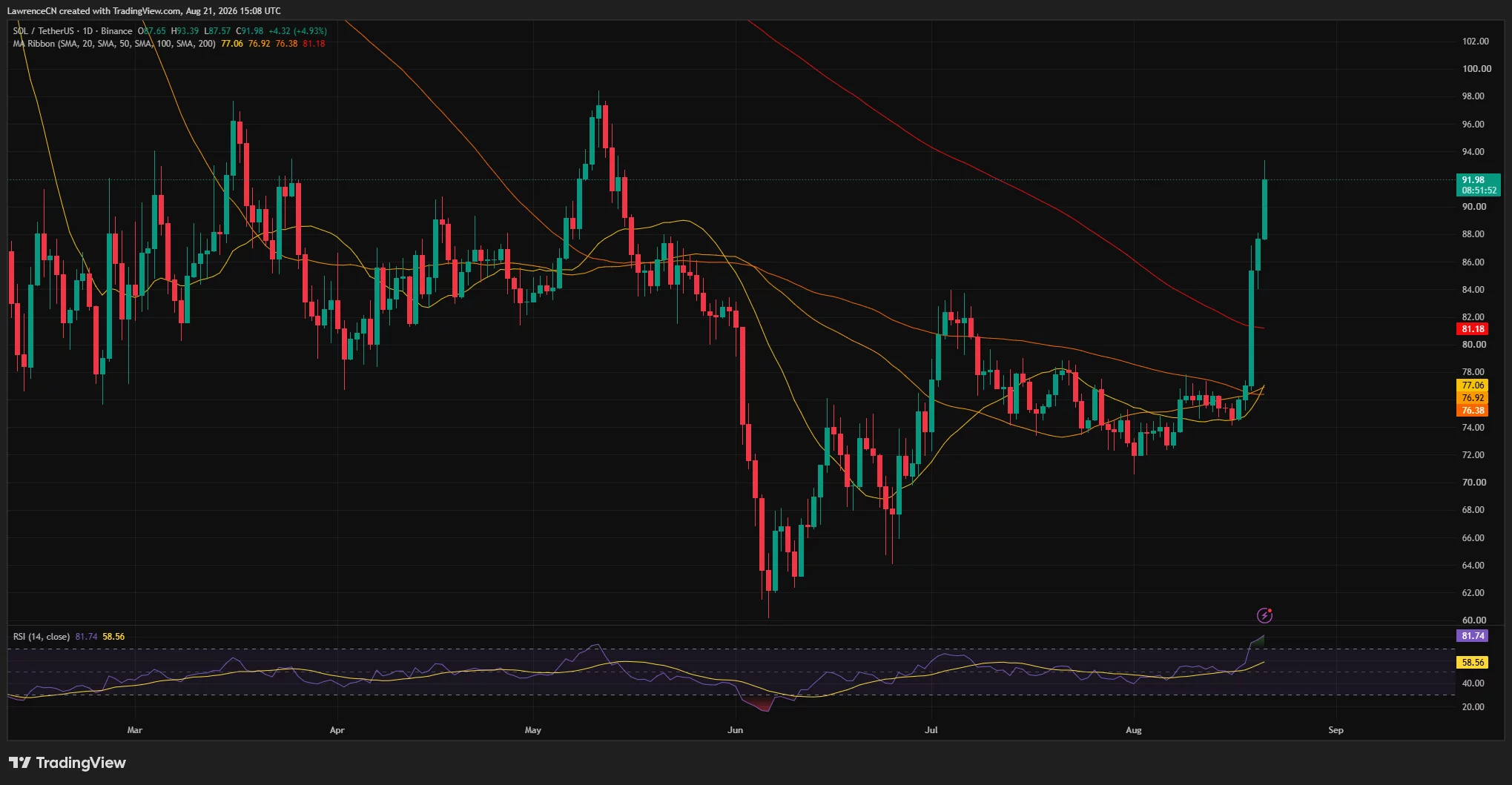
Solana price surged 25% over the past week and briefly reached $93.39 on Aug. 21 as a market-wide short squeeze pushed SOL above its major moving averages. The breakout has opened a path toward $98 and $100, although an overbought daily reading raises the risk of a short-term pullback.
Summary
- Solana price climbed 25% in one week and traded near $92 after reaching $93.39.
- SOL broke above its 20-day, 50-day, 100-day, and 200-day moving averages.
- The daily relative strength index reached 81.74, placing SOL deep in overbought territory.
- Liquidation data shows nearby liquidity around $93–$95, followed by support near $90 and $88.
Solana price breaks out of a two-month range
According to data from crypto.news, Solana (SOL) price was trading near $92 at the time of writing, up almost 5% on the day after moving between $87.57 and $93.39. The advance extended its weekly gain to approximately 25% and carried the token out of the range that had controlled its price since June.
The daily chart shows SOL breaking above the $76–$78 resistance zone, where several recovery attempts had failed during July and early August. The move also cleared the previous swing high near $82, changing the short-term market structure from a series of lower highs to a higher high.
Trading activity expanded during the breakout, supporting the move beyond the former range. SOL has now returned to price levels last seen in May, when sellers repeatedly defended the area between $94 and $98.
The rally followed a broader cryptocurrency short squeeze that erased more than $4 billion in bearish positions over 48 hours. Solana’s faster rise relative to several large-cap assets reflected its tendency to record wider moves during changes in crypto market sentiment.
Short squeeze meets institutional and network catalysts
The derivatives-driven rally received additional support from Shinhan Asset Management’s announced partnership with the Solana Foundation. The South Korean asset manager plans to test a Korean won-denominated tokenized bond fund modeled on BlackRock’s BUIDL product.
The pilot adds to Solana’s effort to attract tokenized real-world assets and institutional financial products. However, its effect on SOL demand will depend on the fund’s eventual size, launch terms, and on-chain activity, none of which were established by the price charts.
Network activity also supported the bullish narrative after Solana reportedly processed 1.2 billion non-vote transactions in one week. A recent increase in the compute limit per block gave applications more capacity, while the planned Alpenglow upgrade aims to reduce finality times and change how validator votes are handled.
Broader US market conditions helped risk assets as well. The supplied market context linked the recovery to increased US Treasury buybacks, falling long-term yields, and a weaker dollar. Washington’s renewed push for the Digital Asset Market Clarity Act and the SEC’s proposed Regulation Crypto Assets framework also contributed to improving regulatory sentiment, though both initiatives still require further action before becoming final policy.
SOL’s overbought RSI warns against chasing
The daily chart confirms the strength of the breakout but also shows that momentum has become stretched. SOL’s 14-day relative strength index reached 81.74, well above the 70 level commonly associated with overbought conditions.
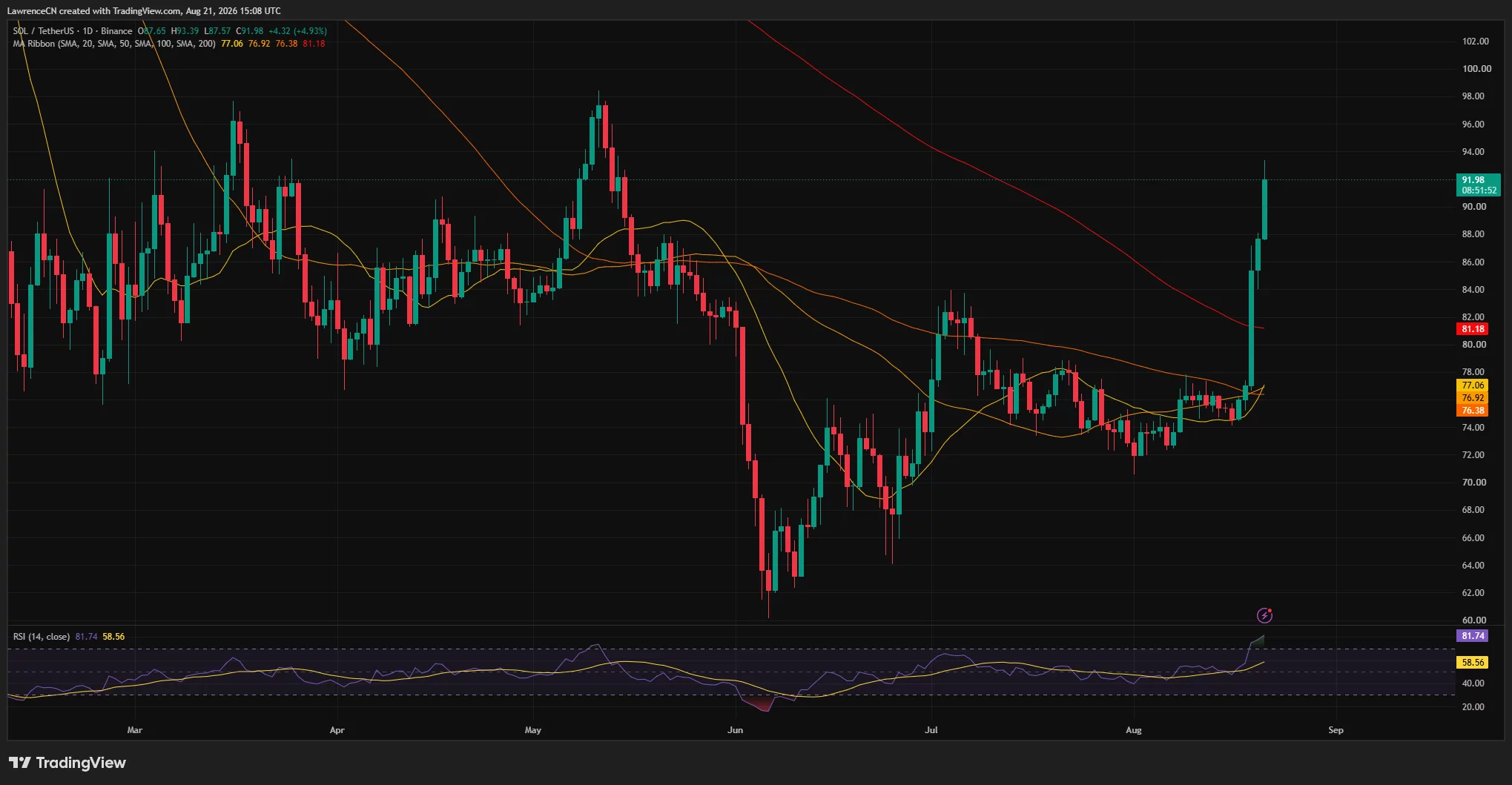
An overbought RSI does not require an immediate reversal. It does, however, show that price has risen much faster than its recent average and may need to consolidate before another sustainable advance.
SOL now trades above its 20-day simple moving average at $77.06, its 50-day average at $76.92 and its 100-day average at $76.38. The token also cleared the 200-day average near $81.18, which had acted as the most important long-term barrier on the chart.
The tight grouping of the shorter averages around $76–$77 identifies the base of the breakout. A later decline into that region would represent a full retest, although nearer support sits at $87–$90.
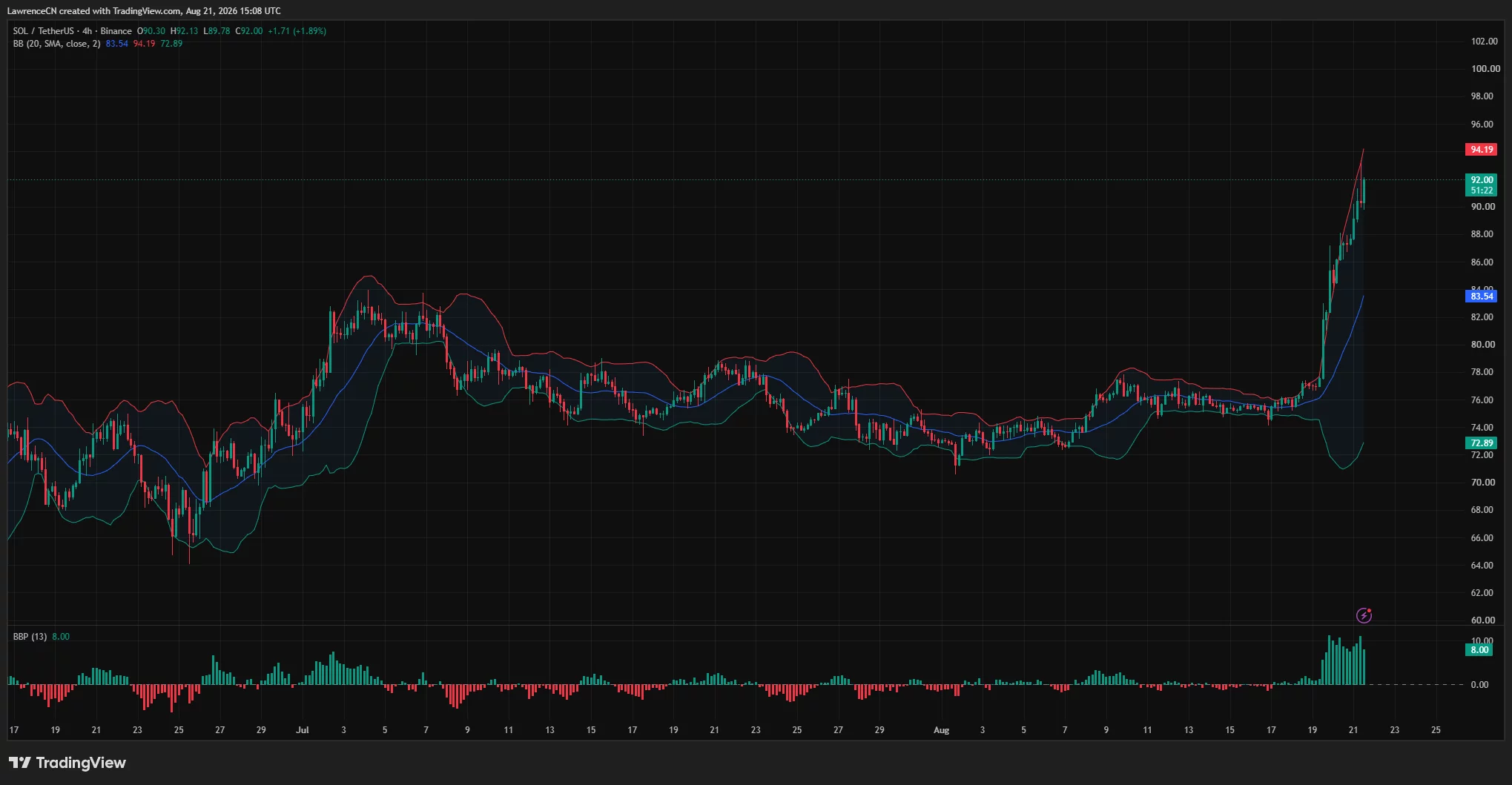
The 4-hour chart shows similarly stretched conditions. SOL traded near $92 while the upper Bollinger Band stood at $94.19. The middle band was much lower at $83.54, showing how quickly the price separated from its recent mean.
Solana liquidation map puts $95 and $98 in focus
The three-day CoinGlass liquidation heatmap shows SOL climbing through several layers of short liquidity between $80 and $92. Forced purchases from liquidated short positions likely helped accelerate the near-vertical move.
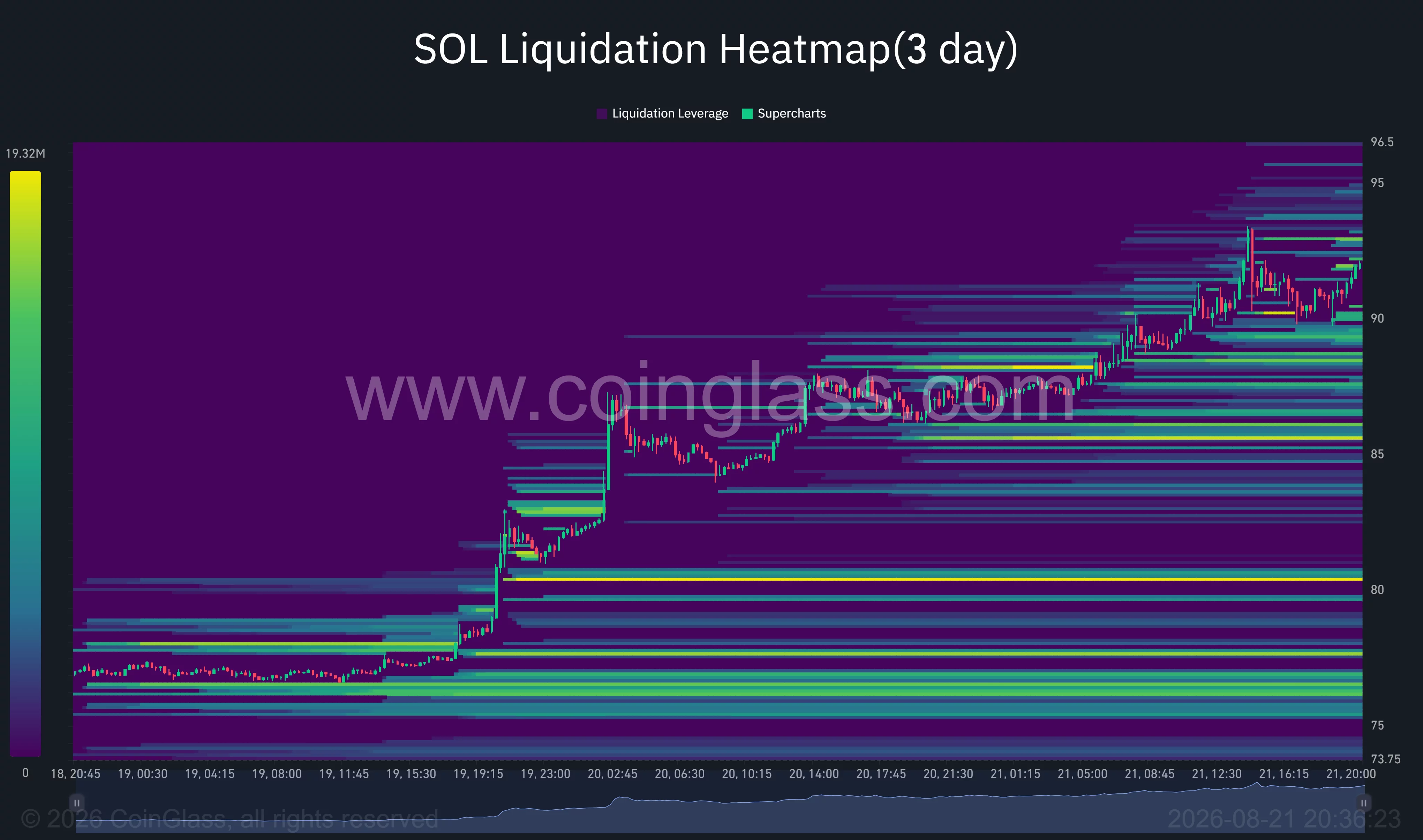
Remaining liquidity appears concentrated immediately above the market between roughly $93 and $95. A break through that area could produce another burst of forced buying, but the chart shows less dense liquidity once SOL moves beyond $95.
Crypto trader Daan Crypto Trades identified approximately $98 as the next range high and said another squeeze could develop if SOL reaches the equal highs around that level. His chart places the larger range between about $67.60 and $97.60.
Altcoin Sherpa offered a similar bullish view, naming $95 as the first target and $120 as a possible later objective if Bitcoin remains strong. Both projections are conditional forecasts rather than confirmed outcomes, and SOL must first hold its breakout.
The heatmap also shows downside liquidity near $90, $88, and $86. The $86 area contains one of the brighter nearby clusters and could attract price if buyers fail to defend $90. A larger concentration remains around $80–$81, close to the daily 200-day moving average.
A $100 breakout depends on holding $87–$90
SOL’s immediate bullish scenario requires a sustained close above the $93–$95 region. Clearing that zone would expose the May range high near $98, followed by the psychological $100 level.
A confirmed move above $100 could strengthen the case that the longer decline from SOL’s 2025 peak has ended. The next target cited by Altcoin Sherpa is $120, but the current charts do not yet confirm that extension.
The bearish scenario starts with rejection below $95 and a loss of $90. Such a move could return SOL to $87–$88, while a deeper correction would bring the 4-hour Bollinger midpoint near $83.54 and the 200-day average near $81.18 into focus.
For US investors, Treasury yields, dollar strength, and progress on federal crypto legislation remain relevant outside catalysts. SOL’s immediate direction, however, will likely depend on whether spot buying can replace the forced purchases that powered the initial squeeze.
Disclosure: This article does not represent investment advice. The content and materials featured on this page are for educational purposes only.

Hungary scraps crypto trading penalties of up to eight years in prison

Brian Hickerson, Brother Tried to Save Hayden Panettiere’s Life

Stan Kasten reassures fans that Dodgers are not for sale





-

 Fashion9 hours ago
Weekend Open Thread: Madewell – Corporette.com
-
 NewsBeat7 days ago
Myanmar says over 300,000 Rohingya refugees verified for repatriation as exodus enters ninth year
-

 Business4 days ago
SMA Solar Technology AG (SMTGY) Q2 2026 Earnings Call Transcript
-

 Politics7 days ago
SEQ Code: The Three Letter Boarding Pass Code That Could Give You The Worst Seat
-

 Tech4 days ago
Qwen3.8-27B runs frontier-class coding agents and reasoning locally, no cloud API required
-

 Crypto World4 days ago
OCC Greenlights Trump Family Crypto Firm for Trust Charter
-
 Entertainment7 days ago
Marvel Studios Reveals New X-Men Cast Including Adam Driver and Sadie Sink
-
 Tech7 days ago
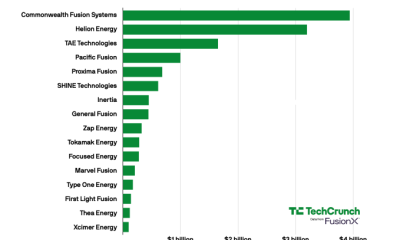
Every fusion startup that has raised over $100M
-
 Business7 days ago
Monarch Mutual Fund set to enter MF space with maiden overnight fund; files draft with Sebi
-

 News Videos2 days ago
Don’t Leave Your Financial Future To Chance | August 19, 2026
-

 Business7 days ago
Cristiano Ronaldo’s Secret Wedding Deepens As Presenter Claims Family Learned ’30 Seconds’ Before
-

 Business7 days ago
Facebook Down Now? Users Report Login And Loading Problems As Outage Trackers Monitor Ongoing Issues
-

 Crypto World5 days ago
Data of 54K Wallet Users Leaked, Clarity Odds Just 10%: Hodler’s Digest, Aug. 16
-

 Crypto World4 days ago
NAVI Prime launches institutional lending framework on Sui
-

 Politics5 days ago
Britain is facing a housing disaster
-

 Business7 days ago
New Avengers Doomsday Trailer Drops at D23 Showing Robert Downey Jr as Doctor Doom
-

 Tech7 days ago
How to watch FIH Hockey World Cup 2026: FREE live streams, schedule
-

 Business6 days ago
Rebel Creamery files Chapter 11 with $23.8M Van Leeuwen judgment on appeal
-

 Crypto World7 days ago
Trump’s World Liberty Financial delayed its Maldives resort token because of a war
-

 Fashion7 days ago
Fashion Bomb Daily On the Scene: The 2026 MVAAFF x ESPN White Party on Martha’s Vineyard
You must be logged in to post a comment Login