
Crypto World
XRP price could break $5 by the end of the month; how to earn $9,999 daily through MoneySimpler AI trading


Disclosure: This article does not represent investment advice. The content and materials featured on this page are for educational purposes only.
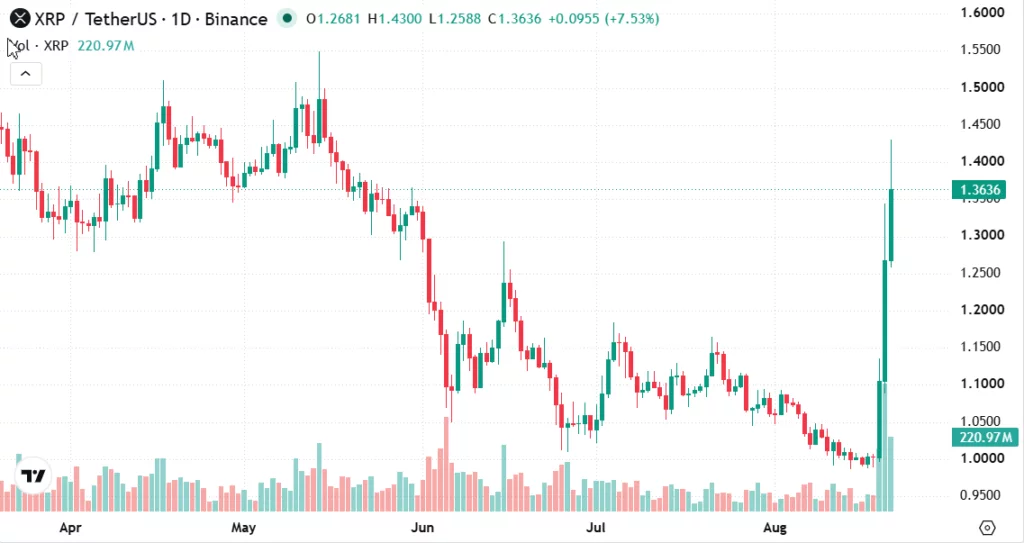
XRP rebounds to $1.40 as ETF inflows boost optimism, while MoneySimpler AI trading offers automated market analysis and trading.
Summary
- XRP rebounds near $1.40 as trading activity and ETF inflows rise, fueling hopes that token could advance toward $5 soon.
- Crypto volatility stays high, prompting investors to explore automated tools marketed as simpler ways to trade and earn.
- MoneySimpler markets AI analysis and automated trade execution as tools designed to lower barriers to quant strategies.
XRP has rebounded to around $1.40, with increased buying and trading volume. ETF inflows and signs of institutional demand are driving the market bullish. If these inflows continue and regulations improve, XRP could gain further upward momentum, increasing its chances of hitting $5 by the end of the month.
However, the high volatility of the cryptocurrency market also brings more uncertainty. Investors are seeking more efficient and intelligent ways to capitalize on market opportunities and explore the potential for passive income.
MoneySimpler AI trading uses AI market analysis and automated trade execution to help users reduce manual operations and provide up to $9,999 in passive income daily.

Why might XRP rise further?
The recent surge in XRP is closely related to the overall recovery of the crypto market. With Bitcoin breaking through $78,000, market risk appetite has improved, and the continued attention from institutional investors to the XRP ETF has further enhanced market focus on XRP’s future performance.
Furthermore, XRP’s potential applications in cross-border payments and digital asset settlement also provide support for its long-term development. If market funds continue to flow back in, and XRP can maintain its current upward momentum, $5 could become a key price target for the next phase of market attention.
MoneySimpler AI trading
Faced with the rapid changes in the cryptocurrency market, more and more investors are turning their attention to AI-automated trading. MoneySimpler AI Trading helps users participate in the digital asset market more conveniently and earn $9,999 in passive income daily through AI market analysis and automated trade execution.
How to get started with MoneySimpler AI trading?
MoneySimpler employs a simplified workflow, allowing users to quickly get started even without programming or quantitative trading experience.
Step 1: Register an account
Step 2: Choose a trading strategy
After logging in, select a suitable AI trading strategy based on your needs.
Popular Strategy Recommendations
Basis Arbitrage Strategy: Invest $100, term 2 days, daily return $4, final return $100 + $8.
Digital Asset Trend Following Strategy 2.55: Invest $500, term 7 days, daily return $6.5, final return $500 + $45.5.
Digital Asset Trend Following Strategy 2.5: Invest $1,200, term 10 days, daily return $15.84, final return $1,200 + $158.4.
Crypto Statistical Arbitrage Strategy 2.8: Invest $5,200, term 20 days, daily return $78, final return $5,000 + $1,560.
Cross-Exchange Arbitrage Strategy 3.75: Invest $10,000 , term 30 days, daily return $168, final return $10,000 + $5,040
Equity Alpha Strategy 3.0: Invest $27,000 , term 35 days, daily return $475.2, final return $27,000 + $16,632.
For more contract details, please visit MoneySimpler.
Step 3: Start AI automated trading
After selecting a strategy, start automated trading. The system will analyze market data and execute trades based on the preset strategy, eliminating the need for continuous monitoring.
Step 4: Earn daily profits
Profits are automatically settled every 24 hours. Users can view trading status, strategy performance, and account data through the platform to understand the performance of automated trading in real time.
Why choose MoneySimpler?
MoneySimpler’s core goal is to lower the technical barrier to entry for traditional quantitative trading.
Compared to traditional quantitative trading methods that require writing your own programs, connecting to APIs, and constantly adjusting parameters, MoneySimpler integrates market analysis, strategy execution, and trade management into a simpler workflow.
Its system uses a self-developed AI quantitative engine and provides real-time market analysis, automated trade execution, and multi-strategy management.
This means that even without a professional quantitative trading background, ordinary users can more easily understand and use AI-driven trading tools.
Conclusion
XRP’s recent strong rebound once again proves that significant price volatility and trading opportunities still exist in the cryptocurrency market. As discussions about XRP’s future price targets intensify, $5 is emerging as a potential target for some market participants.
Meanwhile, AI-powered automated trading is transforming traditional digital asset trading.
MoneySimpler AI Trading offers investors a simpler way to participate in the market through AI market analysis, quantitative strategies, and automated trade execution, potentially generating up to $9,999 in daily profits.
For investors looking to reduce manual operations, minimize screen time, and explore AI trading, MoneySimpler offers an automated trading option worth exploring further.
For more information, visit the official website.
Disclosure: This content is provided by a third party. Neither crypto.news nor the author of this article endorses any product mentioned on this page. Users should conduct their own research before taking any action related to the company.

Disclosure: This article does not represent investment advice. The content and materials featured on this page are for educational purposes only.
UE Crypto offers XRP investors diversified digital asset allocation through cloud mining and yield aggregation mechanisms.
Summary
- XRP traded at $1.42 on Aug. 21, rising 22.8% in 24 hours as XRP-related ETF inflows topped $1,323.71.
- Despite softer trading and cautious retail sentiment, institutional demand continues supporting steady XRP capital inflows.
- UE Crypto draws XRP investors with cloud mining and yield aggregation options, plus layered security and asset protections.
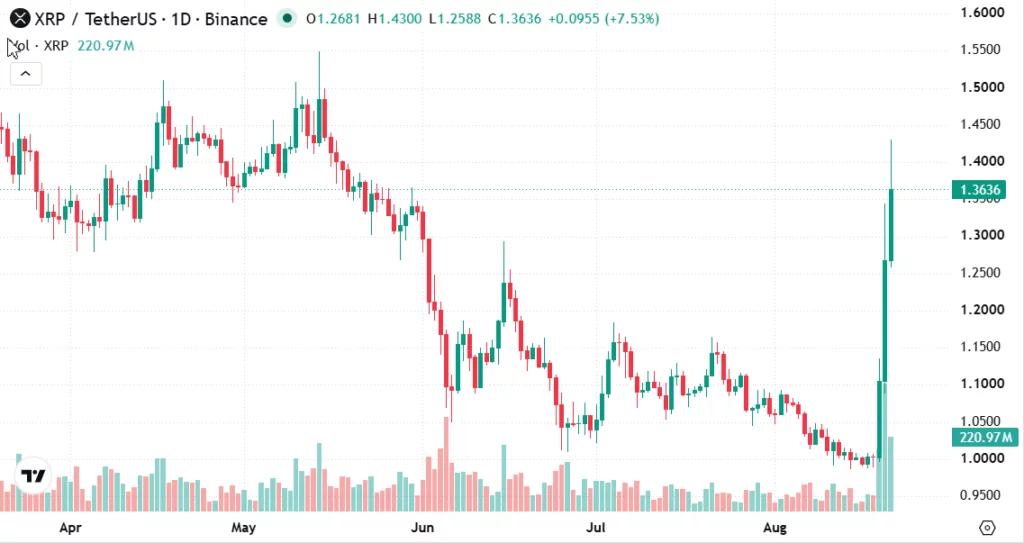
On August 21, XRP ETF prices continued their strong recovery momentum, breaking above the $1.42 mark for the first time since late August. The breakthrough was supported by institutional capital inflows and improving liquidity conditions in the United States.
Continued inflows into XRP ETFs further demonstrate the growing demand from institutional investors for XRP exposure. Although retail investors remain relatively cautious due to market volatility and price uncertainty, institutional capital continues to increase XRP allocations through regulated financial products, making XRP one of the most closely watched mainstream digital assets in the current market.
As the regulatory environment gradually becomes clearer and financing conditions continue to improve, more investors are beginning to reconsider a key question: beyond relying on price appreciation for returns, are there more diversified, efficient, and sustainable ways to participate in the long-term value growth of XRP and the broader digital asset ecosystem?
Total daily net inflows into XRP ETFs reached the $13.2371 million milestone, marking a significant development.
XRP price today
As of August 21, 2026, the current price of XRP (XRP) is $1.42. Over the past 24 hours, the price has moved 22.8%, with a 1.9% increase over the past hour. Over the longer term, the price has moved 41.2% over the past seven days and 25.1% over the past month. The XRP spot ETF market has reached an important milestone. According to data published by the analytics platform uToday, driven by continued net capital inflows, cumulative inflows into XRP-related exchange-traded funds (ETFs) have exceeded $1,323.71.
Meanwhile, overall market liquidity continues to improve. Although secondary-market trading activity has declined somewhat and retail investors remain relatively cautious amid market volatility, institutional allocation demand remains steady, driving continued net capital inflows on most trading days.
A new choice for XRP investors: UE Crypto helps explore diversified digital asset yield mechanisms
In light of this trend, an increasing number of XRP investors are turning their attention to UE Crypto, seeking to expand their digital asset allocation channels through cloud mining and yield aggregation mechanisms and explore more diversified, stable, and sustainable yield models.
Compared with highly volatile futures trading or investment approaches that rely solely on ETF price performance, UE Crypto provides a more convenient and intuitive way to participate in digital assets, allowing users to remain focused on the long-term development of the XRP ecosystem while further expanding their approaches to digital asset allocation and utilization. For users with a certain level of capital, this model also provides another option for exploring potential daily income opportunities.
About UE Crypto
UE Crypto is headquartered in the United Kingdom and operates within European regulatory frameworks such as MiCA and MiFID II, continuously improving its transparency, operational standards, and user protection mechanisms.
The platform adopts a multi-layer security architecture, including:
- Annual financial and security compliance audits by PwC;
- Digital asset custody insurance provided by Lloyd’s of London;
- Enterprise-level network protection from Cloudflare and McAfee® security systems;
- Bank-grade data encryption and professional security infrastructure to provide multiple layers of protection for user assets and accounts.
Currently, UE Crypto supports a range of mainstream digital assets, including XRP, BTC, ETH, USDT, USDC, DOGE, LTC, and SOL, providing users with a more flexible and convenient digital asset service experience.
Start earning daily returns in just three steps
1. Register an account
2. Choose a mining package
Choose a suitable cloud mining contract based on personal budget and needs, and start mining with one click.
3. Start earning
Once the contract is activated, the system will automatically allocate computing power, and returns will be settled every 24 hours. Users can withdraw their earnings at any time or continue participating as needed to achieve long-term compound growth of their assets.
Popular UE Crypto contracts
BTC (Beginner Experience Contract)Investment Amount: $100, Contract Term: 2 days
Daily Return: $4, Total Return at Contract Maturity: $100 + $8
Dogecoin (DOGE, Digital Intelligent System Contract) Investment Amount: $500,
Contract Term: 5 days, Daily Return: $6.25, Total Return at Contract Maturity: $500 + $31.25
BTC (Super Computing System Contract)Investment Amount: $1,000, Contract Term: 10 days, Daily Return: $13.10, Total Return at Contract Maturity: $1,000 + $131
LTC (Algorithm-Driven System Contract)Investment Amount: $5,000, Contract Term: 25 days, Daily Return: $72, Total Return at Contract Maturity: $5,000 + $1,800
BTC (Quantitative Intelligent System Contract)Investment Amount: $10,000, Contract Term: 35 days, Daily Return: $158, Total Return at Contract Maturity: $10,000 + $5,530
For more details about the contract plans, please visit the UE Crypto official website.
Overview
Continued inflows into XRP ETFs, together with the improving regulatory environment, further indicate that XRP is gradually becoming integrated into the mainstream financial system. At the same time, UE Crypto provides XRP investors with more diversified ways to participate in digital assets, encouraging a shift from relying solely on price fluctuations toward a diversified strategy that considers both asset price performance and potential sources of returns.
As a new market cycle gradually unfolds, investors are shifting their focus from simply tracking price movements toward more stable, long-term, and sustainable asset allocation and management strategies. This trend reflects the continued evolution of market participants’ investment approaches and also demonstrates that the digital asset market is moving toward greater maturity and diversification.
Join the UE Crypto cloud mining digital asset platform today, seize the golden opportunity, and embark on a new journey toward wealth growth.
Disclosure: This content is provided by a third party. Neither crypto.news nor the author of this article endorses any product mentioned on this page. Users should conduct their own research before taking any action related to the company.

Bitcoin and the wider crypto market rallied this week after a US Treasury move that effectively expanded long-dated bond buybacks without being labeled as quantitative easing. The shift reignited debate about whether ongoing liquidity measures—however framed—can support high-volatility assets such as Bitcoin and Ether.
Bitcoin rose more than 23% toward $79,000 and Ether pushed above $2,400, according to the market moves described in the original reporting. The same theme has been spilling into corporate strategy across crypto, from treasury reallocations to mining expansions and even new avenues for regulated derivative trading.
Key takeaways
- Standard Chartered’s Geoff Kendrick linked Bitcoin’s strength to expanded US long-end bond buybacks, flagging $65,500 as a key technical level.
- Metaplanet is extending its Bitcoin treasury play into the US by taking a controlling stake in Nasdaq-listed Super League, to be renamed Superplanet.
- Cypherpunk Technologies is launching Zcash mining after a $33.33 million equity deal, claiming roughly 18% of Zcash network hashrate.
- The CFTC is seeking public comment on futures tied to AI compute capacity, while CME Group plans a related launch on Oct. 5 pending approval.
Liquidity optics and Bitcoin’s “not-QE” bounce
According to Standard Chartered’s Geoff Kendrick, the US Treasury’s plan to at least double certain long-dated bond buybacks is “exactly the type of thing Bitcoin loves,” framing the move as a liquidity tailwind even if it stops short of QE terminology. Kendrick highlighted the potential for a technical confirmation, pointing to $65,500 as a key level for Bitcoin.
The original report states that the Treasury buyback program expands operations for 10- to 20-year and 20- to 30-year coupons, with the run scheduled from Sept. 9 through Nov. 4. In the immediate aftermath, long-dated yields fell and Bitcoin climbed more than 6% to nearly $69,000, with the price reference attributed to CoinMarketCap in the source.
Importantly, Kendrick’s bullish thesis is conditional. The analysis notes that Bitcoin must hold above $65,500 for the “cycle low” interpretation to remain intact. Investors watching this narrative will likely focus less on the label attached to government support and more on whether the liquidity impulse persists alongside credit and yield dynamics.
Metaplanet brings its Bitcoin treasury strategy to the US
Corporate moves mirrored the macro discussion. Metaplanet announced plans to take a controlling stake in Nasdaq-listed Super League Enterprise as part of expanding its Bitcoin treasury approach into US markets.
As described in the original coverage, Metaplanet will contribute 2,100 BTC and $2.5 million in cash to Super League, which is expected to be renamed Superplanet. The BTC contribution is said to come from existing treasury holdings rather than fresh purchases, and it represents under 5% of Metaplanet’s approximately 43,000 BTC holdings.
Metaplanet’s leadership described the structure as creating two capital-raising pathways: Superplanet in the US and Metaplanet in Japan. The report also notes that shares of Super League surged by more than 50% on the news. For market participants, the key takeaway is the strategic shift from simply holding Bitcoin as a balance-sheet asset toward building vehicles that may access liquidity and investor demand more directly in different jurisdictions.
The deal is expected to close in the fourth quarter, subject to shareholder approval and standard conditions, according to the source.
Cypherpunk expands into Zcash mining with large hashrate claim
While traditional Bitcoin narratives leaned on macro liquidity, another thread focused on infrastructure and token-specific catalysts. Cypherpunk Technologies announced it is expanding into Zcash (ZEC) mining after acquiring a mining fleet from Winklevoss Capital through a $33.33 million equity deal.
The original report states that Cypherpunk’s setup is already online at US facilities, producing about 4.2 GSol/s and giving the company roughly 18% of Zcash’s current network hashrate. In addition to mining exposure, Cypherpunk holds 323,394 ZEC, about 1.9% of circulating supply, and targets 5% ownership.
The company’s argument for Zcash mining economics versus Bitcoin mining or AI-related data center workloads—also reflected in the source—will matter primarily because mining profitability is sensitive to multiple variables: ZEC price, network hashrate, mining difficulty, and operating costs. The report also notes the broader context: ZEC had surged more than 1,300% over the prior 12 months before correcting.
Another part of the backdrop is Zcash’s technical roadmap. The source points to the network’s Ironwood upgrade, implemented on July 28 to replace the Orchard pool after a flaw that could have allowed counterfeit ZEC creation. It also states that no exploitation was ever detected. For readers, the practical implication is that protocol changes can influence both security assumptions and mining operations, even when the immediate impact is not immediately visible in day-to-day price action.
CFTC seeks input on AI compute futures as CME prepares launch
Regulatory attention isn’t limited to crypto-native assets. The US Commodity Futures Trading Commission (CFTC) is seeking public comment on futures contracts tied to AI computing capacity—an effort that could help shape how markets price and hedge the cost of compute-intensive infrastructure.
As reported, Bloomberg said the CFTC sent a request for comment to the White House Office of Management and Budget. Separately, CME Group announced last week it plans to launch two compute futures contracts on Oct. 5, pending regulatory approval, with Silicon Data providing the benchmarks. The source also attributes estimates to TD Lombard, Goldman Sachs, and Bridgewater Associates that place AI infrastructure spending at roughly 2% to 2.5% of US GDP this year.
The significance for market structure is straightforward: if compute becomes tradable via regulated futures, it may offer hedging tools for industries exposed to fluctuating power, hardware availability, and demand cycles. It could also introduce a new pricing reference point that indirectly affects investment decisions across AI infrastructure vendors and data center operators.
However, timelines appear complicated by review steps. The source notes that once the White House review is complete, the CFTC is expected to open a comment period, typically lasting 30 or 60 days, according to Bloomberg. That process could further influence the schedule for other compute-related products under regulatory consideration, including those described as planned by Intercontinental Exchange in the original report.
What to watch next
Crypto traders and long-term allocators may want to track whether Bitcoin’s momentum holds above the $65,500 technical level flagged by Standard Chartered—and whether additional “liquidity without QE” measures materialize. On the business side, watch how Metaplanet’s US vehicle develops post-close, and whether Zcash mining economics stabilize as hashrate and difficulty move, while regulators continue to define how compute capacity futures should be structured.


ZK proving has begun competing with trillion-dollar AI data centers for the same GPUs, raising proof costs even as Cysic reports a 9% performance gain from improving hardware use.
Summary
- Cysic says inefficient GPU use, rather than inadequate raw computing power, now drives proving costs.
- ZK workloads compete with AI for Nvidia GPUs despite relying on different mathematical operations.
- Real-time Ethereum proving and ZK-rollups could face higher costs before consumer applications do.
- Cysic expects the squeeze to speed up adoption of FPGAs, ZK-specific ASICs and open prover markets.
Cysic founder and CEO Leo Fan told crypto.news that GPU use has become a binding constraint for zero-knowledge proving because proof systems now compete with heavily funded AI data centers for the same silicon.
“AI models are converging. Compute isn’t. Everyone assumed proving costs would fall because chips get cheaper. Instead, we’re bidding against trillion-dollar data centre budgets for the same silicon. That’s why the hardware layer had to be opened up rather than left to a handful of proprietary provers.”
The pressure does not come from a lack of computing capacity alone, according to Fan. He said the main problem is an architectural mismatch between zkVM software and the accelerators used to generate proofs, which leaves part of the available GPU capacity unused and raises the cost of each proof.
Cysic’s Venus proving engine exposed that mismatch by reducing the time spent coordinating work between CPUs and GPUs. As reported in April, the company recorded an end-to-end proof-time improvement of more than 9% against ZisK 0.16.1 without replacing the underlying hardware.
ZK proving costs now matter more than raw speed
Built as a hardware-focused extension of Polygon Hermez’s ZisK zkVM, Venus represents proof generation as one connected computation graph. Cysic says the design lets the system schedule work across the full proving process instead of handling each hardware function as a separate call.
Through CUDA Graph integration, kernel tuning, and shared-memory changes, Venus reduces repeated data transfers and synchronization between the processor and GPU. Fan said the result shows that existing accelerators were not being fully used, making utilization the practical bottleneck behind proof costs.
Raw proving speed has improved quickly across the industry. Cysic has said ZisK can generate an Ethereum block proof in 7.4 seconds with 24 GPUs and can submit real-time proofs through a single RTX 4090 setup. The claims come from the company and have not been independently tested under a common benchmark covering energy use, proof size, security level, and total hardware cost.
Other developers have also crossed Ethereum’s real-time threshold. In November 2025, Succinct reported that SP1 Hypercube proved 99.7% of a 954-block Ethereum sample in less than 12 seconds using 16 Nvidia RTX 5090 GPUs. About 95.4% of the sample was proven within 10 seconds.
The Ethereum Foundation defines real-time proving as completing proofs for at least 99% of mainnet blocks within 10 seconds. Its framework also calls for fully open-source code, proof sizes below 300 KiB, at least 128-bit security, hardware costing no more than $100,000, and power use capped at 10 kilowatts.
Energy use may be a more serious limit than equipment cost for home provers, the Foundation said. A proof can arrive before Ethereum’s deadline while still requiring too much power, cooling or capital for an independent operator.
AI demand is tightening access to the same GPUs
Although AI and ZK proving use GPUs differently, both workloads depend on Nvidia accelerators ranging from consumer RTX cards to data-center H100 systems.
AI training and inference mainly use matrix calculations. ZK proof generation relies heavily on multi-scalar multiplications and number-theoretic transforms, operations that GPUs can process but were not specifically designed to run.
Fan said the mismatch supports the case for ZK-specific hardware because proof systems are entering the same supply queue as AI developers without using the chips in the same way. Since GPU-hours account for much of the proving bill, higher hardware and rental costs pass into the cost of each proof, he added.
Nvidia’s financial results show the scale of demand coming from AI infrastructure. The U.S.-listed chipmaker reported $75.2 billion in data-center revenue for the quarter ending April 26, up 92% from a year earlier. Data-center compute revenue reached $60.4 billion, an annual increase of 77%.
Amazon Web Services has separately agreed to buy one million Nvidia GPUs, with deliveries scheduled to continue through 2027, Reuters reported in March. Nvidia CEO Jensen Huang has estimated a $1 trillion sales opportunity for the Blackwell and Rubin product families through that year.
In June, Nvidia’s planned bond sale sought at least $20 billion to fund AI investments and refinance debt. Bitcoin mining companies had announced more than $70 billion in AI and high-performance computing contracts at the time, illustrating how crypto-linked infrastructure owners are also redirecting power and facilities toward AI workloads.
A Bernstein report covered in May placed announced AI infrastructure partnerships at nearly $90 billion. The analysts estimated that Bitcoin miners controlled more than 27 gigawatts of planned power capacity, compared with about 3.7 gigawatts tied to announced AI agreements, while some U.S. grid connections could take up to 50 months.
ZK-rollups and real-time provers face the pressure first
Real-time layer-1 proving sits at the front of the cost squeeze because it requires GPUs to produce a fresh proof for every block, Fan said. Any delay can cause a prover to miss the network’s time limit, so operators need spare capacity as well as enough hardware for normal demand.
ZK-rollups and proof marketplaces follow because GPU-hours feed directly into operating expenses and, in some cases, user fees. An earlier proving cost analysis estimated that proof generation accounted for 60% to 70% of fees on ZK layer-2 networks, citing L2Beat data.
According to the same analysis, generating a proof for a batch of 4,000 transactions could take two to five minutes on an Nvidia A100 and cost between $0.04 and $0.17 in cloud computing charges. The figures depend on the proof system, transaction batch, hardware configuration, and cloud rate.
Fan placed zkML among the most exposed applications because it combines an AI workload with the added expense of proving that the model ran correctly. For private payments, on-chain games, and other consumer products, he said the economics often require proof costs measured in pennies.
“Can cost limit adoption? Yes at the margin,” Fan said, adding that private payments and gaming would likely be deferred first when their economics no longer work.
Cost pressure could also affect how many entities can operate provers. Fan said more than 90% of ZK layer-2 networks rely on a small group of prover services, although the estimate requires a named dataset and should be treated as Cysic’s assessment.
FPGAs and ZK ASICs offer an alternative hardware path
Cysic has responded by developing multiple backends rather than relying only on GPUs. The public Venus repository includes GPU optimizations, a complete FPGA acceleration backend, and an early ASIC-oriented implementation.
Its FPGA backend contains kernels for Goldilocks field arithmetic, NTTs, Poseidon2, Merkle trees, FRI and expression evaluation. The code targets AMD UltraScale+ and Versal devices with high-bandwidth memory and is available under Apache 2.0 and MIT licences.
Unlike an ASIC, an FPGA can be reprogrammed after production, allowing developers to update circuits and experiment with new proving systems. Custom ASICs offer less flexibility but can deliver better performance and energy efficiency when designed for a stable set of ZK operations.
Fan said moving to FPGAs and ZK ASICs would remove proof operators from the main AI hardware queue. Specialized devices would also avoid paying for GPU functions that ZK workloads do not need, although development costs and limited manufacturing volumes remain obstacles.
Opening the software is one part of Cysic’s approach. The company also proposes a global prover marketplace in which devices ranging from mobile hardware to professional clusters can accept jobs, with GPU and FPGA backends reducing dependence on one chip class.
Cryptographic verification means a verifier rejects an invalid proof regardless of which operator generated it, Fan said. Opening participation, therefore, does not change the proof system’s soundness, but it increases exposure to implementation errors in unaudited or unfinished code.
Cysic states in the Venus repository that the project remains under active development. Fan said audits and redundant multi-prover configurations would be needed to limit implementation risk.
Draft EIP-8025 would let Ethereum validators opt into generating or verifying execution proofs while conventional block re-execution remains in place. The proposal introduces a proof gossip channel and external proof nodes, but its current version does not provide incentives for operators that generate and broadcast the proofs.


Bitcoin has climbed about 23% over the past week to $77,535 as Bitfinex analysts say spot buying, ETF inflows and limited leverage could give the rally more staying power than a typical short squeeze.
Summary
- Bitcoin rose 10%–11% during the breakout while open interest increased only about 4%.
- Bitfinex identified $68,000–$69,000 as the main support zone for the recovery.
- U.S. spot Bitcoin ETFs attracted more than $1.1 billion across Aug. 19 and Aug. 20.
- Rising Treasury yields and profitable coins moving to exchanges could threaten the advance.
Why Bitfinex sees more runway for Bitcoin
Bitfinex analysts told crypto.news that forced liquidations helped Bitcoin break out of its previous range, but spot purchases and returning institutional demand have continued supporting the price after much of the short pressure cleared.
Bitcoin (BTC) traded at about $77,535 at the latest check after reaching an intraday high near $79,200. The cryptocurrency was up almost 7% over 24 hours and about 23% over seven days, extending a rally that began below $65,000 on Aug. 19.
Although squeeze-led advances often weaken once traders finish closing bearish positions, Bitfinex said the combination of ETF demand, improving macro conditions and limited selling could give the latest move a “longer runway,” with smaller retracements still possible.
Derivatives activity provides part of the evidence behind that assessment. Bitcoin gained between 10% and 11% during the initial breakout, while aggregate open interest rose by only about 4%, according to figures cited by the analysts.
“The shape of the move is the tell,” the Bitfinex team said. “Rallies built on fresh leverage show open interest jumping in step with price.”
Because open interest increased at a much slower pace than Bitcoin’s price, the analysts said spot buying and short covering performed most of the work. New leveraged positions played a smaller role, reducing the immediate risk of another large liquidation event caused by an overcrowded long market.
A weaker version of the setup would show open interest building quickly while Bitcoin stops rising. Bitfinex said the latest data had not displayed that pattern, although derivatives positioning will remain important if traders add leverage after the price increase.
Spot demand has outpaced fresh leverage
Bitcoin’s move began with a large short squeeze after the price cleared resistance around $65,000 and then crossed liquidation clusters near $67,000. Traders who had borrowed funds to bet on a decline were forced to buy Bitcoin as exchanges closed positions that no longer held enough collateral.
More than $1 billion in crypto short positions were liquidated within about one hour. Total short liquidations later approached $1.79 billion, while a longer market-wide count placed bearish liquidations near $2.7 billion over 24 hours.
The forced purchases helped Bitcoin jump from below $65,000 to approximately $69,500 on Aug. 19. As earlier liquidation data showed, the move carried BTC through several liquidity bands between $65,000 and $67,500 before it tested the upper cluster around $69,000.
Short covering explains the speed of the advance but does not fully account for Bitcoin holding above $70,000 after many bearish positions had closed. Bitfinex pointed to spot purchases and ETF inflows as evidence that other buyers entered during the breakout.
The distinction matters because liquidation demand is temporary. Each forced purchase closes an existing position, while continued spot accumulation can remove coins from the available market without creating the same exposure to futures liquidations.
Open interest will therefore remain one of the main indicators for judging the rally. A sharp increase in leveraged positions without matching price gains would weaken Bitfinex’s current reading, while steady prices accompanied by restrained open interest would remain consistent with a spot-led move.
The $68K–$69K zone could determine whether Bitcoin holds
Bitfinex identified the $68,000 to $69,000 area as the most important support zone because Bitcoin’s short-term holder cost basis currently sits within that range.
The metric represents the average acquisition price of coins held by investors who entered the market during the previous several months. Bitcoin trading above the level means that recent buyers are collectively holding unrealized profits, according to the analysts.
A sustained price above the range could limit pressure from holders seeking to exit at break-even. Falling below it would place part of the recent buyer group back into loss and could increase selling if confidence weakens.
The same area contains Bitcoin’s 200-day moving averages. BTC crossed its 200-day simple and exponential moving averages near $69,000 during the rally, reclaiming the long-term indicators for the first time in about nine months.
Barchart noted that Bitcoin had remained below its 200-day average since November 2025, about one month after it reached a record above $126,000. A sustained hold above the indicator would support the view that the decline from the October peak is losing strength, though the technical signal cannot guarantee further gains.
For a clearer measure of U.S. participation, Bitfinex said traders should monitor the Coinbase Premium. The indicator compares Bitcoin’s price on Coinbase with prices on other major exchanges, with a positive reading suggesting relatively strong demand through the U.S.-focused platform.
According to the analysts, a Coinbase Premium that catches up with the rally would provide a cleaner signal that American buyers are returning. Weakness in the indicator would suggest that demand remains concentrated outside the United States or in offshore derivatives markets.
ETF inflows and Treasury yields remain key tests
U.S. spot Bitcoin ETFs received approximately $517 million in net inflows on Aug. 19, their strongest daily result since May, according to SoSoValue data cited by market analysts. The funds added about $606 million on Aug. 20, bringing their two-session intake above $1.1 billion.
Across Monday through Thursday, the products attracted approximately $1.6 billion, putting them on course for their strongest week of 2026. Bitfinex said a complete week of inflows at a similar pace would strengthen support and provide firmer evidence of a lasting change in demand.
American investors access Bitcoin through the funds on regulated securities exchanges, making ETF flows a direct measure of demand from U.S. brokerage and institutional accounts. Continued inflows would also separate the rally from an advance driven mainly by traders closing short positions.
As reported earlier Friday, Standard Chartered global head of digital asset research Geoff Kendrick said recovering ETF flows and low open interest could allow more investors to return as Bitcoin rises.
“For the first time this year there is now a risk my end year forecast (of USD100k) is too low,” Kendrick wrote in a client note.
Kendrick said Bitcoin could move toward its $126,000 record before year-end, potentially gaining speed after Oct. 6. Standard Chartered has not formally replaced its $100,000 forecast with a $126,000 target; Kendrick described the record as a possible overshoot if the recovery continues.
Macro conditions have also supported the rally. On Aug. 19, the U.S. Treasury Department announced that it would at least double the maximum size of liquidity-support buybacks for government securities in the 10-to-20-year and 20-to-30-year maturity sectors.
The maximum will increase from $2 billion to at least $4 billion per operation beginning Sept. 9 and remain in place through Nov. 4. Long-term Treasury yields initially declined after the announcement, improving conditions for risk assets as Bitcoin moved through $70,000.
Bitfinex identified renewed increases in Treasury yields and the exhaustion of short covering as possible obstacles. The analysts also warned that a large volume of profitable Bitcoin has moved onto exchanges during the rally, creating the risk of the year’s largest profit-taking wave if holders begin selling those coins.
Disclosure: This article does not represent investment advice. The content and materials featured on this page are for educational purposes only.
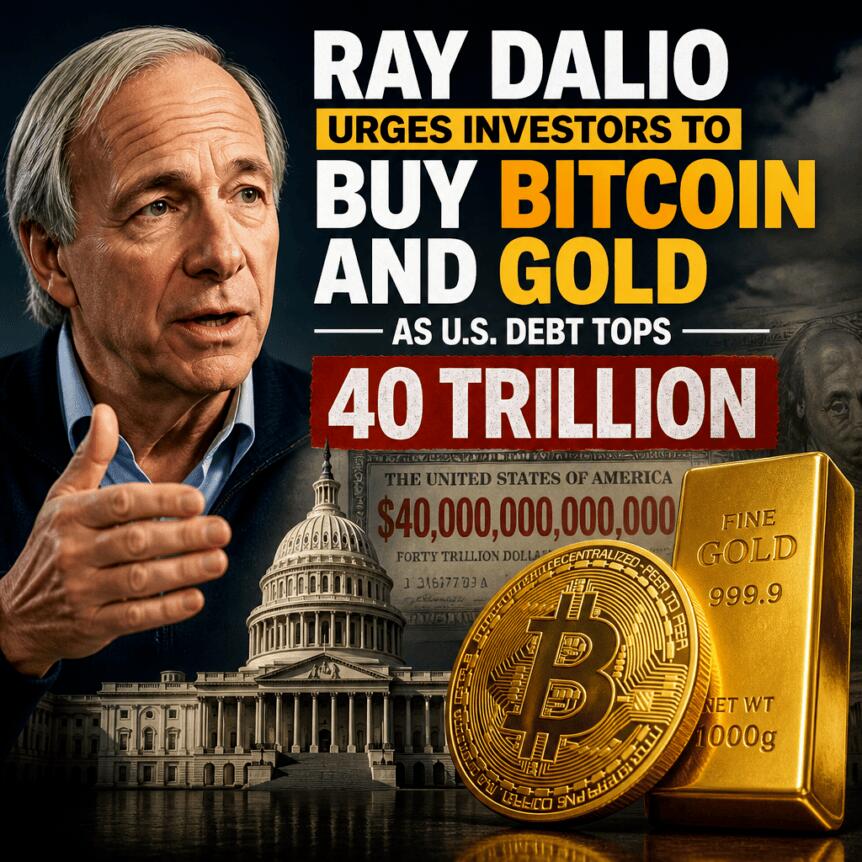
Billionaire investor Ray Dalio has renewed his call to buy Bitcoin and gold. He made the remarks as U.S. national debt crossed $40 trillion this week. Bitcoin, meanwhile, climbed toward $80,000 for the first time since May.
Dalio Pushes Diversification Beyond Bonds
Dalio shared his advice in a post on social media platform X. He told investors to diversify across asset classes and countries with strong balance sheets. He also urged them to avoid nations facing serious political or geopolitical conflict.
The investor advised underweighting debt-based assets such as bonds. He recommended overweighting gold and holding a smaller allocation to Bitcoin instead. According to Dalio, this mix helps balance risk during periods of rising government debt.
He added that holding between 10% and 15% of a portfolio in gold lowers overall risk. This guidance builds on views Dalio has expressed for years. His latest comments arrive as debt concerns intensify across financial markets.
Bitcoin Rallies as Debt Concerns Mount
Bitcoin’s price movement this week reflects growing unease over U.S. fiscal health. The cryptocurrency rose from roughly $63,000 to nearly $80,000 within days. That surge followed news that the U.S. Treasury plans to expand its debt buyback program.
The Treasury’s move came after the 30-year bond yield hit its highest level since 2007. Bitcoin broke above $70,000 on the same day national debt passed $40 trillion. Analysts have linked the rally to investors seeking alternatives to traditional debt instruments.
Inflation pressures have complicated the picture further. The ongoing U.S.-Iran conflict has pushed energy prices higher, adding to inflationary strain. That dynamic has, at times, weighed on Bitcoin’s price despite the broader rally.
Debt Crisis Reaches a Critical Turning Point
Dalio described the government’s financial position as nearing a turning point. He warned that debt could soon reach levels the government cannot manage without significant disruption. He stressed that leaders should act now, while the economy remains relatively strong.
Waiting until conditions weaken would make the problem harder to solve, Dalio explained. He noted that government borrowing needs typically rise sharply during economic contractions. That pattern, he said, can turn a manageable debt load into an unmanageable one.
Dalio also pointed to external factors that can accelerate or delay a crisis. Major political shifts and wars fall into that category, he noted. Both forces, he added, can reshape the timeline for how debt problems unfold.
Federal Reserve Chair Kevin Warsh has pledged to keep prices stable despite these pressures. The Federal Open Market Committee, however, faces mounting pressure to raise interest rates. Rising inflation from energy costs has strengthened the case for tighter policy.
Prediction market data now shows growing expectations of a rate hike this year. Figures from Polymarket put the odds above 50%, with a 55% chance cited. That shift follows the Treasury’s effort to calm volatility in the bond market.
The debt buyback plan and Bitcoin’s rally have unfolded alongside each other this week. Gold has long served as a traditional hedge during periods of fiscal stress. Dalio’s comments frame Bitcoin as a newer addition to that same defensive strategy.
His remarks add to a broader conversation about how investors should respond to record debt levels. The $40 trillion milestone marks a significant point in that ongoing debate. Markets are likely to keep reacting as fiscal and monetary pressures continue to build.

U.S. courts and regulators continued to press crypto market participants on enforcement and insider-trading theories this week, with developments spanning the fallout from FTX, prediction-market litigation, and a newly unsealed indictment tied to an alleged $165 million Ponzi scheme. In parallel, prosecutors asked the court to keep alive a case against a Polymarket user accused of trading on nonpublic information.
Key takeaways
- The CFTC issued consent orders imposing five-year trading bans on former Alameda Research CEO Caroline Ellison and FTX co-founder Zixiao “Gary” Wang.
- Alongside the trading bans, Ellison received a 10-year registration ban and Wang an eight-year registration ban, tied to their roles in the FTX collapse.
- In SDNY, U.S. prosecutors opposed a motion to dismiss filed by a soldier accused of making more than $400,000 on Polymarket using alleged nonpublic information.
- A Georgia judge ordered an indictment unsealed against Edward Zimbardi, who prosecutors allege ran a “Crypto Program” that used false promises to solicit investments.
CFTC consent orders extend market restrictions after FTX
On Tuesday, the U.S. District Court for the Southern District of New York (SDNY) entered consent orders connected to a 2022 enforcement action involving former Alameda Research CEO Caroline Ellison and FTX co-founder Zixiao “Gary” Wang, according to a report by Cointelegraph.
The Commodity Futures Trading Commission (CFTC) required both individuals to accept five-year trading bans related to their involvement in the exchange’s collapse. The regulator also imposed longer-term restrictions on business activity: Ellison was ordered to serve a 10-year registration ban, while Wang received an eight-year registration ban.
In remarks tied to the orders, CFTC enforcement director David Miller said the bans reflected “material assistance in the Commission’s FTX-related investigations.” The CFTC’s civil action is described as separate from criminal proceedings that addressed misuse of customer funds. In those criminal cases, Ellison was sentenced to two years in prison, while Wang received time served.
For traders and compliance teams, these orders underscore how the CFTC can translate cooperation and investigatory conduct into concrete market-access limits—even after criminal outcomes are already underway. The practical effect is clear: individuals can face restrictions on trading and registration that persist well beyond any jail sentence timeline.
Prosecutors fight to keep Polymarket insider-trading case alive
Meanwhile, in SDNY, U.S. government lawyers filed an opposition to a motion to dismiss from Gannon Ken Van Dyke, a U.S. soldier accused of using nonpublic information to generate more than $400,000 through event contracts on Polymarket. Van Dyke was reportedly connected to the military operation involving the removal of Venezuelan President Nicolás Maduro in January.
The defense motion, filed July 31, argued that the Commodity Exchange Act—central to three of the charges—was “ambiguous” about whether event contracts should be treated as “swaps” under the CFTC’s jurisdiction. In its Wednesday filing, the government said Van Dyke’s briefing relied on hypotheticals and “edge cases” involving state gaming laws that were not necessary to resolve the dismissal request.
“Van Dyke’s motion asks the Court to make a factual determination not appropriate at the motion-to-dismiss stage,” said SDNY Deputy U.S. Attorney Sean Buckley. “His argument relies on speculative assertions about facts, based on improper inferences from the Indictment and incorrect conclusions about the nature of the charge, to claim that facts do not amount to ‘property.’”
As of Friday, the court had not made a decision publicly available on the motion to dismiss.
This dispute matters because it tests a recurring fault line in U.S. crypto regulation: whether certain digital market instruments are properly captured by existing commodities frameworks. Even when courts consider jurisdiction and statutory interpretation at an early stage, the arguments can shape how quickly the case proceeds and what facts the government must prove later.
Georgia judge unseals indictment tied to alleged $165 million “Crypto Program”
In Georgia, a judge ordered an indictment unsealed involving Edward Zimbardi, whom prosecutors allege masterminded a cryptocurrency Ponzi scheme worth about $165 million. The case, as described in coverage by Cointelegraph, was initially filed after Zimbardi was indicted on July 8, and prosecutors say he fled to Fiji before being deported back to the U.S.
According to prosecutors, Zimbardi will face wire fraud and money laundering charges in the Northern District of Georgia. Prosecutors allege he “tricked thousands of people” into investing in a venture called the “Crypto Program” through false promises of enormous returns.
The unsealed charging document sets out a total of 25 counts. Prosecutors say the indictment includes 12 counts of wire fraud, one count of money laundering conspiracy, and 11 counts of transactional money laundering tied to alleged activity during the Crypto Program between 2022 and 2023.
Prosecutors also are seeking forfeiture of proceeds from the alleged wire fraud and money laundering, as well as additional crypto reportedly seized on the way toward conviction. The indictment references assets seized by Dutch authorities in 2024, including 11.87 Bitcoin (BTC), 2.15 Ether (ETH), 713,344,695 Shiba Inu (SHIB), 47,110 USDt (USDT), 12,095 USDT0, 3.3 million XRP, 1,095 Dogecoin (DOGE), 10.2 million Osaka Protocol (OSAK), and 11.97 Polygon (POL), which the indictment describes as worth about $6 million combined.
The unsealing of charges is often a key procedural turning point—moving the allegations from investigation into a posture where the court process can formally start testing the claims. For investors who were approached through similar “high-return” crypto schemes, the case also highlights how prosecutors track both on-chain or asset-related activity and traditional fraud theories through wire communications and financial transfer patterns.
Looking ahead, readers should watch whether SDNY resolves the Polymarket motion-to-dismiss and how it frames “event contracts” under the Commodity Exchange Act, while also monitoring the pace of the Zimbardi prosecution in Georgia as courts begin to address the merits of the unsealed wire fraud and money laundering allegations.

Digital Asset, the firm behind the Canton Network, and the American Idea Foundation—an organization associated with former U.S. House Speaker Paul Ryan—say they are preparing a blockchain-based pilot to modernize how public benefits are distributed in the United States.
The program, dubbed RISE, is designed to consolidate multiple state-administered benefits into scheduled payments, with rules that can adjust to changes in household income. The partners said the pilot is expected to begin in the first quarter of 2027, pending federal approvals.
Key takeaways
- Digital Asset and the American Idea Foundation plan a benefits-distribution pilot using the Canton Network across three U.S. states.
- RISE is expected to bundle benefits into monthly or twice-monthly payments and apply spending categories such as food, child care, and cash.
- The system would automatically recalibrate benefit levels when household income changes.
- Participating agencies would reportedly be able to monitor payments, balances, spending, and compliance data through Canton, while limiting access to sensitive information.
- Participating states and specific benefit programs have not yet been named, and the pilot remains subject to federal approval.
A blockchain-based approach to a fragmented benefits system
In their announcement, the partners described RISE as a way to reduce the friction that can come from administering multiple benefit streams that may have different rules and eligibility thresholds. The program is positioned as a “safety net” modernization effort by using Canton to coordinate permissions, payment logic, and transaction execution.
Digital Asset said Canton would be responsible for managing the rules and permissions involved in distributing benefits, while also constraining who can access sensitive data. The partners further stated that the system would support tracking at the agency level, including payment history, balances, spending behavior, and compliance information.
According to the announcement, the pilot would generate benefit payments on a monthly or twice-monthly schedule and apply spending restrictions to categories including food, child care, and cash. A central feature is automation: benefit levels would reportedly adjust as household income changes, aiming to reflect real-time circumstances rather than relying on static eligibility assumptions.
“By combining fragmented benefits, reducing penalties as families earn more, and rigorously measuring results, these pilots can help show what a modern safety net should look like.”
Why the partners say penalties could be reduced
The program’s rationale, as outlined by Paul Ryan, focuses on a common pressure point in benefits administration: when household earnings rise, recipients can face penalties or reductions that may not align with how quickly income changes. Ryan’s remarks explicitly connect the pilot to reducing penalties as families earn more.
From an investor and builder standpoint, the significance of the approach is less about one-off payments and more about how a rules engine can be coupled to compliance and reporting. If RISE works as intended, it could serve as a template for how public agencies handle complex eligibility and spending constraints—especially where multiple benefit categories must be administered without creating operational overload or exposing sensitive information.
However, the partners did not specify which states would participate or which programs would be included in the pilot. They also emphasized that the project requires federal approval, meaning timelines and scope could shift depending on regulatory review.
Canton’s government-linked momentum
This announcement adds another public-sector use case to Canton, whose growth in recent periods has been driven largely by institutional finance deployments. Earlier projects show a pattern of Canton being tested for settlement and collateral use, rather than for consumer-facing redistribution of funds.
In April, Japan Securities Clearing Corporation (JSCC), Mizuho, Nomura, and Digital Asset launched a proof of concept using Canton to test Japanese government bonds as digital collateral, including for real-time cross-border transactions. That work was reportedly selected for support under Japan’s Financial Services Agency Payment Innovation Project.
More recently, in July, Canton was used to settle a tokenized U.S. Treasury trade between Franklin Templeton and Virtu Financial. Tradeweb handled execution and price discovery, and the firms said the transaction moved against USDCx in real time—described as an industry first by Tradeweb.
With RISE, Canton’s role would extend from capital markets applications into the mechanics of public benefits. The pilot, if it gains regulatory traction, would test whether the network can handle compliance-heavy workflows while coordinating payment logic and access controls across multiple agencies.
What to watch before the first quarter of 2027
While RISE’s stated objectives are clear, key operational details remain unconfirmed. The partners have not named the three participating states or identified which benefits would be bundled. The pilot also depends on federal approval, which may determine the final structure of the payment schedules, spending categories, and reporting requirements.
Prospective observers should also watch how the system measures performance—particularly whether automated adjustments to benefit levels meaningfully reduce penalties as income changes, and how agencies validate compliance and audit trails through Canton. If the project advances beyond planning, it could become a reference point for how blockchain-based infrastructure fits into regulated, data-sensitive government programs.
Crypto World
Which Anti-Aging Ideas Actually Work? XPrize Healthspan Is Testing The Best Longevity Innovations


Jamie Justice admits she has no poker face. As executive director of XPrize Healthspan, a philanthropic and corporate sponsored competition, Justice oversees one of the most buzz-worthy science competitions today. The contest, launched in 2023, attracted nearly 200 applicants from groups around the world who think they can help people to live not just longer lives, but healthier ones.
When the 15-member judging panel met in early summer to pick the top 10 teams who would continue on in the seven-year competition, Justice excused herself. “I couldn’t be in the room because my face shows everything,” she says, since she became familiar with each of the teams and their various approaches to extending human life.
Read more: TIME’s 2026 Longevity Leaders
Both in the scientific community and the commercial market, there is no shortage of ideas—from legitimate, rigorously developed approaches to more fantastical schemes—for a fountain of youth. XPrize Healthspan exists to bring some order to that chaos, and legitimacy to the process of developing and, most importantly, testing ideas in longevity. Applicants for the prize, which has a total purse of $101 million, allocated in segments throughout the seven-year competition, included teams from academic research institutes as well as biotech and startup groups. All had to follow a few basic rules; they had to show early promise in human studies that their approach could improve health in three critical areas: muscle function, brain function, and immune function. All teams were judged based on standard measurements of these three functions that XPrize committees of experts had specified, to ensure that all projects were evaluated using the same metrics. The judges announced the top 10 projects on Aug. 11.
“This is where I get the most excited, when things get really sort of dirty and ugly,” says Justice, who spent time researching geroscience at Wake Forest University before coming to XPrize. “You’ve got biohackers selling you this, and you have a bro guy over here that wants you to take so much protein that you’re going to die. What we need to do is have a strainer, a filter where everybody is held to the same standard. There may be something really worthwhile and useful out of some of these things that seem harebrained. What XPrize does well is invite everyone in, teach them how to do the science to get to a level of super credibility. It’s an alliance that comes together to set the frameworks for the start line, a finish line, and how to get there.”
The projects are as varied as you might expect approaches to longevity to be—ranging from the latest anti-aging trends in Asia involving extracellular vesicles, to stem cells and more traditional, well-established programs that include exercise and supplements. Two of the teams are from Japan, one from South Korea, one from China and six from the U.S. Two of the groups are studying repurposed drugs for their potential in extending life, while the Korean team is investigating a novel longevity drug. Four projects involve supplements and five rely on biologic compounds including extracellular vesicles, peptides, and antibodies.
Both teams from Japan are working with the vesicles, which carry a wide menu of molecules in the body, from enzymes to peptides, fats and genetic material. But the teams are taking very different approaches to optimizing what these vesicles can do to improve health.
Time Traveler Corp., a biotech startup launched in 2024 by Rieko Akiyama to bring ideas from her father’s research in tumor biology and cancer research at University of Tokyo to longevity is one of the teams focusing on this approach. Tomoatsu Hayashi, a project assistant professor at the University of Tokyo and co-CEO, started by studying human cells to find ways to make the vesicles at scale. Smaller versions of these vesicles, called exosomes, which are made when cell membranes fold inward, and pinch off tiny bubbles, are an increasingly popular component of anti-aging beauty products in Japan and Asia, but they remain untested from a longevity perspective, and Hayashi and his team were eager to study them in a more rigorous fashion.
Akiyama gave the team what turned out to be its XPrize-leading idea. She noted that during the COVID pandemic, there were more discussions about turning away from animal-derived materials in science, which are heavily regulated to ensure safety before they develop into products used in people, to plant-based sources, including for food products like mayonnaise. “I wondered whether human-derived exosomes could also be replaced by plant-derived exosomes, which might offer advantages in terms of safety, scalability, and ethical considerations,” she says through a digital translator during a recent interview near Hayashi’s labs at the University of Tokyo. “I brought this idea to my father and asked whether plant-derived extracellular vesicles could become a new approach for promoting healthy longevity. That conversation became the starting point of our plant-derived exosome business.”
Hayashi and his team started with edible plants and algae, assuming that those would have the strongest safety profile for eventual human use, and screened more than 140 species, including 95% of those that grow in Japan. While human exosomes were widely studied, those from plants were still a mystery, and “we didn’t know if plant exosomes would have the same effect in human cells,” he says. But starting first with mice and then with human cells, they showed that in fact, plant exosomes worked in very similar ways to human-derived exosomes, proving Rieko’s initial hunch correct. And of the species, it turned out exosomes from parsley showed the strongest effects.
In mice, the parsley-derived exosomes lowered inflammatory factors that are responsible for many aging processes in cells. Animals who were fed the exosomes in their water were able to maintain muscle strength, as measured by the longer time that these mice could hang from a wire cage compared to similarly-aged mice that didn’t get the supplement.
The team saw similar benefits in lowering inflammation in a small group of 40 people who started taking the supplement pill once a day. Anecdotally, the people reported sleeping more consistently and deeply and feeling more energy during the day. The animal and human data were enough to give the team a chance at testing their product further in more people in the next phase of the XPrize competition. That trial will evaluate volunteers on muscle function, walking, leg presses, cognitive tests, and tests looking at inflammatory markers in their blood.
The other Japanese team, also from University of Tokyo, is likewise banking on exosomes. But to address supply issues, instead of plants, they turned to stem cells. Keisuke Goda, professor of chemistry at University of Tokyo, decided to tackle the problem of getting exosomes to the cells where they are needed most. Relying on his chemistry and engineering background, he designed so-called super exosomes with specific molecules on their surface that can draw them to aging cells like a magnet. Because they are revved up to target aging cells, they can deliver the lipids, genetic material, and other compounds cells need to keep them acting like younger versions of themselves. “We knew from previous studies that exosomes secrete a range of molecules including growth factors, metabolic enzymes, lipids, and DNA and RNA, and previous reports showed that injecting young exosomes into aged mice rejuvenated the aged mice,” says Goda. “But there is a delivery problem.”
As part of the XPrize, Goda and his team will start testing the super exosomes in more than 100 people in a formal trial see how they affect muscle, brain, and immune cells.
He is confident that they will see similarly encouraging results as they saw in their mouse and human cells studies, which showed that older human cells in the lab treated with the exosomes had reduced markers of aging and appeared rejuvenated. “We know they work,” says Goda. “It’s exciting. When we saw the results, we doubted it was true. But the cells were rejuvenated, they were not dying.” About 25 months after they started studying the super exosomes in mice, the untreated animals are starting to die, he says, but the treated ones are not. “We of course want to see the actual effect in humans, assuming it’s safe,” he says.
Not all of the top 10 teams involve innovative or cutting edge scientific approaches. The group from Mount Sinai earned its spot by combining three, more familiar strategies: exercise and two supplements, one that’s been bandied about the aging community for a few decades now—rapamycin—and another, spermidine, that came out of work from one of the Mount Sinai scientists as a factor to control inflammation associated with aging. During the COVID pandemic, Dr. Miriam Merad, director of the precision immunology institute at the Icahn School of Medicine at Mount Sinai, and her team noticed a strong connection between age and inflammation that made older people more susceptible to the effects of a COVID infection. That led to a hypotheses about the role that inflammation might play in a range of age-related diseases, including heart disease, respiratory conditions, and muscle loss. “What we realized was that the inflammatory response was contributing to age associated diseases,” she says. “It’s very established what happens with age when organs decline—they acquire somatic mutations from the exposures we have, and at the same time as all of our organs age, our immune system is also declining, and producing more inflammatory molecules. Age-associated diseases are aggravated, or precipitated by chronic inflammation.”
Addressing inflammation, then, might be a powerful way to control the aging process, and in further studies in mice and with human cells in the lab, Merad and her team zeroed-in on a compound that older cells weren’t making as robustly as younger ones—a polyamine called spermidine. By giving older mice the supplement spermidine, they saw improvements in the animals’ immune responses that tipped the balance away from the chronic state of inflammation associated with accelerated aging. “Once we saw the data in the lab, we all started taking it ourselves because [the data] looked so good,” says Dr. Thomas Marron, professor of immunology and immunotherapy at the Icahn School of Medicine at Mount Sinai and the principal investigator of the team’s study of the compound.
The researchers also included rapamycin, a drug approved by the U.S. Food and Drug Administration to treat rejection in kidney transplants, as well as certain types of cancer, in the study as well. Because some, but not all, studies showed rapamycin extended the life of animals, it’s been a controversial product in the longevity field, with some in the health community using the drug off-label in the hopes of a longer and healthier life, despite the lack of solid evidence in human studies that it can have this effect.
That’s one of the reasons the Mount Sinai team is eager to put it to the test, in combination with an exercise regimen and spermidine. Their rationale in combining the two supplements and physical activity lies in the fact that aging isn’t likely directed by a single compound or process, but the net result of a multitude of body processes, so slowing aging will likewise require a multi-pronged strategy. Marron also expects that given the biological differences among people, some may respond more to one supplement, while others respond to the other, and still others may respond best to the exercise regimen. Studying them together could provide the first hints about which components are contributing to slowing aging, and by how much. The researchers will be taking blood samples throughout the coming year, and looking at certain markers of inflammation and as well as conducting tests of hand grip and leg strength, respiratory function and evaluations of changes in fat composition with MRI images. The participants will also take standard cognitive tests to monitor changes in their processing speed and executive function skills such as planning, memory, attention, and impulse control.
“The goal of XPrize is to improve health span by 10 years, and ultimately by 20 years,” says Marron. “But that’s hard because there is no validated way to measure health span, or aging. So the real goal is to inject more science into this process.”
The top 10 teams earned $1 million each to test their ideas in a larger group of people over the next year, and hopefully show improvements in the three areas targeted by the XPrize: muscle, brain, and immune function. “I love to have a front seat and watch the next phase of this go from hype cycle to durable evidence if there is any,” says Justice. But she also acknowledges that aging is a varied process, and no single, uniform solution that applies to the widely diverse human species will likely emerge. “We age at different rates, we have different constellations of diseases and functional decline, so a one-size-fits-all is probably unlikely,” she says. “I expect a lot of failure, but the question is whether you can take that failure and make something useful out of it. Does it become compost to build something better? There needs to be a lot more work from the field within geroscience to really lean on learnings. This is what gets me excited.”
A 2021 clip of Elon Musk making his case for Bitcoin (BTC) is circulating again. His main argument was not scarcity. It was that Bitcoin has no throat to choke.
He meant there is nobody to threaten. No single party can be forced to empty the system. Five years on, filings show what his own companies did with that idea.
Why Elon Musk Framed Bitcoin as an Information System
Musk spoke in July 2021 at The B Word, a one-day conference he joined alongside Jack Dorsey and Cathie Wood.
He opened by redefining money itself. He called it an information system for allocating labor.
Then he went after the plumbing. Bank settlement still takes one to five business days. He called the ACH network ancient and insecure. Paying by card, he said, is like handing a stranger your password.
Bitcoin’s edge, in his telling, was not speed. It was that nobody can be leaned on.
“Bitcoin per se is mostly solving for … having no throat to choke, decentralized, so there’s no one who can be coerced in any way to empty their bitcoin account,” Elon Musk, at The B Word conference, July 2021.
Follow us on X to get the latest news as it happens
In plain terms, there is no head office to raid. There is no chief executive to lean on.
Subscribe to our YouTube channel to watch leaders and journalists provide expert insights
What Tesla and SpaceX Actually Did
Musk named the flaws in the same breath.
“Transaction volume is low, transaction cost is high and usability for the average person is not yet very good, but it has a lot of potential.”
He had already wavered once. Two months before the panel, he stopped Tesla accepting bitcoin for cars, blaming mining emissions.
The harder test came 11 months later. Tesla had bought $1.50 billion of bitcoin in early 2021. By mid-2022 it had converted roughly 75% of that into cash, a filing shows. The sales raised $936 million.
SpaceX did the opposite. Its Bitcoin has not moved in any period it has ever disclosed.
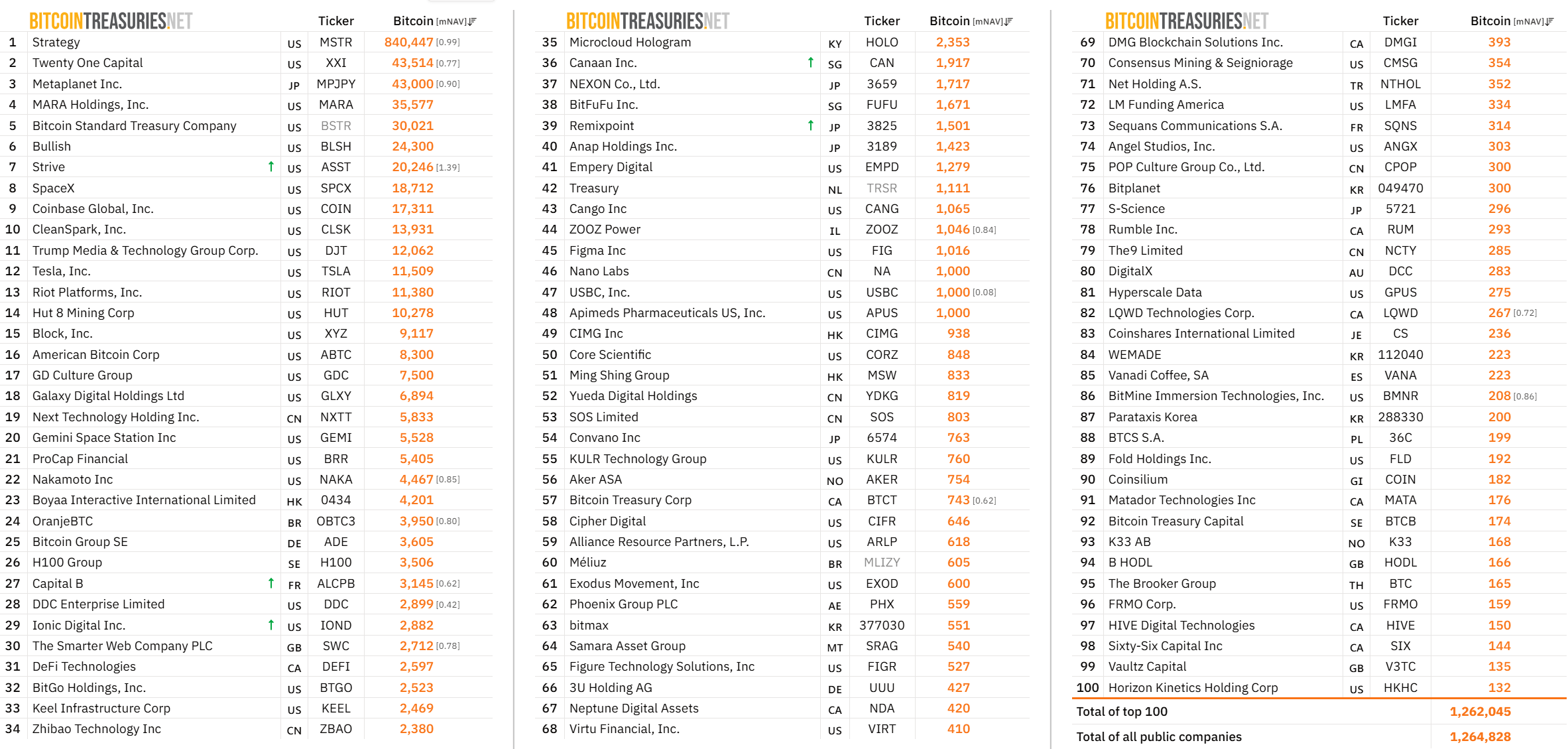
Every SpaceX filing since 2024 lists the same 18,712 BTC at the same $661 million cost. Only the value changes. It was $1.75 billion at the end of 2024 and $1.10 billion in June.
That grip held through pressure. In July, an $88 test transfer triggered sale rumors. Weeks later its debut earnings report booked a $539 million paper loss for the half and kept every coin.
Tesla’s leftover 11,509 BTC cost $386 million and has sat still since 2022. Its second quarter results logged a further $334 million decline over the half. Together the two hold 30,221 BTC for about $1.05 billion.

At a current price near $78,570, that is worth roughly $2.37 billion.
So the answer is plain. Nobody can force either company to sell. Tesla did anyway, once, by choice. That is the part no ledger protects against.
The post Elon Musk Said Bitcoin Has No Throat to Choke: Why Does That Matter? appeared first on BeInCrypto.
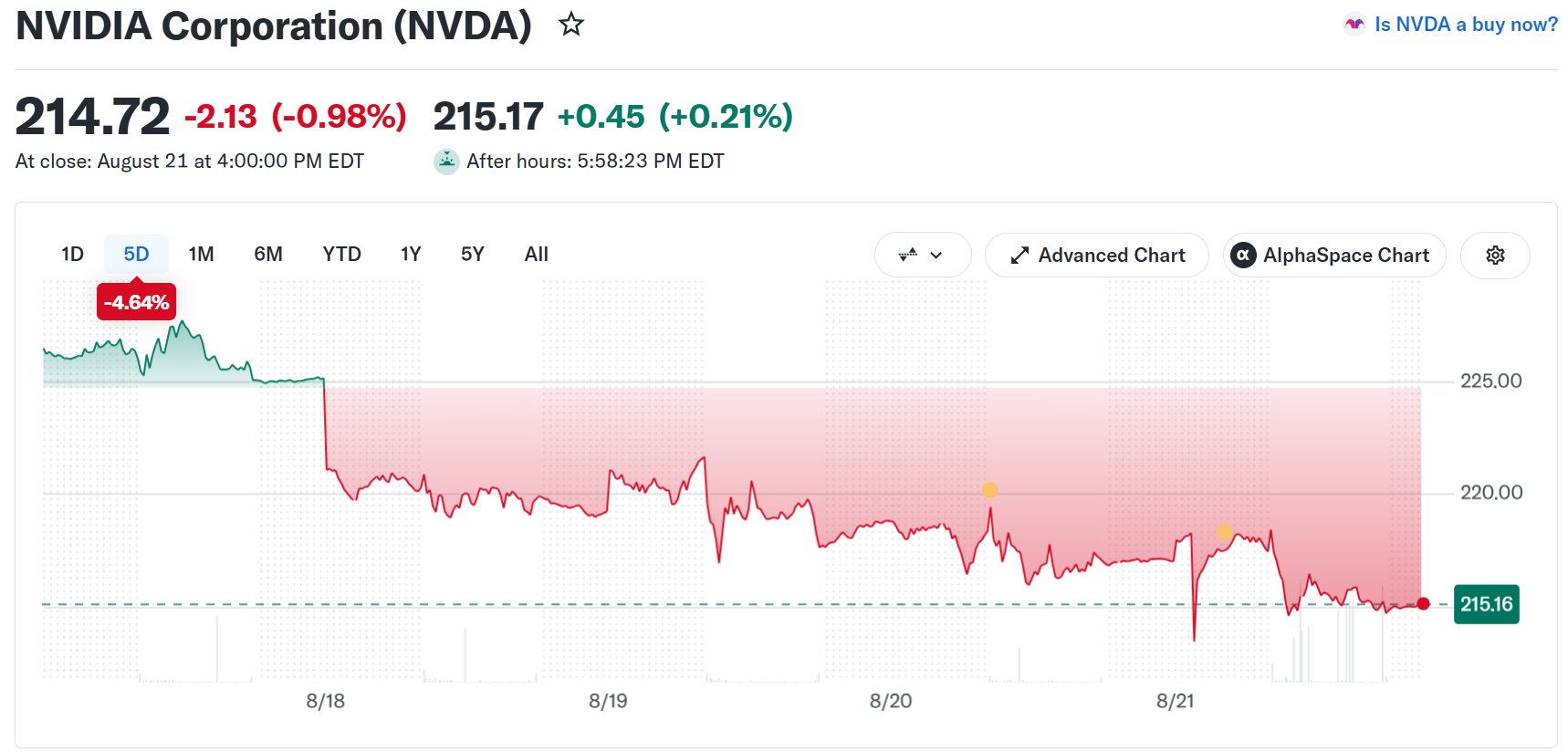
Nvidia stock’s losing streak hit a sixth day on Friday. That is its longest run of declines in four years. The earnings report that could end it lands Wednesday.
So is Nvidia stock a buy after the slide? Every analyst covering it says yes. The reason for the selling, though, has not gone away.
Follow us on X to get the latest news as it happens
Why the Nvidia Stock Losing Streak Kept Going
The slide is small. It is also stubborn. Nvidia last closed higher on August 13, at $225.30. By Friday it sat at $214.75. That is 4.7% gone in six sessions.

The shape matters more than the size. Four of those six days lost less than 1%. A single session, August 18, did half the damage with a 2.34% drop. This is a slow leak, not a crash.
The 2022 comparison flatters it. Nvidia fell seven days straight into September 6, 2022, shedding 24% and closing at its lowest level since March 2021, data from the period shows. That slide was five times deeper than this one. The record here is the length, not the pain.
No single event set it off. The pressure dates to August 10. That day, Nvidia announced financing platforms with Apollo, BlackRock, Blackstone, Brookfield, Goldman Sachs and KKR.
The plan is to raise more than $500 billion from outside investors. That money helps customers buy Nvidia computing power. The stock fell 2.9% on the news.
Here is the worry in plain terms. Nvidia helps its customers find money. Those customers spend that money on Nvidia chips. Critics call it circular financing.
It is not a one-off. Last week, a securities filing revealed Nvidia had guaranteed up to $105 billion in lease obligations tied to an OpenAI campus in Ohio.
Is Nvidia Stock a Buy Before Wednesday’s Earnings?
Nvidia reports on August 26, after the closing bell. The quarter runs through July 2026.

Analysts expect earnings of $2.01 per share. That would be 103% above the $0.99 posted a year earlier. Revenue guidance points to roughly $91 billion, up from $81.6 billion last quarter. Nvidia has beaten estimates four quarters running.
Price targets stay bullish. All 26 analysts tracked by TipRanks rate the stock a buy, with none at hold or sell. Their average target of $301.82 sits about 40% above Friday’s close. Bank of America’s Vivek Arya has held a $350 price target into the print.

One number complicates that picture. Nvidia gained 19.7% over the past year. Its technology sector rose 37.1% in the same stretch. The company at the center of the AI trade has lagged the AI trade.
The recent record is stranger still. Nvidia has beaten estimates four quarters running. It has also fallen the day after every one of them.
Those four reports cost the stock 2.79% on average the next day and 5.31% across two days, by Motley Fool analyst Sean Williams’ count of the post-earnings moves. Beating Wall Street has not been enough to lift the shares.
Nvidia Keeps Buying Power, Not Just Chips
On Friday, Nvidia disclosed a minority investment in Cloverleaf Infrastructure. Terms were not disclosed.
Cloverleaf makes no chips and runs no servers. Founded in 2024, it buys land, secures grid power, and sells sites that are ready to build on.
The company has sold more than 7 gigawatts of powered projects, including Wisconsin sites tied to Oracle and OpenAI, according to trade reporting. Its pipeline runs past 10 gigawatts.
Nico Caprez, vice president of global AI infrastructure growth at Nvidia, explained the thinking.
“AI factories are the infrastructure of the intelligence age, and land, power and shell are their foundation,” he said.
Electricity, not silicon, is now the hard limit on AI growth. So Nvidia is paying for the power years before the chips arrive.
So will earnings end the losing streak? On recent form, the report is at least as likely to extend it. The numbers have not been Nvidia’s problem. The assumptions built on top of them have.
Until Wednesday, the circular financing debate is what traders are trading. After it, the question becomes whether even a record quarter is enough.
The post Nvidia Stock Suffers Longest Losing Streak Since 2022: Will Q2 Earnings End It? appeared first on BeInCrypto.

Apple TV’s Sci-Fi Hit Is Making Its Biggest Formula Change Yet for Season 2

Day 54 of 90 Days of Financial Wisdom #finance #gospel #wealth #christian #finance

Why Ainsley Harriott was at two Morrisons in Lancashire on Friday

Weekend Open Thread – Corporette.com

Weekend Open Thread: Brooks Brothers

London Mayor Sadiq Khan handed a peerage by Keir Starmer alongside 15 other Labour figures… just days before the PM leaves No10
Day 54 of 90 Days of Financial Wisdom #finance #gospel #wealth #christian #finance

How to Create Viral Finance Videos Using AI | Free AI Tools + Complete YouTube Tutorial (2026)

Day 51 of 90 Days of Financial Wisdom #wealth #finance #gospel #money #christian
-

 Fashion7 hours ago
Weekend Open Thread: Madewell – Corporette.com
-

 Sports7 days ago
Birmingham 2026: Day 6 Timetable for Irish Athletes
-
 NewsBeat7 days ago
Myanmar says over 300,000 Rohingya refugees verified for repatriation as exodus enters ninth year
-

 Business4 days ago
SMA Solar Technology AG (SMTGY) Q2 2026 Earnings Call Transcript
-

 Politics7 days ago
SEQ Code: The Three Letter Boarding Pass Code That Could Give You The Worst Seat
-

 Crypto World7 days ago
Pi Network Protocol 27 endgame: last upgrade before what?
-

 Tech4 days ago
Qwen3.8-27B runs frontier-class coding agents and reasoning locally, no cloud API required
-

 Crypto World4 days ago
OCC Greenlights Trump Family Crypto Firm for Trust Charter
-
 Entertainment7 days ago
Marvel Studios Reveals New X-Men Cast Including Adam Driver and Sadie Sink
-
 Tech6 days ago
Every fusion startup that has raised over $100M
-
 Business7 days ago
Monarch Mutual Fund set to enter MF space with maiden overnight fund; files draft with Sebi
-

 News Videos2 days ago
Don’t Leave Your Financial Future To Chance | August 19, 2026
-

 Business7 days ago
Cristiano Ronaldo’s Secret Wedding Deepens As Presenter Claims Family Learned ’30 Seconds’ Before
-

 Business7 days ago
Facebook Down Now? Users Report Login And Loading Problems As Outage Trackers Monitor Ongoing Issues
-

 Crypto World5 days ago
Data of 54K Wallet Users Leaked, Clarity Odds Just 10%: Hodler’s Digest, Aug. 16
-

 Crypto World4 days ago
NAVI Prime launches institutional lending framework on Sui
-

 Politics5 days ago
Britain is facing a housing disaster
-

 Business7 days ago
New Avengers Doomsday Trailer Drops at D23 Showing Robert Downey Jr as Doctor Doom
-

 Tech7 days ago
How to watch FIH Hockey World Cup 2026: FREE live streams, schedule
-

 Business5 days ago
Rebel Creamery files Chapter 11 with $23.8M Van Leeuwen judgment on appeal
You must be logged in to post a comment Login