

Crypto World
Bitcoin Slumps Toward $69K as Mt. Gox Moves 10,422 BTC to Unmarked Wallets


Glee is written all over the faces of bears, as Bitcoin (BTC USD) slipped toward $69,950 on June 2 after on-chain monitoring tools confirmed the Mt. Gox estate moved 10,422 BTC, worth approximately $739 million, from cold storage to multiple unmarked, newly created wallet addresses.
The transfer marks the first major on-chain activity from the defunct exchange’s rehabilitation estate since late 2024, snapping months of relative quiet from one of crypto’s most closely watched wallet clusters.
BTC fell from $71,000 to a low of $69,950 within an hour of the news breaking, triggering cascading crypto liquidations across leveraged long positions.
— Crypto Rover (@cryptorover) June 2, 2026
 HUGE WARNING: Mt. Gox just moved $739 MILLION in $BTC.
The first major transfer in 6.5 months.
Last time they moved this much, November 2025, $BTC dropped 13% within days.
It's happening again.
And we're already under $70,000… pic.twitter.com/RrTLE14ob5
The immediate market fear is an overhang of supply. With tens of thousands of BTC still under trustee control and creditor repayments continuing through 2026, every large wallet movement from the estate functions as a psychological pressure point, regardless of whether coins reach an exchange order book the same day.
Discover: The Best Crypto to Diversify Your Portfolio
Bitcoin News: Mt. Gox BTC Movement, What the On-Chain Data Actually Shows
The destination of the coins is what makes this transfer analytically significant. Unmarked wallets, addresses with no prior transaction history and no publicly verified affiliation with exchanges or known custodians sit in an interpretive grey zone.
They could represent internal estate reorganization, OTC block-sale preparation, or staging addresses ahead of exchange deposits. That distinction matters: a direct transfer to a Kraken or Bitstamp deposit address signals imminent creditor distribution; movement to fresh cold-storage addresses does not.
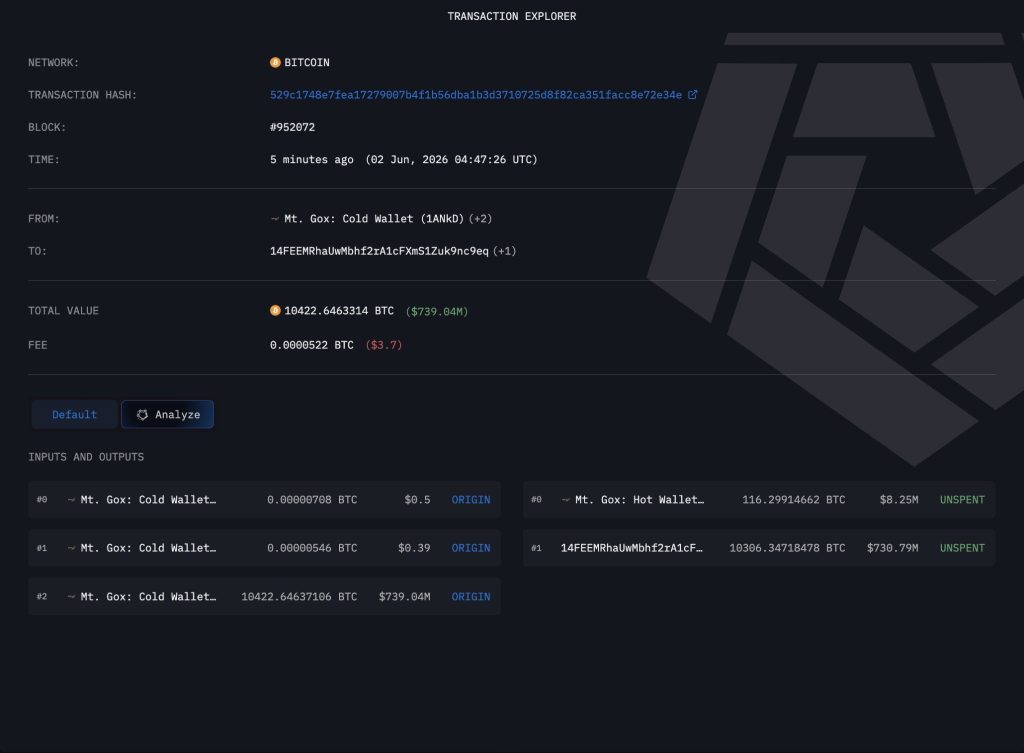
On-chain data from CryptoQuant shows that exchange inflow metrics for Bitcoin remained relatively stable in the immediate hours following the transfer, suggesting the 10,422 BTC had not yet reached exchange order books as of publication.
The transmission mechanism was clear nonetheless: algorithmic monitors flagged the Mt. Gox wallet cluster, headlines hit, and leveraged long positions were unwound before any actual selling occurred. The ghost of Mt. Gox does not need to sell to move markets, it only needs to move.
This pattern has repeated across every major estate transfer since 2024. In July of that year, the trustee moved 44,527 BTC in a single transaction, Arkham Intelligence and on-chain analysts flagged it as repayment preparation, and Kraken later confirmed it had received funds for staged creditor distribution.
A subsequent tranche of nearly 47,229 BTC saw Bitcoin fall more than 3% below $57,000 on the day of the move. The current BTC price drop follows an identical playbook.
The data verdict: this looks like pre-distribution staging, not an immediate market dump, but the market is not waiting for confirmation before repricing risk.
Discover: The Best Token Presales
The post Bitcoin Slumps Toward $69K as Mt. Gox Moves 10,422 BTC to Unmarked Wallets appeared first on Cryptonews.

Fundamental backdrop
In April, US inflation stood at 3.8% year-on-year — the highest level since May 2023. A significant contribution came from rising fuel prices amid escalating tensions in the Middle East. Market reaction was somewhat paradoxical: instead of inflows into safe-haven assets, the strong CPI print triggered a reassessment of Federal Reserve monetary policy. Expectations of a possible rate hike by the end of the year appear to have strengthened the US dollar and weighed on gold.
By the end of May, the precious metal had lost more than 4% and is currently trading roughly 20% below its January record high. Markets are now awaiting labour market data and comments from Federal Reserve officials as key guidance for the next reassessment of monetary expectations.
Technical picture
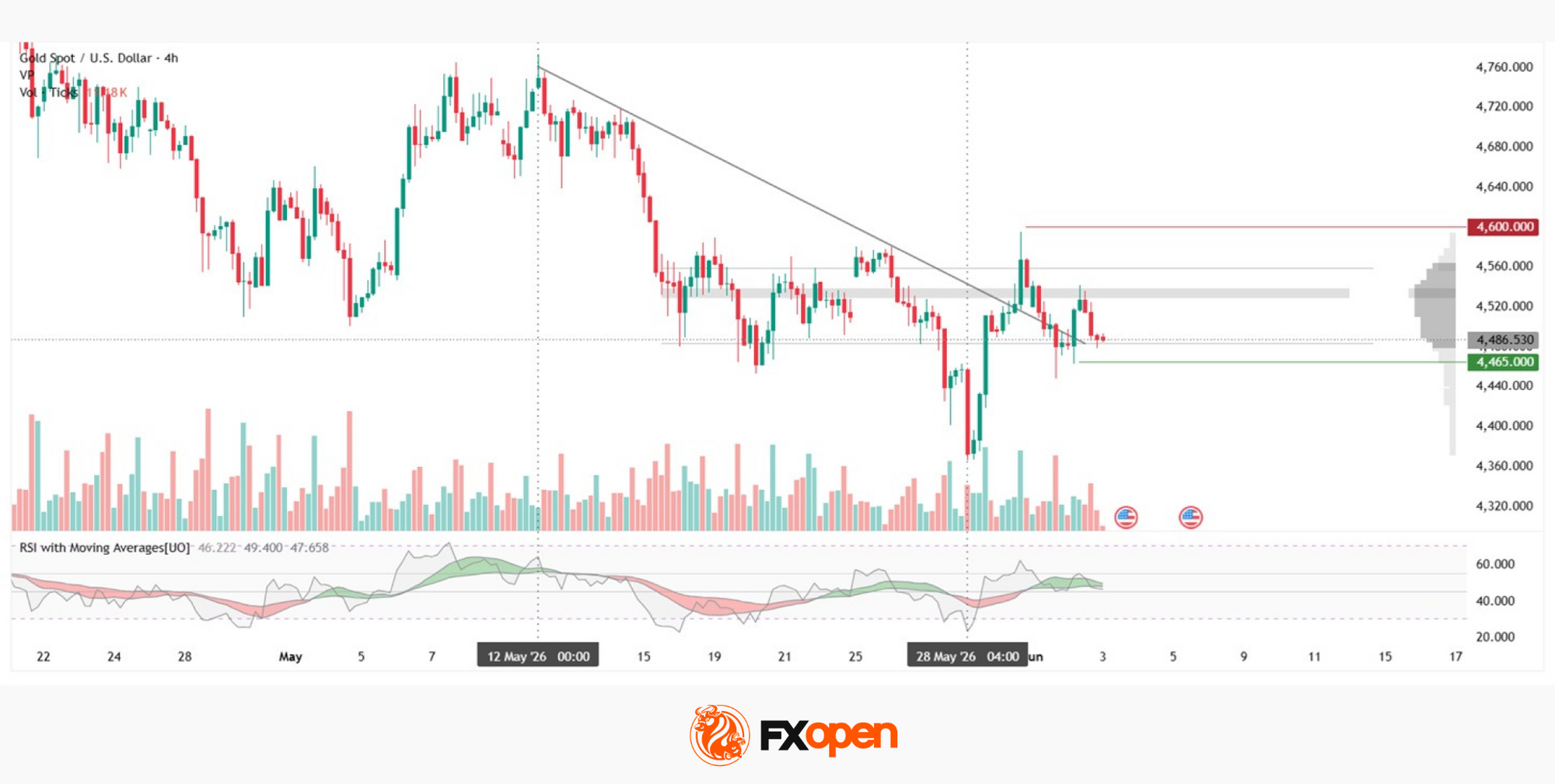
On the four-hour chart of Gold (XAUUSD on FXOpen), a short-term bearish trend can be identified: starting on 12 May and ending in a phase of acceleration on 28 May. The trendline is drawn across consecutively lower highs and is clearly defined. Following the 28 May impulse, price reversed sharply and attempted to break above the trendline. However, it has not yet managed to hold above it — the move may be viewed as an incomplete retest of trend strength, with the final outcome still undecided.
The horizontal volume profile defines the current working range, with the upper boundary located around 4,560 and the lower boundary at 4,485. The point of control (POC) is concentrated between 4,533 and 4,535. At present, price is testing the lower boundary of the profile — if this support is lost, attention could shift towards the 4,465 area, where a key support level is located. The 4,600 area could also attract interest if the upward move continues.
RSI + MAs shows readings of 46, 49 and 47 — the oscillator remains in neutral territory but is poised for a potential new impulse.
Key takeaways
Further gold price dynamics will largely depend on US labour market data and Federal Reserve rhetoric: confirmation of expectations for higher rates could increase pressure on the asset. The technical picture remains mixed — the attempted breakout above the descending trendline has not been confirmed, while RSI does not provide a clear directional advantage for either side.
Start trading commodity CFDs with tight spreads (additional fees may apply). Open your trading account now or learn more about trading commodity CFDs with FXOpen.
This article represents the opinion of the Companies operating under the FXOpen brand only. It is not to be construed as an offer, solicitation, or recommendation with respect to products and services provided by the Companies operating under the FXOpen brand, nor is it to be considered financial advice.
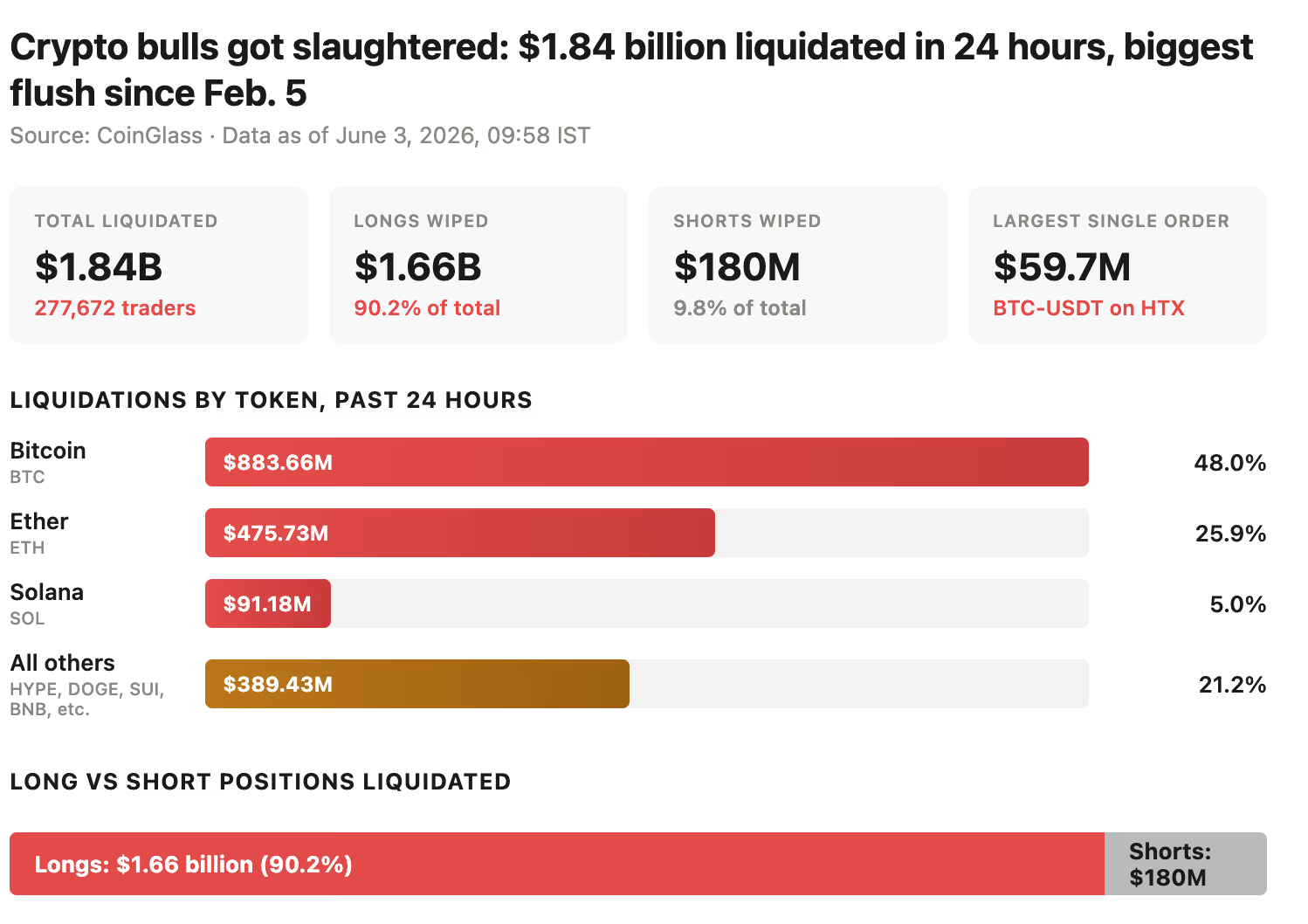
Crypto traders hoping the market would catch up to the global stock rally were left nursing tears on Wednesday as a sharp price drop triggered the largest liquidation event since early February.
Roughly $1.84 billion in crypto leveraged positions were liquidated across the past 24 hours as bitcoin plunged below $66,000 and ether (ETH) broke under $1,900, the largest single-day wipeout since February 5 and a near-pure flush of long bets, with longs taking $1.66 billion of the total and shorts only $180 million, per CoinGlass data.
A liquidation is when an exchange automatically closes a leveraged trade because the trader’s losses have exceeded the collateral they posted to open it. Long positions bet that the price will rise, while short positions are bets on prices falling.
Bitcoin longs absorbed $883.66 million of the damage, ether longs another $475.73 million and solana (SOL) longs $91.18 million, with the remaining roughly $390 million spread across HYPE, DOGE, SUI, BNB, NEAR, AAVE, LINK and the broader top-30 long book.
The single largest order was a $59.67 million BTC-USDT long unwinding on HTX.

Binance accounted for $748 million of the total liquidations, or roughly 41% of the cascade, with 89% of those positions long. Hyperliquid handled $314 million, of which 94% were longs, and Bybit logged $247 million with 93% longs.
Meanwhile, Bitcoin open interest, the total value of all unsettled leveraged futures contracts, actually rose during the cascade.
The contract count climbed from roughly 759,000 BTC to 788,600 BTC even as the long book was being wiped out, per CoinGlass data. Rising open interest into a falling price can indicate new short positions are opening rather than long positions closing, signaling that fresh bearish bets are building on top of the long flush rather than the cascade finding a clearing level.
The positioning split is uneven across trader types. Retail bitcoin traders on Binance, OKX and Bybit are still leaning long at ratios of 2.22, 2.01 and 1.58 respectively, refusing to capitulate even after the wipeout, while whale accounts on OKX have flipped to a 0.54 long-short ratio that CoinGlass flags as ‘extremely bearish.’
Aggregate taker volume across the period showed $65.39 billion in sells against $60.16 billion in buys, with sellers as the marginal actors.
OI rising into a falling price, retail still leaning long, and whale accounts flipping short on OKX all point to a market that has not found a clearing level. A break below $65,000 brings $60,000 into play; a hold opens the door to a relief bounce, but the positioning data argues against the bounce being the more likely outcome.


The legacy financial and digital frameworks propping up the current internet architecture face an imminent, existential crisis.
Evin McMullen, co-founder and CEO of Billions Network, told CoinDesk in an interview during the Proof of Talk conference in Paris that tech giants and global telcos are actively scrambling to deal with an impending collapse of their primary revenue engine: display advertising.
As autonomous AI agents replace human-driven semantic search, the traditional system of monetizing user eyeballs breaks down completely, she added.
“They are terrified—existentially threatened,” McMullen said bluntly, describing the internal reaction of media and telecommunications conglomerates approaching her firm. “AI agents don’t have eyes.
They are not swayed by the visual decoration on the edges of the main body of information that they seek. The interest is less in finding new surfaces to place display ads on, and more of an existential question of how discovery happens. Are we inverting the internet?”
During Consensus in Miami 2026, Cardano Founder Charles Hoskinson mirrored similar thoughts to express how Big Tech feel about AI agents.
“Amazon, Google, Facebook, they’re terrified of the agentic revolution,” Hoskinson said, adding that they are investing heavily because “all of their business models are going to be disrupted.”
With the rise of AI agents, software can scrape a webpage, summarize content and keep the source user inside a chatbot or automated workflow instead of sending a person back to the original site.
Also at Consensus Miami, Cloudflare Chief Strategy Officer Stephanie Cohen said that shift is breaking the internet’s old business model, with non-human traffic now exceeding human engagement.
The core challenge facing the modern web isn’t the technical sophistication of machine intelligence, but a complete absence of programmatic accountability. McMullen pointed out that more than 51% of current online and onchain interactions are driven by unidentified, unaccountable automated bots.
Scaling On-Chain Infrastructure to Legacy Systems
Billions Network has quietly grown to support the third-largest on-chain agent population on the internet, trailing only Binance and Base. According to McMullen, the network’s open-source cryptographic libraries are already utilized by more than 9,000 corporate and sovereign developers worldwide.
In the corporate sector, Billions Network’s technology infrastructure is utilized by platforms like TikTok, the financial giant HSBC, and the decentralized tracking protocol DeBank. It also collaborates with India’s Ministry of Labor to secure credential access for national social security programs, alongside a deployment with the Indian Railway system that protects the digital identities of over 1.2 million personnel.
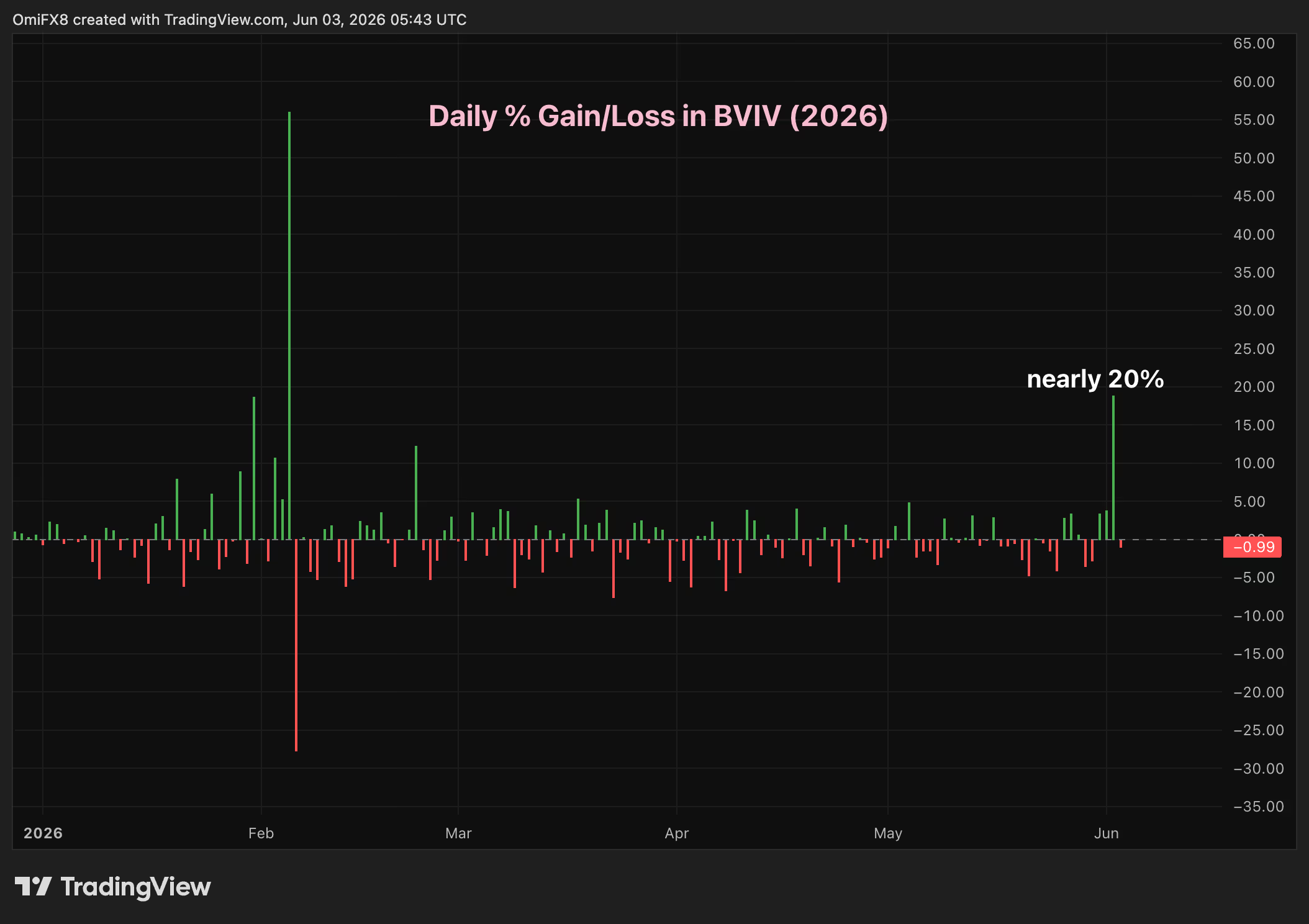
Bitcoin traders are finally taking the price selloff seriously. The cryptocurrency’s fear gauge, the BVIV index, shows it.
BVIV, which measures the 30-day implied or expected volatility in the cryptocurrency, surged nearly 20% on Tuesday to 46.45%. That’s the biggest single-day spike since Feb. 5, according to data source TradingView.
Here’s why it matters.
For roughly two months, the bitcoin market sentiment was calm. Even when BTC dropped from its early May high of $82,000 to $75,000 last week, the market sentiment barely flinched. The BVIV actually remained around its year-to-date low of 40% during that move.
In other words, it was orderly selling. No panic. But that changed Tuesday as BTC’s spot price fell over 6% to $66,000.
The BVIV index exploded with that price drop. The index is essentially a fear gauge. When it rises, traders are aggressively buying options to protect against further downside. Tuesday’s nearly 20% surge signals that protection buying is back.
To put Tuesday’s move in context: back on Feb. 5th, BVIV surged over 50% in a single day, hitting above 90% as bitcoin crashed toward $60,000. Tuesday’s jump is nowhere near that level. But the direction of the move is what traders should care about right now.

VIX like behavior
Think of BVIV like bitcoin’s version of Wall Street’s VIX fear gauge. Since U.S. bitcoin ETFs launched over two years ago, institutional players have flooded into the market. That institutionalization has created something interesting: BVIV now moves in the opposite direction of bitcoin’s spot price with increasing consistency. Price drops, fear spikes. Price rises, fear fades.
That’s a relatively new dynamic for crypto, but not so much on Wall Street, where the S&P 500 and its fear gauge, the VIX, have been inversely correlated for decades.
The takeaway is that after two months of unusual calm, fear is creeping back into the bitcoin market. Whether Tuesday’s spike is a one-day blip or the start of a sustained volatility regime remains to be seen.

Two senior crypto security experts have raised the alarm. They say quantum computers could crack the math protecting Bitcoin (BTC) and Ethereum (ETH) sooner than expected.
Recent breakthroughs and a public rediscovery of hidden Google research have moved the timeline closer.
Google Hid a Quantum Breakthrough, AI Rebuilt It and Made It Worse for Crypto
Justin Drake of the Ethereum Foundation and Charles Guillemet, chief technology officer at Ledger, both shared their thinking. Here are five takeaways crypto holders should not miss.
1. Google’s Quantum Attack Got 10x Faster
On March 31, 2026, Google Quantum AI showed a 10x faster way to crack the math protecting Bitcoin and Ethereum.
The new method requires fewer than 1,200 logical qubits to break the digital locks protecting wallets, addresses, and most online authentication.
2. Outsiders Rediscovered the Hidden Trick in 2 Months
Google did not publish the actual circuits. The hidden quantum research sat behind secrecy for weeks.
Two months later, French researcher André Schrottenloher independently cracked the main optimization.
Follow us on X to get the latest news as it happens
A public challenge then opened, and hobbyists beat Google’s original number by over 8% within hours.
3. A Zero-Knowledge Proof Sparked a Censorship Debate
Google released a zero-knowledge proof, a math trick that confirms something works without showing how.
Guillemet said the U.S. government blocked the full publication. Drake, a co-author of the paper, wrote that aspects of the surrounding context troubled him.
4. AI and Amateurs Drove the Speed-Up
The hidden proof had a side effect. Anyone could test a candidate attack against it and get instant feedback. Guillemet flagged the irony.
“The ZKP was designed to hide the attack. What it actually published is the reward function for rediscovering it,” Guillemet indicated, flagging the irony.
Hobbyists wired the verifier into automated AI searches, and current Q-Day timeline estimates may already be too generous.
5. Migration Timelines Are Behind the Curve
Drake now puts the chance of Q-Day arriving by 2032 at 50%, with 10% by 2030. He dismissed the U.S. government’s 2035 deadline outright.
“In plain language: with hindsight, that date is a joke and should be discounted entirely,” noted Drake.
Ethereum, Google, and Cloudflare are working toward a post-quantum migration deadline of 2029.
Drake leads work on Ethereum’s quantum-resistant plan, which would replace today’s cryptography with hash-based cryptography.
The Bigger Picture
Neither expert urged panic.
Guillemet warned that rushing into untested replacement cryptography could be worse than the threat itself.
The takeaway is not to act today, but to plan now. The gap between classified research and public knowledge keeps shrinking.
The post 5 Quantum Q-Day Takeaways From Top Crypto Security Experts appeared first on BeInCrypto.
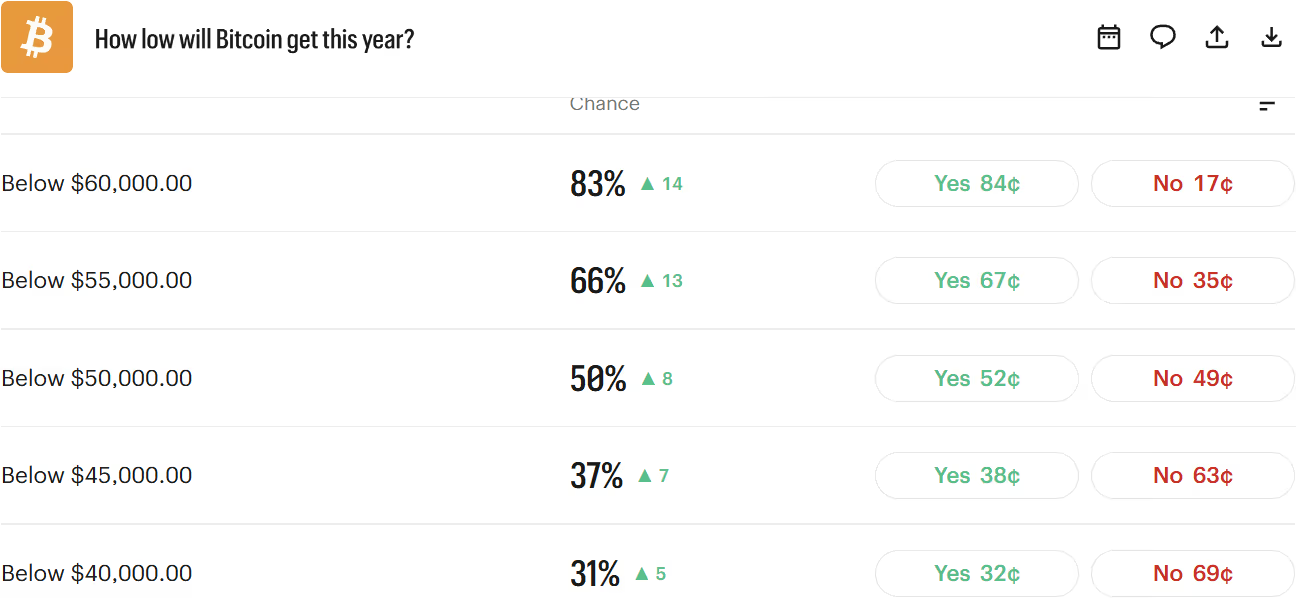
Prediction market traders are increasingly wagering that bitcoin’s correction is far from over, even after the cryptocurrency tumbled toward $65,000 this week amid mounting pressure from ETF outflows and weakening institutional demand.
On Kalshi, traders currently assign a 66% probability that bitcoin drops below $55,000 this year and a 50% probability of sub-$50,000 prices. They also give a 31% chance that prices could even dip below $40,000.

Polymarket traders are expressing a similar view. Contracts on the platform imply a roughly 67% chance bitcoin falls below $55,000 this year and a better-than-even chance it drops under $50,000.
On prediction platform Polymarket, traders now give bitcoin only a 30% chance of outperforming gold in 2026. Gold is down approximately 1.5% in the last month but is up 33% in the last year while BTC is down around 37%.
This comes amid dwindling institutional appetite for the leading cryptocurrency. According to data from SoSo Value, traders withdrew $2.4 billion from U.S.-listed BTC ETFs in May and $1 billion in the first two trading days of June, with the record-breaking outflow continuing.
Meanwhile, K33 Research argues that bitcoin is also losing a battle for investor attention against artificial intelligence-related stocks. As CoinDesk previously reported, in a report on Tuesday, the firm said many investors view the opportunity cost of holding bitcoin as too high while AI-linked companies continue to post outsized gains and major equity indexes push to record highs.
“Much of the market views the opportunity cost of holding BTC as too high while anything AI-related soars,” K33’s Vetle Lunde wrote.
While K33 still views bitcoin as undervalued relative to equities over the long term, prediction markets suggest traders are increasingly positioning for lower prices before any recovery arrives.
While traders increasingly bet on lower bitcoin prices, capital does not appear to be leaving crypto entirely. Instead, it is increasingly moving into digital dollars.
USDT and USDC have both gained market share during bitcoin’s slide to $66,000, CoinDesk previously reported, a sign that traders are raising cash and waiting for better opportunities rather than immediately buying the dip.

Bitcoin continued its retreat on Wednesday as U.S. market activity began, slipping below $67,000 and printing as low as $66,948 on Bitstamp, its weakest level since early April. Across the crypto market, liquidations intensified, with 24-hour cross-asset liquidations approaching $1.25 billion, signaling a broad deleveraging pulse that erased months of gains.
Despite the move, traditional equities painted a contrary picture. The S&P 500 logged another record, highlighting a grim divergence between Bitcoin and broader risk assets as macro dynamics and liquidity considerations took center stage.
Analysts framed the price action as part of a familiar bear-flag narrative that has characterized prior downswings in this cycle. On X, trader Rekt Capital noted that macro risk-off behavior has investors shifting toward stablecoins, even as Bitcoin tests critical technical levels. Kalshi’s markets also reflected downside bets, with participants pricing in a potential retest of lower price bands. Meanwhile, voices in the community pointed to a crowded open interest backdrop that could amplify further moves if selling pressure persists.
Key takeaways
- Bitcoin dips below $67,000 and trades as low as $66,948 on Bitstamp, its lowest since early April.
- 24-hour liquidations total around $1.25 billion, underscoring a broad deleveraging across crypto markets.
- Bitcoin’s price action is viewed by some as a return to a bear-flag breakdown, suggesting further downside if supports fail.
- Analysts highlight a potential test of the 50-month exponential moving average near $66,250 as a key near-term target or pivot.
- Market positioning shows rising open interest and downside bets, with Kalshi pricing in risk of a deeper pullback and traders noting a split between crypto and stock market strength.
Bear-flag mechanics and key technicals
From a technical standpoint, BTC/USD has been revisiting the negative-pattern dynamics that defined earlier phases of the bear market. CollinTalksCrypto, a creator known for tracking chart-driven narratives, argued that the move mirrors a bear-flag breakdown rather than a unique pivot, reinforcing the notion that Bitcoin is in a broader corrective phase rather than signaling an imminent reversal. The argument centers on a flag-like consolidation that fails to sustain bullish momentum, followed by renewed downside pressure when support gives way.
The price dipped to roughly $66,948 on Bitstamp, an imprint that reopens discussion about how much weakness remains before a more decisive bounce—or a further breakdown. Traders watching the chart also note that such patterns often require patience, as relief rallies can be brief and quickly reabsorbed in a bear-market context.
Adding to the near-term complexity, analyst Rekt Capital highlighted the potential test of the 50-month exponential moving average around $66,250. He cautioned that even if a shallow bounce materializes on contact, the long-term trajectory could remain skewed to the downside if Bitcoin fails to establish a clear base above that EMA.
Positioning, open interest, and the macro backdrop
The sell-off comes amid a broader liquidity mosaic. Data suggest that a surge in open interest paired with elevated spot selling could sustain downward pressure, particularly if bitcoin breaks key supports. In parallel, market commentary from Kalshi signals bets around $50,000 as a plausible downside scenario, reinforcing the sense that participants are bracing for a range of outcomes in the near term.
On social channels, observers noted a paradox: while risk assets like the S&P 500 have continued to push higher, bitcoin has been softening, a dynamic described as a “grim divergence” by some traders. The disconnect has fed discussions about where crypto fits within macro portfolios and whether BTC will decouple from equity strength or remain tethered to the prevailing risk-off environment.
“Investors are macro risk-off, fleeing into stablecoins and moving away from Bitcoin,” remarked trader Rekt Capital, highlighting the flow shift amid ongoing macro uncertainty.
Critically, some observers pointed to the possibility that a wave of open interest could intensify any subsequent move. Exitpump, a market observer on X, warned that record open interest has contributed to an “insane amount of spot selling,” increasing the risk of a sharp downward leg if liquidity supplies dwindle. A fellow analyst, Exitpump, echoed the sentiment, suggesting the downside could extend into the low 60s or even the mid-50s if selling accelerates and buyers retreat from the market.
What to watch next
Looking ahead, traders will be focused on whether BTC can establish a foothold above the key mid-60k zone and how quickly volatility responds to incoming liquidity cues. The interaction between price, open interest, and order-book depth will likely shape the near-term path, with the 66,250–66,500 region serving as a critical test for the bears’ control. If BTC sustains a move back above the 50-month EMA, a cautious, data-driven bounce could materialize; otherwise, the path of least resistance may remain toward the lower-$60k territory in the near term.
Readers should monitor how Kalshi’s downside scenarios evolve, how open interest shifts in the coming sessions, and whether any macro catalysts—ranging from central-bank signaling to liquidity shifts—alter the balance between risk-on optimism and risk-off caution in digital assets.
Bitcoin’s latest leg down reinforces the notion that the bear market still dominates price action, but the exact trajectory remains uncertain. As always, traders are urged to weigh risk carefully, diversify exposures, and follow developments that could alter the prevailing technical and macro narrative.

Strive expanded its Bitcoin treasury again after buying 2,500 BTC for about $185.2 million this week. The purchase lifted its total holdings to 19,000 BTC and strengthened its corporate Bitcoin position. The move also came as the firm increased capital plans through its ASST and SATA programs.
Strive Adds 2,500 Bitcoin to Its Treasury
Strive bought the latest Bitcoin batch at an average price of about $74,092 per coin. The firm disclosed the acquisition after its chief executive, Matthew Cole, shared the update on Tuesday. The purchase added fresh scale to a treasury strategy built around steady Bitcoin accumulation.
The latest transaction followed another recent purchase of 1,109 BTC for roughly $85.4 million. That earlier deal carried an average purchase price near $76,988 per Bitcoin. Therefore, the new acquisition came at a lower average cost than the prior disclosed purchase.
Strive now holds 19,000 BTC, according to the latest company update and treasury tracking data. The firm also reported a quarterly Bitcoin yield of 23% and a year-to-date yield of 36.7%. In addition, Cole said Strive raised its cash position and maintained an 18-month dividend reserve.
Bitcoin Strategy Expands Through ASST and SATA
The Bitcoin purchase came after Strive outlined plans to expand its fundraising capacity. Cole said the company expects to increase both ASST and SATA at-the-market programs by $2.1 billion each. As a result, the two programs could add $4.2 billion in combined capital capacity.
The expanded programs would give Strive more room to fund future Bitcoin purchases. It would also support its broader balance sheet strategy as demand for both securities rises. However, the company has not confirmed the exact use of every future fundraising dollar.
Data from Bitcoin Treasuries showed that Strive’s SATA raised about $194.3 million during the past week. That figure sits near the value of the newly disclosed Bitcoin purchase. Therefore, the timing suggests the recent capital raise may have supported the latest reserve expansion.
Corporate Bitcoin Market Shows a Sharp Contrast
Strive’s new purchase arrived as Strategy reported a rare reduction in its Bitcoin holdings. A Monday filing showed Strategy sold about $2.5 million worth of Bitcoin during the past week. The sale drew market attention because Strategy remains the largest corporate Bitcoin holder.
Strategy also focused earlier on repurchasing $1.5 billion in convertible notes instead of adding more Bitcoin. That action marked a different capital approach from Strive’s continued accumulation plan. Meanwhile, Michael Saylor reacted to Strive’s update and kept the focus on corporate Bitcoin adoption.
The contrast shows how public companies now manage Bitcoin exposure through different treasury decisions. Strive continues to raise capital and increase its BTC reserve during market weakness. Strategy, however, has recently balanced its treasury activity with debt and limited Bitcoin sales.
Background Behind Strive’s Bitcoin Buildout
Strive has positioned Bitcoin as a central part of its corporate asset strategy. The firm has used equity programs and treasury metrics to frame its balance sheet expansion. This approach mirrors a wider trend among companies using Bitcoin as a reserve asset.
Corporate Bitcoin holders often use market pullbacks to expand their reserves at lower average prices. Strive’s latest purchase fits that pattern because it followed a weaker Bitcoin trading period. The firm also bought below the average price of its previous disclosed acquisition.
The company’s growing Bitcoin reserve now places it among the larger public corporate holders. Its next moves may depend on liquidity, capital access, and Bitcoin market conditions. For now, Strive has reinforced its position as an active Bitcoin treasury firm.

TapTools, a Cardano-focused real-time analytics platform, has begun winding down after its fifth top-level executive departure, compounding leadership instability and making continued operations unsustainable.
TapTools said in a post to X on Tuesday that it would begin winding down over the next two weeks, and noted the departure of its two co-founders, chief operating officer and chief technology officer earlier this year.
“We worked hard to adapt,” TapTools said, adding that its backend developer had become its CTO as the platform shifted its focus toward shipping products more sustainably; however, they have since departed, and “the technical knowledge required to responsibly operate and maintain TapTools cannot be replaced overnight.”

Source: TapTools
TapTools launched in 2022 and became one of the most widely used tools for Cardano users to track token prices, decentralized finance activity and discover new projects.
The wind-down follows a similar move by Cardano-based nonfungible token marketplace, JPG.Store, which permanently shut down on May 23.
TapTools’ closure comes three days after the Cardano Foundation said its annual conference was cancelled this year after its governance community shot down a revised proposal seeking to fund the event with treasury tokens.
TapTools said the economics of running the platform were another key factor in its decision to wind down.
“Infrastructure costs are real. Development costs are real. Support costs are real. Operating a platform that serves the ecosystem at scale is expensive.”
Related: Cardano can now be used to pay at 137 Spar stores across Switzerland
TapTools said it remains open to acquisition or external funding to sustain operations.
Cardano creator expects more protocol wind-downs
Cardano creator Charles Hoskinson took some of the blame for TapTools’ wind-down, saying in a video shared to X that he expected a lot of protocols to collapse in the current bear market and that he came up with a plan to “bail out” struggling projects.
“I came up with the plan of an index. It did not get executed,” Hoskinson said.
Hoskinson added that Cardano’s governance community could have helped some of these projects, but opted not to.
Magazine: Big Questions: Do we really only need 2–5 cryptocurrencies?


Peter Schiff predicted Bitcoin would break below $50,000 and then quickly plunge under $20,000, sparking a strong wave of pushback across the entire crypto community on X.
We break down what Schiff actually said, the market context behind his call, and how Bitcoiners fired back at the veteran gold advocate.
Why Peter Schiff Is Predicting a Bitcoin Crash
Peter Schiff is the chief of Euro Pacific Capital and one of the longest-running Bitcoin skeptics in finance. He took to X on Tuesday to argue that excessive complacency signals the crypto market remains far from a bottom right now.
“When Bitcoin breaks $50K, it should be a quick fall below $20K,” Schiff wrote, claiming such a move would finally break the resolve of long-term Bitcoin holders across the world.
The prediction came as Bitcoin was trading at $66,670 after falling below the key $70,000 support, accumulating a daily drop of 6.4%. This correction coincided with Mt. Gox transferring approximately 10,422 BTC to new wallets as part of payments to creditors.
A modest sale by Strategy, the largest corporate Bitcoin holder, added some caution to the picture. The amount represented a tiny fraction of holdings, but the symbolism arrived during an already fragile sentiment phase across crypto.
Schiff’s broader argument remains the same. He has long claimed Bitcoin lacks intrinsic value compared to gold, and views the current cycle as another speculative excess waiting for an eventual reckoning across markets.
How the Bitcoin Community Hit Back
Bitcoiners responded with characteristic bluntness, pointing directly to Schiff’s long history of bearish calls. Many noted he has been questioning Bitcoin’s viability since the asset traded in the low thousands, more than a decade ago.
“Peter schiff has been calling bitcoin dead since $1K and he’s still out here writing the same post with different numbers in it,” one user replied, capturing the dominant mood across the community.
Others focused on conviction rather than price. “What Peter refuses to understand is that $20,000 wouldn’t shake a single HODLer,” wrote another user, framing Bitcoin as a censorship-resistant monetary network rather than a speculative bet.
“Yes, people buy for NGU. But the actual use case is a decentralized, censorship-resistant monetary network. That doesn’t change at any price. That’s what gives it value. And in a world where stablecoins hand governments an easier path to overreach, that value only goes up”, added.
The discussion reflects a deeper cultural divide between traditional precious-metals proponents and Bitcoin maximalists. Community replies ranged from memes and old call compilations to declarations of continued accumulation on every notable dip.
Market participants now watch key technical levels, with stronger demand between $64,000 and $66,000, while Bitcoin still trades 47% below its all-time high near $126,000 from late 2025.
For now, the market reaction to Schiff’s prediction looks limited to social media skirmishes. Bitcoin holders largely dismissed the call, and many framed any deeper drop as a buying opportunity rather than fuel for capitulation.
The post Peter Schiff Predicts a Brutal Bitcoin Crash to $20,000 and Sparks Heated Backlash appeared first on BeInCrypto.

This Soap Has Money In It

ITC shares fall 3% to fresh 52-week low; Motilal Oswal sees more pain ahead

Gold: Attempt to Break Out of the Short-Term Trend



-

 NewsBeat7 days ago
Israel says it has killed new Hamas military leader in Gaza City airstrikes
-

 News Videos5 days ago
This is BROKEN! INSANE 5x MONEY CAR WASH WEEK! The NEW GTA Online UPDATE Today! (GTA5 New Update)
-

 Tech5 days ago
Waymo dominates autonomous vehicle registrations as Tesla trails behind
-
 Tech4 days ago
SpaceX just won a second Golden Dome contract. This one is $4.16 billion.
-

 News Videos4 days ago
SHE IS KILLING XRP!!! WATCH URGENT AND ACT FAST
-
 NewsBeat4 days ago
FIRST NIGHT REVIEW: Take That bring the Circus back to life in spectacular sun-soaked style
-

 Business1 day ago
Jade Biosciences, Inc. (JBIO) Discusses Positive Interim Results From JADE101 Phase I Healthy Volunteer Study and Development Plans Transcript
-

 Tech7 days ago
The Samsung pay deal is the moment Korean unions changed register
-
 Crypto World5 days ago
CFTC Has Approved the First Regulated Bitcoin Perpetual Contract in the U.S.
-
Crypto World7 days ago
SpaceX’s $2 Trillion IPO: Why Tech Giants Nvidia (NVDA), Apple (AAPL), and Microsoft (MSFT) May Face Pressure
-
 Entertainment7 days ago
The Most Misunderstood Sci-Fi Horror Movie of the Last 10 Years Just Took Over Netflix
-

 Business4 days ago
Is the Spurs Phenom Already Better Than Prime Diesel?
-
 NewsBeat5 days ago
Novak Djokovic v Joao Fonseca LIVE: French Open latest scores and results after Jannik Sinner’s shocking collapse
-
 Crypto World5 days ago
Snowflake (SNOW) Stock Rallies on Strong Q1 Results and AI Product Growth
-
 Entertainment4 days ago
Weak ‘Supergirl’ Box Office Tracking Amid Milly Alcock Backlash
-

 Business4 days ago
Demand Conditions Improve In Chemicals Sector In April 2026
-
 Crypto World4 days ago
MicroStrategy Moves $30 Million in BTC to Coinbase Prime: Is the Bitcoin Sell-Off Already Here?
-

 Politics4 days ago
The House | Inside Andy Burnham’s Makerfield Campaign: “Nobody Thinks This Is In The Bag”
-
 Entertainment7 days ago
Adam Sandler’s Recent Outing Sparks Fashion Debate
-

 Tech5 days ago
This Week In Security: Ubiquiti Fixes, And FreeBSD Joins The Club You Don’t Want To Join
You must be logged in to post a comment Login