

Crypto World
Bitcoin’s Biggest Holders Are Accumulating Again: What Are Whales Preparing For?


Bitcoin (BTC) has experienced a sharp pullback this week, briefly touching $76,000. Despite growing concern about a deeper price decline, whales and institutions are still accumulating the world’s largest crypto asset.
The number of Bitcoin wallets holding at least 100 BTC has risen to 20,229, according to new data shared by Santiment. This represents an 11.2% increase compared to the 18,191 wallets recorded at the same time last year.
Long-Term Bitcoin Confidence
Wallets holding this amount of Bitcoin currently contain roughly $7.7 million or more in BTC and are often linked to major investors, institutions, whales, and wealthy long-term holders.
Santiment explained that the steady rise in these large wallets continued throughout a year that witnessed strong market volatility and changing investor sentiment. The increase came during periods when many retail traders showed caution, fear, or frustration toward the market.
Historically, growing numbers of large Bitcoin wallets have been interpreted as a sign that influential investors remain confident in BTC’s long-term outlook, supply scarcity, and market position despite short-term uncertainty and price fluctuations.
Zooming in, as a result of the growing stress across the Bitcoin market, many experts believe that a quick V-shaped recovery may not materialize. CryptoQuant’s SOAB ratio surged above normal levels, which indicated large-scale capitulation from older holders. At the same time, short-term investors are also showing signs of panic selling.
The market is also witnessing a rise in fear and negative sentiment among retail traders on social media, according to a separate post by Santiment. Bearish comments about Bitcoin have now outnumbered bullish ones for the first time since April 21. Smaller traders appear to be reacting strongly to the recent weakness, and many expect the market to fall further from current levels.
Despite this bearish mood, the firm said crypto markets tend to move against the majority view, meaning the spike in bearish sentiment could actually improve the chances of a near-term rebound.
Regulatory Tailwind
Nexo research analyst Dessislava Ianeva believes the CLARITY Act’s progress through the Senate could become a major catalyst for Bitcoin’s next bull run. The bill recently advanced out of the Senate Banking Committee, increasing expectations for crypto regulation in the United States.
Ianeva stated that Bitcoin briefly climbed above $82,000 following the approval, while prediction market odds of the bill becoming law in 2026 also increased. She compared the development to the earlier GENIUS Act rally and said a future Senate floor vote on the CLARITY Act could potentially push the crypto asset toward a new all-time high.
The post Bitcoin’s Biggest Holders Are Accumulating Again: What Are Whales Preparing For? appeared first on CryptoPotato.

Bitcoin (BTC) price dropped to $76,500 on Monday, erasing nearly all of this month’s gains as fresh US-Iran war tensions soured the crypto market sentiment. This has led investors and traders to reevaluate their risks and stay cautious, with many recent buyers selling their BTC at a loss.
Key takeaways:
- Bitcoin short-term holders sold over 10,000 BTC worth approximately $770 million at a loss on Monday.
- Analysts agree that pushing Bitcoin’s price below $76,000 could trigger a fresh downtrend toward $65,000-$70,000.
Bitcoin’s “weak hands” realizing losses
Bitcoin has retraced 7% from its local high of $82,800 set on May 6. The rejection from the 200-day moving averages at $82,000, the daily close below the true market mean, and the short-term holder cost basis around $78,000 have cemented a more risk-off stance among Bitcoin investors.
Related: Bitcoin’s trend-defining battle starts at $74K support: Analyst
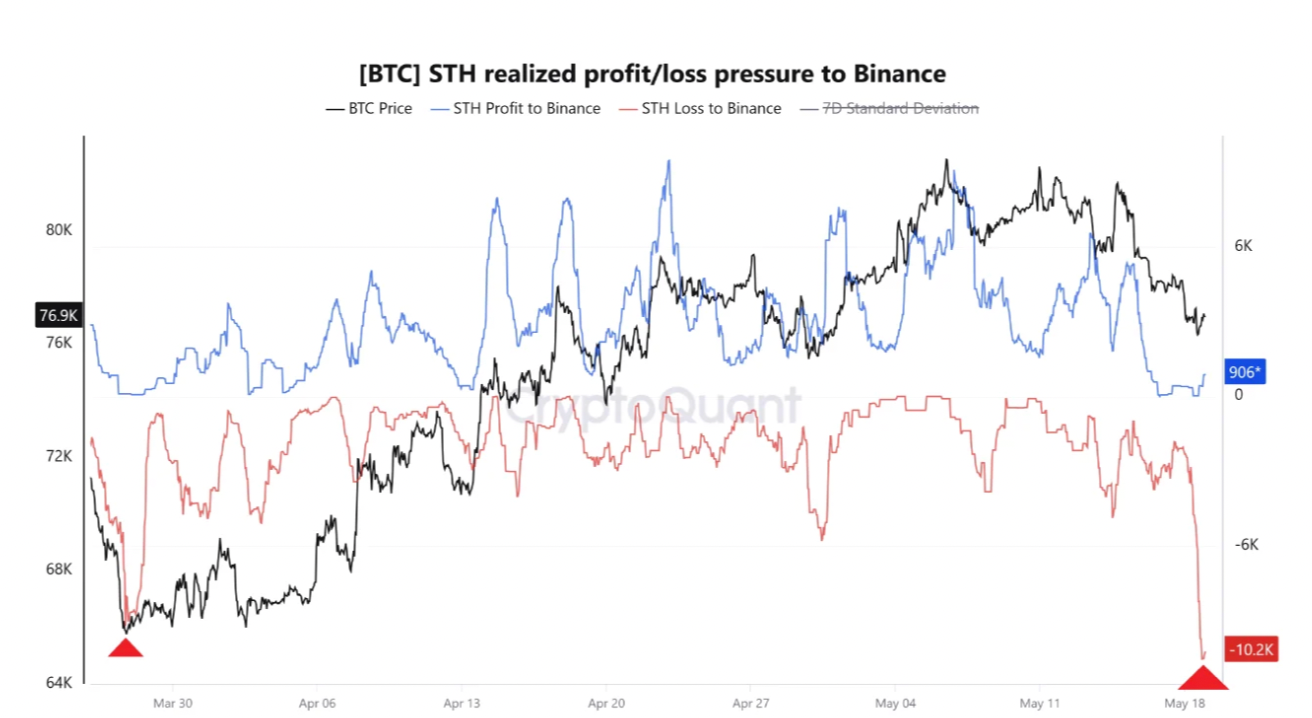
Onchain data from CryptoQuant showed that more than 10,000 BTC were transferred by short-term holders — investors who have held the asset for less than 155 days — to Binance at a loss on Monday.
These moves occurred with Bitcoin at roughly $76,900, about 2% below their average purchase price of $78,440, suggesting that recent buyers sent approximately $769 million in BTC to Binance at a loss.
This “reflects short-term holder stress, forced selling, or capitulation from weaker hands during a correction,” CryptoQuant analyst Amr Tah said in a QuickTake post on Tuesday.
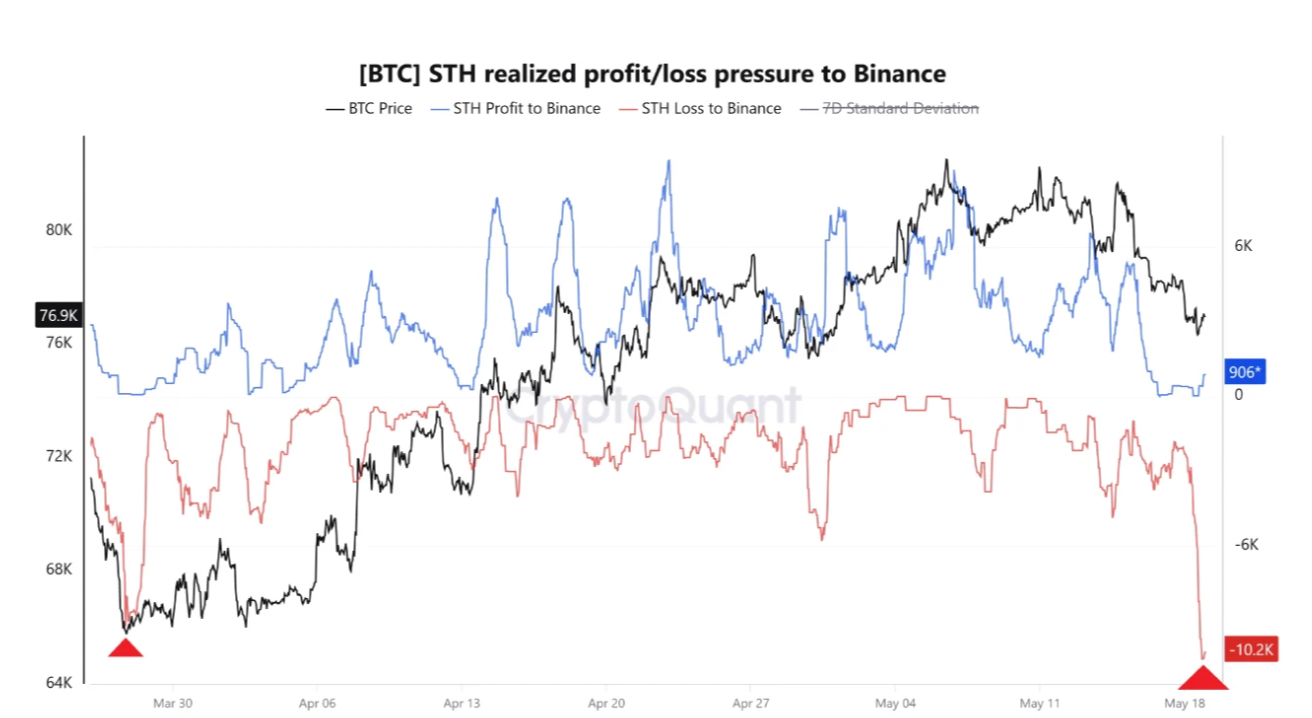
Bitcoin: Transfer volume by STH in loss to Binance. Source: CryptoQuant
This activity underscores a familiar pattern of short-term speculators panic-selling during market dips, frequently realizing losses.
A similar occurrence in mid-November 2025 preceded a 15% BTC price decline to $78,400 from $96,000 in less than five days.
Additional data from Glassnode shows that more than “7.8M BTC are currently held at a loss,” a supply overhang that the market would need to “absorb before any sustained move higher becomes structurally credible.”
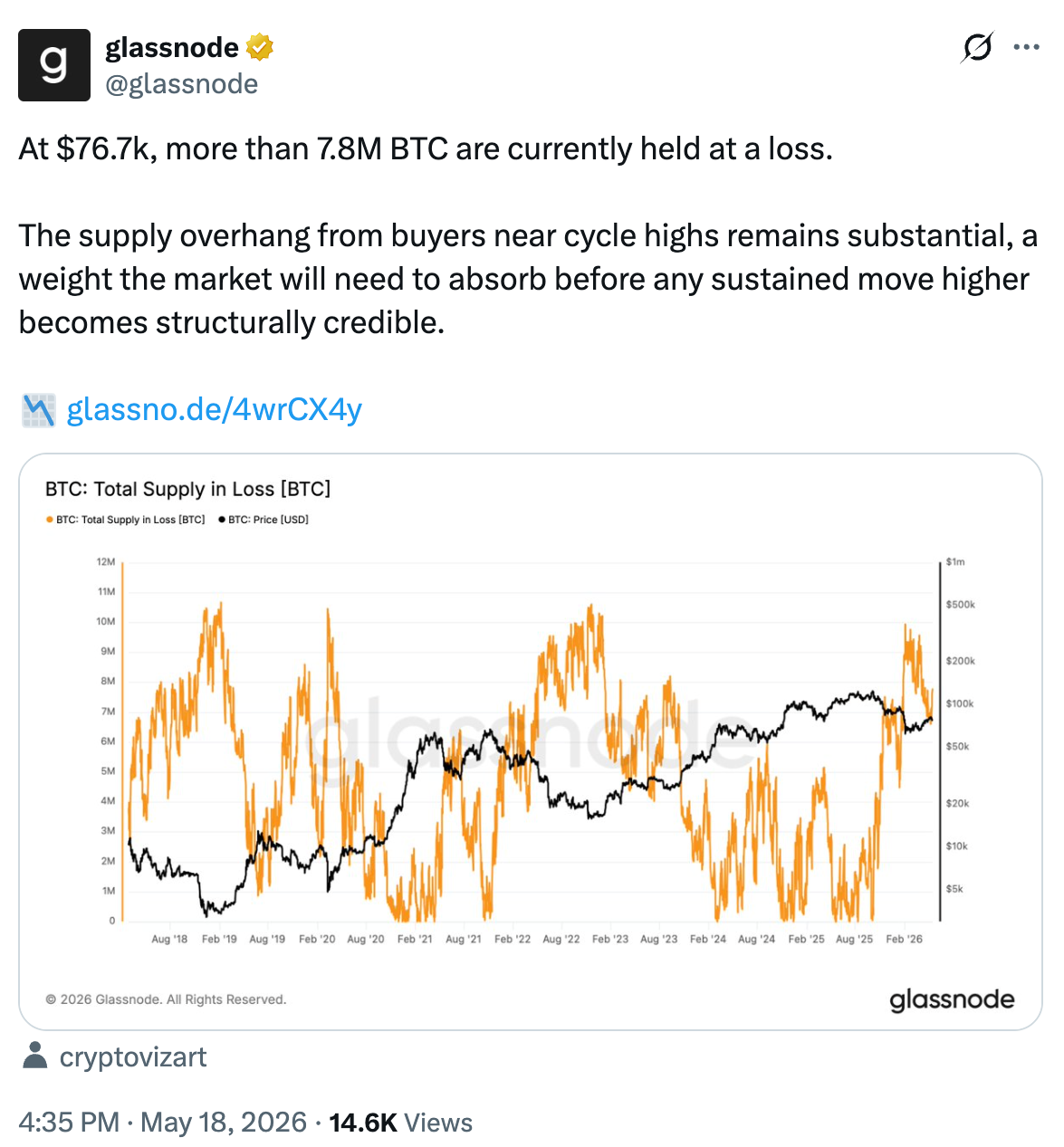
BTC total supply in loss. Source: Glassnode
Also accompanying Bitcoin’s slump are heavy outflows from US-based spot Bitcoin exchange-traded funds (ETFs), which have recorded negative flows for six out of the last eight days.
These investment products saw $648.6 million in net outflows on Monday, the largest withdrawal since Jan. 29.
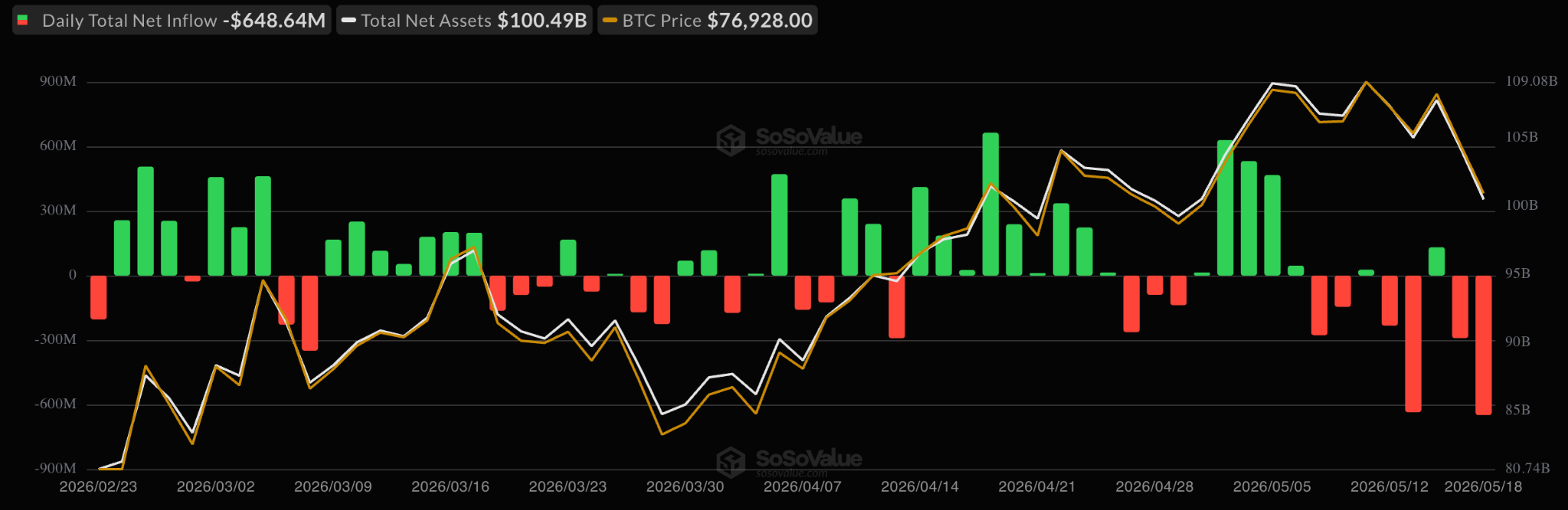
Spot Bitcoin ETF flows table. Source: Farside Investors
Global Bitcoin investment products also recorded $981.5 million in net outflows during the week ending May 15, suggesting declining institutional appetite for BTC.
“Markets are getting absolutely hammered,” analyst Alek_Carter said in an X post on Tuesday, referring to the large outflows from Bitcoin investment products, adding:
“Money is rotating out fast, panic is creeping in, and traders are clearly hitting the risk-off button hard.”
As Cointelegraph reported, record-low retail investor activity, aggressive selling in the futures markets and weakening spot demand are pulling down Bitcoin’s price to new May lows.
How low can Bitcoin price go?
The Bitcoin HODL Waves indicator, which tracks the age distribution of BTC holdings, suggests Bitcoin could bottom at $65,500-$70,500 if current market weakness continues.
Historically, spikes in long-term holder activity and declining short-term speculation have coincided with major market bottoms before recoveries.
The chart below shows a stronger long-term holder base (the blue/purple bands are noticeably thicker), “reflecting growing institutional adoption,” CryptoQuant analyst Sunny Mom said in a Quicktake analysis on Tuesday.
This suggests that the supply structure is structurally stronger in the current cycle than before, “which changes how BTC forms its bottom,” the analyst said, adding:
“Our predicted price range for this cycle’s bottom is $65.9K–$70.5K. If $70.5K holds, we’ll slowly grind out a bottom in the upper range.”
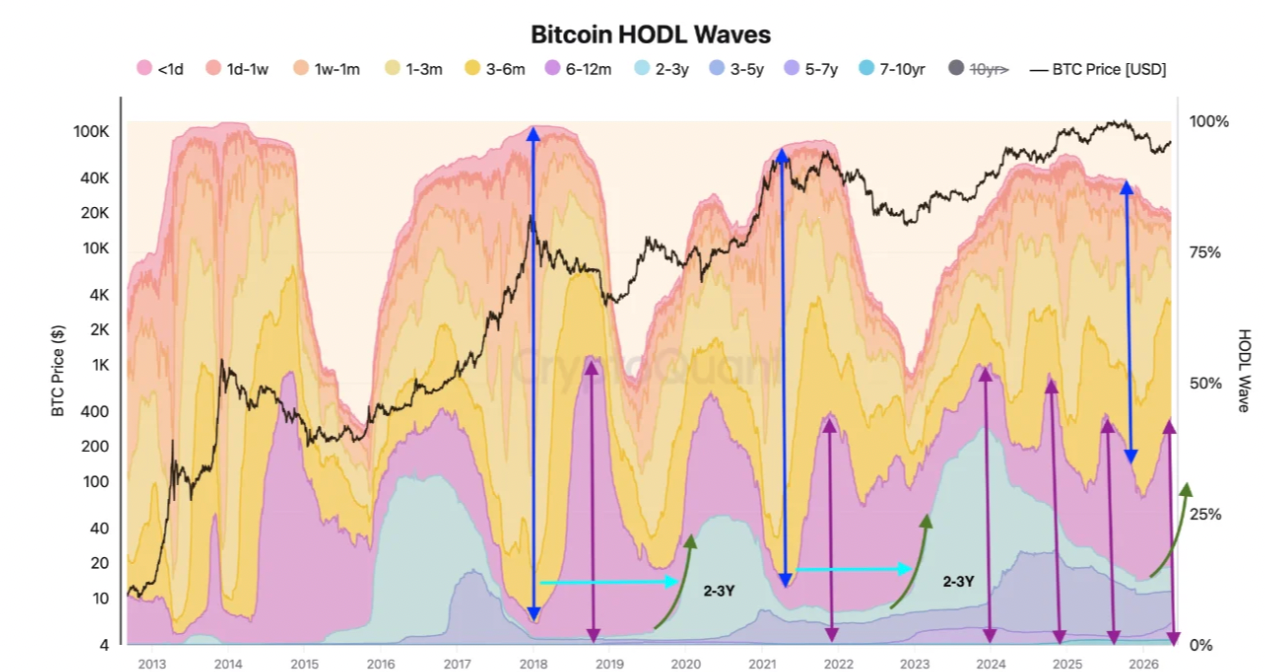
Bitcoin HODL wave indicator. Source: CryptoQuant
From a technical perspective, Bitcoin is printing the fifth consecutive daily red candle, suggesting that the “momentum is starting to shift back to the bears,” analyst Alex Marzell said on Monday in a post on X, adding:
“Bitcoin may come back to retest the breakout zone around $70K support.”
Echoing this sentiment, MN Capital founder Michael van de Poppe said this “doesn’t look great” for Bitcoin, adding that the price needs to hold support at $74,500-$76,000 “in order to get back some momentum in the markets.”
“If this area doesn’t hold, then we’re most likely cascading through the lows of the recent rally and test <$65,000 for support.”
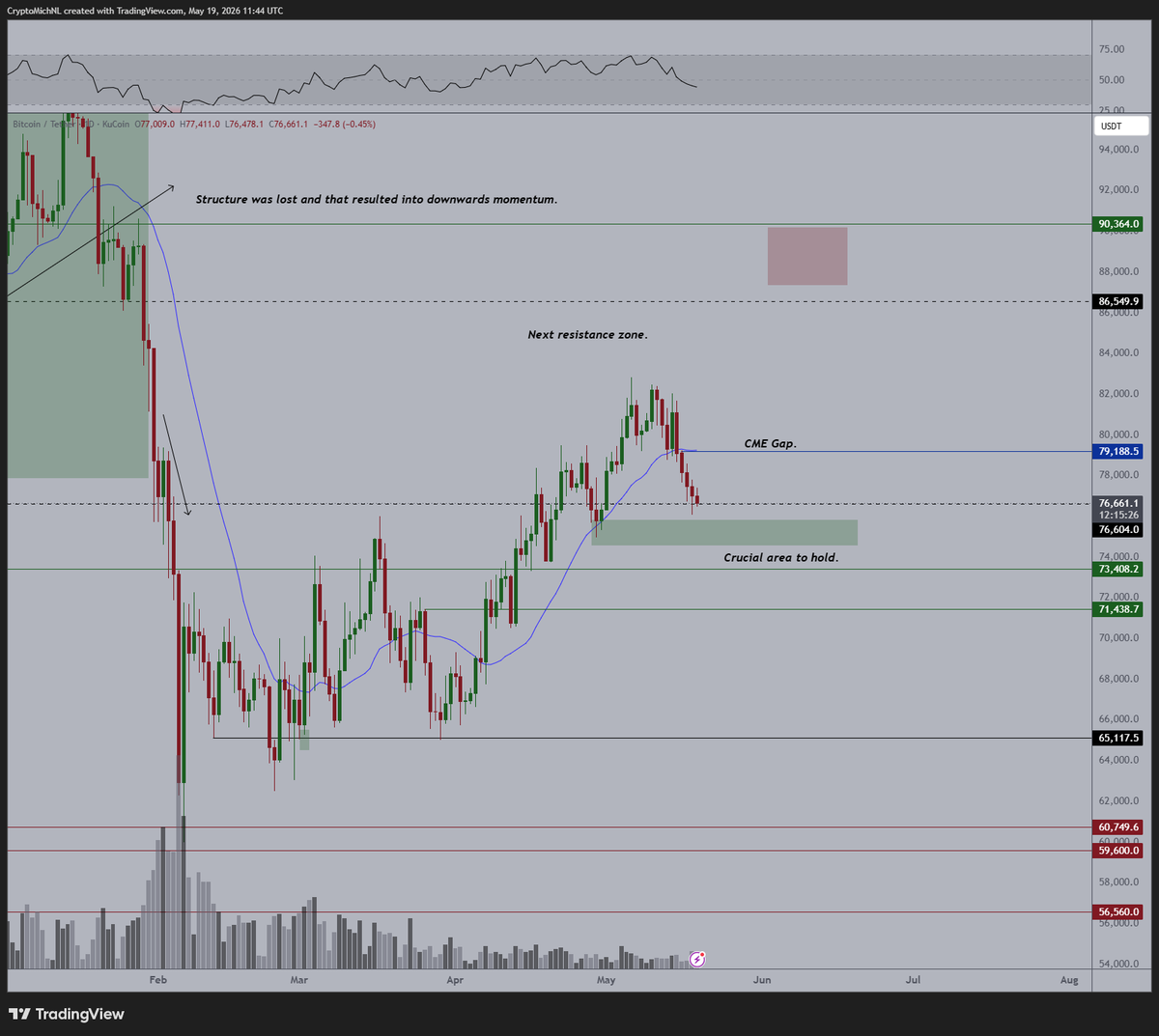
BTC/USD daily chart. Source: X/Michael van de Poppe
As Cointelegraph reported, a break below the 50-day SMA at $76,000 would increase the risk of the BTC/USDT pair dropping to $65,000. in the short term.

Massachusetts Senator Elizabeth Warren has intensified scrutiny of the Office of the Comptroller of the Currency’s push to charter crypto firms as national trust banks, arguing that such moves may violate banking law and blur the lines between banking and crypto activities.
In a letter addressed to OCC Acting Comptroller Jonathan Gould, Warren contends that the agency has approved at least nine national trust charters for crypto companies whose activities “appear to go far beyond the narrow set of activities permitted by law,” potentially breaching the National Bank Act. She has requested a full accounting: all national trust charter applications approved since December 2025, any conditional approvals, and all communications between the OCC and figures connected to the Trump administration, including President Trump, his family, and White House officials. Source: US Senate Banking Committee.
Warren—ranking member of the Senate Banking Committee—described the charter push as a bid by certain crypto companies to act as banks while avoiding the safeguards that come with banking status. “These companies are effectively crypto banks that want to evade the fundamental safeguards and obligations that come with being a bank,” she wrote, warning that the regulator’s approach risks consumers and the integrity of the banking system. The OCC did not provide an immediate comment when reached by Cointelegraph.
Key takeaways
- Senator Elizabeth Warren alleges the OCC has approved nine national trust charters for crypto firms that may exceed the National Bank Act, calling for full disclosures of approvals since December 2025.
- Kraken’s parent Payward filed on May 8 for a national trust charter, aiming to offer fiduciary custody and related services for digital assets under the Payward National Trust Company.
- A national trust charter permits custodial and fiduciary services without traditional deposit-taking or lending, potentially reducing regulatory burdens for crypto custodians.
- The debate sits within broader political and regulatory tensions, including Warren’s criticisms of perceived conflicts of interest and ongoing discussions around the CLARITY Act and related crypto legislation.
- Investors should monitor how, if at all, these charters affect custodial infrastructure, consumer protections, and the boundary between banking regulation and crypto activity.
Kraken bid on the OCC’s table, signaling a broader push for crypto custody
On May 8, Payward—the parent company of the cryptocurrency exchange Kraken—submitted an application to the OCC for a national trust charter. If approved, the charter would allow Payward to provide fiduciary custody and other services primarily for digital assets under the proposed Payward National Trust Company. This aligns with a broader pattern of crypto firms seeking formal, bank-like status to access regulated custodial services and potentially traditional financial rails without engaging in deposit-taking or lending, a hallmark of a national trust charter.
A national trust charter is distinct from a conventional bank charter. It would permit these providers to offer custodial and fiduciary services for clients’ assets while avoiding the full spectrum of deposit-taking and commercial lending requirements typical of traditional banks. The resulting regulatory regime could offer more clarity and oversight for digital-asset custody but may also raise questions about the adequacy of consumer protections and the precise scope of activities allowed under such charters.
Regulatory tensions and the politics of crypto banking
The push for national trust charters sits at the intersection of a broader regulatory debate over how the U.S. should oversee crypto-related financial services. Warren has been a vocal critic of perceived policy conflicts that connect political figures to the crypto industry. In recent weeks, she has pressed for clarifications in crypto market structure legislation—the CLARITY Act—and has urged regulators to slow or reconsider approvals around charter applications tied to political figures and their families, including references to World Liberty Financial, a Trump family–backed initiative that filed for a charter earlier in the year. Cointelegraph coverage.
From the regulator’s perspective, the central question is whether national trust charters strike an appropriate balance between enabling legitimate custody and ensuring robust consumer protections and financial stability. Critics warn that creating a parallel, crypto-specific banking lane could sow regulatory fragmentation if not harmonized with federal banking standards. Supporters argue that formal chartering could bring necessary discipline, tailor oversight for digital assets, and improve confidence for institutional participants seeking regulated custody services.
As the regulatory dialogue continues, lawmakers and industry participants will watch for concrete OCC actions: new charters granted, denials, or policy statements clarifying the framework for crypto custodians. In the meantime, the OCC’s current approach remains under close political scrutiny, with potential implications for market participants seeking regulated custody and for investors assessing the risk and governance of crypto infrastructure.
Cointelegraph requested comment from the OCC but did not receive an immediate response.
Earlier context around Warren’s crypto governance stance and related regulatory efforts is available in ongoing coverage from Cointelegraph, including notes on her push to curb perceived conflicts of interest and to shape crypto policy more firmly in Congress. For reference, see Warren’s remarks on financial policy and related reporting: Warren’s concerns about crypto bailouts.


The SEC is developing a new regulatory framework that would allow digital versions of publicly traded securities to trade on blockchain networks in the US.
Crypto World
A viral hedgehog, Vitalik Buterin, and a bow: the GraphDex launch that crypto won’t forget

5,800 users in two hours. One QR code. One bow that went viral.
Some platforms launch with a whitepaper. Some with a token. GraphDex launched with a hedgehog, a condom, and the co-founder of Ethereum bowing in respect.
A short video from Token2049 Singapore, recorded in September 2024, resurfaced across X this week at precisely the moment GraphDex went live. In this video, the project’s hedgehog mascot moves through the conference floor, greets attendees, and hands a branded condom to Vitalik Buterin. The condom carries GraphDex branding and a QR code that opens the app directly. Buterin takes it and then bows to the hedgehog.

Vitalik Buterin receives a branded condom from the GraphDex hedgehog mascot at Token2049 Singapore, September 2024. Video shows Buterin bowing to the hedgehog immediately after.
The clip sat dormant for over a year. Then the product launched – and everything changed.
The bow heard around crypto
In a space where Vitalik Buterin is treated as something between a philosopher-king and a meme, a moment of him bowing to a hedgehog mascot is not a small thing. It is the kind of image that crypto Twitter cannot ignore, doesn’t want to ignore, and will share without being asked.
The bow was brief, yet the reaction to it lasted longer.
Within two hours of GraphDex going live, the platform registered 5,800 users across its web app and Telegram mini-app. The clip had no destination in 2024; in 2026, it pointed to a live product, and that shift transformed a conference moment into a distribution mechanism that no marketing budget could replicate.
“We always believed the hedgehog would have a second moment. The product was ready. The clip found its timing.” – GraphDex representative
What Vitalik bowed toward
GraphDex is a unified crypto terminal built around a problem every active Solana trader knows intimately: too many tools, not enough time.
The platform consolidates Solana DEX trading, real-time token discovery, wallet and social tracking, Polymarket-powered prediction markets, copytrading for prediction markets – a feature that does not exist on Polymarket itself – and AI-powered signal analysis into a single non-custodial interface.
The non-custodial architecture, built on Privy infrastructure, means user funds stay in user-controlled wallets at all times. After FTX and Celsius, this is less of a feature and more of a baseline expectation. GraphDex built it in from day one.
The copytrading layer for prediction markets is the product’s most structurally novel element. Users can filter top forecasters by PnL and win rate and mirror their positions automatically — bringing the logic of copy trading to outcome-based markets for the first time at this scale.
The hedgehog is still out there
The clip continues to move through X, attaching itself to trading accounts, KOL feeds, and communities with no prior connection to GraphDex. Each share extends the loop: new viewers see the bow, scan the QR code, open the platform, and encounter the same dynamics that made the clip spread – narrative momentum, real-time signals, and fast-moving markets – now visible and actionable in one place.
About GraphDex
GraphDex is a unified crypto terminal combining Solana DEX trading, Polymarket prediction markets with copytrading, AI signal analysis, Bubble Maps, and non-custodial Privy wallet infrastructure.
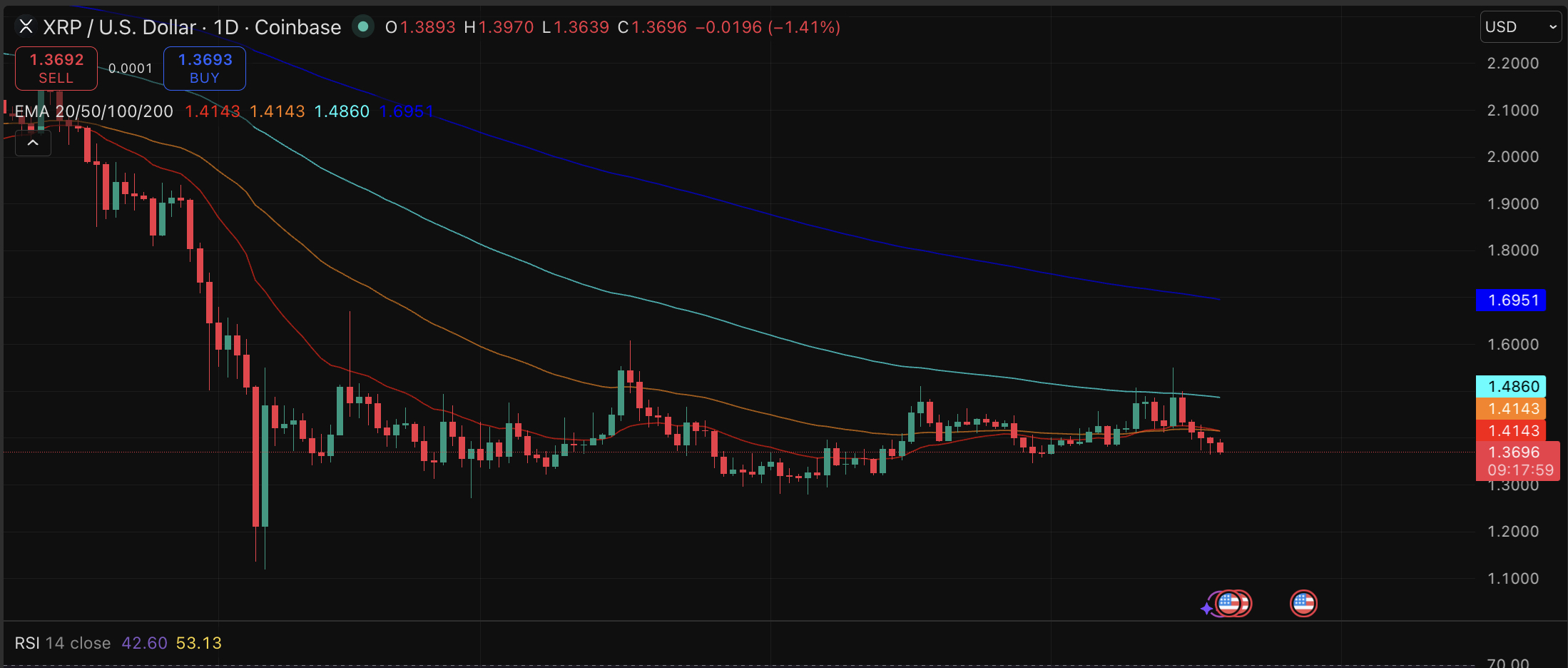
XRP price might be down under its support, but there’s a divergence between short-term technicals and long-range price prediction that has never looked sharper. Bears point to a chart sitting below every major moving average. Bulls point to $27. Both camps have data on their side.
XRP’s current price is below the 10, 20, 50, 100, and 200-day EMAs, and it is bearish. Data reinforces that, tagging market sentiment at 89% Bearish with a Fear & Greed score of just 39. Meanwhile, institutional ETF demand has visibly cooled, removing one of the cleaner near-term re-rating arguments from the table.
Risk-off behavior is real, and the 30-day volatility of more than 3% is showing a bad panic situation. The crypto backdrop led by Bitcoin isn’t offering much cover either. Sentiment has reset from early-year highs, and XRP is caught between two narratives pulling in opposite directions.
Discover: The best crypto to diversify your portfolio with
XRP Price Prediction: $1.45 Is a Must to Validate a Breakout
At $1.38, XRP sits at its immediate support, with resistance beginning just two cents higher at $1.40 and a more meaningful ceiling at $1.45, or more than 5% from the current price.
RSI(14) sits at approximately 42 on the daily chart, technically neutral, but trending toward oversold territory. The weekly RSI is already there at around 38. That divergence of daily neutral and weekly oversold usually precedes a sharp reversal or extended consolidation.
If XRP can reclaim $1.45 resistance on volume with daily EMAs beginning to compress, momentum could shift, triggering a move toward $1.65–$1.80 over the following weeks. Regulatory clarity developments could accelerate this.

Or, price consolidates in the $1.35–$1.45 range for longer as the market awaits a fresh macro catalyst, with the weekly oversold reading limiting downside extension.
The 10-day forecast from CoinLore projects essentially flat action around current levels. Patience, not positioning, appears to be what the chart is asking for right now.
Discover: The best pre-launch token sales
Maxi Doge: The New Dog in Town
When a blue-chip asset like XRP delivers -5% weekly returns while sitting below every major moving average, some traders begin rotating into earlier-stage setups. It’s not because the XRP thesis is broken, but because the near-term risk/reward has compressed.
That rotation logic is what’s drawing attention to presales with asymmetric structures, and one generating momentum right now is Maxi Doge ($MAXI). Maxi Doge is a meme token on Ethereum built around what it calls the “Leverage King” trading culture, representing the 1000x mentality that defines high-conviction crypto trading.
The tagline is “Never skip leg-day, never skip a pump,” which lands somewhere between absurd and oddly motivating. The presale has raised more than $4.7 million at a current price of $0.00028, with a huge 65% APY staking bonus to early participants.
Features include holder-only trading competitions with leaderboard rewards and a dedicated Maxi Fund treasury designed to support liquidity and partnerships over time. For those benchmarking entry points while XRP consolidates, the structure is worth examining.
The post XRP Price Prediction: Hodlers Split as ETF Demand Weakens but $27 Target Lives On appeared first on Cryptonews.


Aave V4 introduces a new market architecture featuring collateral isolation across Hubs and Spokes, with Prime, Core, and Plus Hubs launching initially.
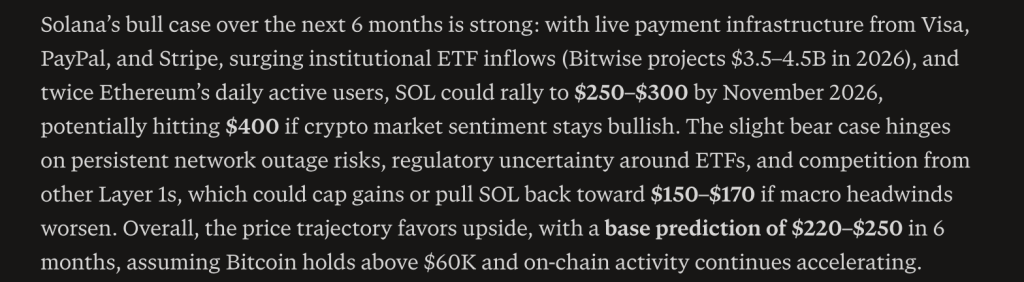
Visa, PayPal, and Stripe are all settling on Solana right now. Most people have not processed what that actually means for price prediction. Perplexity AI did, and the 6-month predicts it produced is the kind of number that makes $84 look like a mistake.
$250 to $300 by November 2026. Potentially $400 if sentiment holds.
Perplexity’s bull case is anchored on real adoption metrics rather than projected ones. Solana already has twice Ethereum’s daily active users, a fact that rarely shows up in price conversations but fundamentally changes the demand argument.
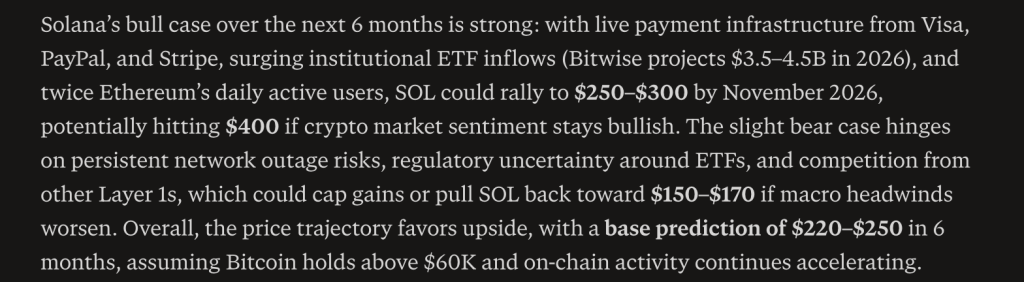
Visa, PayPal, and Stripe are not piloting the network, they are running live payment infrastructure on it, which means institutional legitimacy is already established rather than pending.
Bitwise is projecting $3.5 to $4.5 billion in spot SOL ETF inflows in 2026 alone, and that capital has to buy SOL to function.
The combination of live payment rails from the 3 largest payment processors on the planet, institutional ETF demand building from a low base, and a user base that already dwarfs Ethereum’s creates a setup where the supply side of the equation gets squeezed from multiple directions simultaneously.
Perplexity puts the base prediction at $220 to $250 in 6 months with the assumption that Bitcoin holds above $60,000 and on-chain activity continues accelerating. The $400 scenario requires crypto sentiment to stay broadly bullish through the period.

The bear case is specific and credible. Persistent network outage risks remain the single biggest narrative threat to Solana’s institutional story.
Regulatory uncertainty around ETF approvals could delay the inflow catalyst. And competition from other Layer 1s could cap the narrative momentum that drives speculative inflows. Perplexity puts the downside at $150 to $170 if macro headwinds worsen, which from current price is actually upside, a detail worth noting.
Solana Price Prediction: SOL is Stuck Now, Can it Form the Breakout Foundation Within 6 Months?
Solana price is trading at $84.54 on the daily, and the chart is a familiar story in this series: violent peak, complete destruction, slow base-building that refuses to commit to a direction.
Price peaked at $255 in August 2025, crashed to $70 in February 2026, and has spent the 3 months since grinding in a $75 to $100 range with multiple failed attempts at breaking out.
The most recent attempt was the most convincing, pushing toward $100 in early May before pulling back to current levels.
That pullback from $100 to $84 in less than 2 weeks is the chart’s immediate problem. Price is now sitting near the middle of the range rather than the top, which gives the setup a different feel than it had 10 days ago.
Resistance is $90 to $95, the first ceiling to clear before $100 becomes relevant again. Above $100 the next reference is $120, and then $150 where serious overhead supply from the November distribution sits.
Perplexity’s base target of $220 to $250 requires clearing all of that sequentially and holding each level as support on the way up.
Support below is $78 to $82, the base of the current range that has held since March. Lose that and $70 comes back into play with no meaningful floor between them.
Perplexity’s November deadline gives SOL 6 months to cover roughly 200% of upside. The chart needs to stop giving back gains first.
Perplexity AI Predicts Liquidchain Could Be The Next 1000x Crypto
The rotation is already happening. Most people just have not noticed where it is going yet.
Bitcoin is stuck. Ethereum is grinding sideways. XRP has been one catalyst away from its next move for months now. The large cap trade has run out of easy upside and the capital sitting on the sidelines knows it.
This pattern repeats every cycle. The obvious plays get crowded. Returns compress. Then quietly, money starts finding its way into things that have not been discovered yet. Projects where the market cap is still small enough that a relatively modest inflow changes everything.
The problem is knowing where to look before it becomes obvious.
Cross-chain liquidity is one of the most glaring unsolved problems in the entire space. Three dominant ecosystems, Bitcoin, Ethereum, and Solana, each operating in complete isolation from the others. No native interoperability. No shared liquidity. Every time value needs to move between them it passes through infrastructure that was never designed for the job, and users pay the price in bridging fees, slippage, and transactions that fail at the worst possible moment.
This is not a niche technical complaint. It is a structural tax that every DeFi participant pays every single day.
LiquidChain is eliminating that tax entirely. A Layer 3 execution environment that sits above all 3 networks and connects them into one. Single deployment, full ecosystem access, zero bridging overhead on every interaction.
The presale is at $0.01454. Just over $700,000 raised. The market has genuinely not priced this in yet.
That window does not stay open forever.
The risk profile is what you would expect at this stage. Nothing is proven. Adoption, liquidity, and execution are all still unknowns. That is not a disclaimer. That is the nature of the bet.
The projects that return 10x or 100x are not the ones that looked safe at entry. They are the ones who solved a real problem before the rest of the market understood it.
LiquidChain is still in that window.
The post Perplexity AI Predicts Unexpected Solana Price in 6 Months appeared first on Cryptonews.


Canaan mining maker posted an $88.7m net loss in Q1 2026 on revenue of $62.7m as Bitcoin prices and hashprice both fell sharply.
Summary
- Canaan posted Q1 2026 revenue of $62.7m in line with guidance, but a $25m inventory write-down pushed the net loss to $88.7m, wider than the $86.4m loss in Q1 2025.
- Machine sales fell 75% quarter-on-quarter to $39.6m as deliveries under a major North American customer order were completed, leaving a lean inventory position.
- Canaan guided Q2 revenue at $35m to $45m, well below analyst estimates of around $96m, citing continued Bitcoin price pressure and soft market demand.
Canaan Inc. reported in a May 19 press release that Q1 2026 revenue reached $62.7 million, in line with its February guidance range but down sharply from $196.3 million in Q4 2025.
The company recorded a gross loss of $22.9 million for the quarter, including a $25 million inventory write-down, and a net loss of $88.7 million compared to $86.4 million in the same period a year earlier.
“Despite bitcoin price volatility, compressed hashprice conditions, elevated energy costs, and weather-related disruptions in North America, we delivered total revenue of $62.7 million, which was in line with our guidance,” said Nangeng Zhang, chairman and chief executive of Canaan.
Industrial mining equipment drove $39.6 million of Q1 revenue, though machine sales fell 75% sequentially as the company completed final deliveries under a large-scale North American order.
Canaan mining operations hold amid hardware slump
Self-mining contributed $19.1 million in Q1 revenue, with Canaan producing 257 bitcoin at an average revenue per coin of $61,034. The company’s installed computing power across 10 joint-mining projects reached approximately 11 EH/s, up 10.7% sequentially.
Canaan grew its cryptocurrency treasury to a record 1,807.60 bitcoin and 3,951.53 Ethereum as of March 31.
The company also acquired a 49% interest in ABC Projects in West Texas from Cipher Mining, adding approximately 4.4 EH/s of operational capacity and expanding its energy infrastructure footprint.
As crypto.news reported, Canaan received a second Nasdaq non-compliance notice in January 2026 for trading below the $1 minimum bid price, with a July 13 deadline to regain compliance. The stock fell a further 13.94% to around $0.41 on Tuesday, near its 52-week low.
What Canaan’s Q2 guidance signals for mining hardware
Canaan guided Q2 2026 revenue between $35 million and $45 million, well below the analyst consensus of approximately $96 million. The company said it will continue monitoring global policy developments and market conditions and may revise its outlook as visibility improves.
The weak guidance reflects broader sector pressure. As crypto.news reported in its coverage of American Bitcoin’s Q1 results, miners are navigating simultaneously declining hashprice, higher energy costs, and increasing AI pivot costs.
The Bitcoin price fell 22% in Q1, squeezing margins across the mining hardware supply chain. CFO Jin Cheng noted that $42 million in customer accounts receivable was collected in April, bringing total cash to approximately $85.5 million, providing near-term operational runway while the company awaits market stabilisation.
The crypto market experienced another correction in recent days, with only a handful of leading digital assets managing to escape the broader sell-off.
Solana (SOL) was not among the few exceptions, with its price tumbling by double digits over the past week. Moreover, some analysts think it could fall further in the short term.
What’s Next?
Earlier this month, the renowned analyst Ali Martinez observed SOL’s performance and estimated that its price has been moving within a well-defined channel since February. He identified $98 as the upper boundary of that structure, while $78 was described as the lower one. Later on, he predicted a possible pump if SOL makes a successful breakout above the ceiling and set $88 as “the pivot point.”
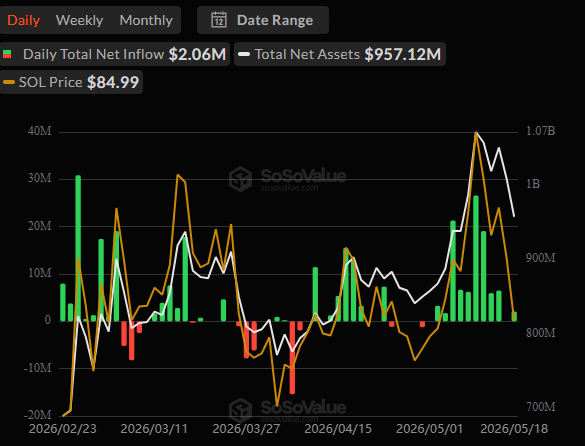
However, the asset’s valuation could not surpass the desired mark and currently trades at around $84.50, representing a substantial 12% weekly decline. In one of his recent X posts, Martinez noted that SOL failed to reach its bullish target, suggesting it could now head south toward the channel bottom near $78.
Another popular market observer who made a pessimistic forecast is Ted. He claimed that SOL’s RSI uptrend has been lost, meaning that the price needs to hold above the $82-$84 level.
“A daily close below won’t be good for Solana,” he added.
Adding to the bearish momentum, recent filings revealed that Goldman Sachs fully exited its SOL ETF exposure during Q1 2026. Such a move from a financial giant often signals caution and can weigh on market confidence.
On the other hand, inflows into spot SOL ETFs have continued to surpass outflows in recent days, suggesting growing institutional interest. Notably, the last red day was April 30.
‘Zoom Out’
Of course, some analysts remain unfazed by the latest pullback and expect SOL’s price to head north in the near future. X user Trader Koala said people should “zoom out,” setting $135 as “the eventual destination.”
SatoshiOwl is also among the optimists. They claimed that many expect “more panic on alts, more fear everywhere.” However, the analyst believes this could be the perfect moment for the market to pivot, with “a monster reversal candle out of nowhere.”
“I’m long on SOL here,” they concluded.
The post Solana (SOL) in Danger: Here’s Why the Price Could Plunge by Double Digits appeared first on CryptoPotato.

TLDR
- Elizabeth Warren questioned the OCC over its approval of crypto-focused trust bank charters.
- She argued that these firms operate like banks while avoiding strict federal banking regulations.
- Warren stated that the approvals could pose risks to consumers and the financial system.
- She requested records of communications between the OCC and Donald Trump or his family.
- The OCC granted charters to companies including Coinbase, Paxos, Ripple, BitGo, and Fidelity Digital Asset Services.
U.S. Senator Elizabeth Warren has pressed a federal banking regulator over approvals granted to crypto-focused institutions. She questioned whether these firms met legal standards and raised concerns about risks to the financial system. Her request targets decisions by the Office of the Comptroller of the Currency regarding trust charters for digital asset companies.
The development follows recent approvals issued by the Office of the Comptroller of the Currency. These approvals allowed several crypto firms to operate under national trust bank charters. Warren sent a formal letter seeking detailed explanations and supporting records from the regulator.
Elizabeth Warren Questions Crypto Charter Approvals
Warren stated that the approved firms operate like banks but avoid strict regulatory requirements. She argued that the agency enabled companies to bypass safeguards applied to full-service national banks. She wrote, “These companies are effectively crypto banks that want to evade fundamental safeguards.”
She also claimed that the approvals conflict with federal banking law and established oversight practices. She warned that the decisions could affect consumers and overall financial stability. She added that the process may weaken the separation between banking and commerce.
Warren’s letter specifically requested documents related to communications between regulators and executive officials. She asked for any records involving President Donald Trump or his family members. She also sought details on internal review processes for the charter decisions.
She noted that several companies received trust charters instead of pursuing full national bank licenses. She argued that this route allows firms to avoid stricter capital and compliance standards. She said the firms “look like crypto banks, not trust companies.”
Regulator Approvals Include Major Crypto Firms
The Office of the Comptroller of the Currency granted trust charters to companies such as Coinbase and Paxos. It also approved applications linked to Ripple, BitGo, and Fidelity Digital Asset Services. These firms now operate under limited-purpose banking frameworks.
Warren argued that business plans from these firms suggest broader financial activities. She said the plans include custodial services, payment facilitation, and lending functions. She also pointed to stablecoin operations that resemble deposit-taking activities.
She stated that these activities align more closely with traditional banking services. She argued that such operations should require full regulatory approval under national bank standards. She emphasized that regulators must ensure compliance with existing federal laws.
The OCC did not issue an immediate response to Warren’s request for comment. However, the agency previously supported efforts to create a crypto-friendly regulatory environment. These actions aligned with policies introduced during Trump’s administration.
Concerns Extend to Trump-linked Crypto Venture
Warren also referenced a pending charter application involving World Liberty Financial Inc. The company has financial ties to Trump and his family members. She raised concerns about potential conflicts of interest in the review process.
She requested further clarity on how the OCC evaluates applications tied to politically connected entities. She asked whether standard review procedures applied equally in such cases. She also sought timelines for pending charter decisions.
Her letter emphasized transparency and accountability in regulatory decisions. She urged the OCC to provide complete records and justification for its actions. The agency has yet to disclose the requested materials or provide a formal reply.


Bitcoin Short-Term Holders Panic-Sell $770M BTC as Bears Eye $65K

Andy Burnham Confirmed As Labour Candidate In Makerfield By Election

CSK In Trouble After Rajasthan Royals’ Win Against Lucknow Super Giants? IPL 2026 Playoffs Scenarios Explained

Manchester United reach agreement with Casemiro over contract clause amid transfer speculation

US brings back mandatory military draft registration

Steven Gerrard disagrees with Gary Neville over ‘shock’ Chelsea and Arsenal claim | Football


-

 Crypto World4 days ago
BloFin War of Whales 2026 Grand Prix opens registration for $5M trading championship
-

 Fashion4 days ago
Weekend Open Thread: Theory – Corporette.com
-

 Crypto World4 days ago
E-Estate Announces 1 Year Live: Washington DC Summit as Real Estate Tokenization Enters Its Next Phase
-
Crypto World7 days ago
Bitcoin Suisse expands with Digital Asset License and Investment Business Act Registration Approval in Bermuda
-

 Tech5 days ago
Tech Moves: Microsoft AI leader jumps to OpenAI; former AI2 exec joins Meta; and more
-

 Politics7 days ago
Pakistan to enter Chinese capital market as war inflation bites
-

 Crypto World7 days ago
Bitcoin Suisse expands with Digital Asset License and Investment Business Act Registration Approval in Bermuda
-
 Crypto World5 days ago
Google’s Gemini AI Predicts Incredible Solana Price by the End of 2026
-

 Business4 days ago
H&R Real Estate Investment Trust (HR.UN:CA) Q1 2026 Earnings Call Transcript
-

 Tech4 days ago
Google reimburses Register sources who were victims of API fraud
-

 Sports4 days ago
Napoleonic enters 2026 Doomben 10,000 field via Abounding withdrawal
-

 NewsBeat7 days ago
Comment on Keir Starmer surviving the day as Prime Minister like a turd that wont flush
-
 Entertainment5 days ago
Zara Larsson Has Blunt Response To Chris Brown Diss
-

 Politics7 days ago
Palestine’s flag becoming a regular sight at European football stadiums
-
 Crypto World6 days ago
Two AI Tokens Lead May Rally, But Risks Are Rising
-

 Fashion7 days ago
The Best-Kept Makeup Secret for a More Defined Face
-

 Crypto World4 days ago
BeInCrypto 100 Institutional Awards Nomination: KAST for Best Digital Assets Neobank and Best Digital Assets Fintech
-

 Fashion3 days ago
On the Scene at Gucci’s Cruise Show in New York City: Mariah Carey, Kim Kardashian, Lindsay Lohan, Iman, and More!
-
 Tech6 days ago
Why AI is making typography a boardroom conversation
-

 Politics7 days ago
The 81 MPs (so far) who have demanded tick-like Starmer out
You must be logged in to post a comment Login