
Crypto World
Bitcoin’s Most Active Day Since 2024. What Happened On-Chain During the Coldcard Panic

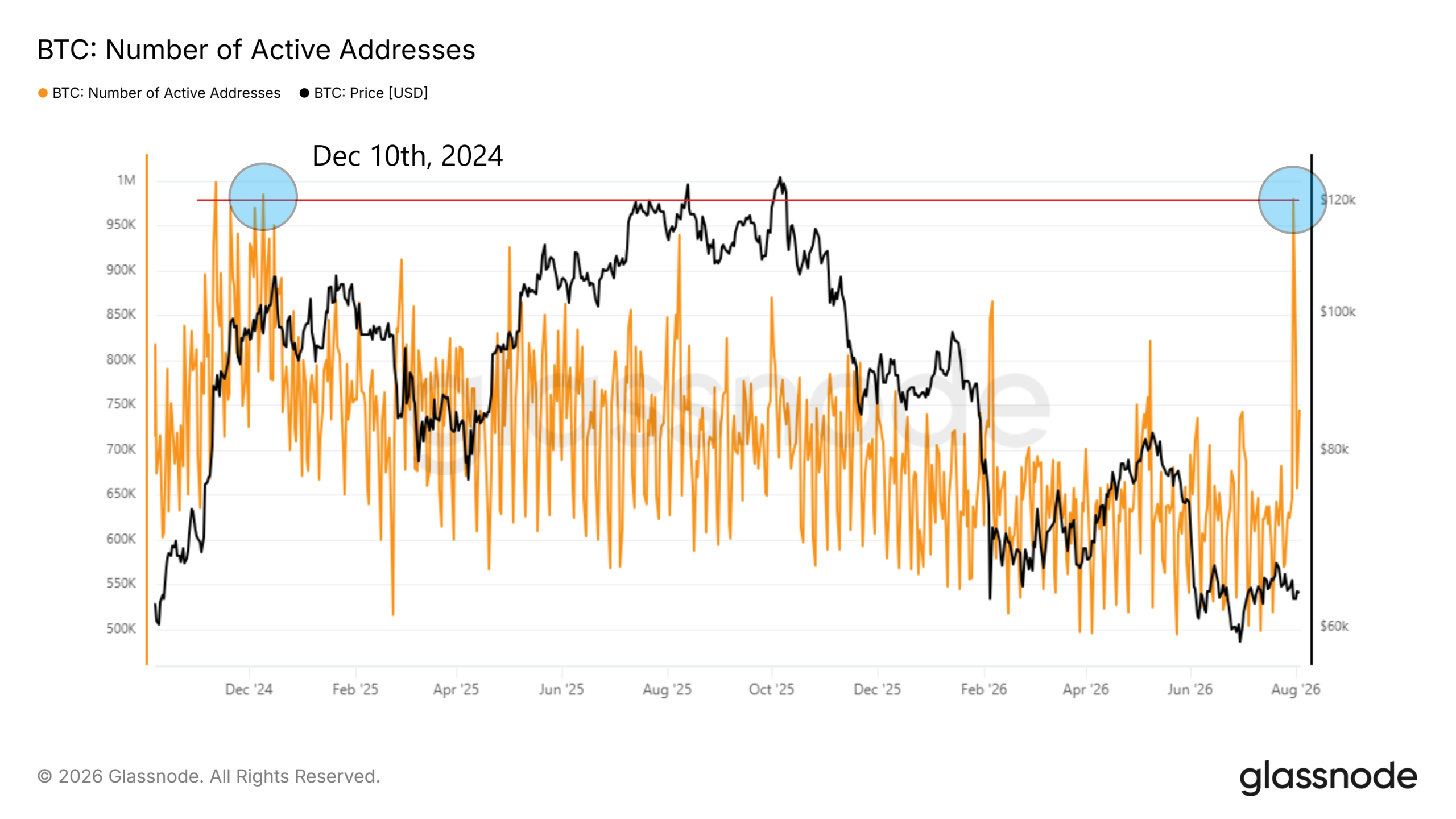
Bitcoin (BTC) daily active addresses jumped from 645,000 on July 30 to nearly 1 million on July 31. The reading was the highest since December 10, 2024, and the Coldcard panic, not new demand, drove it.
BTC traded at $60,347 at press time, up 1.24% in 24 hours, BeInCrypto data shows. Three on-chain charts reveal what holders actually did during a weekend of severe stress for self-custody.
Nearly 1 Million Addresses Moved, the Most Since December 2024
Glassnode data shows about 980,000 active addresses on July 31, up more than 50% in a single day. The jump came days after attackers began draining Coldcard hardware wallets through a flawed random number generator.
Three confirmed attack waves have been linked to 1,367 BTC, worth $88.6 million, stolen from 4,585 addresses. A suspected fourth wave has since swept over 380 BTC more.
The last time this many addresses moved, on December 10, 2024, bitcoin traded near $100,000 during a euphoric rally. This time, the same activity arrived with BTC around $60,000. Same metric, opposite emotion.

CryptoQuant Head of Research Julio Moreno noted on X that sending addresses drove nearly all of the growth. Receiving addresses barely moved in proportion, which suggests consolidation. Thousands of wallets emptied toward a much smaller set of destinations.
Historically, active addresses had churned between 550,000 and 750,000 for most of 2026. Therefore, the spike reads as a one-off event rather than a new trend.
Small Holders Moved the Most BTC Since the FTX Collapse
CryptoQuant’s Spent Output Value Bands point to who panicked. Transfers below 1 BTC totaled 39,600 BTC on July 31. The only comparable daily reading came on November 16, 2022, at 39,900 BTC, days after FTX failed.
These bands capture retail-sized wallets, exactly the profile of Coldcard’s user base. One holder lost 18.25 BTC, worth $1.6 million, in under seven minutes. Stories like his pushed thousands of users to act.
Moreno framed the migration as a healthy reflex rather than capitulation.
“The Bitcoin plebs had not move[d] this amount of BTC in a day since the FTX collapse… I like to see that people seem to be taking action.”
He shared the observation on X on August 1.

However, the direction of travel has reversed since 2022. Back then, users pulled coins off exchanges and into cold storage. This time, a cold storage failure sent coins the other way. The reversal feeds the self-custody debate that Binance founder Changpeng Zhao reignited this week.
Many Wallets, Few Transactions. The Anatomy of the Coldcard Panic
The third chart completes the picture. Glassnode counted 761,796 transfers on July 31, a local spike but far from a record. Prior peaks on December 13, 2024, April 19, 2025, and May 9, 2026, all cleared 1 million transfers.
The divergence matters. Active addresses hit a 20-month high while transfer counts stayed inside their ordinary range. In other words, an enormous number of wallets moved, but each made only one or a few transactions.

That is the anatomy of a mass emergency sweep, not an activity boom. In contrast, earlier transfer records came from concentrated, high-frequency churn by far fewer entities.
Galaxy Research head Alex Thorn observed sweep transactions running at 13.8 per block, roughly 45 times the pre-incident baseline. The shock even reached protocol politics, as developers postponed the BIP-110 soft fork activation, citing the incident.
The Chain Recorded Fear, Not a Trend
Raw on-chain metrics will look distorted for days. Analysts may prefer entity-adjusted data until sweep activity fades, and active addresses could normalize just as sharply as they spiked.
Notably, the price barely reacted. Bitcoin held near $60,000 through its most active day in 20 months. That calm suggests the moved coins fled risk rather than sought exits.
The next signal to watch sits on the exchange books. If migrated coins stay put, the episode remains a security story. If they start selling, the Coldcard panic could yet become a market story.
The post Bitcoin’s Most Active Day Since 2024. What Happened On-Chain During the Coldcard Panic appeared first on BeInCrypto.



There are 15 separate attackers draining BTC from Coldcard customers’ hardware wallets, Galaxy Research concluded on Tuesday morning — and more thieves seem to be arriving by the day.
As the exploitation of last week’s newly-discovered firmware flaw continues, estimated victim losses have topped $130 million from 7,300 wallets and rising.
Given the number of affected wallets, there are probably thousands of victims, and many long-term holders might not even be aware of their losses. Galaxy Research has heard from 73 victims as of Monday.
The fifteenth attacker surfaced overnight after an owner reported losing less than a single BTC. That report led Galaxy to identify an uncatalogued attacker who had already pulled 12 BTC out of 126 wallet addresses.
Galaxy filed the attacker’s on-chain behavior under footprint “O,” the fifteenth letter of the alphabet.
Researchers are labeling each footprint as victims come forward, and the letters are still going up.
Because the vulnerability is public knowledge, any hacker with sufficient knowledge and computational power can join the crime wave.
Stealing money from Coldcard users simply requires scanning Bitcoin’s blockchain for vulnerable wallets and brute-force guessing of private keys that have low entropy due to Coldcard’s faulty firmware.
Read more: What to do if you’re a Coldcard victim
The Coldcard attack keeps getting worse
Coldcard firmware routed wallet seed generation into MicroPython’s software fallback, a pseudo-random number generator rather than true random generator.
Coinkite, the device manufacturer, estimates that the seed phrases its devices generated contained only “about 40 bits” on its Coldcard Mk2 and Mk3 models — far below its 128-bit target.
Later models like Coldcarrd Mk4 land at “about 72 bits,” the company concedes — still far lower entropy than is required to protect customers from brute-force computation.
Unfortunately, the public keys associated with these weak private keys sit on a public ledger accessible on a worldwide, permissionless basis. The opening wave of thefts occurred last week, a few hours before Coinkite issued any advisory.
Coinkite co-founder Rodolfo Novak wrote on July 31, “We take full accountability for the firmware bug and we offer our sincere apologies to those affected.” Coinkite has since shipped hotfixes for every affected model and release track.
It warned again today, “The threat is still active.”
Affected wallet owners must move their BTC to safekeeping. “Updating the firmware does not repair a seed that was generated by affected firmware,” the company notes in its post-mortem.
Interestingly, the hackers are keeping most of their BTC without immediate attempts to spend or liquidate their ill-gotten proceeds.
Galaxy reports that “90% of stolen coins haven’t moved. 100% of coins in Waves 1, 2, and 3 have not moved.”
Law enforcement departments around the world are investigating the criminal activity. If you’re a Coldcard victim, consider reporting your loss to local and federal officials.
Got a tip? Send us an email securely via Protos Leaks. For more informed news and investigations, follow us on X, Bluesky, and Google News, or subscribe to our YouTube channel.
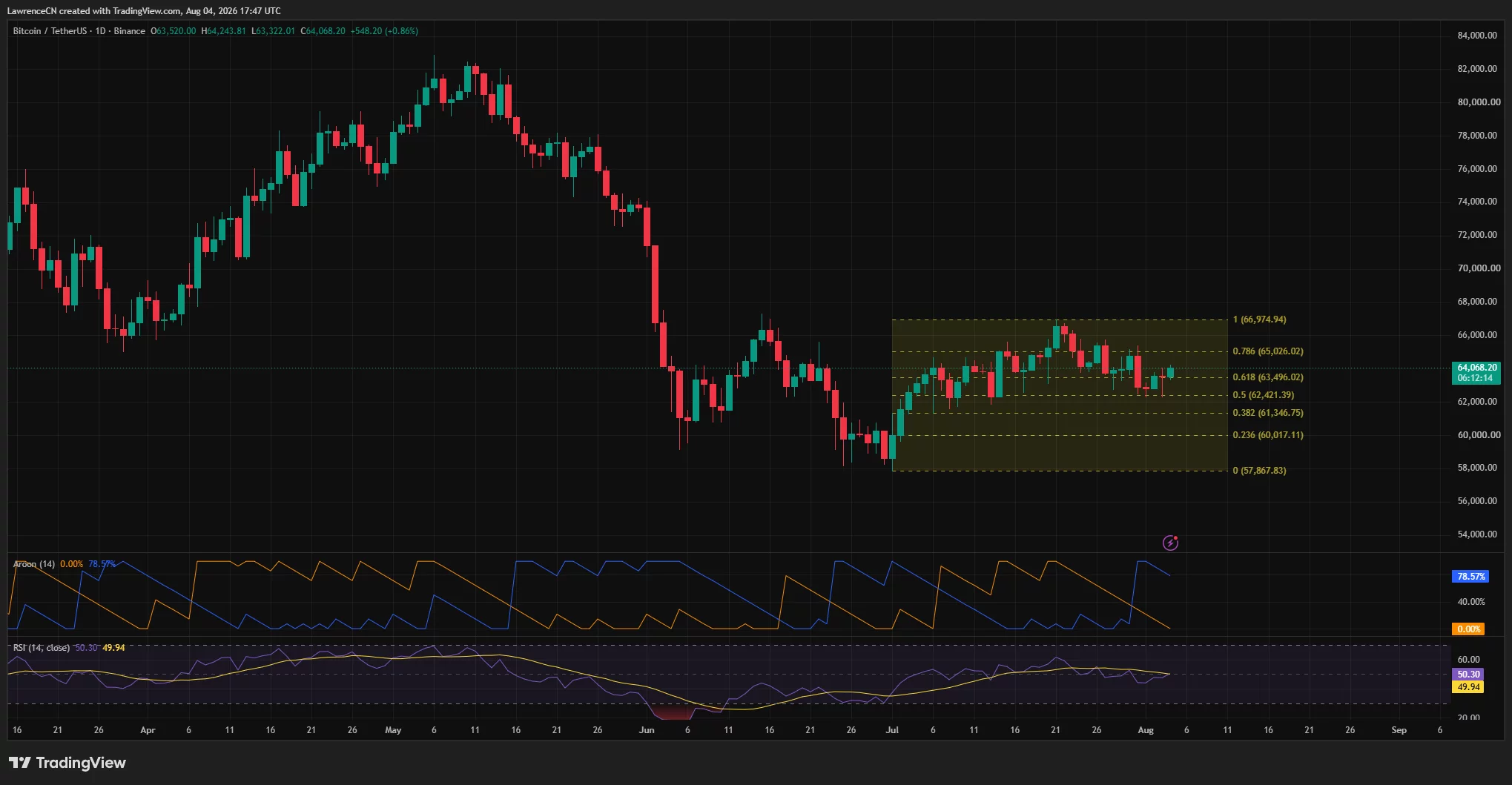
Bitcoin price rebounded above $64,000 as Qatar reported progress in efforts to restart US-Iran negotiations, while technical charts pointed to a possible breakout from a descending channel.
Summary
- Bitcoin price recovered from $62,400 to above $64,000 as geopolitical concerns eased.
- A 4-hour close above $64,300 could open a move toward $65,500 and $66,500.
- Sell orders between $64,000 and $65,000 remain an immediate obstacle for buyers.
- Liquidation liquidity is concentrated near $62,000, raising the risk of another downside sweep.
Bitcoin price rebounds above $64,000
According to data from crypto.news, Bitcoin (BTC) price traded near $64,100 late Tuesday, recovering from an intraday low around $63,300 and extending its rebound from the $62,400-$62,500 support area.
The daily chart showed BTC closing above the 61.8% Fibonacci retracement level at $63,496. Holding this threshold would keep the recovery structure intact and allow buyers to target the 78.6% retracement at $65,026.
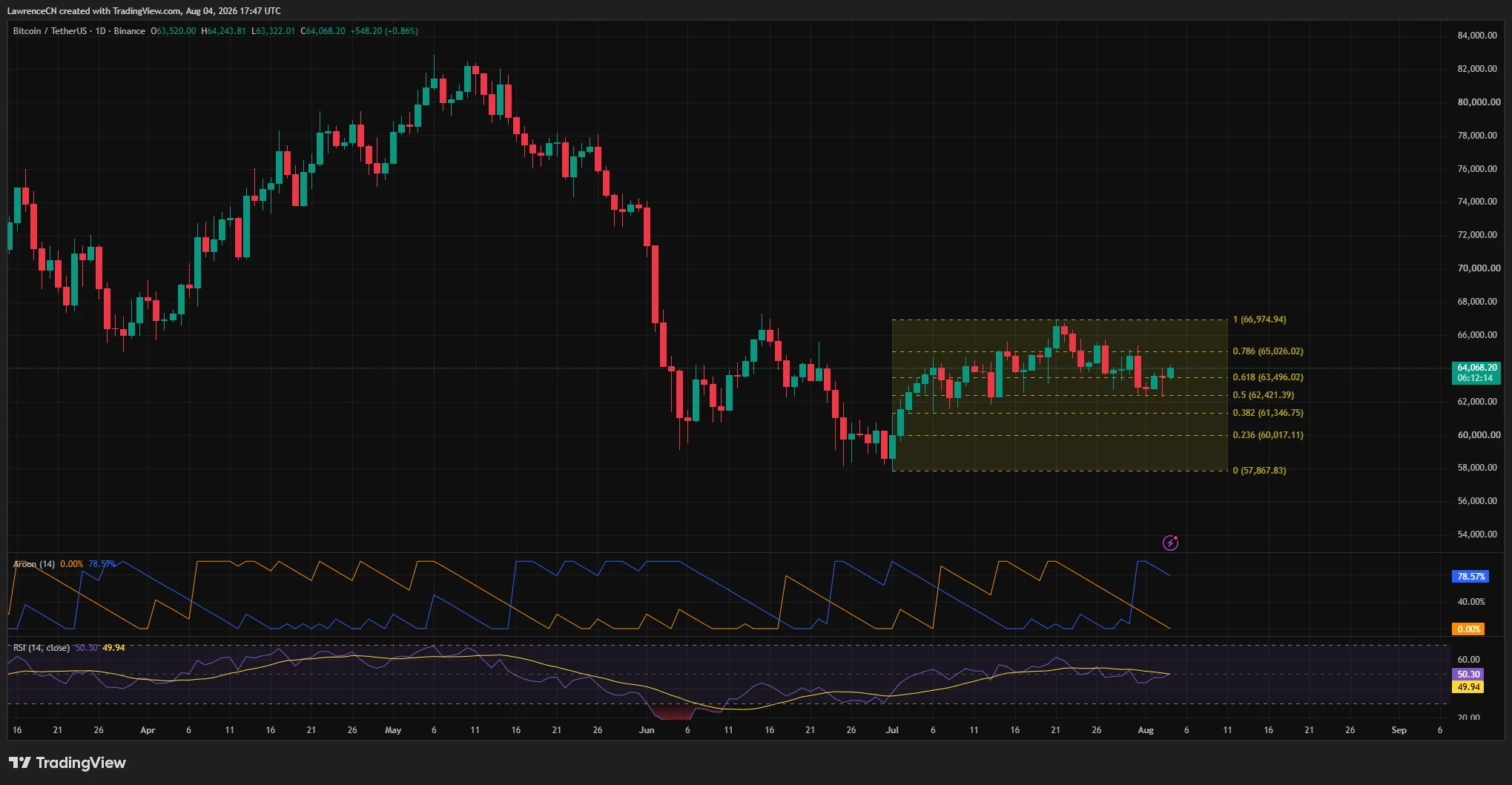
Momentum has also improved. The daily Relative Strength Index stood at 50.30, moving slightly above its signal line at 49.94. The reading places Bitcoin in neutral territory and suggests neither buyers nor sellers have full control.
The Aroon indicator offered a more positive signal. Aroon Up stood at 78.57%, while Aroon Down fell to zero, showing that recent highs are becoming more relevant than recent lows.
However, Bitcoin remains inside a broader consolidation range between approximately $57,868 and $66,975. A daily close above $65,026 would strengthen the short-term recovery, but the July high near $66,975 remains the larger breakout level.
US-Iran talks support demand for risk assets
Bitcoin’s rebound followed Qatar’s confirmation that regional mediators were working to bring the United States and Iran back to negotiations.
Qatari Foreign Ministry spokesperson Majed Al-Ansari said Doha wanted conditions in the Strait of Hormuz to return to normal. Qatar, Pakistan, and Oman are exchanging proposals between Washington and Tehran, although no timetable has been set for an agreement.
“What matters to us now is the resumption of negotiations, and to achieve this, a ceasefire and the reopening of the Strait of Hormuz must be guaranteed,” Al-Ansari said.
The diplomatic push has eased some concerns surrounding global energy supplies. The Strait of Hormuz remains one of the world’s most important oil transit routes, meaning any reopening could reduce pressure on crude prices and improve demand for risk assets.
Still, the negotiations remain uncertain. Iran has denied holding direct talks with Washington, describing its discussions as negotiations with Oman. Shipping activity through the strait also remains restricted despite reported diplomatic progress.
For US investors, the outcome could affect Bitcoin through oil prices, inflation expectations, and broader risk sentiment. A ceasefire and restored shipping traffic could support crypto and equities, while another breakdown in talks may renew demand for cash and other defensive assets.
Bitcoin tests descending channel resistance
The 4-hour chart showed Bitcoin testing the upper boundary of a descending parallel channel that has guided price action since the July 21 peak near $66,700.
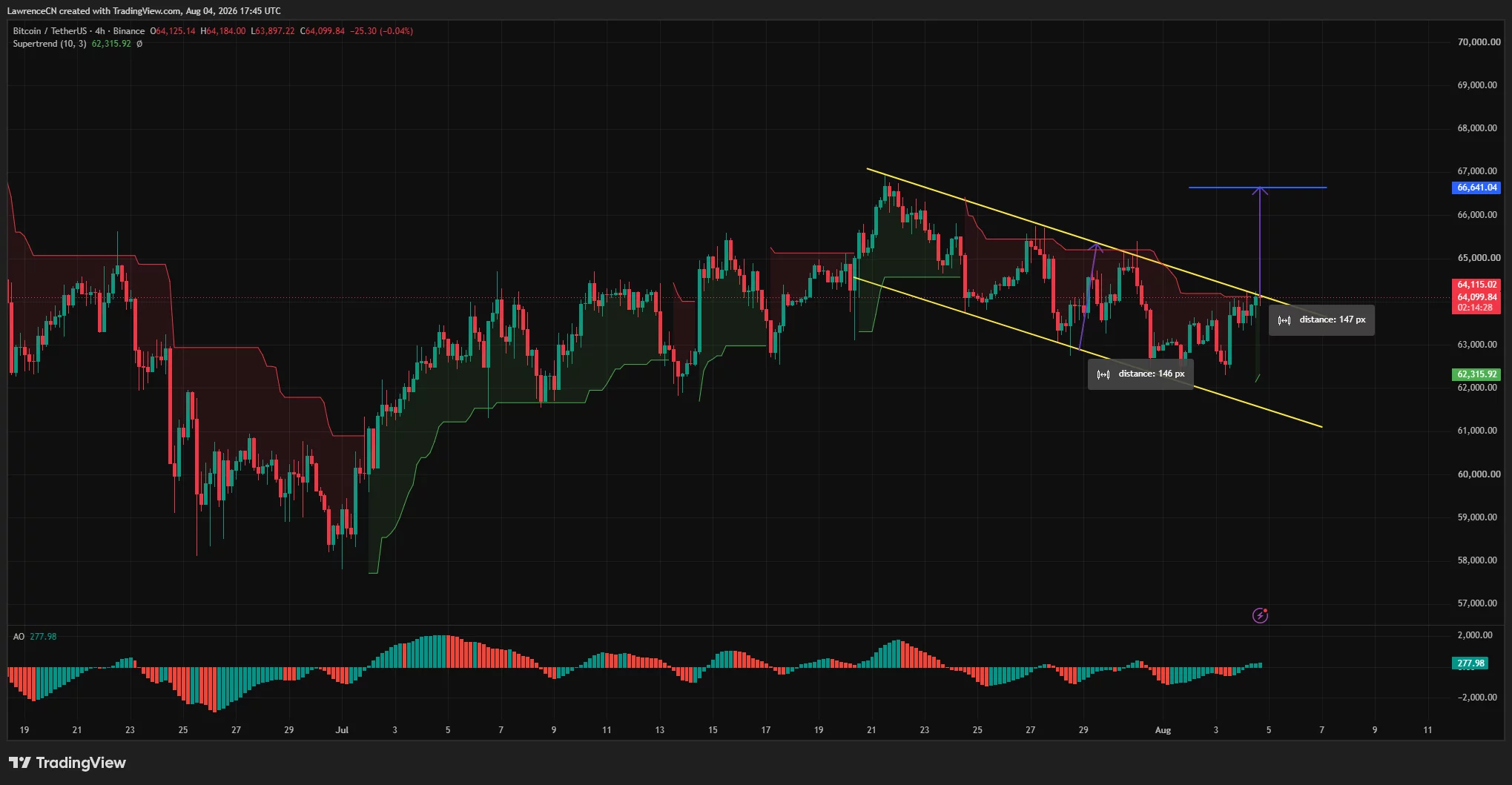
BTC briefly moved above the channel boundary before returning toward $64,100, showing that buyers have yet to confirm a breakout. The Supertrend indicator also placed immediate resistance near $64,115, almost level with the current price.
Analyst Ali Martinez identified $64,300 as the key confirmation level. According to Martinez, a 4-hour close above that price could validate the channel breakout and open the way toward $65,500 or $66,500.
The Awesome Oscillator climbed to 277.98 and printed rising green bars, indicating that bullish momentum was building on the 4-hour timeframe. However, momentum alone may not be enough if Bitcoin fails to absorb overhead supply.
Order-book data shared by analyst Ted Pillows showed large sell orders appearing between $64,000 and $65,000. This supply helps explain why BTC has repeatedly struggled to extend gains above the current range.
A confirmed break above $65,000 would place the next targets at $65,500 and $66,641. Failure to clear the channel could send the price back toward $63,500 and the 4-hour Supertrend support near $62,316.
Liquidation map keeps $62,000 in focus
The one-week Bitcoin liquidation heatmap showed a large concentration of leveraged positions near $62,000. It was the brightest liquidity band below the current price and may attract price if the recovery loses momentum.
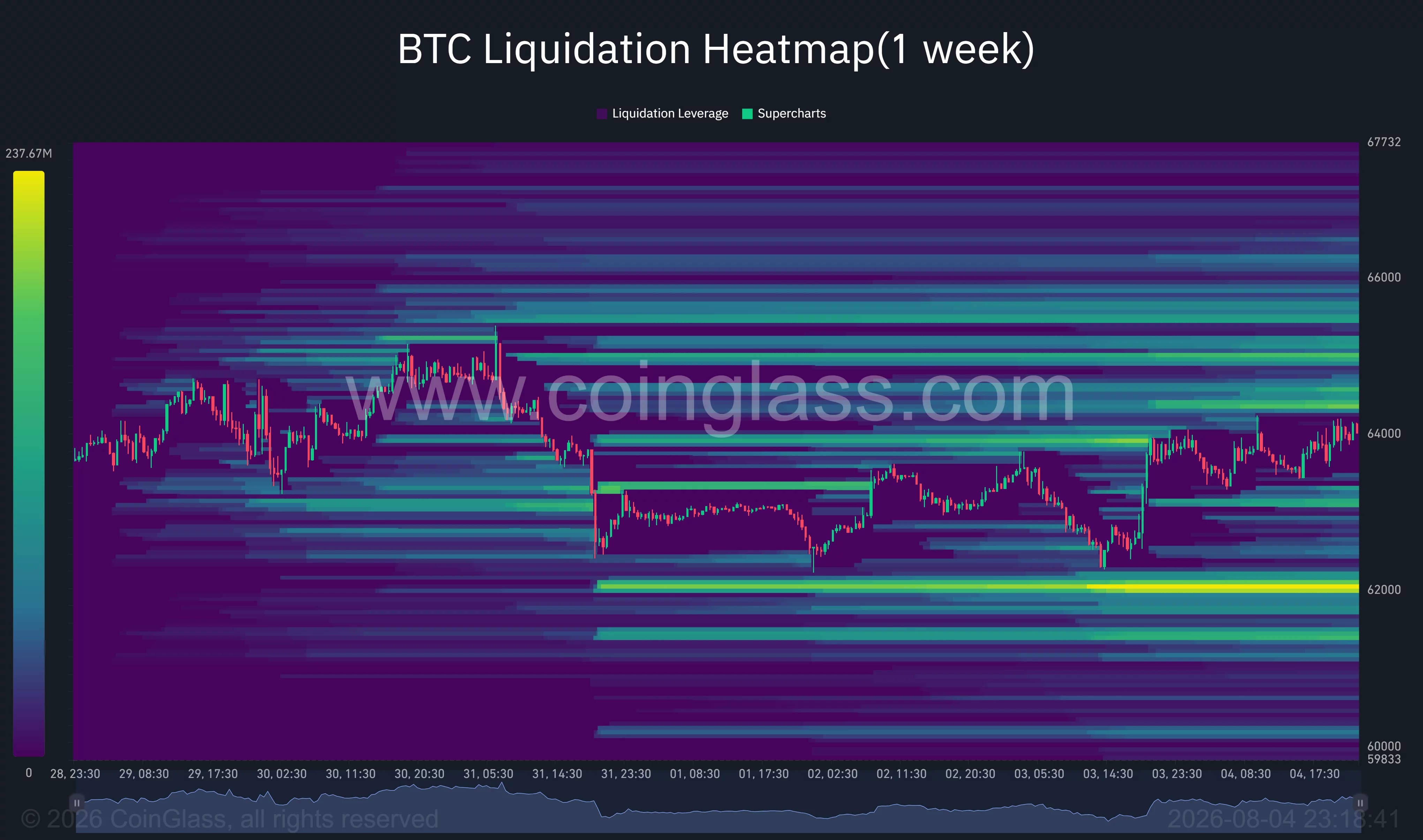
Smaller liquidity clusters appeared around $63,000, while several bands were visible above Bitcoin between $64,500 and $66,000. These levels could fuel a short squeeze if BTC closes above $64,300 and forces bearish positions to exit.
The bullish scenario depends on Bitcoin holding $63,496 and breaking the $64,300-$65,000 supply zone. That would support targets at $65,500, $66,500, and eventually $66,975.
The bearish scenario begins with a loss of $63,500. Such a move could expose $62,421, followed by the liquidation cluster near $62,000. A deeper decline would bring the $61,347 Fibonacci level back into focus.
US-Iran diplomacy may determine which liquidity zone Bitcoin reaches first. Continued progress toward a ceasefire could support a breakout, but stalled talks or renewed disruption in the Strait of Hormuz would leave the recovery vulnerable.
Disclosure: This article does not represent investment advice. The content and materials featured on this page are for educational purposes only.
Crypto World
Philadelphia Fed President Paulson content with current rates, but keeping an open mind
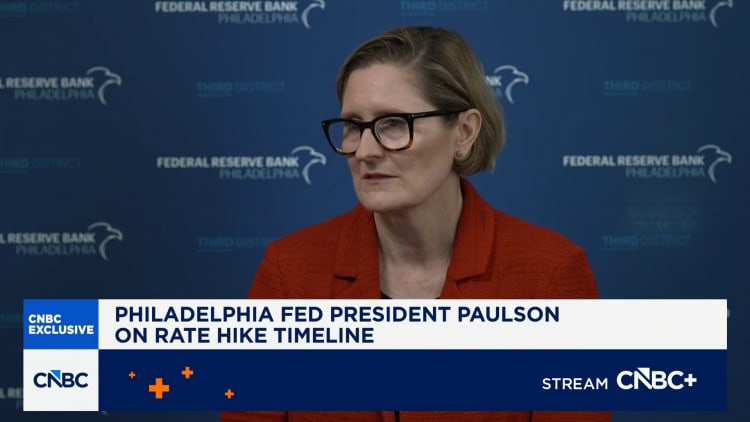

Philadelphia Federal Reserve President Anna Paulson said Tuesday that she thinks the current level of interest rates is sufficient to keep inflation moving toward the central bank’s goal.
In her first CNBC interview, the policymaker insisted she has an open mind about where monetary policy should go, but was confident in her vote last week to keep the Fed’s benchmark borrowing rate anchored at its current target level of 3.5%-3.75%.
“I think we need … policy that’s mildly restrictive, and I think policy has been mildly restrictive to get underlying inflation back down to 2% in an acceptable time period,” Paulson told CNBC’s Steve Liesman during a “Squawk Box” interview. “I need to see progress from here.”
The level of restriction that the current policy level is having on the economy is a key debate point for Fed officials, who have held rates steady all year as inflation has stayed well above the 2% target.
At last week’s meeting, the Federal Open Market Committee, of which Paulson is a voting member, opted by a 9-3 tally to keep the hold on rates. Dissenting voters questioned whether the current rate level is sufficiently restrictive to bring inflation lower.
However, Paulson said voting with the majority wasn’t a tough decision.
“For me, it was not a close call,” she said, adding that she thinks underlying inflation outside of energy supply shocks, tariffs and other factors is around 2.4%-2.8%. The core inflation level that the Fed uses as its primary forecasting tool was 3.3% in June, the Commerce Department reported Thursday.
If that level doesn’t move lower, then Paulson said she’ll be open to adjusting rates.
“Maybe there was a little bit of mild progress over the last several months, but I want to see more progress on that, and that’s what I’m really focused on,” she said. “If we don’t see that progress, then we have to be open to recalibrating monetary policy. You know, we need to get to 2%.”
Paulson added she is keeping an “open mind” about some of the changes Chairman Kevin Warsh has discussed, including the potential to reduce the frequency of FOMC meetings from the current level of eight per year.
“It’s healthy to have a discussion about that,” she said.


You’ve probably heard that getting some morning light can help you feel more awake during the day and sleep better at night—from your doctor, your sleep app, and roughly 900 podcasts. But you might not realize just how much it matters. “Morning light is arguably more important than your coffee,” says Mariana Figueiro, director of the Light and Health Research Center at the Icahn School of Medicine at Mount Sinai.
Morning light shifts the body clock earlier, which can make it easier to feel sleepy at night and alert when it’s time to wake up. In a study of more than 400,000 adults, people who spent more time in outdoor light during the day reported fewer insomnia symptoms, less tiredness, and an easier time getting up in the morning.
What you may not have heard is exactly how to get it: where to position yourself, how early in the morning to start basking, and how long to take in the rays. Without that knowledge, the advice to “get more morning light” is surprisingly hard to put into practice.
Here’s what researchers say about how to get the right dose of morning light.
How morning light helps you wake up—and sleep at night
The amount of light reaching your eyes is measured in lux, and by that measure, most morning routines happen in near-darkness. A dimly lit bedroom might clock in at 30 to 40 lux. A brightly lit kitchen might reach 500. Step outside on an overcast morning, and you’re standing in 5,000 to 10,000. “You’re looking at orders of magnitude more light when you’re outside,” says Jamie Zeitzer, a circadian physiologist and professor of psychiatry and behavioral sciences at Stanford University.
Sitting directly beside a window and looking out might expose you to around 1,000 lux. That’s a fraction of what’s available outdoors, but, as Zeitzer puts it, “even by a window, it’s much brighter than what you’re going to get from most interior lighting sources.”
Light can have an immediate effect, too. It’s “an alerting stimulus to the brain,” Figueiro says, which can help you feel more awake in the moment.
Its longer term effect comes down to a small structure in the brain called the suprachiasmatic nucleus, which serves as the body’s central circadian clock. When light reaches the retina, it sends a signal directly to that clock—and early in the morning, the signal helps nudge it forward. It needs that nudge: The average human clock runs about 24 hours and 11 minutes, which means it would naturally drift a little later each day without light and other signals keeping it synchronized with the outside world.
A well-synced clock does more than govern sleep. Its real job, Zeitzer says, “is allowing your body to anticipate things as opposed to responding to them”—preparing you to wake up, eat, exercise, and wind down instead of scrambling to adjust after the fact. Without that anticipation, your body still functions, of course; just a little less efficiently. “It’s not like if you didn’t have a clock, you drop dead,” he says. “But it’s all less well optimized.”
Many people aren’t giving their clocks much natural light to work with. We tend to overestimate how much time we spend outside, Zeitzer says; for many of us, outdoor exposure amounts to little more than walking to and from the car.
How to get enough morning light
Try to get light within an hour of waking. “You want to have it as soon as you get up,” Figueiro says. What matters is how soon you get it after waking, not the particular time on the clock.
Going outside is best. But if you’re sitting near a window, position yourself close to the window and face it, rather than having it be beside or behind you. “You want to get it at the back of the eye, not at the back of the head,” Figueiro says. Light levels drop quickly as you move away from the glass: You might get around 1,000 lux right beside a window, compared with only a few hundred lux from several yards away. If you work from home, simply turning your desk toward the window can make a meaningful difference.
How long should you stay there? There’s no magic number, but both researchers agree that longer is better. Figueiro recommends at least 30 minutes and ideally an hour. Zeitzer considers 15 minutes a practical minimum. “Technically, with 5 minutes you can get a good effect, but that’s in a lab, and it’s probably not in the field,” he says.
If you want one simple target, aim for 30 minutes of morning light, Figueiro says. Sitting beside a window counts, but going for a half-hour walk after daybreak is even better. “That’s ideal,” she says. “You get your exercise, you get your light, you’re all set for the day.” And wear sunscreen as usual: It won’t blunt the circadian effect, which is driven by light reaching cells in the retina rather than the skin.
Try to get that light at roughly the same time every morning. “Your clock likes that regularity,” Figueiro says. She also leaves her sunglasses off during her morning commute when the light is comfortable, allowing her to take advantage of that exposure.
Give the habit some time to work. Your body clock will begin adjusting within a few days, Zeitzer says, but it might take a few weeks before you notice a difference in your sleep.
How to get morning light when the sun isn’t up
What if you wake up at 5 a.m., work in a windowless office, or look out at what Zeitzer describes as “a brick wall 15 feet across an alley”? You’ll need to create more light indoors.
The easiest place to start is with a brighter bulb. Bulb packages list brightness in lumens, a measure of how much light the bulb produces. A standard one typically produces about 800 to 1,000 lumens; Figueiro recommends looking for one that produces at least 3,000. Place the lamp no more than an arm’s length away, and make sure its shade is translucent, not opaque, so the light can reach your eyes. The bulb doesn’t need to give off cool or bluish light. If you prefer warm light, that’s fine, Figueiro says—the brightness is what matters most.
If a brighter lamp isn’t enough, or you don’t have access to a window, consider a light-therapy box. Zeitzer prefers natural light—“it’s much nicer looking out your window,” he says—but considers a light therapy box a reasonable alternative. Turn it on while you drink your coffee or eat breakfast so it becomes part of your usual routine.
And don’t assume an overcast morning is too dark to be useful. Most of us underestimate how much brighter it is outside: In one study, researchers found that even under cloudy or partly cloudy skies, outdoor light was dozens of times brighter than indoor light. If you can’t go out, sit close to the window and face it; turning on the room’s other lights can help, too.
Getting enough light in the morning is only part of the equation for better sleep. Figueiro also recommends dimming the lights about two hours before bedtime. Your body clock responds to the contrast between day and night, she says, so too much evening light can “in a way cancel out the benefits of the morning light.”
Think of the formula as brighter mornings and darker evenings. Tomorrow, you can start by turning your coffee—and yourself—toward the window.


At least 15 different attackers have exploited the Coldcard vulnerability, according to Galaxy Digital’s head of research, Alex Thorn, citing new victim reports received since the incident.
Thorn said Tuesday that the victim reports helped the company label new attackers that would have gone undiscovered, as the nature of the exploit was different from a hack on a centralized exchange.
“Due to one single victim’s report of less than 1 BTC stolen, we identified a new attack with 12 BTC siphoned from 126 addresses,” Thorn wrote in a Tuesday X post.
The estimated losses from the Coldcard exploit have grown to $100 million across three confirmed attack waves, according to Galaxy Research. The company also identified a suspected fourth wave that could bring total losses to about $130 million in Bitcoin (BTC).
The ongoing attack reignited debate about the security of cold storage wallets and whether users are safer by holding their own Bitcoin.
$2 worth of AI hardening could have prevented the exploit: Dragonfly partner
Roughly “$2 of AI hardening” could have prevented the Coldcard exploit, wrote Dragonfly managing partner Haseeb Qureshi, citing social media reports that some AI models rediscovered the vulnerability that led to the attack in less than 20 minutes.
Qureshi’s remarks came in response to multiple social media users claiming that Claude was able to regenerate the vulnerability in just eight minutes. He argued that these results may have been contaminated by web search and added that open-source AI model GLM 5.2 was able to rediscover the attack in 20 minutes with web access turned off.
However, it is unlikely that AI models would have independently discovered this vulnerability before it was made public, crypto analytics platform Tokenomist’s data lead, Tatsapat Saerejittima, told Cointelegraph. He said:
“The claim that AI found it in 2 mins came from a pseudonymous Reddit user who scanned the code after the vulnerability had already become public. There was no blind test, no documented methodology, and no assessment of the model’s false-positive rate.”
Related: AI has not triggered DeFi ‘hackpocalypse,’ Dragonfly partner says
Vulnerability seen in private key setup
Crypto research company Castle Labs’ co-founder, Francesco, said that the growing capabilities of AI models are drastically reducing the cost and time it takes to discover new cryptocurrency vulnerabilities, but added that Coldcard’s private key may have played a role in the vulnerability.
Coldcard used a “level of private key entropy (40 bits) much lower than the standard adopted by other wallets (a 12-word seed is 128 bits), a result of a firmware bug, making the job easier,” he told Cointelegraph.
Francesco, who asked that Cointelegraph not use his last name, said he expects the cost of bug discovery to continue decreasing as AI models gain more capabilities and become more prominent in both cybersecurity and exploits.
Magazine: Does Botanix’s failure prove Bitcoiners don’t care about DeFi?
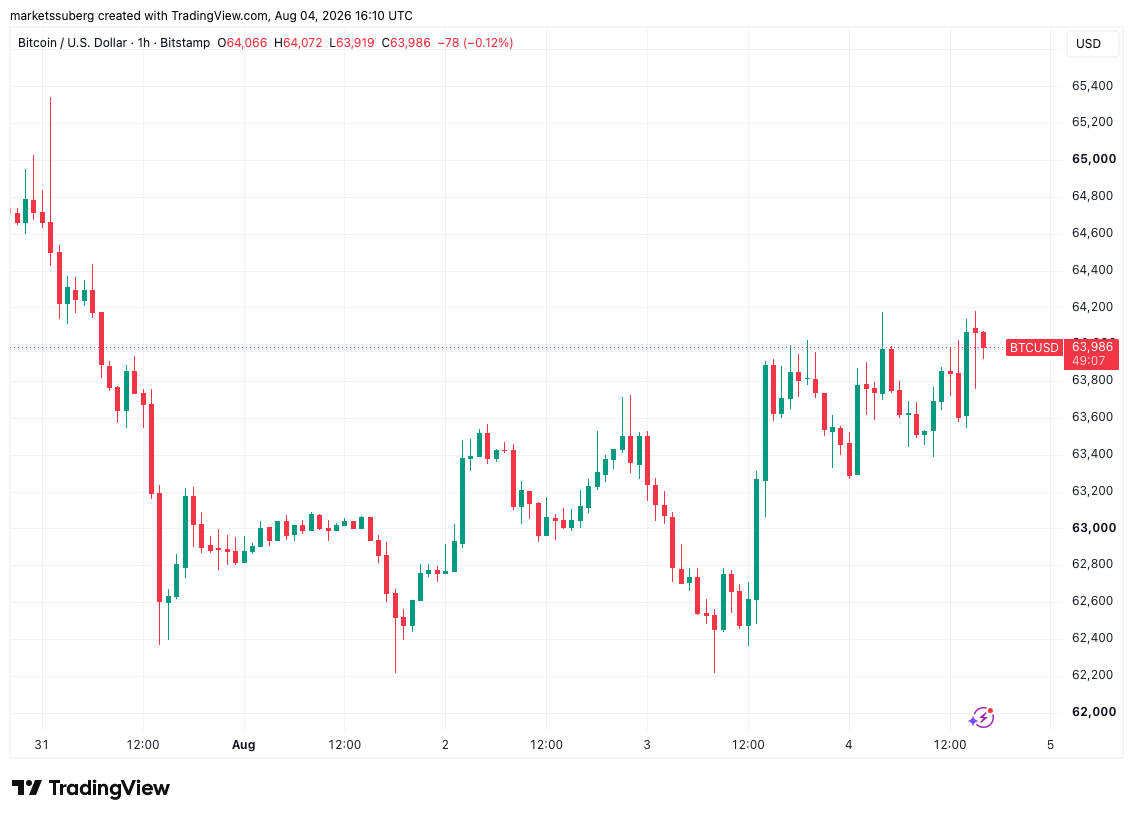
Bitcoin saw new August highs into Tuesday’s Wall Street open as markets bet on US-Iran tensions again easing.
Key points:
- Bitcoin (BTC) edges higher as optimism over the Strait of Hormuz reopening pushes stocks to new all-time highs.
- Oil prices drop to their lowest levels since July 13 with oil traffic potentially returning on Wednesday.
- BTC acts between two daily moving averages as analysis sees “strong accumulation.”
S&P 500 tops $70 trillion market cap to new high
Data from TradingView showed BTC/USD climbing to $64,176 on Bitstamp, marking maximum daily gains of around 1%.
BTC/USD one-hour chart. Source: Cointelegraph/TradingView
Oil prices reacted immediately after US Treasury Secretary Scott Bessent suggested that traffic through the Strait of Hormuz could restart as soon as Wednesday.
Bessent told CNBC that there was “a chance we may have a deal today or tomorrow to open the Strait and move towards a more normalized position” in the US-Iran war amid ongoing talks between the two sides.
The comments came a day after US President Donald Trump confirmed the waterway reopening dialogue, saying that this could happen “as soon as tomorrow.”
WTI and Brent crude traded 4.8% and 4.6% lower, respectively, at the time of writing, hitting their lowest levels since July 13.
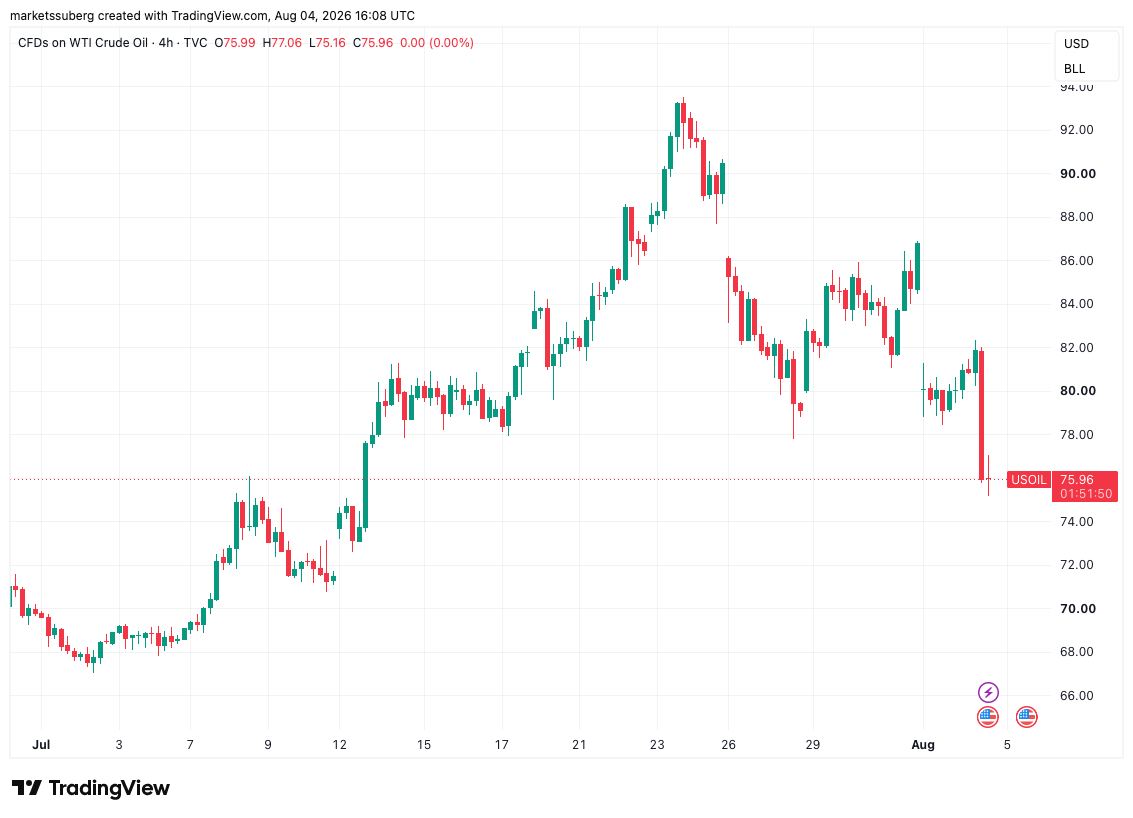
CFDs on US WTI crude oil four-hour chart. Source: Cointelegraph/TradingView
US stocks futures gained prior to the open, which in turn saw the S&P 500 index hit a new record high of 7,713, with its market cap reaching $70 trillion for the first time.
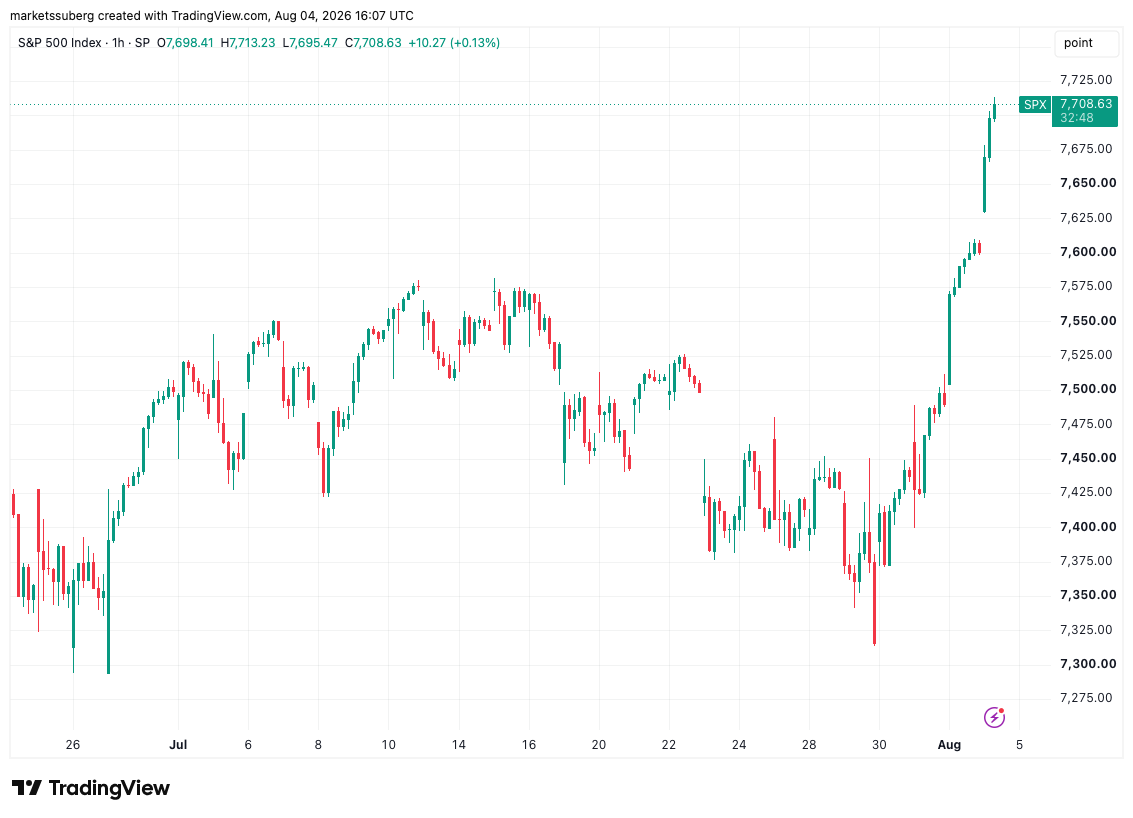
S&P 500 index one-hour chart. Source: Cointelegraph/TradingView
Analysts noted resolution of the Hormuz closure as one factor apt to influence market sentiment when it came to future Federal Reserve policy decisions. Amid an emerging hawkish split between Fed officials on interest rates, markets see 56.7% odds of central bank policymakers approving a 0.25% rate hike at its September meeting, per data from CME Group’s FedWatch Tool.
“Chairman Kevin Warsh’s limited guidance on the Fed’s reaction function means upcoming data, oil prices and the bond market will have a greater influence on the market’s expectations for the policy path,” Bloomberg macro strategist Michael Ball said.
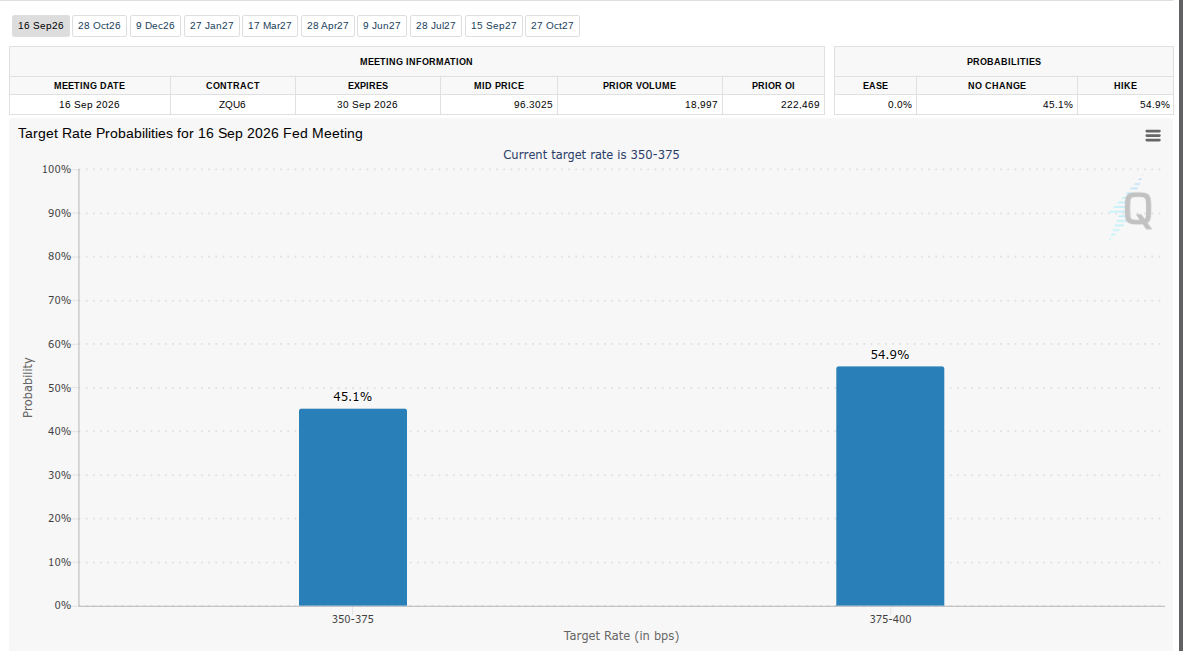
Fed target-rate probabilities for September FOMC meeting.
Source: CME Group
BTC accumulation “strong” in stubborn local range
Bitcoin price action remained comparatively subdued compared to stocks as BTC/USD passed $64,000.
Related: US yen intervention puts Bitcoin, risk assets on notice for liquidity flux
The pair remained held in check by its 21-day simple moving average (SMA) at $64,388, while its 50-day SMA functioned as support on hourly time frames.
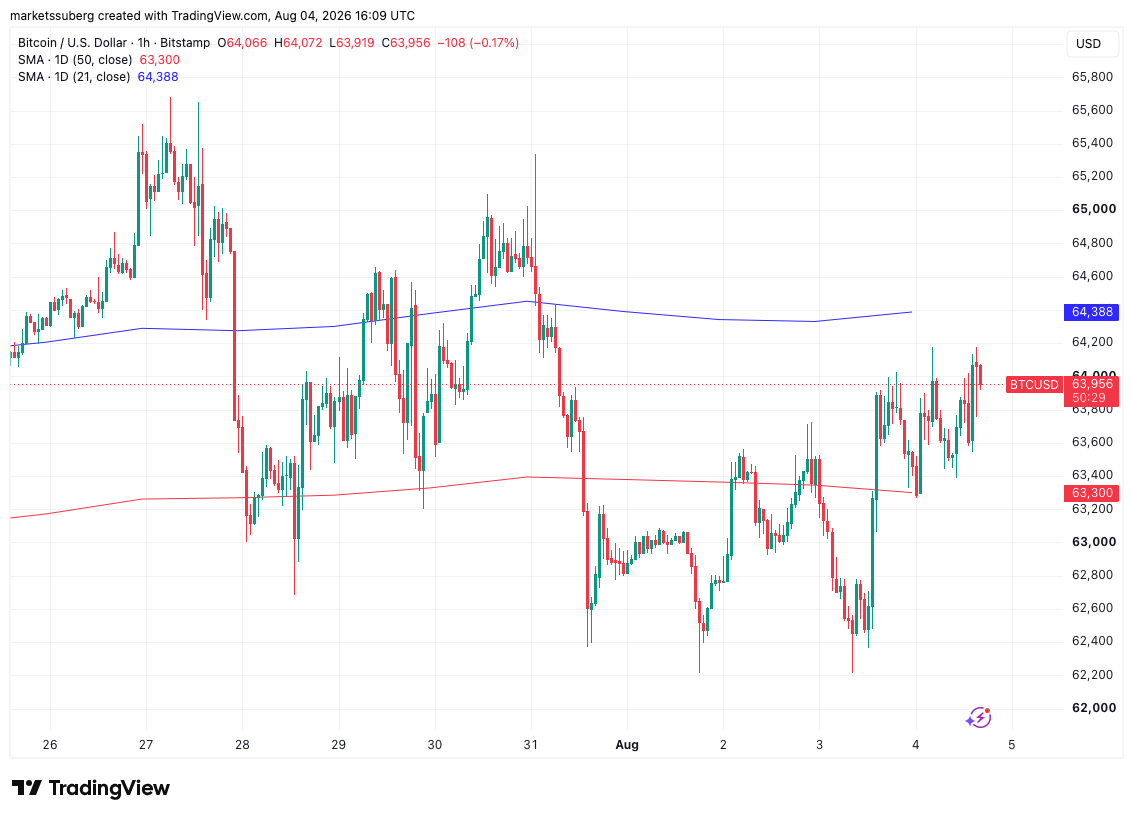
BTC/USD one-hour chart with 21-day, 50-day SMA.
Source: Cointelegraph/TradingView
With price rangebound, analysis from onchain analytics platform CryptoQuant reported “strong accumulation” among investors. 0.7% of the BTC supply, equivalent to around 155,000 coins, now belongs to investors with a cost basis between $62,000 and $65,000.
“This points to absorption rather than capitulation, as buyers accumulated into weakness,” it reported on Monday.
Magazine: How Fake World Assets and onchain gacha became crypto’s latest craze


Kalshi has partnered with compliance technology provider Comply to help financial firms monitor employee activity on prediction markets as the platform expands its institutional business while fighting a multibillion-dollar lawsuit in New York.
Summary
- Comply clients will be able to monitor employee trades placed through Kalshi’s prediction markets.
- The tools aim to detect possible trading based on material non-public information.
- Kalshi plans to extend the monitoring system to its proposed perpetual futures products.
- New York is seeking at least $36 billion from Kalshi in a separate lawsuit.
Kalshi adds employee trade surveillance
The partnership will integrate Kalshi trading data into Comply’s regulatory software, according to CNBC. Financial firms using the compliance platform will be able to track whether employees are trading event contracts and determine if those positions comply with internal policies.
The monitoring tools are designed to help employers identify suspicious activity, including trades that may involve material non-public information. Companies can also use the system to enforce restrictions on contracts linked to events that employees could influence or know about before the public.
Kalshi already operates an internal market surveillance program. However, conversations with institutional clients showed that firms wanted direct access to employee trading data through the compliance systems they already use.
The planned integration would place prediction market contracts alongside assets such as stocks, bonds and cryptocurrencies that are routinely covered by workplace trading controls. Kalshi also expects the system to monitor its planned perpetual futures products once those contracts become available.
Why compliance matters for prediction markets
Employee monitoring could address a major concern for banks, asset managers and other regulated financial firms considering prediction market exposure. Event contracts can cover elections, economic data, corporate developments and other outcomes that may involve sensitive information.
Traditional financial firms generally require employees to disclose brokerage accounts and receive approval for certain trades. Applying similar controls to prediction markets could make it easier for those companies to permit limited participation without creating an unmonitored source of regulatory risk.
The partnership also gives Kalshi a way to present its contracts as regulated financial products rather than conventional bets. Chief Executive Tarek Mansour recently compared the company’s structure to Nasdaq while defending its business during an Aug. 3 CNBC interview.
However, stronger private surveillance does not settle the wider legal debate over whether certain event contracts fall under federal derivatives rules or state gambling laws. That dispute has become central to Kalshi’s expansion in the United States.
Kalshi faces $36B New York lawsuit
New York Attorney General Letitia James sued Kalshi on July 31, seeking at least $36 billion in damages, penalties and other relief. Mansour said the state’s allegations could threaten the broader event contract industry.
Kalshi removed the proceeding from state court to the U.S. District Court for the Southern District of New York shortly after the complaint was filed.
New York Supreme Court Justice Melissa A. Crane then treated the state’s request for a preliminary injunction as moot because the case was no longer before her court, according to records shared by gaming law attorney Daniel Wallach. The procedural decision did not dismiss or reject the state’s allegations.
The Commodity Futures Trading Commission has also sought federal court intervention to prevent state enforcement against federally registered prediction market operators. Meanwhile, court disputes involving sports event contracts continue to test where federal oversight ends and state gaming authority begins.
Santos case shows surveillance stakes
Kalshi’s monitoring push follows a CFTC settlement involving former U.S. Representative George Santos. Regulators found that Santos made misleading public statements while holding contracts tied to whether he would attend President Donald Trump’s State of the Union address.
Under a July 31 order, Santos agreed to return $17,569.98 in trading gains, pay a $17,500 civil penalty and accept a three-year ban from trading through CFTC-registered entities. He neither admitted nor denied the agency’s findings or legal conclusions.
Kalshi referred Santos’ activity to regulators, showing how platform surveillance can lead to federal enforcement. The Comply partnership would extend part of that oversight to employers, giving institutional clients another way to detect conflicts before they develop into regulatory cases.
The rollout comes as Kalshi seeks approval for additional derivatives products. Its ability to attract financial firms will likely depend on both the effectiveness of its compliance tools and the outcome of legal challenges over prediction markets in the U.S.


Cointelegraph is committed to providing independent, high-quality journalism across the crypto, blockchain, AI, and fintech industries.
All news, reviews, and analyses are produced with full journalistic independence and integrity. For more details on our standards and processes, please read our Editorial Policy.
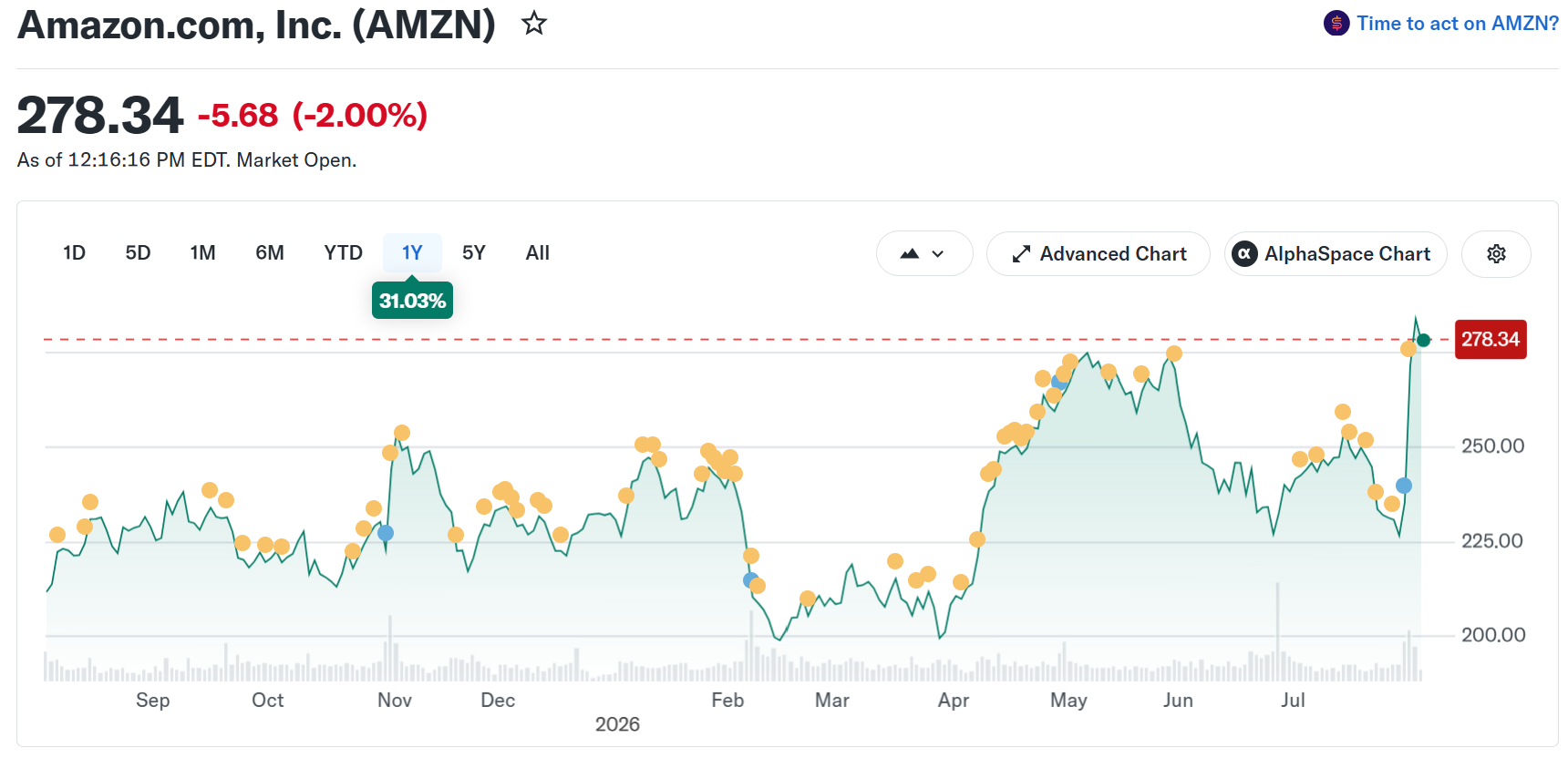
Jeff Bezos wants to sell 15 million Amazon shares. The price tag is about $4.07 billion. Amazon.com Inc. (AMZN) fell more than 2% on Tuesday.
The timing stands out. Amazon had just closed at a record and passed $3 trillion in value for the first time.
Bezos Amazon Stock Sale Was Priced Before the Record
Bezos filed a Form 144. That is the notice an insider files before selling restricted shares.
The notice puts the total value at $4,073,700,000. Divide that by 15 million shares and you get $271.58 each. That was Friday’s closing price, not Monday’s.
Amazon then rose 4.58% on Monday and closed at $284.02, an all-time high. It touched $287.20 during the day.
At Monday’s close, the same shares were worth roughly $4.26 billion. Bezos priced his sale before the record, not after it.
Morgan Stanley Smith Barney will handle the trades on Nasdaq. Bezos received the shares as founder stock in July 1994.
The sales follow a Rule 10b5-1 plan he set up on November 14, 2025. These plans lock in trades months ahead. That shields insiders from claims they traded on private information.
AMZN changed hands near $277.41 late Tuesday morning, down 2.33%. A year ago it closed at $211.65.

Follow us on X to get the latest news as it happens
He Is Selling Less Stock Than He Did Last Year
None of this is new for Bezos. He has filed the same kind of notice repeatedly since 2024.
Here is how his last three compare.
- August 2026, 15 million shares for $4.07 billion, or $271.58 each
- June 2025, 25 million shares for $5.43 billion, or $217.12 each
- November 2024, 16.35 million shares for $3.05 billion, or $186.40 each
So this is his smallest sale by share count. It is his second biggest by dollars.
The stock did that work, not Bezos. Each plan used the same broker and was set months in advance.
AWS Is Why the Price Got This High
Amazon’s second quarter earnings beat started the rally. Sales rose 20% to $200.6 billion. Operating income jumped to $27.5 billion from $19.2 billion.
Amazon Web Services (AWS) is the company’s cloud arm. It grew 37% to $42.2 billion. Its operating income climbed to $16.6 billion from $10.2 billion.
Banks moved fast. More than a dozen raised Amazon price targets. Benchmark went to $400, roughly 44% above Tuesday’s price.
That growth costs money. Amazon spent $54.2 billion on property and equipment last quarter. Over 12 months the bill reached $169 billion.
Free cash flow turned negative, an outflow of $7.6 billion. Other big tech names face the same AI capex draining cash.
Bezos still owned 880,948,653 shares in early May. That is close to 8% of Amazon. This sale trims about 1.7% of his stake.
It reads as diversification, not a warning. The next Form 4 filing will show what the shares actually sold for.
The post Amazon’s $3 Trillion Record Lasts One Day as Stock Takes Big Hit appeared first on BeInCrypto.
Italy’s largest banking group, Intesa Sanpaolo, sharply reduced its reported exposure to BlackRock’s iShares Bitcoin Trust (IBIT) in the second quarter.
While its BTC-related position changed, the bank more than tripled its holdings in staked ETH.
IBIT Holdings Plunges
According to its latest Form 13F, Intesa Sanpaolo held 40,723 IBIT shares as of June 30, which was down 93.7% from the 646,809 reported for March 31. The filing also revealed a major change in its reported call position in the fund. The underlying-share amount linked to its held-call row fell from 2,496,500 shares to 18,000, over a 99% decline.
Meanwhile, a new put position equivalent to 500,000 IBIT shares appeared in the June 30 disclosure. The reported figures, however, do not show that the bank adopted a net bearish strategy on Bitcoin.
Its iShares Staked Ethereum Trust ETF holding rose from 116,200 shares to 349,600. On the other hand, its position in the Bitwise Solana Staking ETF dropped from 2,817 to just seven.
The latest filing comes more than a year after Intesa Sanpaolo made its first direct Bitcoin purchase in January 2025. It bought 11 BTC for about $1.03 million. Back in July 2024, it also used the Polygon network to underwrite Italy’s first on-chain digital bond, worth $25.6 million. Later that year, it began offering options, futures and spot ETFs linked to digital assets through a dedicated desk.
Investors Turn to Ethereum ETFs
The bank’s move is significant as some BlackRock clients have recently made a similar shift. For instance, BSCN said customers of the asset management giant had sold around $60 million worth of the IBIT last week. At the same time, they bought more than $20 million worth of its ETHA spot Ethereum ETF.
While Intesa cut its IBIT position, the broader US spot Bitcoin ETF market has recently moved in the other direction. These funds saw a record monthly net outflow of about $4.5 billion in June. The trend reversed in July, when the funds raked in $172.4 million. That marked a turnaround after two straight months of heavy withdrawals and helped BTC’s prices move back toward $64,000 in the middle of the month.
This sentiment appears to have continued into August, as the ETFs have attracted another $170 million so far. BlackRock’s IBIT remains the leading fund, with almost $61 billion in total inflows since it was first listed.
The post Italy’s Biggest Bank Cuts IBIT Exposure by 94% While Buying More Staked Ethereum appeared first on CryptoPotato.

HUGE! TRUMP TO CANCEL AUGUST RECESS TO PASS THE CLARITY ACT!? (CRYPTO NEWS)

Elle Edwards’ father says early prison release of thug who helped her gunman killer is a ‘massive kick in the teeth’

Institutional investors over-subscribe LIC OFS, govt opts for green-shoe option


-

 Business6 days ago
Why Trees Belong on the Risk Register
-

 Fashion4 days ago
Weekend Open Thread: Wit & Wisdom
-

 Politics4 days ago
Meta enters AI-training agreement with far-right ‘propaganda rag’ Newsmax
-
 Entertainment7 days ago
‘Stargate’ Creator’s New Sci-Fi Series Returns for Season 3 Tomorrow
-

 Crypto World3 days ago
MicroStrategy Post-Earnings CLARITY Act Push Could Add New Catalyst for Its Stock
-

 Politics6 days ago
Reform UK betrays West Mids residents by running from party pledges
-

 Business7 days ago
Major shareholder moves on Canyon
-

 Crypto World4 days ago
XRP Ledger v3.3.0 brings five institutional features
-

 News Videos5 days ago
Bitcoin Enters the 3rd Stage of the Bear Market
-

 Politics2 days ago
Zack Polanski: an incitement to murder Nigel Farage?
-

 Crypto World7 days ago
Kraken Enables Retail Access to Jersey Mike’s IPO via Tokenized Shares
-

 Politics5 days ago
Luke Littler’s dominance sparks GOAT debate
-

 Sports5 days ago
Seema Kaliramna Wins Discus Throw Bronze, Takes India’s CWG Medals Tally To 17
-

 News Videos7 days ago
Claude: Build Financial Dashboards in Minutes (2026)
-

 Crypto World4 days ago
New York sues Kalshi over prediction market gambling
-

 Crypto World2 days ago
Crypto PAC spending tops $2M in Michigan House race
-

 Business7 days ago
Johnson & Johnson agrees to $5.5B settlement over talc cancer claims
-

 Business4 days ago
Trump Announces Hamas Disarmament Agreement as Iran Strikes Kuwait Air Base and US Attacks Pause Overnight
-

 Tech6 days ago
Gemini can now summarize the messiest comment threads in Google Docs
-

 Tech3 days ago
ESET tracks rise in malicious AI skills and adaptable malware
You must be logged in to post a comment Login