

Crypto World
Boerse Stuttgart adds SocGen for EU blockchain settlement



Boerse Stuttgart Group’s Seturion has added Societe Generale, SG-FORGE and flatexDEGIRO to expand blockchain-based securities settlement across Europe.
Summary
- Boerse Stuttgart’s Seturion added SocGen, SG-FORGE and flatexDEGIRO for blockchain-based securities settlement across Europe.
- SG-FORGE will provide EURCV and USDCV stablecoins for settlement under the new Seturion partnership.
- Related reports show European banks are racing to build MiCA-ready stablecoin and tokenization rails.
The May 21 announcement said Seturion will provide settlement for tokenized securities transactions between the partners. The platform is part of Boerse Stuttgart Group and is designed as an open settlement network for banks, brokers and trading venues.
Seturion will support public and private blockchains. It will also allow settlement against onchain money, including MiCA-compliant stablecoins, and central bank money. Boerse Stuttgart said Nasdaq’s European trading venues will also connect to Seturion.
SocGen and SG-FORGE join tokenized securities plan
Societe Generale plans to issue tokenized structured securities through Seturion. These products include turbo warrants and investment certificates, which are expected to trade on European venues connected to the settlement platform.
SG-FORGE, Societe Generale’s crypto-asset unit, will provide its euro and dollar CoinVertible stablecoins for settlement. The release describes SG-FORGE as the first MiCA-compliant stablecoin issuer backed by a major European bank.
Jean-Marc Stenger, CEO of SG-FORGE, said the company aims to connect digital assets with traditional finance. He said “reference MiCA-compliant stablecoins” can help enable secure onchain settlement.
flatexDEGIRO brings retail investor flow
FlatexDEGIRO will connect its European retail investor flow to Seturion. The online broker serves more than 3.5 million customers across 16 countries and processed more than 75 million securities transactions in 2025.
The move gives Seturion access to retail trading activity tied to Societe Generale’s tokenized structured securities. It also gives flatexDEGIRO a role in testing how tokenized products can move through regulated European market pipes.
Europe’s stablecoin race adds pressure
The Seturion deal comes as European financial firms push deeper into stablecoins and tokenized finance. Related reports show Qivalis expanded to 37 member institutions after adding 25 banks across 15 countries ahead of its planned euro stablecoin launch in the second half of 2026.
Separate market coverage noted that dollar stablecoins still account for nearly all global stablecoin supply. Non-dollar stablecoins reached $771 million by April 2026, but held only 0.24% of the market. That gap keeps pressure on European firms to build deeper euro-denominated digital finance rails.
SG-FORGE has also expanded CoinVertible beyond Seturion. Earlier coverage said the firm deployed EURCV and USDCV on Canton Network for institutional collateral management and repo finance use cases.
For Boerse Stuttgart, the new partners bring issuers, stablecoin settlement and retail order flow into one structure. The project now gives Europe another test case for blockchain securities settlement under regulated market conditions.

Crypto World
REAL Finance Finalizes First Securities Tokenization Deal, Unlocking Over $100 Million in Institutional Demand

Real Technologies (parent company of REAL Finance) has executed its first securities-tokenization agreement, marking the initial operational use of its infrastructure.
The deal activates a committed institutional pipeline exceeding $100 million in client assets.
The Details of the Initiative
The deal was signed with Factori AD, an EU- regulated investment broker that will route assets through REAL Finance’s tokenization infrastructure. Additionally, it will oversee OTC execution, custody arrangements, and all regulatory processes, including KYC and AML compliance.
Tokenization itself will take place on an EVM-compatible blockchain ahead of the planned launch of REAL Finance’s dedicated Layer 1 mainnet. Facilitating the initial transaction on existing EVM rails will enable the team to validate the operational workforce before migrating activity to its own network.
According to the plan, the pilot will test each stage of the process, including sourcing a regulated instrument, executing it via licensed channels, and later issuing the tokenized representation on-chain.
What’s important is that REAL Finance focuses on tokenizing real securities rather than synthetic exposure. Eligible instruments include public and private shares, derivatives, and bonds. In this setup, licensed brokers remain responsible for all regulatory obligations, whereas the company provides the on-chain settlement and transparency layer.
The first transaction involves equity derivatives of Alpha Bulgaria AD, specifically 5 million warrants currently valued at roughly €2.75 each. The entity is a publicly traded investment company listed on the Bulgarian Stock Exchange under the ticker ALFB and is headquartered in the capital, Sofia. International securities will be held at the Bank of New York, while Bulgarian assets will remain with the Central Depository in Bulgaria.
REAL Finance said the process represents the first tranche of a broader pipeline. Factori AD has committed to directing more than $100 million in additional client assets for tokenization once the initial workflow is validated. Running the pilot before the mainnet launch is meant to demonstrate that the system works under real-world conditions and can handle higher volumes later on.
The Boss’s Take on the Matter
Speaking on the collaboration was Ivo Grigorov (Chief Executive Officer, REAL Technologies), who believes that signing this deal shows that REAL’s tokenization capabilities are operational and under contract with real securities and a regulated broker.
“The pilot allows us to validate the full model before we scale to service out multi0nine-figure committment asseets pipeline,” he added.
Valenting Dimitrov (Chief Operating Officer, REAL Technologie) also chipped in, saying:
“We designed the architecture around licensed custody, full compliance, and genuine instruments. This first executed deal, together with the committed flow, confirms institutional demand for the infrastructure we are building.”
The post REAL Finance Finalizes First Securities Tokenization Deal, Unlocking Over $100 Million in Institutional Demand appeared first on CryptoPotato.

Ethereum price is being pinned at $2,100 in a deceptively quiet tape for a network making one of its most significant architectural pivots in years.
Ethereum co-founder Vitalik Buterin published a technically dense post outlining three near-term privacy upgrades designed to pull private transactions out of the shadows of third-party workarounds and embed them directly into the protocol. Until now, privacy on Ethereum has been a bolt-on.
Buterin’s roadmap targets three specific initiatives: Account Abstraction (AA) with FOCIL, Keyed Nonces, and Access Layer Work. FOCIL, or fork-choice enforced inclusion lists, makes transaction censorship structurally harder by requiring block builders to include validator-nominated transactions or risk network rejection.
Account abstraction, meanwhile, replaces single-key externally owned accounts (the standard ERC-20 wallet setup most users rely on) with programmable account logic, reducing the metadata trail that currently bleeds from every standard transaction.
These proposals land as the Ethereum Foundation navigates a wave of high-profile internal departures tied to an organizational mandate shift. Institutional voices at Consensus Hong Kong have flagged privacy as a hard prerequisite for enterprise adoption, which gives this roadmap real commercial weight.
ETH’s price structure, though, hasn’t reacted. Consolidation has been the dominant mode for ETH for months now.
Discover: The best crypto to diversify your portfolio with
Ethereum Price Needs to Break $2,200 First
Ethereum price is being suppressed at the $2,100 level. Technically, it appears to be coiling inside a narrowing range, with the price action full of small candles, shrinking intraday spreads, and no decisive wick beyond the consolidation band. This typically precedes an expansion move.
The direction, however, is genuinely unclear from price alone. Bulls need a clean reclaim above the $2,150 zone to open a run toward $2,200 and beyond, which currently functions as the key short-term resistance. Support in the $2,080–$2,100 area has held on pullbacks, but a break below $2,050 would likely trigger further de-risking.

With its privacy upgrade, momentum could attract developer and institutional attention, which then helps ETH to break $2,200 with volume, and the coiling spring resolves upward toward $2,500.
Discover: The best pre-launch token sales
LiquidChain Offers ETH Liquidity, BTC Safety, and Solana Speed
ETH’s tight range frustrates momentum traders looking for real upside potential. Ethereum is always a good pick for longer-term holding, but it won’t be as asymmetric as how the infrastructure presale market is moving.
The Ethereum L2 shakeout has refocused attention on which cross-chain infrastructure projects can actually capture unified liquidity. This is precisely the thesis behind one of the more structurally distinct projects currently in presale.
Built differently. Moving accordingly
⟁https://t.co/vqvBcdSQYC pic.twitter.com/Ij2V9s94Pz
— LiquidChain (@getliquidchain) May 21, 2026
LiquidChain ($LIQUID) is a Layer 3 infrastructure project positioning itself as a cross-chain liquidity layer, fusing Bitcoin, Ethereum, and Solana liquidity into a single execution environment. The architecture is built around four pillars: a Unified Liquidity Layer, Single-Step Execution, Verifiable Settlement, and a Deploy-Once architecture that lets developers ship once and access all three ecosystems simultaneously.
The presale is currently priced at $0.01461 per $LIQUID, with almost $800K raised to date. LiquidChain’s presale trajectory has been covered as it approached the $780K milestone.
Research LiquidChain and review the full presale terms here.
The post Ethereum Price Coils Tight While Vitalik Targets Privacy and Metadata Overhaul appeared first on Cryptonews.


Variational, a peer-to-peer onchain derivatives trading protocol, said it raised $50 million in a round led by global investment fund Dragonfy with participation from companies including Bain Capital Crypto and Coinbase Ventures.
The money will be used to expand the Cayman Islands-based company’s derivatives trading services, it said in a statement released Thursday. The raise comes just as Variational introduces perpetual futures tied to real-world assets (RWAs) such as gold, silver, copper and West Texas Intermediate (WTI) crude oil.
“We believe RWA perpetuals will soon be the biggest contract class in decentralized finance (DeFi), bigger than bitcoin and ether combined,” Lucas V. Schuermann, CEO and co-founder at Variational, told CoinDesk.
Bitcoin , the largest cryptocurrency, has a market capitalization of $1.6 trillion. Ether (ETH), the second-biggest, has $256 billion. Combined, they account for almost 68% of the total cryptocurrency market cap.
Variational said it has carried more than $200 billion in trading volume since its inception in 2025, and the new funds will enable it to build the infrastructure needed to route liquidity directly from traditional markets within the coming months. Its model is uniquely designed to aggregate and route liquidity from traditional and onchain markets, avoiding the need to build it from scratch on isolated marginal order books, the company said.
“Our Series A secures the capital and partners we need to bring [traditional finance] TradFi-grade depth to 100 plus onchain perps by aggregating liquidity from the source, rather than rebuilding thin order books for each new listing,” Schuermann said.
Dragonfly’s investment comes two months after it announced a $650 million raise, at the time was one of the largest in the sector, when many blockchain-focused VCs were struggling, Managing Partner Haseeb Qureshi said. The firm did not immediately respond to a request for comment on this new investment.


Kraken has moved closer to launching in the United Arab Emirates after its parent company, Payward, received preliminary approval from Dubai’s Virtual Assets Regulatory Authority.
Summary
- Kraken’s parent Payward received preliminary VARA approval for broker-dealer, investment and management services in Dubai.
- The planned UAE launch includes AED funding, margin trading, OTC services and Kraken Prime access.
- Related reports show Dubai’s crypto rulebook continues attracting exchanges, payment firms and institutional trading platforms.
Payward received preliminary approval for a broker-dealer, investment and management licence from VARA. The approval gives Kraken a path toward offering regulated crypto services in Dubai once the remaining requirements are completed.
The approval was granted on Thursday, May 21, moving Kraken closer to a full UAE rollout. The exchange has not confirmed a launch date, but plans to offer UAE dirham funding, margin trading, OTC trading and Kraken Prime access for institutional clients.
Kraken plans AED funding and institutional access
The planned launch would give UAE users direct crypto market access through local currency rails. AED funding and withdrawals could reduce friction for traders who currently rely on foreign currency routes or third-party payment channels.
Kraken also plans to offer institutional clients access to Kraken Prime. The service targets funds, trading firms and professional market participants that need deeper liquidity, execution tools and post-trade support.
Dubai keeps building a crypto hub
Kraken’s move follows earlier regional work. The exchange received approval in 2022 to operate under Abu Dhabi’s financial free zone framework, making the latest Dubai approval part of a broader UAE strategy.
Dubai’s public VARA register includes licensed crypto firms across exchange, broker-dealer, custody and lending activities. VARA says it regulates virtual asset services in and from Dubai, except in the Dubai International Financial Centre.
Payward and Kraken co-CEO Arjun Sethi framed Dubai’s rulebook as a reason for the move. He said that regulatory clarity has helped bring liquidity and institutional capital to the UAE.
“Dubai wrote a rulebook for crypto before most jurisdictions even acknowledged the asset class,” he said.
Wider UAE push
Related crypto.news coverage shows Dubai has continued to expand regulated crypto payments and market access. Crypto.com recently received a UAE Stored Value Facilities license, allowing Dubai government fee payments through its regulated platform, with settlement in dirhams or approved stablecoins.
Another crypto.news report said VARA issued guidance on token issuance in Dubai. The guidance clarified how virtual assets should be structured, disclosed and distributed, including rules for stablecoins and asset-referenced tokens.
Kraken has also been expanding outside the UAE. Related coverage said Payward agreed to acquire Hong Kong-based Reap Technologies for $600 million, strengthening Kraken’s stablecoin payments and Asia strategy.
The Dubai approval now gives Kraken another regulated growth path. The company is targeting local funding, professional trading tools and institutional access in one of the most active crypto markets in the Middle East.
Crypto World
Boerse Stuttgart, Societe Generale, flatexDEGIRO Join Forces for EU Blockchain Securities Settlement
Boerse Stuttgart Group’s tokenized securities settlement platform Seturion has partnered with Societe Generale, its crypto subsidiary SG-Forge and online broker flatexDEGIRO to build out a blockchain-based securities settlement system across Europe.
Under the plan, Societe Generale will issue tokenized structured securities, such as turbo warrants and investment certificates, on Seturion, according to a Thursday announcement. SG-Forge, which holds a Markets in Crypto-Assets authorization from French regulators, will settle transactions using its CoinVertible euro and dollar stablecoins, EURCV and USDCV.
FlatexDEGIRO, which says it serves serve 3.5 million customers across 16 countries, will also connect its retail investor flow to the platform.
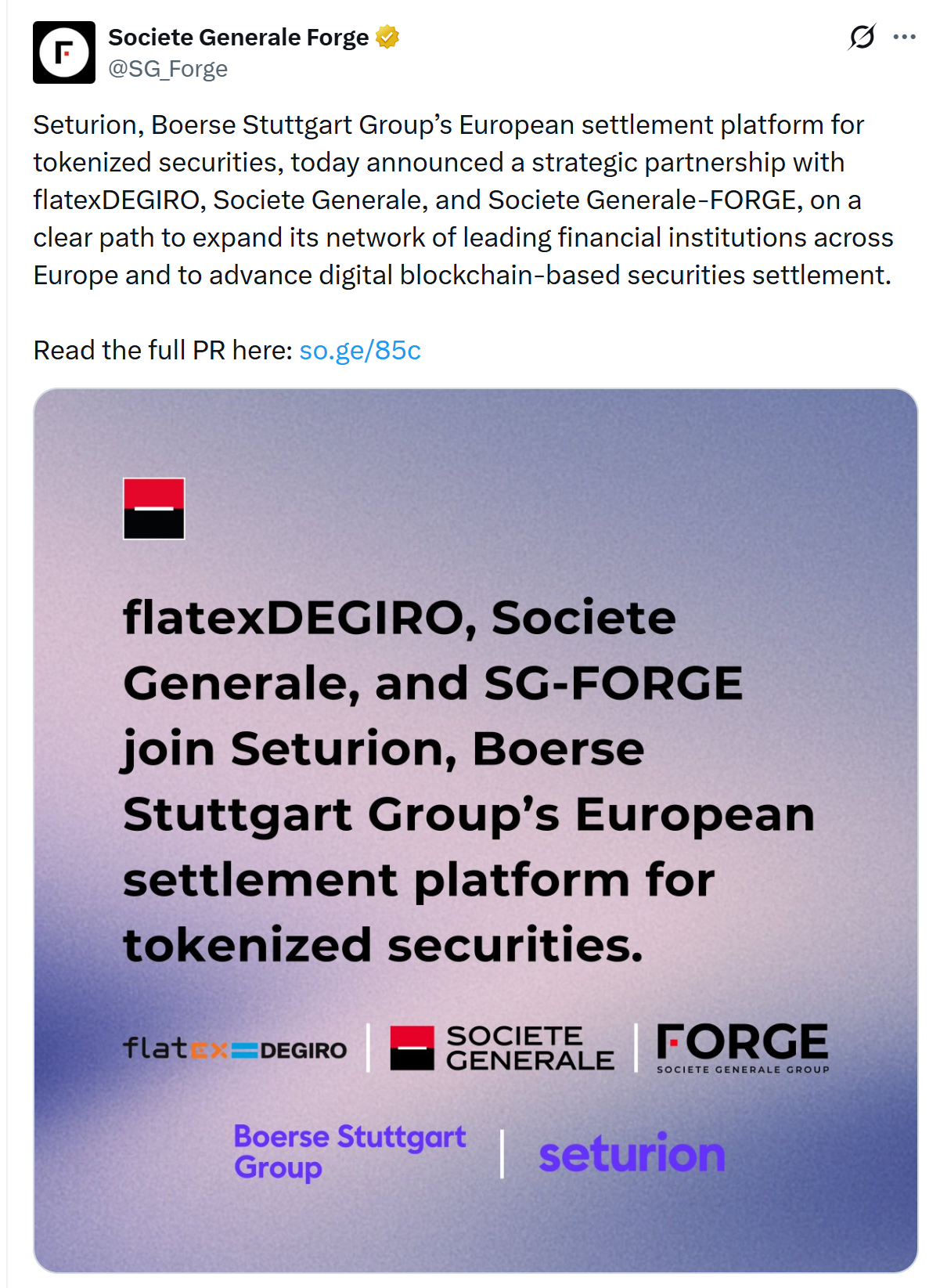
Source: Societe Generale Forge
Seturion has submitted a license application to Germany’s financial regulator BaFin under the European Union’s DLT Pilot Regime, though approval is still pending, a Boerse Stuttgart representative told Cointelegraph.
Related: Europe Bitcoin Treasury Model Won’t Mirror Strategy: PBW 2026
Nasdaq’s European venues to join Seturion
Nasdaq’s European trading venues will also connect to Seturion to facilitate trading of tokenized securities settled through the platform. The two platforms previously announced a partnership in March, revealing plans to build out a broader ecosystem of issuers, brokers and financial institutions across Europe to cut settlement costs and reduce the fragmentation.
“With Seturion, we are building the European settlement platform for the unified European capital market,” said Matthias Voelkel, CEO of Boerse Stuttgart Group. “As an open industry solution, Seturion contributes to overcoming Europe’s fragmented settlement landscape,” he added.
Boerse Stuttgart launched Seturion in September 2025 to replace Europe’s fragmented national settlement systems with a single open infrastructure. The platform supports public and private blockchains, settles in both central bank money and onchain cash, and is already live at BX Digital, Switzerland’s FINMA-regulated DLT trading facility.
Related: Augustus CEO says banks can’t rebuild for AI and stablecoins
European bank consortium Qivalis expands to 37 members
The Seturion deal comes as European financial institutions race to build regulated blockchain infrastructure. Qivalis, a European banking consortium building a MiCA-compliant euro stablecoin, has grown to 37 member institutions after adding 25 banks across 15 countries, including ABN AMRO, Rabobank, Nordea and Intesa Sanpaolo.
The Amsterdam-based group, which is pushing to build regulated alternatives to US dollar-dominated stablecoins, is targeting a second-half 2026 launch.
Magazine: eToro founder timed Bitcoin top perfectly due to belief in 4 year cycles
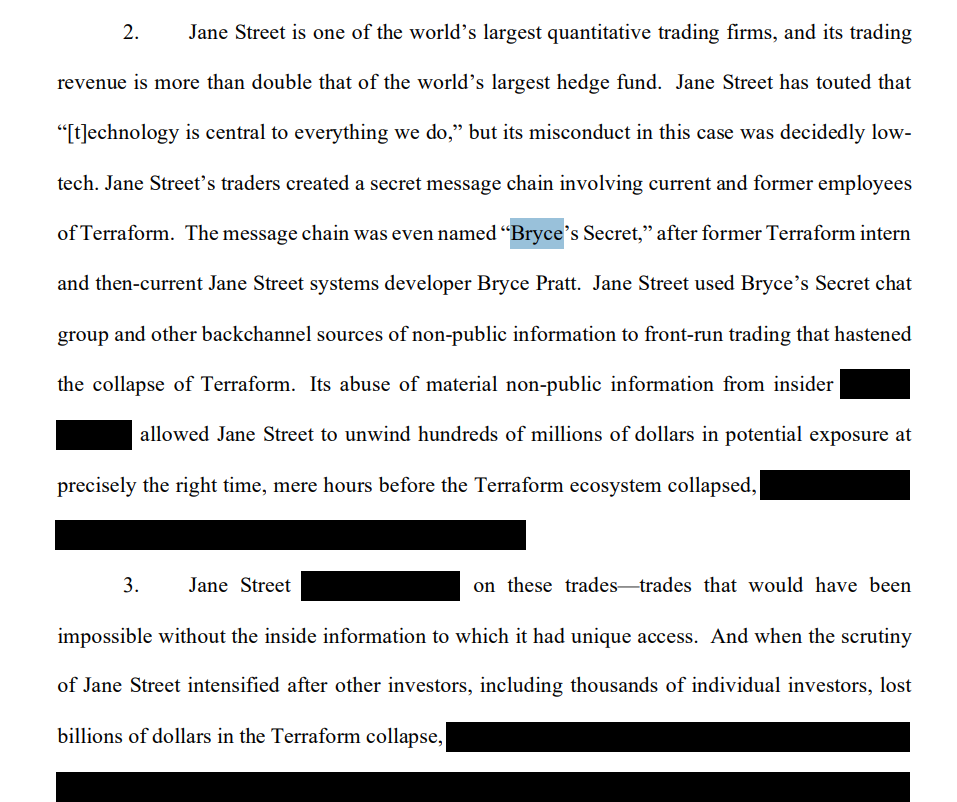
A newly unsealed court filing in the Terraform Labs bankruptcy case alleges Jane Street used a private Telegram channel with former Terraform intern Bryce Pratt to obtain nonpublic information before the collapse of TerraUSD. Pratt is currently a systems developer at Jane Street.
The channel, called “Bryce’s Secret,” allegedly gave the quantitative trading firm a backchannel to Terraform insiders as Jane Street unwound exposure to TerraUSD (UST) shortly before the algorithmic stablecoin lost its dollar peg in May 2022, according to the filing. “Jane Street used Bryce’s Secret chat group and other backchannel sources of non-public information to front-run trading that hastened the collapse of Terraform,” the filing states.
The claims renew scrutiny of who profited from Terra’s $40 billion collapse, one of the crypto industry’s largest failures, and could test how traditional insider trading and market manipulation theories apply to decentralized finance markets.
On Feb. 23, Todd Snyder, Terraform’s court-appointed administrator, sued Jane Street, its co-founder Robert Granieri, and employees Bryce Pratt and Michael Huang in Manhattan federal court, accusing them of “misappropriating confidential information and manipulating market prices.”
Two months later, Jane Street filed a motion to dismiss the lawsuit, arguing that Terraform attempted to “extract cash from Jane Street to foot the bill for a fraud that Terraform itself perpetrated on the market,” Cointelegraph reported on April 23.
A spokesperson for Jane Street told Cointelegraph that the lawsuit was a transparent attempt to “extract money when it is well-established that the losses suffered by Terra and Luna holders were the result of a multi-billion dollar fraud perpetrated by the management of Terraform Labs.”
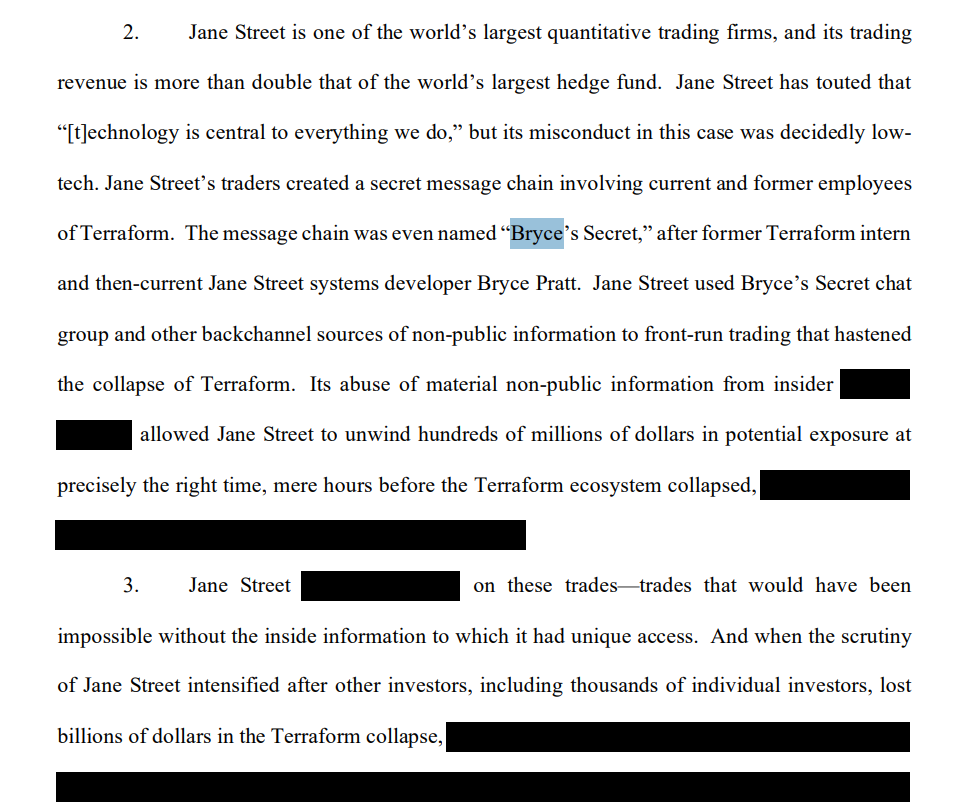
Terraform Labs court filing in the lawsuit against Jane Street. Source: cloudfront.net
Curve trade raises new UST concerns
The timing of a particular UST trade has raised more concerns, suggesting potential access to insider information by an unknown entity.
On May 7, 2022, Terraform quietly withdrew about $150 million in UST from the Curve 3pool liquidity pool.
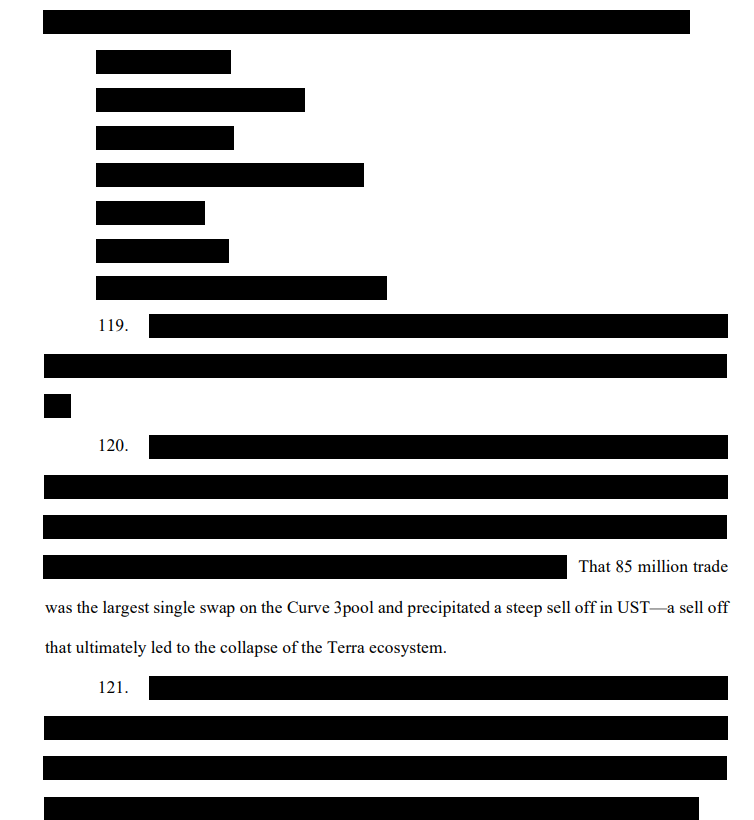
Less than 10 minutes after Terraform’s withdrawal, Curve 3pool saw its largest single swap of $85 million, precipitating a steep sell-off in UST, which the filing said “ultimately led to the collapse of the Terra ecosystem.”
Related: Analysts reject Jane Street ‘10 a.m. dump’ claims, say Bitcoin isn’t easily manipulated
The heavily redacted filing does not identify the entity behind the swap.
Terraform Labs court filing in the lawsuit against Jane Street. Source: cloudfront.net
Snyder seeks to recover alleged wrongful gains from Jane Street, plus compensation for additional damages to distribute to Terraform creditors and investors who lost funds in the 2022 collapse.
Jane Street is the world’s leading quantitative trading firm by net trading revenue, with $39.6 billion generated in 2025, reported Reuters.
Cointelegraph reached out to Terraform’s court-appointed administrator for comment but had not received a response by publication.
Magazine: How to fix suspected insider trading on Polymarket and Kalshi
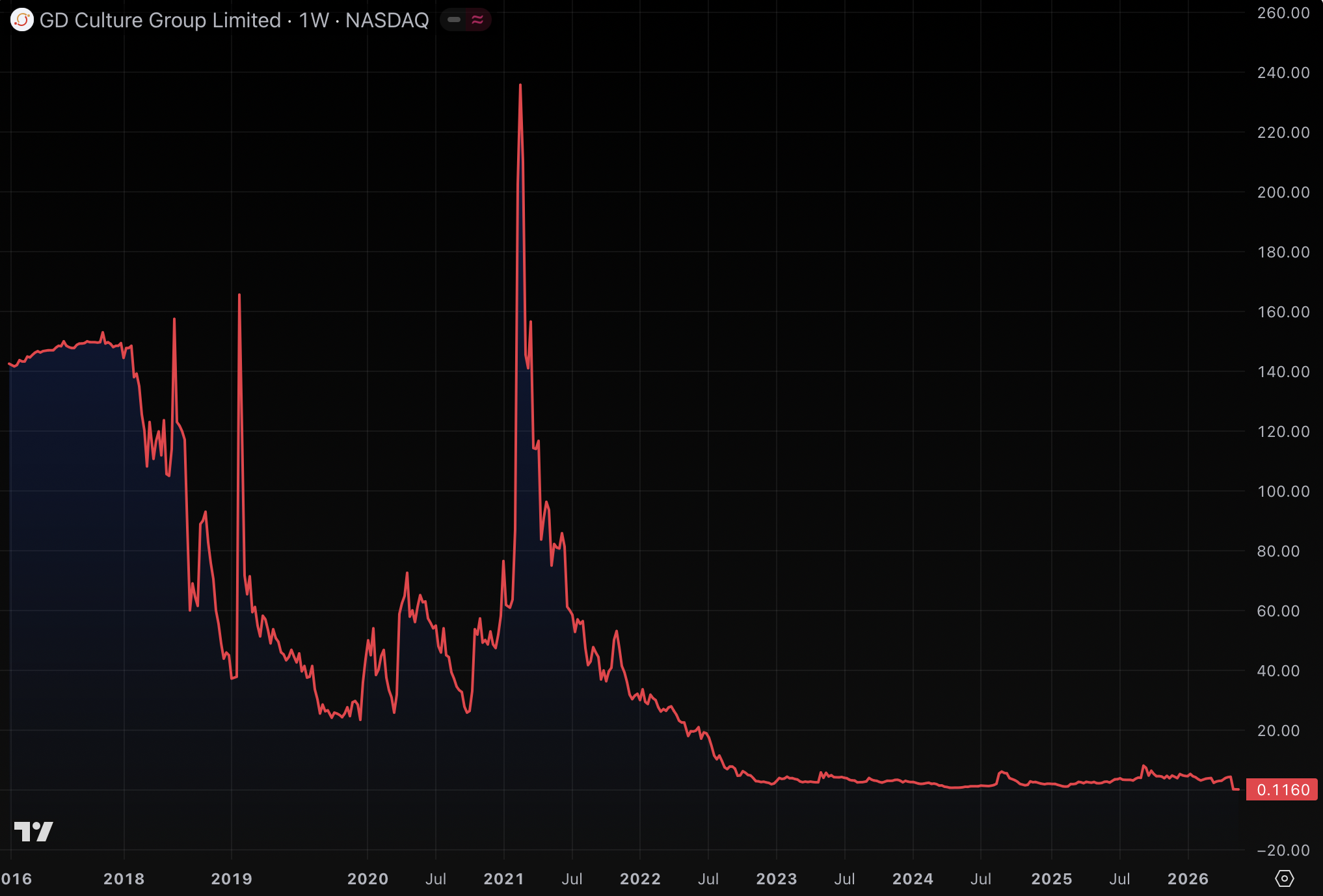
Two weeks ago, GD Culture Group (GDC), a bitcoin (BTC) treasury stock with ties to Donald Trump’s TRUMP memecoin, published a “going private proposal” of $10.75 per share. Yesterday, the stock traded to a 52-week low below $0.10.
Aside from evaluating that non-binding, going-private proposal roughly 88 times higher than its actual stock price, GDC says it will soon provide “digital human creation and customization for social media influencers.”
US representatives have also accused the China-backed company of funnelling money toward Trump in exchange for delaying his TikTok ban.
It’s all a little confusing.
On the day of the going-private proposal two weeks ago, shares spiked to $8.18 on momentary optimism that the deal was credible. Shares have subsequently crashed 98% as fact-checkers actually looked into the details.
Below is the rise and fall of a strange, China-linked, TikTok- and TRUMP-supporting, BTC treasury stock.
GD Culture Group and TRUMP
Days before Donald Trump’s May 2025 dinner at Mar-a-Lago for the top 220 holders of his TRUMP memecoin, GDC announced a $300 million stock purchase agreement with an unnamed buyer in the British Virgin Islands (BVI).
The stated purpose was a “crypto asset treasury strategy, including the purchase of BTC and TRUMP.”
At the time, GDC had essentially no revenue and less than 10 employees and its operations depended on TikTok, a Chinese-founded social media platform.
The generous announcement out of the BVI conveniently coincided with Trump’s decision to delay enforcement actions against TikTok.
The New York Times described GDC as one of the first China-linked companies to publicly acknowledge intentions to buy TRUMP.
Trump-controlled entities CIC Digital LLC and Fight Fight Fight LLC together held 80% of the post-ICO token supply of TRUMP. Therefore, any purchase funded by GDC or its BVI buyer would enrich the president directly through supply reduction and trading fees.
Soon after GDC’s dubious announcement, US representatives Adam Smith and Sean Casten led 35 House Democrats in a letter to the Department of Justice’s Public Integrity Section.
They demanded an investigation into whether GDC’s dinner-for-tokens scheme violated federal bribery laws or the foreign emoluments clause.
The representatives named GDC in their letter, noting its Chinese subsidiary’s disclosed exposure to government intervention, and connected the TikTok-delay timing to the $300 million pledge.
Based on public filings, it’s unclear whether GDC actually ended up purchasing TRUMP tokens, but the company did end up acquiring BTC through a circuitous path.
Specifically, a China-linked consortium sold 7,500 BTC to a GDC affiliate in September 2025. They received newly issued GDC stock in exchange for that disbursement.
Members of that same consortium recently announced their dubious going-private proposal.
GDC’s Q1 2026 quarterly report disclosed less than $50,000 in cash and a working capital deficit of $1.7 million. The 2025 annual report listed a mere five full-time employees.
The company has no substantial operating revenue.
Its only consequential asset is BTC acquired through a transaction that the company itself disclosed as a related-party deal.
Collapse of a TRUMP memecoin and BTC treasury scheme
A Nasdaq-listed penny stock, GDC closed yesterday’s trading session around $0.12, printing a fresh 52-week low yesterday near $0.09 during the day.
Its market capitalization is an embarrassing $7 million. Its 7,500 BTC holdings, if someone can even call them holdings at this point, are worth roughly over half a billion dollars at current prices.
That is a discount of more than 98% or a multiple-to-Net Asset Value (mNAV) of 0.02x.
In other words, a company holding more than half a billion dollars of BTC has a market cap worth less than an average New York City apartment.
Read more: Donald Trump Jr. proclaims he was “at the top of the Ponzi scheme”
GDC issued 39,189,344 new shares in exchange for the 7,500 BTC. The 10-Q records the BTC at a cost basis of $842 million, implying a share value of roughly $21.49 at issuance.
No cash changed hands. The same filing discloses the BTC acquisition as a related-party transaction.
No TRUMP memecoin purchase or holding has ever appeared in the company’s SEC disclosures.
By February 2026, with the stock languishing, the GDC board authorized BTC sales from the 7,500-coin reserve. Management earmarked the proceeds for a $100 million share repurchase program.
The board reserved discretion to sell at any time, in any number of transactions.
This abandoned the corporate BTC reserve doctrine that competitors like Strategy spent years promoting, yet any share buybacks have evidently not helped the stock price, which hit a 52-week low yesterday.
Got a tip? Send us an email securely via Protos Leaks. For more informed news and investigations, follow us on X, Bluesky, and Google News, or subscribe to our YouTube channel.
Crypto World
Ripple Price Analysis: Where’s XRP Going Next After Latest Rejection at the 100-Day MA?
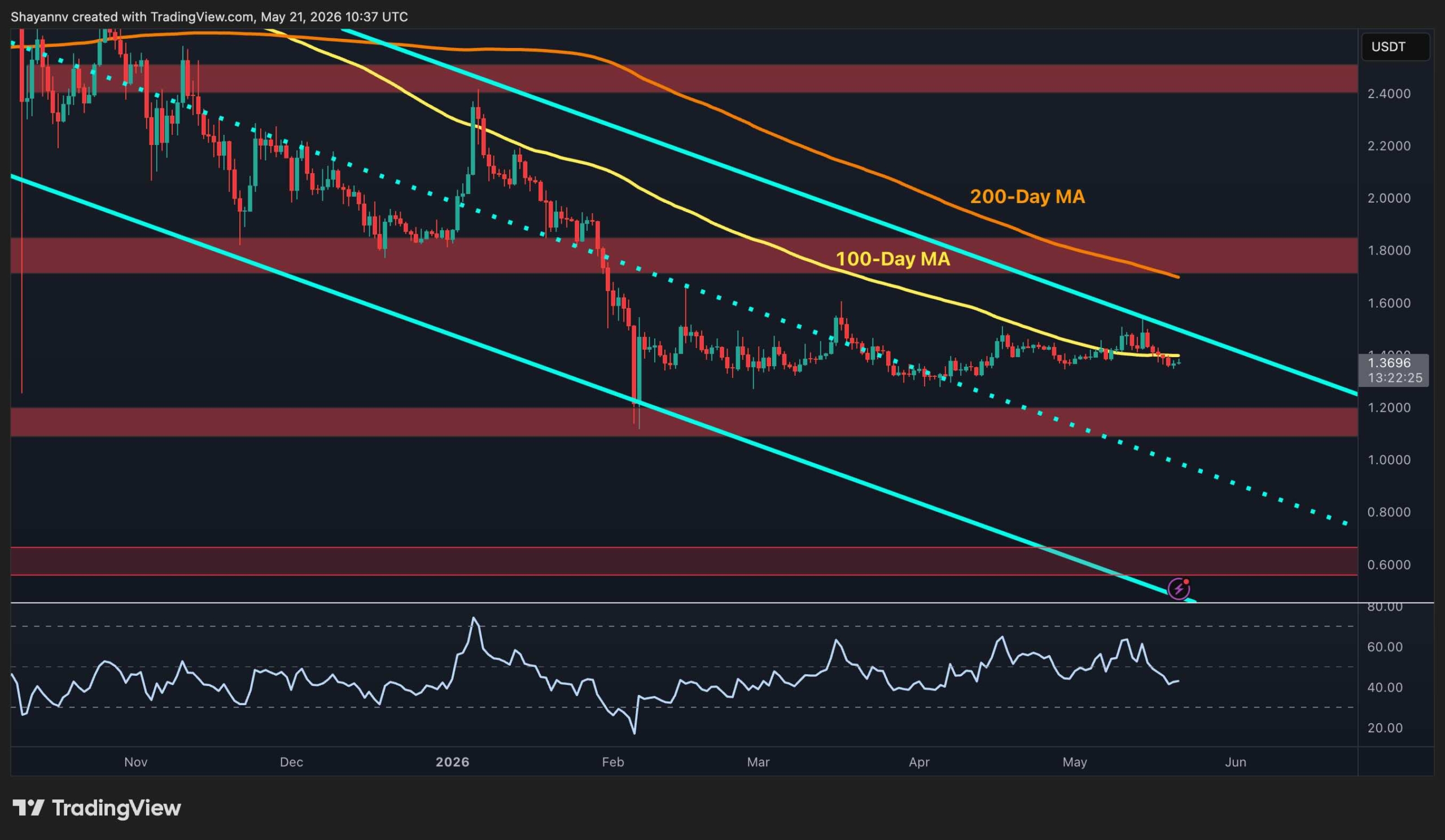
XRP is trading at $1.37 as May draws toward its final week, having erased every gain from what briefly looked like the most promising technical setup of the corrective cycle. The breakout above the 100-day MA on the USDT chart has failed to hold, and a lower high has formed on the BTC pair. The levels that looked like support last week are now the targets that bulls need to reclaim just to get back to where they started.
Ripple Price Analysis: The USDT Pair
The USDT pair’s daily timeframe setup looked compelling last week. The asset was pressing the upper boundary of the long-term descending channel and holding above the 100-day moving average at around $1.45, with an RSI climbing toward 65.
Yet, this move has played out as a textbook rejection. XRP failed to post a single candle close above the channel, and the subsequent sell-off has brought the price back to $1.37. The 100-day MA, which was seen as dynamic support just days ago, is now the nearby overhead resistance at $1.40, sitting just below the descending channel ceiling.
The RSI has faded from 65 back to the 40s, wiping out the momentum that made the setup optimistic. The $1.20 demand zone below should now be watched as the potential floor, while a recovery back above $1.45 and the 100-day MA remains the minimum requirement to rebuild any constructive case. Yet, with the broader altcoin market breaking down, the path of least resistance points toward another test of support rather than another attempt at resistance.
The BTC Pair
The brief breakout above 1,800 sats that appeared on the BTC pair last week has proven to be a fakeout. XRP/BTC has slipped back to around 1,770 sats, creating a lower high at around 1,800-1,900 sats. The RSI, which had recovered from the extreme low of ~25 all the way to above 50 while demonstrating a bullish divergence, has also faded back toward 40. The relief bounce is losing energy before it accomplishes anything structurally meaningful.
The failed reclaim of 1,800 sats is the defining development on this pair. It confirms that the oversold bounce was corrective rather than structural, and that the broader downtrend in the ratio remains intact. The 100-day moving average at ~1,900 sats and the 200-day moving average at ~2,100 sats continue to decline well above, offering no nearby reference for a recovery.
Below, the lower channel boundary near 1,550 sats and the 1,500 sat horizontal support band remain the next downside targets if the current level gives way. With altcoin sentiment deteriorating across the board, there is little in the near-term macro picture to suggest that pressure is about to ease.

The post Ripple Price Analysis: Where’s XRP Going Next After Latest Rejection at the 100-Day MA? appeared first on CryptoPotato.
Demand for Bitcoin (BTC) has decreased sharply over the last few days as the price ran into overhead resistance above $80,000. Analysts say BTC’s inability to hold key support levels may be paving the way for a prolonged consolidation.
Key takeaways:
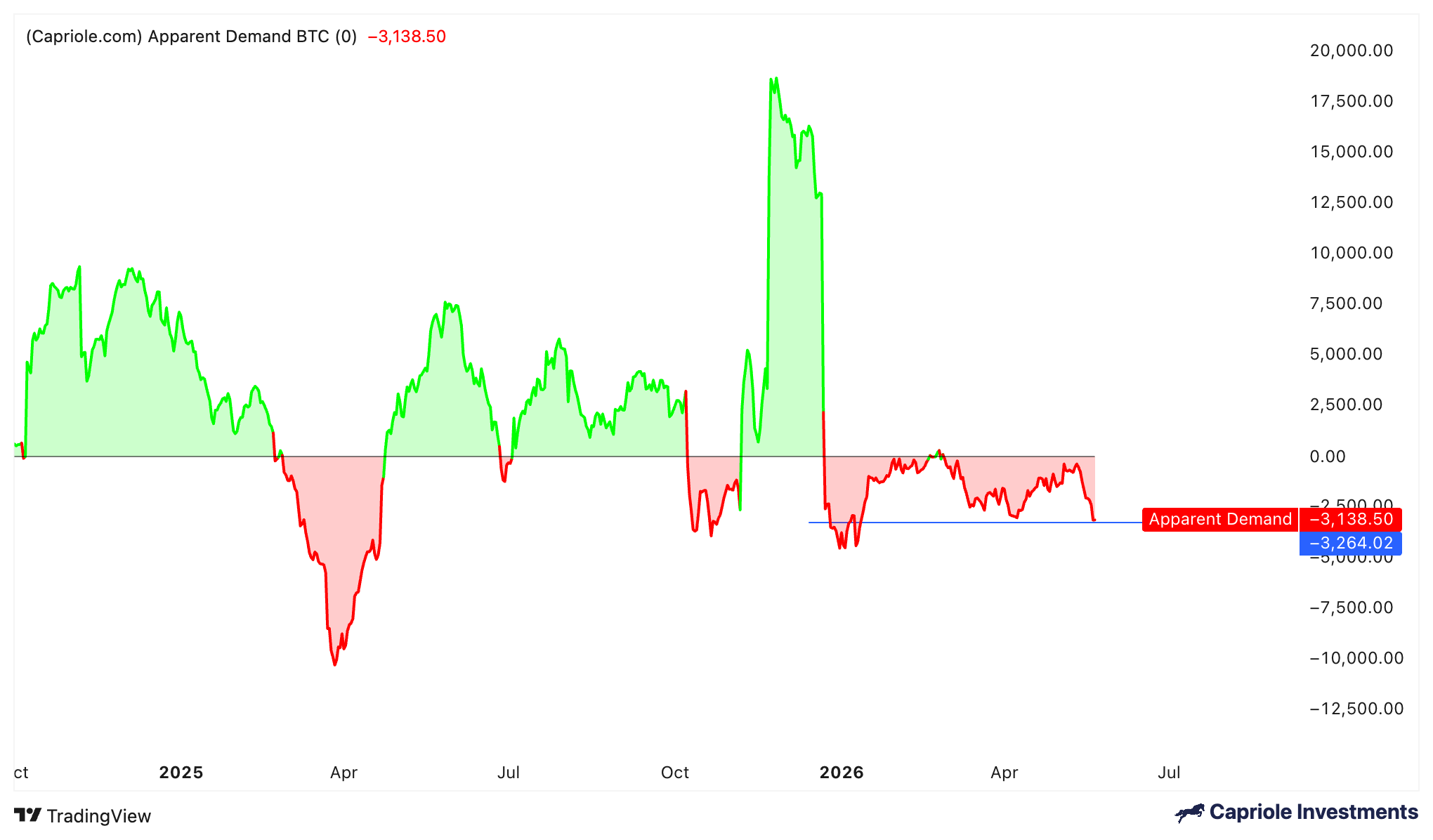
- Bitcoin’s apparent demand fell to -3,138 BTC, its lowest level in four months.
- Weak spot activity and negative ETF flows pressure the BTC price below $80,000.
- Analysts warn that Bitcoin risks prolonged consolidation or a deeper correction if $78,000 is not broken.
Bitcoin’s apparent demand has dropped to its lowest level since mid-January, as traders and investors adopted a risk-off approach due to geopolitical and macroeconomic uncertainties.
Related: Bitcoin rallies through $77K despite spot BTC ETF outflows topping $2B
Capriole Investment’s Bitcoin Apparent Demand metric shows that demand for Bitcoin has been negative since Dec. 22, 2025 and improved slightly in late February, before reversing sharply to -3,138 BTC on Thursday.
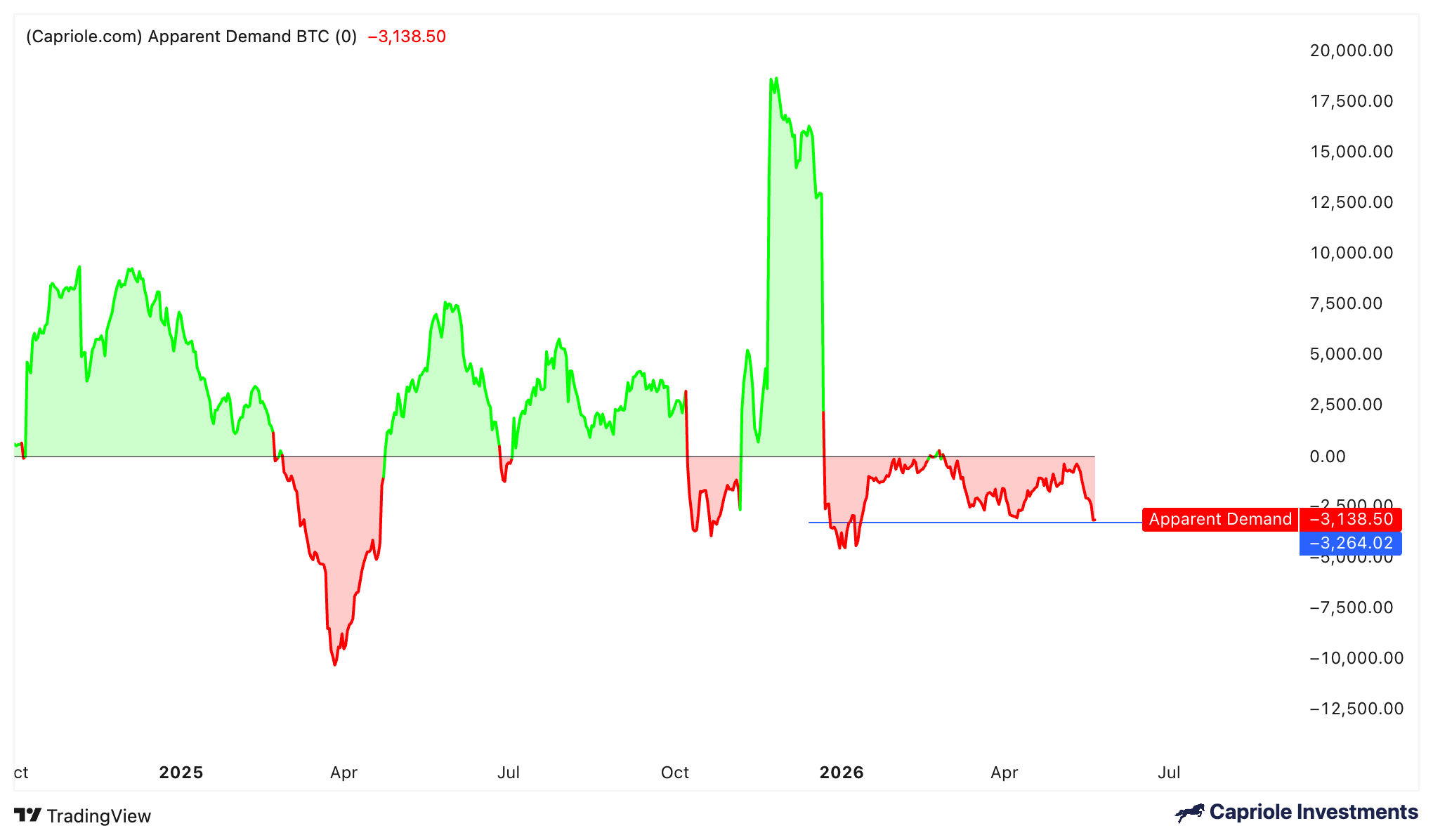
Bitcoin’s apparent demand. Source: Capriole Investments
“Bitcoin’s overall demand has flipped into net contraction,” CryptoQuant said in its latest Weekly Crypto report, adding:
“Spot apparent demand is contracting at a slightly faster pace than in prior weeks.”
Spot market activity has weakened in recent weeks, with the aggregate spot cumulative volume delta (CVD) across all exchanges “remaining negative into the recent pullback toward the high-$70K range,” Glassnode said in its latest Week On-chain newsletter, adding:
“Despite Bitcoin remaining relatively resilient structurally, the latest spot positioning data suggests broad-based spot accumulation has yet to re-emerge.”
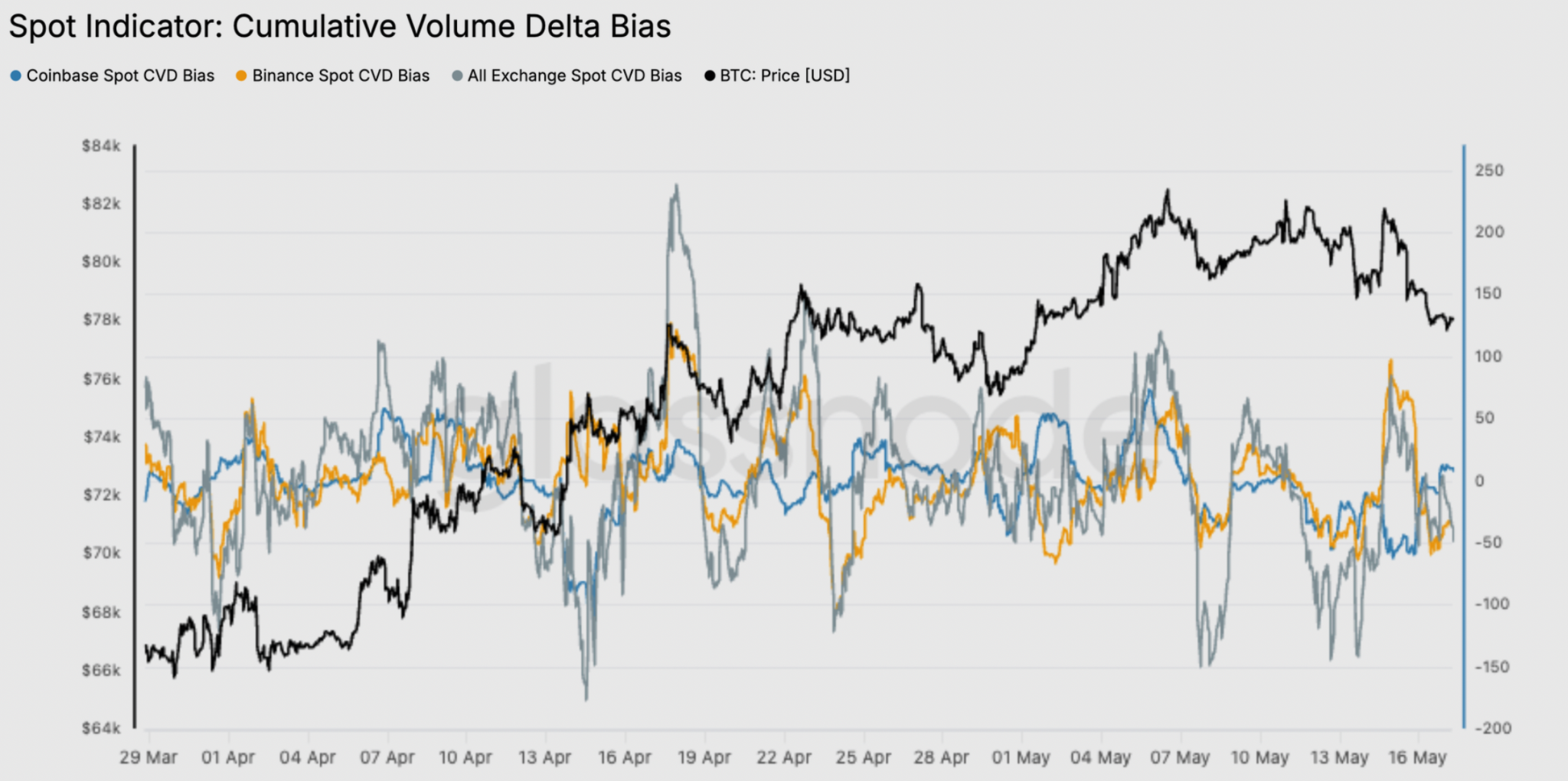
Bitcoin spot CVD. Source: Glassnode
Meanwhile, US-based spot exchange-traded funds (ETFs) also turned net sellers, with the 30-day change in ETF holdings falling to its lowest level in nearly three months.
This suggests that “outright spot demand is becoming less aggressive near the current range highs,” Glassnode added.
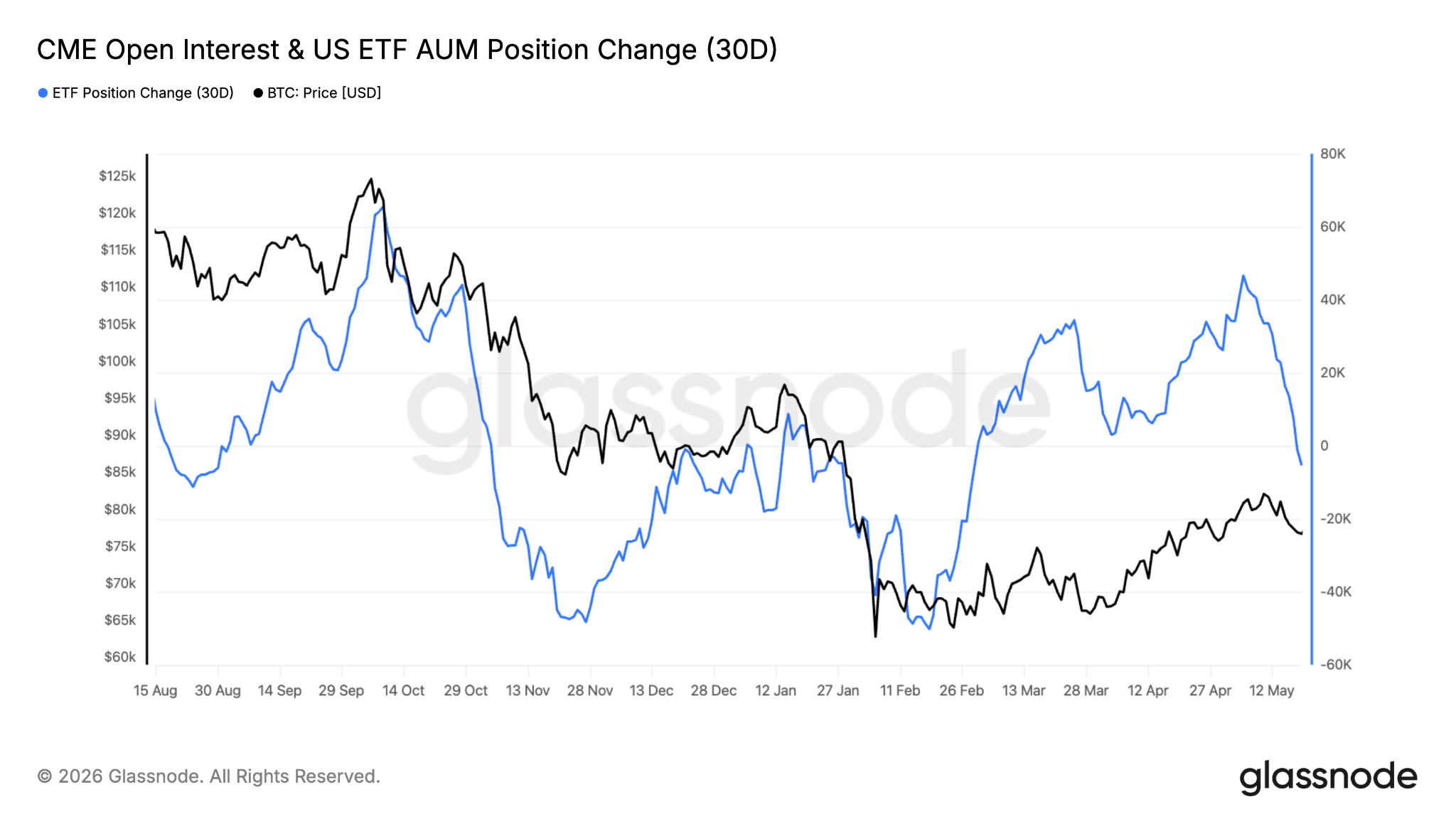
US ETF AUM position change. Source: Glassnode
The simultaneous deterioration across spot demand and ETF flows has “historically been more consistent with renewed price weakness than with stable consolidation,” CryptoQuant concluded.
Bitcoin’s price is at an inflection point
Bitcoin’s 38% rally to $82,800 from its $60,000 macro low marked a notable recovery above the true market mean, now sitting at $78,300.
The true market mean is a price model that tracks the average acquisition cost of actively transacted Bitcoin supply and “historically serves as the dividing line between bear and bull market regimes, according to Glassnode.
The onchain data provider said that reclaiming this level is a “necessary but not sufficient condition for a structural transition,” adding:
“Conventionally, pre-bull market phases require weeks to months of sustained consolidation around this model before a credible regime shift can be confirmed.”
Note that the price consolidated around the true market mean for over six months, between March and October 2021, before breaking into a 174% rally to its previous all-time high of $74,00 reached in March 2024.
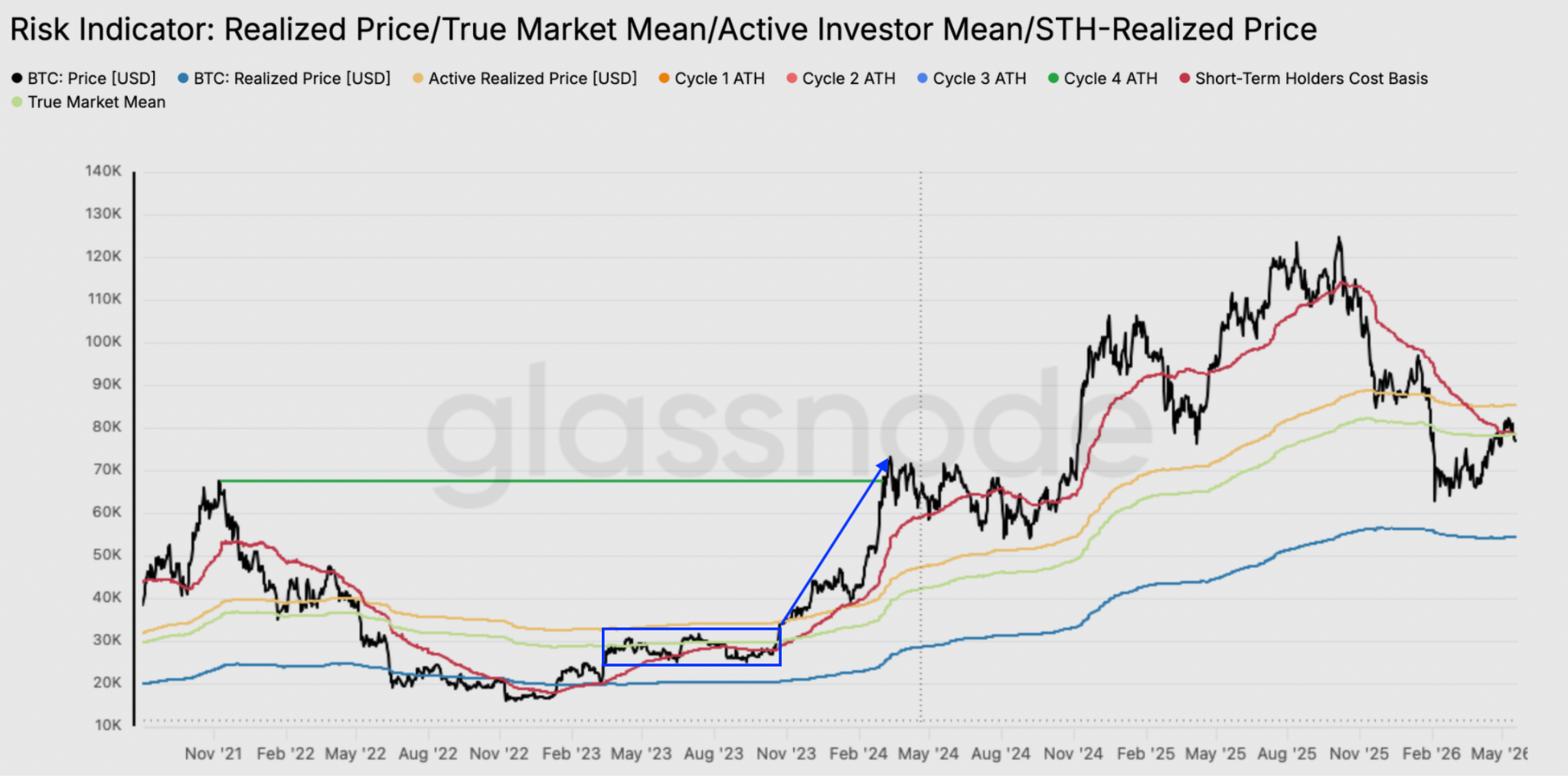
Bitcoin risk indicator. Source: Glassnode
Glassnode added:
“Any deeper correction from current levels would therefore reframe the recent rally as a local top within the ongoing bear market, a structure that has recurred multiple times in prior cycles and remains the higher probability outcome until price demonstrates sustained follow-through.”
Other analysts have highlighted weaknesses in Bitcoin’s market, including fading momentum, declining retail investor activity, aggressive selling in the futures markets and a weakening technical structure, putting BTC at risk of dropping to as low as $65,000 over the next few weeks.
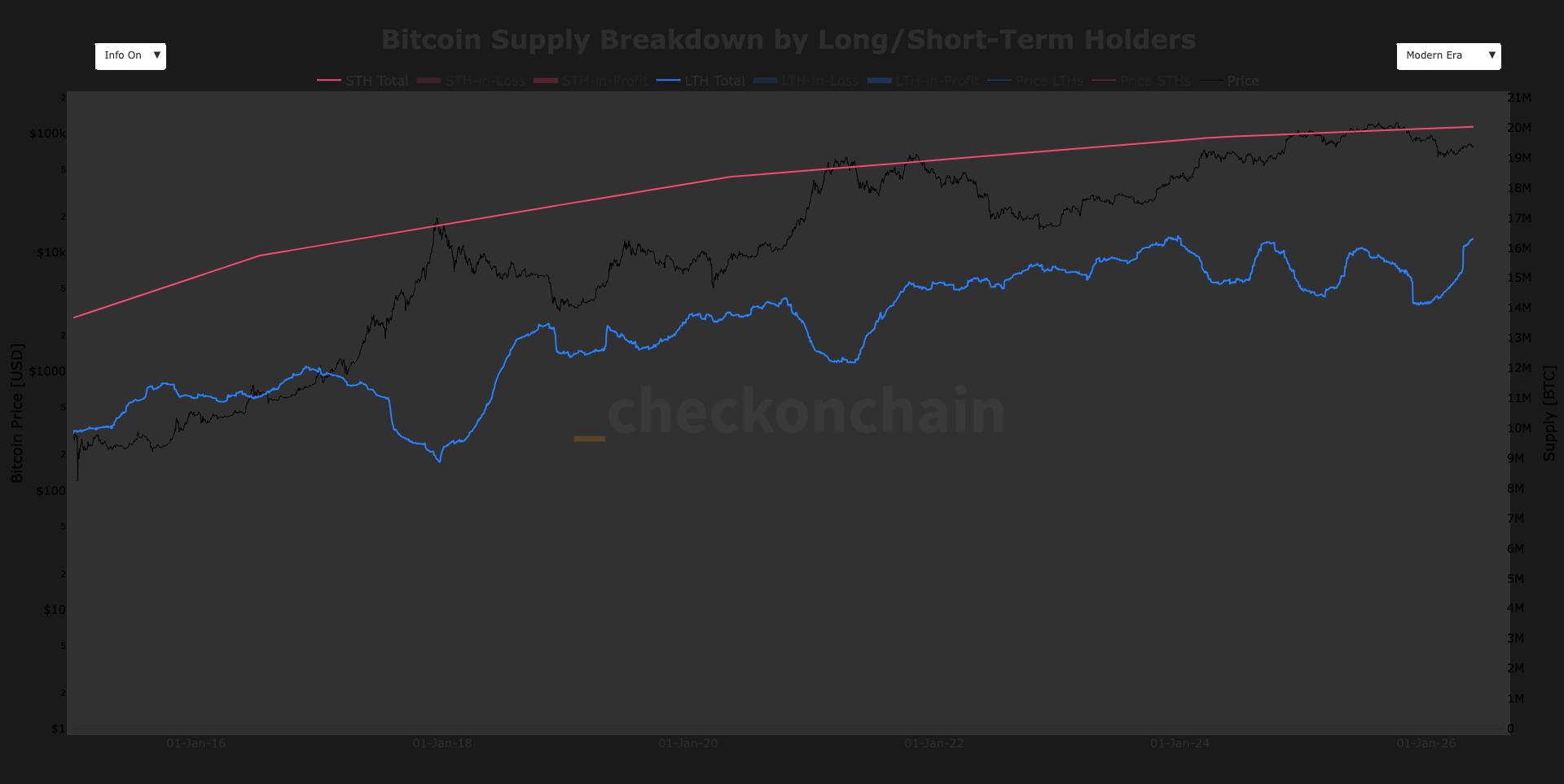

Bitcoin’s long-term holder (LTH) supply is approaching all-time highs. Currently, 16.3 million BTC is held by this cohort, defined as investors who have held bitcoin for at least 155 days.
LTH supply has increased from 14.12 million BTC around the time of bitcoin’s record high above $126,000 in October, to the current 16.3 million BTC. In the past month alone, LTH supply has risen by roughly 200,000 BTC.
The only other time LTH supply was higher was in January 2024, when it reached 16.4 million BTC ahead of the U.S. spot bitcoin ETF launch, one of the most anticipated events in bitcoin’s history. In the months that followed, nearly 2 million BTC was distributed by this cohort as bitcoin rallied.
Typically, during periods of price weakness or full bear market conditions, long-term holders, often viewed as the smarter money, begin increasing exposure after divesting during the previous bull market. During both the 2015 and 2019 bear markets, LTH supply increased as investors accumulated during price weakness.
However, since the ETF launch in January 2024, LTH supply has largely fluctuated between 14 million and 16 million BTC. Now, it appears to have broken out of a 2.5-year downtrend, suggesting long-term holders are once again accumulating rather than distributing during bitcoin’s depressed price levels.

98.6% Of Crypto Is NEVER Coming Back Except These Coins

Greggs to open its doors at Morrisons Starbeck Harrogate

Battery maker Alexander Technologies confident as it introduces new ways to speed up development to manufacturing cycle


-
 Crypto World6 days ago
BloFin War of Whales 2026 Grand Prix opens registration for $5M trading championship
-

 Fashion6 days ago
Weekend Open Thread: Theory – Corporette.com
-

 Crypto World6 days ago
E-Estate Announces 1 Year Live: Washington DC Summit as Real Estate Tokenization Enters Its Next Phase
-

 Tech6 days ago
Tech Moves: Microsoft AI leader jumps to OpenAI; former AI2 exec joins Meta; and more
-

 Tech6 days ago
Google reimburses Register sources who were victims of API fraud
-

 Business6 days ago
H&R Real Estate Investment Trust (HR.UN:CA) Q1 2026 Earnings Call Transcript
-
 Entertainment7 days ago
Zara Larsson Has Blunt Response To Chris Brown Diss
-

 Sports6 days ago
Napoleonic enters 2026 Doomben 10,000 field via Abounding withdrawal
-
 Crypto World6 days ago
BeInCrypto 100 Institutional Awards Nomination: KAST for Best Digital Assets Neobank and Best Digital Assets Fintech
-
 Crypto World6 days ago
Bitcoin Battles US Bond Nerves With BTC Price Dip Toward New May Lows
-

 Fashion5 days ago
On the Scene at Gucci’s Cruise Show in New York City: Mariah Carey, Kim Kardashian, Lindsay Lohan, Iman, and More!
-
 Crypto World6 days ago
Wall Street’s Boldest Gold Prediction Has Russians Rushing to Buy
-

 Crypto World6 days ago
ICE and CME urge US regulators to curb Hyperliquid energy trading
-

 Politics7 days ago
DWP PIP Timms review continues to be an absolute farce
-

 Crypto World6 days ago
IREN closes $3 billion convertible notes deal amid AI infrastructure expansion
-

 Fashion5 days ago
Trending Western Style Vests Perfect for Summer
-

 Entertainment6 days ago
David Letterman Returns to Late Show, Blasts Cancellation
-
 Crypto World7 days ago
Lido Finance Selects Chainlink CCIP as the Official Cross-Chain Infrastructure for wstETH Security
-

 Fashion4 days ago
Amazon Sundays: Memorial Day Hosting
-

 Fashion6 days ago
Creative Ideas for Custom T-Shirts
You must be logged in to post a comment Login