
Crypto World
BTC gyrations likely to calm as Goldman, BlackRock’s explore income ETFs: Crypto Daily



Investors who thrive on bitcoin’s wild price swings may be in for disappointment. Major banks are preparing to introduce new products that could dampen volatility in a market that has already become significantly calmer in recent years.
Most recently, Goldman Sachs filed an application for a Bitcoin Premium Income exchange-traded fund (ETF). The proposed fund relies on selling (writing) options tied to bitcoin-linked exchange-traded products to generate income while providing investors with exposure to the cryptocurrency. BlackRock is looking to launch a similar product.
Selling options is essentially writing insurance against price swings. The writers collect a premium in exchange for providing downside or upside protection, while being exposed to potentially significant losses if the market moves sharply. Traders often use covered strategies — holding the underlying asset or ETFs while writing options — to partially offset risk.
If approved, the ETFs may employ similar covered options strategies to generate yield, though the exact structures will vary by product.
Whatever the case, the net impact would be calmer market conditions. That’s because when options are sold in large numbers, dealers or market makers who take the other side of these trades end up with long positions. To manage their risks, these entities then dynamically hedge by buying the underlying asset on declines and selling on rallies. This dynamic is called hedging the positive gamma exposure, and it tends to restrain volatility.
In addition, the availability of yield-generating institutional-grade products may suck capital away from pure speculative bets, further lowering realized volatility over time. Bitcoin’s implied volatility has been declining for three years, primarily due to the growing popularity of options-selling strategies.
Today bitcoin has pulled back to $74,000 after hitting highs near $76,000 on Tuesday. The CoinDesk 20 Index has dropped over 1% in 24 hours.
A firm breakout is expected to happen if the U.S. stock indexes hit new record highs.
“If Bitcoin is looking for external signals, it may remain indecisive until key US stock indices hit new highs. However, we are more inclined to believe that the first cryptocurrency’s stagnation is a sign of a fragile risk appetite that will soon manifest in the broader market,” Alex Kuptsikevich, chief market analyst at the FxPro said in an email.
In the meantime, the IMF flashed a warning on the rising global debt, strengthening the bull case in bitcoin. Stay alert!
Read more: For analysis of today’s activity in altcoins and derivatives, see Crypto Markets Today . For a comprehensive list of events this week, see CoinDesk’s “Crypto Week Ahead.”
What’s trending
Today’s signal

Bitcoin is struggling to rise past its 100-day simple moving average, a widely watched technical level that reflects the average closing price over the period.
This pattern is reminiscent of mid-January, when sellers regained control at the 100-day average and stalled the recovery. Bitcoin saw a sharp decline in the days that followed.
The question now is whether history will repeat itself, or if this time the level finally gives way, paving the way for faster gains to $80,000 and higher.

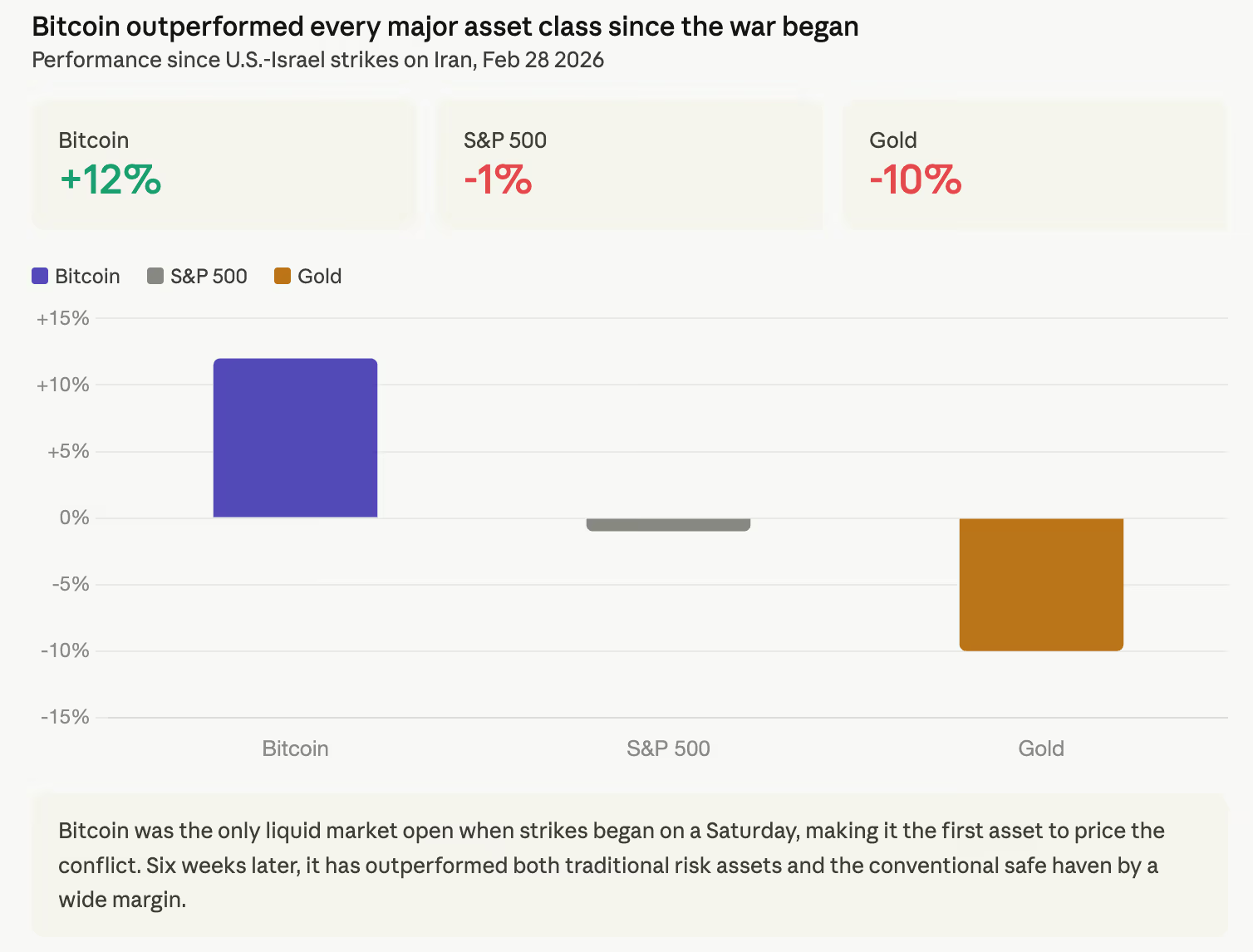
Bitcoin’s outperformance during the Iran conflict doesn’t fit the standard playbook, and Bitwise CIO Matt Hougan thinks he knows why.
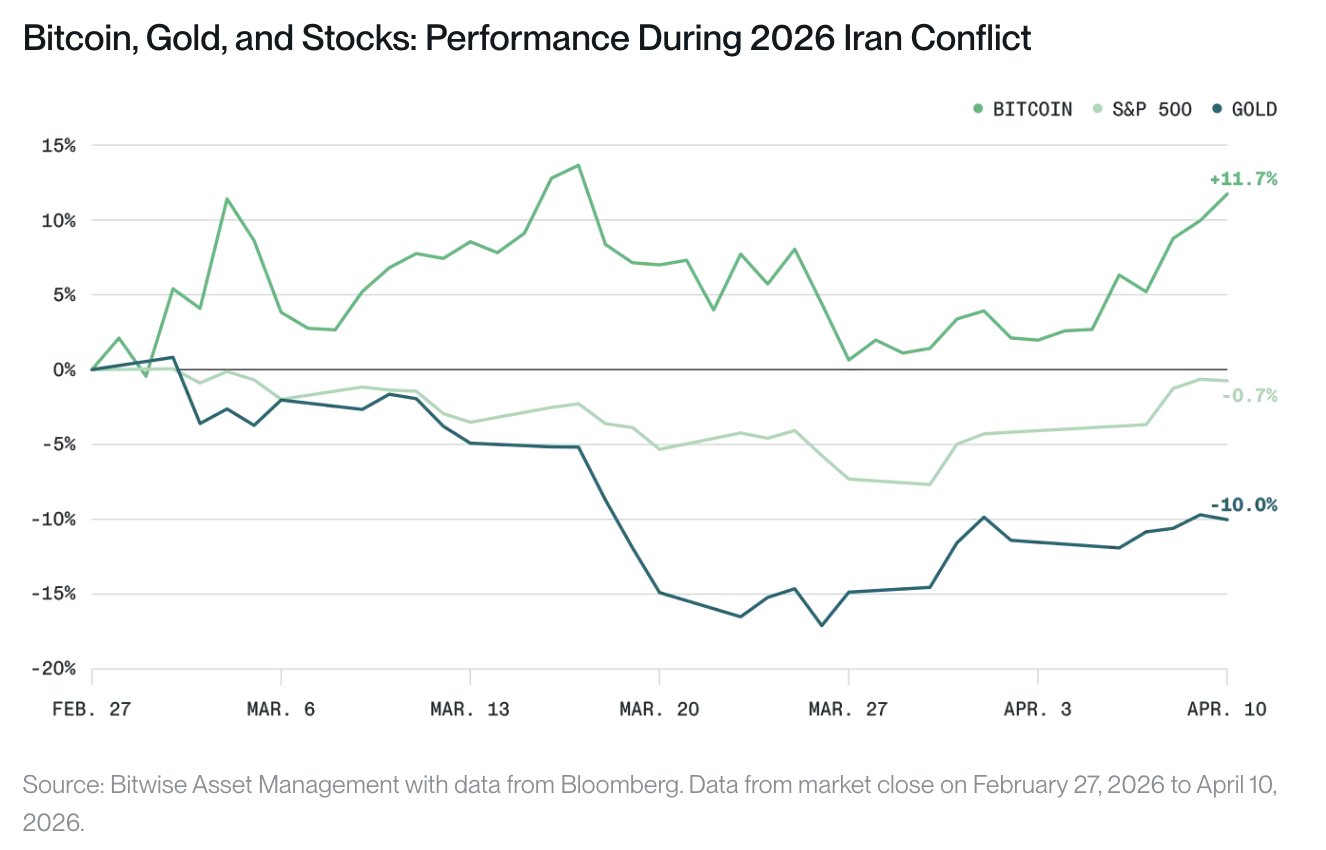
The largest cryptocurrency has gained 12% since U.S. and Israeli airstrikes began Feb. 28, while the S&P 500 has fallen 1% and gold 10%. For an asset routinely dismissed as a leveraged tech bet during risk-off episodes, that performance has forced a rethink.
In a post on X, Hougan reframed bitcoin as two simultaneous bets. The first is the familiar “digital gold” thesis, competing for share of the $38 trillion store-of-value market.
The second is what he calls an out-of-the-money call option on bitcoin functioning as an actual currency, a bet he says most investors have treated as borderline irrelevant until now.

The Iran conflict changed the math on the second bet. Iran said it will collect a $1-per-barrel toll in bitcoin from ships passing through the Strait of Hormuz, the equivalent of roughly $20 million per day.
The levy is one of the first real-world examples of a sovereign state using bitcoin as a settlement mechanism for physical commerce, even if the circumstances were far from ideal.
“In a world where countries have weaponized their financial rails, bitcoin is emerging as an apolitical alternative,” Hougan wrote, tracing the shift back to the U.S. kicking Russia off the SWIFT network in 2022, a move France’s finance minister called a financial “nuclear bomb” at the time.
The options framework is what makes the argument worth watching.
Options gain value when either the probability of hitting the strike price improves or the volatility of the underlying asset increases. Hougan argues the Iran conflict delivered both simultaneously, raising the odds of bitcoin being used as a currency while increasing the volatility of the global monetary order.
If his framing holds, it implies that bitcoin should rally during future geopolitical conflicts, particularly those involving countries caught between the U.S. and Chinese financial systems, and that bitcoin’s total addressable market is significantly larger than the gold market alone.
The counterpoint is that Iran’s use of bitcoin occurs as a sanctioned state acting out of necessity, not preference. It says more about the limits of dollar-denominated enforcement than it does about bitcoin’s readiness to function as a neutral settlement layer. The infrastructure for that, stablecoin settlement, cross-border payment rails, sovereign wallet adoption, remains early-stage at best.
But Hougan’s core observation stands. The market is pricing bitcoin differently during this conflict than during any prior geopolitical shock, and the “digital gold” thesis alone doesn’t explain why.
Crypto World
Leading crypto presales on every investor’s radar in April 2026: Big opportunities right now

Disclosure: This article does not represent investment advice. The content and materials featured on this page are for educational purposes only.
Projects like BlockchainFX are gainining traction as investors target early-stage crypto presales for potential upside during market uncertainty.
Summary
- April 2026 sees surge in crypto presales, with BlockchainFX (BFX) leading as funding nears $15M target
- BlockchainFX gains traction with live beta, multi-asset trading, and strong early investor participation
- Final presale phase drives urgency as BFX offers staking rewards and cross-market trading access
Some months in crypto feel like noise, and some genuinely matter. April 2026 is the latter. The top crypto presales commanding serious attention right now are BlockchainFX (BFX), Pepeto, Ionix Chain, and IPO Genie, each pulling in different types of investors for different reasons. With markets still uncertain, early presale entries during a dip are often where the biggest gains quietly begin.

Among all the top crypto presales available this month, BlockchainFX keeps rising to the top of every serious conversation. Already live in beta, awarded “Best New Crypto Trading App of 2025,” and backed by 23,200+ participants who have pushed over $14.24M into the presale, BFX is now in its final phase. The $15M softcap is nearly reached, the launch countdown is real, and the window to get in at the ground price is closing fast.
BlockchainFX: The presale running out of time and tokens
BlockchainFX is a licensed, regulated trading super app where users can trade crypto, forex, stocks, ETFs, and commodities from one decentralized interface. Most traders today still juggle three or four separate platforms for different asset classes. BFX eliminates that entirely, handling everything in one place with full user custody. The platform is already live with thousands of daily active users and millions in daily trading volume, which is not something most presale tokens can say.
Holding BFX also earns daily staking rewards in both BFX and USDT, reaching up to $25,000 USDT, meaning investors are already generating returns while the presale is still active, not just waiting on a future price move. Multiple third-party audits, full KYC verification, and a verified smart contract back the platform’s credibility. For a token priced at $0.035, the amount of operational substance packed into this early stage is hard to find anywhere else in the top crypto presales list right now.
BFX20: Grab 20% more tokens before the $15m gate closes
The current presale price is $0.035 with a launch price of $0.05, already a 43% return from entry to listing alone. Using bonus code BFX20 adds 20% more BFX tokens to every purchase. On a $15,000 investment, that means roughly 514,285 tokens instead of 428,571. With analysts projecting BFX hitting $1 post-launch, that same $15,000 could return over $514,000. That is not speculation; that is presale math.
With $14.24M raised and the $15M softcap approaching fast, this is the final window. Buying is simple: connect MetaMask or Trust Wallet, pay via crypto or card, and the allocation confirms instantly. BFX20 is only valid during this last phase, and once the cap is hit, the presale closes and the exchange listing begins. Spend $100+ on BFX and gain exclusive access to the $500,000 Gleam prize pool!
Pepeto: Meme energy with an infrastructure angle
At $0.0000001864 per token and $9.04M raised, Pepeto has built a notable following. Unlike most memecoins that run purely on social momentum, the project includes PepetoSwap for zero-fee trading, a cross-chain bridge, and staking rewards. The goal is sustainable utility beyond the hype cycle, which makes it a more interesting memecoin pitch, though execution at scale is still in the process of being fully proven out.
Pepeto remains a memecoin at its core, and the volatility that comes with the territory is very much present. The utility vision is interesting but early. For investors browsing top crypto presales with a higher risk tolerance, it is worth watching, though the risk profile sits in a very different category compared to a regulated, already-live platform like BlockchainFX that has demonstrated real traction.
Ionix Chain: 500,000 TPS ambitions and AI-powered security
Ionix Chain is developing a Layer 1 blockchain using a proprietary “Quantum AI Consensus” mechanism aimed at exceeding 500,000 transactions per second with near-zero fees. Currently priced at $0.025 and moving to $0.030 shortly, the project targets DeFi and AI developers who need serious throughput. The AI-driven fraud detection and cross-chain interoperability put Ionix Chain among the more technically ambitious top crypto presales active in April 2026.
Layer 1 is a competitive space and Ionix Chain has bold claims that need to hold up at mainnet. Execution risk at this stage is real. For investors who want infrastructure exposure across their top crypto presales portfolio, the project deserves attention, though early technical promises in blockchain do not always survive the transition from whitepaper to live network cleanly.
IPO Genie: Opening pre-IPO doors for retail
IPO Genie is addressing a familiar frustration: retail investors locked out of pre-IPO deals while institutions capture all the early upside. At $0.0001408 per token and $1.38M raised, the platform uses AI curation to lower minimum entry points for late-stage startup investments. The listing target of $0.0016 represents significant upside from the current presale price for participants who get in early.
The concept is genuinely useful and the potential audience for democratized startup access is large. IPO Genie is still earlier-stage compared to other top crypto presales this month, and the project needs real deal flow and active user adoption to build confidence beyond the concept stage. The idea has clear merit, but the proof needs to follow soon.

The Research is in: BlockchainFX is the best crypto presale this April
Based on the latest research, the best crypto presale in April 2026 is BlockchainFX, and the case is straightforward. A live platform, regulatory approval, $14.24M raised, 23,200+ participants, daily staking rewards, and a $0.035 entry price that disappears the moment the $15M cap is reached.
Among all top crypto presales active right now, BFX has the strongest combination of real utility, proven infrastructure, and a genuinely limited window left to enter. Investors ready to act should visit the BlockchainFX website and use code BFX20 before the launch begins and the ground floor is gone.
For more information, visit the official website, X, and Telegram.
Disclosure: This content is provided by a third party. Neither crypto.news nor the author of this article endorses any product mentioned on this page. Users should conduct their own research before taking any action related to the company.
Crypto World
Why Morgan Stanley’s CFO sees tokenization as the next big step for its multitrillion-dollar wealth business


Morgan Stanley is signaling a growing focus on tokenization and blockchain-based infrastructure, framing “onchain” finance as a potential next step in how it serves wealth clients.
Speaking during the bank’s first-quarter earnings call, executives described a future where assets and liabilities move more freely across digital rails. “How do you think of a tokenized world? How do you think of an onchain world where you can move assets quickly, the same way you’d be able to move those liabilities quickly?” Sharon Yeshaya, the firm’s chief financial officer, said, pointing to a shift beyond traditional account-based systems.
The comments carry added weight given the scale of Morgan Stanley’s wealth business, which oversees trillions in client assets and serves as a central engine of the firm’s growth. Any change to how assets are moved, lent or advised on within that system could have wide-reaching implications across the financial industry.
The comments place tokenization within the bank’s core wealth strategy, not as a standalone crypto initiative. Executives tied the concept to client advisory, lending and cash management, suggesting that digital infrastructure could reshape how portfolios are managed and how clients access liquidity.
“We would be there to offer different types of products on the asset side,” Yeshaya said, adding that the firm is also considering “what kinds of things might exist on the lending side for onchain… and how do you also move and think about all of those digital assets.”
The framing reflects a broader industry shift, in which large banks are increasingly exploring blockchain technology to modernize financial plumbing rather than disrupt it outright.
At Morgan Stanley, that approach remains measured but is quickly progressing.
The firm recently launched a digital asset pilot through a partnership with Zero Hash, allowing select E*Trade clients to buy and sell major cryptocurrencies. While limited in scope, the initiative gives the bank a controlled entry point into digital assets as it evaluates client demand.
Morgan Stanley has also expanded its leadership in the space, appointing Amy Oldenburg as head of digital assets earlier this year. The firm has taken steps to offer bitcoin exposure through its own spot bitcoin ETF, MSBT, which is trading 8% higher since its launch a week ago.
Still, digital assets remain a small part of the business. Instead, the emphasis appears to be on long-term infrastructure. “There’s a lot of creative space in terms of the advice-driven model,” Yeshaya said.
BAVA is the third U.S.-listed AVAX ETP and highlights in-house staking as a competitive edge.
Bitwise Asset Management has officially launched the Bitwise Avalanche ETF, trading under the ticker BAVA on NYSE Arca.
The fund gives traditional investors regulated exposure to AVAX, the native token of the Avalanche blockchain, and will stake a portion of its holdings to generate additional yield for shareholders. In a post on X, Bitwise said the product features in-house staking designed to maximize Avalanche’s current staking rewards of roughly 5.4%, emphasizing transparency and professional management as key differentiators.
BAVA carries a 0.34% annual management fee, the lowest among competing Avalanche ETFs. Bitwise is waiving fees for one month or until the fund reaches $500 million in assets, whichever comes first. The fund plans to stake up to 70% of its AVAX holdings, with Bitwise retaining 12% of staking rewards to cover operational expenses and passing the remainder to shareholders.
The launch makes BAVA the latest entrant in a rapidly expanding field of U.S.-listed AVAX products. VanEck debuted the first U.S. spot Avalanche ETF (VAVX) in January, and Grayscale followed with its own AVAX staking ETF, GAVA, in March. VanEck’s product carries a 0.40% fee, while Grayscale charges 0.50%.
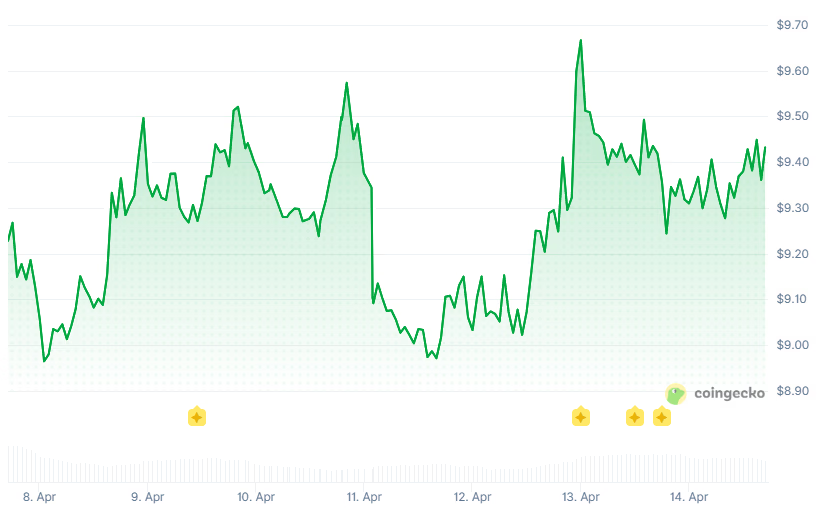
AVAX is trading at $9.43 with a market capitalization of around $4 billion, per CoinGecko. The token is up 3% over the past week.

Bitwise has been on an aggressive ETF expansion spree, having previously launched products tracking XRP and Dogecoin. The firm also pioneered in-kind creation and redemption for its spot Bitcoin ETF last year. The Avalanche fund continues a broader industry trend toward staking-enabled crypto ETFs that gained momentum after BlackRock filed to add staking to its Ethereum ETF in 2025.
This article was written with the assistance of AI workflows. All our stories are curated, edited and fact-checked by a human.


A leading core Bitcoin developer said he would rather see the estimated 5.6 million bitcoin he believes to be lost frozen by the network than risk them falling into the hands of future quantum hackers.
Jameson Lopp told CoinDesk that while he does not want to freeze anyone’s bitcoin, removing dormant tokens from potential circulation may be safer for the network.
“At the moment, I don’t believe any of this is necessary,” Lopp said in an interview, emphasizing that he is thinking “adversarially about a potential future threat.” Still, he would “rather for lost or dormant coins to be taken out of reach from an attacker rather than have them flow into the hands of an entity that likely doesn’t care much about the ecosystem.”
His comments follow the Tuesday release of BIP-361, a proposal from Lopp and others that explores phasing out bitcoin’s current cryptographic signatures and, over time, invalidating transactions from quantum-vulnerable wallets, potentially freezing assets that fail to migrate. At current prices, the dormant tokens Lopp referenced are worth roughly $420 billion.
In a subsequent post on X, Lopp said he “doesn’t like” the proposal and hopes it never needs to be adopted, describing it as a “rough idea for a contingency plan” rather than a finalized specification. “I wrote it because I like the alternative even less,” he wrote, adding that in the face of an existential threat, “individual economic incentives outweigh philosophical principles.”
It’s not the first time Lopp has expressed his feelings about quantum recovery, which he said amounts to rewarding technological supremacy rather than productive participation in the network. “Quantum miners don’t trade anything,” Lopp wrote. “They are vampires feeding upon the system.”
Millions of bitcoin likely lost forever
Roughly 28% of all bitcoin, or about 5.6 million tokens, has not moved in over a decade, Lopp said, adding that he and other analysts consider it likely lost. If ever recovered through advances in quantum computing, that amount could introduce significant volatility and undermine confidence in the original crypto network, Lopp added.
While the proposal remains in early stages with no set timeline for adoption, it has already sparked fierce debate within the community.
Lopp framed the idea as a way to encourage or even push others to upgrade their wallets before any real threat emerges.
“It’s not that I want to freeze anyone’s bitcoin,” he said. “We believe it will be necessary to incentivize the ecosystem to upgrade because humans tend to be procrastinators.”
Any change would require consensus across the decentralized network. While no formal vote takes place on the matter, similar upgrades have in the past required overwhelming support from miners to activate.
Read more: To freeze or not to freeze: Satoshi and the $440 billion in bitcoin threatened by quantum computing
Massive market panic risk
More significant risks include the loss of trust in the largest cryptocurrency itself, Lopp said. While a sudden dump of millions of bitcoin onto the market could trigger sharp price swings, he said the bigger danger lies in perception.
“It doesn’t even require a massive market dump,” Lopp said. “If there is any credible evidence that anyone has the capability to recover lost or vulnerable coins with a quantum computer, you should expect a massive market panic immediately.”
In that scenario, he said, rational holders would probably exit the system until there is confidence the blockchain has been secured against such threats.
The result is a growing divide within the community, one that pits Bitcoin’s long-standing promise of immutable, censorship-resistant ownership against the need to defend the network from a potential future shock.
Departure from Bitcoin’s principles
Market analyst Mati Greenspan, founder of Quantum Economics, said the debate is more philosophical than technological.
“The path to quantum resistance is relatively clear,” he said. “The real question is how the Bitcoin community chooses to handle vulnerable coins along the way.”
In his opinion, freezing dormant bitcoin accounts would mark a significant departure from Bitcoin’s core principles.
“On one hand, freezing dormant or exposed coins could remove a major tail-risk and protect market confidence,” Greenspan said. “On the other, it introduces a precedent of intervention that many would argue is more dangerous than the threat itself.”
Greenspan explained that even without a large-scale sell-off, visible quantum attacks on dormant wallets could trigger panic across the market.
Others argue that freezing dormant BTC accounts risks undermining Bitcoin’s foundational guarantees.
“Ownership becomes conditional. Having keys no longer guarantees you can spend,” said Leo Fan, founder of Cysic and former lead on quantum resilience at Algorand. “That weakens Bitcoin’s ‘unstoppable money’ promise.”
And while he does not agree with freezing the accounts, Fan noted that removing millions of bitcoin from circulation could tighten supply, potentially boosting its value.
Welcome to our institutional newsletter, Crypto Long & Short. This week:
- Tricia Gallagher on how the fix for broken digital identity systems will need to be state-led and user-controlled.
- Top headlines institutions should pay attention to by Francisco Rodrigues.
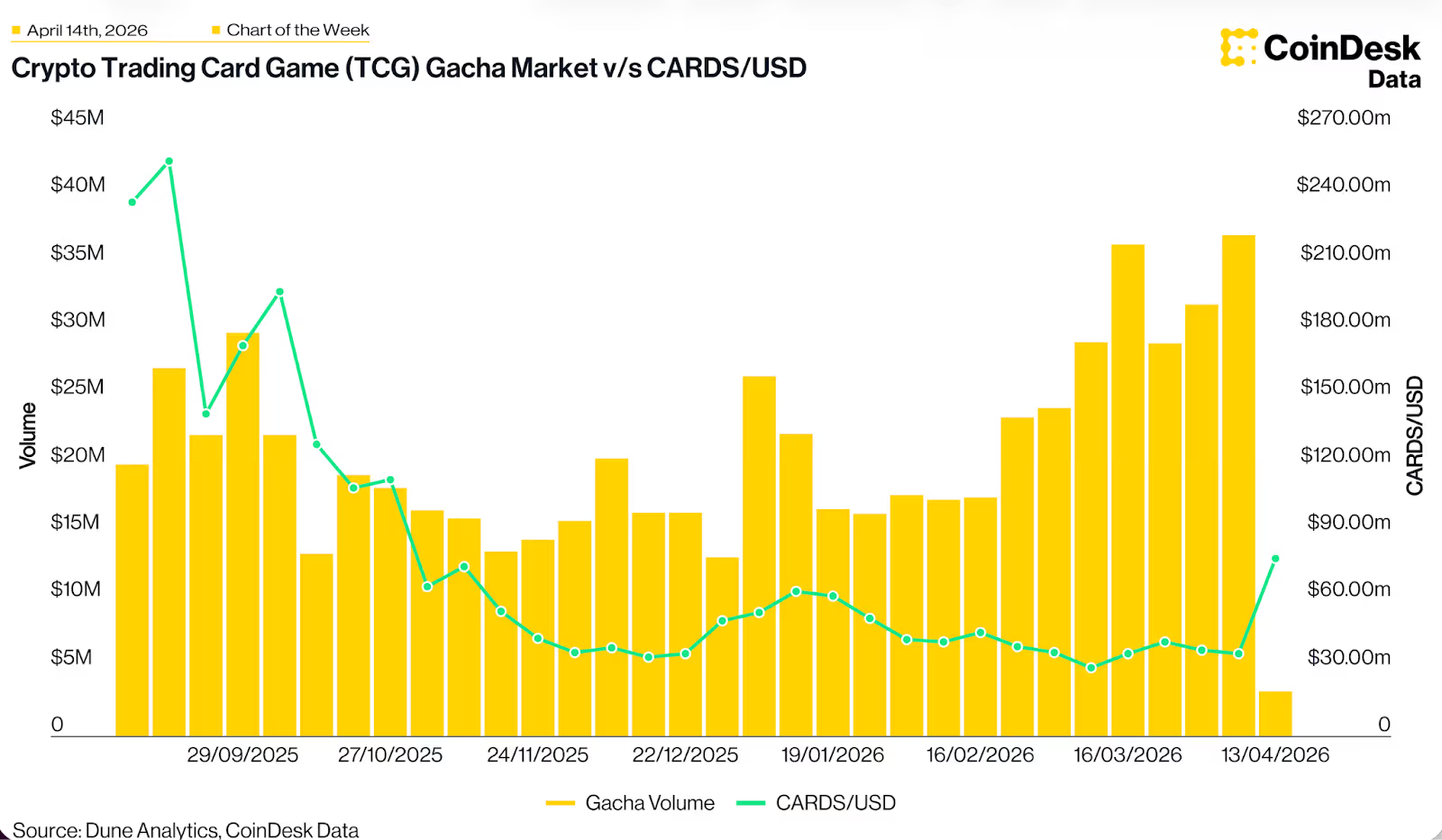
- Crypto TCG gacha volumes hit all-time high as CARDS token surges 52% in Chart of the Week.
Thanks for joining us!
You’re reading Crypto Long & Short, our weekly newsletter featuring insights, news and analysis for the professional investor. Sign up here to get it in your inbox every Wednesday.
Expert Insights
Fighting fraud in the digital age: why state-led identity is the future
By Tricia Gallagher, founder and principal, Treasury Solutions Info Tech (TSIT)
The United States has lost an estimated $5 trillion to fraud and improper payments across government programs.
That number should stop us in our tracks.
Yet most policy responses still focus on detection, recovery and enforcement. They miss the underlying issue. Fraud at this scale is not a compliance failure — it is an infrastructure failure and at its center is identity. Addressing it requires a shift away from band-aid solutions toward a re-architecture of our digital identity framework.
There is a growing movement around the idea that identity — and control over access to personal data — belongs to the individual, not to banks, technology platforms or even the government. Even within the financial system, where data use is more tightly regulated, individuals often lack meaningful visibility or control. Data sharing operates through broad, one-time consent frameworks that enable ongoing access and reuse of financial data with limited transparency. More importantly, when consumers cannot actively direct how their data is shared and used, they are limited in their ability to access new and tailored financial services — constraining innovation, reducing competition and slowing economic growth.
This dynamic is even more pronounced in the technology sector, where personal data is routinely collected, aggregated and monetized at scale. Across both domains, individuals have limited awareness of who has access to their data and how it is used.
At its core, this model requires individuals to surrender control of their identity and personal data to participate. These systems are not only inefficient, they expand the surface area for misuse and security breaches. More fundamentally, they erode individual agency and undermine the very notion of inalienable rights in the digital age.
Two major policy debates in Washington reflect this tension: one focuses on reducing fraud and improper payments; the other centers on control of consumer financial data. They are treated as separate issues, but in reality reflect the same structural gap.
Policymakers are responding, but largely within the constraints of the current system. Congressional efforts to update the Gramm-Leach-Bliley Act focus on consumer data control through opt-in and opt-out regimes. At the same time, the Trump Administration has elevated fraud prevention through expanded oversight and increased data sharing across agencies. Since January 2025, more than a dozen federal initiatives — including an interagency fraud task force — have been launched.
On one side, policymakers are pursuing incremental privacy improvements. On the other, they are expanding access to sensitive government data to combat fraud. The result is continued reliance on centralized data pools, combined with limited individual control over how personally identifiable information (PII) is accessed and used. These architectures increase exposure, create attractive targets for bad actors and remain difficult to secure at scale.
The core challenge is not simply data protection. It is how to enable trusted verification and privacy while preserving individual control over access to personal data. Without that control, individuals are required to relinquish how their data is accessed and used, undermining a core inalienable right in the digital economy. This is where states have a critical role to play.
States have long served as the primary issuers of identity through birth records, driver’s licenses and other foundational credentials. This positions them to lead the next phase of digital identity infrastructure. The future of digital identity will require states to become the anchor of trust — not by expanding data collection, but by re-architecting how that trust is expressed: shifting from centralized data silos to privacy-preserving, user-controlled credentials.
Utah provides a clear example. Through legislation taking effect in May 2026, the state has introduced a Digital Identity Bill of Rights that places individuals at the center of how their identity is used and shared. It establishes clear principles to enable user control, data minimization, restricted surveillance and verification based only on what is necessary. At its core is a simple reality: trust in financial systems requires authoritative identity. Access to public funds and services depends on verified eligibility, and states already fulfill this role.
The goal is not to remove the state, but to modernize how trust is expressed. By shifting to privacy-preserving, user-controlled credentials, states can reduce fraud, improve transparency and strengthen accountability.
As federal debates continue to focus on managing data within legacy systems, states have an opportunity to lead in a fundamentally different direction — one that reduces reliance on centralized data and restores individual control over identity and personal information. The future of digital finance will not be defined by speed alone, but by whether systems uphold both trust and rights.
Identity is the bridge between the two.
Headlines of the Week
This week delivered a blend of significant developments across geopolitics, global regulation, and decentralized finance.
Stablecoins were a key focus globally, with the Federal Deposit Insurance Corp. formally proposing its approach to U.S. federal rules and a group led by HSBC and Standard Chartered receiving Hong Kong’s first stablecoin licenses.
Meanwhile, crypto entered geopolitical tensions as Iran explored collecting transit fees in cryptocurrency for oil tankers passing through the Strait of Hormuz. The Strait has since been blockaded by the U.S. navy.
Chart of the Week
Crypto TCG gacha volumes hit all-time high as CARDS token surges 52%
The crypto Trading Card Game (TCG) gacha market — where players spend crypto to open randomised digital card packs — hit a record $36 million+ in weekly volume on April 13th, 2026, continuing the uptrend post the range-bound move in February. CARDS/USD, the largest tokenised trading card index, appears to be responding, surging 52% in the last 24 hours as on-chain card collecting sentiment recovers.

Listen. Read. Watch. Engage.


The platform’s new Earn feature lets its thousands of institutional clients deposit their stablecoin to DeFi’s top lending protocols directly on Fireblocks.
Enterprise crypto infrastructure firm Fireblocks has launched an on-chain lending product, Earn, giving its institutional clients direct access to two of DeFi’s largest lending protocols, per a press release shared with The Defiant.
Via Earn, the firm’s more than 2,400 institutional clients will be able earn yield on their stablecoin holdings via Morpho and Aave, directly from the Fireblocks platform. The feature is available across all of Fireblocks’ infra solutions, including its digital asset treasury solution, in the case the corporate treasury holds stablecoins.
Existing Fireblocks customers need to apply to get early access to the feature, per the release.
Aave is the dominant lending protocol in DeFi, with roughly $26.3 billion in total value locked (TVL) and around $18 billion in active loans. Aave commands about 50% of the DeFi lending market TVL, per DefiLlama data. Morpho is DeFi’s second-largest lending protocol by TVL, with approximately $7.6 billion in TVL, according to DefiLlama.
Fireblocks Earn will launch with a curated vault managed by Sentora, provided by Morpho. Both integrations operate within Fireblocks’ existing approval workflows, policy controls, and transaction signing infrastructure, the press release notes.
The product targets idle stablecoin balances sitting “between deployment cycles, settlement windows, and operational holds” across Fireblocks’ clients. The company says stablecoin transfer volume on its network totaled $6 trillion in 2025, a 300% increase year-over-year.
“For the first time, institutions can put those balances to work through onchain lending strategies curated by established institutional names, inside the same platform, under the same controls they already run,” said Fireblocks co-founder and CEO Michael Shaulov.
The integration deepens a long-running relationship between Fireblocks and Aave, dating back to Aave Arc, a permissioned version of the DeFi protocol targetting institutions, launched in 2022. As The Defiant reported at the time, at launch, Fireblocks served as sole approved whitelister for Arc, in part tasked with compliantly onboarding institutional players to the platform.
Morpho, meanwhile, has been expanding institutional partnerships, with Apollo Global Management committing to acquiring up to 9% of its token supply in a February agreement. Also recently, the Ethereum Foundation deployed more deposits to Morpho vaults, totaling nearly $19 million as of last month.
This article was written with the assistance of AI workflows. All our stories are curated, edited and fact-checked by a human.


- Fireblocks integrates Aave into its Earn feature, enabling institutional clients to earn yield on stablecoins.
- Aave founder Stani Kulechov highlights Aave’s resilience amid rising DeFi adoption.
- AAVE price analysis shows bullish positioning, with potential rally as adoption continues.
Aave’s role in decentralized finance has received a major boost as Fireblocks unveils a new platform set to bring stablecoin yield to institutional clients.
The enterprise platform’s new Earn feature now embeds Aave, enabling seamless yield generation on stablecoins for its vast institutional network.
The AAVE token is up more than 5% in the past 24 hours, with bulls testing $105 amid broader gains across the cryptocurrency market.
Why Aave and Fireblocks integration matters
As noted, the enterprise platform Fireblocks has integrated Aave into its new Earn feature.
The platform allows the over 2,400 institutions on Fireblocks to tap into DeFi via Aave-powered yield on their stablecoin balances.
Earn thus allows Fireblocks customers to deploy their idle capital to work, and its traction could add to Aave’s adoption.
The digital asset operations tied to the integration will bolster AAVE.
“Aave has demonstrated resilience, transparency, and security across multiple market cycles, driving increased institutional participation,” said Stani Kulechov, founder of Aave Labs.
“As institutions enter the space, access to deep, reliable liquidity becomes essential. With the Fireblocks Earn integration, institutions can now access Aave’s stablecoin liquidity directly within the familiar Fireblocks platform.”
This move builds on Fireblocks’ handling of over $10 trillion in digital asset transactions and $6 trillion in stablecoin volume last year, representing a 300% year-over-year surge.
Aave’s DeFi liquidity markets are available on Ethereum, Base, Arbitrum, and Optimism.
Aave is now available as the primary yield source for Fireblocks Earn, accessible to all Fireblocks users. https://t.co/7FQtILJttJ
— Stani (@StaniKulechov) April 15, 2026
AAVE price analysis
This integration bolsters Aave’s position as DeFi’s leading lending protocol.
Institutional capital via Fireblocks could drive sustained AAVE appreciation, enhancing liquidity depth and protocol utility.
AAVE’s price surged following the Fireblocks announcement on April 15, 2026, reflecting market enthusiasm for institutional inflows.
While the altcoin mirrored the performance of top coins, the news looks to have emboldened buyers.
The token traded around $105 after bearish pressure reemerged near $110, but the dip in daily volume suggests sellers do not hold the sway.
On the other hand, the technical picture shows bullish signals across key indicators.
The Relative Strength Index (RSI) hovers near 55 on the daily chart. Exiting neutral territory indicates a potential bullish momentum before overbought risks kick in above 70.
The MACD also reveals a histogram expansion amid a bullish crossover pattern.

On the upside, 50-day and 100-day exponential moving averages (EMAs) offer the immediate resistance areas at $106 and $124. A short-term bullish structure would see AAVE surge to $164.
However, downside risks include failure to hold $100, which could allow bears to target $89 and then $80 as primary support levels.
Crypto exchanges have become the primary venues where millions of people and businesses store and transfer digital money. According to industry data, the crypto market is currently seeing roughly $190–$192 billion in 24-hour trading volume. As exchanges expand into multi-asset venues, the security mechanism evolves beyond wallets into identity, permissions, pricing and settlement. Yet, despite growing pressure from regulators, their security is still failing.
In 2025, more than $3 billion in crypto assets were stolen, according to industry estimates. Moreover, several single incidents caused losses of over $1 billion each. Were these small or underfunded platforms? No.
The largest hacks happened at major global exchanges with ample capital and technology. So, a lack of resources allocated for protection wasn’t the issue — security, still treated as marketing, was.
Much of the industry keeps treating security as a performance rather than an operating discipline. Exchanges invest in what appears convincing on the surface: dashboards, reserve snapshots, protection funds, public statements. It looks reassuring, but it doesn’t prove how risk is managed day to day.
That’s why, unless security is designed to be enforced, not shown off, even the biggest platforms will stay fragile. And when stress hits, that fragility spills over to users immediately.
Performative Security is Dangerous
In fact, what’s happening is what I call “security theater.” It’s when an exchange focuses on looking safe, but not actually being safe. So the focus shifts to optics, such as headlines and polished statements, while the real governance remains weak.
I’ve seen how such a mindset takes hold. When a business is growing, it has to move fast and keep everything smooth for users. In such conditions, security controls are a friction. They slow down decisions by adding extra steps and triggering uncomfortable questions like “Who can approve this transfer?” And “what happens if the wrong person gets access?” That’s why many platforms prefer confidence on the surface over discipline inside.
And the big problem is that this false confidence doesn’t survive stress. In July 2024, India’s WazirX suffered a roughly $235 million hot valuable wallet breach and suspended withdrawals. In my view, that’s a useful reminder of how quickly “everything looks fine” can turn into users losing access to their funds.
And that’s the point. Security isn’t a page, a logo or a fund. It’s the daily rules that control how money moves, who has access and how cases are handled when something goes wrong.
What exchanges must prove to earn real trust
Genuine exchange security is a system that endures stress, and you can test that. From my experience, it has three core traits:
- it proves full backing of customer balances,
- it controls how money moves,
- and it responds fast in a crisis.
Proof-of-reserves is a start toward demonstrating the system can withstand stress. Simply put, it’s evidence that certain assets exist. Still, it says little about what the exchange owes you, what rules apply to your money if the exchange has troubles or whether the numbers are true when many users withdraw at once. That’s why transparency should be two-sided.
It should clearly show assets and liabilities, with an independent check. And the “proof” should be verifiable, for example, through cryptographic methods that allow users to confirm inclusion without exposing balances.
Then comes the part most “security pages” avoid — strict rules inside the company. No single person should be able to move customer funds, unusual activity should trigger reviews, and large transfers must require approval from at least two people. With these controls in place, one compromised account can’t cause a chain reaction across the platform.
Since exchanges are becoming multi-asset platforms, those rules need one more goal: keeping a permission mistake or pricing anomaly from spilling into cross-asset liquidations.
Quick incident response is the final test of real security. A serious exchange knows exactly what happens in the first hour, isolates the breach, pauses critical flows and communicates clearly. Delays and silence don’t buy time; they simply multiply damage.
Of course, these measures don’t cover every possible risk. Even so, they form the backbone of true exchange durability — the kind that prevents routine incidents from turning into systemic failures.
By 2026, ‘trust us’ costs too much
If exchanges want to keep their customers and attract serious, institutional capital, they have to stop acting like performers in a safety show. Reassuring words and polished pages may calm people in quiet moments, but they fail when a big crisis hits.
Big investors have already started treating security as basic counterparty risk. They want evidence of controls, separation of duties, independent assurance, and a response plan that works under pressure.
So, in 2026, a simple “trust us” on a homepage won’t be enough. Can one mistake drain the platform or does the system stop it? Can you prove that with enforced limits and approvals, instead of explanations after the fact? These are questions that everyday users and large investors alike are starting to ask.
After all, security is about building systems that mitigate damage, slow down bad decisions and hold up under stress. Exchanges that make that shift will keep trust. Those who don’t will keep learning the same lesson the hard way.
Bitcoin (BTC) has a target market that is “probably a lot bigger” than gold’s $30 trillion market cap, says a crypto industry executive.
Key points:
-
Bitcoin should continue to outperform during geopolitical crises, says Bitwise’s Matt Hougan.
-
Bitcoin’s “addressable market” could surpass gold’s near $40 trillion market cap.
-
A trader eyes a return to $90,000 for Bitcoin after a historic drawdown against gold.
Bitcoin “probably” beats gold target market
In an X article on Tuesday, Matt Hougan, chief investment officer of crypto asset manager Bitwise, saw geopolitical conflict fueling BTC price gains in future.
“Bitcoin has performed well since the start of the Iran conflict,” he noted.
“Since U.S. and Israeli airstrikes began on February 28, bitcoin is up 12% while the S&P 500 is down 1% and gold has fallen 10%.”

Bitcoin rallied to $76,000 this week, hitting two-month highs on a combination of US-Iran war relief and cooler US inflation numbers, per data from TradingView.
“This has caught many off guard. Bitcoin is a risk asset, and many assumed it would fall during a risk-off geopolitical shock,” Hougan commented.
“Pundits have grasped for explanations: Some have argued that geopolitics is irrelevant for bitcoin, while others have pointed out that war often leads to money printing, which tends to boost bitcoin in the long term. Both arguments are wrong.”

For Hougan, the nature of recent conflicts — notably Russia being shut out from the SWIFT network in 2022 — has bolstered Bitcoin’s status as an “apolitical alternative.”
“I mused at the time that the weaponization of SWIFT might one day open up space for bitcoin: If countries grew reluctant to deal in dollars, it stood to reason that they might prefer an apolitical alternative at some point,” he continued.
Now, with Iran under both financial sanctions and an oil blockade, collecting crypto tolls for transit through the Strait of Hormuz, that “weaponization” trend is strengthening.
“This framing tells you two important things about bitcoin’s future,” the post summarized.
“First, it tells you that bitcoin is likely to rise during future geopolitical conflicts -— particularly if they occur in regions trapped between the US and Chinese systems. And second, it tells you that bitcoin’s total addressable market is probably a lot bigger than the $38 trillion gold market alone.”
Bitcoin vs. gold sparks $90,000 BTC price target
In gold terms, Bitcoin is currently recovering from a trip to its lowest levels since mid-2023.
Related: Oil price surges 8% on Iran tensions: Five things to know in Bitcoin this week

The rebound has been slow, even as Hougan predicts the end of the current “crypto winter.” For some, however, the writing is on the wall when it comes to a meaningful bullish trend change.
In an X post of his own, crypto trader Michaël van de Poppe predicted that “mean reversion” for Bitcoin was just a matter of time.
“The recent correction of $BTC vs. Gold is the heaviest in the history of Bitcoin,” he noted.
“Comparing this to historical events, the average return after 12 months was 350-450% from this point. That means, from here an increase from $60,000 to $275,000. In 3 months time, it’s very likely that we’ll be trading at $87,500-90,000.”

Comparing behavior after other drawdowns, Van de Poppe said that the “moral of the story” was to “buy the dip” on BTC.
“This is the general moment every cycle that you’d want to get allocated into an asset,” he argued.
This article is produced in accordance with Cointelegraph’s Editorial Policy and is intended for informational purposes only. It does not constitute investment advice or recommendations. All investments and trades carry risk; readers are encouraged to conduct independent research before making any decisions. Cointelegraph makes no guarantees regarding the accuracy or completeness of the information presented, including forward-looking statements, and will not be liable for any loss or damage arising from reliance on this content.

Bayern Munich vs Real Madrid LIVE: Latest team news ahead of Champions League quarter-final second leg

US war on Iran was a 'mistake', says Reeves

Green Party call new immigration propaganda ‘made up nonsense’


-

 Politics5 days ago
US brings back mandatory military draft registration
-
 Sports5 days ago
Man United discover Nico Schlotterbeck transfer fee as defender reaches Dortmund agreement
-

 Fashion5 days ago
Weekend Open Thread: Veronica Beard
-

 Politics6 days ago
Malcolm In The Middle OG Turned Down ‘Buckets Of Money’ To Appear In Reboot
-

 Politics3 days ago
World Cup exit makes Italy enter crisis mode
-

 Crypto World6 days ago
Canary Capital Files SEC Registration for PEPE ETF
-

 Business5 days ago
Tesla Model Y Tops China Auto Sales in March 2026 With 39,827 Registrations, Beating Cheaper EVs and Gas Cars
-

 Crypto World2 days ago
The SEC Conditionalises DeFi Platforms to Be Avoided for Broker Registration
-

 Crypto World2 days ago
SEC Signals Exemption for Crypto Interfaces From Broker Registration
-

 News Videos10 hours ago
Secure crypto trading starts with an FIU-registered
-
 NewsBeat3 days ago
Pep Guardiola and Gary Neville agree over Arsenal title problem that benefits Man City
-

 Business5 days ago
OpenAI Halts Stargate UK Data Centre Project Over Energy Costs and Copyright Row
-

 Business4 days ago
Ireland Fuel Protests Enter Day 5 as Blockades Spark Shortages and Government Prepares Support Package
-

 Politics5 days ago
LBC Presenter Mocks Trump Over Iran War Failures
-

 Crypto World5 days ago
Federal judge blocks Arizona from bringing criminal charges against Kalshi
-
 NewsBeat3 days ago
JD Vance announces ‘no agreement’ with Iran over nuclear weapons fear
-

 NewsBeat1 day ago
Trump and Pope Leo: Behind their disagreement over Iran war
-

 Tech6 days ago
A version of Windows 10 released a decade ago is now eligible for additional security patches
-

 Crypto World2 days ago
SEC Proposes Certain Crypto Interfaces Don’t Need to Register as Brokers
-

 Business5 days ago
IMF retains floor for precautionary balances at SDR 20 billion
You must be logged in to post a comment Login