

Crypto World
Cardano’s Hoskinson Bets Big on AI as Midnight City Development Pushes Forward



Charles Hoskinson is making a stronger case for artificial intelligence as work on Midnight City progresses. The Cardano founder now treats agents as the backbone of how the network communicates and scales.
Below is a breakdown of his recent remarks, plus a closer look at what Midnight City is actually trying to prove.
How Hoskinson Frames AI’s Role in Cardano’s Next Phase
AI agents act autonomously, trading, posting, and coordinating without a human behind the keyboard. Hoskinson is leaning into that definition after fielding pushback over recent experiments tied to Cardano’s official channels.
The complaints centered on a synthetic influencer that surfaced on the Input Output account. Followers were not impressed.
However, Hoskinson defended the move as a transparent trial-and-error, arguing that the team is showing what these tools can do rather than hiding behind polished output.
He also pointed to OpenClaw, an open-source agent project he sees gaining traction at a remarkable speed. For Hoskinson, that growth is a signal. The future of crypto communication will not be carried by a handful of community managers tweeting in real time.
“We’re going to need agents and AI to be able to organize and sort all that out and broadcast on a regular basis what’s going on in Midnight City,” Hoskinson said. As a result, AI is now treated as core infrastructure for the entire Cardano ecosystem.
Follow us on X to get the latest news as it happens.
His reasoning is structural. A blockchain community that grows from thousands to millions cannot be supported by linear hiring. As a result, automation has to take over the routine layer of reporting, moderation, and outreach across every channel that matters.
Hoskinson sketched out what comes next in stronger terms. He talked about AI chief marketing officers, broadcasting tools that feel lifelike, and a long bet on integrating every emerging standard. The shift, in his view, will redefine how protocols introduce themselves to new users.
Why Midnight City Is Becoming the Showcase for That Vision
Midnight City is a live demonstration of what Hoskinson describes. Running on the Midnight Network, it is a digital environment populated by autonomous characters that transact, talk, and behave according to the memory and personality assigned to each.
Visitors can switch the lens they look through. The default view shows only what is committed openly to the chain. An auditor’s view, by contrast, reveals selective information to anyone with the right cryptographic clearance, mirroring how compliance might work in practice.
A third layer, sometimes called God mode, lifts the curtain on each agent’s internal state. Users can see goals, memory, and history that would normally stay private. The point is to teach observers how selective disclosure actually behaves, not just describe it in a white paper.
“It’s why it’s one of our most important projects and we’re leaning into it and integrating every single AI standard,” Hoskinson said. The Cardano founder added that the team will keep experimenting with how the technology evolves across the coming quarters.
The infrastructure underneath is built for volume. Shielded transactions are first wrapped in zero-knowledge proofs. Furthermore, batches are run in Trusted Execution Environments before being anchored back to the base layer via cryptographic checks.
Hoskinson sees real growth potential beyond the demo. Agentic trading and affiliate-style relationships, he argues, could pull millions of fresh users into Midnight as the simulation evolves. That is why he describes the project as one of the most important on Cardano’s plate.
The wider context also explains the urgency. Crypto is moving on two fronts at once: privacy-preserving computation and the rise of on-chain agents that coordinate economic activity.
Subscribe to our YouTube channel to watch leaders and journalists provide expert insights.
The post Cardano’s Hoskinson Bets Big on AI as Midnight City Development Pushes Forward appeared first on BeInCrypto.


Technical analyst Jesse Olson says Bitcoin could face a sharp drawdown scenario in 2026 if the US stock market experiences a major, recession-level shock. In a post shared over the weekend, Olson highlighted a downside target near $23,980, framing it as a potential outcome if equities fall by more than 50%—a regime he links to how BTC historically behaves when risk appetite collapses.
The call comes alongside on-chain and market-demand indicators pointing to continued caution among institutional participants. Coinbase Premium Index readings have stayed largely negative so far this year, while US spot Bitcoin ETFs have recorded net outflows since May, according to SoSoValue data.
Key takeaways
- Jesse Olson’s worst-case technical target for Bitcoin centers on $23,980 if equities undergo a collapse of 50%+.
- Negative Coinbase Premium Index readings suggest institutional-style demand has not returned with conviction.
- Since May, US spot Bitcoin ETFs have logged $4.68 billion in net outflows, reflecting weaker ETF buyer activity.
- CryptoQuant-associated analyst Darkfost argues institutions tend to buy only after “confirmation,” not during the early stages of a downturn.
Why Olson’s chart points to $23,980 under a macro crash
Olson’s analysis is based on a two-week BTC/USD chart and his proprietary Market Sniper Pro VWAP indicator. In his post, he references a long-term, volume-weighted support line—an anchored VWAP-style tool commonly used to visualize where an asset’s average traded price may act as support or resistance.
According to Olson’s description, the line appears to be anchored to the 2022 bear-market bottom, allowing it to slope forward over time as a potential long-term zone. On this setup, Olson presents $23,980 as a base-case forecast for Bitcoin during a severe macro sell-off scenario where the US stock market drops by more than 50%.
That framing matters for traders because it treats BTC’s direction not just as a function of crypto-native flows, but as a response to broader liquidity and risk-reduction behavior across markets. When stocks fall abruptly, BTC has often traded like a high-risk asset, and the knock-on effect can include forced selling, hedging, or simply an institution-wide reduction in exposure.
Olson’s warning sits in the same broader macro conversation that has been circulating among traditional-market strategists. For example, GMO co-founder Jeremy Grantham has called the ongoing AI market boom a major speculative bubble, while Michael Burry has compared parts of the current rally to the late stages of Dot-com mania. Economist Gary Shilling has also warned that a US recession is “almost inevitable” by year-end and suggested stocks could be at risk of a 20%–30% decline.
Even if investors don’t match Olson’s exact scenario, his key contribution is identifying a concrete level that traders may watch if correlations between BTC and risk assets intensify. In a fast-moving equity drawdown, technical targets like $23,980 can shift from hypothetical to actionable much quicker than many market participants expect.
Institutional demand signals stay muted: Coinbase premium and ETF flows
A second layer of Olson’s bearish backdrop comes from indicators tied to institutional and professional positioning.
First, the Coinbase Premium Index—tracked by CryptoQuant and shown in a chart referenced in the coverage—measures the price gap between Bitcoin on Coinbase and Binance. A positive premium is generally interpreted as stronger US institutional demand, while a negative reading can imply weaker professional buying or relatively heavier selling on Coinbase.
In 2026 so far, the index has remained largely negative, which—based on how the metric is commonly used—suggests that institutional-style bids have not returned decisively.
Second, spot Bitcoin ETFs in the US have shown continued outflow pressure. According to SoSoValue, funds have recorded $4.68 billion in net outflows since May. While ETF flows don’t map perfectly to spot market “strength” tick-for-tick, consistent outflows typically align with reduced buying pressure from the ETF wrapper—one of the main channels through which many traditional allocators access BTC.
Why the “de-risking” narrative matters for timing
CryptoQuant-associated on-chain analyst Darkfost, cited in an X post from Sunday, offered a blunt explanation for why these signals may persist during downturns. In the referenced post, Darkfost said that institutional investors “don’t act like retail,” emphasizing that they operate with “permanent risk management logic.” The key point from the quote is that these investors are not necessarily looking to buy a potential bottom, but to see “confirmation” and “performance”—conditions that may not appear early in a drawdown.
For market participants, this distinction affects expectations about recovery. Retail-driven rebounds can happen quickly, but professional flows often lag—meaning ETF outflows and negative premium readings can remain in place even if BTC stops falling temporarily. If Olson’s macro crash scenario were to unfold, the combination of technical downside levels and institutional hesitation could reinforce each other: equities weaken, risk appetite fades, and demand signals fail to provide a timely counterweight.
That tension is also reflected in earlier commentary referenced in the source material. Analysts such as Galaxy Digital’s Alex Thorn and a pseudonymous trader known as Crypto Kid have previously argued that Bitcoin could decline below $30,000 in a stock-market crash scenario. Olson’s more specific target near $23,980 fits into the same broader thesis: if equities break down sharply, BTC’s drawdown could extend beyond widely watched round-number levels.
What to watch next if equities wobble
If macro stress increases, traders and investors will likely focus on whether BTC breaks down toward Olson’s indicated zone—and whether demand indicators improve before or after any sell-off accelerates. The key question is timing: do institutional metrics like Coinbase premium and spot ETF flows stabilize early, suggesting de-risking is ending, or do they remain weak, implying further downside risk?

TLDR:
- XRP trades at $1.13 after a steep 68% drop from its prior $3.66 cycle peak.
- 24-hour trading volume rose 4.83%, reaching a total of $868.27 million in activity.
- Trader Diana points to $1.10–$1.30 as a key accumulation zone on the weekly chart.
- Cryptollica says this XRP washout has only occurred twice before in 13 years.
XRP changed hands at $1.13, down 1.06% over 24 hours. Trading volume hit $868.27 million, a jump of 4.83%.
The token has now fallen 68% from its cycle high of $3.66. That high was set during a previous rally phase. The pullback has reset trader expectations across social media.
XRP Price Holds Support Zone After Steep Correction
The $1.10 to $1.30 range has become a focal point for traders. Crypto commentator Diana, who posts as @InvestWithD on X, said this zone represents an accumulation area. She argued the broader weekly chart structure still points upward despite the drop.
Diana outlined several upside levels in her post. She cited $2.00 to $2.50 as first resistance, and $3.66 as a retest of the previous cycle high. In addition, she highlighted the $5.00 to $6.00 price zone as a possible range for price discovery.
She also flagged $8.17 as a Fibonacci extension target. A further level near $17.15 appeared in her post as a long-term channel projection. Diana described $0.40 to $0.60 as a deeper macro support zone if the current range fails.
Separately, an account posting as @Cryptollica framed the current setup differently. The post claimed XRP has only seen this level of washout three times in 13 years. It suggested past instances of heavy pessimism preceded later rallies.
Trading Activity Reflects Mixed Sentiment Among Holders
Circulating supply for XRP sits at 62.05 billion tokens, against a max supply of 100 billion. Total supply stands at 99.98 billion. The token’s fully diluted valuation reached $113.44 billion based on current pricing.
Holder count data places active addresses at 536,410. That figure offers a snapshot of distribution across the network. Volume relative to market value sat at 1.23% over the past day.
Neither Diana nor Cryptollica cited specific on-chain metrics to support their projections. Their posts relied on chart pattern interpretation rather than fundamental data. Social sentiment around XRP has fluctuated through the corrective phase.
Price action over coming sessions may test whether the $1.10 floor holds. Traders following the accumulation thesis are watching that range closely. Others remain cautious given the scale of the recent pullback.

Global hedge fund leverage sits near multi-year highs. JPMorgan estimates that quarter-end rebalancing could trigger a $165 billion stock selloff before June ends, raising the risk of sharp moves in crowded technology trades.
The warnings come from Goldman Sachs and JPMorgan, two of the biggest forces in equity markets. Both point to the same risk, that leveraged and concentrated positions could amplify any pullback once mechanical selling begins.
Leverage Builds Inside a Crowded AI Trade
Goldman Sachs prime brokerage data has tracked leverage rising for over a year. Gross hedge fund leverage reached about 294% in June 2025, a five-year high, Reuters reported.
A note from Goldman trader Lee Coppersmith, circulated this month, said net leverage has since pushed to four-year highs.
JPMorgan strategist Nikolaos Panigirtzoglou sharpened the concern. He warned that stretched positioning in semiconductors is raising the risk of more frequent selloffs.
These value-at-risk shocks strike when volatility breaches funds’ internal limits and forces selling.
His team calculates that semiconductors’ share of global equity value is now more than six times their share of revenue. That is over double the comparable figure for the Magnificent Seven.
The concentration leaves the rally in AI stocks exposed if sentiment turns.
Why the $165 Billion Stock Selloff Matters
The near-term trigger is mechanical. JPMorgan estimates that quarter-end rebalancing could drive up to $165 billion in equity sales as June closes. Big investors are trimming stocks after a strong run.
Japan’s $1.9 trillion Government Pension Investment Fund is the single largest seller at about $60 billion.
US pension funds account for another $55 billion. Norway’s and Switzerland’s funds add tens of billions more, while balanced mutual funds offset roughly $15 billion of buying.
The selling meets a market already on edge. Under new Chair Kevin Warsh, the Federal Reserve held rates this month and signaled a possible hike this year.
That hawkish Federal Reserve stance has repriced rate-cut bets and lifted volatility.
What it Means for Bitcoin
The fragility reaches into Bitcoin (BTC). JPMorgan flagged that the network’s hash rate has grown more sensitive to price.
That signals more miners are operating near breakeven, an added pocket of fragility for crypto.
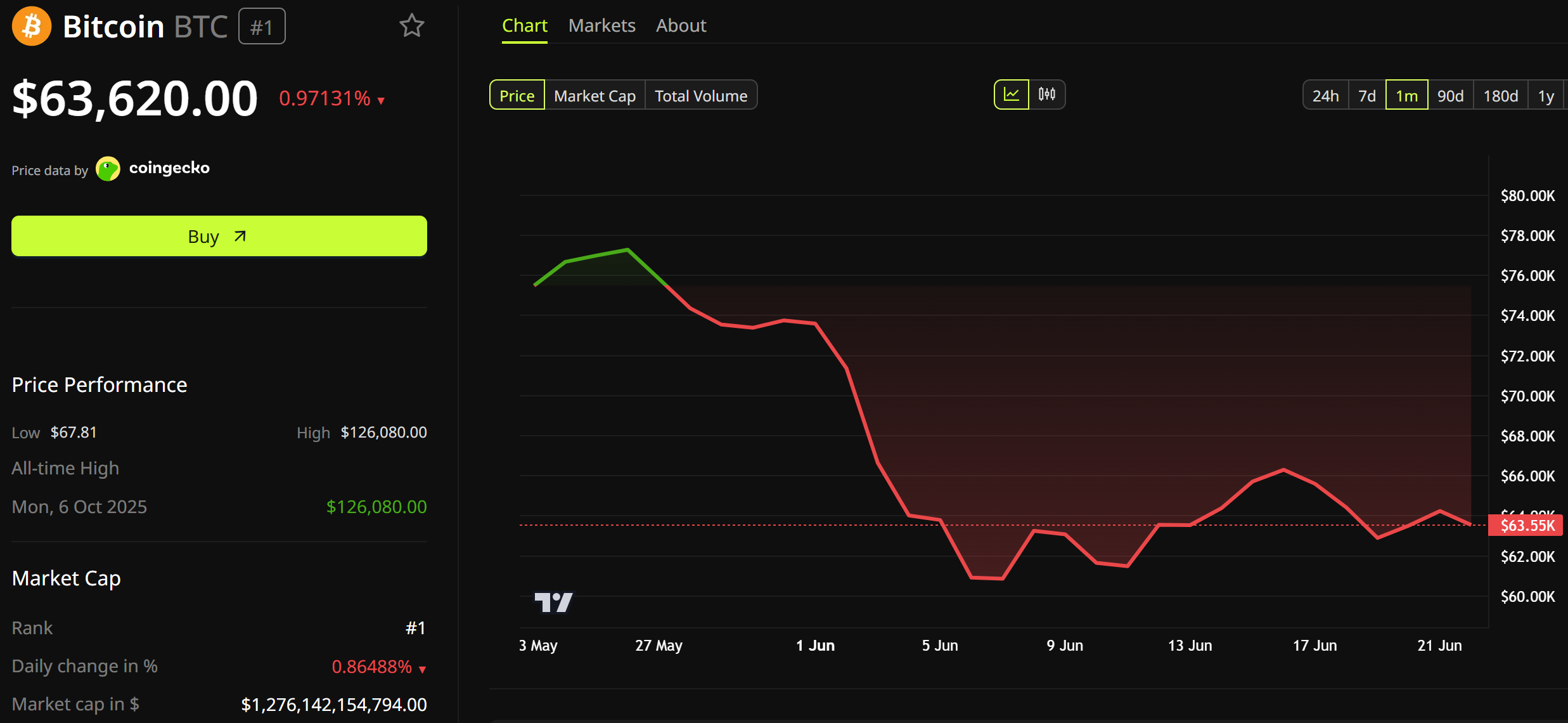
Bitcoin traded near $63,620, with a market value of about $1.28 trillion. It has slid toward the low $60,000s in recent weeks.

The token now trades more like a tech stock than a safe haven. It weakened as FOMC and AI earnings rattled markets.
If forced equity selling collides with high leverage and crowded AI bets, cross-asset volatility could climb into month-end.
The market absorbing the flows or amplifies them may set the tone for stocks and crypto this week.
The post $165 Billion Stock Selloff Looms as Goldman Flags Rising Leverage appeared first on BeInCrypto.
The Proof-of-Stake (PoS) blockchain network, Algorand, has revealed that it is pushing toward becoming quantum-resistant by the end of 2027. The announcement comes as concerns about the post-quantum threat rise in the crypto space.
According to a blog post by the network’s team, the quantum threat has been deemed a serious risk to the security of blockchain technology. Hence, Algorand has outlined a roadmap detailing its efforts, plans, progress, milestones, and ongoing research in the area of post-quantum cryptography (PQC).
Algorand Pushes for Quantum Resistance
Google Quantum AI recently identified Algorand among a set of smart-contract platforms that can achieve PQC. The blockchain already executed its first PQC-secured transaction in 2025 and intends to complete the full PQC transition in less than two years.
“Post-quantum migration is a balancing act. Moving too slowly leaves systems exposed to future quantum attacks, but moving too quickly can mean relying on algorithms and implementations that have not yet been sufficiently battle-tested,” Algorand’s team explained.
The first step in the roadmap is introducing support for native post-quantum accounts in the protocol release scheduled for the third quarter of 2026. Previously enabled Falcon accounts via the Algorand Virtual Machine (AVM) currently demonstrate the viability of post-quantum signatures on the Algorand protocol, but these are not natively supported by the ledger. The introduction of native post-quantum account support will give room for network-level support for multiple concurrent signature schemes.
After the Algorand team establishes a clear direction for standardizing a new derivation scheme for lattice-based post-quantum keys, the network will implement PQC updates to its tools. These include legacy software development kits (SDKs), hardware wallets, and the AlgoKit. Eventually, the network will introduce support for additional signature schemes on traditional Ed25519 accounts.
Exploring Post-Quantum Multisignatures
While implementing these upgrades, Algorand intends to create an environment that enables the integration of future advances with minimal protocol disruption.
“Building on our robust history of native multisig, the arrival of cryptographic agility and native post-quantum accounts enables us to deploy native multisig support for multi-cryptography schemes by the end of 2026. We view this as an essential advancement for institutional operations, treasury management, and high-stakes financial applications,” the team explained.
One of the final steps in the roadmap explores post-quantum multisignatures as a generic policy layer over independently verifiable signatures. This will allow for weighted approvals, hybrid combinations of classical and post-quantum signers, and future PQC signature algorithms as standards develop. This step will ensure protection against both classical and quantum-era threats.
Meanwhile, Algorand is not the only blockchain network pushing for quantum resistance in the coming years; Ethereum and Ripple are working towards the milestone as well.
The post Algorand Reveals Plans to Become Quantum Resistant by 2027 appeared first on CryptoPotato.
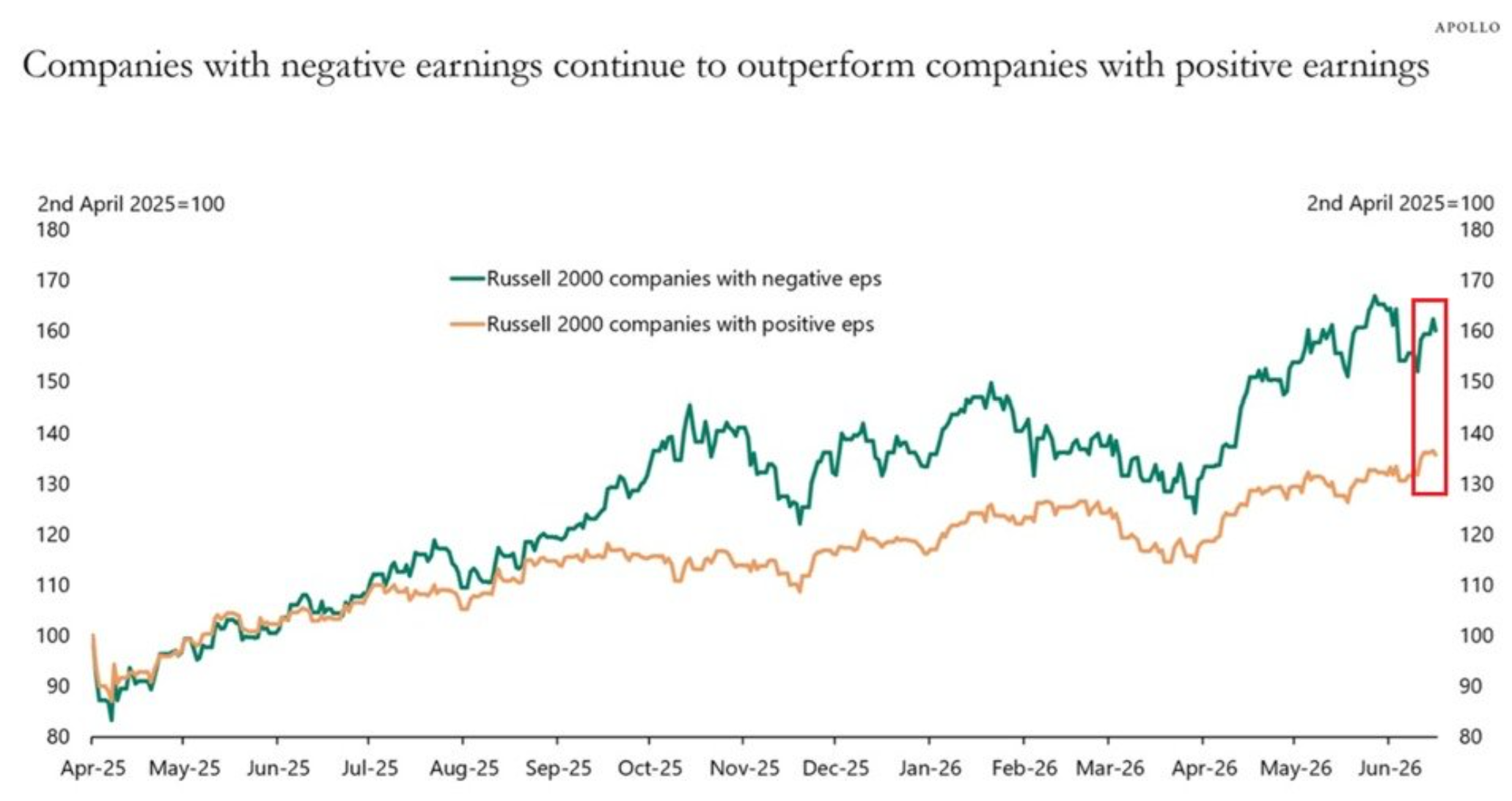
Unprofitable Russell 2000 stocks have climbed about 60% since April 2025, far outpacing the 38% gain for profitable small-cap firms, according to Apollo Global Management.
The divergence has widened through mid-2026, prompting Apollo chief economist Torsten Slok to warn that the market has stopped pricing risk the way it once did.
Unprofitable Russell 2000 Stocks Lead the Rally
The split is stark. Of the index’s roughly 2,000 members, 806 carried negative trailing earnings late last year. Another 1,120 were profitable, Apollo data showed.
That 40% share is not new. Slok first flagged it in November 2023, warning the loss-making firms would be vulnerable to high rates and slowing growth.
Now those same names lead the market. The reversal is the puzzle Slok keeps returning to.
The rally itself traces to early April 2025. Stocks bottomed after the Liberation Day tariff shock. The Russell 2000 has since gained nearly 44% off that low, Royce Investment Partners said.
Micro-caps did even better, up about 66%. Traders watched the rebound through the Russell 2000 breakout signal that pointed to rising risk appetite.
Small caps have since pushed to fresh record highs across the index.

AI Bets Are Fueling the Speculative Bid
Most of the loss-makers are tech firms, Slok told Fortune. Many sit in software, semiconductors, and biotech, sectors riding the AI stocks driving gains across the broader market.
Semiconductor makers led the micro-cap leg of the advance, Royce noted.
Investors are paying up for the promise of future growth rather than current profit. That reach has fed growing AI bubble fears among strategists eyeing stretched valuations.
“Something is broken in price discovery when companies with negative earnings keep outperforming companies with positive earnings.” Slok wrote in a June 20 note.
Not everyone reads it as froth. Morgan Stanley’s Lisa Shalett notes that small-cap firms carry a cost of capital above their return on assets.
Royce’s Francis Gannon counters that many small caps are genuine suppliers to the AI buildout. He also expects stronger small-cap earnings growth in 2026.
The gap keeps widening, with cheap money and AI enthusiasm holding it open.
Slok has returned to the divergence since October, and it has yet to close. Profitable names closing the distance may hinge on interest rates and how long the AI trade lasts.
The post Unprofitable Russell 2000 Stocks Surge 60%, Outpacing Firms That Actually Earn Money appeared first on BeInCrypto.
TLDR:
- HYPE ETFs drew $31.4M inflows equal to 0.208% of market cap, leading relative ETF demand.
- HYPE outpaced SOL on relative inflow rate while BTC and ETH recorded net ETF outflows in period.
- Smaller market cap magnified HYPE ETF impact compared with BTC and ETH capital flows data view.
- ETF flow divergence highlights uneven capital rotation across major crypto assets weekly shift.
HYPE ETFs recorded stronger relative inflows than Bitcoin and Ethereum over the past week, according to reported market data. The token attracted $31.4 million in net ETF inflows, equal to 0.208% of its market capitalization.
Bitcoin and Ethereum both registered negative readings over the same period, while Solana posted weaker positive inflows.
The divergence has placed HYPE ETF activity under closer attention as capital flows shift unevenly across major crypto assets.
HYPE ETF vs BTC & ETH Inflows Show Market Cap Divergence
Data from Hyperliquid Hub and Henry Vo TTT showed HYPE ETF inflows reached $31.4 million over seven days. The figure represented 0.208% of total market capitalization, positioning HYPE ahead on a relative inflow basis.
Solana recorded 0.016% inflows, significantly below HYPE’s absorption rate across the same reporting window. The gap highlighted uneven ETF demand intensity across mid-cap and large-cap crypto assets.
Bitcoin posted a negative 0.011% reading during the same period, based on reported ETF flow data. Ethereum followed with a negative 0.007% figure, signaling net outflows across its ETF exposure.
Both assets faced weaker capital participation compared to smaller-cap tokens in the same cycle. This divergence pointed to shifting allocation behavior across crypto-linked investment products.
Relative comparisons showed how ETF flows scale differently across market capitalizations.
Smaller assets like HYPE reflect sharper percentage movements even with lower absolute inflows.
Larger assets require significantly higher capital to shift their ETF flow percentages meaningfully. The structure of ETF exposure continues to amplify differences between major crypto assets.
HYPE Market Cap Impact and ETF Flow Pressure Across Crypto
HYPE’s smaller market capitalization amplified the effect of ETF inflows on circulating supply dynamics. A $31.4 million inflow represented a larger proportional absorption compared with BTC and ETH flows.
This structural difference explains why relative inflow metrics often favor mid-cap crypto assets.
ETF demand therefore appears more visible in tokens with lower overall market value.
Market participants have tracked whether the inflow trend continues beyond a single weekly cycle. Sustained ETF demand typically signals more consistent capital allocation across crypto investment products.
Short-term spikes remain common, but continuity determines long-term market interpretation.
The latest figures place renewed focus on comparative ETF activity across major tokens.
Future reporting periods will determine whether HYPE maintains its inflow advantage over larger assets. Bitcoin and Ethereum flows will also remain key benchmarks for market-wide ETF sentiment.
Solana’s relative positioning adds another layer to ongoing capital rotation patterns. ETF flow divergence continues to shape how traders interpret crypto market strength.

LUNC price forecast is getting more interesting amid stability in terms of technology and a number of developments within the ecosystem. Short-term dynamics are highly volatile, but market participants keep an eye on the possibility for upgrades and protocol launches to help form a rebound pattern.
Judging from the comments of the analyst terra_army on social media, LUNC is possibly reaching an important stage of its market cycle. The analysis of the weekly chart reveals a period of consolidation accompanied by a decrease in volatility and development of the price base.
Starting from 2022, the majority of the price moves of Terra Classic have occurred in a defined range without any breakdown during bearish trends. Support kept forming in the $0.00006-$0.00007 area, allowing for a long-term accumulation setup.
Technical Indicators Indicate Positive Change
There are a number of technical indicators that have started showing signs of improving conditions in higher time frames. Short-term moving averages have started to flatten out after a long period of decline, whereas momentum oscillators have moved from extremely bearish levels.
Furthermore, the Bollinger Bands, which had been quite tight for a longer duration, have started to widen. This usually indicates a return of volatility following a period of consolidation. It is being watched to see whether there will be any sign of strong directional movement. The overall technical picture remains positive despite a recent downtrend, and traders have their eyes set on a possible breakout in the coming days.
Short-Term Selling Pressure Is An Obstacle
Despite the positive long-term scenario, there was some short-term selling pressure seen in LUNC. The price was seen at $0.00006803 following a daily decline of over five percent. Market capitalization also decreased amid the session due to traders’ cautiousness.
From intraday charts, it could be observed that the asset formed a lower highs and lower lows formation. A couple of bounces were witnessed within the day as well; however, they all met selling pressure.
The drop was fueled further when support at $0.0000690 broke down, causing the asset to move towards $0.0000670 before it found a floor. Even though a slight bounce was seen, resistance zones still keep the upward momentum limited. There was also a decrease in trading activity, with daily volume declining over 20%.
Community Ecosystem Development Continues To Fuel Optimism
In addition to technical developments, developments in the ecosystem of Terra Classic continue to drive optimism among the members of the community. Among the highly anticipated events is the impending mainnet launch of the Juris Protocol, which could act as a catalyst for boosting network activity.
More efforts are being directed towards infrastructure improvements, including upgrades to the station platform in order to improve accessibility and user experience.
The Market Module 2 has also garnered a lot of attention in the community. It aims to link the various Terra Classic projects under one ecosystem while providing USTC staking abilities to the network.
On the other hand, the burning program of Binance is continuing to reduce the amount of supply in circulation. Investors have also cited increasing visibility from HTX and the likelihood of more exchanges joining in future burn programs.
The above developments by Terra Classic will see investors keep their eye on whether the growth of the ecosystem, supply reduction programs, and improved technical conditions can enhance the prospects of LUNC in the future.


Anthropic has reportedly finished training a more capable Mythos successor, according to AI watcher Andrew Curran. The company has not confirmed the model’s existence, name, or capabilities.
Curran said the system could ship as Mythos 5.1 or Mythos 6, or stay internal. His report came nine days after US export controls forced Anthropic to suspend Mythos 5 and Fable 5.
Mythos Successor Emerges from Training
Curran describes the supposed new system as stronger than Mythos 5. However, he stressed uncertainty over its name and whether Anthropic would release it at all.
“A new, more capable version of Mythos has emerged from training. I don’t know whether it will be called Mythos 5.1 or Mythos 6, or if Anthropic will keep it internal to accelerate further development…” Curran wrote.
Anthropic released Mythos 5 and Fable 5 on June 9 and lost them to the directive three days later. Several still expect an iterative upgrade, partly because the model suspension order limits today’s lineup.
Fable 5 ships with heavy safeguards for public use. Mythos 5 runs with fewer security restrictions through Project Glasswing, the firm’s vetted cybersecurity program.
Anthropic says about 50 partners have used early Mythos models to find more than 10,000 high- or critical-severity software flaws.
Why the Suspension Does Not Stop Development
Commerce Secretary Howard Lutnick sent the directive to Anthropic chief Dario Amodei on June 12, citing national security.
It barred every foreign national, including Anthropic’s own foreign-born staff, so the firm disabled both models worldwide.
The government flagged a method for bypassing Fable 5’s safeguards. Anthropic reviewed the demonstration, called it narrow, and warned the same standard would halt new model launches industrywide.
It is still working to reverse the export controls.
Subscribe to our YouTube channel to watch leaders and journalists provide expert insights
The order followed a reported Amazon warning to officials. Amazon has committed up to $25 billion to Anthropic.
Even so, it reportedly told the administration its researchers used Fable 5 to surface attack-ready information.
The clash later drew comments from Donald Trump and a public defense from Amodei.
Curran argued that halting deployment does little to slow progress and may even speed it up by freeing resources.
He pointed to open-weights rivals such as Z.ai’s GLM-5.2, which matches far larger closed models on coding tasks at a fraction of the cost.
The successor’s path stays uncertain. Anthropic shipping it publicly, restricting it to Glasswing, or keeping it internal could reshape the AI race.
The company continues to seek restored access for both suspended models and has not addressed latest developments publicly.
The post Anthropic Reportedly Finishes Training Successor to Suspended Mythos 5 Model appeared first on BeInCrypto.
TLDR:
- Bitcoin traders increasingly identify the $40K-$50K range as a preferred accumulation zone.
- Michaël van de Poppe warned that heavily crowded market expectations often fail to play out.
- Michael Saylor’s latest tracker post renewed attention on Strategy’s Bitcoin acquisition plans.
- Strategy reportedly holds 846,842 BTC, making it one of the largest corporate holders.
Bitcoin traders are increasingly focused on the possibility of a deeper market pullback, with many pointing to the $40,000 to $50,000 range as a preferred entry zone.
At the same time, fresh attention has turned to Strategy after Michael Saylor shared another update tied to the company’s Bitcoin holdings. The developments surfaced across crypto social media as investors weighed future market direction.
Together, they highlight the ongoing debate between waiting for lower prices and accumulating Bitcoin at current levels.
Bitcoin $40K-$50K Buy Zone Debate Gains Attention
Discussion around Bitcoin price expectations intensified after comments from crypto analyst Michaël van de Poppe circulated across social media. He argued that increasingly popular downside targets often fail to materialize once they become widely expected.
The $40,000-$50,000 range is an attractive area for traders to enter Bitcoin, according to Van de Poppe. He said that was similar to the times when investors were anticipating that Bitcoin would go back to $60,000, and it was trading at around $85,000.
The broader message centered on how crowded expectations can influence trader positioning.
Bitcoin’s recent market behavior has kept traders divided between waiting for a larger correction and maintaining exposure at current levels. The debate has become a recurring theme across crypto trading communities.
Social media discussions showed strong engagement around the proposed buy zone. The comments did not contain any predictions on prices, but they were about the psychology of the market.
A number of participants were interested in the possibility of widespread expectations lowering the chances of a substantial drop.
As market participants kept their eyes on macroeconomic trends and institutional movement, the conversation developed as they did. Bitcoin continues to be the biggest digital asset on the market by market cap and can influence the overall crypto trading market.
Michael Saylor Post Sparks Fresh Bitcoin Purchase Expectations
Attention also shifted to Strategy and its Bitcoin accumulation strategy. Michael Saylor posted a chart featuring the company’s Bitcoin tracker alongside the message that it looked better with more dots.
The post quickly attracted attention because similar tracker updates have often preceded announcements of new Bitcoin purchases. Crypto Patel highlighted the development while sharing updated figures related to Strategy’s holdings.
According to the data shared, Strategy currently holds approximately 846,842 Bitcoin. The position was reported to be worth roughly $54.3 billion based on current market values.
Crypto Patel stated that the company’s average acquisition price stands near $75,658 per Bitcoin. The reported total investment reached approximately $64.07 billion.
The figures indicate an unrealized loss of about $9.7 billion, or roughly 15%, based on the data provided. Despite that position, Strategy remains one of the largest corporate holders of Bitcoin globally.
The latest tracker update has renewed focus on the company’s accumulation strategy. Market participants now await any official disclosure regarding additional Bitcoin purchases.
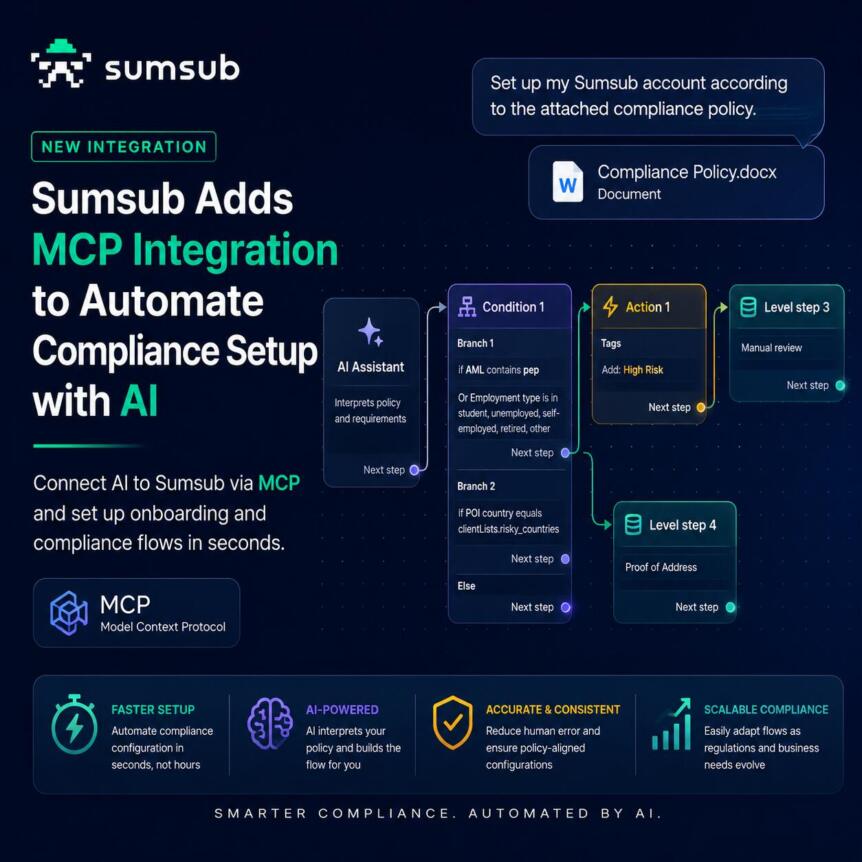
Sumsub integrates Model Context Protocol to connect AI agents with compliance configuration
Sumsub, a verification and anti-fraud platform used by companies to support identity checks and compliance workflows, has launched a Model Context Protocol (MCP) integration and new AI agent skills. The announcement centers on a practical shift for regulated onboarding and fraud prevention teams, by allowing AI agents to help translate anti-money laundering (AML) policies and related compliance documents into configuration changes inside Sumsub.
In many compliance stacks, the work does not end at document review. Teams still need to configure verification levels, risk questionnaires, and onboarding or applicant routing workflows for each jurisdiction and product. Sumsub’s stated goal is to move part of that configuration effort from manual interpretation to a more automated “policy-to-setup” process, mediated by AI agents.
What the MCP integration changes
Model Context Protocol is designed to standardize how AI tools connect to external systems. According to Sumsub, its MCP integration is model-agnostic, intended to work with leading AI agents including ChatGPT and Claude. That is notable because compliance use cases often require consistent auditability and controlled access, even when the AI model behind the assistant varies.
From policy documents to live workflow settings
Sumsub says teams can upload AML policies or other compliance requirements and have an AI agent build a corresponding Sumsub environment. The configuration described includes verification levels, risk questionnaires, and onboarding workflows that can reflect jurisdiction-specific risk logic. Sumsub frames the change as reducing configuration timelines from days to minutes, though the company does not provide independent benchmarks in the material shared.
Handling operational tasks through agent skills
The launch also includes agent capabilities intended to support day-to-day compliance work. Sumsub lists use cases such as reviewing applicants, running analytics, generating verification links, and responding to regulatory changes. In practice, this approach positions AI agents not only as assistants for drafting or analysis, but as tools that can execute operational steps inside a compliance platform, subject to permissions.
Why this matters for identity verification and AML operations
Identity verification and AML compliance have become key layers of customer onboarding, especially in digital-first industries such as financial services, crypto platforms, and other regulated online businesses. Even when organizations have policy documents and internal compliance guidance, there is often a gap between text-based requirements and the configuration logic used by verification vendors.
That gap tends to create manual bottlenecks. Solution architects or compliance operations teams may need to interpret policy text, translate requirements into platform settings, and then rebuild or adjust workflows when regulations or internal risk tolerances change. If the “translation” step can be accelerated safely, it could reduce cycle time for onboarding updates and help teams respond faster to evolving compliance requirements.
At the same time, automating compliance configuration introduces governance questions. AML controls are not simply workflow automation, they are risk controls that must be aligned with regulations, internal policy, and operational evidence. Sumsub’s approach, as described in the announcement, emphasizes controlled execution rather than fully autonomous configuration.
Permissioning, sandboxing, and human approval
Sumsub says access to the MCP integration is restricted by separate permissions to allow granular control over what an AI agent can do. The company also states that sensitive actions are performed in isolated sandbox environments, and that configuration changes are reviewed and approved by humans.
This matters because agentic systems can increase throughput but also expand the potential surface area for mistakes. For compliance workflows, oversight and traceability are typically non-negotiable, particularly when configurations affect verification requirements, risk scoring, or customer onboarding outcomes.
Developer availability and integration pathway
Sumsub indicates the MCP integration is supported via an open-source set of agent skills published on GitHub, installable with a single terminal command. Documentation for the MCP server and for building with Sumsub’s AI features is described as publicly available via Sumsub’s developer resources.
Additionally, Sumsub says it is now officially listed on the ChatGPT Apps platform, and that discussions are ongoing with additional large language model providers. The practical implication is that teams building compliance or onboarding workflows may be able to access the integration through AI application ecosystems, rather than implementing everything from scratch.
Industry context: agentic AI meets regulated workflows
The compliance and identity verification market has been experimenting with AI for multiple years, including document analysis, fraud signals, and investigative assistance. However, the latest push in the industry is moving toward “agentic” workflows, where AI systems can take structured actions in software tools, not just generate text or summaries.
Agentic compliance workflows are attractive because they promise to reduce operational friction, particularly for tasks like policy interpretation and workflow setup. But adoption tends to depend on how well vendors manage governance, permissioning, and audit trails, as well as how reliably they can map policy language to operational controls.
Sumsub’s announcement suggests the company is targeting the configuration layer, positioning MCP integration as a way to standardize how AI agents interact with compliance platforms while keeping human review in the loop.
What to watch next
For teams evaluating this type of capability, several practical questions often determine whether it can move from pilots to production: how permissions are scoped across roles, what evidence is stored for configuration approvals, and how quickly organizations can validate that AI-generated setups match their compliance requirements.
Sumsub says the integration is available now, with additional documentation and agent skills provided for developers. The next phase will likely involve how quickly existing compliance operations teams can test policy-to-configuration accuracy and integrate the workflow into their onboarding processes without adding new governance overhead.

'Oh my word!' – Cape Verde take shock lead against Uruguay

Polymarket Has Reportedly Been Paying Creators To Post Fake Betting Videos

Currency crash, visa crackdowns force Indian students to rethink foreign education


-

 Fashion2 days ago
Weekend Open Thread: Miami – Corporette.com
-
 Crypto World7 days ago
Crude Oil Plunges Over 4% as US-Iran Agreement Reopens Hormuz Strait
-
 Business2 days ago
Wall Street Week Ahead: Investors see Micron earnings as pulse check of AI rally momentum
-

 Crypto World2 days ago
HIVE shares jump as $220M AI deal speeds Bitcoin mining pivot
-

 Tech7 days ago
Over 400 Arch Linux packages compromised to push rootkit, infostealer
-
 Tech5 days ago
The Adder At The Heart Of Intel’s 8087 FPU
-

 Sports3 days ago
FIFA World Cup 2026: Canada beat 9-men Qatar 6-0 to register first ever win | FIFA World Cup 2026
-

 Business3 days ago
Brexit cost 6% of UK economy, Bank of England company data suggests
-

 Crypto World2 days ago
Jake Chervinsky accuses CME of protecting derivatives monopoly
-

 Business1 day ago
Soccer-U.S. defends Iran World Cup travel restrictions, says discussions ongoing
-

 Crypto World4 days ago
Anthropic’s Dario Amodei Urged AI Unity at G7, Even as US Banned His Models
-
 Tech7 days ago
Chinese AI models are learning to detect safety tests and adjust their behaviour accordingly
-

 Tech4 days ago
Weeks Of In-The-Field Testing And A Verdict
-

 Tech3 days ago
Adobe adds its AI assistant to Premiere, Illustrator and InDesign
-

 Entertainment1 day ago
Renter of Home in Anne Heche Crash Denies Settlement With Son
-

 Politics2 days ago
Andy Burnham and the meaning of Makerfield
-
 Crypto World3 days ago
Iren (IREN) Stock Surges on Jefferies Buy Rating: AI Infrastructure Play Gains Momentum
-
 Politics3 days ago
BBC Reporter Discusses Cross Party Criticism Of Trumps Iran Deal
-

 Business1 day ago
MHP SE 2026 Q1 – Results – Earnings Call Presentation (OTCMKTS:MHPSY) 2026-06-20
-

 Crypto World7 days ago
Bitcoin shoots higher on Iran peace deal, with Strait of Hormuz set to open
You must be logged in to post a comment Login