
Crypto World
CFTC Challenges Wisconsin Jurisdiction in Prediction Markets


The U.S. Commodity Futures Trading Commission has filed a federal lawsuit against the state of Wisconsin, alleging that federal law governs prediction-market contracts and that Wisconsin’s actions to curb or criminalize these markets interfere with that framework. The complaint follows Wisconsin’s own litigation against five platforms—Kalshi, Polymarket, Crypto.com, Robinhood, and Coinbase—each of which the state contends operates prediction-market activity subject to state gaming licensing requirements.
The CFTC said in a statement that the lawsuit against Wisconsin was brought “in response to the state’s lawsuits against Kalshi, Polymarket, Crypto.com, Robinhood, and Coinbase, five CFTC-regulated prediction markets.” CFTC Chairman Michael Selig emphasized that states cannot contravene Congress’s clear directive on financial market regulation. “States cannot circumvent the clear directive of Congress,” he stated. “Our message to Wisconsin is the same as to New York, Arizona, and others: if you interfere with the operation of federal law in regulating financial markets, we will sue you.”
According to the agency, the action is its fifth affair with a state seeking to halt prediction-market activity. The CFTC previously pursued complaints against New York and, earlier this month, filed suits against Arizona, Connecticut, and Illinois after those states moved to regulate or shut down platforms operating event contracts. The Wisconsin filing underscores the ongoing, broader legal clash over whether state action may constrain federally regulated markets or whether such markets remain exclusively within federal oversight.
Michael Selig speaking on stage at Bitcoin 2026 in Las Vegas. Source: YouTube
Wisconsin’s lawsuit, filed in federal court, mirrors the state’s broader position that prediction markets that offer sports-related event contracts constitute illegal gambling requiring state gaming licenses. The CFTC and the platforms have consistently rejected that view, arguing that such contracts fall under federal regulation as designated contract markets. The agency contends that Wisconsin’s gambit to criminalize or block these markets would undermine the federal framework established to regulate national swaps markets.
In its complaint, the CFTC argued that Wisconsin’s attempts to criminalize federally regulated markets intrude on the exclusive federal scheme Congress designed to oversee national swaps markets. The agency sought a declaration that state gambling laws do not apply to CFTC-regulated designated contract markets and a permanent injunction preventing Wisconsin from enforcing state actions against prediction markets. The complaint named Wisconsin Governor Anthony Evers, Wisconsin Attorney General Josh Kaul, and the Wisconsin Gaming Division and its administrator, John Dillett, as defendants alongside the state’s actions.
State officials were contacted for comment, but no additional statements were provided in the initial disclosures. The legal maneuver comes amid a broader policy dispute about the proper locus of regulation for prediction markets, a class of financial infrastructure that has evolved rapidly alongside crypto-enabled platforms and traditional financial market mechanisms.
Key takeaways
- The CFTC asserts exclusive federal jurisdiction over prediction-market event contracts, arguing that state gaming laws cannot override the federally regulated framework for designated contract markets.
- The Wisconsin action targets five platforms—Kalshi, Polymarket, Crypto.com, Robinhood, and Coinbase—in the context of Wisconsin’s broader claim that prediction markets operate as illegal gambling without proper licensing.
- This case marks the fifth time the CFTC has sued a state to block state-level actions against prediction markets, following recent suits against New York, Arizona, Connecticut, and Illinois.
- The complaint explicitly links the federal regulatory regime to the operation of designated contract markets, seeking injunctive relief to prevent Wisconsin from taking enforcement actions against these markets.
- For market participants, the proceedings underscore ongoing regulatory contention around jurisdiction, licensing, and compliance requirements for prediction-market platforms in the United States, with implications for AML/KYC frameworks and licensing regimes.
Federal framework versus state enforcement: legal framing and implications
The core legal question in Wisconsin’s dispute centers on the proper locus of regulation for prediction-market contracts, which are traded on designated contract markets under federal law. The CFTC’s position rests on the argument that the contracts—designed to settle on the outcome of real-world events such as sports results or other occurrences—are financial instruments that fall within the federal regime administered by the CFTC, and that designated contract markets operate under federal preemption. In this view, state gambling statutes and licensing schemes cannot legitimately compel or criminalize activity that the federal government has already cleared for operation under the designated contract market framework.
Observers note that the CFTC’s ongoing strategy is to defend a narrow yet potentially far-reaching jurisdictional principle: that federal preemption governs the operation of national markets that rely on centralized, federally supervised trading venues. By layering state gaming or gambling statutes atop or alongside this regime, Wisconsin argues a traditional state authority to license or prohibit activities within its borders. The dispute thus embodies a fundamental tension in U.S. financial regulation: the balance between state-level enforcement prerogatives and the reach of federal market governance, particularly as new market mechanisms emerge at the intersection of traditional finance and digital platforms.
From a policy and enforcement perspective, the case contributes to the broader debate about how to regulate fast-evolving, technology-enabled markets. If federal courts affirm the CFTC’s exclusive-oversight position, platforms operating prediction markets could gain greater regulatory clarity and uniform compliance expectations, potentially reducing the cost and complexity of navigating multiple state regimes. Conversely, if states succeed in asserting licensing or prohibitory authority, a patchwork regulatory environment could emerge, complicating cross-state operations and raising questions about the enforceability of federal prerogatives in the face of diverse state laws.
Implications for platforms, compliance, and market structure
The Wisconsin action explicitly centers on five platforms that the state contends operate in a regulated space that requires state gaming licenses. Kalshi, Polymarket, Crypto.com, Robinhood, and Coinbase are named in the litigation, with the CFTC asserting that their activities fall under the federal designation of contract markets and are therefore subject to federal oversight rather than state gambling statutes. The dual-layered enforcement posture—state lawsuits paired with federal action—highlights the complex compliance implications for platforms that bridge traditional financial markets, crypto assets, and prediction markets.
For regulated venues, the case underscores the importance of robust, federally compliant gatekeeping measures, including registration as a designated contract market and adherence to the range of obligations that accompany such status. It also emphasizes the need for clear customer due diligence and transaction monitoring to remain aligned with AML/KYC frameworks prominent in federal oversight. While the platforms named have operated with varying degrees of federal recognition, this litigation signals that regulators are prepared to assert that federal permission is a prerequisite to offering prediction-market contracts on U.S. soil.
Beyond platform-level implications, the proceedings have bearings on licensing, cross-border access, and the interface with other regulatory bodies, including the SEC, DOJ, and financial-market authorities. The broader policy environment—characterized by heightened scrutiny of crypto-enabled financial services—may prompt exchanges and institutions to reassess product catalogs, risk controls, and interagency coordination to meet evolving compliance expectations. The case also intersects with ongoing debates about market integrity, insider trading risk, and transparent governance of event-driven instruments in a rapidly changing market ecosystem.
Closing perspective
The Wisconsin litigation reinforces a continuing crosswinds between state authority and federal market regulation in the United States, particularly as prediction markets evolve alongside traditional finance and crypto-native platforms. The outcome will shape how states calibrate their enforcement actions and how platforms structure compliance programs to align with a federal preemption narrative. As courts adjudicate these questions, observers should watch for rulings that clarify the boundaries of state licensing power and the resilience of the CFTC’s designated contract market framework in a rapidly changing regulatory landscape.


April 27, 2026 — Changelly and Tonkeeper have teamed up to make cross-chain deposits into TON a seamless, in-wallet experience. Users can now fund their Tonkeeper wallet with USDT, USDC, or DAI from 13 decentralized networks, without leaving the app.
For Changelly users already familiar with cross-chain swaps, this extends existing functionality into direct wallet deposits. For Tonkeeper’s user base, it introduces a new way to move assets into the TON ecosystem within a single interface.
Cross-chain deposits without leaving the app
With Changelly’s infrastructure integrated into Tonkeeper, cross-chain deposits can be completed within the wallet, while routing is handled in the background.
Support spans 13 networks: Ethereum, Solana, TRON, BSC, Polygon, Arbitrum, Base, Liquid, Avalanche, NEAR, Optimism, Matic, and Tezos.
The integration removes the need to use external bridges or manage multiple interfaces when moving assets across chains, keeping the entire process within the wallet environment.
Launch campaign
To mark the integration, the companies have introduced a campaign running from April 27 to May 10, 2026. Users who deposit USDT, USDC, or DAI from any of the supported networks into Tonkeeper via the integration during this period will be eligible to enter a draw for 20 one-year subscriptions to Telegram Premium.
About Tonkeeper
Tonkeeper gives users access to TON assets and dApps, USDT on TRC20, NFTs in one wallet. Tonkeeper supports powerful features like the Battery and Gasless transactions, while Tonkeeper Pro unlocks advanced tools like multisig support.
T. Rowe Price has advanced its entry into the crypto ETF market with a further amendment to its actively managed digital asset fund filing, bringing a potential launch closer.
Summary
- T. Rowe Price has advanced its active crypto ETF filing with a third amendment, bringing a potential launch of ticker $TKNZ closer pending SEC approval.
- The proposed fund is expected to hold 5 to 15 digital assets, including Bitcoin, Ethereum, XRP, and Solana, with allocations guided by active management rather than market size.
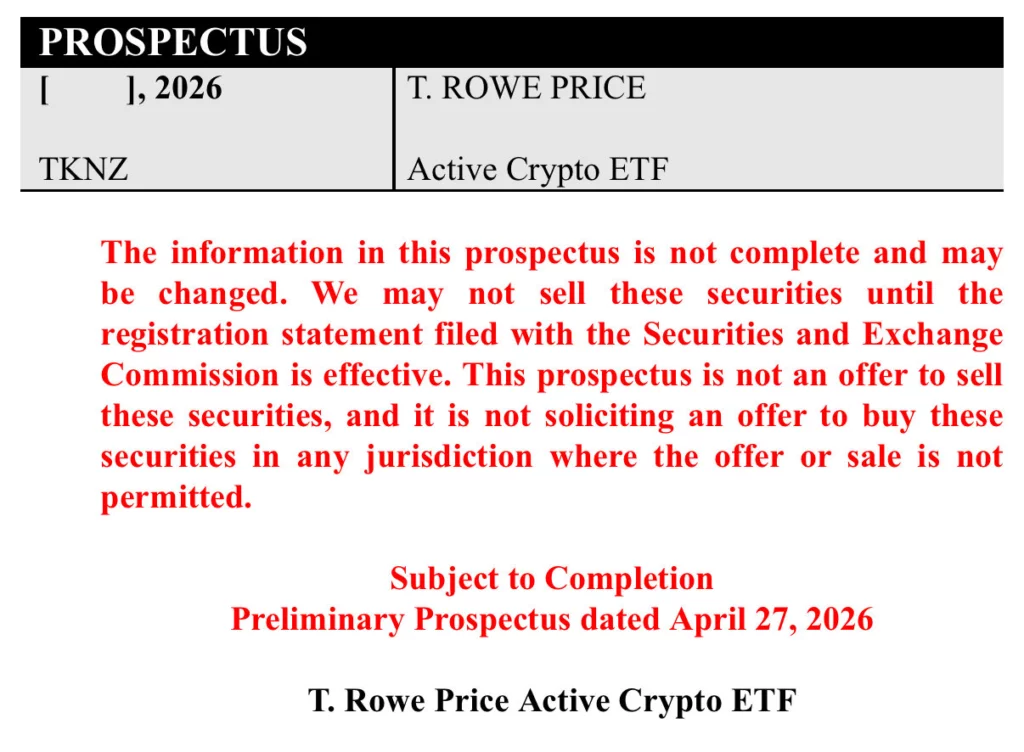
According to a preliminary prospectus dated April 27, 2026, the Baltimore-based asset manager plans to list the T. Rowe Price Active Crypto ETF under the ticker TKNZ, with the document noting the filing remains subject to completion and regulatory approval from the U.S. Securities and Exchange Commission.
Commenting on the matter, Bloomberg ETF analyst Eric Balchunas said the filing has reached a “3rd amendment,” with ticker $TOKN and a 75bps fee, adding that a launch is “likely very soon” and calling it “by far biggest active manager” entering the space.
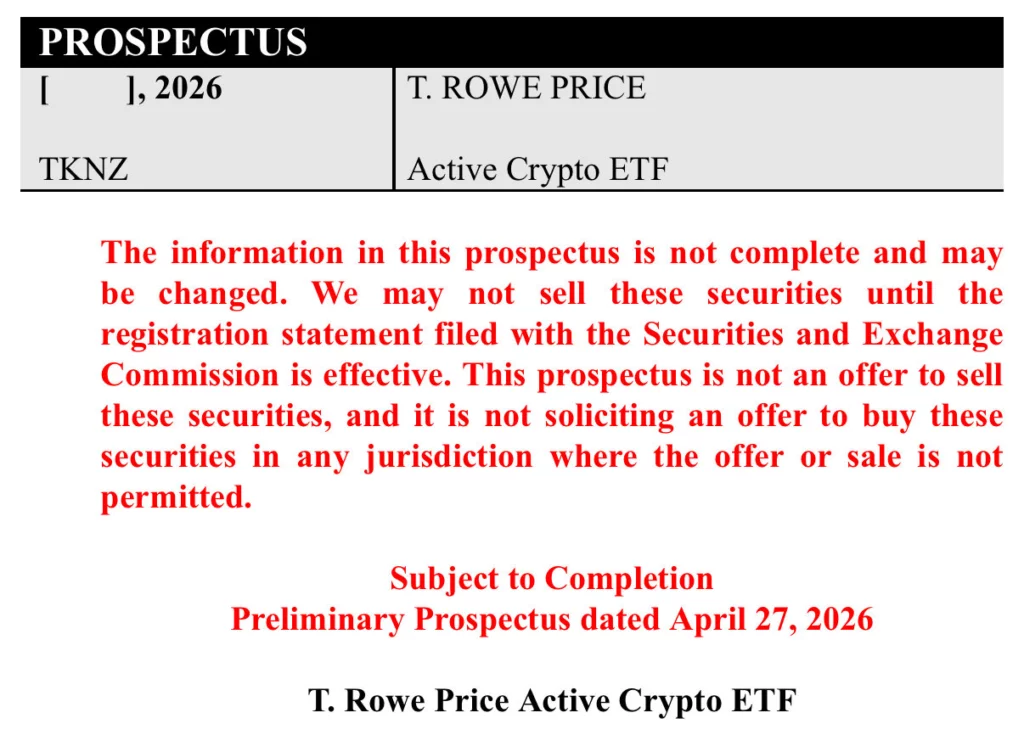
TKNZ fund prospectus. Source: Eric Balchunas.
Holding approximately $1.78 trillion in assets under management, T. Rowe Price has structured the proposed fund as an actively managed product that would invest directly in spot crypto assets, while avoiding leverage or complex derivatives, according to its SEC filings.
Active structure targets multi-asset exposure
Details outlined in the filing show the ETF is expected to hold between 5 and 15 cryptocurrencies selected under the SEC’s generic listing standards, moving away from the single asset structure seen in existing Bitcoin and Ethereum spot ETFs.
Eligible assets listed in the filing include Bitcoin, Ethereum, Solana, XRP, Cardano, Avalanche, Litecoin, Dogecoin, Hedera, Bitcoin Cash, Chainlink, Stellar, and Shiba Inu, with portfolio allocations guided by fundamentals, valuation, and momentum rather than market size alone.
An index snapshot included in the filing indicates Bitcoin carries a 42.83% weight, followed by Ethereum at 19.09%, while XRP stands at 10.56% and Solana at 7.93%, with smaller allocations assigned to assets such as Dogecoin, Cardano, and Avalanche.
Fund managers are expected to adjust holdings over time based on market conditions and internal research, with the stated objective of outperforming the FTSE Crypto US Listed Index, according to the prospectus.
Filing builds on earlier push into crypto ETFs
An earlier S-1 registration submitted on Oct. 22, 2025 confirmed the firm’s initial plans to launch an Active Crypto ETF, marking a departure from its long-standing focus on mutual funds.
“Point is that legacy asset managers are quickly trying to figure out how to implement some semblance of a crypto strategy. A number of these firms actually missed out on ETF boom. They want to avoid same mistake w/ crypto,” NovaDius Wealth Management President Nate Geraci said at the time.
Regulatory developments have also played a role in shaping the timing of the launch, as the SEC has recently moved to accelerate the approval process for crypto ETFs, even as applications tied to individual altcoins remain under review.

Key Takeaways
- Alphabet delivers Q1 2026 financial results Wednesday following market hours
- Analysts anticipate approximately $107 billion in revenue, representing 19% annual growth
- Google Cloud revenue projected to climb 47%, while operating profit could surge 120%
- Earnings per share forecasted at $2.63, declining due to challenging prior-year comparison
- Market volatility expectations point to a 5.67% price swing following the announcement
Alphabet unveils its Q1 2026 financial performance on April 29 following the closing bell. Investors are laser-focused on whether the tech giant’s enormous artificial intelligence investments are delivering tangible returns.
The company has pledged as much as $185 billion toward AI-related capital investments throughout 2026. These funds are being allocated to both proprietary infrastructure development and expanding its Google Cloud platform for enterprise clients. Each earnings cycle now serves as a critical checkpoint for validating this strategic direction.
The previous quarter demonstrated encouraging momentum. Google Cloud revenue soared 48% compared to the year-ago period in Q4 2025, accompanied by an impressive 154% surge in segment operating profitability.
Financial analysts are anticipating similar performance trends. FactSet consensus estimates point to 47% cloud division revenue expansion in Q1, coupled with 120% growth in operating earnings.
Overall company revenue is projected to reach approximately $107 billion, marking a 19% increase versus the comparable quarter.
Earnings per share are expected to decline modestly to $2.63 from the prior year. However, this decrease stems primarily from an accounting quirk — the first quarter of 2025 benefited from a temporary 62-cent-per-share gain tied to unrealized appreciation in Alphabet’s venture capital holdings. Adjusting for this anomaly reveals more consistent operational performance.
Core Business Performance Drivers
Advertising continues serving as the primary revenue generator. Ad-related income is forecasted to represent roughly 71% of Q1 total sales, reaching $76 billion — reflecting 14% year-over-year expansion. Google Search and YouTube constitute the primary growth channels, while the third-party advertising network segment continues its gradual contraction.
The cloud platform represents the principal growth narrative. During the Q4 earnings call, CEO Sundar Pichai noted that the organization has experienced “supply constraints despite our aggressive capacity expansion efforts.” This type of demand-driven limitation typically signals positive market dynamics for shareholders.
Market participants will also scrutinize capital allocation strategies. Shareholder returns through dividend payments and stock repurchases remain areas of interest, especially considering the substantial capital expenditure commitments.
Street Perspective Ahead of Results
Bernstein’s Mark Shmulik maintained his Outperform recommendation this Monday, establishing a $900 price objective. His analysis anticipates strong quarterly results, with both Search and Cloud benefiting from AI-enhanced customer engagement. YouTube performance may show inconsistency but shouldn’t materially impact overall results, according to his assessment.
Shmulik doesn’t anticipate modifications to capital spending projections during this report. He’s seeking additional clarity regarding AI product development milestones and potential operational efficiency improvements.
One note of caution: he suggests the shares may reflect full valuation at present price levels.
GOOGL has appreciated 118% during the trailing twelve months and has advanced 12% since January.
The Street consensus reflects a Strong Buy rating, comprising 26 Buy recommendations alongside 5 Hold ratings. The mean analyst price target stands at $387.68, suggesting roughly 12.6% appreciation potential from current trading levels.
Derivatives market activity indicates expectations for a 5.67% price movement in either direction after earnings publication. This substantially exceeds Alphabet’s typical 1.44% post-earnings volatility across the previous four quarters — suggesting heightened uncertainty around this particular release.
Financial results will be published following market close on April 29.

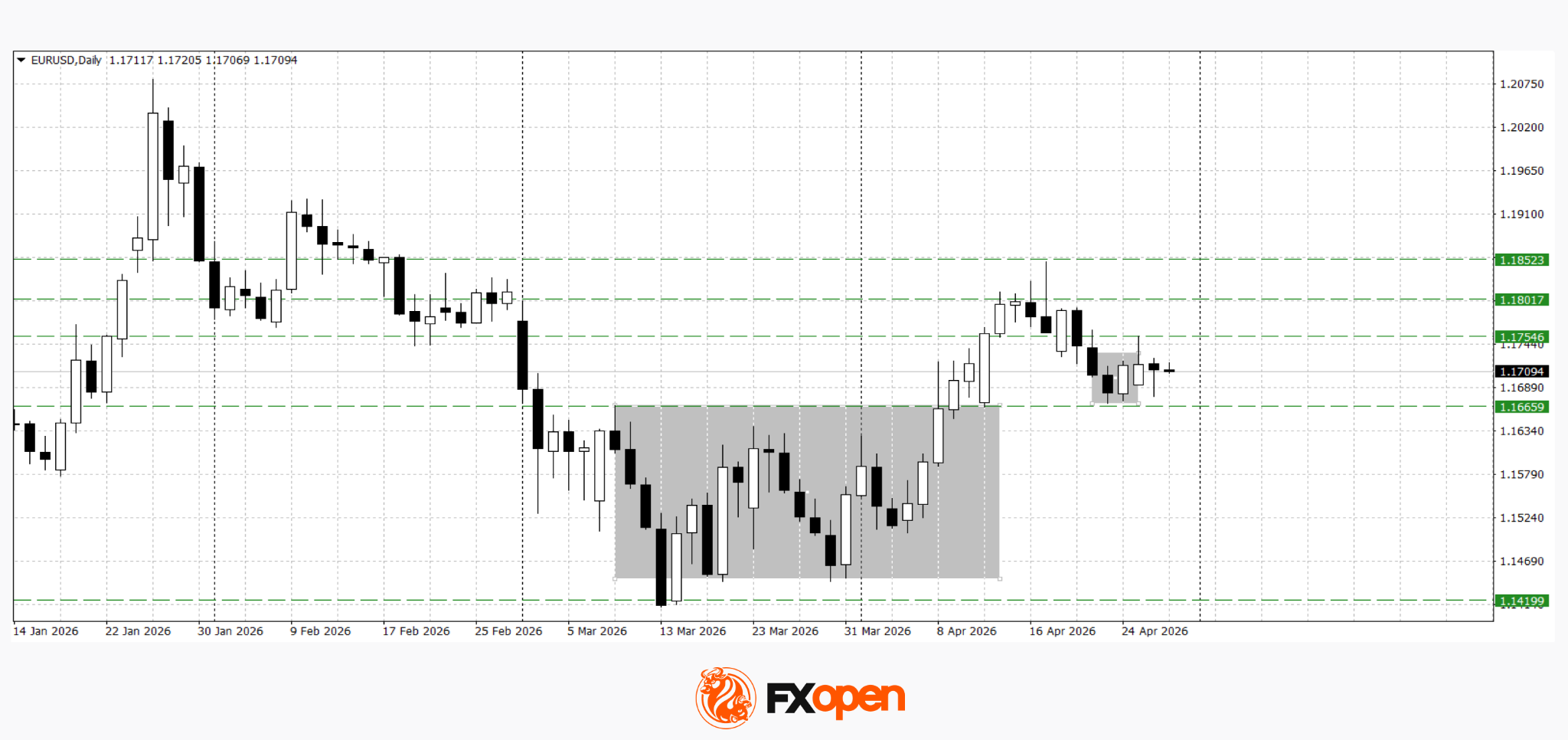
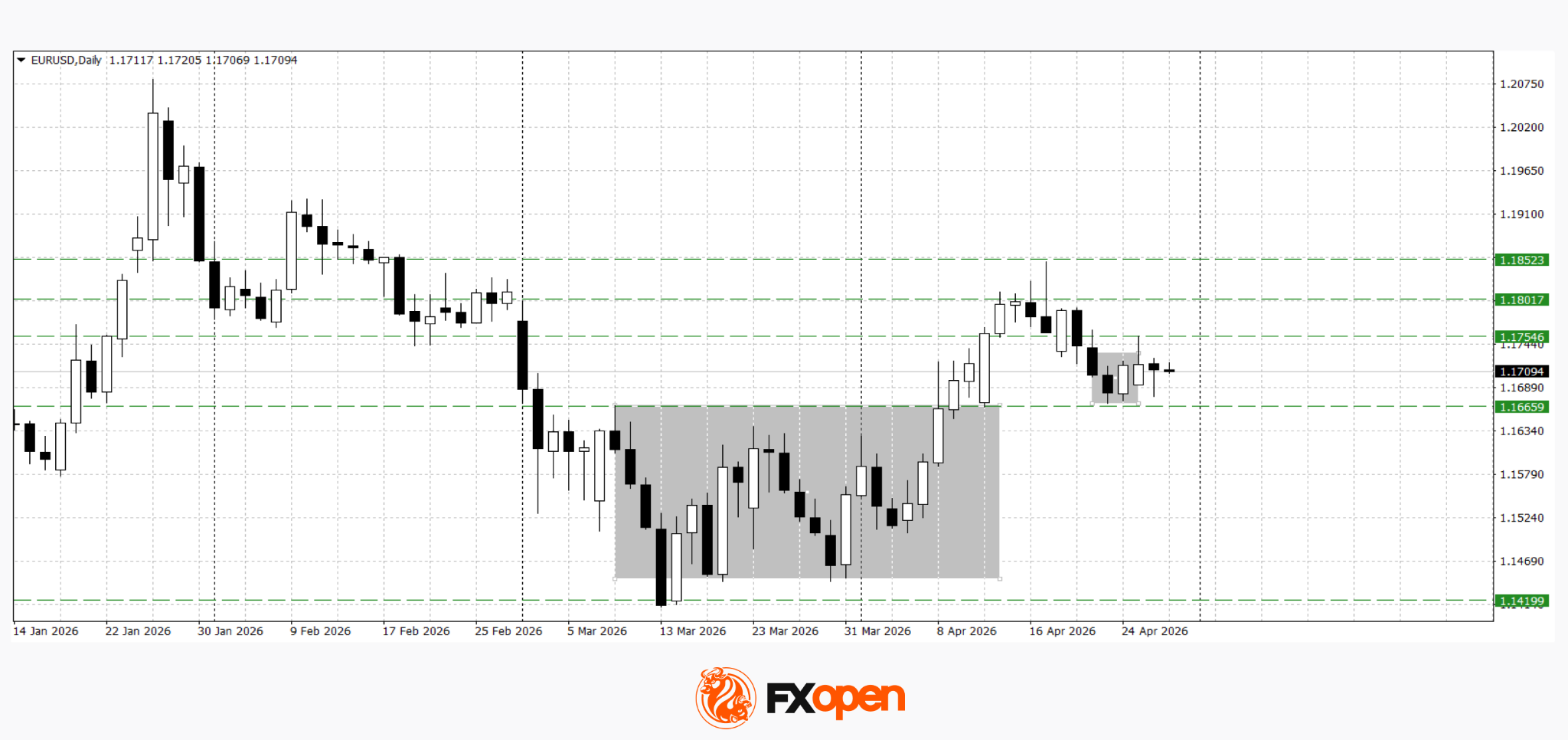
European currencies are showing subdued dynamics, entering a consolidation phase following their previous advance. Earlier, EUR/USD and GBP/USD broke out of their ranges and strengthened; however, the subsequent correction has led both pairs to retest the previously breached upper boundaries of their sideways channels. The current stabilisation near these levels reflects a balance of forces in the market and a wait-and-see stance among participants ahead of the key decision by the Federal Reserve.
The main focus is on the Federal Reserve meeting, including the interest rate decision, the accompanying statement, and the press conference. The market is assessing potential signals regarding the future trajectory of monetary policy, which is limiting activity and restraining the formation of a directional move. Additional influence may come from macroeconomic data from the US, the euro area, and the United Kingdom.
EUR/USD
The EUR/USD pair is consolidating near the previously broken range, holding above key levels. This dynamic preserves a structure favourable for further gains; however, the lack of new drivers is restraining the development of upward momentum. The reaction to the Fed decision may provide the impulse for a breakout from the current range.
Technical analysis of EUR/USD suggests the possibility of a retest of 1.1750, as a bullish engulfing pattern has formed on the daily timeframe. A firm move below 1.1650 could lead to the pair returning to the previously broken range.
Key events for EUR/USD:
- today at 09:00 (GMT+3): speech by Bundesbank’s B. Balz;
- today at 18:30 (GMT+3): speech by Bundesbank Vice President Buch;
- tomorrow at 11:00 (GMT+3): Germany’s gross domestic product.
GBP/USD
The GBP/USD pair is showing a similar structure, holding near its levels after a corrective pullback. The current consolidation reflects market uncertainty and expectations of signals from the Federal Reserve and the outlook for Bank of England policy. Depending on the regulators’ rhetoric, the pair may either resume its advance and firmly establish itself above 1.3600, or deepen the correction and fall below 1.3460.
Key events for GBP/USD:
- today at 17:00 (GMT+3): Atlanta Fed GDPNow indicator;
- today at 21:00 (GMT+3): US Federal Reserve interest rate decision;
- today at 21:30 (GMT+3): FOMC press conference.
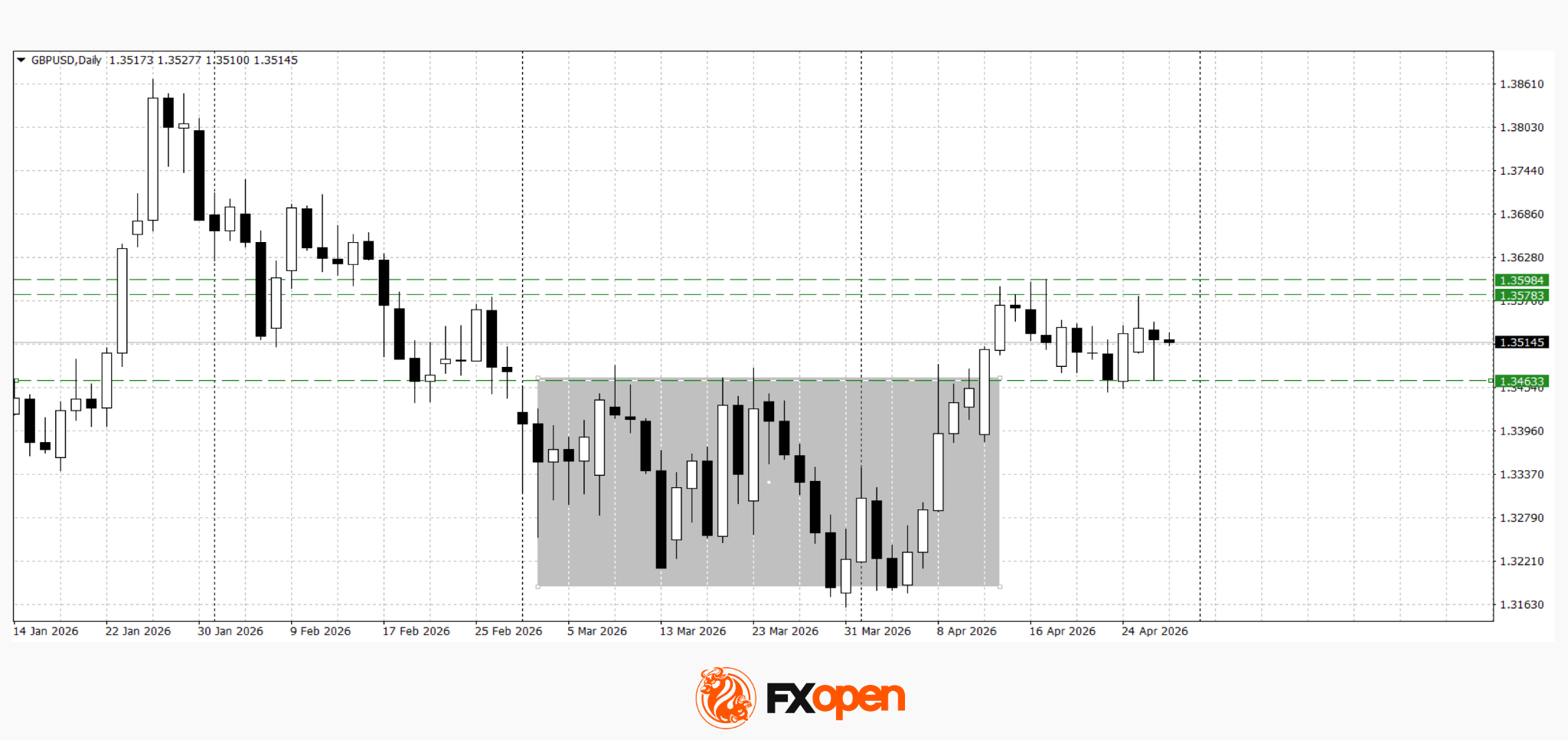
Overall, the market is at a point of equilibrium, where previously broken levels act as a key decision zone. The outcome of the Federal Reserve meeting may serve as the main driver: a more dovish tone could support a continuation of the upward momentum in European currencies, while more hawkish signals may increase pressure and lead to a deeper correction.
Trade over 50 forex markets 24 hours a day with FXOpen. Take advantage of low commissions, deep liquidity, and spreads from 0.0 pips (additional fees may apply). Open your FXOpen account now or learn more about trading forex with FXOpen.
This article represents the opinion of the Companies operating under the FXOpen brand only. It is not to be construed as an offer, solicitation, or recommendation with respect to products and services provided by the Companies operating under the FXOpen brand, nor is it to be considered financial advice.
Crypto World
Blockchain Association presses Fed to formalize end of reputation risk in bank oversight


U.S. crypto lobbying group Blockchain Association has urged the Federal Reserve to formalise the removal of “reputation risk” from bank supervision rules, warning that the concept has been used to restrict access to financial services.
Summary
- Blockchain Association has urged the Federal Reserve to formalise the removal of reputation risk from bank supervision rules.
- The group said reputation risk has enabled the debanking of crypto firms and called for clear, consistent regulatory standards.
- The Cato Institute found most debanking cases in the U.S. were driven by government pressure rather than independent bank decisions.
In a comment letter submitted Monday, Blockchain Association executive vice president of legal and government relations Ashok Pinto said the Federal Reserve should turn its June 2025 policy change into a binding rule to prevent future misuse.
Pinto wrote that regulated institutions require “objective, consistent standards,” adding that reputation risk fails to meet that threshold.
Pinto argued that regulatory frameworks must protect the integrity of the financial system without allowing subjective assessments to influence access to banking services.
He wrote that “regulation is meant to uphold the integrity of our financial system, not to pick winners and losers based on the political winds of the day,” while warning that reliance on reputation risk introduces inconsistency into supervisory practices.
Concerns over future policy reversals
Citing past enforcement patterns, Pinto said the use of reputation risk has contributed to debanking actions targeting crypto firms, often described by industry participants as “Operation Chokepoint 2.0.”
He noted that while the Donald Trump administration has rolled back several policies linked to crypto debanking, long-term safeguards remain necessary.
Pinto wrote that future administrations could reintroduce similar measures without clear regulatory limits, stating that “reputation risk is only as neutral as the administration wielding it.”
He added that removing it through formal rulemaking would create a stable standard applicable across political cycles.
Supporting this concern, the Cato Institute reported in January that most debanking cases in the U.S. stemmed from government pressure rather than independent decisions by financial institutions, reinforcing calls for clearer supervisory boundaries.
Push for regulatory alignment
Addressing implementation, Pinto said the Federal Reserve should coordinate its final rule with steps already taken by other banking regulators. He pointed to recent actions by the Office of the Comptroller of the Currency and the Federal Deposit Insurance Corporation, which issued a joint rule on April 7 removing reputation risk from their supervisory frameworks.
Pinto wrote that aligning standards across agencies would improve predictability for regulated entities, adding that consistent rules grounded in measurable criteria are necessary to maintain trust in the regulatory process and ensure the safety of the financial system.


The White House has signaled that a new step toward operationalizing the U.S. strategic Bitcoin reserve has been prepared, with an announcement expected within weeks.
Summary
- White House adviser Patrick Witt said a major announcement on the U.S. Bitcoin reserve is expected within weeks, pointing to progress on legal and operational structure.
- Lawmakers including Cynthia Lummis and Nick Begich are working to pass legislation that would formalise the reserve and allow up to 1 million Bitcoin to be acquired over time.
Speaking at the Bitcoin 2026 conference in Las Vegas, Patrick Witt said officials have been working through the legal structure needed to secure and manage Bitcoin already held by the government.
He said the administration is close to finalizing key interpretations required to “solidify that and protect the digital assets, specifically bitcoin that we have on the government balance sheet.”
During the panel, Witt confirmed that internal work has focused on translating last year’s executive order into a functioning framework, with further action from the executive branch expected shortly.
He said a “big announcement” would outline the next phase, while adding that legislative backing would still be required to give the reserve long-term footing.
Lawmakers move to anchor reserve into statute
Alongside executive action, lawmakers have continued efforts to formalize the reserve through legislation. Nick Begich said the bill previously introduced as the BITCOIN Act is being renamed the American Reserves Modernization Act, or ARMA, as part of that process.
The proposal builds on the executive order signed by Donald Trump, which created a strategic Bitcoin reserve primarily funded through assets seized in criminal and civil cases, along with a separate digital asset stockpile. Lawmakers have argued that codifying the reserve into law would prevent policy reversals that could occur under future administrations.
Earlier legislative drafts led by Cynthia Lummis outlined plans to acquire up to 1 million Bitcoin over five years using budget-neutral methods.
According to Lummis, writing in October 2025, the government could begin funding the reserve “anytime,” even as Congress continues to debate the bill’s passage.
Her comments followed discussions around alternative funding strategies, including proposals highlighted by ProCap BTC chief investment officer Jeff Park, who pointed to roughly $1 trillion in unrealized gains from U.S. gold reserves as a potential source for long-term Bitcoin allocation.
Structure still taking shape as timeline tightens
While the executive order has already established the reserve framework, details on how additional Bitcoin would be acquired have not been publicly disclosed. Government-held Bitcoin currently comes from forfeitures, with policymakers weighing options to expand holdings without drawing on taxpayer funds.
Witt said the upcoming announcement would represent a “breakthrough” in advancing the reserve from a policy concept to an operational system, though he noted that follow-up legislation remains necessary to secure its permanence.
The White House has not issued further details on the planned announcement or its scope.


An Ethereum (ETH) ICO participant with the wallet address 0xCD59 has transferred all its ETH holdings to a fresh wallet after 10.8 years of dormancy.
On-chain analysts noted that the dormant wallet acquired its 10,000 ETH during Ethereum’s ICO at $0.311 per token.
Decade-Old Ethereum Whale Returns to Life
At ETH’s current price, the whale’s holdings are worth $22.88 million. This marks a 7,381x return on the $3,100 original stake, Lookonchain added.
While the intent behind the transfer remains unclear and there is no confirmed evidence of a sale, similar movements have historically preceded a range of outcomes. Some early Ethereum ICO participants have opted to liquidate portions of their holdings, while others have chosen to stake or simply reposition assets without selling.
For instance, last month, address 0xd64A sold 11,552 ETH for $23.42 million at $2,027 per token. That wallet had originally bought 38,800 ETH for $12,000 during the ICO.
Follow us on X to get the latest news as it happens
However, not all early holders choose to sell. In December 2025, a dormant Ethereum ICO wallet (0x2dCA), holding 40,000 ETH, reactivated after more than a decade and opted to stake the assets rather than liquidate them.
Similarly, in September 2025, an ICO whale holding 1million ETH resurfaced after 8 years. The whale moved 150,000 ETH to a new wallet for staking.
The reactivation of long-dormant wallets continues to draw market attention, but such movements do not point to a single outcome. With no confirmed sale, the transfer leaves open multiple possibilities, reflecting the diverse approaches of early holders.
Subscribe to our YouTube channel to watch leaders and journalists provide expert insights
The post Decade-Dormant Ethereum Whale Moves $22.88 Million in ETH to New Wallet appeared first on BeInCrypto.

A U.S. Army master sergeant appeared in a Manhattan federal court and pleaded not guilty to charges alleging he used nonpublic information about a classified January raid in Venezuela to place bets on Polymarket, the crypto-backed prediction market. Gannon Ken Van Dyke faces five counts, including three that violate federal commodities laws, one wire fraud count and one unlawful monetary transaction. The case could carry a maximum sentence of up to 60 years in prison if convicted. He was released on a $250,000 bond, surrendered his passport, and must adhere to travel restrictions. His next court date is scheduled for June 8.
According to prosecutors, Van Dyke, a master sergeant in the U.S. Army, was involved in planning and execution of “Operation Absolute Resolve,” a special-forces raid in Caracas that allegedly led to the capture of Nicolás Maduro. They contend he used information about the raid to buy “yes” shares in Polymarket contracts, placing about 13 bets on markets tied to Maduro and Venezuela.
The specific markets cited by prosecutors include bets on: “US Forces in Venezuela by January 31,” “Maduro out by January 31,” “Will the U.S. invade Venezuela by January 31,” and “Trump invokes War Powers against Venezuela by January 31.” DOJ prosecutors said Van Dyke wagered more than $33,000 across these markets and others. They also asserted that he profited nearly $410,000 as some bets resolved in the affirmative for the “yes” outcomes.
For context, Polymarket is a decentralized-style platform that allows users to trade on event outcomes using cryptocurrency or fiat-pegged tokens. The government’s filing notes that reports of unusual trading activity in Maduro-related contracts on Polymarket had appeared in the press and on social media prior to the charges.
The Department of Justice’s case is complemented by a separate action from the U.S. Commodity Futures Trading Commission, which has brought parallel insider-trading allegations against Van Dyke tied to Polymarket activities. The overlapping actions illustrate the regulatory sensitivity around prediction markets and the potential misuse of nonpublic information.
Cointelegraph reported on the charges, citing the DOJ’s indictment. For reference, the original coverage can be found here: Cointelegraph.
Key takeaways
- One active-duty U.S. Army master sergeant stands accused of using classified information from a Venezuela raid to place bets on Polymarket, facing five counts including three federal commodities-law violations, wire fraud, and unlawful monetary transaction.
- The alleged operation, described as “Operation Absolute Resolve,” is claimed to have involved a raid in Caracas that prosecutors say led to Maduro’s capture, with the soldier allegedly leveraging nonpublic information for trading advantage.
- Daunting penalties are on the table—up to 60 years in prison if convicted on all counts—coupled with a $250,000 bond, passport surrender, and travel restrictions.
- Prosecutors say Van Dyke’s Polymarket activity totaled more than $33,000 across multiple Maduro- and Venezuela-related markets, with reported profits near $410,000 as some bets resolved in the affirmative.
- In parallel, the Commodity Futures Trading Commission has pursued a separate insider-trading action, underscoring renewed regulatory scrutiny of prediction markets and the risk of nonpublic information leaking into wagering contracts.
Indictment details and what comes next
The charges against Van Dyke enumerate three counts of violating federal commodities laws, one count of wire fraud and one count of unlawful monetary transaction. If found guilty on all counts, he could face a combination of prison time and financial penalties. The defense will have the opportunity to challenge the government’s characterization of the trading activity, the chain of information, and the attribution of intent. The judge also imposed travel restrictions while the case proceeds.
The government’s narrative centers on Van Dyke’s access to sensitive information about a planned operation and his subsequent use of that information to place “yes” bets on various Polymarket contracts. The markets cited by prosecutors were explicitly tied to timelines around January 31, including potential scenarios involving U.S. forces in Venezuela and actions by Maduro or the U.S. government. The prosecution argues that the bets and the timing indicate an attempt to monetize privileged information.
The regulatory overlay adds a further dimension to the case. The CFTC’s parallel action highlights how authorities are treating prediction-market platforms as potential conduits for insider trading, especially when nonpublic information intersects with market activity. Observers will be watching how this case interacts with broader policy discussions about the permissible boundaries of prediction markets and the safeguards needed to prevent misuse of sensitive military information.
The next court appearance for Van Dyke is scheduled for June 8, when the proceedings will advance toward trial on the charges as outlined by federal prosecutors. In the meantime, investors and users of prediction markets will be paying attention to how regulators weigh the linkage between classified information, military operations, and finance in a rapidly evolving digital-asset landscape.
Readers tracking this case should watch for updates on both the criminal proceedings and the CFTC action, as outcomes could influence how prediction markets are perceived and regulated moving forward.


Tether has introduced a Bitcoin faucet inside its self-custody wallet, offering small BTC payouts through the Lightning Network to bring new users into its ecosystem.
Summary
- Tether has launched a Bitcoin faucet within its self-custody wallet, distributing small BTC amounts through the Lightning Network.
- Users must link their tether.me usernames and interact with official posts to receive instant payouts.
According to Paolo Ardoino, who announced the feature at Bitcoin 2026 in Lugano, the faucet forms part of the newly launched tether.wallet application, where users can claim Bitcoin by interacting with the firm’s official social channels and linking their tether.me usernames.
A verified response tagged with @btc triggers an instant Lightning Network transfer to the user’s wallet, delivering funds without on-chain delays.
Lightning payouts positioned as entry point
Using the Lightning Network for distribution, Tether has tied the faucet directly to low-cost, near-instant transactions, allowing users to test Bitcoin transfers without handling traditional network fees or wait times.
The company has framed this approach as a practical introduction for users already familiar with stablecoin transactions but new to Bitcoin’s scaling layers.
Details shared at the event indicate that the faucet also highlights the wallet’s use of human-readable identifiers, where funds are sent to usernames instead of long wallet addresses, reducing friction during onboarding.
Tether has connected the rollout to its push for self-custody adoption, placing Bitcoin, USDT, and XAUT within a single wallet interface. The faucet serves as an initial incentive, giving users a small balance that can be managed alongside other assets without relying on third-party custodians.
Revival of an early Bitcoin distribution model
Earlier industry developments show similar attempts to revive faucet-based onboarding. On April 19, 2026, Jack Dorsey said Block planned to relaunch a Bitcoin faucet through btc.day, revisiting a concept first introduced in 2010 by Gavin Andresen, who distributed 5 BTC to users completing simple verification steps.
While Block has not yet disclosed how its new faucet will operate or how much BTC it will distribute, both initiatives draw from the same early model that helped users test wallets and understand Bitcoin transactions when the network was still in its early stages.


Canada has moved to tighten oversight of cryptocurrency use by proposing a nationwide ban on crypto ATMs while advancing legislation to block digital asset donations in federal elections.
Summary
- Canada has proposed a nationwide ban on crypto ATMs, with CBC News reporting they are widely used in fraud schemes.
- FINTRAC has identified crypto ATMs as a recurring channel in suspicious transaction reports linked to scams.
- Lawmakers have advanced Bill C-25 to prohibit crypto donations in elections, citing challenges in verifying donor identities.
According to CBC News, the federal government has outlined plans in its Spring Economic Update 2026 to ban crypto ATMs, describing them as a key tool used by scammers to extract funds from victims and process illicit cash.
The report notes that officials have linked the machines to fraud activity across the country, with investigations identifying them as a primary channel through which victims are instructed to transfer money.
A months-long investigation by CBC News, which included input from law enforcement agencies, financial regulators, industry participants, and fraud victims, found that crypto ATMs have become a central mechanism in scam operations. Financial Transactions and Reports Analysis Centre of Canada reached a similar conclusion in a February 2023 analysis of suspicious transaction reports, identifying these machines as a recurring route used in fraud schemes.
Across Canada, nearly 4,000 crypto ATMs are currently in operation, the highest number per capita globally, according to CBC News.
These machines allow users to deposit cash and convert it into cryptocurrencies such as Bitcoin, which can then be sent to digital wallets with limited identity verification.
Transactions under $1,000 often require only a phone number, while the absence of in-person oversight removes the chance for intervention during suspected fraud attempts.
Although crypto ATMs are regulated as money services businesses, CBC News reports that Canada does not yet have industry-specific rules governing their operation. Officials have pointed to this gap while outlining the proposed ban as part of a wider effort to address fraud risks tied to digital asset access points.
Lawmakers push ahead with crypto donation ban
Separately, lawmakers have continued to advance restrictions on the use of cryptocurrency in political financing through Bill C-25, known as the Strong and Free Elections Act. The proposed legislation has passed second reading in the House of Commons and would prohibit political parties, candidates, and associated entities from accepting crypto donations.
The bill extends the restriction to leadership campaigns, nomination contests, riding associations, and third-party advertisers, requiring any prohibited contributions to be returned or transferred to the Receiver General within 30 days. According to statements from government officials, the proposal addresses concerns over verifying donor identities and tracing the origin of funds when digital assets are used.

York Designer Outlet bought by Mike Ashley’s Fraser Group

GTA 6 Release Date Set for November 19 2026 After Multiple Delays

Changelly and Tonkeeper enable cross-chain deposits to TON across 13 networks

Manchester United reach agreement with Casemiro over contract clause amid transfer speculation

US brings back mandatory military draft registration

Steven Gerrard disagrees with Gary Neville over ‘shock’ Chelsea and Arsenal claim | Football


-

 Tech2 days ago
Register Renaming | Hackaday
-

 Fashion5 days ago
Weekend Open Thread – Corporette.com
-
 Crypto World4 days ago
Hyperliquid $HYPE Rally Builds Momentum as AI Sector Enters Prove-It Phase
-

 Politics7 days ago
Making troops accountable for war crimes threatens US alliance, ex-SAS colonel warns
-

 Politics7 days ago
Disabled people challenge government SEND proposals over segregation concerns
-

 Business5 days ago
Patterson-UTI Energy, Inc. (PTEN) Q1 2026 Earnings Call Transcript
-

 Business7 days ago
Rolls-Royce Voted UK’s Most Iconic Trade Mark as IPO Register Hits 150
-
 Sports3 days ago
IPL 2026: Ruturaj Gaikwad registers slowest fifty of the season, enters all-time unwanted list | Cricket News
-

 Politics1 day ago
Drax board avoid their own AGM, accused of greenwashing & environmental racism
-

 Politics7 days ago
Zack Polanski responds to home secretary’s taser threat
-

 Politics7 days ago
Starmer handler McSweeney to be dragged from shadows by Foreign Affairs Committee
-
Politics7 days ago
Wings Over Scotland | How To Get Away With Crimes
-

 Politics7 days ago
‘Iran is still a nuclear threat’
-

 NewsBeat3 days ago
LK Bennett closes all stores after entering administration
-
 Sports6 days ago
Tim Bradley names the current best in the world: “Better than Inoue and Usyk”
-

 Crypto World5 days ago
Michael Saylor says BTC winter is over. Market analyst disagrees, says bitcoin was in a pullback
-
 Entertainment4 days ago
Mariah Carey Slams Deposition Claims In Brother’s Lawsuit
-
Business6 days ago
Altimmune prices $225 million public offering at $3 per share
-
Entertainment6 days ago
Michael B. Jordan and Austin Butler's “Miami Vice” movie will bring the action back to the '80s
-
 NewsBeat5 days ago
Trump threatens to review UK’s claim to Falkland Islands and punish Nato allies over Iran war disagreement
You must be logged in to post a comment Login