
Crypto World
Coinbase CEO backs U.S. Treasury’s bid to pass CLARITY Act


Coinbase CEO Brian Armstrong has shifted his stance on a key crypto regulatory bill, saying it’s now the moment for Congress to act. After months of negotiations and a previous pause, Armstrong endorsed the Digital Asset Market Clarity Act (CLARITY Act) and praised the current draft as a strong baseline for passable legislation. The move comes as lawmakers press ahead through committee processes, with both sides of the aisle weighing how a structured framework could shape the crypto market in the United States.
Armstrong disclosed his updated view in a Thursday post on X, aligning with remarks from US Treasury Secretary Scott Bessent in a Wall Street Journal op-ed urging Congress to act promptly. In his message, Armstrong described the legislation as a “strong bill” and argued that it’s now time for Congress to move forward. The endorsement marks a notable reversal from January, when Coinbase said it could not back the act as written, contributing to a temporary stall in the legislative process as committees prepared a markup for CLARITY.
Key takeaways
- Armstrong publicly backs CLARITY Act again, calling for a timely passage after months of negotiations shaped by safety, ethics, and market-structure concerns.
- The bill’s path remains tied to committee activity: a Senate Banking Committee markup is anticipated after the Senate Agriculture Committee’s January approval, with both committees needing to align securities and commodities provisions before a full chamber vote.
- Regulatory momentum is visible in parallel moves, including the Office of the Comptroller of the Currency’s approval of Coinbase’s national bank trust charter, which signals growing regulatory engagement with crypto players.
- The industry’s influence in Washington continues to be debated, though executives from Coinbase and Ripple Labs have participated in talks with administration officials about CLARITY and broader market structure questions.
Armstrong’s recalibration: from pause to endorsement
The timing of Armstrong’s endorsement reflects a broader recalibration within the crypto industry’s Washington engagement. In January, Coinbase publicly stated it could not support CLARITY as written, a stance that contributed to a pause in a Senate Banking Committee markup that would have advanced the bill toward floor consideration. Since then, talks among lawmakers and industry participants have continued, with Armstrong asserting that the latest iteration of CLARITY addresses core concerns raised during negotiations.
Armstrong captured the shift in a succinct update, stating on X that the current form of the CLARITY Act is a “strong bill” and that it’s “time to pass the Clarity Act.” The post echoed comments attributed to the same topic by Scott Bessent in the WSJ op-ed, who urged swift congressional action as a matter of clarity and regulatory coherence for the crypto markets. For readers tracking the arc of the bill, the developer-friendly alterations and the way ethics, tokenized equities, and stablecoin yield provisions were addressed are central to understanding why Coinbase and other industry players have shifting views on the legislation’s current contours. For reference, Coinbase previously noted that progress depended on a broader agreement in Congress and among supervisory agencies, with the initial markup delayed as those conversations continued.
Coinbase’s legal head, Paul Grewal, suggested last week that lawmakers were “very close to a deal,” underscoring a sense that convergence across committees—and with the crypto sector—was near. Still, the exact timing of a mark-up remains uncertain, as the banking committee would schedule consideration only after the Agriculture Committee’s earlier action, and after aligning on a regulatory framework that reconciles token classifications with securities and commodities oversight.
Legislative hurdles: where the bill stands and what comes next
The legislative path for CLARITY Act is intricate, reflecting the overlap between securities and commodities frameworks in U.S. regulation. The latest cadence places the banking committee mark-up after a January approval from the Senate Agriculture Committee, with both panels expected to harmonize the finer points of the bill before lawmakers return to the Senate floor. The process underscores a centralized aim: to provide a clear, predictable regulatory framework that can accommodate a spectrum of crypto activities—ranging from exchanges and token issuances to custody and compliance obligations for crypto-native institutions.
From Coinbase’s perspective, the process has required careful alignment with both the executive branch and Congress. Armstrong’s renewed stance appears to be grounded in the belief that the current version adequately balances innovation with investor protection and market integrity. The operational implications are notable: a clearer framework can reduce regulatory uncertainty for exchanges and developers, potentially accelerating product launches, partnerships, and new use cases for digital assets. Investors and builders alike will be watching whether the final iteration resolves long-standing concerns about ethics, tokenized equities, and the governance and disclosure expectations that typically accompany traded assets.
In parallel, industry voices have continued to press for clarity and predictability. Coinbase’s legal leadership has framed the ongoing talks as a sign that policymakers are close to a workable compromise, while industry participants have highlighted the importance of a comprehensive school of thought that integrates the realities of digital asset markets with established financial-market norms. The evolving dialogue in Washington illustrates a broader theme: as technology accelerates, lawmakers are increasingly pressed to deliver rules that foster both innovation and consumer protection without stifling competition.
Regulatory momentum and industry influence: a broader context
Beyond CLARITY Act’s fate, a broader regulatory arc has emerged that shapes industry strategy in the near term. Earlier this year, the Office of the Comptroller of the Currency granted Coinbase a national bank trust charter, following a series of similar approvals for other crypto and financial-services entities. The approvals signal that regulators are willing to grant more robust, federally recognized structures to crypto firms, potentially enabling more sophisticated product offerings under federal oversight. The approvals build a backdrop against which CLARITY Act could accelerate or adjust, depending on how a unified regulatory framework emerges across agencies.
The Washington conversation around crypto is not happening in a vacuum. Executives from Coinbase and Ripple Labs have participated in discussions with administration officials about the proposed framework, reflecting a broader trend of strategic engagement from the industry. The dynamics of these discussions are nuanced: while some policymakers emphasize the need for robust safeguards, others push for a framework that doesn’t hamper innovation or push firms toward burdensome, one-size-fits-all rules. The resulting tension—between comprehensive regulation and market growth—will shape the clarity and predictability investors rely on as crypto markets mature.
As the debate continues, observers are watching whether CLARITY’s final form will offer definitive classifications for tokens, more precise rules for exchanges, and a clear path for stablecoins and custody services. The current trajectory suggests a scenario in which Congress could deliver a coherent set of rules that reduces ambiguity for U.S. participants, while also inviting international competition to respond to a more predictable U.S. framework. For practitioners, that could translate into a more navigable landscape for product development, fundraising, and regulatory compliance—crucial considerations as institutions, startups, and developers build the next phase of the crypto economy.
What remains uncertain is the exact timetable and the precise language that will reach a floor vote. While Armstrong’s renewed endorsement adds momentum, the bill still faces a complex negotiation across committees, potential amendments, and the broader political calendar. Investors should monitor the timing of the banking committee markup and any additional clarifications on how CLARITY addresses the balance between market structure, consumer protections, and innovation incentives. The path forward will likely shape how quickly institutions can deploy regulated crypto products in the United States and how competitors abroad respond to a more defined U.S. framework.
Readers should stay attentive to updates on committee schedules and any new endorsements from other major industry players, as these signals often influence the market’s expectations about regulatory clarity and product timelines. The coming weeks will be telling for whether CLARITY Act can translate into a formal legislative milestone or whether unresolved questions will extend the negotiation phase into a longer horizon.
As the process unfolds, the industry’s practical takeaway is straightforward: clarity tends to reduce risk, but only when the rules are stable and comprehensive. The next few weeks will reveal how close CLARITY is to becoming law and how the balance between oversight and innovation will be achieved in the final text.


Key Takeaways
- Nvidia shares declined over 4% Thursday even as major tech companies announced significant AI infrastructure spending hikes
- Google revealed intentions to commercialize its proprietary TPU chips for external clients, intensifying competitive pressures
- Amazon highlighted accelerating growth in its proprietary chip division
- Top four hyperscalers collectively plan AI infrastructure investments reaching $725 billion in 2026
- Nvidia’s B300 server pricing in China has surged to approximately $1 million following stricter smuggling enforcement
Nvidia shares tumbled over 4% Thursday, defying the broader narrative of explosive AI infrastructure spending commitments from technology’s biggest players. The decline signals mounting investor anxiety about a critical question: can Nvidia maintain its market leadership as its largest clients develop competing chip solutions?
The downturn followed earnings reports from Meta, Alphabet, Microsoft, and Amazon, each announcing elevated capital expenditure forecasts for 2026. Meta increased its projection by $10 billion, targeting a range of $125 billion to $145 billion. Alphabet boosted its guidance by $5 billion, potentially reaching $190 billion. Microsoft indicated its fourth-quarter capital spending alone would exceed $40 billion.
Combined, these four cloud computing giants are projected to deploy up to $725 billion on AI infrastructure throughout the year. With Nvidia commanding approximately 90% of the AI accelerator market, this investment wave should theoretically benefit the semiconductor manufacturer substantially.
Yet market sentiment doesn’t always align with positive fundamentals.
Alphabet’s TPU Commercialization Triggers Market Concerns
Investor apprehension stemmed primarily from Alphabet’s strategic announcement. The company disclosed plans to market its proprietary Tensor Processing Units — TPUs — to external clients who can deploy them within their own infrastructure environments.
Historically, TPUs functioned exclusively within Google‘s ecosystem. By commercializing these chips, Alphabet positions them as a viable, albeit specialized, competitor to Nvidia’s GPU offerings. While TPUs typically lack the versatility of Nvidia’s solutions, they deliver superior cost efficiency for specific artificial intelligence applications.
Amazon similarly emphasized expansion in its proprietary chip initiatives during its quarterly earnings presentation. While both organizations remain significant Nvidia clients, the strategic trajectory is unmistakable.
Nvidia has historically downplayed threats from custom chip development, emphasizing the superior versatility its GPUs provide for AI application developers. However, maintaining this position without encountering market skepticism is becoming increasingly challenging.
Chinese Market Sees B300 Server Prices Approach $1 Million Mark
On supply dynamics, pricing for Nvidia’s advanced B300 server systems in China has escalated to approximately 7 million yuan, representing a sharp increase from roughly 4 million yuan in late 2024. This translates to nearly $1 million per system.
Intensified enforcement against semiconductor smuggling operations in China — which previously sustained a parallel market for export-restricted hardware — has substantially constrained available supply. The B300 represents one of Nvidia’s most sophisticated AI server configurations and remains subject to US export restrictions in the Chinese market.
Meanwhile, Thursday’s trading session delivered mixed results across the semiconductor industry. Qualcomm surged 9% following announcements of expanded data center initiatives. Memory sector players Sandisk, Western Digital, and Seagate also posted gains after Microsoft and Meta highlighted increasing expenditures for storage and memory infrastructure.
Regarding investment activity, Nvidia’s venture division NVentures contributed to a $50 million extension of Swedish AI legal technology company Legora’s Series D funding round, establishing a $5.6 billion valuation and bringing aggregate capital raised to $600 million.
Nvidia shares were trading near $200.84 Thursday afternoon, representing an approximate $8.41 decline for the session.



TRM Labs says North Korea-linked hackers have stolen about $577m in 2026 so far—76% of all crypto hack losses—driven by massive hits on KelpDAO and Drift Protocol.
Summary
- TRM Labs reports that North Korea-linked actors account for roughly 76% of global crypto hack losses in the first four months of 2026, or about $577 million.
- Pyongyang’s share of global crypto theft has surged from 22% in 2022 to 76% in 2026, with total illicit takings since 2017 now above $6 billion.
- Two April exploits on KelpDAO and Drift Protocol alone accounted for nearly all 2026 losses so far, underscoring protocol-level risk for DeFi and markets.
A new report from blockchain intelligence firm TRM Labs finds that organizations linked to North Korea were responsible for roughly 76% of all global cryptocurrency hacking losses in the first four months of 2026, stealing an estimated $577 million. The report, cited by The Block, warns that North Korean operations have become the dominant source of on-chain theft as state-aligned groups refine their tactics against exchanges, DeFi protocols, and cross-chain infrastructure.
According to the analysis, North Korea’s share of global crypto theft has climbed relentlessly over the past five years: 22% in 2022, 37% in 2023, 39% in 2024, 64% in 2025, and 76% so far in 2026, pushing cumulative illicit profits since 2017 above $6 billion. TRM Labs ties this growth to increasingly sophisticated tooling, better laundering pipelines, and a clear state incentive to bypass traditional sanctions via digital assets.
The report highlights two April incidents as the primary drivers of 2026 losses to date: a roughly $292 million exploit targeting KelpDAO and a separate $285 million theft from Drift Protocol. Together, these two attacks alone account for nearly the entire $577 million total so far this year and about 3% of all recorded hacking incidents in the same period, suggesting that a small number of high-impact exploits continue to dominate loss statistics.
For crypto markets, the concentration of large-scale thefts in DeFi and restaking protocols underscores the structural risk in smart contract and bridge design. Each $200 million–plus drain not only hits token prices for the affected projects, but also tightens liquidity across interconnected ecosystems as market makers, lenders, and LPs de-risk exposure.
This trend also feeds into regulatory and institutional responses. As more of the loss profile is attributed to a single sanctioned state, global authorities will likely intensify pressure on centralized exchanges, OTC desks, and mixers to block known laundering channels, raising compliance costs for the entire industry. For traders in Bitcoin, Ethereum, and other majors, repeated headlines of nine-figure hacks tied to North Korea translate into higher perceived tail risk, wider risk premia, and occasional systemic bouts of deleveraging when large exploits force on-chain liquidations.
Overall, TRM Labs’ findings paint a picture of a crypto market where protocol innovation and capital inflows continue, but where the “crypto war chest” of a sanctioned state is now a central macro variable, not a side story—one that will increasingly shape both policy and risk pricing across digital assets.
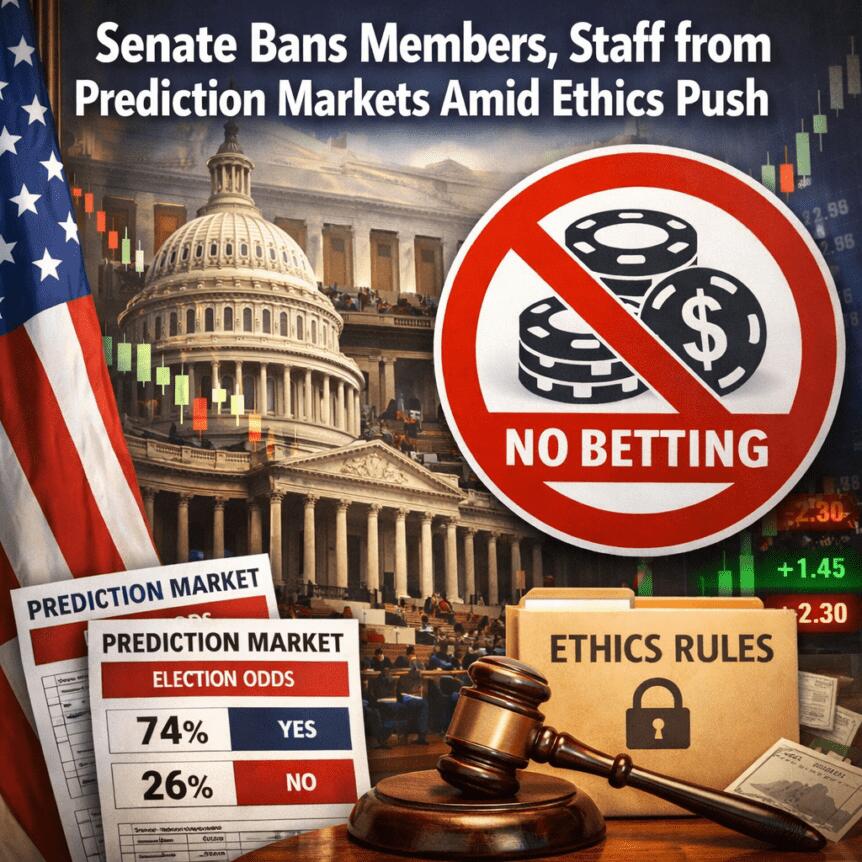
The US Senate moved to tighten its stance on inside information and financial speculation on prediction markets, unanimously approving a resolution that bars members and staff from participating in such markets. The rule change—made by unanimous consent and effective immediately—aims to preserve public trust by preventing potential monetization of sensitive information.
Engaging in any way in a prediction market or trying to place bets where we might have inside information deteriorates the confidence that our constituents have in us.
The measure was introduced by Republican Senator Bernie Moreno, who has framed the reform as a straightforward step to ensure that lawmakers and their aides cannot leverage privileged information for personal gain. He stated on the Senate floor that the rule change will make clear to constituents that no member of the United States Senate or Senate staff can monetize insider information through prediction markets.
Source: Bernie Moreno
The resolution arrives amid heightened scrutiny of prediction-market activity linked to political and national security matters. In a separate but related development, a special forces soldier was charged on April 23 with using classified information to place bets on Polymarket, a case that has fed lawmakers’ concerns about insider trading risk in such platforms. The defendant has pleaded not guilty.
During the floor debate, Senate Democratic leader Chuck Schumer endorsed the measure as a straightforward safeguard against conflicts of interest. He argued that Congress must not resemble a casino where lawmakers could gamble on wars, economic crises, or elections, and urged further steps beyond the initial rule change.
Related: Insider trading backlash forces Polymarket to step up surveillance
Schumer also indicated that broader measures should extend to the administration and its employees, signaling that the executive branch may come under similar scrutiny to ensure consistent ethics standards across government activity.
Republican Representative Ashley Hinson indicated that she will introduce a counterpart resolution in the House to prohibit House members from using prediction markets, signaling a potential expansion of the policy beyond the Senate.
Reaction from the prediction-market ecosystem was swift. Polymarket publicly supported the Senate resolution and noted that its terms of service already prohibit such conduct, describing codification as a positive development for the industry. Kalshi, a direct competitor, welcomed the move as well, with its co-founder noting that the platform already blocks congressional participation and enforces against insider trading.
These developments are part of a broader pattern of regulatory and industry focus on governance, compliance, and market integrity in crypto-adjacent spaces. Cointelegraph’s coverage has highlighted ongoing debates around insider betting detection and the governance of prediction-market platforms, underscoring the legal and regulatory implications for operators, financial institutions, and public institutions alike.
According to Cointelegraph, the heightened attention to insider trading in prediction markets dovetails with broader regulatory and enforcement efforts across the sector, including the need for robust AML/KYC frameworks, licensing considerations, and cross-border policy alignment. The incident and ensuing legislative response illuminate how public institutions are balancing innovation with governance and accountability in a rapidly evolving market structure.
Key takeaways
- The Senate unanimously approved a resolution that bans members and staff from using prediction markets, with the rule change taking effect immediately.
- The action seeks to prevent potential monetization of inside information and to preserve public trust in governmental institutions.
- There is expectation of broader discussion, with a House counterpart already anticipated to pursue a similar prohibition.
- Industry actors have publicly welcomed codification, asserting existing internal controls and surveillance mechanisms align with the new policy.
- The episode underscores ongoing regulatory scrutiny of prediction markets and related crypto-enabled trading from multiple authorities and jurisdictions.
Unanimous reform and immediate effect
The resolution’s passage by unanimous consent marks a clear stance from lawmakers that insider information must not be monetized through prediction-market channels. By amending the standing rules of the Senate, the chamber signaled an approach that emphasizes ethical governance and transparency in legislative operations. The immediate effect removes any potential window for noncompliance, reducing the likelihood of later procedural disputes over timing or enforcement.
Insider information, cases, and market surveillance
The drive for reform follows public concern over cases where insiders may have exploited privileged information. The reported charge against a special forces soldier—linked to bets on Polymarket—illustrates real-world risk vectors that policymakers fear could erode public confidence in government institutions and in market protocols. While the defendant has pleaded not guilty, the incident has intensified calls for clear rules and rigorous enforcement to deter insider trading in prediction markets.
Regulatory and industry implications for crypto markets
From a policy and compliance perspective, the Senate action reinforces the imperative for rigorous governance frameworks around crypto-enabled markets and related services. Although MiCA governs the European Union, the move aligns with a global trend toward stricter oversight of market integrity, disclosure obligations, and conflict-of-interest protections. For U.S. and global financial institutions, this raises considerations for internal risk controls, staff training, and cross-border regulatory expectations that could influence licensing, reporting, and supervisory priorities. The episode also highlights the importance of clear enforcement signals to deter insider trading and to maintain a level playing field for market participants, including traditional exchanges and crypto-native platforms.
Industry reaction and potential policy spillovers
Industry responses have framed the Senate action as a constructive step that formalizes existing best practices while reducing ambiguity for participants. Polymarket welcomed the codification, noting that their platform already prohibited such conduct and implied that formalizing the ban into law strengthens industry standards. Kalshi’s leadership echoed a similar sentiment, emphasizing proactive compliance measures and the removal of insider-trading risk from the regulatory horizon. The prospect of a House counterpart suggests that policy momentum could extend beyond the Senate, potentially shaping a broader regulatory baseline for prediction markets and similar platforms.
As policymakers weigh additional safeguards, observers will monitor how enforcement indicators evolve—whether through targeted investigations, licensing prerequisites for operators, or enhanced cross-agency coordination among financial regulators, national security authorities, and anti-corruption units. The developing narrative may influence how institutions structure compliance programs, monitor for improper information flows, and implement governance protocols that withstand scrutiny in both domestic and international contexts.
Closing perspective: The Senate’s action formalizes a boundary between public service and speculative activity tied to privileged information, signaling that policy makers view prediction markets as a space where integrity must be safeguarded to protect democratic legitimacy and market stability.
Key takeaways:
- Spot Bitcoin ETFs saw $490 million in net outflows over three days, signaling a recent dip in institutional demand.
- Rising inflation is eroding real yields on fixed income, likely fueling long-term demand for scarce assets like BTC.
Bitcoin (BTC) faced three consecutive days of outflows from US-listed spot exchange-traded funds (ETFs). The outflows coincided with a failed attempt to reclaim $78,000. Traders fear more downside, but heightened US inflation will likely act as a catalyst for further bullish momentum.
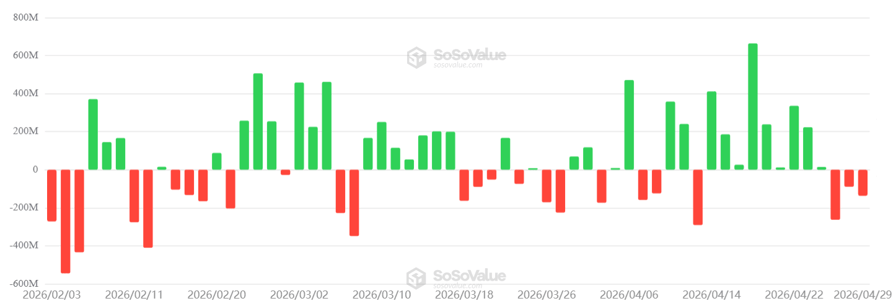
US-listed Bitcoin spot ETFs daily net flows, USD. Source: SoSoValue
The US-listed spot Bitcoin ETFs saw $490 million net outflows between Monday and Wednesday, reversing the trend from the prior two weeks, which indicates a decline in institutional demand. Still, a longer-term perspective shows $3.3 billion net inflows since March.
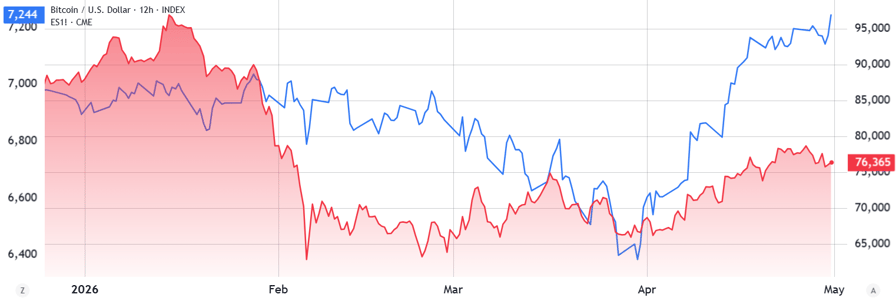
S&P 500 futures (left) vs. Bitcoin/USD (right). Source: TradingView
Part of the lack of confidence among traders can be attributed to the 14% year-to-date decline in Bitcoin’s price, while the S&P 500 soared to an all-time high. However, the tech sector came under scrutiny as quarterly earnings releases failed to impress investors. Meta (META US) faced a 9% correction on Thursday, while Microsoft (MSFT US) shares dropped 4%.
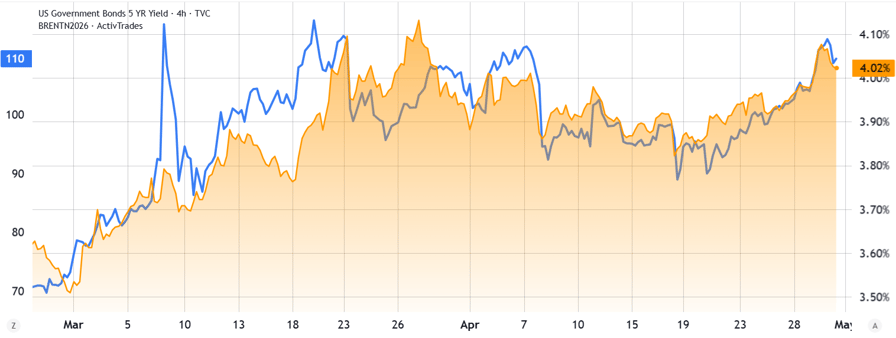
Brent crude oil (left) vs. US 5-year Treasury yield (right). Source: TradingView
Since the war in Iran started in late February, oil prices have been a major driver for risk appetite. The latest Brent crude oil rally to $126 coincided with yields on the US 5-year Treasuries jumping to 4.02%, up from 3.51% two months prior. Traders demanded higher yields on government-backed bonds amid upward pressure on inflation, triggering risk-off sentiment.
Higher inflation favors Bitcoin’s bullish momentum
Bitcoin’s lack of bullish momentum near $78,000 can also be pinned to worsening economic conditions. The US Commerce Department reported that gross domestic product grew at a 2% seasonally adjusted annualized rate in the first quarter, slightly below the 2.3% rate economists projected, according to CNN.
Related: Most crypto investors believe Bitcoin is undervalued–Coinbase survey
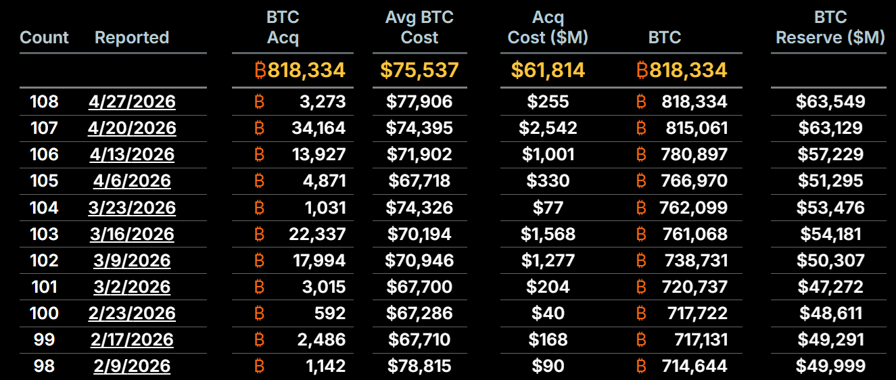
Strategy (MSTR US) latest Bitcoin acquisitions. Source: Strategy
Strategy, the company led by Executive Chairman Michael Saylor, announced the acquisition of 56,235 BTC in the first four weeks of April, driving its average cost to $75,537. Traders fear that the Bitcoin price could suffer if the Strategy accumulation pace does not hold up, even if only temporarily.
US President Donald Trump’s family’s activities in the cryptocurrency market have also hurt the industry’s appeal. Three US Senators demanded an inquiry into Trump and his family’s profits from their cryptocurrency ventures.
The risks of higher inflation and lower economic growth are unlikely to dissipate in the near term, but the mere three-day sequence of net outflows from Bitcoin ETFs should not be a source of concern. Ultimately, reduced returns on fixed income, when adjusted for inflation, will likely drive demand for scarce alternative assets. Thus, the Bitcoin path to $80,000 remains intact.


The social media giant has rolled out USDC payments via Stripe on Solana and Polygon.

Ether’s latest price action has shifted from a February dip beneath $1,800 to a multi-week rally that traders say could have more room to run in May. After rebounding more than 25% off that low, a confluence of chart patterns and on-chain signals is adding to the case for a continued upside move, albeit with the usual caveats around macro risk and a potential testing of nearby resistance levels.
Key takeaways
- Technical setups across multiple timeframes imply a continued bullish tilt for ETH, with a near-term price target around $3,000.
- Ether has found support in a historically strong zone near $2,000, a level that previously sparked 22%–27% rebounds on recent cycles.
- On-chain activity points to strong buyer enthusiasm: the 90-day spot taker cumulative volume delta has turned positive, highlighting demand from market participants.
- Near-term order-flow data shows robust taker buy pressure, including a reported single-day buy volume exceeding $1 billion as traders stepped in below the $2,300 region.
Chart signals point toward a $3,000 ceiling
Analysts are weighing several technical patterns that suggest ETH could press higher into May. On the daily chart, Ether has been forming a bull flag after a sharp upmove earlier in the spring. A breakout above the upper trend line near $2,350 would complete the pattern and could unlock a run similar in height to the preceding rally, placing a fresh upper target just above $3,000—roughly a one-third gain from current levels.
In parallel, an eight-hour ascending-triangle formation has traders watching for a decisive push through the triangle’s upper line around $2,400. A confirmed breakout here could open the door toward a measured target near $3,305, representing a potential 46% upside from recent prices under favorable conditions.
Those who follow ETH price trajectories note that the broader setup points to a near-term upside bias, provided the price can clear key resistance bands around $2,350–$2,400. The confluence of a bull flag and a continuation pattern in shorter timeframes adds to the likelihood of a sustained advance, though breakpoints and macro catalysts remain the primary risks to the forecast.
Strong on-chain support and historical rebound zones
Beneath the price action, on-chain anatomy paints a supportive picture. Ether has sat atop a multi-month support line near $2,000, with repeated rebounds from that area preceding sizable rallies in prior cycles. Current conditions echo those patterns, as ETH bounces have often carried prices back toward or beyond the prior highs after testing the line.
Realized-price distribution for UTXOs adds another layer of context. Data indicates a substantial accumulation zone between roughly $1,980 and $2,178, where a large cohort of investors purchased roughly 7.4 million ETH. That level of stored demand helps explain why buyers have been able to defend the floor around $2,000 even as prices fluctuated in the broader market.
On the resistance side, a subsequent cluster of interest sits higher—between $2,400 and $3,000—where roughly 14 million ETH is believed to have been acquired. If buyers can clear the nearby supply near $2,400, the next notable concentration could come into play as ETH targets the upper zones near $3,000 and beyond.
Order flow and sentiment reinforce the upside case
Beyond price and on-chain accumulation, market microstructure signals add confidence to the bull case. The 90-day spot taker cumulative volume delta has turned decisively green since mid-March, coinciding with Ether’s breakout above the $2,200 resistance and suggesting a renewed appetite among buyers willing to step in as price moves higher.
Trading activity has also shown bursts of aggressive buying when prices dipped near critical levels. CryptoQuant data reported taker buy volume exceeding $1 billion on a recent session, indicating that traders were keen to accumulate on a pullback rather than wait for a deeper correction.
CryptoQuant analyst Darkfost commented on the development, noting that the move below the $2,300 area rekindled interest among participants: “This suggests that market participants still appear willing to bet on a more constructive short term outlook for Ethereum.”
Together, these signals—positive CVD, robust taker buy volume, and supportive on-chain distribution—help explain why a broad slice of market participants remains confident in ETH’s ability to extend gains through the May period, provided price action stays above critical floors and clears immediate overhead supply.
This article synthesizes data and signals from market data providers and on-chain analytics services, reflecting the current sentiment around Ethereum’s price trajectory. Traders should stay mindful of the usual risk factors that can influence crypto markets, including macro policy shifts, regulatory developments, and shifting liquidity conditions.
Looking ahead, investors and traders will be watching how ETH navigates the confluence of chart patterns and on-chain signals as May unfolds. If price action can convincingly clear the $2,350–$2,400 zone, the pathway toward $3,000 and higher could become clearer, while a failure to sustain above these levels might invite a retest of the immediate support near $2,000 and the potential for a more protracted consolidation phase.

TLDR
- Gemini secured approval from the U.S. Commodity Futures Trading Commission for a derivatives clearinghouse license.
- The license allows Gemini to clear and settle trades internally without relying on external providers.
- Gemini aims to expand into the prediction market sector and compete with platforms like Kalshi and Polymarket.
- The company plans to offer a full trading ecosystem including futures, options, and event-based contracts.
- Gemini shares increased by about 7% following the announcement of the approval.
Gemini secured regulatory approval to expand its trading operations into U.S. derivatives and prediction markets. The move allows the exchange to handle trade clearing internally and scale new products faster. The announcement also pushed Gemini shares up by about 7%.
Gemini enters prediction market race with new license
Gemini received approval from the U.S. Commodity Futures Trading Commission for a derivatives clearinghouse license. This license allows the firm to clear and settle trades without external providers.
The approval strengthens Gemini’s control over its trading infrastructure and supports its expansion plans. The company aims to compete directly with established platforms like Kalshi and Polymarket.
Gemini stated that the license supports its strategy to build a full-service trading platform. The company plans to integrate event-based contracts, futures, and options within one system.
Cameron Winklevoss said, “Today marks a major milestone in Gemini’s marketplace expansion.” He added that the firm is working toward building a financial services “super app.”
Gemini prediction market push aligns with rising demand
Prediction markets recorded strong growth, with trading volume rising over 300% in 2025 to $63.5 billion. This growth has attracted both crypto platforms and traditional financial firms.
Hyperliquid, a decentralized derivatives platform, is preparing to compete in the same sector. At the same time, asset managers are developing exchange-traded funds linked to prediction markets.
Roundhill Investments plans to launch the first U.S. ETFs tied to prediction markets on May 5. Two other asset managers are also preparing similar financial products.
Gemini had already launched a prediction marketplace through its affiliate Gemini Titan in December 2025. That platform received a designated contract market authorization from the CFTC.
U.S. focus drives Gemini restructuring and expansion
Gemini shifted its operational focus to the United States earlier this year. The company exited markets in the United Kingdom, the European Union, and Australia.
This restructuring included a workforce reduction of about 25% across affected regions. The company stated that the U.S. offers stronger capital markets for its long-term plans.
The Winklevoss founders said, “America has the world’s greatest capital markets.” They added that their strategy centers on growth within the U.S. market.
With both DCM and DCO licenses, Gemini can now offer a complete trading ecosystem. The company confirmed plans to expand into crypto futures, options, and perpetual contracts for U.S. users.
Disclosure: This article does not represent investment advice. The content and materials featured on this page are for educational purposes only.
SaintQuant expands AI trading adoption with automated strategies and 150,000+ global users.
Summary
- SaintQuant automates crypto trading with AI bots, managing risk, execution, and reinvestment 24/7 for hands-free growth.
- The AI trading platform processes 2.5M signals daily, executing strategies like DCA, Grid, and Swing with verified ROI.
- Trusted by 150K+ users, SaintQuant connects to major exchanges and delivers automated, data-driven crypto trading.
Bought Bitcoin for the first time. The wallet is set up. What comes next?
For most people, the next step is finding the best crypto app in 2026, one that handles trading, storage, automation, and passive income in a single place. That’s easier said than done. The market is flooded with apps that all look great on paper but fall apart the moment somebody tries to use them.
The problem isn’t just picking the wrong app. It’s picking the wrong type of app for what is actually needed. A day trader has completely different requirements from someone who wants to set up an automated crypto trading bot and let it run. Both deserve a platform built for them — not a one-size-fits-all solution that does everything adequately and nothing brilliantly.
In this guide, we’ve reviewed and ranked the 8 best crypto apps of 2026 across five categories: automated AI trading, exchange trading, wallet storage, crypto analytics, and passive earning. Whether someone is a complete beginner looking for the best crypto app to make money with no experience, or an intermediate trader ready to upgrade to automation, they’ll find a clear recommendation here.
Quick answer for scanners: Looking for the best automated crypto trading app in 2026 that genuinely works without having to watch charts all day? SaintQuant is #1 on this list — continue reading to know why.
The 8 best crypto apps ranked
- SaintQuant — Best AI-Automated Crypto Trading App for Passive Income in 2026
- MEXC — Best for Trading Thousands of Crypto Pairs at Low Fees
- Kraken — Best for Security-First Users Who Want Institutional-Grade Protection
- Binance — Best for Volume, Liquidity, and the Widest Range of Markets
- OKX — Best for Decentralized Trading With a Self-Custody Wallet
- Bybit — Best for Derivatives and High-Leverage Margin Trading
- PrimeXBT — Best for Multi-Asset Trading Across Crypto, Forex, and Commodities
- Crypto.com — Best for Beginners Who Want Cards, Rewards, and Simple Onboarding
Key Takeaways
- The best crypto apps in 2026 let users trade, store, and earn from their phone — but the best automated crypto apps go further, running trades on someone’s behalf 24/7.
- SaintQuant is the standout choice for anyone who wants hands-off automated crypto trading — no Telegram signals, no manual entries, no emotional decisions.
- Manual trading apps like MEXC, Kraken, and Binance remain excellent for active traders who want broad market access and low fees.
- Wallet apps like OKX are the right pick if self-custody and key control matter.
- In 2026, the best crypto apps combine ease of use, mobile access, and features that actually help users grow their portfolio — with or without actively managing it.
Best crypto trading apps reviewed
1. SaintQuant — Best AI-automated crypto trading app for passive income in 2026
For those who are tired of watching charts, chasing Telegram signals, and making emotional decisions at 2 am, SaintQuant is the answer.
SaintQuant is an AI-powered crypto trading bot platform trusted by over 150,000 users globally. It’s not a manual trading app. It doesn’t require users to pick entries, manage exits, or babysit positions. They choose a risk level and strategy, deposit funds, and the AI handles everything else — including execution, risk management, and reinvestment — 24 hours a day, seven days a week.
The platform is operated by SAIN PTY LTD (Australian-registered) and has been featured on MarketWatch, TradingView, Benzinga, AMBCrypto, and GlobeNewswire. It holds a Trustpilot rating of 4.3, Capterra 4.8, and G2 4.7 — rare consistency across all three major review platforms.
What makes SaintQuant different from every other app on this list?
Every other app here requires users to trade. SaintQuant trades on behalf of the user. The AI processes over 2.5 million daily signals — real-time prices, on-chain data, NLP sentiment analysis — and executes trades across three diversified bot types:
- DCA Bot (Dollar Cost Averaging): Automatically invests at regular intervals. Reduces the impact of volatility. Best for long-term, low-risk accumulation.
- Grid Bot: Places buy and sell orders at predetermined price intervals. Profits from sideways markets. Runs continuously without directional bias.
- Swing Bot: Captures medium-term price movements using momentum indicators and trailing profit targets. Backtested on five years of historical data.
Each strategy comes with a clearly labeled risk level (Low / Medium / High), bot type, trading frequency, and the verified average daily ROI target. There’s no guesswork about what the user is getting into.
SaintQuant’s verified average daily ROI is 1.2%. That’s not a marketing promise — it’s verified across the platform’s 4 million+ executed trades since 2021.
Here’s a snapshot of their current strategy tiers:
Plan
Investment
Duration
Target Daily ROI
Risk
Bot Type
Starter
$99 Free Trial
10 days
~1.00%
Low
DCA
Basic
$150
5 days
~1.35%
Medium
DCA
Advanced
$500
10 days
~1.48%
Medium
Grid
Pro
$1,000
14 days
~1.55%
Medium
Grid
Elite
$2,500
20 days
~1.62%
Medium
Grid
Premium
$6,000
25 days
~1.75%
Medium
Grid
Institutional
$15,000
30 days
~1.80%
Medium
Swing
At the end of each contract period, the original capital plus earned profit is returned to the user’s account.
SaintQuant connects officially to eight major exchanges — Binance, Bybit, Bitget, BingX, Kraken, OKX, KuCoin, and Coinbase — and funds are secured using institutional-grade cold storage. The platform also has an iOS and Android app with real-time portfolio tracking, push notifications on trade executions, and the ability to pause or adjust strategies on the go.
What it’s missing: SaintQuant doesn’t support manual trading from the app itself — it’s built purely for automated strategies. Thos who want to manually place spot trades or analyze individual charts within the same app need a secondary platform like MEXC or Kraken alongside it.
SaintQuant Key Features
- AI strategy execution running 24/7 — no manual input required after setup
- 2.5M+ daily signals processed across price, on-chain, and sentiment data
- Machine learning optimization continuously refines strategies across market cycles
- Automated stop-losses and exposure monitoring protect a user’s downside in real time
- 10+ strategies across Low, Medium, and High risk — pick what matches a user’s comfort level
- Free 10-day Starter trial — full access to live AI trading with no credit card required
- Available on iOS and Android with full portfolio monitoring and instant strategy controls
- Officially linked to 8 major exchanges, including Binance, Kraken, Bybit, OKX
Pros
- Genuinely hands-off — no chart-watching, no manual entries
Verified avg 1.2% daily ROI across 4M+ executed trades
150,000+ active users with Trustpilot 4.3
Three diversified bot types (DCA, Grid, Swing) that perform across market conditions
Institutional-grade cold storage and automated risk controls
Free 10-day trial with no credit card required
Australian-registered (SAIN PTY LTD) — adds regulatory confidence
Featured on MarketWatch, TradingView, Benzinga
Cons
- Not designed for manual trading — automated platform only
Requires crypto deposit (no fiat on-ramp)
Higher tiers require significant capital investment
Start the free 10-day trial with SaintQuant
2. MEXC — Trade thousands of crypto pairs at just 0.1% per side
MEXC is one of the best crypto trading apps for market diversity. It lists thousands of tradable pairs — ranging from Bitcoin, Ethereum, and Litecoin down to newly launched altcoins with limited trading history. For active traders who want maximum selection and rock-bottom spot fees, MEXC is hard to beat.
Spot trading fees come in at just 0.1%, making it one of the most affordable manual trading apps in 2026. MEXC also benefits from high daily trading volumes and premium liquidity, which means orders fill quickly without significant price impact.
The mobile app is available on iOS and Android and offers a comprehensive charting dashboard with technical indicators — everything needed for on-the-go analysis.
What it’s missing: MEXC doesn’t offer the kind of fully automated AI trading that SaintQuant provides. Users are still manually selecting entries, managing risk, and monitoring their positions. It’s an excellent tool for active traders, but not a set-and-forget solution.
MEXC App Key Features
- Spot trading fees of just 0.1% per side
- Thousands of tradable crypto pairs including new and low-cap altcoins
- Flexible savings accounts with competitive yields (up to 8.8% on Tether)
- iOS and Android app with full charting and technical analysis tools
- High daily volume and strong liquidity across major pairs
Pros
- Extremely low spot trading fees
Widest market selection of any app on this list
Strong mobile trading interface
Flexible savings products for passive yield
Cons
- No AI automation — all trading is manual
- The interface can feel overwhelming for a complete beginner
- Newer altcoins carry a higher liquidity risk
3. Kraken — Competitive fees and institutional-grade security
Kraken has been in the market since 2011 and has built one of the strongest security track records in crypto. For users who want a trustworthy, regulated exchange with solid fees and strong custodial storage, Kraken is a top-tier choice.
Spot fees start competitively for standard users and reduce further with volume. Kraken supports both spot and futures trading, along with staking on selected assets. The mobile app offers two-factor authentication and biometrics, and the exchange keeps the majority of client funds in offline cold storage.
What it’s missing: Like MEXC, Kraken is a manual trading platform. The interface is cleaner than many competitors, but the trader is still the one making every decision.
Kraken App Key Features
- Long-standing security record with no major breaches
- Spot and futures trading available
- 2FA and biometric login on mobile
- Staking available on selected assets
- Regulated in multiple jurisdictions including the US
Pros
- Exceptional security and regulatory compliance
Clean, beginner-friendly app interface
Competitive fees with volume-based discounts
Strong custodial storage with cold wallet majority
Cons
- No built-in AI automation
- Futures leverage lower than some competitors
- Fewer altcoins than MEXC
4. Binance — The largest crypto app for trading volume, liquidity, and active users
Binance is the world’s largest crypto exchange by trading volume. Binance is the gold standard for users who prioritize liquidity, especially when trading large positions. The app supports hundreds of coins, BNB-based fee discounts, staking, futures, and one of the deepest order books in the market.
The Binance app is available globally (with regional exceptions) and offers a sophisticated suite of tools for both beginners and advanced traders. BNB holders benefit from reduced trading fees across the platform.
What it’s missing: Binance requires active management. It has introduced some automated tools like copy trading and simple bots, but these pale in comparison to a dedicated AI platform like SaintQuant’s verified performance across 4M+ trades.
Binance App Key Features
- Deepest order book and highest trading volume globally
- Spot fees of 0.1%, reduced further with BNB
- Staking, savings, and launchpad for new projects
- Futures trading with up to 125x leverage
- Strong mobile app on iOS and Android
Pros
- Best-in-class liquidity
- Widest range of features in one platform
- BNB fee discounts reward loyal users
- Frequent promotions, airdrops, and events
Cons
- Regulatory pressure in several countries
- Overwhelming for complete beginners
- Manual trading only — automation is limited
5. OKX — Decentralized trading with a self-custody wallet
OKX occupies a unique position: it’s both a major centralized exchange and a powerful self-custody wallet. For users who want full control of their private keys while still having access to a CEX when needed, OKX covers both bases in one app.
The OKX wallet supports over 70 network standards and allows token swaps via decentralized liquidity pools — no account required. Fees are determined by the liquidity pool and are typically a small fraction of a percent. Security features include biometrics and multi-party computation (MPC), which removes the single-point-of-failure risk of traditional private keys.
OKX also connects to staking and liquidity farming pools for passive income. The centralized exchange portion requires KYC verification.
OKX App Key Features
- Self-custody wallet with full private key control
- Supports 70+ blockchain networks
- Token swaps via decentralized pools — no account needed
- Biometrics and MPC security
- Centralized exchange available with KYC
Pros
- Best self-custody option with no KYC needed for DEX trading
- Earn competitive yields on idle tokens
- Wide network compatibility
- Advanced security via MPC
Cons
- Decentralized trading is more complex for beginners
- Fees are only fully visible when creating an order
6. Bybit — The hottest app for derivatives and margin trading
Bybit has become one of the most popular apps for derivatives traders in 2026. It specializes in perpetual contracts and margin trading, with competitive funding rates and high leverage options. The app interface is well-designed for active traders who need speed and precision.
Bybit also offers copy trading, allowing users to mirror the positions of experienced traders. Its reward system and frequent promotions make it attractive for new users who want to start with a bonus.
Bybit App Key Features
- Perpetual and futures contracts with up to 100x leverage
- Copy trading for beginners who want to follow experienced traders
- Competitive maker/taker fee structure
- Frequent welcome bonuses and trading rewards
- Available globally on iOS and Android
Pros
- Leading platform for derivatives trading
- Copy trading feature ideal for newer active traders
- High leverage with robust risk tools
- Active rewards and promotions program
Cons
- High leverage amplifies losses — not suitable for inexperienced users
- Complexity of derivatives is a steep learning curve
7. PrimeXBT — Multi-asset trading with high leverage
PrimeXBT stands out for offering trading access across crypto, forex, and commodities in a single app. For users who want to trade Bitcoin alongside EUR/USD or gold without switching platforms, PrimeXBT is worth considering.
The app also offers a copy trading feature called Covesting, which lets traders follow the performance of top-ranked traders and mirror their positions. Leverage is available on most markets, and the interface is clean enough for intermediate-level users.
PrimeXBT App Key Features
- Trade crypto, forex, commodities, and indices in one app
- Covesting copy trading module
- Leverage available on all markets
- Clean interface suitable for intermediate traders
- Available on iOS and Android
Pros
- Unique multi-asset access in one app
- Copy trading lowers the barrier for new users
- Leverage across all asset classes
Cons
- Not beginner-friendly for first-time crypto users
- Copy trading quality depends heavily on the traders to follow
8. Crypto.com — Beginner-friendly app with cards, rewards, and broad market access
Crypto.com is one of the most recognizable names in retail crypto. Its app is designed with simplicity in mind — onboarding is fast, the interface is clean, and the Crypto.com Visa card lets traders spend crypto rewards in daily life.
For beginners who want their first crypto app to feel intuitive, Crypto.com removes a lot of the friction. It supports hundreds of coins and provides staking and savings products with competitive yields.
What it’s missing: Crypto.com’s trading fees include a spread, which can make it slightly more expensive than raw exchange fees on platforms like MEXC. But for beginners, the simplicity trade-off is often worth it.
Crypto.com App Key Features
- Crypto Visa card with crypto cashback rewards
- 250+ supported cryptocurrencies
- Simple buy/sell interface for beginners
- Staking and savings products with variable yields
- Fiat on-ramp with card and bank transfer
Pros
- Best-in-class beginner onboarding experience
- Crypto Visa card adds real-world utility
- Wide coin selection
- Recognizable brand with strong trust signals
Cons
- Spread-based fees can be higher than exchange-based pricing
- No automation or AI trading features
The methodology for ranking the best crypto apps
We reviewed and ranked these 13 apps based on the following criteria, weighted by what actually matters to real users in 2026:
Automation and AI capability — In 2026, the most valuable crypto apps are the ones that can execute profitable strategies. The article gave significant weight to platforms that offer genuine AI-powered automation, verified performance data, and hands-off operation.
Safety and security — Assessed both technical security (cold storage, 2FA, encryption, MPC) and regulatory compliance. Platforms with clean track records and transparent operations ranked higher.
Supported markets — Considered the breadth of tradable pairs, including major coins, altcoins, and derivative products.
User scenarios — Each app serves a different type of user. We matched apps to reader types: beginners, passive income seekers, active traders, and automation-first users.
Fees — Compared trading fees, deposit fees, withdrawal fees, and any hidden spread-based pricing.
Wallet type — Assessed whether wallets are custodial or self-custody, and what that means practically for different users.
Trading tools — Chart analysis, technical indicators, copy trading, and bot features all factored into our evaluation.
Deposit options — Checked fiat on-ramp availability, accepted payment methods, minimums, and deposit fees.
In-app support — Considered the availability and quality of customer support, including live chat and response times.
Best crypto apps for 2026: Compared
| App | Best For | Automation | Fees | Custodial | Fiat On-Ramp |
| SaintQuant | AI-automated passive income | ✅ Full AI | Strategy-based | Custodial | Crypto only |
| MEXC | Maximum market selection | ❌ Manual | 0.1% spot | Custodial | ✅ Yes |
| Kraken | Security-first traders | ❌ Manual | Competitive | Custodial | ✅ Yes |
| Binance | Volume & liquidity | ❌ Manual | 0.1% (BNB discount) | Custodial | ✅ Yes |
| OKX | Self-custody + DEX trading | ❌ Manual | Pool-determined | Self-custody | ✅ CEX only |
| Bybit | Derivatives trading | ❌ Manual | Competitive maker/taker | Custodial | ✅ Yes |
| PrimeXBT | Multi-asset copy trading | Partial (copy) | Competitive | Custodial | ✅ Yes |
| Crypto.com | Beginner onboarding | ❌ Manual | Spread-based | Custodial | ✅ Yes |
How to choose the best crypto app to start with
Safety
The most important question to ask about any crypto app is: Can I lose access to my funds? This depends on two things: the security of the platform itself, and whether it’s custodial or self-custody.
Custodial platforms like Kraken and Binance hold private keys on users’ behalf. They protect them with 2FA, cold storage, and institutional security — but in theory, users don’t control the keys. Self-custody apps like OKX put users fully in control, which is more secure in one sense and riskier in another (lose the seed phrase and there’s no recovery).
For automated platforms like SaintQuant, funds are secured via cold storage, and the bots operate via API — exchange withdrawal permissions are never granted to the bot, meaning funds can’t be removed from the exchange without the user’s action.
Security Features
Look for: two-factor authentication (2FA), biometric login, cold storage for the majority of funds, and where possible, MPC (multi-party computation) technology that removes single-point-of-failure risk.
Supported markets
For those who want to trade Bitcoin only, almost any app works. Want altcoins? Choose MEXC or Binance. For those who want derivatives and leverage, look at Bybit, Margex, or BloFin. Those looking for automated AI trading across strategies, SaintQuant is the only app on this list purpose-built for that.
User Scenarios
Here’s a fast guide:
- Want crypto to generate passive income without watching charts: SaintQuant
- Want to trade manually across thousands of coins: MEXC or Binance
- Prioritize security and regulation above everything: Kraken
- Want to own keys and trade on DEXs: OKX
- Want to copy an experienced trader: Bybit or WEEX
- Want a simple first app as a beginner: Crypto.com
- Want a taste of automation without paying extra: Pionex
Non-Trading Fees
Crypto deposits are usually free. Fiat deposits via card can carry processing fees of 1.5–3%, depending on the provider. Always check withdrawal fees before choosing a platform — these vary significantly across chains and token types.
Trading Fees
For spot trading, 0.1% is the standard benchmark (MEXC, Binance). Margex offers 0.06% for derivatives. SaintQuant’s fee structure is embedded in the strategy tier rather than per-trade commissions. Pionex charges 0.05% and offers bots for free.
Most platforms offer preferential rates for high-volume traders or for holding the exchange’s native token (BNB on Binance, MX on MEXC).
In-Built Wallet
The best crypto apps let users store their coins without a separate wallet app. However, the type of wallet matters enormously:
- Custodial wallets (Kraken, Binance, MEXC): The exchange holds keys. Secure, but the user is trusting the platform.
- Self-custody wallets (OKX): Users hold the keys. Full control, full responsibility.
- Automated platform storage (SaintQuant): Funds are secured via institutional cold storage by SaintQuant, with no exchange withdrawal permissions granted to the AI.
Trading Tools
Active traders should look for apps with full charting, technical indicators, and mobile-optimized interfaces. MEXC and Bybit are excellent here. For automated traders, the “tools” are the AI itself — and SaintQuant’s machine learning optimization, running 24/7, is more powerful than any charting suite.
Deposit Options
Most apps accept crypto deposits. Fiat options vary — Kraken, Binance, Crypto.com, and MEXC all offer card and bank transfer on-ramps. SaintQuant accepts crypto deposits only (supported assets listed in the dashboard after registration).
In-App Support
The leading apps offer 24/7 live chat. SaintQuant offers direct support via the contact page. When evaluating any platform, send a test message before committing capital and assess response time.
How to get started with a crypto app: Step-by-step guide for beginners
Step 1: Decide What to Do With Crypto
Looking to actively trade? Store crypto safely? Generate passive income? Each goal points to a different app.
Step 2: Download the App and Register an Account
Download the chosen app from the App Store or Google Play. Registration typically requires an email or phone number. Some platforms (Kraken, Binance, Crypto.com) require KYC identity verification. OKX lets users use the DEX features without an account.
For SaintQuant: visit the official website, create a free account in under two minutes, and choose a strategy.
Step 3: Deposit Funds
- Fiat platforms: Deposit via debit/credit card or bank transfer.
- Crypto-only platforms (SaintQuant): Transfer crypto to an account wallet. Supported assets are listed in the dashboard.
- Minimums vary: SaintQuant’s Starter plan begins at $99. MEXC and Kraken have low minimum deposit requirements.
Step 4: Activate the Strategy or Make the First Trade
For manual trading apps: search for the asset, choose the position size, and confirm.
For SaintQuant: choose the risk level (Low/Medium/High), select a strategy, activate it, and the AI begins executing immediately. No ongoing input required.
Conclusion: Best apps to buy, trade, and automate crypto in 2026
Crypto apps in 2026 are more capable than ever — but they’re not all built for the same person.
Want to manually trade thousands of crypto pairs with low fees and professional tools? MEXC and Binance are the standout options. If security and regulation are a priority, Kraken is hard to fault. For those who want full control of their keys without a custodial middleman, OKX delivers.
But if what a user actually wants is crypto generating consistent returns without trading manually — without chart-watching, without signal groups, without emotional decisions — then there’s only one platform on this list purpose-built for that: SaintQuant.
150,000+ traders globally. 4 million+ trades executed. Verified avg 1.2% daily ROI. Trustpilot 4.3 / Capterra 4.8 / G2 4.7. A free 10-day trial with no credit card required.
The best crypto app in 2026 isn’t just the one with the most coins or the lowest fees. It’s the one that actually works for a particular lifestyle.
Start the free SaintQuant trial — no credit card, no coding, no charts required
FAQs
What is the best crypto app in 2026?
The best crypto app depends on the goal. For automated passive income, SaintQuant is our top pick — it’s the only AI-powered trading platform on this list with verified average daily ROI and 150,000+ active users. For manual trading, MEXC offers the widest market selection at competitive fees.
What is the best crypto app for beginners with no experience?
SaintQuant is ideal for beginners who want returns without needing trading knowledge — choose a risk level, and the AI handles everything. For beginners who want to learn manual trading, Crypto.com’s simple interface is the easiest starting point.
Is it safe to use a crypto trading bot app?
Bot safety varies enormously by platform. SaintQuant operates via API with no exchange withdrawal permissions — meaning funds cannot be removed from the exchange by the bot. Look for platforms that are transparent about this and have verifiable track records.
What is the best crypto app to make money passively?
SaintQuant. Its AI-powered bots run 24/7, executing strategies across DCA, Grid, and Swing bot types with a verified avg 1.2% daily ROI target. Capital plus profit is returned at the end of each contract period.
What is the best crypto trading app for active traders?
MEXC for spot trading (0.1% fees, thousands of pairs), Bybit or Margex for derivatives (0.06% at Margex), and Binance for maximum liquidity. All require manual input and active management.
Disclosure: This content is provided by a third party. Neither crypto.news nor the author of this article endorses any product mentioned on this page. Users should conduct their own research before taking any action related to the company.
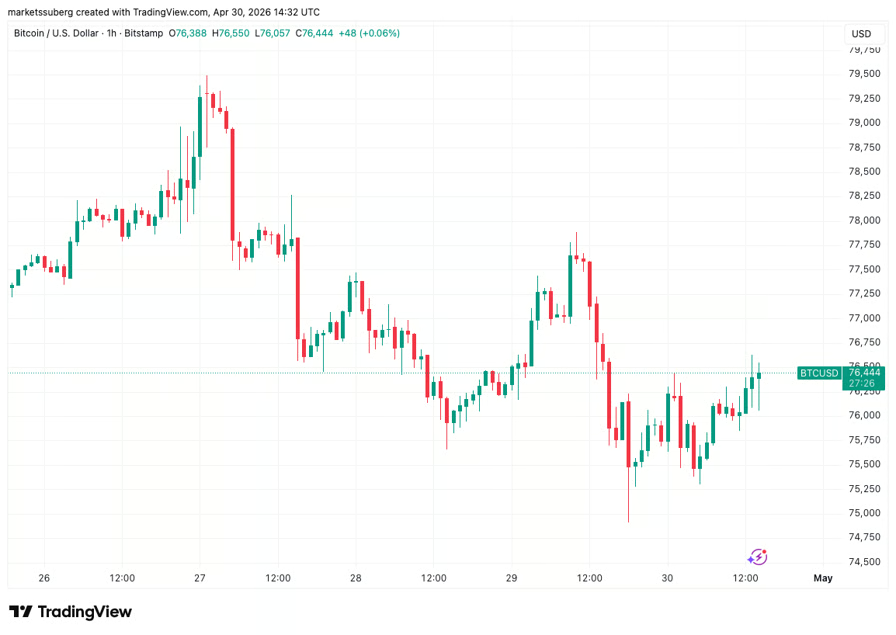
Bitcoin (BTC) rebounded above $76,000 at Thursday’s Wall Street open while traders stayed bearish on the short-term BTC price outlook.
Key points:
- Bitcoin’s Coinbase Premium Index flips negative as analysis warned the January breakdown could repeat.
- BTC price action is already at risk of repeating a bear flag breakdown to new macro lows.
- The April monthly close should still offer Bitcoin’s best gains in a year.
Bitcoin Coinbase Premium risks repeating bearish history
Data from TradingView showed 1% daily gains after initial pressure over high oil prices and a hawkish US Federal Reserve meeting the day prior.
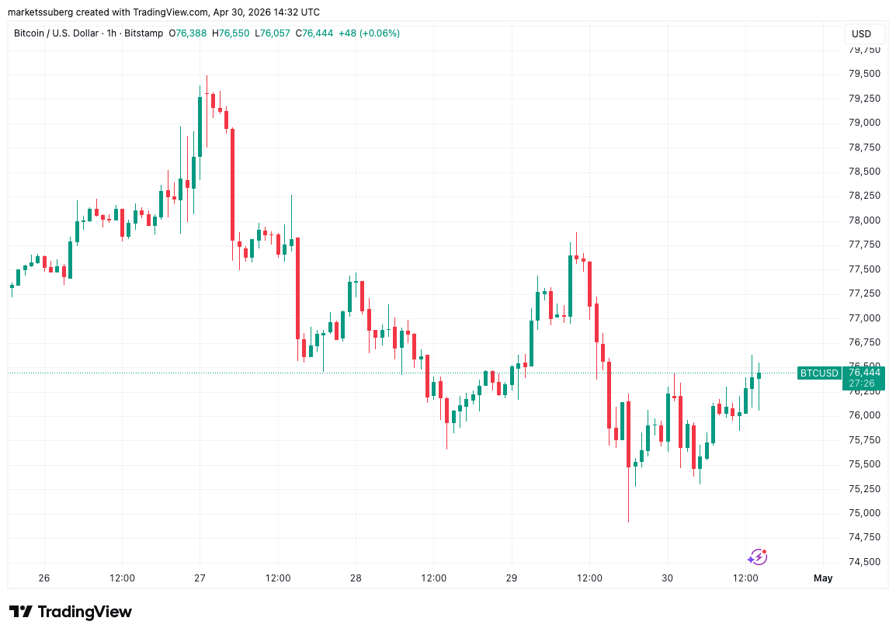
BTC/USD one-hour chart. Source: Cointelegraph/TradingView
With US stocks treading water, Bitcoin market participants saw little reason to flip bullish on shorter time frames.
Among the concerns was the Coinbase Premium — the difference in price between Coinbase’s BTC/USD and Binance’s BTC/USDT pairs.
“Bitcoin’s ripping higher… but the selling on Coinbase is getting DEEPER by the minute,” X user Against Wall Street wrote.
A negative Coinbase Premium implies insufficient demand for Bitcoin during US trading hours, with price action normally suffering as a result.
In January, a relief bounce on BTC/USD combined with a steepening negative Premium, and the pair ultimately broke to new macro lows.
.png?prefix=media%2Fcontent)
Bitcoin Coinbase Premium Index. Source: CryptoQuant
“We’ve seen this exact movie before, and spoiler alert: everybody already knows how it ends,” Against Wall Street continued, referring to January’s events.
As Cointelegraph reported, then, as now, price formed a so-called “bear flag” construction on the daily chart — a warning to buyers that a breakdown could occur.
BTC teases best monthly price gains since April 2025
Other traders also felt the need for caution, with trader CJ seeing little sign of a long-term floor already being in place.
Related: Bitcoin, stocks risk ‘months’ of losses as Kevin Warsh Becomes Fed chair
A chart uploaded to X on the day included a potential target of $65,000.
“I think even if we are putting in a bottom here, we *at least* see something like this,” they commented.
“This would be my bullish outlook. I’m ultimately waiting on April close to refine.”
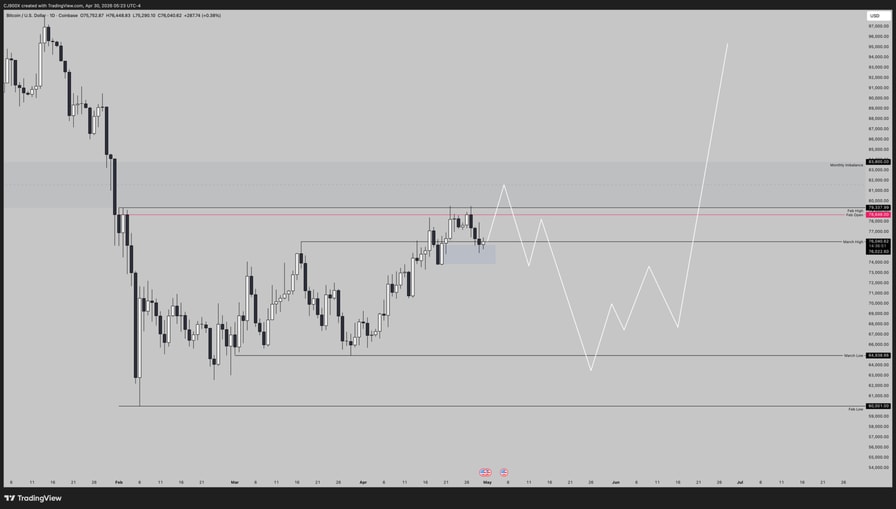
BTC/USD one-day chart. Source: CJ/X
The monthly close was set to offer 11.6% gains for April at the time of writing — still Bitcoin’s best performance in a year, per data from CoinGlass.
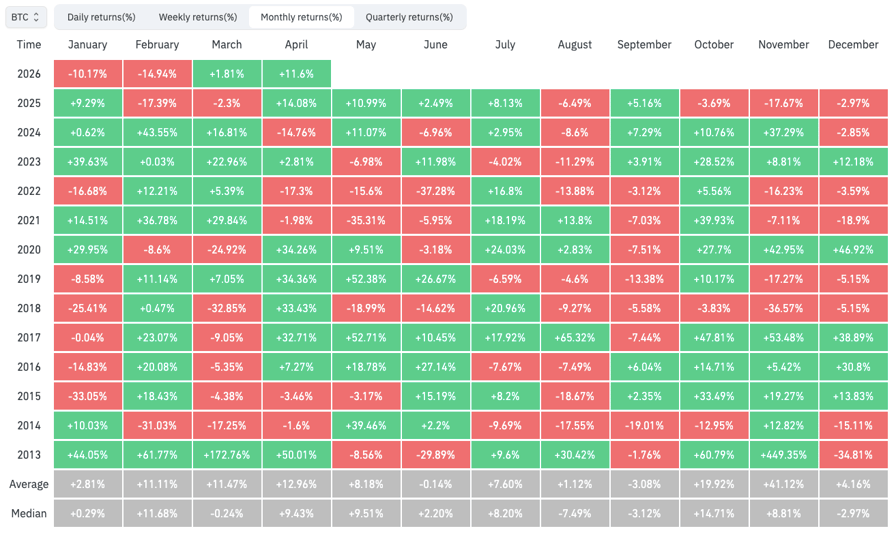
BTC/USD monthly returns (screenshot). Source: CoinGlass
Crypto World
Ethereum Price Prediction Hits $7,500: Standard Chartered Says 2026 Is ETH’s Year, But Pepeto Presale Offers Higher Potential
Ethereum price prediction from Standard Chartered just jumped to $7,500 for year end 2026, a number that caught even the bulls off guard. The bank’s analyst said this will be the year ETH takes back the market, and the data backs it: Glamsterdam targets a 78% gas fee cut by June, spot ETH ETFs just posted their strongest weekly inflows of 2026, and Citi holds $3,175 near term.
But even with $7,500 on the table, that is still a 3x move from 2,299 over eight months. A presale that keeps gaining attention across the market right now offers a path to returns that ETH at a $277 billion market cap will take years to match, and the numbers explain exactly why.
Standard Chartered Raises Ethereum Price Prediction to $7,500 and Declares 2026 the Year of ETH
Standard Chartered lifted its ethereum price prediction from $4,000 to $7,500, arguing that corporate treasury buyers and rising ETF demand will push ETH higher all year, according to The Block. Over half of all stablecoins run on Ethereum, and stablecoins already make up 40% of total blockchain fees.
ETH at 2,299 reaching $7,500 is a 223% gain by December, and that assumes the Glamsterdam upgrade ships on time, ETF inflows hold, and nothing breaks. What if you could earn from ETH trading volume without needing the price to triple?
The $7,500 Target and the Presale That Does Not Need ETH to Reach It
You Do Not Need to Wait for $7,500 When You Earn From Every ETH Trade Today
Standard Chartered says $7,500. Citi says $3,175. Both could be right, both could miss, and if you hold ETH you sit and wait to find out. Pepeto removes that wait entirely, because the exchange collects fees from every trade on the platform, and trades happen whether ETH runs to $7,500 or drops back to $2,000.
Presale wallets get a share of all exchange trading fees after launch, not a short term bonus, but a share of every trade going forward. After that detail came out, the last stage sold out in under 24 hours, and more than $200K hit the presale at a speed nobody expected in this market.
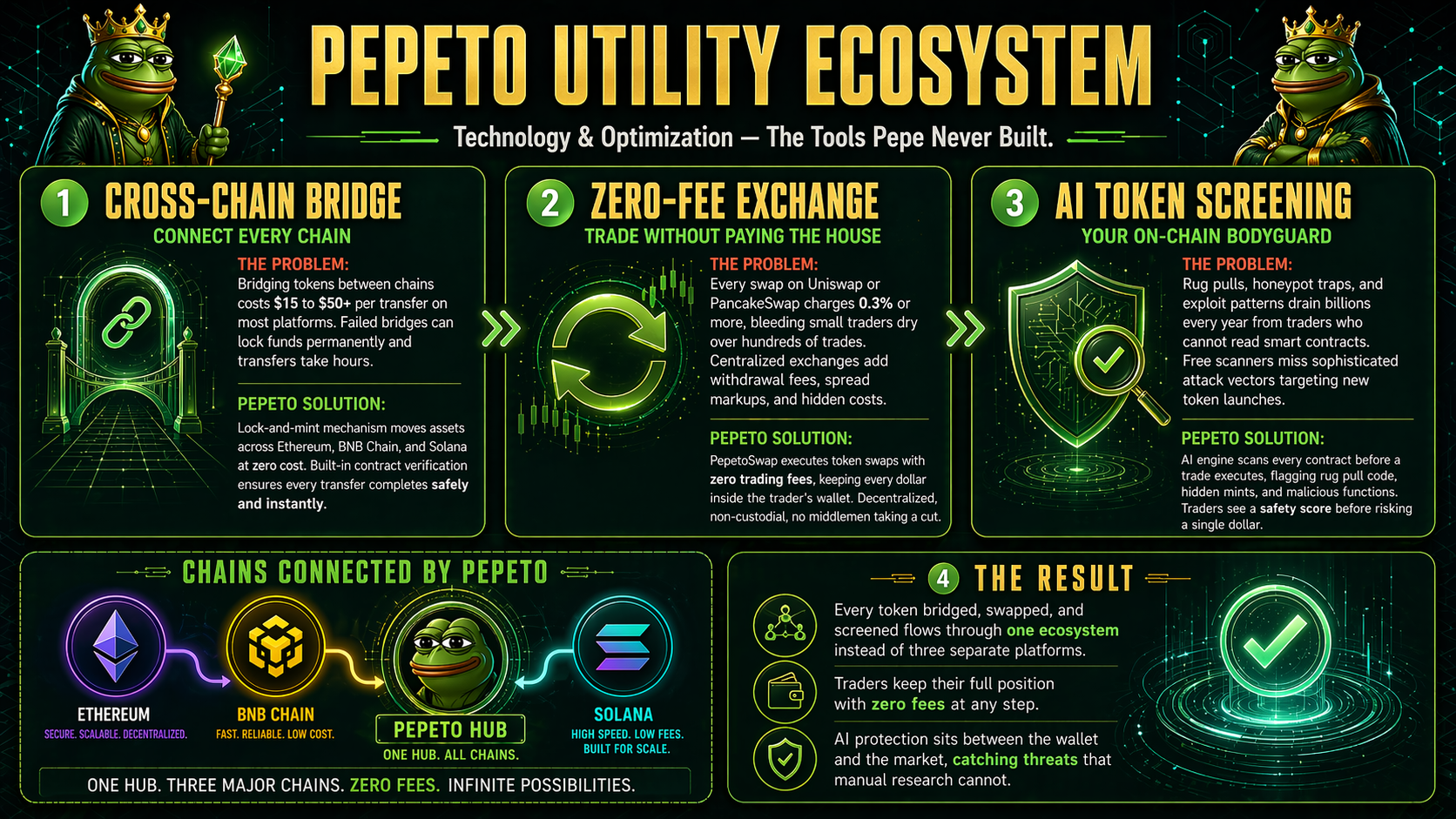
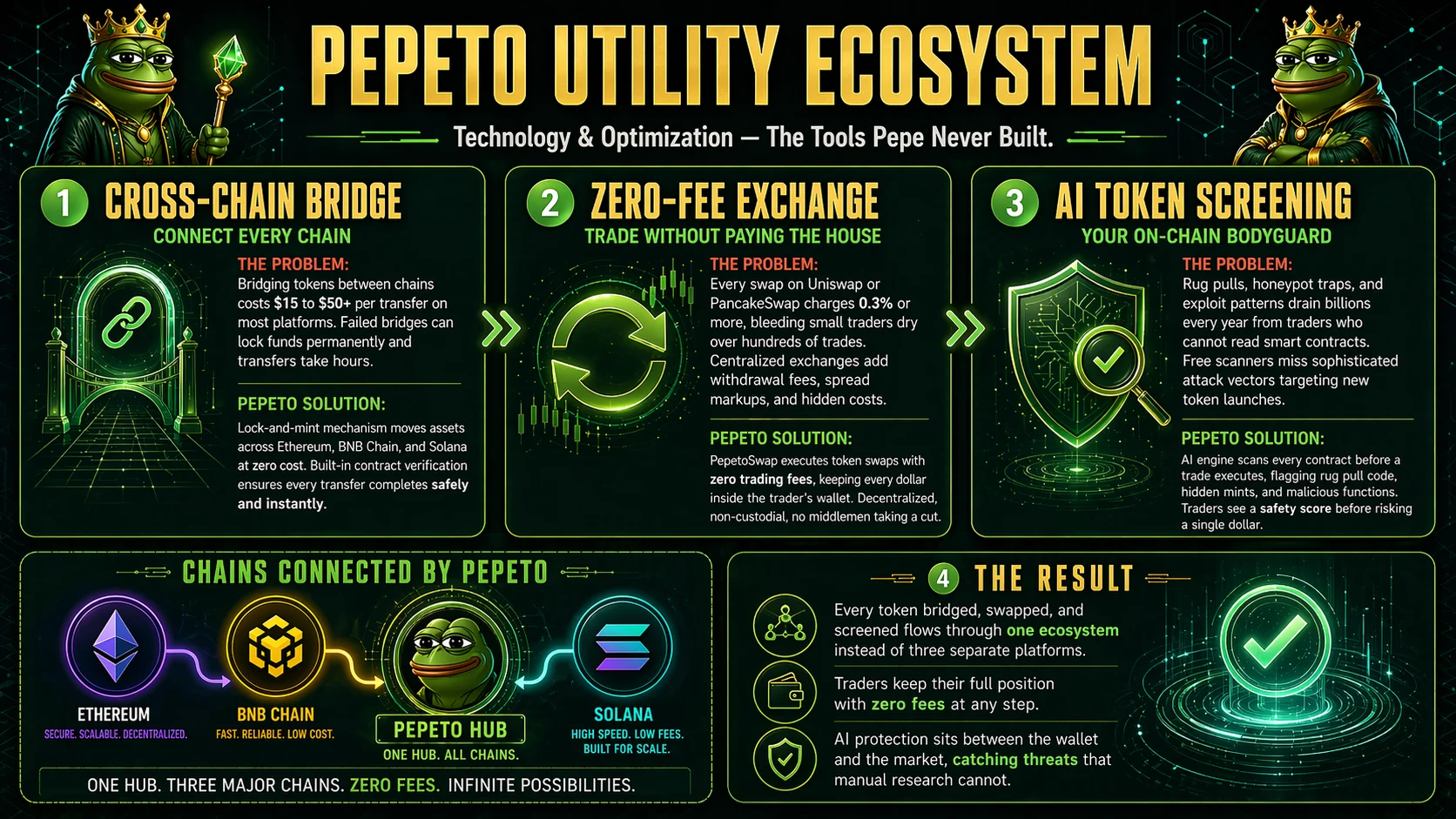
The person who turned Pepe into a $7 billion token came back to build an exchange connecting every blockchain through a cross chain bridge, because the real money is in trading volume, not in guessing direction. The SolidProof audit confirmed the system works before a single dollar entered, and the combination of a verified audit, a proven founder, and working exchange tools at this price is rare.
Funding crossed $9.6M during the same week Standard Chartered told the world to buy ETH. Staking at 177% APY pays holders while the ethereum price prediction debate plays out, and the Binance listing approaches on a timeline the team says is closer than anyone outside the project realizes. The entry at $0.0000001867 gets smaller with every stage, and once it closes, this price becomes something only early wallets will ever see.
Ethereum (ETH) Price at 2,299 as Glamsterdam Upgrade Targets 78% Gas Fee Cut in June
Ethereum (ETH) trades at 2,299 according to CoinMarketCap after gaining 11.66% over the past month. The Glamsterdam upgrade set for June 2026 targets a 78% gas fee cut and parallel processing that would push throughput to 10,000 TPS.
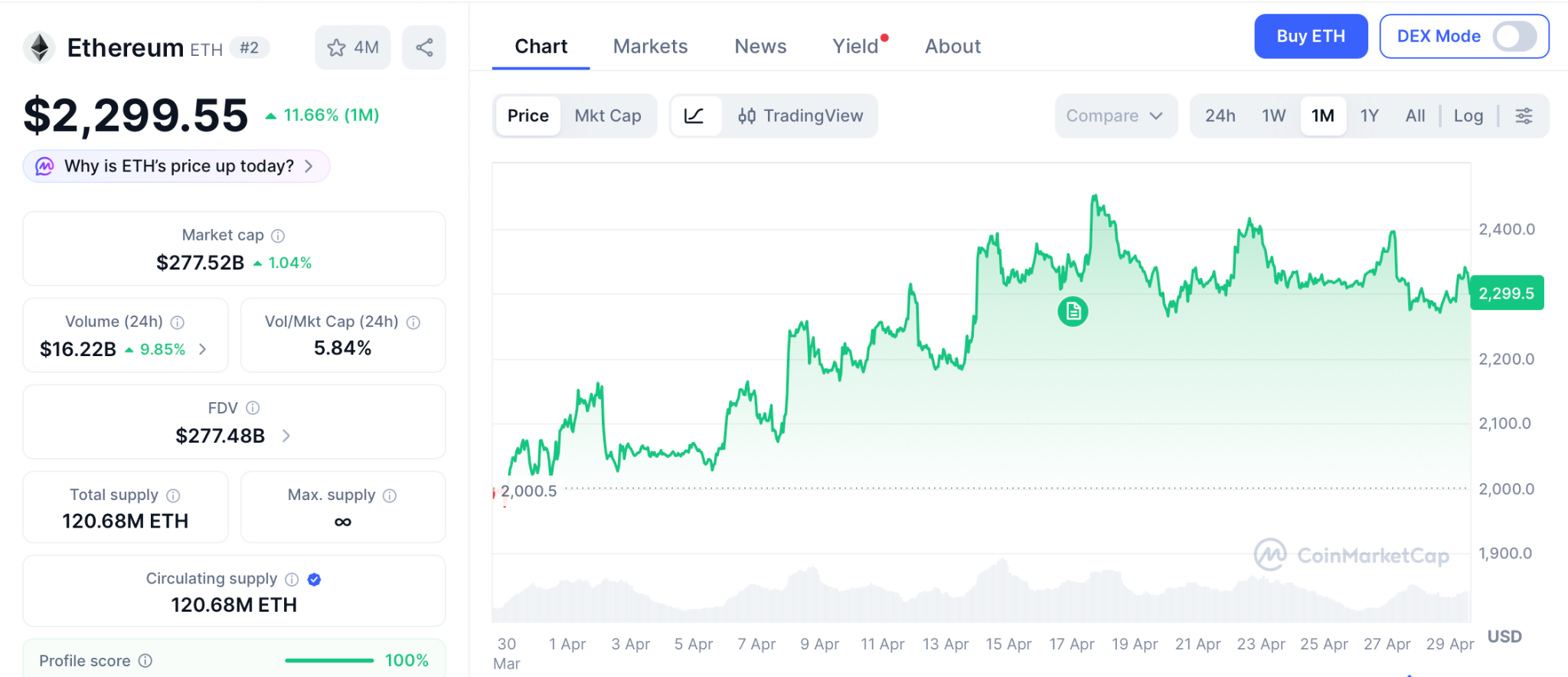
ETH spot ETFs recorded nine straight days of inflows through April 21 with total net inflows at $12.05 billion. Citi holds $3,175 near term, Standard Chartered keeps $7,500 for year end, and the 200 day moving average at $2,600 marks resistance. Even $7,500 sits 223% away over eight months, while presale exchange tools at six decimal zeros work on a faster timeline.
Conclusion
Standard Chartered just gave ETH its strongest call all year, and that $7,500 target will take the rest of 2026 to play out if it happens at all. The gap between Pepeto’s presale price and the listing is the entire opportunity, and it closes permanently once the Binance listing goes live.
Coverage grows louder every week, the ethereum price prediction keeps climbing, 177% APY compounds in wallets that have already entered, and when the Glamsterdam debate drives fresh ETH volume, that volume flows straight through the exchange this presale builds, which will benefit every single presale buyer .
Visit Pepeto Official Website to Enter the Presale

Disclaimer:
The Pepeto project is moving ahead fast, and because of its growing reach, bad actors have launched attacks on the official site.
The backup domain is now « PepetoSwap DOT com » in place of « Pepeto DOT io » until further notice. Users should always confirm they are on the correct URL before connecting wallets or sharing personal information.
FAQs
What is the ethereum price prediction for the end of 2026?
Standard Chartered set an ethereum price prediction of $7,500 for year end 2026, up from a prior $4,000 target, citing rising ETF demand and the Glamsterdam upgrade. Pepeto earns from ETH trading volume at any price level, offering returns that do not depend on ETH reaching that target.
Why is Pepeto a better entry than Ethereum at 2,299?
Pepeto at $0.0000001867 with verified exchange tools, 177% staking APY, and a Binance listing approaching offers listing multiples that Ethereum at 2,299 with a $277 billion market cap cannot match on any realistic timeline. The presale has raised $9.6M from thousands of wallets.
Disclaimer: This is a Press Release provided by a third party who is responsible for the content. Please conduct your own research before taking any action based on the content.

Galaxy S25 battery drain linked to Samsung One UI update

Scottish Greens urge SNP to match universal free childcare pledge

BNP Paribas SA (BNP:CA) Q1 2026 Earnings Call Transcript

Manchester United reach agreement with Casemiro over contract clause amid transfer speculation

US brings back mandatory military draft registration

Steven Gerrard disagrees with Gary Neville over ‘shock’ Chelsea and Arsenal claim | Football

YOU CAN SKIP XRP LAS VEGAS & BAG X,XXX XRP! – THE BTC SHIFT IS HAPPENING – MARK OF THE BEAST & XRP?

Financial Literacy: Think Bigger, Serve Deeper, Build Wealth

| Live Trading – Crypto and Gold | 30 April | – IITian Trader #cryptotrading
-

 Tech3 days ago
Register Renaming | Hackaday
-

 Fashion6 days ago
Weekend Open Thread – Corporette.com
-
Crypto World5 days ago
Hyperliquid $HYPE Rally Builds Momentum as AI Sector Enters Prove-It Phase
-

 Politics3 days ago
Drax board avoid their own AGM, accused of greenwashing & environmental racism
-
 Sports5 days ago
IPL 2026: Ruturaj Gaikwad registers slowest fifty of the season, enters all-time unwanted list | Cricket News
-

 Tech3 days ago
Images of Samsung’s rumored smart glasses have leaked
-

 Tech4 days ago
Why Blue Badges Disappeared From Toyota Hybrids
-

 NewsBeat5 days ago
LK Bennett closes all stores after entering administration
-

 Fashion2 days ago
Kylie Jenner’s KHY Enters a New Era with ‘Born in LA’
-

 Crypto World7 days ago
Michael Saylor says BTC winter is over. Market analyst disagrees, says bitcoin was in a pullback
-
 Entertainment5 days ago
Mariah Carey Slams Deposition Claims In Brother’s Lawsuit
-

 Business2 days ago
Most Commercial Energy Audits Miss the Real Losses
-
 NewsBeat7 days ago
Trump threatens to review UK’s claim to Falkland Islands and punish Nato allies over Iran war disagreement
-

 Business4 days ago
(VIDEO) Charlize Theron Climbs Times Square Billboard to Promote New Netflix Thriller ‘Apex’
-

 Business6 days ago
Jeanine Pirro announces closure of Federal Reserve building cost probe
-

 Tech5 days ago
OpenAI’s Sam Altman apologizes for not reporting ChatGPT account of Tumbler Ridge suspect to police
-

 Tech5 days ago
Microsoft to roll out Entra passkeys on Windows in late April
-

 Crypto World3 days ago
CFTC’s AI will review U.S. crypto registration applications, chairman tells CoinDesk
-
 Crypto World6 days ago
Nvidia (NVDA) Stock Jumps 5% as Intel Earnings Ignite Semiconductor Rally
-

 Tech5 days ago
OpenAI CEO apologizes to Tumbler Ridge community
You must be logged in to post a comment Login