


Connect with us

Crypto World

Coinsbuy offers $100K bounty after reported $7.9M hack

Published

on

Ripple-backed OUSD launch hit by fake issuer scam on XRP Ledger

Coinsbuy has offered a $100,000 reward for information identifying those behind unauthorized withdrawals that reportedly drained more than $7.9 million from its Ethereum and TRON wallets.

Summary

  • Coinsbuy offered a $100,000 identification bounty and an additional asset-recovery bonus.
  • The company said all affected client funds were covered using its reserves.
  • Investigators traced stolen assets through exchanges, with some funds reportedly converted into Monero.
  • Coinsbuy restored deposits and withdrawals but has not disclosed the attack method.

Coinsbuy launches $100K identification bounty

Coinsbuy announced the reward after confirming that unauthorized withdrawals affected several platform wallets on Aug. 9. The Panama-incorporated crypto payments company did not confirm or dispute the $7.9 million loss estimated by blockchain investigators.

The $100,000 reward will go to anyone who provides information leading to the identification of those responsible. Coinsbuy also promised an additional, unspecified bonus for assistance in recovering the stolen assets.

Advertisement

Coinsbuy said it is investigating the incident but will withhold technical details until its findings are complete and independently verified. No suspect or attack method has been publicly identified.

Blockchain investigator SpecterAnalyst initially reported that Coinsbuy-linked wallets lost more than $7.9 million across Ethereum and TRON at around 13:00 UTC on Sunday.

PeckShield later traced parts of the funds through ChangeNOW, FixedFloat, and BingX. ChangeNOW reportedly froze a six-figure amount before it could be moved further.

Advertisement

Coinsbuy covers affected customer balances

Coinsbuy temporarily suspended deposits and withdrawals after detecting the activity. Both services have since resumed, and the company said the platform is operating normally.

“All affected client funds have been fully covered by Coinsbuy from our own reserves, so our users have not experienced any financial losses.”

The company added that all services were fully available. Separate reporting indicated that Coinsbuy replenished the affected wallets to within 0.05% of their balances before the incident within 24 hours.

Around 282 ETH, valued at approximately $542,000 at the time, remained unmoved across five addresses in the latest reported on-chain review. Coinsbuy has not disclosed how much of the remaining cryptocurrency has been recovered or frozen.

The attacker reportedly routed portions of the assets through exchanges for conversion into Monero (XMR), a privacy-focused cryptocurrency that makes subsequent fund tracing more difficult.

Advertisement

Bounty follows other crypto recovery offers

Coinsbuy’s fixed identification reward differs from the percentage-based vulnerability bounties sometimes offered directly to exploiters in exchange for returning stolen assets.

In July, a TrustedVolumes attacker returned about $2 million in Ethereum while retaining another $2 million as a self-declared bounty. TrustedVolumes had previously invited the attacker to negotiate a vulnerability reward and return the funds.

Coinsbuy’s offer instead targets information that could identify those responsible, while providing a separate bonus for recovery assistance. The company has not published eligibility rules, a deadline, or payment terms for the reward.

The incident comes after crypto platforms lost approximately $110 million to hacks in July, according to Immunefi. The security platform also reported that confirmed and paid bug reports increased by 18% during the month.

Advertisement

Coinsbuy has not disclosed the attack vector

GoPlus Security said the cross-chain withdrawals appeared consistent with compromised hot-wallet keys or administrator access. This assessment remains unconfirmed, and moving funds across Ethereum and TRON does not, by itself, establish how the attacker entered Coinsbuy’s systems.

No U.S. authority has publicly announced involvement in the Coinsbuy investigation. However, a recent Bybit case showed that affected platforms may use American courts to obtain records and freeze assets passing through services with U.S. connections. Bybit recently secured U.S. court support to trace stolen funds from its $1.5 billion breach.

Coinsbuy said it would disclose further technical information only after completing and verifying its investigation. Until then, the reported loss, precise attack vector, and amount recovered remain unresolved.

Advertisement

Source link

Continue Reading
Click to comment

You must be logged in to post a comment Login

Leave a Reply

Crypto World

What to Know About the Earthquake in Colombia

Published

on

What to Know About the Earthquake in Colombia

A 7.4-magnitude earthquake rattled western Colombia on Monday, causing widespread destruction and leaving at least 111 people dead.

Colombian President Abelardo De La Espriella, who was sworn into office just days before the disaster struck the nation, said in a post on X on Monday morning that he had “directly assumed leadership of the emergency response.” In another post that morning, he said that he was traveling to the nation’s capital, Bogotá, “to focus on addressing the emergency facing our country.”

“To the Colombians who are going through difficult times today, I want to say: you are not alone,” he said. “You have a President who cares deeply for his people and who will do everything necessary to protect you, support you, and move forward together in rebuilding the affected regions.”

Here’s what to know about the earthquake.

Advertisement

When and where did the earthquake happen?

The epicenter of the earthquake was near San José del Palmar, which is a community west of the country’s capital that has a population of 5,000 and is located in the Chocó region. Other cities nearby, including Pereira, Manizales, and Cali, were impacted, too.

Neighboring countries, including Venezuela, Ecuador, and Panama, also felt the quake.

The damage sustained by the Manizales Cathedral are pictured after the earthquake in Manizales, Colombia, on Aug. 10, 2026. Andres Valencia—AFP/Getty Images

How strong was the earthquake?

Advertisement

USGS reported that the earthquake that struck Colombia had a 7.4 magnitude. “Magnitude” indicates the size of a quake—one with a 5.3 magnitude, for instance, is a “moderate” quake, whereas one with a 6.3 is considered “strong,” according to USGS. The back-to-back quakes that shook Venezuela in June and left more than 6,000 people dead each had a magnitude above 7.

The Colombian Geological Service reported that the quake had a depth of about 103 km, in addition to its 7.4 magnitude, “making it the strongest earthquake recorded in Colombia in the last decade.” The agency also said that two aftershocks—with magnitudes of 2.8 and 4.8—have been recorded so far on Monday

What is the death toll?

The disaster in Colombia left at least 111 people dead, according to the AP. The majority of the deaths reported so far occurred in the region of Risaralda—the capital of which is Pereira—where at least 40 people were killed, the AP reported. Authorities said that at least 27 more people were killed in the nearby region of Valle del Cauca.

Advertisement

De La Espriella said on Monday that at least 87 people were wounded by the quake, the AP reported.

A police officer walks amid the debris of a damaged commercial store after the earthquake in Manizales, Colombia, on Aug. 10, 2026. Jonh Bonilla—AFP/Getty Images

What damage has been reported?

The total extent of the damage caused by the earthquake is not yet clear hours after it hit, but videos and photos shared by news outlets showed buildings in multiple cities collapsing and being destroyed by the disaster. 

Local officials said that they had received reports of many people trapped under buildings that had collapsed.

Advertisement

The International Rescue Committee (IRC) said that its teams are monitoring the situation.

“Our teams near the epicenter in Chocó are reporting damages to infrastructure, including to hospitals and clinics,” Nicole Kast, IRC’s Country Director for Colombia, Venezuela and Ecuador, said in a statement. “Impacted communities were already facing armed conflict and high levels of poverty before the ground began to shake. The IRC is monitoring the situation and stands ready to scale up its response as the full extent of the destruction becomes clear.”

Colombia’s civil aviation authority said in a post on X on Monday morning that it had received reports of damage at airports in Pereira, Manizales, Quibdó, Armenia, Cartago, and Buenaventura, and that operations there were being suspended “for safety reasons” until the damage had been assessed.

An elderly woman is carried on furniture near a collapsed building after an earthquake in Cali, Colombia, on Aug. 10, 2026. Joaquin Sarmiento—AFP/Getty Images

Is there a tsunami threat after the earthquake?

Advertisement

While earthquakes can sometimes trigger tsunamis, the U.S. Tsunami Warning System said on Monday that there was no warning, advisory, watch, or threat for a tsunami after the earthquake in Colombia.


Source link

Continue Reading

Crypto World

Two Prediction Markets Shut Down Hours Apart as Kalshi and Polymarket Take 93% of Volume

Published

on

Two Prediction Markets Shut Down Hours Apart as Kalshi and Polymarket Take 93% of Volume


Two crypto prediction market startups announced they were winding down within 90 minutes of each other on Monday morning, both giving users until Sept. 30 to pull their money out. The venues that closed sat at opposite ends of the market. Trepa built its own mechanism on Solana, paying users by how… Read the full story at The Defiant

Source link

Continue Reading

Crypto World

Trump Media (DJT) BTC holdings shrink as crypto losses hit $361 million

Published

on

Trump Media’s Q1 loss widens to $406 million on bitcoin, CRO markdowns

Trump Media and Technology Group’s (DJT) bitcoin holdings shrank during the second quarter of the year as falling crypto prices saddled the Truth Social parent with $360.6 million in losses in the first half of the year.

The company held 9,477.16 bitcoin with a fair value of $557.1 million as of June 30, according to its quarterly filing Monday. That’s down from 9,542.16 BTC at the end of March, translating to a 65 BTC decline in holdings through the quarter.

Trump Media’s Crypto.com-linked cronos holdings remained unchanged at roughly 756.1 million tokens, but their fair value fell to $40.6 million from $68 million at the end of 2025.

A significant chunk of the company’s bitcoin was also tied up as collateral. Trump Media, which is majority owned by the Donald J. Trump Revocable Trust, had 4,260.73 BTC pledged against convertible notes and another 2,077.34 BTC pledged for its bitcoin options strategy as of June 30.

Advertisement

U.S. President Donald Trump owns a significant stake in the trust, which is controlled by Donald Trump, Jr., one of the president’s children.

The results landed only days after Trump Media pared back parts of its crypto ambitions.

Source link

Advertisement
Continue Reading

Crypto World

Ethereum roadmap puts privacy and quantum safety first

Published

on

Did L2s break Ethereum's ultrasound money?

Ethereum’s updated roadmap adds native rollups, stronger privacy, and post-quantum scaling as advances in cryptography and AI reshape the network’s long-term technical priorities, according to co-founder Vitalik Buterin.

Summary

  • Quantum security has moved higher in Ethereum’s priorities compared with its 2023 roadmap.
  • New areas include native rollups, stronger privacy, and blob and gas futures.
  • Ethereum may use specialized scaling mechanisms for transfers, trading, and privacy applications.
  • STARKs and AI-assisted formal verification could support upgrades across all three protocol layers.

Ethereum (ETH) co-founder Vitalik Buterin compared the network’s 2023 roadmap with its current Strawmap in an Aug. 10 X post, identifying several technologies that have gained, lost, or changed priority over the past three years.

Buterin said the two plans retain substantial overlap, but the order and implementation of several goals have changed. Quantum security has moved closer to the front of the roadmap, while verifiable delay functions and some proposed Ethereum Virtual Machine improvements have received less attention.

Older technical designs have also been replaced as Ethereum researchers identified alternatives. Plans involving Verkle trees shifted toward a unified binary tree and later a PBT design, while state expiry evolved into a broader proposal for new state types.

Advertisement

The biggest difference, according to Buterin, comes from the areas that did not appear in the 2023 roadmap. These include native privacy, post-quantum scaling, simpler specifications for formal verification, markets for future blob and gas capacity, native rollups, and a wider range of possible replacements or modifications for the EVM.

Ethereum privacy and quantum security move forward

Native privacy is one of the clearest additions to Ethereum’s long-term direction. Buterin listed keyed nonces, recent roots, parts of FOCIL, lean privacy pools, and wormholes among the mechanisms now being explored.

Keyed nonces could make it harder for observers to connect a user’s transactions, while recent-root mechanisms may allow private applications to verify recent blockchain states without revealing a complete history. FOCIL, meanwhile, is intended to make transaction inclusion more resistant to censorship by block builders.

Advertisement

The changes build on Buterin’s three-step Ethereum privacy plan released in May. That proposal combined account abstraction with FOCIL, keyed nonces, and changes at the wallet and access layers to reduce metadata leaks.

Post-quantum scaling has also become a separate priority. Ethereum currently depends on cryptographic systems that could eventually become vulnerable if sufficiently powerful quantum computers emerge. Replacing them without sharply increasing signature sizes, verification costs, or network bandwidth presents an additional scaling problem.

The current roadmap considers LeanSPHINCS signatures, signature aggregation, and “zkzk frames” as potential parts of the solution. Crypto.news previously reported that an Ethereum researcher demonstrated account-level post-quantum protection at an estimated cost of $0.07 per account, showing that wallet-level preparation may begin before a full protocol upgrade.

Ethereum’s Strawmap is not a finalized schedule. It is a coordination document covering proposed upgrades through 2029, with individual changes still requiring research, testing, and agreement among developers before they can reach the network.

Advertisement

Native rollups enter Ethereum’s design space

Native rollups were not included in the 2023 roadmap because zero-knowledge proof systems were not mature enough for developers to seriously consider integrating them into Ethereum’s base protocol, Buterin said.

Rollups currently operate as separate layer-2 systems. They process transactions outside Ethereum’s main execution layer and submit proofs or transaction data to the base network. Each rollup generally maintains its own contracts, proof system, upgrade controls, and security assumptions.

A native rollup would move part of that verification process into Ethereum itself. The base protocol could provide a standardized mechanism for checking state transitions, potentially reducing the amount of custom infrastructure each rollup must maintain.

Such a change could simplify the relationship between Ethereum and its layer-2 networks, though the exact design remains unsettled. Developers would still need to decide what functions should become native, how different virtual machines would be supported, and whether protocol-level verification could avoid creating new complexity.

Advertisement

The proposal arrives as Ethereum’s broader scaling approach changes. Buterin said the network is moving away from trying to scale every type of activity through one general mechanism. Instead, developers may build highly scalable but more restricted systems for common use cases such as token transfers, decentralized exchange trades, and privacy protocols.

This approach could allow Ethereum to process specific high-volume activities more efficiently without requiring every node or application to support the same expanded execution environment.

Blob and gas futures are another addition that did not exist as a developed roadmap concept in 2023. Such markets could allow users or layer-2 networks to lock in future access to Ethereum’s data or execution capacity, reducing uncertainty over costs during periods of heavy demand.

AI could make Ethereum easier to verify

Ethereum’s updated roadmap also places more weight on simplifying the protocol specification so developers can formally verify its behavior.

Advertisement

Formal verification uses mathematical proofs to determine whether software follows its intended rules. Applying it to an entire blockchain protocol has historically required substantial time and specialist work, particularly when the protocol includes multiple clients, cryptographic systems, and interacting layers.

Buterin argued that advances in artificial intelligence are making large-scale verification more practical. He previously said AI-assisted formal verification could become the “final form” of software development, allowing developers to combine optimized code with machine-checkable evidence that it works correctly.

That work is closely tied to Ethereum’s use of STARK proofs. Recursive STARKs allow one proof to verify another, producing compact evidence for increasingly large batches of computation.

Buterin said the same underlying verification method could eventually operate across Ethereum’s execution, consensus, and data layers. However, using a common proof system throughout the protocol would make the security of its implementation especially important, increasing the need for formal verification and independent testing.

Advertisement

Ethereum’s virtual machine may also change as these systems develop. Buterin said zkzk frames could require the protocol to expose an instruction set other than the EVM, with leanISA and RISC-V among the possible candidates.

Under one potential model, the EVM could continue serving developers and existing applications while operating as an intermediate representation above a simpler underlying instruction set. Buterin cautioned that this part of the design remains too early even for inclusion in the current Strawmap.

Roadmap remains a long-term coordination plan

Buterin’s comparison provides additional detail on Ethereum’s proposed Lean rebuild, which seeks to make the protocol quantum-safe, private, censorship-resistant, and easier to verify over the coming years.

The direction could eventually affect U.S. wallet providers, exchanges, institutional stakers, and layer-2 operators that rely on Ethereum. However, the post announced no immediate software release, hard fork, or mandatory action for users.

Advertisement

Each major proposal must still move through Ethereum’s research and governance process. Native rollups, alternative instruction sets, and post-quantum signatures remain technical directions rather than confirmed features with fixed activation dates.

Ethereum (ETH) showed no clear positive reaction to the roadmap update. ETH traded near $1,875 at the time of writing, down about 2.6% over the previous 24 hours as the broader crypto market weakened.

The latest comparison nevertheless shows how Ethereum’s development priorities have widened since 2023. Scaling remains central, but privacy, quantum resistance, and verifiable protocol design now carry more weight in determining how the network could operate through the end of the decade.

Advertisement

Source link

Continue Reading

Crypto World

We Must Remember Nagasaki

Published

on

We Must Remember Nagasaki

But contrary to popular understanding among many today, Hiroshima did not convince Japan to surrender. In fact, Japan’s Supreme War Council—the six men responsible for directing the war—did not even meet in the days immediately following the attack. The military leadership remained committed to fighting on despite the destruction of an entire city.

Many were convinced that Hiroshima represented a terrible but isolated event. Atomic weapons were new and extraordinarily expensive, and they surmised that there was no way the Americans had more than one—or at most, a few—such bombs.

If America had only limited bombs, Japanese leaders concluded, they could still hope to force a costly invasion and perhaps negotiate better terms.

Nagasaki shattered that illusion.

Advertisement

Just 75 hours after Hiroshima, a second atomic bomb annihilated another Japanese city, killing 73,000 people. Two cities had vanished in just three days. From Tokyo’s perspective, there was no way of knowing whether the United States possessed two bombs—or twenty. Even more terrifying, America now might never even need to invade Japan. It could simply destroy one city after another until nothing remained.

Source link

Continue Reading

Crypto World

UK Money Laundering Suspect Bought $100M in Trump Crypto Business: NYT

Published

on

UK Money Laundering Suspect Bought $100M in Trump Crypto Business: NYT

Cointelegraph is committed to providing independent, high-quality journalism across the crypto, blockchain, AI, and fintech industries.

All news, reviews, and analyses are produced with full journalistic independence and integrity. For more details on our standards and processes, please read our Editorial Policy.

Source link

Advertisement
Continue Reading

Crypto World

BlackRock Debuts Two Canadian ETFs, One Holds 3% Bitcoin Allocation

Published

on

Crypto Breaking News

BlackRock has expanded its Canadian spot-Bitcoin ETF lineup with two Toronto Stock Exchange listings, including one fund that pairs broad international equity exposure with a small allocation to Bitcoin. The new products begin trading Monday on the TSX.

The ETFs are the iShares Equity + Bitcoin ETF Portfolio (IBQT) and the iShares Core MSCI All-International Equity Index ETF (XINT). While both are managed through BlackRock Asset Management Canada under the RBC iShares alliance, only IBQT includes a direct Bitcoin component.

Key takeaways

  • IBQT is a “core” equity fund with a 3% Bitcoin sleeve, implemented via exposure to BlackRock’s Canadian iShares Bitcoin ETF (IBIT).
  • XINT provides diversified international equities by tracking the MSCI ACWI ex North America IMI Index across more than 5,000 companies.
  • Both funds primarily hold other iShares ETFs, using fund-to-fund structures rather than selecting individual stocks directly.
  • BlackRock positions Bitcoin access as a small allocation within a broader portfolio approach rather than a standalone Bitcoin product.

A Canadian equity fund with a Bitcoin allocation

IBQT is designed to combine globally diversified equities with limited Bitcoin exposure. According to BlackRock, the fund allocates 97% of its portfolio to Canadian, U.S., international and emerging-market equities, with the remaining 3% dedicated to Bitcoin exposure through BlackRock’s Canadian iShares Bitcoin ETF (IBIT), which trades on Cboe Canada.

Importantly, IBQT does not attempt to hold individual stock positions on its own. Instead, it primarily invests in other iShares ETFs to gain both its equity exposure and its Bitcoin component. The structure matters for investors who are evaluating how Bitcoin is being integrated: rather than building a portfolio around crypto volatility, IBQT is framed as an incremental allocation inside an equity-oriented portfolio.

XINT targets ex–North America international diversification

The second listing, XINT, focuses on international equities outside Canada and the United States. BlackRock states that the fund tracks the MSCI ACWI ex North America IMI Index, a benchmark that aims to capture large-, mid-, and small-cap companies across developed and emerging markets.

Advertisement

BlackRock also highlights the breadth of the index XINT follows: exposure to more than 5,000 companies spanning over 40 developed and emerging markets outside Canada and the U.S. For Canadian investors who prefer a “set and track” approach to international equity diversification, XINT offers a standalone index-linked option alongside IBQT’s hybrid design.

What BlackRock says about scale in Canada and beyond

Both funds are managed by BlackRock Asset Management Canada through the RBC iShares alliance. BlackRock said its iShares ETF business managed approximately $6.2 trillion in assets across more than 1,700 ETFs as of June 30.

That scale is relevant when new ETF products launch, because it can influence operational maturity—such as liquidity management, fund administration practices, and index/fund replication workflows—especially for multi-asset products that rely on holding other ETFs.

Bitcoin access follows BlackRock’s existing ETF footprint

IBQT’s Bitcoin sleeve routes through BlackRock’s Canadian iShares Bitcoin ETF (IBIT). BlackRock’s U.S.-listed iShares Bitcoin Trust (IBIT) is also a major reference point in the company’s spot Bitcoin ecosystem.

Advertisement

CoinMarketCap data indicates IBIT is the largest U.S. spot Bitcoin ETF by assets under management, with about $47.9 billion in AUM at the time referenced by the listing data: CoinMarketCap.

By using IBIT as the mechanism for its 3% Bitcoin allocation, IBQT effectively imports the established Bitcoin ETF wrapper into a broader equity product. That approach may appeal to investors seeking Bitcoin exposure without making it the dominant risk driver—though it also means the Bitcoin allocation will typically be smaller in magnitude than what many standalone Bitcoin ETFs provide.

Why this matters for Canadian investors

Bringing a “small allocation” Bitcoin fund to the TSX signals a continued push to normalize crypto exposure inside traditional portfolio frameworks. For investors, the practical question is how the 3% Bitcoin allocation changes the character of an equity-heavy holding—especially in periods when Bitcoin trades independently of global equities.

Traders and portfolio managers may also watch how BlackRock’s fund-to-fund implementation performs in Canada, since IBQT’s design depends on the underlying Canadian iShares Bitcoin ETF for its BTC exposure while the rest of the portfolio is tied to broad equity holdings via iShares ETFs.

Advertisement

As with any newly launched ETFs, attention will likely turn to how assets build after the initial trading start, as well as to whether the funds attract consistent flows from investors seeking either diversified international equities (XINT) or a blended approach that includes Bitcoin (IBQT).

Investors should monitor near-term developments such as IBQT’s uptake on the TSX, trading liquidity as the market digests the new hybrid structure, and how BlackRock’s Canadian iShares Bitcoin ETF (IBIT)—the source of the BTC sleeve—continues to perform as demand for Bitcoin exposure broadens beyond standalone products.

Risk & affiliate notice: Crypto assets are volatile and capital is at risk. This article may contain affiliate links. Read full disclosure

Advertisement

Source link

Continue Reading

Crypto World

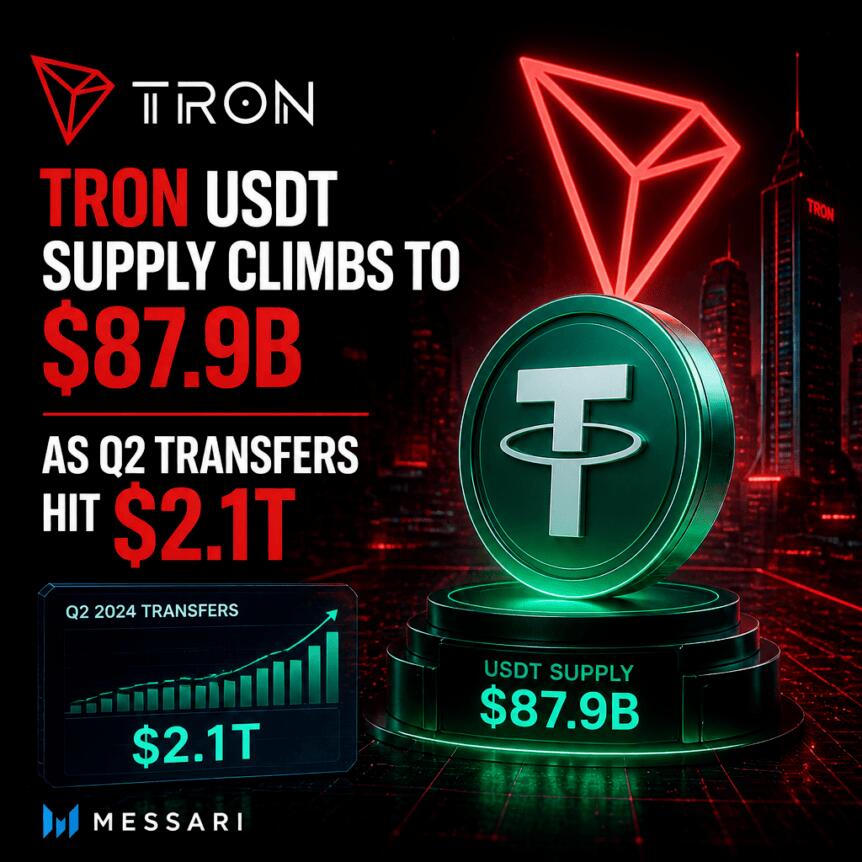
TRON USDT Supply Climbs to $87.9B as Q2 Transfers Hit $2.1T, Messari

Published

on

Crypto Breaking News

TRON ended the second quarter with a major stablecoin milestone: it recorded $87.9 billion in circulating USDT, putting it ahead of Ethereum on the same metric, while processing $2.1 trillion worth of USDT transfers over the quarter. The figures underscore how deeply USDT liquidity has embedded itself in TRON’s rails, even as parts of the ecosystem show softer momentum elsewhere.

According to a Messari report on the network’s second-quarter performance, USDT represented 98.5% of TRON’s stablecoin market. Stablecoin supply on TRON also rose, climbing 4.1% quarter-over-quarter to a record $89.2 billion. After a drop in Q1, average daily USDT transfer volume resumed growth, increasing 4.3% to $22.8 billion.

Key takeaways

  • TRON led on USDT circulation in Q2, reaching $87.9B and processing $2.1T in USDT transfers during the quarter.
  • Stablecoin dominance remained extreme, with USDT making up 98.5% of TRON’s stablecoin supply.
  • Network usage hit new highs, including 14.6M transactions on June 15 and record-level daily activity.
  • Fees reversed direction, rising 15.9% to $699.4M, the first quarterly increase after a prior governance change.
  • DeFi activity cooled even as payments grew, with DeFi TVL down 1.9% and DEX volumes falling for a fourth straight quarter.

USDT expansion drives TRON’s transaction growth

Messari attributes TRON’s improved throughput to stronger day-to-day demand for USDT transfers. The network averaged 11.8 million daily transactions in Q2, up 8.7% from the prior quarter. Active usage also improved: average daily active addresses increased 11.7% to 3.6 million. The report also highlights the peak day, when TRON processed 14.6 million transactions on June 15.

From an investor and market-structure perspective, this matters because USDT activity often translates into consistent utilization of on-chain infrastructure. Even when broader on-chain applications fluctuate, stablecoin transfer volume can sustain network demand—particularly on chains where stablecoins are heavily concentrated.

Fees recover after an earlier governance shift

Beyond transaction counts, the report notes that TRON’s fee environment changed as well. Network fees rose 15.9% to $699.4 million in Q2, described as the first quarterly increase since an August 2025 governance change reduced the network’s energy unit price. In other words, Q2’s fee growth appears tied not only to higher activity, but also to a longer arc in TRON’s fee mechanics after that policy adjustment.

Advertisement

Still, the relationship between network fees and usage can be nonlinear when protocol parameters change. Traders and builders watching TRON may want to pay close attention to whether future fee levels keep rising with demand or whether they plateau as the impact of the earlier energy-unit pricing adjustment stabilizes.

DeFi softens while supply growth continues

Despite the payment-heavy momentum, parts of TRON’s on-chain ecosystem showed uneven performance. Messari reports that DeFi TVL fell 1.9% to $4.4 billion during the quarter. Decentralized exchange activity also cooled: average daily DEX volume dropped 21.7% to $49.3 million, marking a fourth consecutive quarterly decline.

This divergence—strong stablecoin transfer volume alongside weaker DeFi engagement—suggests that Q2’s growth may have been driven more by utility and circulation than by risk-taking or trading depth on TRON’s DeFi venues. For users, this can affect liquidity conditions and token execution quality on DEXs; for developers, it may signal that ecosystem growth is currently being led by transfers rather than by on-chain lending, borrowing, and trading.

Meanwhile, the report indicates that TRX supply remained inflationary. Even with higher activity, circulating supply increased by 87 million tokens during the quarter, with issuance continuing to outpace burns. That dynamic is notable because it can influence long-term expectations around token supply pressure, particularly when network usage is improving but supply reduction mechanisms aren’t yet keeping up.

Advertisement

Institutional access expands through tokenization and custody

While on-chain metrics show clear usage trends, institutional infrastructure around TRON also advanced during the quarter. Messari highlights that Securitize launched Hamilton Lane’s tokenized Senior Credit Opportunities Fund on TRON—its first TRON-issued asset. The fund reportedly started with about $4.3 million under management.

Broader institutional interest also included token listing and potential product developments. Grayscale reportedly added TRX to its list of assets under consideration. Separately, a proposed staked TRX exchange-traded product from Canary Capital remained in registration.

On the market-access side, TRX trading availability improved across venues. Bitnomial launched spot TRX trading in the United States, while OKX Europe introduced MiFID-regulated TRX expiry perpetuals. The quarter also saw Binance.US restore trading in the token.

The institutional push continued after Q2 ended. Earlier coverage noted Anchorage Digital adding native TRX staking and custody for TRC-20 assets in July, enabling institutional clients to stake TRX directly from its custody platform. For market participants, custody-and-staking workflows can be a critical step toward deeper institutional adoption, as they reduce operational friction compared with self-custody or manual transfer processes.

Advertisement

Read together, TRON’s Q2 pattern looks less like a pure “DeFi rally” and more like a chain consolidating stablecoin circulation and steadily improving institutional plumbing. The key question for the next quarter is whether stronger USDT throughput can translate into renewed DeFi demand—particularly DEX volumes and TVL—or whether TRON will remain primarily a stablecoin settlement venue while trading and application activity lag behind.

Risk & affiliate notice: Crypto assets are volatile and capital is at risk. This article may contain affiliate links. Read full disclosure

Source link

Advertisement
Continue Reading

Crypto World

Judge stays CFTC’s case against US solider over prediction market bets

Published

on

Judge stays CFTC’s case against US solider over prediction market bets

Judge stays CFTC’s case against US solider over prediction market bets

A New York judge granted a motion filed by US prosecutors in July to stay the CFTC’s civil case against Gannon Ken Van Dyke over making more than $400,000 on prediction markets.

Source link

Continue Reading

Crypto World

Bitcoin defenders seek frontier AI access in 40-group push

Published

on

Bitcoin policy group joins U.S. State Department freedom tech push

Bitcoin Policy Institute and more than 40 digital-asset organizations have called on leading AI laboratories to give qualified open-source security researchers controlled access to frontier models as AI-assisted cyberattacks grow more capable.

Summary

  • More than 40 organizations signed the appeal for trusted access to advanced AI models.
  • The coalition requested early model access, computing power, secure environments, and direct communication channels.
  • Block, Coinbase, Strategy, MARA, Galaxy, BitGo, Brink, and Trezor were among the signatories.
  • The request follows several AI-assisted attacks and major Bitcoin security failures reported in 2026.

Bitcoin coalition asks AI labs for controlled access

Bitcoin Policy Institute announced the initiative in an Aug. 10 X post, saying the coalition represents organizations from across the digital-asset ecosystem.

The open letter asks leading AI developers to provide qualified open-source defenders with trusted access to their most capable models. It does not call for unrestricted public access to models with advanced cybersecurity capabilities.

Instead, the signatories proposed a controlled program covering early access to frontier cybersecurity models, sufficient computing capacity, secure research environments, and direct channels with AI laboratory security teams.

Advertisement

Those resources would allow vetted researchers to examine Bitcoin wallets, payment infrastructure, and other open-source software before attackers can exploit newly discovered weaknesses.

“The past several weeks have made the need for this abundantly clear,” Bitcoin Policy Institute wrote.

Block, Coinbase, Strategy, MARA, Galaxy, BitGo, Brink, OpenSats, Chaincode Labs, Spiral, Trezor, Unchained, Btrust, and Fedi were among the organizations supporting the request.

The coalition argued that current model safeguards can restrict legitimate security research even as criminals and state-backed groups gain access to increasingly capable open or locally deployed systems. Its central message to AI laboratories was that defenders need an early opportunity to identify and repair vulnerabilities.

Advertisement

No leading AI laboratory had publicly announced a program responding to the coalition’s specific requests at the time of writing.

AI-assisted attacks raise pressure on crypto firms

The appeal follows mounting evidence that hackers are incorporating artificial intelligence into attacks against cryptocurrency companies and financial institutions.

North Korea-linked hacking group Kimsuky has reportedly built three local AI environments using Ollama, GPT4All, and Msty. The systems can support malware development, data analysis, phishing campaigns, and attack automation without transmitting sensitive queries to an external provider.

As crypto.news previously reported, the group produced AI-generated phishing material aimed at cryptocurrency, investment, and financial technology companies.

Advertisement

Local models create a particular challenge for model providers. An attacker running an open model on privately controlled hardware may not be subject to the monitoring, usage restrictions, or account suspensions imposed by commercial AI services.

That difference sits at the center of the coalition’s argument. Restricting trusted defenders may offer limited protection if malicious actors can use locally deployed models or bypass commercial safeguards while researchers remain unable to test the most capable systems.

The threat also carries a U.S. security angle. Several signatories, including Coinbase, Strategy, Block, MARA, and Galaxy, are publicly traded or U.S.-based companies with substantial exposure to Bitcoin infrastructure. Successful attacks could affect American customers, institutional custodians, and investors even when the vulnerable software is maintained by a global open-source community.

Bitcoin flaws show potential role for frontier models

Recent Bitcoin security incidents have demonstrated how weaknesses in open-source software can remain undetected for years.

Advertisement

A firmware build error affecting Coldcard hardware wallets reportedly weakened the entropy used to generate seed phrases. Attackers could then search a much smaller range of possible keys and drain wallets without obtaining physical access to the devices.

Galaxy Research estimated that confirmed Coldcard thefts reached 1,596 BTC, while a suspected additional attack wave could raise losses to about 2,055 BTC. The error had reportedly been present since 2021.

AI-assisted analysis subsequently expanded scrutiny beyond the original flaw. A crypto.news investigation found that automated reviews were surfacing similar classes of security weaknesses across the broader Bitcoin ecosystem.

Bitcoin Red Team provided another example of defensive AI use. The volunteer initiative reported finding 4,962 potential issues across 390 Bitcoin-related projects during fewer than 30 hours of AI-assisted code reviews.

Advertisement

Of those findings, 720 were initially classified as high or critical severity, although automated findings still require human reproduction and verification. More than one-fifth had reportedly been reproduced when crypto.news covered the review campaign.

Those results illustrate both the potential and limits of frontier models. AI can examine large codebases faster than small volunteer teams, but qualified researchers are still needed to remove false positives, test exploitability, and disclose verified vulnerabilities safely.

Bitcoin security funding expands beyond AI access

The open letter adds to a broader push to increase resources available to Bitcoin security researchers.

Strategy, BlackRock, Coinbase, and six other companies recently established the Bitcoin Security Consortium. Its members pledged $15 million over three years to fund developers and researchers working on Bitcoin’s long-term security.

Advertisement

Post-quantum cryptography is the consortium’s initial focus, though its mandate covers broader protocol security. Members said they would choose funding recipients independently and would not direct Bitcoin development or take positions on proposed protocol changes.

Galaxy separately opened a $5 million Bitcoin security fund covering new signature systems, wallet-migration tools, audits, and research into quantum-resistant protections.

Industry-wide losses continue to increase despite those initiatives. Immunefi reported that crypto projects lost roughly $110 million to hacks in July. The security platform recorded 164 incidents through Aug. 3 and projected that the number of hacks exceeding $1 million could reach a record 114 in 2026.

The Bitcoin Policy Institute coalition is now asking AI companies to complement financial support with technical access. Whether laboratories accept that proposal will depend on their ability to verify researchers, supervise potentially sensitive work, and prevent advanced cybersecurity models from being redirected toward offensive activity.

Advertisement

Source link

Advertisement
Continue Reading

Trending

Copyright © 2025