
Crypto World
Cross-Chain Governance Attacks – Smart Liquidity Research


The Governance Exploit Nobody Is Pricing In. Bridges get hacked. That’s old news. We’ve seen the carnage: nine-figure exploits, drained liquidity, emergency shutdowns, Twitter threads filled with “funds are safu” copium.
From Ronin Network to Wormhole, bridge exploits have become a recurring tax on innovation. But here’s the uncomfortable truth. The next systemic risk in crypto probably won’t be a bridge exploit. It’ll be a governance exploit enabled by cross-chain voting power. And almost nobody is pricing it in.
The Shift: From Asset Bridges to Power Bridges
Cross-chain infrastructure has evolved.
We’re no longer just bridging tokens for yield. We’re bridging:
Protocols increasingly allow governance tokens to exist on multiple chains simultaneously — often via wrapped representations or omnichain token standards (like those enabled by LayerZero Labs).
This improves capital efficiency and participation.
But it also introduces a new attack surface:
The separation of voting power from finality.
The Core Problem: Governance Is Local. Voting Power Is Not.
Governance contracts typically live on a single “home” chain.
But voting power can be represented across multiple chains.
This creates a dangerous gap:
-
Tokens are locked on Chain A
-
Voting power is mirrored on Chain B
-
Governance decisions are executed on Chain A
If the system relies on cross-chain messaging to sync voting balances, any delay, exploit, or manipulation in that messaging layer becomes a governance vector.
You don’t need to drain liquidity.
You just need to distort voting power long enough.
And governance proposals often pass with shockingly low turnout.
The Attack Path Nobody Talks About
Let’s walk through a hypothetical.
Step 1: Acquire or Manipulate Voting Power Cross-Chain
An attacker:
-
Borrows governance tokens
-
Bridges them to a secondary chain
-
Exploits a delay in balance updates
-
Or abuses inconsistencies in wrapped token accounting
In poorly designed systems, the same underlying tokens may temporarily influence voting in multiple domains.
Even if briefly.
Even if “just a bug.”
Governance doesn’t need hours. It needs one block.
Step 2: Flash Governance
We’ve already seen governance flash-loan exploits in DeFi.
The most infamous example? The attack on Beanstalk in 2022.
The attacker used flash loans to acquire massive voting power, passed a malicious proposal, and drained ~$182M.
Now imagine that dynamic — but across chains.
Flash-loaned tokens → bridged representation → governance vote → malicious proposal executed → unwind.
All before the watchers even understand what happened.
Step 3: Proposal Payloads as Weapons
Governance proposals can:
If cross-chain voting power is compromised, the proposal payload becomes the exploit.
No bridge drain required.
Just governance “working as designed.”
Why Markets Aren’t Pricing This Risk
Three reasons.
1. Everyone Is Still Fighting the Last War
After major bridge hacks, teams hardened signature validation and multisig thresholds.
But governance-layer risk is subtler.
It doesn’t show up as “TVL at risk” on dashboards.
It shows up as “who controls protocol direction.”
That’s harder to quantify.
2. Voting Participation Is Low
Many DAOs struggle to get 10–20% participation.
Which means:
You don’t need 51%.
You need slightly more than apathy.
Cross-chain voting power distortions don’t need to be massive. They just need to be decisive.
3. Composability Multiplies Complexity
Modern governance stacks combine:
-
Delegation contracts
-
Token wrappers
-
Cross-chain messaging
-
Snapshot systems
-
Execution timelocks
Each layer introduces potential inconsistencies.
And composability means failures cascade.
Where the Real Risk Lives
This isn’t about one protocol.
It’s systemic.
The more governance tokens become:
The more fragile governance assumptions become.
If a governance token is:
You’ve built a multi-dimensional voting derivative.
And derivatives break under stress.
Ask TradFi. They have scars.
The Governance Exploit Nobody Is Pricing In
Markets price:
-
Smart contract risk
-
Bridge exploit risk
-
Oracle manipulation risk
But they do not price:
Cross-domain voting synchronization risk.
No dashboards are tracking:
-
Governance message latency
-
Cross-chain vote desync windows
-
Wrapped-token vote inflation
-
Double-counted delegation
Yet these variables may determine who controls billion-dollar treasuries.
What Builders Should Be Doing (Now)
If you’re designing cross-chain governance:
1. Separate Voting Power from Bridged Liquidity
Avoid naïve 1:1 mirroring without strict finality checks.
2. Introduce Vote Finality Windows
Require:
-
Cross-chain state verification
-
Message settlement delays
-
Proof-of-lock confirmations
Before votes are counted.
3. Use Decay or Cooldowns on Newly Bridged Tokens
Voting power shouldn’t activate instantly after bridging.
If tokens just moved chains 5 seconds ago, maybe they shouldn’t decide protocol destiny.
4. Simulate Governance Stress Scenarios
Run adversarial simulations:
If your governance model breaks under simulation, it will break in production.
What Investors Should Be Asking
Before allocating to a multi-chain DAO:
-
Where does governance live?
-
How is voting power mirrored?
-
Can voting power be double-counted during bridge latency?
-
What happens if the messaging layer stalls?
-
Is there a time lock between the vote and execution?
If the answers are vague, the risk is real.
And it’s not priced in.
The Inevitable Wake-Up Call
Crypto learns through catastrophe.
-
Smart contract exploits → audits became standard.
-
Oracle exploits → TWAP and redundancy
-
Bridge hacks → validator hardening
Governance-layer cross-chain exploits are likely next.
And when it happens, it won’t look like a hack.
It’ll look like a proposal that “passed.”
That’s the scary part.
Final Thought
Cross-chain infrastructure is powerful. It enables capital mobility, global participation, and modular design.
But it also decouples authority from location.
And when authority becomes fluid across chains, attackers don’t need to steal funds.
They just need to win a vote.
That’s the governance exploit nobody is pricing in.
And by the time the market does, it’ll already be too late.
REQUEST AN ARTICLE


Key Highlights
- Share repurchase authorization elevated to $1.5 billion, demonstrating management conviction
- CRWD stock stabilizes around $400 mark with minimal 0.26% session decline
- Recent buyback activity totaled $150.6M following impressive fourth-quarter performance
- Artificial intelligence integration fueling cybersecurity platform expansion and revenue targets
- Enhanced repurchase program underscores management’s belief in current valuation opportunity
CrowdStrike Holdings (CRWD) experienced minimal downward pressure during trading while simultaneously reinforcing its shareholder value initiatives. The cybersecurity platform provider saw shares settle at $398.08, representing a slight 0.26% decrease, as the company unveiled an enhanced share repurchase framework reflecting strong institutional confidence in its artificial intelligence-powered growth trajectory.
CrowdStrike Holdings, Inc., CRWD
Enhanced Repurchase Authorization Demonstrates Financial Strength
CrowdStrike elevated its authorized share repurchase capacity to $1.5 billion, marking a significant increase from its prior authorization level. This strategic move followed the company’s recent acquisition of $150.6 million worth of shares at an average cost of $364.57 per share. Leadership emphasized maintaining operational flexibility for future repurchase execution.
The cybersecurity firm successfully completed the acquisition of more than 413,000 Class A common shares through its active repurchase initiative. These strategic transactions demonstrate a disciplined framework for returning value to shareholders while preserving financial flexibility. The program aligns seamlessly with the organization’s overarching financial strategy and competitive market position.
The repurchase framework operates without predetermined termination dates or mandatory purchase volumes. CrowdStrike maintains discretionary authority to execute transactions according to prevailing market dynamics and strategic priorities. This structure provides management with maximum flexibility regarding transaction timing, pricing strategies, and execution methodologies.
Artificial Intelligence Drives Platform Innovation and Revenue Expansion
CrowdStrike consistently advances its cybersecurity ecosystem through cutting-edge artificial intelligence integration. The organization correlates its expansion roadmap with accelerating enterprise appetite for AI-enhanced security solutions. Management has established an ambitious target of achieving $20 billion in annual recurring revenue before the conclusion of fiscal year 2036.
Leadership identified a valuation discrepancy between the company’s operational performance and current market pricing. This perceived undervaluation served as a catalyst for amplifying the repurchase authorization while simultaneously maintaining aggressive growth investment levels. The company continues scaling its comprehensive platform architecture to capture expanding enterprise market opportunities.
The cybersecurity industry has experienced substantial momentum in adopting artificial intelligence-powered threat intelligence and automated response technologies. CrowdStrike embeds these advanced capabilities throughout its flagship Falcon platform to maximize operational effectiveness and efficiency. The organization balances continuous innovation initiatives with prudent capital management strategies.
Share Price Action Demonstrates Technical Stability
CrowdStrike equity experienced marginal downward pressure throughout the trading session despite periodic recovery momentum. The stock maintained positioning immediately beneath the psychological $400 threshold, suggesting a period of technical consolidation. Price behavior indicates underlying stability rather than fundamental deterioration.
Intraday fluctuations represented equilibrium between profit realization activities and persistent institutional accumulation. Strategic buyers provided support following midday softness, effectively preventing more pronounced declines. Near-term resistance around the $400 level continues limiting immediate upside advancement.
CrowdStrike preserves a constructive technical structure underpinned by its comprehensive growth strategy and capital allocation framework. The expanded repurchase authorization signals strong management conviction regarding future operational performance and valuation normalization. The company successfully navigates the balance between technological innovation, revenue growth acceleration, and consistent shareholder value creation.

Charles Schwab will launch Schwab Bitcoin Ethereum trading in Q2 2026, giving its 38.9 million active brokerage clients direct spot access to crypto for the first time through a new service called Schwab Crypto.
Summary
- Schwab confirmed a phased rollout of direct spot Bitcoin and Ethereum trading in Q2 2026, operated through its banking subsidiary Charles Schwab Premier Bank and branded as Schwab Crypto
- CEO Rick Wurster first signaled the move in mid-2025, confirmed the Q2 timeline in a March 2026 interview with Barron’s, and said the company is “ready to compete in spot Bitcoin and Ethereum trading”
- Schwab manages $12.22 trillion in client assets, saw a 400% spike in crypto site traffic in 2025, and plans to follow the spot launch with a stablecoin product once the GENIUS Act is in effect
Charles Schwab Schwab Bitcoin Ethereum trading is now confirmed and imminent. As crypto.news reported, the firm confirmed it “remains on track to launch our spot crypto offer in the first half of 2026, starting with bitcoin and ether,” with a rollout beginning in Q2. The service will be operated through Charles Schwab Premier Bank, SSB, a regulated banking subsidiary, and is branded as Schwab Crypto. A waitlist for early access is already open.
CEO Rick Wurster confirmed the timeline in a March 2026 interview with Barron’s. He said the company is “ready to compete in spot Bitcoin and Ethereum trading,” framing the launch as the natural next step in a deliberate, multi-year build-out.
The service represents a structural departure from Schwab’s prior crypto model. Until now, clients could access Bitcoin and Ethereum only through ETFs, futures contracts, and Schwab’s Crypto Thematic Index ETF. Schwab Crypto will allow clients to hold actual cryptocurrency through Schwab’s banking infrastructure, eliminating the need to open a separate account at a crypto-native exchange.
The rollout will be phased: internal employee testing comes first, followed by a limited client launch, then a broader rollout to the wider brokerage base. The service will not initially be available in New York or Louisiana. Not all applicants will qualify.
The Scale of What This Represents
Schwab manages $12.22 trillion in client assets across 38.9 million active brokerage accounts. As crypto.news noted, the firm reported a 400% increase in traffic to its crypto site in 2025, with 70% of that traffic coming from non-clients, a signal of how large the untapped demand pool is among mainstream investors who prefer a familiar brokerage environment over crypto-native platforms.
Schwab’s March 2026 internal research characterized Bitcoin as a “matured mainstream asset,” a shift in institutional framing that helped clear the path for the launch. The Trump administration’s rollback of SEC accounting restrictions on crypto and the Federal Reserve’s loosening of bank crypto guidelines provided the regulatory runway Schwab had been waiting for since Wurster first flagged the plan.
Competitive Implications
The competitive threat to existing crypto exchanges is significant. Schwab’s scale could allow it to undercut existing platforms on fees, and the firm’s existing brokerage relationship with tens of millions of retail investors gives it a distribution advantage that no crypto-native exchange can replicate. Morgan Stanley is also preparing a comparable launch through its E*TRADE platform.
Schwab has additionally indicated plans to introduce a stablecoin product once the GENIUS Act clears, a sign that the firm is treating spot trading as the start of a more comprehensive crypto build-out rather than a one-time product launch.

TLDR:
- Circle plans phased quantum resistance across Arc, starting with opt-in post-quantum signatures at mainnet launch
- Arc design allows users and developers to adopt quantum-safe features gradually without disrupting existing systems
- Roadmap addresses risks of future decryption threats by enabling early protection against quantum computing advances
- Infrastructure layers, including validators, will integrate quantum resistance over time for full network security
Circle has outlined a phased roadmap for its Arc blockchain, focusing on long-term security against quantum computing risks.
The plan introduces post-quantum cryptography at launch, while maintaining flexibility through opt-in adoption across wallets, validators, and core infrastructure layers.
Phased rollout targets quantum-resistant infrastructure
A recent update shared by Wu Blockchain on X detailed Circle’s approach to building Arc with quantum resilience in mind.
The roadmap shows a structured path toward securing every layer of the network, starting from wallets to deeper infrastructural components.
The mainnet launch will introduce post-quantum signature support as an optional feature. This allows users to create wallets secured against future quantum threats without forcing immediate system-wide changes. At the same time, existing cryptographic standards remain usable during the transition period.
This phased design reduces disruption across the ecosystem. Developers can continue building without rewriting applications, while users retain control over when to upgrade their security settings. As a result, the network maintains stability during gradual adoption.
Circle’s roadmap also addresses concerns tied to “harvest now, decrypt later” scenarios. In such cases, encrypted data collected today could become vulnerable once quantum computing advances. By enabling early adoption of quantum-resistant tools, Arc aims to reduce that exposure over time.
The update further notes that quantum computing could challenge public-key cryptography by 2030 or earlier. This timeline has shaped the decision to embed quantum resistance directly into the network’s foundation rather than relying on future upgrades.
Mainnet launch introduces opt-in post-quantum signatures
The roadmap places strong focus on the mainnet phase, where post-quantum signatures will be introduced. This step marks the first practical implementation of Arc’s long-term security strategy within a live environment.
Users will have the option to create wallets secured by post-quantum cryptographic schemes at launch. This approach avoids forcing migrations while still offering advanced protection for those who choose it early. Over time, adoption can expand based on user preference and ecosystem readiness.
The design also ensures forward compatibility. As new cryptographic standards evolve, the network can integrate updates without requiring disruptive resets. This supports continuity for both developers and institutions operating on the platform.
Validators and infrastructure layers are also included in later phases of the roadmap. These components will gradually adopt quantum-resistant mechanisms, aligning the entire system under a unified security framework.
Circle’s approach reflects a shift toward building infrastructure prepared for future risks. Instead of reacting to emerging threats, Arc’s roadmap introduces security measures during early development stages. This method reduces the need for urgent fixes later.
The structured rollout ensures that each layer of the network evolves without breaking existing functionality. At the same time, it allows stakeholders to adapt at their own pace while maintaining network integrity.


Georgia’s legislature adjourns today, April 6, having sent three AI-related bills to Governor Brian Kemp’s desk, the most notable being a Georgia AI chatbot bill that mandates disclosure, child protections, and crisis response protocols for self-harm.
Summary
- Georgia’s SB 540, a chatbot disclosure and child safety bill, requires operators to notify users they are interacting with AI, limit certain actions by minors, offer privacy tools, and follow protocols when users express suicidal ideation or intent to self-harm
- Two additional bills also await the governor: SB 444, which bans AI-only health insurance coverage decisions, and SR 789, a resolution creating a study committee on AI’s broader societal impact
- Georgia’s SB 540 stands out nationally because it contains no carve-out for chatbots embedded within larger platforms, meaning major tech companies including Meta and Google would need to comply
Georgia’s 2026 legislative session is closing today with three AI bills awaiting Governor Brian Kemp’s signature, including a Georgia AI chatbot bill that is drawing national attention for its breadth and lack of industry exemptions, according to the Transparency Coalition AI’s legislative tracker. The package arrives as more than 27 states advance chatbot safety legislation in 2026, creating a fast-moving patchwork of AI regulations that the White House has publicly warned against.
Georgia’s SB 540 passed the Senate on March 6, cleared the House on March 25, and received Senate agreement on the reconciliation version on March 27. The bill requires chatbot operators to notify users that they are interacting with AI, implement steps that limit certain interactions with minors, provide privacy tools, and establish response protocols when users express suicidal ideation or self-harm intent.
What makes the bill unusual nationally is that it does not include a carve-out for chatbots embedded within a broader service, an exemption that most similar bills include and that would otherwise shield platforms like Meta and Google from having to comply. As crypto.news reported, the global push for chatbot child safety regulation gained momentum earlier this year when UK Prime Minister Keir Starmer signalled plans to bring AI chatbots under stricter online safety rules, citing identical concerns around emotional dependency and unregulated AI-generated advice to minors.
The Other Two Bills on Kemp’s Desk
SB 444 prohibits health insurance coverage decisions from being based solely on AI systems or software tools, requiring human involvement in coverage determinations. It addresses a growing concern that automated denial systems are replacing clinical judgment without appropriate oversight.
SR 789 is a Senate resolution creating a Senate Study Committee on the Impact of Artificial Intelligence, a recognition that Georgia’s legislature intends to keep engaging on the issue after adjournment.
A State-Level Wave the White House Is Watching
As crypto.news has noted, the acceleration of AI safety regulation without clear standards risks creating a compliance landscape where enforcement is inconsistent and under-resourced. The Trump administration has explicitly warned states against “onerous” AI laws and is pushing for a national standard to preempt state-level patchworks. A 10-year moratorium on state AI laws was proposed in the One Big Beautiful Bill Act last summer but was removed from the final legislation in a 99-to-1 Senate vote.
Tennessee’s Governor Bill Lee recently signed an AI therapy bot ban into law. Idaho approved four AI bills before session end. With Georgia now adjourning, the 2026 state AI legislative wave has not peaked.
“SB 540 is a chatbot disclosure and child safety bill, requiring notification of AI nature, steps to limit certain actions by minors, provide privacy tools, and protocols for response to suicidal ideation or self-harm,” the Transparency Coalition AI wrote in its April 3 legislative update. Whether Governor Kemp signs or vetoes the bills will be one of the first signals of how Republican-led states will navigate Washington’s pressure to stand down on AI regulation.

error code: 502
This article was originally published as Bitcoin Eyes $110K as Strategy Absorbs Nearly 3x New BTC Supply on Crypto Breaking News – your trusted source for crypto news, Bitcoin news, and blockchain updates.
Key Takeaways
-
April deadline set for Senate Banking Committee vote on comprehensive crypto framework
-
Legislators work to clarify jurisdictional boundaries between SEC and CFTC
-
Election cycle considerations accelerate timeline for digital asset legislation
-
Policy disputes over stablecoins and token classification near resolution
-
Committee markup process represents critical milestone for regulatory clarity
The United States Senate is positioning itself for a significant advancement in digital asset policy as April emerges as the critical month for legislative action. With the Senate Banking Committee preparing to restart formal proceedings, a comprehensive regulatory framework may finally transition from prolonged discussions to concrete legislative measures.
Committee Leadership Confirms April Restart for Digital Asset Legislation
Senator Bill Hagerty has publicly confirmed that the Senate Banking Committee intends to reconvene discussions on cryptocurrency policy during April. Committee leadership has expressed determination to advance the proposed legislation through formal markup procedures in the coming weeks. This commitment reflects a significant shift in momentum following extended periods of legislative inactivity.
Lawmakers temporarily suspended earlier initiatives following political challenges and persistent disagreements over fundamental policy elements. Nevertheless, committee participants now demonstrate greater consensus regarding the necessity of moving forward with structured legislative action. Consequently, the upcoming month represents a potentially transformative period for federal cryptocurrency policy development.
Before any consideration reaches the full Senate chamber, the Banking Committee must complete its comprehensive review and formal approval procedures. Additionally, collaboration with the agriculture committee remains essential given the overlapping supervisory responsibilities for commodity-related digital assets. Therefore, successful advancement requires sustained cooperation across multiple legislative bodies.
Regulatory Authority Division Remains Central to Legislative Framework
The proposed legislative structure focuses extensively on establishing clear jurisdictional boundaries between the Securities and Exchange Commission and the Commodity Futures Trading Commission. Presently, both regulatory agencies maintain competing claims over various categories of digital assets. This ambiguity has created an environment where enforcement actions substitute for comprehensive regulatory guidance.
The SEC’s approach typically classifies numerous digital tokens as securities requiring registration and disclosure compliance, whereas the CFTC designates prominent cryptocurrencies as commodities subject to futures market oversight. Such divergent interpretations have resulted in fragmented enforcement rather than coherent industry standards. Accordingly, the pending legislation attempts to establish definitive jurisdictional parameters and eliminate regulatory overlap.
Draft provisions include mandatory licensing frameworks for cryptocurrency exchanges and custodial service providers. Additional requirements would establish standardized disclosure obligations for entities issuing new tokens. These measures collectively aim to create predictable compliance pathways throughout the digital asset ecosystem.
Electoral Considerations and Stakeholder Engagement Shape Legislative Schedule
The accelerated timeline for cryptocurrency legislation reflects increasing awareness of digital asset policy as an electoral consideration ahead of 2026 congressional elections. Legislative leaders acknowledge the expanding political influence exercised by cryptocurrency advocacy organizations and industry coalitions. This recognition has elevated regulatory clarity to a matter of strategic political importance.
Coinbase representatives and allied industry participants have reported meaningful progress in resolving previously contentious policy matters. Outstanding concerns regarding stablecoin interest-bearing functionality and ethical questions surrounding asset tokenization appear closer to compromise. These developments suggest that major obstacles to bipartisan support may be diminishing.
Political action committees focused on cryptocurrency issues have substantially increased their financial participation and campaign engagement throughout recent election cycles. This expanding political footprint continues to influence legislative agenda-setting within Congress. Subsequently, digital asset regulation has become intertwined with broader electoral strategy considerations.
Lawmakers recognize the strategic value of securing committee approval before campaign activities intensify later in the year. However, several technical specifications and jurisdictional details require additional negotiation and refinement. Accordingly, while legislative momentum has clearly increased, final passage remains contingent on resolving these remaining complexities.
Achieving a positive committee vote would establish the first comprehensive legislative framework for digital assets at the federal level. Such progress would significantly reduce the regulatory uncertainty that has constrained domestic innovation and market development. Ultimately, this legislative initiative could fundamentally alter the United States’ approach to digital financial infrastructure and establish a model for coordinated regulatory oversight.
Key takeaways:
-
President Trump’s Tuesday deadline to Iran creates a pivotal moment for Bitcoin as it continues to decouple from gold.
-
While a ceasefire could boost equities, Bitcoin’s $75,000 path depends on its role as a hedge against fiscal instability.
BTC may benefit from (no) US-Iran ceasefire
There is a high probability that US President Donald Trump’s Tuesday deadline to Iran could be the catalyst needed for a Bitcoin (BTC) rally above $75,000.
Should a deal fail to materialize, Bitcoin’s risk perception could strengthen due to its unique decentralized properties. Conversely, a positive outcome in negotiations would likely propel risk assets, including Bitcoin.
President Trump issued an ultimatum to Iran on Sunday, warning the nation would be “living in Hell” if the Strait of Hormuz is not reopened by Tuesday at 8:00 pm ET. However, CNBC reports that Trump has been “vacillating” between productive dialogue and the intensification of military action.
Senior Iranian officials reportedly stated the strait will remain blocked until Iran receives compensation for war damages.

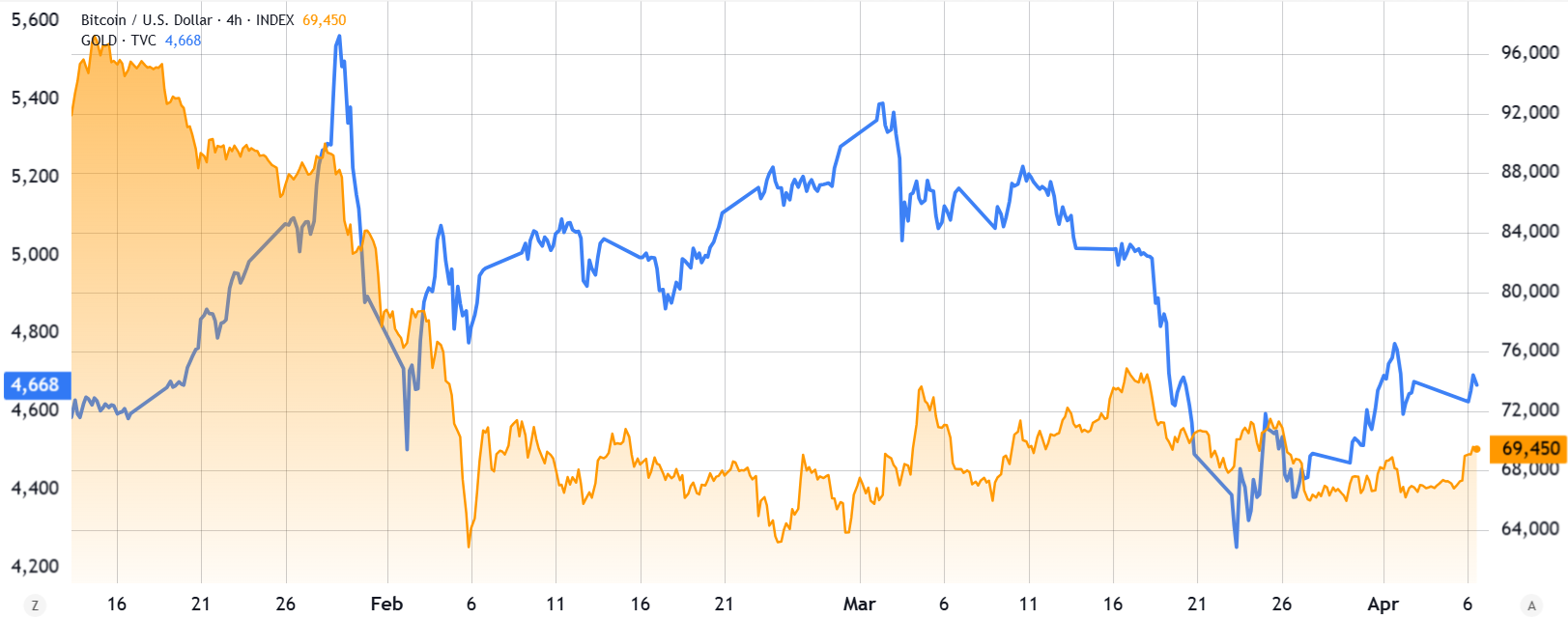
These mixed signals failed to convince market participants on Monday, as US stock markets traded mostly flat. In contrast, Bitcoin jumped above $69,000 for the first time in over 10 days—a trend made more notable by gold prices holding near $4,650, down 17% from a $5,600 all-time high.
Bitcoin slowly catching up to gold
Traders are increasingly concerned that central banks will be forced to liquidate their gold reserves. The Turkish Central Bank reported sales of 50 tonnes of gold for the week ending March 20, the sharpest decline in over seven years.
According to Reuters, Turkey has also sold $26 billion in foreign currencies to stabilize markets since the US and Israel-Iran war broke out in late February. Similarly, Russian gold reserves measured in tons have dropped to their lowest levels in four years.
A ceasefire in Iran, even if temporary, would almost certainly bolster risk markets, though the implications for Bitcoin are less certain.
Traditional corporations remain heavily dependent on energy costs and global logistics. Therefore, any reduction in geopolitical risk is immediately reflected in equity prices.
However, a deal between the US and Iran would likely have a less direct impact on Bitcoin, as a resolution would likely strengthen the demand for US Treasuries.

Yields on the US 5-year Treasury note surged to 4% from 3.55% in late February, signaling that investors are demanding higher returns to hold those bonds. While part of this selling pressure stems from fears of sticky inflation driven by high oil prices, there is also the added burden on the US fiscal debt due to increased spending on military operations.
An eventual ceasefire and renewed confidence in the US Treasury reduces the necessity for alternative hedges and independent financial systems such as Bitcoin.
However, even if the Strait of Hormuz is reopened, Mohit Mirpuri, an equity fund manager at SGMC Capital, warned that “the damage to confidence and supply chains is already done — things don’t just snap back to normal.”
Related: Iran war bets turn prediction markets into real-time macro radar—Sygnum
Predicting that the Bitcoin price will rally 8% by Tuesday based solely on a potential resolution to the US and Israel-Iran war seems far-fetched. Investors are gradually adjusting to President Trump’s characteristic back-and-forth, especially when negotiations involve unreliable third parties.
Traders are unlikely to provide the benefit of the doubt in this instance, so sustainable bullish momentum for risk markets could take longer to materialize. Nevertheless, the case for a $75,000 Bitcoin rally remains possible in the event of a positive outcome by Tuesday.
This article is produced in accordance with Cointelegraph’s Editorial Policy and is intended for informational purposes only. It does not constitute investment advice or recommendations. All investments and trades carry risk; readers are encouraged to conduct independent research before making any decisions. Cointelegraph makes no guarantees regarding the accuracy or completeness of the information presented, including forward-looking statements, and will not be liable for any loss or damage arising from reliance on this content.

Prediction platform Polymarket is overhauling its exchange infrastructure in the coming weeks, introducing a new collateral token and upgraded trading system that give the platform greater control over settlement and risk as it moves toward closer alignment with US regulatory expectations.
In an announcement on Monday, Polymarket said it will deploy new exchange contracts — dubbed version 2 — designed to simplify how orders are structured and matched. The upgrade is intended to make trading more efficient and to make it easier for developers to connect apps and trading bots to the platform.
The new system will also support EIP-1271, an Ethereum standard that allows smart contract-based wallets, such as multisigs and automated trading systems, to sign transactions, expanding compatibility beyond traditional wallets.
A central component of the upgrade is the introduction of Polymarket USD, a new collateral token that will replace USDC.e, the bridged version of USDC (USDC) previously used on the platform. The new token is fully backed 1:1 by USDC, giving Polymarket more direct control over its settlement layer while reducing reliance on bridged assets.
For most users, the transition will be handled automatically through the platform’s interface, requiring only a one-time approval.
The upgrade is expected to roll out over the next few weeks, though the company has not provided a specific timeline.

Related: NYSE parent ICE completes new $600M investment in Polymarket
US regulatory approval shapes Polymarket expansion
The move follows Polymarket’s broader efforts to curb manipulation and insider-trading risks, as it seeks to strengthen market integrity and align more closely with US regulatory standards.
In November, Polymarket received approval from the Commodity Futures Trading Commission to operate an intermediated trading platform in the United States, clearing the way for its return after previously exiting the market.
Following that approval, Polymarket said it plans to onboard brokers and customers directly and facilitate trading through regulated US venues.
Interest in prediction markets has continued to grow, with users increasingly turning to these platforms to trade on real-world outcomes tied to politics, markets and policy. Industry data shows Polymarket’s fee revenue increasing in recent weeks after the platform expanded trading fees.

Magazine: Are DeFi devs liable for the illegal activity of others on their platforms?
JPMorgan CEO Jamie Dimon said “new technologies” are intensifying competition across the financial sector, with blockchain-based players emerging alongside traditional rivals.
In his annual shareholder letter on Monday, Dimon identified artificial intelligence, data and advanced technology as “key to the future,” signaling a shift toward more automated, data-driven financial services.
While blockchain and digital assets were not a central focus, Dimon acknowledged that “a whole new set of competitors is emerging based on blockchain, which includes stablecoins, smart contracts and other forms of tokenization.”
The comments come as JPMorgan continues to focus on its own blockchain initiatives, even as Dimon emphasized that the bank’s long-term success will depend largely on its ability to deploy AI across its operations.

JPMorgan has been expanding its in-house blockchain infrastructure, now known as Kinexys, which enables near-instant fund transfers without relying on traditional intermediaries.
The platform is targeting up to $10 billion in daily transaction volume and recently moved toward that goal by onboarding Japan’s Mitsubishi Corporation. Other clients include Qatar National Bank and major institutional players such as Siemens and BlackRock.
Kinexys is also being positioned as a broader tokenization platform, with JPMorgan aiming to expand into markets such as private credit and real estate.
Related: SoFi expands into institutional finance with integrated crypto services
Dimon comments come as stablecoin battle heats up in Washington
Dimon’s mention of blockchain and stablecoins comes at a contentious moment for the banking industry, as US lawmakers continue to debate digital asset legislation.
The passage of the GENIUS Act last year, which established a regulatory framework for stablecoins, is widely expected to accelerate adoption by providing clearer rules for issuers and institutions.
However, broader market structure legislation remains stalled in Congress. A key point of friction is yield-bearing stablecoins, which banking groups argue could undermine financial stability by allowing issuers to offer interest-like returns without adhering to the same regulatory requirements as banks.

Tensions have also spilled into the public sphere. Dimon and Coinbase CEO Brian Armstrong have traded criticisms over the direction of crypto regulation, with Dimon pushing back against claims that banks are attempting to derail legislative efforts.
Industry lobbying groups, including the American Bankers Association, have made opposition to yield-bearing stablecoins a key policy priority this year.
Related: Stablecoin supply reaches $315B in Q1 as USDC rises, USDT declines


President Trump’s DHS pay order has directed all Department of Homeland Security employees to be paid using redirected federal funds, but legal and budget experts say the administration may be violating a 150-year-old law that gives Congress sole control over federal spending.
Summary
- Trump signed two executive directives — one on March 27 for TSA workers and an expanded memo on April 4 for all DHS employees — directing pay using funds from the One Big Beautiful Bill Act, sidestepping the ongoing partial shutdown
- Legal experts warn the move may conflict with the Antideficiency Act, which bars the executive branch from spending money that Congress has not appropriated for a specific purpose
- The administration has provided no detailed public justification for how it is legally connecting TSA operations to the bill’s DHS border enforcement funds, drawing criticism from budget analysts on both sides
President Trump’s DHS pay order, which directs the Department of Homeland Security to pay all its employees using funds redirected from last year’s One Big Beautiful Bill Act, has put paychecks back in workers’ accounts but opened a serious constitutional question that legal experts say the administration has yet to answer. Trump initially signed a directive on March 27 covering TSA workers, then expanded it on April 4 to include all DHS employees, citing “an emergency situation compromising the Nation’s security.”
The Antideficiency Act, a 150-year-old federal statute, bars the executive branch from spending money that has not been expressly appropriated by Congress for the specific purpose being funded. Trump’s order directed the DHS secretary to use funds with “a reasonable and logical nexus to TSA operations” from the One Big Beautiful Bill Act — a law that allocated $10 billion to DHS for border-related functions, with no specific mention of TSA.
Budget analysts flagged the ambiguity immediately. “The administration’s provided no real clarity about what they’re doing publicly that would allow someone to even figure out whether what they’re doing is legal or not legal,” Devin O’Connor, a senior fellow at the Center on Budget and Policy Priorities, told CNBC. “They haven’t made the case for it in any kind of public way.”
Where the Money Is Coming From — and Why That Matters
Administration officials confirmed the payments are being drawn from the One Big Beautiful Bill’s DHS fund, which gave the secretary discretion to deploy resources supporting DHS’s border mission. Bobby Kogan of the Center for American Progress estimated the cost of funding TSA runs approximately $140 million per week, suggesting the administration could sustain payments for nearly a year before that pool runs dry. But critics note that the bill’s language does not cover TSA, which handles airport security rather than border enforcement, making the legal nexus tenuous.
Senate Majority Leader Thune acknowledged the order as a “short-term solution” that “takes the immediate pressure off,” while noting it does nothing to resolve the underlying standoff between the two chambers.
The Constitutional Fault Line
As crypto.news reported, government shutdowns carry consequences beyond the immediate departments affected — including delays to economic data releases, stalled regulatory activity, and heightened uncertainty across financial markets. The constitutional issue here runs deeper than a funding dispute. Article I of the US Constitution vests the power of the purse exclusively in Congress. Trump’s move to unilaterally pay workers without an active appropriation mirrors actions that have historically invited legal challenge under the Antideficiency Act.
A second broader executive memo on April 4 extended the same approach to every DHS employee, not just TSA, including furloughed workers and those in agencies not obviously connected to the One Big Beautiful Bill’s border funding mandate. As crypto.news noted in its coverage of the DHS shutdown’s earlier market impact, prolonged fiscal uncertainty of this kind tends to weigh on investor sentiment and delay forward guidance from the Federal Reserve.
“America’s air travel system has reached its breaking point,” Trump said in his original March 27 memo. What remains unresolved is whether his chosen remedy is within his legal authority to execute.

NUR NEMU DOMPET ISI UANG? | NURRAYNI25

Nominations for 2026 Energy Safety Awards now open

Fox Factory: Still Offers A Nice Long-Term Ride Despite The Tough Road


-

 NewsBeat4 days ago
Steven Gerrard disagrees with Gary Neville over ‘shock’ Chelsea and Arsenal claim | Football
-

 Business4 days ago
No Jackpot Winner and $194 Million Prize Rolls Over
-

 Fashion3 days ago
Weekend Open Thread: Spanx – Corporette.com
-

 Crypto World5 days ago
Gold Price Prediction: Worst Month in 17 Years fo Save Haven Rock
-

 Business23 hours ago
Three Gulf funds agree to back Paramount’s $81 billion takeover of Warner, WSJ reports
-
Crypto World6 days ago
Dems press CFTC, ethics board on prediction-market insider trades
-

 Sports2 days ago
India men’s 4x400m and mixed 4x100m relay teams register big progress | Other Sports News
-

 Business5 days ago
Login and Checkout Issues Spark Merchant Frustration
-

 Tech7 days ago
EE TV is using AI to help you find something to watch
-

 Sports6 days ago
Tallest college basketball player ever, standing at 7-foot-9, entering transfer portal
-
Tech7 days ago
Daily Deal: StackSkills Premium Annual Pass
-

 Tech7 days ago
Flipsnack and the shift toward motion-first business content with living visuals
-

 Crypto World7 days ago
U.S. rule change may open trillions in 401(k) funds to crypto
-

 Tech7 days ago
How to back up your iPhone & iPad to your Mac before something goes wrong
-

 Politics7 days ago
Usha Vance: Disney Hats Over MAGA Caps?
-
Crypto World7 days ago
Valinor raises $25m to put private credit on-chain
-

 Business7 days ago
Functional benefits brewing in coffee innovation
-

 Tech7 days ago
What Are The Biggest Limitations Of Supercomputers?
-

 Crypto World6 days ago
Bitcoin enters the public bond market as Moody’s gives a first-of-its-kind crypto deal a rating
-
 Business7 days ago
US Stocks today: S&P, Nasdaq end lower as investors weigh Middle East conflict outlook
You must be logged in to post a comment Login