

Crypto World
Crypto.com Wins UAE SVF Licence, Adds BTC Visa Rewards and SEI Support


Crypto.com strengthens UAE presence with SVF licence, expands product suite
Crypto.com this week confirmed it has obtained a Stored Value Facilities (SVF) licence in the United Arab Emirates, while also announcing a set of product updates that include support for the SEI chain migration and the introduction of Bitcoin rewards for eligible Visa cardholders. The combination of regulatory progress and consumer-facing product enhancements signals a continued push by the firm to deepen regional operations and broaden mainstream utility.
What the UAE SVF licence means
A Stored Value Facilities licence typically authorises firms to operate electronic wallets and execute payments using stored value instruments. For Crypto.com, the licence is presented as a step toward enabling virtual asset payments for government services in the UAE. That use case, if implemented, would represent a material shift from speculative trading to routine payments, and could increase exposure of digital assets to public-sector infrastructure.
From an industry perspective, the licence is notable for two reasons. First, it demonstrates continued regulatory engagement by a major global exchange in the Gulf, a region that has been actively developing frameworks for digital assets. Second, it positions Crypto.com to pursue partnerships with public agencies and other corporate payees that require regulated payment rails.
That said, the operational and commercial impact will depend on implementation details not provided in the announcement, including which government services will accept virtual assets, what risk controls and custody arrangements are used, and whether local regulators attach limits or conditions to the permitted activities.
Product updates: SEI chain migration and BTC Visa rewards
On the product front, Crypto.com said it will support the SEI chain migration to ensure a seamless transition for eligible users. Chain migrations can be technically complex: they often require token mapping, ledger reconciliation, and careful handling of snapshots and airdrops. When a custodial platform publicly supports a migration it reduces the burden on retail users, lowering friction and helping to avoid token loss or access interruptions. For institutional clients, such support is also an operational signal about custody and infrastructure readiness.
Separately, Crypto.com introduced a BTC reward option for eligible Visa card users, allowing cardholders to earn Bitcoin on everyday spending. Rewards denominated in major cryptocurrencies can be an effective user acquisition tool because they frame crypto exposure as a byproduct of normal consumer behaviour rather than an explicit investment decision. At the same time, such programmes expose cardholders to market volatility and create balance sheet considerations for the issuer, which must manage reward sourcing and accounting when prices fluctuate.
Market snapshot and token movers
The company’s research dashboard reflected a mild pullback in key indices last week, reporting declines of 2.19% for the price index, 12.75% for volume, and 23.81% for volatility. Bitcoin and Ether were down by roughly 0.6% and 1.4% respectively over the same period.
Despite that broad softness, a few tokens outperformed. Hyperliquid (HYPE) registered notable strength, which Crypto.com attributed to market interest around a $1.16 billion buyback fund and the allocation of trading fees to an assistance fund designed to purchase HYPE. The firm also flagged inflows into Hyperliquid-related exchange-traded products as a contributor to momentum. Other names showing activity included Zcash and Ondo.
These micro-moves underscore how issuer-led token dynamics, and the emergence of tokenised ETFs and other structured products, can materially influence price and trading activity even during quieter periods for larger market benchmarks.
Creator and affiliate initiatives
Crypto.com also rolled out a dedicated creator programme for key opinion leaders and updated affiliate creatives for promotions. The initiative is aimed at streamlining marketing partnerships and improving attribution for referrals. For affiliates, the company reiterated tracking best practices to ensure mentions and conversions are properly credited through its partner platform.
Such programmes are increasingly common among exchanges seeking to scale user acquisition through content partnerships while maintaining compliance with tracking and promotional rules.
Implications and outlook
Taken together, these developments reflect a two-pronged strategy: deepen regulated operations in growth markets and expand consumer-facing utility to drive adoption. The UAE SVF licence places Crypto.com among a group of global platforms establishing formal regulatory footing in the Gulf, which could lower barriers to institutional and government contracts over time.
However, several open questions remain. The practical scope of the SVF licence, the timelines for enabling government payments, and the operational model for both custody and settlement will determine how quickly the licence translates into transactional volume. On the product side, the firm’s support for chain migrations and new reward options reduces friction for existing users, but also raises operational demands for custody and compliance teams.
For market participants, the announcements are useful reminders that exchanges are pursuing growth via regulatory channels as well as through consumer product innovation. Observers should watch for further details on partnerships and product rollouts that clarify how these changes will affect adoption, revenue mix and counterparty risk.
Bottom line: Crypto.com’s UAE SVF licence and concurrent product updates strengthen its regional position and consumer proposition, but the full commercial impact will depend on implementation choices and subsequent partnerships with public and private sector payees.


Blockchain.com has launched 24/7 perpetual trading for institutional clients through its OTC desk, offering around-the-clock exposure to stocks, equity indices, commodities, foreign exchange markets and pre-IPO companies.
The rollout includes a SpaceX-linked perpetual contract, allowing eligible investors to take positions tied to the aerospace company’s anticipated public listing. According to the company, the contract is already live through its OTC desk.
Blockchain.com said the new service is intended for institutions seeking continuous market access outside traditional trading hours. The company said clients can use the platform to hedge or adjust positions across multiple asset classes, including on weekends when most traditional markets are closed.
The firm cited use cases including options desks managing exposure, macro funds trading across asset classes and investors seeking exposure to anticipated public listings.
Blockchain.com’s announcement tweet Tuesday to its 1.3 million followers.
Source: Blockchain.com on X.com
The move follows Blockchain.com’s April launch of perpetual futures trading through its self-custody wallet. At the time, the company said it planned to expand beyond crypto markets into stocks, commodities and foreign exchange.
In May, Blockchain.com confidentially filed paperwork with the US Securities and Exchange Commission for its own proposed initial public offering.
Related: Senator Elizabeth Warren questions Elon Musk about X Money
Pre-IPO trading emerges as a new crypto battleground
Bloomberg reported in April that SpaceX had confidentially filed for an IPO and was considering a valuation of more than $1.75 trillion, potentially making it one of the largest public listings in US history. Anticipation around the company’s expected June 12 market debut has since fueled a wave of pre-IPO products from crypto exchanges.
Binance last month introduced pre-IPO perpetual futures tied to private companies, beginning with a SpaceX-linked contract settled in USDT. The derivatives allow traders to speculate on a company’s expected valuation before and after an IPO without owning the underlying shares.
Last week, crypto exchange Kraken announced that SpaceX would become the first company offered through its xStocks IPO Access platform, allowing eligible users in more than 110 markets to participate through tokenized shares backed 1:1 by the underlying stock. Once issued, the tokens can be traded around the clock on Kraken and other xStocks-supported platforms.
Bybit followed days later, indicating it would also offer access through xStocks, marking the first IPO available through the exchange’s new tokenized equity program.

Source: SpaceX
Coinbase has also launched pre-IPO markets for international users through a perpetual futures contract tied to SpaceX’s estimated private-market valuation. The USDC-settled product is designed to convert into a post-IPO contract if the company ultimately begins trading on public markets.
Investor demand for the offering has continued to accelerate. On Tuesday, Reuters reported that the IPO was running three and a half to four times oversubscribed, with demand exceeding $250 billion for an offering expected to raise $75 billion.
Magazine: Bitcoin miners are pivoting to AI, so why is the hashrate near ATHs?
Crypto World
Humanity Protocol Traces $36M Hack to Single Malware-Infected Machine That Held Seven Keys


Humanity Protocol published a forensic incident report Tuesday tracing its $36 million breach to a single malware-infected developer machine that stored backups of seven private keys, giving an attacker unilateral control over the protocol's Ethereum and BNB Smart Chain infrastructure. The keys,… Read the full story at The Defiant

TLDR
- BlackRock’s IBIT and Fidelity’s FBTC account for the majority of recent U.S. spot Bitcoin ETF inflows.
- On January 14, IBIT and FBTC captured over 90% of the $840.6 million total inflows.
- Similar concentration appeared on April 17 and May 1, with the two funds absorbing most new capital.
- Bitcoin is down about 29% year-to-date, yet IBIT and FBTC continue to dominate allocation days.
- Smaller ETFs such as EZBC, HODL, BRRR, and BTCW often record single-digit million daily flows.
BlackRock and Fidelity now command most new allocations into U.S. spot Bitcoin exchange-traded funds. Recent flow data shows the two firms absorb the bulk of daily inflows and shape overall direction. The pattern has strengthened through 2026 as other issuers record limited activity.
Bitcoin ETFs Flows Concentrate Around Two Issuers
When U.S. spot Bitcoin ETFs launched in January 2024, investors chose from more than a dozen products. However, flow data now shows BlackRock and Fidelity capture most institutional allocations. Farside Investors’ data highlights repeated sessions where the pair dominated inflows.
On January 14, spot Bitcoin ETFs drew $840.6 million in net inflows. BlackRock’s iShares Bitcoin Trust attracted $648.4 million, while Fidelity’s Wise Origin Bitcoin Fund added $125.4 million. Together, they represented over 90% of that day’s total inflows.
On April 17, total inflows reached $663.9 million across all products. IBIT secured $284 million, and FBTC collected $163.4 million. The two funds accounted for roughly two-thirds of new capital entering the sector.
On May 1, the trend continued as total inflows hit $629.8 million. IBIT contributed $284.4 million, and FBTC added $213.4 million. Combined, the pair drew nearly $500 million of the day’s allocations.
Bitcoin has declined about 29% year-to-date, which has pressured the broader crypto ETF complex. Between mid-May and early June, several sessions recorded heavy net outflows. Despite weaker sentiment, IBIT and FBTC frequently absorbed or limited redemptions.
Scale and Liquidity Define the Two-Firm Structure
BlackRock manages over $10 trillion in global assets and maintains wide distribution networks. Fidelity also operates one of the largest U.S. brokerage and retirement platforms. These structures support trading volume, liquidity, and access for advisers and institutions.
Many buyers include registered investment advisers, hedge funds, family offices, and pension consultants. For these allocators, issuer reputation and liquidity weigh heavily in product selection. As a result, many treat IBIT and FBTC as default vehicles for Bitcoin exposure.
Meanwhile, smaller funds post modest daily flow figures. Franklin Templeton’s EZBC, VanEck’s HODL, Valkyrie’s BRRR, and WisdomTree’s BTCW often record single-digit-million inflows. In many sessions, their flows do not alter the total sector direction.
Bitwise’s BITB and Ark’s ARKB also trail the two largest funds this year. Earlier in 2026, Trump Media & Technology Group withdrew plans for a proposed spot Bitcoin ETF. The withdrawal followed intensified competition led by BlackRock and Fidelity.
During volatile sessions, capital shifts primarily into or out of IBIT and FBTC. When investors buy aggressively, most inflows concentrate in those products. When selling increases, their activity often determines whether the sector records net inflows or outflows.



Nigeria’s Senate has advanced a bill that could create formal rules for crypto firms and virtual asset operators.
Summary
- Nigeria’s Senate passed the Virtual Asset Service Providers Regulation Bill, 2026, for second reading.
- The bill would require crypto exchanges and other virtual asset service providers to obtain licenses.
- The proposal now moves to committee review before further readings and possible final approval.
The Virtual Asset Service Providers Regulation Bill, 2026, passed second reading on Tuesday and moved to committee review. The proposal seeks licensing, compliance rules, and consumer protection measures for one of the world’s largest crypto markets.
Nigeria Senate moves crypto bill forward
The Senate advanced the bill, listed as SB 956, after lawmakers debated digital asset oversight. Deputy Senate President Barau Jibrin sponsored it, while Senate Chief Whip Mohammed Monguno presented it. The bill now goes to the Senate Committee on Capital Market for further review.
The committee can examine the proposal, consider amendments, and invite public input. Passing second reading does not make the bill law. It must still pass committee review, third reading, and other required legislative stages.
The proposal seeks a legal and supervisory structure for virtual assets, digital assets, and service providers. It would place crypto exchanges and related operators under licensing requirements. The bill also proposes transparency and compliance rules for firms serving Nigerian users. Lawmakers said these measures would help reduce fraud and improve market order.
Bill targets licensing and global standards
The legislation seeks to align Nigeria’s crypto rules with international standards. Its backers cited frameworks linked to the Financial Action Task Force and International Monetary Fund. The bill would require virtual asset service providers to follow anti-money laundering rules. It would also support counter-terrorism financing controls across crypto operations.
Under the proposal, operators of exchanges and blockchain-based investment platforms would need licenses. Other digital asset service providers would also face regulatory standards Lawmakers said the current regulatory gap leaves major activity outside official oversight. They argued that investments, jobs, and revenue remain harder to track without clear rules.
Senate Whip Tahir Monguno said Nigeria trails some African peers on virtual asset laws. He pointed to Kenya, South Africa, and Ghana as countries developing related frameworks. The sponsor said the bill does not seek to block innovation. He framed it as a way to promote order, confidence, accountability, and consumer protection.
Crypto market awaits committee review
Nigeria remains one of the world’s most active crypto markets by adoption. Users rely on digital assets for remittances, cross-border payments, inflation hedging, and global financial access. The country’s crypto policy has changed over time. Banks once faced restrictions on servicing crypto firms, but regulators later moved toward structured oversight.
Recent efforts have included registration pathways for digital asset providers. The new bill seeks to combine scattered rules into a clearer legal framework. Lawmakers linked the proposal to President Bola Tinubu’s $1 trillion economy target. They argued that unregulated crypto activity limits the digital economy’s official contribution.
If passed, the bill would increase compliance duties for exchanges and other operators. However, supporters said clear rules could help legitimate firms attract investment. The next stage will determine the bill’s final shape. Its impact will depend on committee changes, licensing details, and final implementation rules.


Iran’s main military command has closed the Strait of Hormuz to all vessels after fresh US attacks.
Summary
- Iran’s Khatam al-Anbiya command said the Strait of Hormuz is closed to all vessels until further notice.
- Iranian media reported that Revolutionary Guards forces hit two ships attempting to pass through the waterway.
- US Central Command said it launched fresh strikes on Iran as Qatar sent a delegation to discuss the war.
Iran Iranian media said Khatam al-Anbiya Central Headquarters cited security threats in the waterway. The move came as talks to end the conflict faced new pressure.
Iran warns ships against Hormuz passage
Tasnim News Agency reported that Iran’s military command declared the strait “completely closed to all types of vessels.” The command said “any vessel traffic through the Strait of Hormuz will be targeted.”
Iran’s Revolutionary Guards navy said two ships tried to pass through the waterway. State television IRIB and the Mehr agency reported that Iranian forces hit both vessels. The Guards said the ships attempted to “illegally pass through the Strait of Hormuz.” They also warned ships against leaving anchorages in the Persian Gulf and Sea of Oman.
“Approaching the Strait of Hormuz will be considered cooperation with the enemy,” the Guards said. The warning followed earlier claims of US attacks near Iran’s southern coast. Iranian media also reported explosions near Bandar Abbas, Qeshm, Minab, and Sirik. Iranian sources said “enemy projectiles” hit Qeshm, Kargan, and Sirik.
US launches new strikes in Iran
US Central Command said it launched strikes against multiple Iranian targets on June 10. The command described them as “additional self-defence strikes.” CENTCOM said the strikes began at 5.15pm New York time. It added that the action answered Iran’s “unwarranted and continued aggression.”
As it was reported by crypto.news, the new attacks followed US strikes on June 9 after Iran downed a US Apache helicopter. Iranian media said those earlier strikes hit air defence, radar, and other sites. President Donald Trump accused Iran of delaying talks on an interim peace deal. He told reporters that US forces would “hit them hard” before the strikes began.
“We hit them hard yesterday, and we’re going to hit them hard again today,” Trump said. He declined to name the targets before the military announcement. Iran’s Foreign Ministry accused the United States of striking civilian infrastructure. US Defense Secretary Pete Hegseth said the strikes sought to push Iran toward a deal.
Talks continue as the Qatar delegation arrives
A White House official said negotiations continued, even as Washington increased military pressure. The official said the US would maintain pressure until both sides reach a deal. Trump later said the US military supported the passage of more than 200 commercial ships. He said those movements carried more than 100 million barrels of oil to market.
Trump also claimed the United States controls the Strait of Hormuz, “not Iran.” Tehran’s latest statement directly challenged that claim through its closure order. The semi-official Iranian Students’ News Agency reported that a Qatari delegation reached Tehran on June 10. The delegation planned to discuss the diplomatic process to end the war.
The closure announcement followed claims of repeated ceasefire violations by the “American enemy.” Iran said the Strait of Hormuz will stay closed until further notice. The waterway remains central to oil and commercial shipping between the Persian Gulf and global markets. Iranian media reported the closure after explosions across southern Iran near the strait.


Mastercard extended its payments network to autonomous AI agents on Wednesday, unveiling Agent Pay for Machines (AP4M) with more than 30 launch partners spanning crypto infrastructure, stablecoin issuers, payment processors and DeFi protocols. The company announced the launch Wednesday morning via… Read the full story at The Defiant
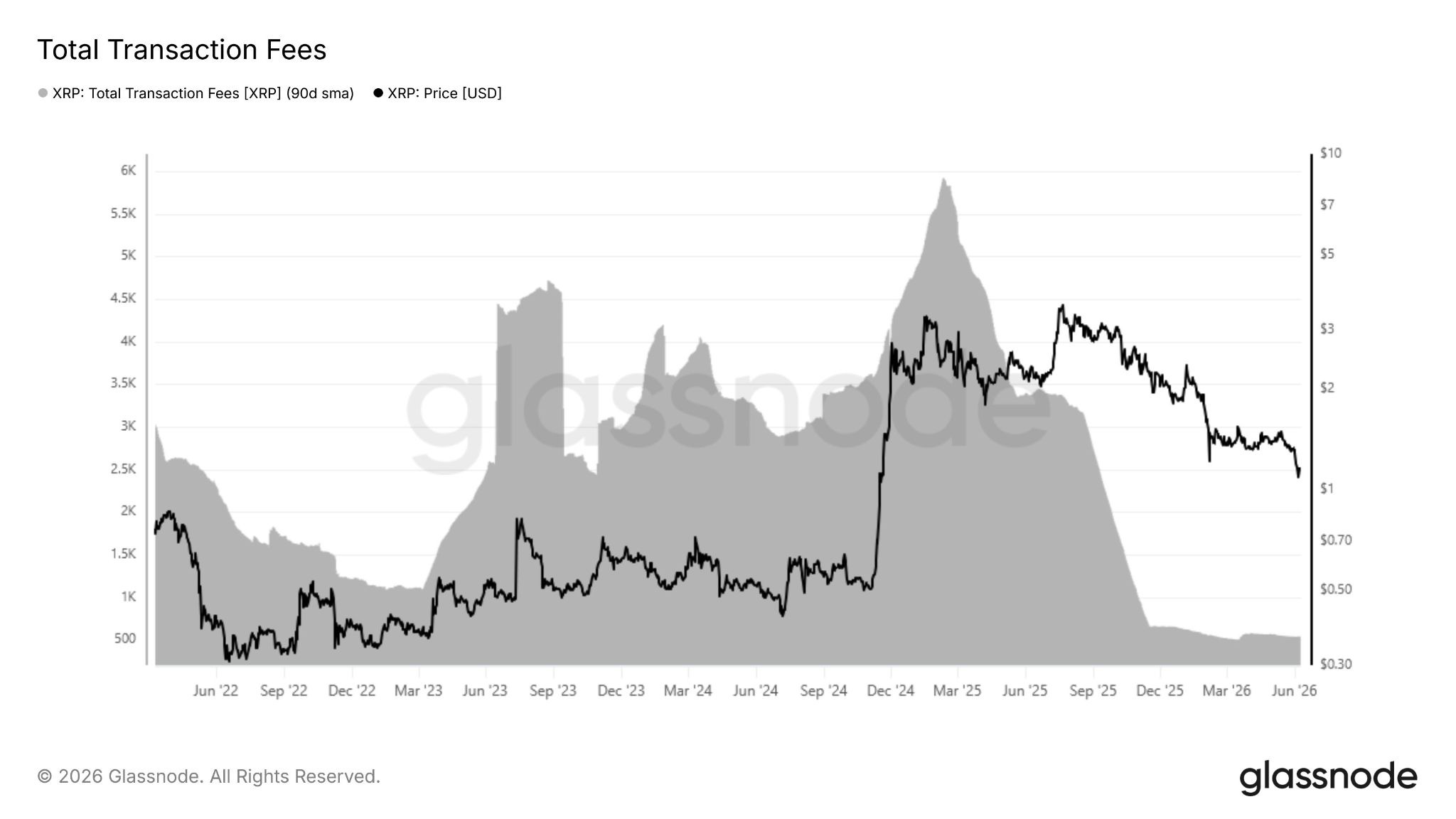
XRP’s (XRP) onchain activity has contracted sharply since its 2025 peak. The 90-day network fee average fell by 91.5%, while the realized profit-to-loss ratio dropped to 0.38 from 50, according to Glassnode.
The decline in activity and profitability comes as traders identify the $1.00-$0.65 region as a major area of interest.
XRP profit-taking flips to network capitulation
According to Glassnode, the 90-day simple moving average of total fees paid on the XRP network has fallen to just 500 XRP from 5,900 XRP in February, a decline of 91.5%.
The network fees are often used as a proxy for transaction demand. The drop points to a sharp slowdown in activity following the speculative surge that carried XRP above $3 in the first half of 2025.
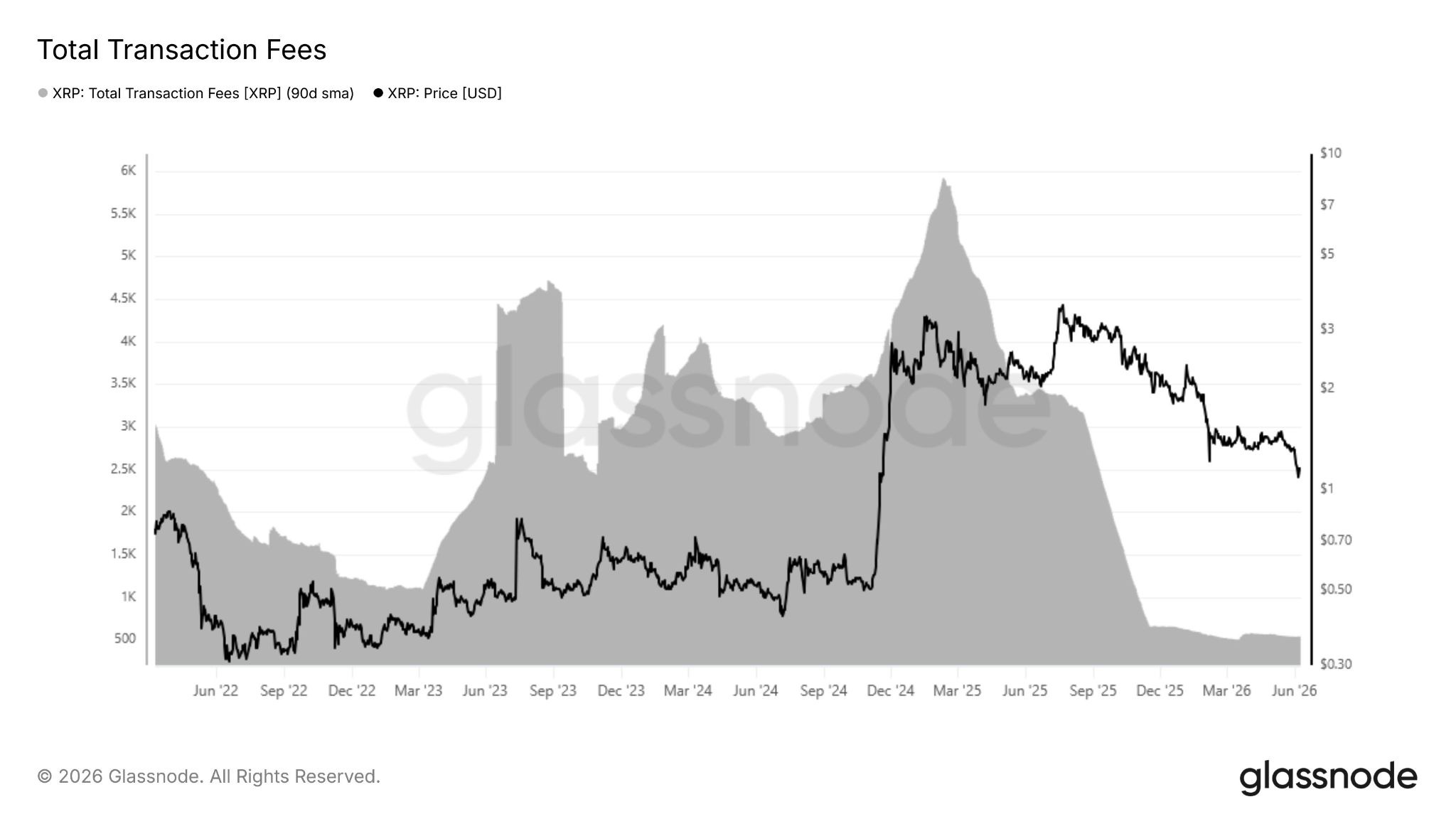
XRP total transaction fees. Source: Glassnode
XRP investor behavior has also shifted. Glassnode reported that XRP’s 90-day realized profit-to-loss ratio has fallen to 0.38, meaning market participants are realizing $1 in losses for every $0.38 in profits.
In January and July 2025, when the XRP price peaked near $3.40, the ratio reached 50 as profit-taking dominated the onchain flows. That balance has now reversed. This indicates that a larger share of onchain coins are being sold below their acquisition cost, a pattern commonly seen during capitulation phases.
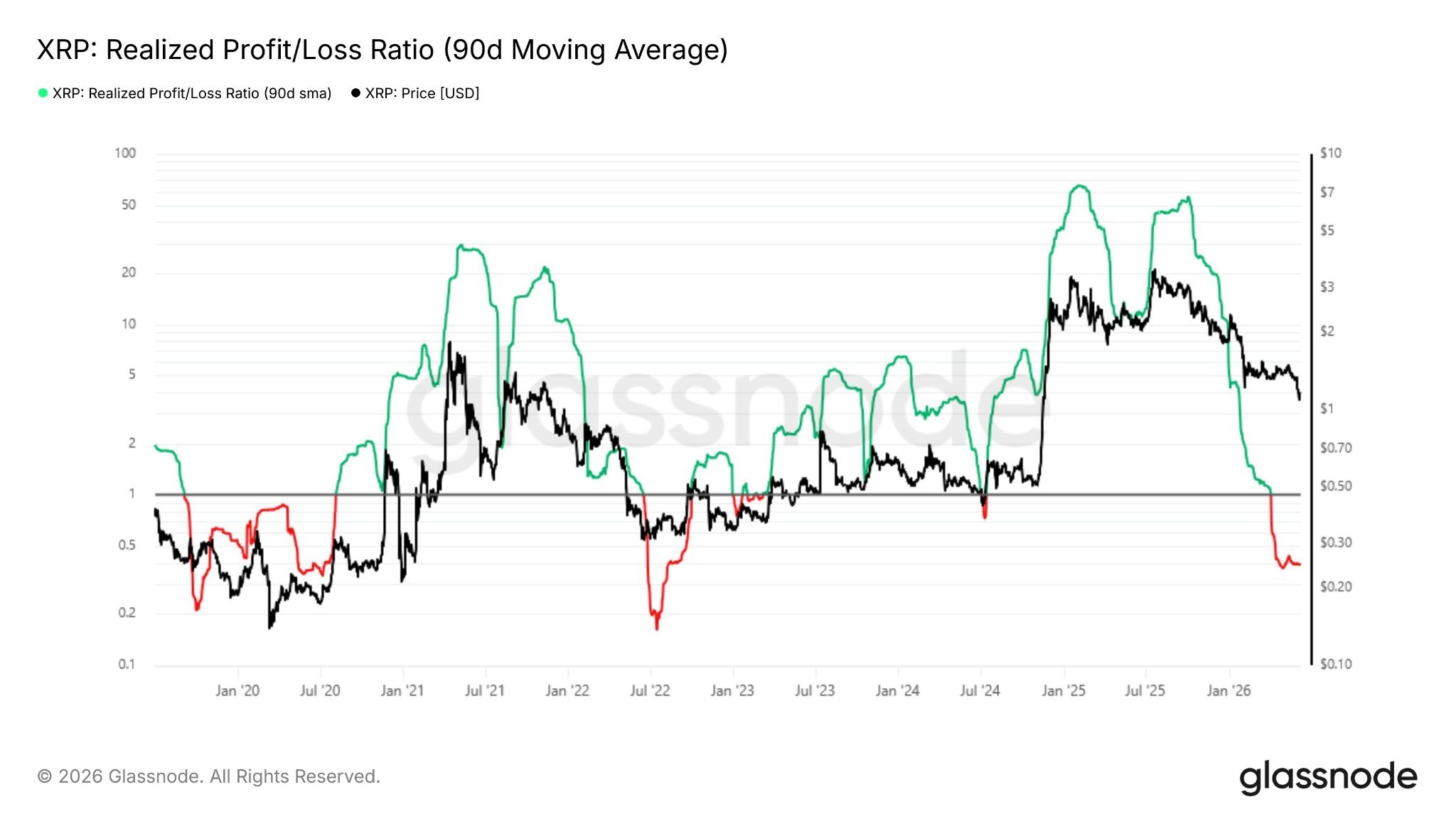
XRP realized profit/loss ratio. Source: Glassnode
Exchange data offers a different view of holder activity. Crypto analyst Pelin Ay noted that transfers of more than 1 million XRP to Binance have declined since XRP’s 2025 peak.
Historically, major corrections were preceded by sharp increases in both the 100,000–1 million XRP and 1 million-plus XRP inflow cohorts as large holders moved tokens to exchanges.
The current data shows a sustained decline in exchange-bound XRP from large holders, with inflows from the 100,000–1 million XRP and 1 million-plus XRP cohorts decreasing by 15% and 20%, respectively, since October 2025.
The analyst said the latest price weakness appears more closely tied to leverage-driven liquidations and risk-off sentiment than aggressive distribution by large holders.
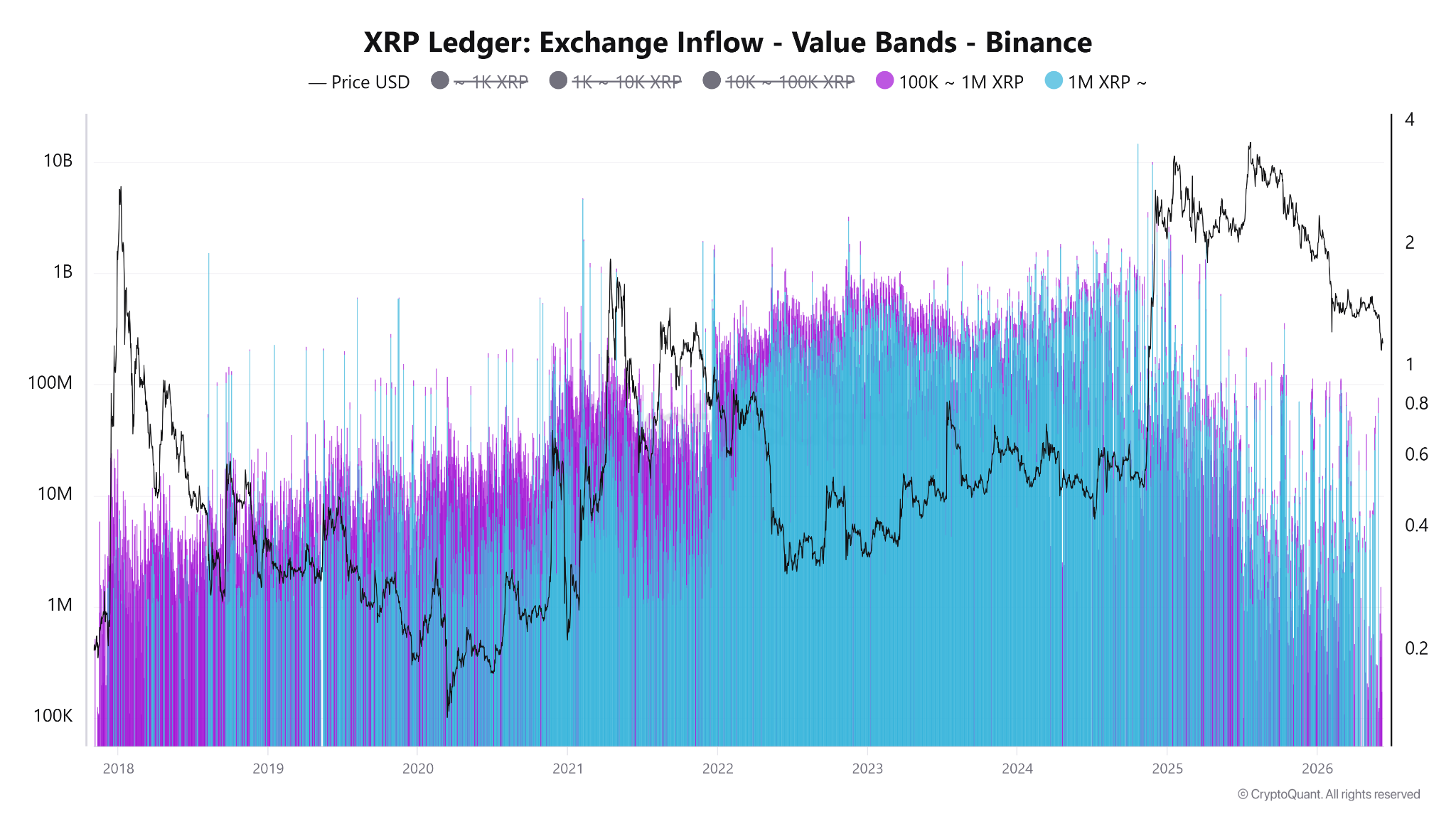
XRP exchange inflows value bands on Binance. Source: CryptoQuant
Related: Arthur Hayes dumps WLD days after Maelstrom’s AI IPO pitch
$0.63 is the key area for accumulation
XRP’s weekly chart highlights a cluster of technical levels between $1.00 and $0.65.
A large fair value gap spans roughly $0.63 to $1.00, created during XRP’s rapid rally in late 2024. The price has already started moving back toward that zone after losing support near $1.40.
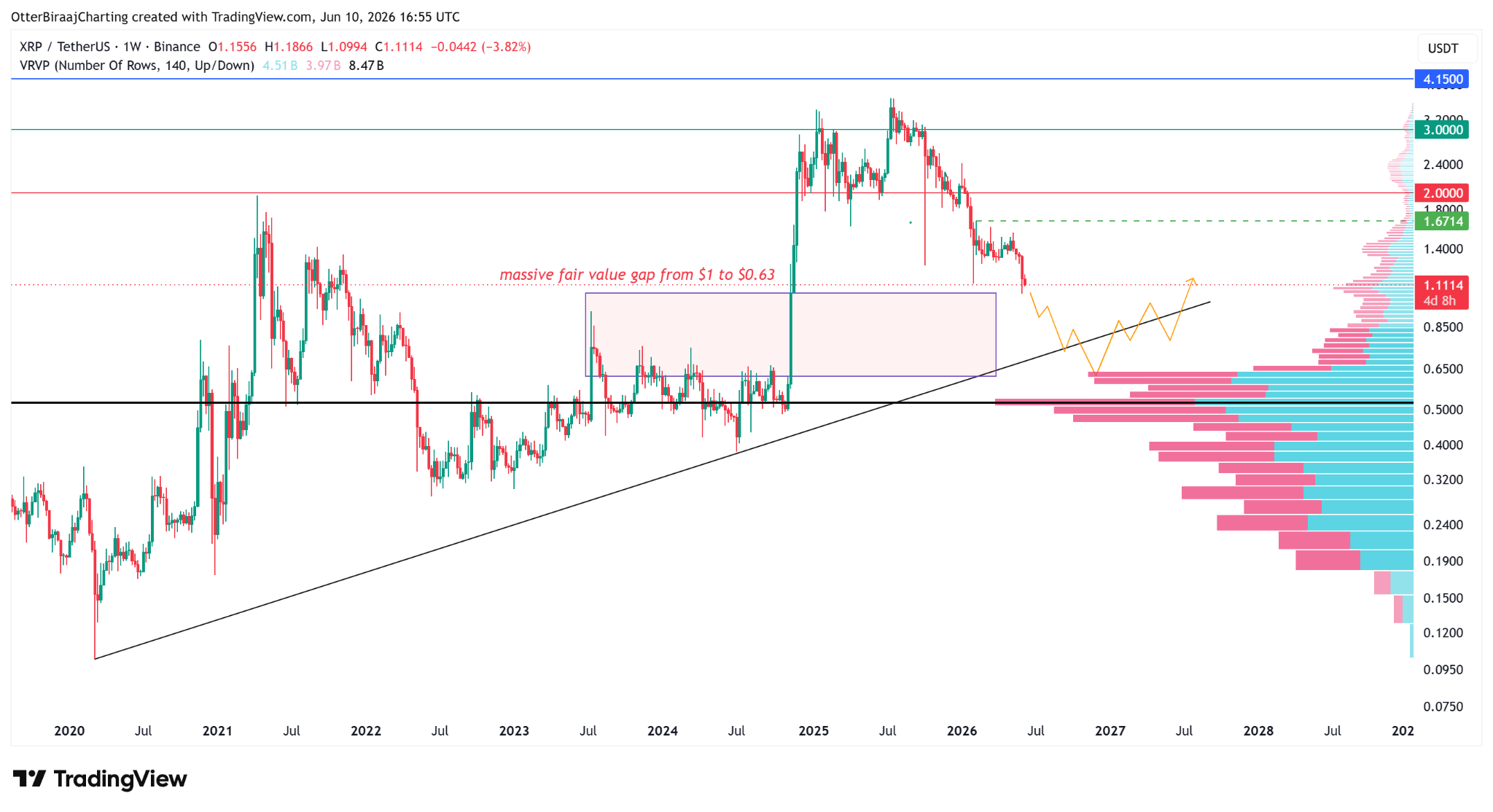
XRP/USDT, one-week chart. Source: Cointelegraph/TradingView
The visible-range volume profile data shows relatively light trading activity below current levels until a high-volume node around $0.50–$0.65. The point of control, which marks the price area with the highest traded volume, sits near $0.52–$0.55.
The same region aligns with XRP’s five-year ascending trendline, projected to intersect near $0.60–$0.65 in the coming months.
Some traders are already treating the zone as an accumulation range. Trader Crypto Patel identified $1.00 to $0.60 as a preferred buying range, while market analyst Javon Marks maintained his long-term breakout target of $15–$18, representing a 1,100% increase.
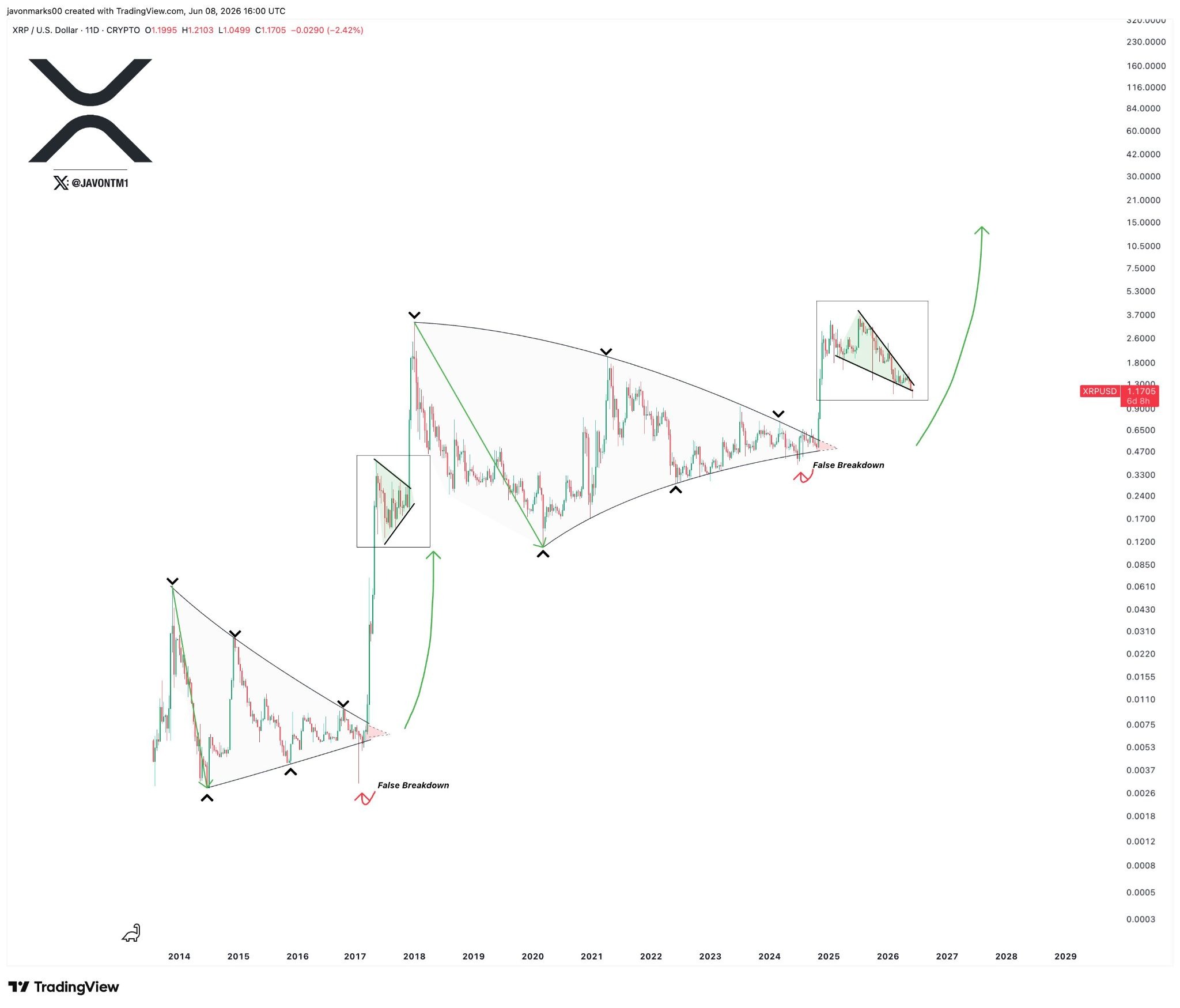
XRP long-term analysis by Javon Marks. Source: X
Related: ETH crash to $1K looms if key support breaks: Will futures traders step in?
TLDR:
- Fold sold ~$45M in Bitcoin at an average price of $71,000 to fund a full balance sheet reset.
- The company repaid $20M in Bitcoin-collateralized debt, eliminating all secured obligations.
- A $25M cash allocation targets Credit Card scaling, new products, and financing partnerships.
- Fold retains a Bitcoin treasury position and keeps its revolving credit facility available.
Fold Holdings has sold approximately $45 million in Bitcoin to eliminate secured debt and fund business expansion.
The Nasdaq-listed Bitcoin financial services company monetized the holdings at an average price of $71,000 per Bitcoin.
Proceeds were split between retiring $20 million in Bitcoin-collateralized debt and allocating $25 million toward growth initiatives.
The move strengthens Fold’s balance sheet ahead of several planned product launches across its consumer and enterprise platforms.
Fold Bitcoin Sale Clears All Secured Debt
The Fold Bitcoin liquidation marks a deliberate shift in the company’s capital strategy. By repaying all Bitcoin-backed secured debt, Fold eliminates monthly cash interest expenses immediately.
This improves the company’s net cash flow position starting in June 2026. Management expects further cash flow gains throughout the year as new products launch and customer activity increases.
Fold retains a meaningful Bitcoin treasury position after the sale. The company also keeps access to its revolving credit facility for future needs.
Management reserves the right to monetize additional Bitcoin holdings when returns justify it. This flexible approach keeps strategic options open as market conditions evolve.
The debt elimination removes a key risk factor tied to Bitcoin price swings. Bitcoin-collateralized loans carry liquidation risk during sharp market downturns.
Clearing that exposure gives Fold more operational stability. It also reduces pressure to make reactive decisions during volatile periods.
CEO Will Reeves positioned the transaction as a forward-looking move. “We believe Fold is poised for near-term growth and investing in that future is exactly what the company needs to do,” Reeves said.
He added that the company has built one of the strongest product roadmaps in its history. The recently launched Bitcoin Credit Card, Bitcoin Gift Cards, and Fold Business products anchor that pipeline.
$25 Million Fuels Fold Bitcoin Credit Card Growth
The $25 million cash allocation is primarily directed toward scaling the Fold Bitcoin Credit Card. Improved liquidity positions Fold to support a larger cardholder base going forward.
The company is also pursuing additional funding relationships to expand the credit program. Management considers the Credit Card among Fold’s highest long-term growth opportunities.
Greater financing flexibility allows Fold to capture more of the economics generated by the card program. As the cardholder base grows, revenue participation from the program increases.
This creates a compounding effect on company revenues over time. The strengthened balance sheet directly enables that participation.
Reeves addressed the strategic rationale directly. “We have reduced financing risk, strengthened our balance sheet, and ensured that short-term market volatility cannot stand in the way of executing our roadmap,” he said.
The statement points to deliberate risk management ahead of several product launches. Fold also plans to introduce additional products in the coming months.
Operating leverage is expected to improve as new products launch and financing partnerships come online. Each factor contributes to a stronger cash flow profile throughout the year.
With debt cleared and cash deployed, Fold Bitcoin operations enter a more stable phase. The company now has the resources to execute its plans without short-term financial constraints.
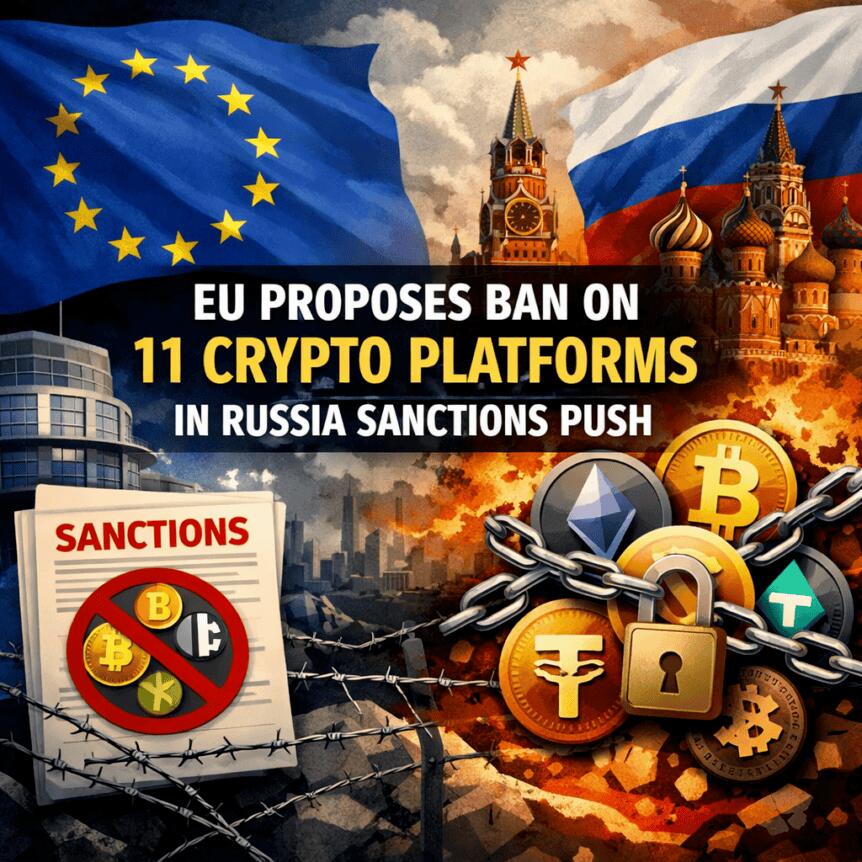
The European Union is expanding its sanctions toolkit to curb crypto-enabled evasion as part of the 21st package aimed at Russia. A proposed measure would ban transactions on 11 crypto platforms, broadening the bloc’s crackdown beyond traditional banks and energy revenues to the crypto sector believed to facilitate Moscow’s circumvention of existing restrictions.
Kaja Kallas, vice president of the European Commission and the EU’s high representative for foreign affairs and security policy, announced the move in a post on X, saying the package would tighten bans on crypto-asset services to certain third countries, add new designations, and ban transactions on 11 crypto platforms.
According to her remarks, the aim is to close gaps in enforcement where crypto firms may be used to move money or engage in activities that help sanctioned actors avoid penalties. The Commission, however, did not identify the 11 platforms in its public statements, and Cointelegraph sought clarification on which platforms would be affected; no additional details were provided before publication.
EU President Ursula von der Leyen later underscored that the package also targets 31 additional Russian banks and 20 entities in third countries, including banks, crypto platforms and oil traders, arguing these targets have either supported sanctioned individuals or enabled circumvention of EU measures.
EU proposal follows UK sanctions against HTX
The EU move arrives as the United Kingdom earlier in May targeted HTX Global S.A., the Panamanian entity behind HTX, over alleged support for Russia-linked financial networks. UK authorities said there were reasonable grounds to suspect HTX had provided financial services and funds to the Russian government via sanctioned entities such as A7 Limited Liability Company and Garantex.
HTX has denied the allegations, arguing the sanctioned entity is separate from the online exchange. A Global Ledger report later flagged that HTX processed roughly $21.06 billion in high-risk crypto flows from 2021 through May 2026, with about $7.64 billion tied to Russian high-risk entities and darknet markets, including Garantex, its successor Grinex, A7A5 and Hydra.
Regulatory researchers criticized the UK’s broader “tainting at the exchange level” approach, warning it could freeze legitimate users and complicate the effectiveness of on-chain compliance tools designed to trace illicit flows. The ongoing debate highlights the tension between tightening enforcement and preserving usable pathways for compliant market participants.
The wider context: why this matters for markets and policy
The EU’s proposed action reflects a broader shift in how regulators seek to police crypto activity amid geopolitical tensions and a persistent push to align crypto rules with traditional finance safeguards. By naming crypto platforms among the targeted channels for sanctions, Brussels signals a willingness to hold crypto intermediaries to account for facilitating cross-border flows that could bypass conventional restrictions.
For investors and traders, the development introduces additional friction points in cross-border transfers and fiat-to-crypto or crypto-to-fiat transactions that involve sanctioned jurisdictions or entities. Compliance teams at exchanges and custodians will be pressured to tighten screening, identify potential high-risk counterparties, and ensure robust end-to-end transaction monitoring to avoid inadvertent exposure to sanctioned networks.
The absence of publicly named platforms at this stage leaves a noteworthy element of uncertainty. Markets often react to clarity; when regulators publish a definitive list of designated platforms or counterparties, participants typically adjust risk models, pricing, and liquidity considerations accordingly. In the meantime, the signal from Brussels is clear: crypto rails will be scrutinized more intensely as part of international sanctions coordination.
What to watch next: enforcement, clarity, and industry response
Key questions loom as the EU moves toward formalizing these restrictions. Which platforms will be designated, and how quickly will the bloc—together with its member states—implement the ban on crypto-asset services to the specified third countries? How will this interact with existing anti-money-laundering and know-your-customer requirements, and what definitions will regulators rely on to determine “high-risk” crypto flows?
Observers will also be watching the cross-border dimension: will the UK and EU deliver a synchronized approach that minimizes loopholes for sanctioned actors while preserving legitimate access for compliant customers? The HTX case illustrates the delicate balance regulators attempt to strike when sanctioning entities with complex international structures and multiple affiliates.
In parallel, some analysts argue that the regulatory framework around crypto could increasingly favor tokenized and tradable assets that sit more clearly within centralized compliance regimes. Others note the ongoing debate around MiCA (Markets in Crypto-Assets) and how its architecture might evolve to address DeFi, tokenization, and cross-border settlement more explicitly, a topic that has surfaced in related coverage.
As Brussels weighs its 21st sanctions package, the concrete impact on the crypto landscape will hinge on several moving parts: the list of targeted platforms, the practical mechanics of enforcement, and how industry participants adapt to tighter controls without unduly hamstringing legitimate use of digital assets. The Commission’s remarks point to a comprehensive effort to integrate crypto services into the sanctions architecture, not merely as a matter of punitive action but as a strategic tool to prevent abuse of digital financial rails.
For readers tracking regulatory developments, the immediate next step is to watch for the official release of the 11 named platforms, along with any accompanying guidance from the European Commission or member states detailing compliance obligations for exchanges and custodians operating within the EU with respect to sanctioned counterparties.
According to the UK’s stance, the HTX actions and subsequent data-driven analyses underscore the risk that broad enforcement measures can create cascading effects across the crypto ecosystem—affecting liquidity, on-chain tracing, and the ability of compliant users to operate normally in international markets. The industry’s response will likely shape future policy iterations as regulators seek to strike a balance between deterrence and pragmatic usability for legitimate participants.
Related commentary has underscored a potential shift in EU regulatory emphasis toward tokenization and asset-backed structures as a complement or alternative to DeFi-centric regulation, suggesting that the sector may see a broader menu of tools used to regulate cross-border flows and protect sanctions regimes. The ongoing conversation around MiCA, DeFi, and tokenization will intersect with these developments and help define the next phase of Europe’s crypto policy.
Readers should stay tuned for updates on the list of targeted platforms, the specifics of how the ban will be enforced, and any subsequent designations that clarify the scope of the EU’s cross-border crypto-sanctions strategy.
What happens next will shape how crypto firms plan compliance, how sanctions risks are priced into markets, and how regulators coordinate across jurisdictions to close the gaps that currently exist between traditional finance controls and digital-asset rails.
As the EU advances this agenda, market participants should watch for concrete guidance from Brussels and for any parallel actions from national authorities, which together will determine the practical boundaries of sanctioned activity within the European crypto ecosystem.
Source context: EU sanctions package coverage and related UK actions are referenced through official statements and industry reporting, including comments from Kaja Kallas and Ursula von der Leyen, and UK sanctions coverage related to HTX. For background on the HTX allegations and subsequent data flows, see reports discussing HTX’s linkages to Russian-related entities and the broader debate over exchange-level sanction enforcement.

A wallet tied to US government seized FTX Chainlink holdings moved 98,590 Chainlink (LINK) tokens, worth about $768,000, to Coinbase Prime on Wednesday, reviving speculation over a potential sale.
Blockchain trackers flagged the deposit within minutes. However, on-chain data alone does not confirm that the tokens are headed for the open market.

Why the Seized FTX Chainlink Transfer Matters
On-chain tracker Lookonchain first reported the movement, and tracking account Solid Intel flagged the same deposit.
Arkham labels the sending address under its US government entity and has documented earlier movements from the same cluster.
Follow us on X to get the latest news as it happens
The funds originate from assets confiscated after FTX and Alameda Research collapsed in November 2022.
A federal judge later ordered Sam Bankman-Fried to forfeit $11 billion after his fraud conviction, with recovered funds directed toward victim compensation.
The US Marshals Service selected Coinbase Prime in July 2024 to custody and trade its large-cap digital assets.
“After a comprehensive process, the U.S. Marshals Service (USMS), a division of the U.S. Department of Justice, selected Coinbase Prime as its partner to safeguard and trade its “Class 1” (large cap) digital assets,” read an excerpt in a 2024 Coinbase blog.
Therefore, deposits to the platform often precede custody changes, over-the-counter deals, or liquidations.
The agency has managed seized crypto sales for over a decade, beginning with its auction of 30,000 Silk Road bitcoins in 2014.
Historically, it has favored structured sales over open-market dumps.
The transaction also extends a pattern of earlier seized altcoin transfers involving Uniswap (UNI), Render (RNDR), Ethereum (ETH), and The Sandbox (SAND), plus stablecoins.
Meanwhile, the FTX estate keeps repaying customers, with its fourth creditor distribution round delivering $2.2 billion in March.
Analysts See Limited Risk of a LINK Sell-Off
Chainlink’s current price sits near $7.66, down 2% over the past 24 hours. The token holds a $5.57 billion market cap and ranks 21st among cryptocurrencies.

The transferred amount equals less than 0.4% of LINK’s $225 million daily trading volume. It also represents roughly 0.01% of the 727 million tokens in circulation.
Consequently, even an outright sale would barely move market liquidity.
Sentiment around the token remains cautious after a 27% slide over the past 30 days. LINK has also shed 49% over the past year, leaving holders alert to new supply signals.
In contrast, Chainlink’s ETF inflow outlook suggests institutional demand could absorb modest government supply over time.
Whether the tokens move to an over-the-counter desk or stay in custody should become clearer in the coming days.
The wallet’s next transaction will reveal whether the deposit marks routine management or the start of a liquidation.
Until then, the sell-off fears look larger than the numbers behind them.
The post US Government Moves $768,000 Seized FTX Tokens, Sparks Chainlink Sell-Off Fears appeared first on BeInCrypto.

Taylor Swift wears ‘Stevie Knicks’ T-shirt at Game 4 of NBA Finals

Anthropic Warns AI Is Already Building Its Own Successors

Blockchain.com Launches 24/7 Institutional Perpetuals, Adds SpaceX Pre-IPO Trading



-

 Fashion5 days ago
Weekend Open Thread: Evereve – Corporette.com
-
 Crypto World6 days ago
Jensen Huang Approves Samsung, SK Hynix, and Micron for NVIDIA (NVDA) HBM4 Memory Supply
-

 Crypto World3 days ago
Anatomy of the June crypto crash: Fed, Iran, Saylor
-
 Entertainment4 days ago
The Best Mystery Series of All Time Is Surging on Streaming 30 Years After It Ended
-

 NewsBeat3 days ago
Alexander Zverev wins the French Open to finally earn a 1st Grand Slam title
-

 Tech5 days ago
Suspicious Polyfill login prompts pop up on Toshiba, Muji websites
-
Crypto World4 days ago
Senator Cynthia Lummis Calls CLARITY Act the Most Consequential Financial Legislation of This Generation
-

 Tech6 days ago
Microsoft launches MXC, an OS-level sandbox for AI agents, with OpenAI and Nvidia already on board
-

 Tech4 days ago
Microsoft unveils seven homegrown AI models in new bid for ‘long term self-sufficiency’
-

 Business6 days ago
(VIDEO) Justin Bieber Delivers Surprise Happy Birthday Serenade to Diners at Los Angeles Mexican Restaurant
-
 Business4 days ago
The Pain Points Taking a Fragile Tech Rally Down a Notch
-
 Crypto World3 days ago
Eli Lilly (LLY) Stock Surges 4% Following Breakthrough Sleep Apnea Trial Results
-
Crypto World6 days ago
LBank Surpasses 25 Million Users Worldwide as AFA Partnership Continues to Drive Global Growth
-

 Tech5 days ago
Von der Leyen’s AI envoy pick draws conflict-of-interest fire
-

 Tech5 days ago
Meta steals a tactic from Tesla and builds data centers in tents
-

 Crypto World4 days ago
Trump’s AI Ownership Plan Could Benefit Anthropic at OpenAI’s Expense
-
 Sports1 day ago
Bangladesh beat Australia after 20 years in ODIs, register only their second win over six-time world champions | Cricket News
-

 Business3 days ago
High Stakes for Wembanyama as New York Pushes for 3-0 Lead
-

 Tech5 days ago
Hackers now exploit SolarWinds Serv-U flaw to crash servers
-

 Tech3 days ago
Notion restores access to Anthropic after service disruption
You must be logged in to post a comment Login