
Crypto World
Crypto Executives Boost Security as Wrench Attacks Rise


Kidnapping-for-ransom attempts targeting prominent crypto executives have surged in recent years, a trend insiders refer to as a “$5 wrench attack.” The rise has drawn attention from policymakers and insurers as the crypto industry grapples with how to secure wealth that is both highly valuable and highly liquid. During Paris Blockchain Week, French officials announced measures aimed at preventing such incidents and improving security coordination, signaling a shift from reactive responses to proactive risk management. In parallel, the private sector is expanding personal security offerings, including bespoke insurance coverage designed to mitigate both the financial and operational fallout of crypto-related kidnap and ransom (K&R) events.
The phenomenon isn’t confined to one corner of the globe, but France has emerged as a focal point in the current wave of attacks. The crypto ecosystem has long faced security challenges, yet the combination of rapid wealth accumulation and high public visibility has made executives tempting targets for criminals. The broader crypto landscape has also faced a long-running toll of incidents documented by researchers and enthusiasts who track physical attacks on crypto holders.
Key takeaways
- Escalating K&R activity against crypto leaders: 316 attacks recorded since 2014 in Jameson Lopp’s public repository, with 79 ransom-focused incidents in 2025 and media reporting 27 attacks in 2026 to date.
- France, and Paris in particular, has become a high-risk region for crypto executives, with authorities signaling more coordinated security measures and a rising police presence at industry events.
- Industry and insurer responses are expanding. Coinbase’s security spending reached about $6.2 million in 2024, and Relm Insurance has begun offering K&R coverage as demand from crypto clients grows; training and prevention are central to many policies.
- Policy and enforcement efforts are moving from ad hoc protections to structured programs. France launched a prevention platform to improve security coordination, and public statements emphasize heightened risk awareness and practical security guidance.
- Crypto executives are rethinking personal security, with private dwellings, travel, and event security increasingly integrated into risk management programs.
A rising threat landscape for crypto executives
The risk is not new, but the scale and visibility have surged as crypto wealth has grown. Jameson Lopp, a veteran cryptography advocate and former Bitcoin core developer, maintains a GitHub repository that tracks “physical-bitcoin” attacks. The repository, though not exhaustive, documents at least 316 incidents since 2014 and has become a reference point for risk awareness within the community.
Historical perspective from within the industry shows a long-standing concern with varied attack vectors—from impersonation and social engineering to home invasions and kidnappings. In 2019, Rigel Walsh of Swan Bitcoin delivered lectures that explored these vectors in depth, underscoring that as wealth concentrates, attackers evolve their methods. In 2025, the repository counted 79 ransom-focused attacks, and by 2026, media reporting has signaled 27 attacks.
Notably, the crypto ecosystem is both highly liquid and highly connected, which means that even if a crime is contained locally, the downstream effects—loss of trust, cyber and physical security costs, and regulatory scrutiny—can be widespread. In practice, criminals can exploit gaps in personal security or reach within the ecosystem to leverage a ransom scenario, creating a persistent incentive for better protective measures across the sector.
“Instead, in crypto, some people go from zero to hundreds of billions of net worth in weeks or months.”
As Davie Davies, a security-focused voice in the industry, has noted, the social fabric of crypto projects often places executives in informal networks where personal and professional boundaries blur. Crypto’s culture—marked by frequent dinners and open collaboration—can inadvertently create opportunities for targeted criminals who know when and where crypto leaders are likely to gather or travel.
France and Paris: a focal point for crypto crime
France has become a conspicuous hotspot for crypto ransom activity, with Paris described as eclipsing other regions by a wide margin. The concentration is partly attributed to a combination of high visitor traffic, dense hospitality and entertainment zones, and the portability of digital assets that criminals view as attractive targets. In the wake of high-profile incidents, one of the most cited cases is the 2025 kidnapping of Ledger Wallet co-founder David Balland. For context, Balland’s incident prompted public commentary from his co-founder, Eric Larchevêque, who suggested French regulatory and registration requirements may have unintentionally facilitated the exposure of crypto executives to risk.
France’s security posture at Paris Blockchain Week reflected a proactive stance. Public officials announced a prevention platform designed to improve security coordination across agencies and private partners. The platform aims to connect risk assessment, rapid response, and information sharing, with the interior ministry indicating continued collaboration in the weeks ahead. Observers noted a visible police presence at the event, and security vessels as commentators highlighted the transition from purely reactive policing to more preventive, data-driven approaches.
These developments come amid broader cross-border concerns about illicit finance and sanctions enforcement. Even as authorities intensify monitoring, the liquidity and cross-border nature of crypto assets complicate enforcement, underscoring the need for multi-stakeholder collaboration that includes policymakers, insurers, and industry participants.
Industry responses: insurance, training, and risk governance
As the risk environment expands, executives and firms are elevating personal security budgets and pursuing more comprehensive risk-management tools. A notable development is the surge in interest in bespoke K&R insurance products. Relm Insurance’s head of distribution pointed to growing demand among crypto clients and explained that the company launched a K&R policy in response to case studies and client inquiries. The program blends security advisory services with financial indemnification, but its core emphasis is on preventing situations that could trigger a payout.
In parallel, the private-sector trend toward heightened personal security spending is evident at the executive level. Coinbase, the largest U.S. crypto exchange by trading volume, reportedly spent about $6.2 million on executive protection for CEO Brian Armstrong in 2024, a figure that TechCrunch described as exceeding the security expenditures of several traditional financial giants combined. This level of spend signals a shift in risk appetite and a growing market for specialized protection services in the crypto economy.
On the ground, Larchevêque has publicly disclosed personal security costs that amount to tens of thousands of dollars per month for himself and his family, including at-home security measures. He has publicly advocated for greater allowances to permit firearms for protection in the crypto context, highlighting the intensity of perceived risk and the lengths to which some executives will go to secure their families.
Beyond private insurance, the market is expanding toward preventive training. Insurance providers and risk consultants emphasize that most successful mitigation hinges on education—knowing what to say, who to contact, how to respond, and which routes to avoid. The emphasis on early, proactive training aligns with the idea that the best protection often starts long before a ransom demand is ever issued.
Policy responses from governments reflect this preventive tilt. During Paris Blockchain Week, France’s interior office announced the launch of a prevention platform designed to bolster cooperation among police, security professionals, and private firms. Officials indicated that thousands of sign-ups had already occurred, signaling substantial interest in formalized security coordination. Public commentary from law enforcement and policymakers underscored the importance of practical steps—routing attendees along secure paths, coordinating with local police, and increasing security visibility at industry gatherings.
As stakeholders race to close security gaps, the crypto-insurance ecosystem remains a critical piece of the puzzle. Brokers serving the sector report that a growing share of clients now requests risk-transfer solutions that combine coverage with training and ongoing advisory services. The emphasis remains on preventing incidents by improving situational awareness, rather than emphasizing payouts after the fact.
What comes next for security and risk governance
The accelerating frequency of kidnap and ransom threats against crypto leaders is shaping a broader discussion about risk governance, personal security, and industry resilience. The pattern—high-value, liquid assets, and a socially dense but potentially risky ecosystem—suggests that both the public and private sectors will continue to invest in protective infrastructure. Expect continued development of prevention platforms, expanded K&R insurance options, and more rigorous private security programs tied to corporate governance practices.
Investors, builders, and executives should watch how the French platform evolves in the coming weeks and whether other jurisdictions adopt similar proactive frameworks. The balance between enabling innovation and mitigating risk will likely become a more prominent feature of corporate strategy in the crypto space, influencing how teams plan travel, host events, and structure personal-security budgets. As risk programs mature, the sector may also see a shift toward standardized best practices in personal-security training and incident-response playbooks.
In the near term, readers should monitor updates from policymakers in France and other crypto-hotspots, as well as insurer product announcements and case studies from major players like Coinbase and Relm. The evolving ecosystem will determine how effectively the industry can reduce exposure without dampening growth or innovation.
Where the story goes next will hinge on whether coordinated prevention platforms can translate into tangible reductions in risk, and whether the crypto sector can sustain its growth trajectory while making personal-security considerations a core element of corporate culture.

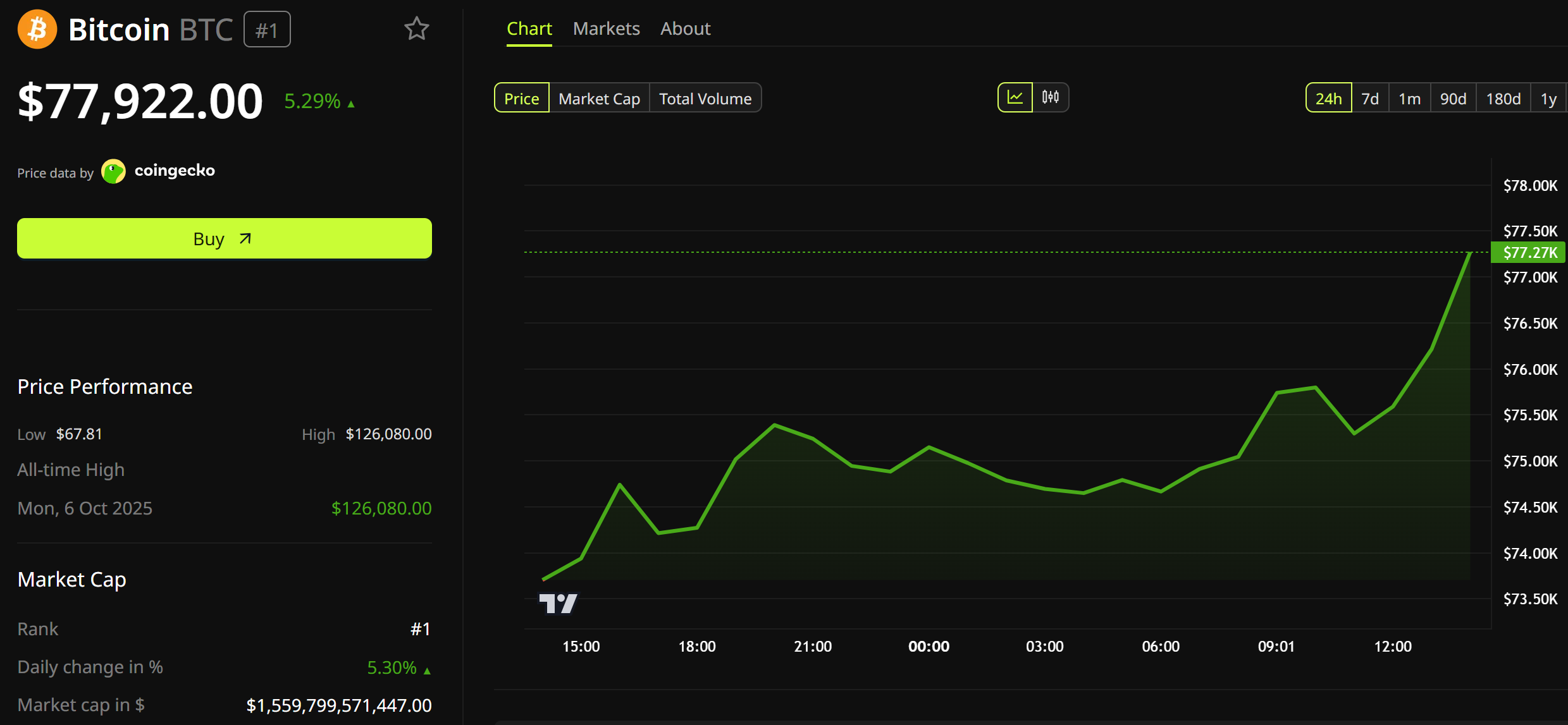
Bitcoin (BTC) climbed above $78,000 on Friday, reaching its highest level in over two months as a confirmed double-bottom breakout fueled momentum toward the $80,000 zone.
The rally followed Iran’s reopening of the Strait of Hormuz under ceasefire terms, which triggered a broad risk-on move across equities and crypto. Yet analysts remain sharply divided on whether BTC can sustain the push through heavy overhead resistance.
Weekly Close Holds the Key to $80,000
As of this writing, Bitcoin was trading for $77,922, just shy of the $80,000 psychological level last tested on January 31, 2026.
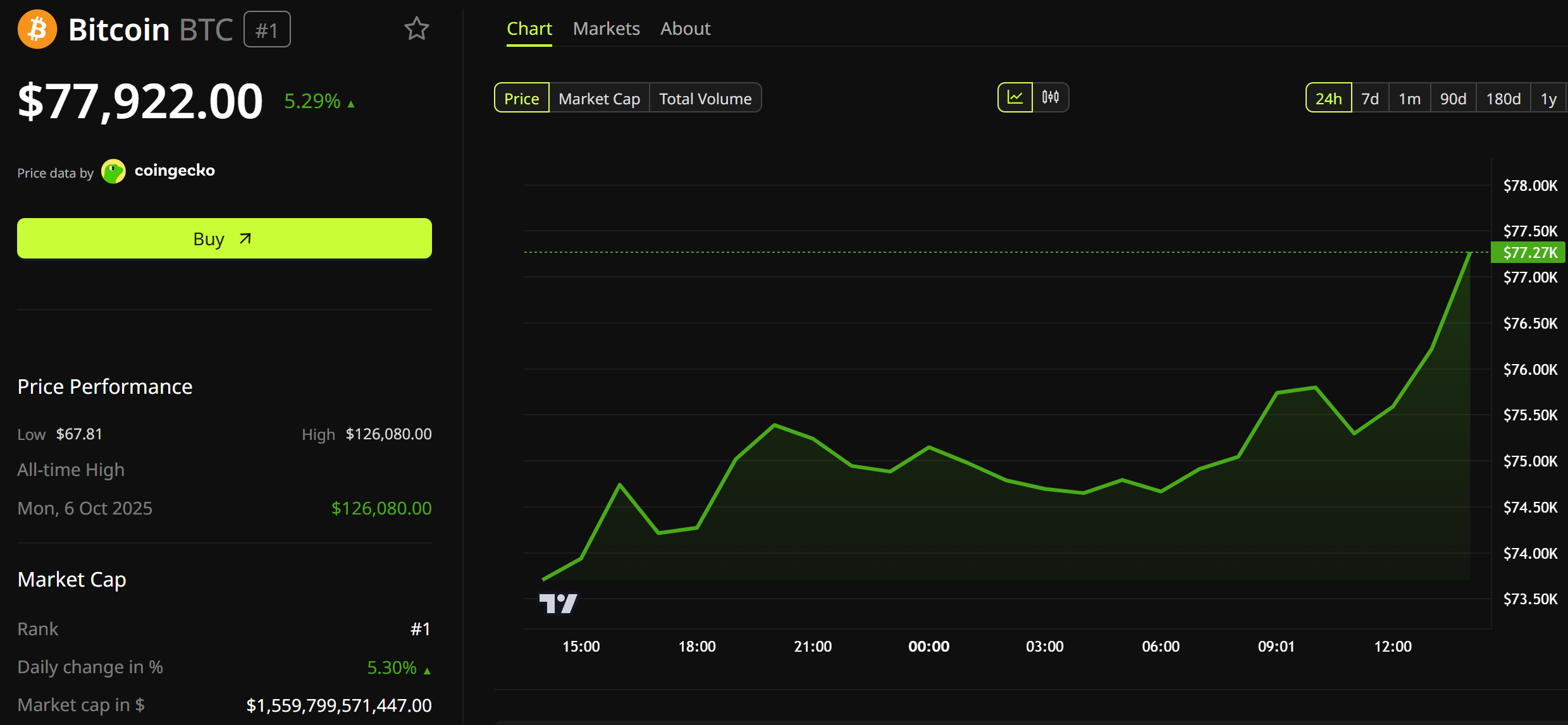
The surge comes after reports that Iran opened the Strait of Hormuz completely, amid ongoing ceasefire terms.
Against this backdrop, eyes remain peeled on whether the Bitcoin price can reclaim the $80,000 psychological level this weekend, potentially drawing tailwinds from resounding risk-on sentiment.
Crypto analyst Rekt Capital highlighted that BTC has maintained itself above the double-bottom formation top near $73,000, positioning price for a positive weekly close.
However, he cautioned that a similar setup in March ended with an upside wick and a subsequent rejection.
“Bitcoin’s progression on the Daily timeframe has been promising, enabling price to maintain itself above the Double Bottom formation top of ~$73,000… it is the upcoming Weekly Close that will be most important to watch for,” wrote Rekt Capital.
On the daily chart, BTC has flipped former resistance levels near $73,000 into support, with consecutive daily closes above prior breakdown zones.
If this behavior continues, it could confirm the breakout from a multi-week consolidation range.
Meanwhile, prediction market Kalshi now prices a roughly 40% chance that BTC hits $80,000 this month, but several key levels remain in focus for Q2.
Trader Ted Pillows identified $76,000 as the key reclaim level that could propel price into the $78,000 to $80,000 band.
“The key zone for Bitcoin here is $76,000 and a reclaim could push BTC towards the $78,000-$80,000 zone. This is where I’ll go short on Bitcoin,” wrote Ted.
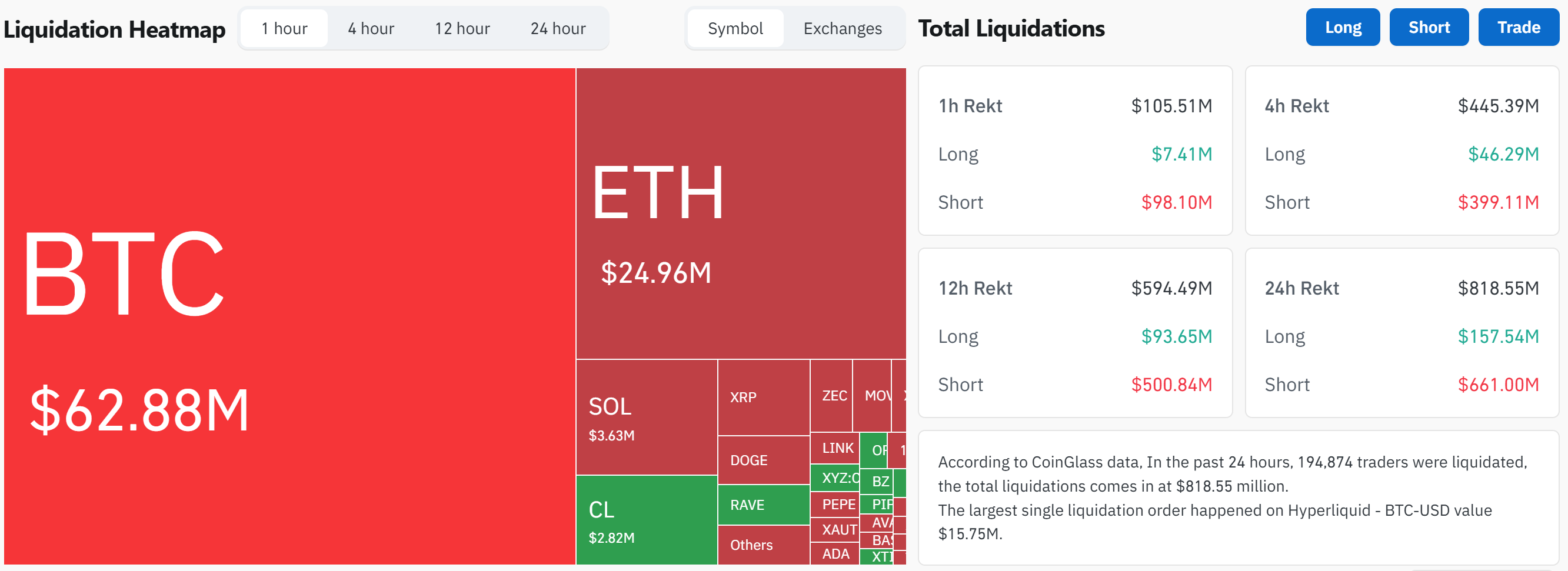
Indeed, Bitcoin’s foray past $76,000 provided an entry for long positions, with a brief test of the $78,000 threshold on Friday catching many naysayers off guard. According to Coinglass data, nearly $100 million in short positions were liquidated in the last hour.
Bear Market Warnings Temper Optimism
Despite the short-term bullish structure, Rekt Capital also flagged significant macro headwinds. He argued that for BTC to build sustained bullish momentum, it would need to reclaim $82,500 and break its multi-month series of lower highs.
History suggests neither milestone will happen, with roughly six months of bear market potentially remaining.
The 21-week exponential moving average (EMA), which tends to act as resistance during bear markets, sits directly in the current price path. The broader oil shock from the Hormuz crisis adds another layer of macro uncertainty.
BTC is also clustering beneath a macro triangle it broke down from months ago, a pattern that in 2014 resolved through distribution to the downside.
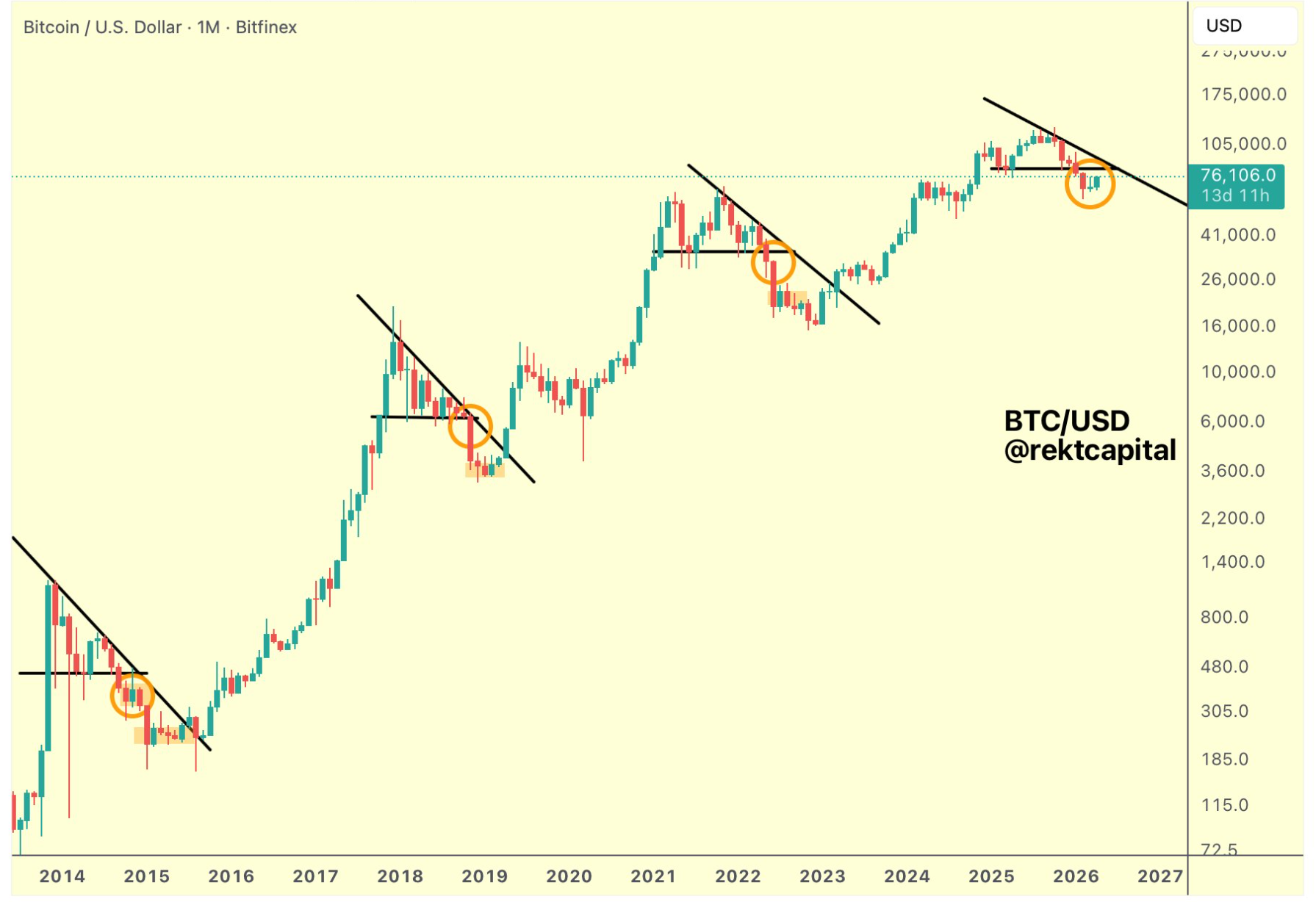
QCP Group echoed the caution, noting that derivatives desks still favor downside protection. The rally appears spot-driven and fragile rather than a structural trend change.
Ted Pillows separately disclosed plans to short BTC near the $79,000 to $80,000 zone, citing a pattern from the last two local tops where price took out the capitulation candle’s highs before reversing.
On-Chain Data Signals Accumulation but Needs Confirmation
Meanwhile, multiple on-chain indicators have flashed mixed signals throughout April. CryptoQuant analyst Woo Mink Yu pointed to the Bitcoin Combined Market Index, or BCMI, which has dropped into the 0.2 to 0.3 range.
This zone has historically marked deep undervaluation.
“We are entering a ‘Value-Accumulation Zone.’ The data suggests the downside is becoming limited compared to the long-term upside. However, wait for price stabilisation to confirm the index’s bottom signal,” wrote Cryptoquant analyst Woominkyu.
Supporting the case for a healthier rally, separate CryptoQuant data showed that Binance open interest has plunged even as the price climbs.
A rally built on spot demand rather than leverage significantly reduces the risk of sudden liquidation cascades.
Meanwhile, exchange inflows on Binance have fallen to 2020 levels, suggesting holders prefer to sit tight rather than sell into strength.
Still, a separate data point flagged roughly 11,000 BTC per hour moving to exchanges this week, the highest rate since December 2025.
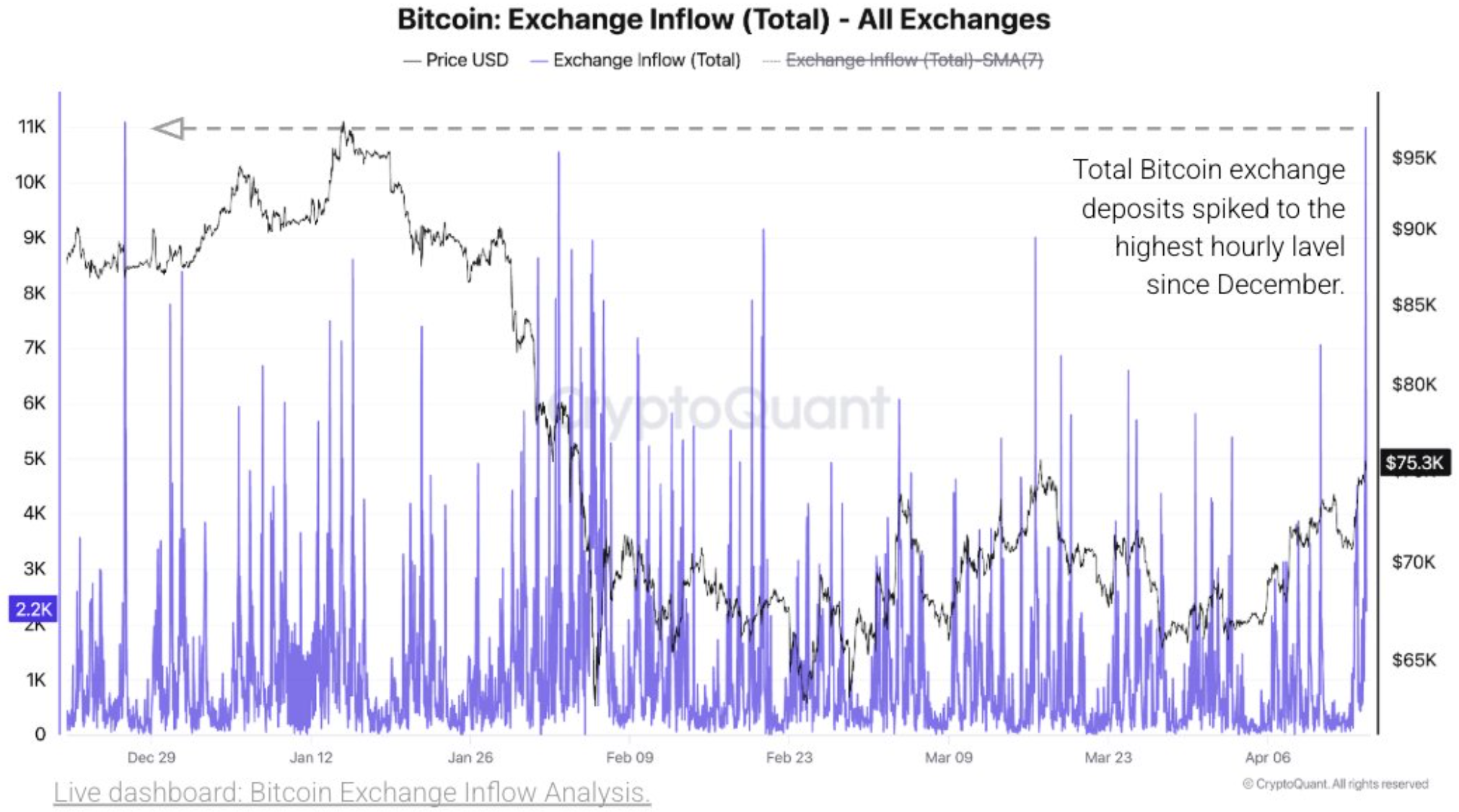
Large holders may be positioning to distribute if the rally extends further.
Earlier forecasts for April projected BTC reaching the mid-$70,000s by month’s end. Friday’s daily close will likely determine whether BTC’s breakout above $77,000 translates into a genuine push toward $80,000 or becomes another failed attempt in a broader bear market structure.
The post Can Bitcoin Reach $80,000 This Weekend as the Strait of Hormuz Opens? appeared first on BeInCrypto.


BTC has broken $77K with 3.45% daily gains, but Coinglass shows $2.221B of longs below $73,610 and $913M of shorts above $81,264, turning the range into a leverage trap.
Summary
- Bitcoin has broken through $77,000 on Gate, with BTC/USDT last changing hands around $77,019 and up 3.45% over the past 24 hours.
- The move comes as Coinglass data show roughly $2.221 billion in BTC longs sitting below $73,610 and $913 million of shorts above $81,264, turning the $70,000–$80,000 band into a heavily levered zone.
- Traders now face a market where even a 5–7% swing can trigger multi‑billion‑dollar liquidation cascades, echoing earlier patterns around $65,000 and $68,000 flagged by Bitcoin liquidation maps.
Bitcoin (BTC) pushed through another psychological round number on Friday, with Gate’s BTC/USDT pair trading around $77,019 and posting a 24‑hour gain of 3.45% as bids continued to grind higher. The latest leg up extends a broader run that has taken BTC from the mid‑$60,000s into the high‑$70,000s over recent weeks, aided by steady spot demand and persistent futures leverage.
BTC clears $77K with liquidations looming
Derivatives data from Coinglass suggest that climb is now happening inside a tight, leveraged corridor. The platform’s liquidation‑levels dashboard shows that “if BTC falls below $73,610, the cumulative long liquidation intensity on major CEXs will reach $2.221 billion,” while a break above $81,264 would put about $913 million of short positions at risk. In other words, a few thousand dollars in either direction from current levels sit atop roughly $3.1 billion of potential forced flows.
Coinglass describes its Bitcoin liquidation heatmap as a way to “estimate price ranges where large‑scale liquidation events may occur,” aggregating leverage across venues such as Binance, OKX and Bybit. Its public materials warn that when price crosses dense liquidation bands, exchanges closing positions “may cause sharp price movements and significantly impact traders’ positions,” especially when open interest is elevated.
A recent crypto.news story on Bitcoin’s liquidation map highlighted an earlier setup around $65,000 and $68,000, where about $1.143 billion of longs and $754 million of shorts were clustered in a narrow range. At that time, Coinglass called those levels “sensitivity zones” that could turn a modest move into an outsized liquidation cascade, a pattern now re‑appearing at higher prices.
Similar leverage dynamics have been visible on Ethereum, where Coinglass data recently flagged near‑$2,000 “trapdoor” levels for longs and a $2,451 liquidation wall threatening $1.47 billion of shorts. Another crypto.news analysis of ETH liquidation walls between $2,057 and $1,863 described how densely packed futures positions can amplify even routine pullbacks.
With BTC now above $77,000, the focus for traders is whether spot demand can keep climbing without triggering the $73,610 downside “trapdoor” or a violent short squeeze beyond $81,264. Those running aggressive leverage into either band are effectively betting that they can front‑run the next liquidation wave rather than be on the wrong side of it.

Bitcoin moved to ten-week highs near $77,000 on Bitstamp as the market readied for the weekly close and weighed the potential for a broader rally back toward the upper end of the $80,000s. The price action came amid a broader risk-on environment, with equities and macro indicators pointing to a calmer backdrop after weeks of volatility driven by geopolitical and supply concerns.
Data from TradingView confirmed BTC briefly topping $77,027, its highest level in roughly two and a half months. The move coincided with a surge in stock benchmarks, as the S&P 500 reached a level of about 7,050 points on Thursday—the first time the index has traded at that mark and sealing its highest-ever close, marking a second all-time high for the week. In crypto markets, the mood shifted toward relief as geopolitical tensions appeared to ease, supporting appetite for risk assets overall.
Meanwhile, traders watched how on-chain liquidity and market structure might shape the next leg. Prominent voices in the space highlighted the role of growing interest from institutional players and the potential for spot BTC ETFs to attract new inflows as macro volatility declines.
“As long as the VIX continues to fall, and we’re in a new equilibrium where oil volatility and gold volatility drop, we should see renewed interest from allocators toward Bitcoin,” wrote Michaël van de Poppe, a well-known trader, on X. He added that a shift in sentiment toward BTC ETFs could bring broader inflows into the space. In the same thread, he projected a path toward the mid-to-high $80,000s if momentum persists.
“What will you start to see? More inflows in the BTC ETF as allocators can allocate more towards Bitcoin.”
Late-week data from Farside Investors underscored that sentiment in the U.S. spot BTC market, noting that weekly inflows into US spot Bitcoin ETFs reached a net $330 million for the week-to-date. The prospect of sustained ETF demand, together with improving risk appetite, fed expectations that Bitcoin could accelerate its ascent in the coming weeks, potentially lifting other digital assets in tandem with BTC.
Van de Poppe reiterated a bullish short- to medium-term thesis, suggesting that if ETF demand and macro conditions hold, Bitcoin could advance toward the $85,000–$88,000 area within the next two to four weeks. He linked the potential rally to a reduction in macro-volatility alongside a cooling in broader market fear gauges, and to new ETF inflows that could unlock fresh capital allocation into the space.
On the chart, the analyst offered a technical view that aligns with a broader bullish scenario: the price could extend its gains so long as the market maintains constructive support above key levels. A separate trader, Rekt Capital, pointed to $72,800 as a pivotal daily close level for BTC/USD to sustain a weekly breakout above resistance around $72,810. He warned that failing to hold that level on dips could trap price in a deeper pullback toward the established weekly range.
“If Bitcoin wants to Weekly Close above the Weekly resistance ($72,810), then price would need to hold the blue level as support on any upcoming dip,” he explained. “The last time Bitcoin rejected from the black resistance in mid-March, price also lost the blue level as support. Which is why a Daily Close below the blue level after any upcoming dip could see price drop back into the blue-blue Weekly Range.”
In parallel, another perspective cautioned that volume dynamics could foreshadow a correction rather than a continuation of the rally. Trader Roman argued that declining trading volume into the highs signals fading momentum, while a high-volume move could push prices lower in a macro-downtrend environment. “We’re in a macro downtrend which when we see high volume continues downward. Low volume implies consolidation/correction to continue the overall trend,” Roman wrote, adding that the next high-volume move is likely to take BTC lower.
The near-term path for Bitcoin sits at a crossroads. On one hand, stronger ETF demand and easing macro volatility could deliver a fresh impulse for BTC and, by extension, for the broader crypto market. On the other hand, thin liquidity during rallies and the risk of a volume-led pullback remind traders to stay mindful of the potential for a test of key supports should momentum fade.
To put the current price action in context, observers have pointed to a broader spectrum of possible macro outcomes. Some analysts argue the market could see a deeper drawdown toward sub-$50,000 levels if macro risk resurges or if volume dries up and fails to sustain a breakout. That framing underscores the importance of watching not just price but also liquidity and institutional flow as Bitcoin navigates this phase of renewed attention from traders and investors alike.
In sum, Bitcoin’s attempt to extend gains beyond $77,000 comes at a moment when ETF inflows, macro calm, and selective risk appetite are aligning to push the narrative higher. While the path to $85,000–$88,000 remains contingent on ongoing demand and favorable technicals, the evolving dynamics around ETF participation and volume will likely shape the next few weeks as investors weigh what comes next for BTC and the wider crypto market.
This article is based on market data and commentary available as of the time of writing. Readers should note that crypto markets remain volatile, and outcomes depend on a range of evolving factors including policy, liquidity, and global risk sentiment.
Crypto World
Ethereum Whales Are Sitting on a Breakeven Ceiling at $2,400 Price: Are They About to Kill the Rally?
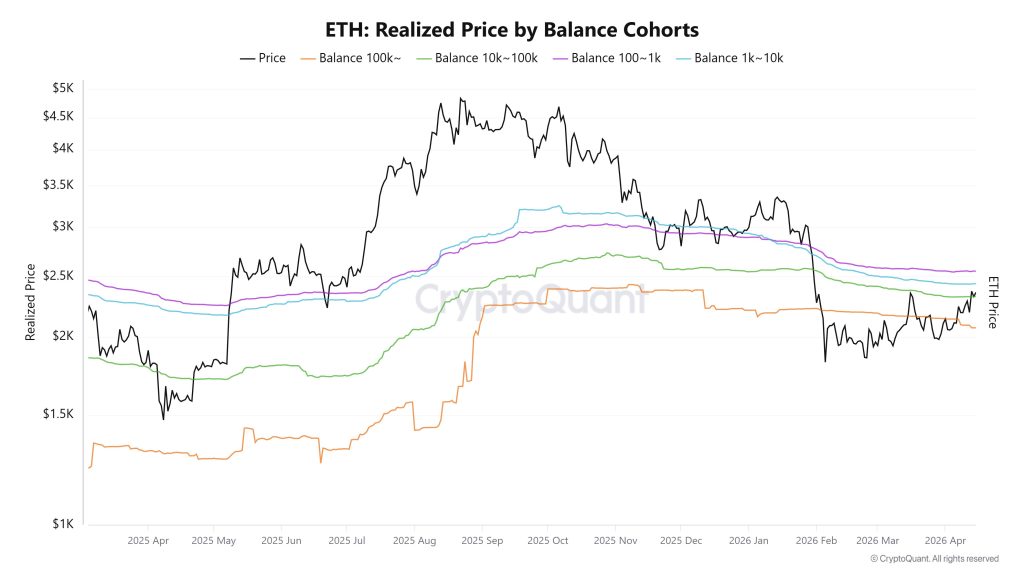
Ethereum price is trading at $2,350–$2,351 after posting back-to-back daily gains of 4.76% and 6.32% in recent sessions, but the chart is telling a more complicated story.
Distribution pressure from whale cohorts sitting near their average cost basis is creating a ceiling that bulls haven’t cracked yet. One resistance level, in particular, is doing most of the heavy lifting right now.
According to Cryptoquant, key whale and retail cohorts carry average cost basis levels between $2,324 and $2,436, a band that neatly brackets current price action and creates natural sell pressure as holders look to exit near breakeven.
US spot ETH ETF inflows returned at $67.8 million on Wednesday after five straight days of net inflows per SoSoValue data, signaling slow but real institutional re-engagement.
Meanwhile, $111.6 million in liquidations hit over the last 48 hours, $70.8 million of that in longs, per Coinglass, a bruising reminder that leverage remains a liability at these levels.
Broader crypto sentiment has stabilized alongside equity markets, but ETH’s internal metrics suggest the recovery lacks the volume conviction needed to flip the next major resistance zone. The next 72 hours may determine whether this is a base-building phase or a fakeout.
Discover: The best crypto to diversify your portfolio with
Can Ethereum Price Break $2,400 and Confirm a Bullish Trend Reversal?
Ethereum price is basically stuck right under a ceiling, and $2,400 is the level doing all the damage, because it lines up with both resistance and the 100-day EMA, and every push into it keeps getting rejected.
The structure underneath still looks solid, though, with price holding above the 20 and 50-day averages, which keeps the bias slightly bullish as long as that holds.
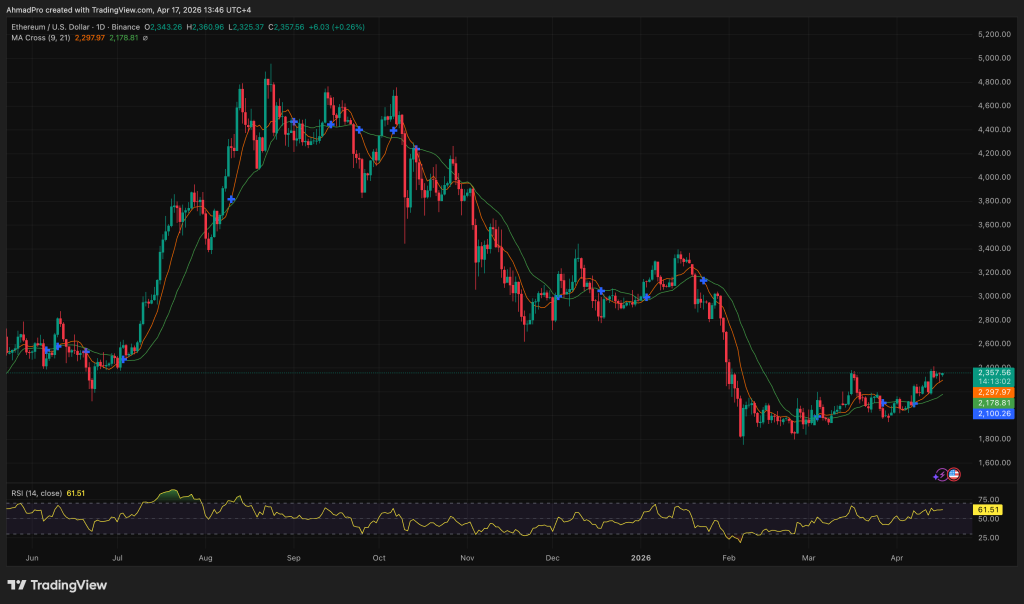
Momentum is kind of neutral right now, RSI is sitting in the middle, and MACD is still weak but flattening, which usually means a bigger move is building but has not picked a direction yet.
If ETH can break above $2,400 with real volume, that is where things open up quickly toward $2,500 and higher, because the structure is already in place for continuation.
But if it keeps failing at this level, a pullback becomes more likely, with $2,200 as the first area that needs to hold, and if that goes, it can slide further down fast.
So this is one of those tight setups where everything comes down to one level, break it, and it runs, fail it again, and it pulls back.
Discover: The best pre-launch token sales
LiquidChain Targets Early-Mover Upside as Ethereum Tests Key Resistance
ETH’s recovery is real, but the math of upside from $2,350 to, say, $3,000 represents roughly 27% — respectable, but not the kind of asymmetric return that early crypto cycles are built on.
For traders watching Ethereum’s open interest dynamics and waiting for confirmation before sizing up, there’s a parallel conversation happening in early-stage infrastructure.
LiquidChain (LIQUID) is an L3 infrastructure project with a specific, structural pitch: it fuses Bitcoin, Ethereum, and Solana liquidity into a single execution environment, which the project calls a Unified Liquidity Layer. Developers deploy once and access all three ecosystems.
The mechanics include Single-Step Execution, Verifiable Settlement, and a Deploy-Once Architecture designed to eliminate the fragmentation that still quietly kills cross-chain DeFi strategies. The presale is currently priced at $0.0145, with $675,934.65 raised to date.
That’s early-stage traction, not a completed raise — and the distinction matters. Presales carry execution risk, no liquidity guarantees, and token unlocks that can pressure price post-launch. Do the work before committing capital.
The post Ethereum Whales Are Sitting on a Breakeven Ceiling at $2,400 Price: Are They About to Kill the Rally? appeared first on Cryptonews.
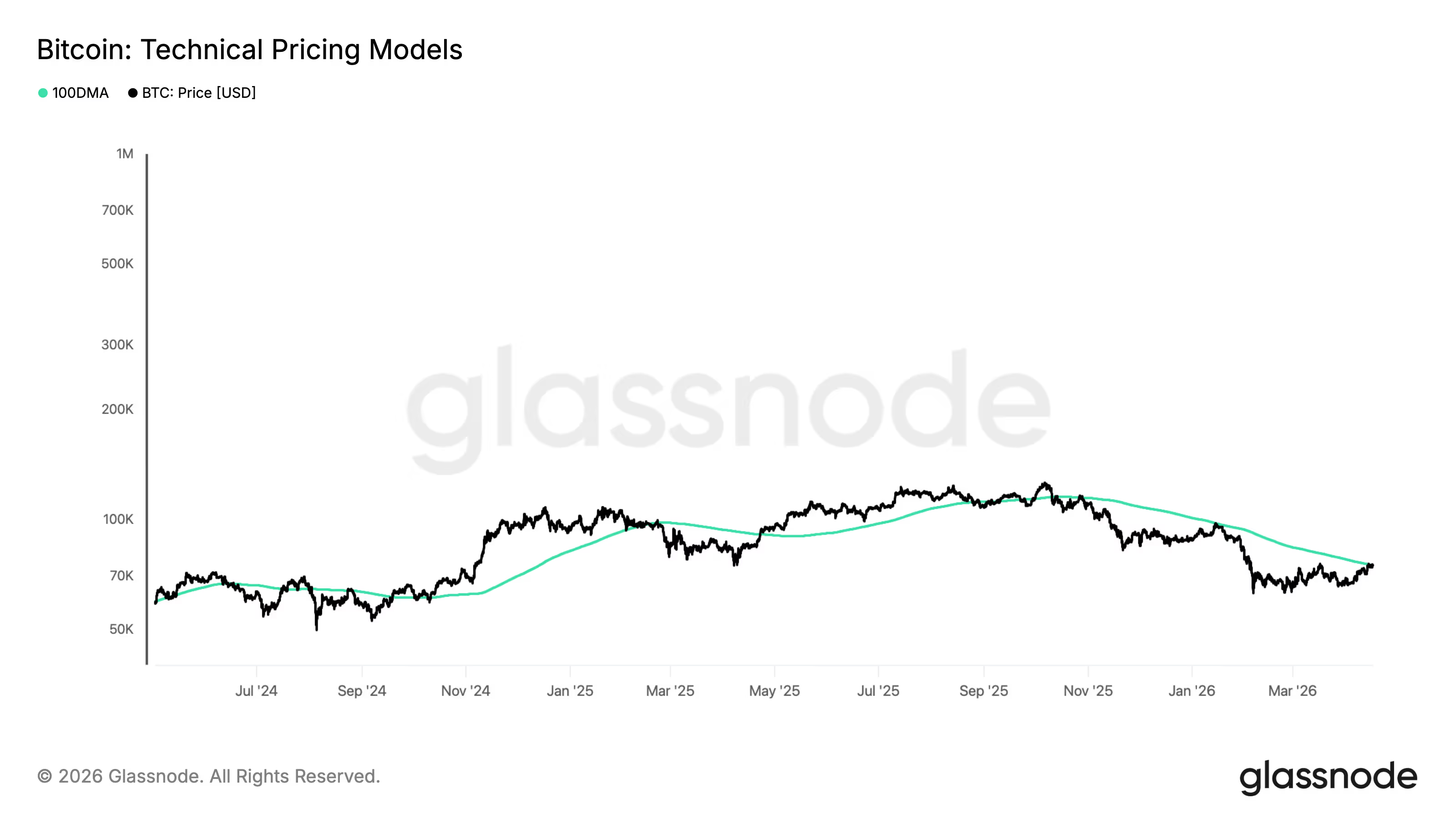
Bitcoin has decisively broken above $77,000 for the first time since its sharp selloff on Feb. 5, when it dropped to a low near $60,000.
The breakout also carries positive implications for Strategy (MSTR), the largest publicly traded holder of bitcoin. The company is now back in profit on its bitcoin holdings, with an average purchase price of $75,577.
Ahead 8% today, MSTR is also trading above its 200-week moving average, a long-term trend indicator that smooths price data over roughly 4 years.
BTC has rallied more than 25% and now trades above its 100-day moving average (100DMA) of $74,774 since bottoming in early February. The previous two tests of this level resulted in rejections and further downside, adding weight to the current move higher.
Bitcoin briefly traded as high as $76,700 on Feb. 4 before continuing lower. A later recovery attempt on March 17 also stalled at $76,013, making the current breakout above $76,300 more notable.



Dollar index DXY erases its Iran war gains as Hormuz blockade scales down, safe‑haven flows unwind, and traders pivot from conflict hedges to ceasefire politics.
Summary
- The U.S. dollar index has erased its entire wartime gain after Iran reopened the Strait of Hormuz.
- DXY fell 0.5% intraday to its weakest level since February 27 as safe‑haven flows reversed.
- Investors are shifting focus from conflict risk to ceasefire terms and a broader political settlement.
The U.S. dollar gave back all of its war‑related gains on Friday after Iran declared the Strait of Hormuz “completely open” to commercial shipping, sending the dollar index (DXY) down 0.5% intraday to its lowest level since February 27. According to data from Gate, the move marks a full reversal of the safe‑haven bid that drove the greenback higher when the U.S.–Iran conflict first erupted.
As tankers resumed passage through one of the world’s most critical oil chokepoints, positioning in currency markets flipped from defence to détente, with traders now pricing a durable ceasefire and negotiations toward a broader agreement. Jayati Bharadwaj, head of foreign exchange strategy at TD Securities, summed up the shift bluntly: “Safe-haven buying has begun to fade. That is the reason for the dollar’s decline.”
The dollar index had previously climbed as investors sought protection from the risk of supply disruption in the Strait of Hormuz, which handles roughly a fifth of global seaborne crude flows, pushing oil well above $100 per barrel at the height of the crisis. With the channel now reopened and headlines dominated by ceasefire mechanics rather than escalation, that conflict premium is rapidly being unwound across foreign‑exchange markets.
Bharadwaj and her team at TD Securities have argued in recent research that while the dollar can still behave like a haven in acute shocks, its longer‑term appeal is weakening as U.S. growth “exceptionalism” fades and capital rotates into Europe and Asia.
That narrative appears to be reasserting itself as the Iran risk recedes, with DXY slipping back toward levels last seen before the first missiles flew and implied volatility in major currency pairs edging lower.
Traders are now more focused on the durability of the ceasefire and the contours of any eventual U.S.–Iran settlement than on shipping disruptions in the Gulf, shifting attention from immediate hedging to medium‑term rate expectations and growth differentials. If talks hold and energy prices stabilize, strategists at several major banks have warned that the dollar could continue to grind lower as investors rebuild positions in risk assets that were cut during the height of the crisis.
For crypto markets that trade against the dollar leg, a softer greenback has historically coincided with stronger risk appetite, reinforcing the role of dollar liquidity and macro politics in driving digital‑asset cycles. As the Strait of Hormuz shifts from flashpoint back to shipping corridor, the dollar’s retreat underlines how quickly safe‑haven trades can reverse once the worst‑case scenario is taken off the table.


Have you had “deploy a stablecoin” and “build an AI agent” on your business to-do list since the beginning of the year?
You know these technologies will create business efficiencies, but finding the time to really get a grasp, a hands-on grasp, of these solutions has proved hard to find. You might even feel like you’re falling behind.
Not for long, you hard-working department head.
CoinDesk is launching the School of Stablecoins and Agentic Commerce at its upcoming Consensus 2026 conference, happening May 5-7 in Miami. These programs include interactive sessions with expert hosts leading you through the biggest cost-saving stablecoin use cases and the easiest implementations of AI agents that can lighten your workload and maybe even secure some big-time bets.
These sessions are for finance and product leaders, operators and entrepreneurs, and executive teams navigating what’s next.
Each workshop has plenty of complements on CoinDesk’s program of keynotes, fireside chats and panel discussions, allowing you to take the big picture insights and turn them into concrete tools you can take back to your team.
Take payments for example. During the “Stablecoins Go Global” panel discussion, you get inspired to adopt USDC in your business. But where do you practically start? “Setting Up a Stablecoin Wallet and Dashboard” hosted by Circle on the University workshop stage.
Or consider AI agents. After hearing the conversation at the “Agents Meet the Enterprise” panel, you want someone to give you a step-by-step tutorial on setting up OpenClaw and writing killer prompts that 10x your efficiency. We’ve got you covered.
Over the course of the three-day show, you’ll get workflow walkthroughs, product demos, and actionable insights for becoming your company’s crypto and AI guy or gal. And that’ll come in handy given these aren’t just niche tools for tech fanatics, or even just the intersection of DeFi and TradFi; these are products and services that every user and business can benefit from.
In this current era of unprecedented innovation and change, CoinDesk University is the place to learn from the visionaries and developers actually building these tools. You’re getting your education directly from the source with these powerful sessions.
Take a look at our current schedule of University workshops here. You’ll be favoriting all these to your schedule.
Crypto World
Spartans.com Built the 14th Biggest Casino in Beta – Now Watch What August 1st Does to Winna and Betano’s Market

Spartans.com is in its beta stage and has already posted numbers that most fully operational platforms take years to produce. The top crypto casino contender already holds a 14th global ranking with $1 billion in wagers and a $7M leaderboard running, all before August 1st. This is the story the industry is tracking. Winna, launched in 2024, is building a crypto-native audience through instant rakeback and VIP status match programmes, including a strong selection of live casino games.
Betano, operated by Kaizen Gaming, is now live in 20 regulated markets following its February 2026 Ghana launch, with a deep catalogue that includes competitive live casino games across its global network. Both represent serious operators. The question August 1st poses to all of them is the same.
Spartans.com: The Record Setting Beta Stage is a Sign Things to Come
Spartans.com is in its beta stage. That is where every number in this article was produced. $1,000,000,000 in total wagers. $100,000,000 in player deposits. $40,000,000 in Gross Gaming Revenue. 27,000 first-time depositors acquired before full global access. A 14th global ranking earned ahead of platforms with years of full operation. This is not a warm-up act. This is a platform that spent its beta stage building the kind of commercial track record that made August 1st inevitable.
The top crypto casino architecture behind these numbers is not complicated to understand. The 33% CashRake system returns up to 33% of the house edge automatically on every wager, plus 3% cashback on losses, from the very first bet with no VIP tier requirements. Near-instant withdrawals and uncapped limits removed every friction point the traditional industry depends on. The $7,000,000 leaderboard, the largest prize pool in online casino history, with $5,000,000 reserved for a single first-place winner, is running live right now, in beta. The community’s first millionaire was crowned during the beta stage.
Era Istrefi, Conor Benn, and streaming duo Sweetflips are active brand ambassadors before the global launch. A $3,000,000 Mansory Koenigsegg Jesko giveaway is running simultaneously. Every element of the platform, the prize infrastructure, the CashRake, the instant payouts, the cultural partnerships, is operating in beta, producing results that put Spartans.com in the same rankings as platforms that have been running for years.
August 1st is when every remaining barrier to global access comes down simultaneously. The beta already answered what this platform is. August 1st answers what happens next.
Winna: A Crypto-Native Platform Built Around VIP Retention
Winna launched in 2024 under a Tobique Gaming Commission licence and has built its identity around ongoing rewards rather than one-off welcome bonuses. The platform stands out with instant rakeback every seven minutes, a $1 minimum crypto deposit, and over 5,200 slots in its library. Its seven-tier VIP programme scales from Bronze through to Nebula, with the top-tier prize wheel offering up to $3.25 million.

A distinctive VIP Status Match programme allows high-volume players to transfer their ranking from another casino and receive cash bonuses of up to $27,000 from day one. Winna’s live casino games section is powered by Evolution and Pragmatic Play Live. As of February 2026, the platform faced increased scrutiny on Trustpilot following reports of a display issue that users interpreted as a security breach, though Winna characterised it as a visual bug with no financial impact on accounts.
Betano: 20 Regulated Markets and Expanding
Betano, operated by Kaizen Gaming, reached a significant milestone in February 2026 with its launch in Ghana, its 20th regulated market launch worldwide and its second market in Africa after Nigeria. The platform operates under licences including the UK Gambling Commission and the Alcohol and Gaming Commission of Ontario, offering over 3,000 casino games and a comprehensive sportsbook covering more than 35 sports.

Its live casino games section features over 500 live dealer tables powered by NetEnt, Pragmatic Play, and Games Global. Betano won EGR’s Operator of the Year award in 2024 and continues to expand its regulated footprint across Europe, Africa, and the Americas. The platform does not currently support cryptocurrency payments, positioning it within the traditional fiat-first regulated market segment.
Summing Up
Winna is building a loyal VIP-focused crypto community through a retention model that rewards consistent play with instant live casino games access and rakeback every seven minutes. Betano is executing a disciplined regulated expansion with 20 market launches and a growing presence across three continents. Both represent serious platforms with clear strategies.
And both now operate in an industry where Spartans.com, a top crypto casino still in its beta stage, has already produced $1 billion in wagers, crowned a community millionaire, launched the largest leaderboard prize pool in casino history, and earned a 14th global ranking before its first day of unrestricted global operation. August 1st is not a beginning. It is the next chapter.

Find Out More About Spartans:
Website: https://spartans.com/
Instagram: https://www.instagram.com/spartans/
Twitter/X: https://x.com/SpartansBet
YouTube: https://www.youtube.com/@SpartansBet
Disclaimer: This is a Press Release provided by a third party who is responsible for the content. Please conduct your own research before taking any action based on the content.


Key Takeaways
- Jim Esposito indicates Citadel Securities exploring prediction market opportunities
- Institutional appetite drives unprecedented expansion in prediction trading platforms
- Growth trajectory extends well beyond traditional sports betting contracts
- Market volumes and institutional participation accelerating at remarkable pace
- Geopolitical uncertainty fueling demand for alternative hedging instruments
Citadel Securities has indicated interest in entering the prediction markets space, according to statements from Jim Esposito. Esposito pointed to increasing appetite for hedging instruments tied to worldwide developments. Therefore, Esposito framed prediction trading as an emerging vertical drawing institutional capital.
Institutional Capital Fuels Sector Growth
Esposito stressed that institutional investors are actively searching for structured mechanisms to manage exposure around geopolitical and economic volatility. Esposito suggested that prediction-based instruments complement existing portfolio hedging approaches. Esposito believes there’s compelling business rationale behind sector evolution.
Prediction markets generated $51 billion in trading volume throughout 2025, demonstrating explosive expansion across diverse categories. Furthermore, market observers anticipate continued momentum as liquidity diversifies beyond election cycles. Consequently, Esposito recognized that these scaling patterns might draw major financial institutions.
Bernstein forecasted sustained momentum powered by regulatory development and enhanced distribution networks. Projections indicate annual transaction volumes potentially hitting $240 billion by 2026. Therefore, Esposito observed that persistent expansion could shape Citadel‘s strategic decisions.
Regulatory Environment Influences Market Evolution
The Commodity Futures Trading Commission maintains regulatory jurisdiction over prediction trading platforms despite growing transaction volumes. Congressional representatives have expressed concerns about regulatory infrastructure and enforcement capabilities. Esposito tracks regulatory progress as a critical consideration.
Sports-related contracts currently represent roughly 62% of overall trading activity. Esposito made clear that Citadel has no plans to participate in sports betting segments. Esposito emphasized interest in categories connected to macroeconomic and political developments.
Regulatory transparency remains fundamental for sustainable market maturation and institutional engagement. Additionally, Esposito acknowledged that comprehensive oversight frameworks could facilitate enhanced liquidity and operational efficiency. Esposito characterizes regulation as simultaneously limiting and facilitating.
Platform Infrastructure Expands With Growing Liquidity
Kalshi and Polymarket have collectively handled $60 billion in transactions during the current year. Both platforms continuously broaden market access via strategic alliances and technical integrations. Esposito acknowledged their contribution to establishing market architecture.
Retail trading platform integration has significantly enhanced market accessibility and transaction velocity. For example, Robinhood provides prediction trading capabilities through platform collaborations. Esposito anticipates ongoing expansion in retail participant liquidity.
Esposito observed that geopolitical developments, including forthcoming electoral contests, may stimulate demand for predictive financial products. Such events generate quantifiable exposure across international markets. Consequently, Esposito positioned prediction trading as practical instruments for navigating volatility.
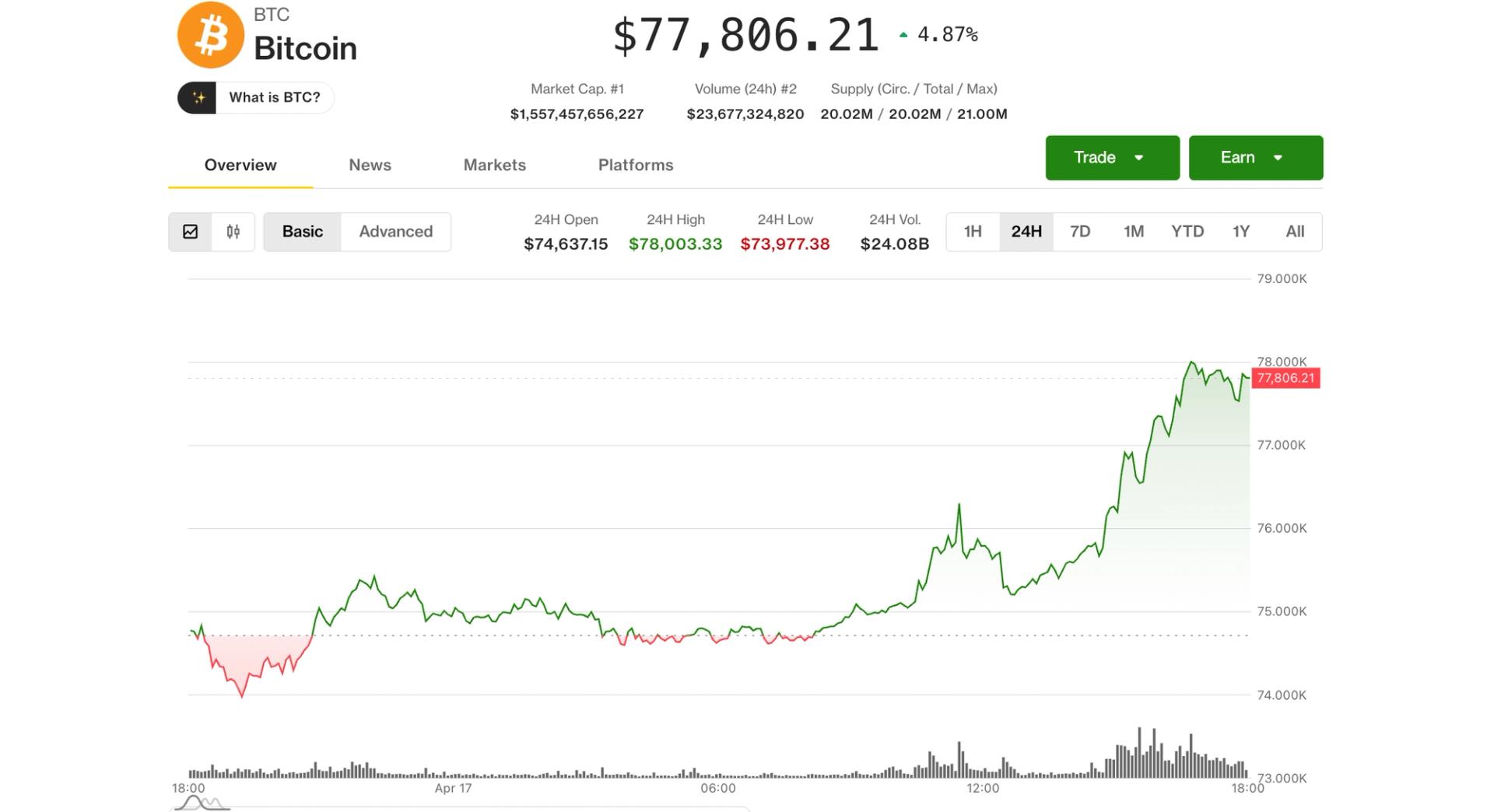
Crypto-linked stocks surged Friday, led by a sharp rally in beaten-down digital asset treasury firms, as progress toward ending the Iran war jolted risk assets, sending bitcoin to a two-month high of $78,000.
U.S. President Donald Trump said in a Truth Social post that Iran committed to keeping open the Strait of Hormuz, a key artery for global energy markets.
“Iran has just announced that the Strait… is fully open and ready for full passage,” Trump said in a Truth Social post, adding that peace talks between the countries were progressing. Reports that the U.S. is considering unfreezing $20 billion in Iranian assets and Trump’s remarks about acquiring Iran’s enriched uranium further boosted sentiment.
As the headlines helped calm fears of a prolonged energy shock, crude oil tanked 13% to near $80 per barrel.
Risk-on signal
“The reopening of the Strait of Hormuz is the risk-on signal the global markets have been waiting for,” said Matt Mena, senior crypto research strategist at digital 21shares.
“By removing one of the most significant geopolitical chokepoints in the world, Iran has effectively uncorked a massive wave of liquidity and investor confidence,” he added. “With oil nose diving below $85 for the first time in a month, inflation fears may finally come to an end.”
Bitcoin climbed to $78,000, breaking out from a two-month range that capped prices since early February and up nearly 5% over the past 24 hours.
The move rippled across the broader cryptocurrency prices higher, with major altcoins ether (ETH), Solana (SOL) and XRP (XRP) posting 4%-5% gains.
Looking at crypto-related equities, the biggest winners were crypto treasury firms — companies that hold digital assets on their balance sheets — which had been heavily battered in recent months.
Trump-family-backed American Bitcoin (ABTC) jumped more than 21%, while Strategy (MSTR) surged 13%. Strive (ASST) and ProCap (BRR) added around 10%-11% as investors rotated back into high-beta bitcoin exposure.
Similar moves played out across altcoin-linked equities. Forum Markets (FRMM), an Ethereum-focused treasury firm that pivoted to tokenization, climbed 19%, while Solana-linked names like Solmate (SLMT) and Upexi (UPXI) gained 12%-11%.
Other digital asset-related stocks also advanced: Coinbase (COIN) rose more than 6%, Galaxy (GLXY) gained 8%, and Bullish (BLSH) rose 4.5%.
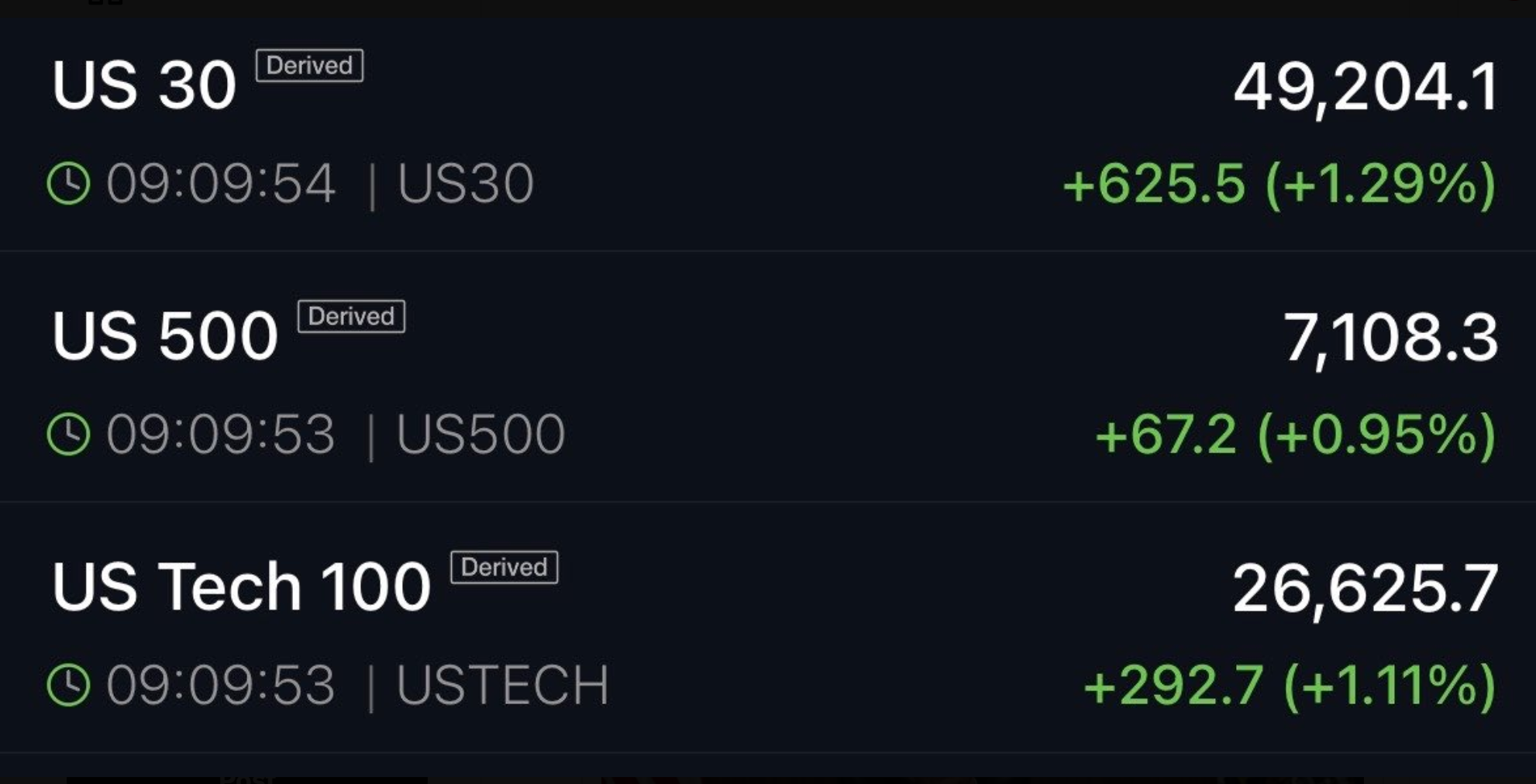
Just after the noon hour on the East Coast, the Nasdaq and S&P 500 were each higher by about 1.4%, both jumping to new record levels.

DWP Access to Work providers are pushing controversial psychotherapies to people with ME

Dwayne Johnson’s ‘Real Masculinity’ Message Has Gone Viral

Girl lured boy to Herrington Country Park, where he was then stabbed


-

 Politics7 days ago
US brings back mandatory military draft registration
-
 Sports7 days ago
Man United discover Nico Schlotterbeck transfer fee as defender reaches Dortmund agreement
-

 Fashion7 days ago
Weekend Open Thread: Veronica Beard
-

 Politics5 days ago
World Cup exit makes Italy enter crisis mode
-

 Business7 days ago
Tesla Model Y Tops China Auto Sales in March 2026 With 39,827 Registrations, Beating Cheaper EVs and Gas Cars
-

 Crypto World4 days ago
The SEC Conditionalises DeFi Platforms to Be Avoided for Broker Registration
-

 Crypto World4 days ago
SEC Signals Exemption for Crypto Interfaces From Broker Registration
-

 News Videos2 days ago
Secure crypto trading starts with an FIU-registered
-
 NewsBeat5 days ago
Pep Guardiola and Gary Neville agree over Arsenal title problem that benefits Man City
-

 Sports8 hours ago
NWFL Suspends Two Players Over Post-Match Clash in Ado-Ekiti
-

 Crypto World3 days ago
SEC Proposes Certain Crypto Interfaces Don’t Need to Register as Brokers
-

 Business6 days ago
Ireland Fuel Protests Enter Day 5 as Blockades Spark Shortages and Government Prepares Support Package
-

 NewsBeat3 days ago
Trump and Pope Leo: Behind their disagreement over Iran war
-

 Crypto World7 days ago
Federal judge blocks Arizona from bringing criminal charges against Kalshi
-
 NewsBeat5 days ago
JD Vance announces ‘no agreement’ with Iran over nuclear weapons fear
-

 Business7 days ago
IMF retains floor for precautionary balances at SDR 20 billion
-
Sports5 days ago
Dexter Lawrence, Stefon Diggs, Trading for De’Von Achane
-

 Business7 days ago
Former Liverpool CEO eviscerates FIFA for World Cup ticket pricing
-
Crypto World5 days ago
Sei Network Enters Quiet Reset Phase as On-Chain Metrics Signal a Slowdown in 2026
-

 Crypto World4 days ago
Trump whales load up ahead of Mar-a-Lago luncheon.
You must be logged in to post a comment Login