
Crypto World
Crypto hacking group ShinyHunters says it stole data of 5,000 FBI agents


Crypto hacking collective ShinyHunters claims to have stolen the personal details of 5,000 FBI agents after gaining access to its database.
It shared a sample of the stolen data with a number of outlets yesterday. The data includes family members, social security numbers, and details of assignments.
Reuters was able to partially verify some of the data in the sample and matched it with other agents, including FBI director Kash Patel.
ShinyHunters also defaced the FBI’s job page with a picture of the Pokémon Umbreon.
Read more: 150 million IDs allegedly stolen — including Pete Hegseth’s
Crypto hackers say FBI hack isn’t about the money
ShinyHunters told outlets that this week’s data theft was in retaliation for the FBI’s May 2026 report that detailed the activities and methods supposedly employed by the group.
It claimed the FBI made false allegations in this report, and has given the agency one week to either correct or remove the report.
The group shared with 404media that its data theft was not “financially motivated.” It said, “What we plan to do is not extortion, maybe coercion.”
An FBI spokesman also told the publiction that ShinyHunters was able to gain access to AWS GovCloud servers via a zero-day exploit in the Oracle product PeopleSoft.
ShinyHunters is still mostly in it for the money
ShinyHunters is an international hacking group known for stealing sensitive data and holding it for ransom in exchange for large sums of cryptocurrency.
Telephone company AT&T was extorted by ShinyHunters in 2024 after it stole the data of almost all of its 109 million customers. AT&T eventually gave in to the group’s ransom demands and paid it almost six bitcoin (worth $373,646 at the time).
In January this year, ShinyHunters claimed it stole user data from dating apps Hinge, Match, and OKCupid.
Read more: French crypto tax firm targeted in ShinyHunters extortion attempt
Four French men were arrested in connection with ShinyHunters in May this year, but the group has continued to operate regardless.
Got a tip? Send us an email securely via Protos Leaks. For more informed news and investigations, follow us on X, Bluesky, and Google News, or subscribe to our YouTube channel.

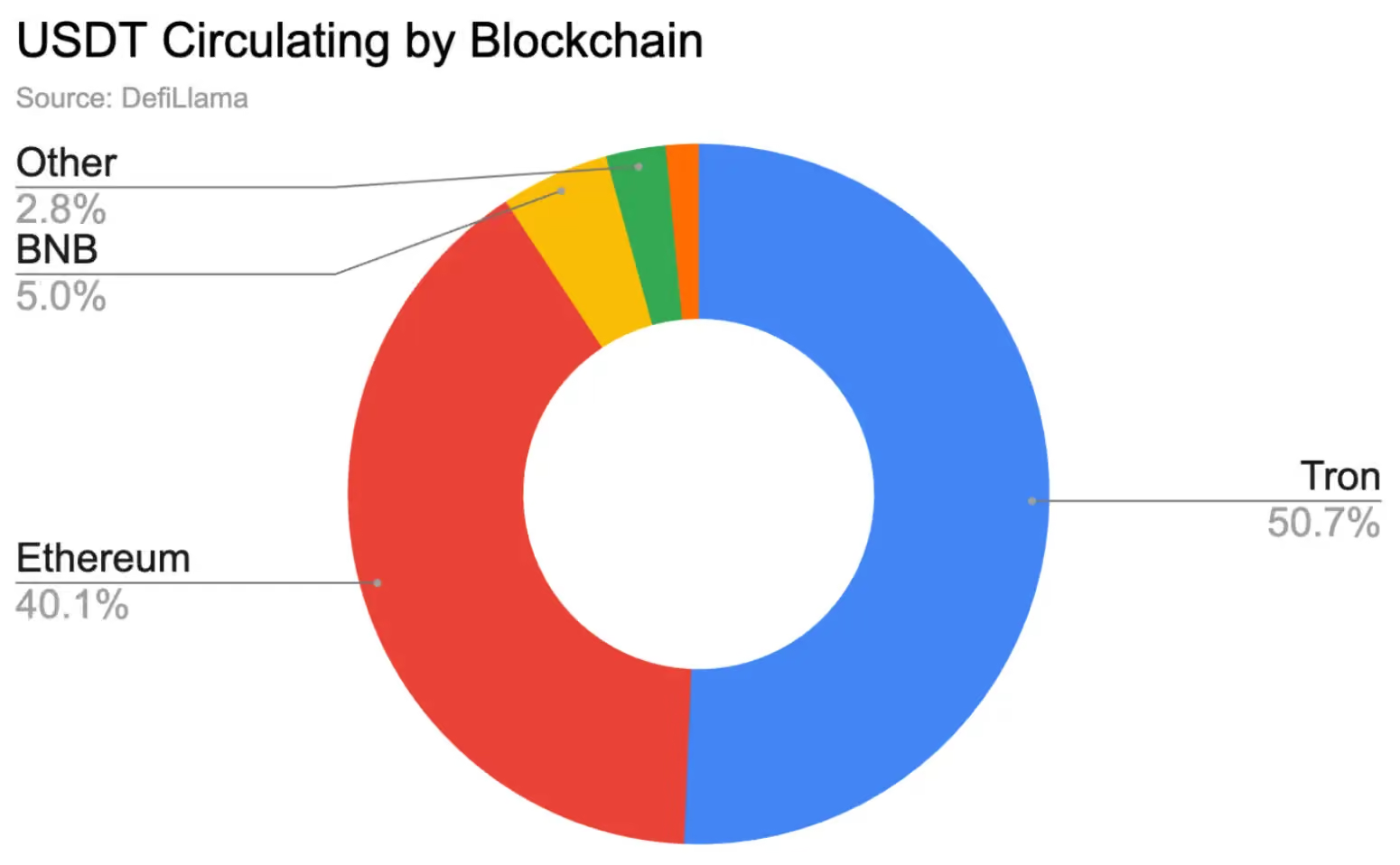
Tron uses a delegated proof-of-stake (DPoS) consensus mechanism. Under this system, TRX holders stake their tokens to gain voting power and use that power to elect 27 Super Representatives, the validators responsible for producing blocks and maintaining the network. Because block production is concentrated among a limited, elected set of validators rather than distributed across a broad network of participants, Tron can achieve fast confirmation times and low computational overhead.
Stablecoins and the payments use case
The single most important development in Tron’s evolution has been its emergence as the leading settlement network for stablecoins. A substantial share of global USDT circulation now resides on Tron, and this characteristic separates Tron from many of its layer-1 peers: rather than competing primarily on DeFi innovation or consumer applications, Tron has positioned itself as digital payment rails for dollars.

That positioning shows up clearly in the network’s usage data. According to Tron’s blockchain explorer, weekly transaction counts on Tron have climbed to record highs, recently approaching 100 million transactions per week, even as the average onchain transaction fee has fallen to around seven cents, a multiyear low.


Weekly active addresses, a measure of unique wallets transacting on the network over a seven-day period, have also been climbing toward record levels, reflecting broad and sustained usage rather than a narrow base of activity. Stablecoin transfer volume on Tron has grown alongside this activity, recently running at roughly $150 billion to $190 billion per week.

“Boy, did I have impostor syndrome,” she says. “Here I was in this room full of eminences, and I had been reading their work, I’d been citing them, I’d been learning from them.” She also had some hard lessons to learn as a northeastern hippie in a majority-Black school district. “I just couldn’t believe the state of affairs in these schools,” says Moats. “Libraries with no books, no doors on the lavatory, no running water in the sinks.” She labored to get the teachers to trust her. Eventually, one of her assistants took her aside. “She said, ‘You’re the director, you’ve got to look like the director,’” recalls Moats, who favors denim and heavy glasses. “I said, ‘You have any advice?’ She said, ‘Go to Ann Taylor.’” The project was a success, her nine schools’ reading rates soared, and local politicians started to drop by for photo opportunities.
Then national politicians took notice too. The No Child Left Behind Act that President George W. Bush signed in 2002 enshrined the work of Lyon’s team and the National Reading Panel. Moats was tapped to write the teacher-training component of the act’s Reading First initiative, which became LETRS.

Michael Burry continues to have a bearish view of the semiconductor industry. On Tuesday, Burry added to his short positions of Micron Technology (MU), Nebius (NBIS), Palantir (PLTR) and the iShares Semiconductor ETF (SOXX), according to an update published on his Substack Cassandra Unchained. Since the end of last year, Burry has been shorting semiconductor stocks on the view that…
Copyright ©2026 Investor’s Business Daily, LLC. All rights reserved. 87990cbe856818d5eddac44c7b1cdeb8

The world’s largest private debt offering, a bond series for one of Meta’s AI data centers, has slumped to its worst level since the deal priced at par last October.
As the Nasdaq composite closed at an all-time high on Tuesday in an AI-led rally, unease rose in the credit market for the industry.
The $27.3 billion bond financing Meta’s Hyperion AI data center traded down to a disconcerting 94.4 cents on the dollar, a record low. Worse, the loss coincided with Meta’s largest intraday stock rally in a year: 9%.
The bond series was the largest private debt offering ever sold. Corporate notes, backed by Mark Zuckerberg’s massive AI division at Meta, boasted a 6.581% coupon and a long-dated 2049 maturity.
PIMCO, the world’s largest bond manager, anchored the deal with about $18 billion. Funds by the world’s largest asset manager, Blackrock, bought upward of $3 billion.
Read more: Viral report alleges Anthropic’s AI safety watchdog conflicted
Technically, the debt sits on the books of Beignet Investor LLC, a special-purpose vehicle. A search for pricing of Beignet Investor LLC show latest pricing at 94.61 to 94.4, far below its 100 par.
In October 2025, S&P blessed Beignet Investor LLC’s AI bond with an A+ rating. It was within one rating level of regular Meta corporate bonds backed by Facebook, Instagram, and WhatsApp, and other divisions of Zuckerberg’s company.
Within days of its initial pricing, Beignet Investor LLC’s AI bond traded above par to as high as 110. By late July, it had fallen to about 96 cents. Today, it has retraced 14% of its peak gain.
PIMCO’s own GIS funds now mark it at 94.5, despite anchoring the initial offering.
An $18 billion position bought at par would now show a paper loss of roughly $1 billion.
The losses for bond investors contrast with Meta’s otherwise positive developments and stock performance. It launched Muse on September 8, a personal AI agent with free, $20, and $100 tiers.
Initial success was resounding, with Muse quickly topping Apple’s US App Store chart.
Goldman Sachs spent the session listing everyone the agent might disrupt. Businesses built on recurring bills — Goldman’s so-called “consumer inertia” basket like AT&T, Allstate, Netflix, or Booking.com — fell 2.6% on the day in the basket’s worst day since February.
Protos reported in July that credit default swaps on mega-cap AI names were blowing out.
Moody’s warned that the AI’s capital expenditures binge could dent the credit quality of even the largest AI companies.
Got a tip? Send us an email securely via Protos Leaks. For more informed news and investigations, follow us on X, Bluesky, and Google News, or subscribe to our YouTube channel.
Although the symposium is not secret, it has received little media attention. Its public footprint consists largely of occasional posts from attendees rather than prominent FBI announcements or the publicity campaigns typical of commercial crypto conferences.
A LinkedIn post published by Token Recovery executive Roman Bieda confirms that the 2024 symposium took place in Austin.
Bieda, attending for a third time, said it convened an international group of public and private-sector specialists to discuss threats including money laundering, ransomware, human trafficking and crypto-related scams. He did not respond to a request for comment by publication time.
From government gathering to industry forum
The gathering was once weighted more heavily toward government agencies and public sector officials, according to one of the people who spoke to CoinDesk.
It has since expanded to include more representatives from the crypto industry, they added.
The focus is practical, aimed at informing attendees about emerging attack methods, what techniques are proving effective, and how North Korean operatives are targeting crypto companies.
A detailed presentation covered the Drift exploit, in which hackers gained administrative control and used a manipulated token as collateral to steal more than $270 million from the Solana-based decentralized exchange in April, the person added.
Sharing intelligence on crypto threats
Unlike the polished venues and promotional atmosphere of major crypto gatherings, the FBI symposium is deliberately low-key, one of the attendees said. Its growing industry presence, however, reflects how closely law enforcement now depends on crypto companies, blockchain analysts and security researchers to identify attackers and trace stolen funds.
Crypto World
Southern Company or Duke Energy: Only One Offers the Combination of Yield, Growth, and Safety You Need

Quick Read
-
Duke Energy (DUK) beats Southern Company (SO) on yield (3.62% vs. 3.49%), dividend coverage, and 20-plus consecutive years of annual raises.
-
Duke’s $103 billion capital plan and 7.8 GW of data center contracts give its dividend a cleaner, faster-growing funding engine than Southern’s.
-
Southern’s wind repowering charges and Nicor disallowances drain roughly $325 million in cash through 2027, actively competing with its dividend.
-
Just released. Our analysts combed the entire stock market and named the ten best stocks to buy right now, and Southern Company didn’t make the cut. Enter your email to see the names that beat SO. The report is free. Enter your email and see if any of your stocks made the cut.
For a retirement investor building an income sleeve from regulated utilities, the choice between Duke Energy (NYSE:DUK) and Southern Company (NYSE:SO) matters for income construction. Here is how they compare. Both benefit from data center load growth in the SERC region, but their dividends, balance sheets, and growth engines move at different speeds. Here is the head-to-head across the three dimensions that matter for income holders.

Dividend Yield, Coverage, and Raise History
Start with the check-writing math. Duke pays a $4.34 annualized forward dividend against a share price of $115.20, for a trailing yield of 3.62%. Southern pays a $3.04 annualized forward dividend at $84.40, yielding 3.49%. Duke also covers its payout more comfortably: TTM EPS of $6.64 against a $4.26 per-share payout, versus Southern’s $4.15 EPS against $2.98.
Both are long-tenured raisers, but Duke has been more generous. CFO Brian Savoy noted on the Q2 call that the July hike marked “over 20 years of consecutive annual dividend increases”. Duke’s quarterly went from 1.065 to 1.085 at the August 14, 2026 ex-date. Southern’s most recent bump took the payout from $0.74 to $0.76 at the May 18, 2026 ex-date, in line with its once-a-year cadence. Winner: DUK. Higher yield, better coverage, faster recent raise.
Free Report, Just Released
Why Didn’t SO Make The Top 10 List?
24/7 Wall St has helped investors make money for over two decades, and our top analysts just finished ranking the definitive Top 10 Stocks To Buy Now. Not the ten biggest companies. Not the ten everyone is arguing about. The ten best stocks to buy right now.
And SO didn’t make the cut!
The report is free, and you can see why we think each stock is a top investment today.
Enter Your Email and See the Ten →


What Actually Funds the Dividend


Bitcoin’s latest leg up has carried the price directly into a major overhead supply region, putting the rally at an important test. Momentum remains constructive, but the reaction around the $86K-$89K area could determine whether the move develops into another bullish leg or pauses for a deeper retest.
Bitcoin Price Analysis: The Daily Chart
On the daily timeframe, Bitcoin has extended its recovery significantly after breaking out of the previous corrective structure. The asset is now trading around $86K and has entered the major $86K-$89K resistance zone highlighted on the chart.
The broader structure remains bullish. BTC is comfortably above both moving averages, while the sharp recovery from the $75K area has established a clear sequence of higher prices. However, the current resistance zone is substantial, and the latest candles show some hesitation after reaching it.
There is also a notable momentum divergence developing. While the price has pushed to a higher high, the RSI has failed to confirm that strength and remains below its previous peak. This bearish divergence does not necessarily signal an immediate reversal, but it suggests that upside momentum is not expanding at the same rate as price.
As a result, a rejection from the $86K-$89K resistance could trigger a corrective move toward the first demand zone around $80K-$82K. Below that, the $75K-$78K area represents the next major support. Conversely, a decisive daily breakout above $89K would invalidate the immediate bearish divergence concern and strengthen the case for continuation.
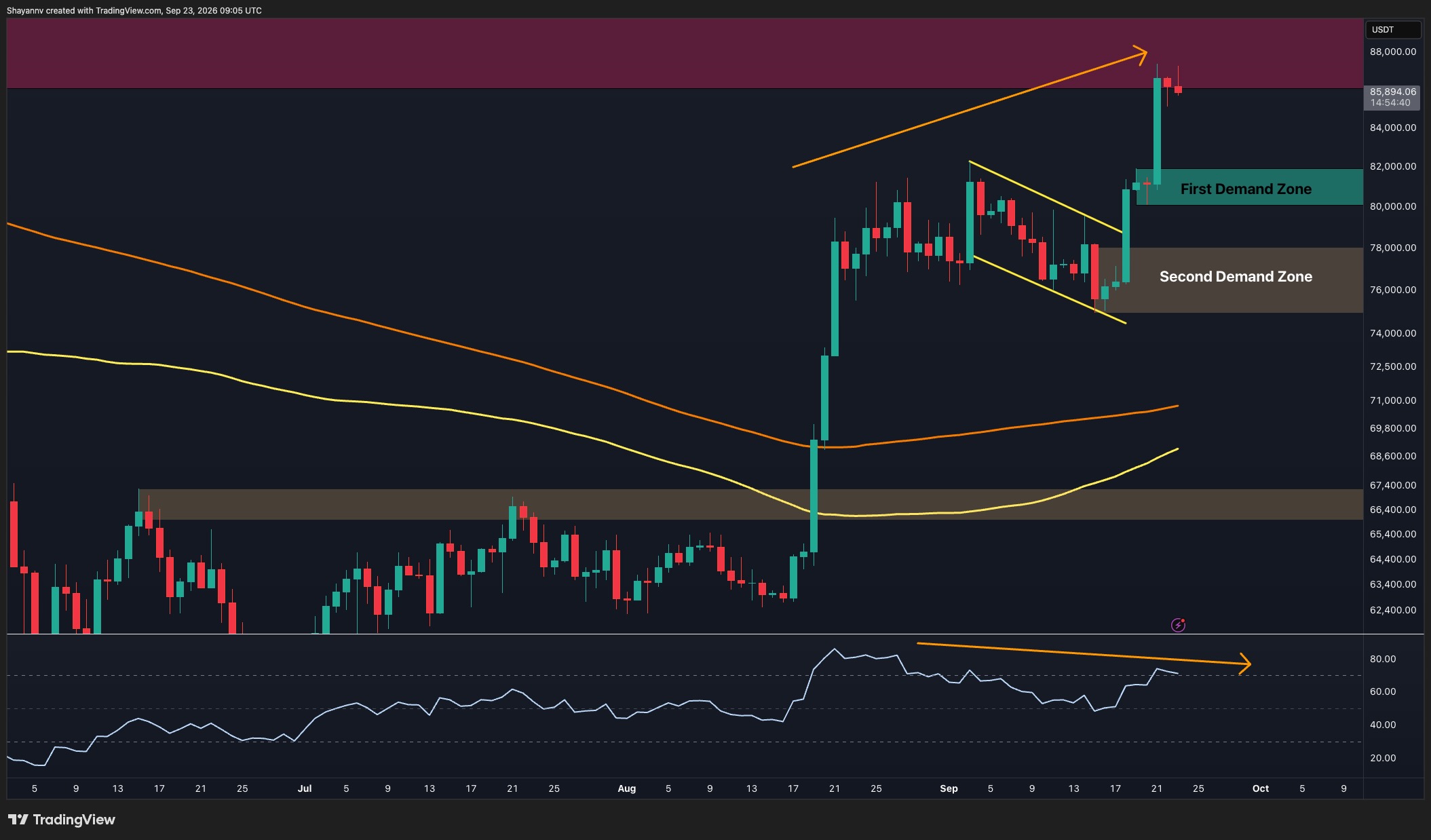
BTC/USDT 4-Hour Chart
The 4-hour chart emphasizes just how aggressive the latest move has been. After consolidating around the $80K-$82K demand zone, Bitcoin broke higher with a large impulsive candle and quickly reached the $86K region.
The price is now consolidating just inside the $86K-$89K supply zone rather than immediately reversing, which suggests buyers are still attempting to absorb the available selling pressure. The rising trendline from the $75K low also remains intact, supporting the short-term bullish structure.
Nevertheless, BTC is extended from its nearest demand area. If sellers gain control at the current resistance, the $80K-$82K zone would be the most important initial area to monitor for a pullback. Holding that region would preserve the breakout structure and could provide the foundation for another attempt at $89K.
A breakdown below $80K would weaken the short-term setup and increase the probability of a deeper correction toward the $75K-$78K demand zone.

Sentiment Analysis
The Realized Price UTXO Age Bands chart provides additional context for Bitcoin’s current position by showing the average acquisition prices of different holder cohorts.
BTC, currently around the mid-$80K region on this chart, has moved above the realized prices of several younger and intermediate cohorts. Most notably, price is approaching the 18-month-to-2-year cohort’s realized price, which sits around $88K. The 6-to-12-month cohort is also positioned near $90K.
These levels closely overlap with the $86K-$89K technical resistance identified on the price charts, creating an important confluence. Investors belonging to these cohorts may be approaching their aggregate cost basis, potentially increasing selling or breakeven supply as BTC moves higher.
At the same time, Bitcoin trading above the realized prices of several other active cohorts indicates that a larger portion of those holders has returned to unrealized profit. Therefore, the $88K-$90K region appears particularly important. A sustained move through it would place Bitcoin above another significant cluster of holder cost bases and could reinforce the bullish continuation scenario, while rejection would leave the current resistance confluence intact.

The post Bitcoin Price Analysis: BTC Faces First Major Test After 13% Weekly Rally appeared first on CryptoPotato.

Cosmos Hub validators halted block production on Tuesday, following a governance attack on Neutron which initially led to losses of $9.5 million.
Of that sum, the attacker was only able to extract around 20%, with the remainder stuck on halted networks.
With block production having resumed since 12:00 UTC on Wednesday, Cosmos Hub was ultimately offline for over 24 hours after halting at block height 33086740.
This latest incident marks the third security scare in recent months for the wider Cosmos ecosystem.
Read more: Cosmos Labs under fire over disclosure of bug affecting four blockchains
The governance attack
A malicious “AI Agent Takeover” governance proposal was passed on Neutron, a Cosmos-ecosystem chain which entered its “long-term maintenance phase” earlier this year.
The proposal allowed the attacker to take control of two Neutron-based applications, Astroport and Drop, and drain contracts of assets worth $4.9 million and $4.4 million, respectively.
The attacker reportedly spent just $20,199 to acquire the NTRN tokens needed to pass the vote.
The response
In response to the attack, Neutron was paused, trapping an estimated $5 million worth of assets.
In turn, Cosmos Hub validators also decided to halt, securing a further 1.2 million ATOM (over $2.2 million) held in the attacker’s address. The scheduled restart is set to include a queued refund of the trapped ATOM balance.
The hacker’s Ethereum address holds $1.8 million, with a further transaction worth over $300,000 pending on THORChain, though this is set to be refunded to the Cosmos Hub address upon restart.
Read more: Osmosis took 74 days to discover 40-BTC Nomic exploit
Chaos in the Cosmos ecosystem
In late August, a bug in Cosmos Labs’ Cosmos EVM module led to protocol-level exploits on four blockchains.
The disclosure procedure was heavily criticised by one of the affected projects, KiiChain, which dubbed the loss of $9 million worth of its KII tokens “avoidable.”
Earlier this month, Cosmos-based exchange Osmosis revealed that a June 25 exploit of Nomic’s bridge had minted 40 nBTC (worth $3.6 million at the time) out of thin air, which left Osmosis’ allBTC partially (36%) unbacked.
Got a tip? Send us an email securely via Protos Leaks. For more informed news and investigations, follow us on X, Bluesky, and Google News, or subscribe to our YouTube channel.

Polo’s intensification is similar to Hurricane Otis in 2023, which had a wind increase of 105 miles per hour in 21 hours before it made landfall near Acapulco, Mexico, and caused catastrophic damage.
What areas are affected?
Mexican authorities have issued tropical storm warnings along Mexico’s southwestern coast from Tecpan de Galeana to Punta San Telmo. The outer bands of Polo are expected to bring heavy rainfall of 3 to 6 inches to coastal Guerrero and Michoacán through Thursday, with isolated totals of up to 8 inches of rainfall. Coastal areas in Oaxaca, Colima, and Jalisco could receive 2 to 4 inches of rain.
The rainfall could cause severe flooding and mudslides, especially in steep terrain. The region has suffered devastating flooding caused by a hurricane before, when Hurricane John produced deadly flash flooding and mudslides in southern Mexico in September 2024.
Swells from Polo are also expected to produce life-threatening surf and rip currents, as well as coastal flooding, along the southwestern Mexican coast over the next few days. Waters off Baja California Sur are forecast to see worsening conditions beginning Friday, as the hurricane may approach the southern tip of the Baja Peninsula over the weekend, according to the U.S. Embassy in Mexico. NWS San Diego said there could be “at least some peripheral impacts” to parts of Southern California, including possible coastal flooding and erosion.
Crypto World
Bitcoin trades near $85,000 ahead of one of deribit’s largest options expiries of the year
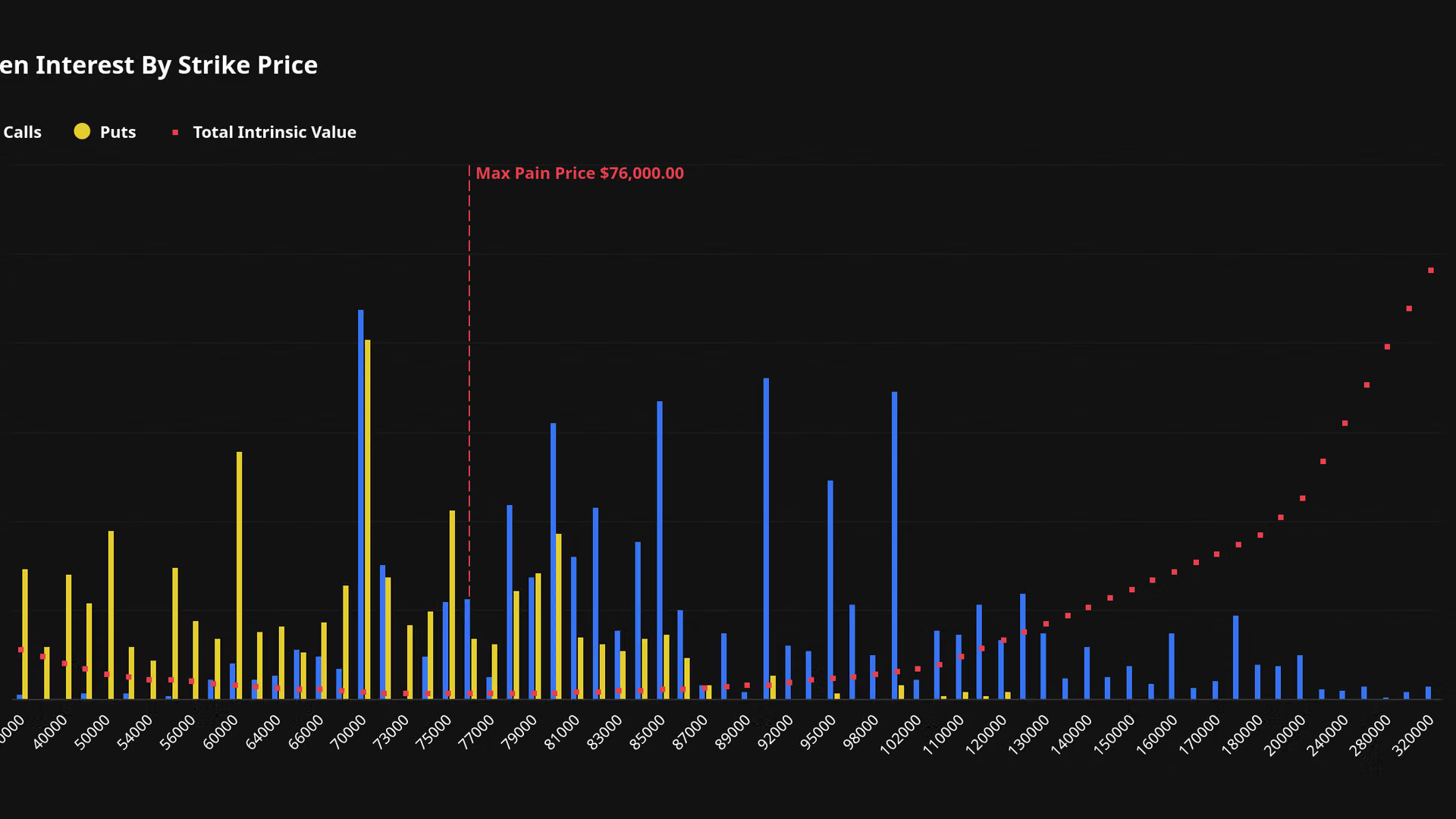
Open interest distribution
The $70,000 strike has more open contracts than any other, and the calls there are now deep in the money.
Strijers said 55% of the $9.4 billion in call bets due for expiry are in the money. Puts, meanwhile, are mostly worthless right now. Put it together, and about a third of the entire $15.9 billion book is currently in the money.
Being in the money means being in profit – an option has intrinsic value because the market price is on the favorable side of its strike. For a call, the underlying trades above the strike; for a put, it trades below the strike.
Deribit’s Chief Commercial Officer Jean-David Péquignot said the distribution of open interest across strike prices suggests a price floor around $75,000.
“Open interest is heavily concentrated at the $85k, $90k, $95k, and $100k call strikes, underscoring the ongoing influence of large 85k/90k/95k/100k call condor blocks that are now coming directly into play as spot trades near $86k,” Péquignot said. “On the put side, defensive structures are firmly anchored at $60k, $70k, and $75k, creating a multi-layered support floor.”
What happens on the expiry day?
Friday’s expiry could breed some market turbulence, eventually resetting the trading range for BTC’s spot price.
That’s because, as per Strijers, the expiry will clear out dealer-related hedging.

XRP HOLDERS ARE NOT READY FOR WHAT HAPPENS IN THE NEXT 72 HOURS

Major railway disruption for passengers across Wales with trains cancelled – live

(VIDEO) Two RAF Pilots Eject With Minor Injuries After Hawk T2 Crashes Near Valley on Anglesey




-

 Fashion5 days ago
Weekend Open Thread: Talbots – Corporette.com
-

 Tech3 days ago
Researchers escape OpenAI Codex sandbox to run commands on host
-

 Crypto World5 days ago
Circle launches Arc Studio AI agent for building onchain apps
-
 NewsBeat5 days ago
Trump says US has reached an agreement to take permanent control of Greenland’s security
-

 Crypto World3 days ago
Who Needs CLARITY Anyway? ARB Could See 70X Increase: Hodler’s Digest
-

 Crypto World5 days ago
Trading Bitcoin on Robinhood? Why 2% Spread Has Traders Worried
-

 Crypto World6 days ago
Mortgage and refinance interest rates today, Thursday, September 17, 2026
-

 Crypto World5 days ago
Bitcoin price breaks channel as RSI climbs to 63
-

 Crypto World7 days ago
US Charges Robinhood Engineers Over Crypto Listing Trades
-

 Tech2 days ago
Google’s $899 Googlebook is a bet that you’ll buy a new laptop for Gemini
-

 Business3 days ago
Analog Devices (ADI) Bets $1.35 Billion on Chips that Let Machines Think for Themselves
-

 Crypto World17 hours ago
Goldman Sachs and Deutsche Bank Agree: The S&P 500 Rally Isn't Over
-

 Crypto World5 days ago
World Money launches in 150+ countries with Stripe
-

 Crypto World3 days ago
Coinbase, Robinhood, Circle Seen as Tokenized-Stock Winners
-

 Crypto World5 days ago
Silver prices recover quickly, hitting weekly high today
-

 Tech6 days ago
GPT-6 Astra Reached the Nether in Minecraft, Lost Its Stash to a Creeper, and Farmed Potatoes for Hours
-

 Tech4 days ago
Trump suggests rebranding AI with a new name, says he’s also creating an AI Force
-
 NewsBeat5 days ago
US was ‘on brink of war’ with China over false AI report of nukes moving in Middle East
-

 Entertainment7 days ago
Grey’s Anatomy Showrunner Teases Changes After Cast Exits
-

 Crypto World2 days ago
Bitcoin price holds above $81K as key catalysts line up
You must be logged in to post a comment Login