Connect with us

Tech

Disney+ and Hulu subscription prices are increasing in 2026

Published

on

Disney+ and Hulu subscribers are about to pay more for their streaming services as Disney rolls out another round of price hikes.

The increases affect both ad-supported and ad-free subscriptions, although customers who subscribe to the ad-supported Disney+ and Hulu bundle will see no change. The largest increases are coming to the standalone ad-free plans, which will each cost an additional $2.50 per month, a roughly 13% increase.

Subscribers could begin receiving notifications about the price increases as early as Wednesday. The new prices are as follows:

  • Disney+ without ads: $21.49, up $2.50
  • Hulu without ads: $21.49, Up $2.50
  • Disney+ and Hulu without ads: $21.99, up $2
  • Disney+ with ads: $12.49, up $0.50
  • Hulu with ads: $12.49, up $0.50
  • Disney+ and Hulu with ads: $12.99, unchanged

The ad-supported Disney+ and Hulu bundle is the only plan exempt from this next batch of price increases. At $12.99 per month, it costs just 50 cents more than subscribing to either service individually with ads.

AppleInsider has some deals for new Disney+ bundle subscribers. Deals include Disney+ and Hulu for $11.99 for the first six months, or a Disney+, Hulu, and HBO Max plan starting at $19.99 per month.

Advertisement

Source link

Continue Reading
Click to comment

You must be logged in to post a comment Login

Leave a Reply

Tech

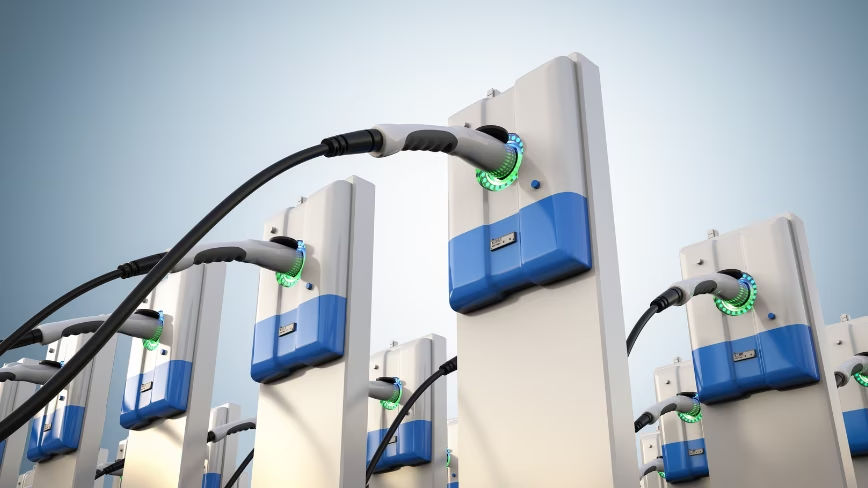
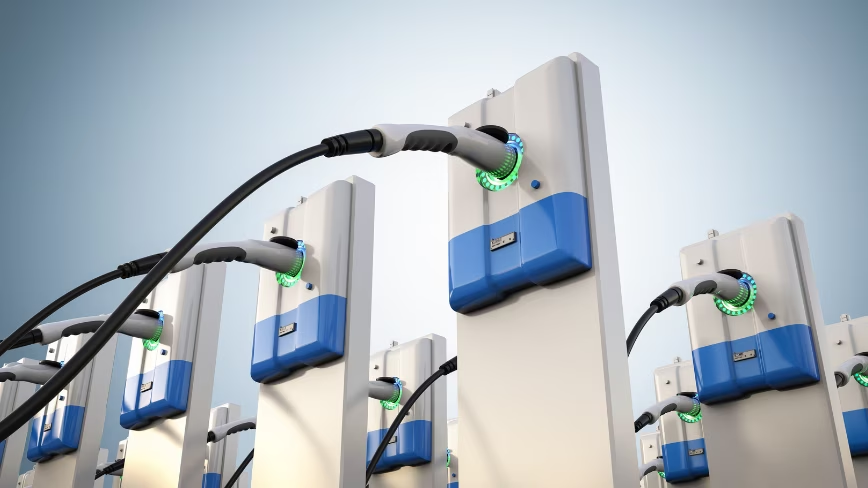
Geely’s new EV charger hits 2.25 megawatts

Published

on

Geely has revealed a fifth-generation charging system peaking at 2,250 kW, which it says takes new Lynk & Co and Zeekr models from 10 to 70% in four minutes and 30 seconds. Under AFIR a charging pool on Europe’s core network must provide 600 kW in total by 2027.

Geely has revealed a fifth-generation Smart Charging System that peaks at 2,250 kW, InsideEVs reported. New versions of the Lynk & Co 10 and Zeekr 001 charge from 10 to 70% in four minutes and 30 seconds, and from 10 to 97% in eight minutes and 40, the company says.

Nothing sold here is close.

The quickest cars on Western markets peak at 400 kW, and the Mercedes-AMG GT four-door will take 600 kW when it arrives. Geely did not say what peak rate its own cars actually reach.

Advertisement

The rules make the better comparison.

A charging pool on Europe’s core network must provide 400 kW in total by the end of this year under AFIR, rising to 600 kW with two 150 kW points by 2027. One Geely connector is nearly four times that whole site.

The battery claim is the part worth reading.

Geely says an AI system called Xingrui PowerMind predicts cell temperatures and adjusts speed to hold an average of 55 degrees Celsius, with a ceiling of 65. It also claims a lithium-ion pulse restoration technique, using micro pulses to reactivate lithium that plates onto the anode during repeated fast charging.

Advertisement

Europe starts testing that in November.

Euro 7 takes effect on 29 November and requires a battery to retain 80% of capacity after five years or 100,000 km, and 72% after eight years or 160,000 km. BYD put 350 fast charges into one car in nine days and reported 98.7% retention, which measures cycles rather than calendar years.

Deployment is the other gap.

BYD passed 10,000 Flash chargers in August, wants 20,000 by December and plans 3,000 in Europe, beginning with 300 in the United Kingdom. Each of its connectors delivers up to 1,500 kW. Geely has not said how many chargers it intends to build, or where.

Advertisement

It owns two European brands.

Geely’s chairman said in April that the group would stop building factories anywhere in the world and use Volvo’s instead. Volvo and Polestar sit in the same group as Zeekr and Lynk & Co. Neither has been offered this charger.

Source link

Advertisement
Continue Reading

Tech

Craftsman Chris Transforms a Dumpster Window Air Conditioner Into a DIY Geothermal Heat Pump

Published

on

DIY Window A/C Geothermal Heat Pump Project
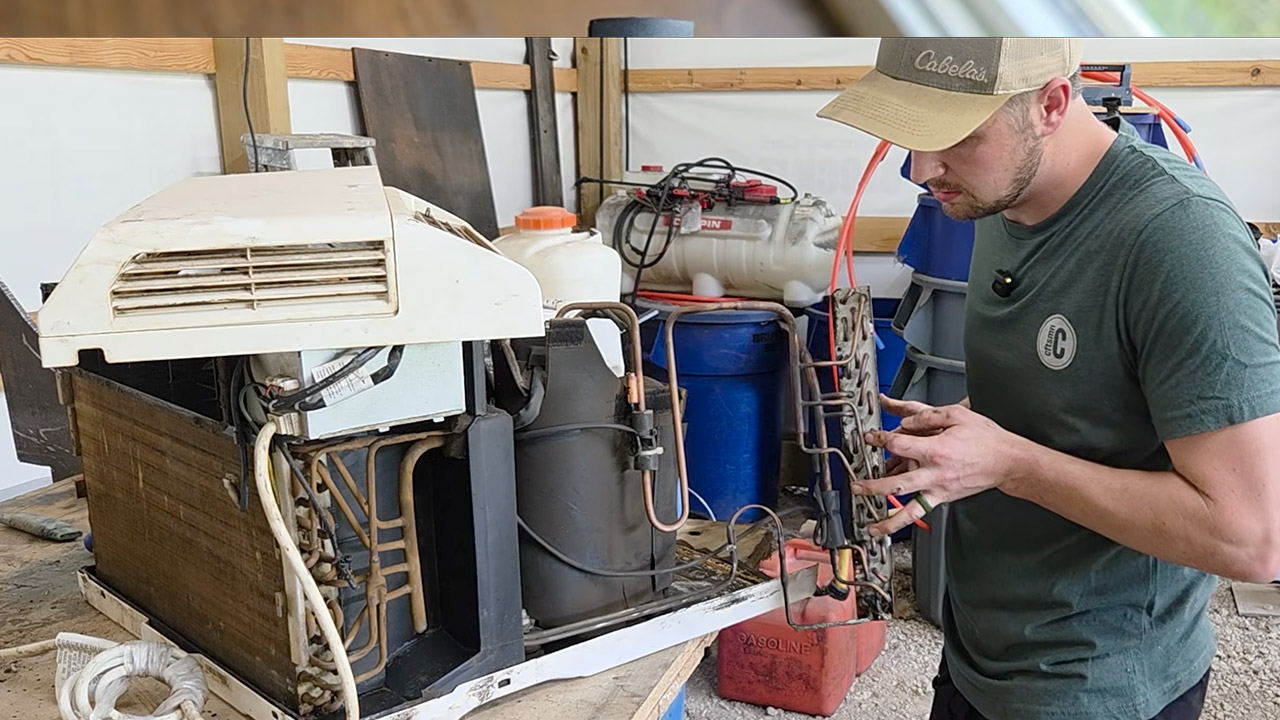
Two thousand feet of half-inch PEX already slept six to eight feet under Craftsman Chris’s yard when his first homemade cooling plan came up short. Four parallel five-hundred-foot slinky loops and a Taco 009 pump pushed water through a heat exchanger in the furnace plenum, yet the dirt had baked in the sun after excavation and the loop stayed warmer than he needed. Direct ground water barely cooled the house. He needed a machine that could pull heat out of indoor air and dump it into that soil instead of into hot summer wind.


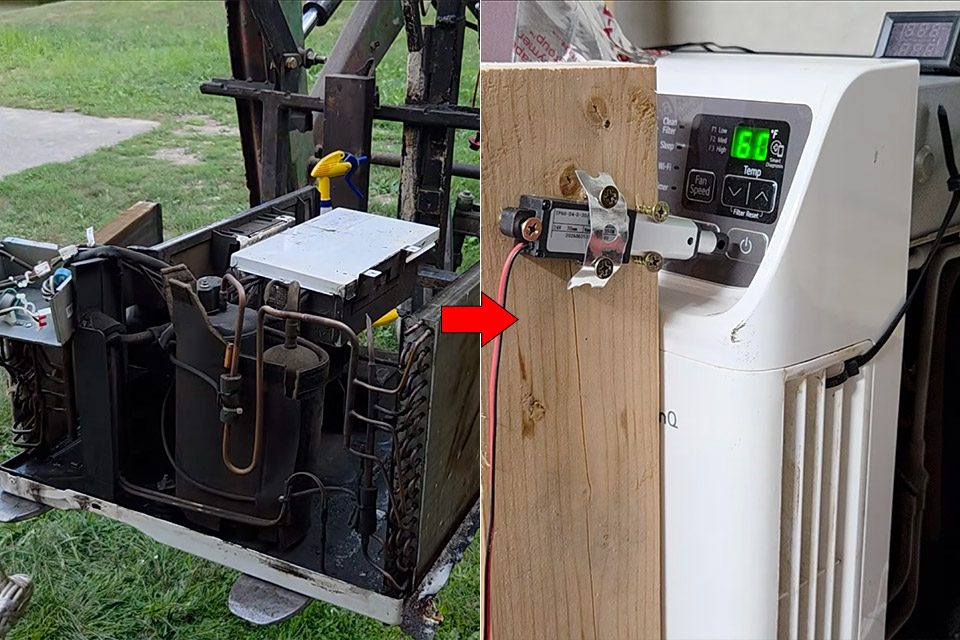
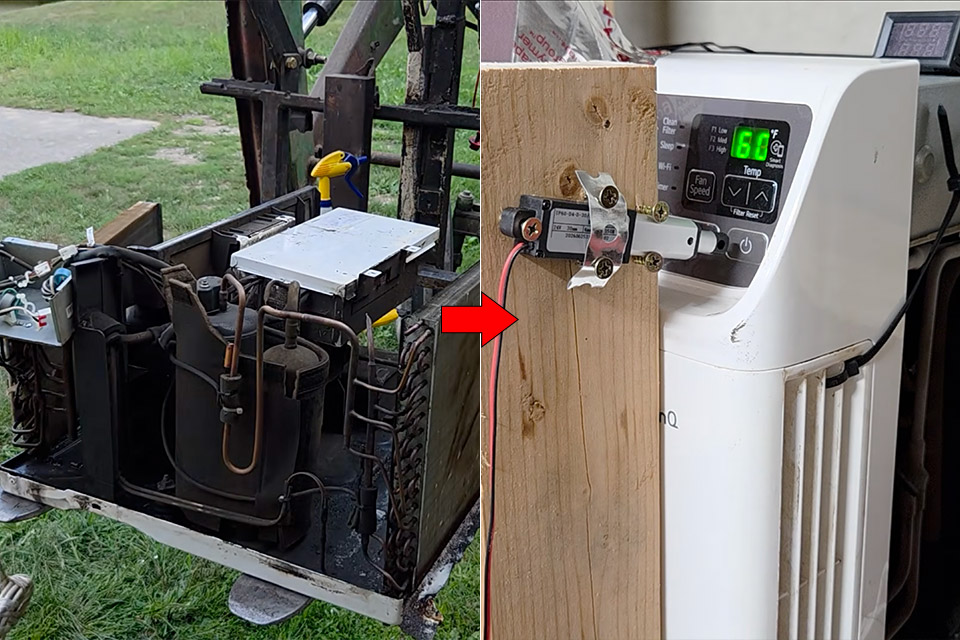
Chris ended up with a 14,000 BTU LG Dual Inverter window unit that he fished from a dumpster. After cleaning the coils with Simple Green and a fin brush, and then washing them with soapy water, he was able to free up the condenser fan without touching any of the copper piping. He then moved the outdoor coil roughly 90 degrees without damaging a single copper line, ensuring that the refrigerant remained sealed. A little of scrap sheet metal and a MIG welder came in helpful for creating a water jacket around the coil, and to make it all work, he rigged up the ground-loop water to feed in at the top, surround the condenser, and exit at the bottom into the underground PEX tubing.

Sale


JISULIFE Handheld Fan Pro1S – Next-Gen Airflow: Up to 40H Runtime
  • Brushless Motor – Super Power: The combination of a three-phase brushless motor and a 5000mAh battery significantly improves the wind speed, power…
  • Scroll Switch – Customizable Wind Speed: This small fan adopts a scroll switch design, and the wind speed can be adjusted steplessly. The portable fan…
  • Fashionable Design – Metal Body: The body of this handheld fan is made with advanced oxidation technology, giving it a metal-like texture. Its smooth…

DIY Window A/C to Geothermal Heat Pump Project
Keeping the sealed circuit intact was important since he never cut any tubing or vented the refrigerant, thus the compressor and valves continued to function properly. Of course, new problems arose anyhow. For one reason, oil might accumulate at the new low point of the spun coil, starving the compressor. Then there was the issue of uninsulated aluminum on the water jacket absorbing extra heat, as well as air bubbles requiring a long time to purge. I suppose the final nail in the coffin was that the safety plug on the original power cord wouldn’t reset, so he had to temporarily replace the power cord end. Nonetheless, none of these concerns prevented him from running the test.

DIY Window A/C to Geothermal Heat Pump Project
The control system for the device remained fairly rough, almost as beat up as the tank. He set together an old programmable logic controller and a linear actuator to hit the stock power button whenever the thermostat signaled for cooling. Not exactly a beautiful interface, but rather a production remnant that looks like it belongs on a plant floor and is being used to click a single button on a thermostat. The water flow rate through the jacket was around 3.3 gallons per minute, utilizing the same Taco pump that already serves the loops.

DIY Window A/C to Geothermal Heat Pump Project
The first true run produced somewhat better results than the previous plenum-only setup. The air leaving the unit was between 49 and 54 degrees. He detected a temperature split of 26.5 degrees, which is fairly good. Water entering and leaving the underground loops varied by barely 3 to 5 degrees, but the jacket itself typically reached the upper 70s or low 80s. As an extra benefit, the cool air was actually making its way upstairs into the main living area. The next topic on the agenda is whether a single window unit and 2,000 feet of piping in the backyard can keep the entire house cool all summer.
[Source]

Advertisement

Source link

Continue Reading

Tech

‘Independent CNN Oversight Board’ To Be Hand Picked By Paramount

Published

on

from the embarrassing-capitulation dept

Earlier this week we noted how California Democrats fecklessly folded to Paramount’s demands and settled the 12-state antitrust lawsuit against Paramount’s $111 billion merger with Warner Bros. We also noted how the conditions affixed to the deal are largely pathetic, and generally consist of a lot of performative fluff Paramount itself recommended and California AG Rob Bonta had previously laughed off.

But Bonta is thinking politically about not just Paramount’s lobbying influence, but any future relationships with potential presidential candidate Gavin Newsom or potential future California governor Xavier Becerra (both of whom rushed to pushing for settlement).

None of the conditions meaningfully protect consumers, labor, and markets from what’s coming, but they clearly spent a lot of time designing conditions that let them pretend otherwise.

That includes a purported “independent CBS and CNN oversight board” that’s supposed to prevent Larry Ellison from degrading CNN and CBS’ editorial mission even further. That’s something Paramount itself first floated last August, largely because it knows it will be able to safely ignore it (just as Rupert Murdoch did when he struck a similar deal after the acquisition of the Wall Street Journal).

Advertisement

And sure enough; as details leak out it’s clear the board is largely decorative. Insiders have already noted how the “independent” board will consist of journalists that have at least ten years experience in journalism, but they’ll be hand picked by Paramount:

“According to the terms of the settlement, the board must be established within 180 days of the closing of the deal. It will be composed of five current or former journalists with at least 10 years of experience each and will be appointed by the board of the company for three-year terms.”

That’s just profoundly embarrassing. There’s absolutely zero chance that Paramount is going to appoint the kind of folks capable of pointing out that Ellison, and underlings like Bari Weiss, are actively working to convert CNN and CBS into corporation and oligarch-friendly agitprop. And there’s really nothing preventing Paramount from tap-dancing around the requirements.

I’m sure, like a stopped clock, this board will occasionally and initially make a useful decision to give the impression it’s a real entity. But historically this stuff is designed to prevent real oversight, particularly by government. Former and current insiders at the network simply aren’t impressed:

“There is no way that is going to work,” former CNN anchor Jim Acosta said. “They will start to fire anchors and certain folks to send a message, and the rest will either have to fall in line or leave. This was a colossal mistake.”

CNN and CBS were already pockmarked with a lot of weak-kneed corporation-friendly journalism. Now that Ellison’s involved, both will indisputably begin to look more and more like other right wing propaganda outlets like the New York Post and Fox News.

Advertisement

These kinds of conditions are designed to make it look like responsible people are doing something about media consolidation — without actually doing anything about media consolidation. You protect consumers, labor, and markets by actively enforcing antitrust law; not by endlessly designing half-cooked half-measures that state regulators then fail to consistently enforce.

What’s extra embarrassing is that Democrats like Bonta, Karen Bass, and Newsom had an opportunity here to demonstrate that Democrats had backbone and actually care about subjects like media reform, media consolidation, and the rise of right wing propaganda and disinformation.

Instead they immediately buckled to Ellison’s threat that he’d move Paramount out of California, and are now patting themselves on the back for “saving jobs” — when the end outcome of these deals is always thousands of layoffs as the bigger company offloads merger debt to labor and consumers.

One nice thing about antitrust: if U.S. politicians were to actually enforce the law, we’d have markets more heavily peppered with the kind of small and mid-sized companies that lack the scale and political influence to threaten government when it tries to enforce the law.

Advertisement

Throughout this whole process Paramount (and by proxy a consolidated press) have made it sound like the 12 states were engaged in “radical leftism” simply by enforcing existing antitrust law. It’s important to remember how little Newsom, Bonta, Bass, and Becerra cared about standing up to corporate power the next time you’re in the voting booth.

Filed Under: consolidation, corruption, david ellison, gavin newsom, hollywood, larry ellison, mergers, movies, oversight board, rob bonta, tv

Companies: cbs, cnn, paramount, warner bros.

Source link

Advertisement
Continue Reading

Tech

Our Division quiz is perfect for fans of the post-apocalyptic looter-shooter looking for a way to test their knowledge of the series

Published

on

Tom Clancy’s The Division and The Division 2 are two of my favorite online and co-op games of all time; I still play The Division 2 most months (at least) and have done so since launch.

The second game still has a committed player base and is a game that keeps on going and keeps on giving for fans who play regularly and those who come back occasionally.

Source link

Continue Reading

Tech

Innovative WorMa Robot Pumps Water From Head to Tail to Cross Land, Steps, and Water

Published

on

NYU WorMa Shape-Shifting Robot Stretch
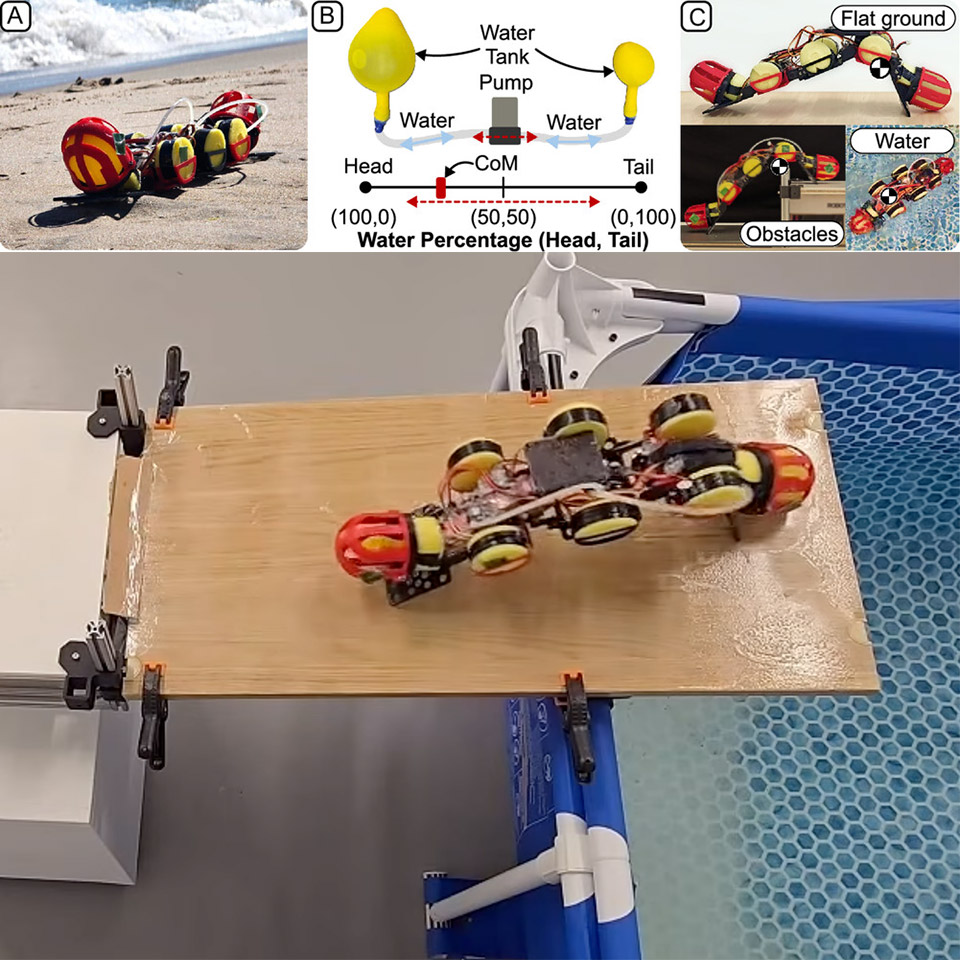
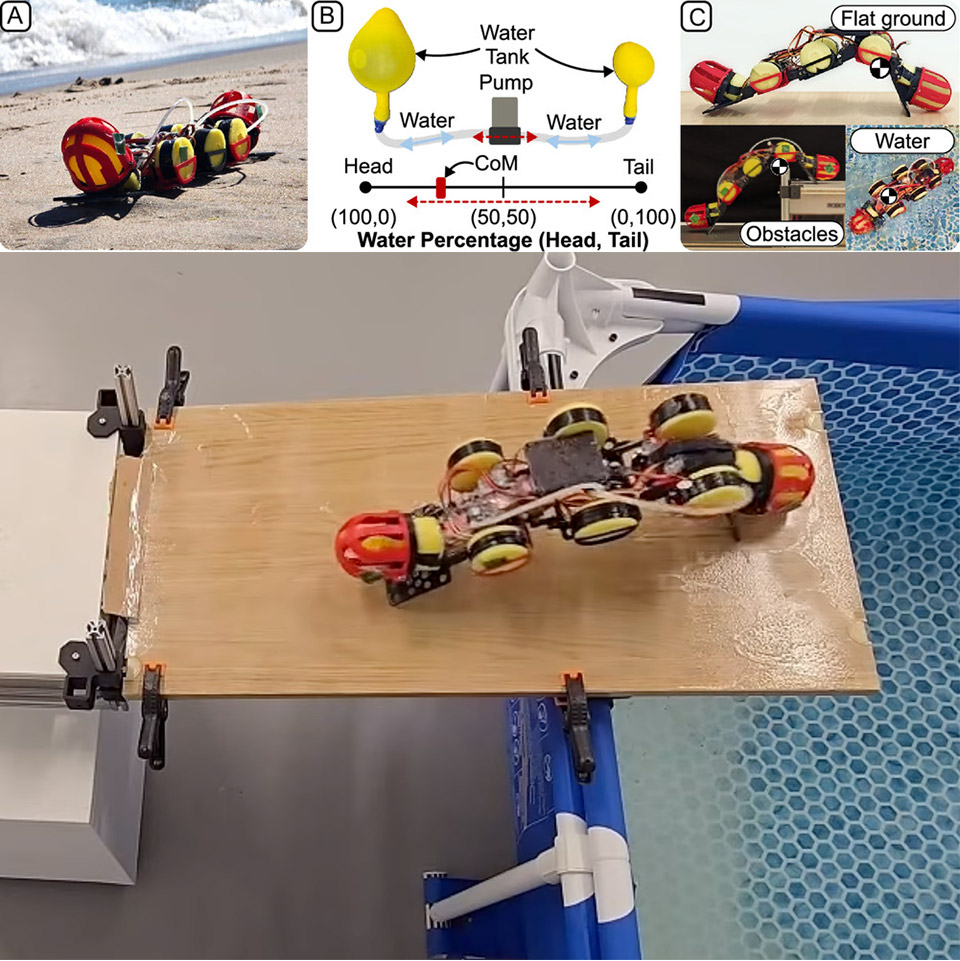
NYU Tandon assistant professor Nana Obayashi and Ph.D. student Daniil Filimonov built WorMa so one undulating machine could inspect a coastline, a flooded street, or a wetland without extra limbs or a second gait. WorMa blends “worm” and “mass,” and that mash-up is the entire plan. Five 3D-printed segments form a body about 50 centimeters long and a little over one kilogram. Four servos at the joints send a traveling wave down the length. Silicone pads under the belly give directional grip on dirt or pavement. Foam disks along the sides keep the robot from sinking once it enters water. An ESP32 runs the servos and the pump.


Nearly 350 grams of water, or 28% of the robot’s total weight, are suspended in two latex balloon reservoirs located inside the robot’s head and tail. They are linked by a piece of silicone tubing, allowing the water to be transferred back and forth. In the robot’s center, a 12-volt peristaltic pump stirs the water, slowly transporting it from one end to another. It takes little under 110 seconds for the pump to completely drain one reservoir and refill another. By shifting the water around, the robot can change where its weight is, on the ground or in the water, while still maintaining its wavelike movement. The water in the head reservoir adds weight to the robot’s front end, strengthening its grip on the ground. The water at the tail end lessens the weight at the front, causing the robot to move differently on the surface.

Sale


ELEGOO UNO R3 Smart Robot Car Kit V4 with Camera, Compatible with Arduino
  • BUILD, CODE & DRIVE YOUR OWN ROBOT CAR: Turn coding, electronics and engineering into a working programmable robot car you can assemble, program and…
  • EXPLORE FPV, LINE TRACKING & OBSTACLE AVOIDANCE: Control the robot with the ELEGOO app or IR remote, view live FPV video through the onboard camera…
  • BEGINNER-FRIENDLY BUILD WITH GUIDED WIRING: Keyed XH2.54 connectors help reduce wiring mistakes, while the illustrated tutorial and example programs…

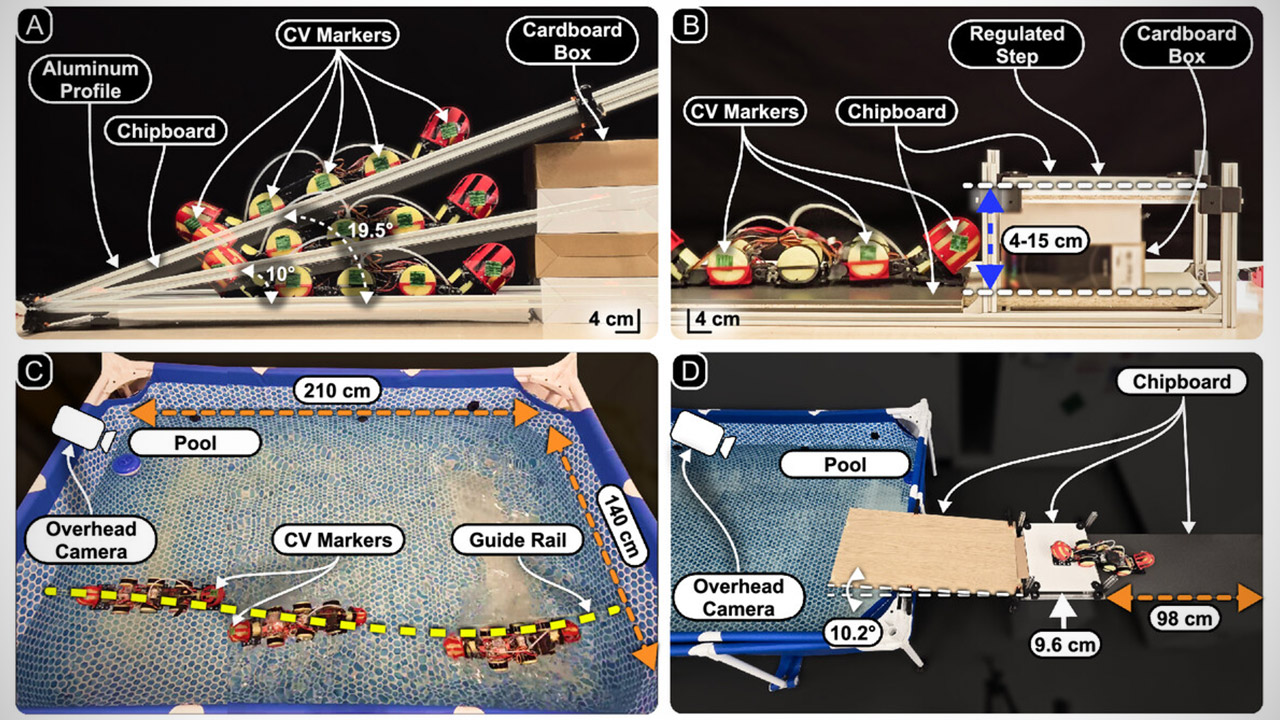
When you take the robot up a 19.5-degree incline, the only setup that can gain enough grip at the front to haul the entire thing up is the head-heavy one. That front weight also reduced transportation costs by more than a third as compared to other weight placements, but other layouts simply couldn’t obtain enough bite at the nose to climb over the slope’s lip. Jumping a 15cm step is simple and only requires a quick pumping sequence. When WorMa approaches a step with water at the front, the front end grabs it and pulls it up; the water then flows to the back, allowing the lightened front to rise up and grab the edge. Water returns to the head so the robot can haul the rest of its body over. A fixed mass distribution failed even a four-centimeter step.

Advertisement

NYU WorMa Shape-Shifting Robot Stretch
Things flip on their head in the pool. WorMa swims 26% faster and 52% more efficiently with water in its tail. It is moving at 9.6 cms per second at one point, yet returning to dry land requires the exact opposite movement. The water must shift back to the front, allowing the leading pads to grab and lift the robot out of the water. If you do this with a hefty tail or an even weight split, it will remain stuck at the waterline.

NYU WorMa Shape-Shifting Robot Stretch
Tying all of this together, the robot can move on flat ground, navigate a step, climb a slope, and swim in water, all while moving 300 grams of water at each stage. An operator can still determine when to move the water. If this type of robot is ever going to roam a real shoreline on its own, upgrading to quicker pumps and an inbuilt system that allows it to rebalance in real time seems like a logical next step.
[Source]

Source link

Continue Reading

Tech

Historic Fighter Jet Takes A 2,700-Mile Drive Through America’s Heartland

Published

on


The United States Navy once operated an iconic twin-engine, two-seat, variable-sweep-wing fighter known as the F-14 Tomcat. If that sounds familiar, it’s because it’s the same plane that Tom Cruise immortalized in the film “Top Gun.” The Navy ultimately retired the 4th-generation F-14 in favor of the F/A-18 Hornet, destroying most of them to ensure none of their spare parts found their way to Iran, which had purchased a sizable number before the Iranian Revolution ended relations between the U.S. and Iran.

Fortunately, some F-14s survived and are on display in museums around the United States, where people can see the legendary fighter jet. One aircraft in particular began a long trek from one museum to another, traveling 2,700 miles to get from the National Naval Aviation Museum in Pensacola, Florida, which had two F-14s, to the Pueblo Weisbrod Aircraft Museum in Pueblo, Colorado.

Advertisement

The task of moving the F-14 fell to Worldwide Aircraft Recovery. Due to the plane’s size, the drive between the two cities, which would normally be 1,300 miles by car, covered more than twice the distance.

Advertisement

The T-14 Tomcat’s 2,700-mile trek from Florida to Colorado

Unfortunately, flying the F-14 wasn’t an option, which is why it had to travel by road. That wasn’t a problem for Worldwide Aircraft Recovery, which specializes in recovering aircraft and transporting them. The F-14 measures 22 feet wide without its wings, significantly wider than the nine to 12 feet of a typical roadway lane. 

Because some states denied Worldwide Aircraft Recovery’s request to operate on their roads, the trip required the plane to travel through Alabama, Mississippi, Tennessee, Kentucky, Indiana, Illinois, Iowa, Missouri, Nebraska, and Kansas, before finally reaching Colorado. The trip took two weeks, with night driving occurring only in Florida, Alabama, and Nebraska. Most of the transit was conducted during daytime, with some states requiring police escorts as the truck carried the F-14 on their roads. Normally, the 1,335-mile drive would take you from Florida through Alabama, Mississippi, Louisiana, Texas, and New Mexico, so you can see how circuitous the drive was.

Receiving a T-14 Tomcat is a great addition to the Pueblo Weisbrod Aircraft Museum, as the U.S. destroyed most of its F-14s, making complete aircraft remarkably rare in the country. After the aircraft arrived, museum staff began the arduous task of reassembly, and once completed, it will find a home inside the museum, where it will be displayed for the public.

Advertisement


Source link

Advertisement
Continue Reading

Tech

6 free and inexpensive sites teaching students to code

Published

on

If you want to learn how to code, but in your own time and without it costing an arm and a leg, here are some useful resources.

In 2026, despite the rising popularity of vibe coding, there are a multitude of STEM-based careers that require employees to have strong, traditional coding skills. You may want to improve yours or even begin from scratch, but if you find that standard courses are costly or too time consuming, it can be a deterrent.

But fret not, because there are plenty of opportunities to develop coding, skills be it with personal or professional goals in mind – and they don’t have to drain your time or your finances. 

So, if you want to build on your programming skills, but aren’t sure where to go, the following six resources could be exactly what you are looking for. 

Advertisement

Codewars

Codewars is a site for the students and professionals who want to broaden their skills, but who also want to have a little fun along the way.

The platform aims to help learners “achieve mastery through challenge” via training with peers on code kata – small coding exercises – that continuously challenges. Users can sharpen their skills, go up in the ranks though the challenge board, engage with a broad community of fellow learners and receive instant feedback to determine if progress is being made.

You can even create your own challenges and questions and put them to the wider community. The creators aptly refer to the site as a coding dojo and whether you are a student or sensei, there is definitely something to be gleaned from Codewars. 

Exercism

UK-based Exercism describes itself as a platform focused on “building a place where anyone can learn and master programming for free, without ever feeling lost or stupid”. Students of all abilities can learn how to code in 83 different languages via articles, videos and project work, with the goal being to have fun and progress, without stress or competition.

Advertisement

The platform also offers a wide community of peers with which to collaborate and build friendships, as well as a wide network of mentors to guide the learning process. 

FreeCodeCamp

FreeCodeCamp is exactly what it sounds like. This free platform is a resource through which students can learn how to code via a collection of podcasts, videos, articles and interactive lessons.

The available curriculum is expansive, can be engaged with via a number of different spoken languages and comes with a free certificate of completion. There are available learning options for beginners all the way through to advanced students and engagement is solely at the discretion of the user.

LeetCode

If you are a professional or a recent graduate preparing for a job interview that will likely demand robust coding skills, LeetCode is the ideal resource to test yourself in advance. The free-to-use platform supports 14 popular coding languages and enables users to debug and write their own online projects.

Advertisement

Students can test their coding knowledge by answering some of the more than 4,300 questions available. Users can also engage with a wide community of peers, participate in contests, challenge themselves and earn rewards.

If you have some skills but are looking to hone them, with future career opportunities in mind, this is definitely the place for you. For those who want a broader experience, there is also a premium paid feature. 

The Odin Project

The Odin Project, which is a free open-source learning platform, is an ideal site for a student or professional looking to advance their coding skills. The goal is to empower students to embark upon a career that requires coding, particularly those looking to become developers, though it is open to anyone who wishes to use it. 

The platform offers a hands-on introduction to all of the essential tools you’ll need to build real, working websites and also offers information on what web developers actually do and the foundations they might need for advancing their education. “This project is designed to fill in the gap for people who are trying to hack it on their own but still want a high-quality education,” according to the site.

Advertisement

Programiz

Programiz’s mission is to create a space in which learners can learn how to program easily and at their own pace. The platform offers tutorials in a variety of languages, the browser is free to use and no installation is required.

Programiz claims to teach the skill of coding step by step, via the use of online compilers available in more than 20 languages and interactive lessons that offer a guided path to learning programming with practical code that runs in your browser. 

Don’t miss out on the knowledge you need to succeed. Sign up for the Daily Brief, Silicon Republic’s digest of need-to-know sci-tech news.

Advertisement

Source link

Continue Reading

Tech

Spotify finally brings Taste Profile to the US, and it sounds like a boon for your iffy feed

Published

on

In October last year, Spotify started testing a new feature that let users prevent certain songs from affecting their called Taste Profile. The whole idea behind this new trick was to let users customize their music feed and what they see on the homepage based on their specific preferences. Officially, Taste Profile became its own feature and went into the testing phase in May this year, but only for a limited audience. Now, it’s finally making its way to the US market.

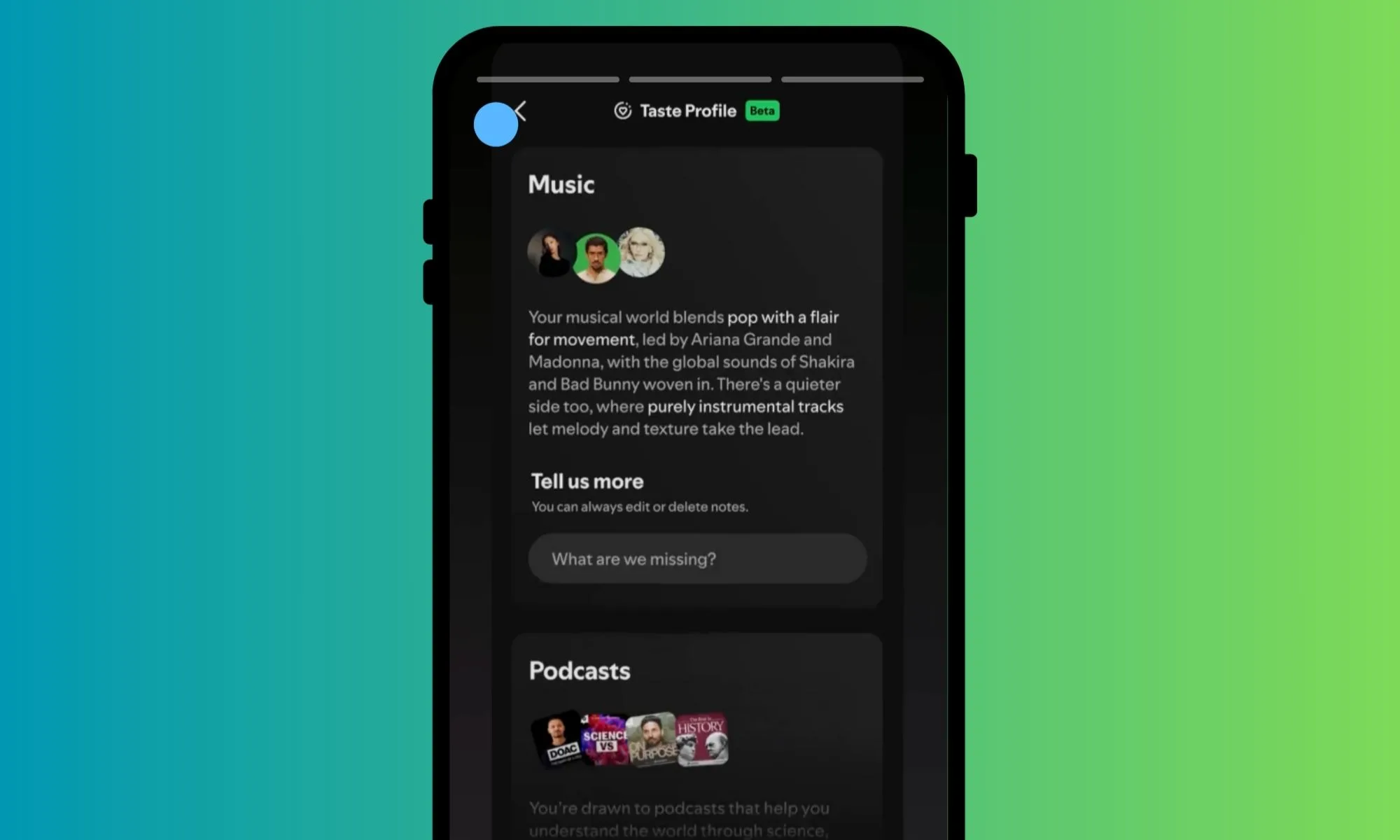
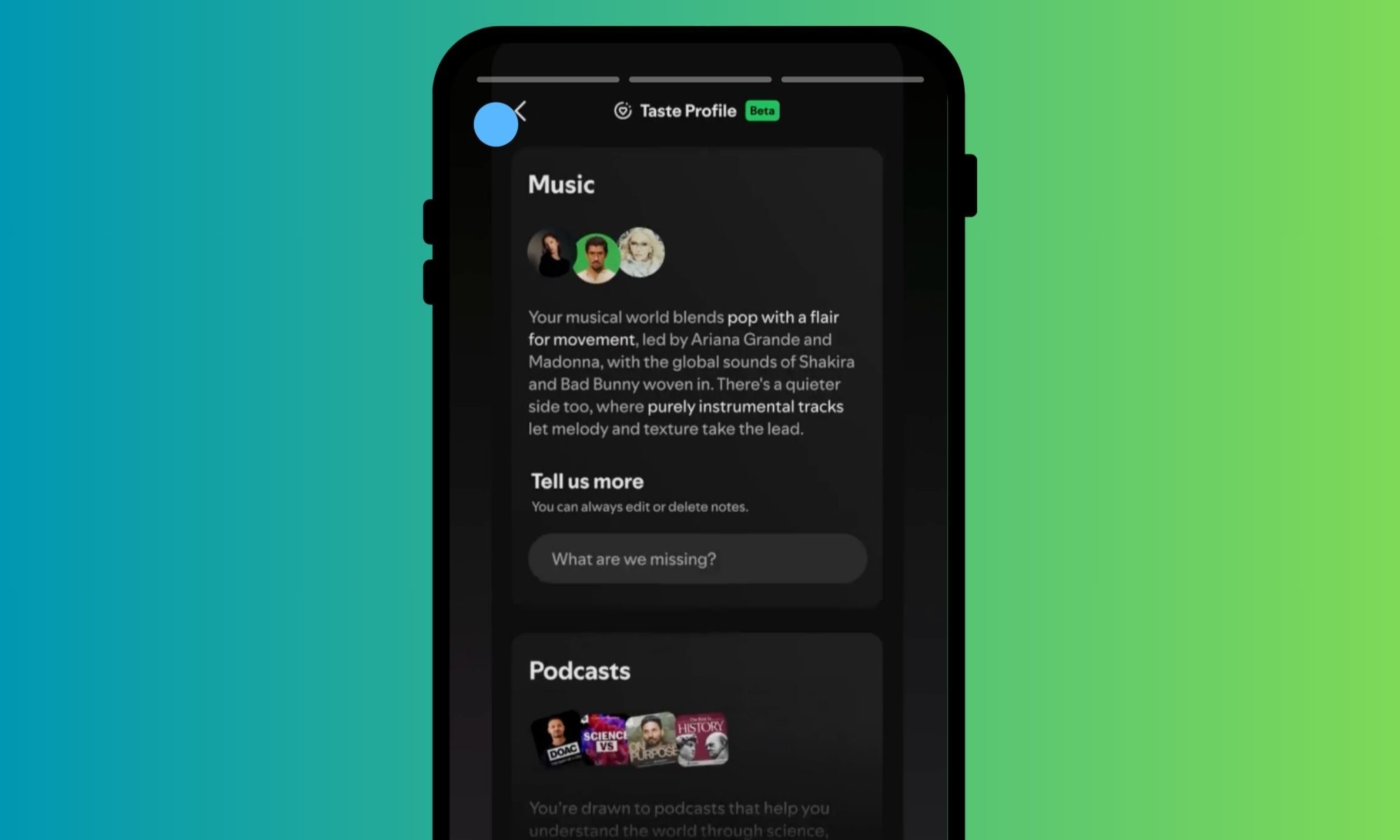
Earlier today, Spotify announced that Taste Profile is now available to all users who are above 18 years of age in the US. “Taste Profile gives you more control over your recommendations, whether you want to explore beyond your usual interests or fine-tune what you already love. For the first time, you can see Spotify’s brief interpretation of your taste across music, podcasts, and audiobooks,” says the company.

The best part about this feature is that it’s not an overtly technical upgrade and doesn’t need any learning curve. Instead, it takes a conversational approach. So, when you swipe on the homepage and access the Taste Profile option in the side menu, you get a text box where you can write in natural language what it is that you want Spotify to show you more or less of. You can ask it to play more Pink songs in the evening, or surface more news-focused podcasts.

Spotify says these notes ultimately dictate what you see on your home feed, whether it’s discovery of new music, podcast, or a certain kind of audiobooks. Interestingly, the conversational notes that you feed into the Taste Profile search box don’t only cover genres of music, but they also dynamically respond to a certain mood, emotion, or areas of interest, like history, technology, or art.

You just have to describe what exactly it is that you want to hear more of, and your home feed and recommendations will be tailored accordingly. In order to check out the new feature, tap on the profile picture icon in the top corner, open the menu panel, click on Taste Profile, and type your note underneath the Tell us more, label.

Spotify says that once you have dropped a note to adjust your Taste Profile, you will see the changes reflected within a few hours. There’s also an option to edit or delete the notes that you have previously fed into the Taste Profile system. Spotify is separately working on a cache limit feature that lets users handle how much space Spotify’s temporary files take up on your phone’s storage.

Advertisement

RELATED COVERAGE:

Source link

Advertisement
Continue Reading

Tech

Snapdragon 8 Elite Gen 6 reaches 5GHz while going big on agentic AI

Published

on

First look: Echoing Apple’s recent iPhone 18 unveiling, Qualcomm has introduced two new Snapdragon 8 Elite mobile processors with AI assistants as a primary focus. While the chips significantly outperform the Snapdragon 8 Elite Gen 5 in CPU performance, GPU performance, and power efficiency, Qualcomm clearly sees AI agent support as the new lineup’s main selling point.

Qualcomm revealed the Snapdragon 8 Elite Gen 6 and 8 Elite Extreme Gen 6 at this year’s Snapdragon Summit. The mobile SoCs will power future flagship Android devices from Doubao, Honor, Motorola, Oppo, RedMagic, Stepx, Vivo, and Xiaomi.

Built on a 2nm process node that enhances power efficiency by 37%, both chips feature two Oryon Prime CPU cores that achieve 5GHz, six 4GHz performance cores, and 16MB of Flex Cache. While the standard Elite Gen 6 improves CPU performance by 10% over its predecessor, the Extreme variant extends the gain to 13%.

Advertisement

GPU and NPU performance enhancements are much more impressive. The new Adreno GPUs outperform the Elite Gen 5 by 35% and 44% in the standard and Extreme models, respectively, while raising power efficiency by 40%, partially thanks to AI rendering via the new Adreno Neural Fusion.

Meanwhile, the Elite Gen 6’s Hexagon NPU runs AI applications 14% faster in the standard model and 35% faster in the extreme variant, with AI performance-per-watt increasing by 20% and 33%, respectively.

Most of Qualcomm’s trailer for the Snapdragon 8 Elite Gen 6 focused on showing AI agents automating various everyday tasks that might take humans multiple steps. In one clip, an agent automatically sorts a newly recorded video and provides options for editing it. In another, a jogger receives a notification about a nearby property that meets their preferences, with the option to automatically share a photo and book a viewing appointment.

Advertisement

Regarding sound, AI also facilitates audio separation and voice isolation. Even the Qualcomm X105 5G wireless modem is AI-enhanced, improving energy efficiency while also increasing upload and download speeds. Meanwhile, Qualcomm’s Wi-Fi 8-compliant FastConnect 8800 can achieve 10Gbps with a 4×4 Wi-Fi configuration, tripling the gigabit range over prior models.

Camera performance is another notable difference between the two tiers. 8 Elite Extreme Gen 6-powered phones can record video at up to 60fps in 8K, while the cheaper SoC only achieves 30fps at that resolution.

The earliest devices powered by Snapdragon 8 Elite Gen 6 will include the RedMagic 12Pro+, iQOO 16, and iQOO Pad Ultra.

Advertisement

Source link

Continue Reading

Tech

Research Ireland funding creates eight spin-outs, report shows

Published

on

In its first annual report, the agency says it paid out €313m in research grants.

The Government’s science and innovation agency, Research Ireland, gave out €288m in fresh research awards last year.

The organisation was formally created in August 2024 after Science Foundation Ireland was merged with the Irish Research Council.

In its first annual report under its new persona, Research Ireland reports it managed €610m in committed funding and paid out €313m to researchers in grants.

Advertisement

That investment leveraged a further €310m, which includes €129m from the EU, nearly €77m in private funding, €24m from Enterprise Ireland and €25m from other Government funding sources. Non-Exchequer funding rose to €227.3m, up 14pc since 2024.

According to the 2025 report published today (23 September), the agency gave out nearly €290m in 1,053 new awards across its range of programmes.

Its funding supported more than 3,000 PhDs and 1,000 senior researchers, and nearly 1,500 postdoctoral fellows. 40pc of its funded principal investigators and co-principal investigators are women, along with 51pc of grant holders, it reports.

Collectively, the researchers supported by the agency’s funding delivered nearly 6,000 publications, 167 invention disclosures and launched eight new spin-outs.

Advertisement

Speaking at the annual report’s launch, Minister for Further and Higher Education, Research, Innovation and Science, James Lawless, TD said that the report provided an opportunity to reflect on the impact of public investment in research.

“It also comes at a time of continued momentum, with Research Ireland advancing key initiatives including the new RINN network, Global Talent Ireland and working in collaboration with the Higher Education Authority to deliver Inspire, helping to ensure Ireland can deliver and support world-class research and innovation.”

Michael Horgan, the Research Ireland’s chairperson added: “The creation of Research Ireland marked an important step in strengthening Ireland’s research and innovation system.

“Since its establishment, the agency has successfully brought together the strengths and expertise of the organisations that formed Research Ireland, while maintaining a commitment to excellence, transparency and impact.”

Advertisement

Don’t miss out on the knowledge you need to succeed. Sign up for the Daily Brief, Silicon Republic’s digest of need-to-know sci-tech news.

Source link

Advertisement
Continue Reading

Trending

Copyright © 2025