
Crypto World
Crypto Long & Short: Asia’s digital asset crackdown: accountability gets personal

Welcome to our institutional newsletter, Crypto Long & Short. This week:
- Bob Williams on how stricter crypto regulations in Asia are putting more personal responsibility on senior leaders, making strong governance and D&O insurance essential.
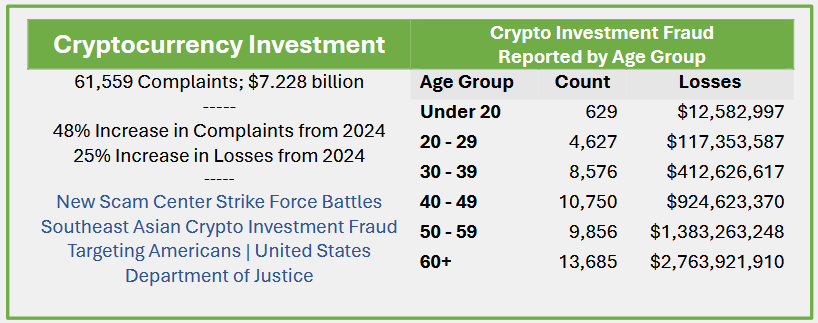
- The FBI’s Haidy Grigsby on how crypto scams are increasingly targeting experienced investors by building trust and tricking them into making larger deposits until their money is gone.
- Top headlines institutions should pay attention to by Francisco Rodrigues.
- Hyperliquid’s TradFi bet is now 40% of its own volume in Chart of the Week.
Expert Insights
Asia’s digital asset crackdown: accountability gets personal
By Bob Williams, FinTech, digital assets, & blockchain advisory leader (Asia/Pacific), Lockton Companies
A new wave of digital asset regulations across Asia is increasing pressure on trading platforms and asset managers to strengthen governance — and to reassess their Directors’ and Officers’ (D&O) liability insurance arrangements.
In recent months, three leading digital asset hubs — Hong Kong, Singapore and South Korea — have announced plans to refine their respective regulatory frameworks. As regulatory expectations rise and senior management’s personal accountability becomes clearer, platform operators must stay informed of these developments and evaluate whether their existing risk transfer strategies remain fit for purpose.
Hong Kong: expanding accountability beyond governance
In August 2025, Hong Kong’s Securities and Futures Commission (SFC) issued a circular to licensed virtual asset trading platform operators clarifying senior management’s responsibilities regarding the custody of clients’ virtual assets. The circular reinforces expectations around governance, internal controls and effective oversight, signaling a continual shift toward personal accountability for directors and senior management.
An emerging consideration from the SFC’s consultation process is whether virtual asset management service providers should be permitted to rely on non‑SFC‑regulated or offshore custodians. From an insurance perspective, the availability of coverage for virtual asset risks is closely tied to the robustness of custody arrangements, including security controls, operational resilience and asset protection standards. To date, insurance capacity has largely been supported by the prescriptive requirements imposed on SFC‑regulated custodians and platforms.
If alternative custody models are permitted, ensuring that non‑regulated or offshore custodians are held to equivalent standards, including appropriate insurance coverage will be critical. Without alignment, firms that have invested heavily to meet Hong Kong’s regulatory and insurance expectations may face a competitive disadvantage, while the objective of enhancing investor protection and market integrity could be undermined.
Singapore: reinforcing senior management competency
In 2025, Singapore introduced licensing requirements for digital token service providers serving only overseas customers, bringing a broader range of firms within the Monetary Authority of Singapore’s regulatory perimeter.
Under the licensing guidelines, the competency and fitness of key individuals are core admission criteria. Senior management is expected to demonstrate a clear understanding of the regulatory framework and to exercise effective oversight and control over business activities and staff.
As regulatory expectations rise, so too does the personal exposure of directors and officers. In this context, D&O insurance remains a critical component of a firm’s overall risk management framework, helping to protect personal assets in the event of claims or regulatory actions arising from alleged governance or oversight failures.
South Korea: gearing up for Digital Asset Basic Act
South Korea is pursuing a more expansive regulatory overhaul through the proposed Digital Asset Basic Act, introduced to the National Assembly in June 2025. The bill seeks to formalize the digital asset market by regulating issuance, trading practices and distributions, while introducing new governance structures around asset listing and delisting decisions.
These imminent changes would significantly increase compliance obligations for trading platforms and related service providers. In this environment, D&O insurance plays an important role in protecting directors and officers from the financial consequences of legal actions, investigations or claims arising from alleged regulatory breaches.
Navigating regulatory complexity with D&O insurance
Across Hong Kong, Singapore and South Korea, regulators are refining already sophisticated frameworks to address the evolving risks of digital assets. These developments reflect a broader global trend toward intensified regulatory scrutiny and heightened expectations of senior management accountability.
For firms operating in the region, this means proactively reviewing governance structures, custody arrangements and insurance programs to ensure leadership is appropriately protected against emerging liabilities. D&O insurance is no longer a secondary consideration — it is a core element of responsible risk management in an increasingly regulated digital asset landscape.
Informed Perspectives
Crypto scams are not just targeting the uninformed
By Haidy Grigsby, special agent, cybercrime and digital evidence unit, Tennessee Bureau of Investigation
A common assumption is that crypto scams prey on the uninformed. While this is often true in financial fraud, crypto-related frauds are increasingly catching experienced investors, retired professionals and former market participants off guard with increasing frequency.
In my work at the FBI, I recently met with a retired trader who fit that profile exactly. He met a young woman online who claimed to know someone involved in crypto trading. He was told he had been selected as a consultant because of his experience. His case illustrates a strategy that we now see often.
Initial contact often begins with a wrong-number text, LinkedIn message or social media outreach. What starts as professional often turns personal or romantic, a tactic known as “pig butchering.” Scammers flatter expertise, create exclusivity and get the target to move the conversation to encrypted apps. In this case, “she” said WhatsApp was easier for her.
Exploiting familiarity with legitimate infrastructure, victims are instructed to open accounts on real exchanges, then use self-custody wallets to access external sites through built-in Web3 browsers. Because they click within a trusted app, they often don’t realize that they have left it.
These fraudulent markets mimic real ones with a twist: unlike real markets, these platforms allow one daily trade at a set time, ostensibly to capture optimal volatility. Victims choose long or short, allocate funds and confirm a brief trade lasting seconds or minutes. The scammer will often claim to contribute their own funds, reinforcing trust and the illusion of shared risk.
Balances grow and profits appear real. In truth, no trading occurs — the website is controlled by the operation, and the returns aresimply numbers entered by the scammer on their end.
To build credibility, victims are encouraged to withdraw a small amount after a “winning” trade. The withdrawal appears processed successfully, but is funded with cryptocurrency stolen from other victims and is meant to encourage larger future deposits. “I took profits. It had to be real,” the retired trader told me in frustration.
The websites change domains and branding frequently, with victims being told the company is merging, upgrading or rebranding. In reality these changes occur because of law enforcement takedowns, and victims are simply redirected to “new trading platforms.”
When victims attempt larger withdrawals, the narrative shifts: regulatory holds, tax prepayments, liquidity verification thresholds or tier upgrades. Each explanation is paired with urgent demands for more funds.
Convincing victims of the truth remains one of the greatest challenges. When I spoke with the retired trader, it was difficult to convince him I was law enforcement and that he had been dealing with a criminal organization, not one individual. No one wants to believe the person they built trust with and gave substantial sums of money to never existed. This retired trader was left to face his family, admit he had been defrauded and ask for help with basic living expenses. By the time he accepted reality, his retirement savings were already gone: assets had been transferred overseas, laundered and liquidated.

Source: FBI Internet Crime Complaint Center (IC3), 2025 Internet Crime Report, p. 53, https://www.ic3.gov/AnnualReport/Reports/2025_IC3Report.pdf
The FBI’s 2024 data show losses rising with age, likely reflecting the fact that older individuals have more accumulated wealth than those in their 20s.
Victims gather evidence: phone numbers, accounts, photos and websites — most of it turns out to be stolen, fake or AI-generated. Despite the difficulties in apprehending the perpetrators of these sophisticated schemes, law enforcement continues to pursue these cases. Anyone affected should cease all communication and report the incident to local law enforcement, IC3.gov and Chainabuse.com.
Headlines of the Week
– By Francisco Rodrigues
This week’s headlines show institutional adoption has kept on growing in the cryptocurrency space, yet old dangers remain. Protocol exploits, state-sponsored attacks, and technology disruption remain active threats.
Chart of the Week
Hyperliquid’s TradFi bet is now 40% of its own volume
Hyperliquid’s HIP-3 has scaled from ~$115 million in its first week (Oct 2025) to a peak of $17.8 billion/week, now consistently representing 35–40% of total protocol volume. Despite launching as a crypto-adjacent product, HIP-3 is overwhelmingly a TradFi venue, with Commodities alone driving ~60% of volume and pure crypto categories accounting for just ~12%. The aggregate (core + HIP 3) volume continues to decline since the early March 2026 peak with the HYPE price now following the same trend.

Listen. Read. Watch. Engage.
- Listen: Jennifer Sanasie is joined by Bloomberg Intelligence Senior Analyst James Seyffart to break down what Morgan Stanley’s bitcoin ETF could mean for institutional flows, fee competition, and the next phase of crypto adoption.
- Read: In Crypto for Advisors, Paul Frost-Smith, CEO of Komainu, covers how institutional crypto is converging with traditional finance, but speed can introduce risk if legal and compliance layers aren’t aligned. Then, in “Ask an Expert,” Sam Boboev from the “Fintech Wrap Up,” details the key coordination risks institutions must solve for.
- Watch: Jennifer Sanasie hosts Public Keys from the NYSE. Christopher Perkins discusses the recent acquisition by Franklin Templeton and the new “Franklin Crypto,” Superstate CEO Robert Leshner and Invesco’s Kathleen Wrynn break down their partnership, and NYSE Senior Market Strategist Michael Reinking, CFA unpacks the macro environment.
- Engage: Have you bought tickets to Consensus Miami yet? More speakers have been added to the agenda! Surrounding Consensus is an institutional summit, an advisor-focused “Wealth Management Day,” 100+ ancillary events and much, much more.
Looking for more? Receive the latest crypto news from coindesk.com and market updates from coindesk.com/institutions.
Note: The views expressed in this column are those of the author and do not necessarily reflect those of CoinDesk, Inc., CoinDesk Indices or its owners and affiliates.


TLDR
- The U.S. Treasury Department has proposed new stablecoin rules to address money laundering and terrorism financing risks.
- The rules, released by FinCEN and OFAC, require stablecoin issuers to implement robust AML and CFT programs.
- Issuers will need to maintain risk-based internal controls and undergo regular audits to comply with sanctions regulations.
- The Treasury Secretary emphasized that the rules would protect the U.S. financial system without hindering innovation.
- The proposed regulations align with the GENIUS Act and set a compliance deadline of January 2027 for stablecoin issuers.
The U.S. Treasury Department’s financial crimes bureau and sanctions agency have proposed new rules for stablecoin issuers. These rules aim to strengthen measures against money laundering and terrorism financing. The joint proposal, released by the Financial Crimes Enforcement Network (FinCEN) and the Office of Foreign Assets Control (OFAC), follows the new GENIUS Act and seeks to ensure compliance with national security concerns while fostering innovation.
FinCEN’s Focus on Anti-Money Laundering (AML)
The proposed rules from FinCEN are designed to safeguard the U.S. financial system from illicit activities. Stablecoin issuers would need to implement comprehensive Anti-Money Laundering (AML) and Countering the Financing of Terrorism (CFT) programs. These programs would involve risk identification, monitoring, and mitigation procedures.
According to FinCEN, it would take a “measured supervisory approach” to enforcement. The agency emphasized that it would not take action unless there was a “systemic failure” in a payment stablecoin issuer’s AML or CFT program. The rule aims to keep stablecoin issuers in line with legal standards while avoiding unnecessary regulatory burdens.
New Stablecoin Rules Focus on Sanctions and AML
Alongside FinCEN’s AML/CFT requirements, OFAC’s proposed rules focus on sanctions compliance. Issuers would be required to develop risk-based internal controls to prevent sanctions violations. These controls would include regular testing and auditing of their systems to ensure they comply with OFAC regulations.
The Treasury Department also made it clear that the rule would not impede innovation. Treasury Secretary Bessent stated, “This proposal will protect the U.S. financial system from national security threats without hindering American companies’ ability to forge ahead in the payment stablecoin ecosystem.” The rules are part of a broader initiative to regulate stablecoins under the GENIUS Act, which mandates full backing of stablecoins with liquid assets.
The rule proposal requires public comments to be submitted within 60 days. Federal agencies are working toward a January 2027 compliance deadline. This regulatory action comes in the wake of other proposals from the Federal Deposit Insurance Corporation and the Office of the Comptroller of the Currency, further solidifying the regulatory framework around stablecoins.



The Wisconsin election on Tuesday produced its expected winner but a striking margin: Democratic-backed appeals court judge Chris Taylor defeated conservative-backed judge Maria Lazar by roughly 20 percentage points, expanding liberals’ court majority from 4-3 to 5-2 and cementing liberal control through at least 2030.
Summary
- The Associated Press called the race less than 40 minutes after polls closed; Taylor, a former Democratic state legislator and current Court of Appeals judge, replaces retiring conservative Justice Rebecca Bradley and will be sworn in August 1, 2026 — the fourth consecutive Supreme Court win for liberal candidates in Wisconsin
- The 5-2 majority means liberals hold the court through the 2028 presidential election regardless of the two upcoming conservative-seat races; even winning both of those would only return conservatives to their current 2-seat minority, leaving liberals firmly in control
- The race was significantly lower-profile than the record-breaking 2025 election — total spending was roughly $8 million versus $100 million-plus last year — because the majority was never at stake; despite the lower stakes, Taylor’s margin was 10 points larger than the previous liberal Supreme Court victory
As NBC News reported, Taylor ran up large margins in Milwaukee and Dane counties, carried Ozaukee County — a traditionally conservative Milwaukee suburb — and won more than 20 counties that voted for Trump in 2024. The race was technically nonpartisan, but both candidates ran with clear partisan backing. In her victory speech, Taylor addressed the political dimension without naming Trump directly: “Politics has no place in the judiciary, and the judiciary is not a rubber stamp for any party, group or branch of government — including the federal government.”
The most significant number from Tuesday is the gap between what was predicted and what happened. The 14th Congressional District in Georgia — another Tuesday election — showed a 17-point Democratic swing in one of America’s most Republican districts. Wisconsin’s Supreme Court race showed a 20-point Democratic margin in a contest where the majority was never in question and spending was a fraction of prior years. Both results, on the same night, in different states and different contexts, pointed in the same direction: Democratic enthusiasm running well ahead of what 2024 results would imply.
Taylor’s geographic reach was notable. She carried rural counties that voted for Trump in 2024 and held Ozaukee County in Milwaukee’s suburban ring — a county that has historically been part of the conservative base in statewide races. That cross-geographic performance without the high-stakes energy of the 2025 race suggests the enthusiasm has a structural quality rather than being exclusively issue-driven.
What the Court Will Now Decide
The Wisconsin Supreme Court under its liberal majority has already forced new legislative maps by striking down a Republican gerrymander and restored ballot drop boxes. With a 5-2 majority secured through 2030, the court is positioned to rule on congressional redistricting — Wisconsin’s congressional map remains heavily gerrymandered in Republicans’ favor — as well as voting rights cases from the 2026 and 2028 elections, and a challenge to the Scott Walker-era law that eliminated collective bargaining for most public workers.
Why Wisconsin’s Court Matters for the Broader Political and Regulatory Environment
As crypto.news has reported, the composition of Congress and state governments after November’s midterms directly shapes the pace and direction of US crypto regulation, including GENIUS Act implementation and market structure legislation. As crypto.news has noted, stablecoin legislation and digital asset market structure bills require sustained congressional engagement; the midterm environment that Taylor’s margin and Harris’s Georgia performance are signaling would produce a very different congressional calculus than the one that currently exists. Liberals will have another opportunity to expand their Wisconsin court majority in 2027, when conservative Justice Annette Ziegler will not seek a third term.
Key points:
-
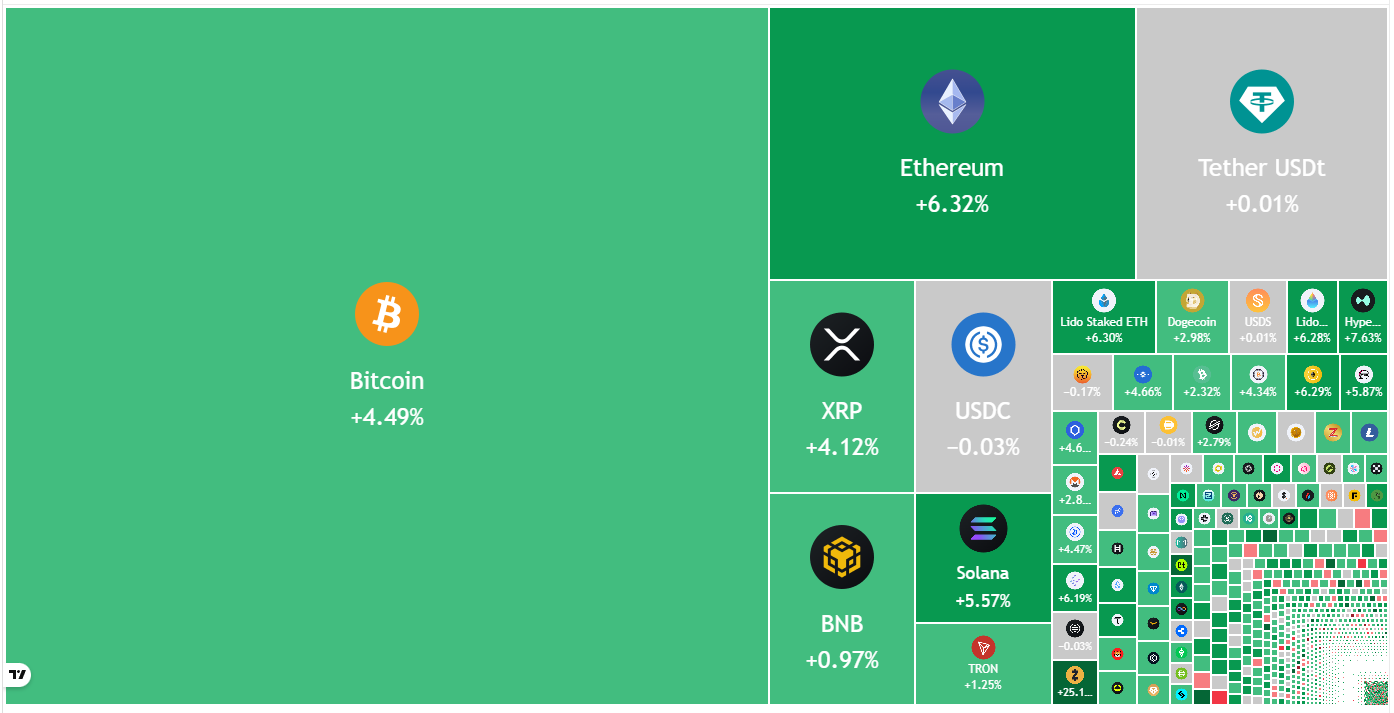
Bitcoin is showing signs of bottoming out, but some analysts believe a final shakeout below $60,000 is still possible over the next few months.
-
Several major altcoins are showing early signs of buying, but the bulls have a lot of work to do before a trend change is signalled.
Bitcoin (BTC) rose above the $72,000 level on Tuesday following the announcement of a ceasefire agreement between the US and Iran. Although the bulls could not achieve a close above $72,000, a positive sign is that the buyers have not ceded much ground to the bears. That suggests the bulls are holding on to their positions as they anticipate the recovery to continue.
Several analysts believe that BTC is showing signs of bottoming out. Crypto trader Quantum Ascend said in a post on X that BTC’s stochastic relative strength index (RSI) indicator is at the “exact same point on the daily as it was in 2022” before the price sprinted higher.

A slightly different view was put forth by Alphractal founder and CEO Joao Wedson, who said in a post on X that the bear trend may be ending but BTC may witness “a sharp move like a –$15K shakeout” over the next six months.
Could BTC and select major altcoins extend their relief rally? Let’s analyze the charts of the top 10 cryptocurrencies to find out.
Bitcoin price prediction
BTC cleared the moving averages and the $72,000 resistance on Tuesday, indicating solid buying by the bulls.

Sellers are expected to defend the $72,000 to $76,000 zone with all their might, as a close above it will complete a bullish ascending triangle pattern. If that happens, the BTC/USDT pair may skyrocket to $84,000.
The first sign of weakness will be a close below the moving averages, suggesting that the bears remain sellers on rallies. A close below the support line will invalidate the positive setup, increasing the risk of a fall to the crucial $62,500 to $60,000 support zone.
Ether price prediction
Ether (ETH) turned up from the 50-day simple moving average ($2,059) on Tuesday and surged above the $2,200 resistance.

The 20-day exponential moving average ($2,110) has started to turn up, and the RSI is in the positive territory, indicating that the path of least resistance is to the upside. There is resistance at the $2,400 level, but if the bulls overcome it, the up move may extend to $2,800.
Time is running out for the bears. They will have to swiftly yank the ETH price below the moving averages to signal a comeback. The ETH/USDT pair may fall to $1,918 and potentially to the $1,750 support.
XRP price prediction
XRP’s (XRP) bounce off the $1.27 level reached the moving averages, which is a crucial resistance to watch out for.

If buyers thrust the XRP/USDT pair above the moving average, it clears the path for a rally to the breakdown level of $1.61 and then to the downtrend line of the descending channel pattern. Sellers will attempt to halt the up move at the downtrend line, as a close above it points to a potential trend change.
On the downside, a close below the $1.27 level signals that the bears remain in control. That increases the risk of a drop to the $1.11 level and eventually to the support line of the descending channel pattern near $1.
BNB price prediction
BNB (BNB) has been consolidating between $570 and $687 for several days, indicating buying near the support and selling close to the resistance.

The flattish moving averages and the RSI near the midpoint suggest that the range-bound action may continue for a few more days. If bulls pierce the moving averages, the BNB/USDT pair may reach the $687 level, where the bears are expected to step in.
The next trending move is expected to begin on a close above the $687 resistance or below the $570 support. If the $687 level is taken out, the pair may soar to $730 and later to $790. On the other hand, a close below $570 may sink the pair to $500.
Solana price prediction
Solana (SOL) is attempting to rise above the moving averages, but the bears have held their ground.

The flattish moving averages and the RSI just below the midpoint do not give a clear advantage either to the bulls or the bears. If the SOL price rises above the moving averages, the next stop may be the $98 level. Buyers will have to secure a close above the $98 resistance to gain the upper hand.
On the downside, a break and close below the $76 support tilts the advantage in favor of the bears. That increases the risk of a drop to $67 and subsequently to $50.
Dogecoin price prediction
Dogecoin (DOGE) rose above the moving averages on Tuesday, but the recovery is facing resistance at the downtrend line.

Sellers will attempt to strengthen their position by pulling the DOGE price below the $0.09 level. If they manage to do that, the DOGE/USDT pair will complete a descending triangle pattern. The pattern target of this bearish setup is $0.06.
On the contrary, a close above the downtrend line invalidates the negative setup. That suggests the bears have given up, opening the gates for a rally to $0.11 and then to the $0.12 level.
Hyperliquid price prediction
Hyperliquid (HYPE) closed above the 20-day EMA ($37.28) on Tuesday, signaling that the correction may be over.

The bulls will attempt to push the HYPE price to the $41.59 to $43.76 zone, where the sellers are expected to mount a solid defense. If buyers clear the overhead barrier, the HYPE/USDT pair may rally to $50.
This positive view will be negated in the near term if the price turns down and breaks below the 50-day SMA ($34.80). Such a move indicates that higher levels continue to attract sellers. The pair may then tumble to the $29.42 level.
Related: Oil falls, Bitcoin jumps to $72K, but is this BTC price breakout for real?
Cardano price prediction
Buyers pushed Cardano (ADA) to the 50-day SMA ($0.26) on Tuesday, indicating that the bulls are attempting a comeback.

If buyers pierce the 50-day SMA, the ADA/USDT pair may reach the downtrend line of the descending channel pattern. Sellers are expected to fiercely defend the downtrend line as a close above it signals a potential trend change.
Sellers are likely to have other plans. They will attempt to aggressively defend the downtrend line and pull the ADA price below the moving averages. If they do that, the pair may extend its stay inside the channel for a few more days.
Bitcoin Cash price prediction
Buyers are attempting to sustain Bitcoin Cash (BCH) above the breakdown level of $443 but are expected to face significant resistance from the bears.

If the BCH price turns down from the moving averages and breaks below the $420 level, it signals the resumption of the downward move. That may sink the BCH/USDT pair to the $375 level.
The first sign of strength will be a close above the moving averages. That suggests the market has rejected the break below the $443 level. The pair may then rally to the $520 to $540 zone.
Chainlink price prediction
Chainlink (LINK) closed above the moving averages on Tuesday, opening the doors for a rally to the resistance of the $8 to $10 range.

Sellers are expected to defend the $10 level, keeping the LINK price inside the range for some more time.
Buyers will have to propel and maintain the price above the $10 resistance to gain the upper hand. That may drive the LINK/USDT pair to $10.94 and thereafter to the $11.61 level. On the downside, a break and close below the $8 level signals an advantage to bears. The pair risks falling to $7.15 and then to the pattern target of $6.
This article does not contain investment advice or recommendations. Every investment and trading move involves risk, and readers should conduct their own research when making a decision. While we strive to provide accurate and timely information, Cointelegraph does not guarantee the accuracy, completeness, or reliability of any information in this article. This article may contain forward-looking statements that are subject to risks and uncertainties. Cointelegraph will not be liable for any loss or damage arising from your reliance on this information.
The political news from the Pentagon on April 2 shocked military officials: Defense Secretary Pete Hegseth fired Army Chief of Staff Gen. Randy George — the Army’s most senior officer — while the 82nd Airborne Division was actively deploying to the Middle East, replacing him immediately with Gen. Christopher LaNeve, a former personal aide to Hegseth.
Summary
- CBS News first reported the ouster; Axios confirmed with defense officials; Hegseth also fired Gen. David Hodne, commander of Army Transformation and Training Command, and Maj. Gen. William Green Jr., the Army chief of chaplains — three generals removed on the same day
- George, confirmed by the Senate as Army Chief in 2023 under Biden and three years into a typical four-year term, learned of the decision via a phone call from Hegseth while he was in a meeting; Pentagon spokesman Sean Parnell announced his retirement as “effective immediately”
- Two US officials confirmed to Axios the firing was driven by clashing personalities, not policy disagreement; it is the latest in a string of more than a dozen generals and flag officers Hegseth has removed since taking office, including Joint Chiefs Chairman Gen. C.Q. Brown and Navy CNO Adm. Lisa Franchetti
As Axios reported, one US official’s response to the timing was blunt: “you fire him? In the middle of a war?” LaNeve, who previously called into the Commander in Chief’s Ball after Trump’s inauguration to congratulate the president, was described by Parnell as “completely trusted by Secretary Hegseth to carry out the vision of this administration without fault.” The firing coincides with the fifth week of the Iran war and the Army’s active deployment of forces for integrated air and missile defense.
George was not a figurehead. He was actively coordinating the deployment of 82nd Airborne forces and integrated air and missile defense systems to the Middle East — capabilities the Army is primarily responsible for delivering to the joint force. Two US officials told Axios that George was in a meeting working through those logistics when Hegseth called. His abrupt departure interrupts continuity at the senior-most level of Army coordination at the precise moment those functions are most operationally critical. Hodne’s simultaneous removal from Army Transformation and Training Command — a unit created months ago to accelerate technology deployment — leaves that mission without confirmed leadership during active combat operations.
A Growing Pattern of Wartime Leadership Disruption
Hegseth has now removed more than a dozen generals and flag officers since taking office. The firings have prompted concern from both military officials and bipartisan observers about the politicization of senior military leadership and the erosion of the tradition of frank, nonpartisan advice flowing from uniformed commanders to civilian leadership. Five former defense secretaries, including retired Gen. Jim Mattis, sent a joint letter to Congress in the past year describing the pattern as “reckless” and calling for hearings on national security implications. Congress scheduled none.
Why the Pentagon Purge Matters for Markets
The Iran war has been a consistent factor in bitcoin price consolidation throughout early 2026. As crypto.news has reported, BTC has remained range-bound between $65,000 and $73,000 with ceasefire signals producing brief rallies above $70,000 before reversing on hawkish news. As crypto.news has noted, geopolitical volatility in the Iran conflict has been a primary market signal in 2026 — and a destabilized military command structure during active combat introduces new uncertainty into that calculus.
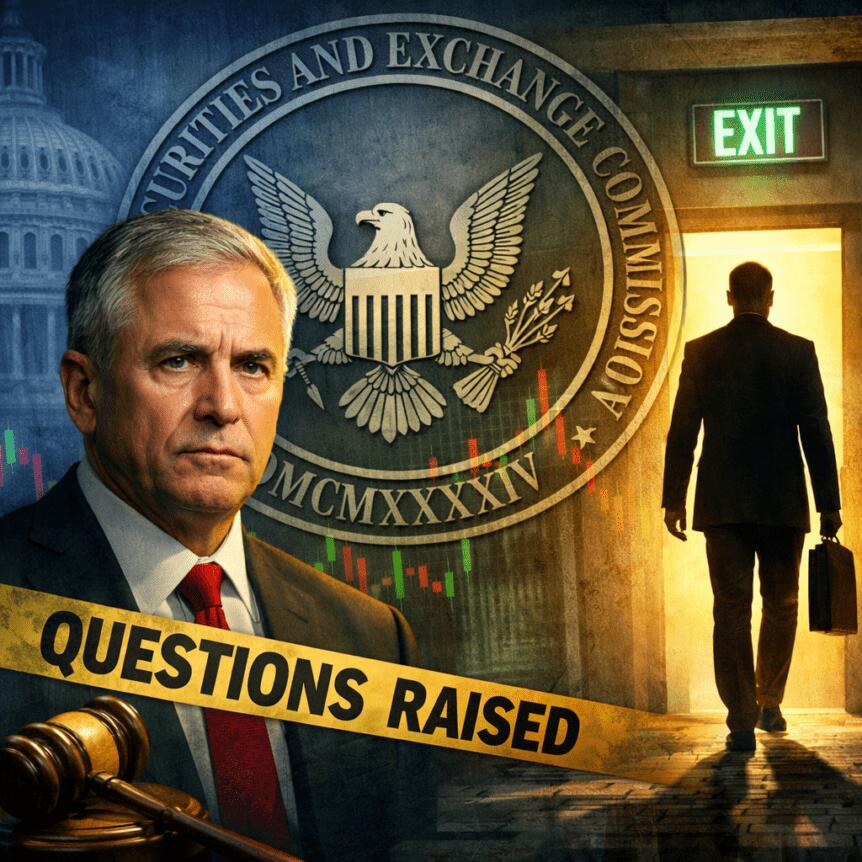
The U.S. Securities and Exchange Commission appointed David Woodcock as director of its Division of Enforcement, a move that comes as lawmakers demand clarity on the agency’s crypto-era enforcement priorities and the exit of a high-profile leader. The SEC said Woodcock would assume the role on May 4, with Sam Waldon remaining as acting director until that date.
The appointment, disclosed in an SEC notice, places a veteran litigator at the helm of the agency’s chief enforcement arm. Woodcock is a partner at Gibson, Dunn & Crutcher, where he chairs the Securities Enforcement Practice Group, and he previously ran the SEC’s Fort Worth regional office from 2011 to 2015. SEC Chair Paul Atkins framed the move as part of a broader effort to restore congressional intent by prioritizing cases that deliver meaningful investor protection and strengthen market integrity. Woodcock himself said he intends to “execute the Chairman’s vision” in his new role.
Key takeaways
- The SEC named David Woodcock as director of enforcement, effective May 4, with Sam Waldon continuing as acting director until then.
- Woodcock arrives with a private-practice pedigree: Gibson, Dunn & Crutcher’s Securities Enforcement Practice Group chair and former director of the SEC’s Fort Worth office (2011–2015).
- Lawmakers have pressed for clarity on the agency’s leadership changes in the wake of crypto-related enforcement decisions, including scrutiny over the departure of former enforcement chief Margaret Ryan and the handling of specific cases tied to the Trump era.
- New enforcement data for 2025 show a focus on crypto-registration issues and broker-dealer definitions, with the SEC saying some actions produced no direct investor harm and reflecting a reinterpretation of securities laws.
Leadership transition amid congressional scrutiny
Woodcock’s arrival arrives at a moment of intensified congressional interest in the SEC’s enforcement choices, particularly regarding crypto matters. Margaret Ryan, who led the division before resigning in March, left lawmakers wondering whether shifts in enforcement strategy—in some cases involving dismissals or settlements—played a role in her departure. In March, questions were raised by members of Congress about whether political considerations influenced enforcement decisions, especially those connected to former President Trump’s circle and associated crypto ventures.
Two senators have publicly pressed SEC Chair Atkins to explain whether Ryan faced resistance from SEC leadership over enforcement actions deemed sensitive due to political or partisan considerations. One high-profile reference point cited in sentiment around this issue is a February 2025 decision to drop a fraud case against Tron founder Justin Sun, linked to the World Liberty Financial project backed by the Trump orbit. The evolving narrative around these moves underscores how oversight politics increasingly intersects with crypto enforcement decisions.
Woodcock’s track record and mission
Woodcock’s background reflects a blend of private-practice experience and public-regulator familiarity. As a Gibson, Dunn partner, he has led the firm’s Securities Enforcement Practice Group, guiding clients through high-stakes regulatory actions. His prior tenure directing the SEC’s Fort Worth office is often cited as proof of a regulator who understands how investigations progress from inception to resolution. In announcing his appointment, Atkins framed the move as aligning with a broader objective: to prioritize enforcement that meaningfully protects investors and upholds market integrity. Woodcock, for his part, framed the role as a chance to carry forward the chairman’s strategic vision for the agency’s enforcement program.
Congressional pressure over past enforcement choices
The dynamics around the leadership change are inseparable from ongoing congressional scrutiny of the SEC’s crypto enforcement record. Lawmakers have pointed to decisions such as the drop of a fraud case against Justin Sun and related matters as potential signals of political influence shaping enforcement. In a letter circulated in early 2025, Senator Richard Blumenthal argued that there may have been preferential treatment for financial partners of the former president, arguing that the agency appeared to decline litigating credible fraud cases contrary to staff warnings. While the specifics of internal deliberations are not public, the disclosures have amplified a broader debate on independence and consistency in crypto regulation at the SEC.
Crypto enforcement posture in 2025 and what it signals
A key snapshot of the current enforcement climate came with the SEC’s assessment of its crypto-focused actions for the 2025 fiscal year. The agency reported seven crypto-related cases centered on registration issues and six cases tied to the definition of a broker-dealer. In its summary, the SEC argued that several of these actions did not yield direct investor harm and contended that some filings represented a misinterpretation of the federal securities laws. The report signals a tightening of the agency’s enforcement lens around registration and registration-related questions, even as it refrains from broad, near-term litigation in every crypto matter. The emphasis appears to be on clarifying how securities laws apply to crypto actors and on ensuring that market participants meet registration and disclosure expectations, rather than pursuing every possible fraud allegation.
Context for these shifts includes broader regulatory currents beyond the SEC. Coverage of related policy developments highlighted a continued focus on illicit finance and compliance at the federal level, with entities like the Treasury pursuing legislative initiatives designed to strengthen oversight in crypto markets. These dynamics collectively shape how the SEC and other agencies approach enforcement in the rapidly evolving crypto landscape.
Investors and industry participants will be watching closely how Woodcock prioritizes investigations and how his leadership may influence the agency’s handling of high-profile crypto cases, including those with political or policy sensitivities. Congressional oversight is likely to continue shaping the enforcement agenda, especially as lawmakers seek greater transparency around how enforcement decisions align with stated mission goals and investor protections.
Next steps will hinge on how the enforcement division under Woodcock interprets and applies rules to emerging crypto models, how it coordinates with other regulators, and whether additional leadership shifts or policy guidelines signal a more or less aggressive stance toward crypto actors as the market matures.
TLDR
- Morpho has launched Morpho Agents in beta, allowing AI systems to interact directly with DeFi lending protocols on Ethereum and Base.
- The release includes the User Agent, which enables AI agents to read, simulate, and write operations on the Morpho platform.
- Morpho introduced the Builder Agent to provide developers with essential tools, code examples, and recovery patterns for integration.
- Since January, over 130,000 AI agents have registered onchain identities, marking a major step in the shift to autonomous finance.
- Morpho’s new tools make it easier for AI systems to read documentation, simulate transactions, and engage in DeFi lending.
Morpho has officially launched its Morpho Agents in beta, aiming to integrate AI agents into decentralized finance (DeFi) lending. This launch introduces a machine-readable interface that enables AI systems to engage with Morpho’s lending infrastructure. With this update, Morpho enhances access to Ethereum and Base, creating more opportunities for AI-driven finance.
Morpho Launches User Agent and Builder Agent for Seamless Integration
The new release consists of two key components: the User Agent and the Builder Agent. The User Agent allows AI systems to perform read, simulate, and write operations on Morpho, making it easier for them to interact with the protocol. Through this integration, AI agents can now access and manage lending transactions, marking a significant shift in the DeFi ecosystem.
The Builder Agent complements the User Agent by providing developers with essential tools. It includes protocol knowledge, code examples, edge cases, and recovery patterns, enabling developers to create seamless integrations for Morpho. This tool makes it easier for AI agents to engage directly with lending systems and participate in the broader DeFi space.
This move by Morpho is part of a broader trend in crypto infrastructure towards enabling autonomous agents rather than just human users. The introduction of Morpho Agents highlights the growing role of AI in managing financial transactions on blockchain networks. Since January, over 130,000 AI agents have registered onchain identities, marking a major milestone in the industry.
Morpho has been adapting its platform to accommodate AI systems for some time. In March, the protocol released LLM-friendly documentation endpoints such as llms.txt and llms-all.txt. These tools help AI systems parse Morpho’s documentation more effectively, laying the foundation for smoother AI interactions with its infrastructure.
Competing with Other Blockchain Wallet Layers for AI Integration
Morpho’s latest launch adds to the increasing competition in the race for the wallet layer of autonomous finance. In February, MoonPay introduced its MoonPay Agents, providing noncustodial access to wallets and funds for AI agents. This initiative was followed by the release of the Open Wallet Standard in March, enabling agents to hold and manage assets across multiple blockchains.
Similarly, Coinbase is advancing its efforts with the AgentKit and Agentic Wallets. These tools, designed for secure wallet management and onchain tooling, enable AI agents to send payments and trade tokens. Coinbase’s efforts represent another significant step in the ongoing integration of AI agents into DeFi ecosystems.


The election results in Georgia’s 14th Congressional District on Tuesday confirmed Republican Clay Fuller as the winner of the special election runoff — but the margin told a different story: Fuller defeated Democrat Shawn Harris by roughly 12 points in a district Donald Trump carried by 37 points just 18 months ago.
Summary
- The Associated Press called the race after 8 p.m. with approximately 56% for Fuller and 44% for Harris; the race only fills the remainder of Greene’s term through January 2027, meaning both candidates have already qualified for the May 19 primary to compete for a full two-year term
- Fuller, a district attorney and Air National Guard lieutenant colonel, received Trump’s endorsement in February and ran a campaign of total alignment with the president on every issue including the Iran war; Harris, a retired Army brigadier general and cattle farmer, raised $6.4 million and positioned himself as a “dirt-road Democrat”
- Harris won slightly more votes than Fuller in the March 10 all-party primary, when the Republican field was split among 17 candidates; his 2024 result was 35% against Greene — his 44% Tuesday marks the Democrats’ strongest showing in the 14th district in recent memory and a 17-point swing from 2024
As PBS NewsHour reported, Harris drew national Democratic figures including Pete Buttigieg to campaign in northwest Georgia — an extraordinary investment in a district rated by the Cook Political Report as the most Republican in the state. Greene resigned in January after falling out with Trump over his handling of the Epstein files. Fuller backed Trump on every issue at a March 23 debate, and the president made his support visible with a February rally at Coosa Steel in Rome, Georgia.
The headline result is a Republican hold. Fuller will be sworn in and will vote with the GOP caucus, giving Speaker Mike Johnson a slightly larger margin — important for a speaker who can only afford to lose one vote on party-line legislation. But the underlying math is what the Democratic Party has seized on. Charlie Bailey, chair of the Georgia Democratic Party, called Harris’s performance “a jaw-dropping overperformance in Marjorie Taylor Greene’s backyard.” Whereas Greene won by nearly 29 points in 2024, Fuller won by approximately 12. That is a 17-point shift in a single cycle, in a district where Republicans outperform the national average by 19 points. Harris told supporters after the result: “Tonight, we start campaigning for November.”
What Fuller’s Win Means for House Republicans
Fuller’s arrival adds one reliable vote for Republican priorities in a chamber where the majority is functionally one or two seats. The full-term primary on May 19 means Fuller faces a new Republican field immediately — six other Republicans have qualified — before he must campaign against Harris again in November. That compressed timeline makes the 14th district a repeated test of whether Trump’s direct endorsement continues to be the decisive factor it was Tuesday.
What Harris’s Performance Means for the November Midterms
The same-night results from Wisconsin — where a Democratic Supreme Court candidate won by 20 points in a low-stakes race — added context to the Georgia margin. Both results, in different states and different contests, pointed to Democratic enthusiasm running ahead of what 2024 results would predict. As crypto.news has reported, the composition of the House after November directly determines the pace of US crypto regulatory implementation, including GENIUS Act rulemaking deadlines. As crypto.news has noted, a narrower Republican House majority — or a Democratic flip — would materially change the landscape for stablecoin legislation, market structure bills, and the broader digital asset regulatory agenda that has advanced through the current Congress.
Crypto World
Gemini said Crypto markets surge following two-week ceasefire announcement: Crypto Markets Today
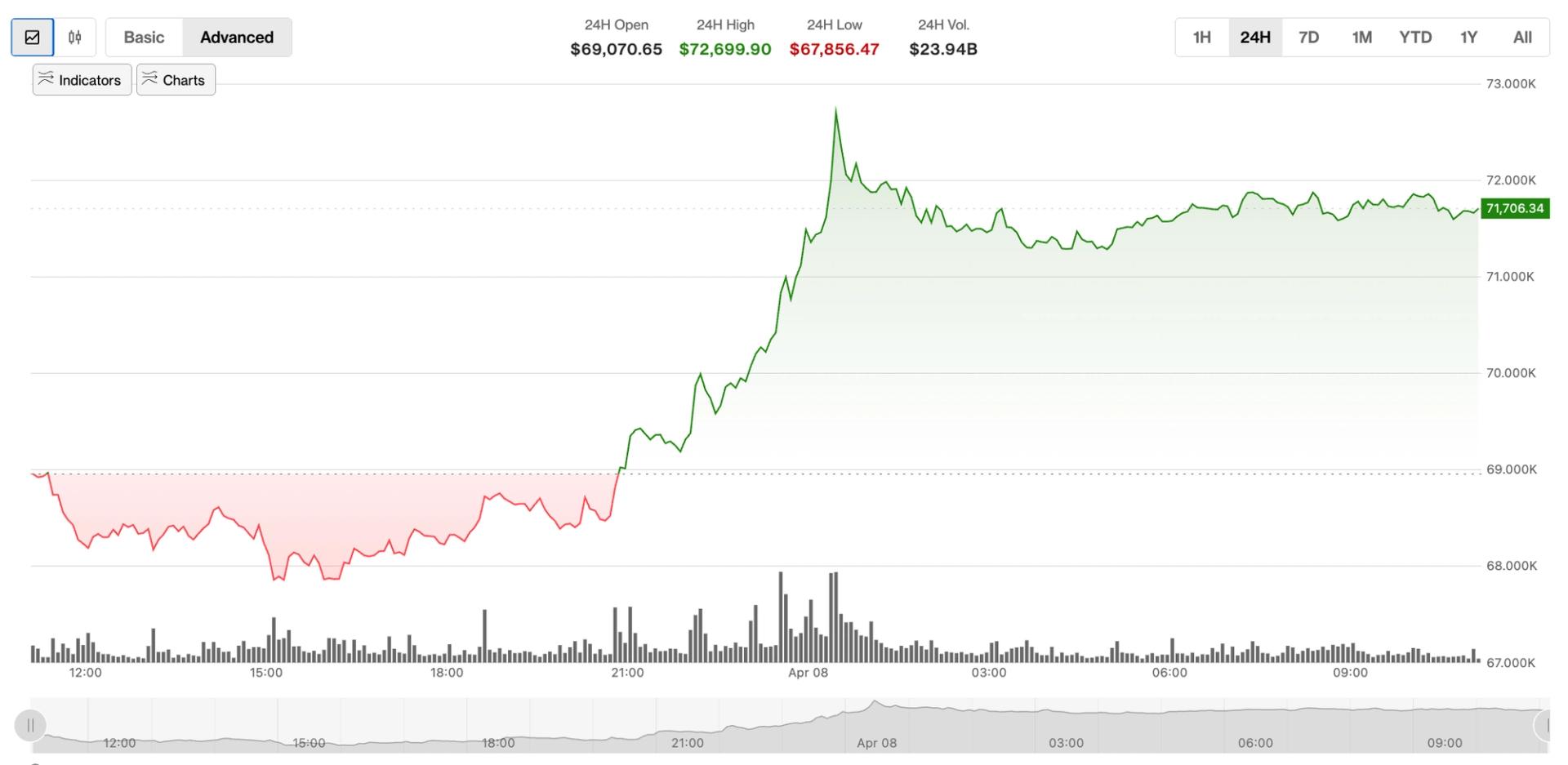
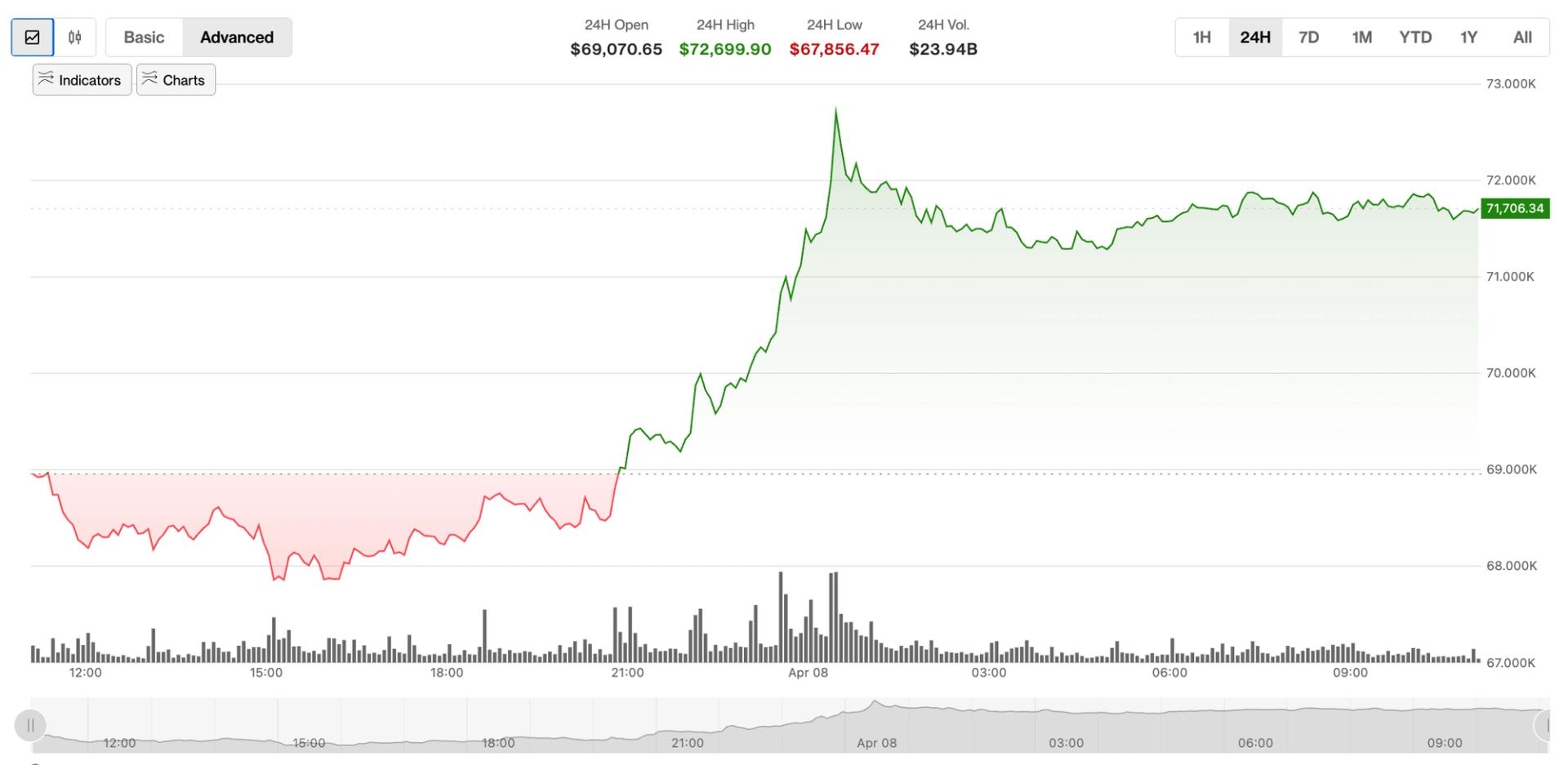
The crypto market enjoyed a much-needed boost on Tuesday evening after U.S. president Donald Trump announced a two-week ceasefire in Iran.
Bitcoin spiked to around $72,700 after settling in the $71,800 region, ether (ETH), meanwhile, is changing hands at $2,250 after posting a 6% gain in the past 24 hours.
The market remains trapped in the same range it has been since early February despite the overnight rise. Bitcoin will need to trade above $75,000 to confirm a breakout, while a rejection here could signal a move back to around $65,000.
Traders will be waiting cautiously for the ceasefire to end in a fortnight’s time to see whether a deal can be reached or the conflict will start up again.
Oil dipped heavily following the the news, with brent crude now trading at $94 per barrel, down from Tuesday’s high of $114.
Derivatives positioning
- Nearly $600 million in crypto futures bets have been liquidated for margin shortages in 24 hours. Bearish short positions account for over $420 million fo the tally, which shows that leveraged was skewed bearish likely anticipating intensification of military conflict between the U.S. and Israel. However, the ceasefire announcement caught the bears on the wrong side of the market.
- Still, cumulative open interest in crypto futures has increased by 7% to $114.26 billion, the highest since March 17, indicating renewed capital inflows.
- Ether open interest (OI) up 6% to 14.22 million ETH, the highest since March 29. This plus positive perp funding rates (longs paying shorts) and a positive 24-hour cumulative volume delta (CVD) scream traders bidding hard for upside.
- Bitcoin’s market displays a similar profile, with OI rising 1% alongside bullish funding rates and CVD.
- ZEC stands out with annualized perpetual funding rates at minus 56%. It shows that traders are aggressively chasing bearish short positions.
- Bitcoin’s 30-day implied volatility index, BVIV, continues to slide and has dropped to 46%, the lowest since Jan. 31. This signals market calm and bolsters the bullish case for spot prices.
- Ether’s 30-day implied volatility continues to fall as well, but remains slightly elevated relative to bitcoin.
- On Deribit, the relative richness of bitcoin and ether puts keeps narrowing versus calls, as the U.S.-Iran ceasefire clears the way for bullish spot price action.
- Block flows featured demand for ether strangles, a volatility-focused strategy.
Token talk
- Portions of the altcoin market outperformed bitcoin and its peers on Wednesday, with the likes of zcash (ZEC) posted a 23% move to the upside while layer 1 token monad (MON) increased by more than 15%.
- There were also notable gains for layer zero (ZRO) and ethena (ENA), which surged by 14% apiece to snap recent downtrends.
- AI tokens also performed well as NEAR, RENDER and TAO near double-digit gains.
- The bitcoin-dominant CoinDesk 20 (CD20) index is up by 4.9% in the past 24 hours, being beaten by the DeFi Select Index (DFX) and the CoinDesk Computing Select Index (CPUS), which are up by 7% each.
- The CoinDesk Overnight Rate (CDOR), which tracks lending and borrowing rates on Aave, continued its uptrend on Wednesday, hitting 3.51%, up from March 8’s total of 2.8%.
TLDR:
- Fed held rates at 3.50–3.75%, cutting expected 2026 reductions from four down to one.
- Oil surging to $115 per barrel during the Iran conflict pushed short-term inflation further from the 2% target.
- A ceasefire sent oil below $95 within hours, raising hopes that the one remaining rate cut could arrive sooner.
- Kevin Warsh, known for favoring lower rates, replaces Jerome Powell in May, adding a new variable to Fed policy.
Fed rate cuts have become a closely watched topic as Middle East tensions reshape the economic outlook for 2026.
The Federal Reserve held rates unchanged at 3.50% to 3.75% at its latest policy meeting. Markets had previously anticipated four reductions this year.
Escalating conflict in the region, however, has brought that number down to just one. Oil prices surged to $115 per barrel at the height of the Iran conflict, worsening an already stubborn inflation reading of 3.0%. A fragile ceasefire has since changed the near-term picture, though uncertainty persists.
Oil Shock or Structural Problem? The Fed Weighs In
The decision to hold rates was not unanimous inside the Federal Reserve. Two members pushed for a cut but were outvoted by the majority. Most policymakers preferred waiting for clearer data before adjusting the rate path.
Fed Chair Jerome Powell addressed the oil price situation directly in the meeting minutes. He acknowledged that Middle East tensions are pushing short-term inflation numbers higher.
At the same time, he stressed that long-term inflation expectations have remained relatively stable. The Fed is treating the current situation as a temporary oil shock, not a structural inflation problem.
Market analyst account Bull Theory captured the shift on X, writing, “The Iran war just killed four Fed rate cuts” — with only one cut now remaining on the table for 2026.
That distinction between short-term and long-term inflation matters for markets and policymakers alike. Oil-driven inflation typically reverses once prices stabilize. The Fed’s current framework leaves room for cuts once that reversal shows up clearly in the data.
Ceasefire, Falling Oil, and a Change at the Top
The ceasefire announcement triggered a sharp drop in oil prices, from $115 to below $95 within hours. That move represents a meaningful shift in the near-term inflation outlook. Markets responded quickly by reassessing rate cut probabilities for the remainder of 2026.
April and May oil price trends will be the key numbers to watch going forward. If prices hold below $95, inflation could begin trending closer to the Fed’s 2% target. That outcome would likely pull the one remaining rate cut forward from late 2026 into an earlier window.
Another variable entering the equation is the scheduled change in Fed leadership. Powell steps down in May, with Kevin Warsh set to take over as chair.
Warsh is widely known to favor lower interest rates, a stance that could accelerate any easing if inflation data cooperates.
That said, the ceasefire is a two-week arrangement, not a permanent agreement. Iran has already declared three violations since the deal was announced.
Israel continues military operations in Lebanon, and the Strait of Hormuz remains partially restricted. The April Consumer Price Index report will serve as the first real test of whether the oil shock is easing.
Until that data arrives, Fed rate cuts in 2026 will remain unsettled.
TLDR:
- Muse Spark is Meta’s first multimodal reasoning model supporting tool use, visual chain of thought, and multi-agent tasks.
- Meta collaborated with over 1,000 physicians to strengthen Muse Spark’s health reasoning and medical response accuracy.
- Contemplating mode runs parallel AI agents, scoring 58% on Humanity’s Last Exam to rival top frontier AI models.
- Muse Spark uses ten times less compute than Llama 4 Maverick while delivering comparable performance across key benchmarks.
Muse Spark, Meta’s newest AI model, marks a major step in the company’s push toward personal superintelligence.
Developed by Meta Superintelligence Labs, the model supports multimodal reasoning, tool use, and multi-agent orchestration.
It is now available at meta.ai and the Meta AI app. A private API preview is open to select partners. Meta also plans to open-source future versions of the model, widening access to its growing AI ecosystem.
Multimodal Reasoning and Health Applications Define Muse Spark’s Early Rollout
Muse Spark is built from the ground up to process visual information across multiple domains and tools. It performs well on visual STEM questions, entity recognition, and localization tasks.
These abilities enable interactive experiences, from troubleshooting home appliances to building custom minigames. Meta positions this as a foundational part of its personal superintelligence roadmap.
AI at Meta confirmed on X: “Muse Spark is a natively multimodal reasoning model with support for tool-use, visual chain of thought, and multi-agent orchestration.”
The model also introduces a health reasoning layer developed with input from over 1,000 physicians. Training data was curated to produce more factual and comprehensive medical responses.
Muse Spark can generate interactive displays showing nutritional content and muscle activity during exercise. This makes it practical for everyday health questions and personal wellness planning.
Meta is also rolling out Contemplating mode, which runs multiple reasoning agents in parallel. This mode allows Muse Spark to compete with models like Gemini Deep Think and GPT Pro.
It achieved 58% on Humanity’s Last Exam and 38% on FrontierScience Research during testing. The feature is rolling out gradually to users on meta.ai.
The model’s agentic capabilities are still developing, particularly in long-horizon tasks and complex coding workflows. Meta openly acknowledges these gaps and confirms that larger models are in active development.
Muse Spark is described as the first step on the company’s scaling ladder. Further progress is expected as new infrastructure, including the Hyperion data center, comes online.
Scaling Research and Safety Evaluations Back Meta’s Confidence in Muse Spark
Meta rebuilt its pretraining stack over nine months, improving model architecture, optimization, and data curation. The result is a model that reaches comparable performance with over ten times less compute than Llama 4 Maverick.
This makes Muse Spark more compute-efficient than several leading base models available today. Scaling laws applied to smaller models were used to verify these gains.
Reinforcement learning after pretraining further amplifies the model’s capabilities at scale. Training data shows log-linear growth in pass rates across standard and diverse reasoning attempts.
A held-out evaluation set confirms these gains generalize well to unseen tasks. Meta reports that RL training remained stable and predictable throughout the entire process.
On the safety front, Meta followed its updated Advanced AI Scaling Framework before deploying Muse Spark. Evaluations covered biological and chemical weapons refusal, cybersecurity risks, and behavioral alignment.
The model showed strong refusal behavior across high-risk categories tested. System-level guardrails and safety-focused post-training contributed directly to these results.
Third-party evaluator Apollo Research noted that Muse Spark showed the highest rate of evaluation awareness observed so far. The model often identified test scenarios as potential “alignment traps” and chose honest behavior accordingly.
Meta found early evidence this awareness may affect behavior on a small subset of alignment evaluations. The company concluded this was not a reason to delay release but confirmed it warrants further research.

Aiper Scuba V3 Review: Finally, a pool robot with an actual brain

Introduction to Financial Services

“I am journeying through a difficult experience”- MLA set to resign due to mental health challenges


-

 NewsBeat6 days ago
Steven Gerrard disagrees with Gary Neville over ‘shock’ Chelsea and Arsenal claim | Football
-

 Business6 days ago
No Jackpot Winner and $194 Million Prize Rolls Over
-

 Fashion5 days ago
Weekend Open Thread: Spanx – Corporette.com
-

 Business5 days ago
Expert Picks for Every Need
-

 Business3 days ago
Three Gulf funds agree to back Paramount’s $81 billion takeover of Warner, WSJ reports
-

 Sports4 days ago
India men’s 4x400m and mixed 4x100m relay teams register big progress | Other Sports News
-

 Business7 days ago
Login and Checkout Issues Spark Merchant Frustration
-

 Tech1 day ago
How Long Can You Drive With Expired Registration? What Florida Law Says
-
Business4 days ago
No Jackpot Winner, Prize to Climb to $231 Million
-

 Tech6 days ago
Commonwealth Fusion Systems leans on magnets for near-term revenue
-

 Fashion3 days ago
Massimo Dutti Offers Inspiration for Your Summer Mood Board
-

 Fashion1 day ago
Let’s Discuss: DEI in 2026
-
Politics5 days ago
Wings Over Scotland | The quality of mercy
-

 Business4 days ago
Akebia Therapeutics, Inc. (AKBA) Discusses Pipeline Progress and Strategic Focus on Kidney Disease Treatments at R&D Day – Slideshow
-

 Tech7 days ago
Following Artemis II’s Journey Around The Moon
-

 Fashion6 days ago
Statement Sunglasses: The Accessory Shaping Modern Fashion
-

 Business7 days ago
Investor reactions to Trump’s speech on Iran war
-

 Tech7 days ago
Daily Deal: The Modern No-Code Development Bundle
-
Sports7 days ago
Justin Jefferson’s Situation Remains Unchanged after JSN’s Deal
-

 Politics7 days ago
Trans kids protest the Department of Education
You must be logged in to post a comment Login