
Crypto World
Crypto Saw It Coming: How Sunday’s Dip Foreshadowed Monday’s Market Meltdown



Markets opened Monday to a sell-off that crypto investors had seen coming. The collapse of US-Iran peace talks in Islamabad and a new US naval blockade impacted major asset classes.
The weekend’s failures raised fresh fears over supply disruption and cast doubt on a fragile two-week ceasefire set to expire on April 22.
Crypto’s Sunday Dip Warned What Monday’s Stock Sell-Off Would Confirm
Bitcoin (BTC) dropped from a weekend high near $74,000 to an intraday low of $70,570 yesterday after Vice President JD Vance confirmed that 21 hours of negotiations had ended without a deal. The total crypto market cap fell about 1.8%.
The sell-off deepened after the US Central Command (CENTCOM) announced a blockade of “all maritime traffic entering and exiting Iranian ports on April 13 at 10 a.m. ET.”
BeInCrypto Markets data showed that the total market capitalization has fallen 2.68% over the past 24 hours. At the time of writing, BTC traded at $71,125. Ethereum (ETH) had dropped to $2,204.
Meanwhile, by Monday morning, traditional markets confirmed what crypto had already priced in. The Kobeissi Letter noted that the S&P 500 and Dow Jones each fell roughly 1%, while the Nasdaq 100 slid 1.3%.
“US stock market futures open sharply lower as Iran War peace talks end without a deal,” the post read.
Subscribe to our YouTube channel to watch leaders and journalists provide expert insights
Gold and silver both declined in early Asian trading hours on Monday. Gold prices fell 0.75% to $4,711 per ounce, retreating rather than rallying despite the geopolitical turmoil. Silver prices dropped more sharply, sliding over 2% to $74.20.
The weakness across precious metals suggests that rising energy costs and the prospect of prolonged inflation are outweighing safe-haven demand, as traders increasingly expect the Federal Reserve to hold rates steady for longer.
Finally, energy markets also reacted sharply, though in the opposite direction. US crude oil jumped over 10% past $105 per barrel. International Brent crude rose 8%. Wholesale gasoline spiked 6%, and heating oil, a proxy for jet fuel, surged 9.3%.
Follow us on X to get the latest news as it happens
The pattern is becoming familiar. Throughout the weeks of the US-Iran conflict, crypto has repeatedly flagged geopolitical risk before equity sessions open. With the two-week ceasefire deadline approaching, traders across both markets face continued uncertainty over whether diplomacy can keep pace with escalation.
The post Crypto Saw It Coming: How Sunday’s Dip Foreshadowed Monday’s Market Meltdown appeared first on BeInCrypto.



Allbirds (BIRD) surged as much as 400% after saying it will pivot from making sneakers into AI computation services, underscoring one of the market’s dominant themes: the race to secure scarce AI infrastructure.
The company said it agreed to sell its footwear brand to American Exchange Group (AXNY) and reinvent itself as NewBird AI, backed by a $50 million convertible financing facility to acquire processing units and build AI infrastructure.
The loan is roughly double the company’s $22 million pre-announcement market cap.
Demand for computing power to support AI is surging, while supply remains constrained. The scarcity has already prompted bitcoin miners such as Bitfarms, now renamed Keel (KEEL), and MARA Holdings (MARA) to reduce or abandon their crypto aspirations and switch their computing resources into supporting the AI industry.
Now, echoing the headlong rush into blockchain technology that engulfed companies such as Long Island Iced Tea Corp. in 2017, it seems even small-cap companies are attempting to position themselves to capture the AI opportunity.
Allbirds’ pivot comes after a steep decline in its core business, with the stock down roughly 99% from its peak. The shares, which closed $2.49 on Tuesday, surged to as high as $12.72 and were recently trading around $11.
Convertible financing means the investor initially provides capital to the company as debt, and can later convert it into equity, often at a discount, which can lead to significant dilution for existing shareholders.
UPDATE (April 15, 14:34 UTC): Updates share price move, adds bitcoin miners in fourth paragraph, Long Island Iced Tea in fifth.
OKX said Wednesday it is rolling out a Europe-specific crypto derivatives product called X-Perps, extending its regulated offering across the European Economic Area (EEA) through its Malta-based MiFID business.
The company said the new derivatives product is available to retail and institutional traders across all 30 EEA countries.
OKX said the platform is purpose-built in compliance with the Markets in Financial Instruments Directive (MiFID), a European Union regulatory framework governing financial instruments such as securities and derivatives.
The launch follows OKX’s March 2025 announcement that it had acquired a MiFID-licensed entity in Malta, which allowed the exchange to expand its derivatives trading across the EEA.
Platform features multi-asset collateral and up to 10x leverage
OKX said X-Perps offers five-year expiry crypto derivatives with up to 10x leverage and supports multi-asset collateral, including euros, US dollars and crypto assets.
At launch, the platform offers pairs for numerous crypto assets, including major coins such as Bitcoin (BTC), Ether (ETH) and XRP (XRP), as well as memecoins such as Dogecoin (DOGE) and Pepe (PEPE).
“OKX will be rolling out more pairs and exploring high-demand products for retail and institutional traders as it builds out its fully featured, regulated European derivatives platform,” the company said in an announcement shared with Cointelegraph.
A structurally different product designed for Europe
OKX’s launch of X-Perps comes as the exchange has emerged as a major player in derivatives trading.
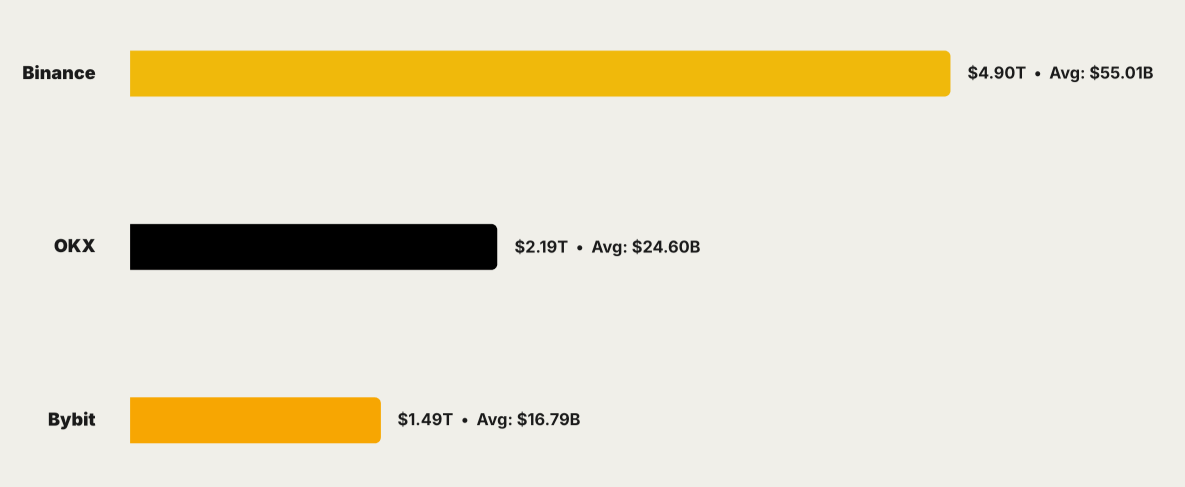
According to CoinGlass, OKX ranked as the second-largest exchange in crypto derivatives in the first quarter of 2026, after Binance, with a cumulative quarterly trading volume of $2.19 trillion, versus Binance’s $4.9 trillion.

X-Perps is specifically structured to comply with MiFID requirements and will differ from products offered under other regulatory frameworks.
Related: Onchain perp DEX volumes fall for five straight months after October peak
OKX Europe CEO Erald Ghoos told Cointelegraph at Paris Blockchain Week that perpetual derivatives “cannot exist” under MiFID II because they would otherwise be classified as contracts for difference (CFDs). He said the exchange instead structured the product as a five-year expiry futures contract to ensure compliance with regional regulatory requirements.
He also said in a post on X that as much as 95% of crypto derivatives trading volume still occurs offshore.

“I do believe that a lot of users will transition from offshore back to a fully regulated onshore environment,” Ghoos said, adding: “With X-Perps, we are bridging that gap under a fully regulated exchange where we offer great liquidity.”
Magazine: How crypto laws changed in 2025 — and how they’ll change in 2026


- Ethereum price falls to $2,325 on profit-taking after rising to $2,416.
- The repeated rejection at $2,360–$2,400 resistance weakens the overall momentum.
- Breaking below the key support at $2,312 could send ETH toward $2,173.
After a rally that pushed Ethereum close to $2,416, things quickly changed, and now ETH sits around $2,325.
This sharp drop near $2,400 tells us a lot about where Ethereum’s headed next, at least for now.
Pushback at $2,416 resistance
Ethereum (ETH) initially surged about 10% in a sharp move that triggered liquidations and brought renewed attention to the token.
After reaching around $2,416, momentum slowed, and the price began to pull back.
In recent weeks, the $2,360–$2,400 range has consistently acted as a supply zone, with selling pressure emerging each time ETH approaches this level.
Broader market conditions have also softened. Data from CoinMarketCap shows that the total crypto market capitalisation has declined by about 1.12%, alongside a drop in trading volumes.
This suggests that traders who entered during the recent rally are taking profits, adding to near-term downward pressure on ETH.
Capital rotation adds pressure
Another factor weighing on Ethereum (ETH) is the ongoing shift in market positioning.
Bitcoin dominance has been trending higher, indicating that capital is rotating into Bitcoin rather than altcoins.
This typically reflects a more defensive stance among investors.
As the largest altcoin, Ethereum is often among the first to face pressure during such rotations.
Even with relatively stable fundamentals, reduced capital inflows can limit its ability to sustain upward price momentum.
This trend is also visible in the ETH/BTC ratio, which has struggled to stabilise.
A recovery in this ratio would be needed to signal renewed confidence in altcoins. Until then, Ethereum may continue to underperform Bitcoin in the near term.
$2,312 now a key battleground
Right now, $2,312 stands out as a key support level. It’s not just psychological; it’s close to the 14-day moving average and already served as the floor during the recent dip.

If the ETH price holds steady above $2,312, the door stays open for another run at $2,400.
But if $2,312 gives way, things will start to look different, and bears will pick up momentum as bulls pull back.
In that case, $2,173 will be the next spot to watch.
Dropping from $2,312 to $2,173 will be a 6% slide, which is pretty standard after a strong rally; it is not something wild or out of the ordinary. It’s a realistic scenario if support breaks.
If buyers can push the price above $2,416 and keep it there, that recent rejection fades away, and a rally starts to look more real.
The short-term picture looks a bit bearish, although we’re not seeing panic selling yet; just uncertainty.
Everything boils down to the $2,312 support level. If buyers hold it, there’s a chance for another run at resistance. If not, a 6% drop is on the table.
Aave price has rallied over 7% this week amidst a surge in institutional interest and critical governance breakthroughs. Will it extend gains now that it has confirmed a bullish reversal pattern on charts?
Summary
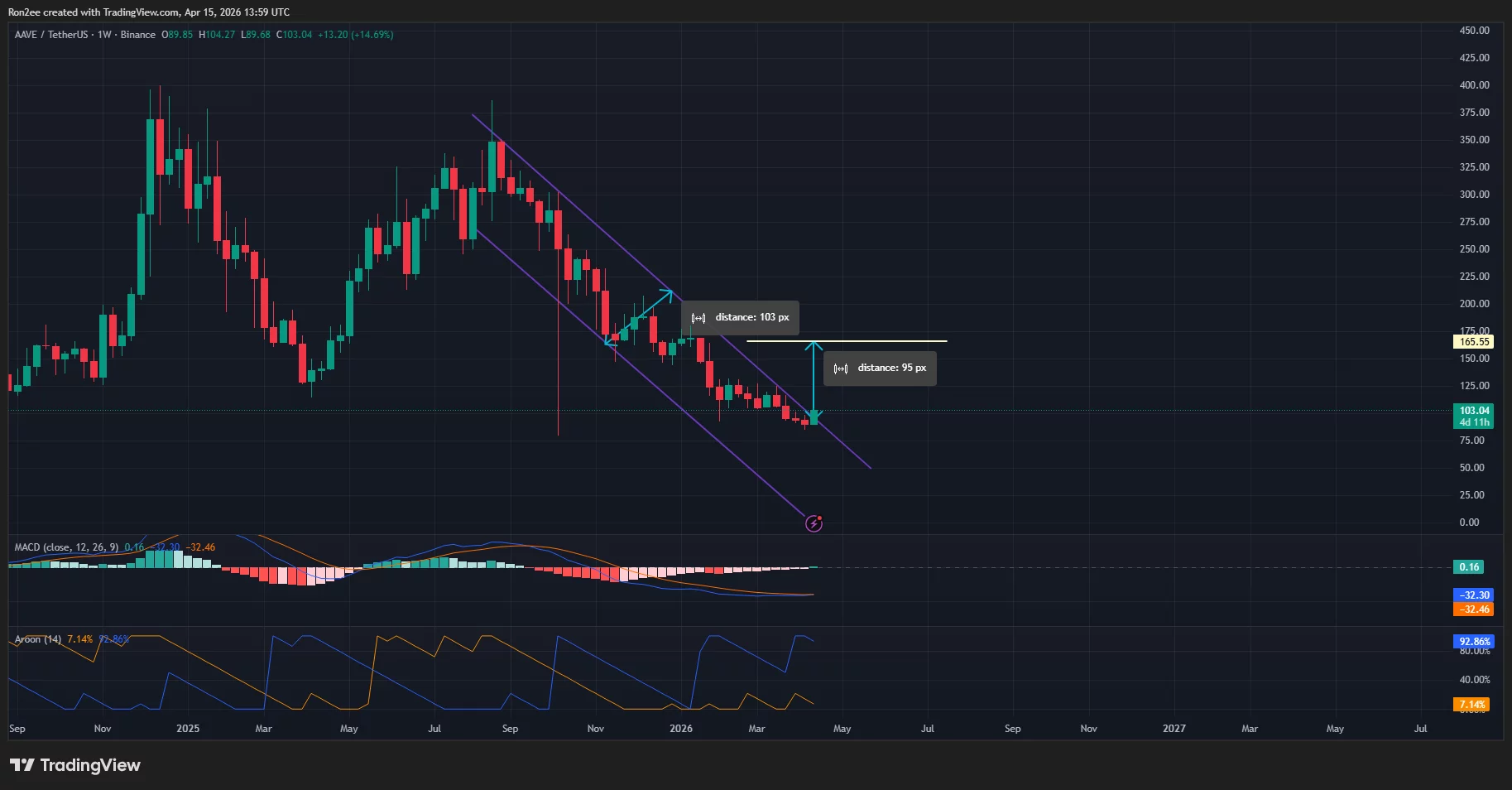
- Aave price rose over 7% this week to around $102, rebounding from a prolonged downtrend and confirming a breakout from a descending channel pattern.
- Technical indicators point to a bullish reversal, with a potential upside target near $165, though some lingering downside momentum suggests possible consolidation.
- Key catalysts include a $25 million DAO-approved funding proposal, the rollout of Aave V4, and expanding institutional adoption through real-world asset tokenization partnerships.
According to data from crypto.news, Aave (AAVE) price rose 7.3% to a weekly high of $103 on Wednesday before settling at $102 at press time. The token’s bounce follows a persistent downtrend in which the token had fallen over 30% from the beginning of this year.
Despite the heavy selling pressure seen in previous months, the daily chart now presents a bullish outlook that suggests the bottom may finally be in.
As Aave price rebounded today, it has confirmed a bullish breakout from a descending parallel channel pattern that had been forming since August last year. A breakout from such a pattern has often been the precursor to a massive trend reversal and long term price appreciation.
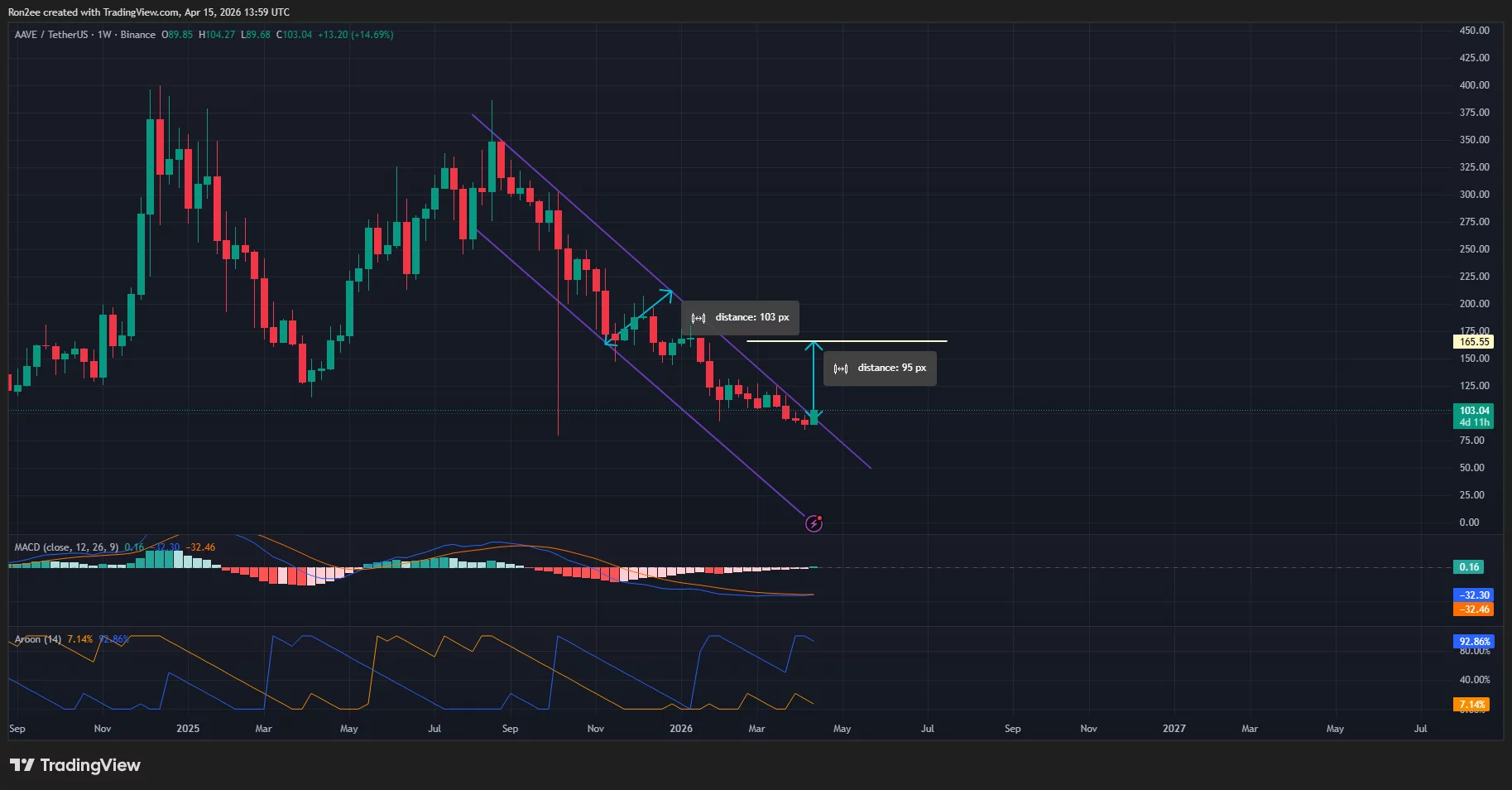
For Aave token, the breakout positions it for more upside to $165, a level calculated by adding the maximum height of the parallel channel to the breakout point on the upper trendline.
Momentum indicators seem to add support to this optimistic narrative. Notably, the MACD lines are on the cusp of a bullish crossover with green histograms starting to form. This means that buyers are regaining control and the short term trend is shifting in favor of the bulls.
However, the Aroon down reading at 92.86% remains far above the Aroon up line, which indicates some negative momentum still lingers in the background. As such, Aave token could face a brief period of consolidation or a minor retest of the breakout zone before the next major leg up.
Meanwhile, there are three key catalysts that could help Aave sustain its current recovery.
First, the Aave DAO officially passed Proposal 469 on April 13 with overwhelming support from the community. The approved framework will grant $25 million to Aave Labs and ensures that 100% of the protocol revenue from Aave branded products would flow directly back to the treasury, a move that significantly strengthens the financial health of the ecosystem.
Second, the successful rollout of Aave V4 on the Ethereum mainnet has also set up a foundation for unprecedented scalability and institutional adoption. The new architecture is specifically designed to accommodate trillions in assets through its hub and spoke model.
As such, it is expected to drive a steady increase in total value locked as institutional spokes go live and enable deeper liquidity across multiple blockchain networks.
Third, Aave has also been aggressively expanding its footprint in the real world asset sector through its Horizon platform. It has secured strategic partnerships with top tier financial firms like VanEck and Franklin Templeton to tokenize U.S. Treasuries on the blockchain.
This will effectively bridge the gap between traditional finance and decentralized markets, allowing the protocol to tap into multi billion dollar institutional credit markets and provide sustainable yields for its users.
Disclosure: This article does not represent investment advice. The content and materials featured on this page are for educational purposes only.
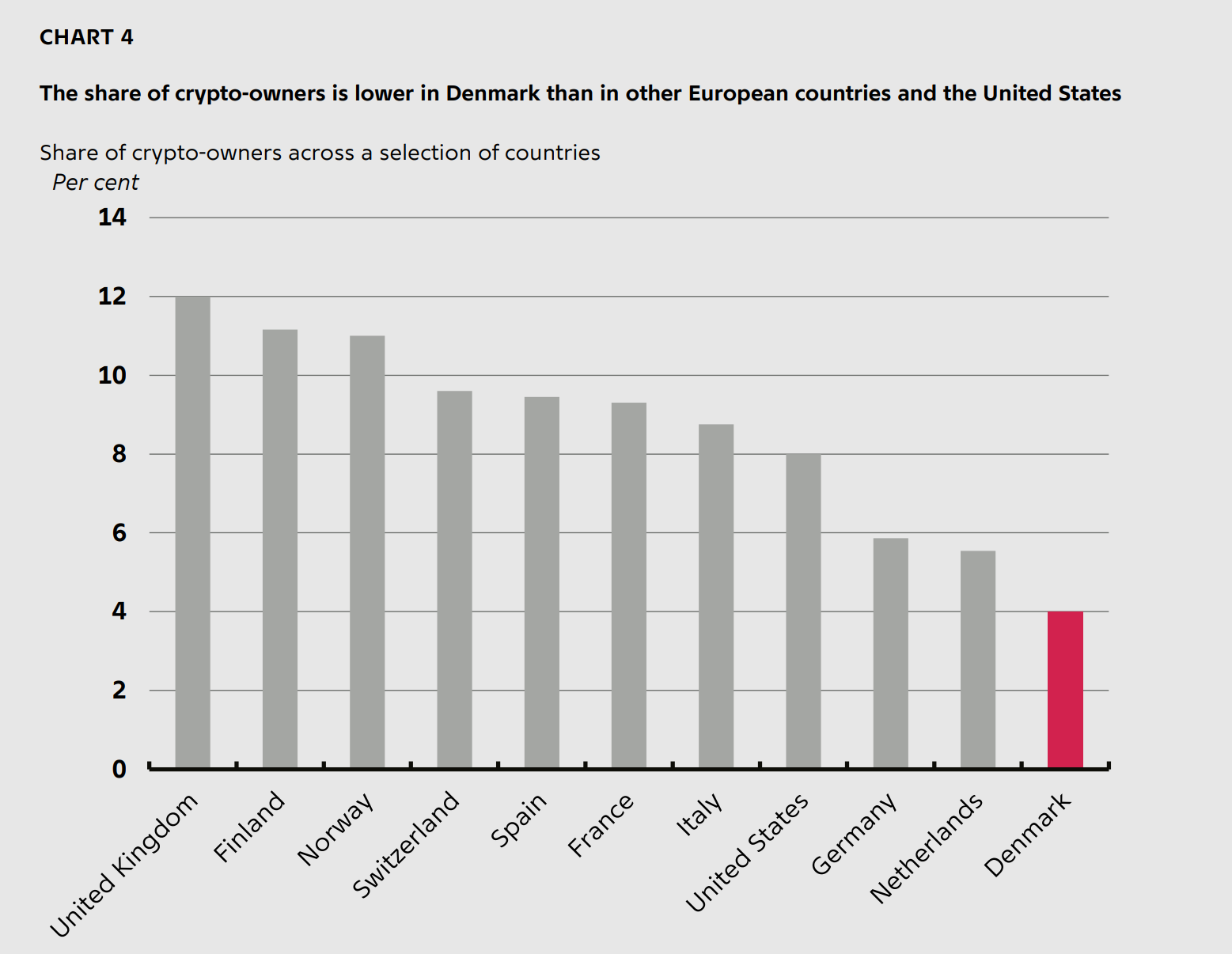
Only 4% of Danish citizens own cryptocurrencies, a figure that has remained unchanged since 2023 despite the global growth of the sector across Europe and other jurisdictions, according to a new staff paper from the country’s central bank published Wednesday.
The Danmarks Nationalbank staff paper, based on a survey conducted by Epinion, revealed that among those who do hold crypto, most maintain relatively small positions. The majority reported holdings below 10,000 Danish kroner (around $1,570), with total national holdings estimated between $317 million and $847 million.
The survey is based on responses from 3,013 citizens aged 15 and above. The data was gathered between October and November 2025 through Denmark’s Digital Post system, with options to respond online or by phone. The sample was weighted to reflect national demographics.
The findings show that Denmark sits at the lower end of crypto adoption compared to other European countries, where ownership rates are higher. Countries such as Norway, Finland and the United Kingdom report over 10% of their populations hold crypto assets.

Danmarks Nationalbank said Danish banks have historically taken a cautious approach to crypto assets, with most previously not allowing customers to buy them through bank platforms and often discouraging such investments as high risk. The paper also pointed to earlier asymmetric tax treatment as another factor weighing on adoption.
Related: EU adviser says ‘MiCA 2’ is likely as crypto market matures: PBW 2026
Crypto ownership in Denmark skews young and wealthy
Crypto ownership in Denmark is concentrated among younger and higher-income individuals, with participation dropping sharply among those over 60, the survey found.
The survey also revealed that crypto is primarily viewed as an investment rather than a means of payment. Actual usage for transactions remains rare, and only a small share of holders report using digital assets to pay for goods or services.

The survey shows that 70%-75% of users store their assets with crypto asset service providers, while only about 20%-30% use self-hosted wallets for self-custody.
Indirect exposure through crypto-linked stocks and exchange-traded products has increased since 2023 but remains limited at around $211 million, or roughly 0.4% of total equity holdings.
Related: No, Denmark did not propose banning self-custody wallets
Danske Bank opens door to crypto investments
Earlier this year, Danske Bank, Denmark’s largest bank, began allowing customers to invest in crypto through exchange-traded products tied to Bitcoin (BTC) and Ether (ETH).
At the time, the bank said more clients are seeking crypto exposure as part of their portfolios, adding that stronger regulatory frameworks, particularly the European Union’s Markets in Crypto-Assets Regulation, have made it feasible to offer such investments.
Magazine: Bitcoin may take 7 years to upgrade to post-quantum — BIP-360 co-author

Key Takeaways
- A $3 billion partnership between ETHGas and ether.fi aims to revolutionize Ethereum blockspace allocation
- Forward pricing mechanisms arrive on Ethereum through the ETHGas-ether.fi $3B collaboration
- $3 billion in ETH resources dedicated to developing execution certainty and market pricing structures
- Strategic alliance between ETHGas and ether.fi creates foundation for institutional-grade Ethereum infrastructure
- $3B commitment by ETHGas and ether.fi enables predictable, scalable transaction execution on Ethereum
A major transformation in Ethereum infrastructure is underway following a $3 billion strategic partnership between ETHGas and ether.fi. This collaboration introduces forward market mechanisms and guaranteed execution capabilities to Ethereum’s blockspace ecosystem. The initiative positions Ethereum as a more robust settlement infrastructure for institutional participants globally.
Current Limitations in Ethereum’s Blockspace Allocation
Ethereum’s existing model operates through immediate spot-based auctions for network blockspace allocation. This approach provides no forward pricing visibility or execution certainty for enterprise-scale users. Validators experience revenue volatility while decentralized applications contend with unpredictable transaction confirmation windows.
Despite attracting more than $25 billion in institutional capital through various structured products, Ethereum lacks sophisticated financial tools for managing execution uncertainty. Without forward market capabilities, Ethereum faces constraints in accommodating large-scale institutional workflows efficiently.
As network capacity grows alongside increasing developer and enterprise adoption, Ethereum’s current allocation systems face mounting pressure. The network requires more sophisticated market structures to compete with traditional financial infrastructure standards.
ETHGas Creates Structured Forward Markets for Ethereum
ETHGas establishes an exchange infrastructure enabling validators to sell future Ethereum blockspace in advance. Purchasers obtain guaranteed transaction slots with predetermined pricing through this platform. Ethereum now supports a forward curve for its fundamental network capacity.
This framework facilitates superior price transparency for Ethereum blockspace across different demand scenarios. Institutional participants can develop execution plans with cost certainty on Ethereum[[/LINK_END_2]]. The network becomes increasingly viable for sophisticated financial applications requiring high transaction volumes.
ETHGas incorporates guaranteed execution through preconfirmation technology within Ethereum’s architecture. This design minimizes timing uncertainties and enhances reliability across diverse use cases. Ethereum’s infrastructure moves closer to established commodity trading and derivatives frameworks.
ether.fi Provides Validator Foundation for Market Development
ether.fi pledges roughly $3 billion worth of ETH to underpin ETHGas infrastructure over a three-year timeline. This commitment constitutes approximately 40 percent of its total Ethereum assets under administration. The partnership creates substantial validator-supported capacity for forward blockspace markets.
With over 2.8 million ETH currently staked, ether.fi maintains considerable influence within Ethereum’s validation ecosystem. This operational scale enables dependable execution assurances within the ETHGas platform. Ethereum benefits from enhanced liquidity depth in blockspace trading markets.
The arrangement grants exclusive access to ETHGas preconfirmation capabilities throughout the contract duration. Performance metrics determine ongoing participation, with potential expansion under subsequent terms. Ethereum establishes durable infrastructure supporting predictable execution and institutional scalability.
This strategic alliance creates a novel market infrastructure transforming Ethereum’s approach to blockspace pricing and distribution. It accommodates enterprise requirements for cost stability and execution reliability. Ethereum consequently reinforces its foundation as critical infrastructure for international digital finance systems.

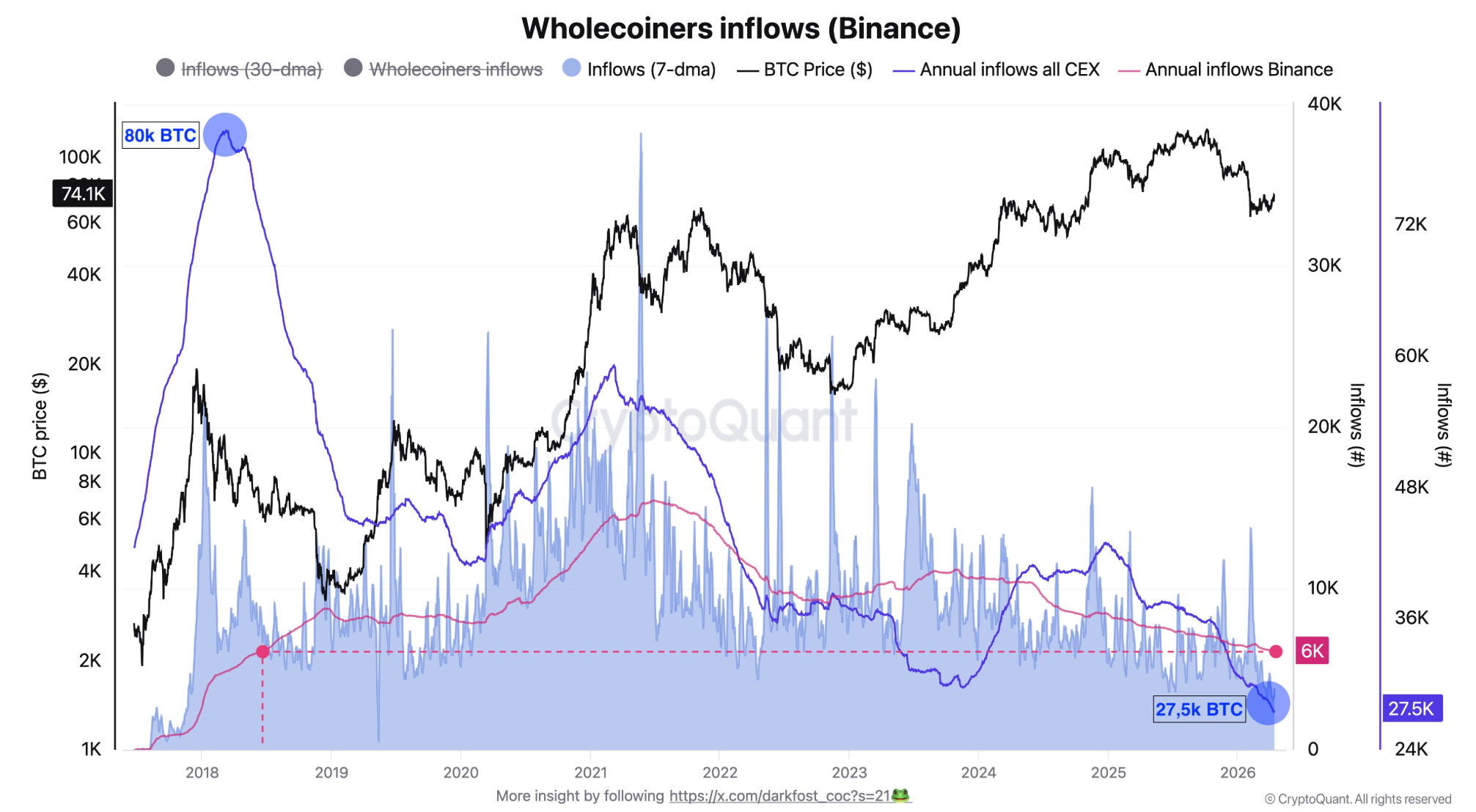
Bitcoin (BTC) wholecoiner exchange flows have collapsed to levels not seen since 2018, signaling a structural shift in how large holders interact with the market.
The decline coincides with Donald Trump’s latest signal of diplomatic coordination with Chinese President Xi Jinping over the Strait of Hormuz, adding a geopolitical tailwind to an already tightening supply picture.
Wholecoiner Flows Hit Multi-Year Lows
Transactions of at least one full BTC sent to exchanges have fallen sharply. On the Binance exchange, the monthly average now sits around 6,000 BTC, far below the 15,400 BTC recorded in 2021.
At a global level, the picture is more pronounced. Total transfers of at least one BTC to exchanges have dropped to roughly 27,500 BTC, compared to 80,000 BTC at the 2018 peak.
Several factors explain the trend. Rising prices have made holding a full bitcoin increasingly difficult, reducing the pool of wholecoiners over time.
The expansion of trading platforms and the introduction of spot Bitcoin ETFs in 2024 now allow investors to gain exposure without directly holding BTC.
A growing share of holders also appears to favor long-term strategies, further reducing exchange activity.
“This decline in active wholecoiners on exchanges reflects both reduced selling pressure and a gradual transformation of market structure, with a growing share of supply becoming increasingly illiquid over time,” Darkfost wrote.
Short-Term Holders Take Profits While Shorts Pile In
While long-term holders pull back, short-term holders (STHs) have moved aggressively in the opposite direction.
When BTC tested the $75,000 level, STHs sent more than 65,000 BTC to exchanges within 24 hours, with 61,000 of those transfers locked in profit.
Analyst Michaël van de Poppe noted that the derivatives market is setting up for a potential squeeze. Funding rates have turned negative while open interest has climbed, meaning traders are overleveraged short as BTC tests resistance for the third time.
“…as long as BTC remains above $72K, I wouldn’t be worried, and I’d rather be looking for longs vs. shorts,” the analyst wrote.
He identified $85,000 to $88,000 as the next resistance zone if $75,000 breaks.
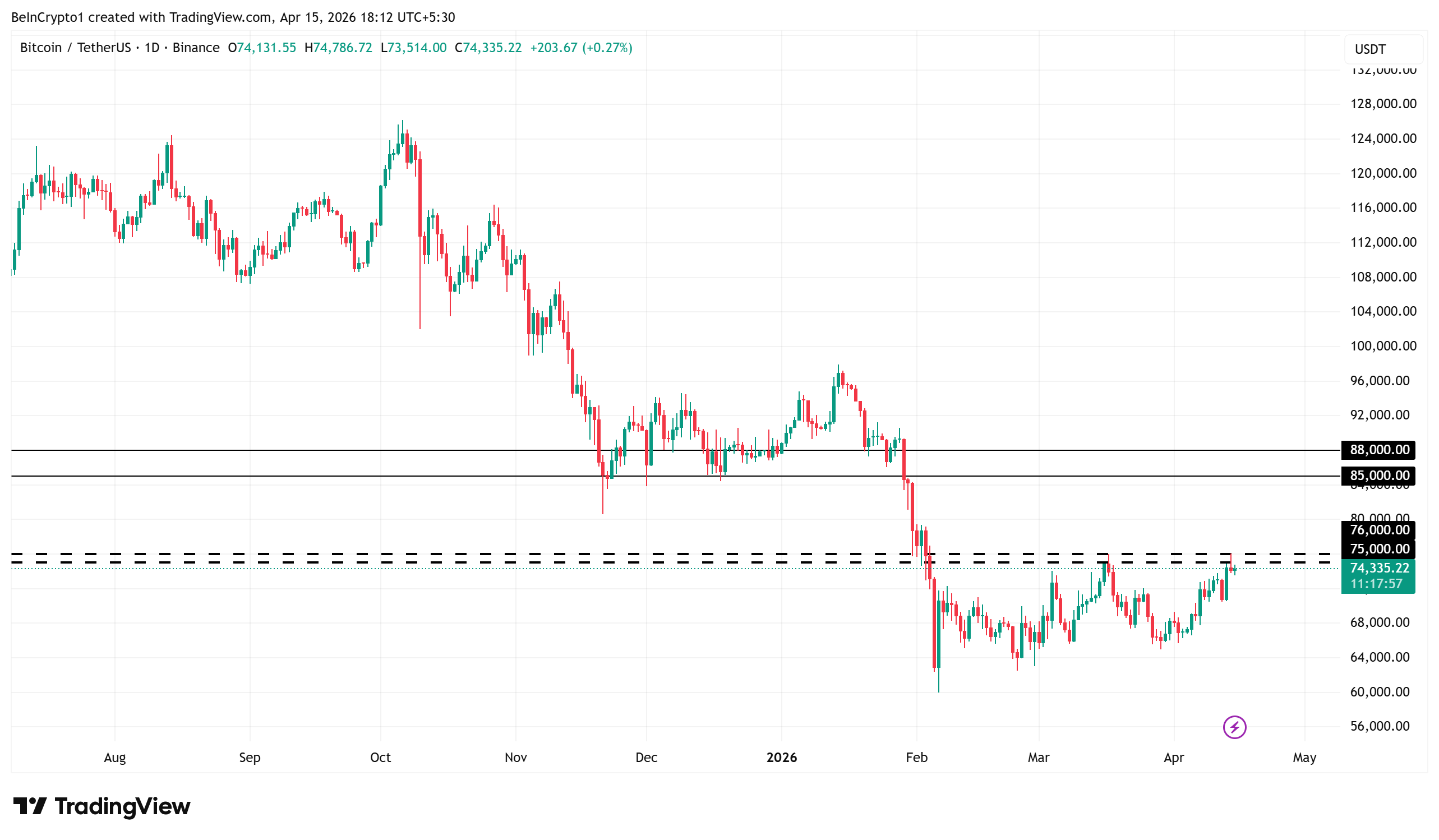
Separately, on-chain researcher Axel Adler Jr. flagged that Bitcoin’s Bull-Bear Index has flipped above zero, clearing the bear zone.
However, he cautioned that network profit and loss sentiment remains underwater, framing the current move as a recovery rather than a new bull regime.
The post Bitcoin Wholecoiner Exchange Flows Drop to 2018 Levels, Tightening Supply appeared first on BeInCrypto.
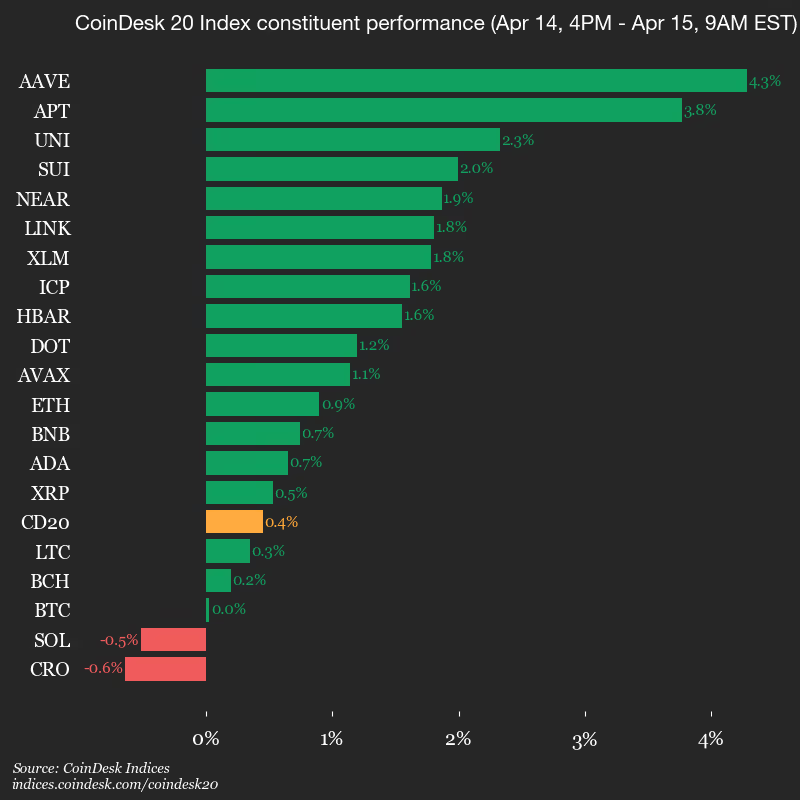
CoinDesk Indices presents its daily market update, highlighting the performance of leaders and laggards in the CoinDesk 20 Index.
The CoinDesk 20 is currently trading at 2058.34, up 0.4% (+9.17) since 4 p.m. ET on Tuesday.
Eighteen of 20 assets are trading higher.

Leaders: AAVE (+4.3%) and APT (+3.8%).
Laggards: CRO (-0.6%) and SOL (-0.5%).
The CoinDesk 20 is a broad-based index traded on multiple platforms in several regions globally.

Key Highlights
- Trading platform eToro has entered an agreement to purchase crypto wallet company Zengo for approximately $70 million
- Zengo leverages multi-party computation (MPC) security, eliminating seed phrase requirements
- The acquisition is designed to integrate self-custody features and decentralized trading capabilities into eToro’s ecosystem
- ETOR shares have declined more than 1% so far this year and approximately 48% over the trailing twelve months
- Citizens analyst Devin Ryan reduced his target price to $85 while maintaining a bullish outlook with ~145% potential upside
eToro (ETOR) revealed on Wednesday that it has reached an agreement to purchase Zengo, a crypto wallet service provider, in a transaction valued at approximately $70 million according to industry reports. The company’s shares experienced a modest uptick following the announcement.
Established in 2018, Zengo has amassed over 2 million users worldwide. The platform provides a non-custodial wallet solution, empowering users to maintain direct control over their digital assets without intermediary involvement.
Zengo’s architecture employs multi-party computation (MPC) technology for asset security, eliminating the traditional seed phrase requirement. This approach addresses a persistent challenge in self-custody solutions: the vulnerability associated with lost or compromised recovery keys.
The acquisition brings established functionality including token swapping capabilities, staking services, and fiat currency onramps that Zengo currently provides. The wallet infrastructure will operate independently from eToro’s regulated offerings, enabling users to engage directly with third-party decentralized protocols.
Speaking on the strategic timing, eToro CEO and co-founder Yoni Assia stated, “As we often say, crypto downtimes are the time to build and this acquisition reflects that long-term approach.”
According to company statements, the purchase will enable eToro to better serve emerging cryptocurrency applications — particularly tokenized real-world assets, decentralized prediction markets, and perpetual futures contracts. The platform intends to weave Zengo’s underlying technology into its core infrastructure moving forward.
“[The acquisition] will strengthen our ability to support evolving digital asset use cases, including tokenized assets and emerging decentralized trading models,” eToro announced in an official statement.
The Zengo deal follows closely on the heels of eToro’s launch of its proprietary app marketplace, unveiled just one day earlier. This marketplace provides a centralized hub for investors and third-party developers to create and access trading tools, analytics platforms, and other functionality within eToro’s environment. ETOR shares jumped more than 4% following that app store reveal.
ETOR Stock Faces Headwinds Despite Strategic Moves
Notwithstanding recent strategic initiatives, the stock has struggled significantly. ETOR has shed over 1% since the beginning of the year and tumbled roughly 48% over the past twelve-month period.
Last week, Devin Ryan from Citizens adjusted his price target downward to $85 from a higher previous level, though this still represents approximately 145% appreciation potential from current trading levels. Ryan noted that “navigating volatility remains the central challenge” facing capital markets and fintech businesses, adding that cryptocurrency market sentiment “remains impaired” in the near term.
These headwinds were evident in eToro’s fourth-quarter financial performance. Revenue from digital assets plummeted 38% during the quarter that concluded on December 31. However, the company still managed to generate a quarterly profit of $69 million, representing approximately 16% growth compared to the same period a year earlier.
Analyst Sentiment and Price Projections
Among Wall Street analysts, the consensus rating for ETOR stands at Moderate Buy, reflecting seven Buy recommendations and three Hold ratings issued over the last three months.
The average analyst price target currently sits at $52.80, suggesting roughly 52% upside potential from present price levels.
The Zengo transaction remains subject to standard closing requirements and regulatory conditions. While eToro has not publicly verified the $70 million purchase price, Bloomberg reported the figure based on information from a source familiar with the transaction terms.
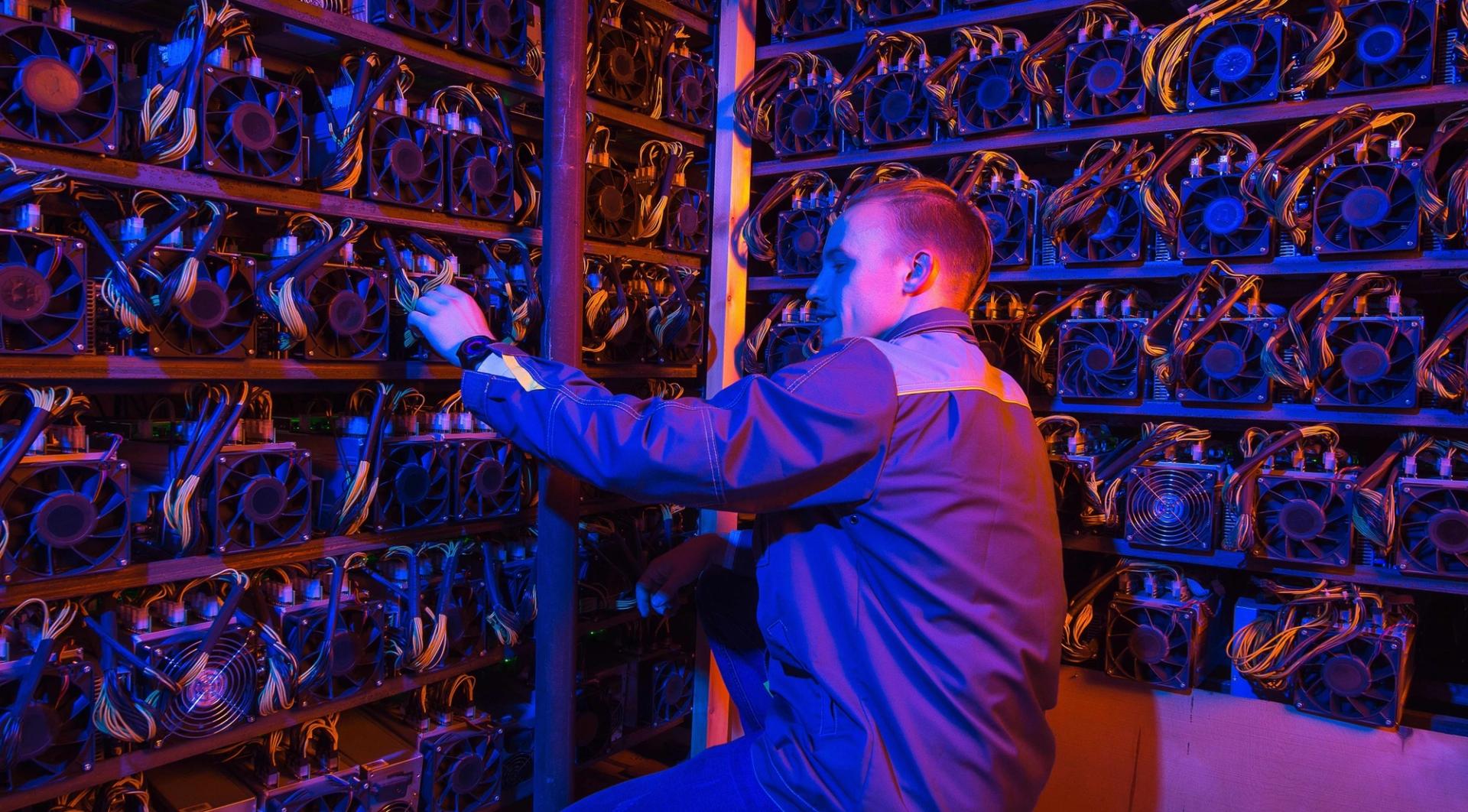
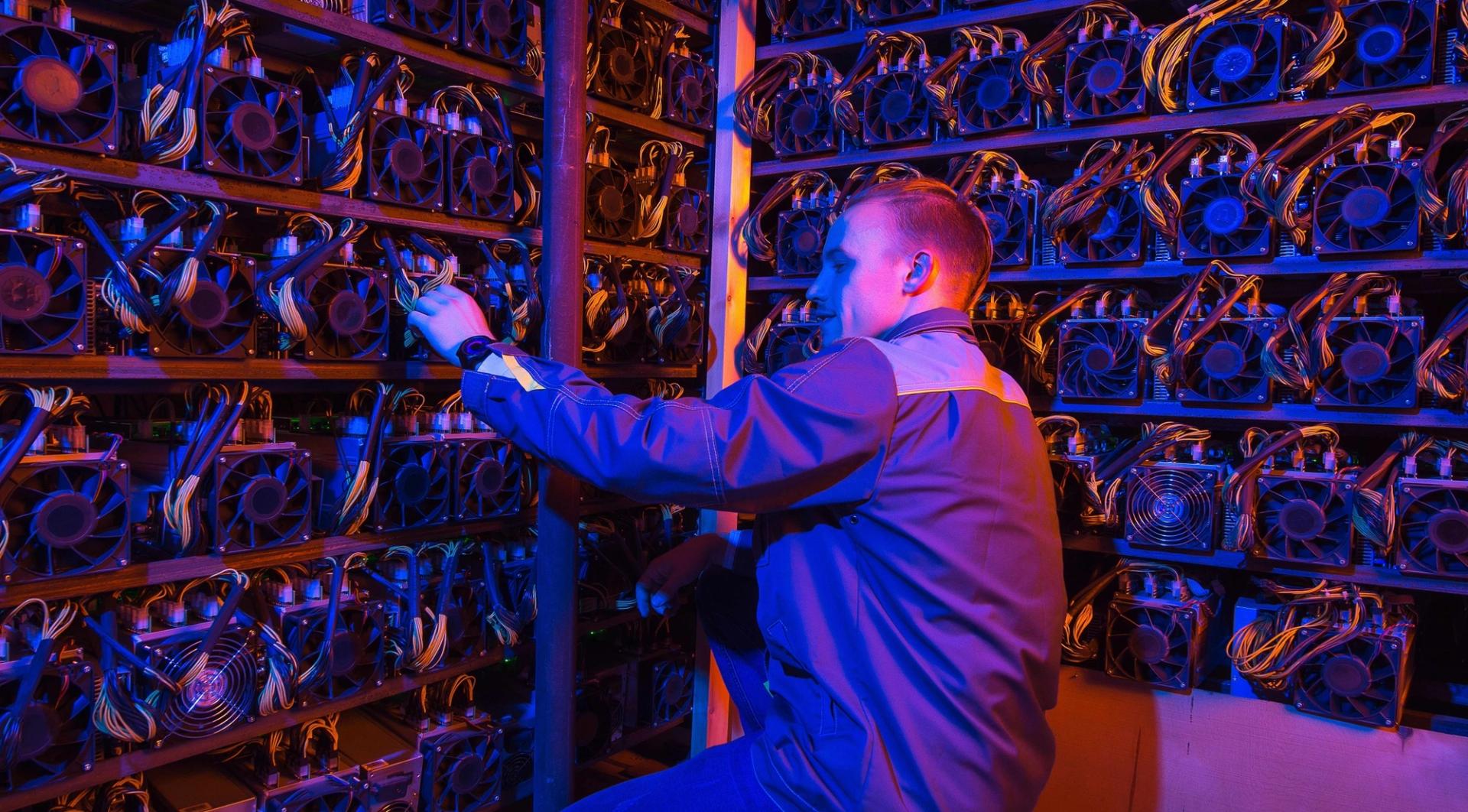
TeraWulf (WULF), a US data center operator focused on bitcoin mining and AI computing, saw its shares drop early Wednesday, after the company announced a $900 million capital raise.
The firm priced 47.4 million shares at $19 each. WULF is down 5.8% to $19.73 in early trading. The underwriter greenshoe option is for an additional 7 million shares.
Alongside other AI infrastructure names, WULF has been on a scorching run, rising more than 50% since late March.
The proceeds are earmarked for funding the construction of a major data center campus in Hawesville, Kentucky, alongside repaying outstanding bridge financing and supporting future expansion.
Preliminary Q1 results
Alongside the offering, TeraWulf released preliminary first-quarter 2026 results. The company expects revenue between $30 million and $35 million. The balance sheet showed $3.1 billion in cash and $5.8 billion in total debt.
Management highlighted a growing shift toward contracted HPC hosting revenues, which now account for over half of total revenue, positioning the business for more stable, long-term cash flows.
Compass Point analyst Michael Donovan, who has a Buy rating and a $28 price target on WULF, pointed to the shift in mix toward HPC as a positive inflection point for the business, with contracted hosting revenue overtaking bitcoin mining for the first time. He also views the capital raise as a necessary step to unlock the next phase of growth. While acknowledging the dilution, he said the added funding improves visibility into the buildout of the Kentucky site, which he expects to be developed in phases based on customer demand. He added that demand for TeraWulf’s power and hosting capacity remains strong.
Looking ahead, Donovan expects the company’s revenue profile to change meaningfully as HPC scales. He forecasts that contracted hosting will become the dominant driver of revenue over the next two years, reducing reliance on bitcoin price swings and supporting a more predictable earnings stream.
The shift reflects a broader trend across the industry, as bitcoin miners increasingly pivot toward AI and high-performance computing infrastructure to diversify revenue streams and improve margins.

Allbirds rides the AI compute wave

Prime Video’s Instant-Classic Fantasy Series Pulls Off One Last Miracle in Epic First Trailer

The House | What to do about SLAPPs? Why urgent reform is needed to protect all of us

Why Israel is blocking foreign journalists from entering

Bitcoin: We’re Entering The Most Dangerous Phase

Alan Cumming Brands Baftas Ceremony A ‘Triggering S**tshow’

XRP COILED SPRING BREAKOUT SETUP! – BANKS ARE HURTING CRYPTO INVESTORS! – $12 – $25 XRP SHORT TERM

7 Money Mistakes You Must Avoid | Smart Financial Habits | Telugu Motivation#motivation#viral#shorts

4-Hour War Countdown. Bitcoin Sphere Of Control
-

 Politics5 days ago
US brings back mandatory military draft registration
-
 Sports5 days ago
Man United discover Nico Schlotterbeck transfer fee as defender reaches Dortmund agreement
-

 Fashion5 days ago
Weekend Open Thread: Veronica Beard
-

 Politics5 days ago
Malcolm In The Middle OG Turned Down ‘Buckets Of Money’ To Appear In Reboot
-

 Politics3 days ago
World Cup exit makes Italy enter crisis mode
-

 Crypto World6 days ago
Canary Capital Files SEC Registration for PEPE ETF
-

 Business5 days ago
Tesla Model Y Tops China Auto Sales in March 2026 With 39,827 Registrations, Beating Cheaper EVs and Gas Cars
-

 Crypto World2 days ago
The SEC Conditionalises DeFi Platforms to Be Avoided for Broker Registration
-

 Crypto World2 days ago
SEC Signals Exemption for Crypto Interfaces From Broker Registration
-

 News Videos6 hours ago
Secure crypto trading starts with an FIU-registered
-
 NewsBeat3 days ago
Pep Guardiola and Gary Neville agree over Arsenal title problem that benefits Man City
-

 Business5 days ago
OpenAI Halts Stargate UK Data Centre Project Over Energy Costs and Copyright Row
-

 Business4 days ago
Ireland Fuel Protests Enter Day 5 as Blockades Spark Shortages and Government Prepares Support Package
-

 Politics5 days ago
LBC Presenter Mocks Trump Over Iran War Failures
-

 Crypto World5 days ago
Federal judge blocks Arizona from bringing criminal charges against Kalshi
-
 NewsBeat3 days ago
JD Vance announces ‘no agreement’ with Iran over nuclear weapons fear
-

 Tech6 days ago
A version of Windows 10 released a decade ago is now eligible for additional security patches
-

 Crypto World1 day ago
SEC Proposes Certain Crypto Interfaces Don’t Need to Register as Brokers
-

 NewsBeat1 day ago
Trump and Pope Leo: Behind their disagreement over Iran war
-

 Business5 days ago
IMF retains floor for precautionary balances at SDR 20 billion
You must be logged in to post a comment Login