
Crypto World
Crypto scams cost Americans $11.4 billion in 2025, FBI says



Americans reported $11.4 billion in losses tied to cryptocurrency scams last year, 22% more than in 2024, highlighting the growing scale of digital asset fraud, an FBI report revealed Tuesday.
“Cryptocurrency investment scams are sophisticated long-term scams using psychological manipulation, the appearance of legitimacy, and exploitation of cryptocurrencies to deceive victims into investing large sums of money,” the report said.
The report also said that most crypto scams are perpetrated by organized criminal enterprises based in Southeast Asia that exploit victims of human trafficking as forced labor to run the operations.
Crypto analytics firm Chainalysis released a report in January revealing that as much as $17 billion in crypto was lost worldwide to scams and frauds in 2025. Impersonation, crypto exchange impostors and AI-generated scams against individuals were gradually surpassing losses to cyber-attacks as the leading methods criminals were using to steal digital assets, according to the Crypto Crime Report.
The FBI noted in its report that the number of victims increased significantly. In 2025, there were 181,565 complaints involving cryptocurrency, a 21% increase. The average damage per case was $62,604, highlighting how victims are often drawn into schemes that extract substantial amounts rather than small sums, the bureau said.
Losses are also heavily concentrated. Nearly 18,600 complainants each lost more than $100,000, suggesting many victims are losing life-changing amounts, including savings and retirement funds.
More broadly, crypto scams now sit at the center of a wider surge in online fraud. Americans filed more than 1 million cybercrime complaints in 2025, with losses exceeding $20.8 billion. Fraud and scams accounted for the overwhelming majority of those losses, reflecting what the FBI describes as a rapidly evolving threat landscape.


U.S. President Donald Trump has edged his position on prediction markets closer to cautious acceptance after a period of public skepticism, signaling that political and regulatory dynamics abroad are influencing his stance. Speaking to reporters in Florida, Trump acknowledged that while some critics remain unconvinced, “a lot of people who are very smart” support these markets, and he suggested the United States risks being left out if it doesn’t participate as other countries move forward.
That shift comes after a separate set of remarks in which Trump said he was not happy with prediction markets overall, describing the global landscape as increasingly “a casino” and noting the proliferation of betting platforms across the world. The remarks underscore a tension between domestic regulatory scrutiny and a rapidly expanding, data-driven sector that has drawn significant user and investor interest in recent months.
Key takeaways
- Prediction markets surged in popularity, with Polymarket and Kalshi reporting record activity; combined trading volumes reached $23.6 billion in March, per Token Terminal.
- Top political figures’ families and businesses are entwined with these platforms, complicating public perception and regulatory considerations.
- Trump’s anticipated involvement in tech-enabled markets extends to his business interests, including a planned Truth Social partnership with Crypto.com for prediction markets, and his family’s advisory roles in related ventures.
- The regulatory backdrop remains unsettled, with ongoing enforcement and legal debates about how gambling and prediction markets should be treated in the U.S. and abroad.
Prediction markets in the spotlight as usage climbs
Two of the most prominent prediction-market platforms—Polymarket and Kalshi—have together captured rising demand, attracting a broad user base seeking to hedge or speculate on real-world events. According to data cited by Token Terminal, the combined trading volume across these sites reached a record level in March, underscoring a sustained appetite for on-chain- or web-based event markets despite ongoing policy debates across jurisdictions.
The growth in activity arrives amid ongoing regulatory scrutiny in the United States and abroad. A recent wave of attention has focused on whether prediction markets should be treated as gambling or as legitimate information markets with potential applications for policymaking, risk assessment, and civic discourse. This tension is not new, but the pace and breadth of participation have intensified, driving investors and users to weigh both risk and opportunity in these platforms.
Family ties and corporate ambitions complicate the picture
The involvement of high-profile political figures and their families adds a layer of complexity to the trajectory of prediction markets. Donald Trump Jr. has been associated with Polymarket since August, joining the company’s advisory board. He also serves as an adviser to Kalshi, a role he took on in January 2025, highlighting how personal affiliations intersect with a rapidly evolving market landscape.
Beyond personal ties, Trump’s business ventures have signaled intended participation in the prediction-market space. In October, Trump Media announced plans to roll out prediction-market functionality on Truth Social, in partnership with Crypto.com. The arrangement would place market-tracking and betting capabilities on the platform, potentially broadening exposure to a U.S. audience for event-based markets. It’s worth noting that Trump divested his stake in Trump Media upon assuming office, transferring shares to a trust for which Trump Jr. is the sole trustee, a move that continues to shape the governance around any future initiatives tied to the brand.
These developments come against a backdrop of independent reporting and industry analysis that emphasize how the lines between technology platforms, political discourse, and regulatory oversight are increasingly intertwined. While executives and high-profile figures may help drive adoption, policymakers have signaled a readiness to scrutinize these markets more closely, particularly where foreign competition and cross-border liquidity intersect with U.S. consumer protection standards.
Regulatory context and what could come next
The broader regulatory environment remains unsettled. Earlier this year, concerns about applying traditional gambling laws to prediction markets drew attention from U.S. regulators, along with enforcement actions in other jurisdictions. In coverage linked to Cointelegraph, regulatory authorities have signaled a willingness to challenge or constrain certain market structures and operators, underscoring that user safety and compliance are likely to shape the pace of growth going forward.
Analysts note that the surge in volume and the involvement of prominent political figures could accelerate calls for clearer rules and standardized practices. This could include more explicit definitions of what constitutes a permissible prediction market, how customer funds are safeguarded, and what disclosures are required for operators and participants. In the near term, observers will be watching for how the U.S. approach evolves under current agencies and how international counterparts—where some countries have already embraced these markets—compare in terms of consumer protections, liquidity, and market integrity.
Recent coverage also points to ongoing discussions about the role these platforms might play in informing public policy or market risk assessment. Proponents argue that well-designed prediction markets aggregate information efficiently and can serve as useful tools for forecasting and governance. Critics, however, caution about moral hazard, manipulation risks, and the potential for inappropriate betting on sensitive or risky events.
For investors and builders, the main takeaway is that the sector’s momentum is unlikely to fade soon, but the road ahead hinges on regulatory clarity and credible risk controls. The next chapters will likely reveal how traditional financial oversight and innovative market design can converge to create sustainable ecosystems that are both compliant and genuinely useful to participants seeking to express hedges or opinions on real-world developments.
Meanwhile, observers should monitor both the policy discourse in Washington and the actions of foreign jurisdictions where prediction markets are already more mature. If the U.S. broadens access or introduces clearer guidelines, it could unlock a wave of new participants and capital. Conversely, tighter restrictions could reallocate activity to overseas platforms or compel operators to rethink product design to align with strict regulatory expectations.
As markets watch for signals from regulators and industry players, the coming quarters may reveal whether the recent rhetoric shift among political figures translates into practical policy or remains a cautious, interest-driven stance. The evolving dialogue between lawmakers, platform operators, and users will likely shape the pace of innovation in public-interest forecasting and its broader implications for governance and markets.
Readers should keep an eye on any formal regulatory updates from U.S. authorities, as well as announcements from platform operators about product changes, liquidity shifts, or new geographies of access. The balance between opportunity and oversight will determine how quickly prediction markets mature from fringe tools into mainstream, widely adopted instruments in the crypto and broader financial ecosystems.
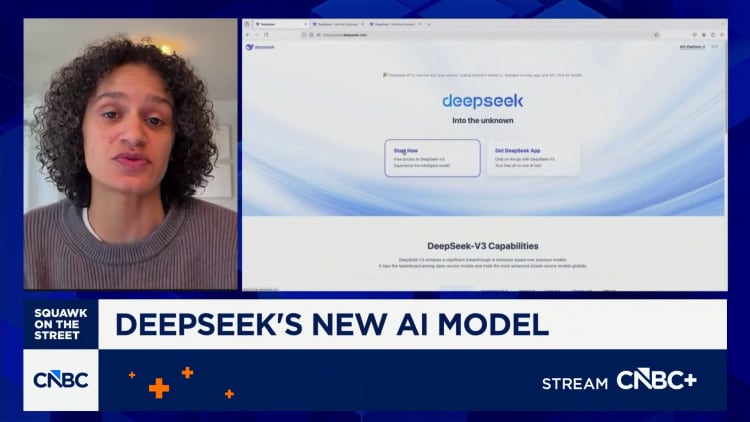
Manus was hailed by Chinese state media as the “next DeepSeek” soon after its launch in March 2025, months before the startup relocated to Singapore.
Cheng Xin | Getty Images News | Getty Images
BEIJING — China’s decision to block U.S. tech giant Meta‘s $2 billion acquisition of artificial intelligence startup Manus is being seen by analysts as a warning to tech entrepreneurs.
“Clearly after Manusgate, founders will know that if you start in China, you stay in China,” said Duncan Clark, an early advisor to Alibaba and chairman of consultancy firm BDA China.
“We know the deal was already in trouble,” he said, “but this draconian development is on the more extreme side of the likely outcomes.”
The timing is notable as it comes just days before Meta’s scheduled earnings release Wednesday local time, and less than a month before a planned visit by U.S. President Donald Trump to Beijing, during which trade and investment are expected to be discussed.
The case also has direct implications for how businesses and investors position themselves in the U.S.-China tech race, as they navigate new risks around data, talent and intellectual property.
For Chinese AI startups and U.S. investors, “the takeaway is that Singapore incorporation alone does not de-risk a deal from Chinese regulatory reach,” said Chris Pereira, president and CEO of consulting firm iMpact.
“The broader implication,” he said, “is that a new front in the competition between the U.S. and China just opened up: talent itself.”

What’s next for the deal
Chinese authorities on Monday demanded that parties involved with the transaction withdraw, just months after launching a probe. It was not immediately clear how the unwinding process would proceed.
Analysts said the decision could serve as a signal to founders about relocating sensitive technology overseas.
“More than the models and AI agents, China is most concerned about whether China-origin strategically sensitive technologies — and the data and talent behind them — are effectively transferred offshore by corporate restructuring in Singapore,” said Winston Ma, adjunct professor at NYU School of Law.
“The most complex aspect of this deal unwinding in the digital world is the data reversal,” Ma said, noting it’s much more challenging than reversing a physical goods transaction.
A Meta spokesperson told CNBC that the transaction “complied fully with applicable law. We anticipate an appropriate resolution to the inquiry.” Manus did not immediately respond to a CNBC request for comment.
“The practical reality is China has no leverage over Meta,” said Gary Dvorchak, Blueshirt Group managing director. The Facebook parent’s social media platforms are blocked in China by an internet firewall.
Compared with its business in the European Union, Meta “makes nothing in China,” which means the company could ignore Beijing and proceed with the deal, Dvorchak said. But Beijing could disrupt Manus’ operations, making the startup “essentially worthless to Meta if they merge,” he added.
Meta disclosed that about 11% of its revenue in 2024 came from China, but did not share those figures in 2025. Europe accounted for more than 20% of Meta’s revenue in 2024 and 2025.
While Meta noted in its 2025 annual report that it generates “meaningful revenue from a small number of resellers serving advertisers based in China,” it flagged that regulatory action, including U.S.-China tensions, could be a risk to its financial performance.

Subscribe now
Beijing’s move to block the acquisition appeared to be the first time China used foreign investment security review measures introduced in late 2020.
Reflecting the weight of national security concerns, the rules established a dedicated office under the National Development and Reform Commission, China’s economic planning agency.
The measures called on companies to seek approval for deals involving national security concerns before undertaking a foreign investment “directly or indirectly” in mainland China. It is unclear whether Meta or Manus was required to do so and whether they communicated with regulators in advance. Reports indicate Beijing started reviewing the deal after it was announced.
“Manus’s early R&D was conducted in China and … its core data originated there,” Chinese state-run tabloid Global Times said in an English-language version of its editorial overnight.
“The key issue is not where the company is registered or where its team is currently based,” the editorial said. “Rather, it lies in the extent of its technological, talent and data links with China, “and whether the transaction could harm China’s industrial security and development interests.”
National attention
As OpenAI’s ChatGPT took the world by storm in 2022, Washington tightened restrictions on chip exports to China, limiting access to a lucrative market for companies such as U.S. semiconductor giant Nvidia.
China has pushed for tech self-sufficiency but has struggled to catch up. Breakthroughs from firms such as DeepSeek in January 2025 marked a moment of national pride.
The open-sourced AI model did not rely on overseas-trained talent. DeepSeek also slashed AI usage costs — even as the U.S. restricted China’s access to high-end chips.
On the heels of this enthusiasm, Manus, on March 5, 2025, released an AI tool that took the tech to the next level, from generating ideas to autonomously completing tasks.
China’s state media hailed the launch as “the next DeepSeek.” Beijing’s municipal government was quick to highlight that Manus was created by a local tech company called Beijing Red Butterfly Technology.
But by July 2025, Manus had restructured as a Singapore-headquartered company. In March, China outlined plans to transform its technology ambitions in its latest five-year development plan.
China wants to “avoid situations where Chinese talent can boost U.S. firms in their AI rivalry,” BDA’s Clark said, noting that Chinese talent accounts for about half of the global AI engineering pool in biotech and many other sectors.
“They don’t want to allow people or companies to bend or skirt the rules. We saw this with Ant Group’s aborted IPO, Didi jumping the gun with its U.S. listing then delisting. Now Manus.”
There’s also a flip side.
“The Manus case could further divide the AI ecosystem between China and [the] U.S., deterring overseas AI talents from returning to China,” said Dan Wang, a director on Eurasia Group’s China team.


Core Scientific plans to turn its Pecos, Texas site into a large artificial intelligence data center campus.
Summary
- Core Scientific will convert its Pecos Bitcoin mining site into a large AI data center campus.
- The company expects about 1GW of the planned 1.5GW capacity to be available for leasing.
- Core Scientific is repurposing 300MW of mining power as miners seek AI revenue streams.
The Bitcoin miner said the project could reach up to 1.5 gigawatts of gross power capacity. The company said about 1 gigawatt of that capacity is expected to be available for leasing. The site will support high-density colocation services as demand for AI computing power continues to rise.
Core Scientific said it will repurpose about 300 megawatts currently used for Bitcoin mining at the Pecos site. That power will now support data center operations for AI workloads.
The company said the first data hall has completed foundation work. Vertical construction is now starting, with early capacity expected in 2027.
CEO Adam Sullivan said the company is using its internal experience to support the buildout.
“We continue to leverage our deep in-house expertise to differentiate how we build and scale next generation artificial intelligence infrastructure,” Sullivan said.
Power contracts and land support expansion
Core Scientific has secured another 300 megawatts of power under contract with its utility provider. The company also plans to expand through a behind-the-meter power solution.
To support the project, Core Scientific said it acquired more than 200 acres of land near the Pecos site. The added land gives the company more room for the planned data center campus.
The company also announced plans last week to raise $3.3 billion through senior secured notes due in 2031. It plans to use the funds for data center expansion in Georgia, Texas, North Carolina, and Oklahoma.
Bitcoin miners seek AI revenue streams
Core Scientific has earned most of its revenue from digital asset mining in the past. However, it has increased its focus on infrastructure services as miners search for new income sources.
Mining companies have faced tighter margins after rising energy costs and changing market conditions. As a result, several firms have moved some mining sites toward AI and high-performance computing.
MARA Holdings bought a 64% stake in French infrastructure firm Exaion in February to expand into AI services. Hive, Hut 8, TeraWulf, and Iren have also worked on converting mining facilities into data centers.
Other energy-heavy sites are also being repurposed. Alcoa is close to selling its idle Massena East smelter in New York to Bitcoin mining firm NYDIG. TeraWulf also bought Century Aluminum’s Hawesville smelter in Kentucky for $200 million, with plans to turn it into a high-performance computing and AI facility.
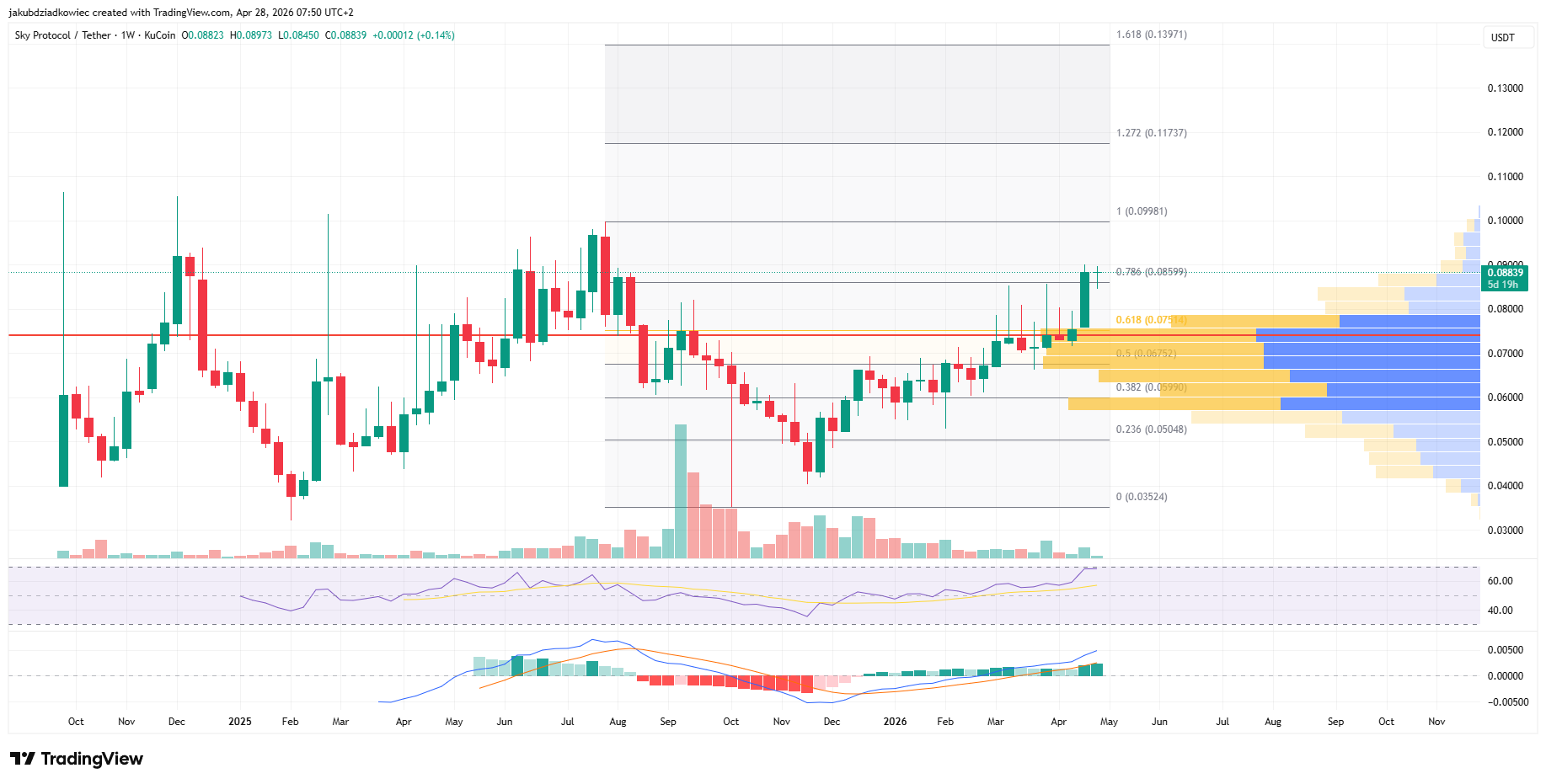
Sky Protocol (SKY) trades near $0.088 after gaining 28% from its February breakout, with the weekly chart showing bullish RSI and MACD readings that suggest the move has more room to run.
The token has benefited from its rebrand from MakerDAO, and current technicals across the weekly, daily, and 4-hour timeframes point to continued upside as long as the $0.078 support floor holds firm.
Sky Protocol replaced MakerDAO in late 2024, with MKR holders able to convert into SKY at a fixed 1:24,000 ratio. The official transition announcement remains the cleanest reference point for newer market participants.
Weekly RSI and MACD Confirm SKY’s Bullish Trend
The SKY weekly chart shows the Relative Strength Index (RSI) sitting near 68, just below the overbought line. The MACD histogram is printing taller green bars, with momentum still expanding to the upside.
The Visible Range Volume Profile (VRVP) on the right side of the chart adds confluence. Volume is thin above $0.078, meaning sellers have left a clear runway through the next resistance band.
Price has already flipped the 0.786 fib retracement near $0.086, leaving the round $0.10 mark as the next ceiling. A weekly close above $0.10 would open the 1.272 extension at $0.117 and the 1.618 extension at $0.140.
For the signal to flip bearish, the weekly price would need to lose the 0.618 retracement at $0.075. The BeInCrypto SKY forecast shows conditions stay constructive while that level holds.
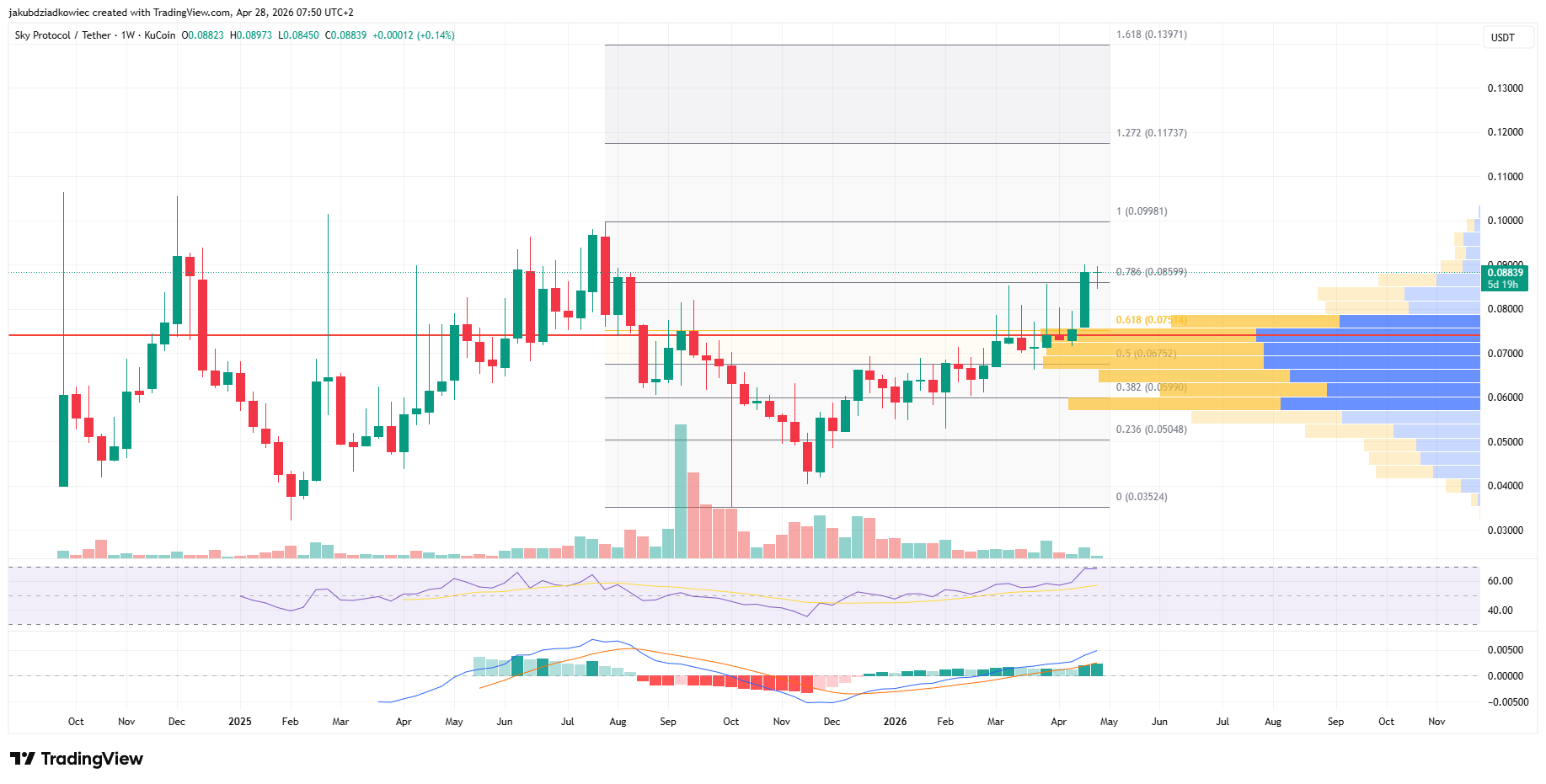
Daily Trendline Break Targets a 36% Move to $0.095
The daily chart shared by trader @Cryptokartha shows SKY broke above a multi-month descending trendline in mid-February. Since the breakout, the token has added 28% and continues to grind higher in a clean stair-step pattern.
The chart shows immediate support in the $0.066 to $0.070 range. The next vertical leg measures a 36% move toward $0.095, with $0.090 acting as the trigger.
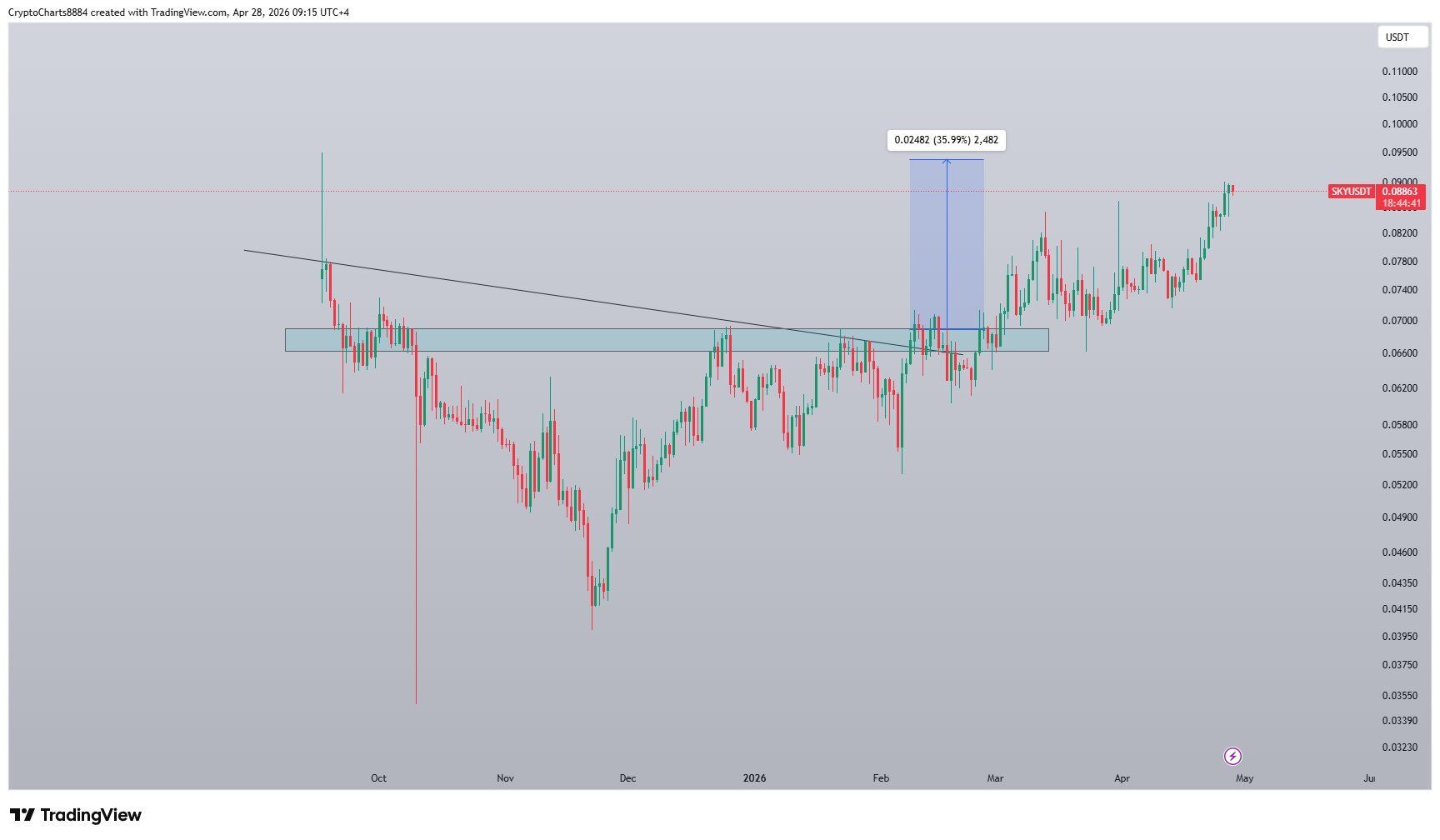
A pullback into the support box would not break the bullish thesis. Only a daily close below $0.066 would invalidate the setup and put the February breakout at risk.
The fundamental backdrop adds support. SKY has been lifted by its Coinbase roadmap inclusion and the launch of USDS staking rewards. Defending $0.078 keeps the door open toward $0.12 in the coming weeks.
SKY Price Prediction on the 4-Hour Zoom In
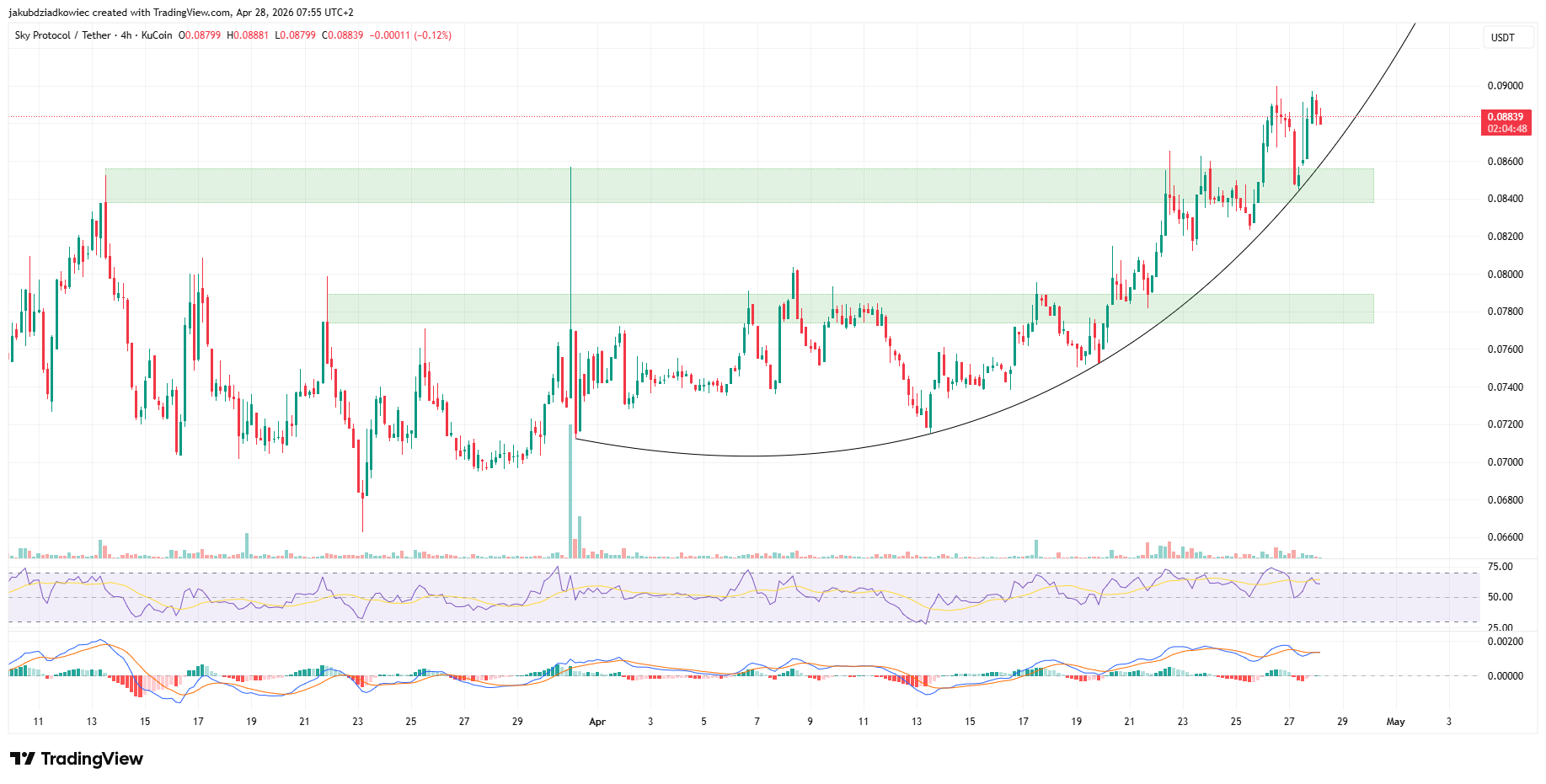
Zooming in on the 4-hour chart sharpens the near-term picture. Price is pressing toward $0.090, but the 4-hour RSI has rolled over and is printing a lower high relative to the latest peak.
This early bearish divergence is the first warning that buying pressure may be fading inside the parabolic uptrend. The MACD on the same timeframe sits flat around the zero line, neither confirming nor rejecting the move.
The black parabolic curve drawn from the early-April low has now been tested three times, and each touch has held. The immediate support box sits near $0.084, tested on April 27, with a deeper cushion at $0.078.
A clean break of $0.078 would invalidate the parabolic structure and likely trigger a flush toward the daily support. Holding that floor keeps the SKY bull case intact, with $0.095 the next near-term magnet and $0.12 the larger weekly target.
The post Sky Protocol (SKY) Eyes 36% Rally Toward $0.095 on Weekly RSI Strength appeared first on BeInCrypto.

Key Takeaways
- ChatGPT failed to reach OpenAI’s ambitious target of one billion weekly active users by year-end 2024
- The artificial intelligence firm fell short of numerous monthly revenue benchmarks during the current year
- Chief Financial Officer Sarah Friar has expressed concerns internally about financing future infrastructure agreements
- Oracle and CoreWeave shares declined 3.5% during premarket hours; AMD slipped 2.7%
- Competitors Anthropic and Google Gemini have captured market share from OpenAI in recent months
OpenAI’s inability to achieve critical expansion milestones is creating turbulence in the AI infrastructure sector.
A Tuesday report from the Wall Street Journal revealed that OpenAI failed to meet its ambitious internal benchmark of attracting one billion weekly ChatGPT users before 2024 concluded. Additionally, the artificial intelligence powerhouse missed its yearly revenue projection along with multiple monthly financial targets throughout the year.
The publication indicates that Google’s Gemini platform experienced significant traction in late 2024, capturing valuable market share from OpenAI. Meanwhile, Anthropic has established dominance in the coding tools segment and enterprise sector, further challenging OpenAI’s expansion trajectory.
During Tuesday’s premarket session, Oracle and CoreWeave experienced 3.5% declines in share value. Advanced Micro Devices saw a 2.7% drop. These corporations have anchored substantial portions of their expansion strategies around anticipated AI infrastructure requirements.
Earlier this year, Oracle unveiled intentions to secure $45 to $50 billion in funding to broaden its cloud infrastructure capabilities. The company referenced committed demand from major clients such as OpenAI, Meta, and Nvidia as rationale for this massive investment. CoreWeave has projected capital expenditures between $30 and $35 billion for 2026, representing more than double its 2025 spending levels.
Uncertainties Surrounding Public Offering Timeline
OpenAI CFO Sarah Friar has reportedly cautioned internal leadership that the organization may face challenges securing funding for upcoming computing agreements if revenue expansion doesn’t accelerate, according to the Journal’s reporting. Board members have also intensified their scrutiny of data center transactions and questioned CEO Sam Altman’s aggressive push for expanded computing capacity.
Friar has allegedly raised doubts about whether OpenAI currently possesses the infrastructure and processes necessary to satisfy the rigorous disclosure requirements mandated for publicly traded enterprises. Altman has publicly stated his intention to transition OpenAI to public markets before the end of 2026.
Altman and Friar jointly disputed the Journal’s characterization. In a unified response, they dismissed any notion of internal friction or scaling back on computing investments as “ridiculous.” The executives emphasized their complete agreement on “buying as much compute as we can.”
Financial Runway and Burn Rate Concerns
OpenAI recently completed its most substantial financing round to date, securing $122 billion in capital. Despite this massive influx, the organization anticipates depleting these funds within a three-year timeframe, even under optimistic revenue growth scenarios. Portions of this financing also carry contingencies tied to particular partnership arrangements.
The company has experienced elevated subscriber churn rates, introducing additional uncertainty for stakeholders and leadership as they contemplate a potential public market debut.
According to the report, Friar alongside other senior executives have advocated for enhanced fiscal responsibility and tighter cost management, occasionally creating tension with Altman’s aggressive growth ambitions.
OpenAI’s primary AI infrastructure collaborators, notably Oracle and CoreWeave, have both pledged substantial spending increases throughout 2026, with projections partially based on anticipated demand originating from OpenAI.


Key Takeaways
- White House develops comprehensive strategy for Bitcoin Reserve utilizing seized cryptocurrency holdings
- Officials anticipate significant Bitcoin Reserve announcement in upcoming weeks
- Congressional members introduce legislation to establish permanent legal framework
- Federal government holds approximately 200,000 BTC from enforcement seizures
- Legal and policy frameworks continue development before official implementation
The Trump administration has significantly advanced its initiative to establish a national Bitcoin Reserve, with official announcements anticipated in the near future. The proposed reserve framework would leverage roughly 200,000 BTC obtained through federal law enforcement seizures. Government officials are currently finalizing legal protocols and policy frameworks ahead of public disclosure.
Administration Develops Comprehensive Reserve Framework
The White House intends to unveil its official Bitcoin Reserve framework within approximately eight weeks. Based on reports from Bybit’s weekly analysis, government officials plan to designate seized Bitcoin as strategic national reserve holdings. Additionally, this initiative represents a significant pivot in digital asset policy under President Trump’s leadership.
The reserve structure would primarily utilize Bitcoin already in federal custody from criminal prosecutions and civil asset forfeitures. This methodology allows officials to establish the reserve without conducting immediate market acquisitions. Accordingly, the administration can position the Bitcoin Reserve as a balance sheet optimization strategy.
Patrick Witt, the White House digital asset adviser, addressed the initiative during the Bitcoin 2026 conference held in Las Vegas. He indicated that legal assessments and executive preparation efforts remain ongoing before the subsequent public phase. Subsequently, the administration anticipates delivering a substantial update in the near term.
Congressional Action Seeks Permanent Legal Authority
The White House recognizes that Congress must provide the Bitcoin Reserve with robust statutory foundation. While executive directives can establish agency guidelines, legislative action creates enduring policy authority. Accordingly, members of Congress have begun drafting bills designed to codify the reserve into federal law.
Senator Cynthia Lummis alongside Representative Nick Begich previously reintroduced the BITCOIN Act. This legislation proposed acquiring one million Bitcoin across a five-year timeline using budget-neutral mechanisms. Begich subsequently announced plans to rebrand this legislation as the American Reserves Modernization Act.
The proposed legislation builds upon Trump’s executive directive while expanding the reserve’s operational scope. It additionally establishes clear separation between the Bitcoin Reserve and a broader digital asset inventory. Furthermore, this organizational structure positions Bitcoin as the cornerstone of the administration’s cryptocurrency policy platform.
Implementation Specifics Await Official Documentation
The Trump administration has yet to disclose the complete legal architecture of the Bitcoin Reserve. Specific implementation details will emerge through official documentation, regulatory guidance, and potential congressional authorization. Nevertheless, current indications demonstrate the reserve initiative has progressed beyond preliminary policy consideration.
The federal government currently maintains substantial Bitcoin holdings from previous law enforcement operations. These digital assets originated from seizures connected to criminal investigations and civil forfeiture proceedings. Consequently, officials can construct the Bitcoin Reserve without immediate expenditure of public funds for asset acquisition.
The initiative emerges amid ongoing Washington deliberations regarding comprehensive crypto regulation. Legislators continue developing frameworks for market structure, asset custody, stablecoin oversight, and digital asset supervision. Therefore, the Bitcoin Reserve may become a cornerstone element of Trump’s comprehensive digital asset policy framework.
Historical Context and Policy Evolution
Trump issued an executive order previously to establish a strategic Bitcoin Reserve. The directive instructed officials to preserve Bitcoin currently maintained on government financial statements. It simultaneously established a distinct repository for additional digital assets obtained through enforcement activities.
The policy represents a fundamental transformation in federal treatment of seized cryptocurrency holdings. Historically, federal agencies frequently liquidated forfeited Bitcoin through public auctions or alternative disposition methods. Currently, the administration seeks to retain Bitcoin as a permanent national asset.
The forthcoming announcement may provide clarity regarding custody arrangements, agency oversight, transparency requirements, and legislative priorities. It could also reveal how officials intend to protect the reserve against future policy modifications. Therefore, the next official documents will determine how the US Bitcoin Reserve transitions from conceptual plan to operational reality.

Block, the payments company behind Cash App and Square, has introduced on-chain proof-of-reserves for its corporate Bitcoin treasury, alongside new features for its products. The move places Block in the vanguard of crypto firms increasing transparency by allowing independent verification of holdings, rather than relying on trust alone.
At a Las Vegas event, Block announced that anyone can independently verify Block’s Bitcoin holdings through on-chain signatures, and that reserves are actively controlled rather than merely historically observed. The company noted a balance of 8,883 BTC, valued at about $681.4 million, which it describes as the 14th-largest corporate Bitcoin holding.
Key takeaways
- Block adds on-chain proof-of-reserves for its corporate Bitcoin treasury and for Cash App and Square, enabling public verification of holdings.
- 8,883 BTC are disclosed as Block’s reserves, valued around $681.4 million, marking Block as the 14th-largest corporate Bitcoin holder.
- PoR is presented as actively controlled and verifiable, not just a historical record, according to Block’s announcement on X.
- Adoption of proof-of-reserves has grown since the FTX collapse, with major platforms like Binance, Kraken, OKX, Bitfinex and Bitget among those embracing disclosures.
- Despite the broader push, some industry figures — notably Strategy’s Michael Saylor — have questioned PoR, citing security and information-exposure concerns.
- Block expanded its crypto toolkit with a touchscreen Bitkey hardware wallet, Cash App enhancements to auto-convert payments to Bitcoin, 5% Bitcoin back at Square merchants, and higher withdrawal limits.
Block’s PoR expansion and what it covers
Block’s new proof-of-reserves offering targets not only its corporate treasury but also the company’s consumer-facing payments rails. The disclosure covers 8,883 BTC on its books, which Block says helps validate the firm’s Bitcoin holdings in a verifiable, on-chain manner. By presenting these reserves alongside its public statements, Block aims to give users and investors a clearer picture of where its Bitcoin assets sit and how they’re controlled.
The company framed the PoR rollout as part of a broader push toward greater accountability in the crypto industry, particularly in the wake of past industry-wide upheavals. By tying the verification to on-chain signatures, Block argues that the reserves are actively managed and auditable, rather than simply reported after the fact.
Verification as a standard, with notable industry context
The PoR trend gained significant momentum after the 2022 FTX collapse, when customers and counterparties increasingly pressed for transparent, independently verifiable asset backing. Since then, several large crypto exchanges and institutions have published proof-of-reserves disclosures as part of a broader transparency push. Block’s adoption adds to a growing list that includes major venues such as Binance, Kraken, OKX, Bitfinex and Bitget.
That broader market debate remains nuanced. In May 2025, Michael Saylor, executive chairman of Strategy, the universe’s largest corporate Bitcoin holder, publicly warned that proof-of-reserves can pose security risks. He argued that exposing certain information about reserves and custodial relationships could undermine security for issuers, custodians, exchanges and investors. His stance illustrates the tensions between transparency and operational security that continue to shape PoR discussions.
New tools, incentives, and what Block is launching next
Alongside PoR, Block announced a slate of product updates aimed at integrating Bitcoin more deeply into its ecosystem. The company introduced a touchscreen Bitkey hardware wallet, designed to verify transactions at the point of interaction. It also rolled out a feature on Cash App that allows a subset of users to automatically convert payments into Bitcoin, broadening the pathway for everyday spending to become Bitcoin exposure.
Block is also expanding incentives for merchants using Square, offering 5% Bitcoin cashback on purchases at Square-enabled merchants. In addition, customer withdrawal limits have been increased fivefold, rising to $10,000 per day and $25,000 per week, easing access for users who hold Bitcoin through Block’s platforms.
Why this matters for investors, users, and builders
For investors and users, Block’s PoR push is a signal that the firm aims to align its disclosures with a growing demand for verifiable, auditable crypto holdings. In a market where opacity and custody risk have historically been points of contention, on-chain verification can reduce information asymmetry and potentially lower counterparty risk perceptions for Block’s Bitcoin assets tied to its treasury and product ecosystem.
For builders and other corporates, Block’s approach offers a playbook for integrating PoR into consumer products without sacrificing security. The combination of active on-chain verification and expanded Bitcoin-enabled features—such as automatic conversion in Cash App and merchant incentives—illustrates a practical path to broad Bitcoin adoption in payments and corporate treasury management.
As the industry weighs the benefits and trade-offs of PoR, readers should watch how more corporates adopt verifiable disclosures, how custodial arrangements evolve to balance transparency with security, and whether regulatory scrutiny shapes future PoR standards.
Looking ahead, the question is whether Block’s expanded PoR rollout will spur further adoption among other corporates and what changes may emerge in the governance of on-chain verifications. Keep an eye on whether more products integrate native Bitcoin mechanics and whether policy developments around disclosure standards influence how PoR is implemented across the sector.
Commodity-linked currencies are trading near key levels, showing restrained price action as market participants adopt a wait-and-see approach. The fundamental backdrop is shaped by expectations surrounding the release of Australia’s inflation data and the Bank of Canada’s interest rate decision, followed by a press conference. These events are viewed as key drivers for the respective currencies and could significantly shift the balance of power in the market.
Additional attention is focused on global factors, including US statistics (data on economic activity and oil inventories), as well as ongoing uncertainty surrounding negotiations between the US and Iran, which continues to influence overall risk sentiment.
AUD/USD
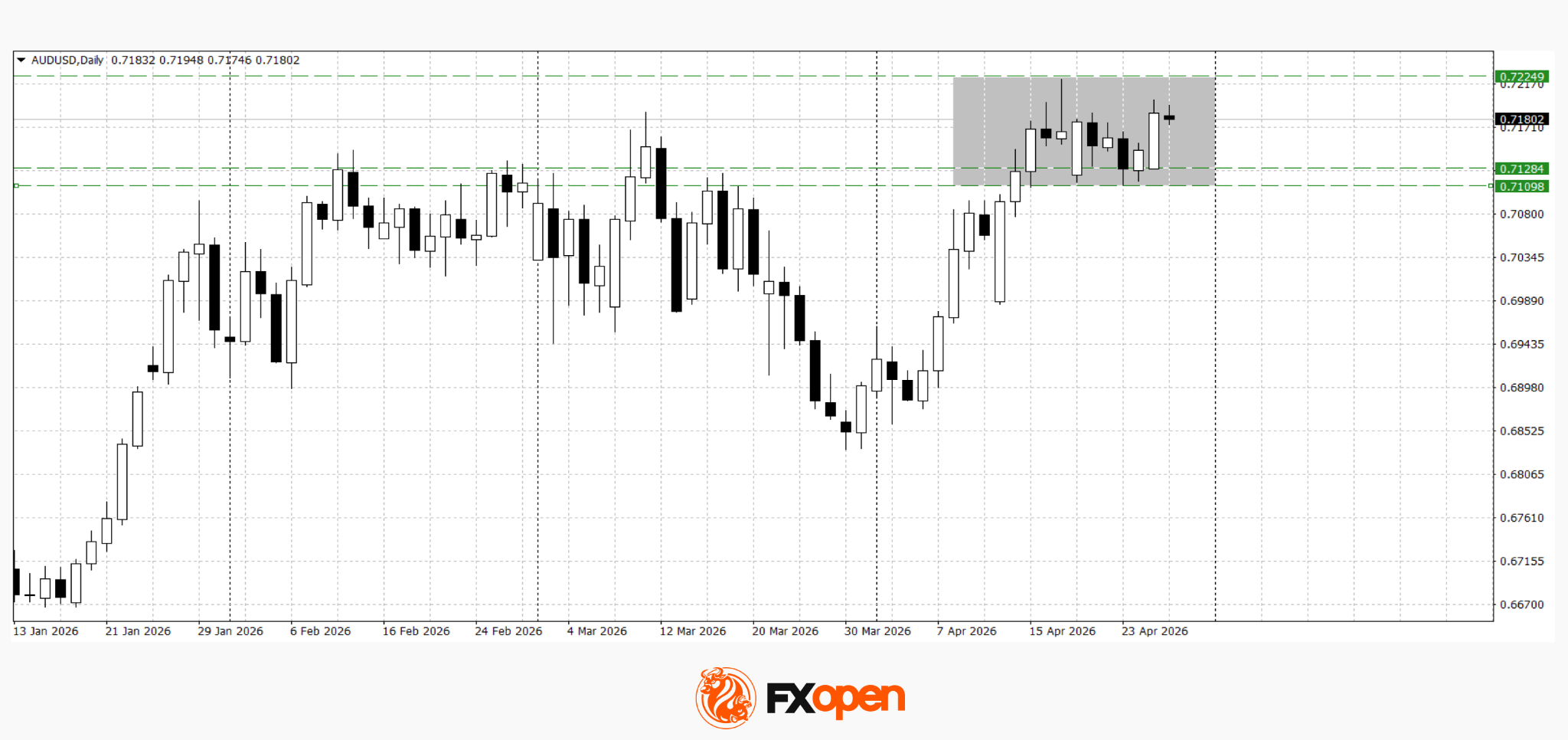
The AUD/USD pair is trading near its yearly high around 0.7220. This level is attracting heightened attention, as the pair has not traded above it for three years, increasing its significance as a supply zone. In the event of strong inflation data, a breakout with further upside is possible, whereas weaker figures could trigger a pullback and a return to the 0.7100–0.7180 range.
Key events for AUD/USD:
- today at 16:00 (GMT+3): S&P/CS Composite-20 Home Price Index (US), not seasonally adjusted
- today at 17:00 (GMT+3): US CB Consumer Confidence Index
- tomorrow at 04:30 (GMT+3): Australia Consumer Price Index
USD/CAD
The recovery in USD/CAD observed last week has lost momentum following a failed attempt to consolidate above 1.3700. Yesterday, the April low was updated, but the price found support at 1.3600 and rebounded. Technical analysis of USD/CAD points to the possibility of a decline towards 1.3540–1.3520 if the pair consolidates below 1.3600. The bearish scenario would be invalidated after a confident move and hold above 1.3700.
Key events for USD/CAD:
- tomorrow at 15:30 (GMT+3): US New Home Construction (housing starts)
- tomorrow at 16:45 (GMT+3): Bank of Canada interest rate decision
- tomorrow at 17:30 (GMT+3): Bank of Canada press conference

Overall, the market is in a waiting phase, where key levels in AUD/USD and USD/CAD serve as decision points. Upcoming macroeconomic events — including Australia’s CPI, the Bank of Canada’s decision, and US data — will determine the next direction: either continuation of current trends with breakouts, or a return to more subdued, range-bound dynamics.
Trade over 50 forex markets 24 hours a day with FXOpen. Take advantage of low commissions, deep liquidity, and spreads from 0.0 pips (additional fees may apply). Open your FXOpen account now or learn more about trading forex with FXOpen.
This article represents the opinion of the Companies operating under the FXOpen brand only. It is not to be construed as an offer, solicitation, or recommendation with respect to products and services provided by the Companies operating under the FXOpen brand, nor is it to be considered financial advice.


A United States judge sentenced a Saipan woman to 71 months in federal prison. The defendant orchestrated a scheme that defrauded older women.
She falsely claimed she came from money in China, owned multiple businesses, and made a fortune trading Bitcoin (BTC).
Saipan Woman Gets 71 Months for Bitcoin Investment Scam Targeting Older Women
According to the press release, Sze Man Yu Inos, 30, also known as Yuki, defrauded victims across multiple states. Between November 2020 and January 2022, she approached older women on Saipan and Guam. She posed as a wealthy Chinese heiress and a successful Bitcoin investor.
The authorities revealed that Yuki treated victims to expensive meals and gifts and “bragged to them about how much money she made investing in Bitcoin.”
“She confided in them about fictitious personal problems and claimed their friendship was important to her – often telling them, ‘You are like my mom.’ After gaining the victims’ confidence, Yuki requested money from these women. She also solicited investments in Bitcoin based on false pretenses,” the press release read.
Follow us on X to get the latest news as it happens
The scheme continued after she left the Marianas, with new victims defrauded in Washington and California. FBI Honolulu Special Agent in Charge David Porter said Yuki forged a federal judge’s signature to advance the scheme. The act showed contempt for victims and the rule of law, he said.
Yuki was found guilty of wire fraud. Alongside the prison term, the court ordered three years of supervised release, 100 hours of community service, restitution totaling $769,355.67, and a mandatory $200 special assessment. In addition, a criminal forfeiture judgment of $684,848.34 was imposed.
Crypto scams have surged across the US. The Federal Bureau of Investigation (FBI) reported $11.4 billion in losses from cryptocurrency fraud in 2025. That marked a 22% jump from 2024. Americans aged 60 and older accounted for $4.43 billion of those losses.
Subscribe to our YouTube channel to watch leaders and journalists provide expert insights
The post Woman Who Claimed Bitcoin Riches to Befriend Elderly Victims Sentenced to Prison appeared first on BeInCrypto.
Key Takeaways
- Attackers exploited Gmail’s dot alias functionality to generate authentic-looking Robinhood security alert emails
- Scammers registered Robinhood accounts using modified versions of victims’ email addresses with dots repositioned
- Malicious HTML code was inserted into the “device name” registration field to embed fraudulent links
- The deceptive emails successfully passed SPF, DKIM, and DMARC authentication protocols
- Robinhood verified that no system compromise occurred and user funds and data remained secure
Investors using Robinhood found themselves on the receiving end of convincing phishing emails that appeared to originate from the platform’s official mail servers. These deceptive messages alerted recipients about suspicious login activity from an unknown device and featured a clickable button directing them to a fraudulent login portal.
Reports of this attack surfaced on social platforms over the weekend, with numerous users posting evidence of the fraudulent communications.
Cybersecurity expert Alex Eckelberry verified that this campaign wasn’t caused by a data breach. Rather, it took advantage of two distinct vulnerabilities: the way Gmail processes dot characters in email addresses and security gaps in Robinhood’s user registration system.
Gmail’s email system disregards periods in the username portion of addresses. This means “jane.smith@gmail.com” and “janesmith@gmail.com” both deliver to the identical mailbox. Robinhood, on the other hand, recognizes these as distinct accounts.
Fraudsters capitalized on this discrepancy by establishing Robinhood profiles using dot-altered variations of targeted users’ Gmail addresses. This triggered Robinhood’s automated notification system to dispatch emails directly to the legitimate owner’s inbox.
The Mechanism Behind the Embedded Phishing Link
To inject malicious URLs into these system-generated emails, attackers inserted HTML markup into the optional “device name” input field during the account registration process. Gmail’s email client interpreted this HTML as legitimate formatting code.
This technique produced a genuine message originating from “noreply@robinhood.com” that displayed a fraudulent security warning complete with a functional phishing button. The email successfully validated against all conventional email authentication mechanisms.
According to Eckelberry, simply accessing the counterfeit website wouldn’t compromise user accounts. The actual threat materializes only when victims input their credentials or sensitive information on the fraudulent page.
Robinhood’s customer support team on X acknowledged the situation on Monday. The malicious emails carried the subject line “Your recent login to Robinhood.”
Official Statement from Robinhood
The financial services company clarified that this incident stemmed from exploitation of its registration workflow rather than a security breach of its infrastructure. The company emphasized that no customer information or financial assets were compromised.
Robinhood recommended that users immediately delete the suspicious emails and refrain from interacting with any questionable links. Those who had already clicked were instructed to reach out to Robinhood’s support team exclusively through the authenticated app or official website.
This incident follows a report from blockchain security firm Hacken identifying phishing and social engineering as the predominant threat vector in the cryptocurrency sector throughout Q1 2026.
Hacken’s analysis revealed these attack methods resulted in approximately $306 million in losses during just the first quarter of the year.
As of now, Robinhood has not publicly disclosed any planned modifications to its account registration protocols following this security incident.

Avant Homes says 85% of Sherburn-in-Elmet scheme is sold

Green light for Alinea’s $40m over-55s build in Shenton Park

Trump Signals Easing on Prediction Markets, Crypto Markets React

Manchester United reach agreement with Casemiro over contract clause amid transfer speculation

US brings back mandatory military draft registration

Steven Gerrard disagrees with Gary Neville over ‘shock’ Chelsea and Arsenal claim | Football


-

 Fashion4 days ago
Weekend Open Thread – Corporette.com
-

 Tech16 hours ago
Register Renaming | Hackaday
-
Crypto World3 days ago
Hyperliquid $HYPE Rally Builds Momentum as AI Sector Enters Prove-It Phase
-

 Politics6 days ago
Making troops accountable for war crimes threatens US alliance, ex-SAS colonel warns
-

 Politics6 days ago
Disabled people challenge government SEND proposals over segregation concerns
-

 Business4 days ago
Patterson-UTI Energy, Inc. (PTEN) Q1 2026 Earnings Call Transcript
-

 Business6 days ago
Rolls-Royce Voted UK’s Most Iconic Trade Mark as IPO Register Hits 150
-
 Crypto World7 days ago
Five Value Stocks with Recovery Potential in 2026: PayPal (PYPL), Nike (NKE), and More
-
 Sports2 days ago
IPL 2026: Ruturaj Gaikwad registers slowest fifty of the season, enters all-time unwanted list | Cricket News
-

 Politics6 days ago
Starmer handler McSweeney to be dragged from shadows by Foreign Affairs Committee
-

 Politics12 hours ago
Drax board avoid their own AGM, accused of greenwashing & environmental racism
-

 Crypto World6 days ago
New York sues Coinbase, Gemini over prediction market offerings
-

 Politics6 days ago
Zack Polanski responds to home secretary’s taser threat
-
Politics6 days ago
Wings Over Scotland | How To Get Away With Crimes
-
Entertainment7 days ago
Sydney Sweeney cameo cut from “The Devil Wears Prada 2”, source explains why (exclusive)
-
 Business6 days ago
HCL Tech share price tank over 9% after weak Q4. JPMorgan, HSBC & 3 others cut target price
-

 Crypto World6 days ago
Crypto’s great hope in Senate’s Clarity Act still has a path to survive tight calendar
-

 Politics6 days ago
‘Iran is still a nuclear threat’
-

 Fashion7 days ago
Kilkenny Design New Beauty Arrivals for Spring 2026
-
 Sports5 days ago
Tim Bradley names the current best in the world: “Better than Inoue and Usyk”
You must be logged in to post a comment Login