

Crypto World
Digital Chamber Files Amicus Brief to Seek Dismissal of NY Suit Over 39,069 BTC Wallets

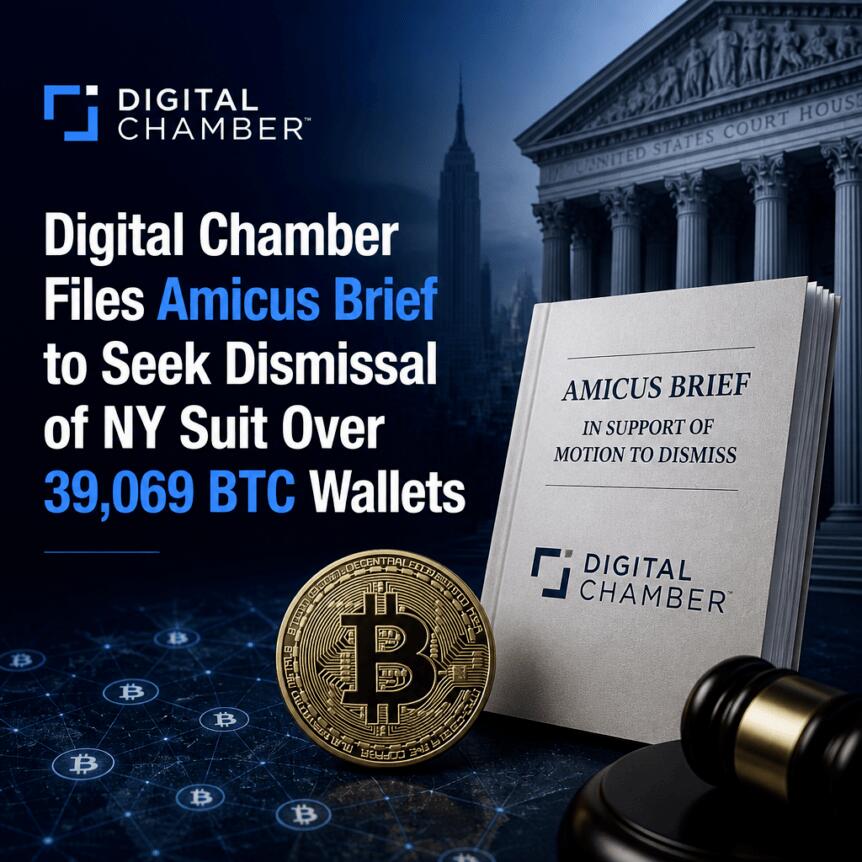
A New York lost-property lawsuit targeting dormant Bitcoin wallets has drawn a fresh filing from the Digital Chamber, a major blockchain industry trade association. In a Monday amicus brief, the group urged the court to reject claims that inactive self-custody wallets should be treated as abandoned property under state law.
The case, brought in late May by a claimant identified as “Noah Doe” and two Wyoming-based companies, seeks ownership of 39,069 dormant Bitcoin addresses. The addresses are reported to contain about 3.7 million BTC, valued at roughly $234 billion at the time referenced in the underlying reporting. Earlier coverage from Cointelegraph noted that the lawsuit could effectively become a test for how dormant or inactive crypto assets should be handled under traditional “lost property” frameworks.
Key takeaways
- The Digital Chamber’s latest amicus brief argues that classifying dormant self-custody wallets as abandoned property would create a “pervasive cloud on title” for crypto owners.
- The filing frames the issue as a threat to the core legal premise of digital property ownership, with potential ripple effects beyond crypto into traditional finance.
- Some wallets named in the lawsuit have already shown renewed activity, complicating assumptions about “dormancy” and control of assets.
- Even if the plaintiffs were to win legally, the private-key requirement remains a practical hurdle for transferring control of funds.
A trade association warns against “cloud on title”
According to the Digital Chamber, allowing the lawsuit’s theory to proceed would undermine widely accepted principles of how digital assets are owned and transferred. In its second amicus brief in the New York case, the organization opposed the plaintiffs’ attempt to establish ownership based on the addresses’ inactivity.
The trade association warned that treating dormant wallets as abandoned property would effectively cast uncertainty over self-custody holdings. The brief characterizes the potential outcome as a “pervasive cloud on title across self-custody wallets,” implying that investors and institutions could face heightened legal risk simply for keeping private keys and not moving funds for extended periods.
Digital Chamber also argued that a decision rooted in the plaintiffs’ approach could have “negative ripple effects” reaching traditional finance. The group’s point appears aimed at the broader market effects of uncertainty—particularly where regulated entities rely on stable, predictable legal definitions of ownership and control.
Digital Chamber describes itself as the oldest and largest digital asset trade association, representing more than 250 members that include exchanges, banks, investment firms, and other participants across the industry.
The dispute centers on dormant wallets and New York’s lost-property law
The lawsuit was filed in late May and targets 39,069 dormant Bitcoin addresses, according to the reporting cited in earlier coverage from Cointelegraph: New York lawsuit seeks ownership of 39,069 dormant Bitcoin addresses. The amicus brief arrives as the legal fight begins to take shape around the interpretation of New York’s lost-property statutes as applied to cryptocurrency held in self-custody.
Among the addresses named in the suit, the filing and accompanying discussion referenced estimates placing the total at 3.7 million BTC, with some wallet addresses allegedly linked by analysts to Bitcoin creator Satoshi Nakamoto. The earlier reporting that references a claim from Sani (founder of Timechain Index) is attributed in the source text to a post on X: according.
It’s important for readers to recognize what the legal process is actually testing. The argument is not simply about whether money can be recovered from inactive addresses, but about whether inactivity alone can trigger ownership claims under a state framework traditionally used for tangible property.
Renewed wallet activity challenges assumptions about “dormancy”
While the lawsuit proceeds, the real-world behavior of at least some listed addresses has shifted. According to analysis cited in the source text, some of the dormant Bitcoin wallets named in the case have begun moving funds.
Galaxy Digital head of research Alex Thorn, as quoted via an X post referenced in the original report, said at least 31 of the addresses moved 17,527 BTC in June. That compares with earlier activity where only five addresses reportedly transferred 4,834 BTC in February. The figures were attributed to Thorn’s monitoring: according to Alex Thorn.
The renewed activity has included notable cases such as the address “1KV47,” which reportedly transferred 30 BTC—worth about $1.88 million in the source text—on Saturday. Earlier coverage from Cointelegraph stated that this marked the wallet’s first movement in almost 15 years, since August 2011: Bitcoin address “1KV47” moved after nearly 15 years.
For investors and market participants, these developments matter because they expose a practical and conceptual mismatch: legal arguments that treat inactivity as a proxy for abandonment can collide with the reality that wallet “dormancy” may be temporary—or could change when private keys are used after long periods.
Private keys remain the gate to control
Even if the plaintiffs’ legal theory were to succeed, the question of control over the underlying Bitcoin remains central. The source text notes that it is unclear how the plaintiffs could gain control of the assets without possessing the private keys to the wallets.
That point effectively highlights the asymmetry between on-chain identifiers (addresses and balances) and off-chain control (private keys). Courts may determine legal ownership, but moving or spending Bitcoin still requires cryptographic authorization.
The case is also not proceeding unopposed. According to the source text, a pseudonymous defendant filed a notice of appearance and a motion to dismiss on Thursday, asserting that they control one of the dormant wallets named in the lawsuit. Earlier coverage from Cointelegraph references that dismissal effort: defendant dismiss New York lawsuit.
In practice, that kind of response could reduce the likelihood of any blanket “ownership transfer” outcome, forcing the court to grapple with ownership claims at the level of individual wallets and the rights of those claiming control.
What to watch next
With the Digital Chamber urging rejection on principle and some named wallets already showing movement, the case may hinge on how the court interprets abandonment versus ownership in the context of self-custody. The next key developments to monitor are the court’s handling of motions to dismiss and whether other defendants challenge the plaintiffs’ ability to prove control beyond the addresses themselves.


Crypto figures are warning that government control over what AI systems can know or discuss could create a dangerous precedent, after Erik Voorhees argued on X on July 28 that states should not decide what forms of intelligence are “safe.”
The post landed in the middle of a fresh debate over how much oversight AI companies should accept, a debate that picked back up after Anthropic laid out its own position on open-weights models.
Erik Voorhees Warns Against State Control of AI Knowledge
Voorhees, a longtime Bitcoin advocate and founder of the ShapeShift crypto exchange, posted his comment after Anthropic published a statement from CEO Dario Amodei pushing back on claims that the AI giant was advocating for the banning of Chinese open-weight models.
Amodei insisted that his company has “never advocated a ban on open-weight models” and argued that such systems can provide value for developers, businesses, and researchers when they do not have dangerous capabilities.
According to the executive, Anthropic’s main concerns involved authoritarian governments developing advanced AI for military or surveillance uses, along with the possibility of misuse in cyberattacks or biological threats. The company said it supports restrictions on access to advanced chips and action against industrial-scale distillation, as well as safety testing for highly capable AI systems.
The Information recently reported that the Trump administration was finalizing a framework for AI companies to voluntarily submit their most advanced models to the government for testing.
But Voorhees was not having it, saying that allowing governments to define acceptable AI knowledge could expand beyond its original purpose. In his post, he walked through a hypothetical progression starting from a seemingly reasonable rule against discussing bioweapons, then dangerous weapons generally, then anything contrary to public health and public safety, then anything that undermines financial solvency, and ending with the banning of unapproved encryption and a requirement that AI not obstruct government orders.
“Civilization must not permit the state to determine what manner of intelligence is ‘safe,’” he wrote, adding that only the United States has the cultural character to resist that outcome over time, and if it fails, then “nowhere will it be preserved.”
Ripple CTO Emeritus David Schwartz replied to Voorhees’ post with “Yes, this. Exactly this,” showing support for the argument. XRP community member Bird also responded, asking, “The moment someone gets to decide what knowledge is ‘safe,’ where does it stop?”
AI Safety Debate Expands Beyond Open Models
The same tension over who gets to police AI showed up earlier this month when Google DeepMind CEO Demis Hassabis proposed a federally backed body to test and certify frontier models before release, an idea that OpenAI’s Sam Altman called “thoughtful” and Microsoft’s Satya Nadella welcomed as a way to keep any model from doing serious harm.
However, Coinbase CEO Brian Armstrong rejected the idea, arguing that a new body would just add another approval process on top of existing regulators. “Why design regulation around a hypothetical problem,” he said, pointing to fraud, tort, and consumer protection laws that already exist as being enough cover for any harm that might be caused by a model.
The post Crypto Pioneers Sound Alarm Over Government Control of AI Knowledge appeared first on CryptoPotato.
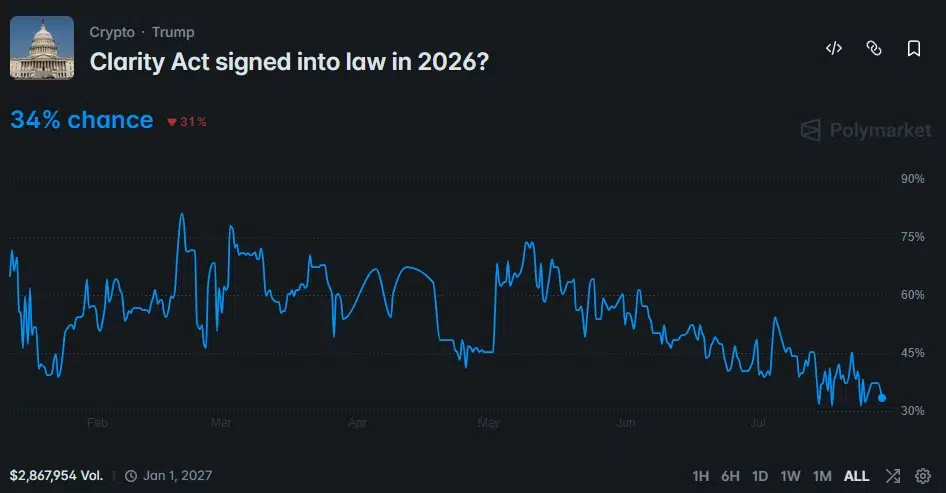
Prediction markets are lowering the chances of the CLARITY Act becoming law in 2026 as the Senate turns to Russia sanctions and federal nominations before its August recess.
Summary
- Polymarket traders place the bill’s 2026 passage odds at about 34%, down from 53% on July 21.
- Galaxy Digital’s Alex Thorn estimates a 30% chance of passage, citing vote math and limited floor time.
- Republicans may need support from at least 10 Democrats if three GOP senators remain unavailable or opposed.
- Bitcoin traded near $63,800 as regulatory uncertainty added to broader pressure across crypto markets.
CLARITY Act loses its place on the Senate schedule
Senate Majority Leader John Thune has not scheduled immediate action on the CLARITY Act, narrowing the path for the crypto market structure bill before lawmakers leave Washington.
The Senate is instead moving forward with federal nominations and legislation imposing sanctions on Russia and Iran. Preliminary action on the crypto bill remains possible during the week of Aug. 3, but the chamber is scheduled to begin its summer recess after Aug. 7.
According to Galaxy Digital head of research Alex Thorn, the timetable has become the main threat to passage.
“The calendar is no longer merely an obstacle. It is now the enemy.”
Thorn estimated that lawmakers needed to begin the floor process by July 30 to leave enough time for procedural votes and debate. The Senate’s decision to prioritize other legislation makes that timeline increasingly difficult.
A vote after the recess is still possible. However, senators would return closer to the November midterm elections, when campaigning could displace complicated legislation requiring bipartisan negotiations.
Senate vote math leaves little room for defections
Most legislation needs 60 votes to overcome the Senate filibuster, while Republicans control 53 seats.
Thorn argues that the bill’s effective Republican support may be closer to 50. Senators Josh Hawley and Rand Paul have not committed to voting for the measure, while Mitch McConnell’s hospitalization could prevent him from participating.
Under that scenario, Republicans would need 10 Democratic votes to advance the bill.
The Senate Banking Committee approved its version of the CLARITY Act in May by a 15-9 vote, with two Democrats joining Republicans. Both Democratic supporters warned that their committee votes did not guarantee backing on the floor without further changes, particularly to ethics provisions governing public officials’ crypto interests.
President Donald Trump later accepted the inclusion of ethics restrictions, helping Polymarket odds reach 53% on July 21. Those gains have since reversed, with the market showing roughly 34% odds at the time of publication.
Kalshi showed traders assigning a 42% probability to crypto market structure legislation becoming law before the end of 2026.
Trump ties deepen the partisan divide
SkyBridge Capital founder Anthony Scaramucci said Democratic opposition may persist because Trump has made the bill part of his political agenda.
“They will do everything they can to block it because he wants it,” Scaramucci said.
Cardano founder Charles Hoskinson has made a similar argument, warning that the “Trump narrative” has turned crypto regulation into a partisan dispute.
Democrats have raised concerns about the adequacy of the proposed ethics rules, citing Trump’s family-linked crypto activities. They have also sought stronger consumer protections, enforcement powers and restrictions covering officials’ indirect financial interests.
Republicans have made several concessions to attract Democratic votes, but the revised language has not produced enough public commitments to clear the 60-vote threshold. The bill would also return to the House if the Senate approves a materially different version, adding another step before it could reach Trump’s desk.
Bitcoin slips as US regulatory uncertainty continues
Bitcoin traded near $63,800 at the time of publication, down about 1.6% over the previous session after moving between roughly $62,772 and $64,953.
The decline coincided with the Senate delay, though the timing alone does not establish that the CLARITY Act caused the broader market pullback. Macro conditions, derivatives positioning and weaker demand can also affect daily price movements.
US spot Bitcoin ETFs recorded $11.64 million in net outflows on July 27, led by an $8.82 million withdrawal from BlackRock’s IBIT. Ether funds attracted $9.23 million, while XRP ETFs added about $592,000.
For US investors, another delay would preserve the existing mix of SEC and CFTC oversight, court decisions and state-level rules instead of creating a single federal market structure. The bill is not dead, but failure to begin the Senate process before the August recess would leave its 2026 prospects dependent on a narrower post-election legislative window.
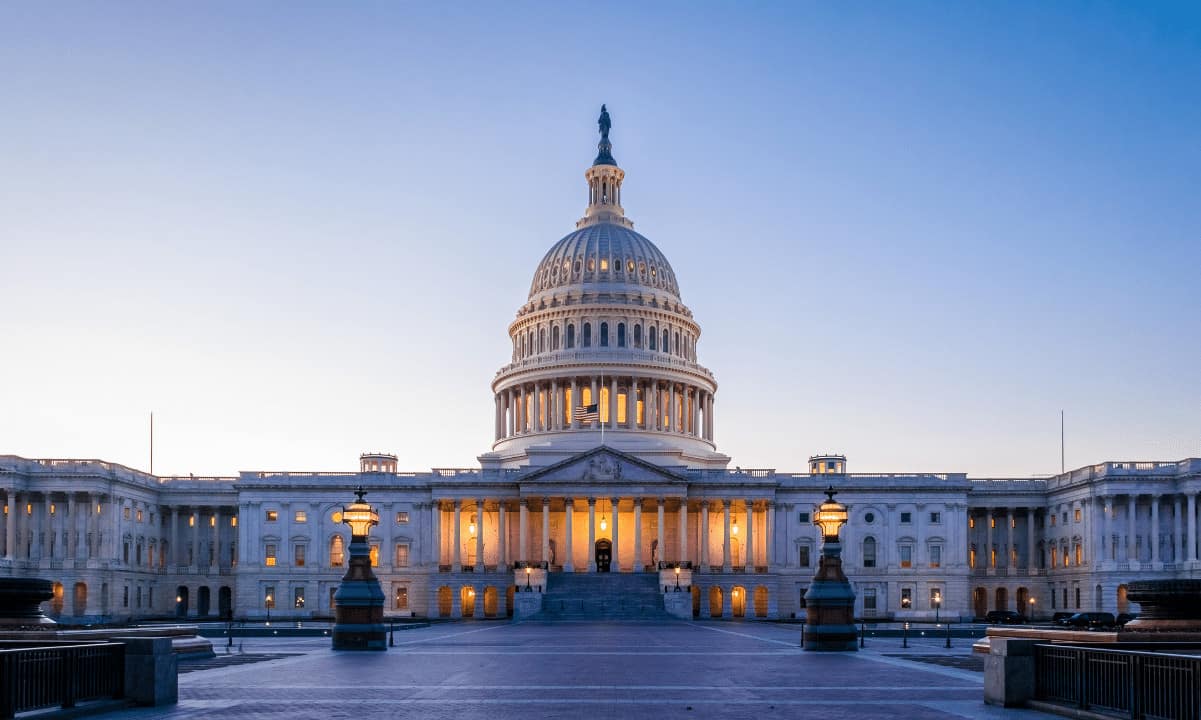
Crypto critic Ben McKenzie has urged Congress to block the CLARITY Act due to President Trump’s financial ties to the digital asset industry.
McKenzie joined Senate Democrats like Richard Blumenthal and Chris Van Hollen at a Capitol Hill anti-corruption forum on Monday to lobby against the bill.
Trump Crypto Concerns
The actor argued that lawmakers could not oppose “Trump’s crypto corruption” while supporting the CLARITY Act, saying the legislation would only allow it to continue. He urged Democrats to reject the bill, warning that only a handful of votes could be enough for it to go through.
His comments come as Democrats continue to push for stronger ethics rules, consumer protections and national security safeguards in the bill. While Republicans added language banning the president and other public officials from issuing or sponsoring cryptocurrencies, Blumenthal believes the updated version still leaves loopholes that could allow Trump to profit from his crypto ventures.
“Donald Trump made $2 billion last year, and $1.4 billion of his income last year consists of cryptocurrency profits that exploit weaknesses in the current law,” he said.
He explained that the current CLARITY Act does not require Trump to divest his crypto holdings and that its ethics provisions would expire in 2029, leaving enforcement to the Department of Justice, which, according to him, would not be enough.
As for what they are doing to stop this, the Democrats said they plan on using their bargaining power to push for changes to the legislation before it comes up for a vote. This is especially important because the Senate will need at least 60 votes to advance the legislation.
New York AG Warns Legislation Could Weaken Oversight
On the same day, New York Attorney General Letitia James warned that the CLARITY Act could weaken state enforcement against crypto fraud, saying stronger regulations are needed to protect investors.
The proposal, she said, would limit the state’s ability to hold digital asset platforms accountable even as crypto scams continue to cost Americans billions of dollars a year.
James finished by saying that strict rules are needed to maintain trust in the financial markets, and warned that without sufficient laws and oversight, there would be financial crises. She therefore urged Congress to strengthen investor protections and safeguard the economy and national security.
Meanwhile, Senate Majority Leader John Thune has put the CLARITY Act on hold for now as the Senate focuses on confirming government nominees and debating a Russia sanctions bill. This now pushes the crypto bill off the pre-recess agenda, with September now the earliest it is expected to return for consideration.
The post ‘OC’ Actor Ben McKenzie Urges Congress to Block CLARITY Act Over Trump Ties appeared first on CryptoPotato.
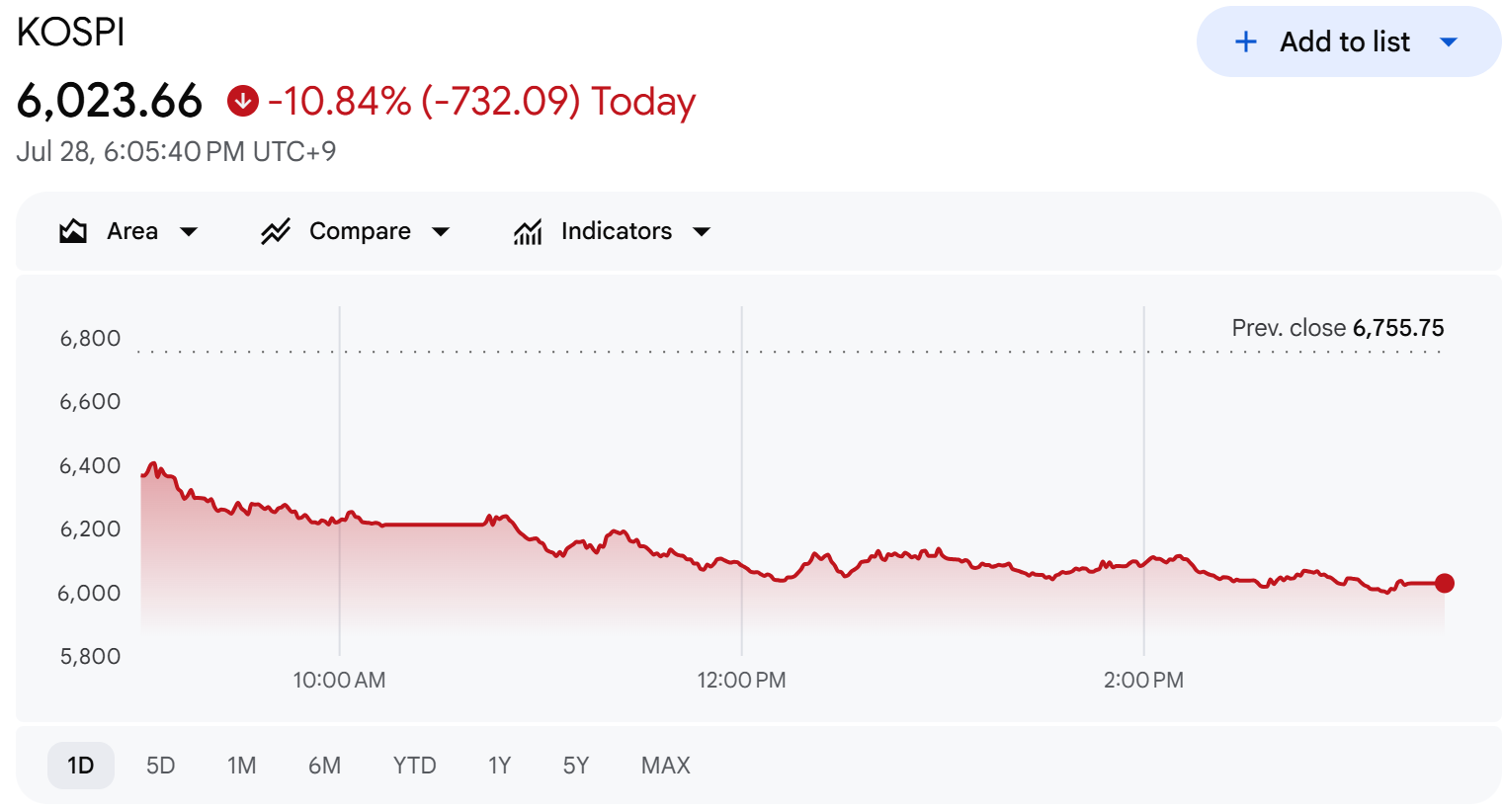
Gemini co-founder Cameron Winklevoss declared the AI trade over on Tuesday, urging investors to rotate into Bitcoin (BTC) and Zcash (ZEC).
The call landed on the day South Korea’s Kospi index closed down 10.84%. deVere Group CEO Nigel Green blames circular financing between Nvidia, OpenAI and Oracle. Tuesday’s actual trigger was narrower, and it points at China.
What Triggered the AI Trade Selloff on Tuesday
The Kospi finished at 6,023.66 after a circuit breaker halted trading for 20 minutes. Samsung Electronics fell 13.4%. SK Hynix dropped 14.7%.

Japan’s Nikkei 225 lost about 4%. Tokyo Electron shed 10.96%, and memory maker Kioxia fell more than 18%.
Two China-specific catalysts drove it. Changxin Memory Technologies, the Hefei-based DRAM maker known as CXMT, closed its Shanghai STAR Market debut on Monday up 466%.
That valued CXMT near 3.3 trillion yuan. It passed Industrial and Commercial Bank of China as the most valuable mainland-listed company. Its prospectus put its 2025 global DRAM share at 7.67%, fourth behind Samsung, SK Hynix and Micron.
Separately, reports said a Chinese state-backed firm has begun producing immersion deep ultraviolet (DUV) lithography machines. DUV equipment is the bottleneck tool that Western export controls were designed to withhold.
Tuesday reversed a recovery that had held through mid-July. The same chip names had rebounded from a selloff driven by memory valuation fears.
Nigel Green’s Circular Financing Case, Checked Against the Record
Green’s argument centers on who pays whom. Nvidia funds OpenAI. OpenAI buys cloud capacity from Oracle. Oracle then purchases Nvidia chips with the revenue.
“The same dollar gets counted as revenue three times on its way around the loop. This is not demand. It’s an accounting trick wearing a growth story as a costume,” deVere Group CEO Nigel Green stated.
Follow us on X to get the latest news as it happens
The loop is real, but three of his supporting figures do not survive a check against primary filings and company statements.
Green’s claim
What the record shows
Nvidia valued at $4.5 trillion
Roughly $5 trillion. Shares fell 5% to $195.44 on July 27
Nvidia committed up to $100 billion to OpenAI
Non-binding letter of intent, later restructured to a $30 billion equity stake
Oracle backlog “north of $500 billion”
$638 billion in remaining performance obligations, up 363% year over year
Nvidia and OpenAI announced the 10-gigawatt partnership in September 2025. CEO Jensen Huang later told Fortune it was “never a commitment.”
The correction cuts both ways. Oracle’s backlog is larger than Green says, and more than half of it traces to a single customer.
OpenAI’s contract with Oracle exceeds $300 billion over five years and starts in 2027. S&P has warned that Oracle could hold long-term data center leases with no exit if that customer stumbles.
OpenAI is on pace for roughly $14 billion in losses this year against about $25 billion in annualized revenue. However, that revenue is up from $21.4 billion at the end of 2025.
Bloomberg reported Nvidia is now assembling more than $750 billion in fresh AI deals. One would backstop up to $250 billion of OpenAI compute leases at a US data center project.
Against this backdop, Cameron Winklevoss urges investors to rotate into Bitcoin and Zcash,
His Zcash position is not new. In April, he argued that investors bullish on AI and quantum computing should also be bullish on the privacy coin.
He also defended Zcash after a June bug in its Orchard shielded pool. The twins have since funded independent protocol work.
Zcash remains up roughly 1,033% over the past year. Its Ironwood network upgrade went live Tuesday.
Schiff Sees a Peak, UBS Sees the AI Trade Maturing
Peter Schiff treats the drawdown as confirmation. He points to SpaceX, now roughly 48% below its $225.64 peak and trading under its $135 June listing price.
Schiff has framed SpaceX stock and bonds as a warning for equities and crypto alike. Its 2056 notes now yield about 7.6%, pricing like junk debt.
That test comes soon. SpaceX reports first results as a public company on August 4, and roughly 911.5 million insider shares unlock on August 6.
UBS disagrees with the peak thesis. The bank told clients the trade is maturing rather than breaking. Cheaper models redistribute compute demand instead of destroying it, in its reading.
Both readings can hold. CXMT’s debut supports Green’s China warning and UBS’s cost-deflation case at the same time.
What Tuesday did not show is a safe haven. Until Bitcoin holds ground on a day equities break, the rotation Winklevoss describes stays a thesis rather than a trade.
The post Cameron Winklevoss Pushes 2 Cryptos as AI Trade Rout Sinks Kospi 11% appeared first on BeInCrypto.


Cointelegraph is committed to providing independent, high-quality journalism across the crypto, blockchain, AI, and fintech industries.
All news, reviews, and analyses are produced with full journalistic independence and integrity. For more details on our standards and processes, please read our Editorial Policy.
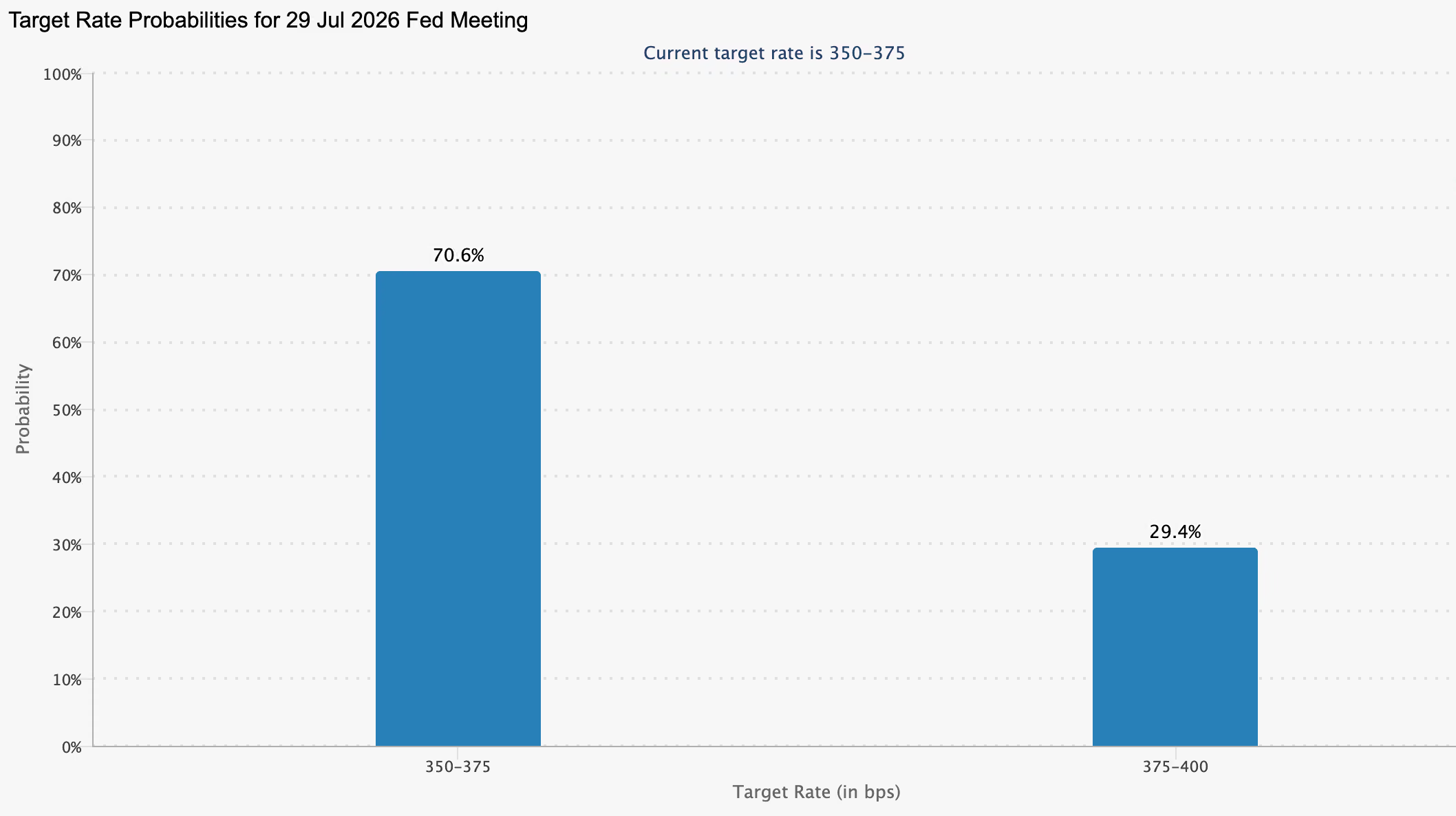
Markets are split on whether the Federal Reserve will hike rates or stay on hold on Wednesday, but analysts say bitcoin may be less vulnerable than AI-driven tech stocks.
Bitcoin recovered from its intra-day losses to trade flat just below $64,000 on Tuesday, while AI-linked technology stocks stumbled again ahead of one of the most uncertain Fed meetings in years.
Markets currently price a 70% probability that the Fed leaves rates unchanged on Wednesday and a 30% chance of a surprise 25-basis-point hike, CME FedWatch data shows. The split reflects Chair Kevin Warsh’s reduced use of forward guidance, leaving investors with less clarity on the central bank’s next move, according to derivatives analytics firm Block Scholes.

“Tomorrow’s FOMC meeting, Kevin Warsh’s second as chairman of the Fed, is one of the most uncertain in years,” said Thahbib Rahman, research analyst at Block Scholes. Looking at every Fed meeting since 2015, he noted that only two have seen markets more divided over the outcome.
Signs of decoupling
Even with that uncertainty hanging over markets, bitcoin has largely held its ground in July while chipmakers and other AI favorites have come under pressure, raising the possibility that crypto is beginning to diverge, at least at the margin, from traditional risk assets.

Crypto security firm Blockaid reports that losses from hacks and other onchain security incidents exceeded $1 billion in the first half of 2026, marking the highest number of security incidents in a six-month period tracked by the platform.
In Blockaid’s H1 2026 security report published Tuesday, Ethereum and Solana led the network-level loss tally, with stolen funds of roughly $332 million and $326 million, respectively.
Key takeaways
- Over $1B lost: Blockaid recorded total crypto losses above $1 billion across H1 2026.
- 212 security incidents: The period included 212 incidents, with more high-threshold exploits verified in H1 2026 than in all of 2025.
- Ethereum dominated by code exploits: The report attributes most Ethereum losses to application and smart-contract vulnerabilities.
- Solana losses driven by key compromises: More than 98% of Solana’s losses stemmed from compromised keys rather than contract bugs.
- Biggest single exploit was KelpDAO: Blockaid identified the largest incident as KelpDAO’s exploit at $292 million.
H1 2026: incident volume climbed, and major exploits shaped outcomes
Blockaid’s report covers 212 security incidents from the first six months of 2026. While the number of incidents rose, the distribution of losses was also shaped by a small set of very large events.
The largest single exploit Blockaid highlighted came from KelpDAO, which it linked to losses of $292 million. Blockaid also reported that it verified 3.4 times as many high-threshold exploits in H1 2026 compared with all of 2025, suggesting a higher frequency of severe, high-impact events rather than only a few outliers.
At the network level, Ethereum and Solana were responsible for nearly all of the most significant stolen-funds figures in the report. Blockaid attributes these differences not only to what applications exist on each chain, but also to how attackers executed their operations.
Why Ethereum losses reflected risk in high-value protocols
According to Blockaid, Ethereum saw the largest losses in H1 2026, driven primarily by incidents that stemmed from code exploits—meaning vulnerabilities in applications, smart contracts, or components interacting with them.
Blockaid said Ethereum’s highest-loss events included key compromises involving Humanity Protocol and StablR. In addition, CoWSwap was identified in the report as the only major Ethereum incident classified as a user mistake, rather than an exploit of protocol code.
Looking beyond individual cases, Blockaid outlined recurring Ethereum attack methods that included weaknesses in bridges and smart contracts, unauthorized access to privileged accounts, and market manipulation techniques. The report frames Ethereum as a persistent target partly because it hosts many of the sector’s highest-value building blocks—restaking platforms, stablecoins, and decentralized exchanges.
For investors and operators, the implication is straightforward: as long as the chain continues to concentrate high-value protocols and liquidity, attackers can profit from both direct smart contract vulnerabilities and operational failures (such as privileged account access) that turn code risk into real-world theft.
Solana’s surge: fewer contract bugs, more key and signer compromises
Solana’s H1 2026 losses came in at roughly $326 million, nearly matching Ethereum. Blockaid describes this as a substantial increase versus about $127 million in stolen funds during 2025.
Notably, Blockaid says the increase was not mainly caused by a rise in smart contract exploits. Instead, the report points to compromised keys as the dominant driver: more than 98% of Solana’s losses in the period were tied to key compromises.
Blockaid connected a large portion of those losses to incidents involving Drift Protocol and Step Finance, which the report linked to North Korea-linked cyber groups.
Blockaid also described a different profile for Solana attackers compared with Ethereum. Where Ethereum’s losses were largely associated with vulnerabilities in protocol code, Solana incidents were centered on signer infrastructure and organizational security controls. In Blockaid’s accounting, only a small portion of Solana losses came from code exploits—citing Raydium and Volo as examples of the remaining code-related cases.
For teams building on or around Solana, this is a clear operational reminder: security reviews can’t stop at smart-contract audits. The report’s emphasis on keys, signing infrastructure, and broader security posture suggests that threat models need to treat custody, signing workflows, and privileged access as first-class attack surfaces.
What to watch next: exploit severity, not just incident counts
As Blockaid’s data shows, H1 2026 combined higher incident volume with a significant jump in verified high-threshold exploits. Readers should watch whether future quarters keep the same balance—especially whether Solana’s key-compromise trend persists and whether Ethereum’s code and privileged-access attack patterns accelerate as new high-value applications launch.
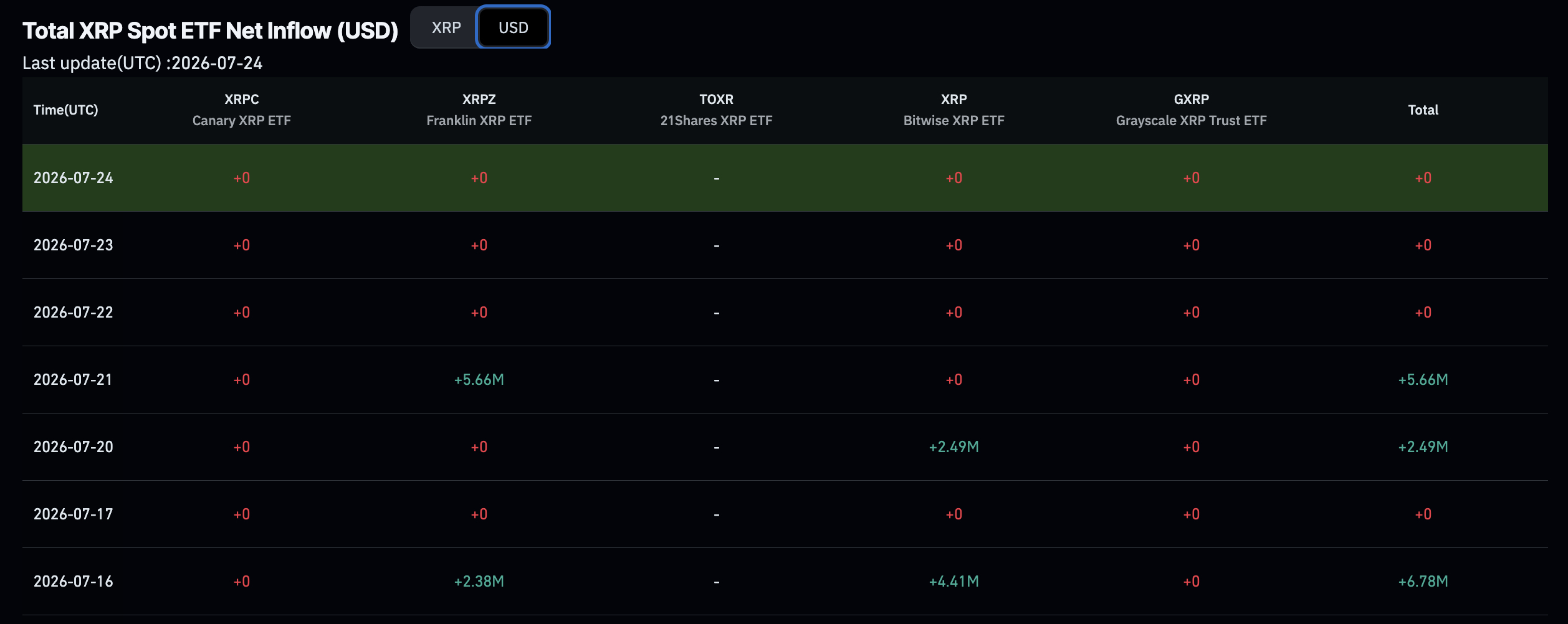
XRP prediction remains mixed as its price trades near $1.5, down about 5% over the past 24 hours, while traders await the Federal Reserve’s July 28 to 29 policy meeting. The macro backdrop remains cautious, yet ETF flow data could be signaling resilience beneath the surface. Bitcoin also slipped to around $63,450 after briefly trading above $64,900, reinforcing the defensive mood across major cryptocurrencies.
Seven US spot XRP ETFs have traded since late 2025. Although inflows have cooled from earlier this year, they have not turned into sustained outflows. That gap between steady ETF demand and weaker prices is the kind of setup analysts often watch for. It may suggest institutional interest remains intact despite short-term selling pressure.

However, expectations for the Fed have shifted. Markets now largely expect rates to remain unchanged, while a surprise 25 basis point hike remains a less likely possibility. That makes forecasts based on an immediate 25- or 50-basis-point rate cut outdated. Even so, some analysts still argue that easing monetary policy later this year could support a stronger XRP recovery alongside continued ETF demand.
Meanwhile, Bitcoin’s negative Coinbase premium continues to point to muted institutional spot buying. That matters because XRP has historically lagged during risk-off periods before recovering quickly when sentiment improves. For now, traders appear focused on the Fed’s decision as the next catalyst for both Bitcoin and XRP.
Discover: The Best Crypto to Diversify Your Portfolio
XRP Price Prediction: Reclaim $1.20 Before the Fed Decision Lands?
At $1.05, XRP price is trading at the bottom of its recent intraday prediction range, around $1.05 to $1.09. The compression building over recent weeks faces a key catalyst. The Fed’s July 29 policy statement could trigger a sharp move in either direction.
Near-term resistance sits around $1.18 to $1.20, marking the first major technical hurdle. Above that, bullish momentum could open the path toward $1.22 to $1.32 if buying pressure returns. Meanwhile, immediate support rests at $1.05. A decisive break below that level could expose the $0.95 to $1.00 zone, where longer-term buyers may step in.
The bullish scenario depends on a dovish Fed and stronger institutional demand. If that happens, XRP could reclaim $1.20 and attempt a move toward $1.35. A sustained rally would also put longer-term targets, including Standard Chartered’s $2.80 year end forecast, back into focus.

The base case remains a Fed pause with dovish language. That could lift XRP toward the $1.15 to $1.20 area before momentum fades into consolidation. On the other hand, a hawkish surprise could drag XRP back toward $1.00 or even $0.95. A daily close below $1.00 would weaken the current bullish outlook.
One encouraging signal remains institutional demand. ETF-related products continue attracting capital even as XRP trades near local lows. That divergence suggests selling pressure is being absorbed, although the price still needs to reclaim resistance before confirming a stronger trend.
Trade XRP on Bybit and Get a Chance to Win Our $1,000 USDT Airdrop
Bitcoin Hyper Eyes Early-Stage Upside as XRP Treads Water Around Key Support
XRP at $1.05 offers a clean macro trade, but the upside is capped by a market cap already north of $60 billion. The Fed catalyst is real; a 10–20% move is achievable.
For traders who want exposure to a Bitcoin-ecosystem catalyst with asymmetric early-stage pricing, the math on established large-caps starts to look less interesting.
Bitcoin Hyper is currently in presale at $0.0136838, with almost $33 million raised to date. The project positions itself as the first-ever Bitcoin Layer 2 with Solana Virtual Machine (SVM) integration, combining Bitcoin’s security and trust layer with sub-Solana-speed execution and programmable smart contracts.
The Decentralized Canonical Bridge handles BTC transfers natively, removing the custodial friction that has historically kept institutional capital out of Bitcoin DeFi. Staking is live with high APY for presale participants.
For active traders watching XRP range-trade into a macro binary, researching Bitcoin Hyper before the presale window closes is a straightforward risk-sizing exercise. Also worth monitoring: how the Fed decision reshapes positioning across the broader crypto complex. The rate outcome will reset the risk appetite framework for everything from large-caps to early-stage plays.
Discover: The Best Token Presales
The post XRP Price Prediction: Fed Rate Decision and Ripple ETF Flow appeared first on Cryptonews.
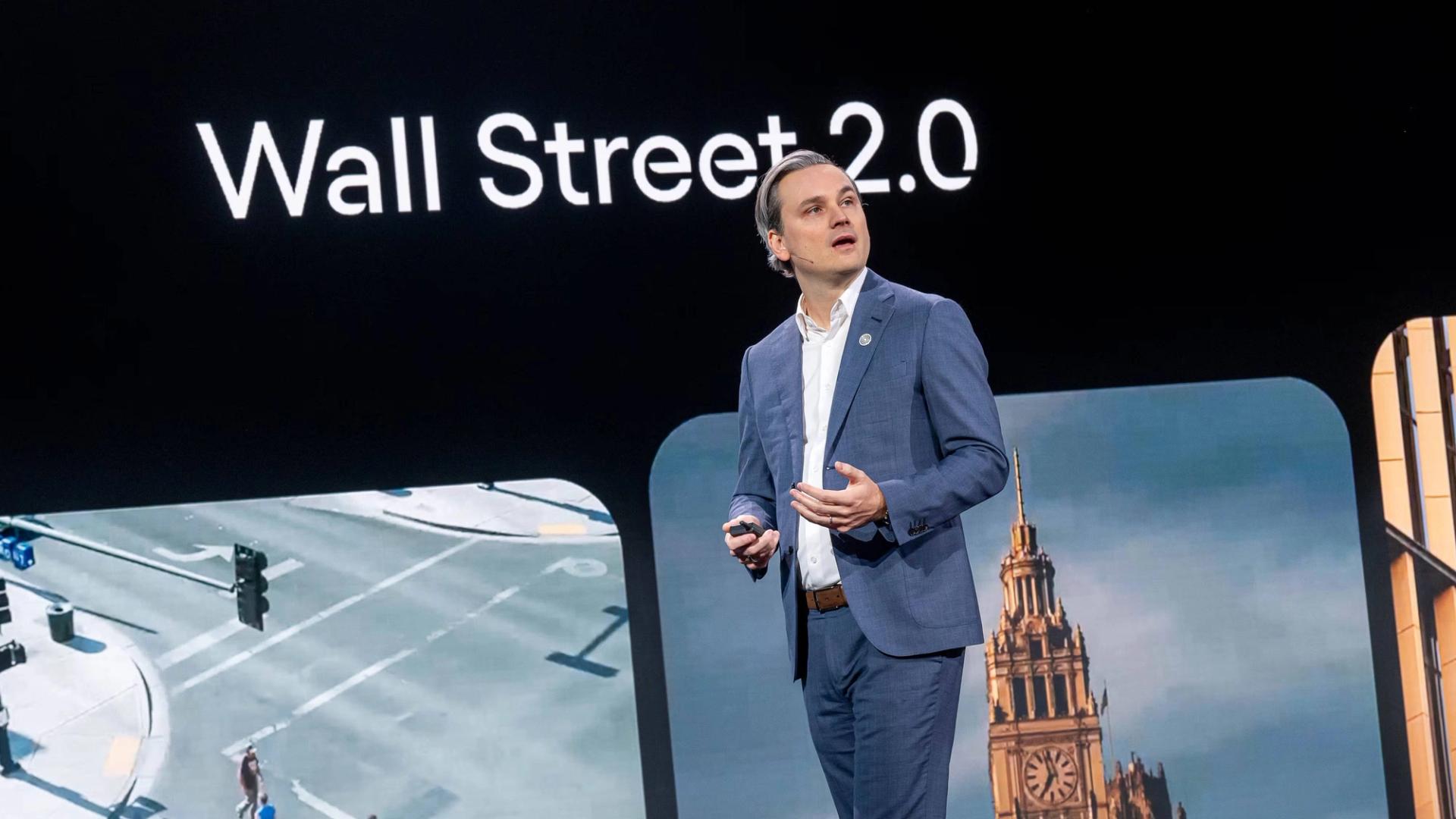
Tokenized asset specialist Ondo Finance has abandoned plans to build a conventional layer-1 blockchain, instead introducing a trading network it says is better suited for the next wave of onchain financial assets.
Dubbed Ondo Network, the system marks a shift from the company’s February 2025 vision for Ondo Chain, a blockchain for institutional finance and tokenized real-world assets. After building its new perpetual futures platform, Ondo Perps, the firm said it concluded that a traditional blockchain wasn’t the best tool for handling the speed and privacy institutional trading requires.
Ondo Perps is the first application using the network, with plans to offer tokenized assets as collateral for trading.
The pivot comes as tokenization gathers momentum across Wall Street. Tokenization — the process of representing traditional assets such as stocks, bonds and funds as blockchain-based tokens — is gaining traction as firms look to modernize capital markets with faster settlement and around-the-clock trading. At the same time, perpetual futures, once largely confined to crypto markets, are expanding to traditional assets such as stocks and commodities like oil and gold.
Beyond issuing tokenized assets
Ondo has emerged as one of the sector’s largest issuers, with about $2.6 billion in tokenized U.S. Treasury products across OUSG and USDY and roughly $850 million in tokenized equities, according to rwa.xyz. The firm’s broker-dealer obtained last week FINRA approval to launch regulated markets and services for tokenized securities.


Disclosure: This article does not represent investment advice. The content and materials featured on this page are for educational purposes only.
Flare launches Flare Smart Accounts v1.3, enabling XRP holders to access DeFi vaults with a single XRPL wallet signature.
Summary
- Flare has launched Smart Accounts v1.3, simplifying FXRP minting and yield farming for XRP holders without manual bridging.
- XRP holders can now access DeFi with a single XRPL signature following the release of Flare Smart Accounts v1.3.
- Flare Smart Accounts v1.3 streamlines XRP DeFi access, enabling one-signature deposits into yield-generating vaults.
Flare today announced the release of Flare Smart Accounts (FSA) v1.3, making it possible for XRP holders to mint FXRP and deposit it into yield-generating vaults with a single XRPL signature.
For XRP holders, accessing DeFi has often meant creating new wallets, bridging assets between chains, and managing gas tokens before earning a single dollar in yield. Flare Smart Accounts v1.3 removes much of that complexity. Users can now choose a vault, sign once using the XRPL wallet they already use, and Flare completes the rest automatically. No separate EVM wallet, gas token, or manual bridging is required.
The update builds on growing momentum for XRPFi. Since February 2026, the amount of FXRP deployed in DeFi has grown by nearly 75%, increasing from 82 million to 144 million FXRP. More than 40 million XRP is currently earning yield through Flare Smart Accounts, while nearly 24,000 Smart Accounts have already been created.
“Millions of XRP holders have wanted access to DeFi, but the experience has been too complex,” said Filip Koprivec, CPO at Flare network. “With Smart Accounts v1.3, users can go from XRP to yield with a single signature while remaining fully non-custodial.”
The update reduces what previously required two separate XRPL signatures to a single transaction. The user’s XRP remains secured on XRPL through FXRP’s 1:1 collateral model while Flare mints FXRP and deposits it into the selected yield strategy. Behind the scenes, the Flare Data Connector (FDC) verifies the XRPL transaction on Flare, allowing a smart contract linked to the user’s XRPL address to carry out the requested actions automatically.
The release also expands the range of yield strategies available through Flare Smart Accounts with the addition of the Clearstar Flare XRP Yield Vault. Users can now choose between two actively managed FXRP vaults with different approaches to generating yield.
The Monarq XRP Yield Vault, operated by Monarq, majority-owned by FalconX, combines options, basis trading, funding-rate capture, and on-chain DeFi strategies, dynamically adjusting allocations as market conditions change. The newly added Clearstar Flare XRP Yield Vault takes a fully on-chain approach, deploying FXRP across lending and liquidity protocols on Flare, including Avant and Euler. Every position is publicly verifiable on-chain, and the strategy has previously managed more than 33 million FXRP in deposits.
Flare is also expanding access by adding support for Ledger, Xaman, Joey Wallet, and WalletConnect, including Bifrost. These integrations join the existing D’CENT support, allowing more XRP holders to access Flare’s yield infrastructure through the wallets they already use.
As part of the release, Joey Wallet, a self-custodial XRPL wallet with under-3-second onboarding and social login support via Web3Auth, now embeds Flare Smart Accounts directly as an in-wallet dApp. Users can mint FXRP and deposit into yield vaults without leaving the wallet.
“There’s a lot of overlap between the XRPL and Flare communities, so integrating Flare Smart Accounts just made sense,” said Christopher Troia, Co-Founder of Joey Wallet. “It brings a breath of fresh air for XRP holders, letting them start putting their XRP to work in a seamless way.”
Users can get started at fsa.flare.network/vaults or through supported wallets, including Joey Wallet, Xaman, and D’CENT.
Disclosure: This content is provided by a third party. Neither crypto.news nor the author of this article endorses any product mentioned on this page. Users should conduct their own research before taking any action related to the company.

CWG 2026: Gulveer Singh creates history, becomes first Indian to win Men’s 10,000m medal | Commonwealth Games News

Paramount Merger Gets Further Delayed, And Things Could Get Expensive

FBTC: Self-Custody Was The Pitch. Now There's A Backup Plan Nobody Explained


![XRP Holders Will Become the New 1%! Elon Musk's 2036 Prediction Will Shock You! [DON'T MISS THIS]](https://wordupnews.com/wp-content/uploads/2026/07/1785270007_maxresdefault-80x80.jpg)
-

 Fashion4 days ago
Weekend Open Thread: Brooks Brothers
-
 Business7 days ago
New Jersey voter registration controversy explained: How 6,600 noncitizens got on the rolls, and what happens next
-

 Tech2 days ago
Intel is reversing course and bringing hyper-threading back to its server chips
-
 Sports2 days ago
Commonwealth Games boxing: Jadumani Singh seals dominant 5-0 win over Pakistan’s Sumama Rehman to enter quarter-finals | Commonwealth Games News
-

 Crypto World6 days ago
Ethics, other provisions in crypto Clarity Act to be further discussed
-

 Politics1 day ago
Luke Littler dismantles Gerwyn Price to retain title in Blackpool
-

 Sports5 days ago
2026 3M Open leaderboard: Scottie Scheffler finds putter in Round 1, sits three back
-

 Fashion5 days ago
16 Dresses for the High Summer Event
-

 Politics12 hours ago
The Part of the Electric Transition Nobody Wants to Discuss
-

 News Videos2 days ago
BITCOIN JUST ENTERED THIS CRITICAL ZONE…
-

 News Videos5 days ago
The Peugeot Family: How 200 Years of an “Old Money” Dynasty Died in A Boardroom
-

 Politics2 days ago
Spain sweeps the board at 2026 World Cup with individual awards
-
 Entertainment4 days ago
A New Post-Apocalyptic Gundam Anime Series Blasts Into SDCC
-

 Crypto World3 days ago
Ripple bought a bank in pieces. The $4 billion audit
-

 Crypto World3 days ago
XRP Ledger adds $2.6B as RWA inflows rank second
-

 Crypto World5 days ago
Uniswap (UNI) pushes deeper into tokenized RWAs with permissioned trading pools
-

 Tech4 days ago
Anthropic launches Claude Opus 5, a cheaper AI model for coding, agents and enterprise workflows
-

 Entertainment3 days ago
Sara Gilson Killed By Husband After Viral “Pedophile” TikTok Video
-
 Entertainment2 hours ago
‘Stargate’ Creator’s New Sci-Fi Series Returns for Season 3 Tomorrow
-

 Crypto World7 days ago
Sablier Labs Enters Maintenance Mode, Halts Development
You must be logged in to post a comment Login