
Crypto World
Ethereum price slips under $1,800 but charts still point to $2,140 target

Ethereum has slipped below the key $1,800 level after renewed U.S.-Iran military escalation pushed oil prices higher and sent investors out of risk assets, although buyers continue to defend support near $1,750.
Summary
- Ethereum fell below $1,800 after renewed U.S.-Iran strikes pushed oil above $74 and sparked a risk-off move.
- Charts still support a possible rally toward $2,140 if ETH breaks resistance near $1,825-$1,850.
- Holding $1,750 remains critical, while a breakdown could expose support near $1,700 and $1,505.
According to data from crypto.news, Ethereum (ETH) price traded around $1,775 during Monday’s session, down roughly 3.6% from its daily high of $1,837 after fresh U.S. strikes on Iran reignited fears of a prolonged Middle East conflict.
Crude oil jumped about 4% to above $74 a barrel as Washington and Tehran exchanged missile strikes while tensions around the Strait of Hormuz intensified. The renewed geopolitical risk revived concerns that higher energy prices could keep inflation elevated, prompting traders to reduce exposure to cryptocurrencies alongside other high-beta assets.
Iran later claimed it had targeted U.S. military sites in Bahrain, Kuwait, Oman and Jordan in retaliation for American bombardment, while conflicting statements over whether the Strait of Hormuz remains open added another layer of uncertainty for financial markets.
The stronger U.S. dollar and renewed demand for defensive assets have added pressure across digital assets as investors await further geopolitical developments.
Ethereum continues to defend $1,750 despite losing key moving averages
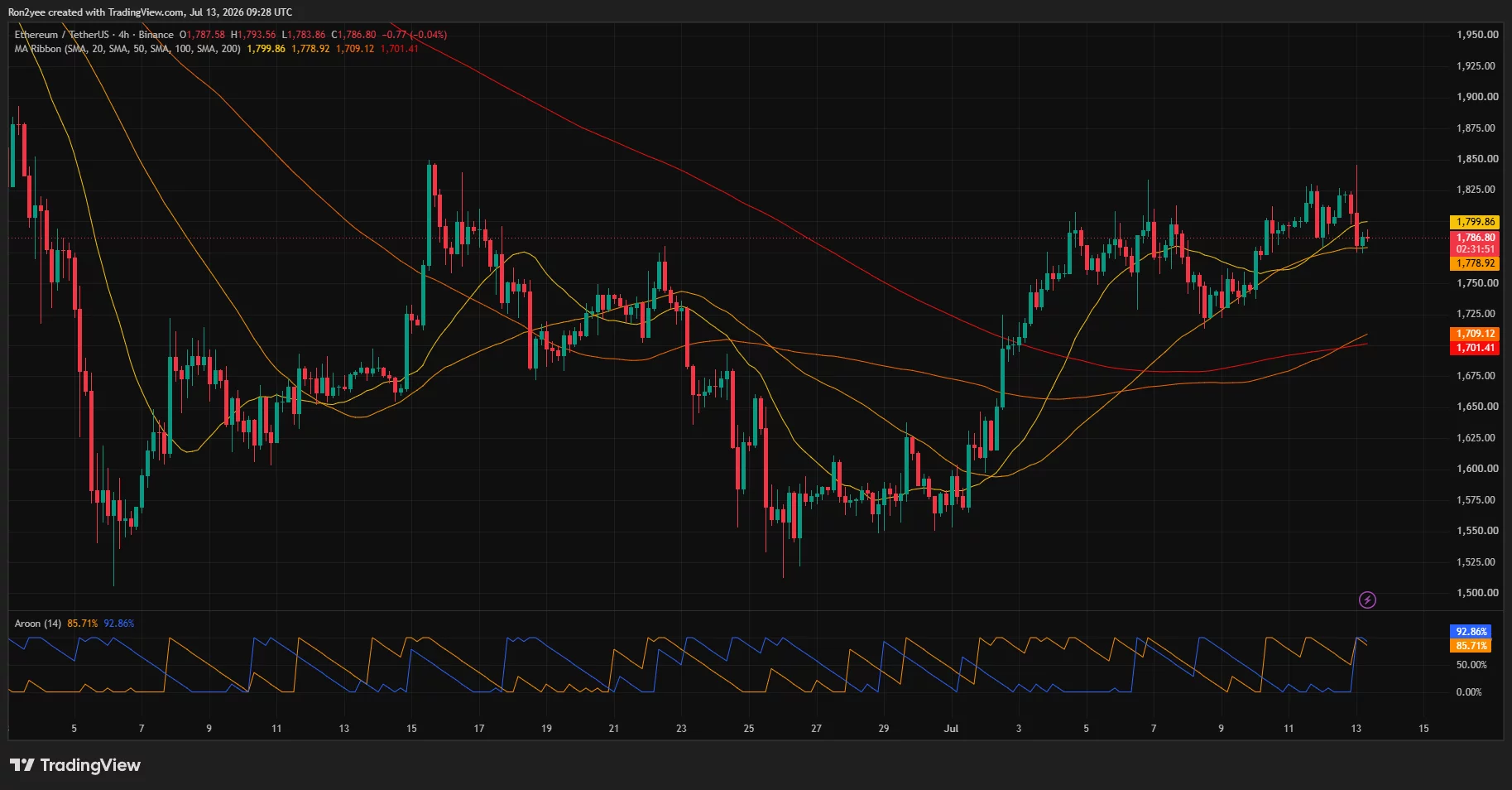
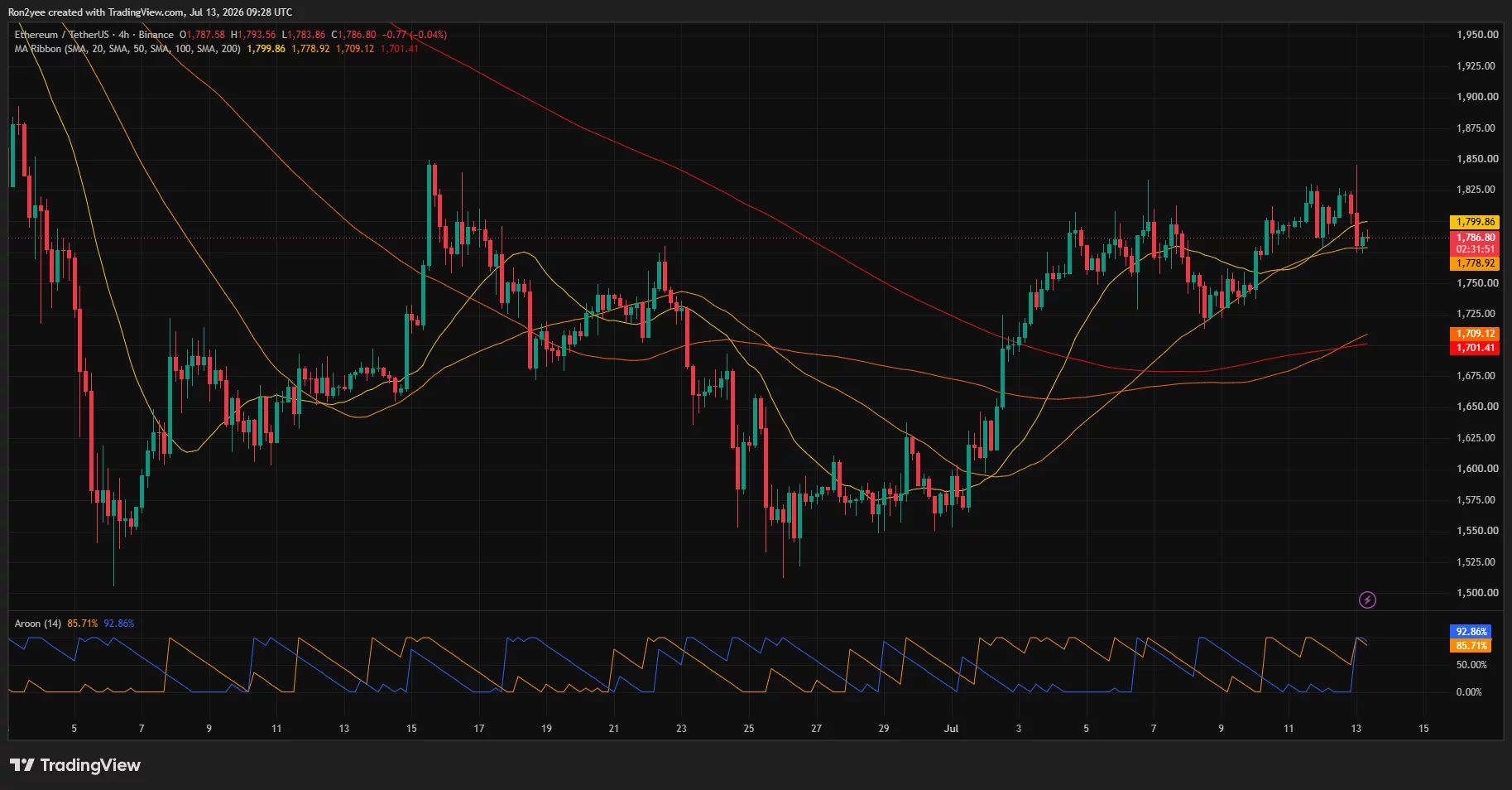
Ethereum’s technical structure has weakened after its price fell below its 20-day moving average near $1,800 on the 4-hour chart. The decline also dragged ETH beneath the psychological $1,800 level that had acted as support throughout last week. Still, the asset continues to trade above its 50-day and 100-day moving averages around $1,779 and $1,709, respectively, preserving the medium-term recovery that began in early July.
The daily chart still shows a potential double-bottom formation with lows near $1,505. A confirmed breakout above resistance around $1,825 would complete that pattern and project an upside target near $2,140.
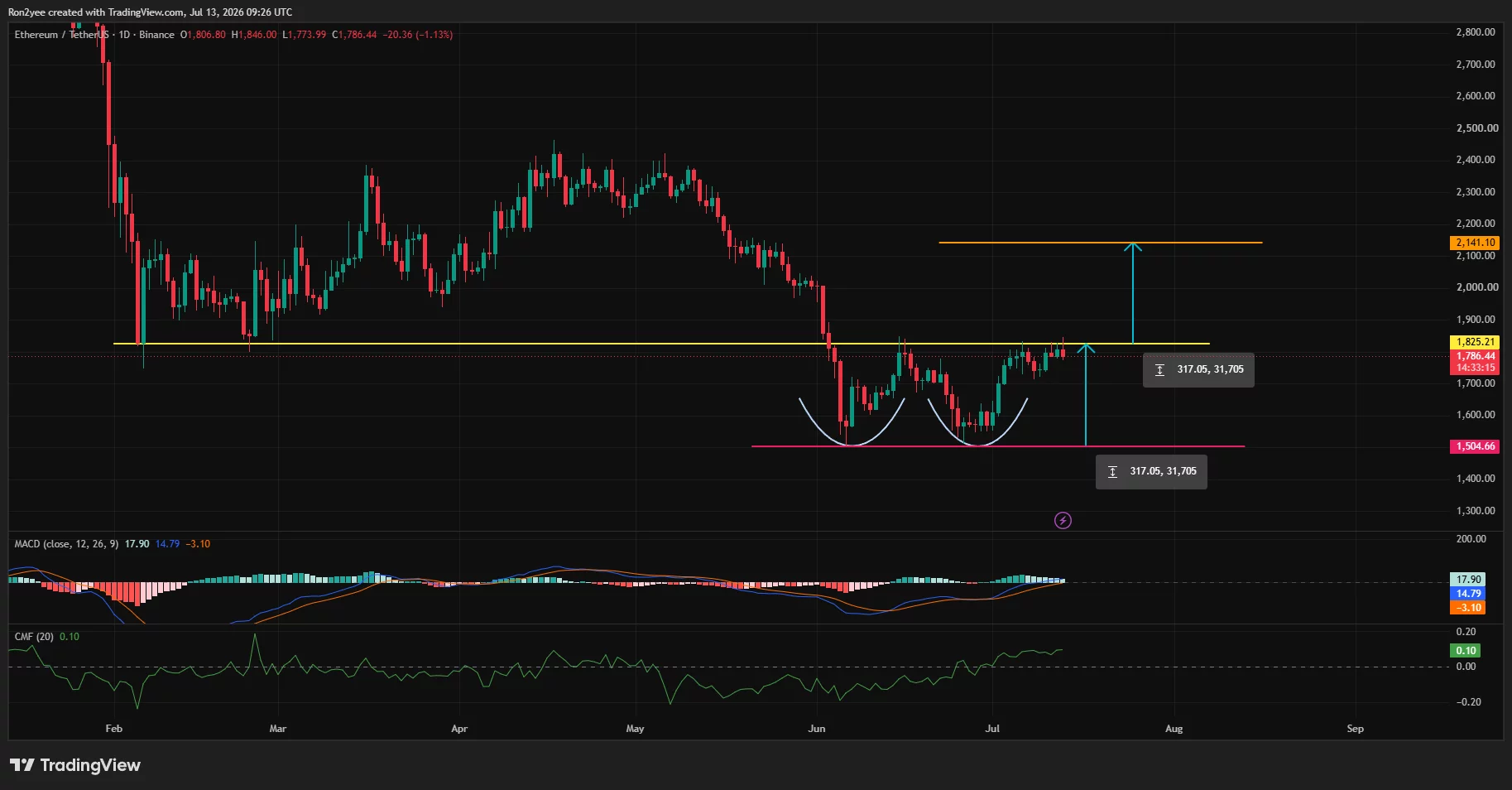
Momentum has yet to fully confirm the move, however. The MACD remains above its signal line despite a narrowing histogram, while Chaikin Money Flow stays in positive territory around 0.10, suggesting capital has not completely exited the market.
The Aroon indicator on the 4-hour timeframe also continues to favor buyers, with Aroon Up near 92.9 and Aroon Down around 85.7. Although both readings remain elevated because of recent volatility, the higher Aroon Up reading suggests bulls still retain a slight advantage if Ethereum reclaims the $1,800-$1,825 resistance zone.
Derivatives positioning presents another important technical level. CoinGlass liquidation data shows one of the largest short liquidation clusters sits between roughly $1,840 and $1,860.
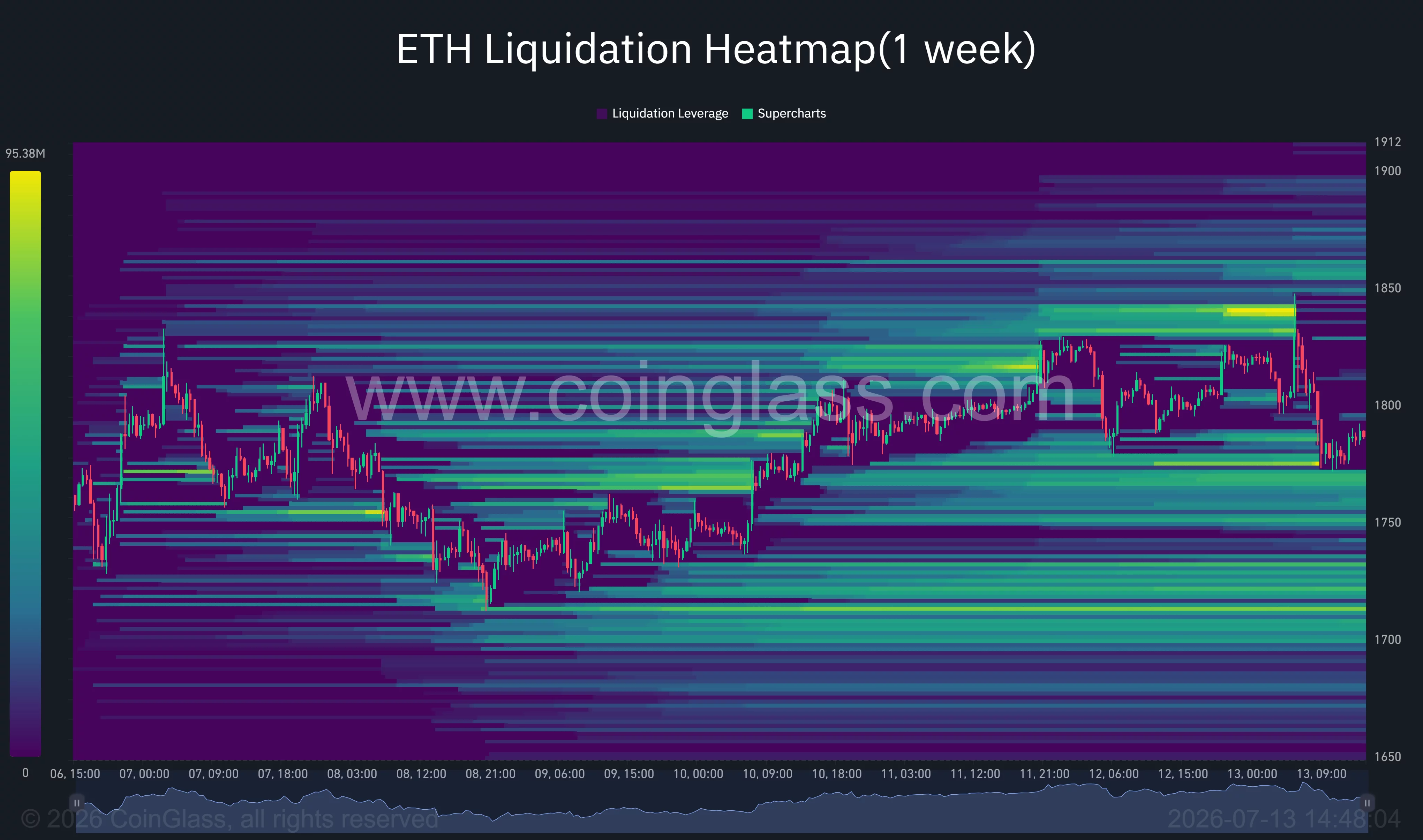
A decisive move through that area could force leveraged short sellers to close positions, potentially accelerating a rally toward $1,900. Larger liquidity pockets remain above $1,900, while notable bid-side liquidity extends toward the $1,700 region.
Commenting on the setup, crypto analyst Ali Martinez wrote, “I’m going LONG on Ethereum $ETH if it breaks $1,850.” His view aligns with the heavy liquidation cluster immediately above current prices, where a breakout could trigger additional buying from short covering.
Failure to hold support could revive the bearish trend
Not every analyst expects an immediate breakout. Analyst Ted Pillows noted in a July 13 X post:
“ETH is still holding above the $1,750 support zone. This is a good sign and shows that sellers are no longer dominating here. As long as Ethereum holds above $1,750, I think a rally towards $2,000 could happen.”
That support now represents the primary invalidation level for the current recovery. A sustained break below $1,750 would place the 100-day moving average near $1,709 back into focus before exposing the June support zone around $1,505, where the double-bottom structure would fail.
Macro risks continue to dominate the outlook. Further escalation between the U.S. and Iran, additional disruption around the Strait of Hormuz, or another surge in crude oil prices could strengthen inflation expectations and reinforce the Federal Reserve’s higher-for-longer interest rate outlook. Under those conditions, cryptocurrencies could remain under pressure even if Ethereum’s longer-term technical structure stays intact.
Disclosure: This article does not represent investment advice. The content and materials featured on this page are for educational purposes only.


Cointelegraph is committed to providing independent, high-quality journalism across the crypto, blockchain, AI, and fintech industries.
All news, reviews, and analyses are produced with full journalistic independence and integrity. For more details on our standards and processes, please read our Editorial Policy.

Other easily missed breeding spots include a tiny pocket of water beneath the soil in a potted plant, a discarded tire, or a planter saucer. Maintained, chlorinated pools and fountains with moving water generally aren’t the problem. Mosquitoes want still water—and the smaller the pool, the easier it is to miss.
They never walk past a container without glancing inside
Once mosquito experts learn what a breeding spot looks like, they see them everywhere.
In her own yard, a tarp left crumpled over some lumber became a collection of tiny pools after it rained. Buckets and cups forgotten after parties are equally inviting. Then there’s her neighbor’s wheelbarrow, which is full of weeds and refills whenever it rains. “I keep sneaking over there and emptying it out,” Bartholomay says. “The mosquitoes just love it.”
Where you live determines where else you need to look. In parts of Florida, some plants, like ornamental bromeliads, collect water in the cups of their leaves, allowing mosquitoes to breed several feet above the ground. Daniel Markowski, technical advisor with the American Mosquito Control Association, flags children’s toys—dump trucks, sand pails, plastic cups—and buried downspouts that aren’t draining properly. Mosquitoes can breed in the trapped water underground, then fly in and out through the top.
Democratic senators want the Commodity Futures Trading Commission (CFTC) to stop betting on California wildfires. They warn that traders could start fires to win their bets.
The letter went to CFTC Chairman Michael Selig on Monday. Oregon Senator Jeff Merkley led it. It points back to wagers placed while Los Angeles burned in January 2025.
$1.2 Million Wagered While California Wildfires Burned
The Palisades and Eaton fires killed 31 people. They destroyed 16,246 buildings, according to CAL FIRE figures.
Polymarket is the largest betting site for real-world events. It opened its first wildfire bet on January 8, 2025. The fires had started a day earlier.
Traders put $1.2 million into roughly 20 questions. Rutgers historian Jamie L. Pietruska tracked the total.
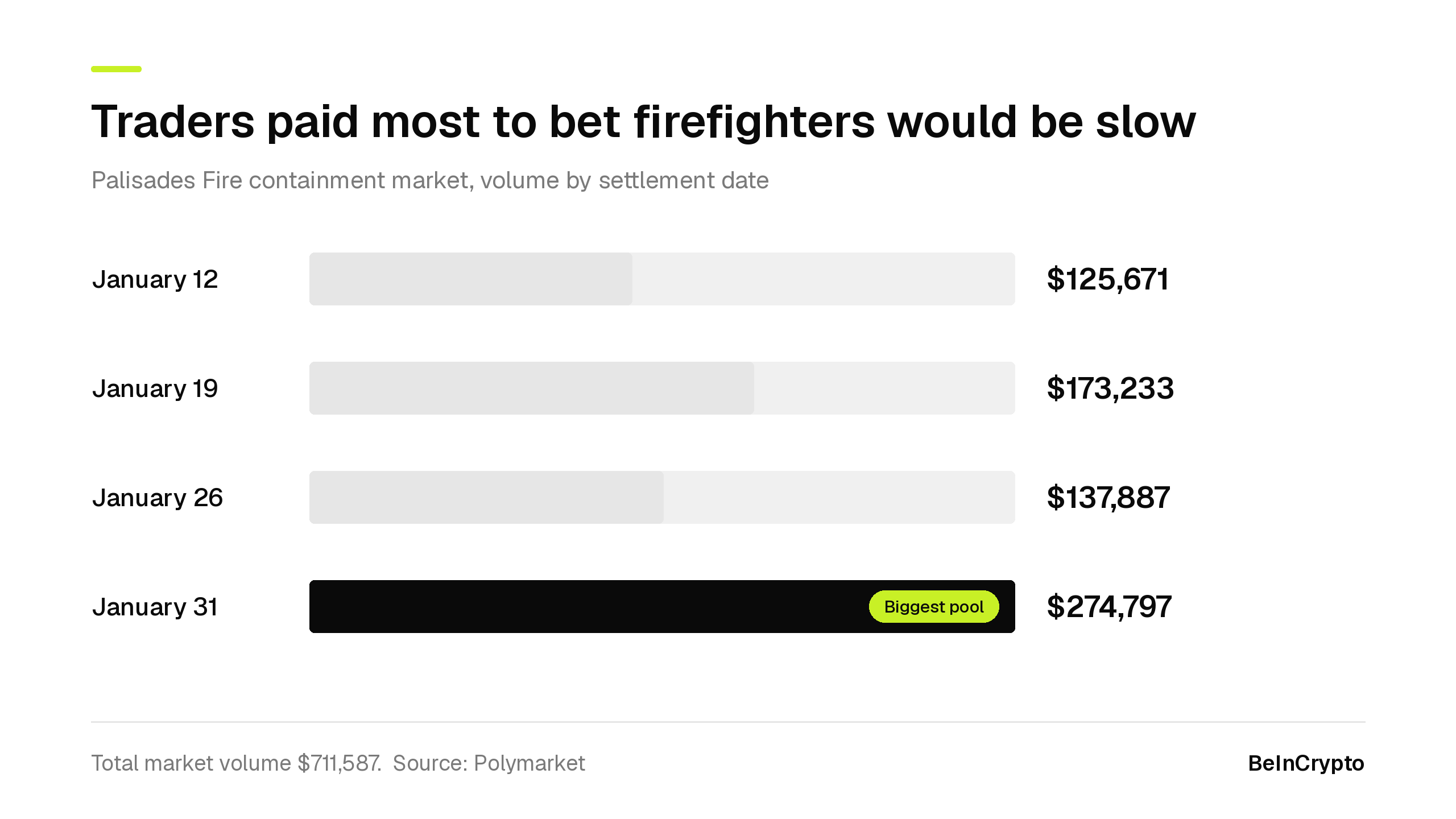
One bet took $711,587 of that. It asked a single thing. When would the Palisades Fire be fully contained?
The biggest pool inside it was $274,797. That money sat on the latest date offered.
In plain terms, traders paid the most to bet firefighters would be slow.

The bet was settled using data from fire.ca.gov, in accordance with its published rules. That is the website of CAL FIRE, the state firefighting agency.
CAL FIRE hands over that data. It refuses to take anything back from these markets.
“Systems that tie financial gain to wildfire outcomes risk encouraging misuse, including arson, and are not compatible with our mission,” US Forest Service spokesperson, reported by High Country News.
Follow us on X to get the latest news as it happens
Fire Is Easier to Rig Than a Thermometer
In April, a Polymarket trader bet $119 on the weather in Paris. He walked away with $21,398. A sensor at Charles de Gaulle Airport had spiked for no clear reason. Météo-France called in the airport police.
The trick is old. In 1950, St. Louis police shut down a weather betting ring worth $2.6 million a year. Gamblers back then bribed officials to fake temperature records.
The Paris weather sensor case shows that one number can still settle a bet.
Fire is worse. Nobody can start a hurricane by hand.
Prosecutors have charged a 29-year-old man with starting the Palisades Fire. He faces up to 45 years and has pleaded not guilty.
Firefighters also know things outsiders do not. That echoes earlier insider trading on Kalshi claims. Polymarket added an on-chain detection system in May.
Why the CFTC Rules Never Mention Fire
The CFTC proposed a new rule on June 10. It checks each contract one at a time.
The test covers terrorism, assassination, war, gaming, and illegal activity. Comments closed on July 27.
Wildfire never made the list.
Arson is illegal. But these bets ask about containment dates, not the crime. That gap is what the senators want closed.
Polymarket has defended the markets. Founder Shayne Coplan told CBS News they carried the least risk and gave the most information. He added that he understood the sensitivity.
The Los Angeles bets ran offshore, where US traders were locked out. Wyldfyre, a play-money site built only for California fire risk, went offline last month.
The CFTC now has one question to answer. Is fire different from weather?
The post California Wildfire Bets Expose Polymarket’s Dark Side appeared first on BeInCrypto.
Crypto World
Bitcoin (BTC), ether (ETH) prices decline as Coldcard exploit enters a fifth day: Crypto Markets Today
Bitcoin and ether (ETH) are under pressure as the multimillion-dollar hack of the hardware wallet Coldcard enters a fifth day, raising questions over the safety of direct custody as a holding strategy.
The incident has rocked sentiment on crypto social media, with numerous small holders complaining of losing long-term holdings and reassessing their faith in crypto.
“Worse for sentiment, it [the hack] has spooked holders into sending coins back to exchanges, the opposite of the self-custody trend crypto is built on,” analysts at Marex said. “When the thing wobbling is cold storage itself, a cheaper barrel does not fix it.”
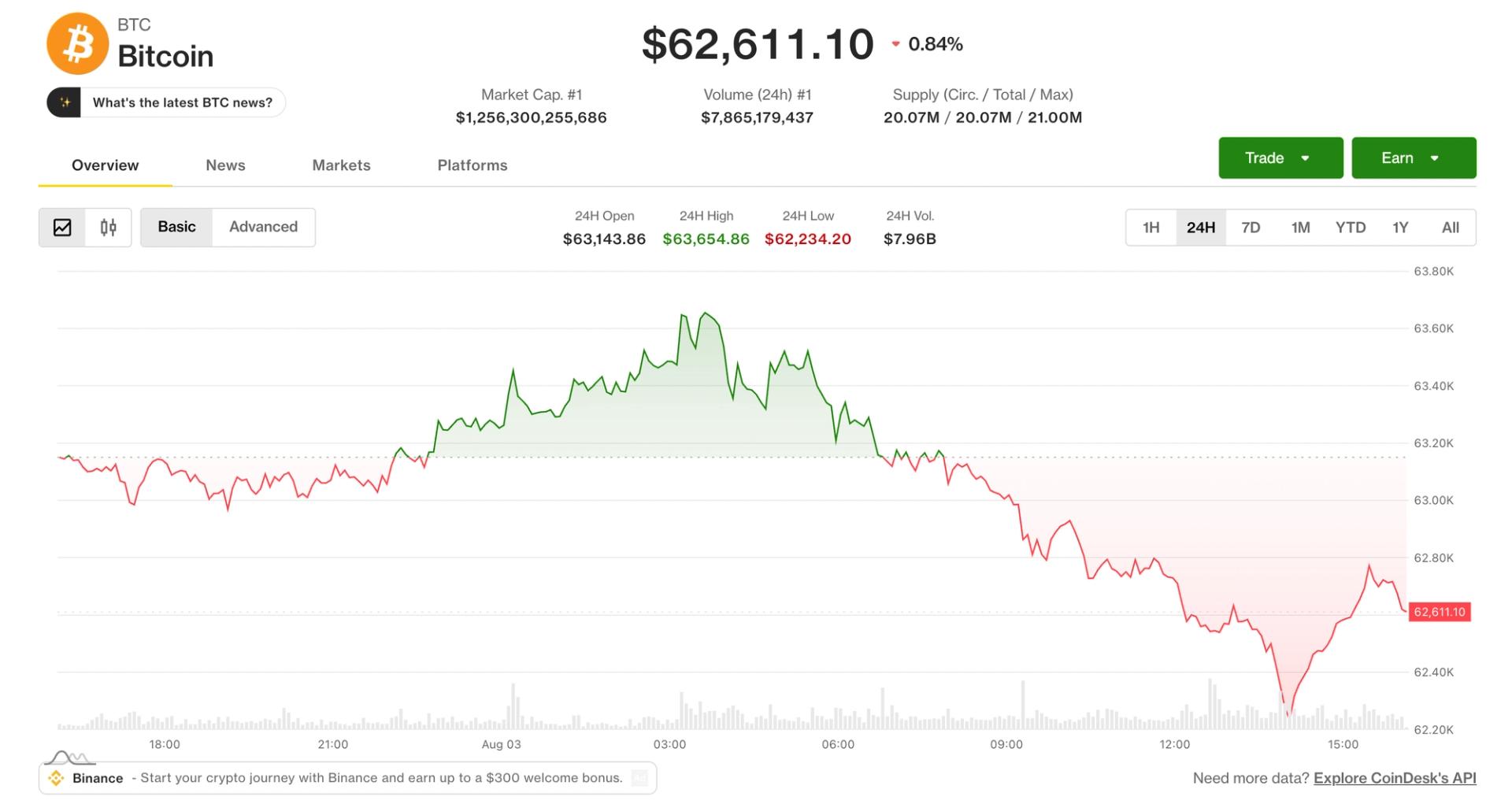
Given the gravity of the situation and the $114 million of bitcoin stolen, the price reaction of the largest cryptocurrency appears relatively restrained. BTC was recently 1.5% lower over 24 hours to $62,595, a level it has visited several times in recent weeks, with ether down nearly 2% to $1,842. The CoinDesk DeFi Select Index has dropped 2.5%.


Michael Saylor says he has never sold any of his own Bitcoin (BTC), not one satoshi. He published the defense hours after Strategy disclosed the sale of 1,638 coins.
His slogan built a following among retail holders. His company runs a treasury that sells coins to cover bills.
Michael Saylor Never Sold His Personal Bitcoin
Saylor drew the line himself on Monday.
“When I say “Never Sell Your Bitcoin,” I speak as one saver to another. I have never sold mine. Not one satoshi. Strategy is a public company, not my wallet. Since 2020, it has disclosed it may buy or sell $BTC to manage capital. Our shared conviction in Bitcoin remains unchanged,” he wrote.
Follow us on X to get the latest news as it happens
Two days earlier he shut down sale rumors spreading on the same platform, saying the company never carried a formal never-sell policy.
The Dividend Bill Behind the Sale
Monday’s filing put holdings at 842,138 BTC as of August 2. The stack has shrunk since late May, when it stood at 843,738.
Strategy sold at an average $63,957 a coin. Its cost basis is $75,419, so each coin left at a loss near $11,500.
The cash did two jobs. It lifted the USD reserve by $250 million to $4.0 billion and retired $81 million of STRC, a Bitcoin-backed preferred share that pays 12% a year.
That obligation keeps growing. Preferred dividends reached $400.7 million in the second quarter, up from $49.1 million a year earlier.
The next disclosure arrives within a week. It will show whether 10 weeks without net buying was a pause or a turn.
The post Michael Saylor: I Never Sold Bitcoin, MicroStrategy Did appeared first on BeInCrypto.


Americans are experiencing historic national pessimism. Polls find Americans feel that the country needs major changes, but doubt these changes are possible.
For many Americans, just following the news can feel exhausting. Each day, Americans see health protections rolled back, climate commitments abandoned, and more technologies that nobody asked for and nobody can opt out of. The decisions that shape our lives—health coverage, the air children will breathe, the tools they will grow up with—seem to be made far above our heads.
In many ways, the country is moving in the opposite direction the public wants. Americans largely favor expanding clean energy, yet federal incentives for it are being dismantled and the banks are walking away from their climate pledges. Similarly, national healthcare programs are more popular than ever, yet policy is moving to strip coverage from millions. And an astonishing 97% of Americans say the immensely wealthy AI industry should face some form of oversight, and yet Washington has moved to stop states from regulating it.
What is there to do when big companies, and even the government, stand in the way of progress on national emergencies? The scale of these problems alone is intimidating: one may reasonably worry, “Can I make any difference? Even if I take action, will others join in?” It is well documented that this sense of futility is demotivating. And, research also shows that when people believe powerful actors will not do their part, they conclude their own effort is both pointless and unfair, and they disengage from the issue. Faced with all of this, is civil society simply powerless?
Our research suggests a more hopeful outlook. Even amid systemic opposition, the public’s voice matters—a lot. Specifically, we find social change can be mobilized when two groups are united behind a solution: scientists and the public.
Through a mix of survey and field studies involving more than 55,000 Americans, we examined how people decide whether to act on a national problem when they receive signals about what to do from a variety of influential players in society: scientists, fellow citizens, governments, and private companies. The finding was strikingly consistent. The joint endorsement of scientific experts and the general public was the most powerful force motivating Americans to act, whether on climate, public health, or technology.
We found that when people learned that scientists and the public both backed a solution, they became more supportive of climate, health, and AI policies, more inclined to pursue solutions like electric vehicles and new vaccines, and more willing to donate their own money to the cause. Collectively, these choices are the building blocks of social change: the votes, purchases, donations, advocacy, and visible support through which public opinion begins to shape markets, movements, and eventually institutions.
Crucially, these effects held even when government bodies and private companies actively opposed the action. In one experiment we conducted, options backed by scientists and the public were chosen about 80% of the time, even when people learned both the government and industry opposed them. We then experimented with the reverse scenario: when a solution was backed by government and industry but opposed by scientists and the public. In this case, the solution was less than half as likely to be chosen.
In other words, failure of our major institutions need not leave the public powerless and immobilized. Government and industry opposition can make progress feel unrealistic, futile, or out of reach. But our findings point to an antidote to the demotivating pull of institutional inaction: it can be offset by a different kind of signal, a bottom-up one, that helps keep the public from giving up.
When you speak up, you are not simply expressing a private opinion. You are helping create the public signal that others use to decide whether change is possible. Your voice becomes part of the evidence that people are not alone in wanting change and that powerful institutions do not have to get the final word. When citizens’ support is made visible alongside scientific consensus, it can move others to act—even when government and industry stand in the way
Together, visible support from scientists and citizens can restore the two things institutional retreat takes away: confidence that action is sound, and confidence that it will not be taken alone.
Intuitively, scientists and the public meet two distinct human needs: Scientists are typically seen as knowledgeable, satisfying the need to be right, while fellow citizens are seen as relatable and likable, satisfying the need to belong. Our theory is that because the two core needs operate through different psychological channels, the duo is more persuasive than either alone. By contrast, the influence of government and industry on Americans’ decisions to take action is relatively weaker. Government support or opposition to a solution carried less weight than some may assume, perhaps due to Americans’ historically low trust in government.
While there is a lot to be hopeful about in these findings, there is an important catch. Our studies show what happens when people are given clear signals that scientists and the public hold a particular view. But in day-to-day life, people may not know what the general public or scientists actually think. We rarely get unfiltered information about public opinion or scientific consensus. Instead, their positions are conveyed to us through the media, political elites, and heads of industry who can amplify, mute, or distort them. The predictable result is that Americans badly misjudge where everyone stands. People consistently underestimate how many of their fellow citizens, and how many scientists, support action on issues like climate change. And when those misperceptions are corrected, willingness to engage goes up.
In our eyes, this points to a clear course of action: We must build coalitions between scientists and citizens and make those coalitions visible. A scientific consensus on its own can be shrugged off as esoteric or impractical, and a popular movement on its own may be dismissed as uninformed, but articulated together, in the form of “the experts agree, and so do the neighbors next door,” they become far harder to ignore.
In this effort, journalists, communicators, and advocates become indispensable, because the public cannot draw motivation from an agreement it does not know exists. Correcting the widespread underestimation of how much scientists and ordinary people actually want action may be one of the highest-leverage things a communicator can do. And it means no one should mistake the silence of governments and corporations for the last word. Their opposition, our results suggest, is far less paralyzing than it feels in the headlines, as long as the alternative coalition is loud enough to be heard.
None of this means institutions don’t matter. Ultimately, durable solutions need policy and capital behind them. But our findings overturn the assumption that may be underlying America’s current pessimism: that the public needs to wait for action from the top. It doesn’t. The most powerful force we found in moving Americans to act toward social change was not a government mandate or a corporate pledge, but the visible agreement of scientists and ordinary people. That coalition already exists on many of the nation’s most urgent problems—it may simply be invisible to Americans. Every time you voice support for a solution the science backs, you are not just expressing an opinion; you are supplying the evidence someone else needs to believe change is possible. Two hundred and fifty years in, that remains the idea this country stands for: that ordinary people, not the powerful, get the final word.
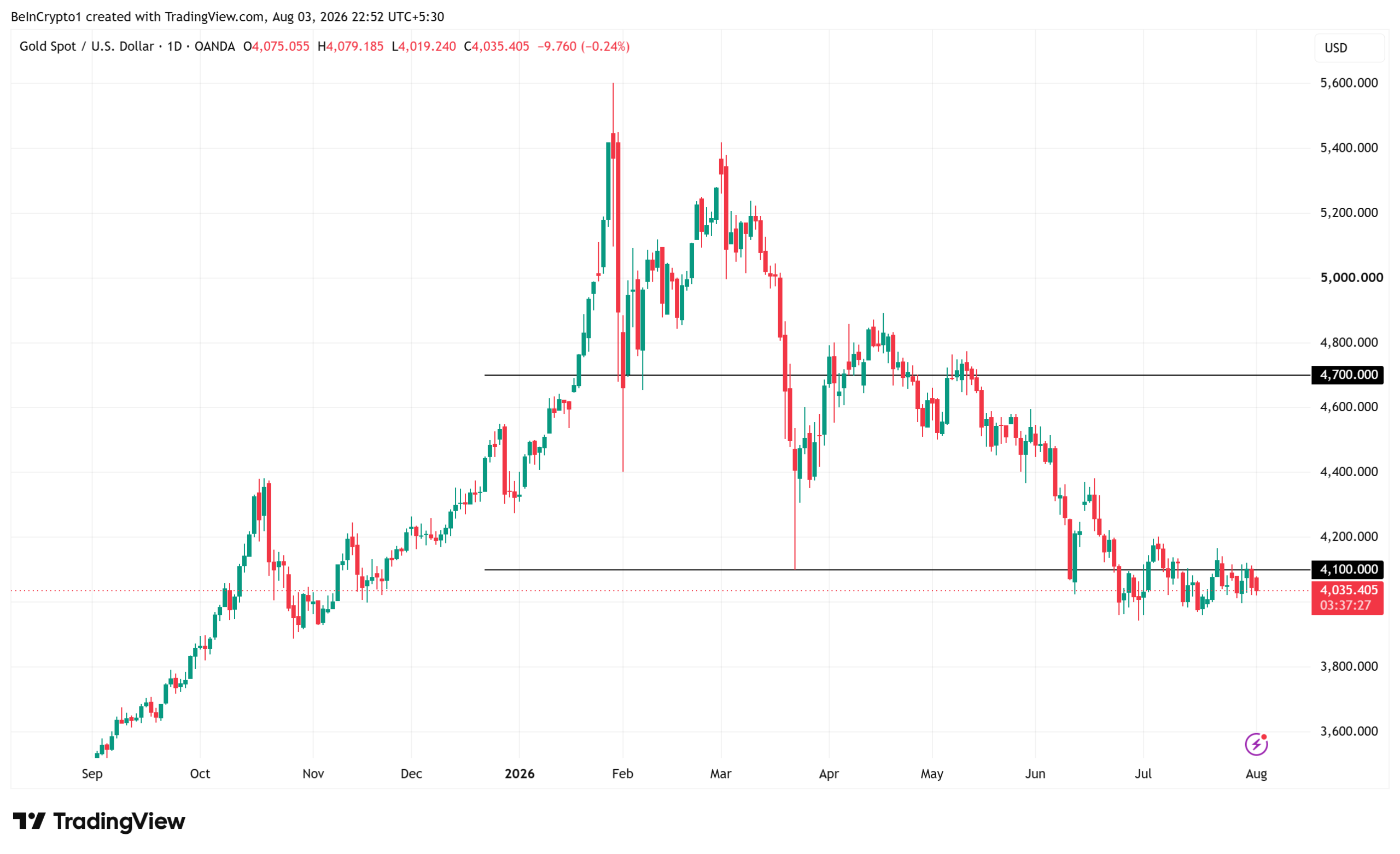
A crypto whale has bet more than $23 million that gold price goes up. Deutsche Bank agrees. Its analysts put gold’s fair value near $4,700 an ounce, well above Monday’s price.
The gold industry’s own research body disagrees. It sees gold stuck near $4,100 for the rest of the year. That gap is worth watching.

The Whale Sold Crypto to Buy Gold
On-chain monitor Mlm on-chain spotted the moves across four wallets. They belong to Loracle, one of the most watched traders on Hyperliquid.
Loracle closed a 503,000 HYPE long worth $26.5 million. He then sold another 800,000 HYPE for $52.7 million. A short of 595,000 HYPE, worth $31.4 million, took its place.
He also closed about $95 million of long bets on Ethereum, Zcash and Solana. Then came the gold long. An Ethereum short above $28 million followed.
Follow us on X to get the latest news as it happens
So how big is $23 million here? All of Hyperliquid’s builder-run markets held about $3.59 billion in open bets on Monday, per analytics site Loris Tools. The bet is large but not dominant.
Those markets exist because of HIP-3. That upgrade lets outside teams launch their own futures markets on Hyperliquid. Gold and stock contracts trade there, not on the main exchange.
Loracle’s record is why people watch him. On-chain trackers say he built $42.2 million in profits over roughly 10 months. One HYPE short then wiped it out in 18 days. He closed that trade down $46.46 million. HYPE went on to hit a record $76.70 in June.
Why Deutsche Bank Sees $4,700
Analysts Michael Hsueh and Bryant Xu sent the note to clients on Monday. They say gold has been in an explosive price phase since August 2024. Only five such phases appear in the data since 1975.
The pair ran three tests to see if gold should fall further.
The first compares gold with other commodities. It points to $2,600 an ounce. The second uses a statistical bubble test. That one suggests the drop already ended near $3,900.
The third test settled it.
“Third, gold has closed the gap to fair value… we would still see gold fair value as likely to register around USD 4,700/oz by year-end, above our USD 4,600/oz forecast for Q4’26.”
The bank kept its $4,600 fourth-quarter target.
The $3,900 call is close to what actually happened. Gold bottomed at $3,959.33 on 24 June, World Gold Council data shows. It had peaked at $5,595.47 on 29 January.
Central bank buying backs the bullish case too. Banks bought 289 tonnes in the second quarter. That is a record for any second quarter. It is also five times the 57 tonnes bought in the first. Poland took 51 tonnes and China 33 tonnes.
The Bubble Test Nobody Can Time
That bubble test has a long name. It is the Backward Supremum Augmented Dickey-Fuller (BSADF) test. In plain terms, it spots prices climbing faster than a normal market allows.
Deutsche Bank says the reading has fallen from 3.3 to 1.3. It still sits above the level that flags a bubble.
The test comes from the Bank for International Settlements (BIS), the central bank for central banks. Its December 2025 study found gold and the S&P 500 in bubble territory at the same time. That had not happened in 50 years.
The authors added a warning that stings bulls and bears alike.
“While the test has reliably detected past bubbles, it provides no information on when bubbles may burst.”
The BIS also checked who was buying. Small investors poured into gold funds. Big institutions sold or sat still.
The Gold Council Sees a Smaller Range
The World Gold Council is the industry’s research body. Its mid-year outlook is far less bullish.
If nothing changes, it expects gold to trade within 5% of $4,100 for the rest of the year. That caps the range near $4,305. Deutsche Bank’s number sits roughly $400 higher.
Gold needs a trigger to reach $4,500, the council said. It listed a geopolitical shock, a shift in rate expectations, or steady long-term buying.
Right now the opposite looks more likely. Traders expect the Federal Reserve to raise rates before October under Chairman Kevin Warsh. Higher rates make gold less appealing to hold.

The council also puts a price on central bank demand. Every extra 20 to 30 tonnes above the usual 600 tonnes a year lifts gold by about 1%.
Gold futures traded near $4,093 on Monday, down 0.3%, in line with a flat August gold price outlook. Crypto money has already moved into tokenized gold products this year.
Loracle has now added leverage to the same bet. The test he is trading against still cannot say when it ends.
The post Whale Bets $23 Million on Gold as Deutsche Bank Sees Fair Value at $4,700 appeared first on BeInCrypto.


Bitget said it will stop providing crypto trading services to residents of Japan, citing efforts to comply with local regulations.
The crypto exchange, ranked fifth by Coingecko with trading volume of roughly $714.7 million over the past 24 hours, stopped accepting new registrations from Japanese residents on Sunday, according to a Monday announcement.
Japan reclassified cryptocurrencies as financial instruments following legislation approved by its parliament in mid-July. The new rules are expected to take effect next year and include fines of about $62,800 and prison sentences of up to 10 years for operation without registration.
Existing users who believe Bitget has incorrectly identified them as Japanese residents must complete a Level-2 identity verification, including proof of address by Nov. 1, the company said. Accounts that do not complete the process will be considered Japanese, it added.
Bitget will place those accounts into close-only mode starting Nov. 1, according to its FAQ. Users will not be able to open or add to positions or use services, including spot and futures trading, copy trading, trading bots and their earn products. Deposits, subject to limits, and withdrawals will remain available.

People likely have different protein needs
Despite some promising research on protein restriction, people shouldn’t start eating diets that are very low in protein, Lamming and other scientists of aging say.
“While we know that protein restriction extends lifespan in yeast, fruit flies, mice, and rats, that doesn’t necessarily mean it will do so in humans,” says Christopher D. Morrison, a professor at Louisiana State University’s Pennington Biomedical Research Center whose lab pioneered the discovery of a life-extending hormone known as FGF21 that is required by mice to respond to protein restriction. The hormone also increases in people eating a protein-limited diet.
Protein restriction studies in people have also been small in scale and short-term, Lamming says. He adds that more research is needed into how protein restriction might impact exercise and people of different ages and needs.
Matt Kaeberlein, a molecular biologist and longevity scientist, says there could also be some negative consequences of a diet that is very low in protein, such as poor immune function and lower bone density. He also points out that while the diets of lab animals in protein restriction studies can be extreme, the studies in people have involved more moderate diets. “We’re not talking about extreme protein restriction down into malnutrition territory,” he says.


A former FBI special agent has been indicted after being accused of stealing somewhere in the region of $1 million in cryptocurrency from the agency.
Specifically, Patrick Steven Yaroch, who worked at the FBI from February 2025 through July 2026, has been charged with receipt of stolen goods and interstate transportation of stolen goods.
This is according to an affidavit filed by another FBI special agent.
Read more: FBI details how USDT is laundered through Binance
After stealing the crypto, Yaroch apparently told a Department of Justice employee about what he had done, claiming that it was “eating him up inside.”
On July 29, Yaroch contacted FBIHQ to set up a meeting to discuss what he’d done, and during the interview it was revealed that the value of Yaroch’s wallet was “approximately one million dollars.”
That same day, when the FBI went to his residence to collect property, he surrendered key phrases for crypto wallets, though about half an hour later he withdrew that consent according to the affidavit.
Read more: FBI Director Kash Patel’s undisclosed Strategy trade is down 45%
Once the FBI obtained Yaroch’s cell phone, they were able to get access to his Kraken account, which contained “approximately $188,570.58” worth of value, principally in USDC and US dollars.
Additionally, the FBI review revealed that Yaroch had previously transferred approximately $1 million to Suilend.
Yaroch apparently told the FBI agents that “he chose this service simply because he liked that the logo was a water droplet.”
ChatGPT helps plan an escape
While the FBI was reviewing ChatGPT conversations on Yaroch’s phone they found fascinating conversations.
These included him asking ChatGPT:
- “If I had a million dollars, how would you suggest investing it/spending it to maximize profit and return”
- “If you had a bucket of money (around $1 million) and you wanted to leave the USA and become a resident or citizen of an EU country, what would you do?”
ChatGPT helpfully suggested to him that Portugal would be his best choice.
The FBI affidavit notes, “FBI Agents located an upcoming trip from the United States to Portugal” for Yaroch.
Yaroch also tried to claim to the FBI agents that “he was not planning to funnel money into Portugal,” and while recognizing he would no longer be allowed to visit Portugal, “he hoped his wife and child would still go on the trip.”
Got a tip? Send us an email securely via Protos Leaks. For more informed news and investigations, follow us on X, Bluesky, and Google News, or subscribe to our YouTube channel.
Kenya Puts Academic Records on Avalanche Blockchain

‘Reacher’s Alan Ritchson Officially Sets ‘Fast and Furious’ Meets ‘F1’ Heist Thriller

Pictured: Afghan small-boat migrant accused of being Athens ‘suitcase killer’ of British woman, ten years after he arrived in Europe and married a US Christian refugee volunteer

Renter of Home in Anne Heche Crash Denies Settlement With Son

No Jackpot Winner as $257 Million Prize Rolls Over to $269 Million Monday Draw

Weekend Open Thread: Staud – Corporette.com

They’re Doing It Again Bitcoin Keeps Going Down And We Know The Exact Reason Why This Time

financial planning for everyone semester 4 || financial planning for everyone

*Get Your Crypto Off Small Exchanges* Insider Trader Strikes Again! Crypto, Stocks And Metals Rally!
-

 Business5 days ago
Why Trees Belong on the Risk Register
-

 Fashion3 days ago
Weekend Open Thread: Wit & Wisdom
-

 Politics3 days ago
Meta enters AI-training agreement with far-right ‘propaganda rag’ Newsmax
-
 Entertainment6 days ago
‘Stargate’ Creator’s New Sci-Fi Series Returns for Season 3 Tomorrow
-

 Crypto World2 days ago
MicroStrategy Post-Earnings CLARITY Act Push Could Add New Catalyst for Its Stock
-

 Politics6 days ago
The Part of the Electric Transition Nobody Wants to Discuss
-

 Business6 days ago
Major shareholder moves on Canyon
-

 Crypto World3 days ago
XRP Ledger v3.3.0 brings five institutional features
-

 News Videos4 days ago
Bitcoin Enters the 3rd Stage of the Bear Market
-

 Crypto World6 days ago
Kraken Enables Retail Access to Jersey Mike’s IPO via Tokenized Shares
-

 Tech7 days ago
New macOS Sequoia & Sonoma security updates for older Macs
-

 News Videos6 days ago
Claude: Build Financial Dashboards in Minutes (2026)
-

 Politics4 days ago
Luke Littler’s dominance sparks GOAT debate
-

 Sports4 days ago
Seema Kaliramna Wins Discus Throw Bronze, Takes India’s CWG Medals Tally To 17
-

 Business6 days ago
Johnson & Johnson agrees to $5.5B settlement over talc cancer claims
-

 Crypto World1 day ago
Crypto PAC spending tops $2M in Michigan House race
-

 Business3 days ago
Trump Announces Hamas Disarmament Agreement as Iran Strikes Kuwait Air Base and US Attacks Pause Overnight
-

 Crypto World3 days ago
New York sues Kalshi over prediction market gambling
-

 Tech5 days ago
Gemini can now summarize the messiest comment threads in Google Docs
-

 Tech2 days ago
ESET tracks rise in malicious AI skills and adaptable malware
You must be logged in to post a comment Login